Archive for ‘rape’

06/12/2019

Indian police kill four men suspected of rape, murder, drawing applause and concern

HYDERABAD, India (Reuters) – Indian police shot dead four men on Friday who were suspected of raping and killing a 27-year-old veterinarian near Hyderabad city, an action applauded by her family and many citizens outraged over sexual violence against women.

However, some rights groups and politicians criticised the killings, saying they were concerned the judicial process had been sidestepped.

The men had been in police custody and were shot dead near the scene of last week’s crime after they snatched weapons from two of the 10 policemen accompanying them, said police commissioner V.C. Sajjanar.

Thousands of Indians have protested in several cities over the past week following the veterinarian’s death, the latest in a series of horrific cases of sexual assault in the country.

The woman had left home for an appointment on her motor-scooter and later called her sister to say she had a flat tyre. She said a lorry driver had offered to help and that she was waiting near a toll plaza.

Police said she was abducted, raped and asphyxiated and her body was then set alight on the outskirts of Hyderabad. Four men were arrested.

Sajjanar, the police officer, said the men – two truck drivers and two truck cleaners, aged between 20 and 26 years – had been taken to the spot to help recover the victim’s mobile phone and other personal belongings on Friday morning.

“As the party approached this area today (during the) early hours, all the four accused got together. They started attacking the police party with stones, sticks and other materials,” he told reporters near the site of the shootings.

The men, who were not handcuffed, then snatched weapons away from the police and started firing at them, but were killed after the police retaliated. He did not say how the accused were able to overpower their escorts.

“Law has done its duty, that’s all I can say,” Sajjanar said.

The National Human Rights Commission, a government-funded watchdog, said it had ordered an investigation. “Death of four persons in alleged encounter with the police personnel when they were in their custody, is a matter of concern for the Commission,” it said in a statement.

Indian police have frequently been accused of extra-judicial killings, called “encounters”, especially in gangland wars in Mumbai and insurrections in the state of Punjab and in disputed Kashmir. Police officers involved in such killings were called “encounter specialists” and were the subject of several movies.

Graphic – Police Custody Deaths in India: here

People shout slogans as they celebrate after police shot dead four men suspected of raping and killing a 27-year-old veterinarian in Telangana, in a residential area in Ahmedabad, India, December 6, 2019. REUTERS/Amit Dave
Reuters Graphic

‘LONG LIVE POLICE’

The victim’s family welcomed the news the alleged perpetrators had been killed.

“I express my gratitude towards the police & govt for this. My daughter’s soul must be at peace now,” Reuters partner ANI quoted her father as saying.

A Reuters reporter saw the four men’s bodies lying in an open field, all of them face up and barefoot, with their clothes stained with blood, surrounded by policemen.

A large crowd gathered at the site and threw flower petals at police vans in support of the action. Some shouted “Long live police”, while others hoisted police officials onto their shoulders and burst firecrackers.

There was no immediate word from Prime Minister Narendra Modi’s government on the incident, but Maneka Gandhi, a lawmaker from his ruling Bharatiya Janata Party, said the police appeared to have over-reached.

“You can’t take the law in your own hands. The courts would’ve ordered them (the accused) to be hanged anyway. If you’re going to shoot them with guns before due process is followed, then what’s the point of having courts, police and law?” she said.

Tough laws were enacted after the 2012 gang rape and murder of a woman in a bus in New Delhi that led to an outpouring of anger across the country, but crimes against women have continued unabated.

Graphic – Rape cases in India: here

Slideshow (9 Images)
Reuters Graphic

SLOW JUSTICE

Fast track courts have been set up but cases have moved slowly, for lack of witnesses and the inability of many families to go through the long legal process. Some victims and their families have ended up being attacked for pursuing cases against powerful men, often local politicians.

Many Indians applauded the killings.

“Great work #hyderabadpolice ..we salute u,” badminton star Saina Nehwal wrote on Twitter.

In Uttar Pradesh state, where a rape victim was set ablaze on Thursday while she was on her way to court, opposition politician Mayawati said the police there should take “inspiration” from what happened in Hyderabad.

“Culprits should be punished, and if they are not punished then whatever happened in Hyderabad should happen,” the victim’s brother said in hospital.

She was on life support, hospital authorities said, news that could further inflame passions in a country where public anger over crimes against women has grown in recent weeks.

Indian police registered more than 32,500 cases of rape in 2017, according to the most recent government data. But courts completed only about 18,300 cases related to rape that year, leaving more than 127,800 cases pending at the end of 2017.

But some people said the lack of progress in the courts did not mean the police had a free hand to dispense justice.

“We now have to trust that a police force that managed to let unarmed suspects escape their custody, and needed to shoot them dead because they could not catch them alive, is somehow competent enough to have identified and arrested the real culprits?,” Meenakshi Ganguly, South Asia Director at Human Rights Watch, told Reuters from London.

Source: reuters
25/11/2019

Priya: India’s female comic superhero returns to rescue ‘stolen girls’

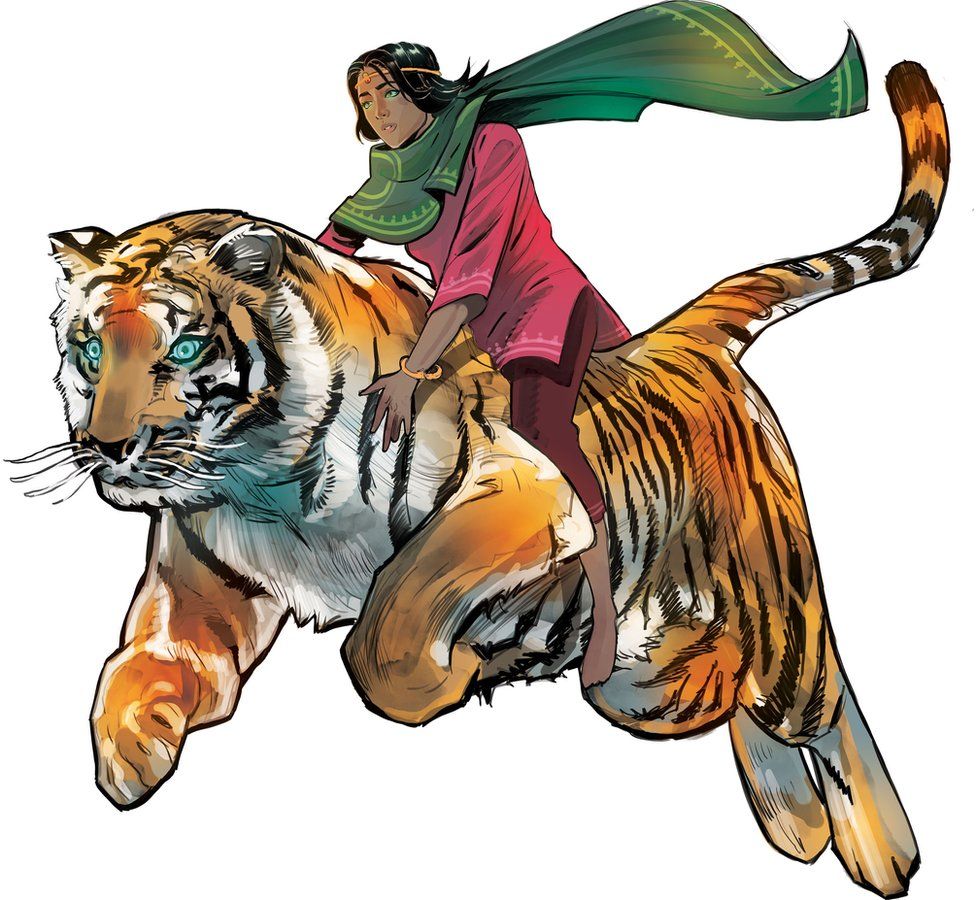
Priya Shakti riding her pet tiger SahasImage copyright PRIYASHAKTI

Comic crusader Priya, a gang-rape survivor who earlier campaigned against rape and acid attack, is back in a new avatar. This time she is fighting the trafficking of girls and women for sex.

The “modern-day female superhero” was first launched in December 2014, exactly two years after the horrific gang rape of a young woman on a bus in Delhi, to focus attention on the problems of gender and sexual violence in India.

In the first edition, Priya Shakti, the tiger-riding heroine challenges the stigma surrounding rape while in Priya’s Mirror, the second edition, she returns to fight acid attacks.

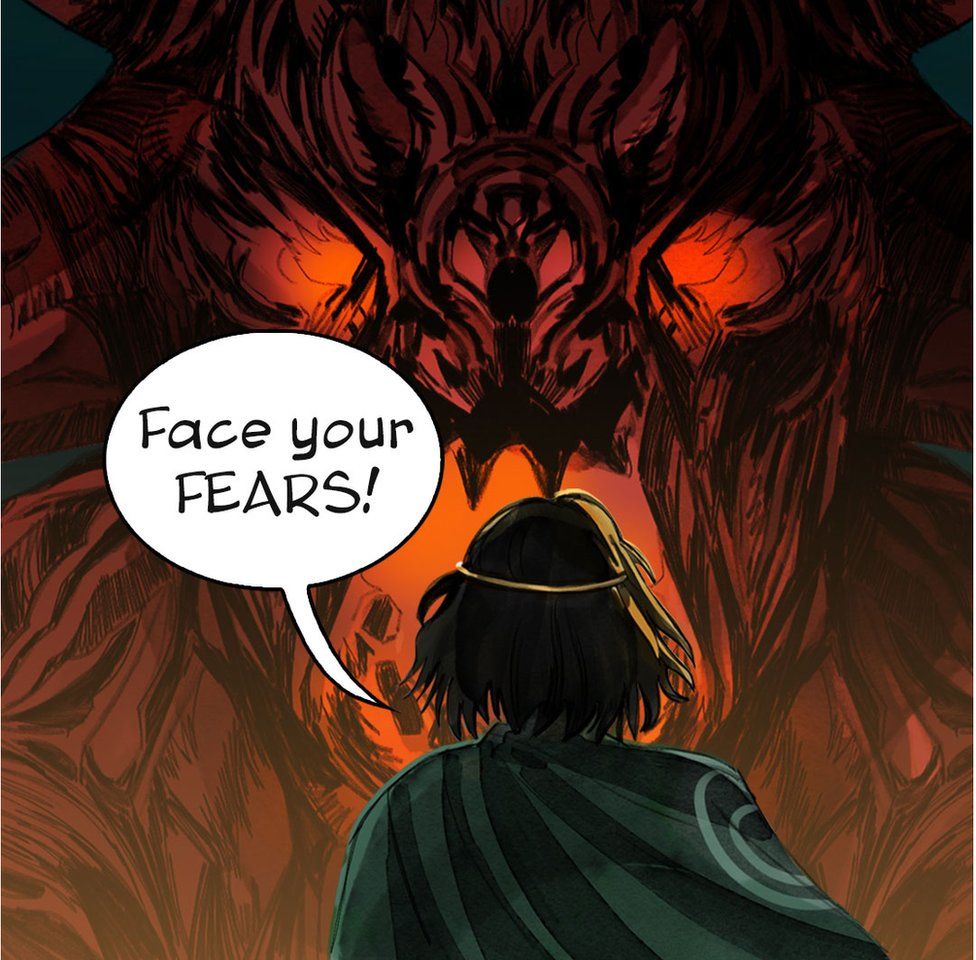
In the latest edition – Priya and the Lost Girls – she takes on the powerful sex-trafficker Rahu, the evil demon who runs an underworld brothel city where he has entrapped many women, including Priya’s sister Lakshmi.

Indian-American actor and writer Dipti Mehta, who wrote the script of the comic, draws on ancient Indian mythology to create larger-than-life fantastical characters and delivers a powerful feminist statement.

The story of Lost Girls begins when the protagonist returns home to find that there are no girls in her village.

She then mounts her flying tiger Sahas (Hindi for courage) and arrives in Rahu’s den. It’s a city ruled by greed, jealousy and lust, where women exist only to serve and please men – and those who resist are turned into stone.

Priya with her tiger SahasImage copyright PRIYASHAKTI

Priya is threatened and attacked, a woman who works for Rahu tries to lure her into the sex trade saying: “If you work for us, you’d serve only five to six men and not 20”, but in the end, good wins over evil and she manages to vanquish Rahu and liberate her sister and all the other trafficked girls.

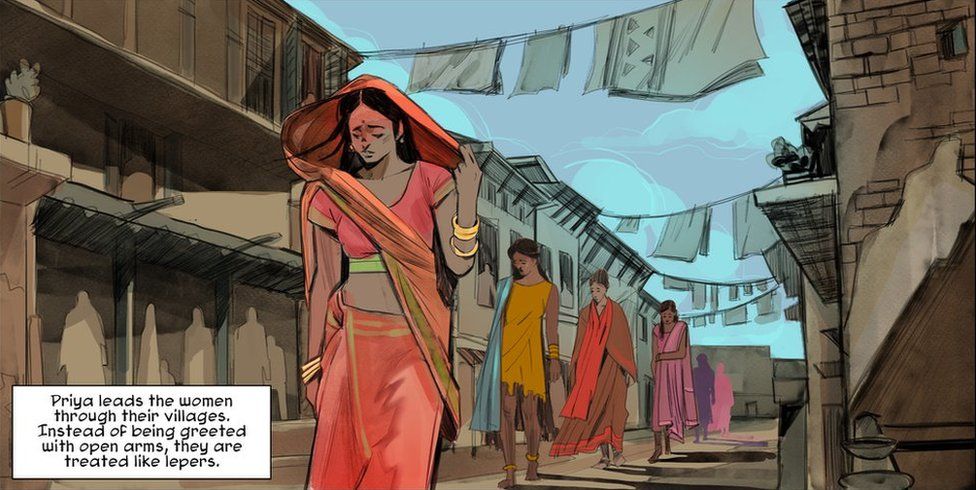
But victory still eludes her. The families of rescued girls refuse to take them back. The survivors are treated like “lepers”, facing stigma, scorn and ridicule.

But Priya and the other girls stand up to confront patriarchy, says Ms Mehta, “just as women have broken their silence to talk about MeToo”, the campaign against sexual harassment and abuse that started in Hollywood in October 2107 and later spread to many other parts of the world.

“I was very clear from the start that Lost Girls can’t be just another comic book where good guy wins and evil dies, it had to be much more than that,” Ms Mehta says.

Presentational grey line
Priya Shakti in the comicImage copyright PRIYASHAKTI
Presentational grey line

Ram Devineni, the Indian-American creator of the comic series, told the BBC that he had decided to focus on sex trafficking in this edition after visiting Sonagachi, India’s largest red-light area in the eastern city of Kolkata, where he met several women engaged in sex work.

“Half of them told me they had been tricked into coming there and, once there, they were forced into the sex trade. The other half said they’d agreed to do this for a living because they were dirt poor and they had no alternative.

“Often there were two to three women sharing a small dingy room, many of them had young children who lived with them, and some of them said their children slept in the same bed where they serviced clients.

“I found that really disheartening.”

Presentational grey line
Cover of Priya and The Lost GirlsImage copyright PRIYASHAKTIPresentational grey lineAccording to the United Nations Office on Drugs and Crime, human trafficking is the second largest organised criminal business in the world after the arms trade. It is even ahead of the drugs trade.

“It’s a multi-billion-dollar industry,” anti-trafficking activist Ruchira Gupta told the BBC on the phone from New York.

Ms Gupta, who supports trafficked girls and women in India through her charity Apne Aap Women Worldwide, says there are 100 million people trapped in human trafficking globally, of which 27 million are in India alone, and most of the trafficking is in girls and young women.

India, Bangladesh and Nepal, she says, make up “the epicentre” of global sex trafficking.

Ms Gupta, who collaborated on Priya and the Lost Girls, says she plans to take the comic to schools and colleges in India and the US to use it as a talking tool, “as a conversation starter on what is a very difficult topic”.

The only way to fight trafficking, she believes, is to “de-normalise” sex trade – and cinema, art and pop culture are tools that can help do that.

The comic is made to appeal to young people. After its launch, it can be downloaded for free anywhere in the world; it also has “augmented reality features”, which means people can see special animation and movies by scanning the artwork with their smartphones.

The families of rescued girls refuse to take them back, the survivors facing stigma, scorn and ridiculeImage copyright PRIYASHAKTI

“People often make flippant comments to say that prostitution is the oldest occupation in the world, but they don’t realise that trafficking is not some poor woman getting money in exchange for having sex with a man. It is the extreme exploitation of most vulnerable girls,” Ms Gupta says.

To stop this “commodification” of girls, she adds, we need to create revulsion in men’s minds about sex trade – and it’s best to catch them young.

“We must work with young boys and teenagers, 13 to 14 year olds, through storytelling and pop culture. They learn about sex from porn sites which portray sex workers as happy hookers, and no-one sees the girl behind her.

“I want to demolish that myth of the happy hooker. I want to ensure that people see the girl behind her.”

Artwork by Syd Fini and Neda KazemifarPresentational grey line

You may also be interested in…

Media caption Freida Pinto: Why I made a film about sex slaves

Source: The BBC

21/12/2018

India man held for rape of British woman in Goa

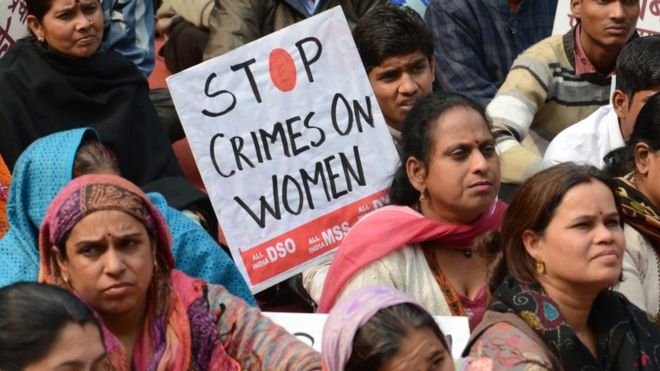
Protest in DelhiImage copyrightAFP

An Indian man has been arrested for allegedly raping and robbing a British tourist in the western state of Goa.

The woman, 48, was attacked around 4:00 local time (22:30 GMT) on Thursday as she was walking to her hotel from a railway station, police told PTI news.

The accused is a man from the southern state of Tamil Nadu. He fled after also taking three of her bags.

Goa is one of India’s top tourist destinations and its beaches attract thousands of foreigners every year.

The woman is a regular visitor to the state. Police said she had been going there every year for the last 10 years.

Police were able to track down the suspect with the help of CCTV footage from the railway station as well as the area where the crime occurred, according to the NDTV news website.

This is one of several crimes against foreigners in the state.

An Irish woman, Danielle McLaughlin, was raped and murdered while on holiday in Goa in 2017. Vikhat Bhagat, 24, was arrested soon after her murder and his trial, which began in April, is still under way.

Scarlett KeelingImage copyrightFAMILY PHOTOGRAPH
Image captionScarlett Keeling was killed in Goa in 2008

In 2008, Scarlett Keeling, a 15-year-old British teenager was raped and killedwhile on a trip in Goa. Her killers are yet to be caught. Two men who had faced charges of culpable homicide and grievous sexual assault were both cleared in 2016.

Public outrage over sexual violence in India rose dramatically after the 2012 gang rape and murder of a student on a Delhi bus.

This year has seen the issue become a political flashpoint again, after a string of high-profile attacks against children.

However incidents of rape and violence against women continue to be reported from across the country.

17/12/2018

Three-year-old assaulted on Delhi bus rape anniversary

A protest in India against child sex abuseImage copyrightAFP

A three-year-old Indian girl is in critical condition after she was allegedly raped by her neighbour in the capital Delhi.

The accused, a 40-year-old security guard who worked in the building the child lived in, has been arrested.

Police found the girl unconscious and rushed her to hospital where she is undergoing surgery.

The incident occurred on Sunday, which was the sixth anniversary of the brutal gang rape of a student on a Delhi bus.

Delhi Women’s Commissioner Swati Maliwal said the incident “let down” the bus rape victim, whose attack saw country-wide protests and a tightening of rape laws.

There is still no clarity on the condition of the girl or whether she will survive the attack, which local media have described as “brutal”.

Locals in the area found the accused and attacked him after the incident came to light, the Times of India newspaper said. It also quoted police as saying that the accused was treated for injuries before they arrested him.

The girl’s parents, who are daily wage labourers, were away when the incident occurred. The accused allegedly lured the girl with sweets and picked her up from outside her house.

Police have registered a case for rape under the Protection of Children from Sexual Offences (POSCO) Act, which could see the death penalty handed out to the accused.

The incident, which has prompted a fresh wave of anger and outrage in India, comes after a series of high-profile cases against children this year. In April, the brutal gang-rape and murder of an eight-year-old in Indian-administered Kashmir dominated headlines. In June, hundreds took to the streets in the central state of Madhya Pradesh over the rape of a seven-year-old girl.


The scale of abuse in India

  • A child under 16 is raped every 155 minutes, a child under 10 every 13 hours
  • The number of reported rapes of children increased from 8,541 in 2012 to 19,765 in 2016
  • More than 10,000 children were raped in 2015
  • 240 million women living in India were married before they turned 18
  • 53.22% of children who participated in a government study reported some form of sexual abuse
  • 50% of abusers are known to the child or are “persons in trust and care-givers”
12/12/2018

Chinese loan shark who raped victim among 18 jailed for gang crime

Wang Yinan was one of 19 people convicted of various gang-related crimes in Hulunbuir in the Inner Mongolia autonomous region, Beijing Youth Daily reported on Tuesday.

Wang and eight of his associates were tried in the city on Monday charged with illegally providing loans of between 10,000 yuan (US$1,450) and 30,000 yuan to people via a smartphone app since September 2017.

Those who failed to keep up with their repayments were subjected to physical assault, including being made to stand naked in the snow, the report said. One victim was raped as punishment, it said, without providing any further details of the crime.

Wang’s associates were each sentenced to between one and nine years in prison.

The trials followed a nationwide crackdown on organised crime launched at the start of the year.

Among the others given prison sentences on Monday were Lee Yongbin, who led a group of hired thugs that intimidated people involved in construction conflicts and worked as debt collectors for loan sharks, the report said.

Members of the gang were also charged with “creating public disturbances”, the court heard.

Lee was sentenced to 5½ years in prison, and his associates to between 10 and 30 months.

10/06/2016

Indian men given life for gang-rape of Danish tourist | Reuters

Five Indian men were sentenced to life in prison on Friday for raping a Danish tourist in the heart of New Delhi‘s tourist district in 2014, in a case that reignited worries about sexual violence against women in India.

The men, all in their twenties, were found guilty by a Delhi court on Monday for robbing and raping the 52-year old Dane at a secluded spot close to New Delhi railway station.

“All the five convicts have been sentenced to rigorous life imprisonment for their offences,” additional public prosecutor Atul Shrivastava, told Reuters at the court. The Dane was walking through an area of narrow lanes near Delhi’s Paharganj district, a tourist area packed with backpacker hotels, on the evening of Jan. 14, 2014, when she asked a group of men for directions to her hotel.

The men then lured the woman to an area near New Delhi railway station where they raped her and robbed her at knife-point, the prosecution said in its chargesheet.

India was shaken into deep soul-searching about entrenched violence against women after the fatal gang-rape in December 2012 of a female student on a bus in New Delhi.

The crime, which sent thousands of Indians onto the streets in protest against what many saw as the failure of authorities to protect women, encouraged the government to enact tougher jail sentences for rapists.

Police accused nine men of attacking the Danish woman in 2014. Three are juveniles being tried in a separate court while a fourth died during the trial.

Lawyer D.K. Sharma, representing the five convicted men, said his clients would appeal against the verdict.

Source: Indian men given life for gang-rape of Danish tourist | Reuters

19/01/2015

India’s New Pink Taxi Fleet for Women Offers Pepper Spray, Panic Buttons – India Real Time – WSJ

One of India’s largest taxi companies says it has a solution for women worried about their safety after the alleged rape by an Uber driver: pink cabs with pepper spray.

Meru Cab chief executive Siddhartha Pahwa announced the new service–called Meru Eve– Friday from a dais decorated with daisies and gladioli.

“The incident last month forced all of us to think how we can make roads safer for women,” he said.

Its new line of taxis in Delhi will be driven by women . They will have pepper spray and panic buttons that immediately notify Meru if there is trouble.

There have been taxi services for women for years-such as ForShe Taxis and Sakha Cabs–but Meru Eve promises to take the concept to the next level. The service started in the capital region Friday with around 20 vehicles and may be rolled out in other cities later.

Meru worked with the Delhi police to equip the cabs and give the women drivers self-defense training to protect themselves and their passengers.

Meru’s Mr. Pahwa said that after the alleged rape of a female passenger by an Uber driver, Meru received calls from anxious passengers asking for female taxi drivers.

“This is an important step towards women’s empowerment,” said Tajender Singh Luthra, a joint commissioner of police in Delhi.

Meru’s regular drivers have always been given specific training on the appropriate ways to interact with women passengers. It says it has never had a complaint but decided to go further to make women passengers feel more safe.

“These drivers come from small towns and are not used to big city culture, like women smoking, wearing a short dress or travelling alone at night,” Mr. Pahwa said. “We train our drivers to avoid eye contact with women, maintain two feet of distance and not to adjust the rear view mirror to watch the passenger.”

The Meru Eve drivers will wear pink vests and drive white-and-pink hatchbacks.

One of the new drivers, 22-year-old Sarita Dixit, said that she expects her income to jump with demand for women drivers as more companies start women taxi services. Meru drivers typically earn between 20,000 and 30,000 rupees ($322 to $483) a month, which is more than she earned in her last job working as a chauffeur.

The new services will not only help empower women that can afford taxis but also woman looking for work, said Vimla Mehra, Delhi’s special police commissioner for administration.

“You don’t see many women professionals in India. Programs like this build confidence in women to earn a living. They become role models,” she said.

via India’s New Pink Taxi Fleet for Women Offers Pepper Spray, Panic Buttons – India Real Time – WSJ.

16/12/2014

India’s Senseless Ban on Uber: Rape Is the Real Problem – Businessweek

The alleged rape of an Uber passenger by her driver in New Delhi on Friday and his arrest over the weekend is another sad chapter in India’s ongoing battle with violence against women. While official statistics suggest the country witnessed 25,000 rapes in 2012, survey evidence suggests numbers perhaps 10 times as high.

Police escorting the hooded Uber driver following his court appearance on rape charges

The government’s response to the incident was to immediately ban Uber operations in Delhi. Alhough this might offer a welcome sign of political commitment to tackle violence, it doesn’t make sense. The police in India have been accused of multiple rapes, and tourists have been raped on a train and in a traditional Delhi taxi this year; the government has not shut down the police force, the railways, and traditional taxi services. It has singled out Uber, perhaps more because it is a high-profile, politically weak service than because of any risks riders may face.

In fact, there are good reasons to think Uber can provide a safer experience than India’s traditional transportation options do. Unlike the vast majority of rape cases in the country, the alleged perpetrator in the Uber case was arrested within hours of the incident. That’s not a surprise: Uber’s procedures guaranteed that there was considerable information available on the suspect. The company provided police with the name, age, and photo of the driver, along with his bank verified address, car details, and trip and route data. That’s a much higher level of knowledge than passengers have when they hail a cab off the street.

via India’s Senseless Ban on Uber: Rape Is the Real Problem – Businessweek.

15/12/2014

This Is What India’s Radio Cabs Are Doing to Make Women Safer – India Real Time – WSJ

Indian authorities and radio taxi operators in the national capital have stepped up security measures to ensure passenger safety in the aftermath of an alleged rape of a female passenger by a driver contracted to the international car booking service Uber Technologies.

Transport authorities in New Delhi have ordered radio fleet taxi companies and web-based operators to submit database of their drivers whose credentials need to be checked and have asked them to come up with a revised safety plan to be put in place by early next year, a Delhi police official, who did not wish to be named said Monday.

“A list of around 20,000 drivers has been submitted so far out of which the background details of more than 10,000 still need to be verified,” he said.

Last week, Delhi’s transport department barred Uber from operating its ride-hailing system in the national capital until it got the proper licenses. Uber on Thursday said it would suspend its service in the capital while it reviewed its screening processes. The department had stated that only six registered radio taxi companies would now be allowed to continue operating in New Delhi.

The cab operators in New Delhi, for their part, said they have certain safety rules in mind that they would submit by Dec. 31 to the transport department.

via This Is What India’s Radio Cabs Are Doing to Make Women Safer – India Real Time – WSJ.

Law of Unintended Consequences

continuously updated blog about China & India

ChiaHou's Book Reviews

continuously updated blog about China & India

What's wrong with the world; and its economy

continuously updated blog about China & India