26/09/2019
- Police investigation reveals animal had escaped from a nearby restaurant
The escaped crocodile was captured by police officers and taken to the local station. Photo: Handout
A security guard at a beauty spot in eastern China was shocked to discover a 2-metre (6ft 6in) crocodile while on his rounds in the early hours of Monday morning.
The animal was lying motionless on a road at Xinlonghu Park in Changzhou, Jiangsu province, with its jaws tied by a strip of cloth, when it was spotted by the security guard, who immediately called the police, according to the Modern Express newspaper.
It took a number of officers to capture the crocodile and take it to the local police station, where an investigation revealed the animal had escaped from a nearby restaurant. The animal was returned and the restaurant owner was “criticised” by police, who urged that a close eye be kept on the animal, the report said.
“They bought it from a farm somewhere as a food material to attract customers. It has been killed for crocodile meat dishes,” an officer told the South China Morning Post on Wednesday.
Crocodiles were once vegetarians – but it was just a phase
Police said it was fortunate that the crocodile had been caught before it had entered the park’s lake or caused any danger to people.
It is unclear what species the crocodile belonged to but China permits the commercial breeding and use of the critically endangered Siamese crocodile, as well as saltwater and Nile crocodiles, which are listed as least concern species.
A staff member of the restaurant, called No. 1 Lakeside, told the Post stewed crocodile meat was on the menu for 168 yuan (US$23.60) a serving, while stewed crocodile claw was also available at 258 yuan.
Crocodile appears in ancient Chinese medicine books as a treatment for respiratory illnesses and the meat has long been regarded as a delicacy, especially in southern China, such as Guangdong province. Crocodile skin also remains a popular material for luxury handbags and other leather goods.
In June, another crocodile, measuring about 1.5 metres, was found in a road puddle during a heavy rain in Wuhan, in the central province of Hubei, where many restaurants have crocodile meat on their menus, the Chutian Metropolis Daily reported.
In that incident it took three officers to capture the animal which was sent to a wildlife centre where a physical check-up showed it had been bred in captivity, most likely for food.
Source: SCMP
Posted in ancient Chinese medicine books, beauty spot, bred, captivity, captured, Changzhou, Chinese, critically endangered, Crocodile shock, danger, delicacy, escaped crocodile, Food, guangdong province, heavy rain, hubei province, jiangsu province, leather goods, local station, luxury handbags, newspaper, Nile crocodiles, No. 1 Lakeside, park’s lake, People, physical check-up, police officers, popular material, Restaurant, road puddle, Security guard, Siamese crocodile, south china morning post, stewed crocodile claw, stewed crocodile meat, taken, treatment for respiratory illnesses, Uncategorized, vegetarians, wildlife centre, Wuhan |
Leave a Comment »
24/09/2019
- Shanghai’s authorities have doubled the free-trade zone to 240 square kilometres by including part of Lingang, a previously untapped area linked to the Yangshan deep water port
- The expansion reflected the city’s renewed efforts to build a free marketplace that can rival regional business hubs such as Hong Kong and Singapore
Aerial photo taken on March 9, 2017 shows the Shanghai free trade zone (FTZ). Photo: Xinhua
Shanghai’s ambitious plan to turn Lingang into a Hong Kong-style free-trade port has yet to impress European companies due to a slow pace of enforcement with a series of liberalisations subject to Beijing’s approval.
The European Union Chamber of Commerce in Shanghai said on Tuesday that the business lobby group was expecting concrete measures to be implemented at the 119.5-square kilometre newly expanded free-trade zone (FTZ), which would whet European companies’ investment appetite, but it also vented dismay towards the slow progress.
It was advisable for the government to carry out planned reforms sooner to convince foreign investors of the golden opportunities inside the zone, said Carlo Diego D’Andrea, the chamber’s Shanghai chairman, who is also vice-president of the EU business chamber in China.
“After so many years [of waiting], we would like to see reform happen soon, not just the talks,” he said in an interview with South China Morning Post.
Shanghai doubled the size of the free-trade zone last month to about 240 sq km by including part of Lingang, a previously untapped area that is linked to the
Yangshan deep water port.
The expansion reflected the city’s renewed efforts to build a free marketplace that can rival regional business hubs such as Hong Kong and Singapore.
Where is China’s Silicon Valley? SCMP Graphics
Hong Kong’s ongoing street protests against a controversial extradition bill have wreaked havoc on the city’s economy and brought an
opportunity to mainland metropolises such as Shanghai and Shenzhen to catch up with the special administrative region.
Shanghai plans to impose zero tariffs on imported goods inside the Lingang FTZ, but the reform measures cannot be implemented unless the General Administration of Customs gives a green light.
Shanghai’s city government had proposed a series of incentives aimed at building Lingang into a world-class investment magnet, the free-trade zone’s deputy director Wu Wei said at a Friday press conference, without elaborating on when the policies might be endorsed by the relevant ministry-level authorities.
Professor Zhou Zhenhua, president of Shanghai Academy of Global Cities, said the central government was still cautious of taking drastic steps in quickly liberalising the Lingang FTZ amid worries of rampant capital and cargo flows.
US bestselling electric vehicle maker Tesla has built its Gigafactory 3 at the Lingang FTZ after it secured an approval from Beijing to establish a wholly owned assembly plant late last year.
The approval for the first wholly-owned foreign car factory on mainland China coincided with a sales drop in the country’s automobile market, the first contraction in nearly three decades.
“Why could not you have opened the market before when the market was booming,” said D’Andrea.
He said that the timing of scrapping the foreign ownership cap amid the first negative growth of the domestic car market in three decades was not enough to show Beijing’s determinations in drawing overseas funds.
Beijing has been harping on its resolution in further opening up the markets to foreign businesses as a way of amid the US-China trade war that began in 2018.
Source: SCMP
Posted in Central government, China’s Silicon Valley, electric vehicle maker, embracing, European firms, European Union Chamber of Commerce, expanded, expansion, foreign car factory, free marketplace, free trade zone (FTZ), Gigafactory, Hong Kong, Lingang, lookout, Mainland China, regional business hubs, rival, Shanghai, Shanghai Academy of Global Cities, Shenzhen, Singapore, south china morning post, tangible incentives, Tesla, Uncategorized, US-China trade war, Yangshan deep-water port, zero tariffs |
Leave a Comment »
18/09/2019
- Authorities investigating why passenger suddenly leapt to her feet and went through open door
The woman in yellow died after alighting from the moving bus in Fenggang county, Guizhou province, on Sunday. Photo: Weibo
Police in southern China are investigating the death of a woman who suddenly leapt from her seat and through the door of a moving bus on the weekend.
The unidentified woman was confirmed dead at hospital in Fenggang county, Guizhou province, on Sunday after alighting from the bus through the rear door which should have been closed, according to county police.
An officer from the county’s traffic police bureau told the South China Morning Post that an investigation into the woman’s action and the bus driver’s responsibility was under way.
Surveillance footage posted online shows the woman in a yellow top sitting near the open back door before suddenly getting up and rushing through the door.
The door then closes and the bus stops moments later as passengers appear shocked.
Chinese police do U-turn on traffic crash after online crowd doubt official account
The footage was shared widely online on Weibo, China’s Twitter-like platform.
Some internet users said the woman might have been dozing and awoke suddenly thinking she had missed her stop.
Others noted that the door should not have been open.
Just late last month, a woman was injured getting off a moving bus in Chongqing as the driver accidentally opened the rear door, video news app Kankanews.com reported.
The woman, in her 60s, simply stepped off as she saw the door open and thought she had arrived at her destination.
The driver said his safety belt loosened and he accidentally triggered the door button while trying to buckle up. He was held fully responsible for the passenger’s injury.
Source: SCMP
Posted in authorities, bus driver, China alert, Chongqing, dies, Fenggang county, Guizhou Province, investigating, Kankanews.com, leapt to her feet, moving bus, open door, passenger, responsibility, Safety questions, south china morning post, stepping off, suddenly, Surveillance footage, traffic crash, U-turn, Uncategorized, Weibo, went through, Woman |
Leave a Comment »
18/09/2019
- Police investigation reveals animal had escaped from a nearby restaurant
The escaped crocodile was captured by police officers and taken to the local station. Photo: Handout
A security guard at a beauty spot in eastern China was shocked to discover a 2-metre (6ft 6in) crocodile while on his rounds in the early hours of Monday morning.
The animal was lying motionless on a road at Xinlonghu Park in Changzhou, Jiangsu province, with its jaws tied by a strip of cloth, when it was spotted by the security guard, who immediately called the police, according to the Modern Express newspaper.
It took a number of officers to capture the crocodile and take it to the local police station, where an investigation revealed the animal had escaped from a nearby restaurant. The animal was returned and the restaurant owner was “criticised” by police, who urged that a close eye be kept on the animal, the report said.
“They bought it from a farm somewhere as a food material to attract customers. It has been killed for crocodile meat dishes,” an officer told the South China Morning Post on Wednesday.
Crocodiles were once vegetarians – but it was just a phase
Police said it was fortunate that the crocodile had been caught before it had entered the park’s lake or caused any danger to people.
It is unclear what species the crocodile belonged to but China permits the commercial breeding and use of the critically endangered Siamese crocodile, as well as saltwater and Nile crocodiles, which are listed as least concern species.
A staff member of the restaurant, called No. 1 Lakeside, told the Post stewed crocodile meat was on the menu for 168 yuan (US$23.60) a serving, while stewed crocodile claw was also available at 258 yuan.
Crocodile appears in ancient Chinese medicine books as a treatment for respiratory illnesses and the meat has long been regarded as a delicacy, especially in southern China, such as Guangdong province. Crocodile skin also remains a popular material for luxury handbags and other leather goods.
In June, another crocodile, measuring about 1.5 metres, was found in a road puddle during a heavy rain in Wuhan, in the central province of Hubei, where many restaurants have crocodile meat on their menus, the Chutian Metropolis Daily reported.
In that incident it took three officers to capture the animal which was sent to a wildlife centre where a physical check-up showed it had been bred in captivity, most likely for food.
Source: SCMP
Posted in ancient Chinese medicine books, beauty spot, bred, captivity, captured, Changzhou, Chinese, Chutian Metropolis Daily, criticised, Crocodile, Crocodile skin, crocodiles, delicacy, endangered, guangdong province, hubei province, jiangsu province, local police station, luxury handbags, Meat, Modern Express, Nile crocodiles, No. 1 Lakeside, owner, police officers, respiratory illnesses, Restaurant, saltwater crocodiles, Security guard, shock, Siamese crocodile, south china morning post, Uncategorized, vegetarians, wildlife centre, Wuhan, Xinlonghu Park |
Leave a Comment »
17/09/2019
- Powerful zoom functions can reveal fingerprint details which may be copied by criminals
A cybersecurity awareness campaign in China has prompted a warning about criminals harvesting fingerprint information from a popular pose in pictures uploaded to the internet. Photo: Shutterstock
A popular hand gesture adopted by China’s online community in uploaded pictures could be used by criminals to steal people’s fingerprints, Chinese cybersecurity experts have warned.
The “scissor hand” pose – similar to the peace sign or “V” for victory– could reveal a perfect fingerprint if held close enough to the camera, according to Zhang Wei, vice-director of the Shanghai Information Security Trade Association.
Speaking at an event promoting a national cybersecurity awareness campaign in Shanghai on Sunday, Zhang said photo magnifying and artificial intelligence-enhancing technologies meant it was possible to extract enough detail to make a perfect copy of the sensitive information.
According to a report by online news portal Thepaper.cn, Zhang’s advice was that scissor-hand pictures taken closer than three metres (10 feet) could be vulnerable and should not be published on the internet.
Chinese face-swapping app sparks privacy concerns soon after its release
“A scissor-hand picture taken within 1.5 metres (four feet 11 inches) can be used to restore 100 per cent of people’s fingerprints, while pictures taken about 1.5-3 metres away can turn out 50 per cent of the fingerprints,” he said.
Based on the information extracted from the pictures, criminals could make models of the prints which could then be used to register at fingerprint-based identity recognition checks, such as door access and payment systems, Zhang said.
Feng Jianjiang, a professor on fingerprint identification from the Department of Automation at Tsinghua University, told the South China Morning Post that, theoretically, pictures could show fingerprints clearly enough to be copied, but said he was unsure of what distance would be safe.
“Some people’s fingerprints could not be captured [at any distance] because of skin problems [for example],” Feng said. “But the fingerprint images would be fairly clear if the distance, angle, focus and lighting were all ideal.”
Feng suggested people check the clarity of detail by zooming in on their fingerprints in pictures before uploading them to social media.
Zang Yali, a researcher from the Institute of Automation at the Chinese Academy of Sciences, agreed that the conditions required to be able to harvest sufficiently detailed fingerprint information were “very demanding”, according to a report in China Science and Technology Daily.
The warning had been viewed on China’s Twitter-like platform Weibo 390 million times within 24 hours of Zhang’s address on Sunday, with 49,000 comments left on the website by Monday afternoon.
“It’s horrifying. I always present a scissor hand in photos,” one Weibo user wrote.
“Advanced technology has brought us convenience but meanwhile has also brought us risk and danger. What can we do now?” another commenter wrote.
One social media user had the perfect solution, writing: “No worries. just show the back of your hand to the camera if you are concerned.”
Source: SCMP
Posted in awareness, Camera, campaign, China alert, China Science and Technology Daily, Chinese Academy of Sciences, criminals, cybersecurity threat, Department of Automation, fingerprint information, harvesting, Institute of Automation, scissor-hand, selfie-takers, Shanghai Information Security Trade Association, south china morning post, Thepaper.cn, Tsinghua University, Twitter, Uncategorized, warned, Weibo |
Leave a Comment »
10/09/2019
- Suspects rounded up after people complain of being duped into making donations to support non-existent temples
- One woman says she handed over US$4,600 after being told that charitable gesture would help her live to be 400
One victim of the alleged scams said she was told she could live for 400 years if she handed over her money. Photo: Thepaper.cn
Police in southeast China have detained 100 people on suspicion of being part of a criminal network that cheated members of the public out of 50 million yuan (US$7 million) by preying on their superstitions and generosity.
Authorities in Ningguo, Anhui province launched an investigation in May after receiving a number of complaints about the activities of several groups posing as fortune-tellers on social media platforms like Weibo, financial news outlet Caijing reported on its website on Tuesday.
One of the groups, which operated on the Twitter-like service under the name “Kanxiang Zen Master”, was run by a local man surnamed Zhang and had 12 million followers, the report said.
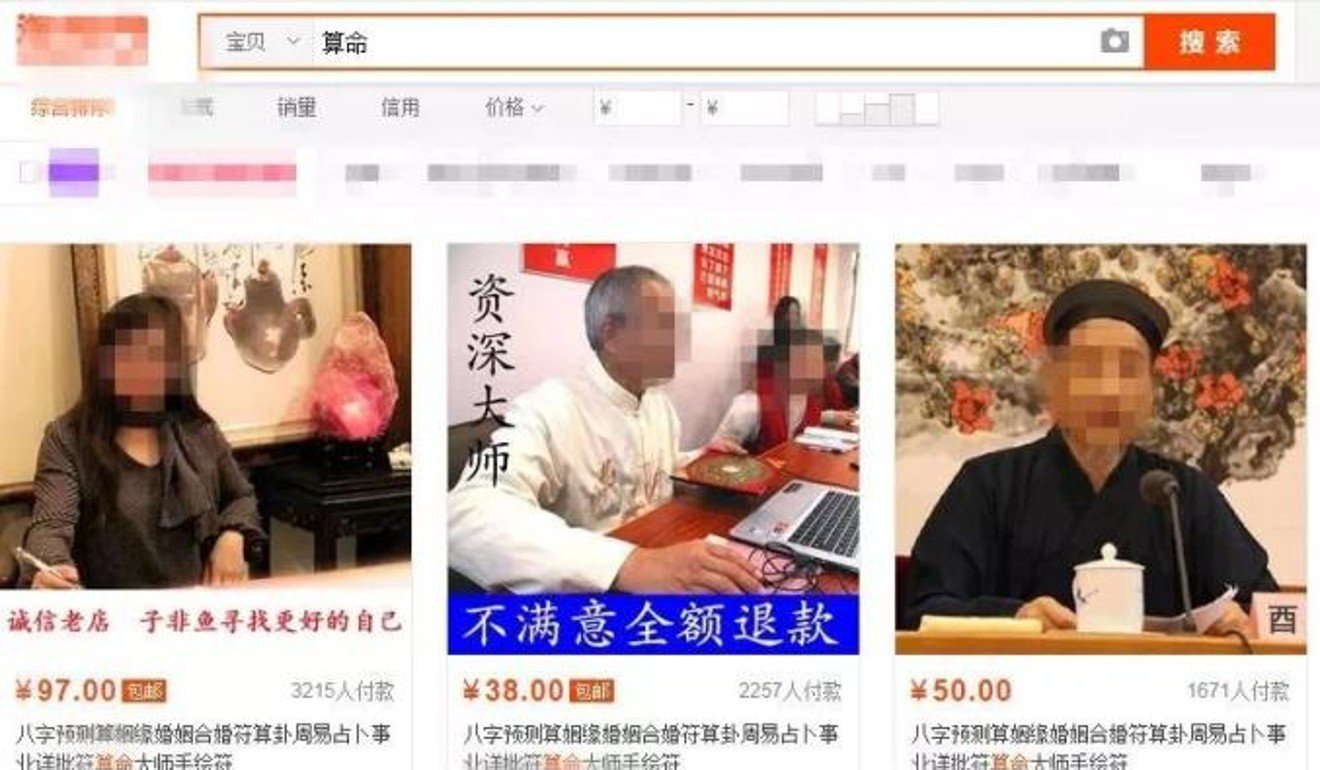
Adverts for online fortune-telling services are common in China. Photo: Thepaper.cn
In one alleged scam, members of the group were told they would receive good luck if they made a donation to support a “famous temple”. But when a man who gifted 10,000 yuan via WeChat Pay checked on the address of the recipient, he found it was a residential address in the city of Xuancheng and not a place of worship, the report said.
When police investigated, they found Zhang had links to seven criminal groups in Anhui and neighbouring Jiangsu province, which between them operated about 60 fortune-telling accounts on Weibo, several of which had more than 10 million followers. The Kanxiang Zen Master account has since been removed from the platform.
Six Chinese wanted for internet scam arrested in Vanuatu
A number of the gangs were registered as media companies and operated as semi-professional organisations with formal recruiting procedures and regular conferences to plan their fraudulent activities, the report said, adding that they had been operating for at least two years.
Police in July staged a series of raids to round up the suspects and confiscated associated equipment, including computers, vehicles and mobile phones, the report said.
Authorities in Ningguo have appealed for more victims to come forward.
A separate report by Shanghai-based news outlet Thepaper.cn said that some of the suspects also used e-commerce sites such as Taobao and the messaging service WeChat to promote their fortune-telling services.
Taobao is owned by Alibaba Group, which also owns the South China Morning Post.
In one case, a woman from the city of Changshu in Jiangsu said she made multiple payments – totalling about 33,000 yuan – to a fortune-teller she met on WeChat who said the money would be used to buy incense for use in offerings to the gods.
She said she reported the alleged fraud after starting to doubt the fortune-teller’s claims, including one that said if she made the donations she could live for up to 400 years.
Alibaba, Weibo and Tencent, which owns WeChat, have been contacted for comment.
Posted in Adverts, Alibaba Group, Anhui, authorities, Caijing, Changshu, chinese police, complain, detain, duped, e-commerce sites, famous temple, financial news outlet, fortune-tellers, fortune-telling, generosity, gods, incense, Jiangsu, jiangsu province, Kanxiang Zen Master, making donations, messaging service, Ningguo, non-existent temples, offerings, place of worship, promote, residential address, scam, Services, Shanghai-based news outlet, social media platforms, south china morning post, superstitions, Taobao, TENCENT, Thepaper.cn, Uncategorized, Vanuatu, website, WeChat, WeChat Pay, Weibo, Xuancheng, Zhang |
Leave a Comment »
09/09/2019
- Merkel makes the case on sensitive issues in Beijing without being offensive, observer says
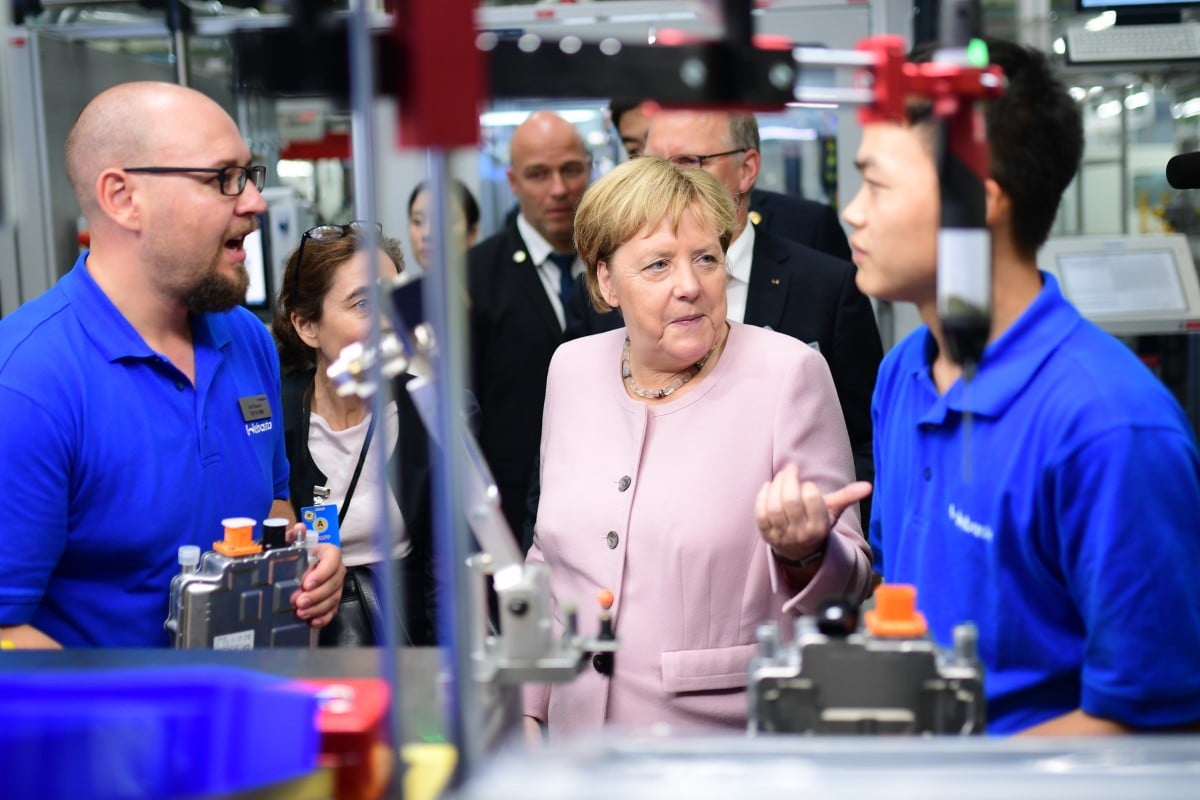
German Chancellor Angela Merkel (centre) talks to staff at manufacturer Webasto during a visit in Wuhan on Saturday. Photo: EPA-EFE
German Chancellor Angela Merkel may be slowly declining in influence in European politics but she remains the EU’s strongest voice in dealing with China, analysts said after her latest trip to China last week.
During the two-day visit, Merkel and Chinese President Xi Jinping discussed the sensitive topic of Hong Kong and the social credit system in China.
German diplomats also averted a plan by Chinese officials to scrap a joint press conference by Merkel and Chinese Premier Li Keqiang out of concerns that it could be dominated by questions about the escalating protests in Hong Kong.
Two sources told the South China Morning Post that the Chinese side initially suggested not letting journalists ask questions during the press conference. German diplomats persisted, saying that Merkel would hold her own press conference to take media questions, the sources said.
Germany’s Angela Merkel renews call for peaceful resolution to Hong Kong protests
After talks with the Chinese president and premier, Merkel said Beijing had listened to her views about resolving the Hong Kong conflict without violence, adding: “This is important.”
She said she also pressed the European Union’s position that the Sino-British Joint Declaration on Hong Kong remained effective, countering Beijing’s assertion that the 1984 document has ceased to be valid.
“Merkel navigated the narrow line to raise these sensitive issues without being overly offensive,” said Jan Weidenfeld, of the Berlin-based Mercator Institute for China Studies.
Joerg Wuttke, president of the EU Chamber of Commerce in China, said Merkel’s biggest achievement was to raise the issue about the social credit system in China, a policy that aims to rank every individual and corporate entity based on their compliance with state-stipulated social norms.
“It is important to us that she makes the Chinese leadership aware that the German business community would like to get better briefed and prepared for this major change in company compliance by the Chinese authorities,” Wuttke said. “Merkel was the first foreign leader to do so.”
Despite Merkel’s tough approach, China’s foreign ministry was full of praise for the German leader’s visit, saying both sides were “satisfied” with the outcomes.
“This is Chancellor Merkel’s 12th China visit, so she should be one of the Western leaders who visited China the most times and knows China the best,” ministry spokeswoman Hua Chunying said on Monday.
Hong Kong is a matter for China, Premier Li Keqiang tells Angela Merkel
Back home, however, German media and businesses remained sceptical about the future.
Bild, the country’s biggest-circulation newspaper, has been following closely the arrest of Hong Kong pro-democracy activist Joshua Wong Chi-fung, who was detained at Hong Kong airport on his way to Berlin at the newspaper’s invitation. Wong was later cleared to travel abroad.
Several newspapers have put pressure on Merkel to speak out for Hong Kong, with one calling on her to replace a stop in mainland China with one in the former British colony, which she refused.
On the business side, German businesses also urged Merkel to caution Beijing against sending troops to Hong Kong out of concerns that the lucrative Chinese market would become subject to international sanctions.
Another concern is the slow pace of structural reforms that would open up Chinese markets to foreign businesses.
Source: SCMP
Posted in Angela Merkel, averted, Beijing, Berlin, Bild, China alert, Chinese leadership, Chinese premier Li Keqiang, Chinese President Xi Jinping, Europe, European Union, former British colony, German business community, German Chancellor, German diplomats, Hong Kong, Hong Kong airport, Joshua Wong Chi-fung, Mainland China, Mercator Institute for China Studies, Sino-British Joint Declaration on Hong Kong, social credit system, south china morning post, strong voice, Uncategorized, views, Webasto, Wuhan |
Leave a Comment »
06/09/2019
- Material that generates heat from sunlight could provide self-maintaining water supply on remote islands
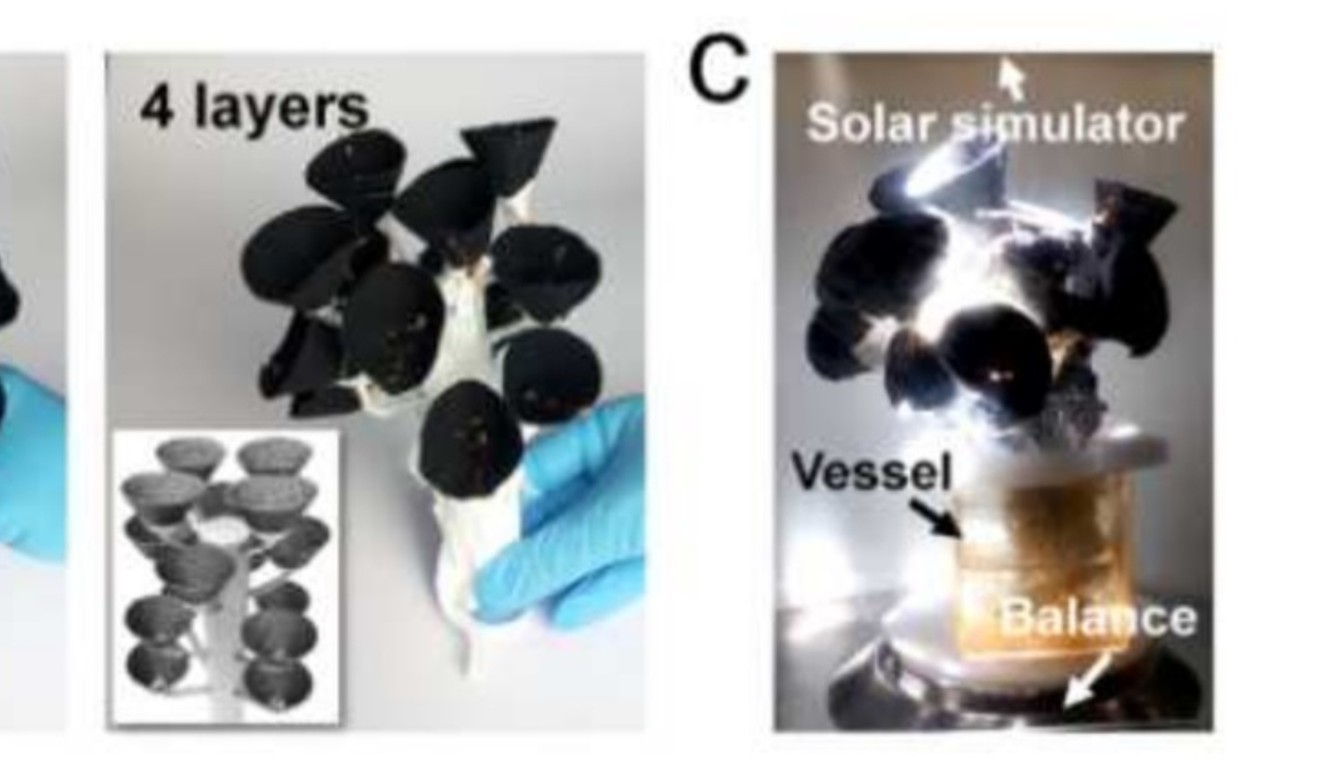
An international research team used solar power to generate a supply of drinking water. Photo: Chinese Academy of Sciences
A Chinese-led international research team has created a “tree” that can generate clean drinking water.
Drawing its energy entirely from the sun just like a real tree, the “water tree” has a root made of cotton fabric that can absorb water from its surroundings, such as from sand on a beach.
After water moves up the stem, it is vaporised by “leaves” made of black-carbon paper cones that convert light energy to heat, reaching nearly 50 degrees Celsius (122 Fahrenheit). The tree sits in a glass chamber with a relatively cool surface that collects the vapour.
Using standard cotton fabric and a new nanomaterial that can be cheaply mass-produced from charcoal, a paper cone with a surface area as large as 1 square metre would cost only US$2, according to the researchers.
The cones, which function like leaves, could be mass-produced cheaply, researchers say. Photo: Chinese Academy of Sciences
A cone that size can generate up to 3.4kg (7.5lbs) of condensed water per hour, faster than any other solar-powered desalination methods previously reported.
Even on a cloudy day, the total output in seven hours of sunlight can reach 5.4kg, or three times the amount the typical adult needs to stay hydrated.
One tree can have multiple layers of branches, each with several cones to increase the vapour-producing surface area.
The study, published this month in the journal Nano Energy, was led by Professor Chen Tao at the Chinese Academy of Sciences’ Ningbo Institute of Material Technology and Engineering in Zhejiang province, and also involved researchers from Singapore and Taiwan.
World’s thirst for fresh water is causing a big toxic problem
One of the paper’s co-authors, Dr Ouyang Jianyong, associate professor at the National University of Singapore’s department of materials science and engineering, told the South China Morning Post that the technology could be applied in remote places such as on islands in the South China Sea.
“It is particularly useful for isles far away without a stable drinking water supply,” Ouyang said. “These ‘trees’ may not be able to quench the thirst of a large city, but they can meet the critical demand of a small community, especially in emergencies.
“We are already in contact with some companies [to commercialise the technology],” he added.
The material used to make the cone has several advantages, according to Ouyang. The cones can absorb a wide spectrum of sunlight, maximising the amount of energy they can collect, and their porous structure allows them to release vapour quickly.
Lawmakers endorse plan for HK$7.7 billion desalination plant
When used to desalinate a supply of seawater, the trees would be self-cleaning at night, by water washing away salt residue without being vaporised as it would during sunlight hours.
The vapour-producing fabric is as thin and lightweight as a few sheets of paper. It can be folded and sewn into almost any shape, or cleaned in a washing machine, and can operate effectively for several years in a harsh environment, the researchers say.
The condensed water meets stringent safety standards for direct drinking set by the World Health Organisation, according to the researchers.
Source: SCMP
Posted in Chinese Academy of Sciences, cleaned, department of materials science and engineering, desalinate, desalination plant, Drinking water, lawmakers, Nano Energy, National University of Singapore, night, Ningbo Institute of Material Technology and Engineering, paper, remote islands, sea, Seawater, self-cleaning, self-maintaining water supply, sewn, shape, sheets, Singapore, solar-powered ‘tree’, solar-powered desalination methods, south china morning post, South China Sea, Taiwan, turns, Uncategorized, vapour-producing fabric, washing machine, World Health Organisation, zhejiang province |
Leave a Comment »
06/09/2019
- Scientists find some chemicals can kill the cotton leaf curl Multan virus and others can boost cotton plants’ immunity to it
- It is feared the virus could wreak havoc in China’s Xinjiang region, which produces most of the country’s cotton
A cotton picker in Xinjiang, where cases of the virus have been reported. Photo: Xinhua
Chinese scientists have found chemicals in medicinal herbs that could tame a destructive plant virus threatening the cotton industry in its western Xinjiang region.
Some small-molecule chemicals in herbs commonly used in Chinese medicine can effectively suppress cotton leaf curl Multan virus, according to ongoing research led by Professor Ye Jian at the Institute of Microbiology in Beijing.
By targeting WRKY20, a gene in the virus’ DNA, the chemicals could disrupt the viral infection and transmission, Ye’s team found.
Some early findings from their research were published last month in the journal Science Advances.
The leaf curl virus – a species of Begomovirus, the largest genus of plant viruses – poses a significant threat to the world’s cotton plantations, causing leaf curling, stunted growth and lower yields of cotton fibre. It costs the cotton industry in the Indian subcontinent about US$1 billion a year, according to a press release about the study from the Chinese Academy of Sciences.
Were there to be a pandemic in China, the drop in output and measures to contain it could cost the cotton farming industry 50 billion yuan (US$7 billion), according to some researchers’ estimates, the academy added.
The first known cases of the virus in China over the past decade were limited to coastal areas in the country’s east, but several cases have now been reported in Xinjiang Uygur autonomous region.
“We are running out of time,” Ye told the South China Morning Post.
Cotton is a pillar industry in Xinjiang, which provides more than 80 per cent of China’s total cotton production. The industry also contributes up to 50 per cent of the income of farmers involved in it, according to government statistics.
Exact figures for infections in the region are not available, but outbreaks so far remain isolated, according to Ye and other researchers with knowledge of the situation.
Double threat to China’s cotton industry: warmer weather and mirid bug
However, Professor Gao Feng, cotton researcher at the Agricultural College of Shihezi University in Xinjiang, warned that leaf curl virus could reduce cotton production in an infected field to almost zero.
“A large-scale outbreak has not occurred yet, but the threat is very serious and people are very nervous,” Gao told the Post. “We are in desperate need of a solution.”
The challenges facing China’s pork industry highlight the danger viruses can pose to the domestic market. A swine fever outbreak that has wiped out 100 million pigs caused pork prices to rise, forcing China to look to new countries to import from, such as Portugal and Argentina.
Its biggest overseas supplier of cotton is the United States, with which it is locked in a protracted trade war. In July, the government allowed some Chinese companies to buy a total of 50,000 tonnes of cotton from the US without tariffs being charged.
The central and regional governments fear that falling incomes caused by the impact of an outbreak on the cotton industry would increase the risk of ethnic conflict, social instability and anti-government thoughts.
Ye’s team adopted two approaches to fighting the virus.
How trade war with the US is changing China’s cotton industry
Some chemicals they discovered could improve cotton plants’ immunity against the infection by stimulating them to generate an antibody that killed the virus. The other chemicals they found could target the virus, directly reducing its intensity.
“They can be used as sprays,” Ye said, adding that he planned to reveal the chemical composites and related herbs in a paper to be published in a peer-reviewed journal in the coming months.
The discovery could offer an environmental benefit, too. Cotton farmers in Xinjiang use pesticides to deter the whiteflies that transmit the virus, but their overuse has affected Xinjiang’s delicate ecology, which in its desert areas is particularly vulnerable to disturbance.
In the agricultural research community, there is growing concern that some whitefly species will become resistant to pesticides. “If that happens, we will have a major problem,” Ye said.
He said the chemicals identified in the ongoing study would not harm the environment.
“These chemicals come from plants, so the negative impact to the environment would be minimal,” he said.
The study also found that it may be possible to use the cotton leaf curl Multan virus to benefit farmers. It stimulates cotton plants to generate a chemical that is harmful to other insects, such as the bollworm, that compete with whiteflies for food, meaning that it could be genetically modified into a pest control agent.
Most cotton species in commercial plantations are genetically modified to produce an insecticide to kill bollworm. Ye said a man-made virus could reduce the dependence on genetically modified plants.
Source: SCMP
Posted in Agricultural College of Shihezi University, agricultural research community, Argentina, Begomovirus, Beijing, bollworm, Chinese Academy of Sciences, Chinese medicine herbs, cotton, cotton leaf curl Multan virus, cotton virus, defeat, devastating, ethnic conflict, indian subcontinent, Institute of Microbiology, pandemic, pork industry, Portugal, Science Advances, scientists, social instability, south china morning post, swine fever outbreak, Uncategorized, whiteflies, wreak havoc, xinjiang region, Xinjiang Uygur Autonomous Region |
Leave a Comment »
05/09/2019
- Doctor who helped 13-year-old girl recover says demands on her to do well at school induced condition
- Weibo poll reveals that 68 per cent of participants had hair loss in school
Studies and polls suggest stress leading to hair loss is a big health concern in China. Photo: Alamy
When the 13-year-old girl walked into the hospital in southern China around eight months ago, she was almost completely bald, and her eyebrows and eyelashes had gone.
“The patient came with a hat on and did not look very confident,” Shi Ge, a dermatologist at the Sixth Affiliated Hospital of Sun Yat-sen University in Guangzhou, told the Pear Video news portal.
The girl had done well in primary school but her grades dropped in middle school, Shi said.
Under parental pressure to do well, the girl pushed herself harder, but the stress resulted in severe hair loss.
With time and medical treatment, the teen’s hair grew back but her story left a lasting impression, raising awareness of the increasing number of young people in China seeking treatment for stress-induced hair loss, according to Chinese media reports.
Jia Lijun, a doctor at Shenzhen Traditional Chinese Medicine Hospital, told state-run Xinhua News Agency in May that aside from genetics, factors such as stress in work, study and life would result in endocrine imbalances which affected the cycle of hair growth.
And in January, a survey of 1,900 people by China Youth Daily found that 64.1 per cent of people aged between 18 and 35 said they had hair loss resulting from long and irregular working hours, insomnia, and mental stress.
Hits and myths: stress and hair loss
Shi said that an increasing number of young people had come to her for treatment of hair loss in recent years, and those working in information technology and white-collar jobs were the two biggest groups.
“They usually could not sleep well at night due to high pressure or had an irregular diet because of frequent business trips,” Shi said.
A Weibo poll on Wednesday revealed that 68 per cent out of 47,000 respondents said they had had serious hair loss when they were in school. About 22 per cent said they noticed after starting their careers, while only 5 per cent said it happened after they entered middle age.
More than half of the Chinese students who took part in a China Youth Daily survey said they had hair loss. Photo Shutterstock
Research published in 2017 by AliHealth, the health and medical unit of the Alibaba Group, found that 36.1 per cent of Chinese people born in the 1990s had hair loss, compared to the 38.5 per cent born in the 1980s. Alibaba is the parent company of the South China Morning Post.
The teenager’s experience sparked a heated discussion on Weibo, with users recounting similar cases and some voicing their panic.
“My niece’s hair was gone while she was in high school and has not recovered, even after she graduated from university. This makes her feel more and more inferior,” one user said.
Hong Kong’s schoolchildren are stressed out – and their parents are making matters worse
Another said: “I lost a small portion of my hair during the high school entrance exam, but that is already scary enough for a girl in her adolescence.”
“I had to quit my job and seek treatment,” said a third, who adding that he also suffered from very serious hair loss a few months ago because of high pressure.
Source: SCMP
Posted in adolescence, Alibaba Group, Alibaba Group Holding, AliHealth, at school, business trips, careers, chasing grades, China Youth Daily, Chinese people, Chinese teenager, condition, debate, demands, dermatologist, do well, doctor, entrance exam, frequent, Guangzhou, hair loss, health and medical unit, her hair, high pressure, High school, induced, inferior, Information technology, irregular diet, job, lost, middle age, middle school, myths, pressure, primary school, quit, recover, school, Shenzhen Traditional Chinese Medicine Hospital, Sixth Affiliated Hospital, south china morning post, sparks, stress, Sun Yat-Sen University, treatment, Uncategorized, university, Weibo, white-collar jobs, Xinhua News Agency, young people |
Leave a Comment »













 CHINDIA ALERT: You'll be living in their world, very soon