Chindia Alert: You’ll be Living in their World Very Soon
aims to alert you to the threats and opportunities that China and India present. China and India require serious attention; case of ‘hidden dragon and crouching tiger’.
Without this attention, governments, businesses and, indeed, individuals may find themselves at a great disadvantage sooner rather than later.
The POSTs (front webpages) are mainly 'cuttings' from reliable sources, updated continuously.
The PAGEs (see Tabs, above) attempt to make the information more meaningful by putting some structure to the information we have researched and assembled since 2006.
Image copyright AFP / GETTYImage caption Shoppers walking past a broadcast of Chinese Premier Li Keqiang delivering his speech at the opening of the NPC on Thursday
China’s ruling Communist Party has set in motion a controversial national security law for Hong Kong, a move seen as a major blow to the city’s freedoms.
The law to ban “treason, secession, sedition and subversion” could bypass Hong Kong’s lawmakers.
Critics say China is breaking its promise to allow Hong Kong freedoms not seen elsewhere in China.
It is likely to fuel public anger and may even trigger fresh protests and demands for democratic reform.
The plan was submitted at the annual National People’s Congress (NPC), which largely rubber-stamps decisions already taken by the Communist leadership, but is still the most important political event of the year.
Hong Kong, a semi-autonomous region and an economic powerhouse, was always meant to have introduced such laws after the handover from British control to Chinese rule in 1997.
After last year’s wave of sustained and violent protest, Beijing is now attempting to push them through, arguing “law-based and forceful measures” must be taken to “prevent, stop and punish” such protests in the future.
On Friday, Hong Kong’s government said it would co-operate with Beijing to enact the law, adding it would not affect the city’s freedoms.
That article says Hong Kong “must improve” national security, before adding: “When needed, relevant national security organs of the Central People’s Government will set up agencies in Hong Kong to fulfil relevant duties to safeguard national security in accordance with the law.”
China could essentially place this law into Annex III of the Basic Law, which covers national laws that must be implemented in Hong Kong – either by legislation, or decree.
Addressing the congress, Premier Li Keqiang spoke of the economic impact of the coronavirus and on Hong Kong and Macau said: “We’ll establish sound legal systems and enforcement mechanisms for safeguarding national security in the two Special Administrative Regions.”
What do opponents say the dangers are?
Hong Kong is what is known as a “special administrative region” of China.
It has observed a “one country, two systems” policy since Britain returned sovereignty in 1997, which has allowed it certain freedoms the rest of China does not have.
Pro-democracy activists fear that China pushing through the law could mean “the end of Hong Kong” – that is, the effective end of its autonomy and these freedoms.
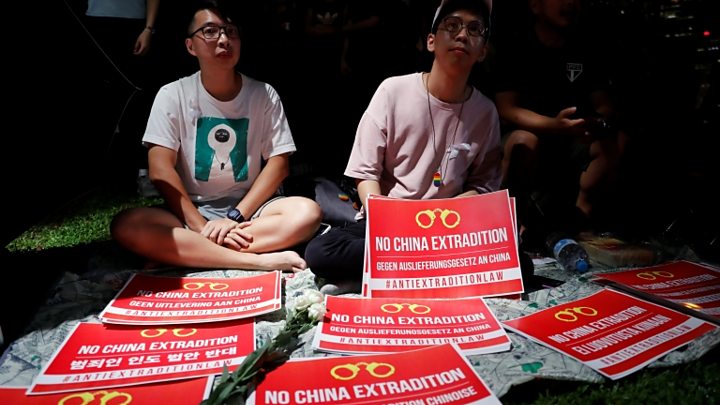
Last year’s mass protests in Hong Kong were sparked by a bill that would have allowed extraditions to mainland China.
Media caption Former Hong Kong governor Chris Patten: “UK should tell China this is outrageous”
The bill was paused, then withdrawn – but the protests continued until the virus outbreak at the end of the year.
The US has also weighed in, with President Trump saying the US would react strongly if it went through – without giving details.
It is currently considering whether to extend Hong Kong’s preferential trading and investment privileges.
Why is China doing this?
Mr Wang said the security risks had become “increasingly notable” – a reference to last year’s protests.
“Considering Hong Kong’s situation at present, efforts must be made at the state-level to establish and improve the legal system and enforcement mechanisms,” he is quoted as saying in state media.
Media caption The BBC’s Helier Cheung on Hong Kong’s 2019 protests
Beijing may also fear September’s elections to Hong Kong’s legislature.
If last year’s success for pro-democracy parties in district elections is repeated, government bills could potentially be blocked.
What is Hong Kong’s legal situation?
Hong Kong was under British control for more than 150 years up to 1997.
The British and Chinese governments signed a treaty – the Sino-British Joint Declaration – that agreed Hong Kong would have “a high degree of autonomy, except in foreign and defence affairs”, for 50 years.
This was enshrined in the Basic Law, which runs out in 2047.
BEIJING, April 28 (Xinhua) — China has achieved much progress in environmental protection and taken the lead in green development in recent years.
The efforts have exemplified Chinese President Xi Jinping’s proposal of “working together for a green and better future for all” made a year ago in his speech at the opening ceremony of the International Horticultural Exhibition 2019 Beijing.
In the keynote speech, Xi proposed a five-point initiative on promoting green development, namely pursuing harmony between man and nature, pursuing the prosperity based on green development, fostering a passion for nature-caring lifestyle, pursuing a scientific spirit in ecological governance, and joining hands to tackle environmental challenges.
China’s hard work on environment protection has paid off.
The ecological environment has improved significantly. People are enjoying more days of blue sky, cleaner water, and fertile land.
China has achieved the goal of zero growth of desertified land by 2030 set by the United Nations ahead of time. Besides, forest stock volume increased by 4.56 billion cubic meters compared with that of 2005.
Carbon dioxide emissions per unit of GDP in 2018 fell by 45.8 percent compared with that of 2005, exceeding the target set for the year.
After more than 30 years of hard work, the seventh largest desert in China, the Kubuqi Desert in Inner Mongolia Autonomous Region, once known as the “sea of death” difficult for birds to fly across, has turned into a green valley.
In January 2020, in a letter in reply to the student representatives of the Global Alliance of Universities on Climate, the Chinese president mentioned his thoughts about ecological civilization in his youth.
“Over four decades ago, I lived and worked for many years in a small village on the Loess Plateau in western China. Back then, the ecology and environment there was seriously damaged due to over-development and the local people were trapped in poverty as a result,” Xi wrote.
“This experience taught me that man and nature are a community of life and that the damage done to nature will ultimately hurt mankind,” said Xi.
China’s progress and achievements are recognized worldwide.
The ecological civilization and green development advocated by China are actually an endeavor to find a way to balance economic development and environmental protection, said John Cobb, Jr., the founding president of the Institute for Postmodern Development of China and member of the American Academy of Arts and Sciences.
Noting that the endeavor is a remarkable exploration, he expressed his hope that it will succeed.
China is on the right path in dealing with global climate change and achieving sustainable development, said Borge Brende, president of the World Economic Forum.
In addition to making efforts at home, China has also rolled out a series of measures to support the global combat against climate change.
In September 2015, ahead of the Paris climate change conference, Xi pledged a 20-billion-yuan (3-billion-U.S. dollars) China South-South Climate Cooperation Fund, which was dedicated to help other developing countries combat climate change.
China has also been fulfilling the obligations of the United Nations Framework Convention on Climate Change and the Paris Agreement, and achieved the goal of its intended nationally determined contributions submitted to the secretariat of the Climate Change Convention as scheduled.
UN Secretary-General Antonio Guterres expressed his appreciation for China’s important contributions to addressing the climate change and building a green “Belt and Road,” and said he expects China to continue to play a leading role in addressing the climate change and other issues.
“Lucid waters and lush mountains are invaluable assets,” a concept put forward by Xi in 2005 when he visited Yucun Village in southeast China’s Zhejiang Province as the party chief of the province, has become the motto of the Lao Ministry of Natural Resources and Environment.
In March 2020, when Xi returned to Yucun, he said that economic development should not be achieved at the expense of the ecological environment. To protect the ecological environment is to develop the productive forces, he said.
The history of civilizations shows that the rise or fall of a civilization is closely tied to its relationship with nature, Xi said at the International Horticultural Exhibition last year.
Only by joining hands can the humankind advance a global ecological civilization and march towards the bright future of building a community with a shared future for mankind.
‘He is a reality-show expert. This is a real crisis. The happy ending is not guaranteed,’ communications strategist says
Televised Oval Office address offered an ineffective remedy in the European travel ban and fell short on other policy recommendations, according to analysts
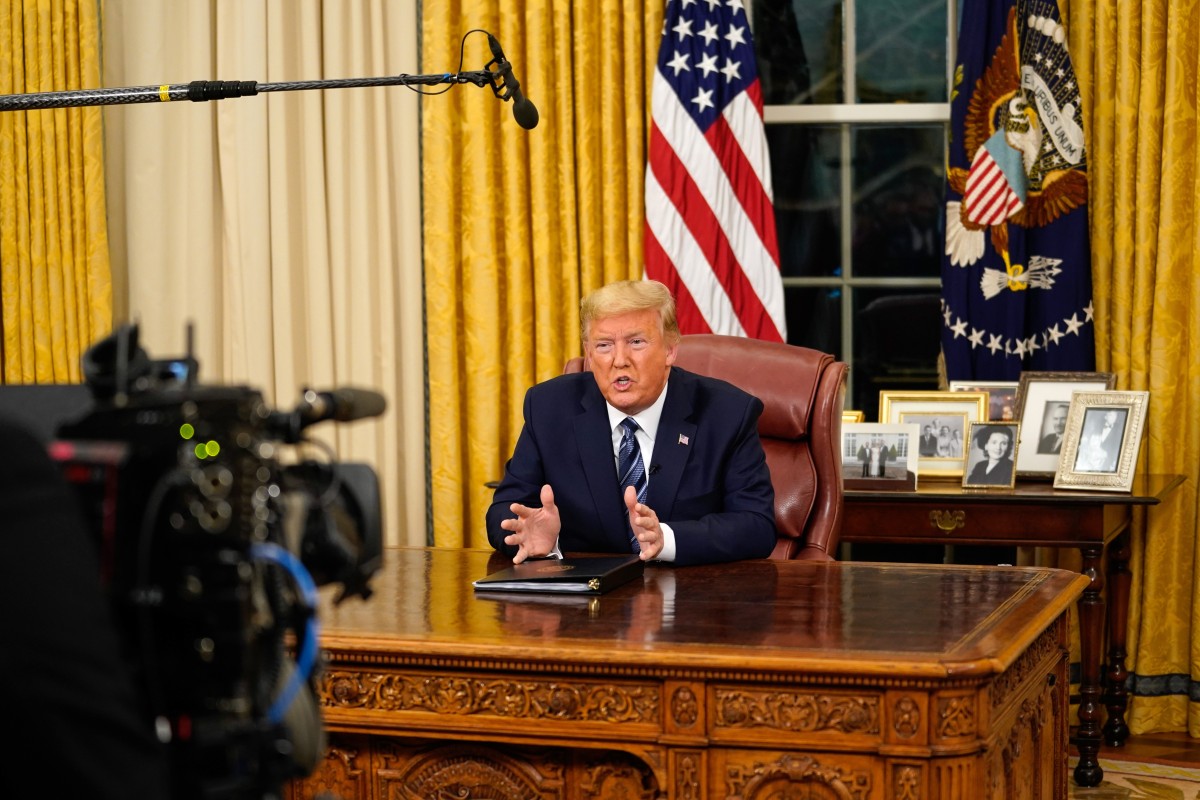
US President Donald Trump addresses the nation from the Oval Office of the White House on Wednesday night. Photo: Bloomberg
US President Donald Trump’s coronavirus address from the Oval Office on Wednesday night was meant to project confidence, show leadership in a time of crisis and otherwise reassure an anxious nation and world.
It didn’t work out that way, say health, government policy and crisis management experts, pointing in part to the 1,000-point drop in stock futures even before his 10-minute nationally televised speech was finished.
“You had an uncomfortable president who looked like he didn’t want to be there. He doesn’t want to be the leader that the country, if not free world, wants him to be in a crisis,” said Richard Levick, chief executive of Levick Strategic Communications.
“He is a reality-show expert,” Levick added. “This is a real crisis. The happy ending is not guaranteed. The applause line is not guaranteed. You have to actually lead. He doesn’t like that.”
Trump bans travel from Europe to the US as coronavirus pandemic hits actor Tom Hanks and the NBA
Public health experts say Trump’s announcement that the US was blocking all incoming visitors from Europe for 30 days will prove largely ineffective given that the virus is already firmly rooted in the US and spreading rapidly. And his efforts to reassure the public that testing is widely available, medical experts are fully deployed and face masks widely available was not convincing and a case of too little, too late, they added.
His speech, only his second Oval Office address, followed weeks of denying the gravity of the coronavirus, spreading misinformation, deflecting blame onto Democrats and the media and contradicting highly regarded experts, including Dr. Anthony Fauci, head of infectious diseases at the National Institutes of Health, observers said.
“He has such a bad track record, no one will believe him,” said JB Silvers, professor of health finance at Case Western University in Ohio. “He can’t help but make this a political thing. A Chinese virus? Viruses don’t have nationalities.”
“He could’ve ramped up testing much earlier,” Silvers added. “Instead he told people, ‘Don’t worry, go back to work.’ All the wrong things.”
New York bans gatherings of more than 500 on coronavirus fears
13 Mar 2020
Governments around the world have struggled to cope with the spread of the virus, prepare adequately and take lessons from China and South Korea, which were hit early.
But Trump’s speech also fell short from a policy standpoint, some said. Washington and the markets have been looking for direction, given the logjam and partisanship in Congress. That includes whether the president would support, albeit grudgingly, a Democratic package of economic stimulus measures, oppose specific parts or reject it outright in favour of a still unformed Republican plan.
“No one has a clear sign what he wants, what he will sign,” said Jeffrey Wright, North America analyst with EurAsia Group. “It was a massive failure, one of the least effective presidential prime-time addresses in my memory.”
Companies and markets hate uncertainty and want reassurance, which they’re not getting said Zhaohui Chen, associate professor of commerce at the University of Virginia. “Investors are worried about the policy, that it may cause more harm to the economy,” he said.
Communication and policy experts said there tend to be few obvious answers initially during a crisis, which puts a premium on relatively transparent leaders who can acknowledges what is known and unknown, build trust and work through complexities toward a solution.
“It’s not so much what he did last night, it’s what he did before. Never before has Trump’s habit of making events about himself hurt him until now,” said Eric Dezenhall, chief executive of public relations firm Dezenhall Resources.
“Standing with science officials and talk about how no one has seen such a scientific genius before him, that he should’ve become a doctor, we’re not selling time-shares in the Caymans,” he added.
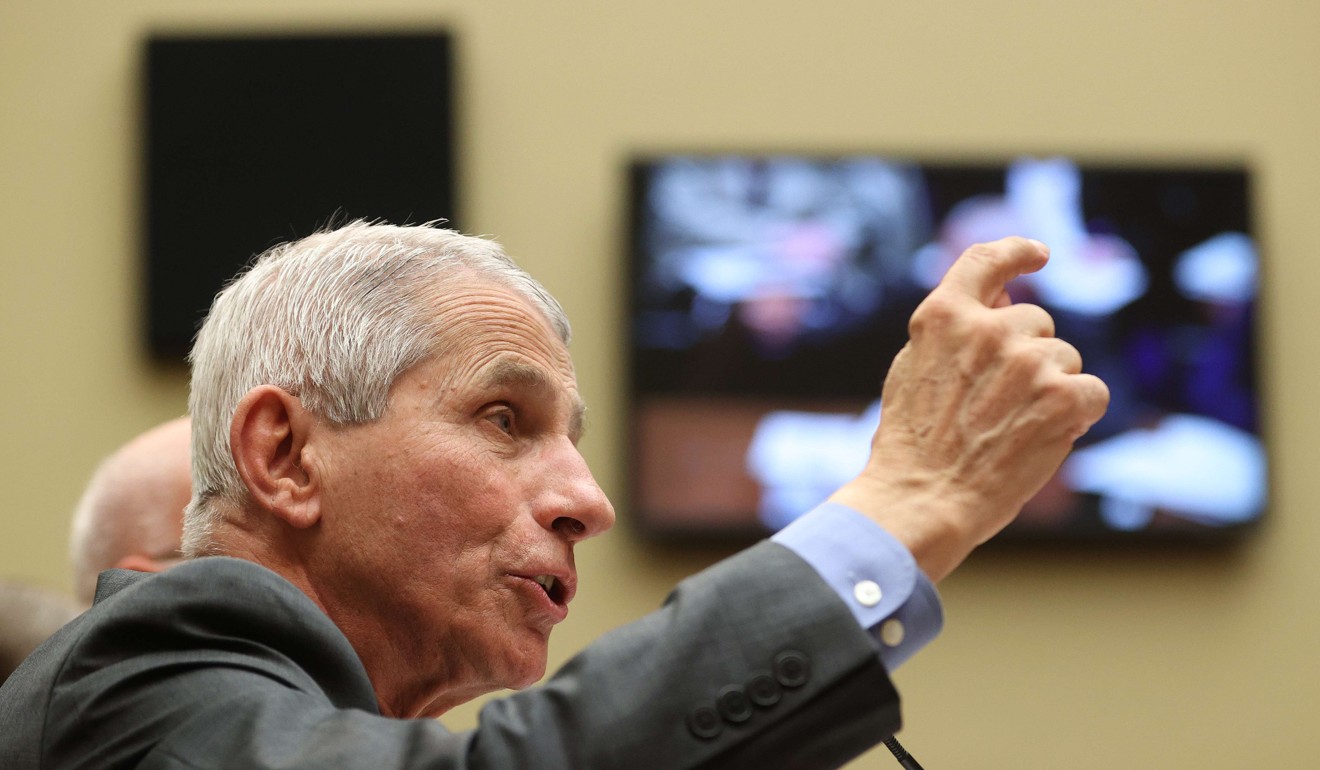
Anthony Fauci, director of the National Institute of Allergy and Infectious Diseases, testifies to lawmakers about coronavirus preparedness on Thursday. Photo: Getty Images/AFP
Leslie Rosenthal, a writer from New Jersey, said the speech failed to reassure her as an ordinary citizen, and seemed to focus on the wrong issues.
“What I wanted to hear from the president was a solution to what’s happening in this country right now,” she said. “While stopping people from coming into the country might do something, it’s about what’s going on here. Where are the test kits? Where are the viral hotspots? I’m placing my trust in Dr. Fauci.”
Trump is a skilled off-the-cuff orator at rallies, where he can energise and be energised by the crowd, communication experts said, and less adept at delivering prepared speeches, as seen on Wednesday night.
“He used a teleprompter, but still made misstatements in ways that rocked the market,” said Levick. Most notable was his statement that his administration was blocking not just people but all cargo from Europe, a statement his office quickly walked back shortly after the speech, he said.
White House orders secrecy for coronavirus meetings
12 Mar 2020
Also questionable was the decision to block travellers from the European continent but not from Britain, even though the UK is a global travel and financial hub.
“You can’t ban people from some countries and not others,” said Ron Waldman, a doctor, professor of global health and infectious disease specialist at George Washington University. “It makes no sense.”
Trump hoped the speech would build confidence in the US economy, its health care system and his leadership. “The virus will not have a chance against us,” he said. “No nation is more prepared.”
But many experts had a different view.
“We’re clearly unprepared,” said Ali Khan, epidemiology professor at the University of Nebraska Medical Center and a former director at the Centres for Disease Control and Prevention.
“We don’t even need to talk about a pandemic,” he said, adding that even a bad flu outbreak would swamp American hospitals.
Trump vows to ‘take care’ of citizens and economy as coronavirus cases rise in the US
After playing down the economic and health risks from the coronavirus for weeks, the Trump administration kicked into gear on Monday, floating a blizzard of proposals to stimulate the economy. These include expanding loans to small businesses, increasing paid sick leave and extending tax relief for the hospitality industry. The White House and congressional leaders are now trying to hammer out an economic relief bill.
Trump’s turnaround reflects, in part, a growing realisation that the disease is real, can’t be tweeted away, can’t be blamed on political opponents and seriously threatens his re-election prospects.
“He’s definitely worried,” said Silvers. “All those ‘Democratic viruses’ are going to cause him trouble.”
BEIJING, Oct. 4 (Xinhua) — Chinese President Xi Jinping’s speech during Tuesday’s National Day celebrations was warmly embraced across the globe, with politicians and experts in different parts of the world expressing support for China’s social and economic development.
“China’s yesterday has been inscribed in human history while China’s today is being created in the hands of hundreds of millions of Chinese people,” Xi said. “China will surely have an even brighter future.”
Marcelo Abi-Ramia Caetano, secretary general of the International Social Security Association, said Xi’s speech briefly summarized the “remarkable socio-economic progress” achieved by the People’s Republic of China (PRC) over the past 70 years.
“In terms of social protection, China serves as an excellent example in extending social security coverage and improving social security administration, and has much to share with the rest of the world,” he added.
The “overarching theme” of China’s National Day celebrations is “a comprehensive and integrated vision of why China’s system works so well for China, and how, at the same time, it benefits the world,” said Robert Kuhn, a leading U.S. expert on China.
China’s goal is “to improve the standards of living of all its citizens, and then to share the fruits of such development with the world in various forms,” added Kuhn, also chairman of the Kuhn Foundation.
“China’s role in the world has increased and (the) PRC has been making an important contribution to global governance and its needed reforms,” said Fabio Massimo Parenti, an Italian scholar of international studies at the International Institute Lorenzo de’ Medici.
The China-proposed Belt and Road Initiative is “for the entire world” and has received support from countries across the globe, he added.
Mahmoud Raya, director of the Lebanese website “China in Arab Eyes,” said Xi’s speech reflected strength and hope.
The strength comes from the glorious history of the Chinese nation and the confidence of the younger generation in their future, he added.
Xi’s speech showed “solid confidence that China has,” and revealed “future directions that China will follow,” said Do Tien Sam, former director of the Institute of Chinese Studies under the Vietnam Academy of Social Sciences.
Image copyright EPAImage caption China is getting dressed up for its big birthday party
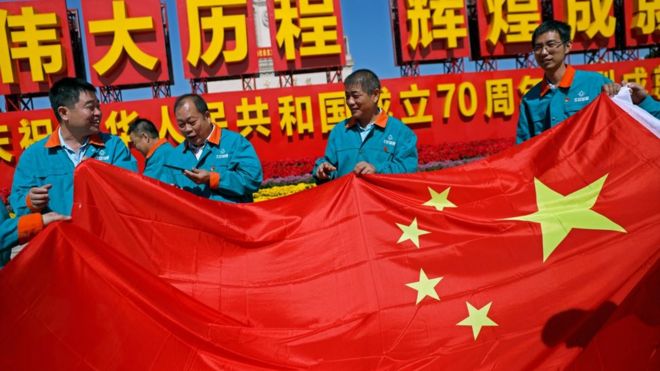
One week from now, the People’s Republic of China will mark its 70th anniversary with celebrations on a scale not seen in China in decades.
Beijing is pulling out all stops and 1 October will be flush with fireworks, fanfare and a huge military parade.
To ensure it goes smoothly, authorities have been ramping up security in the capital – and online – for weeks.
But with yet more protests expected in Hong Kong, the territory might just rain on China’s parade.
What is it all about?
The birth of modern China was declared on 1 October 1949, after the communists under Mao Zedong won the civil war that followed World War Two.
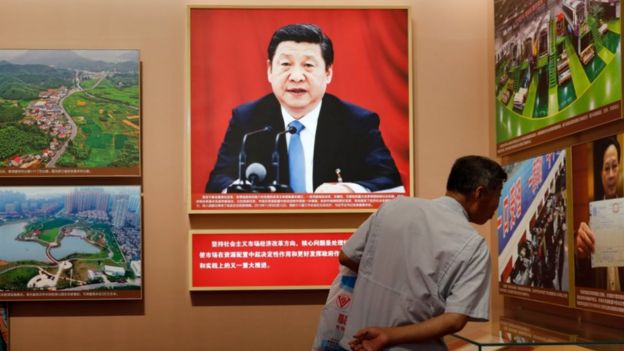
Image copyright EPAImage caption Exhibitions are highlighting the achievements of the Communist Party
The date is marked every year, but celebrations for this 70th anniversary are expected to eclipse previous events.
It’s the first big anniversary since China has emerged as a global power. While 10 years ago China was a superpower in the making, it is now the world’s second largest economy, almost eye-to-eye with the United States.
What to expect?
The main celebrations will take place in the capital, Beijing, where there will be a grand military parade with “advanced weapons” on display, followed by a “mass pageant”.
President Xi Jinping – considered the most powerful Chinese leader since Mao – will address the Chinese people. His speech is expected to celebrate China’s rapid growth and which will be closely watched for any indication of the country’s direction in the coming years.
The president will also hand out honours for contributions to the country and in the evening there will be a grand gala and fireworks show.
All official Chinese celebrations are carefully choreographed and the success of this one is particularly important to the government.
The Dos and Don’ts
The parade – open to invited guests only – will take place around Tiananmen Square in central Beijing. The surrounding area will be practically under lockdown, and in fact has been so several times already.
During rehearsals leading up to the big day, hotels near Tiananmen Square told guests that for several hours each day, no-one would be able to leave the hotel or return to it should they be out, leading to much travel chaos and rebookings.
Many shops and restaurants in the centre are also closed or have shortened hours and some subway stations are temporarily shut.
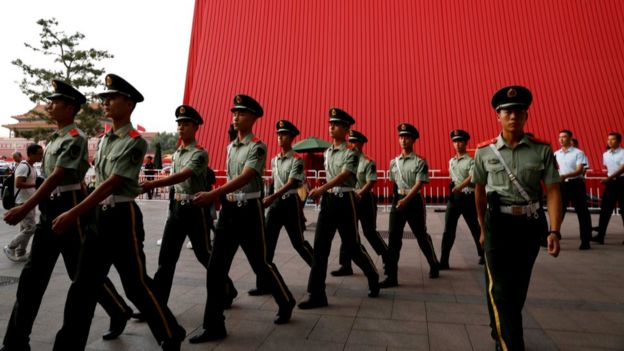
Image copyright EPAImage caption Security is tight ensure the party goes to plan
Trains to Beijing are running numerous safety checks on their passengers and vehicles going into the city are also being tightly watched.
On the big day itself, areas around Tiananmen Square will be blocked and guarded. Local residents will need to identify themselves if they want to pass.
To ensure the sun will shine brightly on the celebration in notoriously polluted Beijing, several coal plants and construction sites in and around the city have been ordered to stop work for the duration.
There’s also a ban on any low-flying aerial vehicles in place. That means anything from light aircraft to drones, balloons and even racing pigeons.
Censorship galore
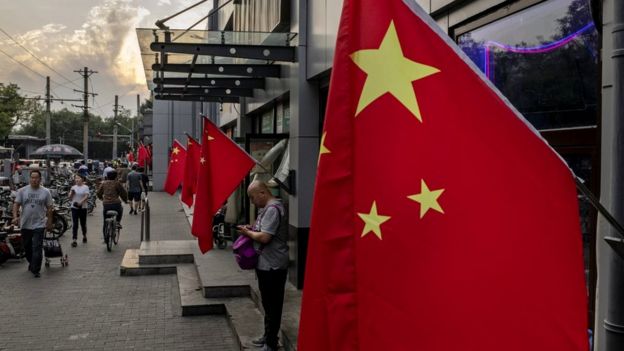
Across much of the city centre, there are national flags set up at every door. Voluntary inspectors are monitoring the streets and locals have told the BBC they’re being questioned after having even brief conversations with foreigners
One person said she was asked by an inspector: “Who were those foreigners? Why were they here?”
The tight control naturally extends online as well. Popular social media platform Weibo said it was deleting content that “distorts” or “insults” the country’s history ahead of the anniversary.
Image copyright GETTY IMAGESImage caption Every house and every shop is sporting a national flag
Chinese journalists are always expected to toe the party line anyway, but starting in October they will have to pass an extra test to prove they are versed particularly in Xi Jinping’s teachings, officially called Xi Jinping Thought on Socialism with Chinese Characteristics, which has been written into the constitution.
Whether or not they pass the exam will then determine whether they’ll be accredited as journalists.
“The fundamental point with this ‘training’ and indoctrination process isn’t so much about the content,” David Bandurski of China Media Watch told the BBC.
“It is about reinforcing the message and understanding among journalists that they work, first and foremost, for the Chinese Communist Party, and serve its agenda.”
So not only will the events be choreographed – the domestic coverage of them will also be tightly guarded.
What about Hong Kong?
Despite Beijing’s determination to let its achievements shine on 1 October, there’s a good chance Hong Kong will pull focus.
Anti-Beijing protests always take place in Hong Kong on China’s National Day, but this time, the activists know that the world is watching.
Anti-government protests have rocked the city for months and the situation shows no sign of dying down.
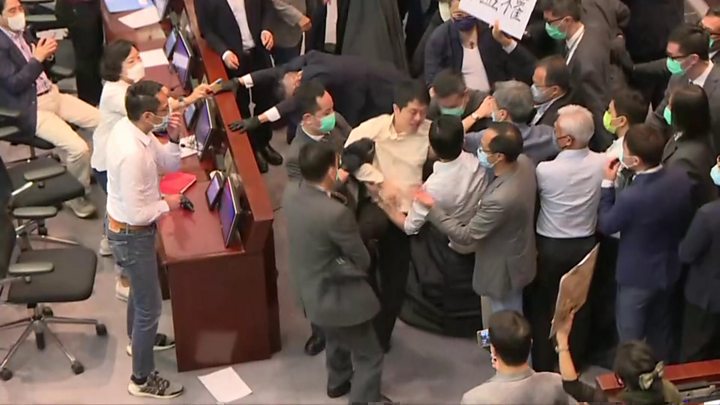
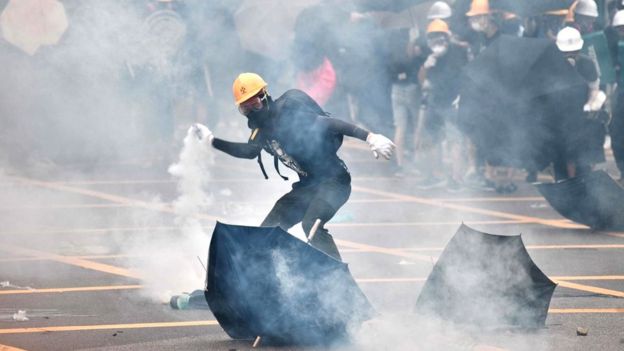
Clashes between police and activists have been becoming increasingly violent, with police using tear gas and activists storming parliament.
Image copyright AFPImage caption The protests have often escalated into violent clashes
That means two things for 1 October: official celebrations in the territory are being toned down to avoid clashes – the annual fireworks display has been cancelled – while at the same time, activists are planning to step up their protests.
On Sunday 29 September, a “Global Anti Totalitarianism March” is scheduled to take place at various locations around the world in support of Hong Kong.
On 1 October itself, a march in central Hong Kong is planned with everyone asked to wear black.
If the past weeks’ demonstrations are anything to go by, the smiles and celebrations in Beijing will be competing for media space with pictures of tear gas and angry young protesters in Hong Kong.
US President Donald Trump and Indian Prime Minister Narendra Modi exchanged warm words of friendship in Texas at a rare mass rally for a foreign leader.
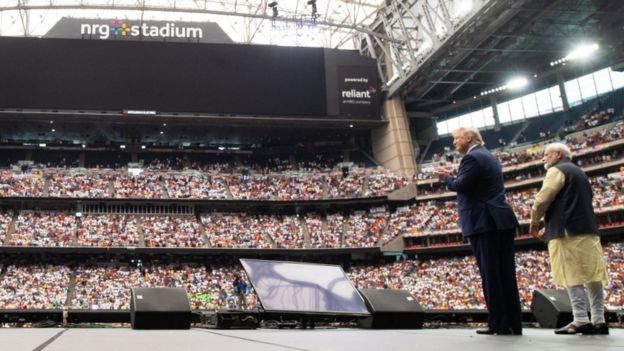
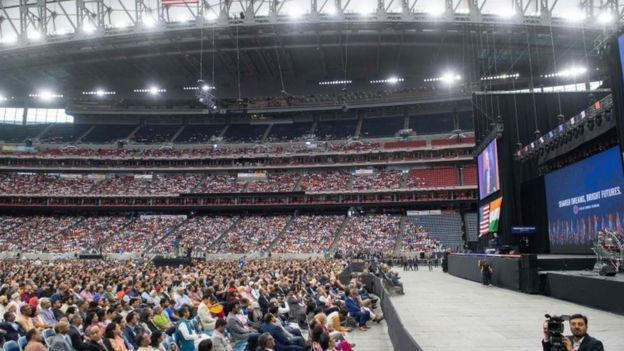
Around 50,000 people gathered for what Mr Trump called a “profoundly historic event” on Sunday in Houston.
The “Howdy, Modi!” event was billed as one of the largest ever receptions of a foreign leader in the US.
Mr Modi, however, may face a frostier reception at the UN General Assembly.
He is likely to face criticism over tensions in Indian-administered Kashmir, which he stripped of its special status last month, promising to restore the region to its “past glory”.
The region has been in lockdown for more than a month with thousands of activists, politicians and business leaders detained.
Trade talks and the UN General Assembly are on the Indian prime minister’s agenda during his week-long visit to the United States.
Pakistani Prime Minister Imran Khan, who has been the most vocal international leader to oppose India’s Kashmir move, is also in the US for the UN conference. Like Mr Modi, he will have a one-on-one meeting with Mr Trump on the sidelines of the summit.
A 90-minute show, featuring 400 performers, warmed up the crowd before Mr Modi and Mr Trump shared the stage.
“I’m so thrilled to be here in Texas with one of America’s greatest, most devoted and most loyal friends, Prime Minister Modi of India,” Mr Trump told the crowd.
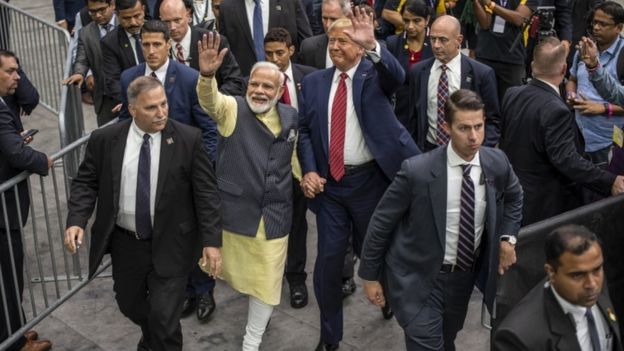
Image copyright GETTY IMAGESImage caption Narendra Modi and Donald Trump leave the stage holding hands at Houston’s NRG Stadium
In his speech, Mr Modi said India has a “true friend” in the White House, describing Mr Trump as “warm, friendly, accessible, energetic and full of wit”.
“From CEO to commander-in-chief, from boardrooms to the Oval Office, from studios to the global stage… he has left a lasting impact everywhere,” Mr Modi said.
Personal-touch diplomacy played to perfection
Brajesh Upadhyay, BBC News, Houston
This was exactly the kind of crowd size and energy President Trump loves at his rallies.
Only here the chants were for Indian Prime Minister Narendra Modi and Mr Trump was the superstar invited to the party. But the crowd did not disappoint him either and greeted him with chants of “USA!”, most heard at Trump rallies.
The personal-touch diplomacy with Mr Modi’s trademark bear hugs was played to perfection.
This rally has been called a win-win for both the leaders. For President Trump, it was a chance to court Indian-Americans for the 2020 presidential election race where Texas could emerge as a battleground state. For Mr Modi, a PR triumph and picture with the president of the United States may help him shrug off the criticism over his recent strong-arm policies at home.
Houston’s NRG Stadium, where the event was hosted, was the first stop for Mr Modi, whose Hindu nationalist Bharatiya Janata Party (BJP) won a landslide victory in this year’s Indian elections.
Greeted by a standing ovation, Mr Trump used his speech to heap praise on Mr Modi, who he said was doing a “truly exceptional job for India” and its people.
Mr Trump also paid tribute to the Indian-American community, telling them “we are truly proud to have you as Americans”.
The US has a population of about 4 million Indians who are seen as an increasingly important vote bank in the country.
Apart from Mr Trump, organisers also invited Democrats to the event – House Majority Leader Steny Hoyer was among those who spoke.
The 2010 US census shows that Texas is home to the fourth-largest Indian-American population in the country after California, New York and New Jersey.
Analysis of voting patterns shows the community tends overwhelmingly to support the Democrat party.
Image copyright GETTY IMAGESImage caption The event, dubbed “Howdy, Modi!”, was attended by an estimated 50,000 people
No stranger to nationalist rhetoric himself, Mr Trump compared security at the US-Mexico border to the tensions between India and Pakistan in the tinderbox Kashmir region.
“Both India and US also understand that to keep our communities safe, we must protect our borders,” Trump said.
Image copyright GETTY IMAGESImage caption Donald Trump described Narendra Modi as one of America’s most “loyal friends”
In India, the rally was closely watched, with most mainstream media outlets running live news updates of what was transpiring on stage.
The event had been making headlines for days before as well.
On Twitter, many people shared instant analysis and opinions of what was taking place on the stage with the sentiment being overwhelmingly positive. Many praised Mr Modi for what they saw as his statesmanship and diplomatic acumen with a lot of praise coming in for the US president as well.


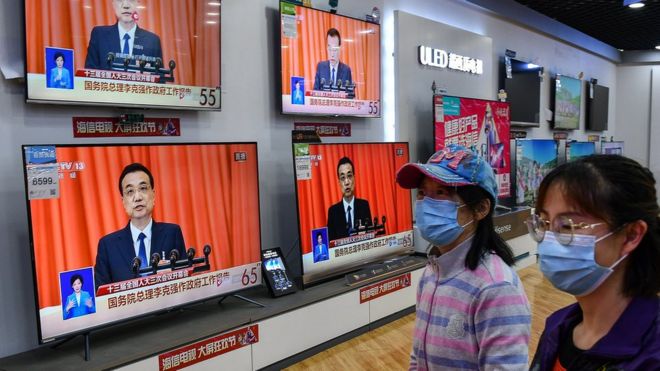 Image copyright AFP / GETTY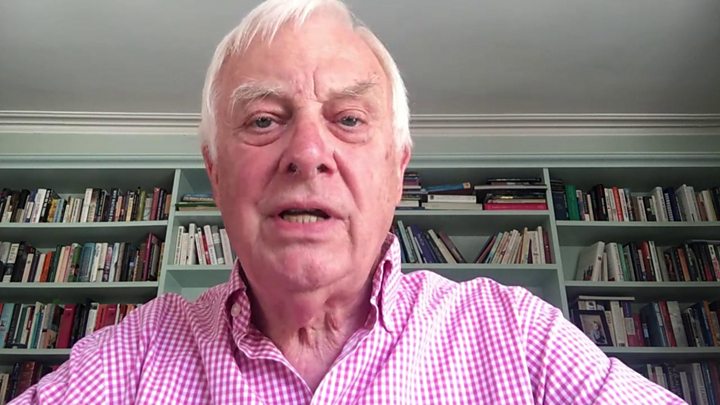


 CHINDIA ALERT: You'll be living in their world, very soon