Chindia Alert: You’ll be Living in their World Very Soon
aims to alert you to the threats and opportunities that China and India present. China and India require serious attention; case of ‘hidden dragon and crouching tiger’.
Without this attention, governments, businesses and, indeed, individuals may find themselves at a great disadvantage sooner rather than later.
The POSTs (front webpages) are mainly 'cuttings' from reliable sources, updated continuously.
The PAGEs (see Tabs, above) attempt to make the information more meaningful by putting some structure to the information we have researched and assembled since 2006.
KOLKATA (Reuters) – Indian and Chinese troops on border patrol duties had a brief skirmish in Sikkim, a northeastern Indian state bordering China, the Indian Defence Ministry said on Sunday, blaming both sides for the incident.
“Aggressive behaviour by the two sides resulted in minor injuries to troops. The two sides disengaged after dialogue and interaction at the local level,” the ministry said in a statement.
The Indian daily Hindustan Times, citing a military source, said four Indian soldiers and seven Chinese troops were injured when some of the soldiers exchanged blows during the confrontation, which it said took place on Saturday and involved some 150 soldiers.
The Defence Ministry said the incident took place in the Nakula area but did not give details of how it started, or what caused the injuries.
China’s Ministry of Defense could not be immediately reached for comment on Sunday.
India and China have often accused each other of intrusions into each other’s territories, but clashes are rare.
There is still deep mistrust between the two countries over their festering border dispute, which triggered a brief war in 1962.
Hundreds of troops from both sides were deployed in 2017 on the Doklam plateau, near the borders of India, Bhutan, and China after India objected to Chinese construction of a road in the Himalayan area, in the most serious standoff in years.
Image copyright ANIImage caption Millions of people across India have been stranded by the lockdown
The first train carrying migrant workers stranded by a nationwide lockdown in India has left the southern state of Telangana.
The 24-coach train, carrying 1,200 passengers, is travelling non-stop to eastern Jharkhand state.
Earlier this week, India said millions of people stranded by the lockdown can return to their home states.
The country has been in lockdown to curb the spread of coronavirus since 24 March.
However, the movement of people will be only possible through state government facilitation, which means people cannot attempt to cross state borders on their own.
This train is a “one-off special train” to transport the workers on the request of the Telangana state government, Rakesh Ch, the chief public relations officer of South-Central Railways, told the BBC.
The train left Lingampally, a suburb of the southern city of Hyderabad, early on Friday and is expected to reach Hatia in Jharkhand on Saturday.
Mr Rakesh said that adequate social distancing precautions had been taken and food was being served to the passengers.
Image copyright ANIImage caption Railways officials said that adequate social distancing precautions had been taken and food was being served to the passengers.
He said each carriage was carrying 54 passengers instead of its 72-seat capacity.
“The middle berth is not being used in the sleeper coaches and only two people are sitting in the general coaches,” Mr Rakesh said.
Before the train pulled out of the station, all the passengers were screened for fever and other symptoms.
They had all been employed at a construction site at the Indian Institute of Technology, a top engineering school, in Hyderabad city.
The workers had earlier protested at the site against the non-payment of wages by their contractor.
Senior official M Hanumantha Rao said the contractor was asked to pay their salaries and arrangement made to send them back home.
The journey was organised at “very short notice”, senior police official S Chandra Shekar Reddy told BBC Telugu.
“We screened them at the labour camp itself and transported them to the railway station in buses,” he said.
India’s migrant workers are the backbone of the big city economy, constructing houses, cooking food, serving in eateries, delivering takeaways, cutting hair in salons, making automobiles, plumbing toilets and delivering newspapers, among other things.
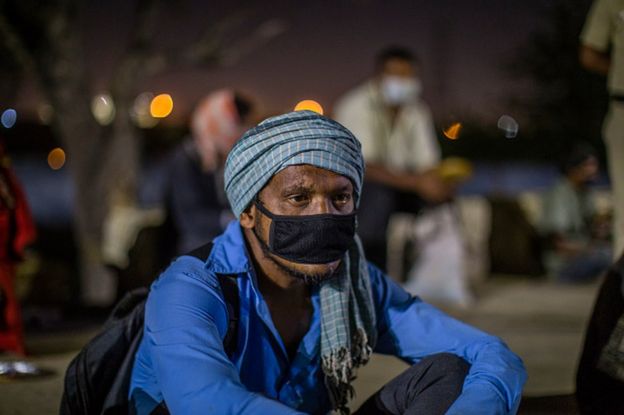
Image copyright ANIImage caption Before the train pulled out of the station, all the passengers were screened for fever and other symptoms.
Most of the country’s estimated 100 million migrant workers live in squalid conditions.
When industries shut down overnight, many of them feared they would starve.
For days, they walked – sometimes hundreds of kilometres – to reach their villages because bus and train services were shut down overnight. Several died trying to make the journey.
Some state governments tried to facilitate buses, but these were quickly overrun. Thousands of others have been placed in quarantine centres and relief camps.
SEOUL (Reuters) – South Korean and Chinese officials on Tuesday cast doubt on reports North Korean leader Kim Jong Un was ill after media outlets said he had undergone a cardiovascular procedure and was in “grave danger”.
Daily NK, a Seoul-based speciality website, reported late on Monday, citing one unnamed source in North Korea, that Kim was recovering after undergoing the procedure on April 12. The North Korean leader is believed to be about 36.
CNN cited a U.S. official with direct knowledge of the matter as saying Washington was “monitoring intelligence” that Kim was in grave danger after surgery. Bloomberg quoted an unnamed U.S. official as saying the White House was told that Kim took a turn for the worse after the surgery.
However, two South Korean government officials rejected the CNN report without elaborating on whether Kim had undergone surgery. The presidential Blue House said there were no unusual signs coming from the reclusive, nuclear-capable state.
Kim is the unquestioned leader of North Korea and the sole commander of its nuclear arsenal. He has no clear successor and any instability in the country could be a major international risk.
RELATED COVERAGE
Factbox: Questions hang over North Korea succession amid reports on Kim health
The state KCNA news agency gave no indication of the whereabouts of Kim in routine dispatches on Tuesday, but said he had sent birthday gifts to prominent citizens.
An official at the Chinese Communist Party’s International Liaison Department, which deals with North Korea, told Reuters the source did not believe Kim was critically ill. China is North Korea’s only major ally.
Chinese foreign ministry spokesman Geng Shuang said Beijing was aware of reports about the health of Kim, but said it does not know their source, without commenting on whether it has any information about the situation.
South Korean shares exposed to North Korea tumbled and the Korean won fell on the reports. The won traded down more than 1% against the dollar even as South Korean government sources said Kim was not gravely ill.
U.S. stock futures were trading 0.5% lower, but it was not clear how much of that weakness was owing to the collapse in U.S. oil prices and consequent concerns over global demand.
Daily NK said Kim had been admitted to hospital on April 12, just hours before the cardiovascular procedure, as his health had deteriorated since August due to heavy smoking, obesity and overwork.
It said he was now receiving treatment at a villa in the Mount Myohyang resort north of the capital Pyongyang.
“My understanding is that he had been struggling (with cardiovascular problems) since last August but it worsened after repeated visits to Mount Paektu,” a source was quoted as saying, referring to the country’s sacred mountain.
Accompanied by senior North Korean figures, Kim took two well-publicised rides on a stallion on the snowy slopes of the mountain in October and December.
KIM’S HEALTH KEY TO STABILITY
An authoritative U.S. source familiar with internal U.S. government reporting on North Korea questioned the CNN report that Kim was in “grave danger”.
“Any credible direct reporting having to do with Kim would be highly compartmented intelligence and unlikely to leak to the media,” a Korea specialist working for the U.S. government said on condition of anonymity.
Japan’s top government spokesman, Yoshihide Suga, declined to comment on the reports of Kim’s health.
“We are regularly gathering and analysing information about North Korea with great concern,” he said. “We will keep gathering and analysing information regarding North Korea by collaborating with other countries such as the U.S.”
Kim’s potential health issues could fuel uncertainty over the future of the reclusive state’s dynastic rule and stalled denuclearisation talks with the United States, issues in which Kim wields absolute authority.
With no details known about his young children, analysts say his sister and loyalists could form a regency until a successor is old enough to take over.
Speculation about Kim’s health first arose following his absence from the anniversary of the birthday of its founding father and Kim’s grandfather, Kim Il Sung, on April 15.
On April 12, North Korean state media reported that Kim Jong Un had visited an airbase and observed drills by fighter jets and attack aircraft.
Two days later North Korea launched multiple short-range anti-ship cruise missiles into the sea and Sukhoi jets fired air-to-surface missiles as part of military exercises.
The missile launches were part of the celebrations for Kim’s grandfather, Seoul officials said, but there was no North Korea state media report on his attendance or the tests.
Reporting from inside North Korea is notoriously difficult, especially on matters concerning the country’s leadership, given tight controls on information. There have been false and conflicting reports in the past on matters related to its leaders.
Kim is a third-generation hereditary leader who rules North Korea with an iron-fist, taking over the titles of head of state and commander in chief of the military since late 2011.
In recent years Kim has launched a diplomatic offensive to promote both himself as a world leader and his hermit kingdom, holding three meetings with U.S. President Donald Trump, four with South Korean President Moon Jae-in and five with China’s President Xi Jinping.
He was the first North Korean leader to cross the border into South Korea to meet Moon in 2018. Both Koreas are technically still at war, as the Korean War of 1950-53 ended in an armistice, not a peace treaty.
Kim has sought to have international sanctions against his country eased, but has refused to dismantle his nuclear weapons programme, a steadfast demand by the United States.
Image copyright GETTY IMAGESImage caption Indore is a bustling commercial city
In early March, 40-year-old Ravi Dosi, a chest specialist in India, saw a baffling surge in patients with respiratory problems at outpatient clinics.
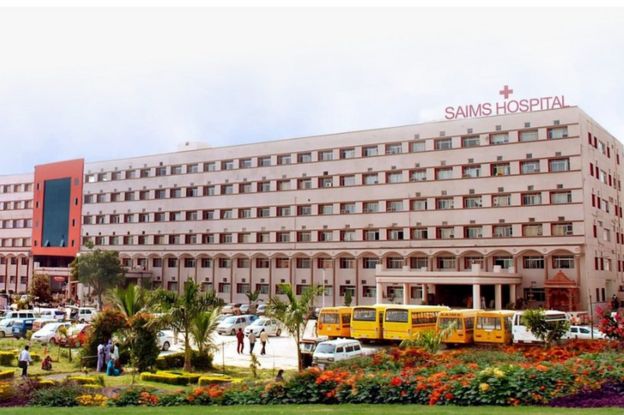
“There was almost a 50% jump in patients with upper respiratory issues and sore throat. They were not responding to antibiotics. Testing was still low and we didn’t really know what was going on,” Dr Dosi, who works at Sri Aurobindo Institute of Medical Sciences, a 1,156-bed private medical college in the central city of Indore, told me.
Less than a fortnight later, Dr Dosi began seeing an uptick in admissions of Covid-19 patients. Around the end of March, the hospital was receiving 28 infected patients every day.
They had dry cough, fever, and difficulty breathing. Their blood oxygen levels were low. They were reporting loss of taste and smell.
In the first wave of patients, nearly a dozen came from far-flung districts, more than 150km (93 miles) from Indore, a bustling commercial city in Madhya Pradesh state. The state has now become a hotspot, with nearly 400 confirmed infections out of the more than 6,400 infections and nearly 200 deaths across the country so far.
By the second week of April, Dr Dosi and his team of 100 doctors and nearly an equal number of nursing staff working 24/7 in three shifts, were treating 144 Covid-19 patients. (Thirty-one had been treated and sent home already.)
A total of 38 patients were in intensive care. Twenty-one of them were critical. There had been seven deaths. “We are handling the largest number of Covid-19 patients in India,” Vinod Bhandari, a surgeon and chairman of the hospital, told me.
Doctors now believe that the infection was spreading in the community long before the government admitted to it, and testing slowly ramped up. Until two weeks ago, Indian health authorities had been denying community transmission.
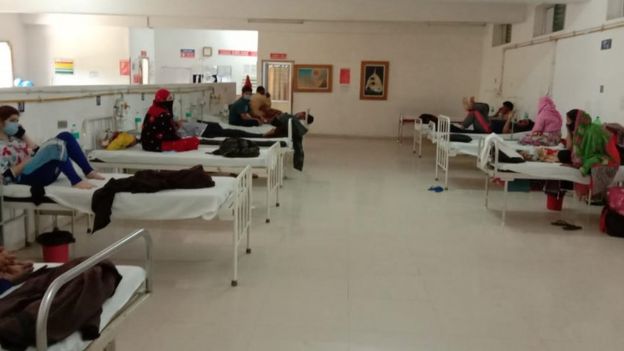
Image caption The hospital in Indore has more than 140 patients
Now a new study by Indian Council of Medical Research (ICMR) using surveillance data from 41 labs in the country has hinted at community transmission: 52 districts in 20 states and union territories reported Covid-19 patients. Some 40% of the cases did not report any history of international travel or contact with a known case. (The survey was based on swabs collected from nearly 6,000 patients who tested positive between 15 February and 19 March.)
Back in the hospital in Indore, the doctors are battling the surge in infections.
Three isolation wards spread over two floors floors are stacked with patients. (The hospital has earmarked 525 beds for Covid-19 patients.) Isolation wards have younger patients with mild infection, while elderly patients with more severe symptoms are in intensive care. The oldest patient is a 95-year-old man, and the youngest is a four-month-old boy.
The team of doctors handling patients includes chest specialists, anaesthetists, microbiologists, and dermatologists. There are patients with a lot of underlying medical conditions – diabetes, hypertension, even cancer – so all the specialists have been called in to help with the treatment.
Dr Dosi wakes up early, puts on protective gear – scrubs, face masks and shields, N95 masks, gowns, double gloves and shoe covers – before going on his rounds of the patients. Doctors say they are not facing a shortage of gear yet.
They are using 22 ventilators to help the critical patients breathe, and also providing oxygen supplies to others using nasal cannulas (nose prongs).
In the isolation wards, patients are given oral medication – antibiotics and hydroxychloroquine (commonly known as HCQ), an anti-malarial drug – and directed to maintain social distancing and wash their hands regularly.
Image caption The isolation wards are packed with patients
“I have never seen a challenge and crisis like this in my career. I have heard stories about an outbreak of plague in Surat [in 1994]. But this seems to be much bigger. The biggest challenge is to keep hopes alive and be positive,” says Dr Dosi.
Keeping hopes up for patients in isolation can be taxing. Three tests, say doctors, are being done for the infection – if the first test comes out positive, the patient remains in isolation for two weeks, and is tested twice on two days after the quarantine period. If the last two tests come back negative, the patient is discharged. If not, the patient has to stay in isolation for another two weeks. “It is a tough grind, mentally,” says one doctor.
For the last three weeks, Dr Dosi has been living in the hospital, away from his wife, two sons and parents. His father is a retired pathologist. They communicate via hurried video calls, between his frantic trips to the isolation wards and intensive care.
I ask him when does he expect this to “get over”, so that he can go home.
“In a couple of weeks,” he says. “The lockdown should have helped to slow down the infection.”
Dr Dosi is alluding to the strict 21-day lockdown India imposed on 24 March to halt the spread of the infection.
Image copyright GETTY IMAGESImage caption Health officials have been denying community transmission
Things are getting better, he says.
“I am getting 10 patients for admission in isolation wards, and two patients severe enough for intensive care every day now. Earlier this week, it was 50:50.”
It is possibly too early to hazard a guess about when admissions will slow down to single digits. As more people are tested, the number of patients can easily rise again.
It’s been unrelenting, Dr Dosi says.
Early, on Friday, I sent him a text to find out what was going on.
India has formally divided the state of Jammu and Kashmir into two new federally-administered territories.
In the new arrangement, Jammu and Kashmir is one territory, and Ladakh, which borders China, is separate.
The two new union territories are now ruled directly from the capital Delhi.
It’s part of a controversial move announced in August to tighten the Indian government’s control over the part of Kashmir it administers.
R K Mathur and Girish Chandra Murmu were sworn in as lieutenant governors of Ladakh and Jammu and Kashmir respectively on Thursday.
“Now the real participation of co-operative federalism will be seen. New highways, new railway lines, new schools, new hospitals will take the development of the people of Jammu and Kashmir to new heights,” Prime Minister Narendra Modi said at a public rally in the western state of Gujarat.
Union territories have far less autonomy from the federal government than states do.
The former state has long been one of the world’s most dangerous flashpoints and is a highly militarised area.
India and Pakistan both claim Kashmir in full, but control only parts of it.
How does this affect the people there?
Almost 98% of the state’s population will be in the union territory of Jammu and Kashmir, comprising two regions – the Muslim-majority Kashmir valley, which has about eight million people, and the Hindu-majority Jammu, which has about six million.
The third region, the newly created union territory of Ladakh, is a high-altitude desert inhabited by 300,000 people, with almost equal numbers of Muslims and Buddhists.
Workers from the previous state government will continue to retain their jobs in the new territories, the government said.
What’s the background?
On 5 August, the government revoked Kashmir’s special status, sparking protests in the Muslim-majority valley.
Article 370, as the constitutional provision guaranteeing special status was known, allowed the region a certain amount of autonomy, including special privileges in property ownership, education and jobs. This provision had underpinned India’s often fraught relationship with Kashmir.
Before the Bharatiya Janata Party-led government announced its decision to scrap the special status, it put the region under lockdown – mobile phone networks, landlines and the internet were cut off; and regional political leaders were placed under house arrest.
Media caption The children being ‘tortured’ in Kashmir
The region also witnessed protests where security forces often clashed with civilians. Thousands of activists and others were believed to have been picked up from their homes in the days that followed the surprise move.
Almost three months later, the situation is still far from normal.
On Tuesday, militants killed five migrant labourers in Kulgam district. Just a day before, a truck driver from outside the region was killed in Anantnag district.
Earlier this month, the Indian government restored mobile services 72 days after they were suspended.
But internet services continue to be suspended and most businesses remain closed – some in protest against the government, and others for fear of reprisals from militants opposed to Indian rule.


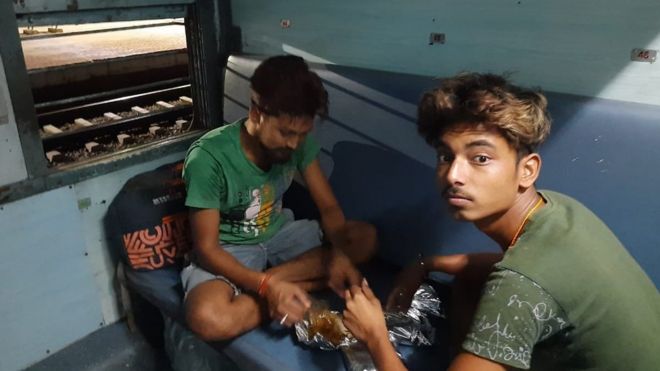 Image copyright ANI
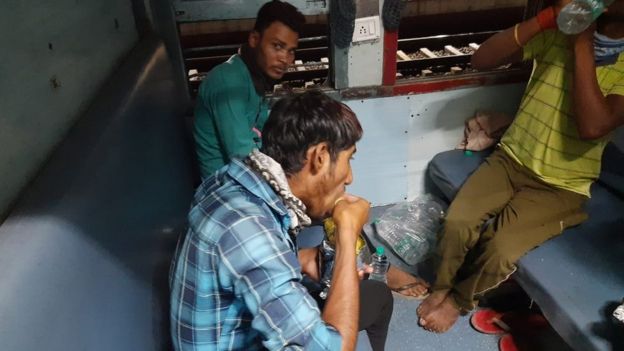 Image copyright ANI
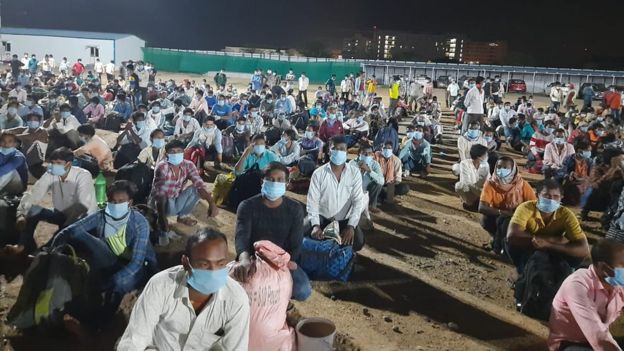 Image copyright ANI



 CHINDIA ALERT: You'll be living in their world, very soon
Indian, Chinese border troops in brief skirmish on northeast Indian border, India says
KOLKATA (Reuters) – Indian and Chinese troops on border patrol duties had a brief skirmish in Sikkim, a northeastern Indian state bordering China, the Indian Defence Ministry said on Sunday, blaming both sides for the incident.
“Aggressive behaviour by the two sides resulted in minor injuries to troops. The two sides disengaged after dialogue and interaction at the local level,” the ministry said in a statement.
The Indian daily Hindustan Times, citing a military source, said four Indian soldiers and seven Chinese troops were injured when some of the soldiers exchanged blows during the confrontation, which it said took place on Saturday and involved some 150 soldiers.
The Defence Ministry said the incident took place in the Nakula area but did not give details of how it started, or what caused the injuries.
China’s Ministry of Defense could not be immediately reached for comment on Sunday.
India and China have often accused each other of intrusions into each other’s territories, but clashes are rare.
There is still deep mistrust between the two countries over their festering border dispute, which triggered a brief war in 1962.
Hundreds of troops from both sides were deployed in 2017 on the Doklam plateau, near the borders of India, Bhutan, and China after India objected to Chinese construction of a road in the Himalayan area, in the most serious standoff in years.
Source: Reuters
Posted in 1962, 2017, accused, aggressive, behaviour, Bhutan, blaming, border, bordering, both, brief, China, China’s, Chinese, citing, clashes, comment, confrontations, Construction, countries, daily, deep, defence ministry, deployed, details, dialogue, disengaged, dispute, duties, festering, four, Himalayan, Hindustan Times, hundreds, immediately, incident, India, Indian, Indian soldiers, injured, injuries, interaction, intrusions, involved, Kolkata, level, local, Military, ministry, Ministry of Defense, minor, mistrust, Nakula, Northeast, Northeastern, patrol, rare, reached, resulted, roads, Saturday, serious, seven, sides, Sikkim, skirmish, source, standoff, state, statement, Sunday, territories, triggered, troops, two, Uncategorized, war, years | Leave a Comment »