29/05/2020
BEIJING, May 29 (Xinhua) — President Xi Jinping on Friday encouraged scientific and technological workers across China to make new and greater contributions to building China into a global power in science and technology.
Xi, also general secretary of the Communist Party of China Central Committee and chairman of the Central Military Commission, made the remarks in replying to a letter by 25 representatives of sci-tech workers. He also called for efforts to achieve breakthroughs in key and core technologies.
Xi extended greetings to sci-tech workers across the country ahead of China’s fourth national sci-tech workers’ day, which falls on May 30.
A vast number of sci-tech workers have dedicated themselves to serving the country through their innovative thinking and practices, Xi noted.
He pointed out that innovation is the primary driving force for development, and science and technologies are powerful tools to overcome difficulties.
Facing the sudden COVID-19 outbreak, sci-tech workers have risen up to challenges and worked day and night on the clinical treatment, vaccine research and development, material support as well as big data application, providing sci-tech support against the epidemic, Xi said.
Xi hoped that sci-tech workers across the country strive to resolve problems with key and core technologies, promote the in-depth integration of application, education and scientific research, reach the peak of science and technology and make new and greater contributions to building China into a global power in science and technology.
In November 2016, the State Council, China’s cabinet, set down May 30 as the national sci-tech workers’ day.
Recently, 25 representatives of sci-tech workers, including agronomist Yuan Longping, respiratory specialist Zhong Nanshan and space expert Ye Peijian, wrote to Xi to express their determination to make contributions in the new era of innovation and entrepreneurship.
Source: Xinhua
Posted in Across China, application, Beijing, Big data, breakthroughs, Building, Chairman of the Central Military Commission, China's cabinet, clinical treatment, contributions, COVID-19 outbreak, development, driving force, education, encouraged, epidemic, general secretary of the Communist Party of China Central Committee, global power, innovation, innovation and entrepreneurship, integration of application, key and core technologies, material support, May 30, national sci-tech workers' day, powerful tools, President Xi Jinping, primary, Research and development, respiratory specialist, sci-tech workers, science and technologies, science and technology, scientific, scientific research, space expert, State Council, technological workers, Uncategorized, Vaccine |
Leave a Comment »
19/04/2020
- Faced with a backlash from the West over its handling of the early stages of the pandemic, Beijing has been quietly gaining ground in Asia
- Teams of experts and donations of medical supplies have been largely welcomed by China’s neighbours
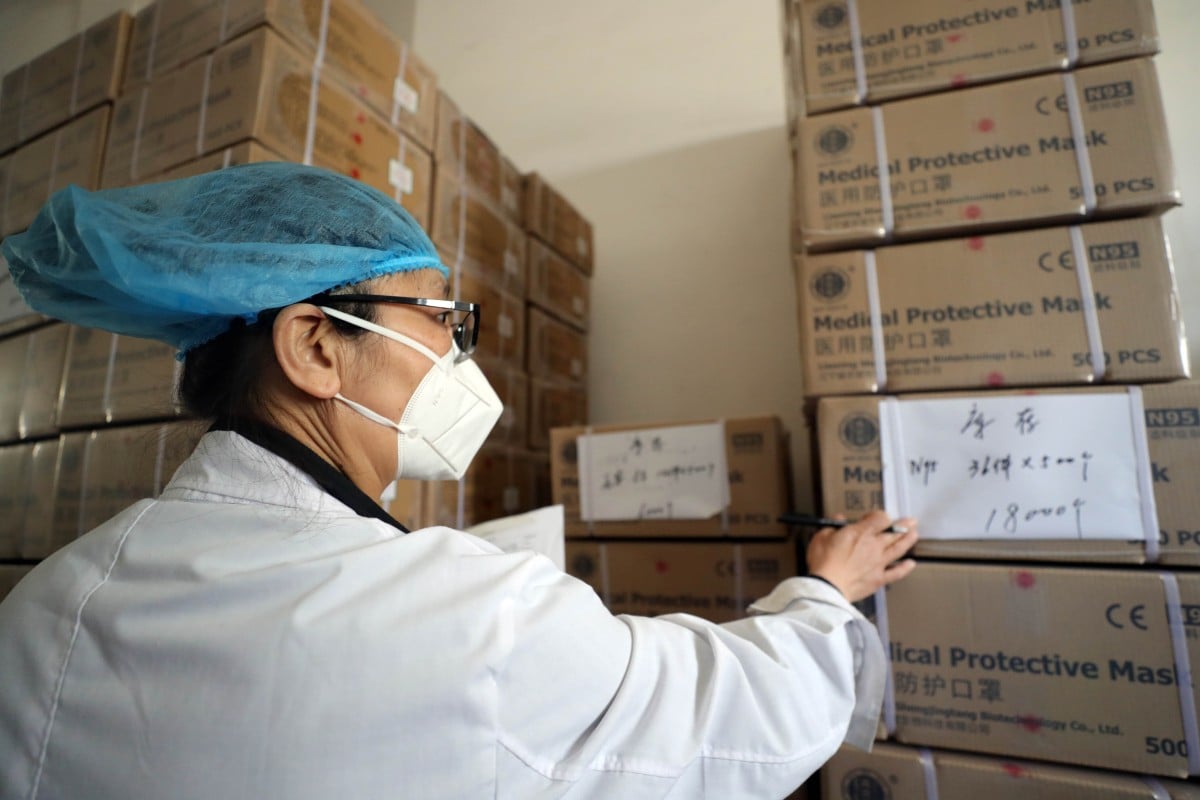
Despite facing some criticism from the West, China’s Asian neighbours have welcomed its medical expertise and vital supplies. Photo: Xinhua
While China’s campaign to mend its international image in the wake of its handling of the
coronavirus health crisis has been met with scepticism and even a backlash from the US and its Western allies, Beijing has been quietly gaining ground in Asia.
Teams of experts have been sent to Cambodia, the Philippines, Myanmar, Pakistan and soon to Malaysia, to share their knowledge from the pandemic’s ground zero in central China.
Beijing has also donated or facilitated shipments of medical masks and ventilators to countries in need. And despite some of the equipment failing to meet Western quality standards, or being downright defective, the supplies have been largely welcomed in Asian countries.
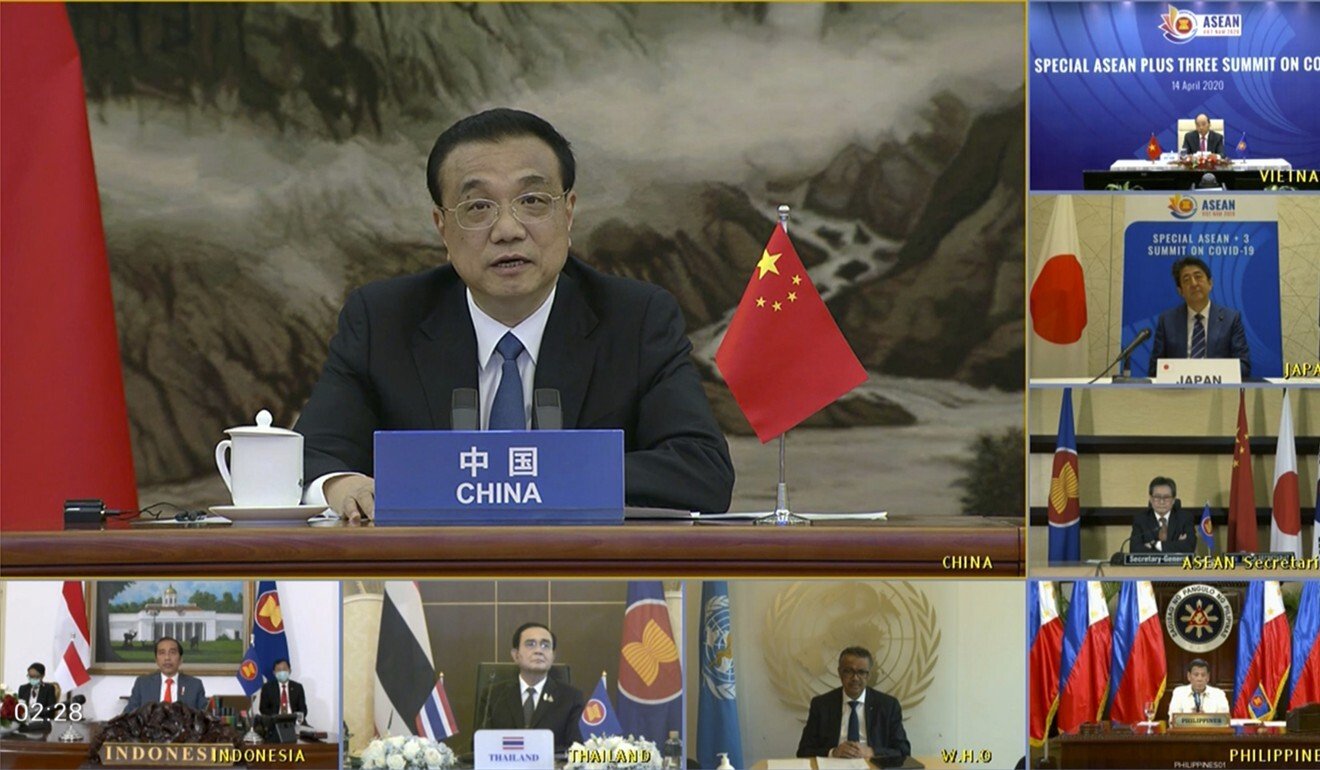
China has also held a series of online “special meetings” with its Asian neighbours, most recently on Tuesday when Premier Li Keqiang discussed his country’s experiences in combating the disease and rebooting a stalled economy with the leaders of the Association of Southeast Asian Nations (Asean), Japan and South Korea.
Chinese Prime Minister Li Keqiang speaks to Asean Plus Three leaders during a virtual summit on Tuesday. Photo: AP
Many Western politicians have publicly questioned Beijing’s role and its subsequent handling of the crisis but Asian leaders – including Philippine President Rodrigo Duterte and Japanese Prime Minister Shinzo Abe – have been reluctant to blame the Chinese government, while also facing criticism at home for not closing their borders with China soon enough to prevent the spread of the virus.
An official from one Asian country said attention had shifted from the early stages of the outbreak – when disgruntled voices among the public were at their loudest – as people watched the virus continue its deadly spread through their homes and across the world.
“Now everybody just wants to get past the quarantine,” he said. “China has been very helpful to us. It’s also closer to us so it’s easier to get shipments from them. The [medical] supplies keep coming, which is what we need right now.”
The official said also that while the teams of experts sent by Beijing were mainly there to observe and offer advice, the gesture was still appreciated.
Another Asian official said the tardy response by Western governments in handling the outbreak had given China an advantage, despite its initial lack of transparency over the outbreak.
“The West is not doing a better job on this,” he said, adding that his government had taken cues from Beijing on the use of propaganda in shaping public opinion and boosting patriotic sentiment in a time of crisis.
“Because it happened in China first, it has given us time to observe what works in China and adopt [these measures] for our country,” the official said.
Experts in the region said that Beijing’s intensifying campaign of “mask diplomacy” to reverse the damage to its reputation had met with less resistance in Asia.
Why China’s ‘mask diplomacy’ is raising concern in the West
“Over the past two months or so, China, after getting the Covid-19 outbreak under control, has been using a very concerted effort to reshape the narrative, to pre-empt the narrative that China is liable for this global pandemic, that China has to compensate other countries,” said Richard Heydarian, a Manila-based academic and former policy adviser to the Philippine government.
“It doesn’t help that the US is in lockdown with its domestic crisis and that we have someone like President Trump who is more interested in playing the blame game rather than acting like a global leader,” he said.
Shahriman Lockman, a senior analyst with the foreign policy and security studies programme at Malaysia’s Institute of Strategic and International Studies, said that as the US had withdrawn into its own affairs as it struggled to contain the pandemic, China had found Southeast Asia a fertile ground for cultivating an image of itself as a provider.
China’s first-quarter GDP shrinks for the first time since 1976 as coronavirus cripples economy
Beijing’s highly publicised delegations tasking medical equipment and supplies had burnished that reputation, he said, adding that the Chinese government had also “quite successfully shaped general Southeast Asian perceptions of its handling of the pandemic, despite growing evidence that it could have acted more swiftly at the early stages of the outbreak in Wuhan”.
“Its capacity and will to build hospitals from scratch and put hundreds of millions of people on lockdown are being compared to the more indecisive and chaotic responses seen in the West, especially in Britain and the United States,” he said.
Coronavirus droplets may travel further than personal distancing guidelines
Lockman said Southeast Asian countries had also been careful to avoid getting caught in the middle of the deteriorating relationship between Beijing and Washington as the two powers pointed fingers at each other over the origins of the new coronavirus.
“The squabble between China and the United States about the pandemic is precisely what Asean governments would go to great lengths to avoid because it is seen as an expression of Sino-US rivalry,” he said.
“Furthermore, the immense Chinese market is seen as providing an irreplaceable route towards Southeast Asia’s post-pandemic economic recovery.”
Aaron Connelly, a research fellow in Southeast Asian political change and foreign policy with the International Institute for Strategic Studies in Singapore, said Asian countries’ dependence on China had made them slow to blame China for the pandemic.
“Anecdotally, it seems to me that most Southeast Asian political and business elites have given Beijing a pass on the initial cover-up of Covid-19, and high marks for the domestic lockdown that followed,” he said.
“This may be motivated reasoning, because these elites are so dependent on Chinese trade and investment, and see little benefit in criticising China.”
China and Vietnam ‘likely to clash again’ as they build maritime militias
The cooperation with its neighbours as they grapple with the coronavirus had not slowed China’s military and research activities in the disputed areas of the
South China Sea – a point of contention that would continue to cloud relations in the region, experts said.
Earlier this month an encounter in the South China Sea with a Chinese coastguard vessel led to the sinking of a fishing boat from Vietnam, which this year assumed chairmanship of Asean.
And in a move that could spark fresh regional concerns, shipping data on Thursday showed a controversial Chinese government survey ship, the Haiyang Dizhi 8, had moved closer to Malaysia’s exclusive economic zone.
The survey ship was embroiled in a months-long stand-off last year with Vietnamese vessels within Hanoi’s exclusive economic zone and was spotted again on Tuesday 158km (98 miles) off the Vietnamese coast.
Source: SCMP
Posted in 10, 13, 15, 16, 17, 18, 1976, 27, 44, 50%, 54, according, across the world, again, against, April, areas, arriving, ASEAN, Asian, Association of Southeast Asian Nations (ASEAN), ASYMPTOMATIC CASES, at, authorities, avoid, ‘mask diplomacy’, battling, Beijing, Beijing’s, biggest, blame, blame game, borders, Britain, build, burnished, cabinet, cases, cautioning, central, central district, chairmanship, China, China's, China’s National Health Commission, Chinese capital, chinese government, Chinese market, City, clinical, closer, closing, coast, coastguard vesse, coastguard vessel, combating, compensate, confirmed, confirmed cases, considered, contain, contention, control, controversial, coronavirus, coronavirus cases, cough, countries, country’s, COVID-19, COVID-19 outbreak, cripples, crisis, criticism, cross infections, Data, day, deadly spread, death toll, deaths, declines, delegations, despite, destabilising, Disease, disputed areas, districts, domestic, down, earlier, eastern, economic recovery, economically, economy, elsewhere, embroiled, epicentre, epidemic, everybody, exclusive economic zones, experiences, eyes, facing, fall, family gatherings, fever, first time, fishing boat, flare-up, foreign policy and security studies programme, Friday, from, GDP, global leader, global pandemic, Government, Guangzhou, Haiyang Dizhi 8, handling, Hanoi’s, Harbin, health commission, Heilongjiang, high-risk, Home, hospitals, However, hubei province, hundreds, imported, imported infections, including, infected, Institute of Strategic and International Studies, interested, International Institute for Strategic Studies, investigations, irreplaceable, Japan, Japanese Prime Minister, Japanese Prime Minister Shinzo Abe, Jiaozhou, km, last, leaders, local, locally, lockdown, low-risk, lowest, mainland, Mainland China, Major, Malaysia’s, March, medical equipment and supplies, medium-risk, miles, military and research activities, millions, months-long, moved, narrative, new, nine, Northeastern, Notably, now, number, off, Official, officials, on guard, outbreak, patients, People, perceptions, Philippine, playing, political, politicians, Post, post-pandemic, pre-empt, Premier Li Keqiang, present, President Trump, prevent, previous, province, provincial capital, provincial government, publicly, published, punished, quarantine, questioned, quickly, quoted, reached, rebooting, rebound, recent, reluctant, remaining, reported, reporting, reputation, research fellow, reshape, resurgence, role, route, Russia, Saturday, saying, scratch, seen, senior analyst, shandong province, shipping data, showed, shrinks, since, Singapore, sinking, Sino-US rivalry, slow, social media, socially, soon enough, South China Sea, South Korea, Southeast Asia, Southeast Asian political change and foreign policy, southern city, spotted, spread, squabble, stalled, stand-off, State Council, statement, stood, stop, subsequent, Suifenhe, Sunday, surge, survey ship, symptoms, tally, task, test positive, Three, Thursday, Total, towards, transmitted, Transparency, travellers, Tuesday, two, Uncategorized, United States, vice governor, vice mayor, Vietnam, Vietnamese, Vietnamese vessels, virtual summit, Virus, Washington, website, weeks, were, Western, within, Wuhan, year |
Leave a Comment »
04/04/2020
- The US saw 1,169 deaths in 24 hours and its infections are 20 per cent of the global total
- China to hold day of mourning for victims; Singapore announces fifth death and school closures; Boris Johnson says he’s still ill; Angela Merkel ends quarantine
A group of nurses gather in the Bronx, New York, for a strike about the lack of personal protective equipment, on April 2, 2020. Photo: EPA-EFE
The number of confirmed
coronavirus cases around the world soared past one million on Thursday and deaths topped 50,000 as
Europe reeled from the pandemic and the
reported the highest daily death toll so far of any country.
Despite more than half the planet imposing some form of lockdown, the virus claimed thousands more lives, with the US, Spain and Britain seeing the highest number of daily fatalities yet.
Covid-19 is currently spreading the most rapidly in the US, where there have been 243,453 infections and 5,926 deaths, according to a tally by Johns Hopkins University.
The US saw 1,169 deaths in 24 hours, the highest one-day toll recorded in any country since the global pandemic began. The grim record was previously held by Italy, where 969 people died on March 27.
Here are other developments:
Singapore shuts schools, workplaces in ‘circuit-breaking’ move
Singapore’s coronavirus case number hits 1,000 after city state reports biggest single-day spike
Singapore Prime Minister Lee Hsien Loong on Friday afternoon announced most workplaces would be shut from April 7, and schools would be closed from April 8, in its
to battle the coronavirus pandemic.
The city state has 1,114 infections and five people have died. More than 200 have recovered.
Essential services such as food establishments, markets and supermarkets, clinics, hospitals, utilities, transport and banking services will remain open.
Coronavirus: what’s behind Singapore’s U-turn on wearing masks?
Lee on Friday said instead of tightening measures incrementally over the next few weeks,
Singapore should “make a decisive move now, to pre-empt escalating infections”.
“Looking at the trend, I am worried that unless we take further steps, things will gradually get worse, or another big cluster may push things over the edge,” Lee said, describing the new measures as a “circuit breaker”.
Medical experts say the stringent measures require the cooperation of citizens to stay at home, given that local infection clusters have ballooned from six at the end of February to more than 20 currently.
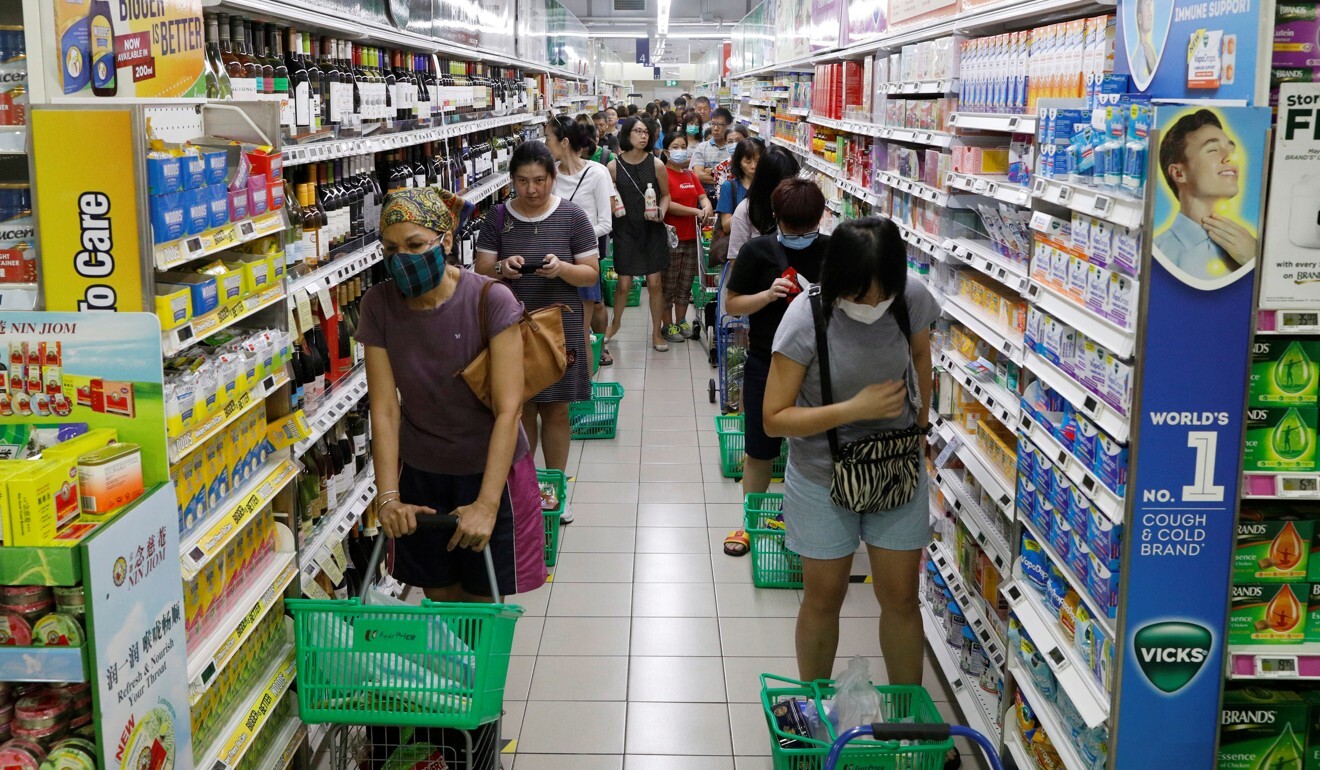
People stand behind markers as they practice physical distancing while queuing up to buy food at a Singapore supermarket on April 3, 2020. Photo: Reuters
The Lion City has launched a website to help individuals with symptoms that might be related to Covid-19 decide whether they should see a doctor or not.
On the
Covid-19 Symptom Checker website, individuals will be prompted to answer a short list of questions including their age, if they have any chronic diseases, if they have travelled outside Singapore in the past 14 days, or have been in touch with a suspected or confirmed Covid-19 case.
They will also be asked to choose which symptoms they are experiencing from a predetermined list including symptoms such as cough, difficulty breathing and the loss of taste/smell. The site will then recommend what the person should do next. This includes whether they should see a doctor or continue to monitor their symptoms.
China to hold day of mourning for Covid-19 victims
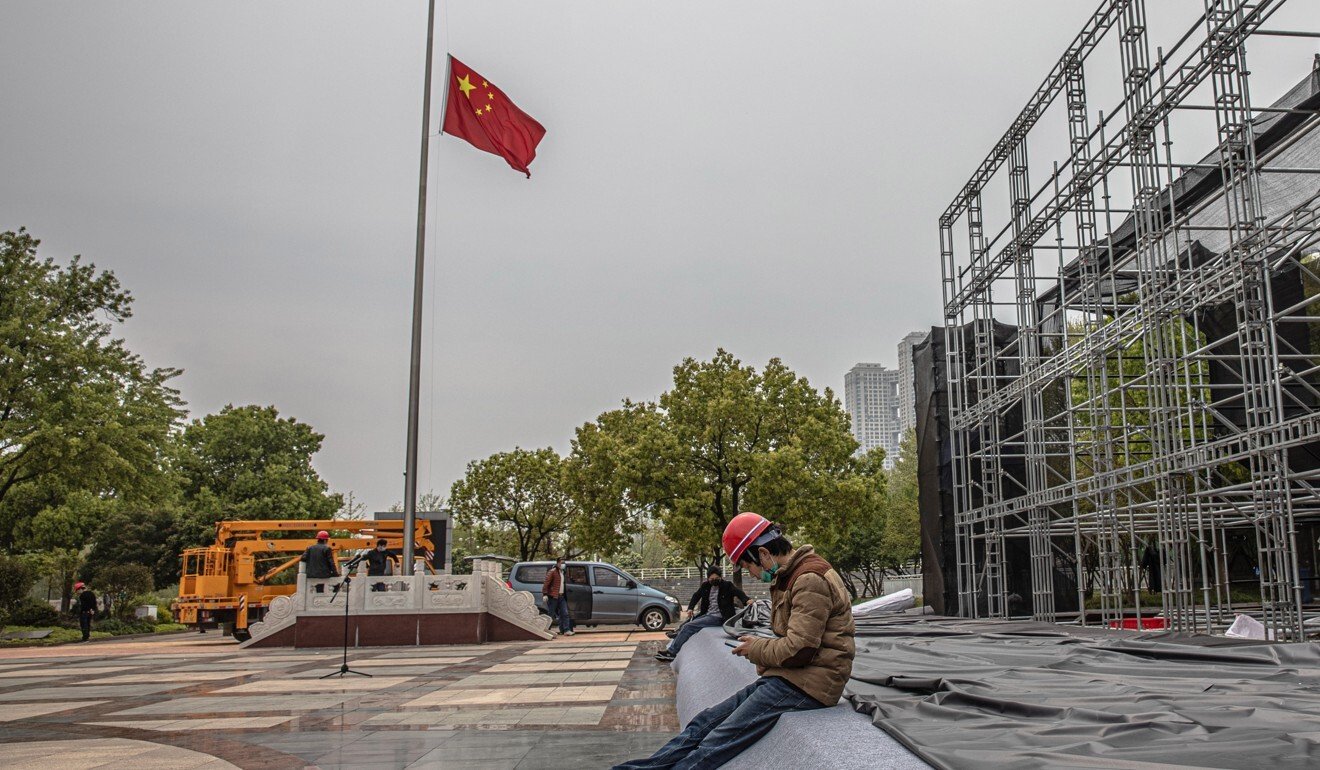
At 10am on April 4, 2020, the public will be asked to observe three minutes of silence. Photo: EPA-EFE
Flags will be flown at half-mast across the country and at embassies overseas, while all public entertainment will be halted for the day, said the State Council, China’s cabinet, on Friday.
At 10am, the public will be asked to observe three minutes of silence, during which sirens will blast out across the country and the owners of cars and boats should sound their vehicles’ horns, the council said.
Saturday also coincides with Ching Ming, or the Tomb-sweeping Festival, when Chinese traditionally gather to remember their ancestors.
China to stage day of mourning for the thousands lost to Covid-19
Mainland
China on Friday reported 31 new confirmed coronavirus cases, including two locally transmitted infections, the country’s National Health Commission said.
It also reported four new deaths as of Thursday, all in Wuhan, the city where the outbreak began, the commission said in a statement. The total number of infections now stands at 81,620 and 3,322 deaths have been reported from mainland China to date.
The commission said 60 new asymptomatic coronavirus patients were also reported on Thursday.
UK’s Boris Johnson still ill with virus fever
British Prime Minister Boris Johnson remains in isolation with a high temperature, more than a week after testing positive for coronavirus.
Johnson made the announcement in a video posted on Twitter on Friday, saying that even after seven days, “alas I still have one of the symptoms, a minor symptom: I still have a temperature”.
“In accordance with government advice I must continue my self-isolation,” he said.
As virus rages, British love for NHS could make or break Boris Johnson
3 Apr 2020
With coronavirus deaths still rising, the PM is anxious to drum home his message that Britons must obey government orders to stay in their homes as much as possible.
On March 23 he ordered a national lockdown, with the closure of schools, stores, restaurants and leisure facilities. Under emergency laws, police have the power to fine individuals who flout the rules and break up gatherings of more than two people in public.
Germany to crack down on people flouting physical distancing rules
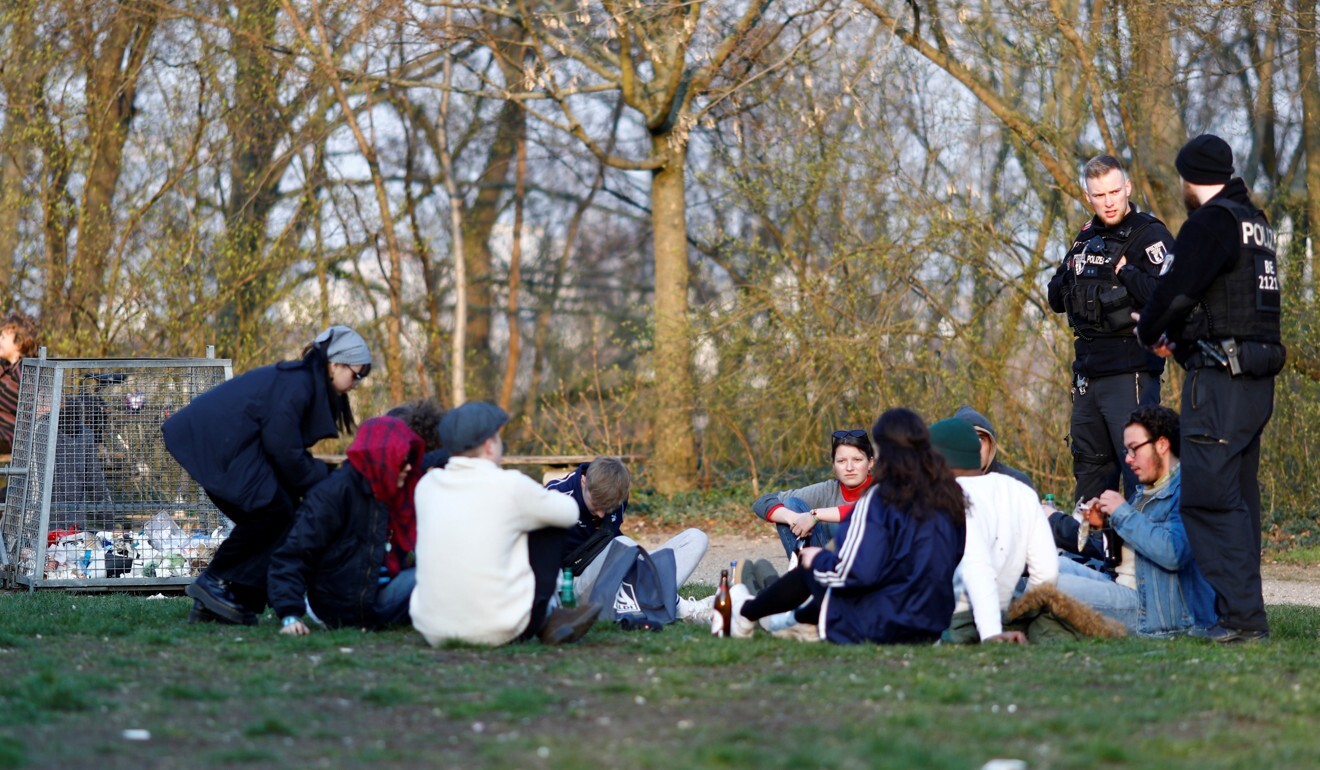
Police officers ask people to disperse as they gather at a park in Berlin, Germany, on March 28, 2020. Photo: Reuters
People in Germany risk being fined up to €500 (US$540) for standing too close to each other from Friday, as officials crack down on people flouting rules brought in to control the coronavirus outbreak.
Chancellor Angela Merkel’s government has ordered people not leave their homes unless they have an exceptional reason such as grocery shopping, exercise or medical appointments.
Gatherings of more than two people are banned and a distance of at least 1.5 metres must be kept from others at all times.
Local governments have the power to set fines for transgressors, with city officials in Berlin saying their fines would be as high as 500 euros. Similar announcements have come from across Germany’s 16 states.
Bow ties to face masks: German firms shift gears in virus crisis
According to figures by the Robert Koch Institute (RKI) on Friday, Germany has recorded more than 79,000 cases of the novel
coronavirus, and 1,017 deaths, although RKI president Lothar Wieler warned on Friday that the actual number of casualties could be much higher.
“We won’t manage to test every single person … I assume we will have more deaths than are officially recorded,” he said.
Wieler said the mortality rate would “continue to rise” in Germany. German minister’s suicide linked to coronavirus crisis
Meanwhile, Merkel on Friday left her Berlin home for the first time in almost two weeks, after she was forced into quarantine following contact with an infected doctor.
Merkel was tested several times, with all tests coming back negative.
The 65-year-old leader has returned to her office, where she will continue to observe social distancing rules and lead the country via video and audio conferencing, her spokesman said.
Spain records over 900 virus deaths
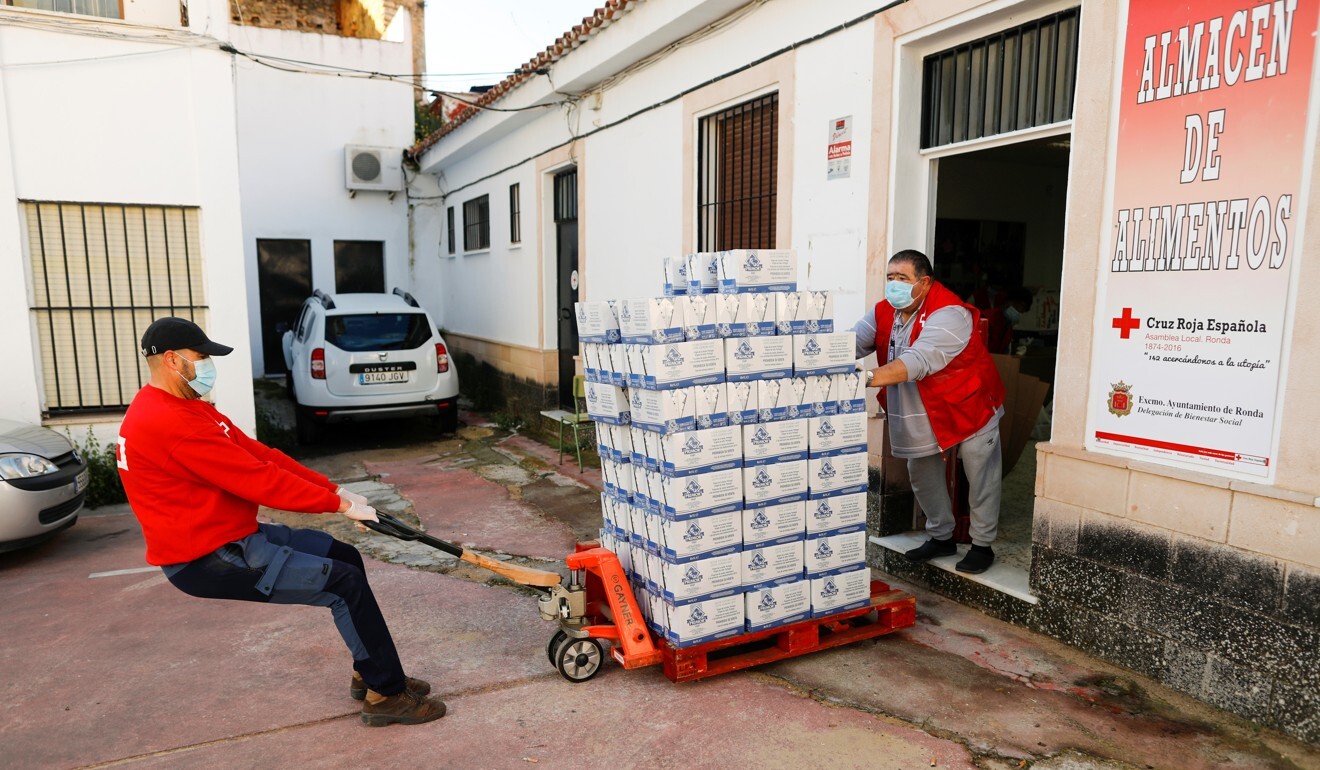
Members of the Red Cross prepare food for families in need at a food bank in Ronda, Spain, on April 3, 2020. Photo: Reuters
on Friday recorded over 900 new coronavirus deaths over the past day, bringing the number of casualties to 10,935, in the first decline in new Covid-19 deaths in four days.
The country has the world’s second-highest death toll after
Italy, but health ministry figures confirm a consistent downward trend in the rate of new cases and fatalities.
The 932 deaths on Friday was a smaller gain than Thursday’s 950, according to Health Ministry data. The number of confirmed cases also increased by less than the previous day, with 7,472 new infections taking the total to 117,710.
Why Europe’s hospitals – among world’s best – are struggling with virus
Prime Minister Pedro Sanchez’s government has been struggling to bring the virus under control. Hospitals are overwhelmed, nursing homes have been especially hard hit in a nation with one of the world’s oldest populations, and the army has been mobilised.
Sanchez may extend the current four-week lockdown for another two weeks beyond April 11, Spanish media reported on Friday. The stay-at-home order limits people’s movement to shopping for food and essentials, while some workers are also allowed to circulate.
Passengers disembark from virus-hit cruise ship in Florida
The Zaandam cruise ship docked in Florida on Friday. Photo: TNS via ZUMA Wire/dpa
Passengers from an ill-fated cruise were carefully freed from their cabins and allowed to disembark on Friday, following the removal of 14 critically-ill people who were wheeled off to Florida hospitals bracing for an onslaught of coronavirus patients.
The exodus from the Zaandam and its sister ship the Rotterdam, both operated by Holland America Line, was expected to continue throughout the day.
Floridians were getting off first, followed by other passengers. Buses were taking people healthy enough to travel directly to the airport, where they will board chartered flights home without going through the terminal.
Coronavirus nightmare for passengers stuck on MS Zaandam ‘death ship’
“This is a humanitarian situation, and the County Commission’s top priority is protecting our 1.9 million residents while providing a contained disembarkation option for people on board who need to get safely home,” Broward County Mayor Dale Holness said in a statement late on Thursday.
Four people have died on the Zaandam, for reasons not yet disclosed. All told, 107 passengers and 143 crew reported flu-like symptoms during the voyage, but many have since recovered.
It was unclear when the bodies of four passengers who died on the Zaandam would be removed from the ship, which set sail on March 7, the day before the US State Department warned people against cruising during the pandemic.
South Korea’s infections top 10,000
South Korean hospital’s ‘phone booth’ coronavirus tests
on Friday said the number of confirmed coronavirus cases in the country has surpassed 10,000, with 174 deaths linked to Covid-19, the disease caused by the new virus.
The Health and Welfare Ministry reported 86 new coronavirus infections over 24 hours to the end of Thursday, taking the total to 10,062 cases. It also logged five more deaths.
The numbers confirmed an encouraging stabilisation of numbers, which have hovered around the 100 mark for the past three weeks, a clear downward trend which began in March after numbers peaked at the end of February with over 900 cases recorded in a day.
South Korea’s virus response is the opposite of China’s – and it works
For a fourth straight day, more new cases were recorded from Seoul and the surrounding Gyeonggi province, than in what has so far been the outbreak epicentre in the country – North Gyeongsang province and city of Daegu – with the capital area registering 34 new cases, and the latter recording 23.
Imported cases in patients recently returned from abroad also continued to increase, with 22 new infections bringing the total to 264.
Japan to give US$2,800 payouts to households
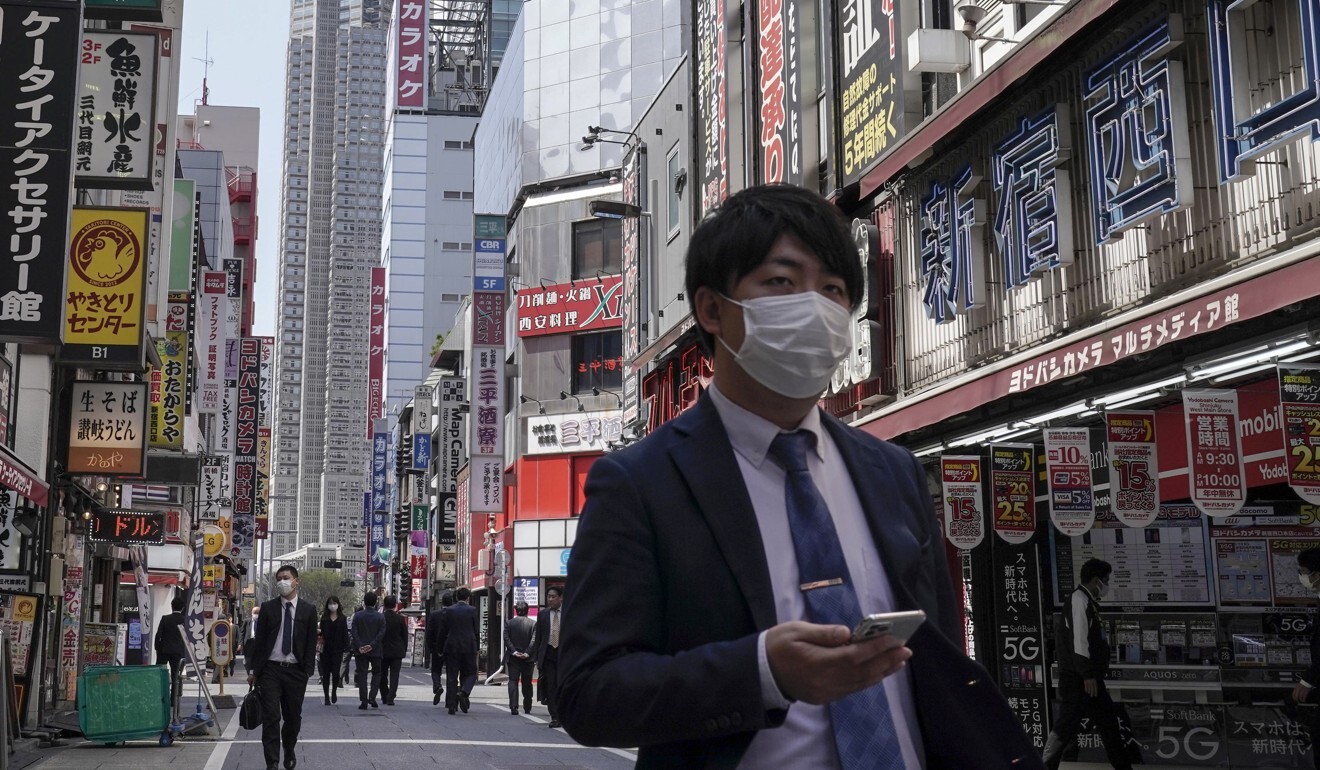
A man seen in a protective mask at Shinjuku in Tokyo, Japan, on April 2, 2020. Photo: EPA-EFE
Japanese ruling party executive Fumio Kishida said on Friday he has agreed with Prime Minister
Shinzo Abe to offer 300,000 yen (US$2,800) in cash payments per household that suffers a certain degree of income declines from the
coronavirus pandemic.
About 10 million of Japan’s 58 million households are expected to be eligible for the cash programme, a key pillar of an emergency economic package that the government plans to compile possibly on Tuesday.
The relief measure will be funded by a supplementary budget for this fiscal year that the government wants to pass in parliament before Japan’s Golden Week holiday starts in early May.
Coronavirus: Tokyo’s nightlife districts linked to rise in cases
The government will not set a household income limit for the cash handout, which will be tax free, officials said.
“If we set an income limit, we would have to check individual incomes, which would take a lot of time,” Yasutoshi Nishimura, minister in charge of economic and fiscal policy, told a press conference. “Instead of that, we’ll come up with an unprecedented way (to judge who should receive cash).”
Nishimura said recipients will be limited to those who are facing livelihood difficulties, and that civil servants, politicians and major corporate executives who have not been significantly affected by the economic impact of the virus outbreak, for example, will be excluded from the scheme.
Japan weighs cost of Tokyo lockdown and Wagyu beef coupons for households
Abe said the government will provide cash “as soon as possible” not only to households but also to small-and mid-sized business operators that have seen their revenues drop.
Abe has said the package to tackle the
coronavirus will be larger than the 56.8 trillion yen emergency package compiled in April 2009 following the previous year’s global financial crisis.
Indonesian Muslims banned from travelling home for Eid al-Fitr
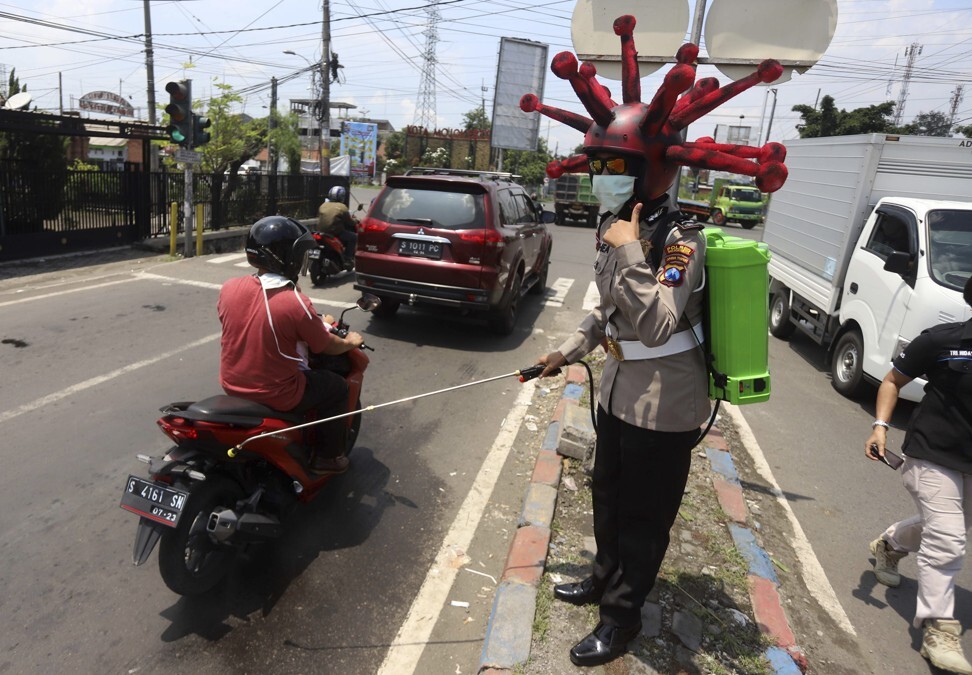
A police officer in a coronavirus helmet sprays disinfectant at a motorcycle in East Java, Indonesia, on April 3, 2020. Photo: AP
Islamic scholars in Indonesia on Friday issued an edict to forbid people from travelling home for Eid al-Fitr, the festival marking the end of the Muslim fasting month of Ramadan, as the country recorded nearly 2,000 infections during the
The fatwa was issued by the Indonesian Council of Ulema a day after President
decided to allow millions of Muslims to travel to celebrate Eid in their hometowns next month, despite fears that they could spread the Covid-19 disease.
“The virus spreads very easily. Doing something like that at a time of a pandemic is haram [forbidden],” the council’s sectary general Anwar Abbas said.
Eid al-Fitr is expected to start on May 23, depending on the sighting of the new moon.
Indonesia frees 18,000 prisoners as virus death toll surges to 170
2 Apr 2020
Indonesia confirmed 196 new infections on Friday, bringing the total number of cases to 1,986.
The death toll rose to 181 after 11 new deaths, making Indonesia the the country with the highest number of fatalities in Asia outside China.
The State Intelligence Agency warned that the outbreak in Indonesia could peak in June with more than 105,000 cases.
Thailand’s night curfew to begin; people banned from making virus pranks
An officer checks the temperature of a passenger in a bus at a health checkpoint in Bangkok, Thailand, on April 3, 2020. Photo: AP
Thailand will on Friday night begin a daily nationwide curfew to try to curb the spread of the coronavirus.
The 10pm-4am curfew, which will run indefinitely, is the latest measure by the government to curb gatherings and have people stay at home as much as possible.
Exceptions include those people transporting medical supplies and health workers travelling to and from work, Prime Minister Prayuth Chan-ocha said.
“We prioritise health over freedom,” Prayuth said. “We might not feel as comfortable as before, but we all need to adapt for survival and have social responsibility, so that we can make it through this crisis.”
In a televised address, Prayuth also asked all Thai citizens abroad to “delay” returning to
until after April 15 in a bid to stop imported cases.
Thai king remains in Germany during pandemic, prompting criticism online
Thais have also been banned from making public gatherings, in an order signed on Friday by defence forces chief General Pornpipat Benyasri.
The order prohibits people from public gatherings, carrying out activities, or gathering for unlawful purposes in a manner that risks spreading the coronavirus.
It also bans any act that aggravates people’s suffering and pranks to spread the virus. Family gatherings at residences and civic activities carried out according to safe social distancing guidelines are allowed.
Violation of the order carries a maximum penalty of two years’ imprisonment and a fine of 40,000 baht (US$1,215).
Pakistan’s mosques remain open amid shutdowns
Coronavirus: In Pakistan food aid is distributed to the poor in Karachi
Mosques in Pakistan were allowed to remain open on Friday, when adherents gather for weekly prayers, even as much of the country had shut down.
Pakistan, with 2,450 confirmed coronavirus cases and 35 deaths, has been sharply criticised for moving too slowly to curb large gatherings.
Prime Minister Imran Khan was relying on restricting the size of congregations attending mosques and advice to stay at home from religious groups like the country’s Islamic Ideology Council.
Coronavirus: Pakistan quarantines pilgrims returning from Iran
However, some provinces had issued their own lockdown orders to prevent Muslims from gathering for Friday prayers.
In southern Sindh province, a complete lockdown was being enforced from noon until 3pm, the time when the faithful gather for prayers. Anyone found on the streets would be arrested, according to the provincial local government minister in a statement.
In eastern Punjab province, where 60 per cent of Pakistan’s 220 million people live, checkpoints had been set up in major cities stopping people from congregating.
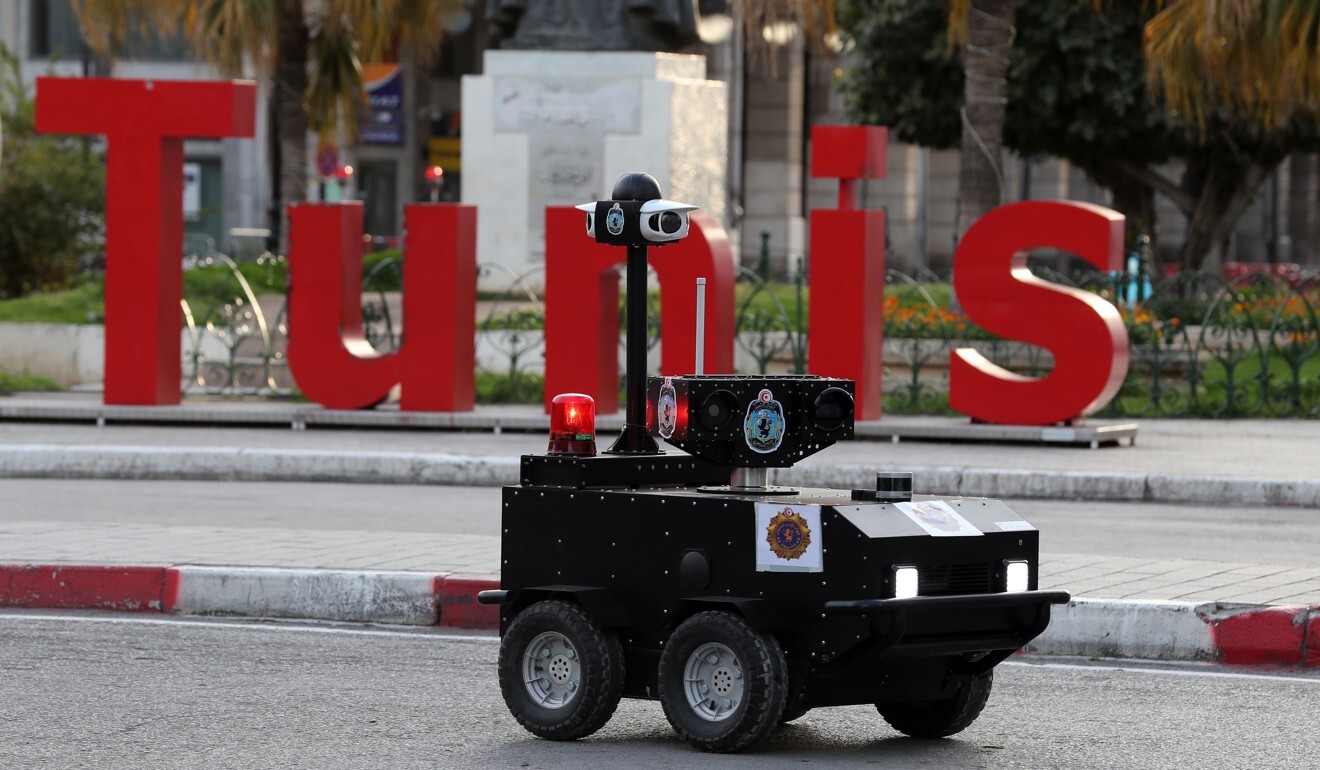
Tunisia ‘robocop’ enforces virus lockdown
The PGuard robot patrols the streets of Tunis, in Tunisia, on April 1, 2020. Photo: EPA-EFE
Tunisia’s interior ministry has deployed a police robot to patrol the streets of the capital and enforce a lockdown as the country battles the spread of coronavirus.
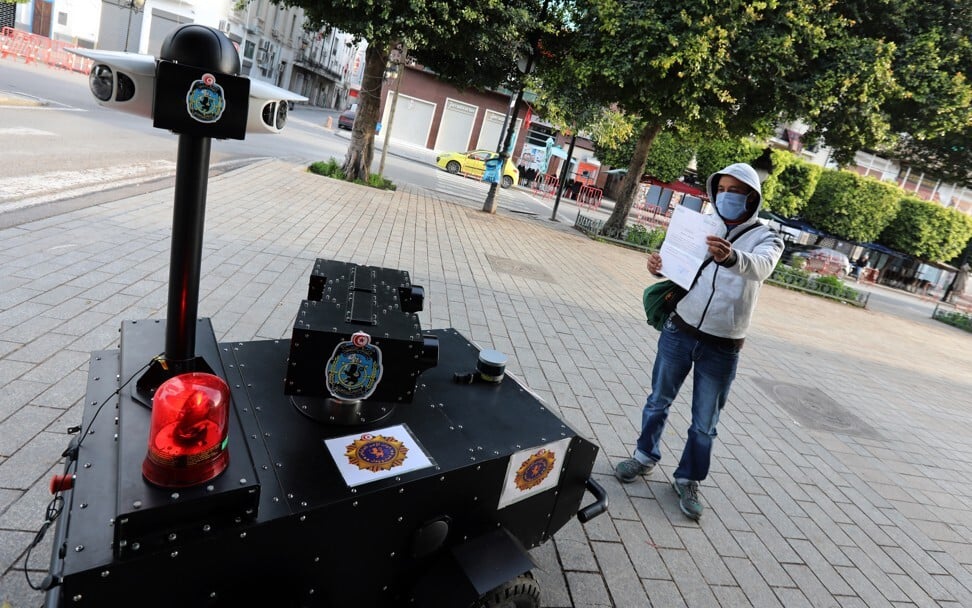
Known as PGuard, the “robocop” is remotely operated and equipped with infrared and thermal imaging cameras, in addition to a sound and light alarm system.
In images and a soundtrack posted on the interior ministry’s website last month, PGuard calls out to suspected violators of the lockdown: “What are you doing? Show me your ID. You don’t know there’s a lockdown?”
The PGuard robot checks the exit permit of a citizen in Tunis on April 1, 2020. Photo: EPA-EFE
Tunisia has been under night-time curfew since March 17 and authorities imposed stricter lockdown orders from March 22.
Fourteen people have died from coronavirus in Tunisia, where 455 confirmed cases have tested positive for the disease.
The robot’s Tunisian creator Anis Sahbani said the machine was first produced in 2015 essentially to carry out security patrols and it also operates autonomously through artificial intelligence.
The robot, built by Sahbani’s Enova Robotics firm, costs between 100,000 and 130,000 euros (US$100,000 and $140,000), and has been selling mostly overseas to companies for security uses.
France death tally passes 5,000
A cashier runs a store counter covered up with a plastic barrier in Paris, France, on April 3, 2020. Photo: Xinhua
reported a jump in coronavirus deaths on Thursday as the country included fatalities in some nursing homes for the first time. Still, a decline in intensive-care admissions suggest the country’s lockdown is starting to slow the pace of the outbreak.
The health ministry reported 471 new hospital deaths from the coronavirus on Thursday. In addition, it reported 884 deaths in a partial count from nursing homes, bringing the total number to 5,387. Nursing homes were not previously included in the statistics.
France is the third-hardest hit country in
in number of deaths, behind Italy and Spain. The number of confirmed cases is now at 59,105.
Italy reported another 760 fatalities on Thursday. Its death toll, already the world’s highest, now stands at 13,915. Total infections, including recoveries and deaths, have reached 115,242.
Spain reported 950 more deaths from the coronavirus, the most in a single day, taking the total to 10,003.
India plans staggered exit from lockdown
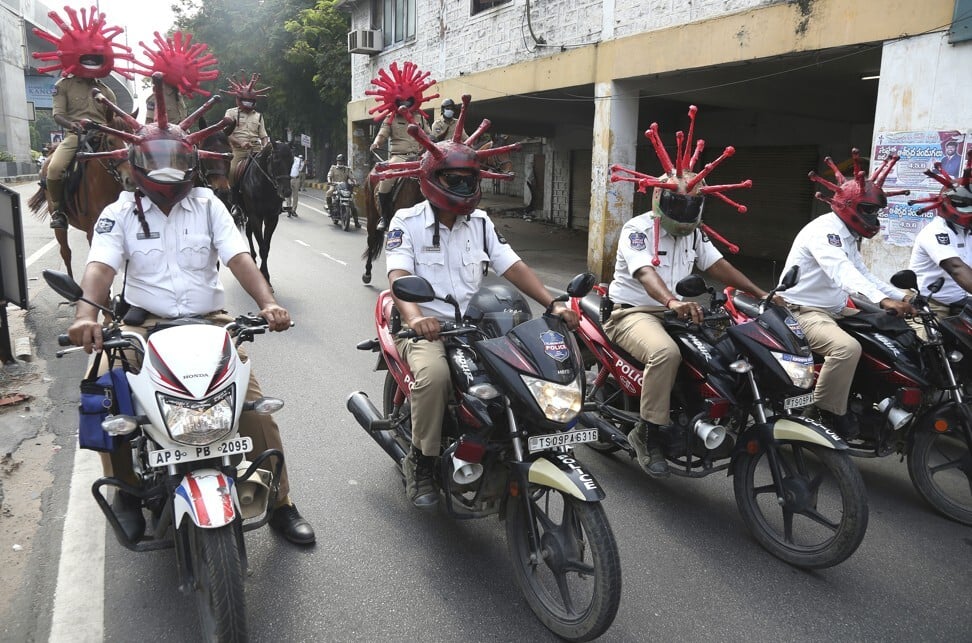
Indian policemen in Hyderabad, India, wear virus-themed helmets for a campaign to raise awareness at preventing the spread of the coronavirus on April 2, 2020. Photo: AP
said on Thursday, as officials battle to contain the country’s biggest cluster of coronavirus infections in the capital, New Delhi.
The shutdown, which has brought Asia’s third-largest economy to a shuddering halt, had been due to end on April 14.
Modi ordered India’s 1.3 billion people indoors to avert a massive outbreak of
infections, but the world’s biggest shutdown has left millions without jobs and forced migrant workers to flee to their villages for food and shelter.
After violence, Indian police try humour to enforce virus lockdown
He told state chief ministers that the shutdown had helped limit infections but that the situation remained far from satisfactory around the world and there could be a second wave.
“Prime minister said that it is important to formulate a common exit strategy to ensure staggered re-emergence of the population once lockdown ends,” the government quoted him as saying in a video conference.
India has had 2,069 confirmed infections, of whom 53 have died, low figures by comparison with the US, China, Italy and Spain. But the big worry is the
because of a gathering held by a Muslim missionary group last month that has spawned dozens of cases across the country, officials said.
Five-minute virus tests ‘may give inaccurate results’
A Chinese drug and diagnostic firm has cautioned that the slew of new test kits that promise to detect the
coronavirus in just a few minutes may not be as accurate as conventional kits, a potential setback for countries seeking to rapidly test their citizens.
“Such rapid testing is not as accurate as the traditional nucleic acid test that takes about two hours to turn out results,” Wu Yifang, Shanghai Fosun Pharmaceutical Group’s chief executive officer, said. The drugmaker also has a swift testing technology but it’s working on making the results more accurate, according to Wu.
Coronavirus nightmare of China’s ‘recovered’ patients
Abbott Laboratories unveiled a coronavirus test on March 28 that can confirm if someone is infected in as little as five minutes. Shenzhen Bioeasy Biotechnology has been supplying its version of rapid testing kits to the
European Union even before getting regulatory approval in
China for domestic use.
The faster and easy-to-deploy diagnostic kits seemingly save time and resources for nations under pressure to widen their testing efforts. But there have been reports of faulty kits, like those bought by Spain and the Czech Republic.
Shenzhen Bioeasy, which sold thousands of test kits to Spain, said in a statement on March 27 that false results could be due to improper use of its kits or faulty specimen collection.
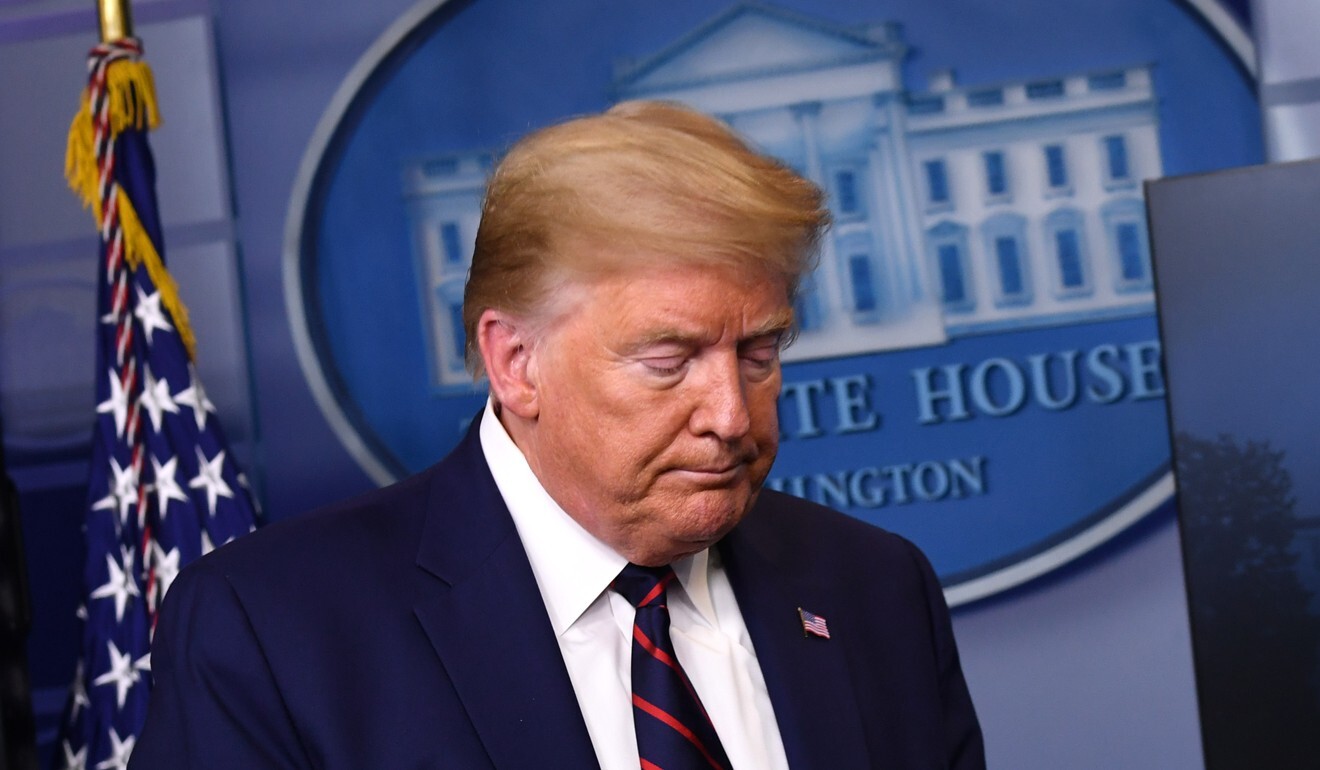
Trump tests negative again
US President Donald Trump was was first tested last month after coming into contact with a Brazilian official who later tested positive. Photo: UPI/Bloomberg
US President Donald Trump on Thursday was tested again to determine whether he had been infected by the coronavirus, and the test came back negative, the White House said.
A letter from Trump’s doctor, Sean Conley, said Trump had undergone what was a second test for coronavirus. He was tested last month after coming into contact with a Brazilian official who later tested positive.
Trump to urge Americans to wear masks when outside
Conley said in a letter released by the White House that Trump was tested with a new, rapid point-of-contact test and the result came back in 15 minutes.
“He is healthy and without symptoms,” Conley said.
Trump said Americans should wear protective face masks if they wish. “If people want to wear them, they can” he said. Scarves work just as well, he said.
NRA sues NY governor over closure of gun stores

A pedestrian pushes a stroller as people wait in line outside a gun store to buy supplies on March 15, 2020. Photo: Reuters
The National Rifle Association (NRA) sued New York Governor Andrew Cuomo for closing gun shops during the coronavirus pandemic, saying the restriction is unconstitutional and leaves citizens defenceless while prisoners are being released early as a result of the crisis.
Cuomo’s March 20 executive order that included firearms retailers as non-essential businesses, which must close is a “pointless and arbitrary attack on the constitutional rights of New York citizens and residents,” the NRA said in a complaint filed late Thursday in Syracuse, New York.
New York ordered most businesses to close to prevent the spread of the virus, but deemed grocery stores, liquor stores, pharmacies and restaurants that do take-out as essential and allowed them to remain open.
The New York lawsuit follows similar action the NRA took in Northern California, where it sued several cities including San Jose for ordering gun stores to close.
Corona beer producer halts brewing
The Mexican brewer of Corona beer said on Thursday it was suspending production because of the health emergency in the country over the Covid-19 pandemic.
Grupo Modelo said the measure was in line with the Mexican government’s order to suspend all non-essential activities until April 30 to slow the spread of coronavirus.
“We are in the process of lowering production at our plants to the bare minimum,” the company said in a statement, adding it would complete the suspension in the following days.
Mexico’s government has said that only key sectors such as agribusiness will be able to continue to function.
US stops issuing passports, except in emergencies
The US State Department will not be processing new passports and renewals except for emergency cases because of the coronavirus pandemic, the agency’s website said.
“Due to public health measures to limit the spread of Covid-19, effective March 20, 2020, we are only able to offer service for customers with a qualified life-or-death emergency and who need a passport for immediate international travel within 72 hours,” said a March 27 online statement.
How elite US university students brought coronavirus home from campus
Passport applications received on or before March 19 will be processed.
Travellers who paid extra for expedited service can expect to receive their passport in the next two to three weeks.
If you applied in-person at a passport agency or centre before March 19, the agency will contact you about getting your passport.
Source: SCMP
Posted in Abbott Laboratories, Airport, Angela Merkel, ‘death ship’, ‘phone booth’ coronavirus tests, ‘robocop’, “circuit breaker”, Bangkok, banking services, battles, Berlin, board, boats, boris johnson, Britain, British love for NHS, Bronx, Bus, buses, capital, cars, cash payments, cashier, Chancellor Angela Merkel’s, chartered flights, chief executive officer, China, China’s cabinet, Chinese, Chinese drug and diagnostic firm, Ching Ming, Citizens, city of Daegu, city state, clinics, closure, Corona beer, coronavirus, coronavirus helmet, Coronavirus latest, Coronavirus pandemic, coronavirus patients, Country, County Commission’s, COVID-19, Covid-19 Symptom Checker, cross 1 million, Cruise Ship, curb, Czech Republic, daily high, defence forces chief, defenceless, Delhi, died, directly, disembark, disinfectant, drugmaker, East Java, economic and fiscal policy,, Eid al-Fitr, embassies, emergency economic package, emergency laws, enforce, enforces, Enova Robotics, Essential services, Europe, European Union, Europe’s hospitals, exodus, expedited service, fatwa, firearms retailers, Florida, Floridians, food bank, France, Germany, global infections, going, Government, government advice, grocery shopping, gun stores, Gyeonggi province, Health and Welfare Ministry, health checkpoint, health ministry, health workers, healthy enough, Holland America Line, Home, hometowns, hospitals, households, humanitarian situation, Hyderabad, ill, India, Indonesian Council of Ulema, Indonesian Muslims, infections, infrared and thermal imaging cameras, interior ministry, iran, isolation, Italy, Japan, Japan’s Golden Week holiday, Johns Hopkins University, Karachi, lack, Lee Hsien Loong, leisure facilities, lockdown, Mainland China, markets, medical appointments, medical supplies, Merkel, Mexican brewer, mosques, Motorcycle, MS Zaandam, Muslim missionary group, national day of mourning, National Health Commission, national lockdown, National Rifle Association (NRA), nationwide curfew, New York, New York Governor, North Gyeongsang province, Northern California, NRA, nursing homes, NY governor, outbreak began, outbreak epicentre, overseas, Pakistan’s mosques, pandemic, Paris, passengers, Passport applications, patrol the streets, payouts, People, personal protective equipment, PGuard robot, pilgrims, plastic barrier, Police, Police officer, President Joko Widodo, Prime minister, Prime Minister Imran Khan, Prime Minister Narendra Modi, Prime Minister Prayuth Chan-ocha, Prime Minister Shinzo Abe, prisoners, prohibits, protecting, provinces, public entertainment, public gatherings, Punjab province, quarantines, Ramadan, recovered, Red Cross, released, remain open, remember, residents, restaurants, returning, Robert Koch Institute (RKI), Rotterdam, San Jose, schools, self-isolation, Seoul, Shanghai Fosun Pharmaceutical Group’s, Shenzhen Bioeasy Biotechnology, Shinjuku, shutdown, shutdowns, shuts, Sindh province, Singapore, Singapore Prime Minister, Singapore’s U-turn, sirens, sister ship, sound and light alarm system, South Korea’s, South Korean hospital’s, Spain, sprays, spread, state chief ministers, State Council, State Intelligence Agency, store counter, stores, strike, supermarkets, swift testing technology, symptoms, Syracuse, temperature, terminal, Thailand, Thailand’s night curfew, the Lion City, their ancestors, through, Tokyo, Tokyo’s nightlife districts, tomb sweeping festival, top priority, traditionally gather, Transport, transporting, travel, travellers, travelling home, Tunis, Tunisia, Tunisia’s, Twitter, UK’s Boris Johnson, Uncategorized, US deaths, US President Donald Trump, US State Department, US university, utilities, vehicles’ horns, Virus, virus-hit, virus-themed helmets, Wagyu beef coupons, wearing masks, website, White House, without, workplaces, Wuhan, Zaandam |
Leave a Comment »
12/03/2020
BEIJING, March 12 (Xinhua) — China’s determination to achieve the goal of poverty elimination remains unwavering despite the impact from the novel coronavirus disease (COVID-19), according to Liu Yongfu, director of the State Council Leading Group Office of Poverty Alleviation and Development.
About 3 million more migrant workers from the poverty-stricken areas have returned to their jobs last week, said Liu. He added that one-third of the poverty-relief projects had resumed operation as of March 6, and resumption will be accelerated.
The country’s poverty alleviation tasks are near completion, as the number of impoverished people fell to 5.51 million at the end of 2019 from 98.99 million at the end of 2012, and the number of poverty-stricken counties fell to 52 in 2020.
Guidance on establishing the poverty-relief supervision and aid mechanism will be released soon to prevent people from returning to poverty after being lifted out of it, according to Liu.
Measures should be taken to ensure the quality of compulsory education as well as develop vocational, higher and pre-school education in impoverished areas to eliminate poverty from the roots, he said.
Efforts to relieve poverty will not be stopped, even after absolute poverty is eradicated, said Liu, stressing that the country would then bridge the development gap and realize common prosperity.
Liu also noted that a census targeting poor people will be launched this year to ensure the data authenticity and accuracy of the achievements of the poverty alleviation tasks.
He also praised the help from Hong Kong in the fight against poverty. Nanjiang county in southwestern China’s Sichuan province has lifted all of the poor populations out of poverty last year, with parts of the contributions made by the government of Hong Kong Special Administrative Region and all walks of life in Hong Kong.
Source: Xinhua
Posted in achieve goal, China's, COVID-19, determination, Hong Kong, Hong Kong Special Administrative Region (HKSAR), Leading Group Office of Poverty Alleviation and Development, Nanjiang county, novel coronavirus disease, poverty alleviation, poverty elimination, sichuan province, State Council, Uncategorized |
Leave a Comment »
12/03/2020
- In response to the 2008 global financial crisis, China pumped a 4 trillion yuan (US$575 billion) into its economy but it led to a mountain of local government debt
- Various early indicators suggest China’s economy will slow in the first quarter of 2020, with some suggestions it will suffer a first contraction since 1976
President Xi Jinping said China must accelerate construction of “new infrastructures such as 5G networks and data centres” on top of speeding up “key projects and major infrastructure construction” in response to the economic impact caused by the coronavirus outbreak. Photo: Xinhua
China should not try to bolster its coronavirus-hit economy by again resorting to a massive debt-fuelled fiscal and monetary stimulus programme, according to a group of government advisers.
Various early indicators suggest China’s economy will slow in the first quarter of 2020, with some even suggesting it will suffer a first contraction since the end of the Cultural Revolution in 1976.
This raises the question if China will miss its key 2020 growth target, with voices on both sides of the debate discussing what stimulus policies are needed to offset the deep impact of the coronavirus.
China is already leaning towards some additional stimulus, with Premier Li Keqiang ordering the central bank pump additional money into the banking system, while President Xi Jinping has announced the need for more spending on “new infrastructure”.
Are there other ways out for China except stimulus policies?Liu Shijin
“Are there other ways out for China except stimulus policies?” rhetorically asked Liu Shijin, who previously worked closely with Vice-Premier Liu He, the top economic aide to Xi, at the Development Research Centre, the think tank attached to the State Council.
“If it really works, why can’t Japan and the United States reach a 5 per cent growth rate?”
It is believed China will need to achieve an average 5.6 per cent growth in 2020 to achieve its goal of doubling the size of its economy from 2010, which is a key goal for
of creating a “comprehensively well-off” society.
China’s economy grew by
6.1 per cent in 2019, and while it was the slowest in 29 years, the US economy only grew 2.3 per cent, with Japan’s estimated to grow by 0.9 per cent.
What is gross domestic product (GDP)?
Liu Shijin, who is now a deputy head of the China Development Research Foundation and a policy adviser to the People’s Bank of China, argued that a growth rate averaging 5 per cent over the next decade is sufficient for China to meet its development goals.
Growth in 2020, though, may well be below 5 per cent given that the impact of the coronavirus is “unprecedented” and larger than both severe acute respiratory syndrome (Sars) in 2003 and the 2008 global financial crisis.
Xi said earlier this month that China must accelerate construction of “new infrastructures such as
5G networks and data centres” on top of speeding up “key projects and major infrastructure construction already included in state plans” like additional high-speed railway lines in response to the economic impact caused by the coronavirus outbreak.
But as this will mainly rely on corporate and private investment, Liu Shijin feels it will be too small to engineer a major rebound in the growth rate.
When encountering challenges, we should first push forward new reform measures to unleash growth potential. Now is the right timeLiu Shijin
“It’s a different thing compared to real [government-led] economic stabilisation,” Liu Shijin told a web seminar hosted by Peking University’s National School of Development on Wednesday.
“When encountering challenges, we should first push forward new reform measures to unleash growth potential. Now is the right time.”
Instead, to support longer-term growth, China should put its efforts into the development of its “city clusters”, which could lead to higher spending on housing construction, urban infrastructure and manufacturing, added Liu Shijin, which would increase the growth rate by up to an additional percentage point over the next decade.
China has so far refrained from the massive stimulus programme it adopted in 2008 in response to the global financial crisis, which included a 4 trillion yuan (US$575 billion) plan that pumped cheap money into government-backed projects but also created a mountain of local government debt.
Trump bans travel from Europe to the US as coronavirus pandemic hits actor Tom Hanks and the NBA
Zhang Bin, a senior researcher at the Chinese Academy of Social Sciences, said infrastructure construction will remain an important part of any plan to support growth.
“If the funding [for the 4 trillion yuan stimulus] had come solely from treasury bonds or local government bonds [rather than risky lending], there wouldn’t be so much shadow banking, unmanageable credit expansion, high leverage, implicit liabilities or financial risks,” he said.
“If the balance sheets of corporations, households and local governments can’t be repaired, it might lead to insufficient demand and a decline into a vicious [downward] cycle.”
Zhang, like Liu Shijin, is a key member of the China Finance 40 Forum, a group of state economists who advocate more structural reforms to support the Chinese economy. In particular, Zhang has set sights on reforms that would boost consumption, which accounted for 58 per cent of Chinese growth last year.
“The biggest weak link of the Chinese economy is that 200 to 300 million
migrant workers can’t [legally] settle in big cities,” he said. “Only if they are able to settle in the city that China can be called a real well-off society. It will also boost the economy, lift demand for manufactured goods and unleashed consumption potential.”
Currently, most large Chinese cities only provide social services including health care and schooling to residents who have a legal permit, or hukou. Most migrant workers who come to the big cities for jobs are blocked from obtaining a hukou, meaning they have to travel back to their rural hometowns to have access to basic social services, so often do not settle in their adopted city.
In response to this idea, Xu Yuan, a professor at Peking University, called for the government to build 10 million affordable housing units annually to accommodate new urban citizens, which would address short-term economic pain and serve the nation’s long-term development.
China will release its annual growth target as well as other key goals, including the fiscal deficit ratio and local bond quota, at the National People’s Congress, although the annual parliamentary convention, previously scheduled for March 5, has been postponed, with a new date yet to be announced.
Source: SCMP
Posted in 1976, 2020 growth target, 5G networks, affordable housing units, China, China Development Research Foundation, China Finance 40 Forum, Chinese Academy of Social Sciences, Construction, coronavirus, data centres, Development Research Centre, Economic, economic slowdown, Health care, hukou, Japan, legal permit, massive stimulus, migrant workers, National People’s Congress, National School of Development, new infrastructures, overcome, Peking University, Peking University’s, People’s Bank of China (PBOC), President Xi Jinping, schooling, Severe Acute Respiratory Syndrome (SARS), slowdown, social services, State Council, Uncategorized, United States, unprecedented, urban citizens, Xinhua |
Leave a Comment »
11/03/2020
BEIJING, March 11 (Xinhua) — China will take new measures to keep the foreign trade and investment stable, and help the enterprises tide over difficulties to mitigate the impact of the coronavirus outbreak.
Further steps will be taken to smooth the industrial and capital chain, and promote work and production resumption in coordination, according to a State Council executive meeting chaired by Premier Li Keqiang Tuesday.
Li urged continued efforts to give better play to the role of reloan and rediscount to ensure supply of materials for epidemic prevention and control and support firms in difficulty.
Source: Xinhua
Posted in China, coronavirus outbreak, foreign trade, Investment, Premier Li Keqiang, stable, State Council, Uncategorized, unveils |
Leave a Comment »
29/02/2020
- Purchasing managers’ indexes for both manufacturing and service sectors drop to all-time lows
- Steep falls raise questions over extent of damage epidemic has caused to China’s economy and how long it will take the country to recover
Many Chinese factories have faced a labour shortage as migrants have been unable to return to work because of the coronavirus outbreak. Photo: AFP
The damage caused by the
coronavirus outbreak to China’s US$14 trillion economy could be much worse than Beijing hoped, as official measures for the country’s factory and service activity indicated on Saturday, threatening President Xi Jinping’s vision for 2020 and underscoring his urgent appeal to get production back to normal.
Monthly economic indicators for February sank to all-time lows as the coronavirus halted China’s manufacturing machine and froze activity in the service sector – from retailing to recycling – painting a bleak picture of the world’s second-biggest economy and challenging Beijing’s repeated assurance that the impact would be manageable and short-lived.
Covid-19, the disease caused by the coronavirus – was first reported in Wuhan in December. Since then it has spread to more than 50 countries and more than 85,000 people have been infected. The outbreak has disrupted travel and cargo shipments, and caused stock markets to slump.
China’s official February purchasing managers’ indexes (PMI) for both manufacturing and services, released by the National Bureau of Statistics on Saturday, confirmed fears that China’s economy was in bad shape and fanned speculation that it may even contract in the first quarter.
Larry Hu, chief China economist at Macquarie Capital in Hong Kong, said in a note that Beijing might report negative growth for “the first time since the Cultural Revolution”.
The manufacturing PMI, which measures factory activity, dropped to 35.7 in February – below the previous all-time low of 38.8 set in November 2008 during the global financial crisis – from 50 in January when the impact of the epidemic was not apparent.
A reading below 50 indicates a contraction in activity.
The February PMI figures confirmed fears that China’s economy was in bad shape. Photo: AFP
All of the sub-indexes of the PMI pointed to the difficult situation facing Chinese factories. Output plummeted, new orders vanished, exports and imports stopped, and logistics were badly disrupted. Input prices, which reflects the costs factories must pay, was the only sub-index that remained above 50.
The non-manufacturing PMI – a gauge of sentiment in the services and construction sectors – also dropped, to 29.6 from 54.1 in January. This was also the lowest on record, beating the previous low of 49.7 in November 2011, according to the China Federation of Logistics and Purchasing, which produces the index with the National Bureau of Statistics.
The declines in the February reflect the difficulties businesses are having in bringing production back online due to shortages of labour as well as difficulties receiving supplies or shipping goods to market because of transport restrictions enacted to contain the spread of the virus.
An extended slump would put upwards pressure on unemployment, especially among small, private sector service firms. Beijing, which worries that rising joblessness could cause social unrest, has called on local governments to remove unnecessary restrictions to get businesses back to work.
The employment sub-index in the manufacturing PMI fell to 31.8 in February.
“It is not because factories have stopped hiring migrant workers, it is because the flow of migrant workers to factories has been blocked,” said Hua Changchun, an analyst at brokerage Guotai Junan Securities. “There’s no point talking about resuming production if workers can’t return to their jobs.”
Zhang Qiqun, a researcher with the Development Research Centre of State Council, said in a statement that the major economic indicators for this quarter would see “obvious drops” and China must “be prepared”.
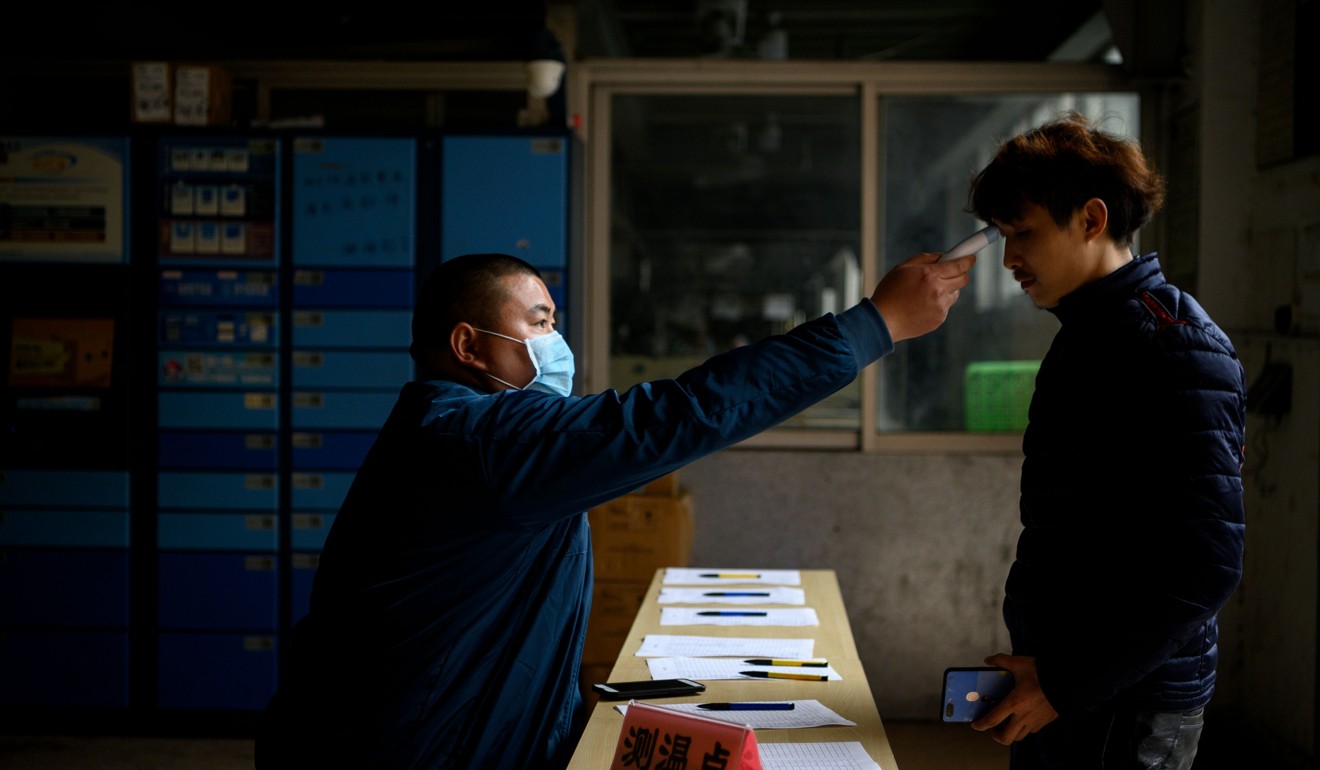
The employment sub-index in the manufacturing PMI fell to 31.8 in February. Photo: AFP
How quickly China can dig itself out of the coronavirus hole is a matter of debate.
According to the PMI survey, about 90 per cent of medium and large-sized manufacturers are expected to resume production in March, meaning about 10 per cent will still be closed four weeks from now.
As for small firms, the industry ministry said this week that two-thirds would still be closed at the end of February.
China’s production difficulties have resulted in economic problems for nations around the world that rely on supply chains that begin or pass through the country. The global spread of the coronavirus will only exacerbate the problem.
Barclays and Nomura forecast China’s first-quarter growth at 2 per cent, while Capital Economics said it would contract in year-on-year terms.
“The sharp drop in China’s manufacturing PMI in February reinforces our view that the normalisation in economic activity will be delayed,” said Xing Zhaopeng, an economist at Australia & New Zealand Banking Group.
“There’s scant chance for a V-shaped rebound – the authorities are using targeted aids more than stimulus to stabilise the economy and that will lead to a gradual bounce.”
The National Bureau of Statistics tried to put a brave face on the data, saying there would be a substantial improvement in March.
“The resumption of work is ramping up and market confidence is steadily recovering,” said Zhao Qinghe, a senior statistician at the NBS.
“Although the novel coronavirus pneumonia epidemic has caused a larger impact on production and operations of Chinese enterprises … currently the epidemic has come under initial containment, and the negative impact on production is gradually weakening.”
Source: SCMP
Posted in Beijing, China Federation of Logistics and Purchasing, China’s economy, coronavirus, cost, COVID-19, Cultural Revolution, Development Research Centre, Hong Kong, larger, manufacturing and service sectors, national bureau of statistics, plunge, purchasing managers’ indexes (PMI), State Council, Uncategorized |
Leave a Comment »
18/02/2020
- China was widely expected to announce a gross domestic product (GDP) growth target for 2020 of ‘around 6 per cent’ following 6.1 per cent growth in 2019
- Zhang Yansheng, who is an adviser to China’s economic policymakers, says ‘there will definitely be adjustments’
(190305) — BEIJING, March 5, 2019 (Xinhua) — Xi Jinping (C, front), Li Keqiang (3rd R, front), Wang Yang (3rd L, front), Wang Huning (2nd R, front), Zhao Leji (2nd L, front), Han Zheng (1st R, front) and Wang Qishan (1st L, front) attend the opening meeting of the second session of the 13th National People’s Congress at the Great Hall of the People in Beijing, capital of China, March 5, 2019. (Xinhua/Li Xueren)
China may revise down its annual economic growth target for 2020 in response to the impact of the coronavirus outbreak, but will still not give up the overall target of maintaining economic growth “in a reasonable range”, according to a Chinese government researcher.
The Chinese government has never officially published its goal for 2020, but it is widely expected that the specific gross domestic product (GDP) growth target for 2020
would be “around 6 per cent”, marking a potential slight slowdown from
6.1 per cent growth in 2019 but enough to achieve Beijing’s grand goal of
doubling the size of its economy in 2020 from 2010.
China’s 2020 growth target was originally to be released during Premier Li Keqiang’s government work report at the National People’s Congress, but the March 5 annual parliamentary meeting is set to be postponed due to the coronavirus outbreak.
“There will definitely be adjustments. For the central government, it hasn’t defined what the ‘reasonable range’ should be after the outbreak of coronavirus. People are still watching how the outbreak will develop and influence the economy,” Zhang Yansheng, the chief research fellow at the Beijing-based think tank, the China Centre for
International Economic Exchanges, told the South China Morning Post on Tuesday.
As for the final GDP target figure, we have to be true to facts. The GDP target was not a compulsory requirement but a soft forecast figureZhang Yansheng
“As for the final GDP target figure, we have to be true to facts. The GDP target was not a compulsory requirement but a soft forecast figure – strictly speaking, a forecast figure could be revised three or four times in a year.”
Zhang, though, referenced the fact that 29 of China provincial-level regions, out of a total of 31, had published their 2020 economic growth targets at the Central Economic Work Conference in December.
“The direction and the goals are clear. It’s not the case that people have not known what they should do this year,” added Zhang, who is an adviser to China’s economic policymakers.
has repeatedly said over the last two weeks that China will still strive to achieve its economic and social development goals for 2020 despite the outbreak, which has claimed over 1,800 lives and infected over 70,000 people, and remain on course to build the country into a “comprehensively well-off society”.
China to postpone the year’s biggest political gathering amid coronavirus outbreak
One key aspect of that vision is that China will
double the size of its GDP in 2020 from 2010, which would require a minimum 5.6 per cent growth rate in 2020, although Beijing has never clearly defined the full details of the goal.
On Tuesday, Ren Hongbin, vice-chairman of the State-owned Assets Supervision and Administration Commission of the State Council, said that the annual production goals and reform tasks set earlier in the year for state-owned enterprises would also not change despite the outbreak.
“The impact of the epidemic is temporary and phased, will not change the long-term positive fundamentals of the Chinese economy,” he said.
We should neither view 6 per cent as a red line nor take doubling the GDP size as a bottom line Song Xiaowu
Before the country fell into an economic standstill around the extended Lunar New Year holiday as the
virus spread from the city of Wuhan, economists and analysts have been engaged in a heated debate over whether China needs to keep its growth rate above 6 per cent in 2020.
Song Xiaowu, former president of the China Society of Economic Reform, a state-backed think tank, said at a forum on Saturday that China’s GDP growth rate could drop to 3 per cent in the first quarter and 5 per cent for the whole of 2020.
“We should neither view 6 per cent as a red line nor take doubling the GDP size as a bottom line,” said Song, in a speech published by the China Development Research Foundation, who organised the forum.
Source: SCMP
Posted in 13th National People's Congress (NPC), 2020, adjust, Beijing, capital, China, China Development Research Foundation, China Society of Economic Reform, coronavirus, government policy adviser, Great Hall of the People, Han Zheng, Li Keqiang, Premier Li Keqiang’s, President Xi Jinping, Ren Hongbin, State Council, State-owned Assets Supervision and Administration Commission, target, Uncategorized, Wang Huning, Wang Qishan, wang yang, Wuhan, Xi JinPing, Zhao Leji |
Leave a Comment »
24/01/2020
BEIJING, China (Reuters) – China ramped up measures to contain a virus that has killed 26 people and infected more than 800, suspending public transport in 10 cities, shutting temples over the Lunar New Year and even closing the Forbidden City and part of the Great Wall.
The week-long holiday to welcome the Year of the Rat began on Friday, raising fears the infection rate could accelerate as hundreds of millions of people travel to their homes and abroad in what is usually a festive time of year.
The World Health Organisation (WHO) has declared the new coronavirus an emergency for China but stopped short of declaring the epidemic of international concern.
While most of the cases and all of the deaths have been in China, the virus has been detected in Thailand, Vietnam, Singapore, Japan, South Korea, Taiwan and the United States. It was likely Britain also had cases, a health official said.
The newly identified coronavirus has created alarm because it is too early to know just how dangerous it is and how easily it spreads between people.
Symptoms include fever, difficulty breathing and coughing.
Most of the fatalities have been elderly, many with pre-existing conditions, the WHO said.
Cases are likely to continue to rise in China but it is too soon to evaluate the severity of the virus, a WHO spokesman said on Friday.
As of Thursday, there were 830 confirmed cases and 26 people had died there, China’s National Health Commission said.
In Wuhan, where the outbreak began last month, pharmacies were running out of supplies and hospitals were flooded with nervous resident seeking medical checks.
“There’s so much news, so much data, every 10 minutes there’s an update, it’s frightening, especially for people like us in a severely hit area,” Lily Jin, 30, a resident of the city, told Reuters by phone.
GRAPHIC: The spread of a new coronavirus – here
MORE RESTRICTIONS
While restrictions have already been put in place in cities across the country to curb the outbreak, China will take stricter and more targeted measures, state television reported citing a state council, or cabinet, meeting on Friday, but gave no further details.
“The spread of the virus has not been cut off … Local authorities should take more responsibility and have a stronger sense of urgency,” state broadcaster CCTV said.
Most cases have been in Wuhan, where the virus is believed to have originated in a market that traded illegally in wildlife. Preliminary research suggested it crossed to humans from snakes.
The city of 11 million people, and neighboring Huanggang, a city of about 7 million, were in virtual lockdown.
Nearly all flights at Wuhan’s airport had been canceled, and airports worldwide have stepped up the screening of passengers from China.
Checkpoints blocked the main roads leading out of town, and police checked incoming vehicles for wild animals.
Wuhan was rushing to build a 1,000-bed hospital for the infected by Monday, the official Changjiang Daily reported.
About 10 people got off a high-speed train that pulled into Wuhan on Friday afternoon but nobody got on before it resumed its journey. Although it stopped there, Wuhan had been removed from the train’s schedule.
“What choice do I have? It’s Chinese New Year. We have to see our family,” said a man getting off the train who gave his family name Hu.
CHINA EMERGENCY
The WHO said on Thursday it was a “bit too early” to designate the outbreak a public health emergency of international concern, which would require countries to step up their response.
Some experts believe the virus is not as dangerous as the one that caused the 2002-03 outbreak of Severe Acute Respiratory Syndrome, which also began in China and killed nearly 800 people, or the one that caused Middle East Respiratory Syndrome, which has killed more than 700 people since 2012.
There is no known vaccine or particular treatment.
“There is some work being done and there are some trials now for MERS (vaccines). And we may look at some point whether those treatments and vaccines would have some effect on this novel coronavirus,” WHO spokesman Tarik Jasarevic said on Friday.
Gilead Sciences Inc said it was assessing whether its experimental Ebola treatment could be used. Meanwhile, three research teams were starting work on vaccines, the Coalition for Epidemic Preparedness Innovations said.
In the meantime, Chinese authorities have imposed restrictions on movement and gatherings to try to stem the spread. It has advised people to avoid crowds and 10 cities in the central province of Hubei, where Wuhan is located, have suspended some transport, the Hubei Daily reported.
Some sections of the Great Wall near Beijing will be closed from Saturday, state media said.
Some temples have also closed, including Beijing’s Lama Temple where people make offerings for the new year, have also been closed as has the Forbidden City, the capital’s most famous tourist attraction.
Shanghai Disneyland will close from Saturday. The theme park has a 100,000 daily capacity and sold out during last year’s Lunar New Year holiday.
The virus is expected to dent China’s growth after months of economic worries over trade tensions with the United States, unnerving foreign companies doing business there.
Shares in luxury goods firms have suffered from the anticipated drop in demand from China, and on Friday French spirits group Remy Cointreau said it was “clearly concerned” about the potential impact.
Source: Reuters
Posted in Beijing, Britain, cabinet, China, chinese authorities, chinese new year, Coalition for Epidemic Preparedness Innovations, elderly, emergency, epidemic, experimental Ebola treatment, fatalities, Forbidden City, Gilead Sciences Inc, Great Wall, hospitals, Huanggang, Hubei Daily, hubei province, humans, Japan, Lama Temple, local authorities, lunar new year, Lunar New Year holiday, luxury goods firms, MERS (vaccines), Middle East Respiratory Syndrome, National Health Commission, new coronavirus, pharmacies, Preliminary research, public transport, Rémy Cointreau, Severe Acute Respiratory Syndrome, Shanghai Disneyland, shuts, Singapore, snakes, South Korea, State Council, Taiwan, temples, Thailand, train’s schedule, Uncategorized, United States, Vietnam, Virus, wildlife, World Health Organisation (WHO), Wuhan, Year of the Rat |
Leave a Comment »
19/09/2019
BEIJING, Sept. 18 (Xinhua) — China’s state-owned enterprises (SOEs) have navigated torrential waters over the past 70 years, from breaking the ground for the country’s industrial system to becoming the model of enterprises worldwide, and are now pledging more contributions to the world economy.
LAYING THE FOUNDATION
At a time when China’s manufacturing industry was still in its infancy, it was the SOEs that supplied the bedrock of the country’s industrial development.
The seamless steel pipe that debuted in China 66 years ago, the green-clad truck bearing the brand name “Jiefang” as well as the silver-white fighter jet that first rolled off production lines in 1956 attested to the SOEs’ early triumphs.
Seven decades have proved long enough for China’s SOEs to emulate their foreign counterparts and lead global innovation.
As a long-time pillar of the Chinese economy, the steel industry delivered a total output of 928 million tonnes in 2018, almost 5,900 times that of 1949, accounting for more than half of the world’s annual steel production.
Today, SOEs remain active in the advent and growth of China’s most acclaimed industrial fronts, including high-speed railway, supercomputers and navigation satellite systems, to name a few.
UNLEASHING VITALITY
Alongside their dazzling achievements, the SOEs’ quest to maintain vitality is equally memorable.
China’s SOEs have undergone a series of reforms in terms of shareholding, payroll and human resource management since 1978, in an effort to better fit into the big picture of China’s economy, which at the time was morphing into a socialist market economy marked by diverse corporate ownerships.
These reforms focused on granting the SOEs more leeway in making corporate decisions.
In 2003, the founding of the State-owned Assets Supervision and Administration Commission (SASAC) of the State Council further improved the management system for China’s SOEs and better prepared them for market competition.
Ongoing tasks of SOE reform include mixed-ownership reforms, employee shareholding and differentiated salary systems, with the underlying logic of delegating power unchanged.
GOING TOP-TIER
Years of continuous reforms have honed Chinese SOEs’ competitive edge, equipping them with the technologies and managerial skills needed to become global top-tier enterprises.
From 1978 to 2018, the business revenue and profit of China’s SOEs expanded at an annual rate of 11.9 percent and 10.3 percent, respectively.
The combined total assets of China’s SOEs in 2018 reached 247.1 times those in 1978, while shareholders’ equity amounted to 130 times.
The number of Chinese enterprises in the Fortune 500 list has risen for the 14th consecutive year, surpassing the U.S. in 2019 with 129 companies, among which 48 are centrally administered SOEs.
Seventy years on, the path of glory continues for China’s SOEs.
Source: Xinhua
Posted in Assets Supervision and Administration Commission (SASAC), Beijing, China’s State Council, Chinese SOEs, high-speed railway (HSR), Jiefang, navigation satellite systems, rise, scratch, seamless steel pipe, silver-white fighter jet, spotlight, State Council, state-owned enterprises (SOEs), supercomputers, Uncategorized |
Leave a Comment »























 CHINDIA ALERT: You'll be living in their world, very soon