Chindia Alert: You’ll be Living in their World Very Soon
aims to alert you to the threats and opportunities that China and India present. China and India require serious attention; case of ‘hidden dragon and crouching tiger’.
Without this attention, governments, businesses and, indeed, individuals may find themselves at a great disadvantage sooner rather than later.
The POSTs (front webpages) are mainly 'cuttings' from reliable sources, updated continuously.
The PAGEs (see Tabs, above) attempt to make the information more meaningful by putting some structure to the information we have researched and assembled since 2006.
Image copyright GETTY IMAGESImage caption Discrimination against women on account of menstruation is widespread in India
India’s uncomfortable relationship with periods is back in the headlines.
College students living in a hostel in the western Indian state of Gujarat have complained that they were made to strip and show their underwear to female teachers to prove that they were not menstruating.
The 68 young women were pulled out of classrooms and taken to the toilet, where they were asked to individually remove their knickers for inspection.
The incident took place in the city of Bhuj on Tuesday. The young women are undergraduate students at Shree Sahajanand Girls Institute (SSGI), which is run by Swaminarayan sect, a wealthy and conservative Hindu religious group.
They said a hostel official had complained to the college principal on Monday that some of the students were breaking rules menstruating women are supposed to follow.
According to these rules, women are barred from entering the temple and the kitchen and are not allowed to touch other students during their periods.
At meal times, they have to sit away from others, they have to clean their own dishes, and in the classroom, they are expected to sit on the last bench.
Image copyright BBC GUJARATIImage caption Female students gather outside the Shree Sahajanand Girls Institute (SSGI)
One of the students told BBC Gujarati’s Prashant Gupta that the hostel maintains a register where they are expected to enter their names when they get their periods, which helps the authorities to identify them.
But for the past two months, not one student had entered her name in the register – perhaps not surprising considering the restrictions they have to put up with if they do.
So on Monday, the hostel official complained to the principal that menstruating students were entering the kitchen, going near the temple, and mingling with other hostellers.
The students allege that, the next day, they were abused by the hostel official and the principal before they were forced to strip.
They described what happened to them as a “very painful experience” that had left them “traumatised” and amounted to “mental torture”.
One student’s father said that when he arrived at the college, his daughter and several other students came to him and started crying. “They are in shock,” he said.
On Thursday, a group of students held a protest on the campus, demanding action against the college officials who had “humiliated” them.
The college trustee Pravin Pindoria said the incident was “unfortunate”, adding that an investigation had been ordered and action would be taken against anyone found guilty of wrongdoing.
But Darshana Dholakia, the vice-chancellor of the university which the college is affiliated with, put the blame on the students. She said that they had broken rules and added that some of them had apologised.
However, some of the students told BBC Gujarati that they are now under pressure from the school authorities to play down the incident and not to speak of their ordeal.
On Friday, the Gujarat State Women’s Commission ordered an investigation into this “shameful exercise” and asked the students to “come forward and speak without fear about their grievances”. The police have lodged a complaint.
Media caption Using comics to combat India’s menstruation taboos
This is not the first time that female students have been humiliated on account of periods.
Discrimination against women on account of menstruation is widespread in India, where periods have long been a taboo and menstruating women are considered impure. They are often excluded from social and religious events, denied entry into temples and shrines and kept out of kitchens.
Increasingly, urban educated women have been challenging these regressive ideas. In the past few years, attempts have been made to see periods for just what they are – a natural biological function.
But success has been patchy.
In 2018, the top court in a landmark order threw open the doors of the Sabarimala shrine to women of all ages, saying that keeping women out of the temple in the southern state of Kerala was discriminatory.
NEW DELHI (Reuters) – Violent clashes erupted in Delhi between police and hundreds of university students on Friday over the enactment of a new citizenship law that critics say undermines India’s secular foundations.
The unrest has already led Japanese Prime Minister Shinzo Abe to cancel a planned visit to India from Sunday.
The new law offers a way to Indian citizenship for six minority religious groups from neighbouring Bangladesh, Pakistan and Afghanistan including Hindus and Christians, but not Muslims.
RELATED COVERAGE
Explainer: What does India’s new citizenship law mean?
Clashes erupt in New Delhi between students, police over citizenship law
See more stories
Police fired tear gas and used baton charges to disperse scores of students demonstrating at Jamia Millia Islamia university in the heart of Delhi over the law.
Protesters attacked cars in the capital, and several people were injured and taken to hospital.
Zakir Riyaz, a PhD student in social work, said the new law made a mockery of India’s religious openness.
“It goes against the whole idea of a secular India,” he said, speaking by phone from the Holy Family Hospital in New Delhi where 15 of his fellow students were admitted after being injured in a police baton charge.
Police barricades were knocked down and streets were strewn with shoes and broken bricks. An official at the university dispensary said that more than 100 students had been brought in with injuries but all had been discharged.
Parvez Hashmi, a local politician who went to the protest site to speak to police, said about 50 students had been detained.
Students said it was meant to be a peaceful protest, with them trying to go from Jamia University to Parliament Street to show their opposition to the legislation. But police pushed them back, leading to clashes.
Critics of Prime Minister Narendra Modi’s government say it is promoting a Hindu-first agenda for India and that the citizenship law excluding Muslims showed a deep-seated bias against India’s 170 million Muslims.
Imran Chowdhury, a researcher, said “either give citizenship to refugees of all religions or none at all. The constitution is being tampered with in the name of religion.”
Modi’s ruling Bharatiya Janata Party denies any religious bias but says it is opposed to the appeasement of one community. It says the new law is meant to help minority groups facing persecution in the three nearby Muslim countries.
ABE CANCELS
The United Nations human rights office voiced concern that the new law is “fundamentally discriminatory in nature”, and called for it to be reviewed.
Two people were killed in India’s Assam state on Thursday when police opened fire on mobs torching buildings and attacking railway stations in protest at the new citizenship rules signed into law on Thursday.
Japan’s Prime Minister Shinzo Abe cancelled a trip to Assam for a summit with his Indian counterpart Narendra Modi that had been due to begin on Sunday.
Japan has stepped up infrastructure development work in Assam in recent years, which the two sides were expected to highlight during the summit. Abe had also planned to visit a memorial in the nearby state of Manipur where Japanese soldiers were killed in World War Two.
“With reference to the proposed visit of Japanese PM Abe Shinzo to India, both sides have decided to defer the visit to a mutually convenient date in the near future,” Indian foreign ministry spokesman Raveesh Kumar said in a tweet.
Japan’s Chief Cabinet Secretary Yoshihide Suga said both countries would decide on the appropriate timing for the visit although nothing has been decided yet.
A movement against immigrants from Bangladesh has raged in Assam for decades. Protesters there say granting Indian nationality to more people will further strain the state’s resources and lead to the marginalisation of indigenous communities.
HONG KONG (Reuters) – China’s People’s Liberation Army (PLA) soldiers in shorts and t-shirts made a surprising appearance in some Hong Kong streets on Saturday, briefly helping residents clean up debris after anti-government protests blocked roads, witnesses said.
The presence of PLA troops on the streets, even to help clean up roads near their base, could stoke further controversy over the Chinese-ruled territory’s autonomous status.
Hong Kong has been rocked by more than five months of demonstrations by protesters angry at perceived Communist Party meddling in the former British colony, which was guaranteed its freedoms when it returned to Chinese rule in 1997.
Beijing denies interfering and has blamed the unrest on foreign influences.
Clashes between protesters and police have become increasingly violent. China has warned that any attempt at independence for Hong Kong will be crushed, but troops have remained inside their base.
RELATED COVERAGE
China’s PLA soldiers seen helping clean up streets after Hong Kong protests – RTHK
Saturday’s clean up followed some of the worst violence seen this year, after a police operation against protesters at the Chinese University of Hong Kong on Tuesday.
The authorities have since largely stayed away from at least five university campuses that had been barricaded by thousands of students and activists who stockpiled petrol bombs, catapults, bows and arrows and other weapons.
Many protesters appeared to have left the campuses by late Saturday, though some remained behind to man makeshift barricades. Hong Kong’s Cross-Harbour Tunnel was still blocked by protesters occupying Polytechnic University.
Earlier, hundreds of pro-China demonstrators gathered by the city’s legislature and police headquarters, waving Chinese and Hong Kong flags. Some held up posters reading “Police we stand with you”, while others chanted “Support the police”.
Pro-China protests have so far attracted much smaller numbers than those angry at Beijing.
RARE TROOP PRESENCE
By late afternoon, the PLA soldiers had left the streets outside Baptist University, beside their barracks in leafy Kowloon Tong.
Chinese troops have appeared on local streets only once since the 1997 handover, to help with cleanup operations after a typhoon in late 2018. It was not immediately clear how many were involved on Saturday.
Calls to the PLA Hong Kong garrison office and a media liaison officer went unanswered.
Demosistō, a pro-democracy organisation, said Saturday’s cleanup operation could set a “grave precedent” if the city’s government invites the military to deal with internal problems.
In August, Beijing moved thousands of troops across the border into Hong Kong in what state news agency Xinhua described as a routine “rotation”.
Foreign envoys and security analysts estimate up to 12,000 troops are now based across Hong Kong — more than double the usual garrison number.
Standing beside a black flag with the slogan “Liberate Hong Kong, Revolution of our Times,” James Wong, 23, was among a handful of protesters still manning a bridge at Baptist University.
“We didn’t want to confront the people and the PLA troops directly,” he told Reuters. “We are not directly against the PLA, but rather the government. But the PLA should not leave their base because this is Hong Kong territory.”
Wong said even after the campus fortifications have been dismantled “Hong Kong will keep resisting until the government responds to our demands”.
Hundreds of residents moved in to help clear barricaded roads near several universities.
Clashes on Saturday saw at least one petrol bomb thrown before anti-government protesters at the campuses retreated. No soldiers appeared to have been involved in the confrontations.
“We just want our lives to continue,” said one resident who was helping clear streets near HKU. “There are many elderly who need to go the hospital and children who need to go to school. I am very sad to see what is happening in my community.”
PRO-POLICE DEMONSTRATION
Saturday’s rally to denounce the anti-government violence drew a mix of young and elderly.
“From the bottom of our hearts, we believe it is the correct thing to support the police in fighting the rioters for Hong Kong citizens,” said a 49-year-old housewife surnamed Kong.
“A lot of people keep silent, afraid of the rioters. It’s time for all the people who are silent to step up and say that’s enough.”
A 70-year-old street cleaner died on Thursday after being hit on the head by one of several bricks police said had been thrown by “masked rioters”. On Monday, police blamed a “rioter” for dousing a man in petrol and setting him on fire. The victim is in critical condition.
On the same day, police shot a protester in the abdomen. He was in a stable condition.
Many pro-police protesters laid white flowers outside the government office to pay their respects to the cleaner. Others applauded and cheered the police, some bowing and giving thumbs up as they walked past riot police on duty.
Authorities said on Saturday that a highway blocked by anti-government protesters on Friday had reopened after being cleared of debris and petrol bombs.
Train services suspended earlier in the week were gradually resuming, metro operator MTR Corp (0066.HK) said.
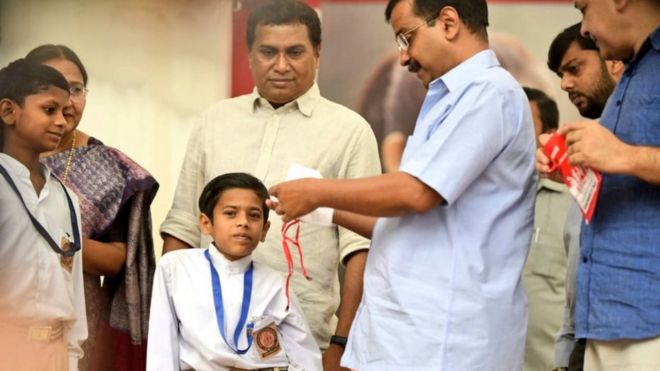
Image copyright TWITTER/@ARVINDKEJRIWALImage caption Delhi Chief MinisterArvind Kejriwal has been handing out masks to school students
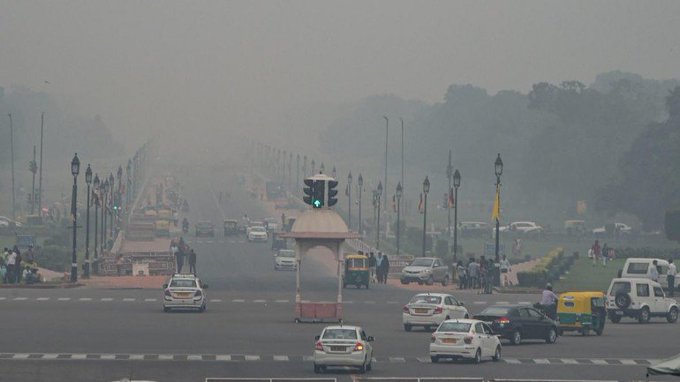
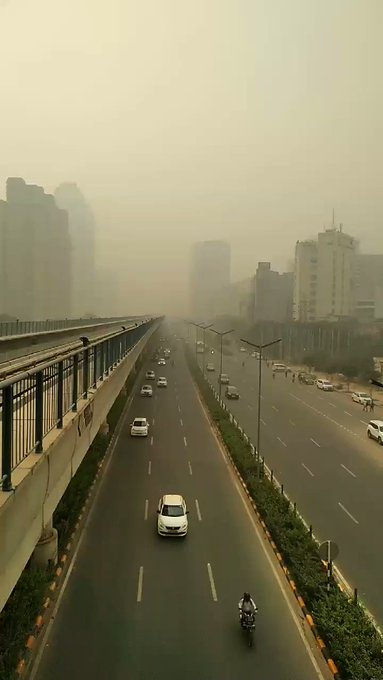
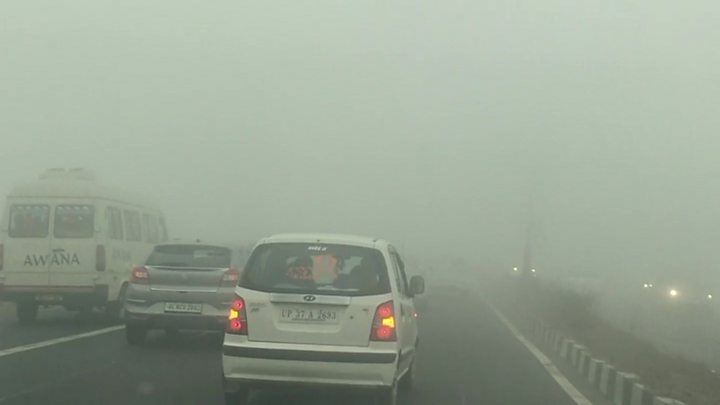
Five million masks are being distributed at schools in India’s capital, Delhi, after pollution made the air so toxic officials were forced to declare a public health emergency.
A Supreme Court mandated panel imposed several restrictions in the city and two neighbouring states, as air quality deteriorated to “severe” levels.
All construction has been halted for a week and fireworks have been banned.
The city’s schools have also been closed until at least next Tuesday.
Delhi’s Chief Minister Arvind Kejriwal said Delhi had been turned into a “gas chamber”.
The masks are being handed out to students and their parents, and Mr Kejriwal has asked people to use them as much as possible.
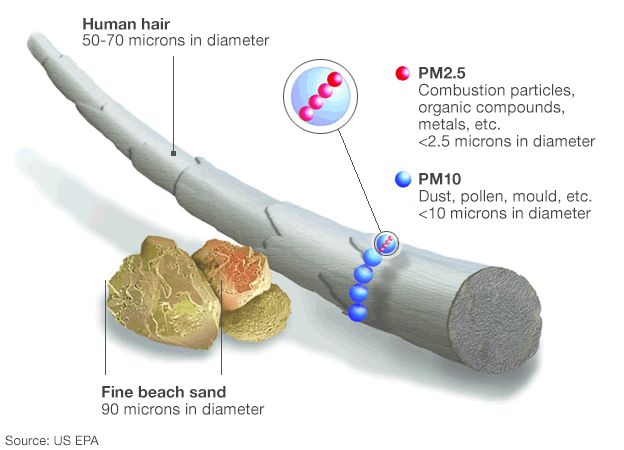
The levels of tiny particulate matter (known as PM2.5) that enter deep into the lungs are 533 micrograms per cubic metre in the city. The WHO recommends that the PM2.5 levels should not be more than 25 micrograms per cubic metre on average in 24 hours.
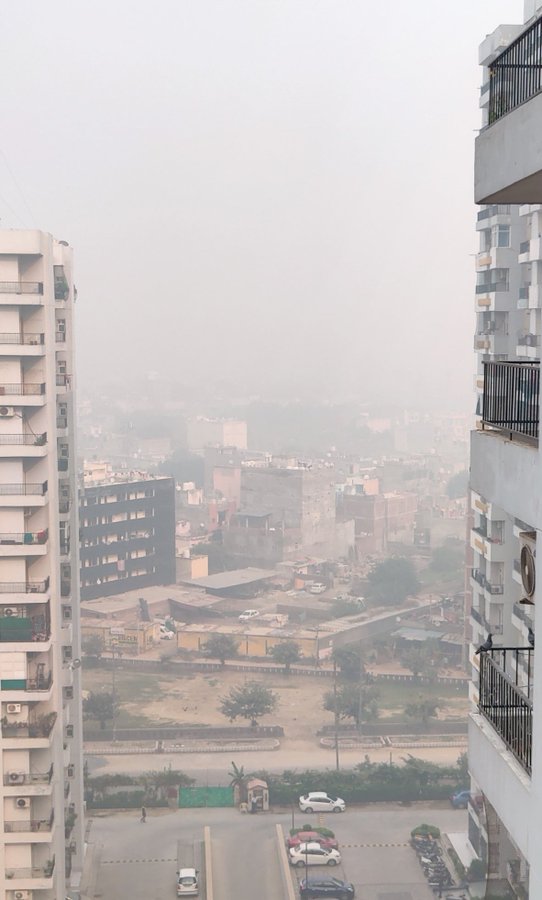
As thick white smog blanketed the city, residents started tweeting pictures of their surroundings. Many are furious that the situation remains the same year after year.
The hashtags #DelhiAirQuality and #FightAgainstDelhiPollition are trending on Twitter.
One of the main reasons for air quality in the city worsening every year in November and December is that farmers in the neighbouring states of Punjab and Haryana burn crop stubble to clear their fields. It’s made worse by the fireworks during the Hindu festival of Diwali.
There are other reasons too, including construction dust, factory and vehicular emissions, but farm fires remain the biggest culprit.
Media caption A hair-raising drive through the Delhi smog
More than two million farmers burn 23 million tonnes of crop residue on some 80,000 sq km of farmland in northern India every winter.
The stubble smoke is a lethal cocktail of particulate matter, carbon dioxide, nitrogen dioxide and sulphur dioxide.
Using satellite data, Harvard University researchers estimated that nearly half of Delhi’s air pollution between 2012 and 2016 was due to stubble burning.
The burning is so widespread that it even shows up in satellite photos from Nasa.
What are PM 2.5 particles?
Particulate matter, or PM, 2.5 is a type of pollution involving fine particles less than 2.5 microns (0.0025mm) in diameter
A second type, PM 10, is of coarser particles with a diameter of up to 10 microns
Some occur naturally – e.g. from dust storms and forest fires, others from human industrial processes
They often consist of fragments that are small enough to reach the lungs or, in the smallest cases, to cross into the bloodstream as well
BEIJING, Oct. 23 (Xinhua) — Chinese authorities demand primary and middle schools to step up education on environment protection and reduce the use of plastic, according to a statement issued Wednesday.
The schools should not force students to use plastic book covers, especially substandard ones, which could damage children’s health, said the statement.
The statement also requires low-carbon consumption in curricular and extracurricular activities and in school management so as to raise the environmental awareness among the students.
TIANJIN, Sept. 21 (Xinhua) — Just scan a QR code on a vending machine, then you will be given a drink. The special vending machine placed at the ongoing cybersecurity expo held in Tianjin has attracted many people to try it out.
Once you scan the code, you will receive a message in a second, reminding you that “arbitrary code-sweeping will endanger personal property safety,” as your personal information might have been illegally collected.
This machine was installed by 360 Security Technology Inc.
The expo is a part of a cybersecurity publicity campaign held in north China’s Tianjin Municipality, aiming to promote public awareness of the issue
In fact, it is also a part of the 2019 China Cybersecurity Week, held from Sept. 16 to 22 nationwide.
The campaign was jointly launched by the Publicity Department of the Communist Party of China Central Committee, the Office of the Central Cyberspace Affairs Commission and the ministries of education, public security and industry and information technology.
Over 100 cybersecurity and Internet enterprises have attended various activities held during the week.
There will also be themed activities to promote cybersecurity issues related to students, the telecommunication sector and financial sector.
Personal information protection is a major theme of this year’s campaign.
In Tianjin, an interactive experience area has been set up at the expo, which allowed visitors to raise their cybersecurity awareness through taking part in different activities.
“I’ve learned a lot about cybersecurity through these activities. Do not click strange links or download mobile software from unofficial platforms,” said a 64-year-old visitor surnamed Zhang.
Statistics released showed that China has more than 200 app stores providing nearly 5 million apps. They bring convenience for many people, but some of them become “information funnels,” leaking people’s mobile phone numbers, call records, text messages, consumption records and other private information.
According to a report on netizen’s satisfaction on cybersecurity issued during the event, 51.25 percent of surveyed Chinese netizens believe the Internet is safe, up 12.91 percentage points from last year. About 37 percent of the respondents believe there are personal information leaks on the Internet, and 58 percent experienced personal information infringement.
More than 82 percent of the respondents also urge legislation on individual information protection.
Early in January, the Office of the Central Cyberspace Affairs Commission, the Ministry of Industry and Information Technology, the Ministry of Public Security and the State Administration for Market Regulation teamed up to launch a campaign to crackdown on illegal collection of personal information in mobile apps.
So far, more than 600 popular apps have been evaluated, with over 200 apps asked to make improvements in personal information protection.
BEIJING, Sept. 1 (Xinhua) — As the autumn semester started Sunday, Chinese education departments, schools and military authorities have geared up for military training programs for students.
The Ministry of Education and three departments of the Central Military Commission jointly issued a directive earlier this week underlining adequate preparation of trainers, careful design of training programs and proper security management.
Freshman college students across the country and entrants to middle schools in many places are required to attend a short military training program mostly on campus but sometimes at training camps.
The military should select competent servicemen to be trainers and provide them with adequate training on teaching policies and skills, according to the directive.
Civilian and military authorities were also asked to introduce more interactive and creative training models and design courses that suit students’ physical and psychological conditions.
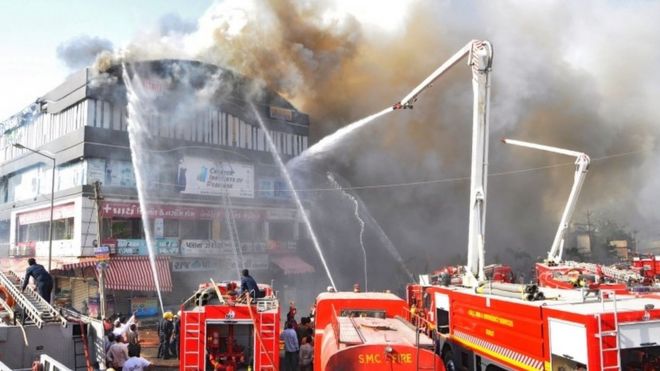
Image copyright GETTY IMAGESImage caption The fire ripped through tuition classes in the western state of Gujarat
At least 19 students have died in a fire at a school in India, officials said.
Students were seen jumping and falling from the building in the western city of Surat as black smoke billowed from windows.
Most of the victims were teenagers who had been studying at a tuition centre.
The initial cause of the fire was not immediately clear. Officials said the blaze spread through packed classrooms because of flammable roofing.
At least 20 others sustained serious injuries and were being treated in hospital in Gujarat.
“The students lost their life both because of the fire and jumping out of the building,” Deepak Sapthaley, a local fire official, told AFP.
All of the dead were aged below 20 years and many were trapped because the fire began near the staircase, Reuters reported.
Prime Minister Narendra Modi offered his condolences on Twitter and called for local authorities to provide assistance.
Narendra Modi
✔@narendramodi
Extremely anguished by the fire tragedy in Surat. My thoughts are with bereaved families. May the injured recover quickly. Have asked the Gujarat Government and local authorities to provide all possible assistance to those affected.
An inquiry into the incident has been ordered and a report is expected within three days, said the spokesman for the office of Gujarat Chief Minister Vijay Rupani.
Class members must add more than 1,000 new contacts to make the grade
Students studying social media operations at one Chinese university must add more than 1,000 new contacts to pass the class. Photo: Shutterstock
A marketing course has become a popularity contest with a university in central China requiring students to add more than 1,000 contacts to their WeChat account to earn a pass, according to Chinese media reports.
Students enrolled in Henan University of Finance and Economics’ course on social media operations must add 1,001 new contacts to pass and 1,667 to get a distinction, Shanghai-based news site Thepaper.cn reported on Sunday.
The course, run by the university’s school of communications, teaches students about marketing and promotion on social media, particularly WeChat, China’s biggest social media network with more than 1 billion users.
The app, operated by Chinese internet giant Tencent, is a conduit for games, shopping, news, payments and personal posts.
Market for bogus WeChat accounts still alive and well despite crackdown on illegal practice
Many students complained about the requirement online, saying the number was too high and there was no way they could meet so many new people and add them to their WeChat accounts.
Responding to the complaints, the university said the requirement had an academic purpose and staff discussed the issue last week with students who had signed up for the course.
BEIJING, March 6 (Xinhua) — China has created a special committee to implement the country’s national nutrition plan, according to the National Health Commission (NHC).
Jointly established by NHC and 17 other government departments to coordinate and advance nutrition and health related work, the national nutrition and health committee held its inaugural meeting on Feb. 28 in Beijing, said a source of the NHC.
During the meeting, the committee adopted the regulation on its work and the main tasks for 2019 on the national nutrition plan.
Among the key jobs are improving food nutrition and health standards that build upon food safety, and establishing subcommittees at local levels to organize nutrition education and training, to conduct pilot programs and spread scientific knowledge in this regard.
Innovation will also be encouraged in the efforts, while nutrition intervention will be introduced in the campaign to battle poverty.
The national nutrition plan (2017-2030) was released by the General Office of the State Council in July 2017, with the goal of raising awareness of nutrition among the Chinese people, reducing obesity and anemia among students.


 Image copyright GETTY IMAGES
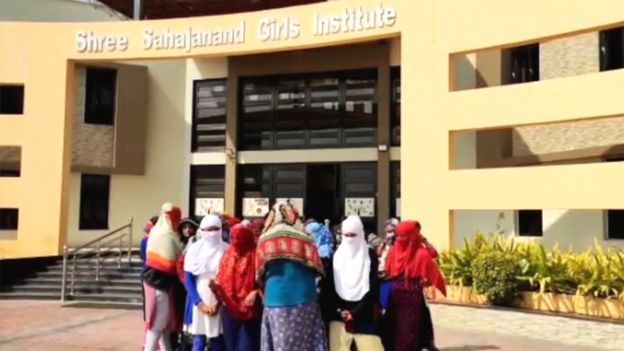 Image copyright BBC GUJARATI














 CHINDIA ALERT: You'll be living in their world, very soon