Chindia Alert: You’ll be Living in their World Very Soon
aims to alert you to the threats and opportunities that China and India present. China and India require serious attention; case of ‘hidden dragon and crouching tiger’.
Without this attention, governments, businesses and, indeed, individuals may find themselves at a great disadvantage sooner rather than later.
The POSTs (front webpages) are mainly 'cuttings' from reliable sources, updated continuously.
The PAGEs (see Tabs, above) attempt to make the information more meaningful by putting some structure to the information we have researched and assembled since 2006.
American destroyer’s mission comes a week before Taiwanese president officially starts second term in office
Increased military activity in the region could have unintended consequences but unlikely to lead to direct conflict, observer says
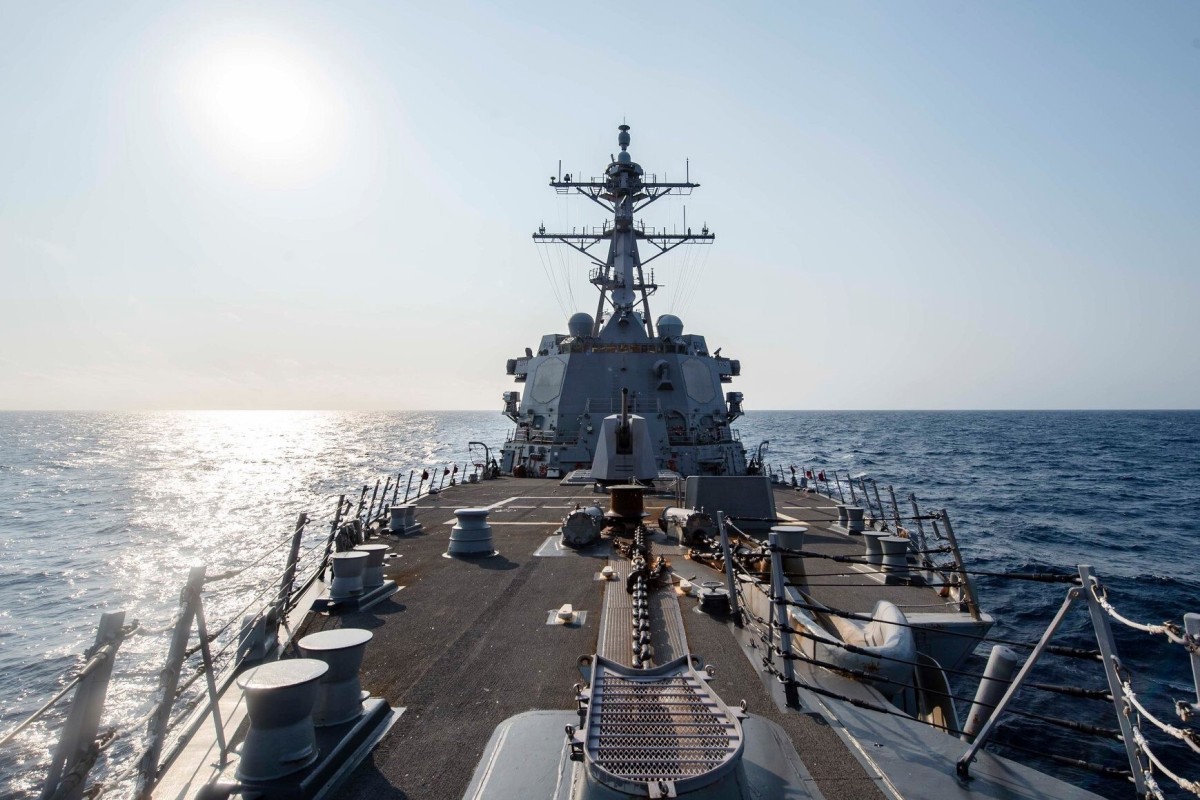
The guided-missile destroyer USS McCampbell made a transit through the Taiwan Strait on Thursday. Photo: US Navy
The United States sent a warship through the Taiwan Strait on Thursday as the Chinese military embarked on more than two months of live-fire naval drills off the mainland’s northern coast.
According to Taiwan’s defence ministry, the Arleigh Burke-class guided-missile destroyer transited the narrow body of water separating Taiwan from mainland China from north to south “in a routine mission”.
“It is continuing its southward voyage and the military is monitoring its movement through the intelligence it has gathered,” the ministry said.
In a statement on its Facebook page, the US Pacific Fleet said the McCampbell transited the Taiwan Strait as part of ongoing operations in the Indo-Pacific.
Analysts said the passage was a response to the People’s Liberation Army’s increasing military activity near Taiwan and in the wider region.
“This will become a new routine as a kind of US security commitment to maintain stability in the Indo-Pacific region,” said Soong Hseik-wen, professor of strategic studies and international relations at National Chung Cheng University in Taiwan.
Beijing urges France to cancel contract to sell arms to Taiwan
13 May 2020
The PLA has staged a series of war games, including fly-bys and warship transits through the strait, in recent months in response to what Beijing sees as growing pro-independence moves by the Tsai government and her party. China has also warned the US against supplying weapons to the island, which Beijing considers to be a wayward province that must return to the mainland fold, by force if necessary.
Mainland China has suspended official exchanges with Taiwan since Tsai was first elected president in 2016 and refused to accept the one-China policy, which Beijing says must be the foundation for any talks.
The PLA has embarked on 11 weeks of naval exercises off the coast of Tangshan in northern China, barring all other vessels from a 25km (15 mile) radius of the drill area, according to the China Maritime Safety Administration.
Taiwanese support closer ties with US over China, few identify as solely Chinese, Pew Research survey finds
13 May 2020
Both Beijing and Washington have ramped up military activities near Taiwan in recent months during the coronavirus pandemic, moves that some observers say run the risk of miscommunication.
Alexander Huang Chieh-cheng, professor of strategic studies and international relations at Tamkang University in Taipei, said no one could exclude the possibility of unintended incidents when both the US and the mainland were stepping up their presence in the region.
“Rational analysts would however argue that the two nuclear powers are not likely to engage in or escalate to direct military conflict,” he said.
Huang said he believed cross-strait relations would worsen during Tsai’s second term in office, which begins on May 20.
“The already damaged relationship between Taiwan and mainland China has worsened since the pandemic mainly due to travel bans and Taiwan’s increased international visibility,” he said.
On Tuesday, Japan’s Kyodo News reported that the PLA was planning a large-scale beach landing exercise near Hainan province in August, simulating a takeover of the Pratas Islands, which are controlled by Taiwan and also known as the Dongsha Islands.
In Taipei, Major General Lin Wen-huang said Taiwan was monitoring the PLA movements and “has contingency plans in place for the South China Sea to strengthen combat readiness and defence preparedness on both the Spratly and Pratas islands”.
Taiwan’s coastguard also announced on Wednesday that its Pratas Islands Garrison was scheduled to conduct an annual live-fire exercise in June to ensure the “effectiveness of various mortar and machine-gun positions”.
Taiwan shows off its military power after presidential election
Shanghai-based military commentator Ni Lexiong said that both the US Navy and PLA were increasing activities during the pandemic because neither side could afford to show weaknesses that the other might take advantage of.
The destroyer’s passage and the PLA’s drills were all part of such efforts, Li said.
But he agreed that both countries were unwilling, unable, and unlikely to have a real conflict.
“They are both bluffing. It’s a fake crisis,” he said. “A pandemic always ends or prevents a war if you look at history.
“I also don’t believe the PLA would want to take over the Dongsha or Taiping islands [in the South China Sea], because these islets alone are not worth a military campaign and all the consequences of that. The only target valuable enough for the PLA is Taiwan.”
Hardline politicians want president to fulfil promise to overhaul constitution to reflect the self-ruled island’s political reality
A petition calls for two referendums on the issue – proposing it either be replaced with a new one or revised
The push for constitutional change could lead to a cross-strait conflict. Photo: Handout
Taiwanese President Tsai Ing-wen is under growing pressure from the hardline camp to push for constitutional change to reflect the self-ruled island’s independent status – something observers say could provoke a cross-strait conflict.
With Tsai due to be sworn in for a second four-year term next month after a landslide victory in January’s election, hardline pro-independence politicians want her to fulfil a 2015 campaign promise: to overhaul the constitution so that it reflects Taiwan’s political reality. The process has been stalled since Tsai’s first term, which began in 2016.
Leading the charge is the Taiwan New Constitution Foundation, a group formed last year by a Tsai adviser and long-time independence advocate Koo Kwang-ming.
The foundation launched a petition at the end of March calling for two referendums on the constitution – proposing that it either be replaced with a new one or revised.
The existing constitution was adopted when Kuomintang leader Chiang Kai-shek and the KMT fled to Taiwan and set up an interim government in 1949 following their defeat by Mao Zedong’s communists in mainland China.
Drawn up in 1947, the constitution still puts the mainland and Mongolia under the Republic of China jurisdiction – Taiwan’s official name for itself. In reality, its jurisdiction extends only to Taiwan and its outlying islands of Penghu, Matsu and Quemoy, which is also known as Kinmen.
Taiwan’s constitution was adopted when KMT leader Chiang Kai-shek fled to the island in 1949. Photo: Handout
“We have garnered more than 3,000 signatures from the public for the first phase of initiating the proposals to hold two referendums asking the president to push for constitutional change,” Lin Yi-cheng, executive director of the Taiwan New Constitution Foundation, said on Wednesday.
He said they would propose that voters be asked two questions in the referendums: “Do you support the president in initiating a constitutional reform process for the country?”
And: “Do you support the president in pushing for the establishment of a new constitution reflecting the reality of Taiwan?”
“We’re ready to send the two referendum proposals to the Central Election Commission on Thursday,” he said.
Confusion prompts call for China Airlines name change in Taiwan, but at what cost?
14 Apr 2020
Under Taiwan’s Referendum Act, the process for holding a referendum involves three stages: a proposal, endorsement and voting.
Lin said there should be no problem for the commission to approve the proposal stage since they had gathered far more than the minimum 1,931 signatures needed under the act.
The endorsement stage requires a minimum of 290,000 signatures, and if the referendum is held, they will need at least 5 million votes.
Lin said if the process went smoothly, he expected a referendum could be held in August next year, allowing time for review and making the necessary arrangements.
He said if the referendum questions got enough public support, Tsai would need to deal with the issue.
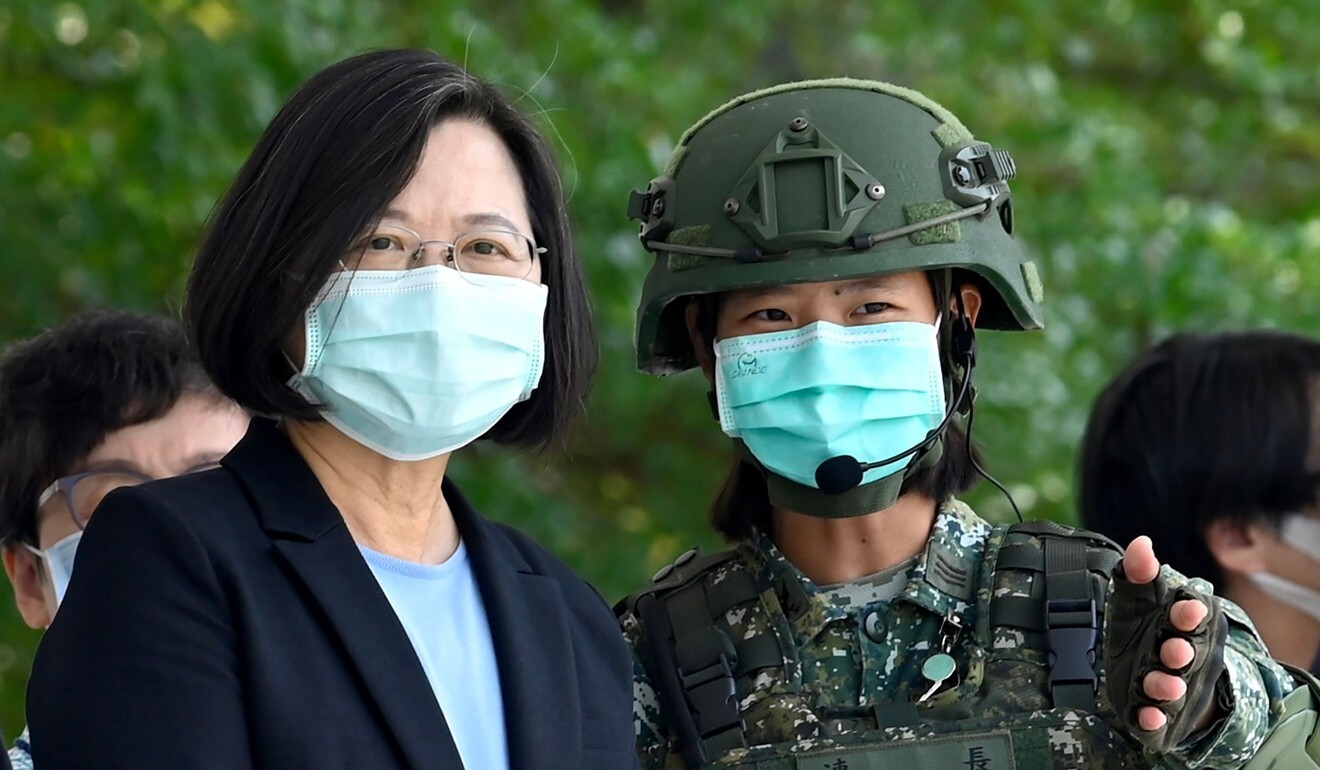
Tsai Ing-wen visits a military base in Tainan earlier this month. The pressure for constitutional change creates a dilemma for the president. Photo: AFP
Tsai’s Democratic Progressive Party government has been tight-lipped over the constitutional change issue, which Beijing sees as a move for the island to declare formal independence from the mainland.
Beijing considers Taiwan a wayward province that must be returned to the mainland fold, by force if necessary, and it has warned Tsai against declaring formal independence.
A DPP official said the foundation’s push would put Tsai in a difficult position.
“If she ignores the referendums, she will come under constant pressure from the hardline camp, and if she seriously considers taking action and instituting a new Taiwan constitution, she will risk a confrontation with Beijing, the consequence of which could be a cross-strait conflict,” said the official, who requested anonymity.
On Tuesday, Zhu Fenglian, a spokeswoman for the mainland’s Taiwan Affairs Office, warned the island against holding any referendum on constitutional revision, saying it would be doomed to end in an impasse and would ultimately fail.
“It will only push Taiwan towards an extremely dangerous abyss and bring disasters to Taiwanese compatriots,” she said.
Chinese air force’s drill ‘aimed at signalling deterrent around Taiwan’
2 Apr 2020
But according to Wang Kung-yi, a political science professor at Chinese Culture University in Taipei, Tsai should not be too worried about the hardline camp move.
“The hardline camp has been marginalised greatly in the past several years as reflected by the poor showing in the legislative elections in January,” Wang said, adding that he expected Tsai to continue her relatively moderate cross-strait policy of not sharply provoking the mainland.
Mainland social media users come out in strong support for the officer, compounding extensive coverage of vandalism of businesses with ties across the border
Hong Kong’s police force has gained support from online commenters on the mainland. Photo: Nora Tam
As Monday morning’s police shooting of a protester triggered a wave of shock and outrage in Hong Kong, across the border in mainland China, the response online was just as swift – but in support of the force.
“Support Hong Kong police opening fire! Clean up Hong Kong’s cockroaches!” one popular financial blogger on Weibo, China’s Twitter-like platform, said as he shared footage of the incident.
In the video, an officer grapples with a protester and points his gun towards another approaching protester. The second protester reaches out towards the gun, the officer dodges, steps back and shoots him in the torso.
“It feels great [to watch]! Kill them all, these trash and tumours of society,” a Weibo user replied to the video, with a thumbs-up emoji.
“Hongkong’s loser youth, [police] should totally open fire!! It would be best to shoot them in the head,” another post read.
These comments, and many others like them flooding social media in mainland China, highlight the deep divisions in views on each side of the border as Hong Kong’s political crisis drags into its sixth month.
Despite some initial sympathy, mainland public sentiment towards Hong Kong has hardened since July, amid state propaganda painting the protesters as a separatist movement plotted by “Western black hands”.
In recent weeks, the rancour from the mainland has only appeared to deepen, with photos and videos of protesters vandalising businesses with ties to the mainland spreading online.
Last month, a mainland Chinese banker was assaulted in a confrontation with protesters during his lunch break in Central, drawing the wrath of many mainlanders and renewed online calls for military intervention.
Extensive media coverage of the vandalism and attack, as well as a series of inflammatory commentaries, have further fanned the anger.
On Monday, the social media account of state-run Beijing Daily ran the story of the shooting under the headline: “This morning, a gunshot in Hong Kong, to the applause of citizens!”
“At such a critical moment, the police officer acted so bravely and restrained,” the report said.
“After the police fired the shot and subdued the rioters, some citizens at the scene directly applauded the police. The reaction of the public directly shows that the officer fired not only in a legal and reasonable way, but also in line with the will of the people.”
In the video, a man in a dark blue jumper claps his hands at a nearby traffic light, as police officers pin the protesters to the ground.
The Beijing Daily report did not refer to angry bystanders condemning the officers as “murderers”.
Hong Kong police officer who shot protester receives death threats against children after personal details released online, force says
Hu Xijin, editor-in-chief of nationalist tabloid Global Times, and a regular – and hugely popular – commentator on Hong Kong’s unrest, also weighed in.
“As a media worker, I resolutely support this Hong Kong police officer gunning down the attacking rioters,” he wrote to his 2 million fans on Weibo in a post that included video of the shooting.
Hu accused Hong Kong and Western media of “focusing their coverage on the police shooting and diluting the illegal, criminal and evil deeds of the rioters”.
“Such guiding of public opinion is disgusting,” he wrote.
Hu ended his post with a message to Hong Kong police: “Don’t you be afraid of anything, resolutely defend Hong Kong’s law and order, be strong and be tough. You’re not alone on the front lines. Behind you there are not only the [patriotic] Hong Kong public and the nation, but also the country’s paramilitary police and the People’s Liberation Army Hong Kong garrison, who can enter Hong Kong and offer support in accordance with the Basic Law when needed.”
The post was liked more than 26,000 times in six hours.
Scores of Chinese students flee Hong Kong over fears they will be attacked as anti-mainland sentiment sweeps through protesters in city
Meanwhile, Taiwanese President Tsai Ing-wen called on the Hong Kong government to give a detailed response to the Hong Kong people’s calls for democracy and freedom, which she described as “the only path to return to stability and order”.
“Governments should not fire upon unarmed people, this will only exacerbate the problem,” she wrote on her official Facebook account. “Beijing and the Hong Kong government should respond to the Hong Kong people, not with bullets but with the promise of democracy and freedom.”
Taipei’s Mainland Affairs Council, which oversees the island’s policies on Beijing, called on all sides to give up their arms and aggressive actions to make way for peaceful conversation.
Latest measures grant island’s people and enterprises more equal treatment with their mainland counterparts
Package in March last year was dismissed by Taiwan’s Mainland Affairs Council as an attempt to buy political support
Taipei’s elections in January could influence the tone of cross-strait relations. Photo: EPA-EFE
Beijing announced a series of sweeteners for Taiwanese businesses and individuals on Monday – including participation in its 5G research and allowing Taiwanese to use mainland consular services – only two months before Taiwan’s critical presidential election.
The latest 26 measures drawn up by 20 government departments, including the State Council’s Taiwan Affairs Office and the National Development and Reform Commission, are designed to attract more Taiwanese to live and work in mainland China, despite worsening cross-strait relations.
But Taiwan’s Mainland Affairs Council criticised the move as an attempt by the Chinese Communist Party to “divide Taiwan internally, and was a further reflection of attempts to try to interfere in and influence Taiwan’s election”.
It follows a similar package of 31 measures unveiled by Beijing in March last year, which included tax incentives, preferential land-use policies for Taiwanese businesses on the mainland and benefits for Taiwanese individuals in studying or living on the mainland.
Taiwan charges pro-Beijing politicians with accepting mainland cash
The latest measures to grant Taiwan-funded enterprises more equal treatment with their mainland counterparts include offering access to research and development in 5G technology, investment in passenger and cargo air services, the establishment of microlending and financing companies and the right to apply for financial guarantees from local government funds.
Taiwanese individuals will also be officially entitled to mainland Chinese consular protection abroad, will be treated the same as their mainland counterparts when buying residential property on the mainland, and will be able to train in Beijing for the 2020 Olympic Games.
Beijing claims sovereignty over self-ruled Taiwan, and has not renounced the use of force to take the democratic island into its fold. Beijing’s ruling Communist Party has stressed its intention to promote “peaceful reunification”, pledging in its communique from the fourth plenary meeting of the party’s elite last week to “deepen cross-strait integration and development” while opposing Taiwanese independence.
The latest measures from Beijing came ahead of Taiwan’s presidential and legislative elections in January. Relations across the Taiwan Strait have been frozen under the administration of independence-leaning Taiwanese President, ostensibly over her refusal to accept the “1992 consensus”, or the understanding that there is only “one China” – something that Beijing considers a prerequisite for any talks with Taipei.
Taiwan’s Mainland Affairs Council said on Monday that the roll-out of the 26 measures one year later was intended to “cover up” the fact that the 31 measures had not been executed properly, and reflected administrative problems on the mainland amid slowing economic growth.
“Even more than that, it also reflects that during this period Taiwanese people have rejected ‘one country, two systems’ and do not agree with the results of the Communist Party’s united front divisions,” the council said.
“We urge the Communist Party officials to specifically implement protections for Taiwanese businesses and Taiwanese people in their investments and lives.”
Joseph Wu, Taipei’s foreign minister, also responded with a tweet written in simplified Chinese – which is used on the mainland – rather than the traditional Chinese used in Taiwan.
“China’s Taiwan Affairs Office came out with 26 measures and last year there were 31 – it looks like there are so many measures,” he wrote. “But we in Taiwan do not need one country, two systems, so there is really no need to be so polite. Giving your people more freedom is also good!”
Ongoing anti-government protests in Hong Kong – which is semi-autonomous from Beijing under the one country, two systems model – have highlighted for many Taiwanese voters the threat from Beijing to the island’s sovereignty.
The latest polling by the MAC found that 89 per cent of respondents opposed the one country, two systems framework that Beijing proposed for Taiwan, up from 75 per cent in a similar survey in January.
Edward I-hsin Chen, a political-science professor at Chinese Culture University in Taipei, said the impact of the 26 measures on the election would depend on how they were implemented, but that one country, two systems was clearly not palatable for Taiwanese voters, whether they supported Tsai’s Democratic Progressive Party (DPP) or the mainland-friendly Kuomintang (KMT).
“Taiwan, of course, will not accept one country, two systems, so these policies will need to be more long-term. Mainland officials did not handle the Hong Kong issue very well, so it will be very hard for one country, two systems in Taiwan – blue and green will both reject it,” he said, referring to the party colours for the KMT and DPP. “But it is good for Taiwanese people and businesses to be able to take part in the 5G sector, and there will be more cooperation in the future.”
Lin Chingfa, former chairman of the Beijing-based Association of Taiwan Investment Enterprises, said he believed the new measures were intended to appeal to Taiwanese youth.
“A very important direction for cross-strait cooperation nowadays is to bridge the opportunities available in mainland China for young people who feel deprived from the slow Taiwanese economy. Some of these policies should be especially appealing to them because it shows that the country hopes to make it more convenient for young Taiwan people willing to come,” Lin said.
He said this approach was especially obvious in the measures that were introduced to provide equal treatment for Taiwan people on the mainland – for example the opportunities for Taiwan people to apply for scholarships and the expansion of places for Taiwanese students at universities.
Tsai meets leaders of 1989 pro-democracy movement to bolster credentials for protecting island’s democracy
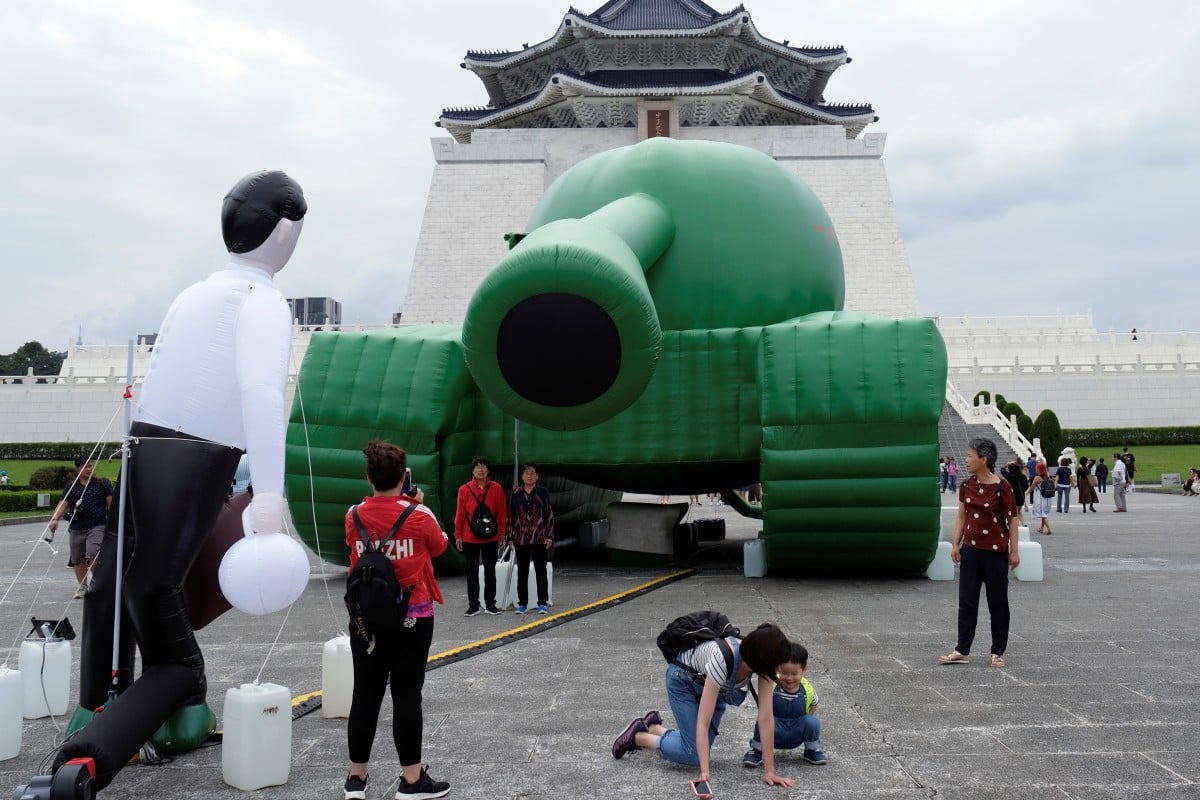
An installation recreating the celebrated Tank Man photograph in Taipei’s liberty square. Photo: Reuters
Taiwanese President Tsai Ing-wen met a group of exiled Tiananmen protesters on Thursday, a move that further burnishes her credentials for standing up to Beijing.
She said the bloody crackdown on the student protesters in 1989 should remind Taiwan that it must firmly reject the “one country, two systems” formula put forward by Beijing for reunification to safeguard its sovereignty, freedom and democracy.
“We don’t want to mislead the other side into making a wrong judgment nor do we want to let down those who support democracy and freedom as a result of an ambiguous answer by a Taiwanese president,” Tsai told her visitors.
“There is no room for ambiguity or dodging when the ‘one country, two systems’ proposal was raised, and we must clearly state that this is not a proposal that we, who have enjoyed freedom, democracy and human rights, could accept.”
The group of mainland émigrés included former Tiananmen student leaders such as Wang Dan, Wang Juntao, Deng Biao, Zhou Fengsuo and Fang Zheng, who were visiting Taiwan for a three-day international forum held to mark the 30th anniversary of the crackdown.
At the start of the year Chinese President Xi Jinping proposed that the two sides should start cross-strait unification talks under the one country, two systems model used to reunite Hong Kong and Macau with the mainland – a model that Tsai flatly rejected saying the two cities had no real autonomy.
In a statement issued by the presidential office, Tsai also noted the different course Taiwan and mainland China had taken over the past 30 years, with the island developing a fully fledged democracy while Beijing has tightened its curbs on freedom of speech.
She also accused Beijing of infiltrating free societies and undermining others’ freedoms using disinformation or hi-tech and commercial weapons.
Taiwanese President Tsai Ing-wen says the 1989 killings highlight the importance of standing up to Beijing. Photo: EPA-EFE
In the meeting, Tsai sharply criticised Chinese Communist leaders for suppressing the pro-democracy student movement in 1989 and failing to restore the activists’ rights.
Teng Biao, one of the visitors, said it was the first time Tsai had set up a meeting with so many pro-democracy activists.
Despite her sharply worded comments, Tsai and her independence-leaning Democratic Progressive Party have generally kept their distance from the Tiananmen exiles, some of whom support cross-strait unification.
Since the DPP’s first election victory in 2000, increasing numbers of people on the island have identified themselves primarily or exclusively as Taiwanese rather than Chinese, and events to mark the 1989 crackdown have dwindled.
On the 20th anniversary of the June 4 killing more than 200,000 people took part in a memorial event in Hong Kong, a sharp contrast to the handful of people who marked the event in Taiwan.
“I guess that might be because we no long cared that much about the [1989] incident over the years. June 4 is just a symbol we use to justify our push for further democracy in Taiwan,” said Chen Wei-ting, a former leader of the Sunflower movement that formed in 2014 to protest against a cross-strait trade deal with the mainland.
Analysts said Tsai hoped the Tiananmen anniversary would remind people of the need to reject the mainland’s overtures to protect Taiwan’s hard-won democracy.
“By reiterating her stand against one country, two systems, Tsai has built up her image as being the leader who is willing to defend Taiwan’s sovereignty despite mounting pressure from Beijing,” said Wang Kung-yi, a professor of political science at Chinese Culture University in Taipei.
Tsai, who is running for a second four-year term in January, has seen her approval rating rebound recently to around 40 per cent from a low of 20 per cent after the DPP’s humiliating defeat in last year’s local government elections.
The mainland-friendly Kuomintang made a string of gains at the DPP’s expense to punish it for unpopular labour and pension reforms and the economy’s poor performance.
Self-ruled island cannot match Beijing’s spending, but innovation can help it succeed in a one-sided military conflict, observers say
First of Tuo Jiang-class stealth warships expected to be ready by 2021
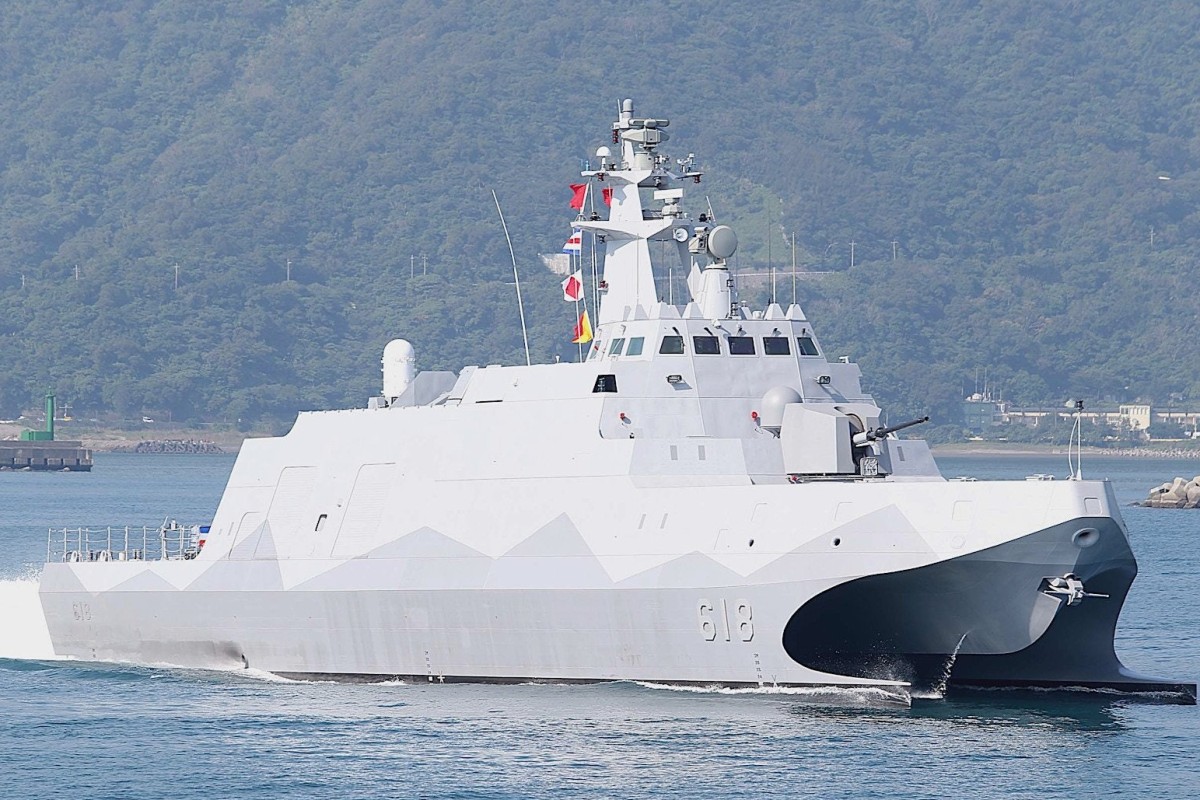
Taiwan began mass production of its Tuo Jiang-class missile corvettes on Friday.
Taiwan has begun mass production of its home-grown Tuo Jiang-class missile corvettes and high-speed minelayers as it seeks to shore up its naval forces amid rising hostility from Beijing.
Dubbed the “aircraft carrier killer”, the small but powerful corvette, which has a displacement of 680 tonnes and a top speed of 45 knots, is a state-of-the-art stealth warship built by Lung Teh Shipbuilding.
A total of three corvettes will be built under the NT$31.6 billion (US$1 billion) Hsun Hai project, the self-ruled island’s navy said.
The warship is equipped with one of the world’s most technologically advanced computer systems and built partly with high-entropy metal alloys for extra strength and durability, it said. Its stealth technology and low radar cross section makes the ship virtually invisible at sea and even more obscure when operating close to the coastline.
Armed with eight subsonic Hsiung Feng II and eight supersonic Hisung Feng III anti-ship missile launchers, the corvettes are intended to take over many of the missions currently undertaken by larger, less manoeuvrable and more expensive frigates and destroyers, the navy said.
In the event of an actual armed conflict with Beijing, the warships would also boost Taiwan’s ability to counter a much larger and better equipped rival, a concept known as asymmetric warfare.
Taiwan simulates repelling invasion as Beijing threat persists
In a ceremony on Friday at Lung Teh’s shipyard in Suao, Yilan county, to mark the start of mass production, Taiwanese President Tsai Ing-wen said the move was made possible after the navy succeeded in overcoming a number of design and technological issues regarding the warship, an earlier version of which she boarded soon after becoming the island’s leader in 2016.
Together with the construction of the high-speed minelayers, also by Lung Teh, and a home-grown submarine at a separate shipyard in Kaohsiung, Tsai said Taiwan was entering a “new era” of naval strength that would give it the ability to thwart any attempts by the People’s Liberation Army to invade its territory.
“This proves we are able to build our own warships and launch a new era of the naval force,” she said.
Construction of the Tuo Jiang-class corvettes was under way, with the first expected to be ready for delivery to the navy in 2021 and the last by 2025, Tsai said.
The first batch of four minelayers would also be ready by 2021, she said.
Taiwan has sought to counter the rising threat from mainland China by developing more of its own military hardware in recent years. Beijing’s military budget for 2019 is 1.2 trillion yuan, or about 16 times as much as Taiwan’s.
Beijing considers Taiwan a wayward province awaiting reunification, by force if necessary, and suspended all official exchanges with it after Tsai, from the independence-leaning Democratic Progressive Party, was elected president and refused to accept the one-China principle.
Experts doubt China’s ability to launch assault on Taiwan
Over the past three years Tsai has prioritised Taiwan’s military expansion, ordering the Chungshan Institute of Science and Technology – the island’s top weapon research and development agency – to speed up production of weapons like the surface-to-air Skybow-III and supersonic anti-ship Hsiung Feng-III missiles.
Taiwan is also expected next year to begin mass production of its CM-34 Clouded Leopard eight-wheeled armoured vehicles and has set a target to manufacture 284 of them by 2023.
Four prototypes of the vehicles, which passed pre-production tests in October, are expected to take part in the island’s annual Han Kuang war games next week.
Chieh Chung, a national security research fellow at the National Policy Foundation in Taipei, said that because of the huge discrepancies in their military budgets Taiwan could not engage in an arms race with the mainland so had to be more innovative.
“Taiwan has to develop an asymmetric defence strategy,” he said. “Take the Tou Jiang corvettes, for example. Because of their high speed, stealth function, small size and powerful weaponry, they can be deployed anywhere near Taiwan’s coast and called into action very quickly to fend off enemy vessels,” he said.
“The same applies to the high-speed minelayers, which can drop mines very quickly and make it very hard for enemy ships to attack the coast,” he said.









 CHINDIA ALERT: You'll be living in their world, very soon