Chindia Alert: You’ll be Living in their World Very Soon
aims to alert you to the threats and opportunities that China and India present. China and India require serious attention; case of ‘hidden dragon and crouching tiger’.
Without this attention, governments, businesses and, indeed, individuals may find themselves at a great disadvantage sooner rather than later.
The POSTs (front webpages) are mainly 'cuttings' from reliable sources, updated continuously.
The PAGEs (see Tabs, above) attempt to make the information more meaningful by putting some structure to the information we have researched and assembled since 2006.
Image copyright GETTY IMAGESImage caption The village made headlines after photos showed people scaling ladders to get home
They used to call an 800m-high cliff home, but dozens of villagers in China’s Sichuan province have now been relocated to an urban housing estate.
Atulie’er village became famous after photos emerged showing adults and children precariously scaling the cliff using just rattan ladders.
Around 84 households have now been moved into newly built flats as part of a local poverty alleviation campaign.
It’s part of a bigger national campaign to end poverty by the end of 2020.
‘So happy I got a house’
Atulie-er village made headlines in 2016 when it was revealed that its villagers had to scale precarious ladders to get home, carrying babies and anything the village needed.
The households have now been moved to the county town of Zhaojue, around 70km away.
They will be rehoused in furnished apartment blocks, which come in models of 50, 75 and 100 sq m – depending on the number of people in each household.
It’ll be a big change for many of these villagers, who are from the Yi minority and have lived in Atulie-er for generations.
According to Mark Wang, a human geography professor at the University of Melbourne, such housing schemes are often heavily subsidised by the government, typically up to 70%. However, in some instances families have been unable to afford the apartments despite the subsidies.
“For some really poor villages, the 30% may still be difficult for them to pay, so they end up having to borrow money – [ironically] causing them even more debt,” he told BBC News.
“For the poorest, it’s a big financial burden and so in some instances, they might have to stay.”
According to Chinese state media outlet China Daily, each person will have to pay 2,500 yuan ($352; £288) for this particular move – so for a family of four, the cost would come up to 10,000 yuan.
Image copyright GETTY IMAGESImage caption This is the journey the villagers had to make to get home
This is quite a low price, says Mr Wang, as he had heard of people having to pay up to 40,000 yuan for other relocation projects.
Mr Wang says in most poverty resettlement campaigns, villagers are given a choice whether or not to move, and are not usually moved into cities from the countryside.
“In most instances it’s a move to a county town or a suburb. So it’s not like they’re moving to a big city. Not everyone wants an urban life and most of those who do would have already left these villages and moved to the big cities,” he says.
“Usually the government [puts a limit] on the resettlement distance. This is in most people’s favour because it means they can keep their farm land, so that’s very attractive.”
The Atulie’er villagers will share this new apartment complex with impoverished residents across Sichuan province.
Image copyright CGTN/YOUTUBEImage caption The villagers will be living in these apartment buildings
Around 30 households will remain in the Atulie’er village- which is set to turn into a tourism spot.
According to Chinese state media outlet China Daily, these households will effectively be in charge of local tourism, running inns and showing tourists around.
The county government has ambitious plans – planning to install a cable car to transport tourists to the village and to develop some surrounding areas. An earlier report said there were plans to turn the village into a vacation resort, with state media saying the state would pump 630 million yuan into investment.
Though these developments are likely to bring more jobs to the area, it’s not clear what safeguards are in place to make sure that the site’s ecological areas are protected and not at risk of being overdeveloped.
Media caption Do people in China’s rural communities think poverty reduction can work?
Chinese President Xi Jinping has declared that China will eradicate poverty in China by 2020.
There’s no one standard definition of poverty across all of China, as it differs from province to province.
One widely quoted national standard is 2,300 yuan ($331; £253) net income a year. Under that standard, there were around 30 million people living in poverty across the whole of China in 2017.
But the 2020 deadline is approaching fast – and Mr Wang says the plan could be derailed by the virus outbreak.
“Even without Covid-19 it would be hard to meet this deadline and now realistically, it has made it even more difficult.”
Tourists have fun at Laojundong scenic spot in Rongshui Miao Autonomous County, south China’s Guangxi Zhuang Autonomous Region, May 4, 2020. (Photo by Liao Ziyuan/Xinhua)
GUBEI WATER TOWN, China (Reuters) – The mock Qing dynasty village nestled below the Great Wall would normally be teeming with tourists on Labour Day, but the thin crowds on Friday showed that while China’s coronavirus epidemic has subsided, people’s fears could take longer to fade.
During holidays, some 100,000 visitors a day would traipse round the quaint stone-paved streets of Gubei Water Town, 110 kilometres (68 miles) northeast of Beijing. Its marketing manager reckoned on getting just a tenth of that number this year.
“People have concerns about the virus and are unwilling to travel long distances,” said Guo Baorong. For a start, there will be no international tourists this time, he said, noting foreigners would normally make up around 15% of visitors.
About 70% of China’s tourist attractions had reopened as of Thursday, according to China’s Ministry of Culture and Tourism, but all sites have had to cap visitors to 30% of designed capacity.
More sites, including the Forbidden City in Beijing, were set to reopen Friday.
Staff at the entrance to Gubei Water Town checked visitors’ temperatures and health tracking codes. And inside, lines on the ground directed tourists to stand one meter apart and stores used ropes to keep crowds from forming. Like everywhere in China since the lockdowns were imposed to stem the epidemic, everyone wore masks.
Still, in places where tourists squeezed together as the streets narrowed, staff shouted at them to spread out.
Some tourists enjoyed the smaller crowds.
Xiao Chen, a 24-year-old student wearing traditional Chinese garb known as “Hanfu” came to Gubei to take pictures around ancient architecture.
“It’s good to come out of the city. There was barely anyone in Gubei Water Town yesterday, and even today, it’s not crowded,” she said.
The tranquility may not last. Room bookings jumped on Thursday after Beijing and nearby areas began easing coronavirus restrictions, with about 90% of accommodation now reserved.
“We were not expecting that many people to come in,” said Guo.
Outbound flights from Beijing were 15 times higher on one travel site within half an hour of Beijing relaxing quarantine requirements on the city
The rebound in bookings spells some hope for online travel providers in China as the country emerges from a pandemic which saw widespread travel restrictions
Passengers arrive from a domestic flight at Beijing Capital Airport on March 27, 2020. Photo: AFP
Within an hour of Beijing downgrading its emergency response level, relaxing quarantine requirements for some arrivals to the Chinese capital city, travel bookings on some sites surged up to 15 times.
Thirty minutes after the announcement on Wednesday, bookings for outbound flights from Beijing were 15 times higher than before the announcement on Qunar, one of the biggest online travel service providers in China. Searches for travel packages and hotel bookings on the platform also increased three-fold, according to a Qunar report.
On Alibaba Group Holding‘s Fliggy travel platform, bookings for flight and trains heading in and out of Beijing increased 500 per cent and 300 per cent respectively one hour after the announcement, compared to the same time a day ago, according to a Fliggy report. Alibaba owns the South China Morning Post.
Bookings for flight and train tickets in Beijing for the upcoming Labour Day long weekend also increased more than 300 per cent and 160 per cent respectively on Chinese group buying site Meituan Dianping on Wednesday after the announcement compared to the day before, while searches for the attractions in the Beijing area on the platform increased almost three times from a week ago, according to Meituan.
“The surge in searches for travel in Beijing was because the lockdown measures in the city were the strictest in the country after work resumed,” said Jiang Xinwei, senior analyst with Analysys. “Consumption among residents was suppressed [during the lockdowns], so there is now a rebound in bookings.”
China’s online travel sites prepare for surge in domestic tourism
21 Mar 2020
The rebound in bookings spells some hope for online travel providers in China as the country gradually emerges from a pandemic which the Chinese government responded to by implementing strict quarantine measures, shutting down tourist attractions and suspending group tours.
Beijing-based consultancy Analysys estimates that China’s national tourism economy lost at least 10 billion yuan (US$1.4 billion) a day on average during the outbreak, with travel service providers like Qunar and Ctrip overloaded with millions of booking changes as well as cancellation and refund requests.
The relaxation of travel restrictions in and out of Beijing also comes ahead of a
, which starts on Friday and is the first extended public holiday after Lunar New Year in late January.
In November, the Chinese government lengthened the holiday from the original three days to five to stimulate consumption and encourage travelling amid a slowing economy weighed down by the US-China trade war.
Some cities, such as Huzhou in eastern China’s Zhejiang province and Kunming in southwestern province Yunnan, have issued travel vouchers to stimulate consumption for the tourist industry, according to the Ministry of Culture and Tourism.
Ctrip estimated that there would be more than 86 million domestic tourists during the long weekend – more than double the number of travellers seen during the Ching Ming Festival in April, which recorded 43 million tourists, according to the China Tourism Academy.
However, Jiang said the rebound this week does not mean the Chinese travel industry is out of the red. “The travel industry will recover partially during the public holiday, but this will not be more than 60 per cent [of levels before the pandemic],” he said. “The government needs to do more to signal that travelling is safe and encourage residents to do so.”
TOKYO (Reuters) – Uncertainty over Japan’s economic outlook is “extremely high” as the coronavirus pandemic hits output and consumption, central bank Governor Haruhiko Kuroda said, stressing his readiness to take additional monetary steps to prevent a deep recession.
While aggressive central bank actions across the globe have eased financial market tensions somewhat, corporate funding strains were worsening, Kuroda told a quarterly meeting of the Bank of Japan’s regional branch managers on Thursday.
“The spread of the coronavirus is having a severe impact on Japan’s economy through declines in exports, output, demand from overseas tourists and private consumption,” he said.
Japan recorded 503 new coronavirus infections on Wednesday – its biggest daily increase since the start of the pandemic – as a state of emergency took effect giving governors stronger legal authority to urge people to stay home and businesses to close.
In contrast to stringent lockdowns in some countries, mandating fines and arrests for non-compliance, enforcement will rely more on peer pressure and a deep-rooted Japanese tradition of respect for authority.
RELATED COVERAGE
Head of Japan junior coalition partner wants to consider more economic steps
Some firms in central Japan cutting back on capex: BOJ official
The balancing act underscores the difficulty authorities have in trying to contain the outbreak without imposing a mandatory lockdown that could deal a major blow to an economy already struggling to cope with the virus outbreak.
Hideaki Omura, the governor of the central Japan prefecture of Aichi, said he would declare a state of emergency for his prefecture on Friday.
Omura said Aichi, which includes the city of Nagoya and hosts Toyota Motor Corp, was talking with the central government about being included in the national state of emergency as well, but felt he could not wait any longer to restrict movement.
“Looking at things the past week and watching the situation – the rise in patients, the number without any traceable cause – we judged that it was a very dangerous situation and wanted to make preparations,” he told a news conference.
Even with less stringent restrictions compared with other countries, analysts polled by Reuters expect Japan to slip into a deep recession this year as the virus outbreak wreaks havoc on business and daily life.
Shares of Oriental Land Co (4661.T) fell on Thursday after the operator of Tokyo Disneyland said it would keep the amusement park shut until mid-May.
Entertainment facility operator Uchiyama Holdings (6059.T) said it was closing 43 karaoke shops and 11 restaurants until May 6.
“For the time being, we won’t hesitate to take additional monetary easing steps if needed, with a close eye on developments regarding the coronavirus outbreak,” Kuroda said.
Kuroda’s remarks highlight the strong concern policymakers have over the outlook for Japan’s economy and how companies continue to struggle to generate cash, despite government and central bank promises to flood the economy with funds.
At its policy meeting later this month, the BOJ is likely to make a rare projection that the world’s third-largest economy will shrink this year, sources have told Reuters.
The BOJ eased monetary policy in March by pledging to boost purchases of assets ranging from government bonds, commercial paper, corporate bonds and trust funds investing in stocks.
The government also rolled out a nearly $1 trillion stimulus package to soften the economic blow.
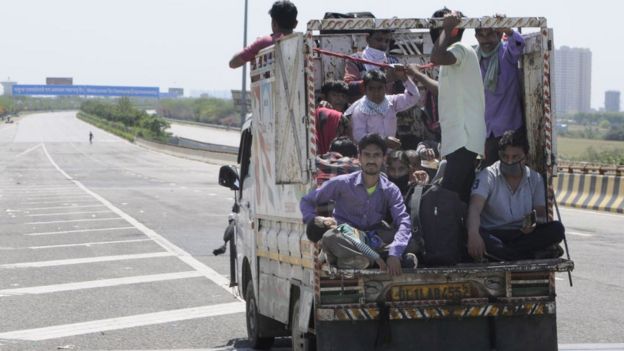
Image copyright GETTY IMAGESImage caption Millions are workers are defying a curfew and returning home
When I spoke to him on the phone, he had just returned home to his village in the northern state of Rajasthan from neighbouring Gujarat, where he worked as a mason.
In the rising heat, Goutam Lal Meena had walked on macadam in his sandals. He said he had survived on water and biscuits.
In Gujarat, Mr Meena earned up to 400 rupees ($5.34; £4.29) a day and sent most of his earnings home. Work and wages dried up after India declared a 21-day lockdown with four hours notice on the midnight of 24 March to prevent the spread of coronavirus. (India has reported more than 1,000 Covid-19 cases and 27 deaths so far.) The shutting down of all transport meant that he was forced to travel on foot.
“I walked through the day and I walked through the night. What option did I have? I had little money and almost no food,” Mr Meena told me, his voice raspy and strained.
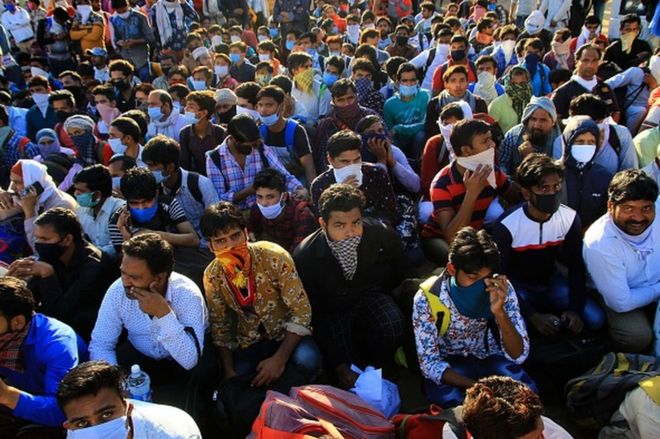
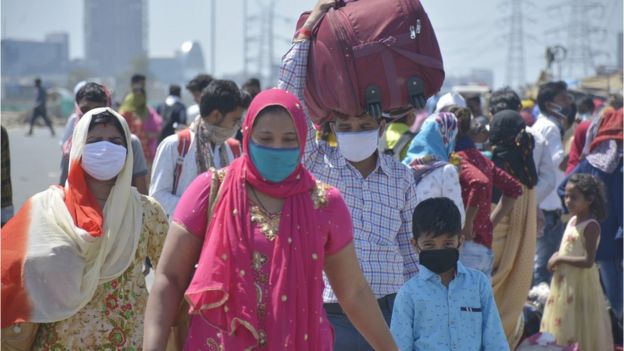
He was not alone. All over India, millions of migrant workers are fleeing its shuttered cities and trekking home to their villages.
These informal workers are the backbone of the big city economy, constructing houses, cooking food, serving in eateries, delivering takeaways, cutting hair in salons, making automobiles, plumbing toilets and delivering newspapers, among other things. Escaping poverty in their villages, most of the estimated 100 million of them live in squalid housing in congested urban ghettos and aspire for upward mobility.
Image copyright GETTY IMAGESImage caption Informal workers are the backbone of India’s big city economies
Last week’s lockdown turned them into refugees overnight. Their workplaces were shut, and most employees and contractors who paid them vanished.
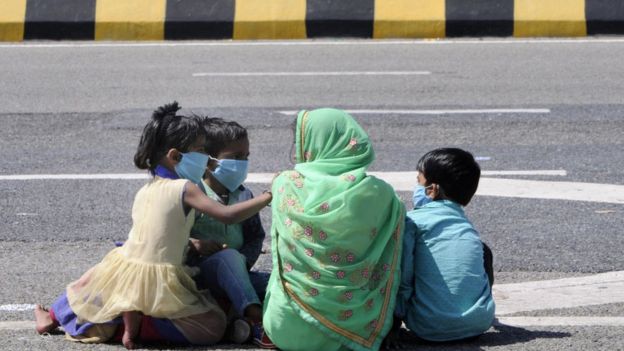
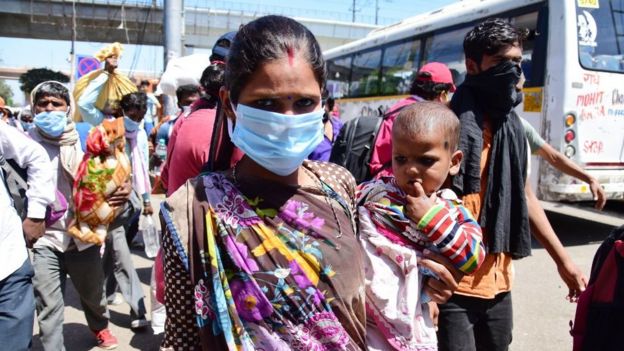
Sprawled together, men, women and children began their journeys at all hours of the day last week. They carried their paltry belongings – usually food, water and clothes – in cheap rexine and cloth bags. The young men carried tatty backpacks. When the children were too tired to walk, their parents carried them on their shoulders.
They walked under the sun and they walked under the stars. Most said they had run out of money and were afraid they would starve. “India is walking home,” headlined The Indian Express newspaper.
The staggering exodus was reminiscent of the flight of refugees during the bloody partition in 1947. Millions of bedraggled refugees had then trekked to east and west Pakistan, in a migration that displaced 15 million people.
Image copyright GETTY IMAGESImage caption Migrant labourers feel they have more social security in their villages
This time, hundreds of thousands of migrant workers are desperately trying to return home in their own country. Battling hunger and fatigue, they are bound by a collective will to somehow get back to where they belong. Home in the village ensures food and the comfort of the family, they say.
Clearly, a lockdown to stave off a pandemic is turning into a humanitarian crisis.
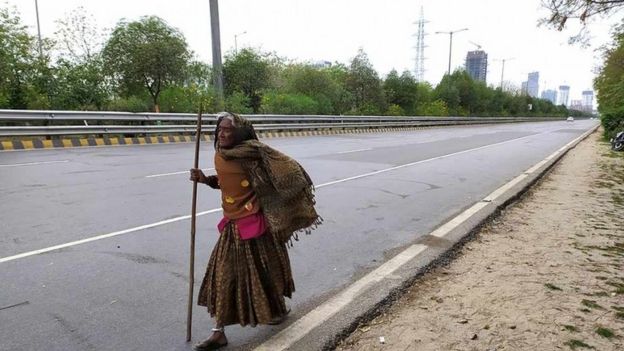
Among the teeming refugees of the lockdown was a 90-year-old woman, whose family sold cheap toys at traffic lights in a suburb outside Delhi.
Kajodi was walking with her family to their native Rajasthan, some 100km (62 miles) away. They were eating biscuits and smoking beedis, – traditional hand-rolled cigarettes – to kill hunger. Leaning on a stick, she had been walking for three hours when journalist Salik Ahmed met her. The humiliating flight from the city had not robbed her off her pride. “She said she would have bought a ticket to go home if transport was available,” Mr Ahmed told me.
Others on the road included a five-year-old boy who was on a 700km (434 miles) journey by foot with his father, a construction worker, from Delhi to their home in Madhya Pradesh state in central India. “When the sun sets we will stop and sleep,” the father told journalist Barkha Dutt. Another woman walked with her husband and two-and-a-half year old daughter, her bag stuffed with food, clothes and water. “We had a place to stay but no money to buy food,” she said.
Then there was Rajneesh, a 26-year-old automobile worker who walking 250km (155 miles) to his village in neighbouring Uttar Pradesh. It would take him four days, he reckoned. “We will die walking before coronavirus hits us,” the man told Ms Dutt.
He was not exaggerating. Last week, a 39-year-old man on a 300km (186 miles) trek from Delhi to Madhya Pradesh complained of chest pain and exhaustion and died; and a 62-year-old man, returning from a hospital by foot in Gujarat, collapsed outside his house and died. Four other migrants, turned away at the borders on their way to Rajasthan from Gujarat, were mowed down by a truck on a dark highway.
As the crisis worsened, state governments scrambled to arrange transport, shelter and food.
Image copyright SALIK AHMED/OUTLOOKImage caption Ninety-year-old Kajodi Devi is walking from Delhi to her village
But trying to transport them to their villages quickly turned into another nightmare. Hundreds of thousands of workers were pressed against each other at a major bus terminal in Delhi as buses rolled in to pick them up.
Delhi chief minister Arvind Kejriwal implored the workers not to leave the capital. He asked them to “stay wherever you are, because in large gatherings, you are also at risk of being infected with the coronavirus.” He said his government would pay their rent, and announced the opening of 568 food distribution centres in the capital. Prime Minister Narendra Modi apologised for the lockdown “which has caused difficulties in your lives, especially the poor people”, adding these “tough measures were needed to win this battle.”
Whatever the reason, Mr Modi and state governments appeared to have bungled in not anticipating this exodus.
Mr Modi has been extremely responsive to the plight of Indian migrant workers stranded abroad: hundreds of them have been brought back home in special flights. But the plight of workers at home struck a jarring note.
“Wanting to go home in a crisis is natural. If Indian students, tourists, pilgrims stranded overseas want to return, so do labourers in big cities. They want to go home to their villages. We can’t be sending planes to bring home one lot, but leave the other to walk back home,” tweeted Shekhar Gupta, founder and editor of The Print.
Image copyright GETTY IMAGESImage caption There is a precedent for this kind of exodus during crisis
The city, says Chinmay Tumbe, author of India Moving: A History of Migration, offers economic security to the poor migrant, but their social security lies in their villages, where they have assured food and accommodation. “With work coming to a halt and jobs gone, they are now looking for social security and trying to return home,” he told me.
Also there’s plenty of precedent for the flight of migrant workers during a crisis – the 2005 floods in Mumbai witnessed many workers fleeing the city. Half of the city’s population, mostly migrants, had also fled the city – then Bombay – in the wake of the 1918 Spanish flu.
When plague broke out in western India in 1994 there was an “almost biblical exodus of hundreds of thousands of people from the industrial city of Surat [in Gujarat]”, recounts historian Frank Snowden in his book Epidemics and Society.
Half of Bombay’s population deserted the city, during a previous plague epidemic in 1896. The draconian anti-plague measures imposed by the British rulers, writes Dr Snowden, turned out to be a “blunt sledgehammer rather than a surgical instrument of precision”. They had helped Bombay to survive the epidemic, but “the fleeing residents carried the disease with them, thereby spreading it.”
More than a century later, that same fear haunts India today. Hundreds of thousands of the migrants will eventually reach home, either by foot, or in packed buses. There they will move into their joint family homes, often with ageing parents. Some 56 districts in nine Indian states account for half of inter-state migration of male workers, according to a government report. These could turn out to be potential hotspots as thousands of migrants return home.
Image copyright GETTY IMAGESImage caption The fleeing migrants could spread the disease all over the country
Partha Mukhopadhyay, a senior fellow at Delhi’s Centre for Policy Research, suggests that 35,000 village councils in these 56 potentially sensitive districts should be involved to test returning workers for the virus, and isolate infected people in local facilities.
In the end, India is facing daunting and predictable challenges in enforcing the lockdown and also making sure the poor and homeless are not fatally hurt. Much of it, Dr Snowden told me, will depend on whether the economic and living consequences of the lockdown strategy are carefully managed, and the consent of the people is won. “If not, there is a potential for very serious hardship, social tension and resistance.” India has already announced a $22bn relief package for those affected by the lockdown.
The next few days will determine whether the states are able to transport the workers home or keep them in the cities and provide them with food and money. “People are forgetting the big stakes amid the drama of the consequences of the lockdown: the risk of millions of people dying,” says Nitin Pai of Takshashila Institution, a prominent think tank.
“There too, likely the worst affected will be the poor.”
Matriarchal and matrilineal communities centred around women have existed for centuries in China, India and Indonesia
But a recent influx of tourism, technology and mainstream patriarchal ideas is rapidly changing their way of life
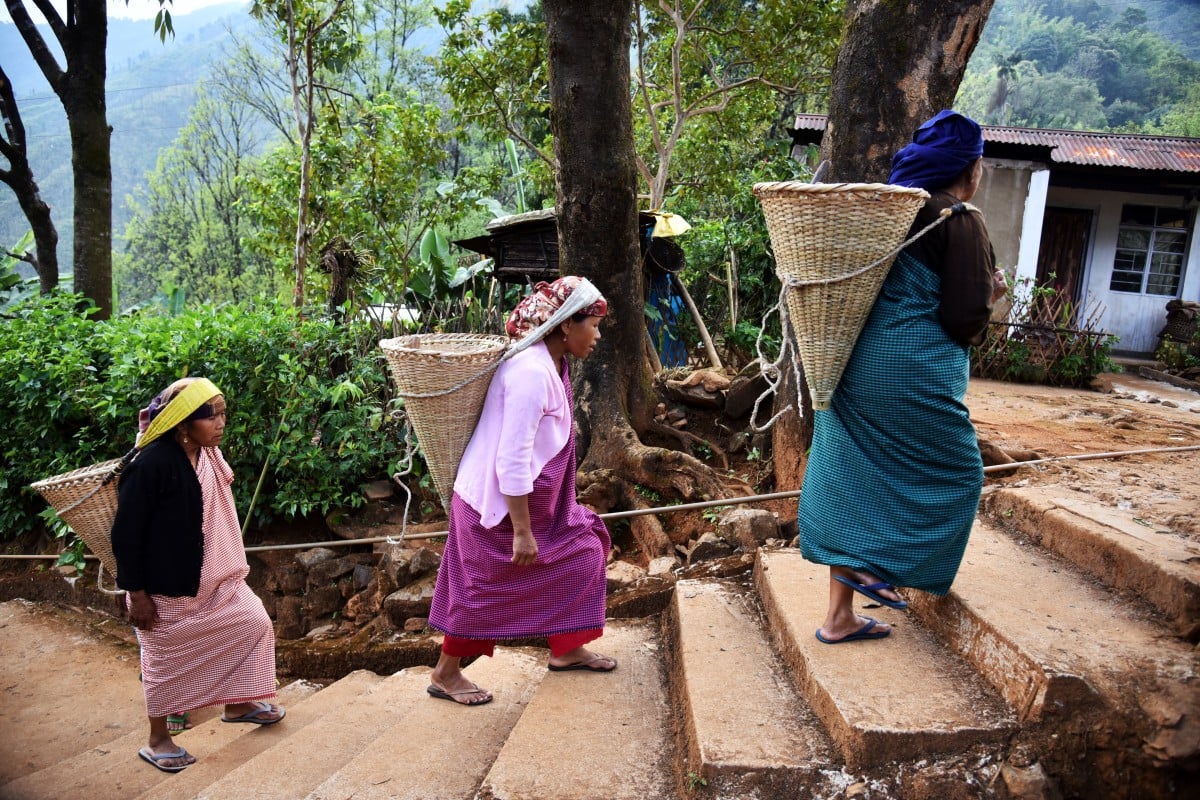
Khasi women leave their village of Nongtraw in India’s northeastern Meghalaya state to collect herbs from the fields. Photo: AFP
While women’s rights may have become a major topic of discussion around the world in recent years, there are female-centric communities that for centuries have distinguished themselves by carving out their own feminist traditions in places such as China, India
and Indonesia.
But many of these matriarchal and matrilineal societies are now struggling to survive, amid threats posed by the modern world such as mass tourism, technology and the infiltration of ideas from mainstream patriarchal society.
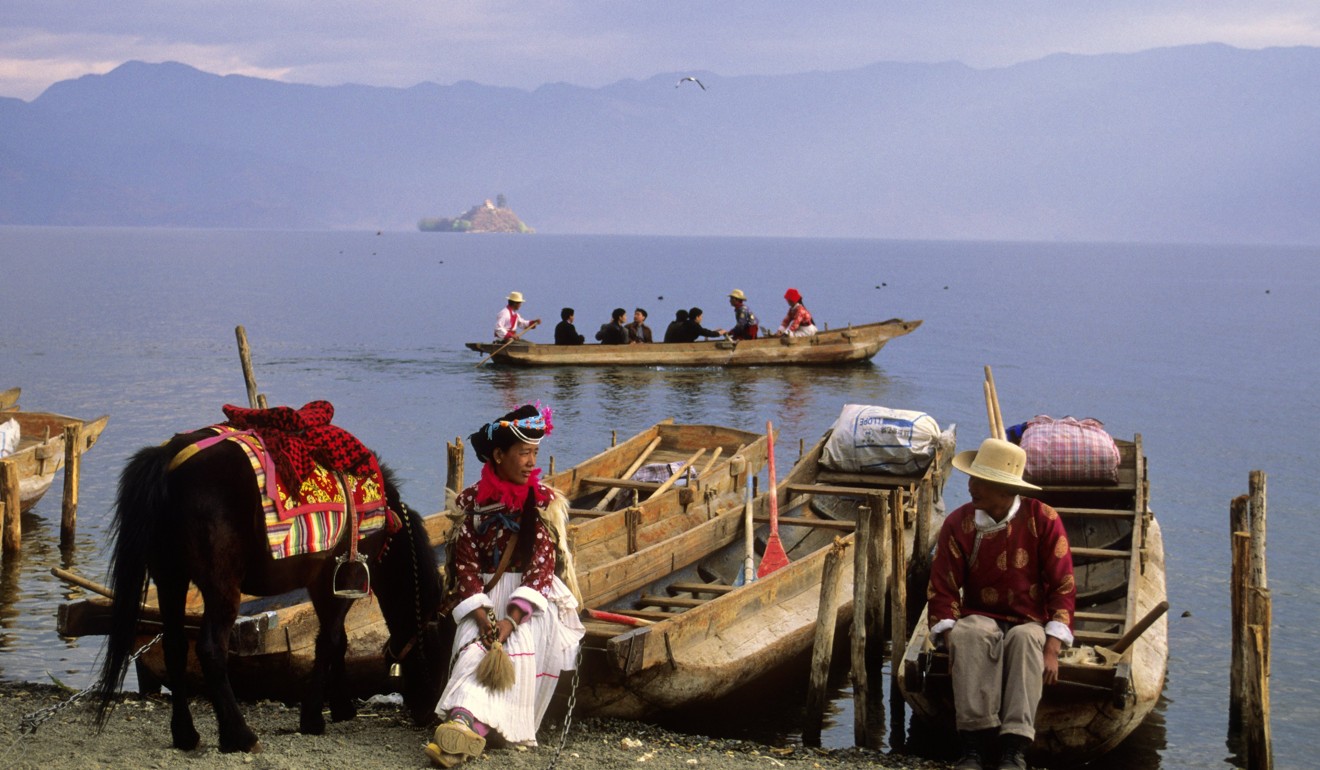
In China, for instance, there is a small Mosuo tribe known as the “kingdom of women”.
“Key to the Mosuo culture is their matrilineal family structure, with a basic building block of only members sharing the same female bloodline making up the family … Any male bloodline is not taken into account,” says Choo Waihong, a former Singaporean corporate lawyer who has researched the community for the past decade.
Lugu Lake in China’s Yunnan province is home to the Mosuo tribe. Photo: hemis.fr
At the top of the hierarchy is the grandmother, who is the head of the household. “Her daughters run the home and look after all the children of the female siblings … The sons and grandsons are expected in their supporting role to shoulder the manual tasks required to maintain the farmstead,” Choo says.
Researchers say that there are about 30,000 to 40,000 Mosuo people – most of whom live in the far eastern foothills of the Himalayas in Yunnan, southwest China. This unique community has come together in a series of villages dotted around a mountain and Lugu Lake, while growing numbers have moved out to work in larger towns and cities elsewhere in the country.
According to Choo, author of the book The Kingdom of Women: Life, Love and Death in China’s Hidden Mountains, the most distinctive facet of this community that sets it apart from mainstream society is the absence of formal marriage arrangements between men and women. Instead, they have “walking marriages”, where the man goes to the woman’s home, spends the night with her and then leaves the following morning.
The Kingdom of Women: China’s ‘lost tribe’ of matriarchs, the Mosuo
15 Mar 2017
The couple can choose to have a temporary or even a permanent arrangement as partners, but they are not bound by marriage ties. If they have children, the baby belongs to the woman’s household. “In fact, the man is not considered part of the matrilineal family and his ties to the baby do not determine the social place of the baby,” the researcher says.
Such a society, where women are not subjected to men and sexual freedom is an intrinsic part of their culture, is so radically different from mainstream patriarchal family structures that the Mosuo tribe has been examined and studied over time. More recently, its unique features have also become an eye-catching selling point for the local tourism industry.
TOURISM INDUSTRY
The Mosuo tribe used to live off the land by farming, herding and hunting. But many families now rely on tourism after the tribe’s culture and Lugu Lake became more popular and widely known.
“Tour buses on fancy freeways and planes arriving at a new airport bring more and more tourists daily to turn the whole area into a busy travel playground,” Choo says. “Every household around the lake is involved one way or another with the hotel, restaurant and tour guide industries.”
While the tourism industry has brought money and better food for most families as well more access to educational opportunities for their children, it is also posing a serious threat to their culture and traditional ways of life.
“The greatest challenge for the tribe is their rapid transition from living a rudimentary subsistence farming way of life right into a burgeoning modern middle-class existence within a short span of 20 or so years,” Choo says.
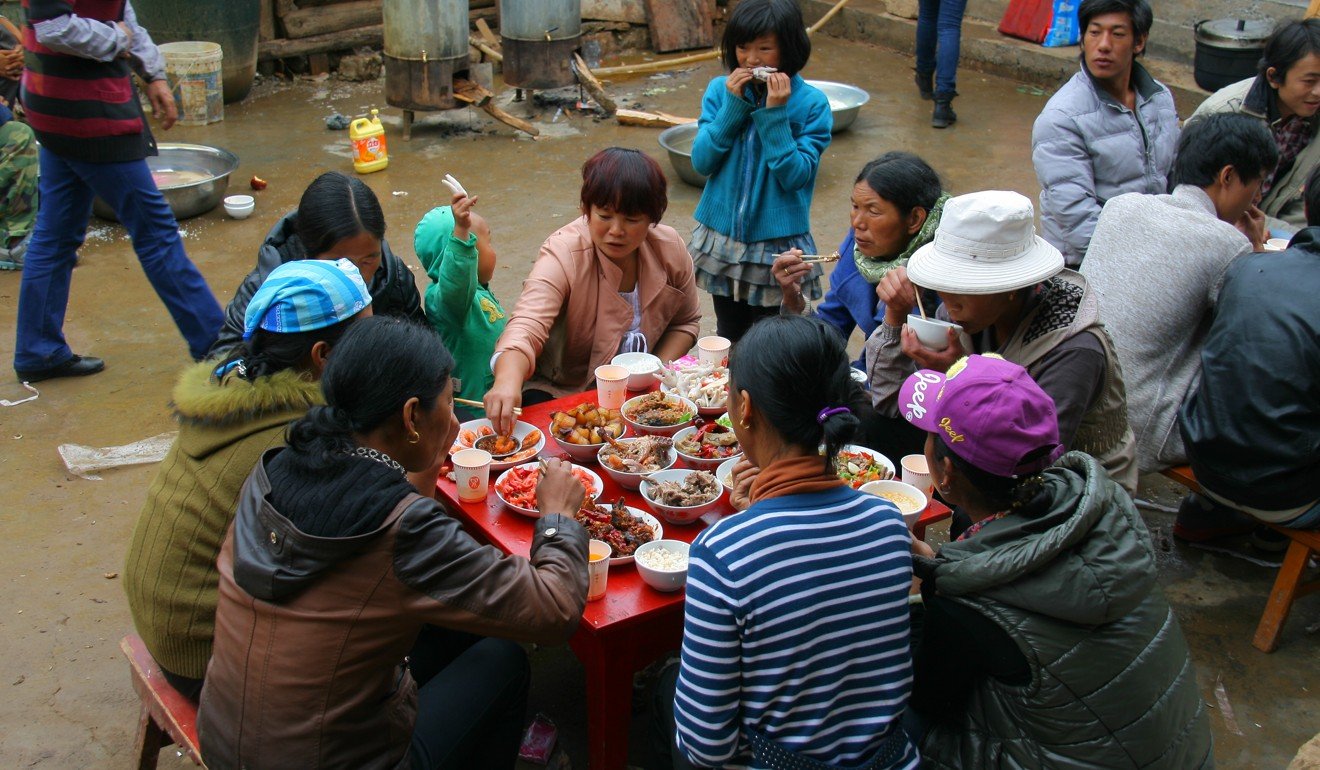
Mosuo people pictured at a wedding ceremony with an all-meat feast in 2013. Photo: Shutterstock
The Mosuo are now being bombarded not only by mainstream traditional Chinese values, but also by new economic values connected to money and the digital economy. “That is a lot to take in for people who had no writing to support their oral language … and only had primary schools for their children not so long ago,” she says.
Older Mosuo are now being pushed to learn Mandarin in order to keep up with the younger generations.
At the same time, the researcher says, “their long-held cultural beliefs and principles are evolving as the young generation gets exposed to the outside world and start to question the old ways of doing things.”
How life is changing for Thailand’s Karen tribe
17 Mar 2017
Walking marriages are not as common, with more youngsters getting married and forming nuclear families. “Large matrilineal families which were the norm are now breaking up into smaller nuclear families. All this dilutes the traditional matrilineal Mosuo family structure,” Choo says.
“The central place of the female in old Mosuo society is slowly being affected, as the male Mosuo are beginning to entertain some patriarchal outlook in the face of outside cultural influences.”
China may have radically reinvented itself in recent decades, but the changes to the Mosuo tribe have been nearly as dramatic. “The world of the Mosuo when I first ventured into their midst 12 years ago is a distant past as I look [today in 2020] at how they have changed,” Choo says.
PATRIARCHY IN DISGUISE
There are dozens of female-centric communities scattered around the world. The Garo and Khasi tribes, which are also traditionally matrilineal societies, can be found mostly in India.
In a Khasi family, the youngest daughter inherits the ancestral property, while in the Garo community, women also inherit property, but don’t necessarily have to be the youngest daughter of the family.
Caroline Marak, former head of the Garo Department at the North Eastern Hill University in India, says that the Garo are female-oriented, but not female-dominated. Women “have no part in the field of administration decision-making”, she wrote in an academic paper.
In recent years, the husbands of Garo women who are property owners have had a greater say over land deals, such as with government. “We are now trying to reclaim our rights from the males,” says Sume Sangma, secretary of the Garo Mothers Union NGO. “Women in the community are self-reliant and we are fighting for their real power.”
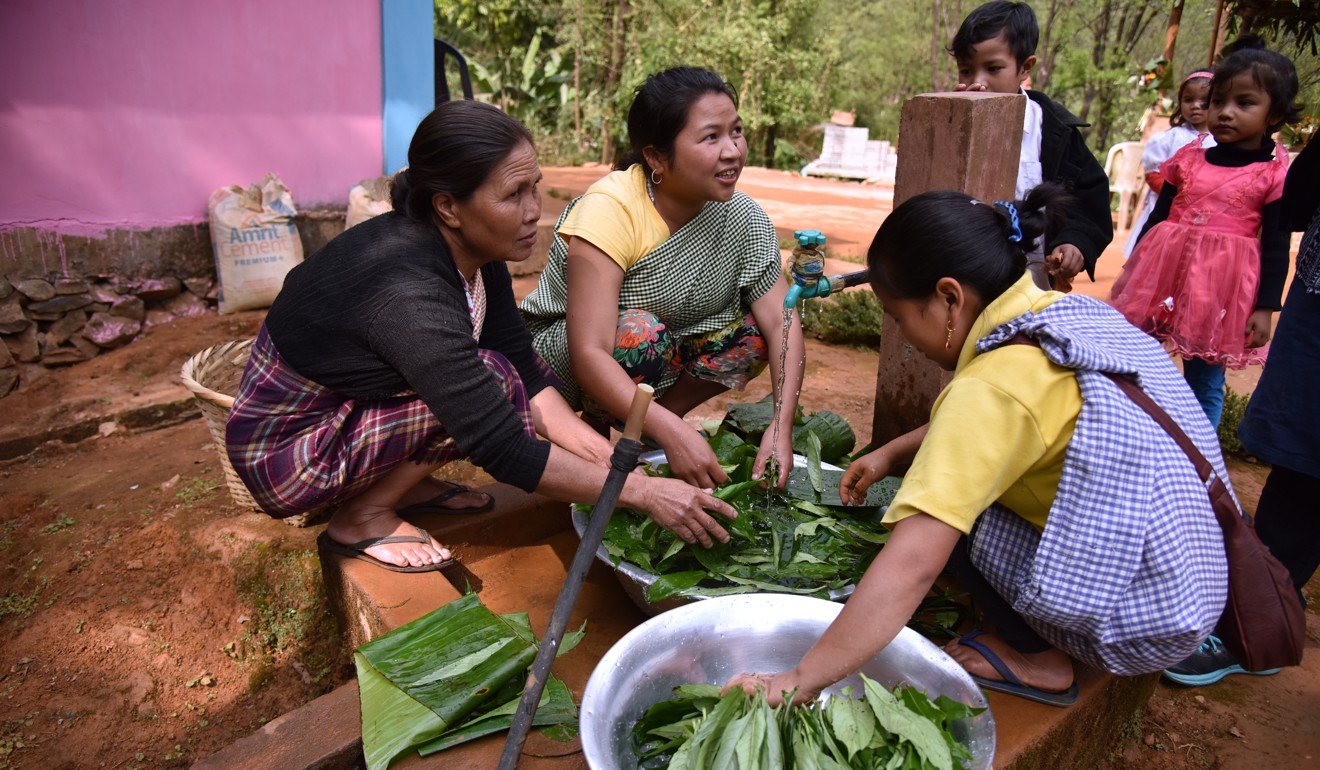
Khasi women wash leaves for cooking in the village of Nongtraw in India’s north-eastern Meghalaya state. Photo: AFP
Tiplut Nongbri, from the Centre for North East Studies and Policy Research at the Jamia Millia Islamia in New Delhi, also says women don’t have much authority in Garo and Khasi societies. “Patriarchy is in disguise in both the communities. The societies are matrilineal only as far as descent, residence and inheritance of property are concerned,” she says. “Women are not allowed to take part in politics.”
RG Lyngdoh, former home minister of Meghalaya – the hilly state in north-eastern India where both communities are based – says inward migration and the presence of Christian missionaries in the state have affected traditional lifestyles. “The old practices of equity between males and females have eroded,” Lyngdoh says.
“This has led to a perception of inadequacy among the males, [creating] discord within the family, which found expression in many negative ways, such as domestic violence and abandonment of wives, which never existed within the Khasi community.”
Gertrude Lamare, a member of the Khasi-Jaintia community now pursuing her PhD in anthropology at the London School of Economics and Political Science, argues that “with families becoming more nuclear, women do have a huge role in the decision-making process”.
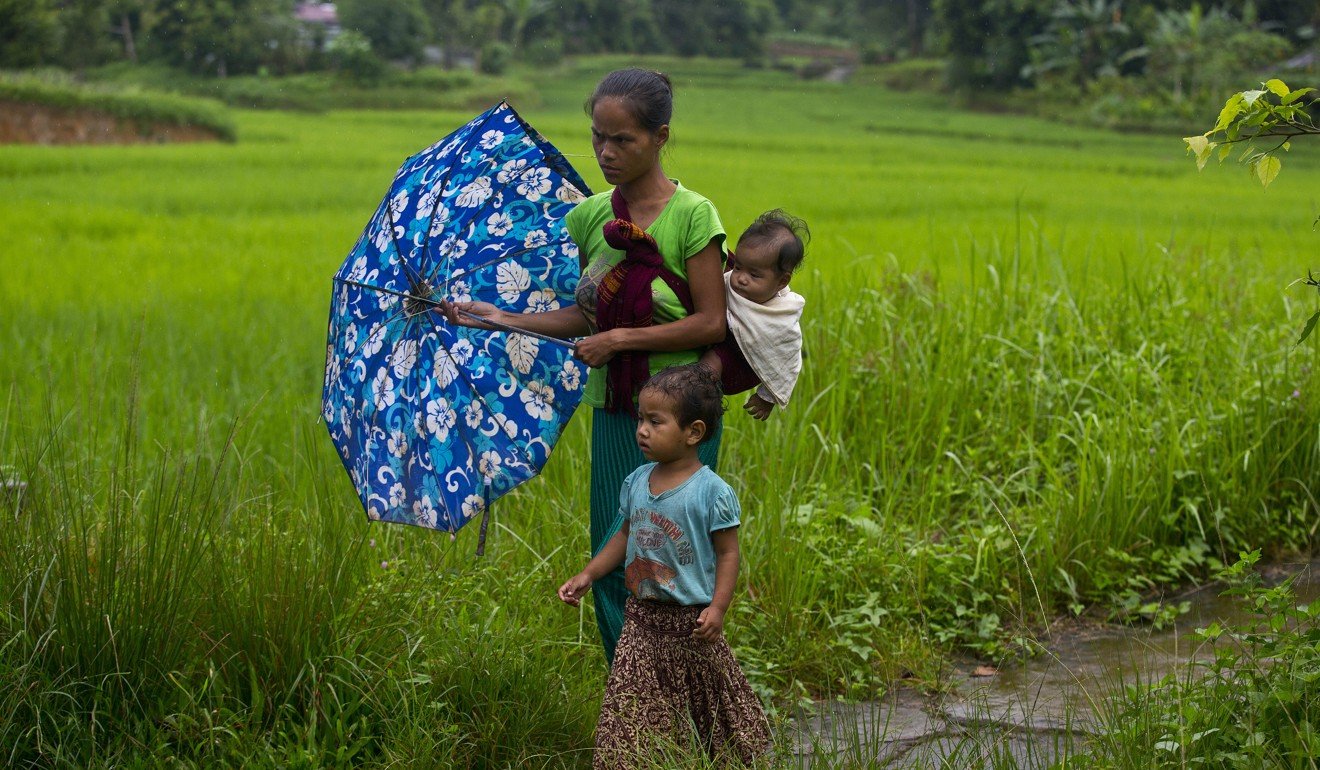
A Khasi woman walks in the rain with children past a paddy field along the Assam-Meghalaya state border in India. Photo: AP
Researchers have estimated that there are 1 million Garo in India and
, and 1.7 million Khasi in the Khasi and Jaintia Hills.
Some of them have become increasingly wary of outsiders preying on their natural resources, which are dwindling, thanks to deforestation and climate change.
Another challenge these communities are facing has to do with the growing trend of mixed marriages. “In recent years, children of a Khasi or Garo mother and non-tribal father [have] not [been] welcomed. The males in the family want their women to marry within the tribal community,” researcher Nongbri says, noting that younger generations are going through an identity crisis.
STILL PROUD
The world’s largest known matrilineal society today is believed to be in Indonesia: the Minangkabau, also known as Minang. Their community of about 8 million is scattered around the world, but most are in Indonesia’s West Sumatra province. While traditionally animist, they were later influenced by Hinduism and Buddhism, and most have since embraced Islam.
But much like the others, their community is also changing.
Nursyirwan Effendi, dean of the Faculty of Social and Political Science at Andalas University, says that many of those who remain in villages and rural areas still hold tight to the tribe’s values.
“Women are central in the distribution of assets, such as rice fields, gardens and [houses], from their ancestors,” he says.
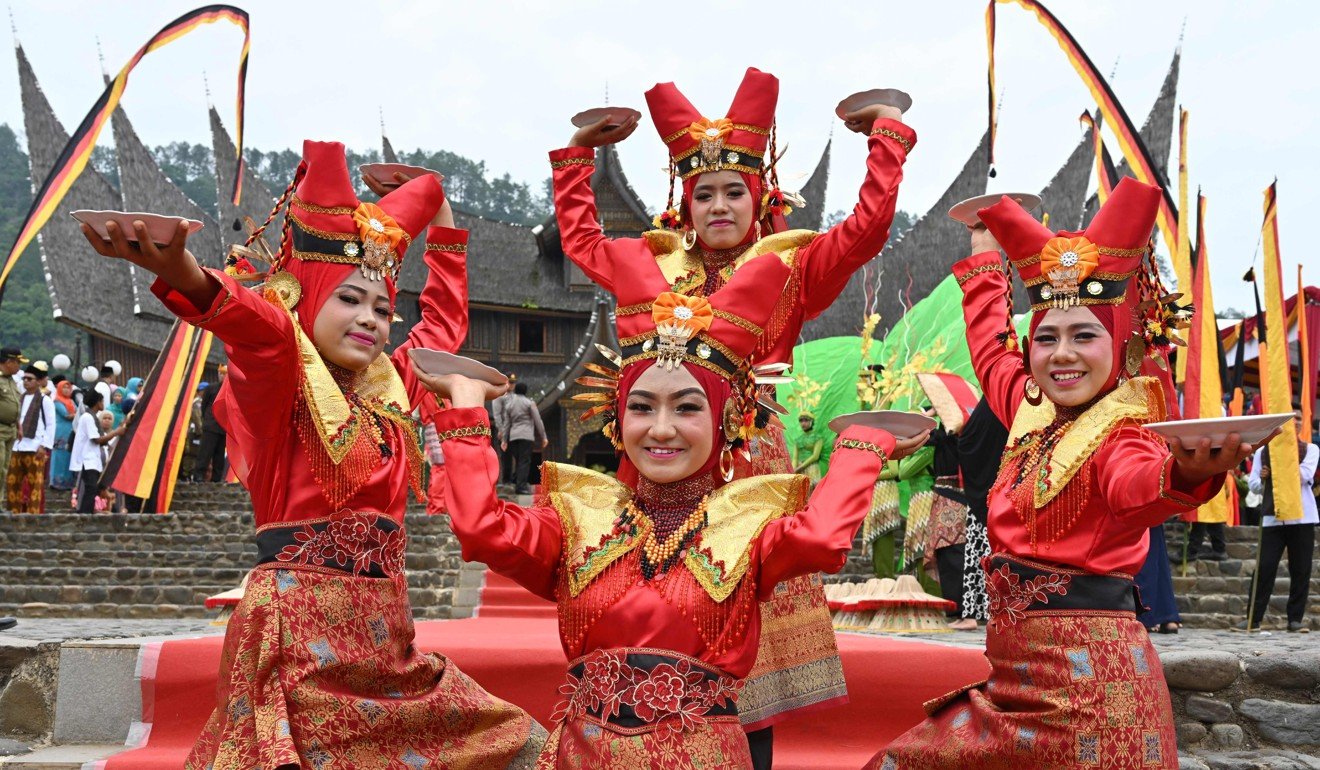
Dancers pose during the 2018 Minangkabau art and culture festival in Batusangkar, West Sumatra. Photo: AFP
Traditionally, Minangkabau women play an essential role in their children’s education and hold inheritance rights, while men are expected to take jobs elsewhere and occupy political and religious positions. When they do get married, the man moves to the woman’s house.
But Nursyirwan, who is of Minangkabau descent, notes that many have left for bigger cities, where they do not closely follow the community’s traditions.
An example of this is Afrianto Sikumbang, a 53-year-old businessman who was born to Minangkabau parents in West Sumatra province but now lives in the capital, Jakarta. Although he married a Minangkabau woman, he says they “don’t really apply” the tribe’s values in their daily life.
Sonya Anggraini, 35, who also works in the capital, has got used to city life, but remains proud of her ancestral roots and hopes that Minangkabau culture will persist for years to come.
“I am a member of my mother’s family, not of my father’s,” she says. ■
Tokyo (Reuters) – Japan on Saturday moved to contain the economic impact of a coronavirus outbreak originating in China as strict new measures aimed at limiting the spread of the virus, including targeting foreign visitors, came into effect.
Japan had 17 confirmed cases as of Friday, including some without symptoms. One of the most recent was a bus guide who worked on a bus tour for tourists from China – the same tour as a bus driver who also came down with the virus.
Prime Minister Shinzo Abe told a Saturday meeting of a government task force coordinating Japan’s response to the virus to come up with steps aimed at easing the impact of the outbreak on Japan’s economy.
Abe has made tourism a key part of his economic policy, with a large proportion of foreign visitors from China, and major Japanese companies have a number of factories in China.
“I ask ministers to compile measures to use reserves (in the state budget) and implement them as soon as possible,” Abe was quoted by Kyodo news agency as saying.
“The new coronavirus is having a major impact on tourism, the economy and our society as a whole. The government will do its utmost to address the impact.”
No further details were given, though Abe stressed ensuring that Japanese residents have access to medical checkups and masks, which have been selling out around the nation.
New measures to fight the disease took effect on Saturday, including banning the entry of Chinese holding passports issued by Hubei, where the disease is thought to have originated, as well as all foreigners who had visited the province within two weeks, whether they show symptoms or not.
The government also brought forward implementing measures including compulsory hospitalisation and the use of public funds for treatment by six days to Saturday.
Of the 2.6 million tourists who came to Japan in December 2019, nearly 600,000 were Chinese, outnumbered only by South Koreans, government data shows. Japan aims to have 40 million tourists visit the country in 2020, up from 31.8 million in 2019.
On Friday, the president of Japanese airline ANA Holdings (9202.T) said it was considering suspending flights to China after February reservations plunged, Jiji news agency reported.
JTB Corporation, Japan’s largest travel agency, said it was suspending tours to China throughout February, Kyodo news agency reported.
MUMBAI (Reuters) – India’s tourism industry has been hit by a wave of violent anti-government protests against a new citizenship law that have rocked several cities this month, with at least seven countries issuing travel warnings.
At least 25 people have been killed in clashes between police and protesters, and demonstrations against the law continue.
Officials estimate about 200,000 domestic and international tourists cancelled or postponed their trip to the Taj Mahal in the past two weeks, one of the world’s most popular tourist attractions.
“There has been a 60% decline in visitor footfalls in December this year,” said Dinesh Kumar, a police inspector overseeing a special tourist police station near the Taj Mahal who has access to visitor data. He said the decline was compared to December last year.
“Indian and foreign tourists have been calling our control rooms to check security. We assure them protection, but many still decide to stay away,” said Kumar.
The 17th century marble monument is in Uttar Pradesh, the northern state that has witnessed the highest number of deaths and intense bursts of violence in two weeks of unrest.
A group of European tourists travelling in a group across India said they now planned to cut short their 20 day trip.
“We are all retired folks, for us travel has to be slow and relaxing. The newspaper headlines have led to a sense of concern and we will leave sooner than we had planned,” said Dave Millikin, a retired banker living on the outskirts of London, who spoke to Reuters from the capital New Delhi.
The Taj Mahal, situated in the town of Agra, attracts over 6.5 million tourists every year, generating nearly $14 million annually from entrance fees. A foreign tourist pays 1,100 rupees (about $15) to enter the grounds, although nationals from neighbouring countries get a discount.
Managers in luxury hotels and guest houses around the Taj Mahal said last minute cancellations during the festive season have further dampened business sentiment at a time when the country’s economic growth has slowed to 4.5%, its slowest pace in more than six years.
In a bid to clamp down on violence and unrest, authorities have suspended mobile internet services in Agra.
“Blocking the internet has affected travel and tourism in Agra by about 50-60%,” said Sandeep Arora, president of the Agra Tourism Development Foundation that groups over 250 tour operators, hotels and guides.
The United States, Britain, Russia, Israel, Singapore, Canada and Taiwan have issued travel advisories asking their citizens to either refrain from visiting or to exercise caution when visiting regions embroiled in India’s protests.
Jayanta Malla Baruah, the head of the Assam Tourism Development Corp., said the state, home to the world’s largest concentration of one-horned rhinoceroses, is visited on average by 500,000 tourists during December.
“But this time, due to the ongoing protests and travel advisories by various countries, the number is down by 90% if not more.”
Tourists visit the imperial tombs dating back to the Western Xia Dynasty (1032-1227) in Yinchuan, capital of northwest China’s Ningxia Hui Autonomous Region, Oct. 2, 2019, the second day of the 7-day-long National Day holiday. (Xinhua/Feng Kaihua)


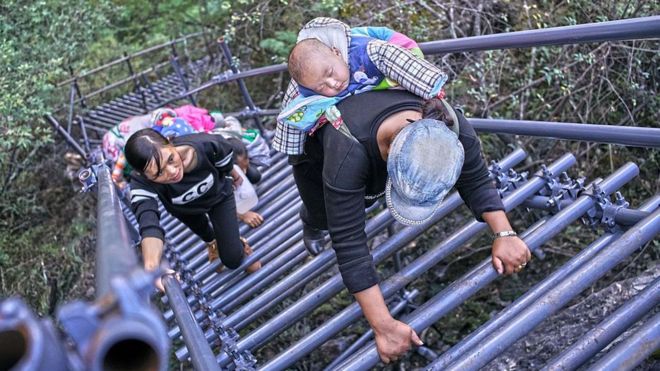 Image copyright GETTY IMAGES
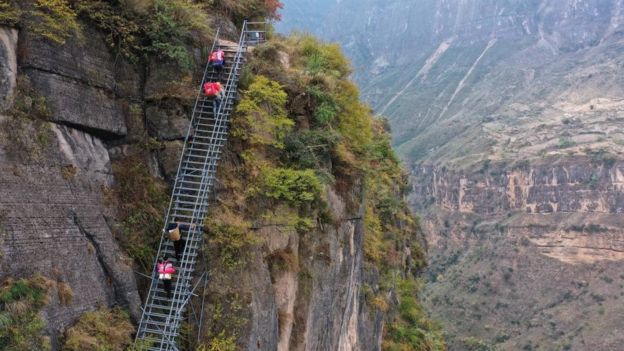 Image copyright GETTY IMAGES
 Image copyright CGTN/YOUTUBE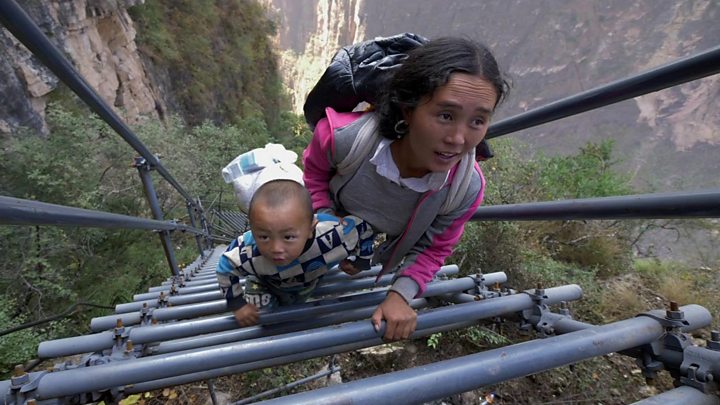





 CHINDIA ALERT: You'll be living in their world, very soon