Chindia Alert: You’ll be Living in their World Very Soon
aims to alert you to the threats and opportunities that China and India present. China and India require serious attention; case of ‘hidden dragon and crouching tiger’.
Without this attention, governments, businesses and, indeed, individuals may find themselves at a great disadvantage sooner rather than later.
The POSTs (front webpages) are mainly 'cuttings' from reliable sources, updated continuously.
The PAGEs (see Tabs, above) attempt to make the information more meaningful by putting some structure to the information we have researched and assembled since 2006.
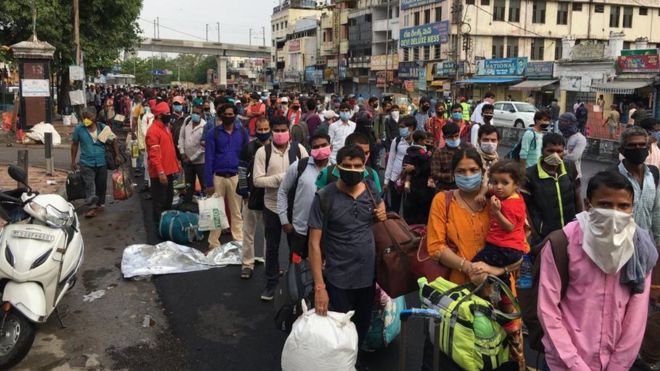
Image caption Passengers gathered outside Secundarabad station in Andhra Pradesh state
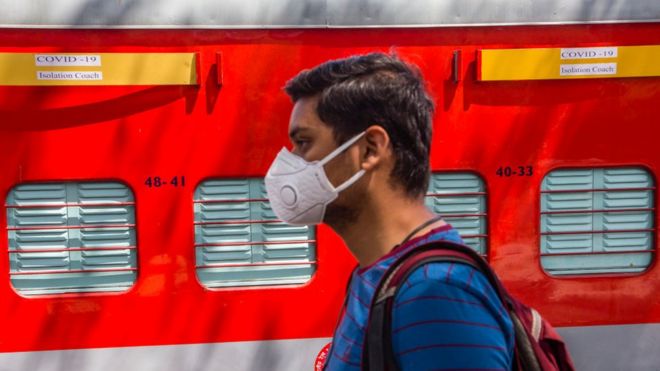
India has partially restored train services amid reports of chaos and overcrowding at some stations.
At least 145,000 people will travel in trains on Monday as the country starts to reopen after a prolonged lockdown.
Two hundred trains will now start operations – up from the existing 30 that are currently running.
But maintaining social distancing and cleanliness is proving to be a difficult task as huge crowds gathered outside some stations.
India’s mammoth railway network usually carries 25 million passengers every day.
The ministry of home affairs has issued specific guidelines for the smooth operation of train services. They say that all passengers will have to be screened, social distancing must be followed at the station and in trains and only passengers who have confirmed tickets will be allowed to travel.
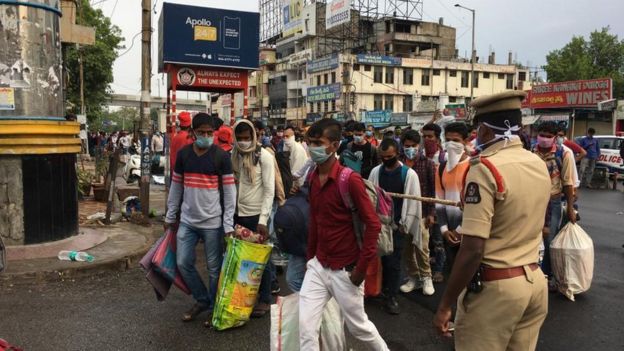
Image caption Police struggled to enforce social distancing due to large crowds
But some stations reported chaotic scenes as officials struggled to enforce these guidelines. BBC Telugu reported that people were standing much too close to each other at Secunderabad railway station in the southern state of Telangana.
“Railway staff and police didn’t allow passengers to go inside the station until at least one hour before the scheduled departure, citing physical distancing measures. This led to some chaos outside the railway station as a large number of passengers had gathered and there was no physical distance maintained. Police later arrived and organised the queues,” BBC Telugu’s Sharath Behara says.
Reporting from Delhi, BBC Hindi’s Salman Ravi said strict social distancing was being followed when passengers boarded trains, and all of them wore masks.
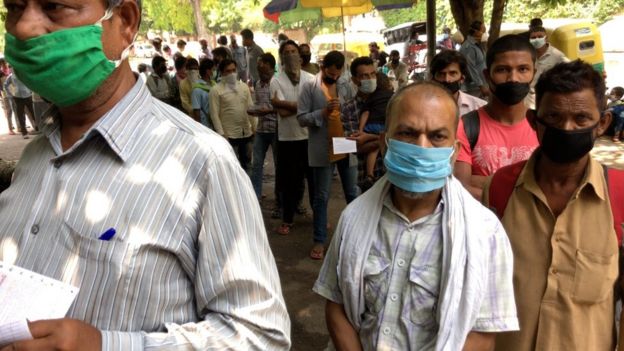
Image caption Passengers waiting outside the train station in Delhi
“But the same was not observed at ticket booking counters. Many people who did not have tickets also turned up at the station and that caused crowding,” he added.
Train services came to a grinding halt when Prime Minister Narendra Modi announced the lockdown on 24 March to stop the spread of coronavirus.
This left millions of daily-wage workers stranded as they desperately tried to go back to their villages from cities. Many of them decided to walk long distances – in some cases more than 1,000 kilometres.
As pressure and criticism mounted, the government started running special trains to ferry migrants. Some 30 trains restarted on 12 May, since then there has been a consistent demand to reopen more routes.
Getting the train network going again is part of the government’s wider strategy to slowly reopen the economy. Millions have lost jobs and factories are struggling to reopen as demand is likely to be sluggish in the coming weeks.
BEIJING, May 2 (Xinhua) — The number of China-Europe freight trains hit a record monthly high of 979 in April, up 46 percent year on year, the China State Railway Group said Saturday.
A total of 88,000 TEUs (20-foot equivalent units) of cargo were transported by the trains, up 50 percent from a year earlier.
From January to April, a total of 2,920 China-Europe freight trains transported cargo of 262,000 TEUs, up 24 percent and 27 percent from a year earlier, respectively.
The number of departing trains rose 36 percent year on year to 1,638 during the first four months, while the number of returning trains climbed 11 percent to 1,282.
China-Europe cargo train services have become an important logistics channel to ensure smooth trade as air, sea and road transportation have been severely affected by the novel coronavirus epidemic, the company said.
The freight trains have also been playing a crucial role in helping with the fight against the pandemic in Europe as massive quantities of medical supplies were sent by them.
From March 21 to the end of April, anti-epidemic supplies totaling 660,000 items and weighing 3,142 tonnes were sent by the freight trains to European countries such as Italy, Germany, Spain and the Czech Republic.
Image copyright GETTY IMAGESImage caption India’s railways are hoping to ease the burden on hospitals
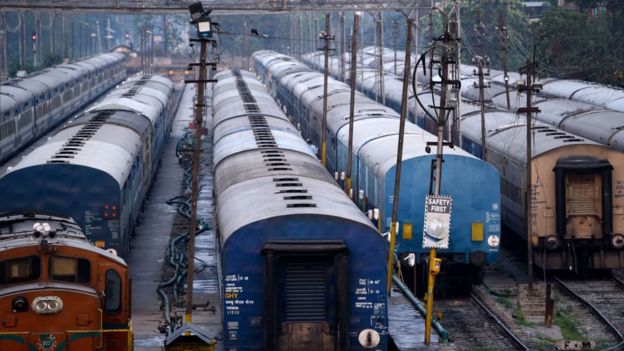
India is preparing for a potential surge in Covid-19 patients by tapping into an unusual resource: its trains, which power the world’s fourth biggest rail network.
The country suspended its passenger trains for the first time after it announced a three-week lockdown on 25 March to contain the coronavirus. As of Wednesday, it had reported 4,643 active cases and 149 deaths, and the numbers are rapidly increasing.
“We, at the railways, thought: how can we contribute?” its spokesman, Rajesh Bajpai, told the BBC. “So we came up with this idea and everyone liked it.”
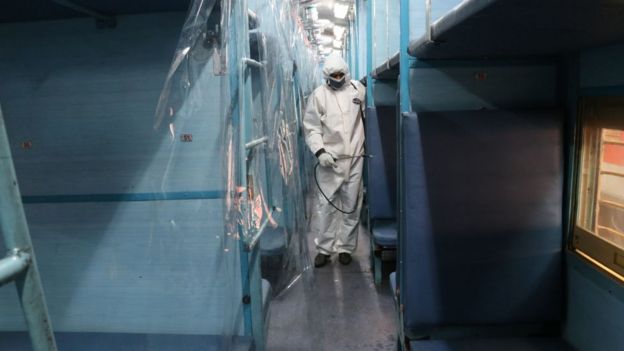
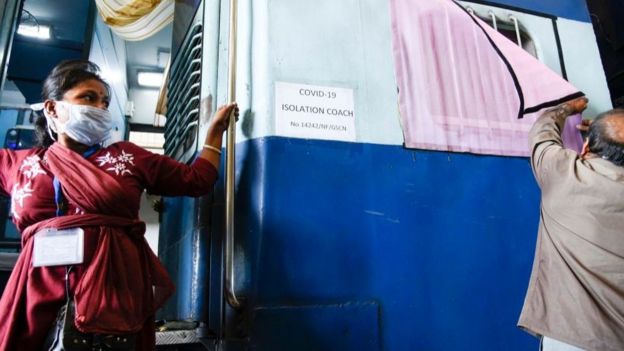
Work has already begun to convert 5,000 train coaches into quarantine or isolation wards, which amounts to 40,000 beds. And the railway ministry says it’s prepared to convert 15,000 more coaches.
The Indian railways – as the ministry is known – is a behemoth. Largely constructed during British rule, it’s still the mainstay of India’s public transport, and includes some of the world’s busiest urban rail systems. It transports 23 million passengers a day and its 12,000 trains crisscross 65,000km (40,389 miles) of tracks, connecting the remotest parts of India.
Mr Bajpai says the coaches can be spared as they are mostly trying to convert older ones, and passengers will be fewer than ever in the coming months even if restrictions are eased.
He adds that this is not unusual for the railways, which already runs several “special” trains, from luxury trains to exhibition trains to a hospital train, complete with operation theatres.
“The coach is a shell and inside, you can provide anything – a drawing room, a dining room, a kitchen, a hospital.”
A looming crisis?
And India may well need the extra beds.
States have already turned all sorts of spaces – sports centres, stadiums, wedding venues, hotels, resorts – into quarantine or isolation centres. But officials fear they will run out of space as the country ramps up testing.
Image copyright GETTY IMAGESImage caption India suspended all passenger trains last month
For every person who tests positive, there are scores more who need to be traced, quarantined and, if necessary, isolated. But isolation at home is not always an option in India’s joint family households – and especially not in its densely-populated slums.
“There are so many options available and this [the coaches] is one of the options,” Mr Bajpai says.
He doesn’t foresee them being used until beds in existing quarantine or isolation centres are filled. But, he adds, they will keep them ready with the necessary facilities.
That includes converting one of the two toilets in each coach into a “bathing room”, providing oxygen cylinders in every coach, and modifying all the cabins so they can hold medical equipment. And then there are measures that are specific to Covid-19 – such as replacing taps that turn with those that have long handles, and fitting dustbins with foot pedals.
Image copyright GETTY IMAGESImage caption It takes up to three days to turn a coach into an isolation ward
The ministry has also ordered extra coat hooks and mosquito nets for every cabin, and has instructed officials to make sure that charging points are working, the upholstery “is in good condition” and “broken panels are replaced”.
The coaches are being readied in 130 different locations across the country, but it’s yet to be decided where they will be stationed.
Mr Bajpai says it’s up to states to decide which stations they want the coaches in. But that in itself is a process because the coaches need regular water and electric supply.
And there are other concerns too. Summer has begun and large parts of India record scorching temperatures, often more than 40C. And the coaches that are being converted are not air-conditioned.
“The patient will be very uncomfortable. Doctors and nurses will be wearing protective gear, and they will find it very difficult,” says Vivek Sahai, a former chairman of the railway board.
Image copyright GETTY IMAGESImage caption Staff member of Northeast Frontier Railway (NFR) prepare train coaches to convert them into isolation wards for COVID-19 patients.
He also says not everyone might be comfortable squatting to use Indian-style toilets; and he wonders if all the designated coaches have a proper system of waste management. (Indian coaches are designed to dispose of human waste onto the tracks although new technologies have begun to be adopted in recent years.)
“I am not saying it cannot be done but they have to take care of these things,” he says. “But if anybody can do it, it’s the railways.”
However, some experts say that this by itself is not going to help solve India’s problems.
“You don’t just need space,” says Dr Sumit Sengupta, a pulmonologist. “We need thousands of doctors and nurses if you really have to make a dent.”
India is severely short of both, and at least three hospitals have been sealed this week alone after members of the staff tested positive.
Media caption As cases of coronavirus rise and the virus hits India’s congested slums, will the country cope?
“Why isolate someone who has symptoms when there is no treatment? Because you don’t want them to spread the infection,” Dr Sengupta says.
But, he adds, the virus is spreading anyway because so many patients are asymptomatic. He says isolating symptomatic patients will not help unless India starts testing aggressively.
“This will work only as part of a larger strategy,” he adds. “Test, trace and isolate. Test should come first.”
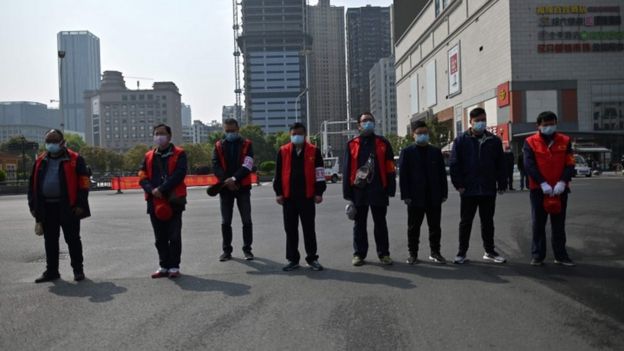
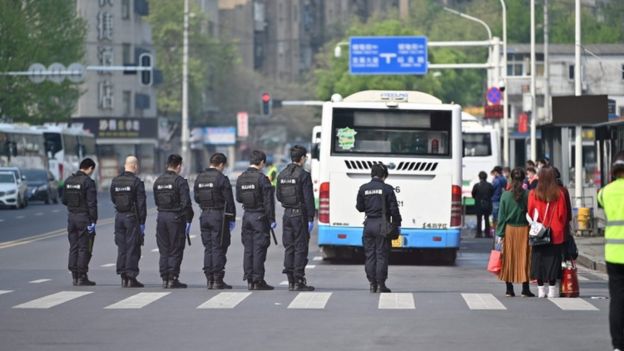
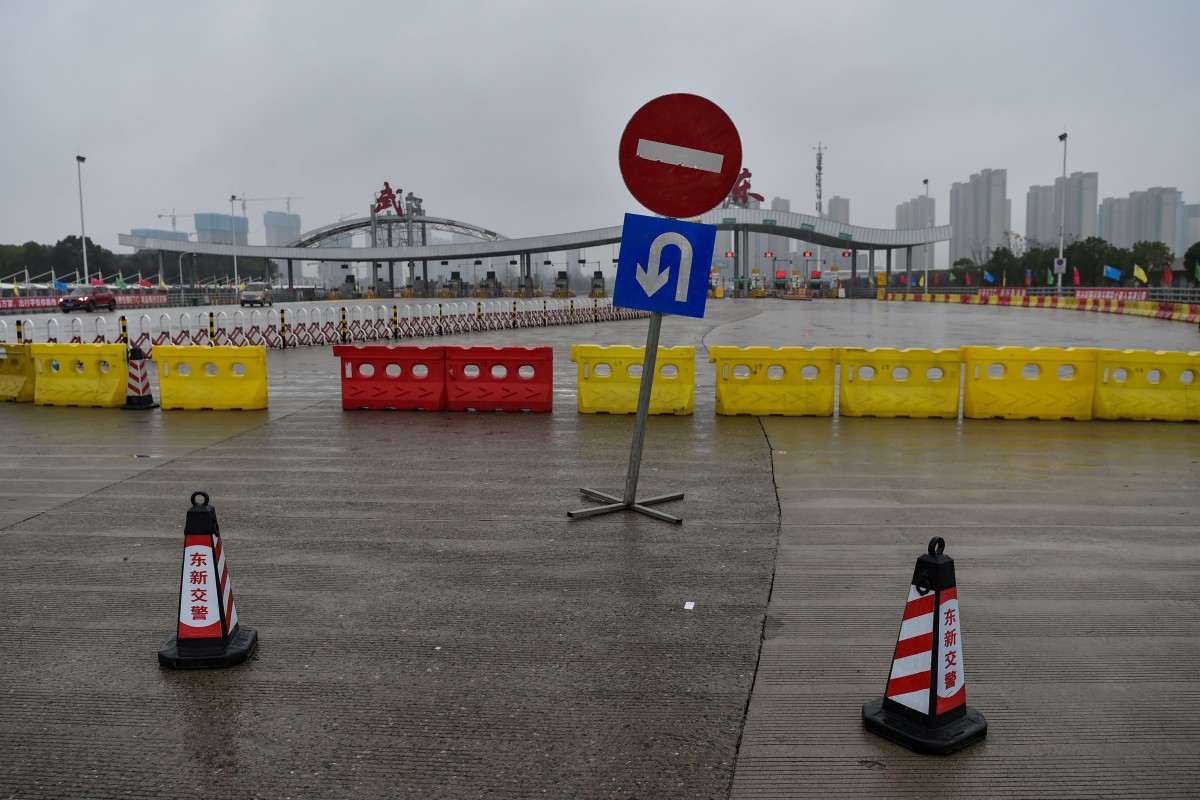
In Wuhan, the epicentre of China’s outbreak, all traffic lights in urban areas were turned red at 10:00, ceasing traffic for three minutes.
China’s government said the event was a chance to pay respects to “martyrs”, a reference to the 14 medical workers who died battling the virus.
Image copyright GETTY IMAGESImage caption China came to a standstill during the three-minute silence at 10:00 local time
They include Li Wenliang, a doctor in Wuhan who died of Covid-19 after being reprimanded by the authorities for attempting to warn others about the disease.
“I feel a lot of sorrow about our colleagues and patients who died,” a Chinese nurse who treated coronavirus patients told AFP news agency. “I hope they can rest well in heaven.”
Wearing white flowers pinned to their chest, Chinese President Xi Jinping and other government officials paid silent tribute in Beijing.
Saturday’s commemorations coincide with the annual Qingming festival, when millions of Chinese families pay respects to their ancestors.
China first informed the World Health Organization (WHO) about cases of pneumonia with unknown causes on 31 December last year.
By 18 January, the confirmed number of cases had risen to around 60 – but experts estimated the real figure was closer to 1,700.
Image copyright GETTY IMAGESImage caption China’s government said the commemoration was held to pay respects to “martyrs”
Just two days later, as millions of people prepared to travel for the lunar new year, the number of cases more than tripled to more than 200 and the virus was detected in Beijing, Shanghai and Shenzhen.
From that point, the virus began to spread rapidly in Asia and then Europe, eventually reaching every corner of the globe.
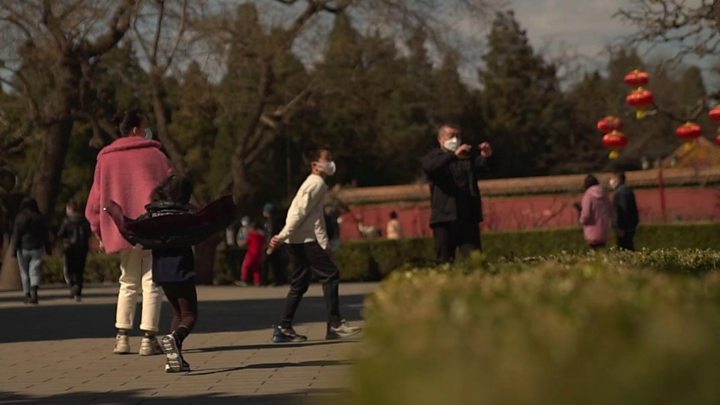
Media caption The BBC met people in Beijing heading out after the lockdown
In the past few weeks, China has started to ease travel and social-distancing restrictions, believing it has brought the health emergency under control.
Last weekend, Wuhan partially re-opened after more than two months of isolation.
On Saturday, China reported 19 new confirmed cases of coronavirus, down from 31 a day earlier. China’s health commission said 18 of those cases involved travellers arriving from abroad.
As it battles to control cases coming from abroad, China temporarily banned all foreign visitors, even if they have visas or residence permits.
What is the latest worldwide?
As the coronavirus crisis in China abates, the rest of the world remains firmly in the grip of the disease.
The deaths increased by 1,480 in 24 hours, the highest daily death toll since the pandemic began, AFP news agency reported, citing Johns Hopkins University’s case tracker.
The head of the International Monetary Fund (IMF) said the pandemic has bought the global economy to a standstill, causing a recession “way worse than the global financial crisis” of 2008
The United Nations appealed to governments around the world not to use the pandemic as an excuse to stifle dissent
BEIJING/WUHAN, China (Reuters) – China on Saturday mourned the thousands of “martyrs” who have died in the new coronavirus outbreak, flying the national flag at half mast throughout the country and suspending all forms of entertainment.
The Chinese national flag flies at half-mast at Tiananmen Square in Beijing, as China holds a national mourning for those who died of the coronavirus disease (COVID-19), on the Qingming tomb sweeping festival, April 4, 2020. REUTERS/Carlos Garcia Rawlins
The day of mourning coincided with the start of the annual Qingming tomb-sweeping festival, when millions of Chinese families pay respects to their ancestors.
At 10 a.m. (0200 GMT) Beijing time, the country observed three minutes of silence to mourn those who died, including frontline medical workers and doctors. Cars, trains and ships sounded their horns and air raid sirens wailed.
In Zhongnanhai, the seat of political power in Beijing, President Xi Jinping and other Chinese leaders paid silent tribute in front of the national flag, with white flowers pinned to their chest as a mark of mourning, state media reported.
More than 3,300 people in mainland China have died in the epidemic, which first surfaced in the central province of Hubei late last year, according to statistics published by the National Health Commission.
In Wuhan, the capital of Hubei province and the epicentre of the outbreak, all traffic lights in urban areas turned red at 10 a.m. and all road traffic ceased for three minutes.
Some 2,567 people have died in Wuhan, a megacity of 11 million people located in the middle reaches of the Yangtze river. The Wuhan deaths account for more than 75% of the country’s fatalities.
Among those who died was Li Wenliang, a young doctor who tried to raise the alarm about the disease. Li was honoured by the Hubei government earlier this week, after initially being reprimanded by police in Wuhan for “spreading rumours”.
Gui Yihong, 27, who was among thousands of Wuhan locals who volunteered to deliver food supplies to hospitals during the city’s months-long lockdown, recalled the fear, frustration and pain at Wuhan Central Hospital, where Li worked.
“If you weren’t at the frontlines you wouldn’t be able to experience this,” said Gui, as he laid some flowers next to Wuhan’s 1954 flood memorial by the Yangtze.
“I had to (come) and bear witness. For the last 80 days we had fought between life and death, and finally gained victory. It was not easy at all to come by.”
While the worst was behind Wuhan, the virus has spread to all corners of the globe since January, sickening more than a million people, killing more than 55,000 and paralysing the world economy.
Wuhan banned all tomb-sweeping activities in its cemeteries until at least April 30, curtailing one of the most important dates in the traditional Chinese lunar new year calendar which usually sees millions of families travel to tend to their ancestral graves, offer flowers and burn incense.
They have also told residents, most stuck at home due to lockdown restrictions, to use online streaming services to watch cemetery staff carry out those tasks live.
ASYMPTOMATIC CASES
Online, celebrities including “X-Men: Days of Future Past” star Fan Bingbing swapped their glamorous social media profile pictures for sombre photos in grey or black, garnering millions of “likes” from fans.
Chinese gaming and social media giant Tencent (0700.HK) suspended all online games on Saturday.
As of Friday, the total number of confirmed cases across the country stood at 81,639, including 19 new infections, the National Health Commission said.
Eighteen of the new cases involved travellers arriving from abroad. The remaining one new infection was a local case in Wuhan, a patient who was previously asymptomatic.
Asymptomatic people exhibit few signs of infection such as fevers or coughs, and are not included in the tally of confirmed cases by Chinese authorities until they do.
However, they are still infectious, and the government has warned of possible local transmissions if such asymptomatic cases are not properly monitored.
China reported 64 new asymptomatic cases as of Friday, including 26 travellers arriving in the country from overseas. That takes the total number of asymptomatic people currently under medical observation to 1,030, including 729 in Hubei.
Image copyright GETTY IMAGESImage caption Hundreds have been leaving the mosque to be monitored or tested for the virus
Officials across India are searching for hundreds of people who attended a religious event in the capital that has set off several Covid-19 clusters.
At least six regions have reported cases that can be directly traced to the days-long congregation at a mosque.
Delhi officials are now clearing the building, where more than 1,000 people have been stranded since the government imposed a lockdown last week.
At least 24 have tested positive so far, the state health minister said.
They are among some 300 people who showed symptoms and have been moved to various hospital to be tested, he told the media. Another 700 have been shifted into quarantine centres, he added.
It is believed that the infections were caused by preachers who attended the event from Indonesia.
State officials have called for action to be taken against mosque officials, but they have denied any wrongdoing.
Local media reports say that Nizamuddin – the locality where the mosque is located – has been cordoned off and more than 35 buses carrying people to hospitals or quarantine centres.
The congregation – part of a 20th Century Islamic movement called Tablighi Jamaat – began at the end of February, but some of the main events were held in early March.
It’s unclear if the event was ticketed or even if the organisers maintained a roster of visitors as people attended the event throughout, with some staying on and others leaving. Even overseas visitors, some of them preachers, travelled to other parts of the country where they stayed in local mosques and met people.
Image copyright GETTY IMAGES
So officials have no easy way of finding out how many people attended the event or where they went. But they have already begun to trace and test.
The southern state of Telangana reported on Sunday night that six people who had attended the event died from the virus. The state’s medical officer told the BBC that more than 40 of Telangana’s 71 cases were either directly or indirectly linked to the event.
Indian-administered Kashmir reported its first death from the virus last week – a 65-year-old who had been in Delhi for the congregation. Officials told BBC Urdu that more than 40 of the region’s 48 cases could be traced back to that one patient.
A cluster has even appeared in the distant Andaman and Nicobar Islands, where six of the nine who have tested positive, had returned from the Delhi event.
The southern states of Tamil Nadu, Telangana and Andhra Pradesh have said more than 3,000 people from their states had attended the event, and Tamil Nadu has traced 16 positive patients to it.
States have also asked other people who attended to come forward for testing.
Delhi Chief Minister Arvind Kejriwal has asked for a police complaint to be registered against the head of the mosque.
However, the event’s organisers have issued a statement, saying they had suspended the event and asked everyone to leave as soon as Prime Minister Narendra Modi announced that there would be a day-long national curfew on 22 March.
While many were able to leave, they say, others were stranded because states began to seal their borders the following day, and two days later, India imposed a 21-day lockdown, suspending buses and trains.
The mosque’s premises include dormitories that can house hundreds of people.
The organisers say they informed the local police about all of this and continued to cooperate with medical officers who came to inspect the premises.
The mosque, the statement says, “never violated any provision of law, and always tried to act with compassion and reason towards the visitors who came to Delhi from different states. It did not let them violate the medical guidelines by thronging ISBTs (bus stops) or roaming on streets.”
This is not the first time religious congregations have been blamed for the spread of coronavirus.
Tablighi Jamaat events have also been blamed for spreading cases in Indonesia and Malaysia.
And in South Korea, many positive cases were linked to the Schincheonji church, a secretive religious sect, that has since apologised for its role in the outbreak.
Image copyright EPAImage caption Wuhan has been sealed off since mid-January
The lockdown in Wuhan, the Chinese city where the global coronavirus outbreak began, will be partially lifted on 8 April, officials say.
Travel restrictions in the rest of Hubei province, where Wuhan is located, will be lifted from midnight on Tuesday – for residents who are healthy.
A single new case of the virus was reported in Wuhan on Tuesday following almost a week of no reported new cases.
Countries around the world have gone into lockdown or imposed severe curbs.
The UK is getting to grips with sweeping new measures to tackle the spread of coronavirus, including a ban on public gatherings of more than two people and the immediate closure of shops selling non-essential goods.
Image copyright AFPImage caption The WHO has urged the G20 group of nations to boost production of protective equipment
Meanwhile, health experts say Americans must limit their social interactions or the number of infections will overwhelm the health care system in the US.
Spanish soldiers helping to fight the coronavirus pandemic have found elderly patients in retirement homes abandoned and, in some cases, dead in their beds, the defence ministry has said.
An ice rink in Madrid is to be used as a temporary mortuary for Covid-19 victims.
The World Health Organization (WHO) has warned that the pandemic is accelerating, with more than 300,000 cases now confirmed. It is urging countries to adopt rigorous testing and contact-tracing strategies.
Wuhan has been shut off from the rest of the world since the middle of January. But officials now say anyone who has a “green” code on a widely used smartphone health app will be allowed to leave the city from 8 April.
Earlier, the authorities reported a new case of coronavirus in Wuhan, ending a five-day run of no reported new cases in the city.
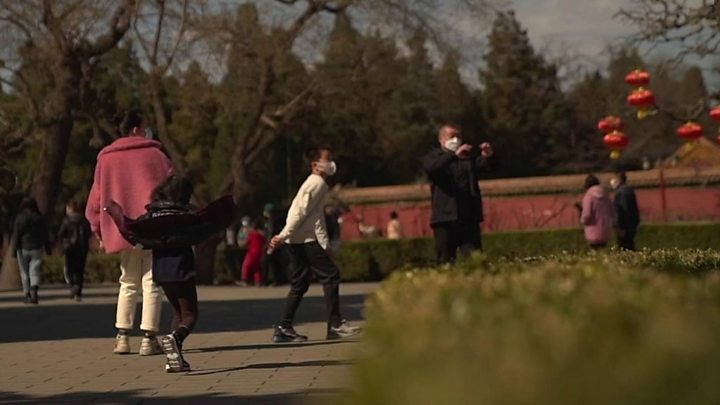
Media caption Coronavirus: People in Beijing begin to head outdoors
It comes after health officials there confirmed that they were not counting cases of people who were positive but had not been admitted to hospital or did not show any symptoms of the disease.
Official government figures say there have been 78 new cases reported on the Chinese mainland in the last 24 hours. All but four of them were caused by infected travellers arriving from abroad.
This so-called “second wave” of imported infections is also affecting countries like South Korea and Singapore, which had been successful in stopping the spread of disease in recent weeks.
South Korea has been seeing a drop in its daily tally of new cases. On Tuesday it reported its lowest number since 29 February.
China looks to repair its reputation
By Robin Brant, BBC News, Shanghai
China considers itself to be – very nearly – a “post corona” country.
In the last week we’ve heard Wuhan medics warning the UK and others that they need to do more to protect frontline health workers, citing the mistakes they made early on when some treated patients without wearing proper protective clothing.
But there’s also been reporting in state media of the reported death toll in Italy surpassing that in China. This has been combined with some commentary from prominent media figures that has appeared distasteful, almost triumphalist.
At the same time there is a panic about the threat of a second wave from imported cases – travellers arriving from abroad. This has fuelled the view – right or wrong – that some other countries aren’t taking the threat seriously because they aren’t doing what China did. (Almost all the cases in Beijing that have been made public are of Chinese nationals returning home).
Meanwhile, well away from senior leaders, there are some high-profile diplomatic figures using international-facing social media to spread theories that the US may have weaponised and dumped the virus in China. Or that Italy had cases that may have been Covid-19 earlier than China. China is sowing seeds of doubt and questioning assumed truths as it looks to repair its reputation.
Almost all of India with its 1.3bn people is under lockdown. Buses, trains and other forms of public transport are suspended. On Monday, the authorities said domestic flights would also stopped. The country has reported 485 cases and nine people have died. Prime Minister Narendra Modi will address the nation again this evening.
Image copyright GETTY IMAGESImage caption Mumbai’s suburban train network carries eight million passengers a day
Neighbouring Pakistan has almost twice as many confirmed cases – 878 as of Monday evening. Sweeping restrictions are in place although the government has stopped short of imposing a nationwide lockdown. However, several provinces have announced them independently. The army is being brought in to help enforce the restrictions.
Bangladesh, which has reported 33 cases and three deaths, is also deploying its armed forces to help maintain social distancing and boost Covid-19 preventive measures. The soldiers will also monitor thousands of quarantined expatriate returnees. Across South Asia, there are concerns that the actual number of cases could be much higher than is being reported.
Indonesia, which has 49 confirmed Covid-19 deaths – the highest in South-East Asia – has converted an athlete’s village built for the 2018 Asian Games into a makeshift hospital for coronavirus patients. A state of emergency was declared in Jakarta on Monday.
In Thailand, a month-long state of emergency which will include curfews and checkpoints will begin on Thursday. The government has been criticised for failing to take strong action so far. Four people have died and nearly 900 tested positive.
Talks between the Japanese PM and the International Olympic Committee are expected this evening.
The most populous country that was without a case until now – Myanmar – has announced two cases.
Europe’s battle against virus intensifies
UK Prime Minister Boris Johnson announced on Monday night that, with immediate effect, “people will only be allowed to leave their home…for very limited purposes”. They include shopping for basic necessities, taking one form of exercise per day, fulfilling any medical need, or travelling to work if working from home is impossible.
Media caption Reality Check tackles misleading health advice being shared online
The number of people who have died in the UK rose to 335 on Monday.
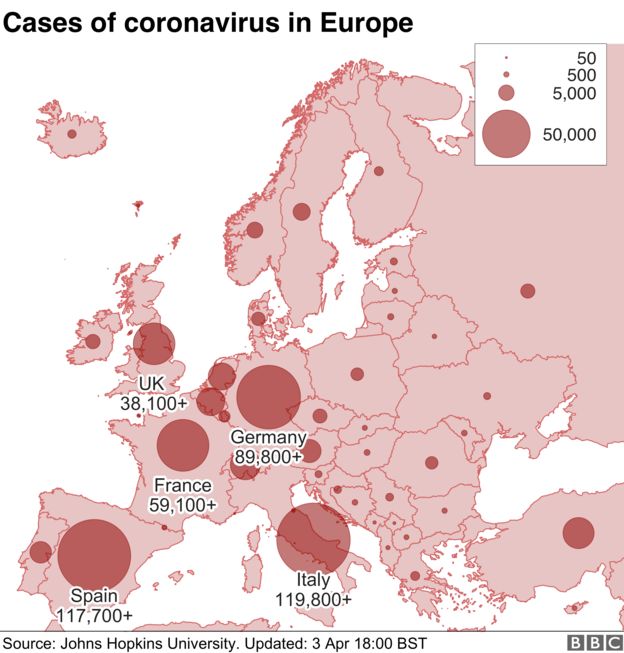
In Italy, the worst-hit country in the world, the authorities said 602 people with Covid-19 had died in the past 24 hours, bringing the total death toll there to 6,077.
But the daily increase in cases was the smallest since Thursday, raising hope that the stringent restrictions imposed by the government were starting to have an effect.
Spain, however, said on Tuesday that its death toll had risen by 514 to 2,696. Nearly 40,000 are infected, about 5,400 of them healthcare workers.
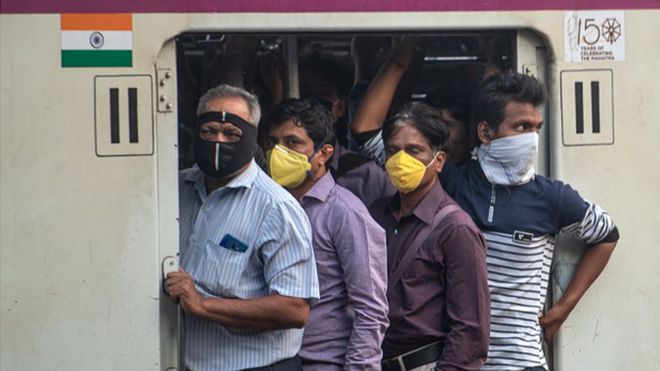
Image copyright GETTY IMAGESImage caption Many passengers have been wearing masks while travelling on the network
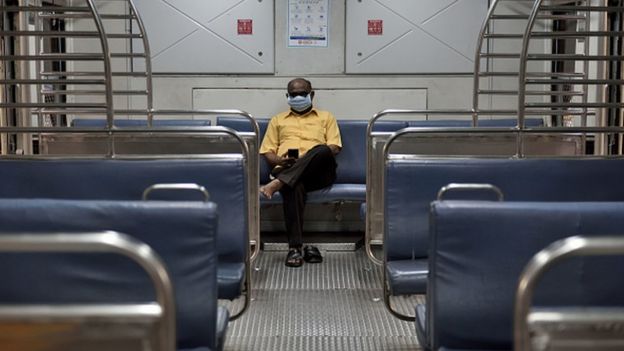
One of the world’s busiest urban rail systems will be shut down for ordinary commuters from Monday morning to prevent the spread of coronavirus infection in Mumbai, one of India’s most populous cities. Only government workers in “essential services” will be allowed to travel on a truncated service.
This was waiting to happen.
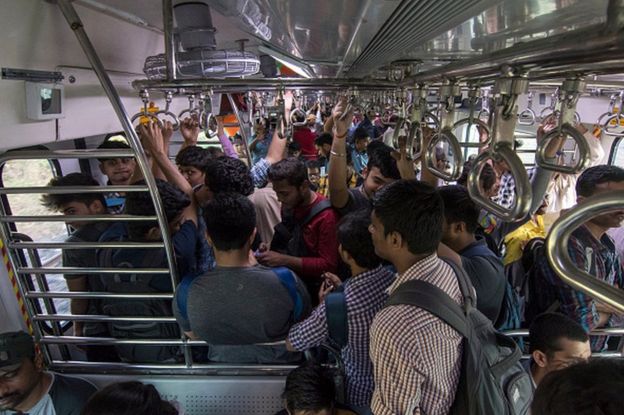
Consider this. Eight million people take Mumbai’s crowded suburban train network every day. Packed to nearly three times its capacity, this is one of the busiest railway systems in the world.
The 459km (285-mile) network is the lifeline of India’s financial and entertainment capital, accounting for nearly 80% of all commuting trips in the populous western city. The suburban trains “cover almost the distance up to [the] moon in one week,” the network’s website says.
The 66-year-old network carries 60,000 passengers per km per day, the highest among all the leading commuter rail systems in the world, say officials. The coaches are sturdy enough to carry a “super dense crush load”, a phrase coined by the railways to describe the intense crowding on Mumbai’s trains. This means that a nine-car train designed for 1,800 standing passengers will often carry up to 7,000 passengers, according to Monisha Rajesh, author of Around India in 80 Trains. “Mumbai’s local trains were certainly not for the fainthearted,” she wrote.
Image copyright GETTY IMAGESImage caption Mumbai’s suburban train network carries eight million passengers every day
Now consider this. The western state of Maharashtra, of which Mumbai is the capital, has confirmed more than 60 coronavirus infections, the highest in India so far. Scores of long distance trains out of the city have been cancelled, but the suburban network has continued to rumble on, raising fears of the mass spread of the virus on these packed trains. The crowded service was an easy target of a terror attack in 2006 when serial blasts ripped though a number of trains. At least 180 people were killed and more than 800 injured – the high casualty figure was attributed to overcrowding.
“From ports and landing places the local transport networks, particularly the railways, carried the virus from large cities to the smallest, remotest settlements,” said a report on the spread of the flu in Britain in 1918-1919.
So should one of the world’s busiest rail networks be shut down to stop a possible spread of the virus in a city that many fear could turn into a coronavirus hotspot?
Image copyright GETTY IMAGESImage caption Officials say ridership on the trains has dropped by 17% after the coronavirus scare
Economists like Shruti Rajagopalan believe so.
“India is conducting the fewest tests per million at the moment. If the virus is truly within the community, then given these two issues, the Mumbai outbreak cannot be contained and people will die without healthcare.
“Mumbai trains are the fastest and surest way to spread the virus (if it is within the community) to the densest parts of the city,” she told me.
There is enough precedent: China stopped trains, ferries, planes and buses from leaving the city of Wuhan; and on Thursday, London officials announced that up to 40 stations on the London Underground network are to be shut as the city attempts to contain the outbreak.
Others are not so sure about linking the spread of a pandemic to public transport systems. One study does not support the effectiveness of suspending mass urban transport systems to reduce or slow down a pandemic because, “whatever the relevance of public transport is to individual-level risk, household exposure most likely poses a greater threat”.
“I have not seen any data on the relative risk of public transportation compared with [dense places like] workplaces or schools,” Timothy Brewer, a professor of epidemiology at the University of California Los Angeles told Vox.com.
He said data from China suggested that “household contact was an important means of transmission outside of Wuhan, suggesting that prolonged contact [with a sick person] increases the risk of transmission”.
“If correct, then the time spent commuting and the density of people commuting could be important factors in assessing if public transportation is a risk factor for the disease’s transmission.”
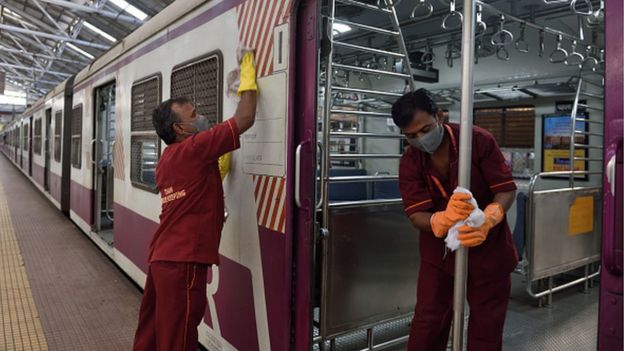
Image copyright GETTY IMAGESImage caption Trains on the network are being scrubbed clean to avoid the spread of infection
Shivaji Sutar, a senior communications officer of the railways, told me that the network was running an aggressive campaign to ease the rush: awareness announcements, posters and videos containing virus information.
They were also monitoring crowds, scrubbing the trains, taking the temperature of willing passengers and embarking on a drive against public spitting, he said.
A combination of awareness and panic has already led to a 27% drop in traffic on the network. But millions of people continue to take the train to work and home every day.
“This is more because of fear than anything else. Most of us have to take the network because we have to come to work. There is still no government directive to all companies to work from home. And apart from passengers wearing masks, I haven’t seen any other precautions being taken,” Rekha Hodge, who has been using the network for three decades, told me. That is bad news.
Evacuation plan outlined in email as diplomats look for ways to protect foreign nationals
Paris earlier reports three cases on its soil – the first to be identified in Europe
The French consulate in Wuhan is planning to evacuate French nationals from the city to escape the deadly coronavirus. Photo: AFP
Foreign diplomats in Wuhan are scrambling to assess the situation in the coronavirus
-plagued city, with French officials planning to evacuate French nationals trapped by the Chinese government’s lockdown.
The plan would allow French people who want to leave Wuhan, the capital of Hubei province, to travel by bus to Changsha in neighbouring Hunan province, according to an email seen by the South China Morning Post.
“The consulate general, in collaboration with local authorities, plans to set up a bus service to allow French nationals … and their Chinese and foreign spouses and children to travel from Wuhan to Changsha,” it said.
The email, sent by the French consulate, also asked anyone who received it to pass the notice on to other French nationals. It was not clear which bodies received the email and the date of the planned evacuation was not specified.
The consulate could not be reached for comment on Saturday.
France, the United States, Britain and South Korea all have consulates in Wuhan, according to China’s foreign ministry.
The South Korean consulate said in a post on its website that it would suspend all visa applications “indefinitely until further notice”.
A diplomatic source said several foreign embassies in China were considering plans to evacuate their nationals from Wuhan.
First coronavirus case ‘had no links to seafood market’
25 Jan 2020
It is not known how many foreigners remain in the city, which has a population of about 11 million and has been under a government-imposed lockdown since Thursday morning.
French Foreign Minister Jean-Yves Le Drian said in a statement on Friday that Paris was monitoring the crisis and “can increase the power [to respond] if necessary”.
There have so far been three confirmed cases of the new coronavirus in France, in Paris and Bordeaux.
French Foreign Minister Jean-Yves Le Drian said on Friday that Paris was monitoring the crisis in China. Photo: AFP
The US said earlier that most of its consulate staff and their families had been pulled out of Wuhan.
An emailed inquiry to the British consulate in the city received only an automated reply, saying: “Wuhan is now in crisis mode. We may not be able to answer your emails for some time.”
The consulate would be closed for the Lunar New Year holiday until January 31, it said.
Meanwhile, British citizen Kharn Lambert told the BBC on Thursday how he had been “trapped” in Wuhan.
The PE teacher said he was afraid to leave his house for fear of catching the deadly virus.
“If you saw the street behind me at night time where I normally live … if I show you out there now, it’s dead,” he said.
More than 1,280 confirmed cases have been reported across China, of which more than 700 were in Hubei, according to local government figures released on Saturday.
The death toll in Hubei stands at 39, with two other fatalities reported in the provinces of Hebei and Heilongjiang.
Tens of millions of people in Hubei are effectively on lockdown since a travel ban was imposed on most of the province.
Flights, trains, buses and ferries connecting Wuhan to other cities in Hubei have been suspended. Rail authorities in Wuhan, which is a hub for several major high-speed lines, said operations at 61 stations and more than 400 train services had been suspended until further notice.
Best pilots from carrier-borne squadrons sent to naval academy for warship training to meet ‘urgent need’ for commanders
They had to pass more than 10 assessments – from political thought to psychological testing – before they could join the programme
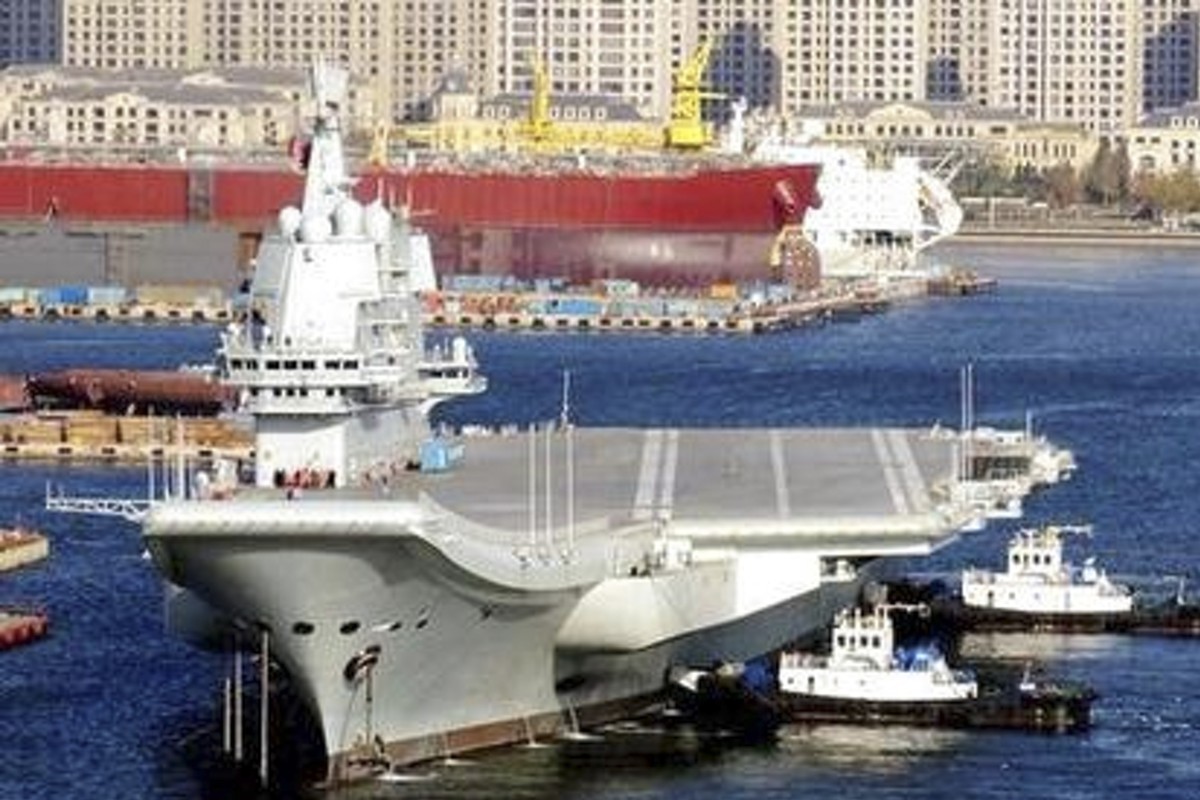
China’s second aircraft carrier, the Type 001A, is expected to be operational by the end of this year. Photo: Sina
The Chinese navy is training fighter pilots experienced in carrier-borne operations to command and manage its warships as it seeks to expand its global naval power.
Its best pilots from carrier-borne squadrons – including some qualified to fly fighter jets during both daytime and at night – were sent to a naval academy for warship combat and command training late last month, PLA Daily reported on Monday.
It did not say how many pilots had been selected, but all of them were required to pass more than 10 assessments – ranging from political thought to psychological testing – before they could join the training programme, the official People’s Liberation Army newspaper said.
Beijing-based naval expert Li Jie said the programme would focus on command and control skills for air and sea operations, and some of the pilots would ultimately be selected to command China’s new aircraft carrier strike groups.
As part of its ambition to build a powerful blue-water navy that can operate globally, China plans to have four aircraft carriers in service by 2035. Its second aircraft carrier – the first built in China, known as the Type 001A – is undergoing sea trials and is expected to be operational by the end of this year.
Work on the more modern Type 002 carrier started two years ago and a naval source told the South China Morning Post that construction of a second Type 002 vessel could begin as early as 2021.
But they will need suitable carrier pilots to take command.
“It’s quite an urgent need for the Chinese navy to have carrier group commanders – like its Western counterparts do – who are capable of commanding different warships and aircraft in modern joint-operation combat situations,” Li said.
China to deploy Sharp Sword stealth drone for new Type 001A aircraft carrier
“Aircraft carrier strike groups are supposed to sail on the high seas and into unfamiliar territory, so aside from having a background as naval aviators, all commanding officers should have a broad set of skills and knowledge – from foreign languages and international maritime law to air and sea operations – to help them make good decisions,” he said.
Other navies, such as the United States Navy, require more experience for the role – commanding officers of US aircraft carriers must be former naval aviators as well as former captains of different types of warships.
For example, Captain Pat “Fin” Hannifin, commanding officer of the Nimitz-class aircraft carrier USS Ronald Reagan, has over 2,800 flight hours in 33 different aircraft under his belt. He was also executive officer on another aircraft carrier and commander of an amphibious transport dock.
Rear Admiral Li Xiaoyan, the first captain of China’s only active aircraft carrier, the Liaoning, was a pilot with no experience on carrier-borne aircraft, though he did have experience on a destroyer and frigates. He was replaced by Zhang Zheng just days after the Liaoning formally joined the PLA Navy in 2012, and later by Liu Zhe – neither of whom had naval aviator backgrounds.
Li Xiaoyan was one of the first group of 10 pilots selected for a training programme designed specifically for China’s future aircraft carriers back in 1987. But the whole aircraft carrier plan was suspended in 1998 by premier Zhu Rongji for political and economic reasons, according to China’s Carrier, a book published by China Development Press.
China’s navy begins national search for trainee top-gun pilots
Naval expert Li Jie said the Chinese navy now had to catch up in terms of training pilots, and especially commanding officers, for its aircraft carriers.
“China resumed the aircraft carrier plan and in 2004 started refitting the hull of the Varyag. But after that first group of pilots was trained in 1987, there was no formal training in air and sea operations because there was no aircraft carrier training platform until 2012,” Li said, referring to the unfinished Admiral Kuznetsov-class vessel China bought from Ukraine in 1998, which became the Liaoning.
He said the latest training programme for commanding officers was a continuation of the one that began more than 30 years ago.









 CHINDIA ALERT: You'll be living in their world, very soon