Chindia Alert: You’ll be Living in their World Very Soon
aims to alert you to the threats and opportunities that China and India present. China and India require serious attention; case of ‘hidden dragon and crouching tiger’.
Without this attention, governments, businesses and, indeed, individuals may find themselves at a great disadvantage sooner rather than later.
The POSTs (front webpages) are mainly 'cuttings' from reliable sources, updated continuously.
The PAGEs (see Tabs, above) attempt to make the information more meaningful by putting some structure to the information we have researched and assembled since 2006.
China is facing mounting criticism over a planned security law for Hong Kong which would make it a crime to undermine Beijing’s authority in the territory.
The UK and US said at a private session of the UN Security Council that the law would curtail the city’s freedoms.
China, which blocked a formal meeting, warned them to “stop interfering”.
Hong Kong’s autonomy is guaranteed by the 1997 agreement under which it was returned to China from the UK.
It enjoys some freedoms – of the press and association – unseen in mainland China.
But there are fears the proposed law – which has sparked a wave of anti-mainland protests – could end Hong Kong’s unique status.
There are 350,000 BNO passport holders in Hong Kong who currently have the right to visit the UK for up to six months without a visa.
On Friday, the UK Home Office confirmed the new rights could be given to up to three million people with BNO status – as long as they applied for and were granted a passport.
China says all BNO passport holders are Chinese nationals, and if the UK changes this practice, it would violate international law.
Australia, Canada and the EU have also criticised the security law and its implications for Hong Kong.
Taiwan’s parliament has backed a plan to offer sanctuary to people who want to flee Hong Kong, but China – which considers Taiwan to be part of its own territory – has warned the island not to get involved.
On Friday, Chinese Foreign Ministry spokesperson Zhao Lijian urged other countries to stop interfering in the matter.
“We will take necessary measures to resolutely counter the wrong acts of external forces interfering in Hong Kong affairs”, he said.
What might the US do?
On Wednesday, US Secretary of State Mike Pompeo told Congress that Hong Kong no longer merited special treatment under US law, potentially paving the way for it to be stripped of trading privileges such as lower tariffs than mainland China.
He is expected to make an announcement later on Friday.
The EU has warned that imposing sanctions would not solve the crisis.
“Our relationship with China is based on mutual respect and trust… but this decision calls this into question and I think that we have to raise the issue in our continued dialogue with China”, EU High Representative for Foreign Affairs Josep Borrell said after talks with foreign ministers on Friday.
Media caption Police arrested dozens of people in Causeway Bay on Wednesday
Hong Kong’s justice secretary Teresa Cheng told the BBC’s Chinese service that any threat of sanctions was unacceptable.
“Are the sanctions being imposed with a view to coerce another state to change their policy…? Any such sanctions are not going to benefit anyone”.
China’s parliament has backed the security legislation, which would make it a crime to undermine Beijing’s authority in Hong Kong.
The resolution – which now passes to China’s senior leadership – could also see China installing its own security agencies in the region for the first time.
Full details about exactly what behaviour will be outlawed under the new security law are not yet clear. It is due to be enacted before September.
Image copyright AFPImage caption President Xi Jinping and other senior figures applauded when the security law was passed
However, it is expected to criminalise:
secession – breaking away from China
subversion – undermining the power or authority of the central government
terrorism – using violence or intimidation against people
activities by foreign forces that interfere in Hong Kong
Experts say they fear the law could see people punished for criticising Beijing – as happens in mainland China. For example, Nobel Laureate Liu Xiaobo was jailed for 11 years for subversion after he co-authored a document calling for political reform.
China’s foreign ministry in Hong Kong described US criticism of the new draft law as “utterly imperious, unreasonable and shameless”.
Image copyright GETTY IMAGESImage caption Mr Trump is making his first official visit to India
US President Donald Trump is expecting a raucous welcome on his first official state visit to India on Monday and Tuesday.
He follows a long line of leaders who have made the journey. Some of his predecessors were greeted enthusiastically; others stumbled through diplomatic gaffes; one even had a village named after him.
Can history be a guide to how this diplomatic tryst might go? Here’s a brief look at past visits, ranked in order of how they went.
The good: President Eisenhower
Let’s begin at the beginning.
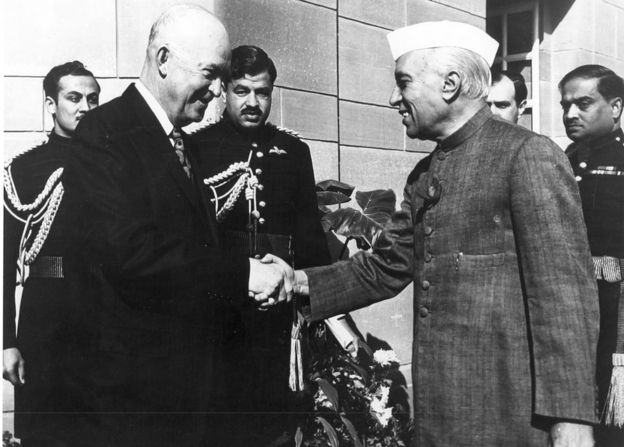
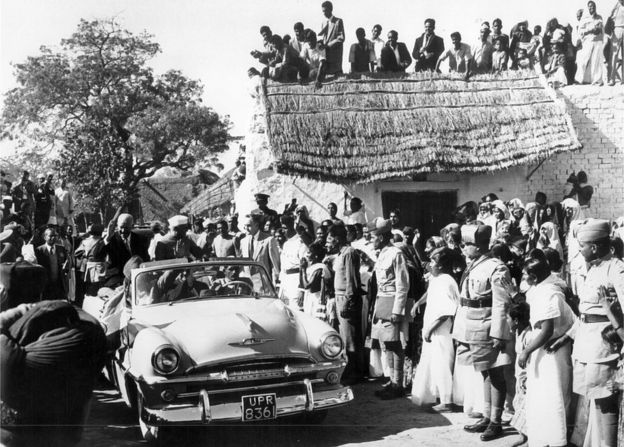
Dwight D Eisenhower, the first US president to visit India, was greeted with a 21-gun salute when he landed in the national capital, Delhi, in December 1959. Huge crowds lined the streets to catch a glimpse of the World War Two hero in his open-top car – Mr Trump is expecting a similar reception in Ahmedabad city, where he will be doing a road show.
Image copyright US EMBASSY ARCHIVESImage caption Dwight D Eisenhower, pictured with Prime Minister Jawaharlal Nehru, was the first US president to make the trip
The warmth between President Eisenhower and Indian Prime Minister Jawaharlal Nehru helped during what was a rocky phase in US-India ties. This was early in the Cold war, when the US and Pakistan had become become close allies, and India insisted on staying neutral or “non-aligned”. Like today, relations with China were at the core of the India-US equation, with Washington pressuring Delhi to take an aggressive stance with Beijing on the issue of Tibet.
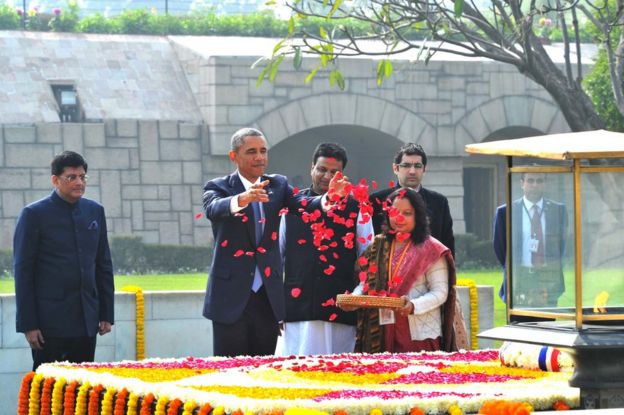
But, on the whole, Eisenhower’s four-day trip was billed a success. And nearly every US president on a state visit to India has emulated his itinerary: he laid flowers at Mahatma Gandhi’s memorial, took in the splendour of the Taj Mahal, addressed parliament and spoke at Delhi’s iconic Ramlila grounds, which, according to one news report, attracted one million people.
When he left, Nehru said he had taken with him “a piece of our heart”.
Image copyright US EMBASSY ARCHIVESImage caption President Eisenhower was greeted by large crowdsThe game-changer: Bill Clinton
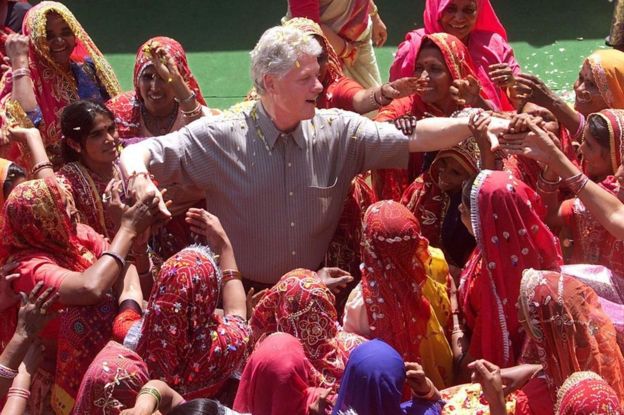
If there was a game-changing visit, it would be Bill Clinton’s in March 2000 with Prime Minister Atal Bihari Vajpayee. Mr Clinton’s arrival came after a two-decade lull – neither Ronald Reagan nor George Bush Snr made the journey East. It came at a tricky time as Washington had imposed sanctions on Delhi following its 1999 test of a nuclear bomb.
But, according to Navtej Sarna, a former Indian Ambassador to the US, the five-day trip was “a joyous visit”. It included stops in Hyderabad, a southern city that was emerging as a tech hub, and Mumbai, India’s financial capital. “He came and saw the economic and cyber potential of India, and democracy in action,” says Mr Sarna.
Image copyright GETTY IMAGESImage caption Bill Clinton’s visit was described as “joyous”Mr Clinton also danced with villagers, took a tiger safari and sampled Delhi’s famously creamy black dal (lentils) at a luxury hotel that has since been associated with the president.
The country’s reaction is perhaps best expressed in this New York Times headline: “Clinton fever – a delighted India has all the symptoms.”
The nuclear deal: George W Bush
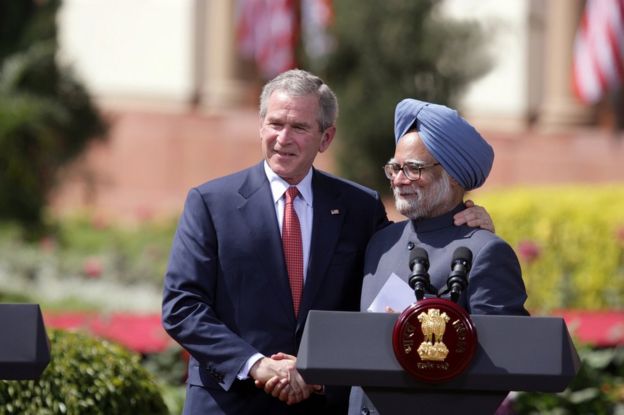
George W Bush, as Forbes magazine once put it, was the “best US president India’s ever had”. His three-day visit in March 2006 was a highlight in the two countries’ strategic relationship – especially in matters of trade and nuclear technology, subjects they have long wrangled over. His strong personal dynamic with Prime Minister Manmohan Singh was hard to miss – after he left office, Mr Bush, a keen artist, even painted a portrait of Mr Singh.
The two leaders are credited for a historic but controversial nuclear deal, which was signed during Mr Bush’s visit. It brought India, which had for decades refused to sign the Nuclear Non-Proliferation Treaty (NPT), out of isolation. Energy-hungry India got access to US civil nuclear technology in exchange for opening its nuclear facilities to inspection.
Image copyright US EMBASSY ARCHIVESImage caption George W Bush and Manmohan Singh had a very good relationshipHowever, while the visit was substantive, it was not as spectacular as others – there was no trip to the Taj, nor an address to parliament. But the timing was important. Anti-US sentiment over the invasion of Iraq was running high – left-wing MPs had staged a protest against Mr Bush’s visit, and there were demonstrations in other parts of India.
Double visit: Barack Obama
Barack Obama was the only president to make two official visits. First, in 2010 with Prime Minister Manmohan Singh, and then in 2015 with Prime Minister Narendra Modi.
On his first visit – in a break from the past – he landed in Mumbai, instead of Delhi, with a large trade delegation. This was not just about economic ties but a show of solidarity following the Mumbai terror attacks of 2008, which killed 166 people. Mr and Mrs Obama even stayed at the Taj Mahal hotel, one of the main targets.
It was significant that the US president declared support for India to join a reformed and expanded UN Security Council, says Alyssa Ayres, a former US deputy assistant secretary of state for South Asia. “That all these years later nothing has changed in the UN system is another matter, but that was a major policy shift for the United States.”
Image copyright US EMBASSY ARCHIVESImage caption Barack Obama visited India twiceMr Obama returned in 2015 as chief guest at India’s Republic Day celebrations, at PM Modi’s invitation. Trade, defence and climate change were at the heart of the talks. The trip also emphasised an Indo-Pacific strategy, where both leaders expressed unease over Beijing’s provocations in the South China Sea.
The not-so-good: Jimmy Carter
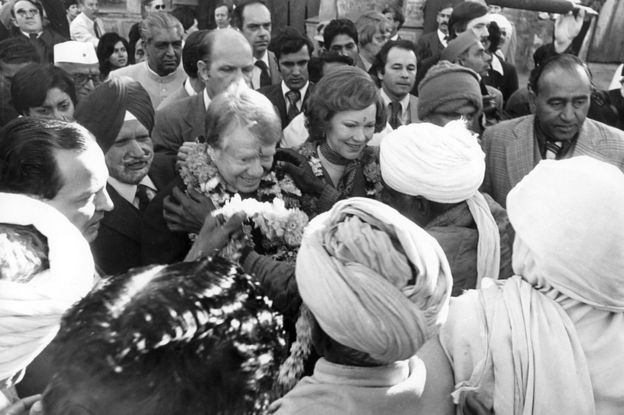
Although Jimmy Carter’s two-day visit in 1978 was a thaw in India-US relations, it was not free of hiccups.
With some 500 reporters in tow, Carter followed a packed itinerary: he met Prime Minister Morarji Desai, addressed a joint session of parliament, went to the Taj Mahal, and dropped by a village just outside Delhi.
The village, Chuma Kheragaon, had a personal connection: Carter’s mother, Lillian, had visited here when she was in India as a member of the Peace Corps in the late 1960s. So when Carter and his wife, Rosalynn, made the trip, they gave the village money and its first television set. It was even renamed “Carterpuri”, a moniker it still holds.
Image copyright US EMBASSY ARCHIVESImage caption Jimmy Carter being greeted by villagers of ‘Carterpuri’But beyond the photo-ops, India and the US were sparring. India was building its nuclear programme, and had conducted its first test in 1974. The US wanted India to sign the NPF, which sought to stop the spread of nuclear weapons. But India refused, saying the agreement discriminated against developing countries.
In a leaked conversation that made headlines and threatened to derail the visit, Mr Carter promised his Secretary of State, Cyrus Vance, a “very cold and very blunt” letter to Desai. The two leaders signed a declaration, promising greater global co-operation, but Carter left India without the assurances he had hoped for.
The ugly: Richard Nixon
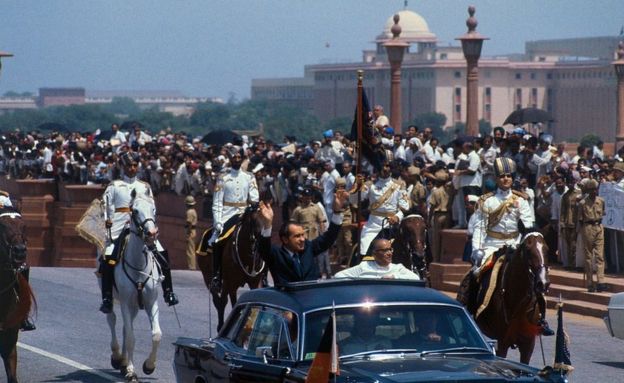
Richard Nixon was no stranger to India when he arrived in August 1969 for a day-long state visit. He had been here as vice-president in 1953, and before that on personal trips. But, by all accounts, he wasn’t a fan.
“Nixon disliked Indians in general and despised [Prime Minister] Indira Gandhi,” according to Gary Bass, author of Blood Telegram: Nixon, Kissinger and a Forgotten Genocide. And, he adds, the feeling was said to be mutual.
This was also at the height of the Cold War, and India’s non-alignment policy “appalled” American presidents. Mr Bass says that under Gandhi, India’s neutrality had turned into a “noticeably pro-Soviet foreign policy”.
Image copyright GETTY IMAGESImage caption Richard Nixon waves to the crowds alongside Mohammad Hidyatullah, India’s acting presidentThe relationship only turned frostier after the trip as India backed Bangladesh (then East Pakistan) in its fight for independence from Pakistan, a close American ally. The differences were laid bare when Gandhi visited the White House in 1971. Declassified state department cables later revealed that Nixon referred to her as an “old witch”.
And the future: Donald Trump
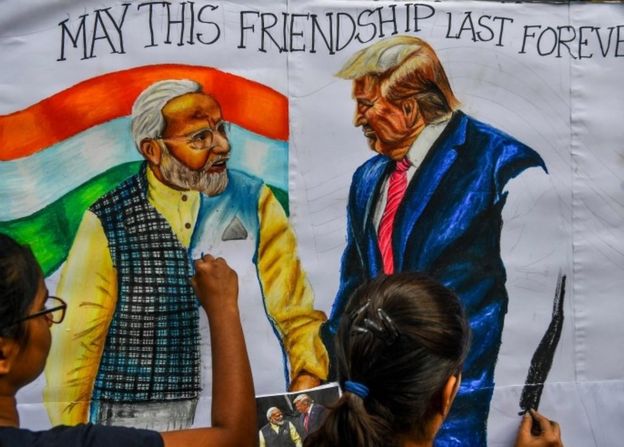
The US and India have certainly had their ups and downs, but during the last official visit in 2015, Mr Obama and Mr Modi signed a declaration of friendship: “Chalein saath saath (Let’s move forward together)…” it began.
President Trump’s visit will take the relationship forward, but it’s unclear how.
Image copyright AFP
His arrival in Ahmedabad, the main city in PM Modi’s home state of Gujarat, followed by a big arena event, is expected to draw a massive crowd. It will echo President Eisenhower’s rally in Delhi years ago, perhaps cementing the personal ties between the two leaders.
But while Mr Trump’s trip will be packed with pageantry, it could be light on policy. Unlike other presidential visits, this one is not expected to yield concrete agreements, with the trade deal Mr Trump so badly wants looking unlikely.
BEIJING, Nov. 1 (Xinhua) — China welcomes and attaches great importance to French President Emmanuel Macron’s upcoming state visit and his attendance at the second China International Import Expo, Chinese State Councilor and Foreign Minister Wang Yi said Friday.
Wang made the remarks when holding a telephone conversation with Emmanuel Bonne, diplomatic counselor to Macron, adding that Macron’s visit will mark another highest level of strategic communication between the two countries’ heads of state.
France and China should, through this visit, speak in one voice to uphold multilateralism and maintain the authority of the United Nations (UN) so as to create positive energy for the world, Wang said.
This is the responsibility that should be assumed by China and France as two permanent members of the UN Security Council as well as the proper content of the comprehensive strategic partnership between the two countries, he added.
China is willing to make all necessary preparations together with France to ensure fruitful results of Macron’s visit, he said.
Bonne thanked China for its delicate preparations for Macron’s visit, and said France is willing to closely coordinate with China to deepen mutually beneficial cooperation in various fields, ensure that the visit will achieve complete success and make new progress in advancing the France-China comprehensive strategic partnership.
Zhang Jun (R), China’s permanent representative to the United Nations, speaks to journalists at the UN headquarters in New York, Aug. 2, 2019. Zhang Jun said Friday that China attaches great importance to its cooperation with the United Nations while meeting with reporters from major international media at the UN headquarters in New York. (Xinhua/Li Muzi)
UNITED NATIONS, Aug. 2 (Xinhua) — A Chinese envoy said Friday that China attaches great importance to its cooperation with the United Nations while meeting with reporters from major international media at the UN headquarters in New York.
“We attach great importance to our cooperation with the United Nations, and everything goes well,” Zhang Jun, China’s permanent representative to the UN, told reporters from The Associated Press (AP), Reuters, Bloomberg News, and others.
The ambassador stated that China will “stand firm” with the United Nations and “give strong support” to the organization “by defending multilateralism and supporting an international system with the United Nations at its center.”
He also said that China will support “an international order on the basis of international law and the purposes and the principles of the UN Charter.”
As one of the five permanent members of the UN Security Council, “China will continue to play a responsible and a constructive role in addressing global political and security issues,” he said.
Noting that the world is “far from being peaceful,” the envoy said that China will continue to work hard on issues including in the Middle East and in other parts of the world.
In general, he said, China will continue to promote peace “through diplomatic means and political dialogues,” adding it will always be China’s basic position.
“We will try our best to be helpful and to be contributing more to world peace and security,” he noted. “China will continue to be positively engaged in peacekeeping operations for that purpose.”
Zhang started his role as China’s new permanent representative to the UN earlier this week.
The bonhomie witnessed between India and China over the last one year after the informal summit between Prime Minister Narendra Modi and Chinese President Xi Jinping in Wuhan April last year has clearly evaporated following the Chinese action
Even as China asserted on Thursday that the ‘Wuhan Spirit’ was still on, there is a sense of betrayal in New Delhi over Beijing’s decision to stand by its ‘all-weather friend’ Pakistan by blocking the designation of JeM chief Masood Azhar as a global terrorist by the UN Security Council.
The bonhomie witnessed between India and China over the last one year after the informal summit between Prime Minister Narendra Modi and Chinese President Xi Jinping in Wuhan April last year has clearly evaporated following the Chinese action.
Amid the growing clamour in India for boycotting China after it used its veto power to block listing of Masood Azhar as a global terrorist, New Delhi has expressed disappointment over Beijing’s move while reaffirming its determination to pursue all avenues to bring the JeM chief to justice for terror attacks in different parts of India.
A number of reasons, including the significant role Pakistan plays in China’s ties with the Islamic world and Beijing’s anxiety over spill-over effect of a ban on Azhar in China’s own restive Muslim-dominated Xinjiang region, could have played a role in Beijing deciding to yet again stonewall any action by the UNSC against the JeM chief, observers say.
Despite its burgeoning trade relationship with India, China has never hidden the fact that it needed Pakistan more than any other country for achieving its geo-strategic goals in the region. Pakistan’s importance for China has increased manifold in recent years in view of the heavy economic and manpower investments it has made in the China-Pakistan Economic Corridor (CPEC) as part of President Xi’s signature Belt and Road Initiative (BRI).
Sources said it was quite clear to New Delhi over the past few days that China was adopting double standards in the global fight against terrorism only to shield Pakistan. China, they said, could no longer take shelter under ‘lame excuses’ like India had not provided any ‘updated material’ on Azhar’s terrorist activities in India which could compel Beijing to reconsider its position on the JeM chief.
Sources pointed out that India had submitted to China and other key nations ‘clinching and irrefutable’ evidence linking JeM to terror attacks in India, including the Pulwama attack. All other members of the UNSC, including those in the non-permanent category, solidly backed India’s effort to get the JeM chief banned but China put a spanner in their works yet again, they regretted.
The US, meanwhile, said responsible UNSC members might be forced to other actions at the Security Council if Beijing continued to block Masood’s designation.
China’s veto against banning Masood Azhar has once again highlighted the deep-rooted suspicion and mistrust between India and China on strategic issues, particularly the fight against terrorism. Despite pledging to work with India in combating terror, China has done precious little to assuage India’s concerns over terrorism emanating from Pakistan.
China has, in fact, praised Pakistan on many occasions for its role in the global war against terrorism. Beijing’s contention has been that Pakistan itself has been one of the main victims of terrorism and it must be supported in combating the menace.
There is also a feeling in Chinese circles that the situation in Jammu and Kashmir is the prime reason for terrorism in India. The argument being advanced by them is that while Kashmir is a disputed territory, Xinjiang is a province of China and, therefore, a comparison can not be drawn between the two regions.
The IAF strike on Jaish camp in Balakot deep across LoC comes a day before the foreign ministers of Russia, India, and China (RIC) are expected to meet in the eastern China town of Wuzhen under the RIC mechanism.
China has urged India and [pakistan to exercise restrain after the Indian Air Force hit a Jaish camp in Balakot acro(AP file photo)
China on Tuesday urged India to fight terrorism through “international cooperation” hours after the Indian air force carried out a targeted strike on a Jaish-e-Mohammed (JeM) camplocated across the Line of Control (LoC).
India should create “favourable” conditions internationally to fight terrorism, China added possibly in an oblique reference to New Delhi’s failure to convince Beijing to allow Jaish-e-Mohammed chief, Azhar Masood to be designated as a terrorist at the UN Security Council.
The strike comes a day before the foreign ministers of Russia, India, and China (RIC) are expected to meet in the eastern China town of Wuzhen under the RIC mechanism.
Responding to a question on the air strike, the foreign ministry spokesperson, Lu Kang said both India and Pakistan — one of China’s closest allies — should maintain restraint.
“We have taken note of relevant reports. I want to say that India and Pakistan are both important countries. A sound relationship and cooperation serve the interests of peace and stability in South Asia. Both parties (should) remain restrained and do more to improve bilateral relations,” Lu Kang said.
“As for India’s claims on taking action against terrorism, fighting terrorism is a global practice. It needs to be dealt with international cooperation. And India needs to create a favourable condition internationally for the same,” Lu said.
The Chinese foreign ministry’s reaction came soon after foreign secretary, VK Gokhale confirmed that Indian forces carried out a strike on the biggest camp of the terror group Jaih e Mohammed in Balakot area early on Tuesday.
“Credible intelligence was received that JeM was attempting another suicide terror attack in various parts of the country, and the fidayeen jihadis were being trained for this purpose. In the face of imminent danger, a preemptive strike became absolutely necessary,” the foreign secretary said.
The Chinese foreign ministry reacted carefully, keeping in mind its close ties with Pakistan and the fact that India’s decision to carry out the strike was triggered by JeM-planned Pulwama attack that killed 40 CRPF personnel.
Interestingly, Chinese foreign minister, Wang Yi and his Pakistani counterpart, Shah Mehmood Qureshi spoke over phone about the Pulwama attack and its aftermath over the phone on Monday evening.
“Qureshi informed Wang of Pakistan’s stance on and measures to deal with the attack, reaffirming the country’s sincerity and resolution to communicate with India and find out the truth of the incident,” a report by China’s official news agency, Xinhua, said.
“Qureshi said Pakistan’s position on maintaining regional peace and fighting terrorism will remain unchanged and it is willing to join hands with other countries to cooperate in this area,” it added.
In the phone conversation, Wang said China supports Pakistan and India to resolve the issue through dialogue as soon as possible and avoid an escalation of the situation.
“He called on both sides to collaborate on fighting terrorism and jointly safeguard the security and stability of South Asia,” the report said.
Meanwhile, the Pulwama terrorist attack and the listing of Azhar as a global terrorist by the UN is expected to prominently figure at the 16th RIC foreign ministers’ meeting being held here on Wednesday.
Besides attending the annual trilateral meeting, external affairs minister Sushma Swaraj would also hold bilateral talks with Chinese FM Wang and Russian counterpart, Sergei Lavrov on the sidelines of the meeting.
Swaraj’s meeting with Wang assumes significance as it will be the first high-level interaction between the two countries after the Pulwama terror attack and Tuesday’s air strike.
China, a veto-wielding member of the UNSC, has consistently blocked India, the US, the UK and France’s efforts to list Azhar as a global terrorist since 2016 but endorsed a scathing statement issued by UN Security Council on February 21 on the Pulwama attack.
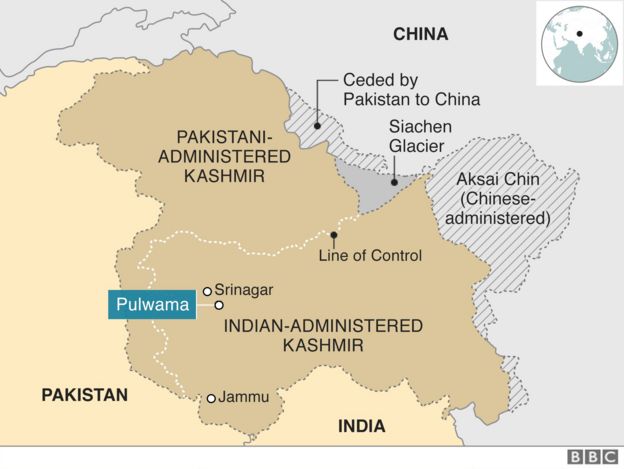
India has said it will ensure the “complete isolation” of Pakistan after a suicide bomber killed 46 soldiers in Indian-administered Kashmir.
Federal Minister Arun Jaitley said India would take “all possible diplomatic steps” to cut Pakistan off from the international community.
India accuses Pakistan of failing to act against the militant group which said it carried out the attack.
This is the deadliest attack to hit the disputed region in decades.
Both India and Pakistan claim all of Muslim-majority Kashmir but only control parts of it.
An insurgency has been ongoing in Indian-administered Kashmir since the late 1980s and there has been an uptick in violence in recent years.
How will India ‘punish’ Pakistan?
India says that Jaish-e-Mohammad, the group behind the attack, has long had sanctuary in Pakistan and accuses its neighbour of failing to crack down on it.
It has called for global sanctions against the group and has said it wants its leader, Masood Azhar, to be listed as a terrorist by the UN security council.
Although India has tried to do this several times in the past, its attempts were repeatedly blocked by China, an ally of Pakistan.
Mr Jaitley set out India’s determination to hold Pakistan to account when speaking to reporters after attending a security meeting early on Friday.
He also confirmed that India would revoke Most Favoured Nation status from Pakistan, a special trading privilege granted in 1996.
Pakistan said it was gravely concerned by the bombing but rejected allegations that it was in any way responsible.
But after Prime Minister Narendra Modi said in a speech that those behind the attack would pay a “heavy price”, many analysts expect more action from Delhi.
After a 2016 attack on an Indian army base that killed 19 soldiers, Delhi said it carried out a campaign of “surgical strikes” in Pakistan-administered Kashmir, across the de facto border. But a BBC investigation found little evidence militants had been hit.
However analysts say that even if the Indian government wants to go further this time, at the moment its options appear limited due to heavy snow across the region.
How did the attack unfold?
The bomber used a vehicle packed with explosives to ram into a convoy of 78 buses carrying Indian security forces on the heavily guarded Srinagar-Jammu highway about 20km (12 miles) from the capital, Srinagar.
“A car overtook the convoy and rammed into a bus,” a senior police official told BBC Urdu.
It stands as the deadliest militant attack on Indian forces in Kashmir since the insurgency began in 1989.
The bomber is reported to be Adil Dar, a high school dropout who left home in March 2018. He is believed to be between the ages of 19 and 21.
Soon after the attack Jaish-e-Mohammad released a video, which was then aired on the India Today TV channel. In it, a young man identified as Adil Dar spoke about what he described as atrocities against Kashmiri Muslims. He said he joined the banned group in 2018 and was eventually “assigned” the task of carrying out the attack in Pulwama.
He also said that by the time the video was released he would be in jannat (heaven).
Dar is one of many young Kashmiri men who have been radicalised in recent years. On Thursday, main opposition leader Rahul Gandhi said that the number of Kashmiri men joining militancy had risen from 88 in 2016 to 191 in 2018.
India has been accused of using brutal tactics to put down protests in Kashmir – with thousands of people sustaining eye injuries from pellet guns used by security forces.
What’s the reaction?
“We will give a befitting reply, our neighbour will not be allowed to de-stabilise us,” said Prime Minister Modi.
Mr Gandhi and two former Indian chief ministers of Jammu and Kashmir all condemned the attack and expressed their condolences.
The attack has also been widely condemned around the world, including by the US and the UN Secretary General.
The White House called on Pakistan to “end immediately the support and safe haven provided to all terrorist groups operating on its soil”.
Pakistan said it strongly rejected any attempts “to link the attack to Pakistan without investigations”.
What’s the background?
There have been at least 10 suicide attacks since 1989 but this is only the second suicide attack to use a car.
Prior to Thursday’s bombing, the deadliest attack on Indian security forces in Kashmir this century came in 2002, when militants killed at least 31 people at an army base in Kaluchak near Jammu, most of them civilians and relatives of soldiers.
The latest attack also follows a spike in violence in Kashmir that came about after Indian forces killed a popular militant, 22-year-old Burhan Wani, in 2016.
More than 500 people were killed in 2018 – including civilians, security forces and militants – the highest such toll in a decade.
India and Pakistan have fought three wars and a limited conflict since independence from Britain in 1947 – all but one were over Kashmir.
Who are Jaish-e-Mohammad?
Started by cleric Masood Azhar in 2000, the group has been blamed for attacks on Indian soil in the past, including one in 2001 on the parliament in Delhi which took India and Pakistan to the brink of war.
Most recently, the group was blamed for attacking an Indian air force base in 2016 near the border in Punjab state. Seven Indian security personnel and six militants were killed.
It has been designated a “terrorist” organisation by India, the UK, US and UN and has been banned in Pakistan since 2002.
However Masood Azhar remains at large and is reportedly based in the Bahawalpur area in Pakistan’s Punjab province.
India has demanded his extradition from Pakistan but Islamabad has refused, citing a lack of proof.


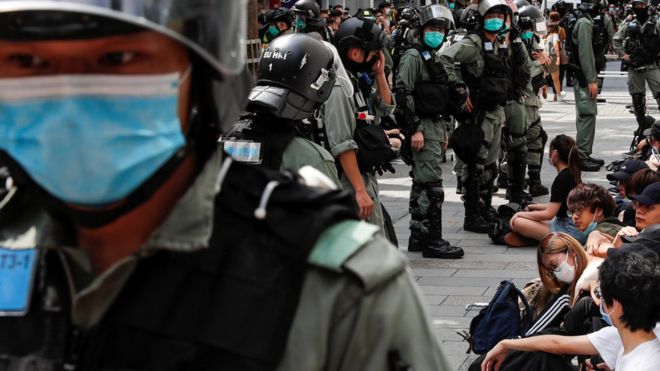 Image copyright REUTERS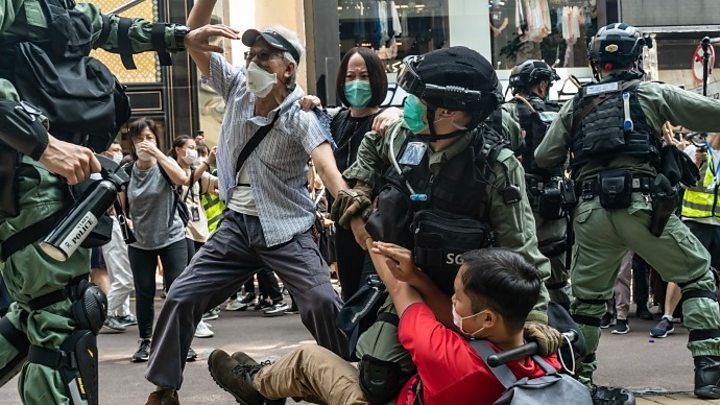
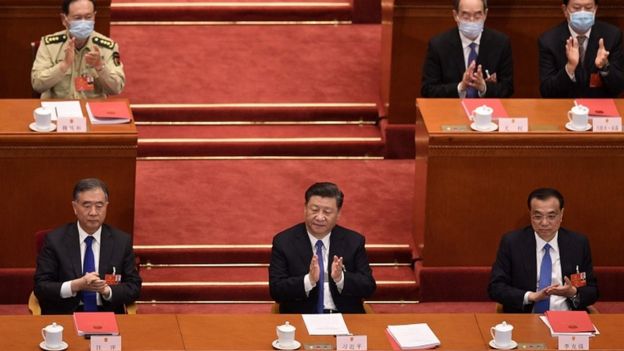 Image copyright AFP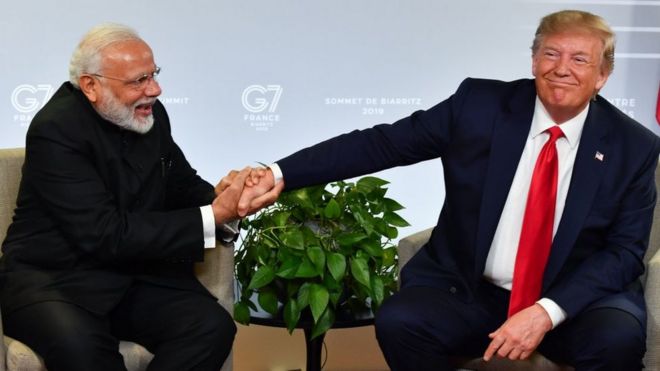




 CHINDIA ALERT: You'll be living in their world, very soon