Chindia Alert: You’ll be Living in their World Very Soon
aims to alert you to the threats and opportunities that China and India present. China and India require serious attention; case of ‘hidden dragon and crouching tiger’.
Without this attention, governments, businesses and, indeed, individuals may find themselves at a great disadvantage sooner rather than later.
The POSTs (front webpages) are mainly 'cuttings' from reliable sources, updated continuously.
The PAGEs (see Tabs, above) attempt to make the information more meaningful by putting some structure to the information we have researched and assembled since 2006.
WASHINGTON (Reuters) – U.S. Ambassador to China Terry Branstad was due to begin visiting Tibet on Sunday for official meetings and visits to religious and cultural sites, according to a news report on Sunday.
Branstad was scheduled to visit the Tibet Autonomous Region and Qinghai Province, a historic region of Tibet known to Tibetans as Amdo, from Sunday to Saturday, Radio Free Asia said in a report.
RELATED COVERAGE
U.S. Ambassador to China visiting Tibet this week
The State Department did not immediately comment on the story.
Radio Free Asia said it would be the first visit to Tibet by a U.S. official since the U.S. Congress approved a law in December that requires the United States to deny visas to Chinese officials in charge of implementing policies that restrict access to Tibet for foreigners. The U.S. government is required to begin denying visas by the end of this year.
In December, China denounced the United States for passing the law, saying it was “resolutely opposed” to the U.S. legislation on what China considers an internal affair, and it risked causing “serious harm” to their relations.
Since then, tensions have been running high between the two countries over trade. China struck a more aggressive tone in its trade war with the United States on Friday, suggesting a resumption of talks between the world’s two largest economies would be meaningless unless Washington changed course.
On Saturday, China’s senior diplomat Wang Yi told U.S. Secretary of State Mike Pompeo that recent U.S. words and actions had harmed the interests of China and its enterprises, and that Washington should show restraint.
While the Trump administration has taken a tough stance towards China on trade and highlighted security rivalry with Beijing, the administration has so far not acted on congressional calls for it to impose sanctions on China’s former Communist Party chief in Tibet, Chen Quanguo, for the treatment of minority Muslims in Xinjiang province, where he is currently party chief.
A State Department report in March said Chen had replicated in Xinjiang, policies similar to those credited with reducing opposition to Chinese rule in Tibet.
Beijing sent troops into remote, mountainous Tibet in 1950 in what it officially terms a peaceful liberation and has ruled there with an iron fist ever since.
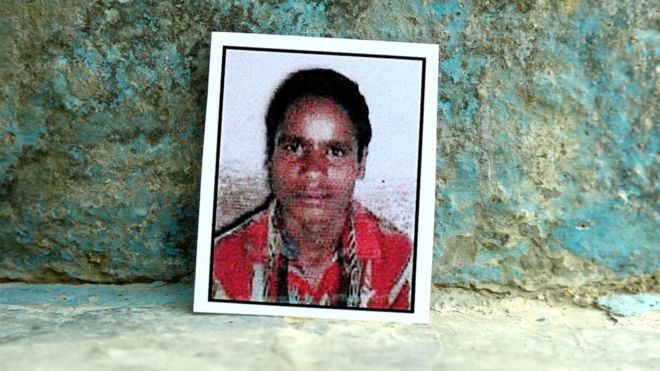
Image caption Jitendra was a carpenter and the only breadwinner in his family
A helpless anger pervades the Dalit community in the remote Indian village of Kot.
Last month, a group of upper-caste men allegedly beat up a 21-year-old Dalit resident, named Jitendra, so badly that he died nine days later.
His alleged crime: he sat on a chair and ate in their presence at a wedding.
Not even one of the hundreds of guests who attended the wedding celebration – also of a young Dalit man – will go on record to describe what happened to Jitendra on 26 April.
Afraid of a backlash, they will only admit to being at a large ground where the wedding feast was being held.
Only the police have publicly said what happened.
The wedding food had been cooked by upper-caste residents because many people in remote regions don’t touch any food prepared by Dalits, who are the bottom of the rigid Hindu caste hierarchy.
“The scuffle happened when food was being served. The controversy erupted over who was sitting on the chair,” police officer Ashok Kumar said.
The incident has been registered under the Scheduled Castes and Scheduled Tribes (Prevention of Atrocities Act) – a law meant to protect historically oppressed communities.
It is still common to see reports of Dalits being threatened, beaten and killed for seemingly mundane reasons.
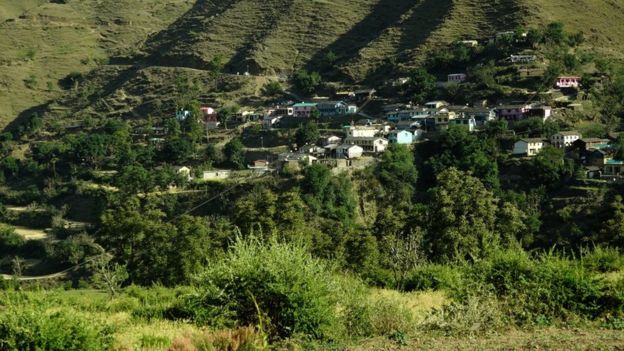
The culture that pervades their community is visible everywhere – including in Kot, which is in the hilly northern state of Uttarakhand.
Local residents from the Dalit community allege that Jitendra was beaten and humiliated at the wedding.
They say he left the event in tears, but was ambushed again a short distance away and attacked again – this time more brutally.
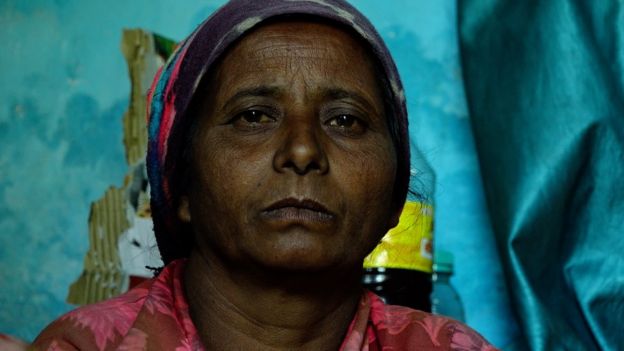
Jitendra’s mother, Geeta Devi, found him injured outside their dilapidated house early the next morning.
“He had been perhaps lying there the entire night,” she said, pointing to where she found him. “He had bruises and injury marks all over his body. He tried to speak but couldn’t.”
Image caption Dalits are outnumbered by upper-caste families in the village
She does not know who left her son outside their home. He died nine days later in hospital.
Jitendra’s death is a double tragedy for his mother – nearly five years ago her husband also died.
This meant that Jitendra, who was a carpenter, became the family’s only breadwinner and had to drop out of school to start working.
Family and friends describe him as a private man who spoke very little.
Loved ones have been demanding justice for his death, but have found little support among the community.
“There is fear. The family lives in a remote area. They have no land and are financially fragile,” Dalit activist Jabar Singh Verma said. “In surrounding villages too, the Dalits are outnumbered by families from higher castes.”
Of the 50 families in Jitendra’s village, only some 12 or 13 are Dalits.
Dalits comprise almost 19% of Uttarakhand’s population and the state has a history of atrocities committed against them.
Police have arrested seven men in connection with Jitendra’s death, but all of them deny any involvement.
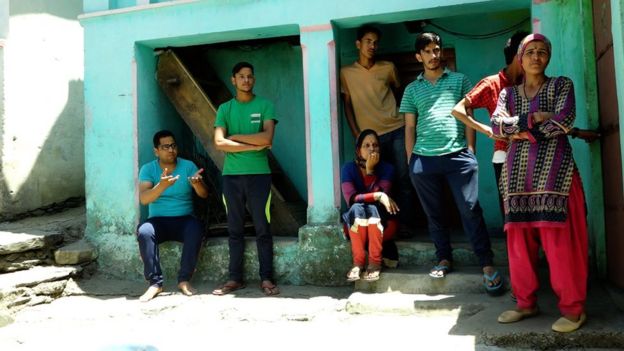
Image caption Upper-caste villagers deny discriminating against the Dalit community
“It’s a conspiracy against our family,” said a woman whose father, uncles and brothers are among the accused. “Why would my father use caste slurs at a Dalit’s marriage?”
“He must have been embarrassed that he got beaten and popped dozens of pills that led to his death,” another local upper-caste person said.
But the Dalits in the village, who are livid over Jitendra’s death, hotly deny these claims.
They say Jitendra suffered from epilepsy, but insist there is no chance that he overdosed on his medication.
Apart from these expressions of anger, local Dalit families have largely remained silent.
“It is because they are economically dependent on families from the higher castes,” activist Daulat Kunwar said.
“Most Dalits are landless. They work the fields of their wealthy upper caste neighbours. They know the consequences of speaking out loud.”
Jitendra’s family has already experienced some of these consequences – Geeta Devi says they are under pressure to stop pushing for the truth.
“Some men came over to our house and tried to scare us,” she said. “There is no one to support us but I will never give up our quest for justice.”
NEW DELHI (Reuters) – India’s ruling Bharatiya Janata Party (BJP) is preparing to meet coalition partners to discuss a new government, two BJP sources said on Monday, after exit polls predicted a better-than-expected result for it in a general election.
The talks would most likely be held on Tuesday afternoon, the two sources in the BJP said. They declined to be identified as they are not authorised to speak about the meeting.
Nalin Kohli, a spokesman for the BJP, declined to comment.
India’s seven-phase general election, billed as the world’s biggest democratic exercise, began on April 11 and ended on Sunday. Votes will be counted on Thursday and results are likely the same day.
Prime Minister Narendra Modi’s BJP-led National Democratic Alliance is projected to win anything between 339-365 seats in the 545-member lower house of parliament with the Congress-led opposition alliance getting only 77 to 108, an exit poll from India Today Axis showed on Sunday.
A party needs 272 seats to command a majority.
Indian stock markets and the rupee were sharply higher on expectation the business-friendly Modi would stay on at the helm.
The benchmark NSE share index was up 2.8%, its best single day since March 2016.
“I expect another 2-3% rally in the market in the next three to four days based on the cue,” said Samrat Dasgupta, a fund manager at Esquire Capital Investment Advisors.
Congress spokesman Sanjay Jha cast doubt on the exit polls, saying on Twitter he believed they were wrong.
“If the exit poll figures are true then my dog is a nuclear scientist,” Jha said, adding he expected the next prime minister would come from outside the BJP alliance.
Modi and his BJP faced criticism in the run-up to the election over unemployment, in particular for failing to provide opportunities to young people coming onto the job market, and for weak farm prices.
But Modi rallied his Hindu nationalist base and made national security a central theme of the campaign after a surge in tension with Pakistan in February following a suicide bomb attack in Indian-controlled Kashmir by Pakistan based militants.
Modi ordered air strikes on a suspected militant camp in Pakistan, which led to a surge in tension between the nuclear-armed neighbours.
But many Indians applauded Modi’s tough stand and he was able to attack the opposition for being soft on security.
Ram Madhav, a senior leader in the BJP, told Reuters partner ANI the results would be even better for the party than the exit polls were suggesting, particularly in West Bengal state.
West Bengal has the third largest number of members of parliament and has been hotly contested between the BJP and the Trinamool Congress, one of the most powerful parties in the coalition trying to unseat Modi.
“Bengal will surprise all the pollsters, we are hoping to do extremely well there,” Madhav said. “Everyone has seen the tremendous support for PM Modi and the BJP in Bengal.”
BEIJING, May 19 (Xinhua) — China has allocated 47 billion yuan (6.8 billion U.S. dollars) for building 1,390 county-level hospitals since 2016, in a bid to ensure that every county and urban district has at least one county-level hospital, Health News reported.
This is part of the country’s efforts to narrow the gap in health services between urban and rural areas.
Traditional Chinese service centers have been set up in more than 30,000 health centers in towns, townships and communities, according to the newspaper.
The standard for the per capita basic public health service subsidy has raised from 25 yuan in 2011 to 55 yuan in 2018, and the number of free services provided by the national basic public health service program has been increasing over the period.
The health inequality index rated by urban and rural residents dropped by 32.5 percent from 2006 to 2016, according to the newspaper.
“The achievement is attributed to the national reforms in the medical and health care system aiming to ensure every citizen has the access to basic health services,” Miao Yanqing, a researcher with the health development research center under the National Health Commission, was quoted as saying.
Ma Zhaoxu (C, front), China’s permanent representative to the United Nations (UN), hosts a briefing on the U.S.-China trade relations at the UN headquarters in New York, May 17, 2019. Cooperation is the only right choice for China and the United States, said Ma Zhaoxu on Friday. (Xinhua/Ma Jianguo)
UNITED NATIONS, May 18 (Xinhua) — Cooperation is the only right choice for China and the United States, said China’s Permanent Representative to the United Nations (UN) Ma Zhaoxu on Friday.
The economic and trade relations between China and the United States are the “ballast” and “propeller” of this important bilateral relationship, said the Chinese envoy when hosting a briefing on the U.S.-China trade relations at the UN headquarters in New York, adding that it is not only about U.S.-China bilateral relations but also world peace and prosperity.
Representatives from more than 100 UN member states and international agencies attended the meeting.
Referring to the consultations between the two countries since the United States unilaterally provoked the frictions in March 2018, Ma said that China will resolutely defend its core interests and will never give in on major issues of principle.
China strongly opposes the U.S. practice of imposing additional tariffs, said the Chinese envoy, while expressing the hope that the United States and China could work together, meet each other in the halfway, address each other’s concern based on mutual respect and equality, and strive for a mutually beneficial agreement.
“The agreement between the two sides must be equal-footed and mutually beneficial,” he said, noting that China’s three core concerns — remove all the additional tariffs, work out a realistic amount of purchases, and improve the balance of the wording of the text — must be addressed.
The Chinese economy has maintained steady growth and has shown positive momentum, Ma told the audience. “The trade protectionist measures of the United States will have an impact on the Chinese economy, but it can be overcome.”
“The Chinese economy is a sea, not a small pond,” he added. “We will continue to promote reform and opening up according to our own pace, and promote high-quality development of the economy according to our own timetable and road map, to realize the long-term stability and growth of the Chinese economy.”
According to Ma, paying mutual respect to each other’s core concerns, and making mutual concessions on the basis of mutual respect, equality and mutual benefit are the premises of expanding cooperation, and only in such a way, the trade issues between the two sides could be resolved.
Li Zhanshu, chairman of the Standing Committee of the National People’s Congress (NPC), meets with Norwegian King Harald V in Oslo, Norway, May 16, 2019. China’s top legislator Li Zhanshu paid an official friendly visit to Norway from May 15 to 18, expecting to promote the development of Sino-Norwegian ties to score more progress. (Xinhua/Huang Jingwen)
OSLO, May 18 (Xinhua) — China’s top legislator Li Zhanshu paid an official friendly visit to Norway from May 15 to 18, expecting to promote the development of Sino-Norwegian ties to score more progress.
During the stay in Norway, Li, chairman of the Standing Committee of the National People’s Congress (NPC), met with Norwegian King Harald V, Norwegian Prime Minister Erna Solberg and President of the Norwegian parliament Storting Tone Wilhelmsen Troen.
When meeting with Norwegian King Harald V, Li conveyed the greetings of Chinese President Xi Jinping to the King, and expressed congratulations on the Norwegian National Day, which falls on May 17.
Li said during the King’s successful visit to China last year, the two heads of state made strategic plans for the development of bilateral relations in the new era. As this year marks the 65th anniversary of the establishment of diplomatic relations between China and Norway, the two sides are expected to seize the opportunity to cement friendship and expand cooperation on the basis of mutual respect and treating each other equally, so as to realize better development of bilateral relations.
Harald V expressed gratitude to China’s friendliness to the Norwegian side, saying Norway admires China’s tremendous development achievements. He said Norway is ready to strengthen cooperation with China in such fields as winter sports, and will make efforts to help China successfully host the 2022 Beijing Winter Olympics.
When meeting with Solberg, Li said although Sino-Norwegian relations have experienced ups and downs, friendship and cooperation has always been the main theme of the ties. As both countries share common interests on safeguarding current global mechanism, building an open world economy, the two sides should jointly support multilateralism and free trade. Moreover, the two countries have similar development concepts and share strong economic complementarities, so the outlook of bilateral cooperation is very broad.
Norway is welcome to actively participate in the construction of the Belt and Road Initiative. And bilateral cooperation on economy, trade, environmental protection, science and technology, people-to-people exchanges and tourism is expected to be forged ahead, said China’s top legislator.
“China hopes the Norwegian side provides a fair, just and non-discriminatory business environment for Chinese enterprises’ investment and operation in Norway,” said Li.
Solberg said bilateral cooperation has maintained sound momentum since the normalization of bilateral ties, expecting the two sides to push forward talks on inking a free trade deal and deepen cooperation in such areas as maritime affairs, shipping, fishery and environmental protection. She also voiced the will to advance communication and collaboration with China on issues concerning the United Nations, coping with the climate change and Arctic affairs.
When respectively meeting with Troen and members of the parliament’s standing committee on foreign affairs and defense, Li introduced China’s development path and political system.
“The reasons why China continues to make new development achievements are that we have embarked on a development path that suits our national conditions. This is the path of socialism with Chinese characteristics,” said Li, stressing that the Chinese people will unswervingly follow this path.
He said that the NPC of China is willing to work with the Norwegian parliament to implement the important consensus reached by the leaders of the two countries, strengthen friendly exchanges at all levels, enhance understanding and trust through frank dialogues, and create a favorable environment for pragmatic cooperation.
Troen said that this visit is of great significance as Li’s tour marks the first visit of a Chinese leader since the normalization of bilateral relations in 2016. The Norwegian parliament is willing to carry out all-round exchanges and cooperation with the NPC of China, and make positive contributions to the development of state-to-state ties.
The two legislators also exchanged views on jointly safeguarding multilateral trade system, sustainable development and other issues of common concerns.
On May 16, Li attended the economic and trade conference in commemoration of the 65th anniversary of Norway-China diplomatic relations. He said in a speech that President Xi’s proposal of the high-quality development of jointly building the Belt and Road and the policy of China’s further expansion of opening up have provided new opportunities for the common development of all countries. The two countries’ enterprises are expected to seize the opportunity, tap cooperation potentials, so as to translate the desire for strong cooperation into more practical results.
During the tour, Li visited the Chinese skiers who were training in Norway and encouraged them to train hard and carry out bilateral friendship.
He also visited a local ecological agriculture project, an oil gas processing plant, and met with local officials in Norway’s southwestern county of Rogaland and its southern city of Stavanger.
Norway is the first lag of Li’s ten-day tour in Europe, which will also take him to Austria and Hungary.
Experts win reprieve for two out of three heritage houses but fear their success is only temporary
Authorities plan public cultural facilities for the site
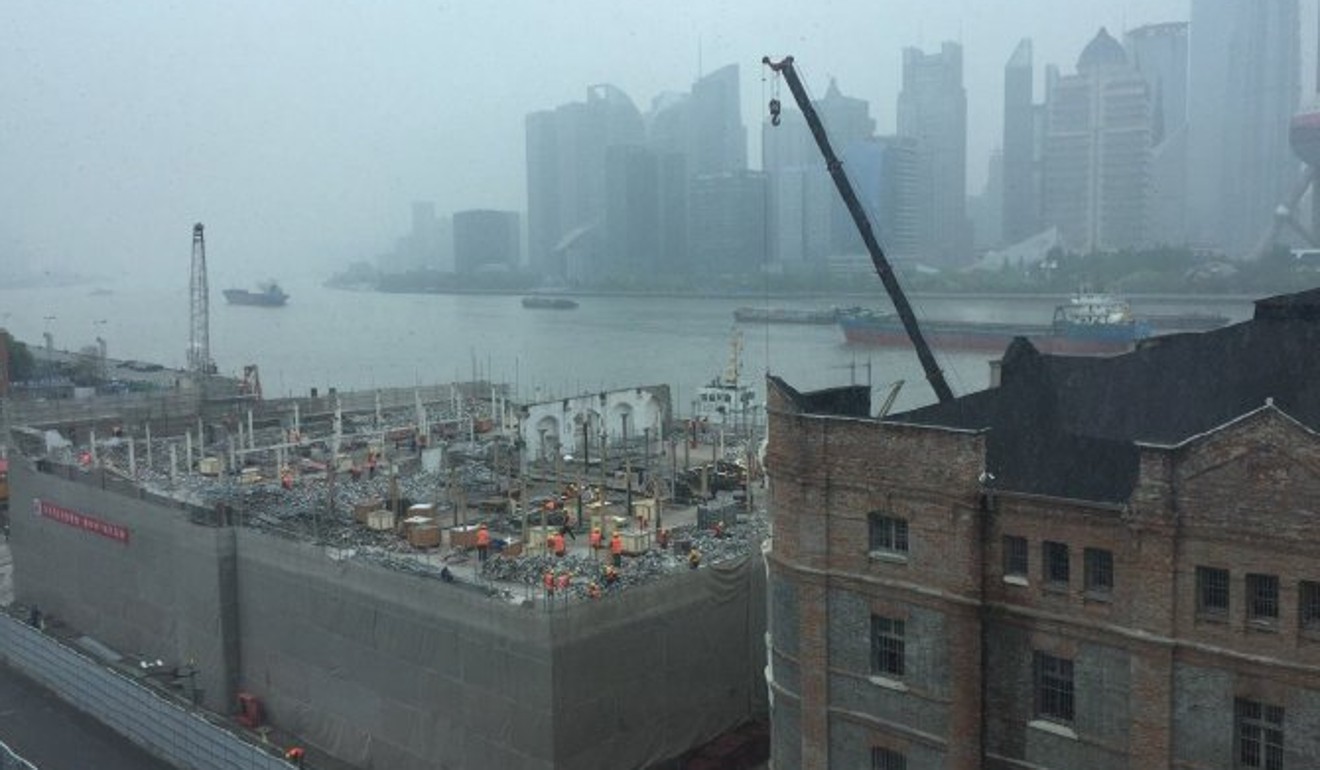
The historic buildings on Shanghai’s Bund in the 1930s. One of the three structures has already been demolished but authorities have temporarily suspended plans to knock down the other two. Photo: Handout
Two historic buildings on Shanghai’s famous Bund have temporarily escaped demolition after a group of experts appealed to the government to conserve the heritage sites, but the intervention was too late to save a third.
About 15 architecture, history and culture experts based in Shanghai banded together to write an article on social media app WeChat last month, calling on the city’s government to “protect the city’s memories” by preserving three houses on Huangpu Road.
A few days after the article was published one of the buildings was demolished as part of a plan to build public cultural facilities on the site. But authorities suspended work on the other two and are considering removing only the interior structure while preserving the external walls, according to the group.
The houses, which date back to 1902, witnessed the city’s boom in the first half of the 20th century when it became one of the world’s most important, and famous, ports, the experts said.
The demolition project on The Bund, Shanghai has been suspended, but not before one of the three historic buildings was demolished. Photo: Urban China magazine
All three of the properties originally belonged to Japanese shipping company Nippon Yusen Kaisha Group and were later used as storage facilities for Japan’s military forces during the second world war, according to Yu Hai, a sociologist from Shanghai’s Fudan University.
“These buildings, along with the nearby Yangzijiang port on the Huangpu River, represented Shanghai’s wharf culture and port culture,” Yu said. “They are historically significant as they witnessed Shanghai grow prosperous through shipping and trade industries about a century ago.”
Although the two remaining buildings are safe for now, the experts argue their interiors are also worth preserving.
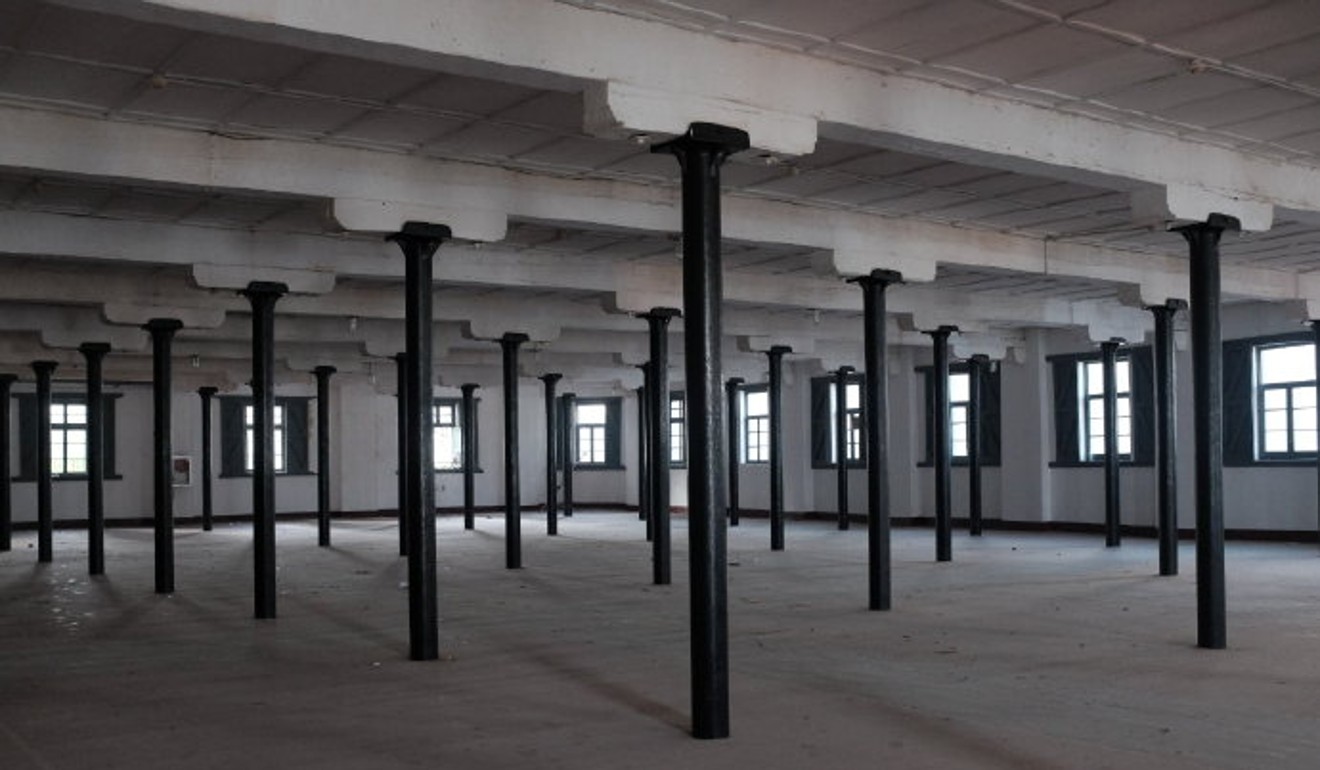
Liu Gang, an architecture professor at Shanghai’s Tongji University, said the properties featured big wooden beams supported by black iron pillars, which were prominent architectural features of industrial buildings dating back to the 19th century.
“We guess it was hard to move these giant beams with vehicles at the beginning of the 20th century. Quite possibly they were transported on the river. We guess that the wood was chopped down and processed in places across the Pacific [from North America] and shipped to Shanghai.”
In the WeChat article, Liu called for the protection of the interior structure of the buildings. “Without solid research, we cannot simply take them down to be replaced by new ones.”
Yu agreed, saying: “The building with a new inside structure would be a fake and this plan will destroy historical heritage.”
Experts say the interiors of the historic buildings are also worth preserving. Photo: Urban China magazine
Huangpu Road, where these houses sit, is rich with history. It features the Garden Bridge of Shanghai – the city’s first steel bridge, built in 1907 – and was once home to the consulates of the United States, Russia, Japan, Germany, Denmark and the Austro-Hungarian empire.
Other notable landmarks on the road include the Astor House Hotel, built in 1846, where Charlie Chaplin, Albert Einstein and George Bernard Shaw stayed in the 1920s and 1930s. The hotel is still there.
“History happened here,” Yu said. “But it’s a pity that most of the old buildings in this area no longer exist.”
Despite their success in winning a stay of execution for the two buildings, the experts are cautious in their expectations.
“The demolition work was suspended, but that does not mean they have accepted our proposals. We are not optimistic,” Yu said.
About two weeks ago as part of their effort to save the buildings, Yu and three other scholars approached officials from Shanghai’s Planning and Natural Resources Bureau, the government body behind the demolition project.
“Officials emphasised the difficulties of keeping the completeness of the old buildings and we just pointed out the damage to their historical values,” Yu said.
The Shanghai bureau did not immediately reply to a request for comment.
Shanghai nightclub king opens new art space – in disused oil tanks
Appeals by the public to conserve historical buildings have generally not been successful. Shenyuli, a typical Shanghai residential community built in the 1930s, was included in the city’s protected list of historical buildings in 2004.
The listing was not enough to prevent its demolition eight years later to make way for a public green land space.
Three years ago, the Shanghai government announced it was suspending the planned demolition of a former sex slavery station used by Japanese soldiers during the second world war, following media reports and a public outcry.
However, the building was later demolished, according to Su Zhiliang, history professor from Shanghai Normal University and a researcher on sex slavery, who predicts a similar outcome for this latest conservation effort.
“I think the government is just using the same tactic to postpone their plan. After the public’s attention is over, they will continue demolishing,” Su said.
US paper mills are expanding capacity to take advantage of a glut of cheap waste materials
Some facilities that previously exported plastic or metal to China have retooled so they can process it themselves
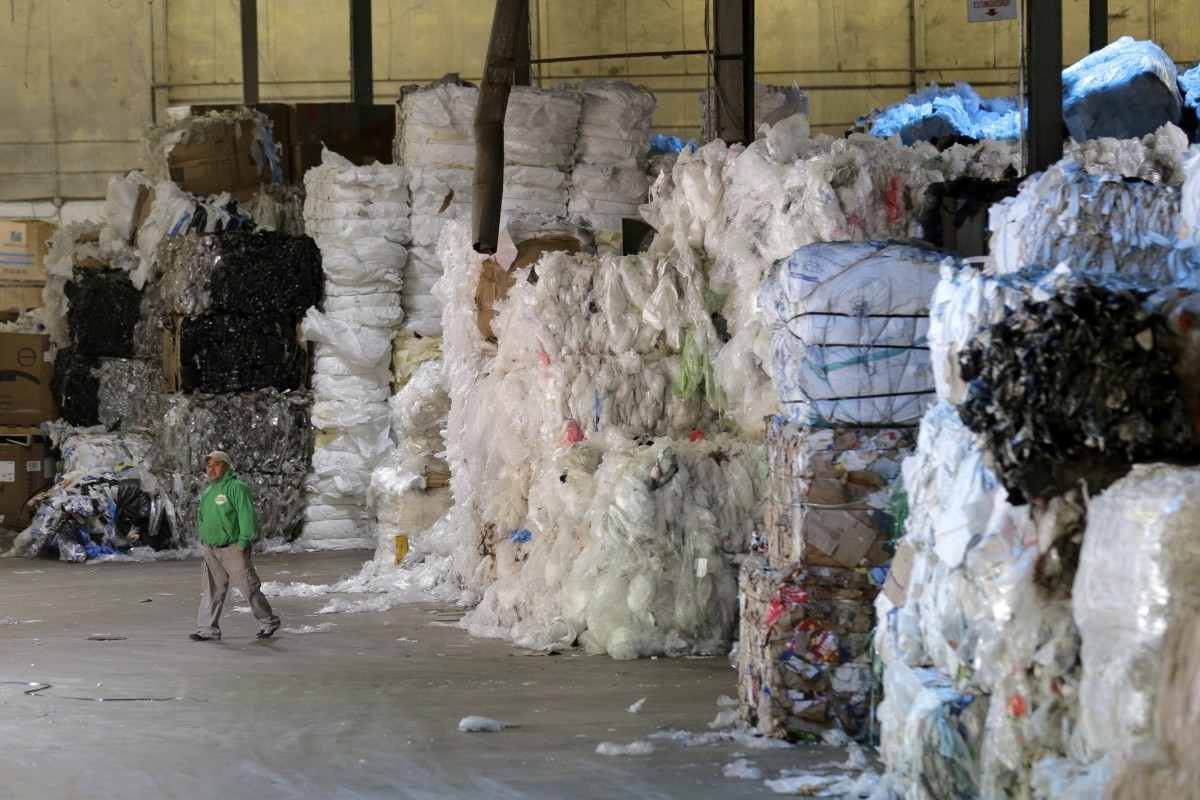
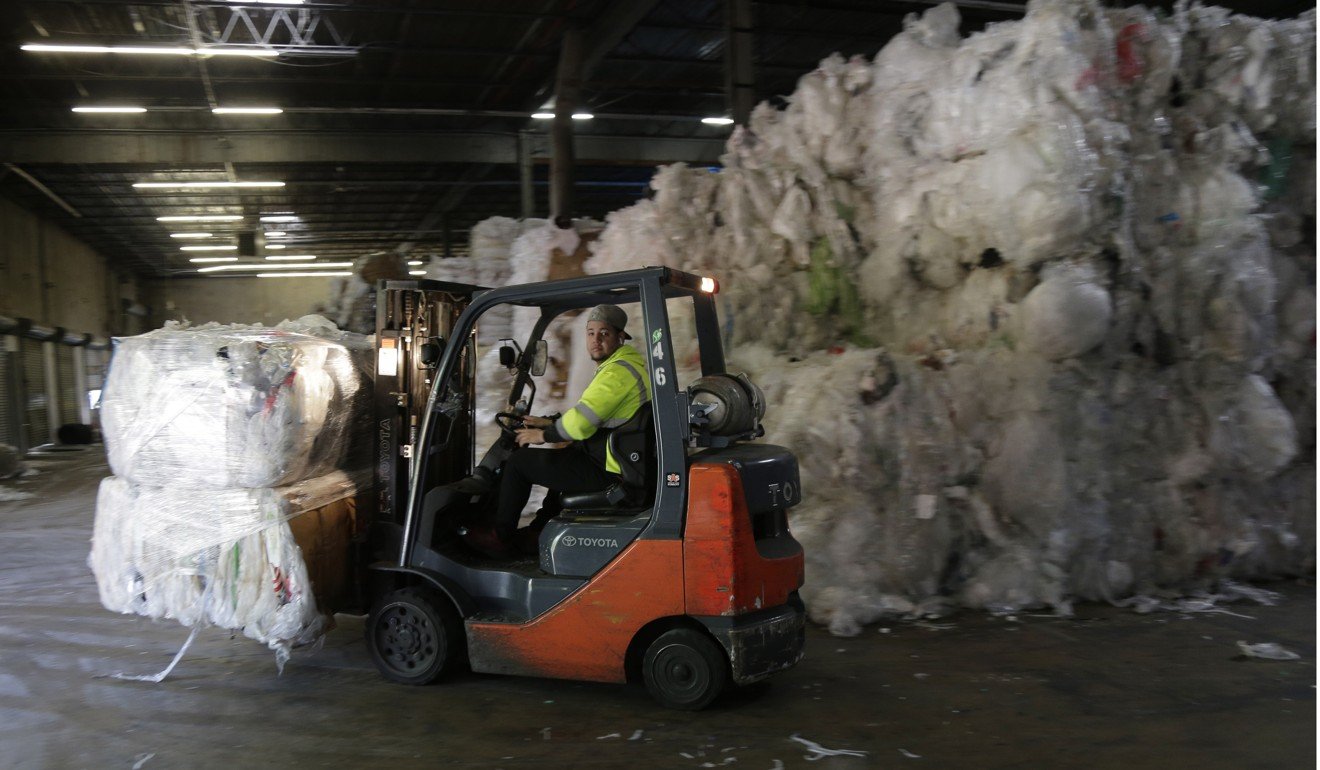
China phased in import restrictions on scrap paper and plastics in January last year. Photo: AP
The halt on China’s imports of waste paper and plastic that has disrupted US recycling programmes has also spurred investment in American plants that process recyclables.
US paper mills are expanding capacity to take advantage of a glut of cheap scrap. Some facilities that previously exported plastic or metal to China have retooled so they can process it themselves.
And in a twist, the investors include Chinese companies that are still interested in having access to waste paper or flattened bottles as raw material for manufacturing.
“It’s a very good moment for recycling in the United States,” said Neil Seldman, co-founder of the Institute for Local Self-Reliance, a Washington-based organisation that helps cities improve recycling programmes.
Global scrap prices plummeted in the wake of China’s ban. Photo: AP
China, which had long been the world’s largest destination for paper, plastic and other recyclables, phased in import restrictions in January last year.
Global scrap prices plummeted, prompting waste-hauling companies to pass the cost of sorting and baling recyclables on to municipalities. With no market for the waste paper and plastic in their blue bins, some communities scaled back or suspended kerbside recycling programmes. But new domestic markets offer a glimmer of hope.
How China’s ban on plastic waste imports became an ‘earthquake’
About US$1 billion in investment in US paper processing plants has been announced in the past six months, according to Dylan de Thomas, a vice-president at The Recycling Partnership, a non-profit organisation that tracks and works with the industry.
Hong Kong-based Nine Dragons, one of the world’s largest producers of cardboard boxes, has invested US$500 million over the past year to buy and expand or restart production at paper mills in Maine, Wisconsin and West Virginia.
Brian Boland, vice-president of government affairs and corporate initiatives for ND Paper, Nine Dragons’ US affiliate, said that as well as making paper from wood fibre, the mills would add production lines turning more than a million tonnes of scrap into pulp to make boxes.
“The paper industry has been in contraction since the early 2000s,” he said. “To see this kind of change is frankly amazing. Even though it’s a Chinese-owned company, it’s creating US jobs and revitalising communities like Old Town, Maine, where the old mill was shuttered.”
Hong Kong-based Nine Dragons has invested US$500 million in paper mills in Maine, Wisconsin and West Virginia. Photo: Handout
:
The Northeast Recycling Council said in a report last autumn that 17 North American paper mills had announced increased capacity to handle recyclable paper since the Chinese cut-off.
Another Chinese company, Global Win Wickliffe, is reopening a closed paper mill in Kentucky. Georgia-based Pratt Industries is constructing a mill in Wapakoneta, Ohio that will turn 425,000 tonnes of recycled paper per year into shipping boxes.
Plastics also had a lot of capacity coming online, de Thomas said, noting new or expanded plants in Texas, Pennsylvania, California and North Carolina that turned recycled plastic bottles into new bottles.
Chinese companies were investing in plastic and scrap metal recycling plants in Georgia, Indiana and North Carolina to make feedstocks for manufacturers in China, he said.
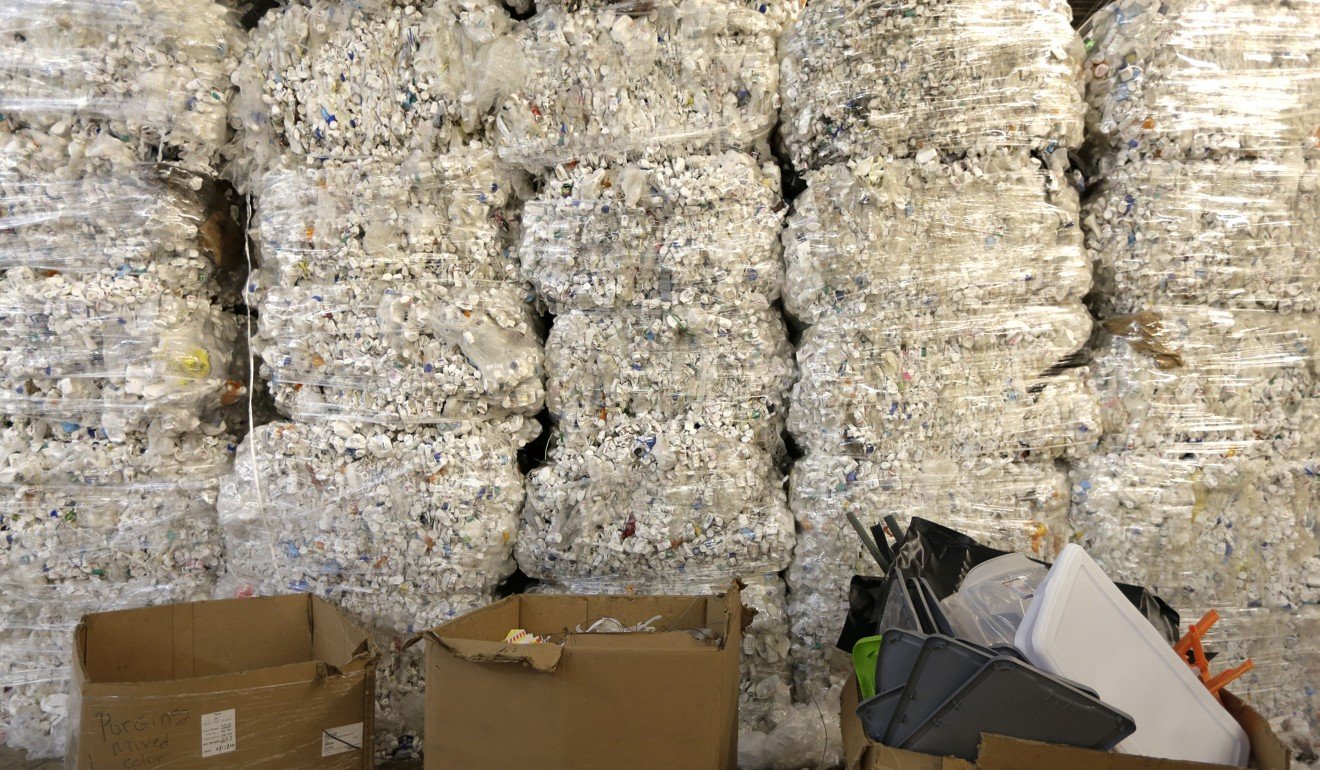
GDB International processes bales of scrap plastic film into pellets to make garbage bags and plastic pipe. Photo: AP
In New Brunswick, New Jersey, the recycling company GDB International exported bales of scrap plastic film such as pallet wrap and grocery bags for years. But when China started restricting imports, company president Sunil Bagaria installed new machinery to process it into pellets he sells profitably to manufacturers of garbage bags and plastic pipe.
The imports cut-off that China called “National Sword” was a much-needed wake-up call to his industry, he said.
“The export of plastic scrap played a big role in easing recycling in our country,” Bagaria said. “The downside is that infrastructure to do our own domestic recycling didn’t develop.”
China to suspend checks on US scrap metal shipments, halting imports
That was now changing, but he said far more domestic processing capacity would be needed as a growing number of countries restricted scrap imports.
“Ultimately, sooner or later, the society that produces plastic scrap will become responsible for recycling it,” he said.
It has also yet to be seen whether the new plants coming on line can quickly fix the problems for municipal recycling programmes that relied heavily on sales to China to get rid of piles of scrap.
About US$1 billion in investment in US paper processing plants has been announced in the past six months, according to a non-profit group that tracks the industry. Photo: AP
“Chinese companies are investing in mills, but until we see what the demand is going to be at those mills, we’re stuck in this rut,” said Ben Harvey, whose company in Westborough, Massachusetts, collects trash and recyclables for about 30 communities.
He had a car park filled with stockpiled paper a year ago after China closed its doors, but eventually found buyers in India, Korea and Indonesia.
China to collect applications for scrap metal import licences from May
Keith Ristau, chief executive of Far West Recycling in Portland, Oregon, said most of the recyclable plastic his company collected used to go to China but now most of it went to processors in Canada or California.
To meet their standards, Far West invested in better equipment and more workers at its material recovery facility to reduce contamination.
In Sarepta, Louisiana, IntegriCo Composites is turning bales of hard-to-recycle mixed plastics into railroad ties. It expanded operations in 2017 with funding from New York-based Closed Loop Partners.
“As investors in domestic recycling and circular economy infrastructure in the US, we see what China has decided to do as very positive,” said Closed Loop founder Ron Gonen.
General will spend five days meeting top Chinese leaders including President Xi Jinping
Mission seeks to patch up wounds caused by Brazilian President Jair Bolsonaro’s anti-China rhetoric
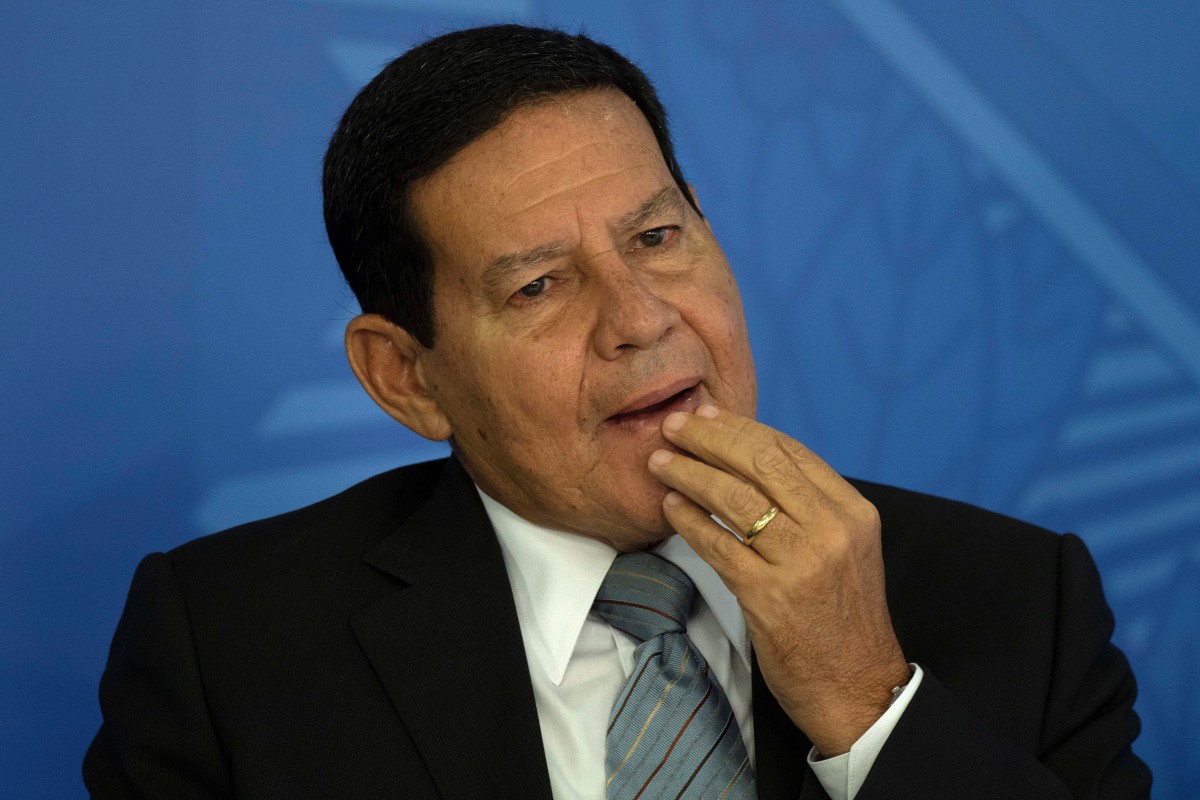
Hamilton Mourao favours maximising engagement with China. Photo: EPA-EFE
Brazil’s vice-president is expected to land in Beijing on Sunday on a mission to patch up wounds caused by President Jair Bolsonaro’s lacerating anti-China rhetoric.
General Hamilton Mourao will spend five days in China rubbing shoulders with some of the country’s most powerful leaders, culminating in an audience with President Xi Jinping, in an effort to shore up the relationship between the two emerging market giants. Bolsonaro himself is due to visit later this year, while Xi is due to visit Brasilia in November for the BRICS summit.
China – Brazil’s most important trading partner for the past decade – remains a sensitive subject in the Bolsonaro administration. While Mourao and the other business-oriented members of government favour maximising engagement with the Asian giant, Bolsonaro and his more radical appointees view China with a high degree of suspicion, as a predatory economy that wishes not merely to invest in Brazil, but to own it.
“The Chinese can buy in Brazil, but they can’t buy Brazil,” the president said at a breakfast with journalists last month.
Brazilian President Jair Bolsonaro said last month that the “Chinese can buy in Brazil, but they can’t buy Brazil”. Photo: AFP
Still, in comparison with his pre-election criticism of China as “heartless”, Bolsonaro in office has dialled down his anti-Beijing sentiment. Mourao’s visit is part of an effort to reset that relationship.
“The Chinese understand that Mourao plays a central role in toning down Bolsonaro’s rhetoric,” said Oliver Stuenkel, a specialist on BRICS – an association of five major emerging economies, namely Brazil, Russia, India, China and South Africa – at the FGV business school. “They know that the Mourao-China relationship will be fundamental.”
Should China be worried about Bolsonaro’s bromance with Trump?
Speaking to reporters recently, Mourao recognised the need to balance the Bolsonaro administration’s desire to pivot towards the United States with practical considerations of China’s economic significance.
“The US are the champions of democracy and freedom and our government has left it very clear what this represents,” the vice-president said. “But on the other side we have to be sufficiently pragmatic to understand the importance of China for Brazil’s economic development.”
Chinese investment in Brazil reached almost US$134 billion between 2003 and 2018, Brazilian government figures showed.
Chinese President Xi Jinping is expected to meet the visiting Brazilain vice-president. Photo: AP
While the trade war between the US and China may offer Brazil some short-term gains, particularly for its agricultural sector, the downsides outweigh the benefits, according to Renata Amaral, a foreign trade analyst at Barral MJorge consultancy.
“In truth this war is no good for anyone,” she said.
Mourao said that Brazil was monitoring the situation “critically and cautiously”.
Why US-China trade war could be good for Brazil
From the Chinese perspective, Beijing is looking for Brazil’s formal support for its “Belt and Road Initiative” – Chinese President Xi Jinping’s signature global infrastructure megaproject. Asked whether Brazil might sign up to the programme, Mourao said that any agreement would have to be approved by Bolsonaro in the second half of the year.
After trips to the Great Wall of China and the Shanghai Stock Exchange, Mourao will meet Xi, in a clear sign of Brazil’s importance to China. “The visit of vice-president Mourao will reinforce mutual political confidence, deepen our friendly cooperation and add new dimensions to our strategic partnership,” according to Chinese foreign ministry spokesman Geng Shuang.
With Beijing both uncertain about the direction of Brazilian foreign policy under Bolsonaro and eager to strike deals on infrastructure and food security, it makes sense for the Chinese to roll out the red-carpet for Mourao, according to Hussein Kalout, a specialist in foreign policy and a researcher at Harvard.
China trade vs economic growth: the dilemma for Brazil’s president
While the federal government remains ambivalent about its relationship with China, some of Brazil’s powerful state governors are seeking to develop their own relationship with the Asian country. One of them is Carlos Massa Ratinho Junior, the governor of the southern state of Parana, who travelled to China recently to discuss agriculture and railroad projects.
“We’re open to talk with any country that wants to and understands that the state of Parana is the best to place to invest in Brazil,” the governor said in an interview, adding that his actions did not conflict with the federal government’s stance towards Beijing.
But in a sign of the domestic pressure Bolsonaro is under not to abandon entirely his sceptical attitude to China, Luiz Philippe de Orleans e Braganca, the vice-president of the lower house’s foreign affairs committee and a lawmaker from Bolsonaro’s own party, said the government should set limits to the partnership.
“It’s good to talk to China, but it depends what is being discussed,” he said. “For example, the 5G network set up by China is dangerous because it will give the Chinese more information about Brazilian citizens than the Brazilian government.”
BEIJING (Reuters) – China’s housing regulator has urged four more cities to prevent their residential property markets from overheating in the latest sign that authorities are not about to relax their grip on the real estate business in order to spur the economy.
The cities of Suzhou, Foshan, Dalian and Nanning have been told by the Ministry of Housing and Urban-Rural Development to stabilize land and housing prices as well as market expectations, the official Xinhua news agency reported late on Saturday.
Six other cities were warned by the ministry last month to monitor the growth of home prices in their markets, after some cities, including, Foshan quietly started to relax some curbs since December to spur demand.
China’s home property market is a key plank of the economy, influencing tens of related sectors such as construction and financial services.
The sector has held up well despite a slowdown in growth in the world’s second-biggest economy, with policymakers walking a fine line between preserving stability and hurting market sentiment.
Renewed tensions between China and the United States over trade have also added pressure on Chinese policymakers to keep the domestic economy on a stable footing, while continuing to fend off risks such as housing bubbles.
Average new home prices in China’s 70 major cities rose 0.6% in April, unchanged from the pace of growth in March, according to a monthly official survey.
Most of the 70 cities surveyed by the National Bureau of Statistics still reported monthly price gains for new homes. The number increased to 67 in April from 65 in March, signaling a slight strengthening in the market.
The housing ministry reiterated that “houses are for living in, not for speculation”, according to the Xinhua news agency on Saturday.
Even before the ministry’s latest warning, the prosperous city of Suzhou, just northwest of Shanghai, had already rolled out new property curbs.
On May 11, Suzhou said it would restrict buyers of new homes in some districts from selling their property within three years.