Chindia Alert: You’ll be Living in their World Very Soon
aims to alert you to the threats and opportunities that China and India present. China and India require serious attention; case of ‘hidden dragon and crouching tiger’.
Without this attention, governments, businesses and, indeed, individuals may find themselves at a great disadvantage sooner rather than later.
The POSTs (front webpages) are mainly 'cuttings' from reliable sources, updated continuously.
The PAGEs (see Tabs, above) attempt to make the information more meaningful by putting some structure to the information we have researched and assembled since 2006.
NEW DELHI (Reuters) – Economists and investors are increasingly showing that they have little or no confidence in India’s official economic data – presenting whoever is elected as the next prime minister with an immediate problem.
There have been questions for many years about whether Indian government statistics were telling the full story but two recent controversies over revisions and delays of crucial numbers have taken those concerns to new heights.
The government itself has admitted there are deficiencies in its data collection.
A study conducted by a division of the statistics ministry in the 12 months ending June 2017 found that as much as 36 percent of the companies in the database used in India’s GDP calculations could not be traced or were wrongly classified.
But the ministry said there was no impact on GDP estimates as due care was taken to adjust corporate filings at the aggregate level.
Last December, the government held back the release of jobs data but an official report leaked to an Indian newspaper showed the unemployment rate had touched its highest level in 45 years.
Economists and investors are now voting with their feet – by using alternative sources of data and in some cases creating their own benchmarks to measure the Indian economy.
Ten economists and analysts at banks, think-tanks and foreign funds interviewed by Reuters said they were moving to use alternative data sources, or at least official data of a different kind.
Among the numbers they prefer are fast-moving indicators like car sales, air and rail cargo levels, purchasing managers’ index data, and proprietary indices created by the institutions themselves to track the economy.
Many economists said they were stunned when the government upwardly revised GDP growth for 2016/17 to 8.2 percent from 6.7 percent, although the demonetization of high value notes hit businesses and jobs in that financial year.
“Our response has been to spend time developing an Indian Activity Index, which takes a range of time series data that in the past were strongly correlated with real GDP growth and extract the common signal from them,” said Jeremy Lawson, chief economist at Aberdeen Standard Investments, which manages more than $700 billion in assets.
The preliminary evidence from the index, which includes components like car sales, air cargo and purchasing managers’ index data suggests the government has over-estimated GDP growth, he said.
Our index would suggest that there was stable growth, rather than the rapid acceleration suggested by the GDP figures,” he said, referring to three years of data from 2014.
Even those close to the government have said the lack of accuracy in the official data makes it much more likely that authorities will miss major swings in activity and be unable to react quickly to head off a crisis. It is also a problem for investors who may be misled into thinking the economy is more robust than it really is.
The economic wing of the Rashtriya Swayemsewak Sangh, the fountainhead of the ruling Hindu nationalist Bharatiya Janata Party, said the government and the Indian central bank missed anticipating a farm crisis that has now gripped the countryside, with low crop prices driving down farmers’ incomes.
“The fact is the government advisers and the monetary policy committee of the central bank could not diagnose the farm crisis, deflationary conditions in rural economy, and ignored the need to boost growth,” said Ashwani Mahajan, the co-convenor of the group, Swadeshi Jagran Manch, adding the government was now taking steps to address the problem.
The delayed response has cost Prime Minister Narendra Modi at least some support in the countryside in the current general election – although most political strategists still think he can probably hang onto power.
The opposition and other critics have said Modi suppressed jobs data and “massaged” economic growth numbers in an attempt to show that his government has done better than the previous administration.
A spokesman at Modi’s office said no official was available for comment as they were busy with the election while a finance ministry spokesman referred to Finance Minister Arun Jaitley’s previous comments.
In a blog in March, Jaitley criticized economists for doubting the credibility of data and accused them of running a fake campaign against the government.
IDLE CAPACITY
Some investors have been burned by believing in India’s high growth story.
Private power producers invested billions of dollars based on expectations of electricity demand that didn’t pan out in the rural economy. With economic growth pegged at over 8 percent a year, they had expected a pick up in demand by small businesses and household.
Many of the power producers are now facing bankruptcy and legal disputes as many of the new plants they built are working at about 60 percent of capacity.
In the real estate sector, developers said, it could take 3-4 years to clear about 500,000 unsold flats in and around New Delhi that were built on the assumption of higher income jobs in urban areas.
To be sure, the proportion of the Indian economy that is based on the unofficial sector, such as household enterprises, makes it a nightmare to assess economic activity.
P. C. Mohanan, former acting chairman of the national oversight body for statistics, who resigned to protest government interference over the release of the jobs figures and back series data on GDP, said the government hasn’t allocated the resources it needs to measure activity given the growth in the economy.
Gita Gopinath, the International Monetary Fund’s chief economist, told an Indian TV channel last month the IMF had raised the issue of “transparency” with Indian officials in data collection and, in particular, measurement of the GDP deflator – the adjusted inflation rate used to estimate real GDP.
In a statement, the statistics ministry said it was working to address the issue.
A senior official earlier said they were open to suggestions for improvement, just not “politically motivated” criticism.
There are already plans to revamp data compilation and capture the nuanced relationship between prices and real GDP, he said.
China’s Permanent Representative to the United Nations Ma Zhaoxu (Front) addresses a Security Council open debate on “Investing in Peace: Delivering Quality Training and Capacity Building to Improve Safety and Security and Performance of UN Peacekeepers” at the UN headquarters in New York, on May 7, 2019. Ma Zhaoxu said Tuesday that the international community must pay attention to the real needs of troops-contributing countries (TCCs) in peacekeeping. (Xinhua/Li Muzi)
UNITED NATIONS, May 7 (Xinhua) — A Chinese envoy said Tuesday that the international community must pay attention to the real needs of troops-contributing countries (TCCs) in peacekeeping.
“The international community must pay attention to the real needs of TCCs, in particular, those of developing countries, enhance capacity building in the area of peacekeeping and ensure the availability of targeted training and resources,” Ma Zhaoxu, China’s permanent representative to the United Nations, told the Security Council open debate on “Investing in Peace: Delivering Quality Training and Capacity Building to Improve Safety and Security and Performance of UN Peacekeepers.”
“Thorough and effective training and capacity building must be conducted to keep improving the safety, security and performance of peacekeepers,” said the Chinese ambassador.
As for the role of the Secretariat, the Chinese envoy noted that efforts must be made to “fully leverage the role of the Secretariat. The Secretariat should keep improving training policies for peacekeeping and provide updated training materials in a timely manner in light of the situation in the task areas,” said Ma.
“The Secretariat, on the basis of its own advantages, can play a coordinating role between the supply and demand in the area of capacity building for peacekeeping,” he said.
Investigation follows violent protest at Nanjing school
Students discovered nursing qualification was actually a home economics degree
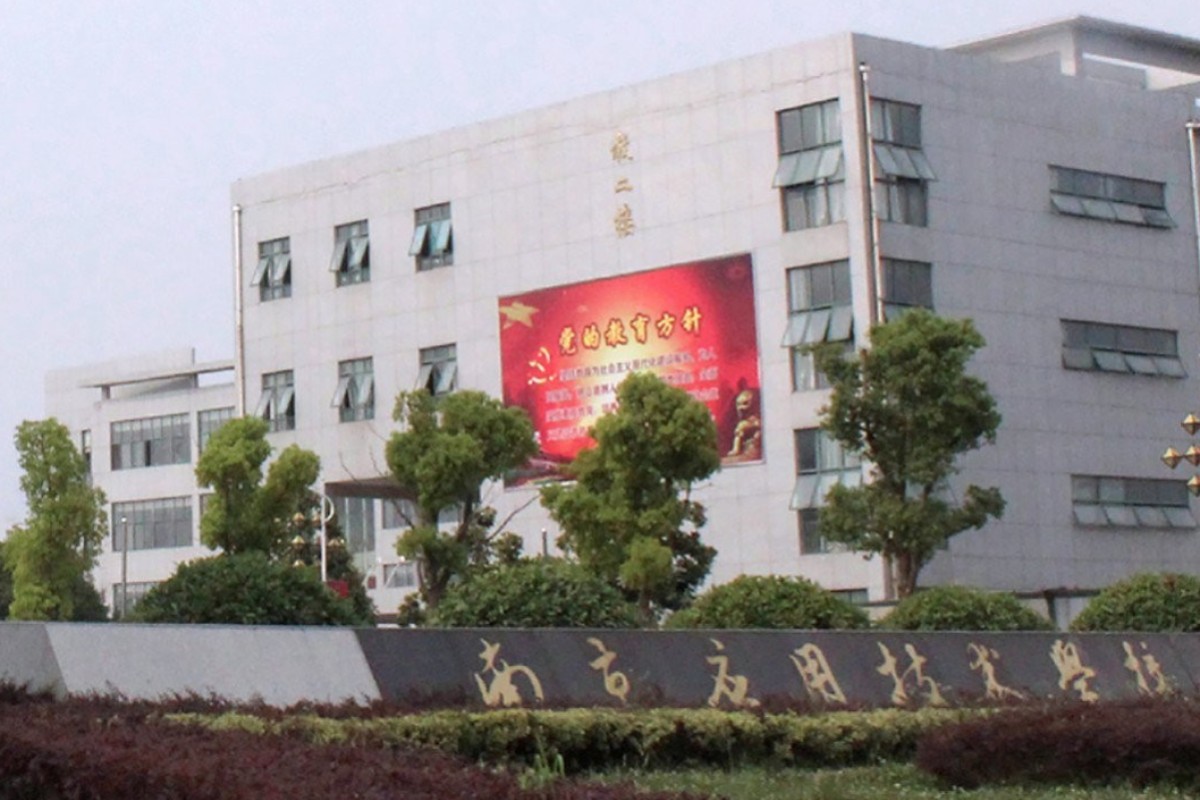
An investigation into enrolment practices at eastern China’s Nanjing Institute of Applied Technology has been widened into a country-wide check for similar frauds. Photo: Handout
A protest by technical school students over fake degrees that led to a
in eastern China last month has prompted the Ministry of Education to order local governments across the country to check for similar frauds in their regions.
Wang Jiping, director of the ministry’s vocational education department, said the authorities had been cracking down on fraudulent promotions in student enrolment – cause of the disturbance at Nanjing School of Applied Technology – for a long time.
“But some schools still irresponsibly cheated parents and students,” Wang said at a press conference on Wednesday.
“For this kind of phenomenon, our attitude is one of firmly stopping and seriously punishing.”
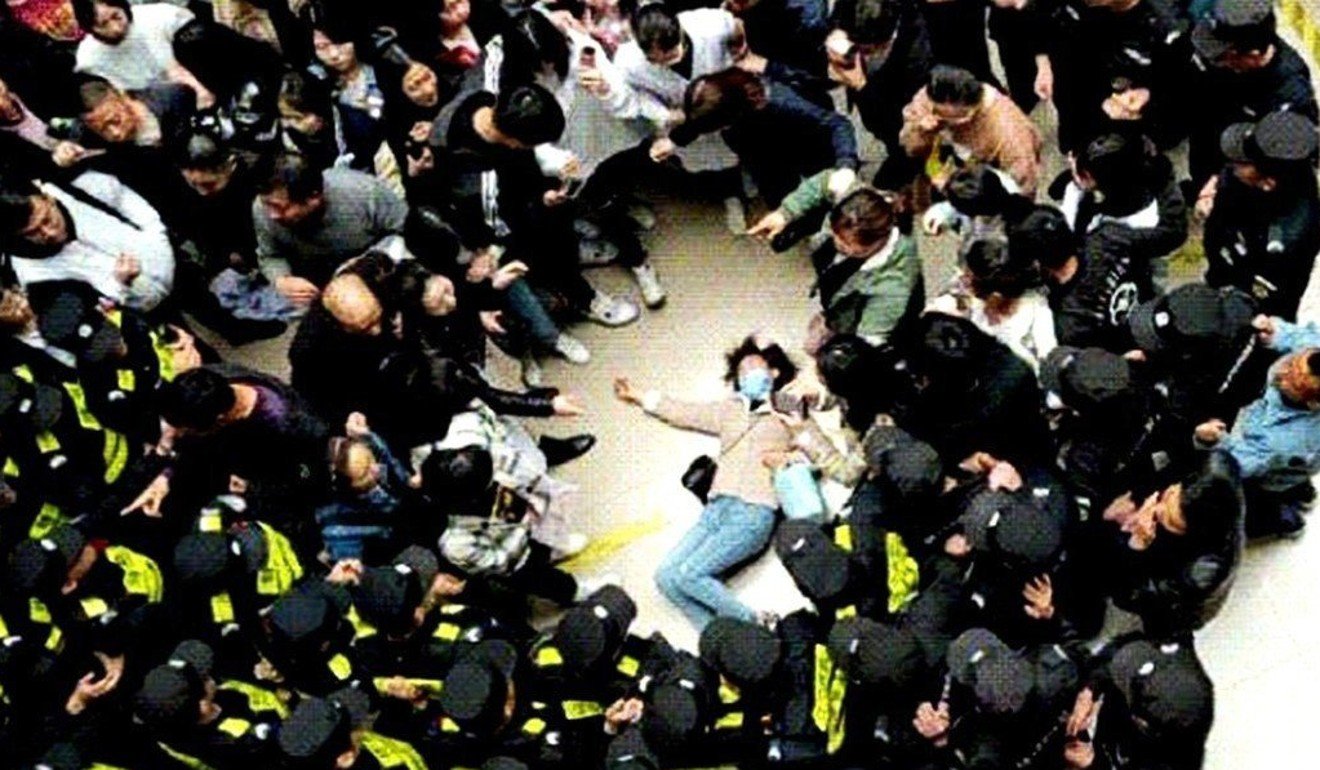
Dozens of students clashed with police and security staff at the Nanjing School of Applied Technology in eastern China last month after the discovery that their nursing course only provided a degree in home economics. Photo: Weibo
In a statement on Weibo, China’s Twitter-like microblogging service, the city government in Nanjing, capital of Jiangsu province, said on Tuesday the rally by students and parents at the school had attracted the attention of city and provincial authorities.
Investigations showed that when the school enrolled new students for its home economics major in 2016, it promised they would receive associate degrees and a nursing certificate upon graduation. The students were also guaranteed jobs.
Students about to graduate this summer were angry when they learned the school could not fulfil any of its promises.
At the end of last month, some parents started petitioning the local government. On the evening of April 26, dozens of students clashed with police and security staff, with two students sustaining leg injuries. Police took several people away for “stirring up trouble among students”, the police said on Weibo.
The city government said that, with the intervention of its education and human resources departments, 405 out of the 409 affected students had been transferred to higher level institutions, and the students and their parents had accepted that arrangement.
The investigation is continuing and school officials will be held accountable, it said.
The Nanjing government said some people had spread rumours online after the incident. The government statement said two people, both surnamed Wang, had falsely claimed a female student was beaten to death by school staff and her parents knocked unconscious by police in the incident.
The pair also claimed in their article, published on Monday, that the school’s security guards were armed during the confrontation with students.
The article went viral and the authors – one from Wuhan, Hubei province, and the other in Changsha, Hunan province, both in central China – were detained for causing trouble.
According to the government statement, they confessed to cooking up the rumour to attract online traffic and solicit rewards from readers.
They made 32,000 yuan (US$4,700) from the article.
The document was riddled with reversals by China that undermined core U.S. demands, the sources told Reuters.
In each of the seven chapters of the draft trade deal, China had deleted its commitments to change laws to resolve core complaints that caused the United States to launch a trade war: theft of U.S. intellectual property and trade secrets; forced technology transfers; competition policy; access to financial services; and currency manipulation.
U.S. President Donald Trump responded in a tweet on Sunday vowing to raise tariffs on $200 billion (153 billion pounds) worth of Chinese goods from 10 to 25 percent on Friday – timed to land in the middle of a scheduled visit by China’s Vice Premier Liu He to Washington to continue trade talks.
The stripping of binding legal language from the draft struck directly at the highest priority of U.S. Trade Representative Robert Lighthizer – who views changes to Chinese laws as essential to verifying compliance after years of what U.S. officials have called empty reform promises.
RELATED COVERAGE
Explainer – How U.S.-China talks differ from any other trade deal
Lighthizer has pushed hard for an enforcement regime more like those used for punitive economic sanctions – such as those imposed on North Korea or Iran – than a typical trade deal.
“This undermines the core architecture of the deal,” said a Washington-based source with knowledge of the talks.
“PROCESS OF NEGOTIATION”
Spokespeople for the White House, the U.S. Trade Representative and the U.S. Treasury Department did not immediately respond to requests for comment.
Chinese Foreign Ministry spokesman Geng Shuang told a briefing on Wednesday that working out disagreements over trade was a “process of negotiation” and that China was not “avoiding problems”.
Geng referred specific questions on the trade talks to the Commerce Ministry, which did not respond immediately to faxed questions from Reuters.
Lighthizer and U.S. Treasury Secretary Steven Mnuchin were taken aback at the extent of the changes in the draft. The two cabinet officials on Monday told reporters that Chinese backtracking had prompted Trump’s tariff order but did not provide details on the depth and breadth of the revisions.
Liu last week told Lighthizer and Mnuchin that they needed to trust China to fulfil its pledges through administrative and regulatory changes, two of the sources said. Both Mnuchin and Lighthizer considered that unacceptable, given China’s history of failing to fulfil reform pledges.
One private-sector source briefed on the talks said the last round of negotiations had gone very poorly because “China got greedy”.
“China reneged on a dozen things, if not more … The talks were so bad that the real surprise is that it took Trump until Sunday to blow up,” the source said.
“After 20 years of having their way with the U.S., China still appears to be miscalculating with this administration.”
FURTHER TALKS THIS WEEK
The rapid deterioration of negotiations rattled global stock markets, bonds and commodities this week. Until Sunday, markets had priced in the expectation that officials from the two countries were close to striking a deal.
Investors and analysts questioned whether Trump’s tweet was a negotiating ploy to wring more concessions from China. The sources told Reuters the extent of the setbacks in the revised text were serious and that Trump’s response was not merely a negotiating strategy.
Chinese negotiators said they couldn’t touch the laws, said one of the government sources, calling the changes “major.”
Changing any law in China requires a unique set of processes that can’t be navigated quickly, said a Chinese official familiar with the talks. The official disputed the assertion that China was backtracking on its promises, adding that U.S. demands were becoming more “harsh” and the path to a deal more “narrow” as the negotiations drag on.
Liu is set to arrive in Washington on Thursday for two days of talks that just last week were widely seen as pivotal – a possible last round before a historic trade deal. Now, U.S. officials have little hope that Liu will come bearing any offer that can get talks back on track, said two of the sources.
To avert escalation, some of the sources said, Liu would have to scrap China’s proposed text changes and agree to make new laws. China would also have to move further towards the U.S. position on other sticking points, such as demands for curbs on Chinese industrial subsidies and a streamlined approval process for genetically engineered U.S. crops.
The administration said the latest tariff escalation would take effect at 12:01 a.m. Friday (0401 GMT), hiking levees on Chinese products such as internet modems and routers, printed circuit boards, vacuum cleaners and furniture.
The Chinese reversal may give China hawks in the Trump administration, including Lighthizer, an opening to take a harder stance.
Mnuchin – who has been more open to a deal with improved market access, and at times clashed with Lighthizer – appeared in sync with Lighthizer in describing the changes to reporters on Monday, while still leaving open the possibility that new tariffs could be averted with a deal.
Trump’s tweets left no room for backing down, and Lighthizer made it clear that, despite continuing talks, “come Friday, there will be tariffs in place.”
BEIJING, May 7 (Xinhua) — China and Japan will hold their 11th round of high-level consultations on maritime affairs in Otaru, Japan, from May 10 to 11, a foreign ministry spokesperson said Tuesday.
Spokesperson Geng Shuang told a routine news briefing that officials from foreign ministries, defense ministries, maritime law enforcement and management departments of both counties will attend the talks.
China expects to fully exchange views with Japan on maritime issues of common concern to strengthen mutual understanding and trust with Japan, Geng said.
The China-Japan high-level consultations on maritime affairs were established in 2012. The last round of consultations was held in Wuzhen of eastern China’s Zhejiang Province last December.
XI’AN, May 7 (Xinhua) — Yan’an, a former revolutionary base of the Communist Party of China (CPC), is no longer labeled “poor,” as its last two impoverished counties have shaken off poverty, the Shaanxi provincial government announced Tuesday.
Yan’an hosted the then headquarters of the CPC and the center of the Communist revolution from 1935 to 1948. The city is now home to more than 350 sites related to the Chinese revolution.
The counties of Yanchuan and Yichuan, with a population of 192,000 and 120,000 respectively and both located along the western bank of the Yellow River, have limited fertile valley fields. Villagers there had been plagued by poverty for decades.
American journalist Edgar Snow wrote in his 1937 book “Red Star over China” that the area was “one of the poorest parts of China” he had seen.
According to the provincial poverty relief office, poverty-stricken residents in the two counties now only account for 1.06 and 0.58 percent respectively of their populations, meeting the country’s requirement for an impoverished county to shake off the title.
An investment of 6.25 billion yuan (920 million U.S. dollars) from the central and local governments has been poured into Yan’an over the past four years.
To make sure that every household can get rid of poverty, the city has sent a total of 1,784 Party chiefs, 1,546 working teams and 37,400 cadres to live in the villages to help with poverty alleviation.
A total of 693 impoverished villages in the city have shaken off poverty, with 195,000 people being lifted out of poverty.
The cradle of the revolution has continued to undergo tremendous changes over the past decades. Improved environment and infrastructure, booming agricultural economy, increasingly affordable education, healthcare, and multiple career choices for rural residents have rejuvenated the city.
Yan’an will continue to help the remaining impoverished people shake off poverty, and strive to enter a moderately prosperous society in all respects with the rest of the country by 2020, said Xu Xinrong, Party chief of the city.
Yang Jiechi (R), a member of the Political Bureau of the Communist Party of China (CPC) Central Committee and director of the Office of the Foreign Affairs Commission of the CPC Central Committee, meets with South Korean National Assembly Speaker Moon Hee-sang in Beijing, capital of China, May 6, 2019. (Xinhua/Liu Bin)
BEIJING, May 6 (Xinhua) — Yang Jiechi, a member of the Political Bureau of the Communist Party of China (CPC) Central Committee, met with Republic of Korea (ROK) National Assembly Speaker Moon Hee-sang here Monday and both sides expressed hope to strengthen bilateral cooperation.
Yang, also director of the Office of the Foreign Affairs Commission of the CPC Central Committee, said China and the ROK are close neighbors, friends and partners, and their bilateral relations enjoy a long history and also potential for future development.
The two sides should continue to deepen bilateral pragmatic cooperation, strengthen multilateral coordination, cement friendly public support, and work together to advance China-ROK relations, said Yang.
Moon Hee-sang said the ROK National Assembly stands ready to make greater efforts to deepen cooperation between the ROK and China in all areas.
The two sides also exchanged views on the Korean Peninsula issue.
Inspired by early colour television, method can create thousands of alloys quickly
Leader of Beijing team says a ‘revolution in material science’ is close to hand
Speedy development of alloys may accelerate programmes to explore the harsh environments of space and ocean depths. Photo: Xinhua
Chinese physicists say they have developed a method that can cut the time involved in the discovery of alloys from years to hours.
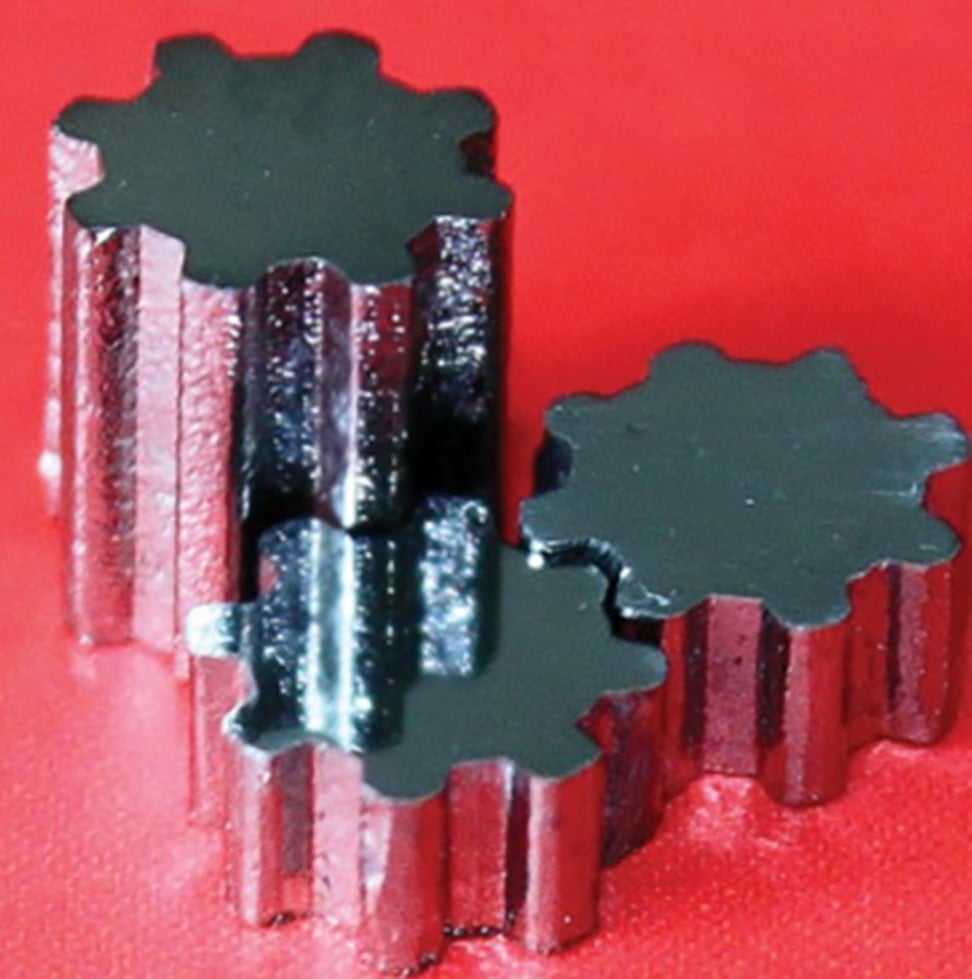
The technique has led to the creation of high performance alloys, including the world’s toughest amorphous metal, or metallic glass, for use in extremely hot environments.
The search for an alloy typically takes years, but now it can be done in less than two hours, the Chinese researchers said.
Part of their findings was published in the journal Nature this month.
Inspired by the colour gun method used to create images for television sets, the Beijing
In the conventional method, metals needed to be weighed, melted to an alloy and tested for performance. To find the right formula, researchers might need to test more than a thousand combinations and each test might take a day or two.
Professor Wang Weihua, researcher with the institute of physics at the Chinese Academy of Sciences in Beijing and lead scientist of the study, said his team’s research was inspired by early colour televisions, which used three electric devices known as guns that fired red, green and blue light onto the back of the screen to create real-world colours for the viewer.
Wang’s team’s alloy technology also involved three guns, but instead of electronic pulses they fired “bullets” made of different metals. These struck a silicon board simultaneously and fused to form alloys.
Chinese University becomes first in world to build and test its own hypersonic plane
Sensors quickly measured the alloys’ properties and picked the most appropriate for the researchers.
This approach allowed scientists to create more than 1,000 samples, test their performance and select the most promising within a couple of hours.
“We proved it works,” Wang said. “It will increase people’s confidence. There will be a revolution in material science.”
The alloy reported in the Nature paper contained iridium, nickel and tantalum. It had a distorted atomic structure similar to that of glass. Metallic glasses can be extremely strong but they usually weaken by temperatures of 400 degrees Celsius or more.
The Beijing team hopes artificial intelligence, in tandem with its technique, will start a materials revolution. Photo: Handout
The new alloy can maintain a tensile strength nearly eight times that of steel at more than 700 degrees Celsius, researchers said.
It can also remain intact for months in aqua regia, the mixture of nitric acid and hydrochloric acid that can dissolve gold and platinum.
Such properties make the alloy an ideal candidate material for manufacturing critical components for use in harsh environments such as space, ocean depths and battlefields.
“We are introducing artificial intelligence into the design and search for new amorphous metals,” Wang said. “It can further increase the speed of discoveries. In the near future, we may even be able to create material on demand.
It was close to midnight and Vlada, a Serbian engineer, was speeding towards his apartment in Belgrade. He had taken his 20-year-old son out that evening but bombs had started to fall across the Yugoslav capital. The power grid was down and he wanted to get home.
Nato, the world’s most powerful military alliance, had been pummelling Yugoslavia from the skies since late March to try to bring a halt to atrocities committed by President Slobodan Milosevic’s forces against ethnic Albanians in the province of Kosovo. It was now 7 May 1999 and the US-dominated air campaign was only growing more intense.
Vlada’s family had spent many nights in recent weeks huddled with others in the basement of their apartment building as air raid sirens blared outside, praying that an errant missile wouldn’t strike their homes.
They were lucky, some thought, to live just next to the Chinese embassy – an important diplomatic mission. Being there would surely protect them.
But as Vlada and his son approached the glass doors of their building in the dark, US B-2 stealth warplanes were in the skies above Belgrade. They were locked-on to the precise co-ordinates of a target selected and cleared by the CIA. All Vlada heard at first was the whoosh of an incoming missile. There was no time to move. The doors shattered, spraying glass at them.
“The force of the first bomb lifted us off the ground and we fell… Then one after the other [more bombs landed] – bam, bam, bam. All the shutters on the block were ripped off by the blast, it broke all the windows.”
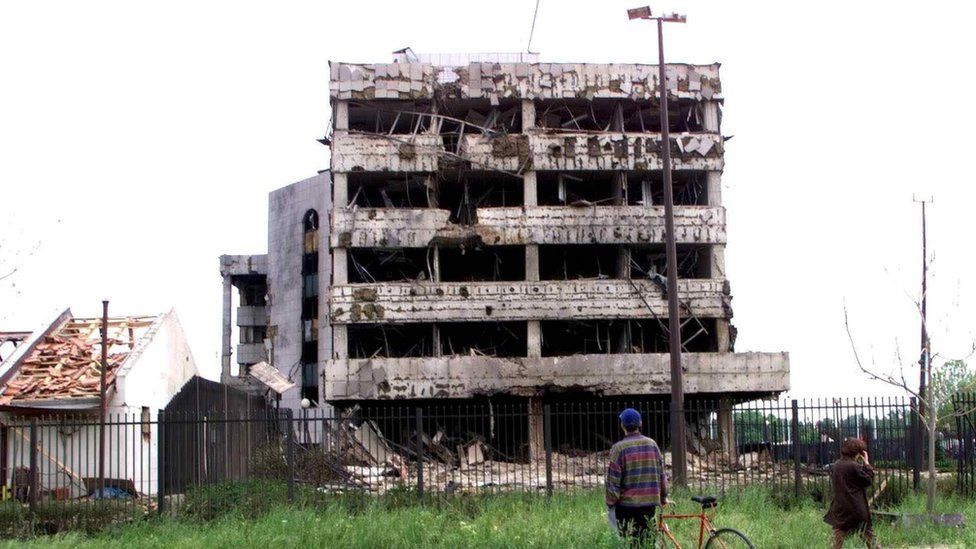
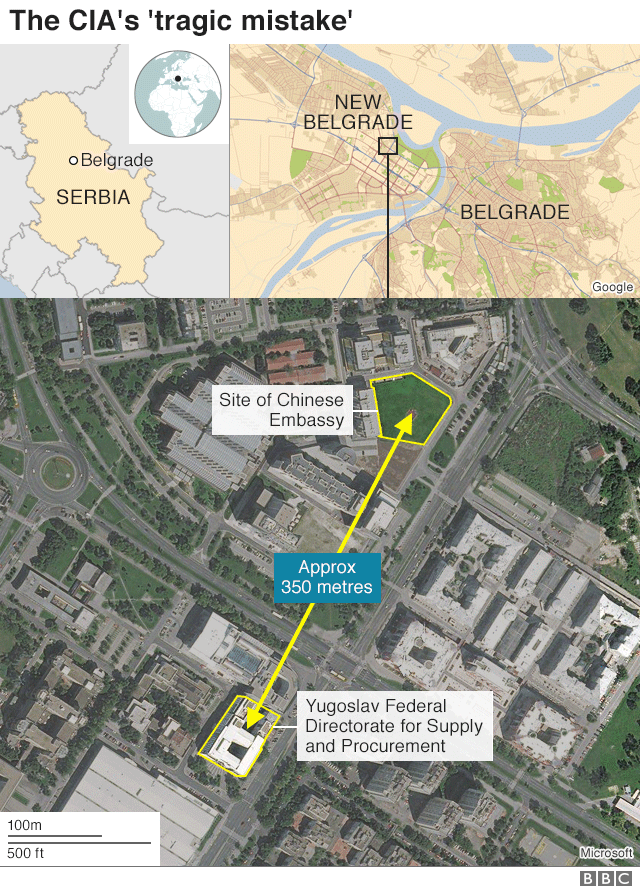
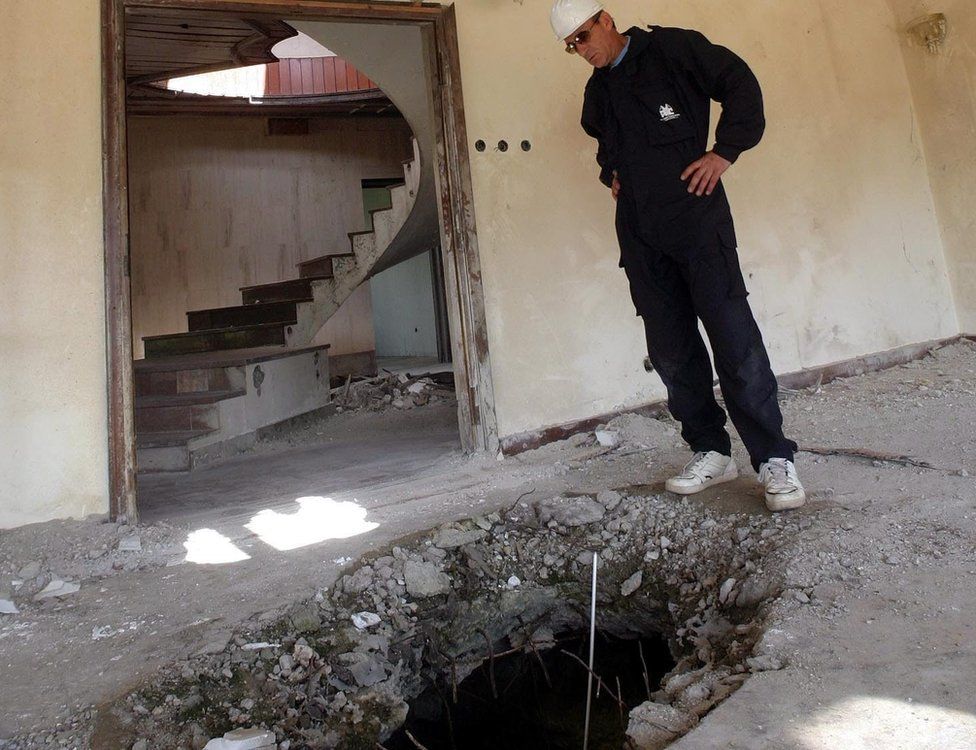
They were terrified but uninjured. All five bombs had hit the embassy, 100 metres away.
The US and Nato were already facing scrutiny over mounting civilian casualties in a bombing campaign conducted without UN authorisation and fiercely opposed by China and Russia. They had now attacked a symbol of Chinese sovereignty in the heart of the Balkans.
Image copyright SASA STANKOVIC/EPA/REX/SHUTTERSTOCKImage caption Embassy workers escaped through windows after the strikesAcross town, Shen Hong, a well-connected Chinese businessman, was getting word that the embassy had been hit. He refused to believe it. Just a few days earlier, his father had phoned from Shanghai and joked that his son should park his new Mercedes at the diplomatic compound to keep it safe.
“I called a policeman who I knew and he said, ‘Yes, Shen, it’s really hit’. He said come right away, so then I knew it was real, it was true.”
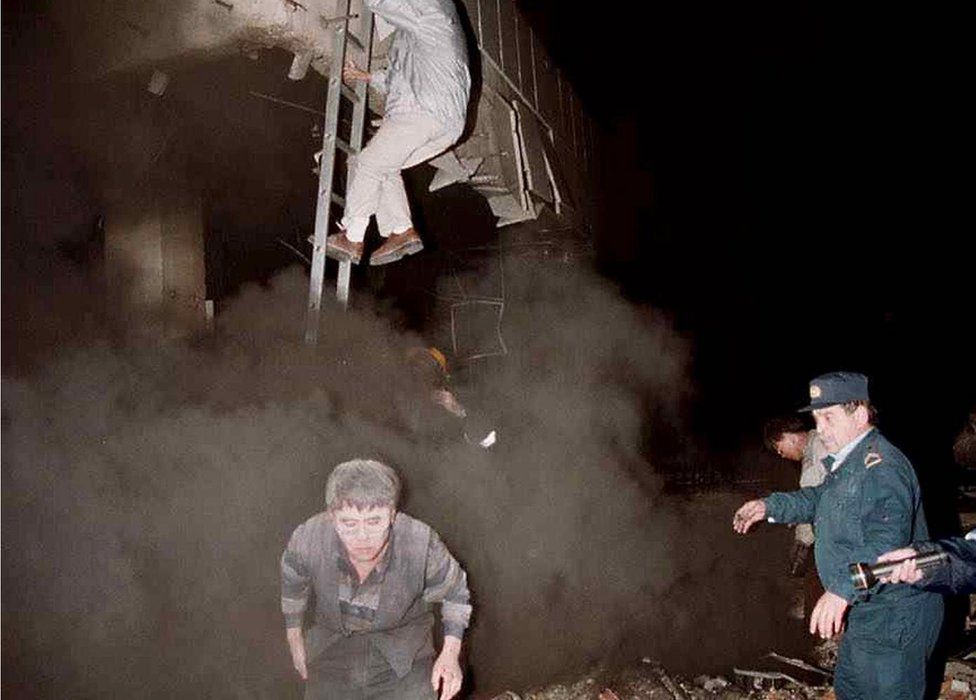
He arrived to a scene of chaos. The embassy was burning; workers covered in blood and dust were climbing out of windows to escape. Politicians close to Milosevic – who had been charged two weeks earlier with crimes against humanity by an international tribunal – were already arriving to denounce the bombing as the latest example of Nato barbarity.
“We could not go inside. There was a lot of smoke, there wasn’t any electricity and we couldn’t see anything. It was horrible,” said Shen.
Image copyright LAZARA MARINKOVICImage caption Shen Hong lost close friends in the bombingHe spotted the cultural attaché, a man he knew, who had knotted together curtains to get out of a first-floor window. “We didn’t see that he was injured and he didn’t notice it either. It was only when I shook his hand that I realised my hands were covered in blood. I told him ‘you’re injured, you’re injured!’ – but when he saw this he passed out.”
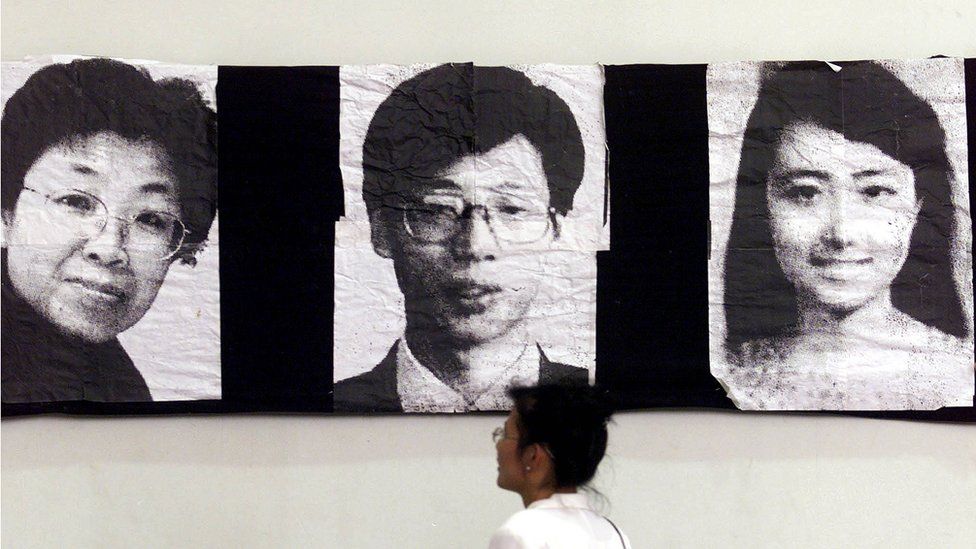
The next day Shen would learn that two close friends – newlywed journalists Xu Xinghu, 31, and Zhu Ying, 27 – had been killed by a bomb that hit the sleeping quarters of the embassy. Their bodies were found under a collapsed wall.
The pair had worked for the Guangming (Enlightenment) Daily – a communist party newspaper. Xu, a language graduate who spoke fluent Serbian, had chronicled life in Belgrade during the bombings in a series of special reports called “Living Under Gunfire”.
Image copyright DRASKO GAGOVIC/EPA
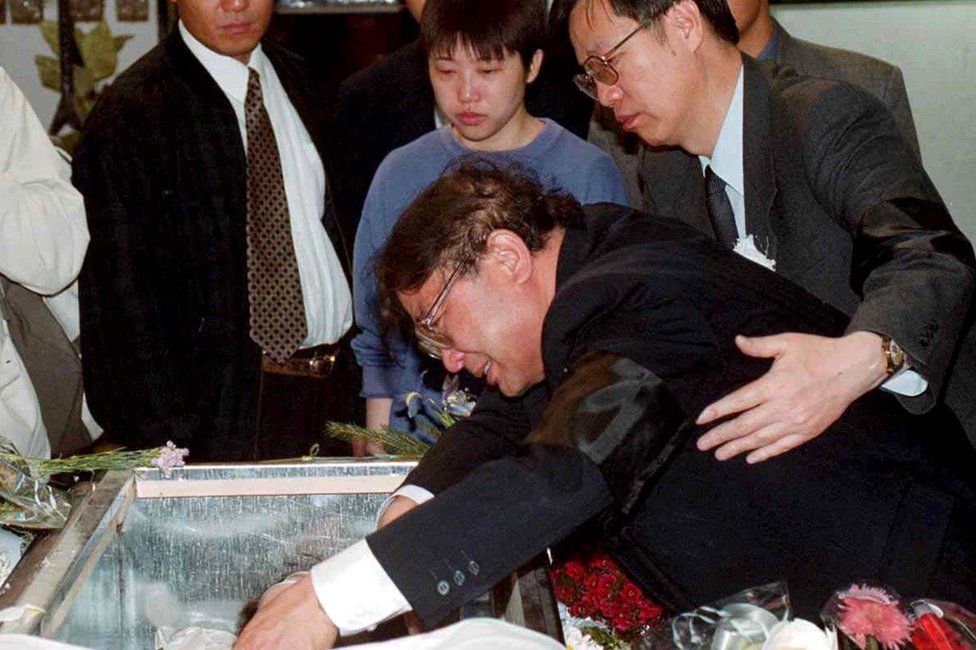
Zhu Ying worked as an art editor in the paper’s advertising department. Her mother collapsed with grief and was sent to hospital when she learned of her daughter’s death so Zhu’s father travelled alone to Belgrade to see the body.
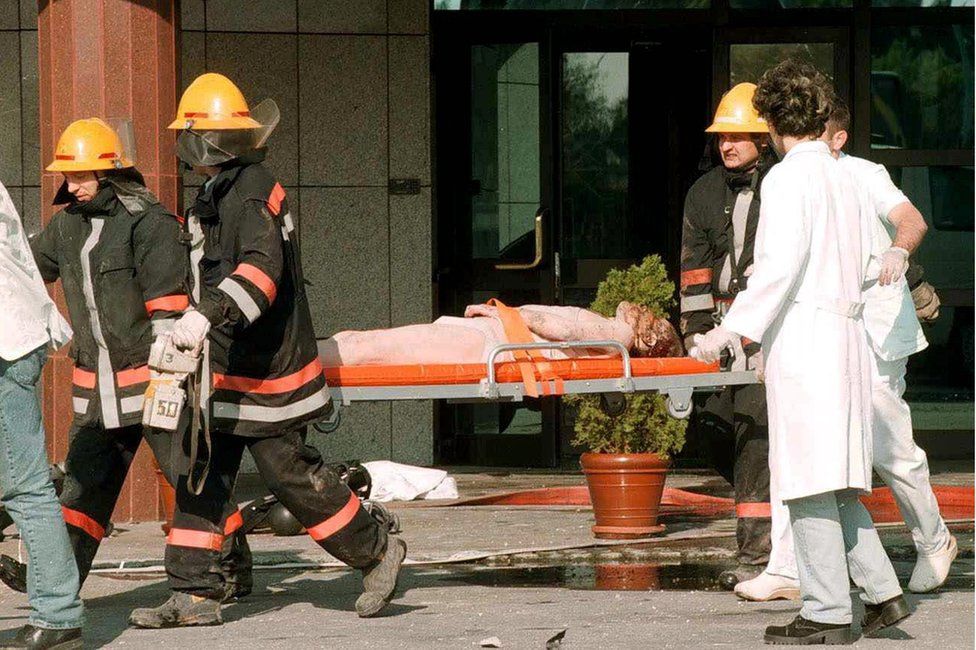
A third journalist, 48-year-old Shao Yunhuan, of the Xinhua news agency, also died. Her husband, Cao Rongfei, was blinded. The embassy’s military attaché, who is believed to have run an intelligence cell from the building, was sent back to China in a coma. In total, three people were killed and at least 20 injured.
For Shen, this was an act of war. The next day he led a protest through the streets of Belgrade carrying a sign reading “NATO: Nazi American Terrorist Organisation”
It was a sign of what was to come.
Image copyright REUTERSImage caption Three journalists were killed in the embassy
Within hours of the bombing, two competing narratives began to emerge. They would harden over the coming months and form the basis of how the incident – which continues to linger over the US-China relationship – remains debated today.
The bombing fuelled speculation, and there was no shortage of unanswered questions and missing pieces that were put together by some to imply a grand conspiracy. Intrigue continued to hang over the incident and, months afterwards, two respected European newspapers suggested the strikes were by design.
But, as former Nato officials point out, in 20 years no clear evidence has come to light proving what almost all of China believes and America strenuously denies: that it was deliberate.
In those first hours after the bombs fell, the US and Nato wasted no time to announce that it was an accident. China’s representative at the UN, meanwhile, denounced a “crime of war” and a “barbarian act”.
In Brussels, Jamie Shea – the British Nato spokesman who became the public face of the war – was woken up in the middle of the night and told he would have to face the world’s press in the morning. The information available in those early hours was thin but he would give one of the first explanations of what had happened, along with an apology. The warplanes, he said from the briefing podium, had “struck the wrong building”.
“It’s like a train accident or a car crash – you know what has happened but what you don’t know is why it has happened,” he says 20 years later. “That took a lot longer to establish… But it was clear right from the get-go, that targeting a foreign embassy was not part of the Nato plan.”
Image copyright BORIS SUBASIC/EPAImage caption The father of Zhu Ying weeps over her coffin in BelgradeIt would take more than a month for the US to give Beijing a full explanation: that a series of basic errors had led to five GPS-guided bombs striking China’s embassy – including one that hurtled through the roof of the ambassador’s residence next to the main building but didn’t explode, likely sparing his life.
The real target, officials said, was the headquarters of the Yugoslav Federal Directorate for Supply and Procurement (FDSP) – a state agency that imported and exported defence equipment. The grey office building is still there today – hundreds of metres down the road from the embassy site.
Nato had initially hoped the bombing campaign would only last a few days until Milosevic gave up, pulled his forces out of Kosovo and allowed peacekeepers in. But by the time the embassy was hit it had stretched to more than six weeks. In the rush to find hundreds of new targets to sustain the aerial assault, the CIA, which was not normally involved in target-picking, had decided the FDSP should be struck.
But America’s premier intelligence agency said it had used a bad map.
“In simple terms, one of our planes attacked the wrong target because the bombing instructions were based on an outdated map,” US defence secretary William Cohen said two days after the bombing. He was referring to a US government map that apparently did not show the correct location of the Chinese embassy nor the FDSP.
All US intelligence officers had was an address for the FDSP – 2 Bulevar Umetnosti – and a basic military navigation technique was used to approximate its co-ordinates. The technique used was so imprecise, CIA chief George Tenet later said, that it should never have been used to pick out a target for aerial bombing.
To compound the initial error, Tenet said, intelligence and military databases used to cross-check targets did not have the embassy’s new location listed, despite the fact that many US diplomats had actually been inside the building.
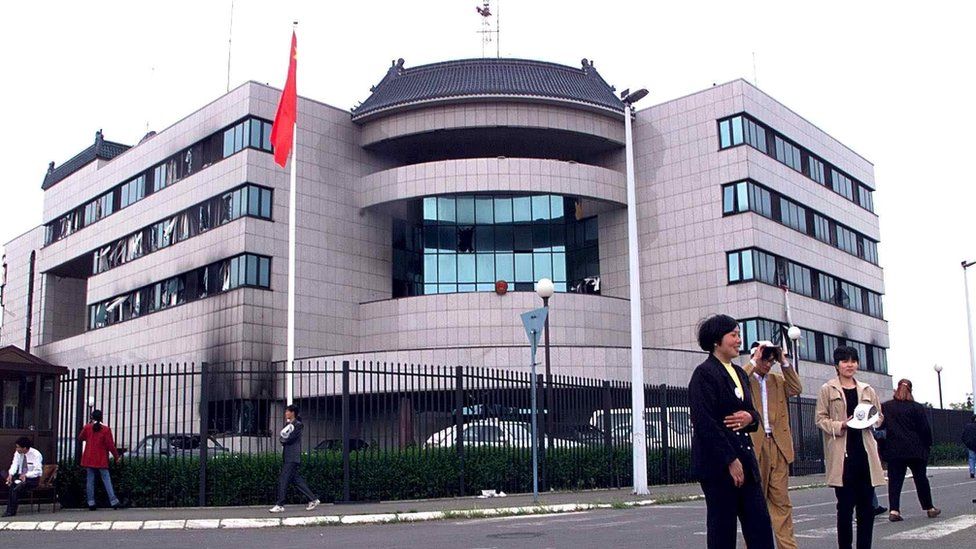
Had anyone on the ground visited the site to be bombed they would have found a gated compound, a five-storey building with a green-tiled oriental sloped roof, a bronze plaque announcing the embassy’s presence and a large, bright red Chinese flag fluttering more than 10 metres in the air.
Image copyright SASA STANKOVIC/EPA/REX/SHUTTERSTOCKImage caption The front of the embassy was largely undamagedThe crux of the CIA’s explanation was hard for many to believe: the world’s most advanced military had bombed a fellow UN Security Council member and one of the most vocal opponents of the Nato air campaign because of a mapping error. China was having none of it. The story, it said, was “not convincing”.
“The Chinese government and people cannot accept the conclusion that the bombing was a mistake,” the foreign minister told a US envoy sent to Beijing in June 1999 to explain what had happened.
But why would the US intentionally attack China?
It wasn’t long after the Sun rose on the morning of Saturday, 8 May 1999, that David Rank, a US diplomat, got out of bed in Beijing.
He turned on the television and switched to CNN. The American news network was carrying live pictures of the smouldering Chinese embassy in pitch-dark Belgrade.
By that afternoon, thousands of irate Chinese protesters would be gathered outside. But Rank, at that stage, was fairly calm. He rang his boss, the head of the political section: “I said, you know, Jim, this is the damndest thing.”
The diplomat rushed from his residence to the embassy down the road, where US officials were trying to figure out what had happened. Something had clearly gone wrong but this must have been, had to have been, a tragic mistake.
“It was so patently obvious that it was a sort of fog of war accident… At that point I didn’t think that down the road this was going to be a major problem. Obviously, it was a major problem, but not the sort of convulsive incident that it turned out to be,” said Rank.
But in the next hours, the shape of how the Chinese government and people would respond started to become clear.
Image copyright PETER ROGERS/GETTY IMAGESRank began receiving calls from liberal Chinese friends who were outraged at the bombing. American journalists got similar calls from Chinese contacts with pro-US views, expressing shock and a sense of betrayal.
Chinese state media was already laying out a clear narrative – the US had breached international law by bombing a Chinese diplomatic outpost. “The language that I heard from lots and lots of Chinese, it was identical. It was the same almost word-for-word lines of real anger,” said Rank.
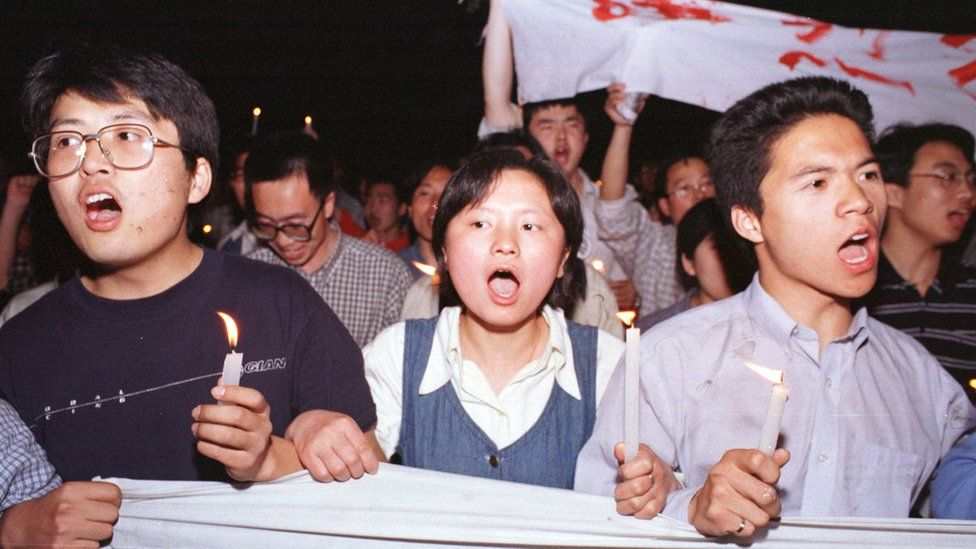
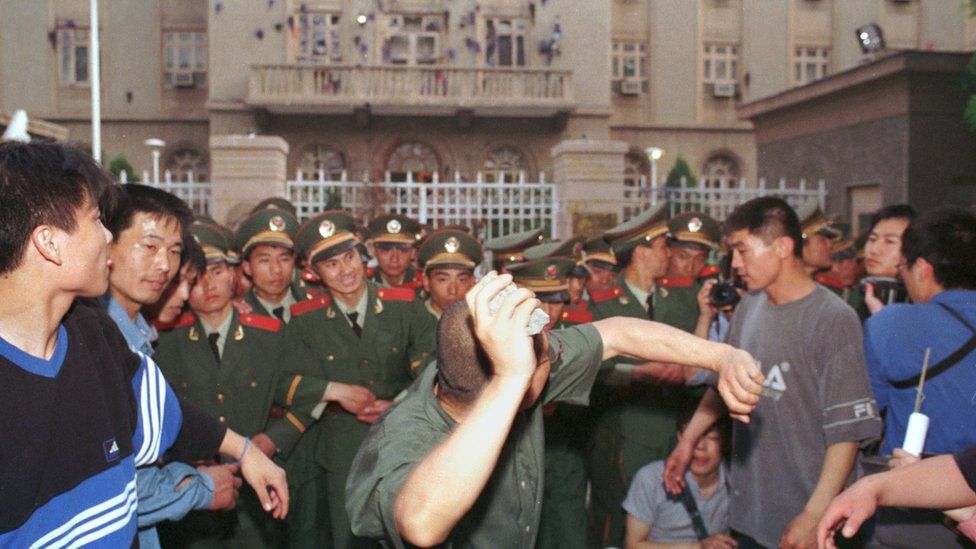
By that afternoon thousands of students were streaming onto the streets of Beijing. They gathered outside the embassy and things quickly turned violent.
“They were pulling up the paving stones. Beijing sidewalks aren’t paved, they have big tiles and they were pulling those up and smashing them and throwing them over the walls.”
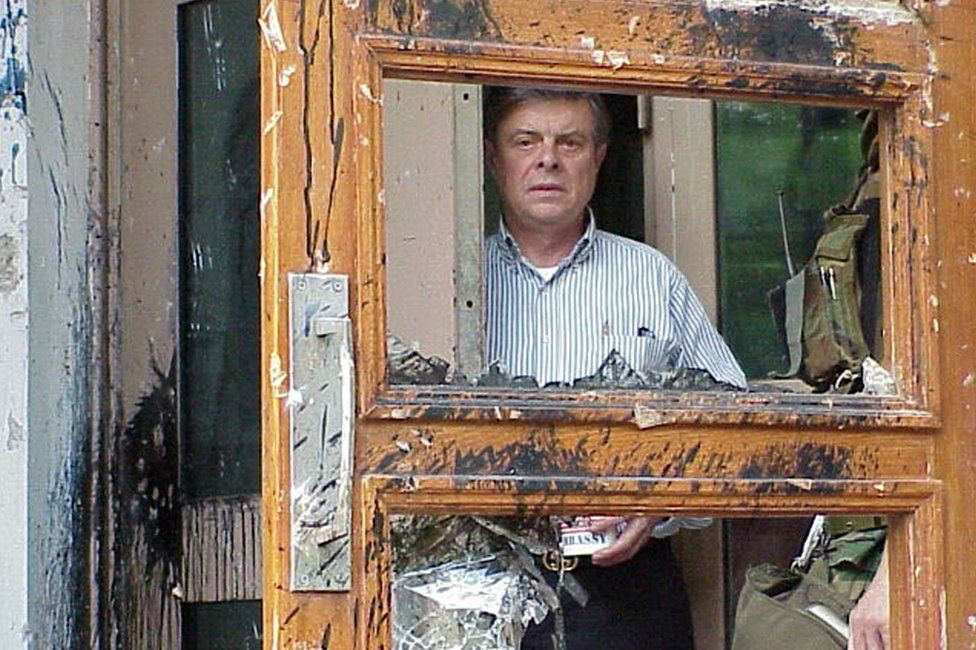
Image copyright PETER ROGERS/GETTY IMAGESMany of those bits of concrete were crashing through the windows of a building where more than a dozen embassy staff, including US Ambassador James Sasser, had hunkered down. Embassy cars were being defaced and attacked.
The message was clear: the bombing was intentional and, as one slogan went, “the blood of Chinese must be repaid”. The protests would continue the next day, with even more people – some reports said 100,000 – storming the diplomatic district, and pelting stones, paint, eggs and concrete at the British and American embassies.
“We feel like we’re hostages,” Bill Palmer, an embassy spokesman trapped in one of the buildings, said at the time.
Demonstrations of this scale had not been seen in tightly-controlled China in the decade since students led a pro-democracy uprising in Beijing’s Tiananmen Square in 1989. This time the anger was directed away from the Communist Party but, with the 10th anniversary of the crackdown on students in Tiananmen approaching, the government had to strike a balance between giving vent to public anger and remaining in control.
In a rare TV address Vice-President Hu Jintao endorsed the protests but also warned they had to remain “in accordance with the law”.
Image copyright REUTERSImage caption US Ambassador James Sasser was trapped in the embassy for four days as protests ragedThe uproar was not isolated to Beijing. Crowds also took to the streets of Shanghai and other cities that weekend. In central Chengdu, the US consul’s residence was set alight.
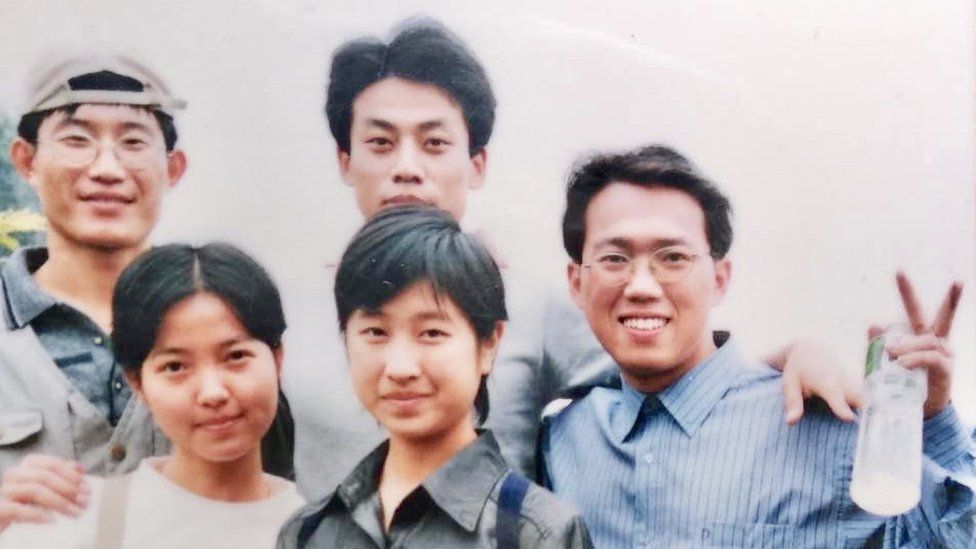
Weiping Qin, a then 19-year-old student leader at the maritime college in southern Guangzhou city, said demonstrators were not informed that Nato had already apologised for what it said was an accident. “The government was hiding this important message. They didn’t tell us – so young people, everybody, felt angry. We just wanted to go in the streets and protest against the United States.”
He said that initially students at his college were told they had to stay in their dormitories. But 24 hours after the bombing, the university leadership told him that they needed 30,000 students in the streets around the US consulate – 500 of whom would come from the maritime college.
The fired-up students drew lots to choose who could attend. They were loaded onto buses and given statements to read that echoed the stilted official language being broadcast by state media. “They gave us long sentences. But in the street, to speak out in long sentences is very hard.” He decided to yell slogans about the evils of Nato and the US instead.
Image copyright WEIPING QINImage caption Weiping Qin (right) was a student leader at Guangzhou Maritime College in 1999“We were just young people and we just felt angry. Our emotions came out like a wave,” said Qin, who now lives in the US and criticises the Chinese government in YouTube videos.
David Rank agreed that the anger was genuine. “I think it would really sell the Chinese people short to say this was manufactured by the system,” he said. “There was real outrage.”
Since the early 1990s, China had embarked on a concerted campaign to instil nationalism and “patriotic education” in its people. The narrative pushed in school textbooks, university classrooms and the media was that China – home to a great and benevolent civilisation – had been subjugated and humiliated at the hands of Western powers. The Belgrade embassy bombing fit the story.
“The anger that ordinary Chinese felt I think can only be understood in that historical context, being socialised to resent the West,” said Peter Gries, a professor of Chinese politics at Manchester University and an expert on Chinese nationalism.
For Liu Mingfu – a retired People’s Liberation Army colonel known for his hardline views of the US – the embassy bombing was part of a series of events that proved the US was engaged in a “new Cold War against China”.
“It was totally intentional. It was a purposeful, planned bombing, rather than an accident,” he said.
China would receive $28m in compensation from the US for the bombing, but had to give back close to $3m for the damage to US diplomatic property in Beijing and elsewhere. The US paid another $4.5m to the families of the dead and injured.
On the day of the bombing, Dusan Janjic, an academic and advocate for ethnic reconciliation in Yugoslavia, was having lunch at an upscale restaurant in central Belgrade with a man he considered a good friend.
Ren Baokai was the military attaché at the Chinese embassy and Janjic said he was surprisingly open with him about the fact that China was spying on Nato and US operations and tracking warplanes from its Belgrade outpost. The attaché invited him to dinner at the embassy that night because he knew he liked Chinese food.
“And I started making jokes. ‘Come on, you’re going to be bombed! I’m not coming!’,” Janjic recalled. He was being facetious: he did not actually think the embassy would be hit.
But Janjic couldn’t make it to dinner and that evening, when the missiles flew into the building, Ren was thrown to the ceiling by the blast and then fell through a crater left by a bomb. He was found in the basement in a coma only the next morning.
Citing Nato sources, they reported that the embassy was being used as a rebroadcast station for Yugoslav army communications and was as a result removed from a prohibited target list. US Secretary of State Madeleine Albright decried the story as “balderdash”, while British Foreign Secretary Robin Cook said there was “not a single shred of evidence” to support it.
But two decades later, Jens Holsoe, Politiken’s correspondent in the Balkans from 1995 to 2004, and John Sweeney, formerly of the Observer and now with the BBC, said they stood by their reporting that the bombing was intentional.
Holsoe said what made him investigate in the first place was CIA Chief George Tenet publicly saying that satellite images gave no indication the target was an embassy – “no flags, no seals, no clear markings” – when in fact all three were present.
One of his sources – a very senior Danish military figure – almost went on the record to confirm publicly that the bombing was intentional, he said. “Then he suddenly backed out and said if he uttered another word to me about this story that not only did he risk being fired but also prosecuted.”
Holsoe said it was clear at the time that there was military co-operation between Serb forces and the Chinese – and that he personally saw military vehicles entering and exiting the Chinese embassy. American officials told the New York Times that after the bombing they learned the embassy was China’s most significant intelligence collection platform in Europe.
“This was, and always will be, a murky story,” said Sweeney.
Ren Baokai survived and was later given the rank of general. He declined an interview with the BBC, saying he was now retired.
The Chinese ambassador who narrowly survived the strike, Pan Zhanlin, denied in a book that the embassy had been used for re-broadcasting and that China, in exchange, had been given parts of the US F-117 stealth fighter jet that Serbian forces had shot down in the early stages of the Nato campaign.
Getty Images
I think it’s complete nonsense – it was a bad map-reading error and a bad mistake.
It’s widely assumed that China did get hold of pieces of the plane to study its technology. It’s also been speculated that China was using the Nato air campaign to test technology to track stealth bombers that are normally undetectable.
But even if all these stories are true – the question remains: would the US really take the risk of bombing a Chinese embassy on purpose?
Even among ex-Yugoslav insiders there is no consensus. One former military intelligence officer told the BBC he believed the bombing was intentional and that the CIA’s explanation was ludicrous; while another, a retired colonel, said he believed America’s story.
“When something bad happens everybody thinks there has to be a secret reason – not a cock-up but a conspiracy,” said the former Nato spokesman Jamie Shea. “I think it’s complete nonsense – it was a bad map-reading error and a bad mistake.”
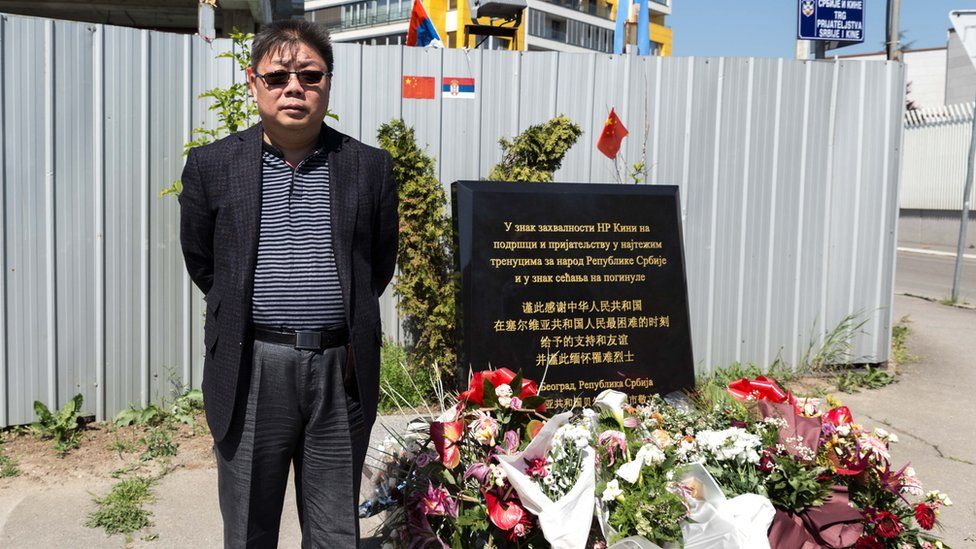
On a sunny day in late April, more than a dozen fresh bouquets were stacked up neatly against the memorial stone, but Shen Hong still felt compelled to re-arrange them. He comes to the site of the embassy bombing regularly, to remember his friends that died. But these days, it’s rare that he is alone.
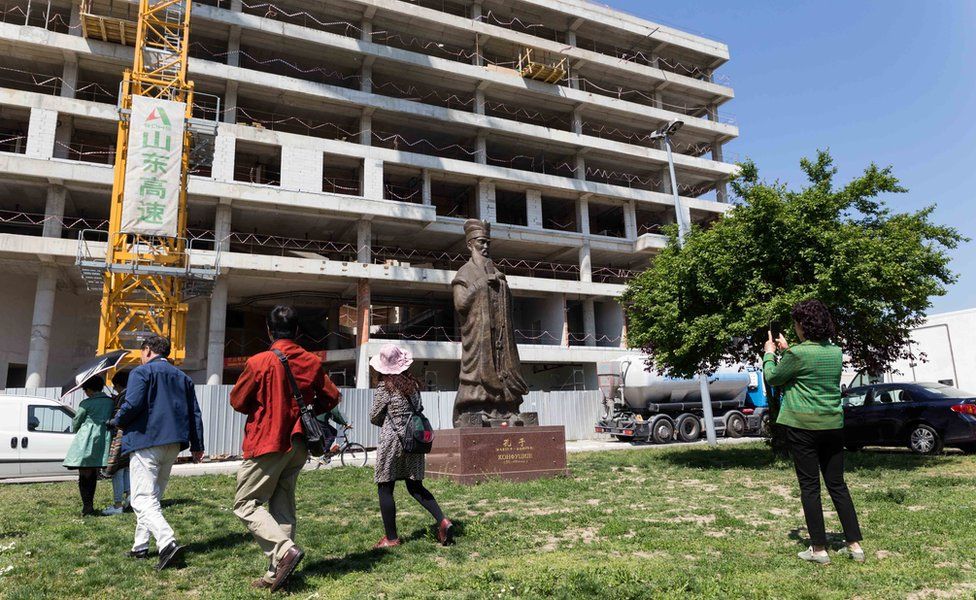
Busloads of Chinese tourists arrive every day to gaze at the memorial and the statue of the Chinese sage and philosopher Confucius that now stands nearby.
A young Chinese couple, Zhang and He, were in Belgrade for their honeymoon and decided to visit the memorial. They are around the same age that Xu Xinghu and Zhu Ying were when they were killed in 1999. “Three of our countrymen died here. We knew about this since we were kids and we came to see it,” said He.
Yang, a guide who was leading some 30 middle-aged Chinese tourists on a two-week bus tour through the Balkans, said the embassy site was a mandatory stop. “Our embassy was destroyed by Americans. Every Chinese knows this.”
Image copyright LAZARA MARINKOVICImage caption The embassy site is being turned into one of the largest Chinese cultural centres in EuropeIn 1999, China was not the economic, technological and military giant it is now. It was focused on getting wealthy and had a much less visible foreign policy. But 20 years later the country knows it sits at the top table with America and its ambitions around the world reflect that.
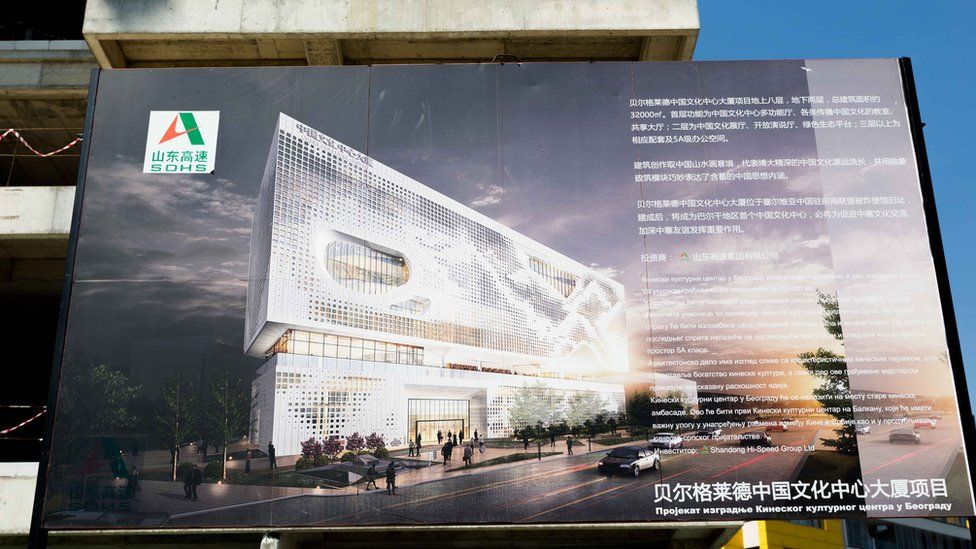
The Belgrade embassy site is being turned into a Chinese cultural centre that will be one of the biggest in Europe. The symbolism is hard to miss: a site of national humiliation and tragedy at the hands of the West re-born as a shiny edifice to China’s glorious history.
It’s a sign that Beijing has no plans to forget a bombing that allows it to paint the US as an imperialist superpower looking to hurt China. Diplomats who have served in Beijing say the incident is still brought up regularly in conversations.
Image copyright LAZARA MARINKOVICBut even those who called for immediate retaliation in 1999 now realise it was fortunate that China’s reaction did not spiral out of control: no Americans were killed during the protests and the compensation agreement allowed Beijing to draw a line – if a thin one – under the incident.
“We were the fastest developing country, every year our economy grew by double-digits. And if we would have stopped that because of war back then, we would have lost a lot,” said Shen, as another group of tourists arrived at the memorial.
“By nature, I’m a radical. I am always more for war than for a conversation. But when I look back, they did a good thing. Because now we can sit equally with the Americans.”
TUCUPITA, Venezuela (Reuters) – The project was meant to feed millions.
In Delta Amacuro, a remote Venezuelan state on the Caribbean Sea, a Chinese construction giant struck a bold agreement with the late President Hugo Chavez. The state-run firm would build new bridges and roads, a food laboratory, and the largest rice-processing plant in Latin America.
The 2010 pact, with China CAMC Engineering Co Ltd , would develop rice paddies twice the size of Manhattan and create jobs for the area’s 110,000 residents, according to a copy of the contract seen by Reuters.
The underdeveloped state was an ideal locale to demonstrate the Socialist Venezuelan government’s commitment to empower the poor. And the deal would show how Chavez and his eventual hand-picked successor, President Nicolas Maduro, could work with China and other allies to develop areas beyond Venezuela’s bounteous oil beds.
“Rice Power! Agricultural power!” Chavez tweeted at the time.
Nine years later, locals are hungry. Few jobs have materialized and the plant is only half-built, running at less than one percent its projected output. It hasn’t yielded a single grain of locally grown rice, according to a dozen people involved in or familiar with the development.
Yet CAMC and a select few Venezuelan partners prospered.
Venezuela paid CAMC at least $100 million (76 million pounds) for the stalled development, according to project contracts and sealed court documents from an investigation by prosecutors in Europe.
The thousands of pages of court papers, reviewed by Reuters, were filed in Andorra, the European principality where prosecutors allege Venezuelans involved in the project sought to launder kickbacks paid to them for helping secure the contract. The material on the China deal, reported here for the first time, includes confidential testimony, wiretap transcripts, bank records and other documents.
Last September, an Andorran high court judge alleged in an indictment that CAMC paid over $100 million in bribes to various Venezuelan intermediaries to secure the rice project and at least four other agricultural contracts.
The indictment charged 12 Venezuelans with crimes including money laundering and conspiracy to launder money. Among those indicted was Diego Salazar, a cousin of a former oil minister who, investigators say, enabled the contracts. Also indicted was the top representative in China at the time of state-run oil company Petroleos de Venezuela SA, or PDVSA.
Sixteen people of other nationalities were also charged and at least four other Venezuelans, one of whom was formerly ambassador in Beijing and is now the country’s top diplomat in London, are under investigation, according to the documents.
The indictment, the names of those charged, and their association with Chinese companies were reported last year by El Pais, the Spanish newspaper. A Reuters review of the case files, which are still under seal in Andorra, gleans how CAMC and other Chinese companies forged ties with many of those charged and paid to win projects the companies often didn’t complete.
The result, according to prosecutors, was a far-reaching culture of kickbacks, paid through offshore accounts, in which well-connected Venezuelan intermediaries milked and ultimately crippled projects that were meant to develop neglected corners of the country.
Among other findings reported here for the first time:
• CAMC agreed to at least five agricultural projects in Venezuela, valued at about $3 billion, that it never completed.
• The company, according to contracts and project documents reviewed by Reuters, received at least half the value of the $200 million contract for the rice project and at least 40 percent of the contract value for the other four developments – a combined total of at least $1.4 billion for work it never finished.
• CAMC paid over $100 million in fees to intermediaries; prosecutors say those payments were kickbacks that helped the company win contracts in Venezuela.
Neither CAMC nor any of its executives were charged in the indictment.
In a statement, the Beijing-based company told Reuters the details and assertions in the case files include “a large number of inaccuracies,” but didn’t elaborate. The company didn’t respond to requests to speak with CAMC executives mentioned in the documents. Reuters couldn’t reach those executives independently.
“Our company operates in Venezuela in adherence to the idea of integrity and strives to complete every construction project with the best technology and management,” the statement said.
China’s Foreign Ministry, in a statement to Reuters, said “reports” about alleged bribery by Chinese companies in Venezuela “obviously distorted and exaggerated facts, with a hidden agenda.” It didn’t specify to what agenda it was referring. Cooperation between the two countries will continue, the statement read, “based on equal, mutually beneficial, and commercial principles.”
Venezuela’s Information Ministry, responsible for government communications, and oil giant PDVSA, a partner in many of the contracts cited in the court case, didn’t respond to Reuters inquiries.
It isn’t clear when any of those charged could face trial. Enric Gimenez, a lawyer in Andorra for Salazar, the Venezuelan who prosecutors say brokered many of the contracts, told Reuters his client is innocent of the charges there.
The leftist regime founded by Chavez and now led by Maduro is facing its most serious threat yet. Opposition lawmakers, with the support of most Western democracies, say Maduro’s re-election last year was illegal and that Juan Guaido, head of the National Assembly, is the country’s rightful leader.
Last week, in a failed uprising, Guaido unsuccessfully sought to rally Venezuela’s military, the lynchpin of support for the unpopular government, against Maduro.
The political crisis was prompted by an economic meltdown of hyperinflation, mass unemployment and an exodus of desperate citizens. Venezuelans suffer regular shortages of food, power and water – basics that were meant to improve through projects like the one in Delta Amacuro.
The dire scarcities and dysfunctional projects, the opposition alleges, illustrate how corruption and crony capitalism helped impoverish the once-prosperous country and many of its 30 million people.
After an ambitious 2007 agreement between China and Venezuela, Chinese companies were announced as partners in billions of dollars’ worth of infrastructure and other projects. Since then, China invested over $50 billion in Venezuela, mostly in the form of oil-for-loan agreements, government figures show.
In a 2017 speech, Maduro said 790 projects with Chinese companies had been contracted in sectors ranging from oil to housing to telecommunications. Of those, he said, 495 were complete. Some developments have stalled because of graft, people familiar with the projects said; others were derailed by incompetence and a lack of supervision.
In Delta Amacuro, even government officials say a mixture of both ruined the rice project. “The government abandoned it,” says Victor Meza, state coordinator for Venezuela’s rural development agency, which worked with CAMC. “Everything was lost. Everything was stolen.”
Prosecutors in Andorra, where secretive banking laws long made it a tax haven, launched their investigation into Venezuelan laundering amid a broader effort to clean up the local financial sector.
The indictment is part of a much larger case in which the prosecutors allege Venezuelan officials between 2009 and 2014 received more than $2 billion worth of “illegal commissions” from contractors, state companies, and other sources, often for enabling transactions with the government.
The payments, the indictment alleges, passed through accounts held at Banca Privada D’Andorra, a local bank known as BPA.
Andorra’s government, after the United States accused BPA of money laundering, took over the bank in 2015. Courts there since then have charged 25 former BPA employees with money laundering in a series of cases, including the one probing the Venezuela contracts. A spokeswoman for Andorra’s government declined to comment for this article.
In addition to the agricultural projects by CAMC, the Andorrans examined two power-plant projects by the company and four other power plants built by Sinohydro Corp, another state-owned Chinese engineering firm. None of those plants ever became fully operational, leaving towns near them subject to regular blackouts.
Sinohydro wasn’t charged in the indictment. The company didn’t respond to calls, emails and faxes seeking comment.
During a recent visit by Reuters to Delta Amacuro, the CAMC rice plant remained unfinished. Only one of its 10 silos, half full, held any grain. Some machinery was running, but processing rice imported from Brazil. The nearby paddies lay fallow, the laboratory incomplete, the roads and bridges unbuilt.
“WE DON’T PRODUCE ANYTHING”
Tucupita, a town of 86,000 residents, is Delta Amacuro’s capital. It hugs the banks of the Cano Manamo, an offshoot of the Orinoco, one of South America’s biggest rivers. Once, Tucupita was a stop for vessels shipping goods from inland factories to buyers in the Caribbean and beyond.
In 1965, the government dammed the Cano Manamo. Boat traffic stopped, fresh water receded and seawater seeped inland, degrading soils. By the time Chavez became president in 1999, little farming remained.
“When I was a kid, there was rice everywhere,” recalled Rogelio Rodriguez, a local agronomist. “Now we don’t produce anything.”
In 2009, Chavez and Xi Jinping, China’s vice president at the time, expanded a joint fund the countries had created with the 2007 development agreement. “Aren’t we grateful to China?” Chavez said at a ceremony with Xi at the presidential palace in Caracas, Venezuela’s capital.
Promising to supply Beijing with oil “for the next 500 years,” Chavez pointed toward Delta Amacuro on a map. “Look, Xi,” he said, announcing an effort to rehabilitate the region.
In attendance were CAMC Chairman Luo Yan and Rafael Ramirez, a Chavez confidante who ran PDVSA and the oil ministry for a decade.
Soon, businesses jostled to get in on the development.
Diego Salazar, a cousin of Ramirez, was well-positioned.
Salazar’s father was a communist guerrilla and author who later became a legislator and Chavez ally. His family ties and connections to lawmakers gave the younger Salazar a valuable address book he wielded at a consulting firm he operated in Caracas.
The firm, Inverdt, was owned by a Panama-based holding company he had established called Highland Assets, according to testimony Salazar gave investigators in Andorra when they first began probing his BPA account. From an office a few blocks from PDVSA headquarters, he met often with Ramirez and other top officials, according to people familiar with his activities.
Ramirez left the ministry in 2014 and was Venezuela’s ambassador to the United Nations until 2017. Since then, Maduro has publicly accused him of unspecified corruption, but Ramirez wasn’t indicted in Andorra and hasn’t formally been charged with any crime in Venezuela. He now lives abroad as an opponent of the government. Ramirez didn’t respond to Reuters emails seeking comment and couldn’t be reached otherwise.
At the time of the ceremony with Xi, Chavez was making PDVSA a hub for a growing array of developments, many of them unrelated to oil. A newly created unit known as PDVSA Agricola, for instance, was tasked with boosting food supply.
The diversification made PDVSA the conduit through which contracts, and a growing sum of money administered by Venezuela’s national development bank, were awarded.
By 2010, the filings say, the bank had received $32 billion from the China Development Bank and another $6 billion from an infrastructure fund created by Chavez.
China Development Bank didn’t respond to Reuters requests for comment.
Salazar began reaching out to Chinese executives, offering his services, as a well-connected consultant, to help broker business in Venezuela. He travelled to China monthly and began paying Venezuelan officials there to forge ties with companies including CAMC.
“My work was to convince them, through meetings, trips, and promotion, to sign contracts,” Salazar told Andorran investigators.
People familiar with the case said Salazar and his alleged associates, before the indictment, agreed to testify in Andorra because they hoped to clear their names.
In his testimony, Salazar told the Andorran investigators he chose BPA as an offshore bank because he knew other wealthy Venezuelans had done so. Nestled in a quiet valley of the Pyrenees, BPA had a reputation as a discrete money manager for clients from high-risk countries.
After Andorra submitted information requests for its case to Caracas, a Venezuelan court in 2017 ordered Salazar arrested on suspicion of corruption, money laundering and conspiracy.
Citing the Andorran probe, the Venezuelan arrest order said Salazar sought to “give legal appearance to funds originating from numerous contracts with Venezuelan state institutions.” A trial date hasn’t been set and Salazar remains jailed in Caracas. A lawyer for Salazar in Venezuela denied the charges before the court.
Gimenez, Salazar’s lawyer in Andorra, in an email to Reuters said Chinese authorities decided which companies would receive funds and that neither Salazar nor his alleged intermediaries could sway that. Inverdt, Salazar’s consulting firm, offered “professional” and “technical” services to many Chinese companies, Gimenez wrote in the email, and that “only a handful of those companies were chosen to carry out works.”
One of Salazar’s intermediaries, the indictment alleged, was Francisco Jimenez, a career engineer who was PDVSA’s envoy in Beijing and who the Andorrans indicted along with Salazar. Salazar first contacted him during a trip to China in 2010, according to testimony Jimenez gave in Andorra.
That March, Jimenez signed a “strategic alliance” with Salazar to promote Inverdt in China. Under the terms of their contract, reviewed by Reuters, Salazar agreed to pay Jimenez $7.38 million in a BPA account that Inverdt helped open. Bank records in the case files show Jimenez later received another $7 million.
Jimenez, who now lives in Panama, didn’t respond to phone calls or text messages from Reuters. Salvador Capdevila, his lawyer in Andorra, declined to comment.
Another official who prosecutors say helped Salazar was Rocio Maneiro, Venezuela’s ambassador to China and now the country’s ambassador to Britain.
Maneiro wasn’t charged in the Andorran indictment; numerous court documents, including a filing by prosecutors in relation to her testimony, refer to her as “under investigation” for payments they say she received from Salazar and for her alleged role helping him make contacts with Chinese companies.
In 2010, bank records contained in the court documents show, Salazar made a transfer of $30,000 to a Chinese account in her name, citing “services provided by Mrs. Maneiro.”
Later, Salazar made deposits totalling $13 million into a BPA account owned by a Panama-based company that Maneiro, in a disclosure document linked to the account, said belonged to her. An internal report from BPA’s anti-money laundering committee, reviewed by Reuters, also listed Maneiro as its owner.
Maneiro, through a lawyer and in a text message to Reuters, denied helping Salazar and receiving payments from him. “Those are assertions with no basis,” she wrote in the message. She told an Andorran judge that the signature on the form about the Panamanian company is forged.
The court has ordered an analysis of the signature.
“A BRIEFCASE FULL OF CONTRACTS”
By early 2010, Salazar’s outreach bore fruit.
Sinohydro, the engineering firm, that March signed a $316 million contract with PDVSA to build a power plant near the city of Maracay.
In the contract, Sinohydro agreed to pay Salazar a 10 percent fee for helping it “gain a favourable and positive position to pursue the contract.” Bank records in the case files show the company paid $49 million into Salazar’s BPA account and another $72 million after Sinohydro secured additional power plant contracts from PDVSA.
Sinohydro eventually built four plants, but none met full contract specifications, engineers say. The plant near Maracay, for example, was meant to generate as much as 382 megawatts, the contract shows. Instead, the plant is producing no more than 140 megawatts, according to Jose Aguilar, a former director at Venezuela’s state power company.
Soon, Salazar’s company was earning over $100 million a year, according to testimony by him and several aides. “He had a briefcase full of contracts,” Luis Mariano Rodriguez, a Salazar deputy also charged in the indictment, told Andorran investigators.
“We made deals with every company possible,” he added. “Some of these companies never actually carried out the projects.”
Reuters was unable to reach Rodriguez, who like Salazar has been charged with money laundering and conspiracy to launder. Gimenez, Salazar’s attorney in Andorra, also represents Rodriguez, and in the email said that Rodriguez, too, is innocent.
As money poured in, Salazar splurged, paying tens of thousands of dollars for hotel stays and spending millions on gifts. For $1 million, he bought 83 Rolex and Cartier watches at a Caracas jeweller, according to an invoice in the filings. In a Rodriguez email to BPA justifying the purchase, he said the watches were “gifted to relatives and friends.”
In April 2010, Andorran police began investigating Salazar. French investigators had asked them about a recent transaction: From his BPA account, Salazar had transferred $99,980 to a Paris hotel employee as a “tip for providing services.” It’s not clear what those services were.
By May, talks for the rice project began.
That month, Rodriguez met with Wang Hong, a CAMC vice president, in Caracas, according to a contract the men signed. In the contract, they agreed that CAMC would pay Salazar’s company 10 percent of the value of the rice contract to help it “win.”
Within months, PDVSA Agricola awarded CAMC the contract, valuing the rice development at $200 million. CAMC signed another agreement with Salazar for help securing additional projects. That June, CAMC made the first of several deposits totalling $112 million to Salazar’s BPA account, bank records show.
Workers broke ground in Delta Amacuro.
By 2012, project documents show, CAMC had received $100 million from the Venezuelan development bank for the undertaking, half that agreed upon. The company shipped excavators, steamrollers and other equipment from China.
But progress was slow.
An excavator bogged down in mud and stayed there. Chinese foremen spoke little Spanish and struggled with local crews, according to engineers who worked on the project.
That November, an Andorran court, on suspicion of money laundering, froze BPA accounts of Salazar, his aide Rodriguez and six other Venezuelans. In 2013, the prosecutors began a years-long effort to interview Salazar and others.
In 2015, the U.S. Treasury Department began pressuring Andorra over alleged money laundering. In a report at the time, the Treasury wrote that BPA facilitated laundering of money from Russia, China and Venezuela.
That March, the Andorran government took over BPA.
Oil prices, which had recently exceeded $100 per barrel, that year fell by more than half. Venezuela’s economy foundered.
CAMC pulled its team of 40 employees from the rice site, people involved in the project said. Locals looted scrap abandoned by CAMC. Jobless workers sold leftover cables and lightbulbs, former managers said.
Still, Maduro has sought to make something of the unfinished project.
In February, Agriculture Minister Wilmar Castro inaugurated the “Hugo Chavez” plant, snipping a ribbon in front of rice sacks emblazoned with Venezuelan and Chinese flags. No one from CAMC attended, according to a person present at the ceremony.
Instead of machinery able to process 18 tonnes each hour, workers are packing imported rice by hand. “There’s not a gram of rice growing anywhere here,” said Mariano Montilla, a 47-year-old local who lives off the few crops he can coax from nearby scrubland.
“It seemed like a revolutionary idea,” he said of Chavez’s initial promise. “Now we’re starving.”