Archive for ‘Uncategorized’

07/05/2019

‘Arrogant like Duryodhan’: Priyanka Gandhi jabs PM after ‘corrupt Rajiv’ attack

Over the last few days, Prime Minister Narendra Modi and his party’s top leadership have scaled up attacks on the Gandhi family, particularly on former prime minister Rajiv Gandhi.

LOK SABHA ELECTIONS Updated: May 07, 2019 17:40 IST

HT Correspondent
HT Correspondent
Hindustan Times, New Delhi
Priyanka Gandhi,Congress,PM Modi
Congress general secretary Priyanka Gandhi Vadra(PTI file photo)
Launching a scathing attack on the ruling BJP, Congress leader Priyanka Gandhi Vadra said on Tuesday that the saffron party’s “arrogance is like that of Duryodhan”, just days after Prime Minister Modi referred to Congress general secretary’s father and former prime minister Rajiv Gandhi “bhrashtachari no 1”.
Without naming anyone, Priyanka Gandhi Vadra said:” This country has never forgiven arrogance. Even Duryodhan had such arrogance, when Lord Krishna tried to make him see sense, he wanted to take him hostage.”
Speaking at a rally in Ambala for party candidate Kumari Selja, Priyanka Gandhi quoted poet Ramdhari Singh Dinkar to reinforce her remarks. “Jab naash manuj par chaata hai, pehle vivek mar jata hai (When doom looms, first thing a human loses is the ability to discern right from wrong).”
Priyanka Gandhi slams BJP, says party’s ‘arrogance like that of Duryodhan’
Priyanka Gandhi launched an attack on BJP while addressing a rally in Ambala.
The party incharge of eastern Uttar Pradesh added: “They never fulfil the promises they make at election time, instead they either seek votes in the name of martyrs or insult the martyr members of my family.”
Over the last few days, Prime Minister Narendra Modi and his party’s top leadership have scaled up attacks on the Gandhi family, particularly on former prime minister Rajiv Gandhi.
At a rally in Uttar Pradesh over the weekend, PM Modi had attacked Congress president Rahul Gandhi who has been hammering the BJP-led national coalition alleging corruption in the Rafale deal.
“Your father was termed Mr Clean by his courtiers, but his life ended as corrupt no 1,” PM Modi said, provoking a sharp response from the Congress and other opposition parties.
As she spoke at an election rally in Bengal on Tuesday, chief minister Mamata Banerjee said PM Modi’s attack was in bad taste. “Rajiv Gandhi died for the country. You may not like him but you should give respect to a departed leader,” Mamata Banerjee said.
The BJP response came soon after. Amit Shah, the party chief and its master strategist, wondered why PM Modi’s comment was made an issue when the latter spoke only the “truth”. “Is it not true that there was a Bofors scandal,” Shah told a public rally in Bengal insisting that the prime minister had only reminded the Congress about one fact. “It is not an insult to remind someone about the truth,” the BJP chief said.
Source: Hindustan Times
06/05/2019

Mainland, Taiwan youths called on to contribute to national rejuvenation

BEIJING, May 5 (Xinhua) — The Chinese mainland’s Taiwan affairs chief on Sunday called on youths on both sides of the Taiwan Strait to jointly shoulder the historic mission of national rejuvenation and contribute to cross-Strait integrated development.

Liu Jieyi, head of the Taiwan Work Office of the Communist Party of China Central Committee and the Taiwan Affairs Office of the State Council, made the remarks at the opening ceremony of a summit on cross-Strait exchange and cooperation among the youths.

Young people on the two sides of the Strait should value this great time, be responsible and do their share in safeguarding and building the common home of compatriots on the two sides of the Strait, Liu said.

“Attempts by the ‘Taiwan independence’ forces to undermine cross-Strait peace and obstruct national development will never be allowed,” he said.

He also pledged to provide better conditions for youths from Taiwan to carry out exchanges, study, work and start businesses on the mainland.

As Saturday marks the centenary of the May Fourth Movement, Liu called on the youths on both sides of the Strait to pass on the May Fourth spirit, which refers to patriotism, progress, democracy and science, with patriotism at the core.

Source: Xinhua

06/05/2019

Summit demonstrates China’s leapfrog into digital world

CHINA-FUJIAN-HUANG KUNMING-DIGITAL CHINA SUMMIT-SPEECH(CN)

Huang Kunming, a member of the Political Bureau of the Communist Party of China (CPC) Central Committee, also head of the Publicity Department of the CPC Central Committee, speaks at the opening ceremony of the second Digital China Summit in Fuzhou, southeast China’s Fujian Province, May 6, 2019. (Xinhua/Ding Lin)

FUZHOU, May 6 (Xinhua) — China on Monday sounded another heartening note for its development of information technologies, as both companies and the government rush to harness the nationwide tech boom to raise efficiency, buoy public satisfaction and even tackle corruption.

The second Digital China Summit opened Monday in eastern China’s Fujian Province, shedding light on the latest information technologies that have penetrated the country’s government, industries and society.

The Chinese government has expected information technologies to nurture new economic engines and upgrade old industries as the country shunts from the high-speed economic growth to the path of high-quality development.

Huang Kunming, a member of the Political Bureau of the Communist Party of China (CPC) Central Committee, in a keynote speech at the summit called for advancing the building of a digital China and smart society, stressing the role of information technology in promoting high-quality development.

Huang, also head of the Publicity Department of the CPC Central Committee, said China’s advantages in internet technology innovation, technology application and as a huge market should be transformed into advantages in developing a digital economy.

The official called for achieving breakthroughs in core technologies, enhancing protection of intellectual property rights, advancing information infrastructure construction and narrowing digital gaps between urban and rural areas.

A report reviewing the country’s digital development in 2018 was also issued at the summit, pointing to rapid growth in sectors including electronic information manufacturing, software service, communications and big data.

The report published by the Cyberspace Administration of China said the country last year recorded more than 9 trillion yuan (1.3 trillion U.S. dollars) in online retail. China’s digital economy reached 31.3 trillion yuan in scale, accounting for one-third of the national GDP in 2018.

Provincial-level e-government platforms have also slashed time for getting government permits by an average of 30 percent, noted the report.

Trendy technologies from driverless vendor vehicles and facial recognition security checks to 5G networks are being used at the event in the city of Fuzhou. A number of tech companies are displaying their cutting-edge products including Baidu’s driverless vehicles, Huawei’s AI chip “Ascend” and Foxconn’s “future factories.”

Pony Ma, CEO of China’s Internet giant Tencent, said at the summit that the company, by working with Fujian police, has used its facial recognition technology to help 1,000 families find missing family members in the past two years.

Hu Xiaoming, president of Ant Financial that runs the popular online payment network Alipay, said at the event that one of every four Chinese now handles government services on Alipay, making it the country’s largest platform that offers access to government services.

E-GOVERNMENT

One of the major highlights at the summit’s exhibition area are the many e-government apps, which have mushroomed across China to incorporate a wide range of government and public services. They are part of the government’s efforts to cut red tape to benefit residents and businesses alike.

In Fuzhou, the host city of the event, a citizen’s typical day now revolves around the e-Fuzhou app, which allows users to buy bus tickets, pay tuition fees and manage social security accounts without the need of visiting government offices.

A slew of digital technology applications, including the big data credit inquiry system, the online tax bureau, and the paperless customs clearance system, have also been developed in the province over the years.

Dingxi, one of the least developed cities in west China’s Gansu Province, has a booth displaying an online monitoring platform, which it launched last year to allow villagers to scrutinize the management of poverty-relief funds and report any signs of corruption.

“We went door-to-door to teach villagers how to use mobile phones to check the subsidies they are entitled to and the sum other families actually received,” said Yang Sirun, an inspector with the city’s discipline inspection commission.

“In the past, some wealthy families feigned poverty to claim subsistence allowances, while some officials fraudulently pocketed subsidies in the names of families that had moved away. The new platform can easily expose such ‘micro corruption,'” Yang said.

The official said since its launch, over 3,400 officials and residents have voluntarily turned in their illegal gains for fear of being reported. “Many hidden problems were also found during the collation of data from different departments, which proves big data’s power in fighting corruption,” he said.

The summit from May 6 to 8 aims to serve as a platform for issuing China’s policies on IT development and displaying the achievements and experience of e-government and the digital economy.

More than 1,500 officials, company representatives and scholars are attending the event, which is co-organized by the Cyberspace Administration of China, National Development and Reform Commission, Ministry of Industry and Information Technology and Fujian provincial government.

Source: Xinhua

06/05/2019

China fires up drills near Taiwan Strait in test of combat strength

  • Military exercises this week meant to foster image that Beijing can win a war over the island, analyst says
The PLA is staging live-fire drills at the northern end of the Taiwan Strait this week. Photo: AP
Beijing is conducting live-fire military drills at the northern end of the Taiwan Strait as it signals its resolve to thwart “pro-independence forces” in Taiwan.
Authorities in the small city of Yuhuan, Zhejiang province, notified the public on Sunday that a “no-sail zone” and “no-fishing zone” would be in effect in the area until Friday night.
It said the drills were part of the People’s Liberation Army’s “annual regular exercise plans” and would involve “actual use of weapons”.
“According to the annual [PLA’s] regular training plan … live-fire exercises involving the use of real weapons will be organised … in the designated areas from 6am on May 5 to 6pm on May 10,” the authorities said.
Collin Koh, a military analyst from the S. Rajaratnam School of International Studies at Singapore’s Nanyang Technological University, said the stress on the live-fire manoeuvres suggested the six-day exercise would simulate real combat conditions.
The drills come hard on the heels of an annual report by the Pentagon warning that China was preparing options to unify Taiwan by force, and there was a need to deter, delay or deny any third-party intervention on Taiwan’s behalf.
Under the Taiwan Relations Act, the United States is bound by law to help defend the self-ruled island. Washington is Taipei’s main source of arms, selling the island more than US$15 billion in weaponry since 2010, according to the Pentagon.
Beijing ‘loses all hope for Taiwan’s Tsai Ing-wen’ as she rallies Washington

Taiwan is one of a growing number of flashpoints in the China-US relationship – along with a trade war, Beijing’s growing influence in emerging economies, and its stronger military posture in the South China Sea. On Monday, two guided-missile destroyers, USS Preble and USS Chung-Hoon passed within 12 nautical miles of Gaven and Johnson reefs in the Spratly Islands, drawing immediate criticism from Beijing.

In addition, Taiwan will hold its annual Han Kuang live-fire drills from May 27 to 31 and held a computer-aided one just last month.

A Taiwan affairs analyst from the Chinese Academy of Social Sciences said the drills off Zhejiang were meant to show Beijing’s determination to defend its position on Taiwan.

“Beijing is trying to build up an image that China can win a war over Taiwan and Beijing’s key goal is to contain pro-independence forces, which are the biggest threat now to the peaceful unification process,” the analyst said.

Koh agreed, saying the drill sent a signal to external and domestic parties after the recent high-profile transits of US warships through the Taiwan Strait.

“The messaging to domestic audience is necessary because Beijing can’t be seen as weak following those reported transits by foreign warships – especially the Americans who are seen as supporting Taipei,” Koh said.

“And regarding external audience, the messaging is quite obviously to demonstrate that Beijing is ready to respond more resolutely to future such transits, following the tough verbal responses from Beijing, including its statement that it considers the strait under its jurisdiction and comprise its internal waters.”

Beijing ‘tones down’ response after US warships sail through Taiwan Strait

Relations between Beijing and Taipei have plunged since Tsai Ing-wen from the independence-leaning Democratic Progressive Party won the presidential election in 2016 and repeatedly refused to accept the “1992 consensus”, which Beijing says is the foundation for cross-strait dialogue.

In response, Beijing ramped up pressure against the island, including conducting more military exercises and establishing diplomatic ties with Taipei’s allies.

Source: SCMP

06/05/2019

Ex-CIA agent Jerry Chun Shing Lee admits spying for China

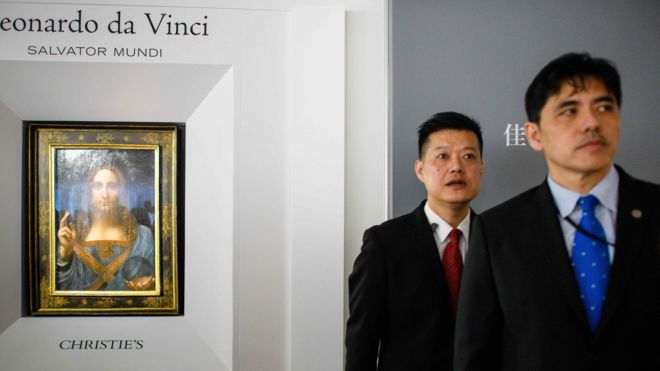
A man (R, wearing blue tie) identified by local Hong Kong media as former CIA agent Jerry Chun Shing LeeImage copyrightAFP
Image caption A man (R in blue tie) identified as Jerry Chun Shing Lee by Hong Kong media

An ex-CIA agent has pleaded guilty to spying for China, the US justice department says, in a case believed to be linked to the dismantling of a US espionage network.

Jerry Chun Shing Lee, 54, left the CIA in 2007 to live in Hong Kong, where he was recruited by Chinese agents.

Prosecutors say the naturalised US citizen was then paid to divulge information on US covert assets.

This led China to bring down a network of informants between 2010 and 2012.

About 20 informants were killed or jailed during that period – one of the most disastrous failures of US intelligence in recent years.

The US Assistant Attorney General for National Security, John Demers, said Lee’s case was the third involving US agents and China in less than a year.

“Every one of these cases is a tragic betrayal of country and colleagues,” he said.

What did Lee do?

Lee, who worked for the CIA between 1994 and 2007, pleaded guilty to conspiracy to deliver national defence information to aid a foreign government in a court in Virginia on Wednesday, the justice department said in a statement.

It said Lee was contacted by the Chinese intelligence agents in 2010. They offered him money, promising to take care of him “for life” in exchange for the required secret information. Hundreds of thousands of dollars were deposited in his Hong Kong bank account between May 2010 and December 2013.

Mr Lee created a document containing information about CIA activities, including locations to which US agents would be assigned.

In 2012, FBI agents searched a hotel room in Hawaii registered in Mr Lee’s name and found a USB drive. Investigators found the document on unallocated space in the drive, suggesting it had been deleted.

The search also revealed Lee to have a day planner and address book containing notes of intelligence provided by CIA agents, their true identities, operational meeting locations and phone numbers, and information about covert facilities.

Lee was interviewed by CIA officers in 2012 during which he said he had met Chinese intelligence officers but concealed the fact that they had set him tasks, the justice department said. In 2013 he first denied knowing about the document on his USB drive and then admitted he had created it but said he had never handed it on to Chinese agents.

Mr Lee was arrested at New York’s JFK airport in January 2018. He will be sentenced in August.


Spy v Spy

By Tara McKelvey, BBC News, Washington DC

The Lee case shows that the battle between Chinese and US spies has intensified over the past year, turning into a new “Cold War”, as Michael Collins, the deputy assistant director of the CIA’s East Asia mission center, called it.

The Chinese are investing more resources into their efforts to ferret out information about the US government, while the US government has become more aggressive in its pursuit of US citizens who have helped Chinese agents.

And when the guilty party is a former CIA officer, one of their own, the men and women who work in the field of US intelligence are ready to “bring the hammer down”, one senior intelligence official said.


CIA spy operation in China: Key dates

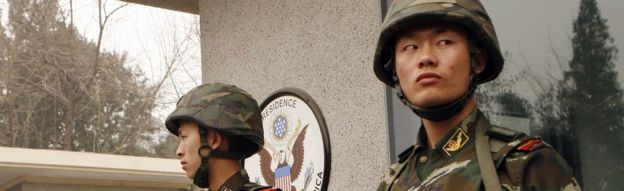
Three armed Chinese policemen guarding the US embassy in BeijingImage copyright AFP
Image caption Chinese police guard the US embassy in the capital, Beijing
  • 2010: Information gathered by the US from sources deep inside the Chinese government bureaucracy start to dry up
  • 2011: Informants begin to disappear. It is not clear whether the CIA has been hacked or whether a mole has helped the Chinese to identify agents
  • 2012: FBI begins investigation
  • May 2014: Five Chinese army officers are charged with stealing trade secrets and internal documents from US companies. Later that same month, China says it has been a main target for US spies
  • 2015: CIA withdraws staff from the US embassy in Beijing, fearing data stolen from government computers could expose its agents
  • April 2017: Beijing offers hefty cash rewards for information on foreign spies
  • May 2017: Four former CIA officials tell the New York Times that up to 20 CIA informants were killed or imprisoned by the Chinese between 2010 and 2012
  • June 2017: Former US diplomatic officer Kevin Mallory is arrested and charged with giving top-secret documents to a Chinese agent
  • January 2018: Former CIA officer Jerry Chun Shing Lee is arrested

Source: The BBC

06/05/2019

Warren Buffett says U.S.-China trade war ‘bad for the whole world’

(Reuters) – Warren Buffett said on Monday that a trade war between the United States and China would be “bad for the whole world.”

Buffett spoke after U.S. President Donald Trump tweeted on Sunday that he will raise tariffs on $200 billion of Chinese imports to 25 percent from 10 percent beginning on Friday, and “shortly” slap a 25-percent tariff on $325 billion of Chinese goods that have not been taxed.

Major stock markets fell worldwide on Monday in response to the president’s tweet, which came ahead of scheduled trade talks this week, and was a “rational” response, Buffett said on CNBC television.

Buffett’s conglomerate Berkshire Hathaway Inc owns or invests in many companies that do business in China, including Apple Inc, in which it has a more than $50-billion stake.

“If we actually have a trade war it will be bad for the whole world,” Buffett said.

A full-scale trade war is unlikely but “would be bad for everything Berkshire owns,” Buffett added.

He nonetheless said it would be “nonsense” for investors to sell stocks based on headlines, and that the U.S.-China would not affect how Omaha, Nebraska-based Berkshire operates.

“We will buy the same stocks today that we were buying last week,” he said.

Trump on Monday tweeted that the United States has for many years lost $600 billion to $800 billion annually on trade, and “with China we lose 500 Billion Dollars. Sorry, we’re not going to be doing that anymore!”

Buffett said tough talk ahead of trade negotiations was understandable, saying that for some people “the best technique is to act half-crazy,” but it would be ineffective to “shake your fist first and then shake your finger later on.”

He added that Trump’s threat raises the stakes for Chinese leader Xi Jinping.

“You’re talking about two personalities who are very much used to getting their way in politics, and talking about how they will be perceived in their own country in terms of their behavior,” Buffett said. “It gets very complicated.”

Buffett said the trade dispute has already had an effect on Berkshire’s BNSF railroad.

Last week, Jim Weber, the chief executive officer of Berkshire’s Brooks Running unit, said in an interview that his company was ending most shoe production in China and moving it to Vietnam because of tariff concerns.

Buffett also said the United States should bolster its trade relations with Canada and Mexico.

“We’ve got lots and lots and lots of common interests,” he said. “Trade with Mexico and Canada is enormously important. We should treat them as neighbors, and not adversaries.”

Berkshire ended March with $191.8 billion of equity investments. It also owns more than 90 companies including energy and utility companies, Geico auto insurance and Dairy Queen ice cream.

Source: Reuters

05/05/2019

2nd Digital China Exhibition held in Fuzhou, China’s Fujian

CHINA-FUJIAN-FUZHOU-DIGITAL CHINA EXHIBITION (CN)

Photo taken on May 5, 2019 shows the booth of Xinhua News Agency at the 2nd Digital China Exhibition in Fuzhou, southeast China’s Fujian Province. The 2nd Digital China Exhibition runs from May 5 to 9 at the Fuzhou Strait International Conference & Exhibition Center. (Xinhua/Wei Peiquan)

Source: Xinhua

05/05/2019

Trump to raise tariffs on $200bn of Chinese goods

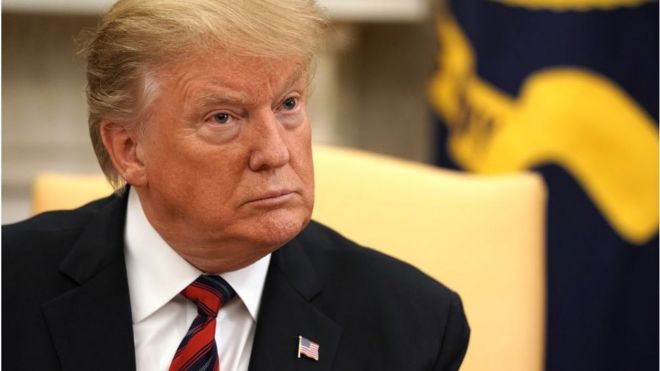
Donald TrumpImage copyright GETTY IMAGES

Donald Trump has said he will raise tariffs on $200bn in Chinese goods this week, because talks on a US-China trade deal are moving “too slowly”.

The US president tweeted that tariffs of 10% would rise to 25% on Friday, saying: “The Trade Deal with China continues, but too slowly, as they attempt to renegotiate. No!”

Some $325bn of untaxed goods will also face 25% duties “shortly”, he said.

It follows signals from Washington that a US-China trade deal was imminent.

The move dramatically increases the pressure on China, after Mr Trump previously delayed the tariff increases earlier in the year, citing progress in talks.

Trade trade talks are due to resume this week, with Chinese Vice Premier Liu He due to travel to Washington.

That follows talks in April in Beijing that US Treasury Secretary Steven Mnuchin called “productive.”

So far, the US has imposed tariffs ranging from 10-25% on $250bn (£191bn) of Chinese goods, having accused the country of various unfair trade practices

Beijing has hit back with duties on $110bn of US goods, blaming the US for starting “the largest trade war in economic history”.

Source: The BBC

05/05/2019

China putting minority Muslims in ‘concentration camps,’ U.S. says

WASHINGTON (Reuters) – The United States accused China on Friday of putting well more than a million minority Muslims in “concentration camps,” in some of the strongest U.S. condemnation to date of what it calls Beijing’s mass detention of mostly Muslim Uighur minority and other Muslim groups.

The comments by Randall Schriver, who leads Asia policy at the U.S. Defense Department, are likely to increase tension with Beijing, which is sensitive to international criticism and describes the sites as vocational education training centres aimed at stemming the threat of Islamic extremism.

Former detainees have described to Reuters being tortured during interrogation at the camps, living in crowded cells and being subjected to a brutal daily regimen of party indoctrination that drove some people to suicide.

Some of the sprawling facilities are ringed with razor wire and watch towers.

“The (Chinese) Communist Party is using the security forces for mass imprisonment of Chinese Muslims in concentration camps,” Schriver told a Pentagon briefing during a broader discussion about China’s military, estimating that the number of detained Muslims could be “closer to 3 million citizens.”

When asked by a reporter why he used the term, Schriver said that it was justified “given what we understand to be the magnitude of the detention, at least a million but likely closer to 3 million citizens out of a population of about 10 million.””So a very significant portion of the population, (given) what’s happening there, what the goals are of the Chinese government and their own public comments make that a very, I think, appropriate description,” he said.
The Chinese embassy in Washington did not immediately respond to a request for comment.
U.S. Secretary of State Mike Pompeo on Thursday used the term re-education camps to describe the sites and said Chinese activity was “reminiscent of the 1930s.”
The U.S. government has weighed sanctions against senior Chinese officials in Xinjiang, a vast region bordering central Asia that is home to millions of Uighurs and other Muslim ethnic minorities. China has warned that it would retaliate “in proportion” against any U.S. sanctions.
The governor of Xinjiang in March directly dismissed comparisons to concentration camps, saying they were “the same as boarding schools.”
U.S. officials have said China has made criminal many aspects of religious practice and culture in Xinjiang, including punishment for teaching Muslim texts to children and bans on parents giving their children Uighur names.
Academics and journalists have documented grid-style police checkpoints across Xinjiang and mass DNA collection, and human rights advocates have decried martial law-type conditions there.
Source: Reuters
05/05/2019

India student leader ‘a symbol of protest’ against PM Modi

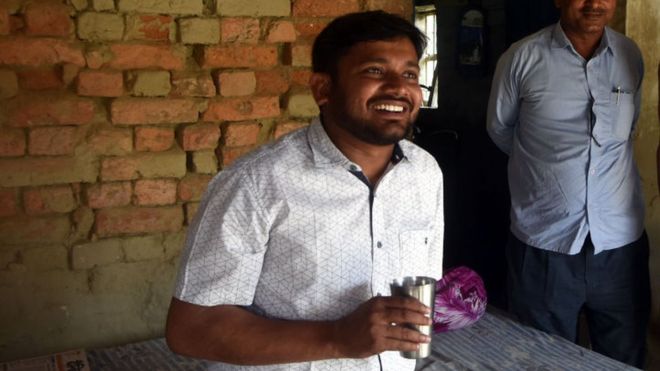
Kanhaiya Kumar CPI Candidate for Begusarai Lok Sabha seat meets with people in rural area on April 2, 2019 in Begusarai, India.Image copyrightGETTY IMAGES
Image caption Mr Kumar is a candidate for the Communist Party of India

A district in one of India’s poorest states has made national headlines in the ongoing general election after a firebrand student leader decided to run for a seat there. Kanhaiya Kumar, who was charged with “sedition” for allegedly shouting anti-India slogans and spent a few weeks in jail in 2016, is a candidate from Begusarai constituency where voting was held on Monday. Neha Thirani Bagri reports.

It is early morning in the Bihari village of Bihat, when Kanhaiya Kumar emerges from his home.

He is immediately swamped by young men rushing to shake his hand, asking to take selfies with him, wearing t-shirts emblazoned with his image.

Mr Kumar, who grew up here, shot to fame in 2016 when he was arrested and charged with sedition.

Then a student union leader at Delhi’s Jawaharlal Nehru University, he was accused of chanting anti-India slogans at a campus event to commemorate the anniversary of the hanging of Mohammed Afzal Guru, a Kashmiri man convicted of plotting the 2001 attacks on the Indian parliament.

His arrest became the rallying cry for critics of the Hindu nationalist politics of India’s ruling Bharatiya Janata Party (BJP), with student protests organised across the country.

Mr Kumar is still fighting the charge of sedition, a colonial-era statute that has been used to clamp down on dissent in India, which he calls “completely false propaganda.”

“Kanhaiya Kumar has become a symbol of protest against the politics which is represented by Prime Minister Narendra Modi,” said Sanjay Kumar, director of the Centre for the Study of Developing Societies.

Mr Kumar has since completed his PhD. On Monday, he had his first foray into politics, when he ran for election in the constituency of Begusarai in the fourth phase of polling in the Indian election. Votes will only be counted in late May.

The constituency was once a communist stronghold known as the “Leningrad of Bihar.”

“This was not a choice, to enter politics. It was a forced responsibility,” Mr Kumar said during a full day of campaigning before his constituency went to the polls.

Mr Kumar is from the Communist Party of India (CPI), the influence of which has been waning over the past few years.

Presentational grey line

India votes 2019

Presentational grey line

“Our constitution talks about a secular country. If they are attempting to invoke a particular religion and change the character of the state, then, of course, we will oppose this.”

While Mr Modi swept to a historic victory in India’s last election in 2014 on the promise of better days ahead, many rural Indians have been disappointed with rising unemployment and an agrarian crisis.

Mr Modi and other BJP leaders have been criticised for spouting communally-charged rhetoric and remaining silent in the face of increasing religious violence.

The main opposition Congress party has struggled to mount a strong challenge, though gained some momentum with victories in key state elections last year.

Bihar, India’s third most populous state, elects 40 members out of 545 to India’s lower house of parliament. In the 2014 general election, the BJP won 22 of the 40 seats.

On Monday, Mr Kumar went up against BJP’s Giriraj Singh, who once said that those who oppose Mr Modi should go to Pakistan. It was a three-way contest with the regional Rashtriya Janata Dal (RJD), which has fielded a Muslim candidate.

Media captionKanhaiya Kumar talks about his politics

“Right now, people’s real issues have vanished from the conversation,” said Mr Kumar.

He has become known for often emphasising education, jobs, public healthcare, and minority rights in his speeches.

Mr Kumar has garnered the support of civil rights campaigners, activists, and celebrities from across India.

His outsized social media presence has also made him particularly popular with young people, many of whom are drawn towards Mr Kumar’s charismatic personality, fiery oratory, and local roots.

‘Connect with the young’

Videos of his speeches, often critical of the BJP and right-wing politics, have garnered millions of views on YouTube and Facebook.

“Kanhaiya’s thinking connects with us young people,” said Pankaj Kumar, 24, adding that he often shares the politician’s speeches with his friends on WhatsApp.

“If Kanhaiya wins at least we will have pride – it was because of him that Begusarai became famous in India and even the whole world.”

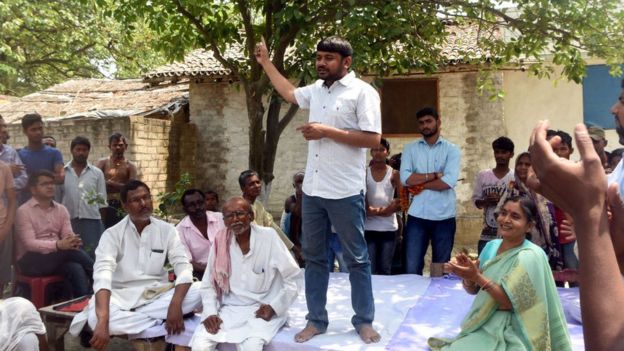
Kanhaiya Kumar CPI Candidate for Begusarai Lok Sabha seat addresses people of rural area on April 2, 2019 in Begusarai, India.Image copyrightGETTY IMAGES
Image captionMr Kumar’s fiery speeches have drawn in voters

Mr Kumar’s speeches have also attracted a sizeable number of Muslim voters – many in the district were vocal supporters of him.

“People with power in this country are only thinking about how to create religious division,” said Mohammed Shoaib Alam.

“Kanhaiya will raise his voice for the issues of poor people,” he added.

While Mr Kumar’s popularity has drawn national attention to the contest for the parliamentary seat from this remote constituency, his victory is far from certain.

“All odds are against him,” said Neelanjan Sircar, a senior fellow at the Centre for Policy Research, adding that Mr Kumar did not benefit from having the backing of a large political party or coalition or the consolidated vote from one community.

“If he pulls this off – and he is massively popular on the ground – it would just be a testament to his individual political skill.”

Source: The BBC

Law of Unintended Consequences

continuously updated blog about China & India

ChiaHou's Book Reviews

continuously updated blog about China & India

What's wrong with the world; and its economy

continuously updated blog about China & India