Archive for ‘Uncategorized’

05/05/2019

India’s rural pain goes beyond farmers, and it may be a problem for Modi

ZADSHI VILLAGE, India (Reuters) – Three years ago, brick mason Pundlik Bhandekar was always busy as farmers in his tiny hamlet in Maharashtra commissioned new houses and nearby towns were undergoing rapid urbanisation. Now, as the rural economy sinks and the pace of construction slows, Bhandekar is struggling to get work.

“I used to get a new construction project before I could even finish one. People would come to my house to check when I would be free to work for them,” said Bhandekar, as he sat with friends under the shade of a tree on a hot afternoon.

From daily wage workers such as masons, to barbers and grocery shop owners – just about everyone in Zadshi village, some 720 km (450 miles) from India’s financial hub Mumbai, says a drop in farm incomes has dented their livelihoods.

Their woes are symptomatic of a wider problem across India, where more than half of the country’s 1.3 billion people are dependent on agriculture for their livelihoods, as the slowdown in the rural economy is felt in the dampening sales of consumer goods, especially the biggest such as car and motorbike sales.

The slowdown has also dented Prime Minister Narendra Modi’s popularity in the hinterland that propelled him to power in 2014, and political strategists say it may mean he struggles to form a majority after voting in a staggered general election that began on April 11 concludes on May 19.

Zadshi has been almost entirely dependent on annual cotton and soybean crops that, according to farmers, have given lacklustre returns in the past few years due to a dip in prices, droughts and pest attacks.

And as incomes have dropped, farmers have cut back on big-ticket spending such as building new houses, digging wells or laying water pipelines, squeezing employment opportunities for people such as Bhandkekar.

“No one is interested in hiring us. We are ready to work even at 250 rupees ($3.60) per day,” said Bhandekar, who charged 300 rupees a day when work was steady, but now gets work only once or twice in a fortnight.

LOWER WAGES, LESS SPENDING

Economic data reflects the plight of farmers and daily wage workers.

Retail food inflation in the fiscal year ended on March 31 fell to 0.74 percent, even as core inflation stood at 5.2 percent, according to Bank of America Merrill Lynch Research, eroding the spending power of farmers.

Inflation adjusted wage growth for workers involved in crop sowing was just 0.6 percent 2018/19 compared with 6.5 percent in 2013/14.

The value of farm produce at constant prices grew 15 percent in the past five years, compared with 23 percent in the previous five, while the manufacturing sector grew 40 percent, against 32.6 percent in the previous five years, government data shows.

“Lower rural wages will result in lesser spending, which in turn will reduce demand for goods and services that are part of the rural basket,” Rupa Rege Nitsure, group chief economist at L&T Finance Holdings in Mumbai, told Reuters.

The government needs to spend more in rural areas to generate employment and boost incomes, Nitsure said.

Modi’s Hindu nationalist government did introduce various support schemes in the past six months, such as a 6,000 rupees yearly handout to small farmers.

The main opposition Congress party has gone much further with its pledges though, saying it would introduce a basic minimum income, where the country’s poorest families would get 72,000 rupees annually, benefiting some 250 million people.

RISING UNEMPLOYMENT

In Zadshi, as the mercury touched a searing 40 degrees Celsius(104F), a group of villagers gathered under the trees lining a dusty road and began chatting about everything from crop prices to politics.

“What else we can do? Had work been available in urban areas, we could have moved there but even in the cities construction has slowed down,” said Amol Sontakke, an unskilled labourer who works in farms and on construction sites.

Job opportunities have slowed even in urban areas and India’s unemployment rate touched 7.2 percent in February, the highest since September 2016, according to data compiled by the Centre for Monitoring Indian Economy (CMIE). Official data is unavailable for recent periods.

The mood in Zadshi was glum. While four dozen villagers interviewed by Reuters were hopeful that if there was a good monsoon this year it could improve farm incomes, they’ve been cutting back on spending in the meantime.

“People are thinking twice before buying new clothes during festivals,” said Avinash Gaurkar, a farmer currently doubling up as a part-time driver. “Buying big-ticket items such as motorcycles or refrigerators is out of the question.”

Two years ago Gaurkar began building a house, but had to give up midway as his five-acre farm could not generate the money needed, he said, pointing towards a half-finished structure without doors.

In 2018, just four villagers bought new motorbikes compared with as many as 10 a year about four years ago, said cotton farmer Raju Kohale, whose son is sitting at home unemployed after graduating as an engineer.

“Poor monsoon or lower prices, something or the other has been hurting us in the past few years,” Kohale said.

MODI AGAIN?

In the 2014 general election, most in Zadshi voted for Modi, but the farmers’ distress has swayed many towards the opposition Congress party. That was clear from Reuters’ interviews with 48 villagers, who cast their ballots last month.

Farmers are at the bottom of the Modi administration’s priority list, said labourer Sagar Bahalavi.

“They are building big roads to connect metros and calling it development. How is that useful for us?” he said.

Some, though, want to give Modi a second chance.
“Modi’s intentions are good, it’s the bureaucratic system that is not supporting him,” said Gulab Chalakh, who owns a 20-acre farm and is among the richest in the village. “We should give him another chance.”
Source: Reuters
02/05/2019

China, Thailand to hold joint naval training

ZHANJIANG, Guangdong, May 1 (Xinhua) — China and Thailand’s naval forces will hold their joint training, code-named Blue Commando-2019, starting on Thursday.

The fleet of Thai forces arrived at the port city of Zhanjiang, south China’s Guangdong Province on Wednesday.

They were welcomed by the navy of the Southern Theater Command of the Chinese People’s Liberation Army.

The drill will be held both on land and at sea, as Chinese and Thai fleets and marines will train on subjects including fleet defense, landing, live-fire attacks and marine rescue.

Source: Xinhua

02/05/2019

Tibet launches venture base to promote cultural industry

LHASA, May 1 (Xinhua) — China’s Tibet Autonomous Region Tuesday launched its first innovation and entrepreneurship base for small and micro venture companies wanting to take a share of the booming cultural industry.

The base, established by the regional department of culture, prioritizes incubating locally-established cultural startups by providing innovation-oriented training as well as displaying featured cultural products.

Sambo, deputy head of the department, said the base aims to promote Tibetan culture through innovative companies and their featured cultural products.

Official data shows the number of cultural companies in Tibet exceeded 6,000 with more than 50,000 employees by the end of 2018. Their total annual output value surpassed 4.6 billion yuan (about 683 million U.S. dollars), with average yearly growth being maintained at over 15 percent.

Source: Xinhua

02/05/2019

China, U.S. hold 10th round of high-level trade consultations in Beijing

CHINA-U.S.-ECONOMIC AND TRADE CONSULTATIONS (CN)

This combo photo shows Chinese Vice Premier Liu He, who is also a member of the Political Bureau of the Communist Party of China Central Committee and chief of the Chinese side of the China-U.S. comprehensive economic dialogue, posing for photos with U.S. Trade Representative Robert Lighthizer and Treasury Secretary Steven Mnuchin. They held the tenth round of China-U.S. high-level economic and trade consultations in Beijing from April 30, 2019 to May 1, 2019. (Xinhua/Shen Hong, Zhai Jianlan)

BEIJING, May 1 (Xinhua) — Chinese Vice Premier Liu He, U.S. Trade Representative Robert Lighthizer and Treasury Secretary Steven Mnuchin held the tenth round of China-U.S. high-level economic and trade consultations in Beijing from Tuesday to Wednesday.

As planned, the two sides will hold the 11th round of high-level economic and trade consultations in Washington D.C. next week.

Liu is also a member of the Political Bureau of the Communist Party of China Central Committee and chief of the Chinese side of the China-U.S. comprehensive economic dialogue.

Source: Xinhua

02/05/2019

China Int’l Emergency Medical Team (Macao SAR) certified by WHO

MACAO, April 30 (Xinhua) — China International Emergency Medical Team (Macao SAR) successfully passed the evaluation and certification of the World Health Organization (WHO) on Tuesday, becoming the fifth Chinese international emergency medical team, a WHO verification team said in the special administrative region (SAR).

Macao SAR Health Bureau held a press conference on Tuesday afternoon to introduce the preparation work of Macao’s international emergency medical team, and show its facilities and operation to local media.

Ian Norton, a representative from WHO Emergency Medical Team (EMT) Secretariat, told media that the Macao team not only meets the relevant WHO standards, but also has unique advantages in use of languages. Besides their mother tongue, the team members can also speak in English and Portuguese, and can be deployed to Portuguese-speaking countries.

He added that the Macao team will also bring back the experience and expertise they have learned from assistance missions, and better serve Macao and its residents.

The medical team members were drawn from the staff of Health Bureau and Fire Department of Macao SAR government. A total of 120 members were divided into four squads, each consisting of doctors, paramedics, pharmacists, engineers and logistics personnel.

The standard deployment of the whole team covers an area of 3,600 square meters with 41 tents, can diagnose and treat over 100 persons per day, and independently complete the clinical medical work for 14 days.

Macao’s international emergency medical team is the 25th in the world and the fifth in China certified by WHO.

Source: Xinhua

02/05/2019

China’s roads jammed as millions take Labour Day holiday

  • Major highways gridlocked for hours at start of four-day break
  • Chaos at railway stations as ticket-holding passengers turned away
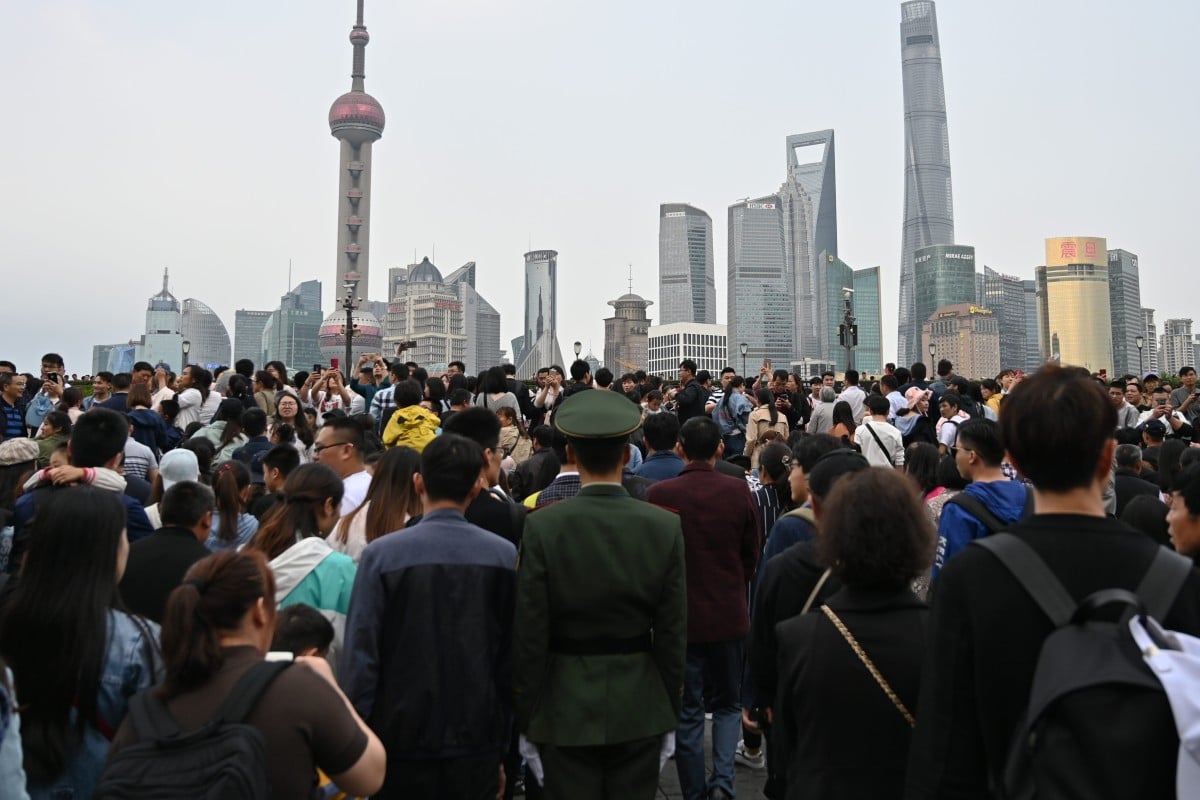
Holiday crowds pack the promenade on the Bund along the Huangpu River in Shanghai on the first day of China’s May break. Photo: AFP
China’s Labour Day holiday started on Wednesday with gridlocked roads and chaos at railway stations as millions of people took advantage of this year’s unusually long break.
Motorists reported being stuck in traffic jams which did not move for hours, while ticket-holding passengers were turned away from some trains due to severe overcrowding on the first day of the holiday.
Travel agency Ctrip estimated that around 160 million domestic tourists would be travelling over the four-day break, according to data from travel booking platforms.
Forty major highways recorded a 75 per cent spike in traffic on Wednesday, according to Xinhua, as toll fares for cars were suspended for the holiday.
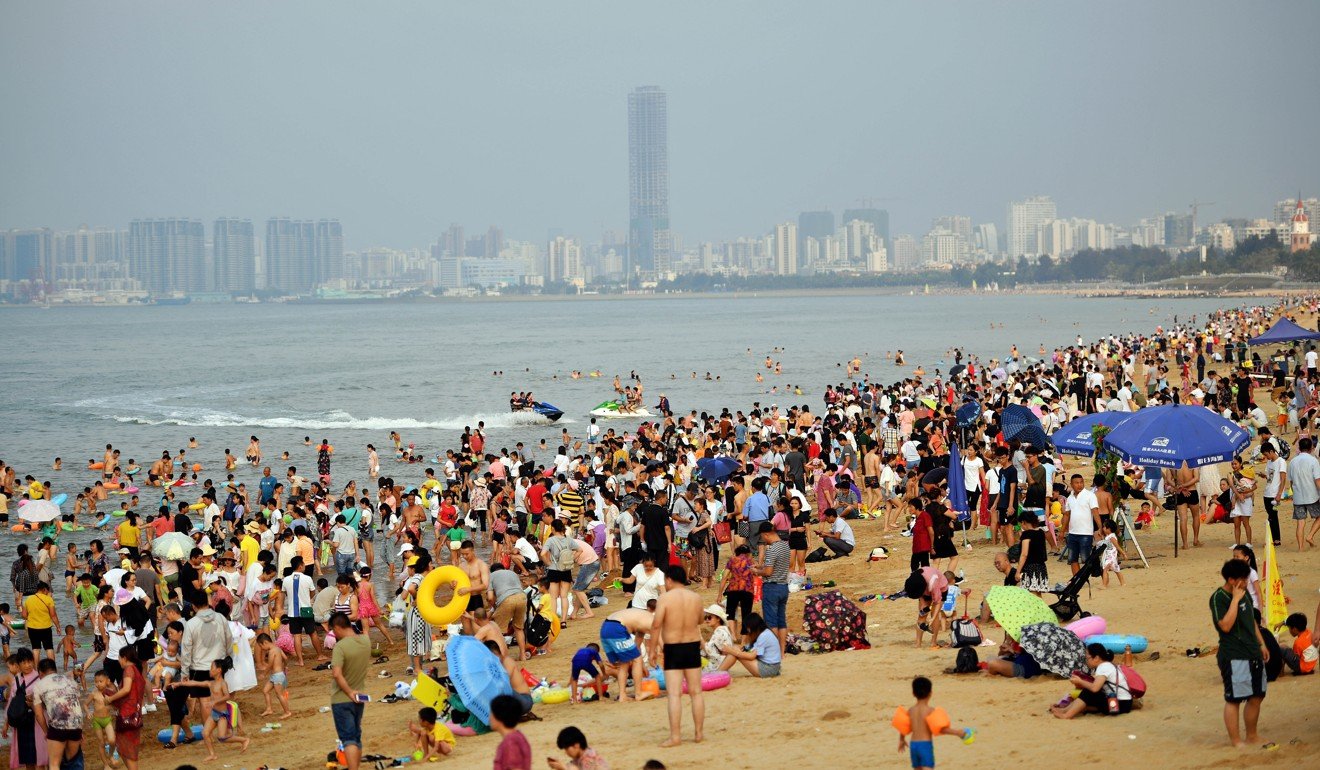
Tourists enjoy the first day of China’s four-day May holiday on a beach in Haikou, Hainan province, southern China. Photo: Xinhua

Monitoring stations on major routes – including the Beijing-Tibet Expressway, the Shanghai-Shaanxi Expressway, Shanghai’s Humin Elevated Road and the Beijing section of the Beijing-Hong Kong-Macau Expressway – recorded a 200 per cent increase in traffic from Tuesday onwards, Xinhua said.

The Ministry of Public Security’s traffic management bureau has warned holiday motorists to drive safely, especially on winding mountainside routes.

Online news portal The Paper reported on Thursday that traffic jams on some major routes were so severe that the drive from Shanghai to Hangzhou, capital of neighbouring Zhejiang province, took some travellers seven hours instead of the usual two.

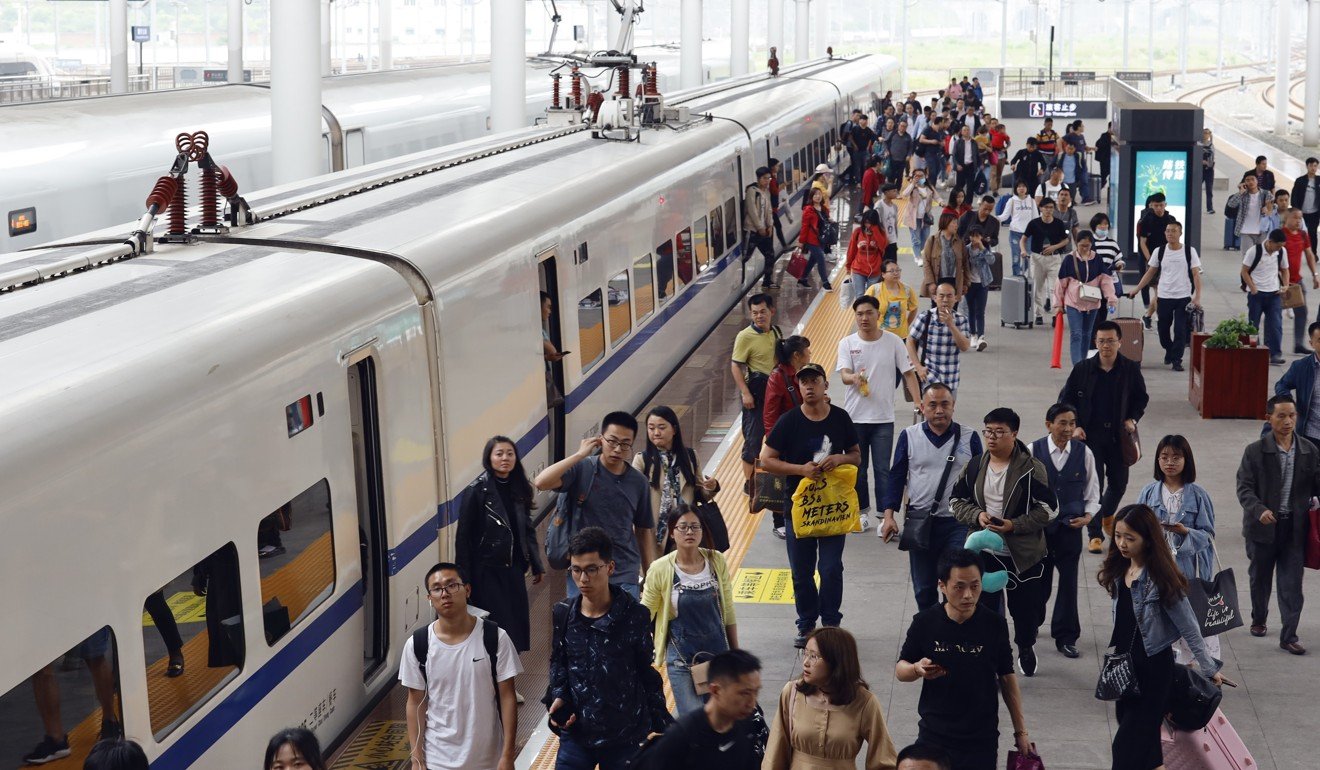
Passengers board the train at Chongqing North Railway Station in southwest China on Tuesday, hoping to beat the May holiday travel rush. Photo: Xinhua
Meanwhile, more than 54,000 tourists visited the popular Badaling section of the Great Wall on Wednesday, according to Beijing Youth Daily. The attraction’s management team had increased the number of volunteers, parking spaces and shuttle buses to prepare for the influx, the report said.
More than 53,000 tourists had visited the Shanghai International Tourism Resort and Shanghai Disneyland by 4pm on Wednesday, according to data from the Shanghai municipal government’s real-time visitor tracker. The Shanghai Zoo attracted more than 24,000 people, and more than 9,200 visited the Shanghai Science and Technology Museum.
Despite the crowds, no records were broken at the Shanghai attractions, which reached about 70 per cent of their maximum visitor numbers recorded, The Paper reported.
At railway stations, ticket-holding passengers were stopped from boarding trains between Nanjing and the city of Zibo in Shandong province, eastern China, due to severe overcrowding, Beijing Youth Daily reported on Wednesday.
Station staff promised full refunds to customers with pre-booked tickets who were refused entry.
Source: SCMP
02/05/2019

Why jobs are dominating the Indian election

As unemployment climbs in India, job creation is top of the agenda this election season.

By some estimates the country needs to create eight to ten million jobs each year to tackle the problem. But is the goal achievable?

Source: The BBC

02/05/2019

Towns evacuate, tourists flee as cyclone churns towards Indian northeast coast

BHUBANESHWAR, India/NEW DELHI (Reuters) – India has evacuated more than 200,000 people along its northeast coastline by boat, bus and train ahead of a severe cyclone due to make landfall on Friday, with many villagers piling household possessions on to trucks before fleeing their homes.

Severe cyclonic storm Fani was lying in the Bay of Bengal about 420 km (260 miles) south-southwest of the Hindu temple town of Puri where special trains were put on to evacuate tourists and the beaches were empty.
In total, about 800,000 people are expected to be evacuated from low-lying areas of the eastern state of Odisha to cyclone shelters, schools and other buildings, authorities said.
“We are maximizing efforts at all levels for evacuation,” Odisha’s Special Relief Commissioner Bishnupada Sethi told Reuters.
Fani was generating maximum sustained winds of 170-180 km (105-111 miles) per hour, the state-run India Meteorological Department said. Cyclone tracker Tropical Storm Risk rated Fani a mid-range category 3 storm.
Authorities have also shut down operations at two major ports – Paradip and Visakhapatnamon – and ships have been ordered to move out to avoid damage.
In Paradip, television footage showed residents piling bicycles, sewing machines and gas cylinders on to small trucks and leaving for any of nearly 900 shelters supplied with food, water and medicines.
Odisha state government has deployed hundreds of disaster management personnel, closed schools and colleges and asked doctors and other health officials not to go on leave until May 15.
India’s cyclone season can last from April to December, when severe storms batter coastal cities and cause widespread deaths and damage to crops and property in both India and neighboring Bangladesh.
Technological advancements have helped meteorologists to predict weather patterns well in advance, giving authorities more time to prepare.


In 1999, a super-cyclone battered the coast of Odisha for 30 hours, killing 10,000 people. A mass evacuation of nearly a million people saved thousands of lives in 2013.

The National Disaster Response Force (NDRF) has sent 50 teams across four coastal states, including Odisha. The NDRF has also put 32 teams equipped with boats, tree cutters, medical supplies, telecoms gear and other equipment on standby.

“I think we are fully prepared,” Satya Narayan Pradhan, NDRF director general, told state TV.

Source: Reuters

01/05/2019

Chinese Foreign Ministry comments on U.S. announcement to withdrawal from ATT

BEIJING, April 30 (Xinhua) — China said Tuesday it hopes that relevant country can do more things conducive to strengthening the mechanism of international arms control and safeguarding international and regional peace and stability.

Foreign Ministry spokesperson Geng Shuang made the comments after U.S. President Donald Trump announced on April 26 that the United States was withdrawing from the Arms Trade Treaty (ATT), which regulates international trade in conventional arms and seeks to prevent and eradicate illicit trade and diversion of conventional arms by establishing international standards governing arms transfers.

“We hope that relevant country can do more things conducive to strengthening the mechanism of international arms control and safeguarding international and regional peace and stability,” Geng said at a daily press briefing.

Calling ATT an important multilateral treaty in the field of conventional arms control, Geng said that China supports the international community taking necessary measures in setting standards for international trade of arms and cracking down on illegal transfer and trafficking of arms.

China supports the purpose and goals of the ATT, and has been attending relevant conferences as an observer, Geng said, adding China has been considering joining the treaty.

Source: Xinhua

01/05/2019

China Focus: Xi holds talks with Lao president to promote ties

CHINA-BEIJING-XI JINPING-LAO PRESIDENT-TALKS (CN)

Xi Jinping (R), general secretary of the Communist Party of China (CPC) Central Committee and Chinese president, holds talks with Lao President Bounnhang Vorachit, who is also general secretary of the Lao People’s Revolutionary Party Central Committee, in Beijing, capital of China, April 30, 2019. (Xinhua/Li Xueren)

BEIJING, April 30 (Xinhua) — Xi Jinping, general secretary of the Communist Party of China (CPC) Central Committee and Chinese president, held talks here Tuesday with Lao President Bounnhang Vorachit, who is also general secretary of the Lao People’s Revolutionary Party Central Committee.

The two leaders agreed to forge ahead with the efforts in building a community with a shared future for the two countries and work together to usher in a new era for bilateral ties.

After the talks, the two leaders inked an action plan between the CPC and the Lao People’s Revolutionary Party on building a community with a shared future for the two countries.

Noting that this year marks the 10th anniversary of the establishment of the comprehensive strategic cooperative partnership between China and Laos, Xi said as bilateral ties now stand at the best stage in history, China will work with Laos to take the opportunity of signing the action plan to jointly cultivate the bilateral relationship in the new era.

Xi said China and Laos should take strengthening the leadership of the CPC and the Lao People’s Revolutionary Party as guidance and grasp the correct direction of the development of bilateral ties in the new era.

He said the two parties must strengthen their strategic self-confidence and sense of urgency, uphold party leadership and ensure the long-term stability of the two countries, so as to contribute to the development of the socialist cause.

Noting the two sides should maintain close high-level exchanges, Xi said he would like to carry on the good tradition of conducting annual meetings with Bounnhang.

Xi also called on the two sides to deepen theoretical exchanges and strengthen exchanges between their cadres.

China and Laos should accelerate the synergy of each other’s development strategies, promote the construction of economic corridors, expand the radiation and demonstration effects of major projects such as the China-Laos railway, so as to contribute more to regional connectivity, common development and prosperity, Xi said.

The two sides should also closely coordinate and cooperate within multilateral mechanisms such as the United Nations, East Asian cooperation and the Lancang-Mekong cooperation, said the Chinese president.

Bounnhang spoke highly of China’s great achievements in Party and state building and hailed China’s successful experience in poverty alleviation.

He said it is an unshakable policy of Laos to develop its traditional friendship with China. Laos appreciates China’s long-term support and will work with China to give further play to the leading role of the inter-party ties in the development of the state-to-state relationship, and maintain regular high-level meetings between the two parties.

Regarding the Belt and Road initiative, Bounnhang said Laos will continue to accelerate cooperation in major projects, so as to further promote the prosperity of the two countries and the region.

Concerning the action plan, Xi said this is the first time for China and Laos to sign a cooperation document on building a community with a shared future on the bilateral level, which will not only benefit the two parties, countries and peoples, but also serve as a significant exploration in advancing humanity.

Bounnhang said the signing of the action plan will further promote the building of a community with a shared future for humanity.

The two leaders also watched the signing of a series of cooperation documents after the talks.

Source: Xinhua

Law of Unintended Consequences

continuously updated blog about China & India

ChiaHou's Book Reviews

continuously updated blog about China & India

What's wrong with the world; and its economy

continuously updated blog about China & India