Chindia Alert: You’ll be Living in their World Very Soon
aims to alert you to the threats and opportunities that China and India present. China and India require serious attention; case of ‘hidden dragon and crouching tiger’.
Without this attention, governments, businesses and, indeed, individuals may find themselves at a great disadvantage sooner rather than later.
The POSTs (front webpages) are mainly 'cuttings' from reliable sources, updated continuously.
The PAGEs (see Tabs, above) attempt to make the information more meaningful by putting some structure to the information we have researched and assembled since 2006.
Ghazi Abdul Rashid was an aide of the Pakistan-based JeM patron, Masood Azhar, and had infiltrated into India in mid-December to train Kashmiri terrorists in IED blasts, according to authorities
SP Sharma | Jammu | February 18, 2019 4:26 pm
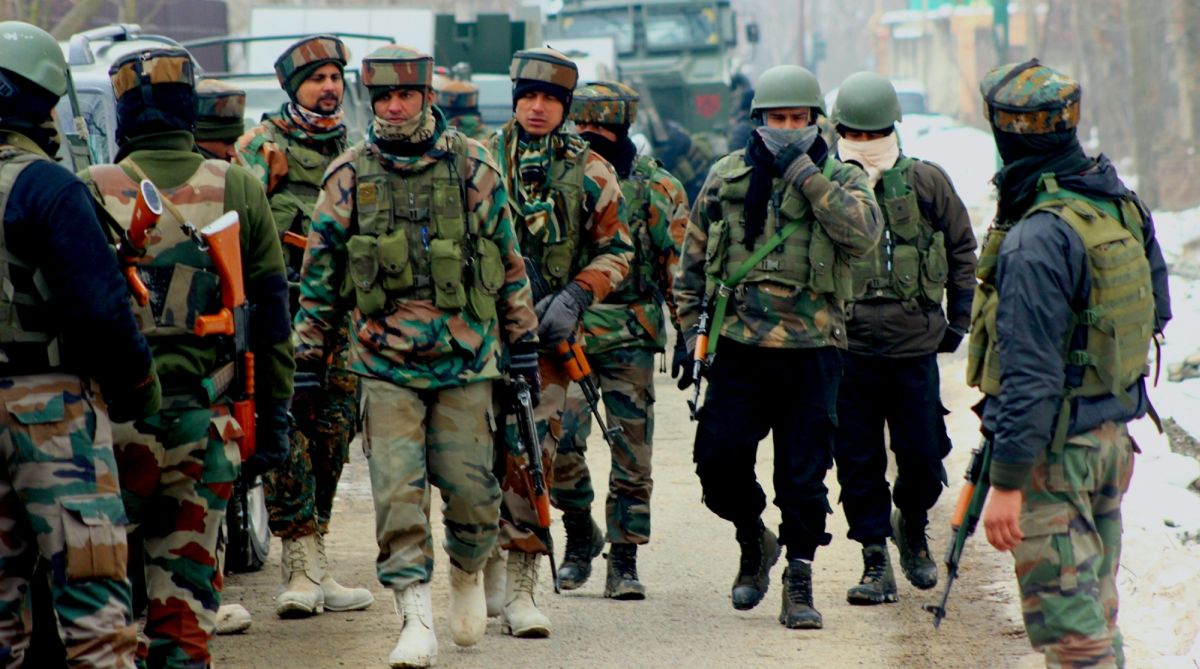
In a major success, security forces in Jammu and Kashmir killed two Pakistani terrorists, including Jaish-e-Mohammad (JeM) top commander Ghazi Abdul Rashid who was the mastermind of the 14 February Pulwama terror attack in which 44 CRPF jawans were martyred, in an encounter in the same of South Kashmir area on Monday. Ghazi, a trusted man of JeM patron Azhar Masood, reportedly motivated and trained a Kashmiri youth, Adil Dar, to ram his explosives-laden car into a convoy of CRPF vehicles. The nearly 10-hour-long Pulwama encounter also left four Army personnel, including a Major, and a civilian killed.
The second slain militant was identified as Bilal Ahmed Naik, who was a local Kashmiri.
The encounter took place after a joint team of the Army, the CRPF and the J&K Police cordoned off the area on Sunday night.
The martyred soldiers are Major Vibhuti Shankar Dhoundiyal, Havaldar Sheo Ram, and Sepoys Ajay Kumar and Hari Singh. After Major Chitresh Singh Bisht, who died while defusing a mine in Rajouri on Saturday, Major Dhoundiyal is the second officer of the rank from Dehradun to be attain martyrdom in Kashmir this month.
MUNICH, Germany, Feb. 16 (Xinhua) — People-to-people and cultural exchanges are thriving, making China and Europe a great example of cultural dialogue and engagement, a senior Chinese official said here Saturday.
Yang Jiechi, a member of the Political Bureau of the Communist Party of China (CPC) Central Committee, said this in his keynote speech themed “Working for a Community with a Shared Future for Mankind by Promoting International Cooperation and Multilateralism” at the 55th Munich Security Conference.
Fifteen years since the establishment of the China-EU comprehensive strategic partnership, the two sides have developed an all-dimensional and multi-tiered framework of exchanges and cooperation covering wide-ranging areas, said Yang, who is also director of the Office of the Foreign Affairs Commission of the CPC Central Committee.
Efforts to build China-EU partnerships for peace, growth, reform and civilization have made substantial progress, Yang noted.
“It is essential that our two sides continue to draw on each other’s strengths, focus on shared interests, remove obstacles and work together to seize the opportunities presented by the Fourth Industrial Revolution and meet our people’s aspirations for a better life,” said the official.
This year marks the 70th anniversary of the founding of the People’s Republic of China. Under the leadership of the Communist Party of China, Yang said, the country has embarked on the right path, one that is suited to its national conditions and follows the trend of the times.
The Chinese economy has entered a new phase of transitioning from high-speed growth to high quality development, operating within a proper range and maintaining overall stability and continued progress, he added.
“Facing lackluster new drivers and mounting downward pressure in the global economic context, China has enough resilience and huge potential to keep the economy on a sound track for a long time to come,” Yang said.
The enormous effective demand being generated by the 1.4 billion Chinese people who are moving up the income ladder will provide the world with even more opportunities in terms of market, investment and cooperation, he reassured.
German Chancellor Angela Merkel makes appeal to Beijing at Munich Security Conference as Washington prepares to leave INF treaty
But China’s top diplomat Yang Jiechi says nation’s missiles are defensive, do not pose a threat
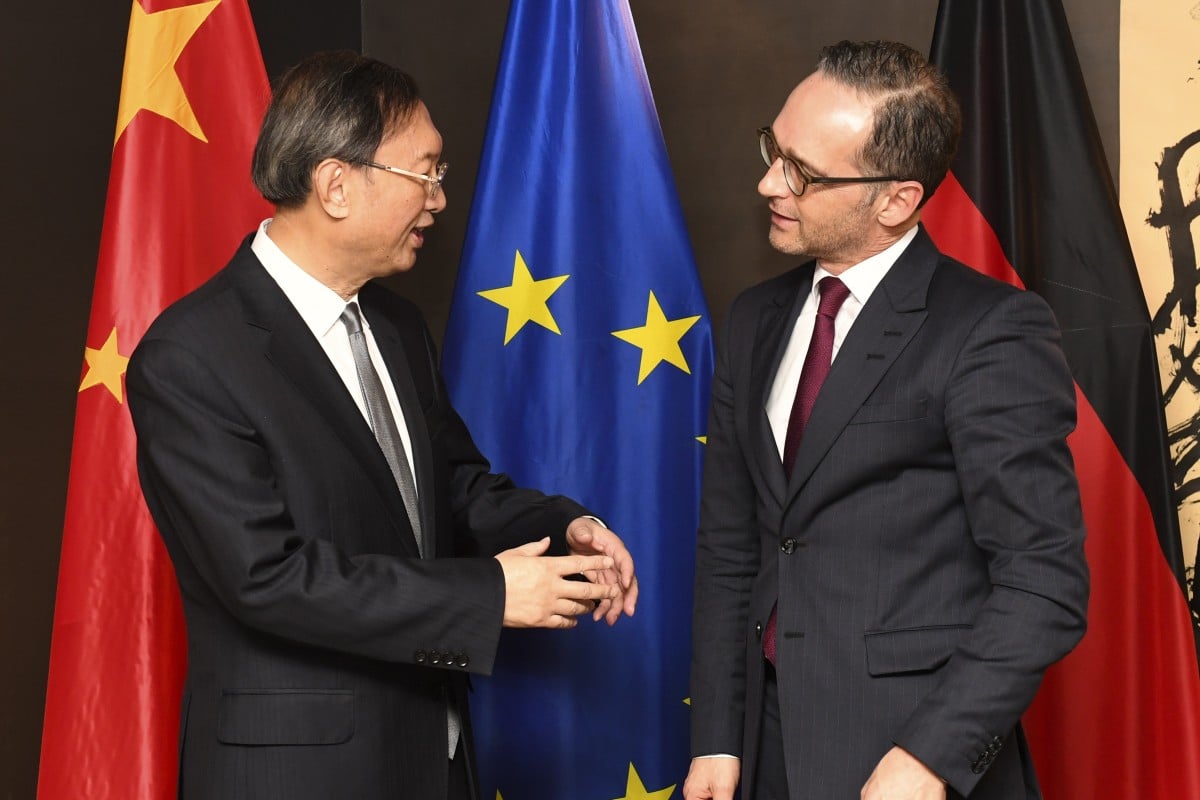
Chinea’s top envoy Yang Jiechi chats to German Foreign Minister Heiko Maas at the Munich Security Conference. Photo: AP
China on Saturday rejected German Chancellor Angela Merkel’s appeal to join a cold war-era arms control treaty that the United States accuses Russia of breaching, saying it would place unfair limits on its military.
Fearing a nuclear arms race between China, Russia and the US after the collapse of the Intermediate-Range Nuclear Forces (INF) treaty, which the US is withdrawing from, Merkel made her call for a global treaty.
“Disarmament is something that concerns us all and we would of course be glad if such talks were held not just between the United States, Europe and Russia but also with China,” she told the Munich Security Conference.
Is China about to abandon its ‘no first use’ nuclear weapons policy?
Russia and the United States are the signatories to the 1987 INF treaty that bans land-based missiles with a range between 500km (310 miles) and 5,500km, and which US President Donald Trump started the six-month withdrawal from this month, blaming Russian violations.
Moscow denies any wrongdoing, but the US and its Nato allies want Russia to destroy its 9M729 nuclear-capable cruise missile system, which Washington says could allow Russia to strike Europe with almost no warning.
Merkel’s suggestion of involving China in a negotiation is seen by European Nato diplomats as a potential way out of the impasse because a new treaty could address American concerns about a growing military threat from China and Russia.
But China’s top diplomat Yang Jiechi, who spoke on a panel in Munich, said that Chinese missiles were defensive.
“China develops its capabilities strictly according to its defensive needs and doesn’t pose a threat to anybody else. So we are opposed to the multilateralisation of the INF,” he said.
China’s stated ambition is to modernise its People’s Liberation Army by 2035, improve its air force and push into new technologies including very high speed cruise missiles and artificial intelligence.
Its defence budget grew nearly 6 per cent between 2017 and 2018, according to the London-based International Institute for Security Studies.
Chinese scientists make progress on nuclear submarine communication
Retired Chinese general Yao Yunzhu told delegates a new arms control agreement would only work if it included sea- and air-launched missiles, as well as land, because most of China’s military technology was ground-based and the country would not want to put itself at a disadvantage.
Cheaper to build, more mobile and easier to hide, ground-based rocket launchers are an attractive option for China as it develops its armed forces, experts said, whereas the United States operates more costly sea-based systems to comply with the INF.
“China is traditionally a land power and the Chinese military is a ground force,” Yao said.
“If China is to enter into these kinds of negotiations, I think it ought to be more comprehensive to include not only land-based but also air and sea-based strike capabilities … and that would be hugely complicated,” she said.
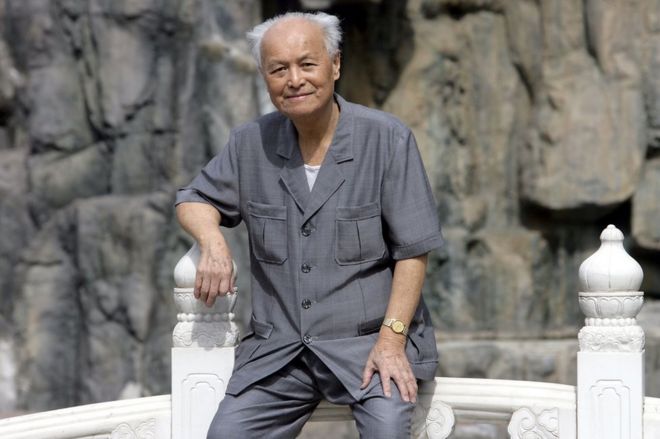
Image copyrightAFPImage captionLi Rui remained an activist and idealist until his death
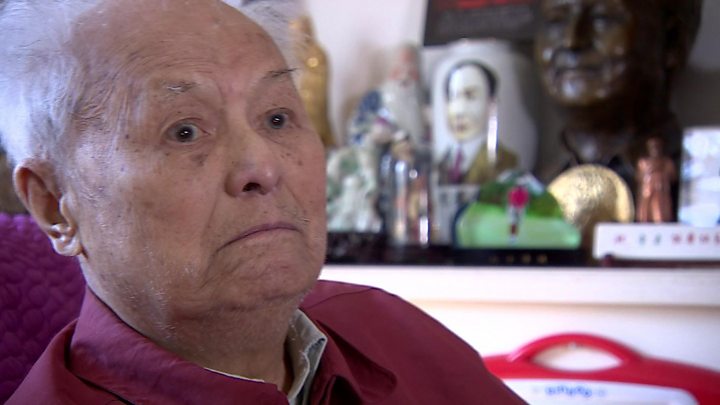
“We are not allowed to talk about past mistakes.”
Li Rui said this in 2013, while reflecting on the similarities between China’s then-new leader Xi Jinping and the founding father of Communist China, Mao Zedong.
Mr Xi, he warned, was echoing Mao’s suppression of individual thought, and was trying to build a similar cult of personality – both things he had experienced at first hand.
Li Rui joined the Communist Party in 1937, at the start of the brutal Sino-Japanese war, and 12 years before the party won the civil war that established the People’s Republic. He was hand-picked by Mao to become his personal secretary in 1958.
Despite this turbulent history with the party, the fact that Mr Li was one of the original revolutionaries meant that he occupied a special place in contemporary China – one that allowed him a degree of freedom to talk about the ruling party’s many issues, and how he felt things should be done differently.
People may not be allowed to talk about past mistakes, but Mr Li did it anyway – and his work has helped historians understand the truth and scale of Mao’s atrocities.
Li Rui died in Beiijng on Saturday, aged 101.
An underground revolutionary
As a university student, Mr Li joined a group of idealistic Communist activists protesting against Japanese occupation. Shortly afterwards, at the age of 20, he officially joined the party. He was tortured for his communist activism.
But things changed when the party came into power in 1949, and by 1958 Mr Li had become the youngest vice minister in China.
It was also that year that he had a meeting with Mao that would change the course of his life. Mao, having seen Mr Li argue passionately against building the Three Gorges Dam on the Yangtze River, chose him to be his personal secretary.
Their relationship didn’t last long.
‘Mao put no value on human life’
In 1959, Mr Li openly criticised Mao’s Great Leap Forward – a policy that was supposed to boost China’s economic output, but instead unleashed widespread famine across the country.
For this transgression Mr Li was expelled from the Communist Party, and he was imprisoned for eight years in Qincheng, maximum security prison built for the detention of disgraced senior party officials.
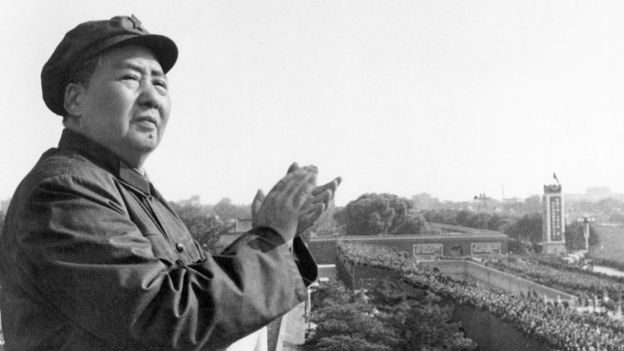
Image copyrightGETTY IMAGESImage captionLi Rui said Mao Zedong, pictured, “put no value on human life”
Following Mao’s death, the more pragmatic Deng Xiaoping came to power in 1978 and Mr Li was rehabilitated and allowed back into the party. He then became a strong advocate for political reform, and in his later years, threw himself into calling for China to move further towards a European socialist-style system.
He wrote five books on Mao, all of which were published overseas and banned in mainland China. His last book, published in 2013, called for the current “one-party, one-leader and one-ideology regime” to be overhauled. His daughter, Li Nanyang, has spoken of having her copies of his memoir confiscated at Beijing’s airport.
Aside from writing books, he worked right into his 90s as a patron of the reformist magazine Yanhuang Chunqiu – roughly translated as “China through the ages”.
The magazine was taken over in 2016. Its editor Wu Si was forced out, and its former staff released a statement warning that “anybody who publishes any periodicals with the title of Yanhuang Chunqiu will be nothing to do with [them]”.
Professor Steve Tsang, director of SOAS’s China Institute, tells BBC News that this affected Li Rui deeply.
“The single most important thing that Li Rui had, was the patronage that he gave to the magazine Yanhuang Chunqiu,” Professor Tsang says. “It does still exist, but it’s been completely changed it terms of management and focus. It’s practically a different magazine.”
The last idealist
But even though his writing was censored, Mr Li was not a dissident – he remained a party member until his death. And the fact that he was left to compose his memoirs from a prestigious apartment block in Beijing shows how, despite his outspoken criticism of the current leadership, he continued to be revered for his role as one of the country’s original revolutionaries.
But with Mr Li dies the idealism of the activist who joined his party eight decades ago, and spent the years since vigorously rebelling against leaders who abused their power.
“He was among the last of that generation of idealists who joined the Communist Party at the beginning, and who tried to hold the Communist Party to the rhetoric [they heard] when they were being recruited,” Prof Tsang says.
“There is probably nobody else who will hold the party now to what the party had originally said it was meant to do.”
ISLAMABAD (Reuters) – Saudi Arabia’s Crown Prince Mohammed bin Salman is due to arrive in Pakistan on Sunday at the start of his tour of South Asia and China, but the visit risks being overshadowed by escalating tensions between nuclear-armed rivals India and Pakistan.
The trip comes days after a suicide bomber killed 44 Indian paramilitary police in the disputed Kashmir region. New Delhi has accused Pakistan of having a hand in the bombing and vowed to punish Islamabad, which denies involvement.
Prince Mohammed had also planned to visit Indonesia and Malaysia during the Asian tour, but those trips have been postponed, according to Malaysian and Indonesian officials. No reasons for the postponements or alternative tour dates were given.
Cash-strapped and in need of friends, Pakistan is welcoming the crown prince with open arms for a visit during which he is expected to sign investment agreements worth more than $10 billion.
Saudi Arabia has in recent months helped keep Pakistan’s economy afloat by propping up its rapidly dwindling foreign exchange reserves with a $6 billion loan, giving Islamabad breathing room as it negotiates a bailout with the International Monetary Fund.
Analyst say the crown prince’s trip is being treated by Islamabad as the biggest state visit since Chinese President Xi Jinping in 2015, soon after Beijing announced plans to invest tens of billions of dollars on infrastructure in Pakistan as part of China’s global Belt and Road initiative.
The visit marks a deepening in ties between allies whose relationship has in the past centred on oil-rich Saudi Arabia backing Pakistan’s economy during difficult periods, and in return Pakistan’s powerful army lending support to Saudi Arabia and its royal family.
As the guardians of most holy sites in the birthplace of Islam, the Saudi royal family carries vast religious clout in Pakistan, a staunchly conservative and mainly-Muslim nation of 208 million people.
“What is happening in this relationship is a renewal of Pakistan’s commitment to help protect the royal family and the order as it exists in Saudi Arabia,” said Mosharraf Zaidi, Senior Fellow at Tabadlab, a Pakistani think tank focussed on global and local public policy.
“On the flip side, there is reassurance that Saudi Arabia will not only continue to serve as a strategic friend who will help shore up Pakistan’s finances when needed, but it’s also going to become a participant in the wider investment in Pakistan.”
Pakistan is shutting down its airspace and has stepped up security in Islamabad for the crown prince, who is set to become the first guest to stay at the Prime Minister’s House. Pakistan’s new populist premier, Imran Khan, has refused to use the residence in a bid to save taxpayers’ money.
Pakistani hopes for further investment opportunities from Saudi Arabia were dealt a blow on Saturday when the government announced that the Pak-Saudi Business Conference had been “postponed”.
Pakistani officials have already flagged up that Saudi Arabia will announce eight investment agreements, including a $10 billion refinery and petrochemicals complex in the coastal city of Gwadar, where China is building a port.
But the crown prince’s arrival comes amid a vow by India to isolate Pakistan internationally following the deadliest attack in Kashmir in decades.
New Delhi is demanding Islamabad act against the Jaish-e-Mohammad (JeM) militant group, which it says has the backing of the Pakistani state, over the bombing. Islamabad denies playing a role and has called for an investigation.
In Islamabad, the crown prince is expected to meet Khan and Pakistan’s army chief, Qamar Javed Bajwa.
He is also set to meet representatives of the Afghan Taliban militant group to discuss peace negotiations to end the 17-year civil war in Afghanistan, Pakistani government and Taliban sources say.
“We arrived in Islamabad today Sunday and others are on their way,” one senior Afghan Taliban figure told Reuters. “As per the plan we know so far, we are going to meet Mohammed bin Salman and his delegation members today at night and then on Monday.”
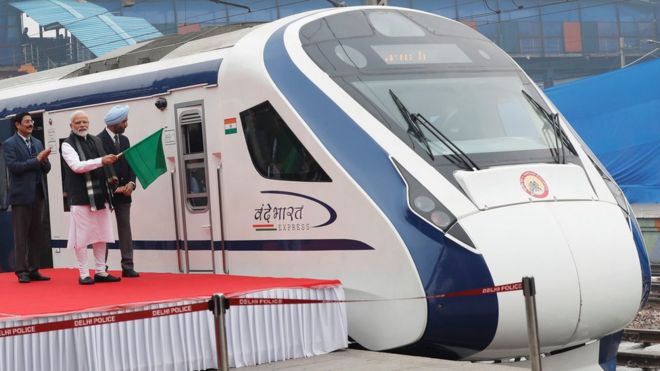
Image copyrightREUTERSImage captionPM Narendra Modi flagged off the Vande Bharat Express on Friday
India’s fastest train has broken down on its first trip, a day after it was inaugurated by Prime Minister Modi.
The Indian-built semi high-speed Vande Bharat Express was returning to the capital Delhi from the city of Varanasi after its first outing when brakes in a carriage reportedly jammed.
Indian media quoted a railways spokesperson as saying the train may have struck cattle on the line.
The train reached a speed of 180km/hr (110mph) during trials.
The new train service is expected to start its commercial run from Sunday. It is expected to reduce the travel time between Delhi and Varanasi by six hours.
SRINAGAR (Reuters) – India has warned against rising communal tensions across the country as Kashmiris living outside their state faced property evictions, job suspensions and attacks on social media after a suicide bomber killed 44 policemen in the region.
The car bomb attack on a security convoy on Thursday, claimed by Pakistan-based Islamist militant group Jaish-e-Mohammad and carried out by a 20-year-old Kashmiri man, was the worst in decades of insurgency in the disputed area, which is claimed in full by both the nuclear-armed neighbours but ruled in part.
As the bodies of the paramilitary policemen who died in the attack were returned to families across India this weekend, passionate crowds waving the Indian flag gathered in the streets to honour them and shouted demands for revenge. Pakistan has denied any role in the killings.
Kashmiri Muslims, meanwhile, are facing a backlash in Hindu-majority India, mainly in the northern states of Haryana and Uttarakhand, forcing the federal interior ministry to issue an advisory to all states to “ensure their safety and security and maintain communal harmony”.
Aqib Ahmad, a Kashmiri student in Uttarakhand capital Dehradun, said the owner of the house he was staying in had asked him to move out fearing an attack on his property. Rates for air tickets to Kashmir have sky-rocketed as tensions escalate, he said.
Two other students in Dehradun said they also had been asked to vacate their rooms immediately.
“Where are we supposed to go?” Waseem Akram told Reuters, demanding authorities to ensure safety of all Kashmiri students.
Local media reported that some Kashmiri students were assaulted by members of Hindu right-wing groups in Uttarakhand, while a Kashmiri man had been booked by the police in the southern city of Bengaluru under a colonial-era sedition law for a post allegedly backing the militants. Reuters was not able to independently verify the reports.
Police in Jammu and Kashmir (J&K) state said they were providing temporary accommodation to people returning to Kashmir. The police urged Kashmiris to contact their hotline for “speedy assistance in case they face any difficulties/harrasment”.
“TRAITOR”
Fear has engulfed Kashmiri students in Haryana’s Ambala district after a video on social media showed a village headman asking people to evict Kashmiri students in the area.
“In case it is not done, the person in whose residence such students are living will be considered as a traitor,” the man says in the video, whose authenticity Reuters has not been able to independently verify.
Police said they were investigating the matter.
Since the video surfaced on social media on Saturday, at least half a dozen Kashmiri students have been shifted to the hostel of a university campus in Ambala.
A Facebook user named Anshul Saxena, meanwhile, has claimed credit for getting people fired or suspended for posts he calls “anti-national”.
Saxena uploaded a screengrab of a suspension letter handed out to a Kashmiri employee of a pharmaceutical company who had allegedly written in favour of the attack.
The attack on India’s paramilitary police follows the deadliest year in Kashmir for security personnel since Prime Minister Narendra Modi’s Hindu nationalist Bharatiya Janata Party came to power nearly five years ago.
Government data shows 91 officers lost their lives in Kashmir last year, about 14 percent more than 2017. Thousands of people, including militants and civilians, have died since the insurgency began in late 1980s.
Political leaders from Kashmir appealed to the government to ensure security of Kashmiris across India, while many people on Twitter said their homes were open to Kashmiris seeking shelter.
“Understand the pain and anguish,” Mehbooba Mufti, former chief minister of J&K, said in a tweet. “But we must not allow such mischievous elements to use this as an excuse to persecute/harass people from J&K. Why should they suffer for somebody else’s action?”
Addressing a rally in Assam’s North Lakhimpur, Amit Shah said that the NRC had been brought in to identify infiltrators and that the BJP would identifiy and deport all such infiltrators.
Saying that the NRC had been brought in to identify infiltrators, Amit Shah said, the BJP will rid Assam of all such aliens by deporting them.(HT Photo)
BJP chief Amit Shah on Sunday said that Modi-led government at the Centre will not allow Assam to become another Kashmir and that is why it has brought about the National Register of Citizens (NRC).
Saying that the NRC had been brought in to identify infiltrators, he said, the BJP will rid Assam of all such aliens by deporting them.
“We won’t let Assam become another Kashmir, this is our commitment. We’ll repeat the NRC exercise as many times as required to, but we’ll identify and deport each infiltrator from Assam,” Shah said while addressing a public rally at North Lakhimpur in Assam.
Shah criticised the Congress and its former ally Asom Gana Parishad (AGP), and said both the parties had done nothing to implement the Assam Accord despite ruling most of the period since the pact was signed in 1985.
Referring to the contentious Citizenship (Amendment) Bill, which the Centre couldn’t present in Rajya Sabha, he said misinformation was being spread as if it was only for Assam and other parts of the Northeast.
“It was not for Northeast alone, but for all refugees across the country. The way demography is changing in Assam, without the Citizenship Bill, the people of the state will be in danger,” he added.
He also spoke about the Pulwama attack in which 40 CRPF jawans were killed in a suicide bombing on Thursday.
“This cowardly act was done by Pakistani terrorists. Their (jawans’) sacrifices will not go in vain, because there is no Congress government at the Centre. It is BJP government and the Narendra Modi government will not compromise on any security issue,” he added.
Saying that the government at the Centre was not that of the Congress, Shah said that the current government was that of the BJP and was led by Modi, who he said was determined to uproot terrorism from the country.
ZHENGZHOU, Feb. 15 (Xinhua) — The middle route of China’s South-to-North Water Diversion Project has transferred 20 billion cubic meters of water, benefiting over 53 million residents along the route.
The Construction and Administration Bureau of South-to-North Water Diversion Middle Route Project said that, as of Friday, the project has transferred 20 billion cubic meters of water since the project started in December 2014.
Thanks to the project, over 53 million residents in central China’s Henan Province, northern China’s Hebei Province, Beijing and Tianjin have bid farewell to unsafe drinking water.
So far, 37 cities and counties and 83 waterworks in Henan have received transferred water as planned, while 11 new waterworks have been built up, with the beneficiaries in the province increasing by nearly one million.
Aimed at increasing water safety and improving the water ecology and environment along the route, the middle route project has been carrying water through canals and pipes from the Danjiangkou reservoir in central China’s Hubei Province to Henan, Hebei, Beijing and Tianjin since 2014.
The project has also helped prevent the falling of underground water levels in the North China Plain. Meanwhile, test results have shown that the good water quality of the source of the middle route project has also ensured drinking water safety for residents.
The usual cast of characters were back at the negotiating table, trying to find a way to stem another round of US tariff increases that were stayed in December after the Buenos Aires G20 meeting between US President Donald Trump and Chinese President Xi Jinping.
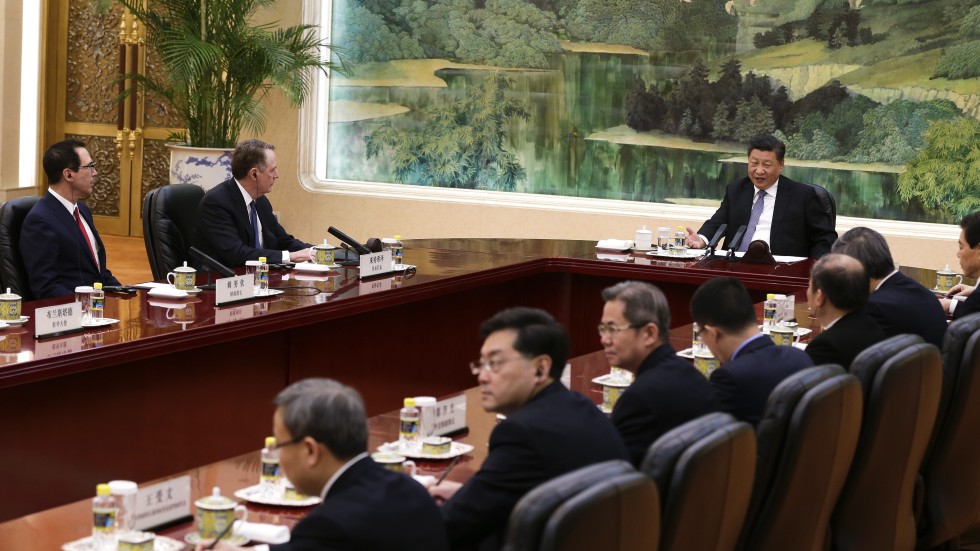
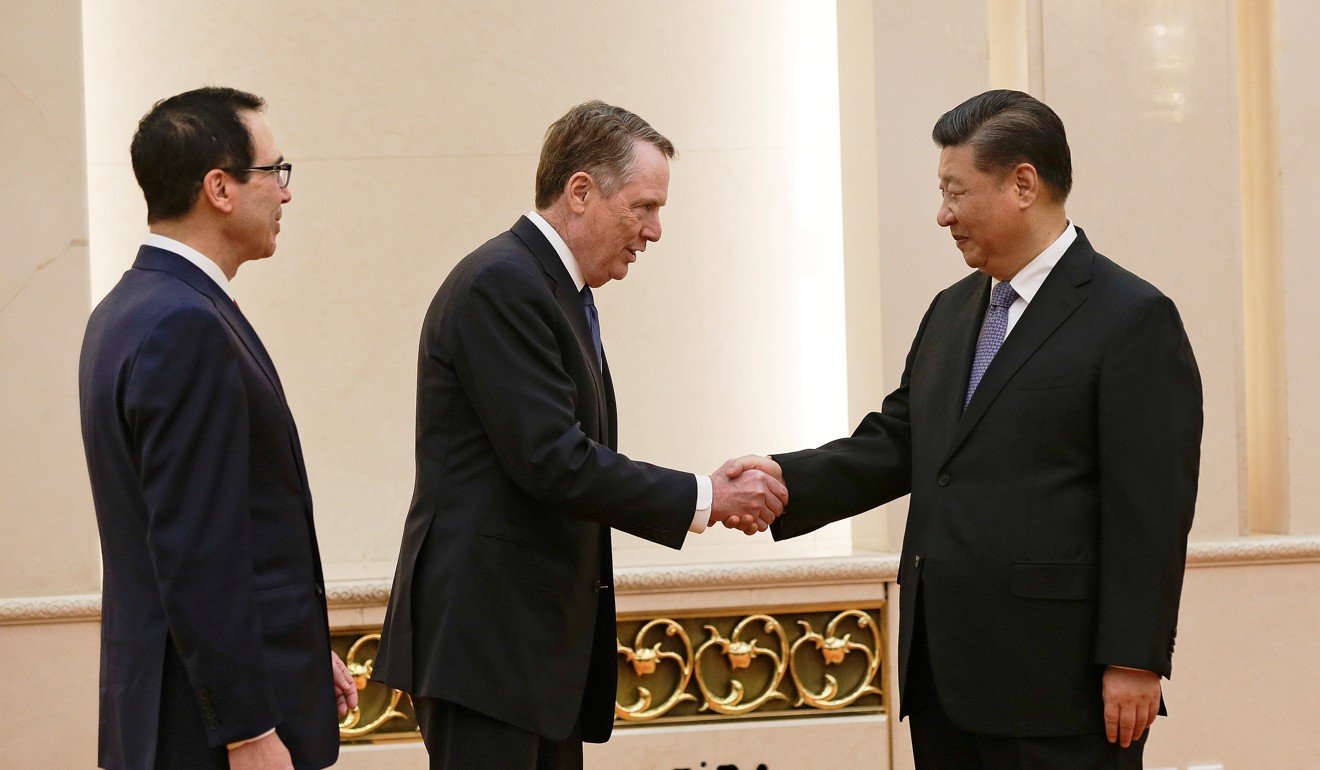
US Treasury Secretary Steven Mnuchin and Trade Representative Robert Lighthizer were back in Beijing, where they again sat across the table from Vice-Premier Liu He, China’s lead trade negotiator. The US delegation also met Xi himself at the end of the talks on Friday.
Both nations said they had made progress to settle their disputes, but admitted there were still difficult issues to deal with. Negotiators will continue the talks in Washington next week.
The stakes are clear and the clock is ticking. The two sides need to arrive at an understanding by March 2, the day on which Trump has said he will move forward with an increase in tariffs.
At least that was the idea. In recent days, Trump has made multiple remarks that suggest the March deadline is anything but absolute. He has hinted he would be open to pushing it back if he sensed that a deal was around the corner. Reports have even suggested the White House is considering another 60-day extension of the tariff truce.
Already articulated US concerns cover a broad range of Chinese practices. The ideal short-term measures the American side would like to see include unconditional market access for US firms in China; a less insulated environment for state-owned enterprise decision making; greater regulatory transparency; and fairer legal protections for American businesses in China.
As with so many aspects of the Trump administration’s foreign policy, the US president’s personality is taking over the process, leaving his deputies who are doing the negotiating in a disadvantageous position. For China, the obvious answer then becomes not to discuss the nuances of what kinds of structural reform might be necessary with Lighthizer, but to simply get Xi in the room with Trump.
This mirrors the lesson that North Korea’s Kim has taken away over the course of nearly a year of negotiations with the US. Instead of expending any serious diplomatic capital in a detail oriented negotiation with the secretary of state or the president’s special representative, the key is to simply meet Trump and work out high-level arrangements mano a mano.
In this climate, we can’t expect a real resolution on the core issues. Everything from American misgivings about Beijing’s interventionist industrial policies that protect Chinese enterprises to broader structural shifts in the nature of the US-China economic relationship since the turn of the century are on the table today – and they’ll stay there.
Xi and Trump may well find a temporary way out of the impasse, giving global investors the runway necessary to avert the panic that would likely ensue if the US pushed ahead with a tariff increase on US$200 billion in Chinese goods. Even if China doesn’t quite give the United States a down payment on structural reforms, Xi can promise Trump that he will chip away at the trade deficit while leaving untouched the issues that a more detail oriented negotiator like Lighthizer might zero in on.
If there is a “win-win” outcome here, it would be for Trump and Xi to find an agreeable arrangement that would allow the US president to walk away looking tough to his base while leaving China’s core, long-term industrial policy trajectory unharmed. That would strip away any remaining negotiating leverage the US side might have within the trade war, and it’s not unlikely.







COMMENTS: