Chindia Alert: You’ll be Living in their World Very Soon
aims to alert you to the threats and opportunities that China and India present. China and India require serious attention; case of ‘hidden dragon and crouching tiger’.
Without this attention, governments, businesses and, indeed, individuals may find themselves at a great disadvantage sooner rather than later.
The POSTs (front webpages) are mainly 'cuttings' from reliable sources, updated continuously.
The PAGEs (see Tabs, above) attempt to make the information more meaningful by putting some structure to the information we have researched and assembled since 2006.
American destroyer’s mission comes a week before Taiwanese president officially starts second term in office
Increased military activity in the region could have unintended consequences but unlikely to lead to direct conflict, observer says
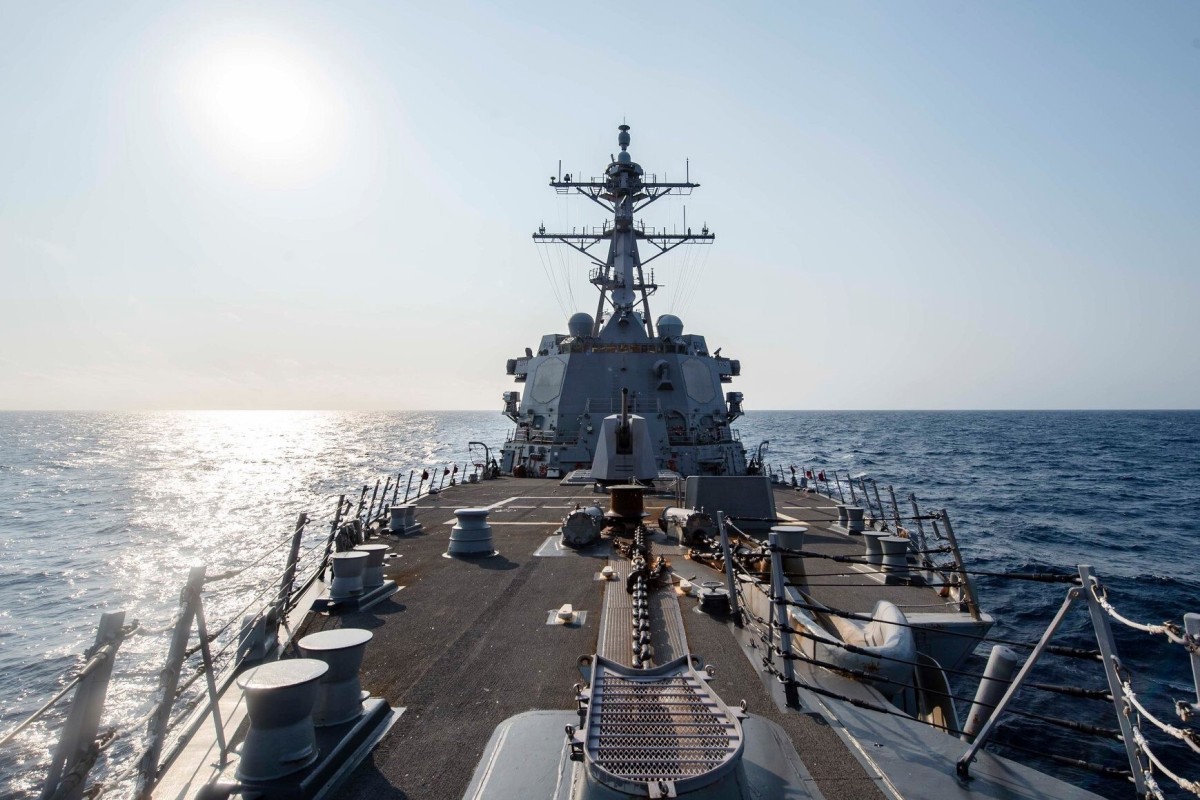
The guided-missile destroyer USS McCampbell made a transit through the Taiwan Strait on Thursday. Photo: US Navy
The United States sent a warship through the Taiwan Strait on Thursday as the Chinese military embarked on more than two months of live-fire naval drills off the mainland’s northern coast.
According to Taiwan’s defence ministry, the Arleigh Burke-class guided-missile destroyer transited the narrow body of water separating Taiwan from mainland China from north to south “in a routine mission”.
“It is continuing its southward voyage and the military is monitoring its movement through the intelligence it has gathered,” the ministry said.
In a statement on its Facebook page, the US Pacific Fleet said the McCampbell transited the Taiwan Strait as part of ongoing operations in the Indo-Pacific.
Analysts said the passage was a response to the People’s Liberation Army’s increasing military activity near Taiwan and in the wider region.
“This will become a new routine as a kind of US security commitment to maintain stability in the Indo-Pacific region,” said Soong Hseik-wen, professor of strategic studies and international relations at National Chung Cheng University in Taiwan.
Beijing urges France to cancel contract to sell arms to Taiwan
13 May 2020
The PLA has staged a series of war games, including fly-bys and warship transits through the strait, in recent months in response to what Beijing sees as growing pro-independence moves by the Tsai government and her party. China has also warned the US against supplying weapons to the island, which Beijing considers to be a wayward province that must return to the mainland fold, by force if necessary.
Mainland China has suspended official exchanges with Taiwan since Tsai was first elected president in 2016 and refused to accept the one-China policy, which Beijing says must be the foundation for any talks.
The PLA has embarked on 11 weeks of naval exercises off the coast of Tangshan in northern China, barring all other vessels from a 25km (15 mile) radius of the drill area, according to the China Maritime Safety Administration.
Taiwanese support closer ties with US over China, few identify as solely Chinese, Pew Research survey finds
13 May 2020
Both Beijing and Washington have ramped up military activities near Taiwan in recent months during the coronavirus pandemic, moves that some observers say run the risk of miscommunication.
Alexander Huang Chieh-cheng, professor of strategic studies and international relations at Tamkang University in Taipei, said no one could exclude the possibility of unintended incidents when both the US and the mainland were stepping up their presence in the region.
“Rational analysts would however argue that the two nuclear powers are not likely to engage in or escalate to direct military conflict,” he said.
Huang said he believed cross-strait relations would worsen during Tsai’s second term in office, which begins on May 20.
“The already damaged relationship between Taiwan and mainland China has worsened since the pandemic mainly due to travel bans and Taiwan’s increased international visibility,” he said.
On Tuesday, Japan’s Kyodo News reported that the PLA was planning a large-scale beach landing exercise near Hainan province in August, simulating a takeover of the Pratas Islands, which are controlled by Taiwan and also known as the Dongsha Islands.
In Taipei, Major General Lin Wen-huang said Taiwan was monitoring the PLA movements and “has contingency plans in place for the South China Sea to strengthen combat readiness and defence preparedness on both the Spratly and Pratas islands”.
Taiwan’s coastguard also announced on Wednesday that its Pratas Islands Garrison was scheduled to conduct an annual live-fire exercise in June to ensure the “effectiveness of various mortar and machine-gun positions”.
Taiwan shows off its military power after presidential election
Shanghai-based military commentator Ni Lexiong said that both the US Navy and PLA were increasing activities during the pandemic because neither side could afford to show weaknesses that the other might take advantage of.
The destroyer’s passage and the PLA’s drills were all part of such efforts, Li said.
But he agreed that both countries were unwilling, unable, and unlikely to have a real conflict.
“They are both bluffing. It’s a fake crisis,” he said. “A pandemic always ends or prevents a war if you look at history.
“I also don’t believe the PLA would want to take over the Dongsha or Taiping islands [in the South China Sea], because these islets alone are not worth a military campaign and all the consequences of that. The only target valuable enough for the PLA is Taiwan.”
Nations may need help from China during virus outbreaks but remain wary of Beijing as adversary in disputed waters
Analysts say code of conduct negotiations are too sensitive and important for virtual meetings and may be delayed until coronavirus crisis is resolved
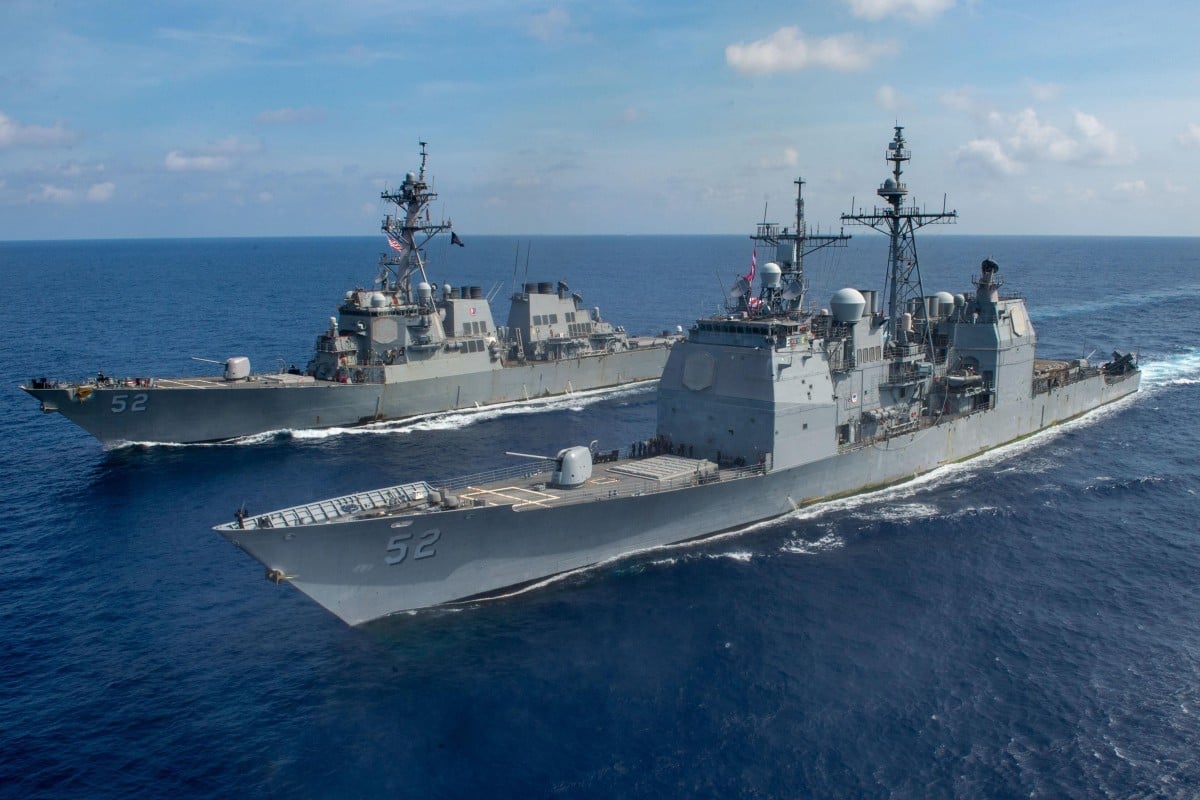
On April 18, the US Navy Ticonderoga-class guided missile cruiser USS Bunker Hill (front) and Arleigh-Burke class guided-missile destroyer USS Barry transit the South China Sea. The presence of both Chinese and American navy ships in the area in recent weeks worries Southeast Asian nations. Photo: US Navy
Negotiations between China and its Southeast Asian neighbours for a South China Sea
code of conduct have been postponed as the nations involved put their efforts into containing the Covid-19 pandemic, creating uncertainty about whether the two sides can work together amid rising tensions in the contested territory.
Southeast Asian nations are increasingly caught in a dilemma whether to maintain relations with Beijing during the pandemic while also fearing that tensions over the disputed waters are spiralling out of control. Both Chinese and United States navies are sending vessels to the area more frequently.
Indonesian Foreign Minister Retno Marsudi expressed concern over recent activities in the South China Sea, noting that they might potentially escalate tensions at a time when global collective effort to fight Covid-19 was essential.
Speaking on Wednesday, she called on all parties to respect international law, particularly the United Nations Convention on the Law of the Sea.
“While negotiation of the code of conduct is being postponed due to Covid-19, Indonesia calls on all relevant parties to exercise self-restraint and to refrain from undertaking action that may erode mutual trust and potentially escalate tension in the region,” she said.
Indonesia’s Foreign Minister Retno Marsudi. Photo: AP
Calls for a binding code of conduct surfaced in 1995 when China occupied Mischief Reef
, a maritime feature claimed by the Philippines. China did not agree to start talks until 1999, and subsequent negotiations led to a non-binding Declaration on Conduct in 2002.
The Association of Southeast Asian Nations (Asean) and China agreed in 2018 on a draft code laying the foundations for conduct in the disputed waters. At that time, Chinese Premier Li Keqiang said China hoped to complete the negotiation by the end of 2021, a move he said could show China and Asean could jointly maintain regional peace.
Named and claimed: is Beijing spoiling for a new fight in the South China Sea?
27 Apr 2020
But tensions over the South China Sea have not calmed and, in fact, have surged in recent months with both Beijing and Washington seen to be using the Covid-19 pandemic to create a stronger presence there.
This year, the US has conducted four freedom of navigation operations in the South China Sea and China has scrambled air and sea patrols to expel US vessels.
The confrontation between Beijing and Southeast Asian nations has also intensified. Last month, a Vietnamese fishing boat sank after a collision with a Chinese coastguard vessel near the Paracel Islands, known in China as the Xisha Islands, and in Vietnam as the Hoang Sa Islands.
On Saturday, the 35th escort fleet of the Chinese navy also conducted drills in the Spratly Islands chain – known as Nansha Islands in China – after completing an operation in the Gulf of Aden, off Somalia. Analysts said the drill aimed to boost far-sea training for combat ships and boost protection against piracy for Chinese merchant ships.
Collin Koh, a research fellow at the S. Rajaratnam School of International Studies, based at Nanyang Technological University in Singapore, said the code of conduct talks had been delayed because of the pandemic, but Beijing was consolidating its position in the South China Sea amid the outbreak.
“So it’s doing what it can now to consolidate and further enhance its position before talks restart, and by then these moves will raise Beijing’s leverage in the negotiations with its Asean counterparts,” he said.
“The current situation gives it a window of opportunity amid this interlude on the talks, to further advance its physical hold in the South China Sea, especially while Asean parties have their hands full on the pandemic”.
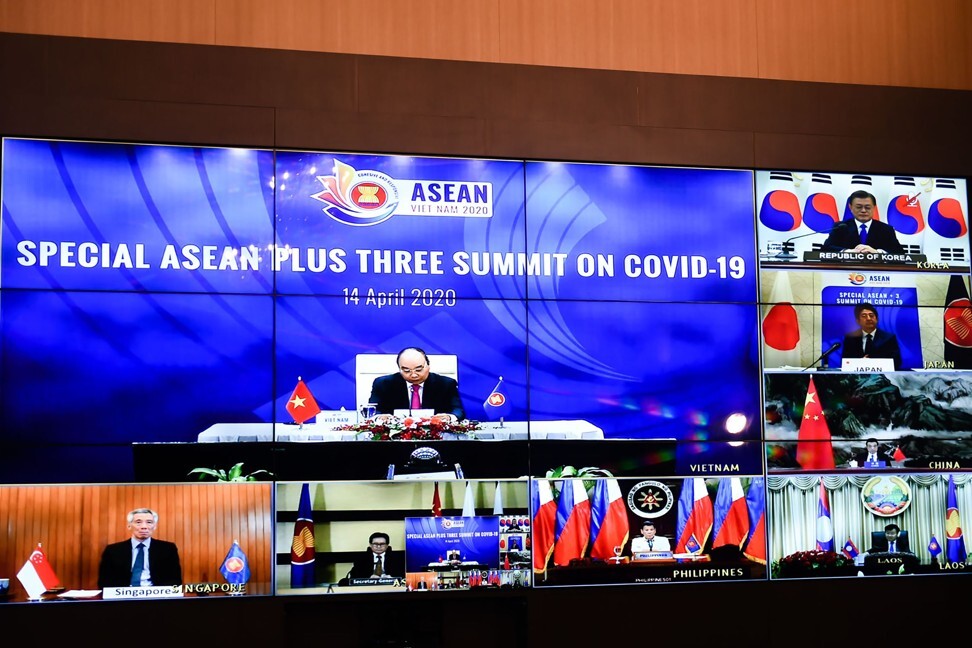
Asean nations have turned their attention to coping with coronavirus outbreaks in their own countries. On April 14, a live video conference for the special Asean Plus Three Summit on the coronavirus pandemic was held in Hanoi. Photo: AFP
Kang Lin, a researcher with Hainan University, said progress for the code of conduct would still go ahead, but it might be affected as face-to-face meetings between officials were disrupted.
“The negotiations involves multiple departments, such as diplomacy, maritime affairs, fisheries and even oil and gas-related departments,” he said, adding that those discussions might go online and might not be as effective.
“It is not easy to predict to what extent it will affect next year's goals. If the pandemic cannot be eliminated in the first half of next year, it may be longer than the three-year period we had previously scheduled,” he said.
Richard Heydarian, an academic and former Philippine government adviser, said video-conference meetings would be inadequate for negotiations about the future of the South China Sea.
“The problem with the negotiation of the code is that these are very sensitive, difficult negotiations. I don't think you can really do it just online, these are things that are done in the corridors of power,” he said. “It’s close to impossible to have that right now with the suspension of all international meetings in the Asean.”
Heydarian said Southeast Asian nations hoped to get help from China to contain the pandemic, but were showing unease about Beijing.
“I think there is a lot of resentment building against China,” he said. “There is also a lot of desperation to get assistance from China and, at the same time, complete helplessness with the fact that it is very hard to conduct any important extended international meeting on the level of Asean and beyond under current circumstances.”
Chinese Foreign Ministry spokesman Hua Chunying said on Thursday that China would push forward negotiations on the code of conduct, and hoped the code would be useful for peace and stability over the South China Sea.
Footage shows aircraft manoeuvring strangely before emitting bright light and flying away at great speed
Clips of unexplained ‘aerial phenomena’ were recorded by pilots between 2004 and 2015
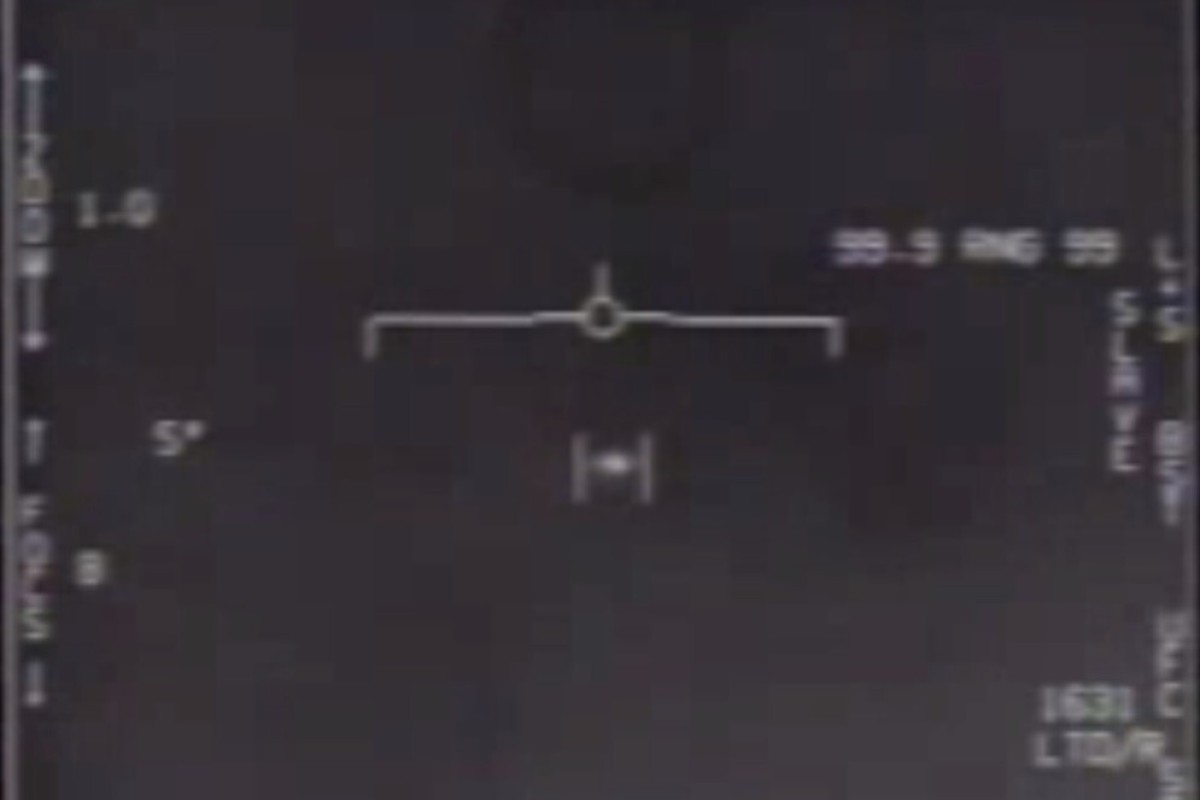
A screen grab from one of the UFO videos released by the Pentagon on Monday. Photo: US Department of Defence
The US Department of Defence has been watching, and recording, the skies.
The Pentagon released three videos on Monday that depict unexplained “unidentified aerial phenomena” which were recorded by pilots between 2004 and 2015.
In each of the reconnaissance videos, a flying aircraft manoeuvres strangely before emitting a bright light and flying away at great speed.
The Pentagon released the videos “to clear up any misconceptions by the public on whether or not the footage that has been circulating was real, or whether or not there is more to the videos”, spokesperson Sue Gough said. “The aerial phenomena observed in the videos remain characterised as ‘unidentified’.”
The Navy originally verified the videos’ existence in 2019 after they were leaked by To the Stars Academy of Arts and Sciences, a UFO research group started by Blink-182 guitarist Tom DeLonge.
“After a thorough review, the department has determined that the authorised release of these unclassified videos does not reveal any sensitive capabilities or systems, and does not impinge on any subsequent investigations of military air space incursions by unidentified aerial phenomena,” Gough said.
The Navy has previously said that releasing information from top-secret briefings about UFOs would cause “exceptionally grave damage” to US national security.
According to the Navy, two of the videos were taken during training missions over military airspace.
“Any incursion into our training ranges by any aircraft or phenomena, identified or not identified, is problematic from both a safety and security concern,” Navy spokesperson Joseph Gradisher said in September 2019.
Warship joined by at least five escort vessels and analysts say the drills were ‘very significant’ to show the strike group wasn’t hit by coronavirus
Latest exercises also seen as putting pressure on Taiwan’s pro-independence forces, with strike group sailing through the strait
The Liaoning is seen as having a big role in the Chinese military’s plan to unify Taiwan by force. Photo: AFP
China’s first aircraft carrier, the Liaoning, returned to its home port of Qingdao on Thursday after nearly a month of training on the high seas, the People’s Liberation Army said.
According to military analysts, the warship was joined by at least five escort vessels, and the drills showed its crew had not been affected by the coronavirus pandemic and that it remained combat-ready.
The annual cross-region drills included intensive and complicated air and sea operations, the official PLA Daily said in a post on social media on Friday.
“The drills have further improved the real combat training level of the Liaoning carrier strike group, putting its systematic combat capability to the test,” the statement on WeChat said, without giving other details.
It was the longest training session by China’s navy since the PLA resumed all large-scale drills in March, after they were suspended because of disruptions to transport and military resources across the country as the deadly new virus rapidly spread.
Beijing-based naval expert Li Jie said it was important for the carrier to get back to training activities.
“The recent training by the Liaoning carrier strike group is very significant because it’s evidence that none of the 2,000 sailors and commanders on the ship have been hit by Covid-19, and neither have any of the other soldiers and personnel on the other warships and support units,” Li said.
The coronavirus situation has eased in China, where the first cases were reported late last year, but it continues to spread across the globe and has infected more than 3.2 million people worldwide and killed over 233,000.
Sailors on warships like USS Theodore Roosevelt vulnerable as coronavirus spreads
29 Mar 2020
The virus has also hit crew members on at least 40 US Navy warships, and Li said that left China with the only operational aircraft carrier in the region.
“Since the four American aircraft carriers in the Indo-Pacific region have all been struck by the pandemic, China is the only country that can operate an aircraft carrier in the area,” he said.
US warship captain seeks to isolate crew members as coronavirus spreads
Taiwan’s defence ministry reported earlier that the Liaoning flotilla had sailed through the Taiwan Strait twice last month as it headed towards the western Pacific, prompting the self-ruled island to scramble aircraft and send warships to monitor its movements.
Japan’s Ministry of Defence said the Liaoning was escorted by two destroyers, two frigates and a supply ship, and they had passed through the Bashi Channel, a waterway to the south of Taiwan, and headed towards waters east of Taiwan.
As tensions continue to simmer between Taipei and Beijing, the PLA has stepped up activities around the island, which the mainland sees as part of its territory awaiting reunification.
Hong Kong-based military commentator Song Zhongping said the latest naval drills were also aimed at heaping more pressure on Taiwan’s pro-independence forces as well as foreign countries seeking to intervene in cross-strait issues.
Coronavirus: US ‘supports Taiwan joining WHO events’ in ministerial phone call
28 Apr 2020
“Taiwan’s pro-independence forces have become more active and are attempting to take advantage amid the pandemic,” said Song, a military commentator with Phoenix Television.
“The Liaoning would play a major role in the PLA’s plan to unify Taiwan by force, so it’s necessary for the aircraft carrier strike group to get back to operations, step up training and send a warning to Taipei,” he added.
Lu Li-Shih, a former instructor at the naval academy in Taiwan, noted that the PLA Navy had regularly held drills in the waters east of Taiwan in recent years to avoid surveillance by US satellites.
, the People’s Liberation Army said on Friday, amid a growing number of patrols and exercises by US warships in the region.
The drill, which involved two aircraft, was conducted earlier this month, not long before the US naval and marine units took part in expeditionary strike force training in the disputed waters, the PLA Navy said in a report.
While acknowledging the difficulties involved in such an operation, the report said the aircraft successfully identified several suspicious objects.
“Anti-submarine exercises are like trying to find a needle in a haystack. It’s difficult, the underwater hydrological conditions are complex,” Yu Yang, the captain of one of the aircraft, was quoted as saying.
But by having two planes working together, it “increase[d] the probability of finding a submarine”, he said.
The anti-submarine exercise involved two aircraft from the PLA Navy. Photo: Handout
Wang Shelin, one of the commanders of the exercise, said that anti-submarine operations were not only dangerous but a real test of the pilots’ skills.
Successfully completing the mission demanded precise “control of the speed and altitude of the aircraft”, he said.
The publication of the PLA report came after the United States staged a four-day exercise in the South China Sea last week involving the Theodore Roosevelt Carrier Strike Group, the America Expeditionary Strike Group and the 31st Marine Expeditionary Unit.
At the end of last month, the US Navy accused the PLA of “unsafe and unprofessional” behaviour after a Chinese destroyer pointed a laser at an American maritime patrol aircraft flying over international waters west of Guam.
Collin Koh, a research fellow with the S Rajaratnam School of International Studies at Nanyang Technological University in Singapore, said the Chinese military was keen to promote its anti-submarine capabilities.
“This means we can expect to see more such exercises in the future, with no let up because of the coronavirus,” he said.
“You can also see this as a response not only to the [recent] carrier strike group operations, but the intensified US military presence in the South China Sea.
“And it would not be surprising if a nuclear attack submarine was in the vicinity of the carrier strike group,” he said.
Chinese and US defence chiefs discuss coronavirus crisis in phone call
4 Mar 2020
Song Zhongping, a Hong Kong-based commentator on military affairs, said that with the possibility of a military conflict growing in the South China Sea, it was important for the PLA Navy to increase its anti-submarine training.
“The rivalry between the great powers is getting more and more intense, and the PLA must strengthen its preparations,” he said.
Echoing commander Wang’s comments, Song said that the high volume of maritime traffic and sheer size and depth of the South China Sea made searching for submarines difficult.
“So the PLA is trying to enhance its capabilities by constantly installing and testing new anti-submarine equipment,” he said.
Military insiders say the aircraft appears to have beaten the FC-31 in the race to become the PLA Navy’s fighter of the future
A military source close said it would be almost impossible to develop both aircraft over the next few years given the risk of an economic downturn
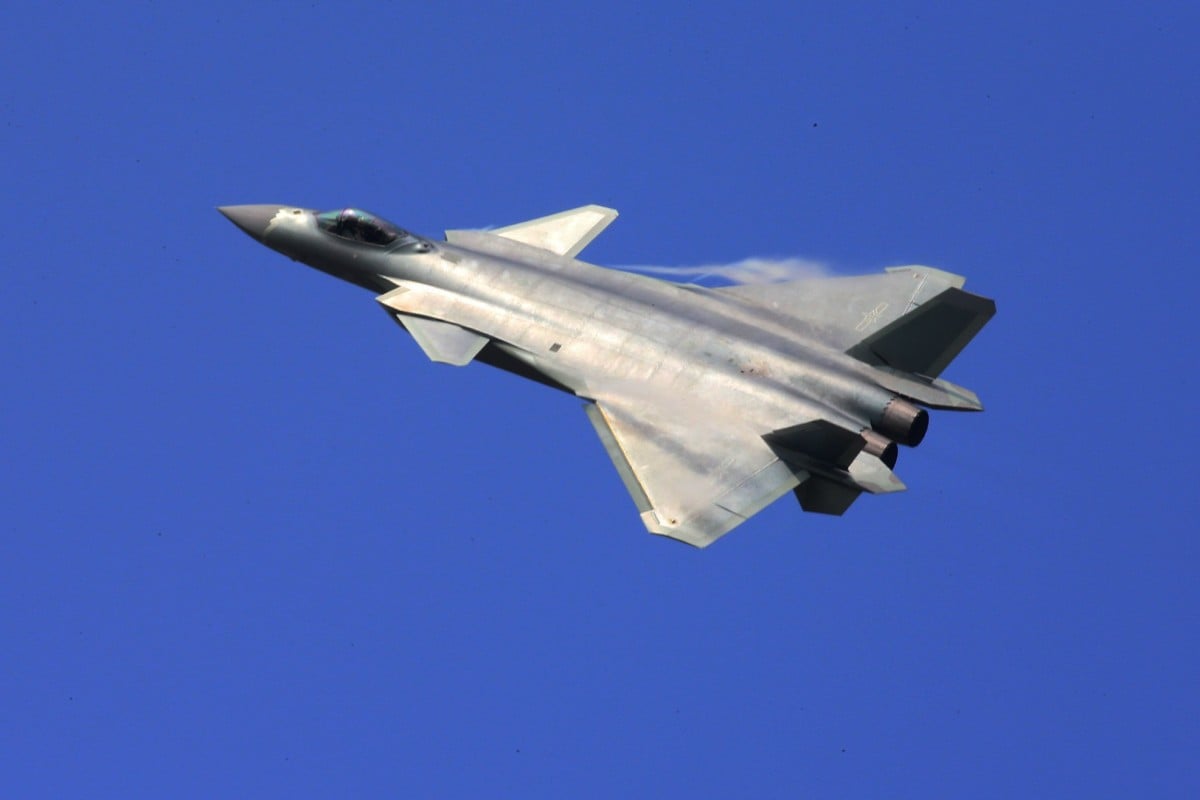
The J-20 stealth fighter is likely to be modified to serve on China’s next generation aircraft carriers. Photo: Xinhua
China’s military is likely to pick the country’s first active stealth fighter, the J-20, for its next generation aircraft carriers, according to military sources and a recent report on state media.
A military insider told the South China Morning Post that the Central Military Commission, the People’s Liberation Army’s top decision-making body, now favoured adapting the J-20 for its new carriers.
“The Chengdu Aerospace Corporation will announce some new products, which will include a new version of their J-20. You can guess what type it will be,” the military insider, who requested anonymity because of the sensitivity of the subject, said.
The FC-31 was independently developed by CAC’s sister company Shenyang Aircraft Corporation (SAC), which also produced the J-15 – the jets currently in use on the country’s only active aircraft carrier, the Liaoning.
Both aerospace firms are subsidiaries of the state-owned giant Aviation Industry Corporation of China, which specialises in designing and developing military aircraft, and were set up to ensure benign competition between manufacturers.
However, the SAC has faced criticism from some military leaders and experts for being too conservative and failing to innovate because of its bureaucratic structure.
A recent programme aired by the state broadcaster China Central Television also suggests the J-20 will be chosen.
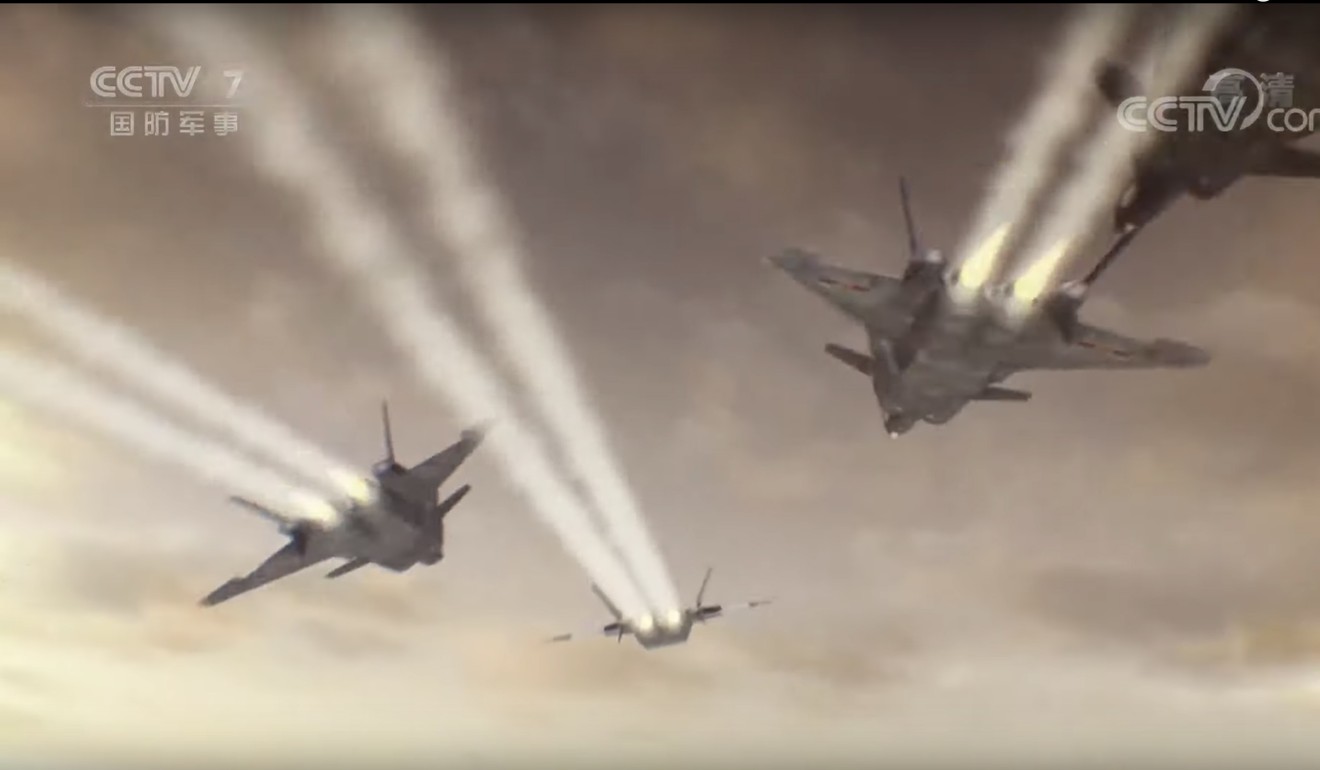
An episode of Military Documentary shown on August 16 reported how the PLA Navy was selecting candidates for pilot training and illustrated the feature with a mock-up of jets that looked like J-20s taking off from a carrier.
Ground-based J-20s – also known as Powerful Dragons – entered service with the PLA Air Force in 2017.
as China stepped up its efforts to counter the deployment of American F-22s and F-35s in the Asia-Pacific region.
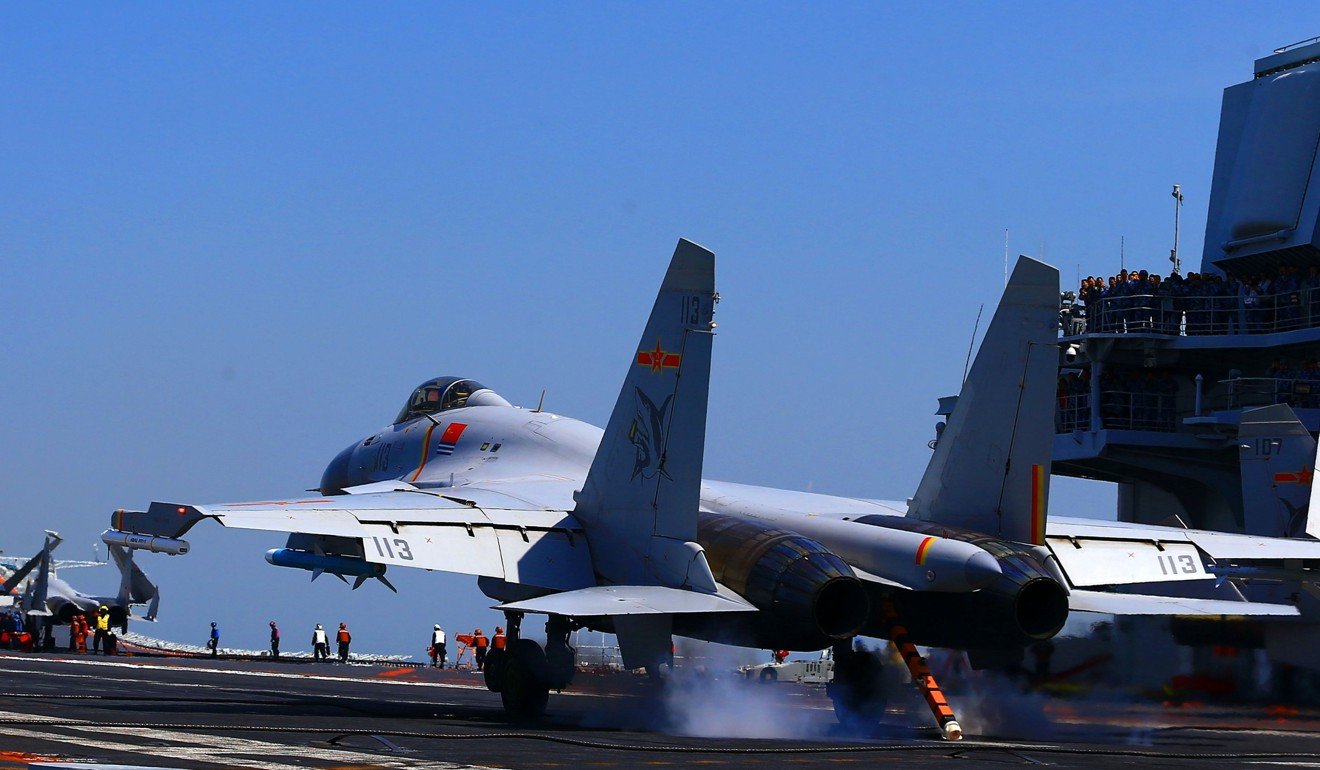
A J-15 fighter lands on the Liaoning. Photo: AFP
If the selection of the J-20 is confirmed it will mark the end of a lengthy debate between its supporters and advocates of the FC-31 as to which would make a better carrier-based fighter.
Those who favoured the J-20 said it was more advanced and reliable than the FC-31, but its supporters said it was more light and nimble.
“Both the J-20 and FC-31 have their advantages. The size of the J-20 is similar to the J-15 since both are powerful heavy fighters,” Song Zhongping, a military commentator for Hong Kong-based Phoenix Television, said.
Song said the lighter FC-31 could be developed into a medium-sized carrier fighter that would complement the J-20 in future.
But another military source close to the PLA Navy said it would be almost impossible to develop both aircraft over the next few years given the risk of an economic downturn as the trade war with the US continues to escalate.
A video simulation broadcast on state television earlier this month showed fighters that resembled the J-20 taking off from a carrier. Photo: CCTV
The source said China’s next generation aircraft carriers would be with equipped electromagnetic catapults similar to those used on the US Navy’s Ford-class supercarriers.
These enable the use of heavier fighters because they are more powerful than the older diesel systems used on older carriers.
“The key problem of the J-20 is not weight, but length. If it wants to be a carrier-based fighter jet, it needs to be made shorter.”
Military insiders have previously said that CAC engineers are working to produce a shorter version of the J-20 that will work with the new launch system.
At present both the J-20 and F-31 still rely on Russian engines. The WS-15 engine that has been purpose built for the J-20 has undergone hundreds of hours of testing but has yet to meet reliability targets while the F-31 prototype does not have a purpose-built engine.
China’s navy plans to build at least four carrier battle groups by 2030, three of which will be active at any given time.
Military analysts say China will need at least a decade to develop its new generation carrier-based fighters, so the J-15 will remain in service for at least a decade, if not two.
The J-15 made its maiden flight in 2009 and has been in service since 2012. They are the only fighters based on the Liaoning and will be used by its sister ship the Type 001A when it enters service, probably later this year.
It follows Beijing’s decision earlier this month to turn down an application for two US Navy ships to visit Hong Kong
The countries have traded barbs about the handling of anti-government protests in the city
The US has had port visits denied by Chinese authorities twice this month. Photo: Alamy
A US Navy warship was denied a port visit to the eastern Chinese city of Qingdao on Sunday, the US Indo-Pacific Command said on Wednesday.
The request denial comes at a time of heightened tensions between China and the United States, with the countries engaged in a prolonged trade dispute and a war of words over anti-government protests in Hong Kong.
“The PRC [People’s Republic of China] denied the US Navy’s request to visit the Qingdao Port,” Commander Reann Mommsen, public affairs officer for the US Seventh Fleet, said in a statement on Wednesday.
Mommsen declined to name the warship denied entry or when the request was refused, referring questions about the reasons to Beijing.
The blocked visit was first reported by Reuters, which cited an anonymous US defence official as saying that China had denied the request for the destroyer before the intended visit on Sunday.
It is the second time in a month that China has prevented US Navy vessels making a port call.
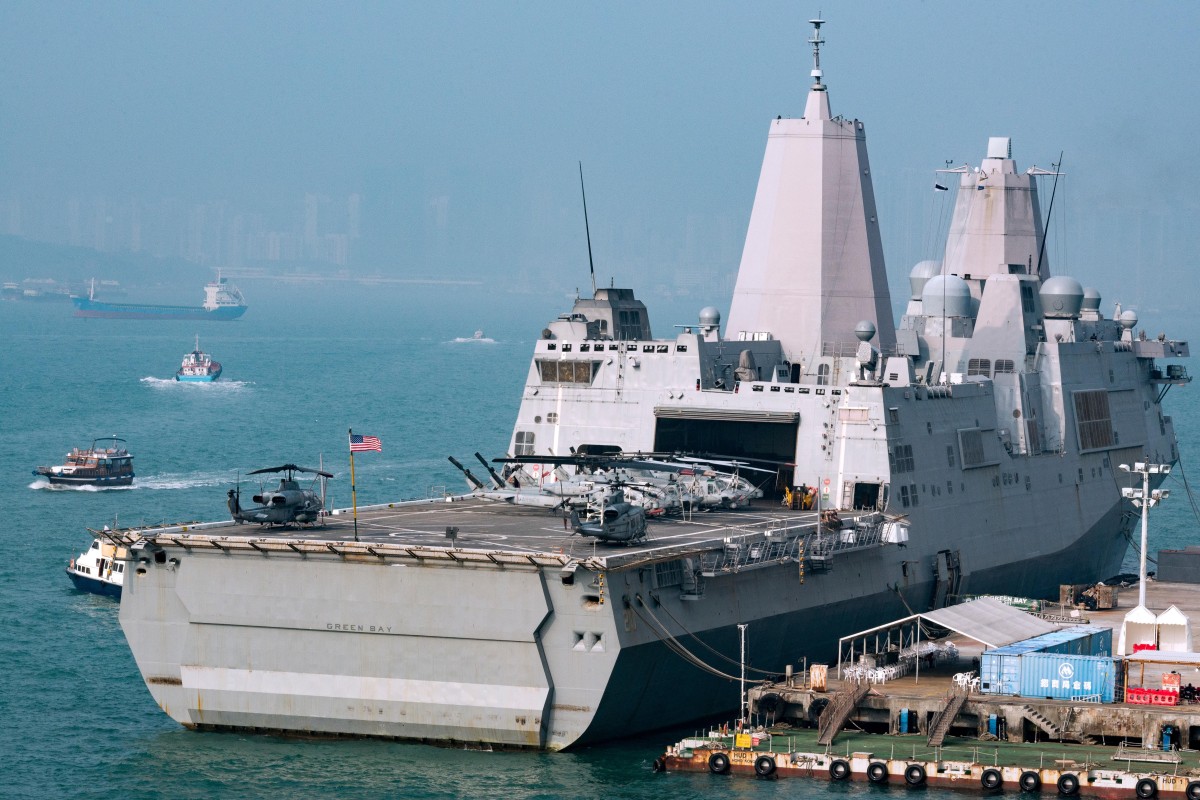
On August 13, the United States Pacific Fleet said China had denied requests for two US Navy ships to visit Hong Kong.
The USS Green Bay, an amphibious dock landing ship, had been due to make a port call in Hong Kong on August 17, and the guided missile cruiser USS Lake Erie was scheduled to visit next month, according to Nate Christensen, deputy spokesman for the Pacific Fleet.
A source close to the Chinese navy confirmed the Qingdao rejection, saying it was “normal practice” based on the current China-US relationship.
“Hasn’t the [US’] application to visit Hong Kong just been rejected?” the source asked.
Hong Kong has seen 12 weeks of anti-government protests, triggered by a now-shelved
that would have allowed criminal suspects to be transferred to mainland China.
Beijing has increasingly suggested
the protests are being funded by the West, a claim the US has called “ludicrous”
.
Zhou Chenming, a Beijing-based military expert, said the refusal was a natural result of the worsening bilateral ties between China and the US.
“Many bilateral exchanges are bound to deteriorate when countries’ ties worsen, such as during the China-US trade war. And now coupled with the Hong Kong unrest, many exchanges [between China and the US] have been downgraded,” Zhou said.
Liu Weidong, from the Chinese Academy of Social Sciences, echoed Zhou’s view and said a visit from the US warship would be meaningless at present.
“Now the US is very provocative … so China doesn’t want to welcome its warship,” Liu said.
Doubt has been cast on whether trade talks between the two countries are set to resume, with Beijing’s foreign ministry contradicting US President Donald Trump’s claim that China had sought a return to the negotiating table.
The countries had been due to speak on Tuesday, according to a previous statement from China’s Ministry of Commerce after their last telephone call on August 13. But there has been no announcement so far from either side on whether such a conversation took place.
Last week, China said it would levy retaliatory tariffs of 5 to 10 per cent on US$75 billion worth of US goods. The Trump administration responded by announcing a tariff increase from 25 to 30 per cent on US$250 billion of Chinese goods, and from 10 to 15 per cent on US$300 billion worth of Chinese products.
The US also designated Beijing as a currency manipulator, raising fears of an economic cold war between the two countries.







 CHINDIA ALERT: You'll be living in their world, very soon
China’s Liaoning aircraft carrier returns home from a month of training
China’s first aircraft carrier, the Liaoning, returned to its home port of Qingdao on Thursday after nearly a month of training on the high seas, the People’s Liberation Army said.
According to military analysts, the warship was joined by at least five escort vessels, and the drills showed its crew had not been affected by the coronavirus pandemic and that it remained combat-ready.
The annual cross-region drills included intensive and complicated air and sea operations, the official PLA Daily said in a post on social media on Friday.
“The drills have further improved the real combat training level of the Liaoning carrier strike group, putting its systematic combat capability to the test,” the statement on WeChat said, without giving other details.
Beijing-based naval expert Li Jie said it was important for the carrier to get back to training activities.
“The recent training by the Liaoning carrier strike group is very significant because it’s evidence that none of the 2,000 sailors and commanders on the ship have been hit by Covid-19, and neither have any of the other soldiers and personnel on the other warships and support units,” Li said.
The coronavirus situation has eased in China, where the first cases were reported late last year, but it continues to spread across the globe and has infected more than 3.2 million people worldwide and killed over 233,000.
Sailors on warships like USS Theodore Roosevelt vulnerable as coronavirus spreads
The virus has also hit crew members on at least 40 US Navy warships, and Li said that left China with the only operational aircraft carrier in the region.
“Since the four American aircraft carriers in the Indo-Pacific region have all been struck by the pandemic, China is the only country that can operate an aircraft carrier in the area,” he said.
Japan’s Ministry of Defence said the Liaoning was escorted by two destroyers, two frigates and a supply ship, and they had passed through the Bashi Channel, a waterway to the south of Taiwan, and headed towards waters east of Taiwan.
As tensions continue to simmer between Taipei and Beijing, the PLA has stepped up activities around the island, which the mainland sees as part of its territory awaiting reunification.
Hong Kong-based military commentator Song Zhongping said the latest naval drills were also aimed at heaping more pressure on Taiwan’s pro-independence forces as well as foreign countries seeking to intervene in cross-strait issues.
Coronavirus: US ‘supports Taiwan joining WHO events’ in ministerial phone call
“Taiwan’s pro-independence forces have become more active and are attempting to take advantage amid the pandemic,” said Song, a military commentator with Phoenix Television.
“The Liaoning would play a major role in the PLA’s plan to unify Taiwan by force, so it’s necessary for the aircraft carrier strike group to get back to operations, step up training and send a warning to Taipei,” he added.
Lu Li-Shih, a former instructor at the naval academy in Taiwan, noted that the PLA Navy had regularly held drills in the waters east of Taiwan in recent years to avoid surveillance by US satellites.
Source: SCMP
Posted in air and sea operations, Aircraft, Aircraft carrier, annual, Beijing, by force, China’s, combat-ready, complicated, coronavirus, Coronavirus pandemic, cross-region drills, destroyers, escort vessels, Friday, frigates, from, high seas, home port, intensive, Japan’s Ministry of Defence, Liaoning, military commentator, military’s plan, month, naval academy, People’s Liberation Army, pla navy, pro-independence forces, Qingdao, returns home, sailing through, sailors, scramble, self-ruled island, social media, strait, strike group, supply ship, Surveillance, Taipei, Taiwan, Taiwan Strait, Taiwan’s, Taiwan’s defence ministry, to unify, training, Uncategorized, US Navy, US satellites, USS Theodore Roosevelt, vulnerable, warship, warships, WeChat, western Pacific, WHO | Leave a Comment »