23/10/2019
- Chinese geologists think they have formula that could help to increase control of market in the elements hi-tech industries depend upon
- Simple combination of clay mined for porcelain production, granite bedrock and acid rain could point to lucrative sources of rare earths
China has 80 per cent of the reserves of rare earth elements the world needs to keep talking on its smartphones, and geologists in Guangzhou think they know why. Photo: EPA
Geologists in southern China say they have isolated a series of critical factors that could make it easier to find
rare earth elements used in hi-tech consumer goods such as smartphones.
China has more than 80 per cent of the world’s reserves of heavy rare earths such as terbium, dysprosium and holmium concentrated in a few provinces to the south of the country.
The reason for the concentration is one of the biggest puzzles in geology, but researchers at the Guangzhou Institute of Geochemistry in Guangdong province say the answer may be found in a combination of clay deposits, acid rain and granite that is distinctive to southern China.
Professor He Hongping and his colleagues came to the conclusion by testing the interaction between rare earths and different types of clay. Through their research they found that kaolinite – or china clay – was the best at absorbing rare earths from water.
The clay, named after Gaoling village near Jingdezhen, a centuries-old ceramic production centre in east China’s Jiangxi province, is a raw material for porcelain production.
While kaolinite is found in many countries, those places do not have rare earth deposits – probably because of the lack of acid rain, He said.
“You need the right environment.”
He said that rocks that contained tiny amounts of rare earth elements weathered faster in an acid environment, but the acidity could not be too high or the rare earth might run off before it could be captured by the clay.
Why Beijing cut tax rate on rare earths amid trade war
Rainwater with the right natural acidity often occurred in areas around 20 degrees latitude, such as southern China, he said.
The last step was to locate the source rock. Granite formed in volcanic eruptions between 100 million and 200 million years ago is considered to be the main source of rare earths.
He said that part of the Pacific tectonic plate containing rare elements might have been forced under the Eurasian Plate and was pushed to the surface as magma that formed rocks.
Other countries could learn from the Chinese experience, said He, whose team submitted their findings to the research journal Chemical Geology.
Recent discoveries in Vietnam, Australia and North Carolina in the United States conformed to the Guangzhou team’s theory, but there was still more research to do, he said.
“Rare earth deposits are quite unlike minerals such as copper. Sometimes they occur in this mountain but not in another nearby with almost the same geological features. Sometimes they occur in one half of the mountain but not in the other.”
With China and the US engaged in a trade war, and Beijing cutting taxes on mining companies looking for these elements, the pressure was on to unlock the secrets of China’s abundant rare earth deposits, he said.
Does China’s dominance in rare earths hold leverage in trade war?
Dr Huang Fan, associate researcher with the China Geological Survey, said the Guangzhou discovery would help geologists to find more rare earths.
Most rare earth mines were located along the borders between provinces such as Guangdong and Jiangxi, but recently there were discoveries on a plateau in Yunnan province, where few geologists believed rare earths could be found, he said.
“There are many more rare earth deposits out there waiting for us.”
Source: SCMP
Posted in Acid rain, Australia, Chemical Geology, China alert, china clay, China Geological Survey, copper, discovered, dysprosium, formula, Gaoling, geologists, granite bedrock, Guangdong, guangdong province, Guangzhou, Guangzhou Institute of Geochemistry, hi-tech industries, holmium, Jiangxi Province, Jingdezhen, kaolinite, porcelain production, rare earth elements, rich, scientists, smartphones, terbium, trade war, Uncategorized, United States, Vietnam |
Leave a Comment »
15/10/2019
HANOI (Reuters) – Vietnamese President and Communist Party chief Nguyen Phu Trong has called for restraint in the disputed South China Sea amid a tense months-long standoff between Chinese and Vietnamese ships, state media reported on Tuesday.
China claims almost all the energy-rich waters but neighbours Brunei, Malaysia, the Philippines, Taiwan and Vietnam also have claims.
Tension escalated when Beijing dispatched a research ship to conduct an energy survey in waters controlled by Vietnam in July.
“On the subject of foreign policy, including the East Sea issue, the General Secretary stressed the importance of maintaining a peaceful and stable environment, and resolutely fighting to protect Vietnam’s independence, sovereignty and territorial integrity,” the state-run Voice of Vietnam (VOV) said on its website.
The South China Sea is known as the East Sea in Vietnam.
Vietnam has good relations with China but should “never compromise” on its sovereignty and territorial integrity, VOV quoted Trong as saying.
The Chinese vessel, the Haiyang Dizhi 8, was continuing its survey in Vietnam’s exclusive economic zone late on Tuesday, under escort from at least three Chinese ships, according to data from Marine Traffic, a website that tracks vessel movements.
Vietnam’s foreign ministry has repeatedly accused the vessel and its escorts of violating its sovereignty and has demanded that China remove its ships from the area.
On Sunday, Vietnam pulled DreamWorks’ animated film “Abominable” from cinemas over a scene featuring a map which shows China’s unilaterally declared “nine-dash line” in the South China Sea.
The U-shaped line is used on Chinese maps to illustrate its claims, including large swathes of Vietnam’s continental shelf, where it has awarded oil concessions.
In August, police broke up a brief protest outside the Chinese embassy in Hanoi over the survey vessel.
Trong has made more public appearances in recent weeks after suffering from an unspecified illness..
The 75-year-old has presided over a widespread crackdown on corruption in the Southeast Asian country that has seen several high-ranking ministers and politicians, including one Politburo member, sent to prison on charges ranging from embezzlement to economic mismanagement.
Source: Reuters
Posted in amid, “Abominable”, “nine-dash line”, Beijing, Brunei, China alert, Chinese embassy, Chinese ships, communist party chief, Continental Shelf, DreamWorks, East Sea, Exclusive economic zone, exclusive economic zone (EEZ), Foreign Ministry, Haiyang Dizhi 8, Hanoi, Malaysia, Marine Traffic, maritime tensions, Nguyen Phu Trong, oil concessions, Philippines, restraint, South China Sea, sovereignty, survey, Taiwan, Uncategorized, urges, Vietnam, Vietnamese President, Vietnamese ships, Voice of Vietnam (VOV) |
Leave a Comment »
06/10/2019
- Leaders exchange congratulatory messages on 70th anniversary of diplomatic relations amid speculation that Kim Jong-un will visit China soon
- It comes after Pyongyang’s denuclearisation negotiations with Washington broke off in Stockholm without any breakthroughs
North Korean leader Kim Jong-un (left) may soon visit China again. He last met Xi Jinping during the Chinese leader’s trip to Pyongyang in June. Photo: AFP
China and
North Korea on Sunday vowed to continue strengthening their ties that have “stood the test of time”, hours after another squabble broke out between Pyongyang and Washington over the breakdown of their first nuclear talks in eight months.
Chinese President Xi Jinping exchanged congratulatory messages with North Korean leader Kim Jong-un on the 70th anniversary of diplomatic ties, according to state media in both countries, amid speculation that Kim will soon pay another visit to China.
Observers said the communist neighbours’ warm exchanges and Kim’s possible visit showed Beijing and Pyongyang shared mutual interests and needed each other in their respective geopolitical plans to counter Washington – especially as they both come under pressure from US President Donald Trump.
The two countries are said to be
preparing for Kim to visit China as early as Sunday, which would be his fifth China trip since March last year and the first since Xi’s state visit to Pyongyang in June.
But given Pyongyang’s denuclearisation negotiations with Washington on Saturday – which broke off in Stockholm without any breakthroughs – China and North Korea may need to reconsider or delay Kim’s visit to avoid criticism of Beijing’s role in the nuclear talks, one expert suggested.
“The triangular ties between China, the United States and North Korea are of immense importance in finding a solution to the nuclear issue on the Korean peninsula and Beijing’s role in the talks has always been sensitive, especially in the eyes of the US and its allies,” said Wang Sheng, a North Korea specialist at Jilin University.
“While China will almost certainly reiterate its stance to support continued dialogue and talks between Pyongyang and Washington, it may not be a good time for Kim’s high-profile visit just a day after their talks broke down, which would inevitably make it more difficult for China to play a mediating role,” he said.
On Sunday, Xi said the traditional friendship between the two countries had “stood the test of time and changes in the international landscape, growing stronger with the passage of time” and “made important and positive contributions to regional peace and stability”, according to Chinese state news agency Xinhua.
Citing his five recent meetings with Kim, Xi said bilateral ties had entered a new era and China would promote “long-term, healthy and stable” relations with North Korea.
Kim also hailed the special relationship between the two countries, which he said had been forged “at the cost of blood” and “weathered all tempests while sharing weal and woe with each other”, the Korean Central News Agency reported.
North Korean mouthpiece Rodong Sinmun meanwhile said in a commentary that bilateral ties with Beijing were “fully in accordance” with the interests of the two sides and would develop “regardless of the international situation”, according to South Korea’s Yonhap news agency.
The lavish praise for Sino-North Korean relations comes as a group of working-level officials from North Korea are working with the Chinese side for a possible visit by Kim in the next few days, according to South Korea’s Dong-A Ilbo.
China and North Korea have set aside their differences as both countries come under pressure from US President Donald Trump. Photo: AFP
North Korea was among the first countries to recognise the
People’s Republic of China
70 years ago and Xi has exchanged three messages with Kim in the past month, repeatedly pledging to move closer despite lingering grievances over Pyongyang’s nuclear brinkmanship.
In the face of Trump’s increasingly antagonistic approach, the former communist allies – whose relationship deteriorated over Beijing’s support for the UN sanctions against the North, led by Washington – have set aside their differences to patch up ties in recent months.
Meanwhile, Pyongyang’s first nuclear talks with Washington in eight months ended on Saturday with the two sides offering conflicting assessments of their first formal discussion since the failed Trump-Kim summit in Vietnam in February.
North Korea’s top negotiator Kim Myong-gil expressed his “great displeasure” with the discussions, blaming Washington and urging the Trump administration to correct its course and keep the talks alive or “forever close the door to dialogue”, according to Yonhap.
North Korean negotiator Kim Myong-gil expressed his “great displeasure” with the discussions on Saturday. Photo: AP
But the US State Department issued a rebuke hours later, claiming the negotiators had a “good discussion”. State Department spokeswoman Morgan Ortagus said in a statement that the US had put forward “creative ideas” and “a number of new initiatives that would allow us to make progress in each of the four pillars of the Singapore joint statement”.
The two countries were not expected to “overcome a legacy of 70 years of war and hostility on the Korean peninsula through the course of a single Saturday”, she said, adding that Washington would return for more discussions with Pyongyang in two weeks at Sweden’s invitation.
As Trump administration enters survival mode, foreign policy moves are anyone’s guess
Wang from Jilin University said the breakdown of another round of talks had again laid bare the huge gap between the two sides over a long list of issues, from the definition of denuclearisation to their vastly different, often conflicting, demands and interests.
“It’s very likely that Washington has again rejected some of Pyongyang’s key demands in the recent talks, such as providing a security guarantee for Kim’s regime and a range of economic sanctions relief,” he said.
And with North Korea a polarising issue in the looming US presidential poll for Trump as he seeks to score diplomatic points for his re-election bid, it might become even more challenging for the two sides to narrow their differences.
“The breakdown of the talks should not be seen as a failure,” Wang said. “It simply underscores the difficulty of reaching any consensus in the nuclear talks, which still have a long way to go.”
Source: SCMP
Posted in 70th anniversary, Beijing, breakthroughs, broke off, China alert, collapse, denuclearisation negotiations, diplomatic relations, Dong-A Ilbo, geopolitical plans, invitation, Jilin University, Kim Jong-un, Korean Central News Agency, Korean peninsula, North Korea, nuclear brinkmanship, nuclear talks, People’s Republic of China, President Donald Trump, Pyongyang, Sino-North Korean relations, South Korea, speculation, Stockholm, strengthen ties, Sweden, Trump-Kim summit, U.S. State Department, UN sanctions, Uncategorized, United States, US nuclear talks, Vietnam, visit, vow, Washington, without, Xi JinPing, Xinhua News Agency, Yonhap news agency |
Leave a Comment »
04/10/2019
Chinese geologists think they have formula that could help to increase control of market in the elements hi-tech industries depend upon
- Simple combination of clay mined for porcelain production, granite bedrock and acid rain could point to lucrative sources of rare earths
China has 80 per cent of the reserves of rare earth elements the world needs to keep talking on its smartphones, and geologists in Guangzhou think they know why. Photo: EPA
Geologists in southern China say they have isolated a series of critical factors that could make it easier to find
rare earth elements used in hi-tech consumer goods such as smartphones.
China has more than 80 per cent of the world’s reserves of heavy rare earths such as terbium, dysprosium and holmium concentrated in a few provinces to the south of the country.
The reason for the concentration is one of the biggest puzzles in geology, but researchers at the Guangzhou Institute of Geochemistry in Guangdong province say the answer may be found in a combination of clay deposits, acid rain and granite that is distinctive to southern China.
Professor He Hongping and his colleagues came to the conclusion by testing the interaction between rare earths and different types of clay. Through their research they found that kaolinite – or china clay – was the best at absorbing rare earths from water.
The clay, named after Gaoling village near Jingdezhen, a centuries-old ceramic production centre in east China’s Jiangxi province, is a raw material for porcelain production.
While kaolinite is found in many countries, those places do not have rare earth deposits – probably because of the lack of acid rain, He said.
“You need the right environment.”
He said that rocks that contained tiny amounts of rare earth elements weathered faster in an acid environment, but the acidity could not be too high or the rare earth might run off before it could be captured by the clay.
Why Beijing cut tax rate on rare earths amid trade war
Rainwater with the right natural acidity often occurred in areas around 20 degrees latitude, such as southern China, he said.
The last step was to locate the source rock. Granite formed in volcanic eruptions between 100 million and 200 million years ago is considered to be the main source of rare earths.
He said that part of the Pacific tectonic plate containing rare elements might have been forced under the Eurasian Plate and was pushed to the surface as magma that formed rocks.
Other countries could learn from the Chinese experience, said He, whose team submitted their findings to the research journal Chemical Geology.
Recent discoveries in Vietnam, Australia and North Carolina in the United States conformed to the Guangzhou team’s theory, but there was still more research to do, he said.
“Rare earth deposits are quite unlike minerals such as copper. Sometimes they occur in this mountain but not in another nearby with almost the same geological features.
Sometimes they occur in one half of the mountain but not in the other.”
With China and the US engaged in a trade war, and Beijing cutting taxes on mining companies looking for these elements, the pressure was on to unlock the secrets of China’s abundant rare earth deposits, he said.
Does China’s dominance in rare earths hold leverage in trade war?
Dr Huang Fan, associate researcher with the China Geological Survey, said the Guangzhou discovery would help geologists to find more rare earths.
Most rare earth mines were located along the borders between provinces such as Guangdong and Jiangxi, but recently there were discoveries on a plateau in Yunnan province, where few geologists believed rare earths could be found, he said.
“There are many more rare earth deposits out there waiting for us.”
Source: SCMP
Posted in Acid rain, Australia, ceramic production centre, Chemical Geology, China alert, China Geological Survey, Chinese geologists, clay, control, copper, discovered, dysprosium, elements, Eurasian Plate, formula, Gaoling, geologists, granite bedrock, guangdong province, Guangzhou, Guangzhou Institute of Geochemistry, hi-tech industries, holmium, Jiangxi Province, Jingdezhen, kaolinite, lucrative sources, market, mined, need, Pacific tectonic plate, porcelain production, rare earth elements, rare earths, rich, scientists, smartphones, terbium, Uncategorized, United States, Vietnam, World |
Leave a Comment »
04/10/2019
- ‘Difficult decision to cease operations’ at plant in Huizhou taken to ‘enhance efficiency’, company says
- Firm’s market share in China has dwindled to near insignificance as competitors like Huawei and Xiaomi have taken upper hand
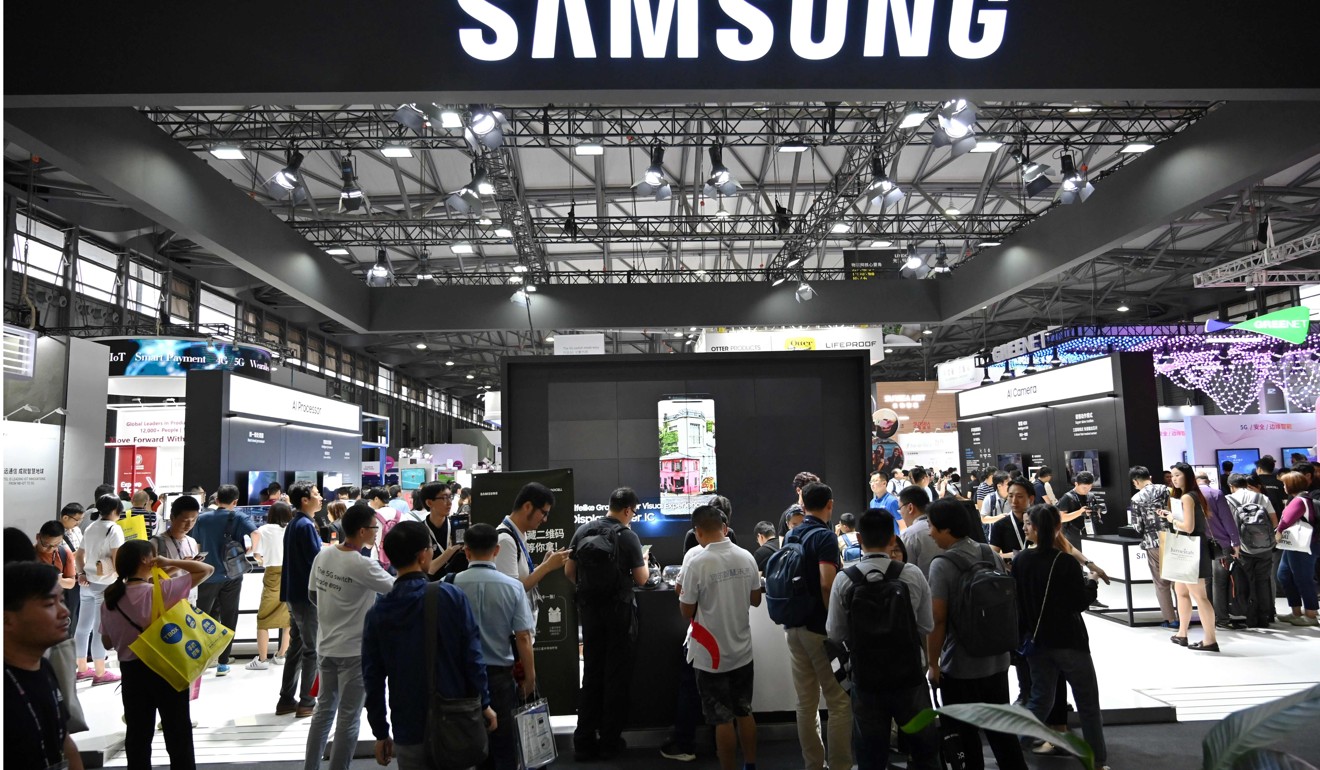
Samsung said operations at its last factory in China ended last month. Photo: Reuters
said on Friday it has ended the production of smartphones in its last factory in China.
Operations at the plant in the south China city of
Huizhou, Guangdong province, ended last month, it said in an email.
The company made “the difficult decision to cease operations of Samsung Electronics Huizhou” in order “to enhance efficiency” in its manufacturing, it said.
Samsung’s market share in China has dwindled to near insignificance as competitors like
Huawei and
Xiaomi have taken the upper hand. It once had 15 per cent of China’s smartphone market.
Samsung once had a 15 per cent share of China’s smartphone market. Photo: AFP
The South Korean giant has moved a large share of its
smartphone production to Vietnam and closed a factory in northeastern China’s Tianjin last year.
“The production equipment will be reallocated to other global manufacturing sites depending on our global production strategy based on market needs,” the statement said.
Samsung is the world’s biggest manufacturer of semiconductors and smartphones and a major producer of display screens. But the flagship of
South Korea’s largest conglomerate is currently weathering a spell of slack demand for computer chips.
Like other South Korean electronics makers, it also is facing the impact of tightened Japanese controls on exports of hi-tech materials used in semiconductors and displays.
On Wednesday, Sony said it was closing its Beijing smartphone plant and would only make smartphones in Thailand.
But Apple still makes major products in China.
“In China, people buy low-priced smartphones from domestic brands and high-end phones from Apple or Huawei,” Park Sung-soon, an analyst at Cape Investment & Securities, said.
“Samsung has little hope there to revive its share.”
Samsung’s factory in Huizhou was built in 1992, according to the company. South Korean media said it employed 6,000 workers and produced 63 million units in 2017.
Samsung manufactured 394 million handsets around the world in 2107, according to its annual report.
Source: Reuters
Posted in Apple, Beijing, Cape Investment & Securities, China alert, closes, computer chips, conglomerate, display screens, Factory, guangdong province, hi-tech materials, Huawei, Japanese controls, last, manufacturer, Samsung, Semiconductors, smartphone, Sony, South Korea, Thailand, Tianjin, Uncategorized, Vietnam, Xiaomi |
Leave a Comment »
28/09/2019
- Military experts say PLA modernisation brought about during Xi Jinping’s presidency will be the main focus of October 1 celebration in Beijing
- It’s necessary for China to ‘show some of its muscle’ amid the trade dispute with the US, observer says
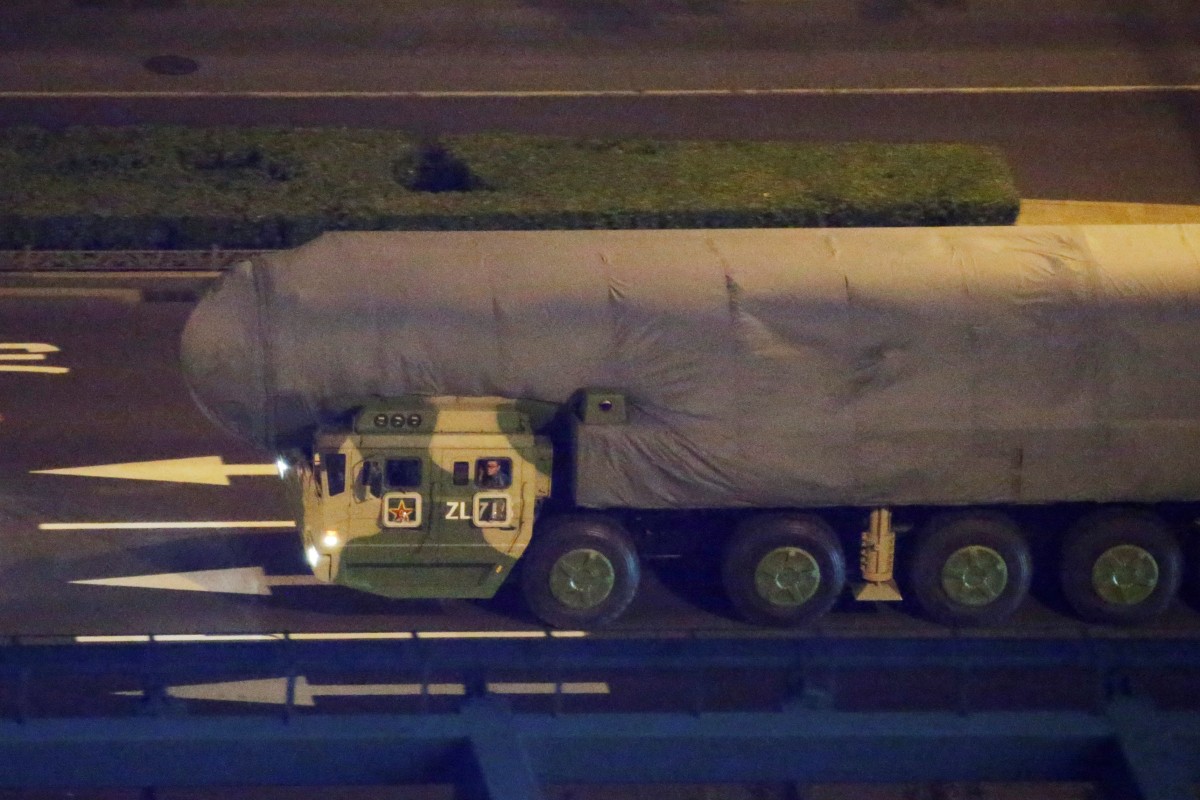
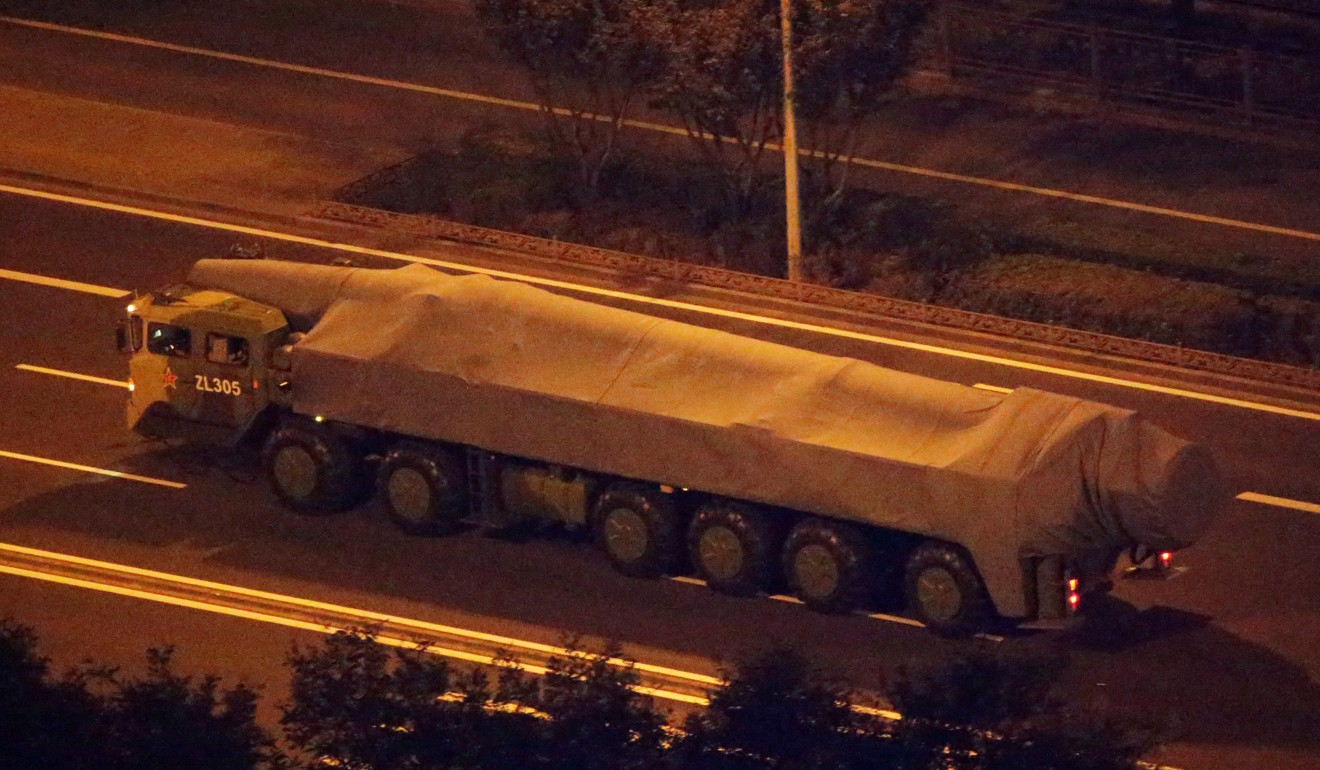
China’s land-based DF-41 intercontinental ballistic missile will be among the military hardware on show on October 1. Photo: Reuters
China plans to show off its most advanced active weapon systems at the upcoming National Day parade, which will be the biggest of the 14 such events it has held over the past seven decades.
The parade, to be held on October 1 to mark the 70th anniversary of the founding of the People’s Republic, will highlight the military modernisation – particularly in nuclear deterrence – that has taken place since President Xi Jinping came to power in late 2012, according to military experts.
The People’s Liberation Army (PLA) offered a glimpse of those weapons during rehearsals for the parade in downtown Beijing from September 14.
As part of the celebrations, Xi, who also chairs the Central Military Commission, will inspect 48 squads on the ground and more than a dozen airborne squadrons, according to a military insider involved in support services for the parade.
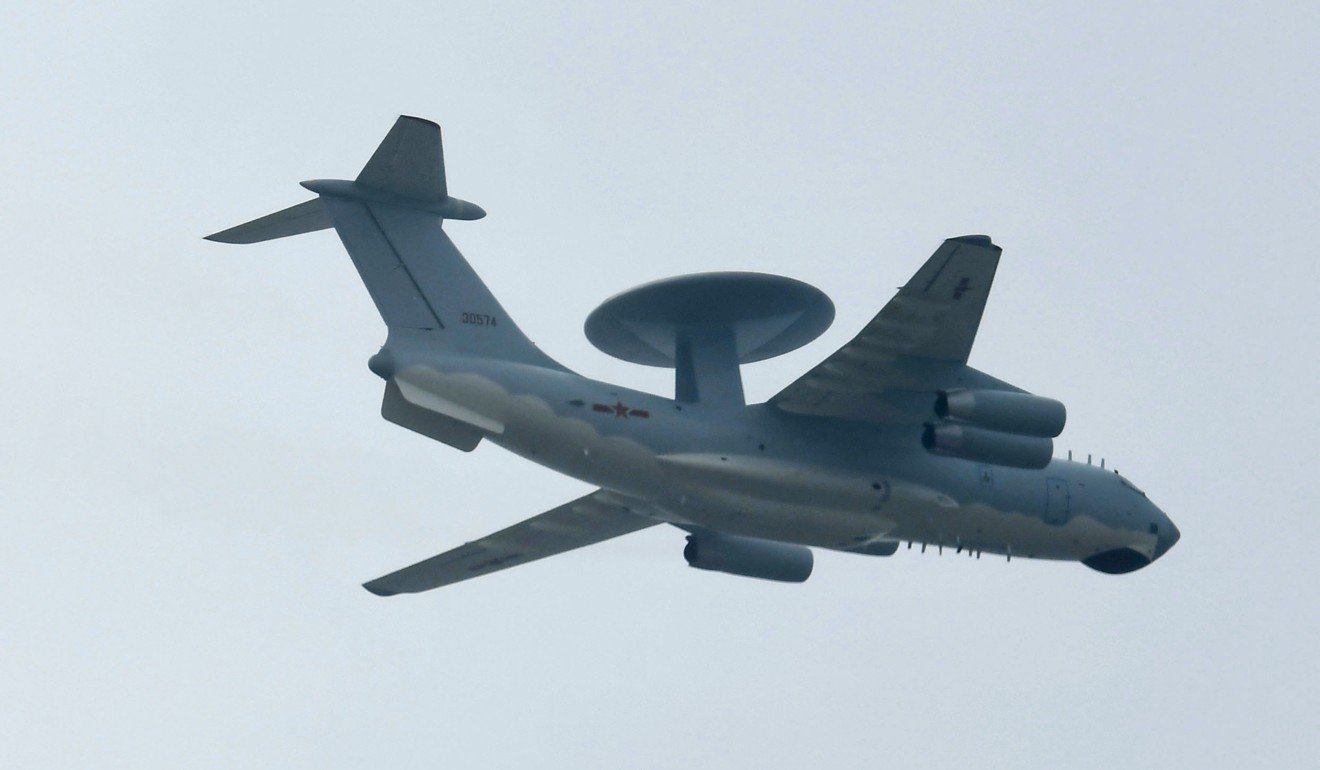
More than a dozen airborne squadrons will take part in the National Day parade. Photo: Kyodo
The squadrons will include the air force’s first stealth fighter, the J-20; the main active warplanes such as the J-10 and J-11B; and armed helicopters like the Z-20. However, the J-8 fighter jet would not appear this year, the source said, confirming that the first interceptor built in China has been formally retired.
“The ground march will be led by several hero forces from the five theatre commands, which is different from previous squads selected from the ground forces, air force and navy,” said the insider, who requested anonymity because of the sensitivity of the matter.
“The main goal of this year’s parade is to promote the military modernisation of the PLA under President Xi’s leadership over the past seven years, with the military overhaul being one of the key achievements.”
Thirty-three of the 48 squads would be “weapon squads”, while the 13 others would be made up of infantry troops from the five theatre commands, the source said.
National Day fireworks in Hong Kong cancelled over safety fears
As part of the PLA’s sweeping military reforms, the army’s previous seven military commands were reshaped into five theatre commands, while the four former general headquarters were dissolved and replaced by 15 small functional departments.
In September 2015, Xi announced the PLA would shed 300,000 troops, cutting its size to 2 million, a move aimed at turning the PLA into a more nimble and combat-ready fighting force on a par with international standards.
Xi also split the former Second Artillery Corps into the Rocket Force and the Strategic Support Force, with the latter backing up the military’s electronic warfare units in cyberspace and outer space.
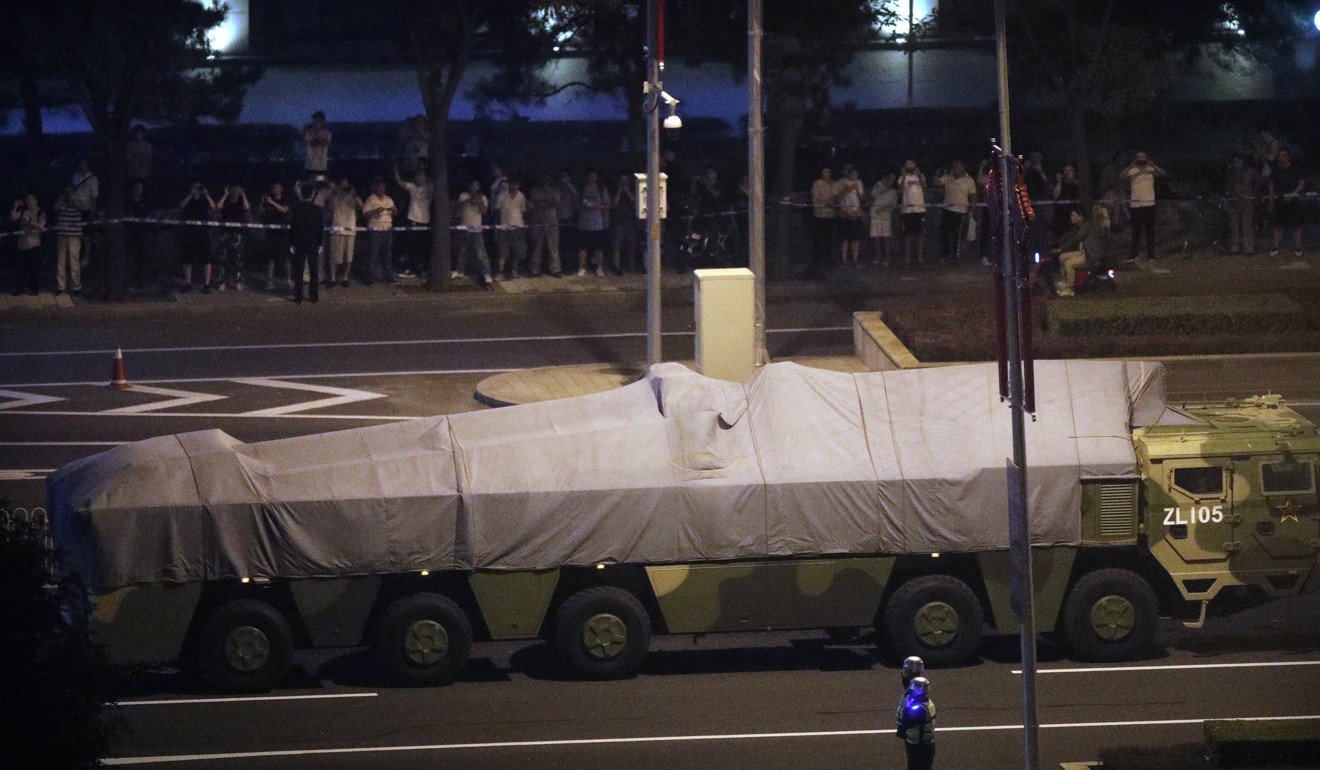
Among the 33 weapon squads, the highlights are expected to be the PLA’s strategic nuclear missiles such as the Rocket Force’s land-based DF-41 intercontinental ballistic missile (ICBM), the DF-21D anti-ship ballistic missile, the DF-17 hypersonic missile and the sea-launched JL-2, or Big Wave-2.
Adam Ni, a researcher at Macquarie University in Australia, said that showing off different types of missiles on land and sea indicated that the PLA was improving its nuclear deterrence capabilities by perfecting a three-pronged military force structure, or the so-called nuclear triad.
The DF-17 hypersonic ballistic missile will be one of the highlights of the parade. Photo: AP
The DF-41 is capable of carrying multiple warheads and many decoys, making it harder to detect than silo-based systems and better able to survive a first strike.
Ni said the DF-41 was China’s next-generation cutting-edge weapon.
“It’s actually an advanced ICBM and has a range to hit practically anywhere in the world, including the continental United States,” Ni said.
“The DF-41 is the ultimate symbol of the destructive potential of Chinese armed forces, just as nuclear weapons are similar symbols of the US and Russia.”
The JL-2 – which has a shorter range of 7,000km (4,350 miles) and can be launched by the PLA Navy’s Type 094 submarines – is unable to hit anywhere on the American continent when launched from submarines in the South China Sea and coastal areas of China.
China tests new warships in live-fire drills near Vietnam
However, China is developing the JL-3, which has a range of about 9,000km; the upgraded version of the JL-2, with a flight test conducted in June, though it is still less than the 12,000km range of the American Trident II.
“China is stepping up its military modernisation, which includes a number of aspects; the land-based aspect is introducing more mobile and survivable missile systems,” Ni said.
“The game change will happen when China is able to hit the whole US continent with its missile submarines in Chinese coastal waters.”
In military terms, survivable refers to the ability to remain mission capable after a single engagement.
The DF-17 is a land-to-land short-range strategic missile capable of delivering both nuclear and conventional payloads. The US intelligence community has estimated that it will reach initial operational capability by 2020. But if the missile is displayed in the parade, that means it is active already.
China conducted two tests of the DF-17 in November 2017, with the first launched from the Jiuquan Space Launch Centre in Inner Mongolia.
An insider said the main goal of this year’s parade is to promote the military modernisation of the PLA. Photo: Reuters
Hong Kong-based military commentator Song Zhongping said the nuclear weapons that would go on show in the parade would all be strategic missiles designed to improve China’s deterrent capabilities.
The show comes after the PLA delivered a national defence white paper in July stressing its goal to “maintain national strategic security by deterring other countries from using or threatening to use nuclear weapons against China”.
Unlike in the past, this year’s report stated that the US and China were now competing superpowers, and that the PLA’s growing forces were developing to the point that they could challenge the US.
Zhou Chenming, a Beijing-based military observer, said it was also necessary for the PLA to “show some of its muscle” amid the ongoing trade dispute between Beijing and Washington.
“To prevent misunderstanding, most of the weapons are just strategic equipment, not tactical arms, because Beijing still doesn’t want to irritate Washington,” he said.
About 280,000 people were involved in the rehearsals for the parade and related support services, according to Xinhua.
Source: SCMP
Posted in 70th anniversary, accuse teacher, advances, air force, airborne squadrons, American Trident II, armed helicopters, Australia, Beijing, celebration, Central Military Commission, Central Military Commission (CMC), China’s National Day, continental United States, cyberspace, decoys, DF-41 intercontinental ballistic missile, DF-41 intercontinental ballistic missile (ICBM), first strike, founding of the People’s Republic, ground forces, Inner Mongolia, J-20 stealth fighter, J-8 fighter jet, Jiuquan Space Launch Centre, Macquarie University, Military experts, military hardware, multiple warheads, navy, nuclear deterrence, nuclear triad, October 1, outer space, parade, People’s Liberation Army (PLA), pla navy, Rocket Force, Russia, Second Artillery Corps, showcase, silo-based systems, South China Sea, stealth fighter, strategic nuclear missiles, Strategic Support Force, survive, Type 094 submarines, Uncategorized, US, Vietnam, weapon squads, Xi JinPing |
Leave a Comment »
28/09/2019
- Legal process under way, Beijing says after Foreign Minister Wang Yi tells United Nations China is committed to defending multilateralism
- Any unilateral move to leave weapons control pact will have a ‘negative impact in various areas’, minister says in thinly veiled swipe at United States
China, the world’s fifth-largest weapons supplier, has signed up to a global arms control treaty. Photo: Simon Song
China said it has begun preparations to join an international arms control treaty that the United States has threatened to abandon, while also warning Washington against deploying missiles in the Asia-Pacific region.
Speaking at the United Nations General Assembly in New York on Friday, Chinese Foreign Minister Wang Yi said that signing up to the Arms Trade Treaty (ATT) was further evidence of Beijing’s commitment to defending multilateralism.
said in April that he intended to withdraw from the pact, which regulates the US$70 billion global trade in conventional arms.
The White House said at the time that the ATT “will only constrain responsible countries while allowing the irresponsible arms trade to continue”, as major arms exporters like Russia and China were not part of it.
Wang said on Friday that any unilateral move to leave the treaty would have a “negative impact in various areas”. He stopped short of naming the United States or its president.
China’s foreign ministry said in a statement on Saturday that it had begun the legal process of joining the treaty, adding that it attached great importance to the issues caused by the illegal sale and misuse of arms, and supported the aims of the ATT in seeking to regulate the international weapons trade.
Wang also spoke out against the possible deployment of ground-launched missiles in the Asia-Pacific region.
After withdrawing from the
Intermediate-Range Nuclear Forces Treaty in August, the US said it was planning to deploy such weapons in Asia to counter any possible threat from China or Russia.
“[We] urge the country with the largest nuclear weapons to fulfil its special and prior responsibilities on nuclear disarmament,” Wang said, adding that “China will continue to participate in the international arms control process”.
Wang Yi spoke out against the possible deployment of ground-launched missiles in the Asia-Pacific region at the UN General Assembly in New York on Friday. Photo: AFP
According to figures released in May by the Stockholm International Peace Research Institute, the United States is the world’s largest arms exporter, supplying weapons worth 58 per cent more than those of its nearest competitor, Russia.
Together with France, Germany and China, the five nations accounted for 75 per cent of all weapons sold around the world between 2014 and last year, the institute said.
Although China is among the world’s big five arms suppliers, its sales – most of which go to Asia and Oceania – are dwarfed by those of the US, accounting for just 5.2 per cent of the 2014-18 total, compared to America’s 36 per cent.
Several major arms importers, including India, Australia, South Korea and Vietnam, refuse to buy arms from China for political reasons.
Beijing’s decision to join the ATT is in keeping with the image it has sought to present of China as a defender of multilateralism. The stance is also in sharp contrast to the US’ position under Trump, who has repeatedly scrapped multilateral trade agreements in favour of bilateral deals.
Since taking office in 2016, he has withdrawn the US from the Paris climate accord, the Iran nuclear deal and the Trans-Pacific Partnership.
Military observers said Beijing might seek to pressure on Washington to stay in the deal to try to maintain the strategic and military balance in the region.
Song Zhongping, a Hong Kong-based military affairs commentator, said Beijing might be trying to avoid misuse of conventional weapons.
“Beijing may want to press big exporters, such as the US and Russia, to join the deal because without proper regulations, the risk of illegal trade and misuse of conventional weapons could be running high,” he said.
“This could also threaten regional stability or even trigger unnecessary arms races.”
Adam Ni, a China specialist at Sydney’s Macquarie University, said the treaty would put some limits on the arms trade “but it would not mean that China would not be able to do deals. It will still be able to do [most deals]”.
Retired PLA colonel Yue Gang said the strategy could also improve China’s international reputation.
Source: SCMP
Posted in abandon, arms importers, Arms Trade Treaty, Asia, Asia-Pacific region, Australia, Beijing, China alert, deploying, dwarfed, Foreign Minister Wang Yi, France, General Assembly, Germany, global arms control treaty, India alert, Intermediate-Range Nuclear Forces Treaty, Iran nuclear deal, join, largest nuclear weapons, Macquarie University, military affairs commentator, Military observers, missiles, New York, Paris climate accord, political reasons, President Donald Trump, Russia, South Korea, Sydney, threatened, Trans-Pacific Partnership (TPP), Uncategorized, United Nations, United States, Vietnam, Washington, White House |
Leave a Comment »
22/09/2019
- Military experts say PLA modernisation brought about during Xi Jinping’s presidency will be the main focus of October 1 celebration in Beijing
- It’s necessary for China to ‘show some of its muscle’ amid the trade dispute with the US, observer says
China’s land-based DF-41 intercontinental ballistic missile will be among the military hardware on show on October 1. Photo: Reuters
China plans to show off its most advanced active weapon systems at the upcoming National Day parade, which will be the biggest of the 14 such events it has held over the past seven decades.
The parade, to be held on October 1 to mark the 70th anniversary of the founding of the People’s Republic, will highlight the military modernisation – particularly in nuclear deterrence – that has taken place since President Xi Jinping came to power in late 2012, according to military experts.
The People’s Liberation Army (PLA) offered a glimpse of those weapons during rehearsals for the parade in downtown Beijing from September 14.
As part of the celebrations, Xi, who also chairs the Central Military Commission, will inspect 48 squads on the ground and more than a dozen airborne squadrons, according to a military insider involved in support services for the parade.
More than a dozen airborne squadrons will take part in the National Day parade. Photo: Kyodo
The squadrons will include the air force’s first stealth fighter, the J-20; the main active warplanes such as the J-10 and J-11B; and armed helicopters like the Z-20. However, the J-8 fighter jet would not appear this year, the source said, confirming that the first interceptor built in China has been formally retired.
“The ground march will be led by several hero forces from the five theatre commands, which is different from previous squads selected from the ground forces, air force and navy,” said the insider, who requested anonymity because of the sensitivity of the matter.
“The main goal of this year’s parade is to promote the military modernisation of the PLA under President Xi’s leadership over the past seven years, with the military overhaul being one of the key achievements.”
Thirty-three of the 48 squads would be “weapon squads”, while the 13 others would be made up of infantry troops from the five theatre commands, the source said.
National Day fireworks in Hong Kong cancelled over safety fears
As part of the PLA’s sweeping military reforms, the army’s previous seven military commands were reshaped into five theatre commands, while the four former general headquarters were dissolved and replaced by 15 small functional departments.
In September 2015, Xi announced the PLA would shed 300,000 troops, cutting its size to 2 million, a move aimed at turning the PLA into a more nimble and combat-ready fighting force on a par with international standards.
Xi also split the former Second Artillery Corps into the Rocket Force and the Strategic Support Force, with the latter backing up the military’s electronic warfare units in cyberspace and outer space.
Among the 33 weapon squads, the highlights are expected to be the PLA’s strategic nuclear missiles such as the Rocket Force’s land-based DF-41 intercontinental ballistic missile (ICBM), the DF-21D anti-ship ballistic missile, the DF-17 hypersonic missile and the sea-launched JL-2, or Big Wave-2.
Adam Ni, a researcher at Macquarie University in Australia, said that showing off different types of missiles on land and sea indicated that the PLA was improving its nuclear deterrence capabilities by perfecting a three-pronged military force structure, or the so-called nuclear triad.
The DF-17 hypersonic ballistic missile will be one of the highlights of the parade. Photo: AP
The DF-41 is capable of carrying multiple warheads and many decoys, making it harder to detect than silo-based systems and better able to survive a first strike.
Ni said the DF-41 was China’s next-generation cutting-edge weapon.
“It’s actually an advanced ICBM and has a range to hit practically anywhere in the world, including the continental United States,” Ni said.
“The DF-41 is the ultimate symbol of the destructive potential of Chinese armed forces, just as nuclear weapons are similar symbols of the US and Russia.”
The JL-2 – which has a shorter range of 7,000km (4,350 miles) and can be launched by the PLA Navy’s Type 094 submarines – is unable to hit anywhere on the American continent when launched from submarines in the South China Sea and coastal areas of China.
China tests new warships in live-fire drills near Vietnam
However, China is developing the JL-3, which has a range of about 9,000km; the upgraded version of the JL-2, with a flight test conducted in June, though it is still less than the 12,000km range of the American Trident II.
“China is stepping up its military modernisation, which includes a number of aspects; the land-based aspect is introducing more mobile and survivable missile systems,” Ni said.
“The game change will happen when China is able to hit the whole US continent with its missile submarines in Chinese coastal waters.”
In military terms, survivable refers to the ability to remain mission capable after a single engagement.
The DF-17 is a land-to-land short-range strategic missile capable of delivering both nuclear and conventional payloads. The US intelligence community has estimated that it will reach initial operational capability by 2020. But if the missile is displayed in the parade, that means it is active already.
China conducted two tests of the DF-17 in November 2017, with the first launched from the Jiuquan Space Launch Centre in Inner Mongolia.
An insider said the main goal of this year’s parade is to promote the military modernisation of the PLA. Photo: Reuters
Hong Kong-based military commentator Song Zhongping said the nuclear weapons that would go on show in the parade would all be strategic missiles designed to improve China’s deterrent capabilities.
The show comes after the PLA delivered a national defence white paper in July stressing its goal to “maintain national strategic security by deterring other countries from using or threatening to use nuclear weapons against China”.
Unlike in the past, this year’s report stated that the US and China were now competing superpowers, and that the PLA’s growing forces were developing to the point that they could challenge the US.
Zhou Chenming, a Beijing-based military observer, said it was also necessary for the PLA to “show some of its muscle” amid the ongoing trade dispute between Beijing and Washington.
“To prevent misunderstanding, most of the weapons are just strategic equipment, not tactical arms, because Beijing still doesn’t want to irritate Washington,” he said.
About 280,000 people were involved in the rehearsals for the parade and related support services, according to Xinhua.
Source: SCMP
Posted in 70th anniversary, advances, airborne squadrons, Australia, Beijing, Big Wave-2, celebration, Central Military Commission, Central Military Commission (CMC), China’s National Day, continental United States, cyberspace, decoys, DF-17 hypersonic missile, DF-21D anti-ship ballistic missile, DF-41 intercontinental ballistic missile, DF-41 intercontinental ballistic missile (ICBM), electronic warfare units, first strike, founding of the People’s Republic, ICBM, Inner Mongolia, J-20 stealth fighter, Jiuquan Space Launch Centre, live-fire drills, Macquarie University, Military experts, military hardware, military modernisation, missile submarines, multiple warheads, National Day, nuclear deterrence, nuclear triad, nuclear weapons, October 1, outer space, parade, People’s Liberation Army (PLA), PLA modernisation, pla navy, President Xi Jinping, Rocket Force, Russia, sea-launched JL-2, showcase, silo-based systems, South China Sea, stealth fighter, Strategic Support Force, submarines, superpowers, survive, Trident II, Uncategorized, US, Vietnam, warships, Washington, Xinhua |
Leave a Comment »
20/09/2019
NANNING, Sept. 19 (Xinhua) — Pham Thi Nguyet Hoa, a vendor living in Vietnam’s Mong Cai, comes to Dongxing, a southern Chinese port city, to sell Vietnam fruits every day. When night falls, she often ends up with thousands of yuan in her pocket, much more than what she can earn at home.
“Most of my customers are Chinese, and it is very convenient to exchange Chinese yuan to Vietnamese Dong as many banks in Dongxing have this currency exchange service,” said Pham.
Tourism has been a pillar industry in the border city of southern China’s Guangxi Zhuang Autonomous Region. Dongxing port saw 12 million people, of which half were tourists, pass through last year, ranking first among all land ports in China.
In the first six months this year, tourism consumption at the port exceeded 6.2 billion yuan (874 million U.S. dollars), up 40.4 percent from the year before.
The flourishing border tourism has brought a huge demand for currency exchange, with a slew of financial reforms rolled out in recent years.
In 2014, the ABC China (Dongxing Experimental Zone) ASEAN Currency business center was established in Dongxing, allowing direct convertibility of Chinese yuan and Vietnamese Dong.
In February 2018, a total of 8 million yuan was transferred in cash from Vietnam to China, marking the first cross-border cash transfer in Guangxi between China and Vietnam.
Fan Zuojun, vice president of Guangxi University, said the cross-border cash transfer will further promote the financial cooperation between China and Members of the Association of Southeast Asian Nations (ASEAN) as well as deepen reform and push forward the internationalization of the Chinese currency in the region.
China and ASEAN countries have always maintained close relations in trade.
In January 2010, the China-ASEAN Free Trade Area was set up, which has significantly boosted bilateral trade. China has maintained its position as the largest trading partner of ASEAN for 10 consecutive years, and trade between China and ASEAN has skyrocketed tenfold from 16 years ago to 587.8 billion U.S. dollars in 2018.
In the first half of 2019, ASEAN became China’s second-largest trading partner, with bilateral trade volume reaching 291.85 billion U.S. dollars, up 4.2 percent year on year.
Guangxi’s geographical advantages have also given it huge development dividends over the past decades. ASEAN has been Guangxi’s largest trade partner for 19 consecutive years, and trade volume between Guangxi and ASEAN in the first seven months of this year topped 128 billion yuan, accounting for 48.7 percent of Guangxi’s total foreign trade.
Now with the launch of the Guangxi Pilot Free Trade Zone (FTZ) in August, bilateral trade exchanges are expected to embrace another golden opportunity.
The pilot FTZ, with a total area of nearly 120 square km, will focus on modern financial services, smart logistics, digital economy, port shipping logistics, international trade and cross-border tourism, among others.
Guangxi vows to make greater efforts to consolidate its financial strength and build itself into an ASEAN-oriented financial portal, with over 90 financial reform measures being rolled out to further facilitate trade and investment and promote innovation in financial services with ASEAN countries.
Posted in ABC China (Dongxing Experimental Zone) ASEAN Currency business center, ASEAN, Association of Southeast Asian Nations (ASEAN), build, China alert, China's border region, China-ASEAN Free Trade Area, Chinese, Chinese yuan, consumption, customers, Dongxing, exchange, expedites, financial gateway, first, Guangxi Pilot Free Trade Zone (FTZ), Guangxi University, Guangxi Zhuang Autonomous Region, land ports, Nanning, night, pillar industry, port city, ranking, reform, sell, Tourism, tourists, Uncategorized, Vietnam, Vietnam fruits, Vietnamese Dong |
Leave a Comment »
12/09/2019
BEIJING (Reuters) – China and Malaysia have agreed to set up a joint dialogue mechanism for the disputed South China Sea, the Chinese government’s top diplomat said on Thursday after meeting Malaysia’s foreign minister.
Recent Chinese naval deployments in the strategic waterway, through which more than $3.4 trillion worth of goods are transported annually, have reignited tension with Vietnam and the Philippines. Malaysia, Brunei and Taiwan also have competing claims in the South China Sea.
Malaysia had been critical of China’s South China Sea position, but has not been excessively outspoken recently, especially after China pumped in billions of dollars into infrastructure projects under its Belt and Road Initiative.
Malaysia regularly tracked Chinese naval and coastguard vessels entering Malaysia’s territorial waters, but China respects Malaysia and had “not done anything that caused us trouble, so far”, Defence Minister Mohamad Sabu told Reuters last month.
Chinese State Councillor Wang Yi told a news conference with Malaysian Foreign Minister Saifuddin Abdullah that this year, tensions in the South China Sea had dropped.
Littoral states and China were committed to continue appropriately handling the South China Sea issue and jointly safeguard peace and stability there, said Wang, who is the Chinese government’s top diplomat.
“To this end, our two sides have agreed to set up a bilateral consultation mechanism for maritime issues, a new platform for dialogue and cooperation for both sides,” he said.
Abdullah, who referred to Wang as “my brother”, said the mechanism would be led by the two countries’ foreign ministries.
“Our officers will be discussing the details, but I think this is one important outcome of the meeting today and also the 45 years of our diplomatic relations,” he said.
China is debt-heavy Malaysia’s biggest trade partner and the countries have close cultural ties too.
In July, China and Malaysia resumed construction on a train project in northern Malaysia, which is part of China’s Belt and Road plan, after a year-long suspension and following a rare agreement to cut its cost by nearly a third, to about $11 billion.
Source: Reuters
Posted in Belt and Road Initiative, Belt and Road Initiative (BRI), belt and road plan, Brunei, China alert, coastguard vessels, defence minister, dialogue, infrastructure projects, Littoral states, Malaysia, Malaysian Foreign Minister, mechanism, Mohamad Sabu, naval deployments, naval vessels, Philippines, Reuters, Saifuddin Abdullah, set up, South China Sea, State Councillor Wang Yi, strategic waterway, Taiwan, Uncategorized, Vietnam |
Leave a Comment »





 CHINDIA ALERT: You'll be living in their world, very soon
China set to join Arms Trade Treaty that Donald Trump threatened to abandon
China said it has begun preparations to join an international arms control treaty that the United States has threatened to abandon, while also warning Washington against deploying missiles in the Asia-Pacific region.
Speaking at the United Nations General Assembly in New York on Friday, Chinese Foreign Minister Wang Yi said that signing up to the Arms Trade Treaty (ATT) was further evidence of Beijing’s commitment to defending multilateralism.
said in April that he intended to withdraw from the pact, which regulates the US$70 billion global trade in conventional arms.
The White House said at the time that the ATT “will only constrain responsible countries while allowing the irresponsible arms trade to continue”, as major arms exporters like Russia and China were not part of it.
Wang said on Friday that any unilateral move to leave the treaty would have a “negative impact in various areas”. He stopped short of naming the United States or its president.
China’s foreign ministry said in a statement on Saturday that it had begun the legal process of joining the treaty, adding that it attached great importance to the issues caused by the illegal sale and misuse of arms, and supported the aims of the ATT in seeking to regulate the international weapons trade.
Wang also spoke out against the possible deployment of ground-launched missiles in the Asia-Pacific region.
According to figures released in May by the Stockholm International Peace Research Institute, the United States is the world’s largest arms exporter, supplying weapons worth 58 per cent more than those of its nearest competitor, Russia.
Together with France, Germany and China, the five nations accounted for 75 per cent of all weapons sold around the world between 2014 and last year, the institute said.
Although China is among the world’s big five arms suppliers, its sales – most of which go to Asia and Oceania – are dwarfed by those of the US, accounting for just 5.2 per cent of the 2014-18 total, compared to America’s 36 per cent.
Several major arms importers, including India, Australia, South Korea and Vietnam, refuse to buy arms from China for political reasons.
Beijing’s decision to join the ATT is in keeping with the image it has sought to present of China as a defender of multilateralism. The stance is also in sharp contrast to the US’ position under Trump, who has repeatedly scrapped multilateral trade agreements in favour of bilateral deals.
Since taking office in 2016, he has withdrawn the US from the Paris climate accord, the Iran nuclear deal and the Trans-Pacific Partnership.
Military observers said Beijing might seek to pressure on Washington to stay in the deal to try to maintain the strategic and military balance in the region.
Song Zhongping, a Hong Kong-based military affairs commentator, said Beijing might be trying to avoid misuse of conventional weapons.
“Beijing may want to press big exporters, such as the US and Russia, to join the deal because without proper regulations, the risk of illegal trade and misuse of conventional weapons could be running high,” he said.
“This could also threaten regional stability or even trigger unnecessary arms races.”
Adam Ni, a China specialist at Sydney’s Macquarie University, said the treaty would put some limits on the arms trade “but it would not mean that China would not be able to do deals. It will still be able to do [most deals]”.
Retired PLA colonel Yue Gang said the strategy could also improve China’s international reputation.
Source: SCMP
Posted in abandon, arms importers, Arms Trade Treaty, Asia, Asia-Pacific region, Australia, Beijing, China alert, deploying, dwarfed, Foreign Minister Wang Yi, France, General Assembly, Germany, global arms control treaty, India alert, Intermediate-Range Nuclear Forces Treaty, Iran nuclear deal, join, largest nuclear weapons, Macquarie University, military affairs commentator, Military observers, missiles, New York, Paris climate accord, political reasons, President Donald Trump, Russia, South Korea, Sydney, threatened, Trans-Pacific Partnership (TPP), Uncategorized, United Nations, United States, Vietnam, Washington, White House | Leave a Comment »