Chindia Alert: You’ll be Living in their World Very Soon
aims to alert you to the threats and opportunities that China and India present. China and India require serious attention; case of ‘hidden dragon and crouching tiger’.
Without this attention, governments, businesses and, indeed, individuals may find themselves at a great disadvantage sooner rather than later.
The POSTs (front webpages) are mainly 'cuttings' from reliable sources, updated continuously.
The PAGEs (see Tabs, above) attempt to make the information more meaningful by putting some structure to the information we have researched and assembled since 2006.
Chief executive Rupert Hogg says staff who ‘support or participate in illegal protests’ would face disciplinary action that ‘may include termination of employment’
Airline’s shares down 4.37 per cent on Monday morning to lowest level in 10 years, despite it complying with orders on Friday from China’s aviation authority
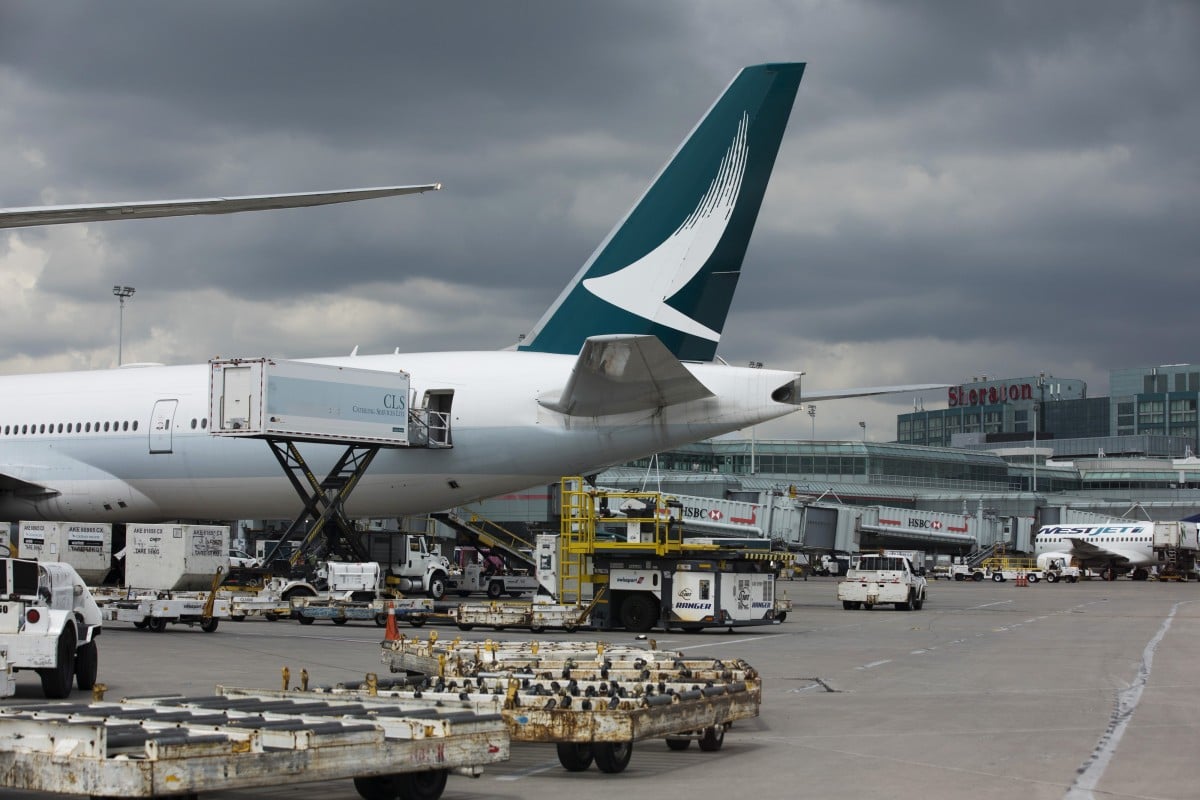
Cathay Pacific moved over the weekend to comply with new orders from China’s aviation authority. Photo: Bloomberg
Cathay Pacific has warned that it would sack staff taking part in illegal protests in Hong Kong, saying it would take a “zero tolerance” approach, as its shares slumped to their lowest level in 10 years in morning trading on Monday.
In a note to staff on Monday, chief executive Rupert Hogg said staff who “support or participate in illegal protests” would face disciplinary action that “could be serious and may include termination of employment”.
His warning indicated an escalation by the company, under pressure to crack down on employees after China’s civil aviation regulator said on Friday that airline staff supporting the Hong Kong protests would be barred from flights going to, from or through mainland China.
“We are all obliged to abide by law at all times,” Hogg said. “Cathay Pacific Group has a zero-tolerance approach to illegal activities. Specifically, in the current context, there will be disciplinary consequences for employees who support or participate in illegal protests. These consequences could be serious and may include termination of employment.”
By noon in Hong Kong, the stock had fallen 4.37 per cent to HK$9.85 (US$1.26), its lowest level since June 2009. Losses dragged the carrier’s parent company Swire Pacific down 5.4 per cent to HK$77.50, making it the worst performer on Hong Kong’s stock market during morning trading.
This was the lowest price since October 2018 for Swire, which owns 45 per cent of the airline. Air China, which owns 22.7 per cent of Cathay, also fell 1.53 per cent in Hong
On Friday, the Civil Aviation Administration of China (CAAC) told Hong Kong’s flagship carrier that any staff members who had taken part in what it called “illegal protests”, “violent actions” and “overly radical activities” would not be allowed to fly to or from the mainland, in a first warning shot at a Hong Kong-based corporate giant.
The CAAC also said that the airline would have to submit identification details of all crew operating all services using mainland China airspace, and that flights with unapproved crew lists would be barred. It gave the airline until Thursday to submit a detailed plan to improve its procedures.
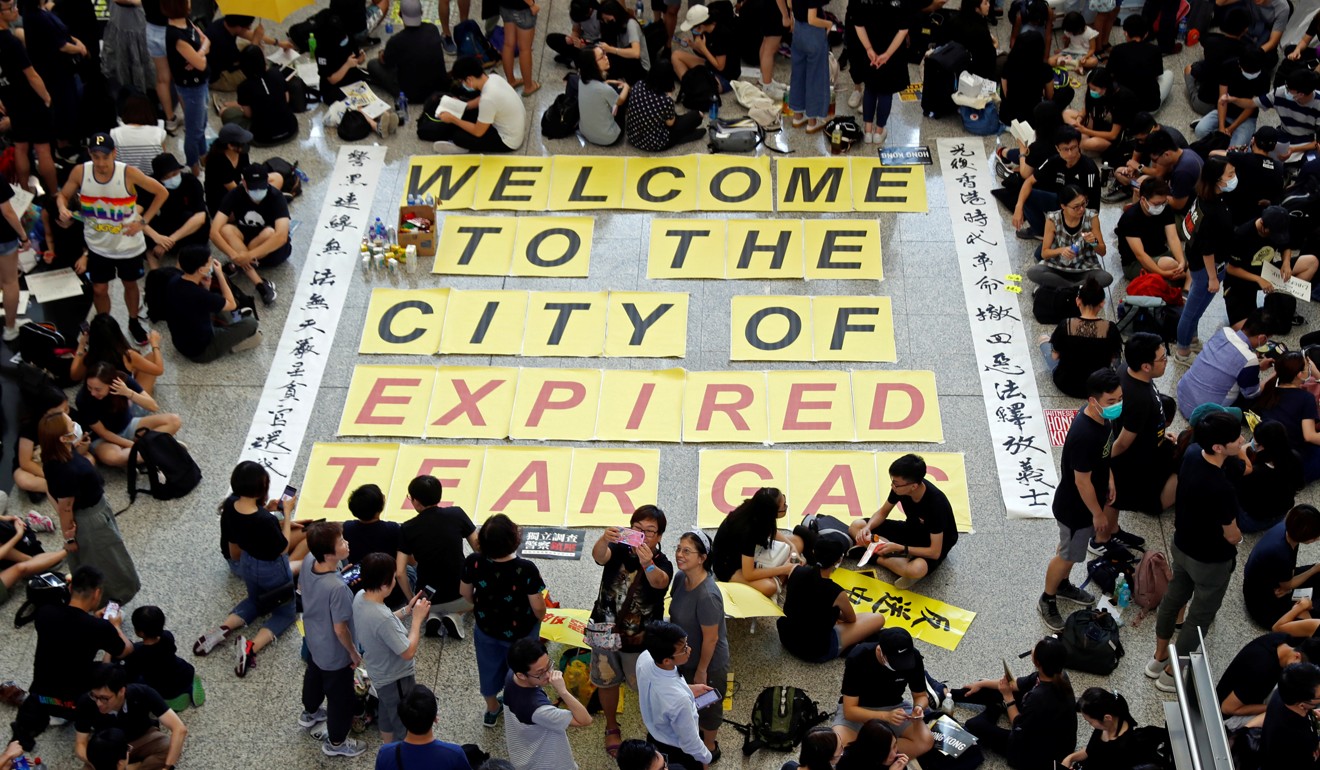
Anti-extradition bill protesters join a sit-in protest at Hong Kong International Airport on Sunday. Photo: Reuters
Cathay Pacific had earlier said it would not stop staff members from taking part in demonstrations.
On Wednesday, Cathay Pacific chairman John Slosar said the company would not rein in staff for openly supporting the protests. “We certainly wouldn’t dream of telling them what they have to think about something,” Slosar said.
But in his second statement in two days in relations to the CAAC’s sanctions, Hogg said the “actions and words” of staff outside of work hours could have a “significant effect on the company”, adding that the actions of a few of Cathay’s 34,000 employees would be seen as a company position.
He also asked staff to not “support or participate” in the illegal protest at the airport, saying the carrier was concerned that the protests could become disorderly and violent.
No flights by Cathay Pacific, nor by its subsidiaries Cathay Dragon or HK Express, were delayed or cancelled on Saturday or Sunday, the company said.
The CAAC’s move was widely seen as a clear warning to Hong Kong’s business community to toe Beijing’s line to pressure ongoing anti-government protests in the city that have been taking place for over two months.
Despite the airline acting over the weekend to comply with the rules, Chinese state media continued to put pressure on the company.
Global Times, a tabloid associated with Communist Party mouthpiece People’s Daily, said on Sunday the airline had still not allayed all concerns despite its adjustments to comply with the ruling.
Carrie Lam’s remarks about Beijing’s sovereignty ‘add fuel to the fire’, analysts warn
“These are only small steps [showing] that Cathay Pacific is heading towards the right direction, and their sincerity will need to be tested over time,” the tabloid said in an opinion article on Sunday.
It said 2,000 company staff joined citywide strikes last Monday, and cited the case of a pilot who was arrested and charged with rioting during a demonstration on July 28.
“Cathay Pacific has touched on this behaviour lightly, which has a huge impact on the trust the industry and the public have towards the company,” the article said.
State broadcaster CCTV published a short video on Weibo on Monday morning of its anchor issuing further warnings to the airline, saying there were reports of staff continuing to join “illegal gatherings” and asking tourists not to go to Hong Kong.
“If this continues, it’s not a matter of whether or not people would still want to come to Hong Kong, but whether they would still want to be on your airline,” Kang Hui said in a one-minute video.
“Let me send a friendly reminder: one would not be in trouble had one not asked for it,” Kang said, in Mandarin and then in English, translating the popular Chinese internet meme phrase “No zuo no die” and claiming some Cathay Pacific staff pretended not to understand Mandarin. Cantonese is the dominant language in Hong Kong.
Elsewhere, the company announced that two of its airport employees
for leaking passenger information about a Hong Kong police soccer team who had been on a flight to mainland China. It has also suspended the pilot who was among 44 people charged with rioting on July 28.
Although the company does not clearly specify its country-by-country performance, China and Hong Kong produced half of all its 2018 revenue – HK$57 billion of a total of HK$111 billion. A fifth of all the carrier’s flight are to and from the mainland.
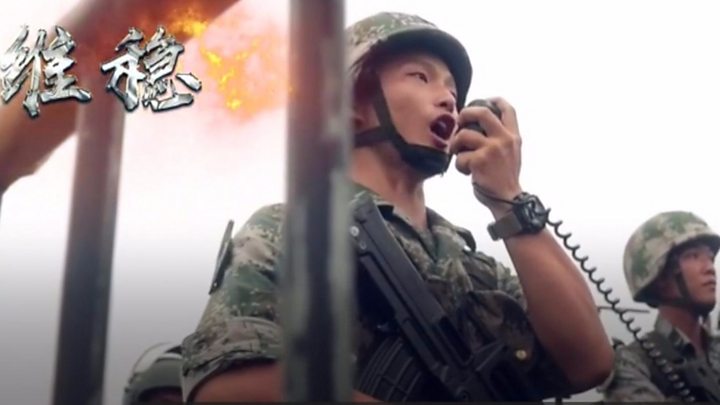
Security forces shown tackling ‘demonstrators’ wearing black shirts
‘Anti-mob’ tactics prepare forces for the 70th anniversary of the People’s Republic
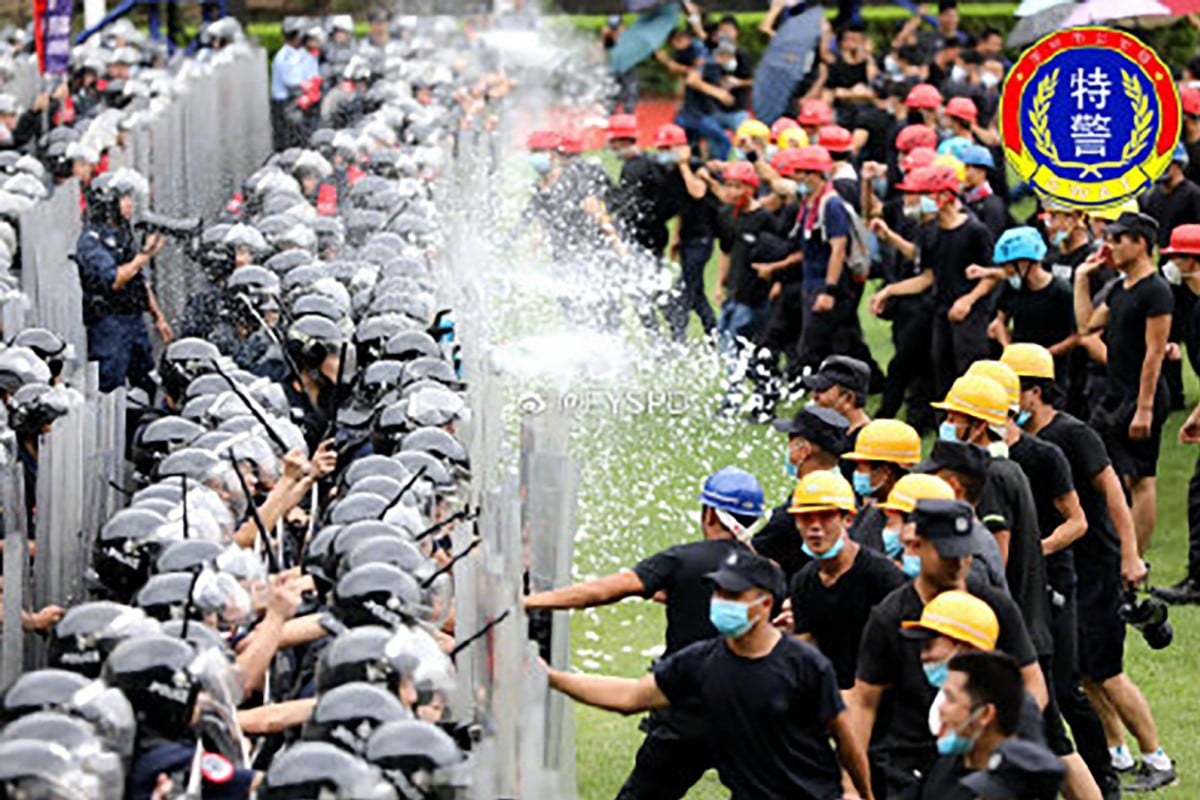
Shenzhen police broadcast live footage of a security exercise involving 12,000 officers rehearsing anti-riot drills. Photo: Weibo
More than 12,000 police officers assembled in Shenzhen in the southern Chinese province of Guangdong on Tuesday for a drill that included anti-riot measures similar to those seen on the streets of Hong Kong.
The drill was part of security preparations for the 70th anniversary of the People’s Republic of China on October 1, Shenzhen police said on the force’s Weibo newsfeed.
“A drill will be held to increase troop morale, practise and prepare for the security of celebrations, [and] maintain national political security and social stability,” police said.
China mobilises 190,000 police officers to prepare for 70th anniversary celebrations
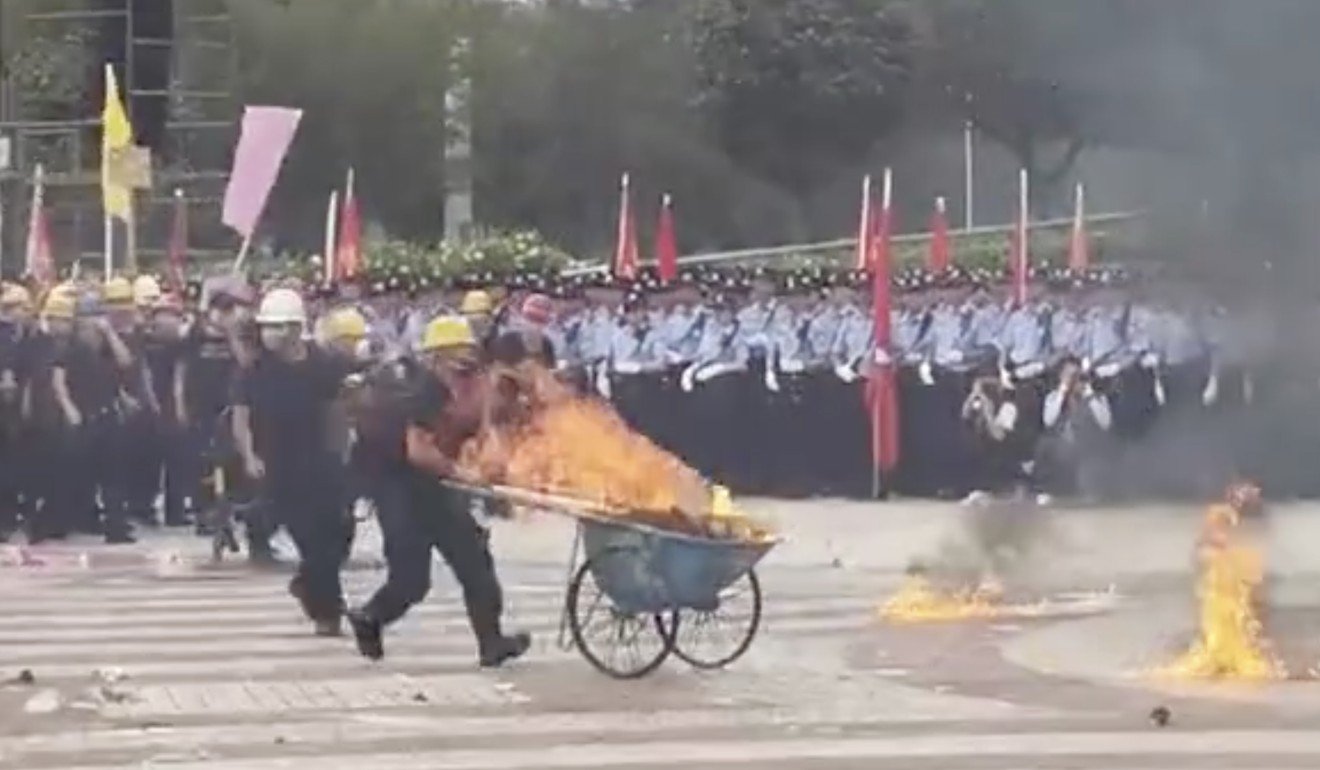
In live videos of the police drills shown on the Yizhibo network, officers in body armour, helmets and shields confronted groups of people in black shirts and red or yellow construction safety helmets – similar to those worn by Hong Kong protesters – who were holding flags, banners, batons and wooden boards.
Global Times
✔@globaltimesnews
Shenzhen #police drill attracted unusual attention as it features scenarios that resemble the ongoing riots in #HongKong. #香港http://bit.ly/2YobnJc (Video: Shenzhen News Radio)
One of the banners read “return my hard-earned money” – a slogan often used by migrant workers in protest against unpaid salaries.
“The practice is complete with mature anti-mob tactics. The police forces can present an anti-mob formation, which is flexible, suitable for different situations, with accurate aim and effective control,” a narrator said during the live broadcast.
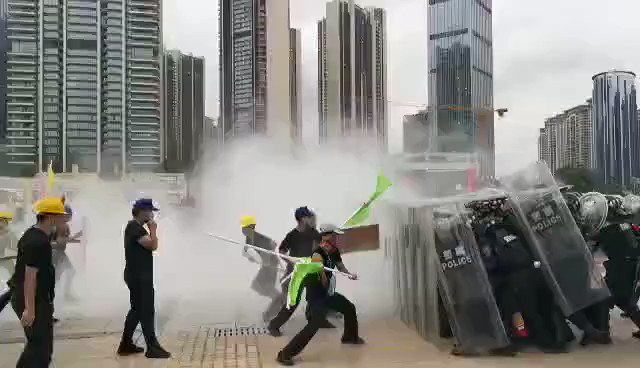
As the drill escalated and more “rioters” were deployed, police fired tear gas and smoke covered the training ground.
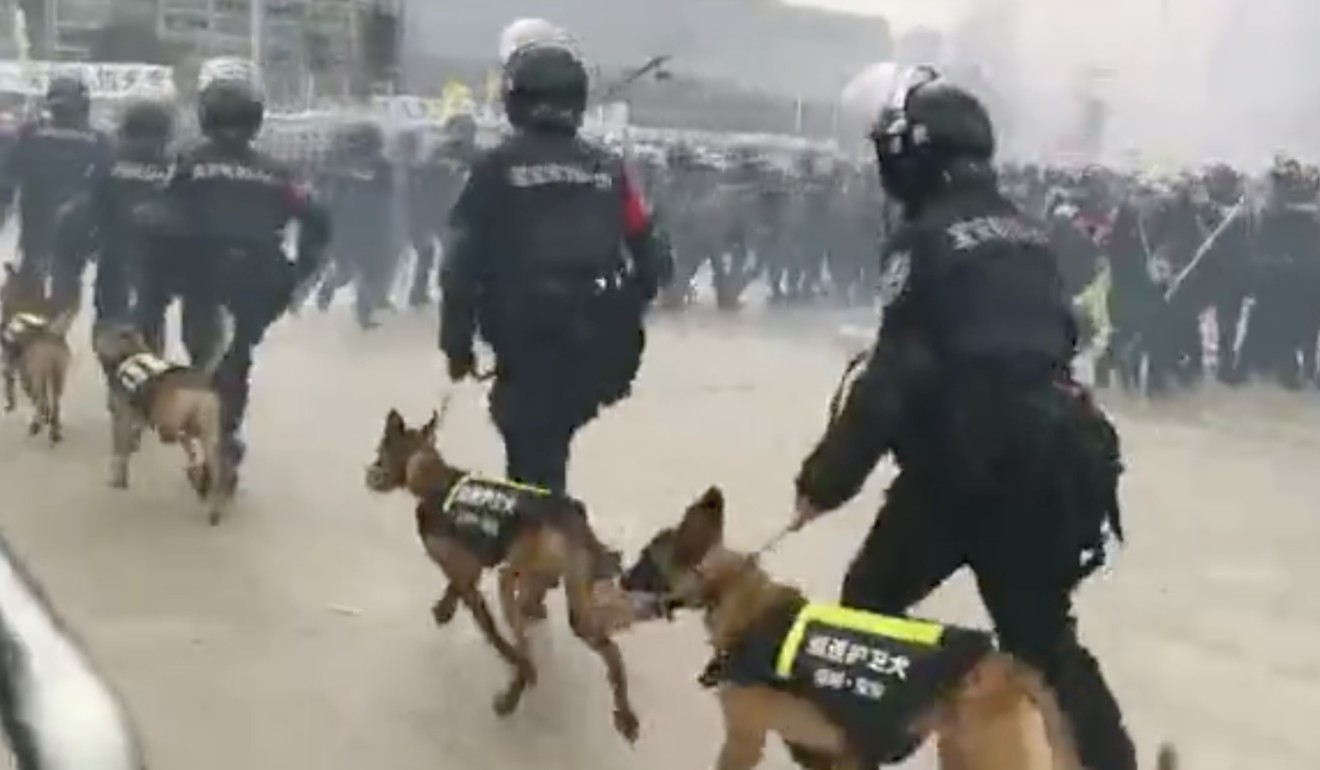
A few minutes later, the rioters fired home-made gas bombs then set bogies alight and drove them at the police lines. The officers changed formations and pressed the rioters, making arrests. Police handlers and their dogs were also on the scene.
A blazing bogie is driven towards police lines during Shenzhen police’s anti-riot exercise. Photo: Weibo
Other drills included anti-smuggling and search-and-rescue exercises involving personnel from the People’s Liberation Army.
The drill was presented as preparation for the 70th anniversary celebrations but it came amid continued violence in the streets of Hong Kong and two incidents of the Chinese national flag being thrown into Victoria Harbour.
Hong Kong has been engulfed in two months of turmoil stemming from opposition to the now-suspended extradition bill.
Police handlers and their dogs were deployed against people dressed like Hong Kong demonstrators. Photo: Weibo
“Is this hinting at Hong Kong?” a commenter on the Shenzhen police Weibo thread asked.
“We are doing drills today, and they can enter into real practice in Hong Kong in the future. We can send thousands of anti-mob squads over and strike hard at the radical traitors, those Hong Kong independence supporters,” another user said.
Since protests escalated in Hong Kong, Beijing has reiterated its “unflagging support” for embattled Hong Kong Chief Executive Carrie Lam Cheng Yuet-ngor and her administration to take lawful action to restore order, and warned that the city was entering “a most dangerous phase” with violence on the streets.
Analysts say mood is shifting in mainland China as demonstrators ‘cross a line’ with national symbols
Staff and students from Pui Kiu Middle School in North Point hold flag-raising ceremony on campus on Monday. Photo: Nora Tam
A Hong Kong protester’s decision to tear down a Chinese flag and throw it in Victoria Harbour on Saturday set off an outpouring of criticism, from Chinese internet users and celebrities to pro-Beijing businesses and schools in the city.
Then on Monday at about 7pm, a group of protesters went to the same flagstaff in Tsim Sha Tsui, tore down the flag again and threw it into the harbour, the second such incident in three days. In both cases, the protesters escaped.
In North Point, the Pui Kiu Middle School organised a flag-raising ceremony at the campus on Monday even though the school was officially on summer holidays.
Principal Ng Wun-kit said teachers and students were called back on short notice to take part.
“We saw [on the news] that some rioters in helmets threw the Chinese national flag in the harbour and we strongly condemn such behaviour. It was disrespectful,” Ng said.
“We wanted to show that we are one of the 1.4 billion Chinese people who want to protect the national flag. We hope that the students, teachers, and [Hong Kong] citizens who love the country and the Chinese Communist Party can respect the Chinese flag.”
Other Hong Kong businesses and organisations flying the Chinese flag on Monday included international hotel chain Courtyard by Marriott Hong Kong, Chinese engineering firm Shanghai Zhenhua Heavy Industries and Chinese pharmaceutical giant Beijing Tong Ren Tang.
Beijing’s Hong Kong affairs office condemns protesters who threw Chinese flag in the sea
A spokeswoman from the hotel chain said it had flown the flag for many years and Monday was no exception.
“We display the flag because we are a Chinese-funded company. We do not have plans to take it down any time soon,” she said.
On Sunday, a group of Beijing supporters sang the national anthem and raised the Chinese flag in Tsim Sha Tsui to replace the one taken down.
On microblogging site Weibo, mainland Chinese and Hong Kong celebrities were among those forwarding pictures of the flag or salutes to it, adding the hashtag “the Chinese national flag has 1.4 billion flag bearers”, a topic started by China Central Television (CCTV) on Sunday. As of Monday night, the trending topic had been read more than 2 billion times, with more than 8 million posts and support from Hong Kong actors Jackie Chan, Jordan Chan Siu-chun and Hawick Lau Hoi-Wai.
In a commentary published online on Sunday, CCTV said the topic had attracted a strong response because patriotism ran deep among the Chinese people.
“We protect the flag, the national emblem, our country, and we protect our country like we protect our own homes,” it said.
Hong Kong Chief Executive Carrie Lam blasts violence at Yuen Long and liaison office, amid further extradition bill unrest
Analysts said the mood on Chinese social media had changed as protesters in Hong Kong vandalised symbols of the central government, crossing a line for most mainland Chinese.
Wang Jiangyu, an associate law professor at the National University of Singapore, said that although many mainlanders had admired Hong Kong and sympathised with its civil movements in the past, the situation had changed.
“The Chinese flag being insulted is on the top of a list of things mainlanders dislike, and for state media, which represent the central government’s position, focusing on such issues can frame the protesters as enemies of the Chinese nation or the people,” Wang said.
“It can increase the hatred of mainlanders towards the Hong Kong protesters and gain support for the central government to take action in the future.”
Ma Ngok, a political scientist at Chinese University of Hong Kong, said mainland media were using the incident to achieve their own propaganda purposes.
“Mainland media made it seem like [the flag protest was] the theme for the whole movement … but it does not represent the main demands of the anti-extradition movement. They are turning single actions into broad propaganda, and biasing mainland sentiment about Hong Kong,” Ma said.
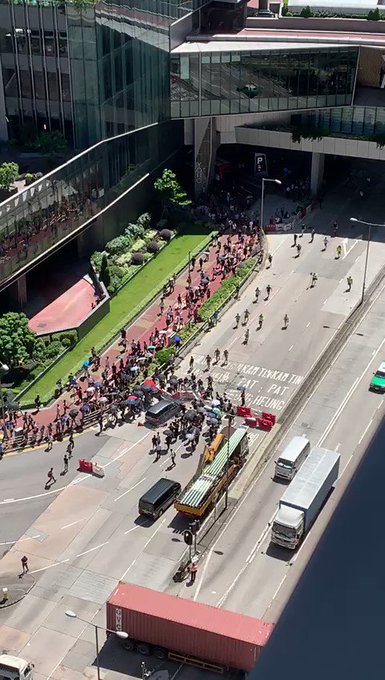
Police in Hong Kong have been fighting running battles with activists in a third consecutive day of protests, after a call for a general strike caused widespread disruption on Monday.
Protesters blocked roads and paralysed train services at peak times on a day of action across the city.
More than 200 flights were cancelled as the protests entered their ninth week.
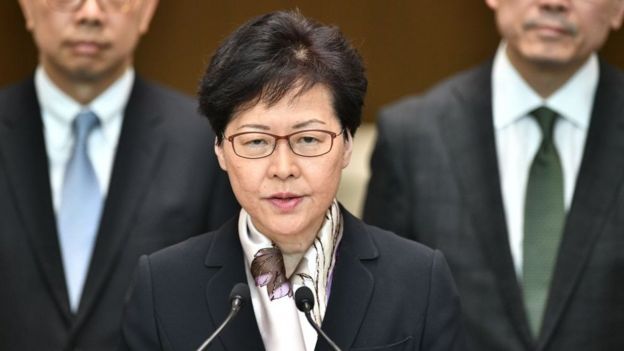
Hong Kong’s leader, Carrie Lam, has pledged to restore law and order, rejecting calls for her resignation.
Initially the demonstrations, which began on 9 June, focused on a controversial extradition law, which would have allowed the transfer of suspects to mainland China. However, the protests have now become a wider challenge to Beijing’s authority.
Ms Lam warned that Hong Kong was “on the verge of a very dangerous situation”.
Media caption Protests take place in Hong Kong for the ninth weekend – for and against the authorities
In her first media address in two weeks, Ms Lam said the protesters’ actions had challenged the principle of “one country, two systems” – the extra freedoms granted to Hong Kong when it was returned from British to Chinese rule in 1997.
She also accused activists of using the extradition bill as a cover for their real goals.
“We continue to allow these violent protesters to make use of the [extradition] bill to conceal their ulterior motives,” she said. “Those ulterior motives are going to destroy Hong Kong.”
Image copyright GETTY IMAGES
The Chinese foreign ministry said no one should underestimate China’s resolve to safeguard the stability of Hong Kong, Reuters news agency reports.
What happened on Monday?
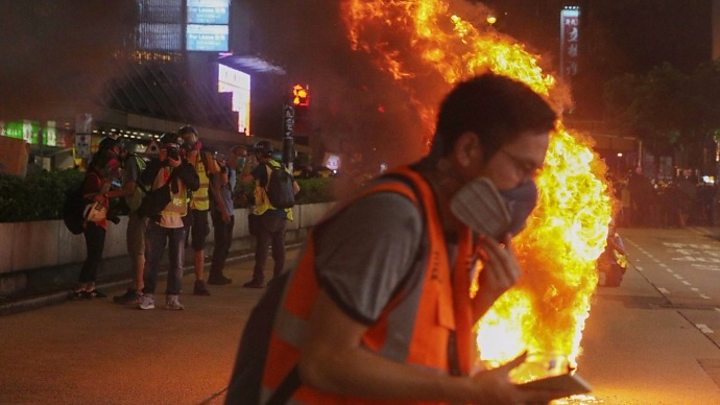
Police fired tear gas at several locations as protesters rallied into the night, setting fires and besieging police stations. In the North Point district, which has a reputation for pro-Beijing sympathies, men wielding long poles clashed with demonstrators before falling back.
More than 80 people were arrested, in addition to the 420 detained since 9 June. In that time, police said they had used more than 1,000 tear gas canisters and 160 rubber bullets.
Protest leaders had called for a general strike. While many people made it to work, in some areas protesters blocked trains from leaving stations and scuffled with commuters. Several lines of the Mass Transit Railway (MTR) were suspended for a time, and the Cross-Harbour Tunnel was also blocked.
One video circulating on Twitter reportedly showed a car in the district of Yuen Long forcefully hitting a barricade set up by protesters, injuring one person.
It is not clear how many joined the strike, but tens of thousands of protesters were out on the streets. Several shops and businesses were closed, including international fashion retailers like Topshop and Zara.
Hong Kong airport, one of the busiest in the world, said travellers should check its website and seek updates directly from the airlines.
Most of the cancelled flights were with local carriers Cathay Pacific and Hong Kong Airlines.
The protests were initially sparked by a controversial bill that would allow China to extradite suspects from Hong Kong to the mainland.
Critics said it would undermine the territory’s judicial independence and could be used to target those who spoke out against the Chinese government.
Although the bill has now been suspended, demonstrators want it fully withdrawn.
Their demands have broadened to include an independent inquiry into alleged police brutality, Ms Lam’s resignation, and the dropping of riot charges linked to the protests.
Last week, more than 40 activists appeared in court charged with rioting. If convicted, they could be jailed for up to 10 years.
The Chinese army has so far stayed out of the dispute, but China’s top policy office in Hong Kong has previously condemned the protests, calling them “horrendous incidents” that have caused “serious damage to the rule of law”.
City’s richest person was ‘very pleased’ to have bumped into group of youngsters in Hokkaido, mother says on social media
Li has a personal fortune of US$31.7 billion and is known for his charitable acts
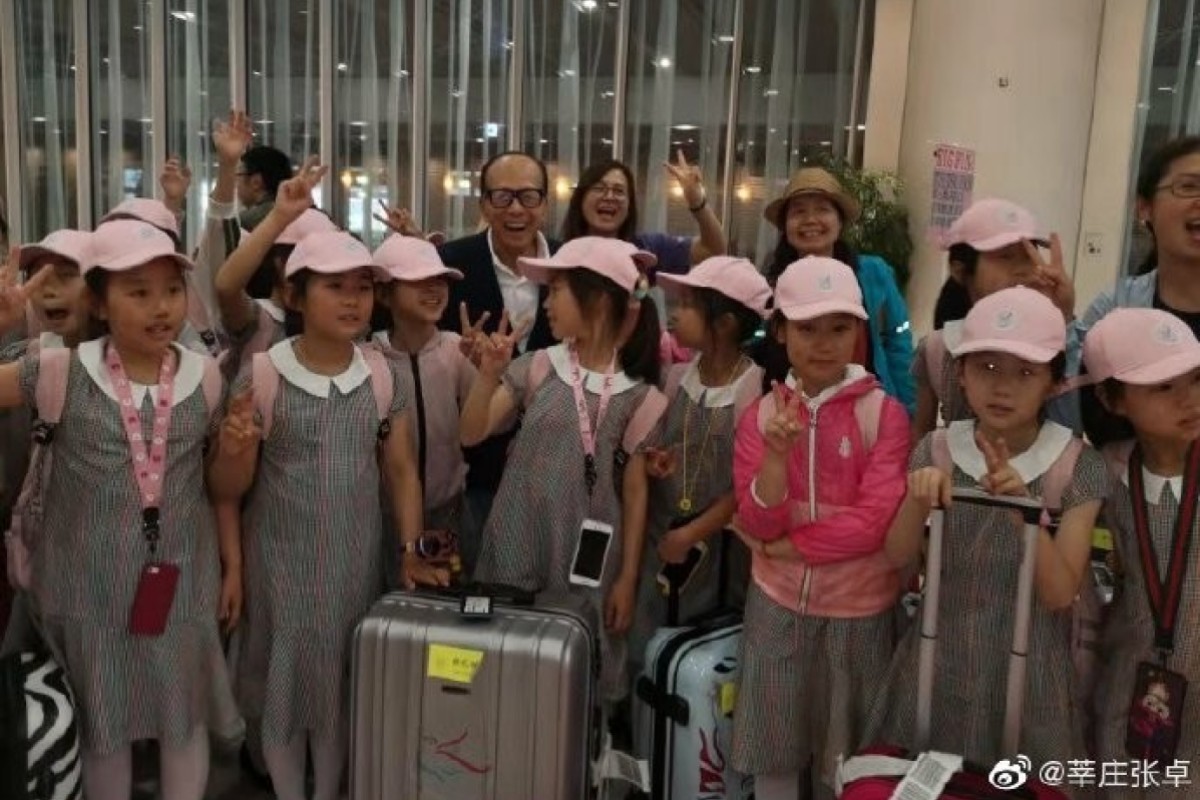
The youngsters from Shanghai got a wonderful surprise when they met billionaire Li Ka-shing at an airport in Japan. Photo: Weibo
Christmas came early for a group of children from Shanghai on Tuesday when they met Hong Kong billionaire Li Ka-shing at an airport in Japan while en route to a dance competition and he offered to pay for their trip … and buy them each a gift.
The 45 youngsters and their teachers from the Little Pigeon Dancing Group in the east China metropolis were passing through New Chitose Airport in Hokkaido, the northernmost of Japan’s main islands, when the serendipitous meeting happened, according to social media posts.
“The children bumped into Mr Li Ka-shing at the airport, who looked very pleased and volunteered to take pictures with the children,” Zhang Zhuo wrote on Weibo – China’s Twitter-like platform – on Thursday, adding that she was the mother of one of the dancers.
“Today a staff member from the Li Ka Shing Foundation contacted the dance group and offered to sponsor the trip to Japan,” she said. “The children shot a video to wish him good health,” she said.
Li met the youngsters from the Little Pigeon Dancing Group in Hokkaido. Photo: Weibo
One of the dance teachers wrote on Weibo that Li was “so pleased after seeing the children at the airport that he decided to sponsor for the trip”.
“So rich and generous, charitable and loving,” she said.
It was not clear exactly how much Li donated, but based on a post by another of the teachers, the cost of the trip was 18,840 yuan (US$2,700) per child, so it would appear to have been in excess of US$120,000.
As part of the offer, the foundation said also that the children should treat themselves to a gift.
Zhang said her daughter treated herself to an eraser, as it was something she wanted to buy before the trip.
“It is not about how expensive the gift is. It’s happiness that counts. We must know to be grateful and moderate,” she wrote.
Li’s influence at Shantou University under threat
Born in 1928 near Shantou in south China’s Guangdong province, Li moved to Hong Kong as a child. According to the latest Forbes list he is richest person in Hong Kong and 28th richest in the world, with a personal fortune of US$31.7 billion.
In 1981 he helped to establish Shantou University and since then the Li Ka Shing Foundation has donated more than 10 billion yuan to support its development.
Last month, the university announced that starting this autumn, for the next four years all new intakes will have the entire cost of their university education paid for by the foundation – a donation of about 100 million yuan a year.
National outrage sparked when high-profile traveller Li Yaling shares details of incident on social media
Employee on long-term sick leave disrupts flight to Beijing but airline says she is a private traveller
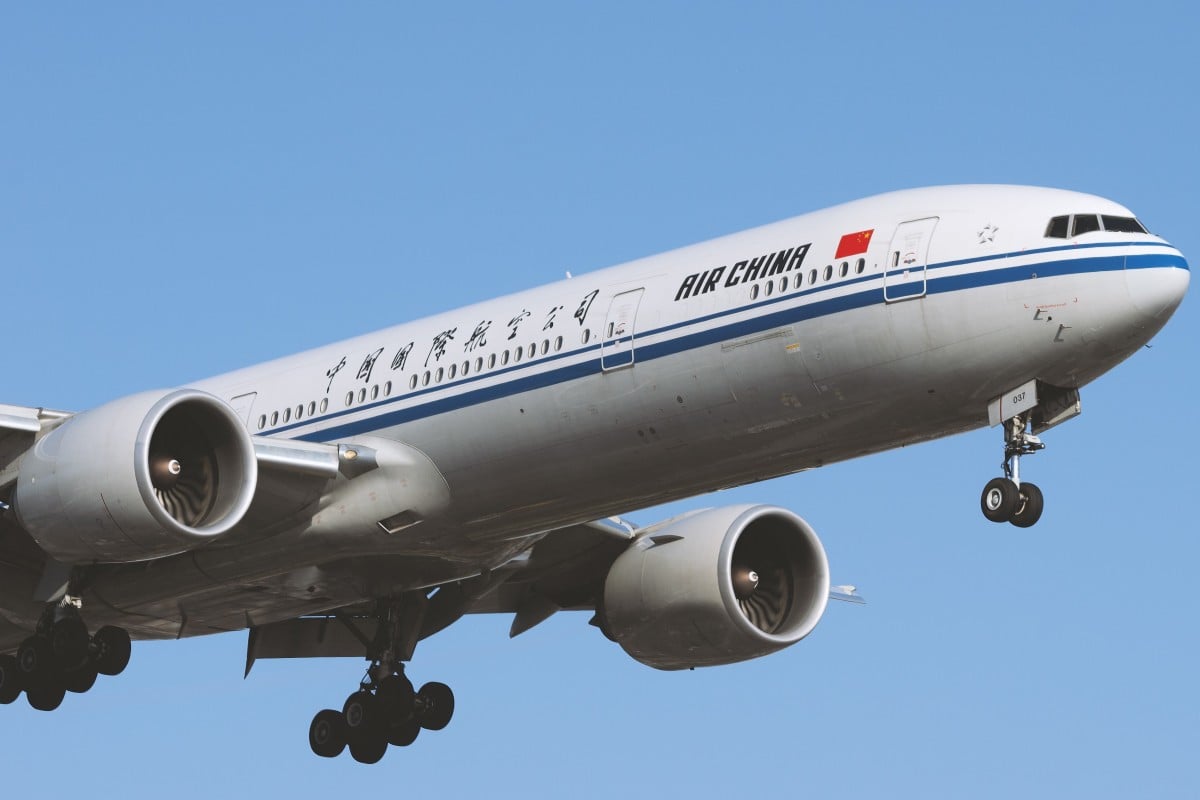
Air China has flown into an internet storm after a flight attendant on long-term sick leave scolded business class passengers. Photo: Shutterstock
National flag carrier Air China has come under fire after an employee made a scene during a flight and accused three business class passengers of attacking her, leading to them being held and questioned for seven hours last Friday after their arrival in Beijing.
Playwright Li Yaling, who was travelling business class on flight CA4107 from Chengdu uploaded a video and lengthy post detailing the incident to her nearly 1.3 million followers on Weibo, China’s Twitter-like microblogging platform.
Li’s video showed a female passenger, who claimed to be an Air China supervisor, scolding passengers for using their phones while the plane was on the runway at Chengdu, capital of Sichuan province, southwest China.
The scolding lasted half an hour, according to Li, even after the passengers stopped using their phones and explained they had been switched to flight mode. Air China permits smartphones in flight mode to be used during its flights.
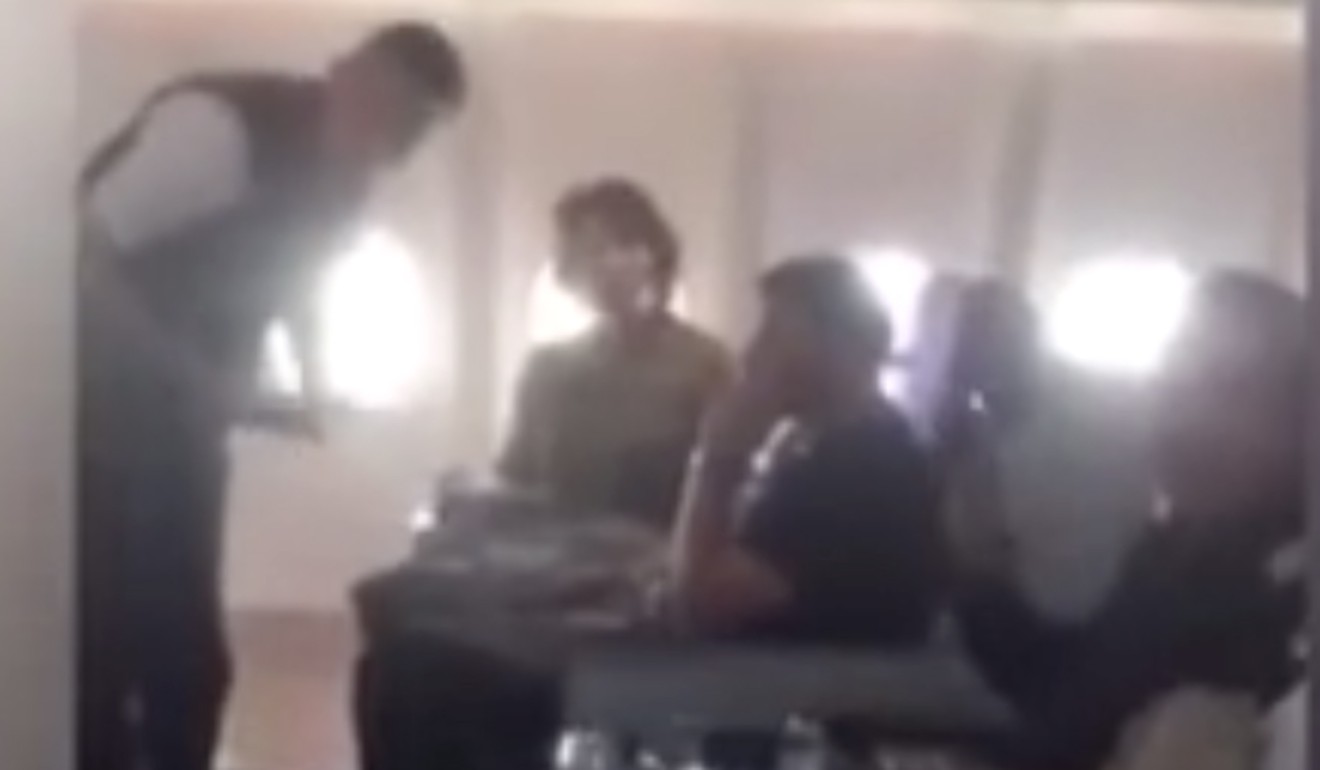
A screenshot of the video filmed during the Air China flight, and later posted to Weibo, of the incident in business class. Photo: Weibo
The woman paced about the cabin as the plane taxied down the runway and continued to make a scene until the flight approached Beijing. She was seen making a call, asking for the police to be notified that the passengers had “attacked” her and “endangered aviation safety” and to come and take them away.
The passengers were stopped by the crew and removed by the police, who took them to the airport police station where they were held for seven hours before being released with a warning, according to Li’s post.
“I want to ask Air China what the position of the Air China supervisor is,” Li wrote on Weibo. “Is she independent or your employee? What legal rights does she have? Has she abused her power, if any?”
Li’s post shocked internet users who reacted with sympathy. Some posted video clips or their own accounts of the same woman making similar false accusations on buses, subway trains and other flights, leading to similar problems for individual passengers, as well as travel delays.
Li later said on Weibo she was contacted by the airline on Saturday afternoon and told the woman was a former flight attendant who had been on sick leave since pouring hot water on a passenger more than 10 years before and had subsequently been diagnosed with bipolar disorder.
Unlucky coin toss lands another Chinese airline passenger in trouble
In a public statement on Monday, Air China said the dispute had involved an employee who was on leave for health reasons and had been on a private trip. The airline said three passengers and four crew members had been taken to the airport police station to help with an investigation into the incident.
Li followed up her Weibo posting on Monday, meeting several senior officials at Air China’s headquarters, where she was told the situation was a dispute between passengers and the airline had fulfilled its responsibilities.
Air China said it could not stop the employee from boarding its flights.
Li said she felt sympathy for mental health patients but not for the woman, who she said had apparently endangered public safety on flights several times. Li also demanded compensation for paying a high price to travel in business class, only to suffer two hours of verbal abuse.
Rush to emergency exit lands Chinese first-time flier in detention
The situation angered many on social media, who felt the airline had not taken enough responsibility for the incident. Some said they would not choose Air China again.
“The incident is not about passengers switching off their phones, it is about how your airline’s employee caused a row in business class,” one Weibo user wrote.
“This is a serious threat to flight order and safety, yet Air China can’t handle it. I will not consider flying with Air China again. Safety comes first after all,” said another.
Online news portal Ifeng.com ran a survey on the incident, with nearly 88 per cent of the 160,000 who took part agreeing that the airline should take responsibility for the incident. A total of 84 per cent said Air China had mishandled the incident and some 58 per cent said they would consider other carriers ahead of Air China in future.
Influential party newspaper People’s Daily also weighed in, criticising the airline for evading the crucial point in its public statement posted to Weibo on Monday night.
“The public does not question the significance of caring for patients with special diseases, but showing humane care does not mean inaction and to maintain the company image does not [mean] blindly protecting its employee,” the newspaper said.
“After all, the travel rights of all passengers and public safety are more important.”
Article 34 of China’s civil aviation rules for domestic transportation of passengers and baggage stipulates mentally ill patients or passengers whose health conditions may endanger themselves or affect the safety of other passengers shall not be carried.
However, in the eyes of the psychiatric profession mental health patients have the same right to fly as anyone else, as long as they are not posing any threat to others.
“The law on mental health protects some basic rights of mental patients and they are entitled to all rights of citizens, as long as they are not in an acute onset of mental illness,” said Ye Minjie vice-president of Kangning Hospital, which is affiliated to Wenzhou Medical University
“We can’t treat them as if they were secondary citizens or deprive them of basic rights just because they have had episodes before,” he said.
Animal lovers angered after viral video shows moment a visitor decided to ‘wake up’ Meng Da
Keepers say they will reassess physical safety measures and improve inspections
A video shows Beijing Zoo giant panda Meng Da examining a stone thrown at him by a visitor. Photo: Weibo
Beijing Zoo has promised to improve security around its giant panda enclosure after stones were hurled at Meng Da, one of its residents.
A video of the incident on Saturday was posted to Weibo, China’s version of Twitter, where it drew more than 100 million hits.
It shows Meng Da sitting in the enclosure when a stone appears to bounce next to him and stop close by. The startled panda pauses then goes over to examine the object.
Visitors are heard asking, “Who threw the stone?” But no one identifies the stone thrower. Beijing News reported that a bigger stone struck Meng Da about 30 minutes later.
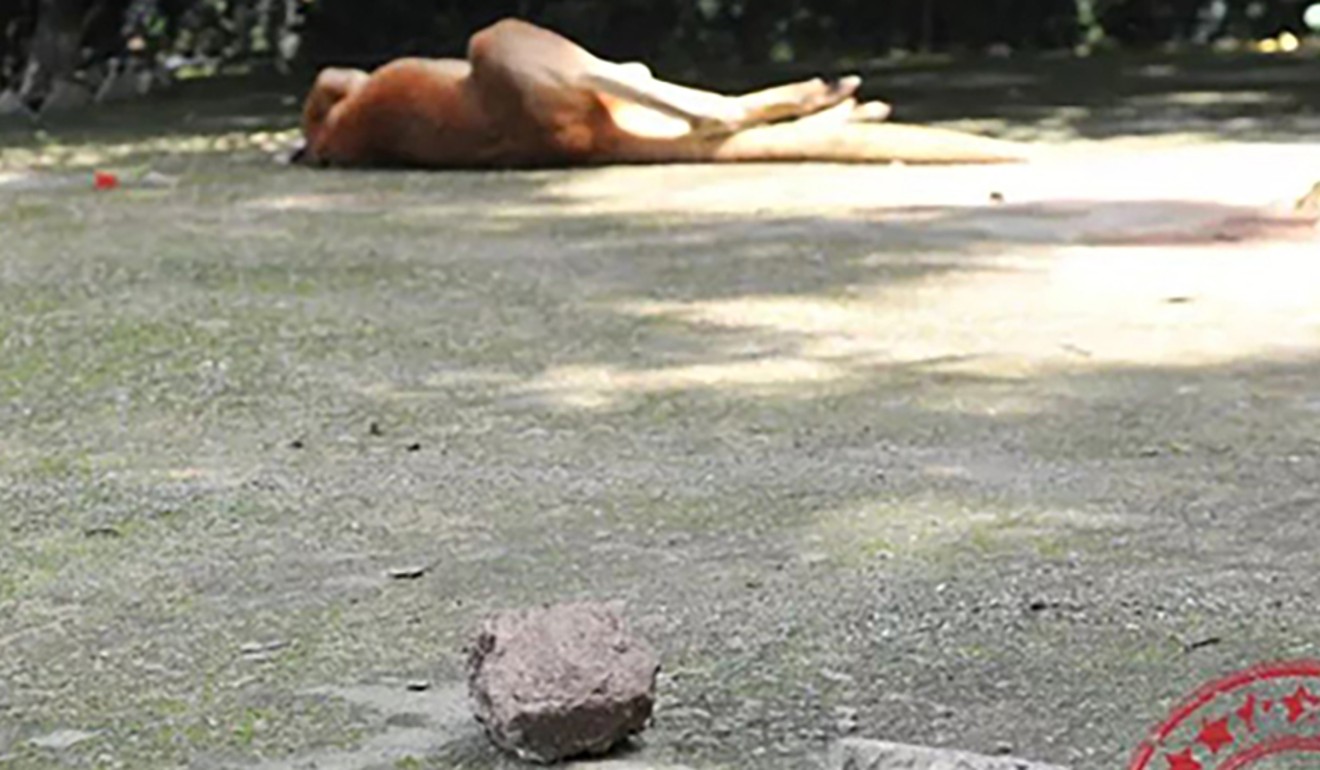
In April last year, a kangaroo died from its injuries at Fuzhou Zoo in Fujian province after visitors threw bricks and concrete at it. Photo: Sina.cn
The report quoted the person who shot the video as saying the culprits threw objects to “wake the panda up”.
On Weibo, Beijing Zoo assured panda lovers that Meng Da was unhurt and unruffled by the stone-throwing. The zoo promised to improve security and inspections at the panda enclosure.
Meanwhile, on social media there were calls for better protection of China’s national symbol in zoos. “How dare they hurt our lovable national treasure?” one Weibo user wrote.
Chinese tourists who threw rocks at panda blacklisted from nature reserve
“The zoo should build a glass wall to protect the panda,” another said. “Those tourists should be blacklisted and punished.”
In July last year, visitors to a reserve in Foping county in Hanzhong, Shaanxi province, were asked to leave and blacklisted after throwing stones at a panda, state broadcaster CCTV reported.
Chinese tourists kill kangaroo, hurling bricks to make it hop
That followed an incident in April last year, when a 12-year-old kangaroo in Fuzhou Zoo, Fujian province, was fatally injured after visitors hurled bricks and chunks of concrete at it in an attempt to make it hop.
Threatening or injuring zoo and park animals can result in a fine of 100 yuan (US$15) and offenders may face criminal charges under Beijing municipal law.
Image copyright GETTY IMAGESImage caption (File photo) They were arrested in the city of Xuzhou in Jiangsu province
Four Britons have been arrested in China’s Jiangsu province over drug-related offences.
They are among 16 foreigners – seven teachers and nine students – who were detained last week after testing positive for drug use.
At least some of those being held are from an international language school, Education First.
Police did not specify the type of drugs involved and it is not clear where the other foreigners are from.
There are extremely severe penalties for drug offences in China.
“We are in contact with the Chinese authorities following the arrest of four British people in Jiangsu province, and are providing consular assistance,” said the British embassy in Beijing.
On Tuesday, the Xuzhou Public Security Bureau, located in Jiangsu province, posted a statement on Chinese social media site Weibo saying police had successfully cracked a drug-related case.
It said 19 people had been arrested, including 16 foreigners.
According to police, 18 people had been placed under administrative detention, which carries a maximum detention period of 15 days. One person was placed in criminal detention – a procedure that usually leads to a formal arrest and an indictment.
Police did not name the school involved, but state news agency Xinhua later reported that some of the teachers were from the Switzerland-based Education First (EF) Centre.
The EF centre told Xinhua it had a “zero tolerance” policy towards drugs, adding that it was deeply regretful that some of its teachers were involved.
It said the drug-related incident had taken place during “non-work” hours.
EF first entered China in 1998 and has around 2,000 English teachers now based in the country.
Father of three is killed as flames engulf car in crash at stop light in Henan
Woman from wealthy family is held as police investigate drink-driving
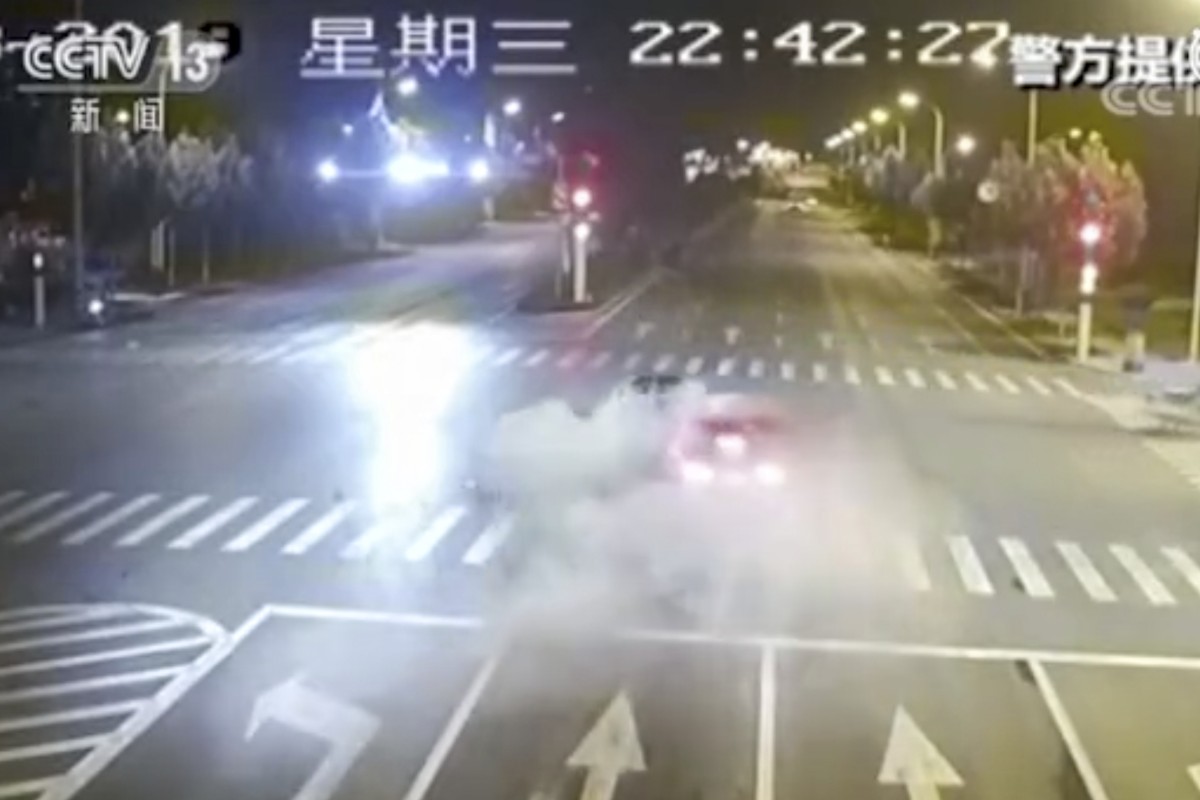
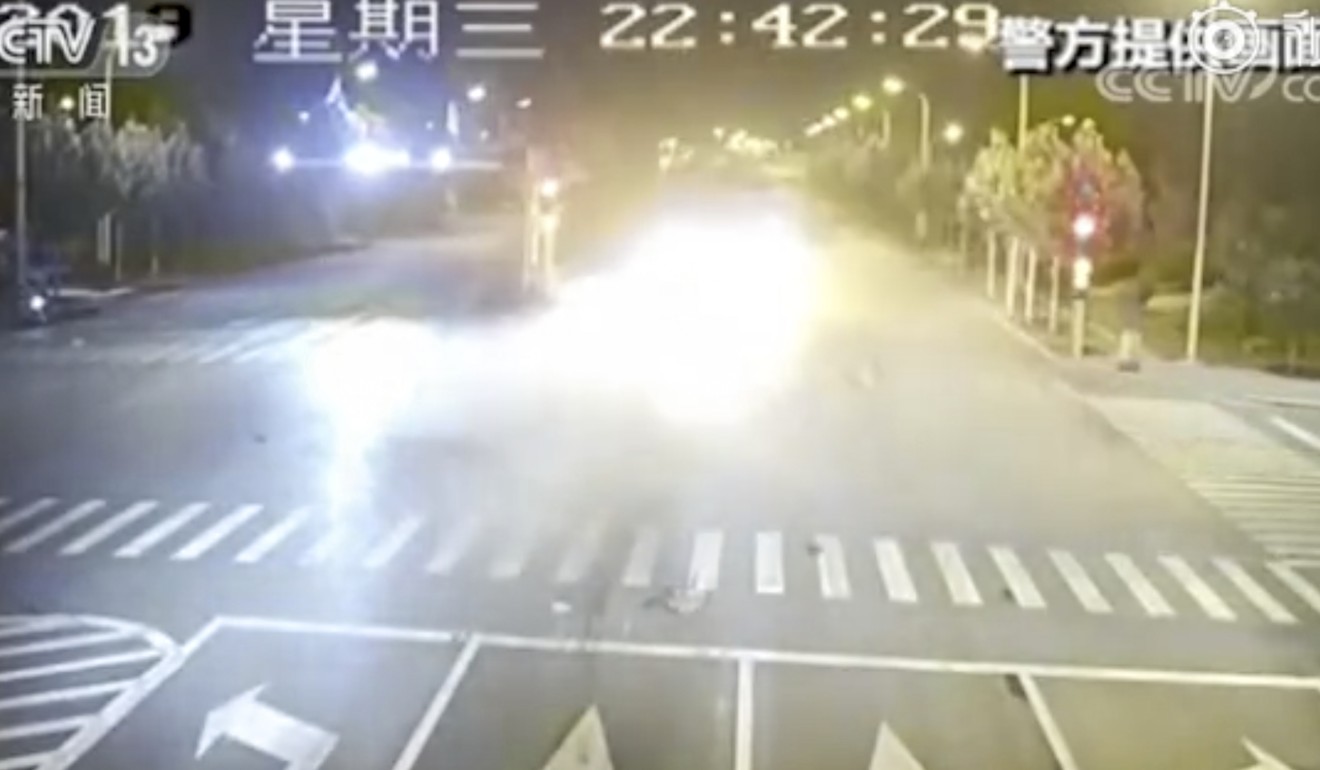
Footage from an intersection in Yongcheng, Henan shows the BMW being propelled across the road before bursting into flames. Photo: Weibo
A driver and her two passengers are in custody in central China after the Maserati SUV she was driving slammed into a BMW, killing two men.
Police said a 23-year-old woman surnamed Tan drove the Maserati through the streets of Yongcheng in Henan province on Wednesday night, scraping against cars on the way.
They said her vehicle struck the BMW at a red traffic light, causing it to burst into flames, killing two passengers and injuring the driver.
Tan and two others in the SUV, a woman and a man, were also injured. All three were detained by police but have not yet been charged. Police said Tan returned a blood-alcohol reading of 0.167 – well over the legal limit of 0.02.
State broadcaster CCTV reported that Tan and friends Zhang and Liu had met at a barbecue restaurant that night for dinner, according to police. After drinking, Tan took her friends for a drive. The Maserati scraped against multiple cars before the driver was slowed down by pedestrians signalling for her to stop, but she suddenly sped away from the scene. It crashed into the BMW soon afterwards, CCTV said.
The BMW bursts into flames after being shoved across the intersection. Photo: Weibo
Two men in the back of the BMW were killed in the fire that engulfed the vehicle, while the driver, also a man, suffered severe burns, according to the report. The occupants of the Maserati were treated in hospital for bone fractures and abdominal injuries, CCTV said.
Man arrested after car crashes into shop, injuring 12, in Tsim Sha Tsui, Hong Kong
The accident has prompted heated online discussion in China, with some calling for the death penalty for “such reckless behaviour and disregard for the law”.
Others have doxxed the detained driver – finding photos on a Weibo account that allegedly belonged to Tan showing she had an appetite for luxury goods and expensive cars.
In recent years, a “hate the rich” sentiment has emerged in Chinese society. As the wealth gap widens, many people have become vocal about injustices they feel are fuelled by the affluent and privileged.
Others voiced anger at the legal system, saying wealthy people could buy the law.
Coach driver in crash that left five dead and 32 injured had been working 12-hour shifts, Hong Kong police say
Civil affairs ministry reaffirms plan to eradicate names that ‘violate the core values of socialism, damage national confidence’
One man says it reminds him of the dark days of the Cultural Revolution
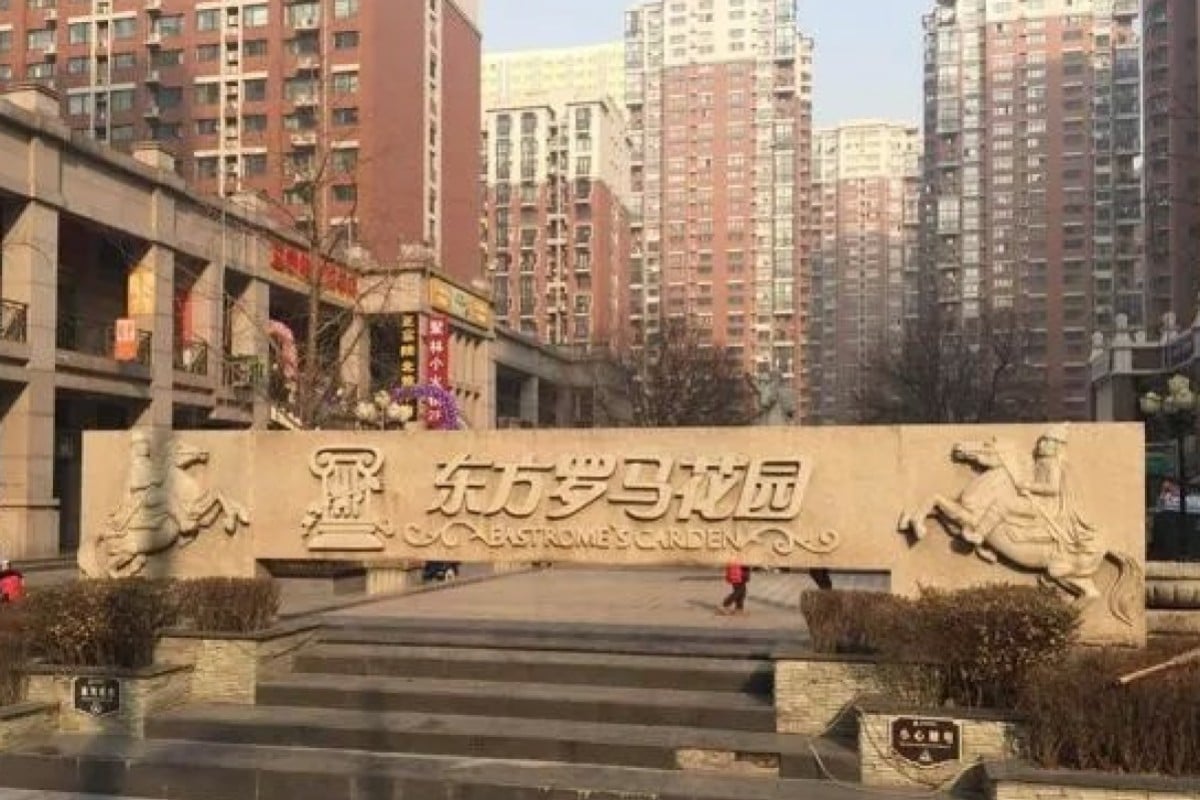
Beijing wants to eradicate place and property names, like “East Rome’s Garden”, that are influenced by foreign or “weird” words. Photo: Weibo
Beijing has reiterated its commitment to rid Chinese cities of “big, foreign and weird” property and place names, sparking a backlash from the public.
The campaign began last year when six government departments introduced a joint policy requiring provincial and county authorities to identify all such properties within their jurisdictions and rename them by the end of March.
On Friday, the Ministry of Civil Affairs reaffirmed its support for the plan, but reminded local governments to implement it “prudently and appropriately”.
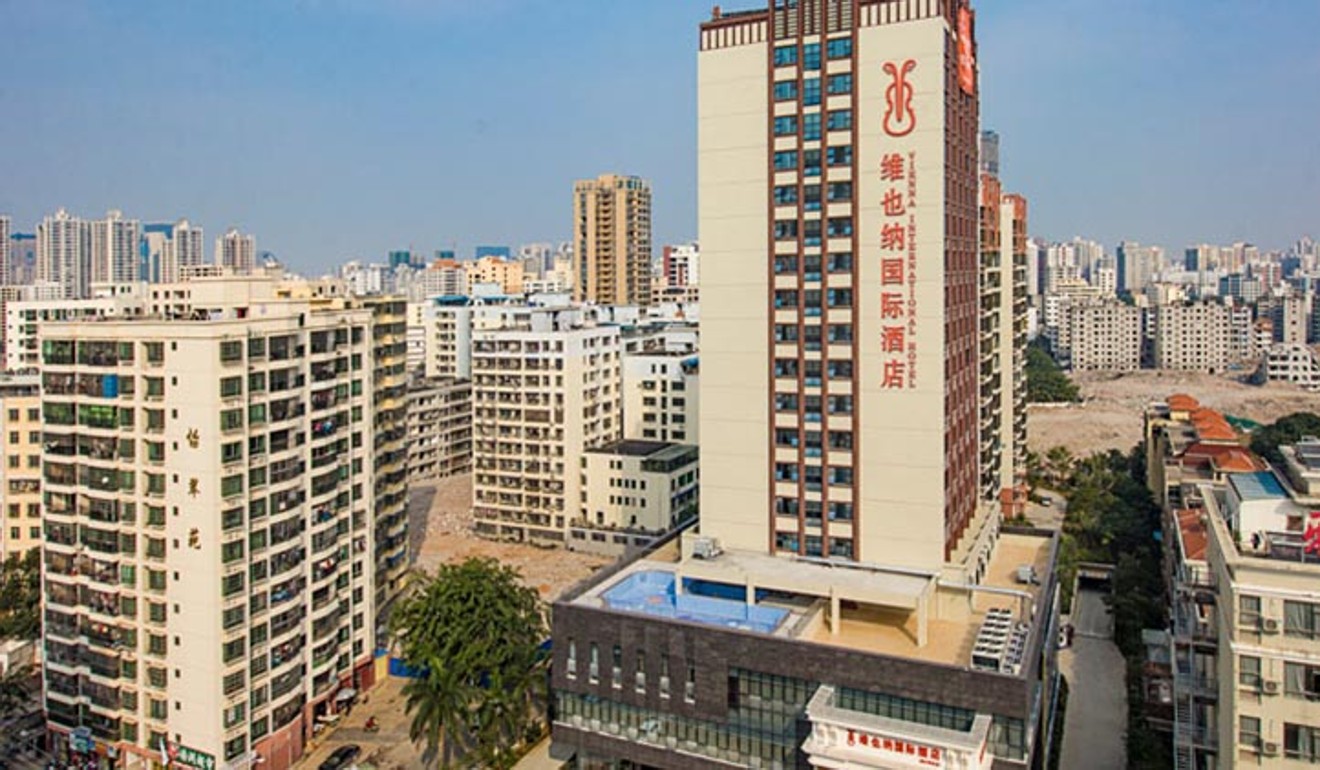
Many Chinese properties, especially hotels and apartment buildings, incorporate famous foreign places, like Manhattan, California or Paris, into their names, but under the new rule they all have to go. According to a report by local newspaper Sanqin Metropolis Daily, in one city in Xian, the capital of Shaanxi province, at least 98 apartment projects, hotels, townships, communities and office towers need to be rebranded.
Many Chinese properties, like the Vienna International Hotel, incorporate famous foreign places into their names. Photo: Weibo
But for some people, the plan is nothing more than a waste of time and money.
“If projects are forced to change their names, what about the name on the property certificate, the enterprise licence and tax registration? Do they have to be changed too?” asked Zhu Yun, a woman who lives in Guangzhou, the capital of south China’s Guangdong province.
Hospital’s plan for ‘lucky’ Harvard babies gets poor marks
“And what’s the standard for the new names, and who’s going to do the renaming? It’s just a waste of people’s energy and money, and will do nothing for the national culture or confidence.”
Zhu Min, an octogenarian who also lives in Guangdong, said the scheme had echoes of a darker time in China’s history.
“It reminds me of the bad times of the Cultural Revolution,” he said. “At that time, a great number of streets, roads and stores were forced to rename, because they contained elements of old customs and old culture.”
The debate has also been raging online, with tens of thousands of people airing their views on social media.
“Cultural and national confidence is about respect for multiculturalism,” one person wrote on Weibo, China’s Twitter-like platform.
Tsinghua University sues kindergartens for using its name
Despite the outcry, the civil affairs ministry said the implementation of the scheme was “an important measure … to carry forward the national and local culture”, Xinhua reported.
“The relevant regulations and guidelines of the campaign should be strictly observed to prevent the campaign from being expanded in an arbitrary manner,” it said.
The plan announced last year stated that “big, foreign, weird” place names and those based on homonyms “violate the core values of socialism, damage national confidence, and affect the production and lives of the people, and must be rectified and cleaned up”.








 CHINDIA ALERT: You'll be living in their world, very soon