Chindia Alert: You’ll be Living in their World Very Soon
aims to alert you to the threats and opportunities that China and India present. China and India require serious attention; case of ‘hidden dragon and crouching tiger’.
Without this attention, governments, businesses and, indeed, individuals may find themselves at a great disadvantage sooner rather than later.
The POSTs (front webpages) are mainly 'cuttings' from reliable sources, updated continuously.
The PAGEs (see Tabs, above) attempt to make the information more meaningful by putting some structure to the information we have researched and assembled since 2006.
A Shanghai woman who set 20 ‘strict’ rules for her employee has sparked a fairness debate on social media
By 2025 it is estimated 5 million people will work in China’s home service industry
A list of rules for a new housemaid in Shanghai has sparked a debate on Chinese social media about the demands placed on workers in the home service industry. Photo: Shutterstock
The demands made on Chinese housemaids by their employers have triggered a heated debate after a Shanghai woman gave her new employee a list of 20 rules to memorise before she started work.
The new housemaid was required to sleep on the living room floor, change in to special clothes when caring for her employer’s baby, clean floors by hand with just a towel, and refrain from eating garlic.
Jail for Singapore woman who abused helper for doing chores slowly
According to Shanghai news channel STV, the woman, surnamed Zhou, offered 12,000 yuan (US$1,750) a month – far above the city’s average housemaid’s wage of 5,929 yuan – for someone to care for her baby and do the housework after her maternity leave.
The attractive compensation drew many applicants and a woman, surnamed Tang, was eventually offered the position. But when she was told of the rules she would have to follow, Tang rejected the offer.
“I have worked as a housemaid for 16 years, yet these are the strictest rules I have ever seen,” she said.
The 20 rules were divided into three parts: basic requirements and privacy protection, instructions for taking care of the newborn, and a set of personal hygiene requirements for the housemaid.
The list was leaked and circulated on a number of housemaid groups on WeChat, China’s most popular messaging app, before being posted on Weibo, China’s Twitter-like service, on June 29 where it quickly went viral. The hot trend attracted 140 million people to discuss and comment on the issue.
Saudi Arabia executes Filipino domestic worker for murder
Yet, others agreed with the employer, leaving comments like, “Actually, these rules are very basic, not immoral or unlawful”, and “I think is reasonable to raise the 20 rules with this high salary, if you cannot accept it then back to apply for the job with 4,000 to 5,000”.
The position was finally taken by a woman, surnamed Wang, who said, “Nowadays it is getting harder to earn money, no pain no gain. Housemaids are here for giving a high quality and friendly service, aren’t we?”
On Monday, Beijing Youth Daily reported the Shanghai Home Service Industry Association as saying the 20 rules were “strict and a rare requirement in the current home service industry, but didn’t contain any discrimination to the housemaid so it is a normal employer’s requirement”.
A 2018 report on China’s home service industry said there were more than 2.5 million people employed in home service work in 2016, and estimated that by 2025 the demand for household service would increase to 5 million.
On June 26, China’s State Council issued guidelines to improve standards in the home service industry. Among the recommendations were the establishment of courses to improve the quality of housemaids in China, the provision of health check services to the workers and the establishment of related laws to improve their working conditions
BEIJING (Reuters) – With a cryptic message about UFOs and a picture of a missile launcher, China’s military has hinted that it has carried out a test of a new missile, after images of an object streaking towards the sky circulated on Chinese social media.
The People’s Liberation Army typically does not announce new missile tests, but occasionally drops hints about what it is up to, amid a massive modernisation push championed by President Xi Jinping to ramp up combat capabilities.
On Sunday, footage circulated on China’s Weibo microblogging service of an object travelling up into the sky, leaving a white trail behind it, over the Bohai Sea, partly closed at the time for military drills.
That caused some Chinese internet users to wonder if it was a UFO, though most thought it was probably the test of a new underwater launched ballistic missile.
In a short post on its official Weibo account late on Monday, the People’s Liberation Army Rocket Force showed a picture of what looked like a road mobile intercontinental ballistic missile launcher against a night sky.
“Do you believe in this world there are UFOs?” it wrote in the caption, without offering further explanation.
The navy then chimed in on its Weibo account with a picture of a missile being launched from underwater heading off into the blue sky above, with a similar caption: “Do you believe in UFOs?”
Defence publication Janes said on its website that the weekend pictures could have been China’s next generation submarine-launched ballistic missile, the JL-3.
The Ministry of Defence did not respond to a request for comment.
The development of the nuclear-armed JL-3 is being closely watched by the United States and its allies as it is expected to have a longer range than its predecessor and will significantly strengthen China’s nuclear deterrent.
In its latest annual survey of China’s military modernisation, the Pentagon said last month the new missile would likely to be fitted on China’s next generation nuclear missile submarines. Construction is due to start in the early 2020s.
BEIJING (Reuters) – It’s the most sensitive day of the year for China’s internet, the anniversary of the bloody June 4 crackdown on pro-democracy protests at Tiananmen Square, and with under two weeks to go, China’s robot censors are working overtime.
Censors at Chinese internet companies say tools to detect and block content related to the 1989 crackdown have reached unprecedented levels of accuracy, aided by machine learning and voice and image recognition.
“We sometimes say that the artificial intelligence is a scalpel, and a human is a machete,” said one content screening employee at Beijing Bytedance Co Ltd, who asked not to be identified because they are not authorised to speak to media.
Two employees at the firm said censorship of the Tiananmen crackdown, along with other highly sensitive issues including Taiwan and Tibet, is now largely automated.
Posts that allude to dates, images and names associated with the protests are automatically rejected.
“When I first began this kind of work four years ago there was opportunity to remove the images of Tiananmen, but now the artificial intelligence is very accurate,” one of the people said.
Four censors, working across Bytedance, Weibo Corp and Baidu Inc apps said they censor between 5,000-10,000 pieces of information a day, or five to seven pieces a minute, most of which they said were pornographic or violent content.
Despite advances in AI censorship, current-day tourist snaps in the square are sometimes unintentionally blocked, one of the censors said.
Bytedance declined to comment, while Weibo and Baidu did not respond to requests for comment.
SENSITIVE PERIOD
The Tiananmen crackdown is a taboo subject in China 30 years after the government sent tanks to quell student-led protests calling for democratic reforms. Beijing has never released a death toll but estimates from human rights groups and witnesses range from several hundred to several thousand.
June 4th itself is marked by a cat-and-mouse game as people use more and more obscure references on social media sites, with obvious allusions blocked immediately. In some years, even the word “today” has been scrubbed.
In 2012, China’s most-watched stock index fell 64.89 points on the anniversary day here, echoing the date of the original event in what analysts said was likely a strange coincidence rather than a deliberate reference.
Still, censors blocked access to the term “Shanghai stock market” and to the index numbers themselves on microblogs, along with other obscure references to sensitive issues.
While companies censorship tools are becoming more refined, analysts, academics and users say heavy-handed policies mean sensitive periods before anniversaries and political events have become catch-alls for a wide range of sensitive content.
In the lead-up to this year’s Tiananmen Square anniversary, censorship on social media has targeted LGBT groups, labour and environment activists and NGOs, they say.
Upgrades to censorship tech have been urged on by new policies introduced by the Cyberspace Administration of China (CAC). The group was set up – and officially led – by President Xi Jinping, whose tenure has been defined by increasingly strict ideological control of the internet.
The CAC did not respond to a request for comment.
Last November, the CAC introduced new rules aimed at quashing dissent online in China, where “falsifying the history of the Communist Party” on the internet is a punishable offence for both platforms and individuals.
The new rules require assessment reports and site visits for any internet platform that could be used to “socially mobilise” or lead to “major changes in public opinion”, including access to real names, network addresses, times of use, chat logs and call logs.
One official who works for CAC told Reuters the recent boost in online censorship is “very likely” linked to the upcoming anniversary.
“There is constant communication with the companies during this time,” said the official, who declined to directly talk about the Tiananmen, instead referring to the “the sensitive period in June”.
Companies, which are largely responsible for their own censorship, receive little in the way of directives from the CAC, but are responsible for creating guidelines in their own “internal ethical and party units”, the official said.
SECRET FACTS
With Xi’s tightening grip on the internet, the flow of information has been centralised under the Communist Party’s Propaganda Department and state media network. Censors and company staff say this reduces the pressure of censoring some events, including major political news, natural disasters and diplomatic visits.
“When it comes to news, the rule is simple… If it is not from state media first, it is not authorised, especially regarding the leaders and political items,” said one Baidu staffer.
“We have a basic list of keywords which include the 1989 details, but (AI) can more easily select those.”
Punishment for failing to properly censor content can be severe.
In the past six weeks, popular services including a Netease Inc news app, Tencent Holdings Ltd’s news app TianTian, and Sina Corp have all been hit with suspensions ranging from days to weeks, according to the CAC, meaning services are made temporarily unavailable on apps stores and online.
For internet users and activists, penalties can range from fines to jail time for spreading information about sensitive events online.
In China, social media accounts are linked to real names and national ID numbers by law, and companies are legally compelled to offer user information to authorities when requested.
“It has become normal to know things and also understand that they can’t be shared,” said one user, Andrew Hu. “They’re secret facts.”
In 2015, Hu spent three days in detention in his home region of Inner Mongolia after posting a comment about air pollution onto an unrelated image that alluded to the Tiananmen crackdown on Twitter-like social media site Weibo.
Hu, who declined to use his full Chinese name to avoid further run-ins with the law, said when police officers came to his parents house while he was on leave from his job in Beijing he was surprised, but not frightened.
“The responsible authorities and the internet users are equally confused,” said Hu. “Even if the enforcement is irregular, they know the simple option is to increase pressure.”
Parent posts photos of son’s bruised bottom and it is claimed pupils are too scared to go to school
Education authority says teacher is under investigation
The education authority said the teacher was under investigation. Photo: Shutterstock
A primary school teacher in eastern China has been sacked and detained for hitting a young boy on the bottom with a stick over 100 times, education authorities have said.
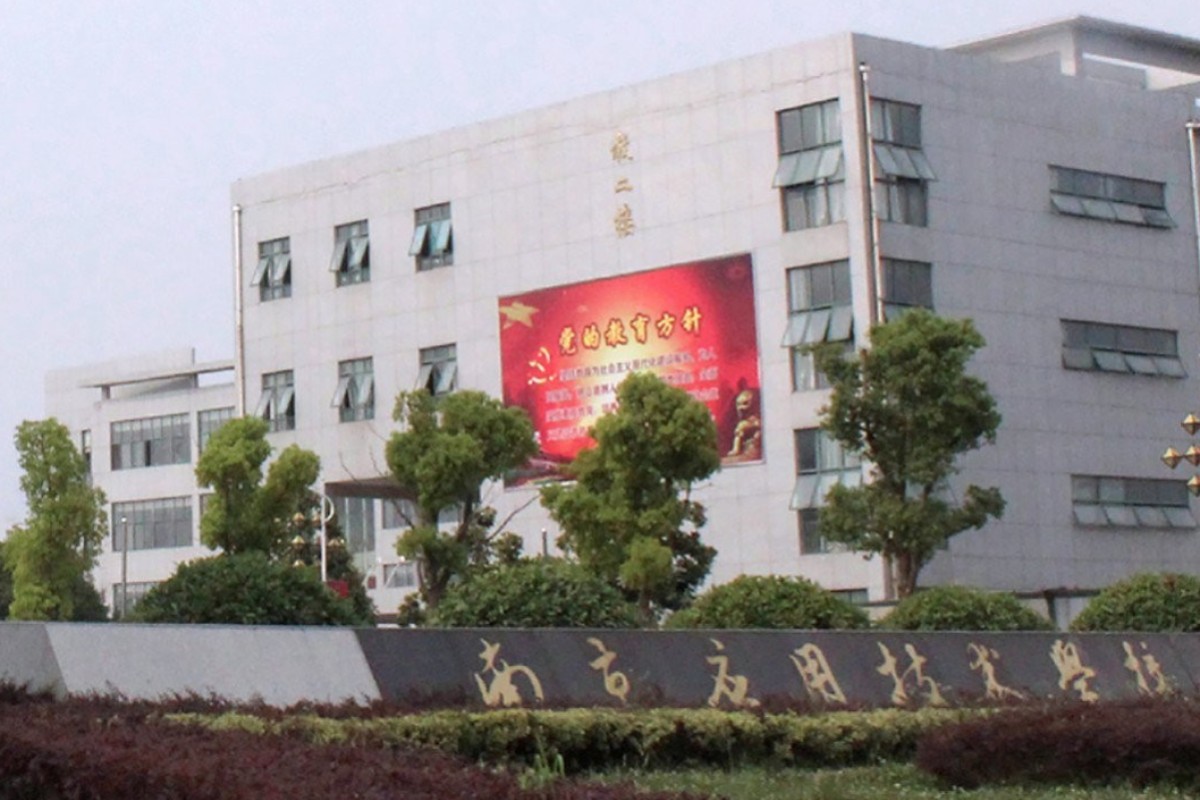
The teacher, surnamed Han, was dismissed by No 2 Experimental Primary School in Tancheng county, Shandong, the county’s education and sports bureau announced.
The boy, a first-year pupil surnamed Wang, sustained minor injuries from Han’s corporal punishment, the bureau said on Thursday in a post on Weibo, China’s equivalent of Twitter.
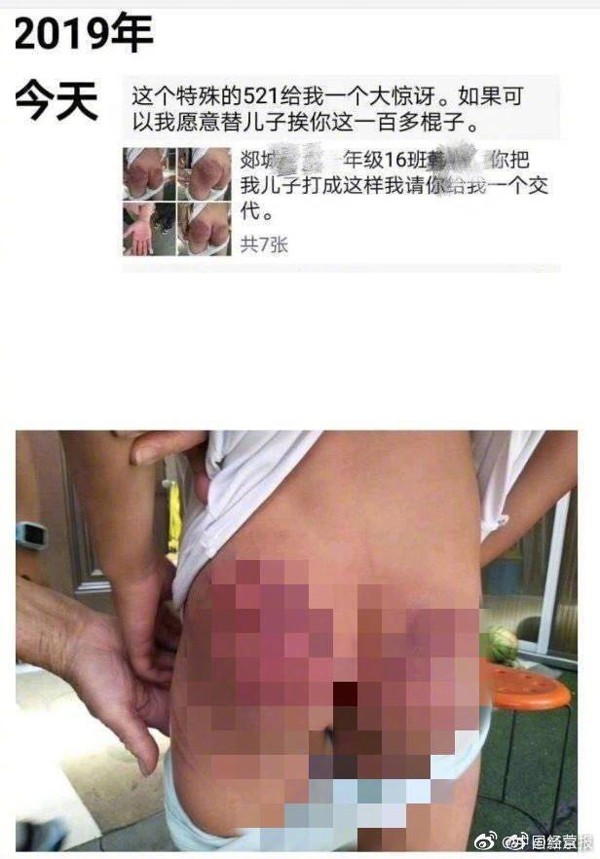
One of the boy’s parents posted pictures of his red and swollen bottom on social media. “It’s a shock to me,” they wrote, according to news outlet The paper. “I wish it were possible to take my son’s place to be beaten 100 times.”
Chinese kindergarten teachers arrested after camera shows beatings
A Weibo post by someone who said they lived in the county claimed the teacher had beaten the boy in a classroom on Tuesday after telling him to bend over so that he could strike the boy’s hip more easily.
One of the boy’s parents posted pictures of his bruises on social media. Photo: Weibo
“Now the students in that class are too scared to go to school,” they wrote.
The paper reported that, at a meeting between school staff and the boy’s parents, the principal blamed Han but acknowledged that the school, too, had been responsible. The principal did not say whether the school would compensate the boy, according to the report.
Han’s actions were being investigated jointly by the local police and education authorities.
Kindergarten teacher accused of stepping on child’s face, abusing two others
It is not rare for allegations to surface about mainland China’s pupils being beaten by teachers for making mistakes at school.
Last December, a primary school teacher from Huating in Gansu province was suspended and investigated for allegedly using a plastic water pipe to beat a third-year pupil who could not remember English words correctly, leaving the boy’s arms swollen and bruised, according to The Beijing News.
A maths teacher in Chenzhou, in Hunan province, was sacked and investigated in 2017 for allegedly lashing the bottom of a 10-year-old boy with a bamboo whip for three consecutive days for not finishing his homework, news portal qq.com reported.
Man says his pay packet takes a hit every time cabbies flick butts onto the street
Zhengzhou city management says supervisors are too zealous with staff fines
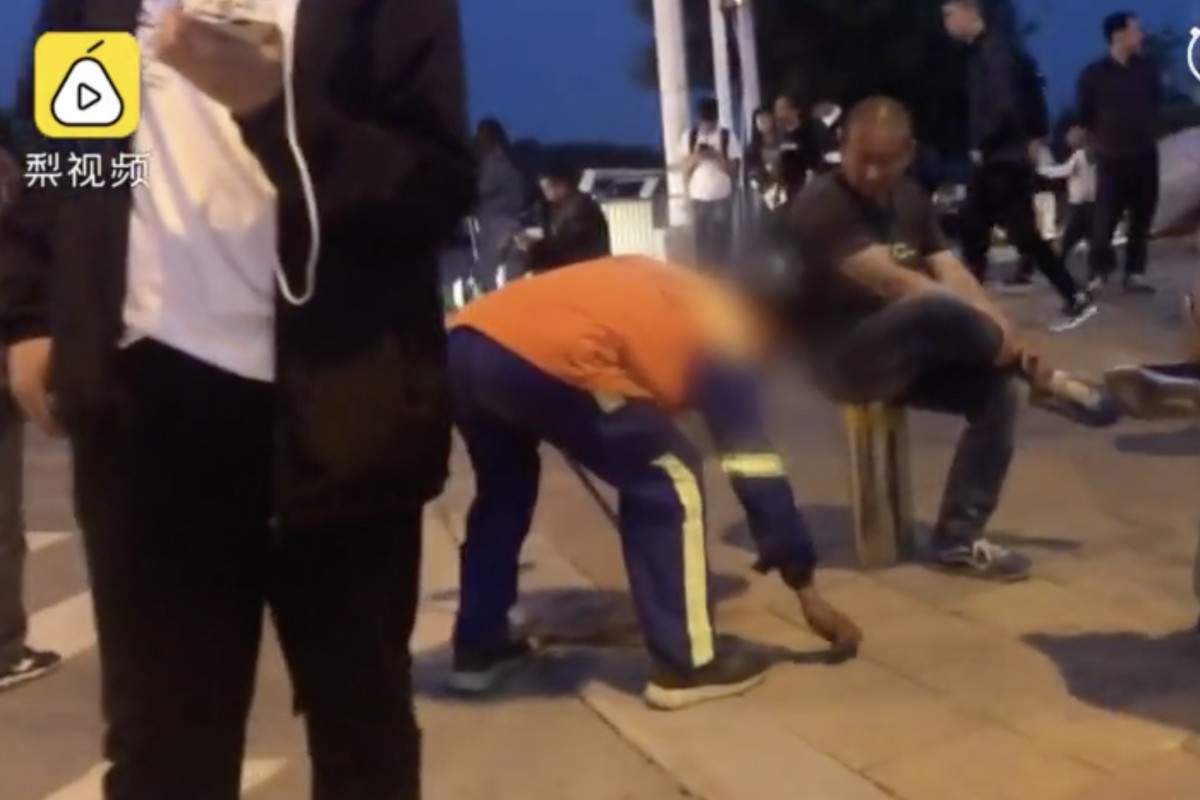
Local authorities say a street cleaner in Henan province fined for the cigarette butts left by smokers on his beat may be the victim of a zealous supervisor. Photo: Weibo
A street cleaner in eastern China who was filmed complaining about the hefty fines he had to pay for the cigarette ends found littering his section of road has won a hearing for his case and the support of internet users, social media site Pear Video said on Tuesday.
In the video taken on Saturday, the elderly man from Zhengzhou in Henan province claimed that he was once fined 260 yuan (US$38) – 7 yuan (about US$8) per cigarette end – from an 86 yuan per day pay packet.
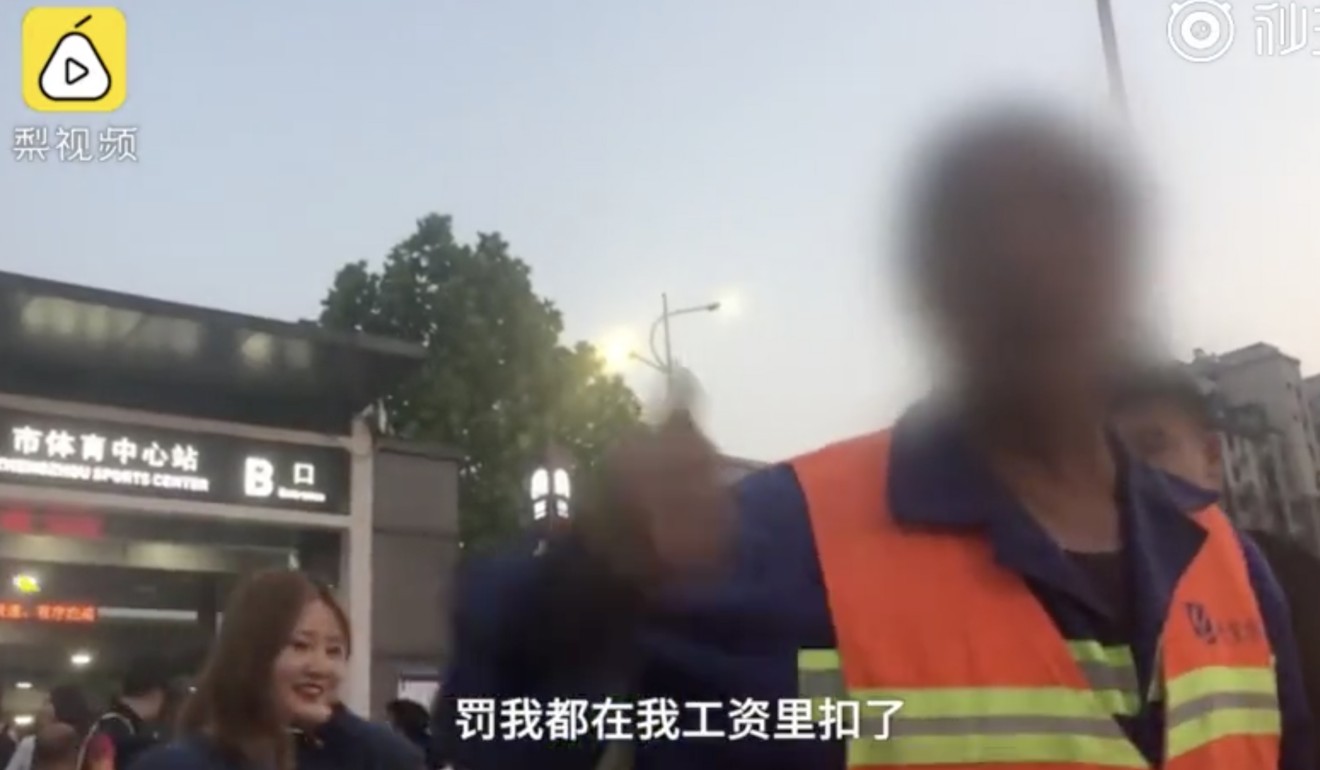
“Today, I had to clean up five or six thousand cigarette butts,” the man said in the video while working outside a subway station.
“All the fines come out of my salary. This month they docked me a few hundred yuan.”
The Zhengzhou street cleaner says he can pick up thousands of cigarette ends off the street each day but the littering in his section does not stop. Photo: Weibo
The man blamed littering on unauthorised taxi drivers who throw cigarette ends into the street.
“These black cab drivers come here every day, again and again. They never stop coming here,” the cleaner was quoted as saying.
Pear Video spoke to other street cleaners in Zhengzhou, who confirmed that they were fined 7 yuan per cigarette butt found after cleaning.
It’s a dirty job, but don’t treat them like trash: Hong Kong’s cleaners are an aged, overlooked group
However, city authorities denied that the penalty system was strictly enforced and blamed overzealous monitoring officers.
“[Management patrol] will say things like this because they want to supervise the street cleaners. But there are no detailed written guidelines, and this was never formally implemented,” a representative from the Zhengzhou City Management Command Centre was quoted as saying in the report.
“It is just for the purpose of verbal supervision and encouragement.”
The Zhengzhou official said the centre would investigate further and speak to the street cleaners about fines.
In response to the cleaner’s complaints, city authorities in Zhengzhou say they will investigate and speak to staff about fines. Photo: Weibo
The video stirred up angry reactions on Weibo, China’s Twitter-like platform.
“When [Pear Video] investigated they say it hasn’t been implemented. If they didn’t investigate, they would have just carried on giving fines,” read one comment that attracted more than 17,000 likes.
Street cleaners in China often earn meagre salaries for gruelling manual labour for long periods of time.
Last month, it emerged that more than 500 street cleaners in the city of Nanjing were ordered to wear GPS tracking bracelets that would alert authorities if they stayed in the same place for more than 20 minutes. The manufacturer removed the feature after a backlash inside and outside China.
Investigation follows violent protest at Nanjing school
Students discovered nursing qualification was actually a home economics degree
An investigation into enrolment practices at eastern China’s Nanjing Institute of Applied Technology has been widened into a country-wide check for similar frauds. Photo: Handout
A protest by technical school students over fake degrees that led to a
in eastern China last month has prompted the Ministry of Education to order local governments across the country to check for similar frauds in their regions.
Wang Jiping, director of the ministry’s vocational education department, said the authorities had been cracking down on fraudulent promotions in student enrolment – cause of the disturbance at Nanjing School of Applied Technology – for a long time.
“But some schools still irresponsibly cheated parents and students,” Wang said at a press conference on Wednesday.
“For this kind of phenomenon, our attitude is one of firmly stopping and seriously punishing.”
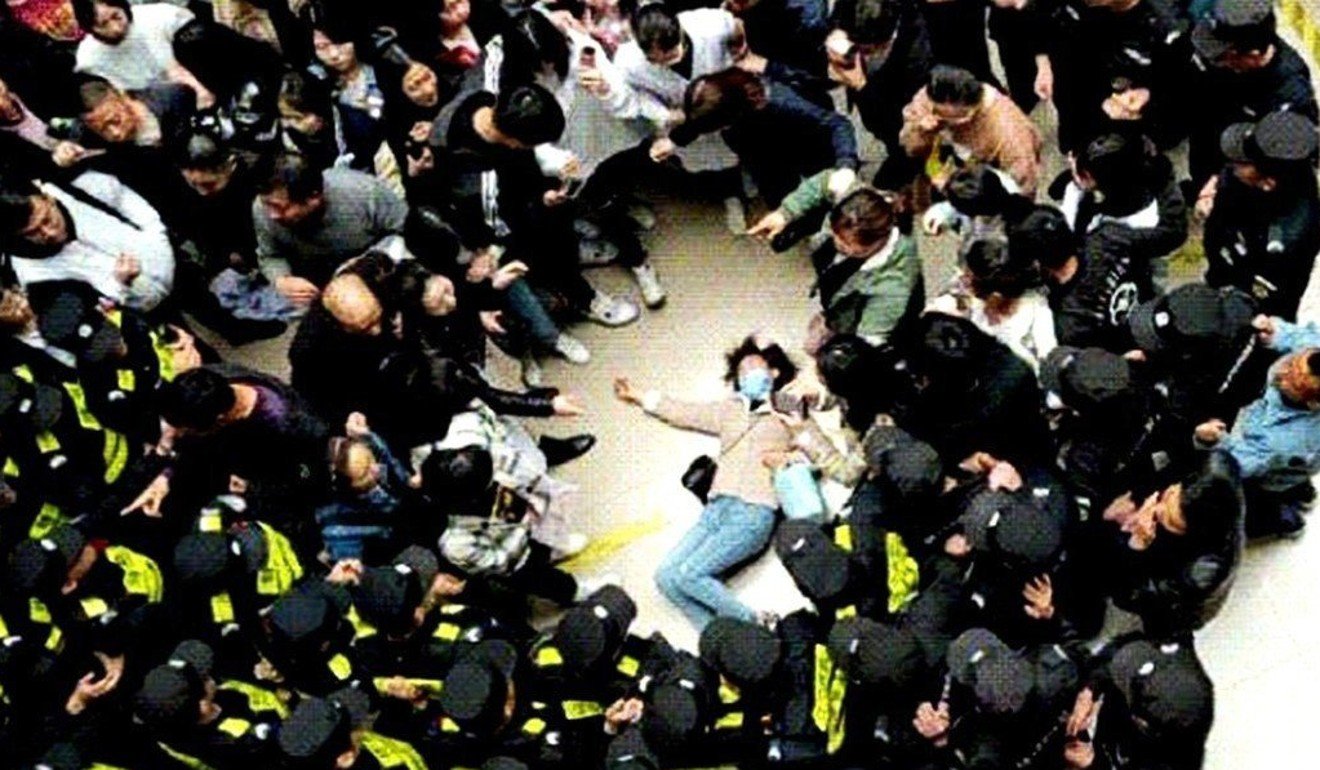
Dozens of students clashed with police and security staff at the Nanjing School of Applied Technology in eastern China last month after the discovery that their nursing course only provided a degree in home economics. Photo: Weibo
In a statement on Weibo, China’s Twitter-like microblogging service, the city government in Nanjing, capital of Jiangsu province, said on Tuesday the rally by students and parents at the school had attracted the attention of city and provincial authorities.
Investigations showed that when the school enrolled new students for its home economics major in 2016, it promised they would receive associate degrees and a nursing certificate upon graduation. The students were also guaranteed jobs.
Students about to graduate this summer were angry when they learned the school could not fulfil any of its promises.
At the end of last month, some parents started petitioning the local government. On the evening of April 26, dozens of students clashed with police and security staff, with two students sustaining leg injuries. Police took several people away for “stirring up trouble among students”, the police said on Weibo.
The city government said that, with the intervention of its education and human resources departments, 405 out of the 409 affected students had been transferred to higher level institutions, and the students and their parents had accepted that arrangement.
The investigation is continuing and school officials will be held accountable, it said.
The Nanjing government said some people had spread rumours online after the incident. The government statement said two people, both surnamed Wang, had falsely claimed a female student was beaten to death by school staff and her parents knocked unconscious by police in the incident.
The pair also claimed in their article, published on Monday, that the school’s security guards were armed during the confrontation with students.
The article went viral and the authors – one from Wuhan, Hubei province, and the other in Changsha, Hunan province, both in central China – were detained for causing trouble.
According to the government statement, they confessed to cooking up the rumour to attract online traffic and solicit rewards from readers.
They made 32,000 yuan (US$4,700) from the article.
Police investigation finds nearly 40 people received the shots since January last year – before the drug was approved by the Chinese regulator
Hainan hospital had rented out its medical cosmetics department to a beauty parlour, which authorities suspect administered the vaccinations
The Gardasil HPV vaccine has been in short supply in China since it was approved by the regulator last year. Photo: Shutterstock
A private hospital on Hainan Island has been closed down after it gave fake HPV vaccines to dozens of patients, including at least one who was pregnant, the local health authority said.
Police found 38 people had been given the fake shots at Boao Yinfeng Healthcare International Hospital, in the city of Boao, since January last year, the Health Commission of Hainan said in a statement on Sunday.
Some of the vaccines were found to have been smuggled in from overseas before the drug was approved in China, while others were illegally made in Jilin province.
The case is the latest in a series of scandals in recent years – including drug makers
and people including children being given fake, faulty or expired vaccines – that have rocked public confidence in the industry.
The hospital began administering the fake HPV shots three months before Merck’s Gardasil vaccine against human papillomavirus, which causes cervical cancer, was approved by the Chinese regulator in April last year. There has been a constant shortage of the vaccine since it was approved and a ballot system is used at some hospitals due to the huge demand and limited supply.
All of the Boao patients given fake shots had paid 9,000 yuan (US$1,300) to be immunised except for a hospital employee, who was vaccinated for free, the statement said.
The health commission said the hospital did not have approval to administer HPV vaccines and some of the shots were given before it officially opened in March last year.
Are Philippine children’s deaths linked to dengue vaccine?
It was also in breach of the hospital management regulation because it had rented out its medical cosmetics department to a beauty parlour from Qingdao, which authorities suspect administered the fake vaccinations.
Its medical institution business licence was revoked and the hospital was fined 8,000 yuan, while authorities have confiscated the illegal proceeds of the fake vaccinations. It was not known whether any arrests had been made in the case, and the investigation was continuing.
The scandal came to light in March when a man posted on the People’s Daily website his complaint to the health authority about his pregnant wife being told by police she was given a fake HPV shot.
Another patient, who identified herself as Wang Xi, wrote on microblog site Weibo last week that she was told the hospital could receive the vaccine before it was officially approved because it was located in a medical tourism pilot zone, giving it preferential access to treatments.
“As a victim, I’m constantly worried – what have they injected into my body?” Wang wrote.
Tesla said it is investigating a video on Chinese social media that appears to show one of its vehicles bursting into flames in Shanghai.
In a statement, the carmaker said it had sent a team to investigate the matter, and that there were no reported casualties.
The video, which has not been verified by the BBC, showed a stationary car erupting into flames in a parking lot.
Tesla did not confirm the car model but social media identified it as Model S.
“After learning about the incident in Shanghai, we immediately sent the team to the scene last night,” according to a translation of a Tesla statement posted on Chinese social media platform Weibo.
“We are actively contacting relevant departments and supporting the verification. According to current information, there are no casualties.”
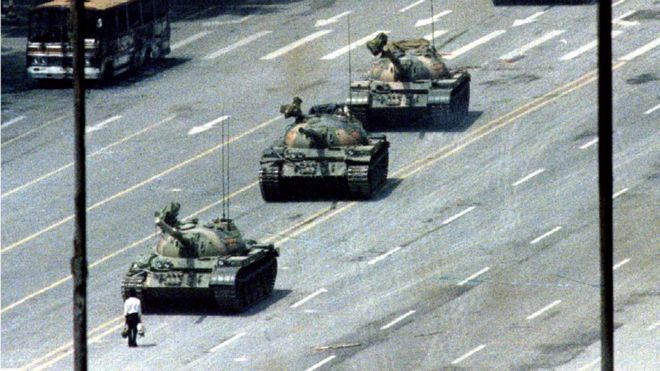
Image copyrightREUTERSImage caption This year marks the 30th anniversary of the pro-democracy protests
A promotional video for camera company Leica has sparked backlash in China for featuring a famous Tiananmen Square image.
The video depicts photographers working in conflicts around the world, including a photographer covering the 1989 protests.
People on Chinese social media site Weibo have called for a boycott of the camera brand.
Leica has distanced itself from the video.
“Tank Man” was a lone protester who brought a column of tanks to a standstill during a crackdown on pro-democracy protesters in Beijing in 1989.
He refused to move out of the way and climbed onto the leading tank to speak to the driver. He was later pulled away from the scene by two men. What happened to him remains unknown.
Users on Chinese social media site Weibo have been forbidden from commenting on recent official posts by Leica. However some people are managing to post carefully worded comments on earlier official Leica posts, BBC Monitoring has found.
A search of the hashtag Leica shows that 42,000 users have left posts on Weibo but only 10 are available to view.
Some comments urge users to “boycott the camera” and joke about the company being linked to “patriotic Huawei”.
Chinese technology giant Huawei has been restricted by the US and other countries over security concerns in telecommunications networks. Consumers in China have rallied around the company, which uses Leica technology in its latest mobile phones.
A spokeswoman for Leica told the South China Morning Post that the film was not an officially sanctioned marketing film commissioned by the company. However it features Leica cameras and the company’s logo at the end of the footage.
They added that the company “must therefore distance itself from the content shown in the video and regrets any misunderstandings of false conclusions that may have been drawn”.
The BBC has contacted Leica for additional comment.
How China keeps Tiananmen off the internet
By Kerry Allen, BBC Monitoring China analyst
China has banned all activists’ commemorations of the 1989 Tiananmen incident for years and has strictly regulated online discussion of it.
If users search for “Tiananmen” on domestic search engines like Baidu or social media platforms like Sina Weibo, they only see sunny pictures of the Forbidden City in Beijing. If any pictures of tanks running along Chang’an Avenue are visible in image searches, they are only from Victory Day parades.
Hundreds of references to 4 June 1989 are banned all-year round by thousands of cyber police, and Weibo steps up censorship of even seemingly innocuous references to the incident on its anniversary.
Simple candle emojis, and number sequences that reference the date, such as “46” and “64” (4 June) and “1989” (the year of the protests), are instantly deleted. Small businesses also struggle to market items on 4 June every year, if their sale price is 46 or 64 yuan. Such advertising posts are swiftly removed by nervous censors.
But creative users always find ways of circumventing the censors. For example in 2014, when Taylor Swift released her 1989 album, the album cover featuring the words “T.S.” and “1989” was seen as an effective metaphor by users to talk about the incident – as T.S. could be taken to mean “Tiananmen Square”.
More than one million Chinese students and workers occupied Tiananmen Square in 1989, beginning the largest political protest in communist China’s history. Six weeks of protests ended with the bloody crackdown on protesters of 3-4 June.
Estimates of the death toll range from several hundred to more than 1,000.
China’s statement at the end of June 1989 said that 200 civilians and several dozen security personnel had died in Beijing following the suppression of “counter-revolutionary riots” on 4 June 1989.
Health watchdog warns that tobacco products are widely available on both social media and online retailers
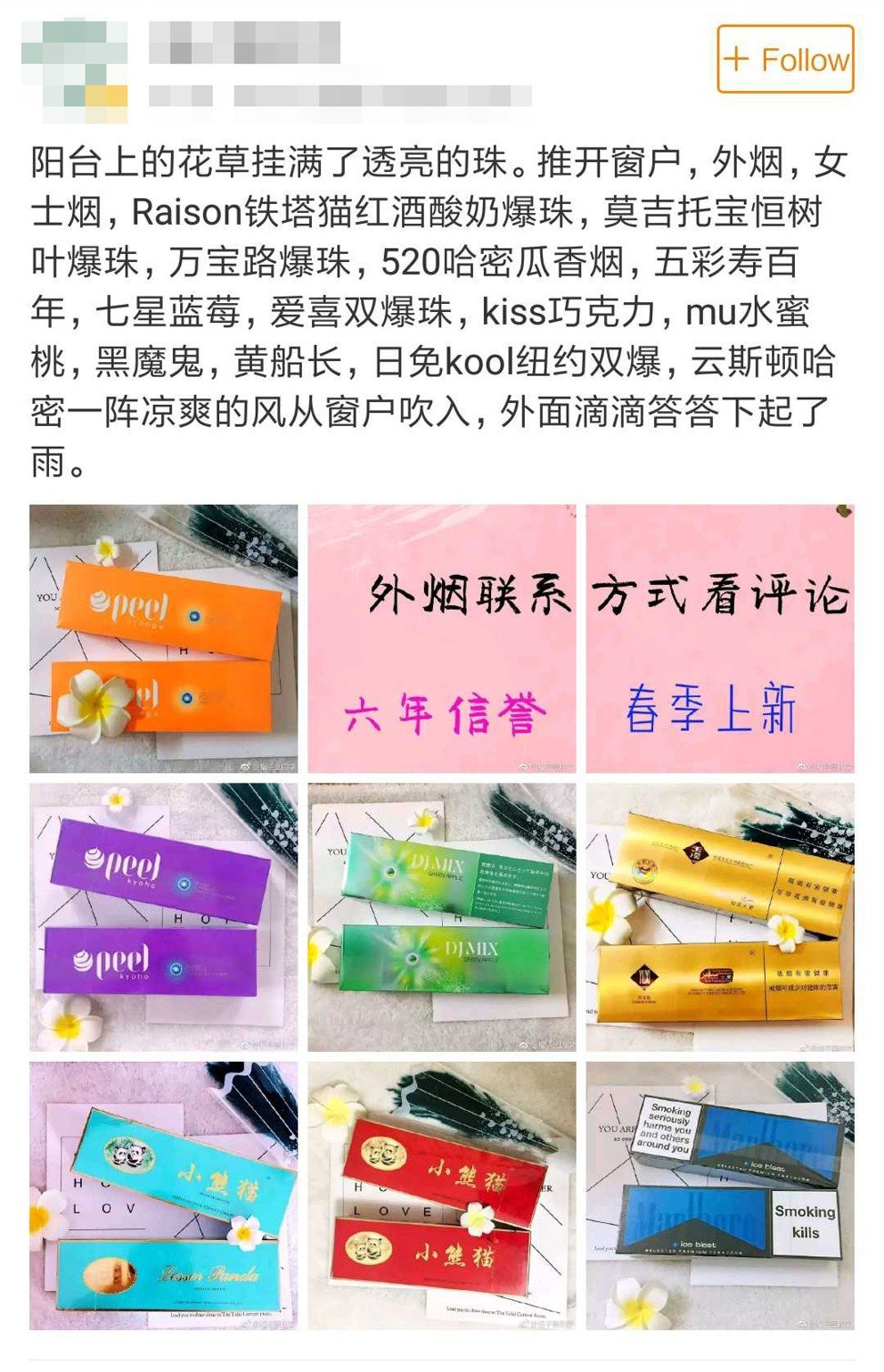
A tobacco seller’s advert posted on WeChat. Photo: Handout
Illegal tobacco trading is rife online in China both via social media and e-commerce platforms, a health watchdog has warned.
The Beijing Centre for Disease Prevention and Control released a report on Monday that said almost 52,000 advertisements and listings for tobacco products had been found on 14 social media and e-commerce platforms in the first half of last year.
“Compared with traditional advertising, tobacco promotion on the internet uses methods such as sponsored content, which is more discreet,” the report said.
China’s internet advertising regulations prohibit the online promotion of tobacco products.
Selling cigarettes online is illegal as the State Tobacco Monopoly Administration bans the sale of tobacco across provinces and strictly controls the production, sale and import of the product.
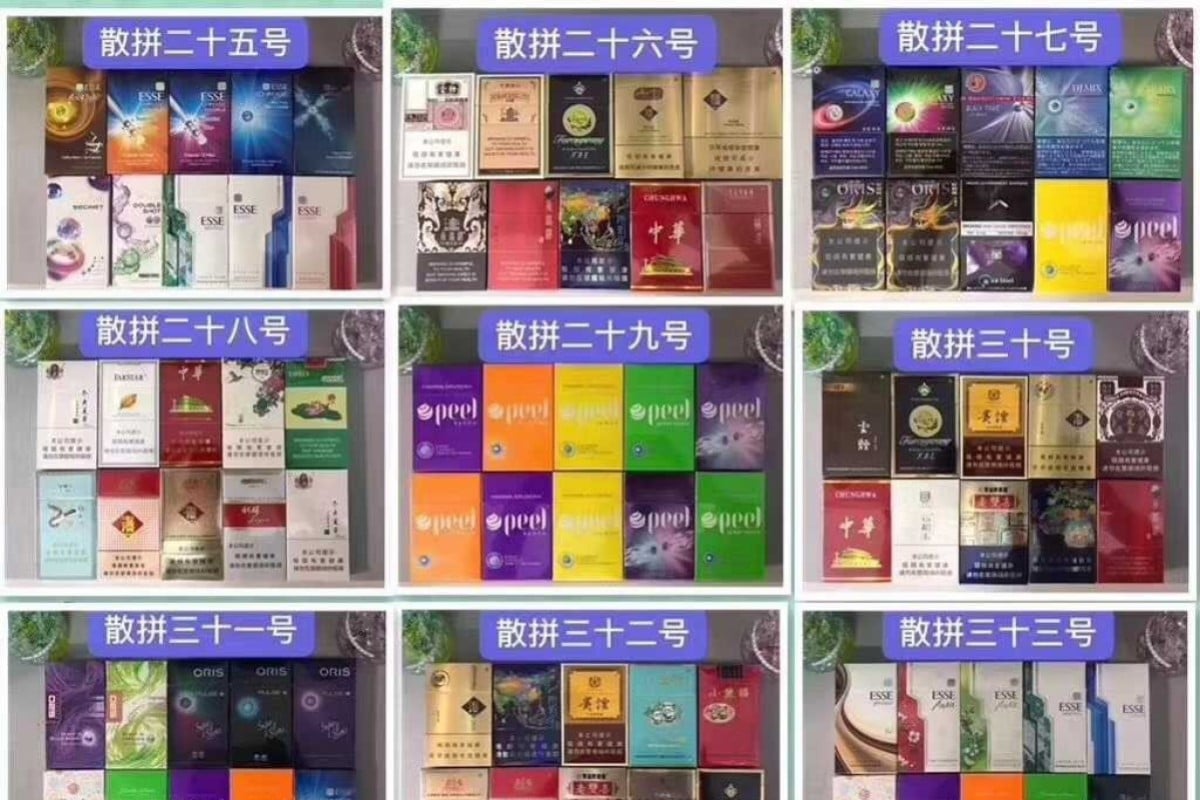
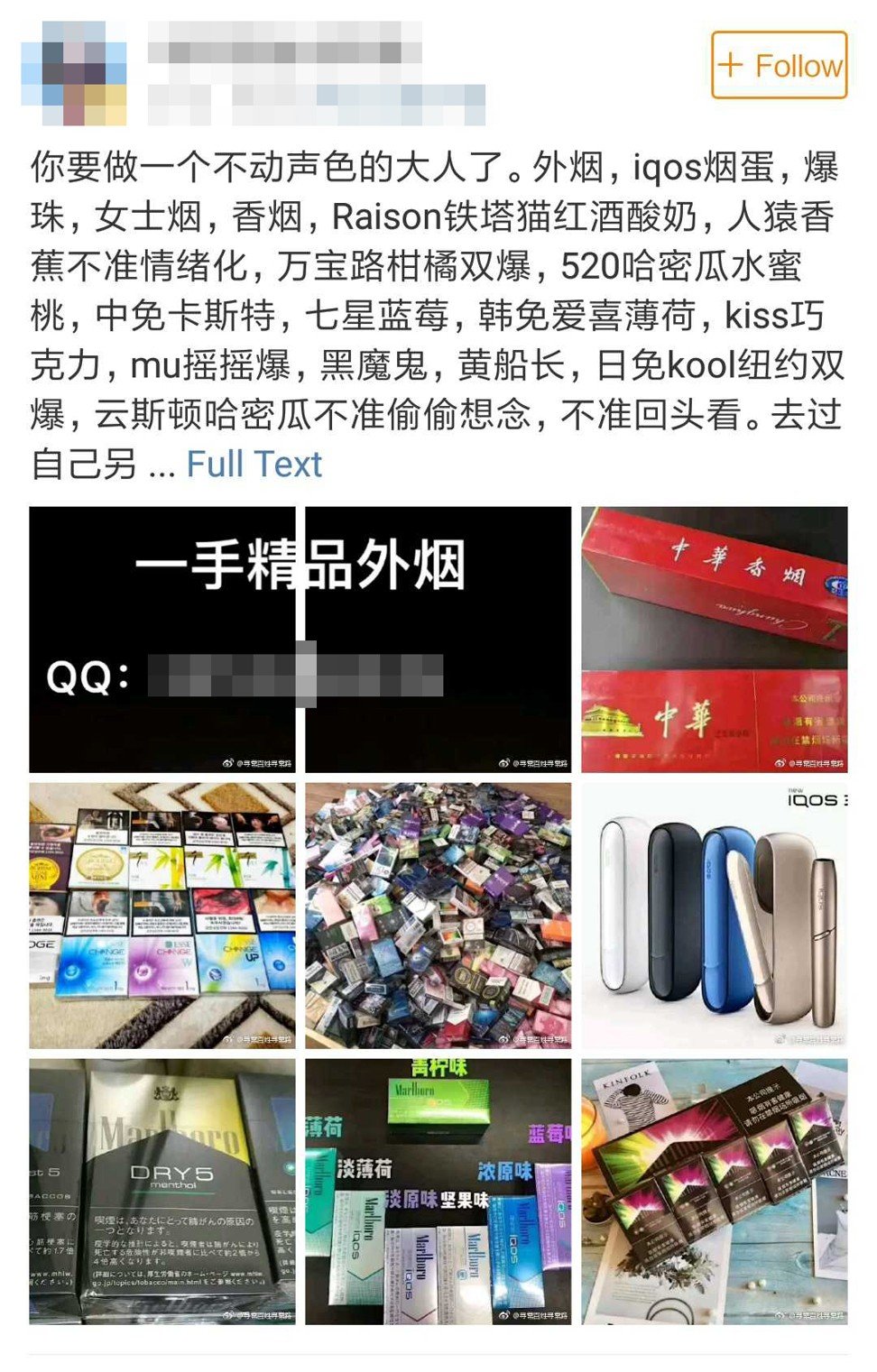
Screenshot from Weibo of an advertisement for imported cigarettes. Photo: Handout
The social network Weibo, China’s equivalent of Twitter, was highlighted as the platform where most of the banned promotion and selling were found, with nearly 43,000 adverts and listings, or 82 per cent of the total.
The South China Morning Post found that tobacco advertising and direct selling proliferates on Weibo, where searching for terms such as “cigarettes” and “women’s cigarettes” yielded almost 1,300 results, many of them offering WeChat and QQ contact information.
Five vendors found through Weibo offered various imported cigarettes such as Marlboro and South Korean brand Esse.
One seller claimed his wares were smuggled into China from places like the US. Another offered refunds for products that were confiscated, but only if they were bought for delivery within the same province.
A 10-packet carton of Kent cigarettes, an American brand, was selling for around 30 per cent less than the retail price in Beijing.
An extraordinary man’: China’s tobacco and orange king, entrepreneur Chu Shijian, dies aged 91
“A few days ago, cigarette sellers on Little Red Book began trending. People in different places have stopped. I’m still going, one step at a time,” a vendor calling herself “24 hours online cigarette hawker” wrote on her WeChat timeline on Wednesday.
She was referring to media coverage of Little Red Book the e-commerce platform popular with influencers selling lifestyle products.
Little Red Book, whose investors include Alibaba, the owner of the South China Morning Post, has pledged to remove as many as 95,000 adverts and listings for tobacco products found on the app on Tuesday in response to a report by newspaper Beijing Youth Daily.
Searches for “cigarettes” or “women’s cigarettes” no longer yielded results on Thursday.
“We are working hard to remove related content. We ask users to promptly report cases and work together to maintain order on the platform,” Weibo’s PR director Mao Taotao said.
Imported cigarettes on sale on Weibo. Photo: Handout
While advertising and online selling of tobacco are prohibited, e-cigarettes fall in a grey area. China’s tobacco agency has banned the sale of IQOS, a type of battery heated cigarette that delivers nicotine. However, regulations for non-nicotine vaporisers are less clear. These continue to be widely available online.
“In China, even toilet paper has standards. There are none for e-cigarettes,” Li Enze, the industrial law committee secretary for the Chinese Association on Tobacco Control, said.
“I think there needs to be a total ban on the sale of e-cigarettes until standards and regulations are set.”
E-cigarettes and vaporisers come in a variety of flavours and shapes to target women and young people, which poses a serious problem according to Li.
Under-18s can easily purchase vaporisers online and can be induced to smoking the real thing, he said.
Two sets of standards for e-cigarettes have been considered by the Standardisation Administration of China since 2017.
However, both were proposed by organisations associated with the state tobacco monopoly, which Li deemed a conflict of interest.








 CHINDIA ALERT: You'll be living in their world, very soon