05/07/2019
- Riot police deployed after week of unrest over proposed plant next to residential areas – echoing recent years’ protests against incinerators elsewhere in the country
- District government urges people to ignore rumours and says plant’s location has yet to be finalised
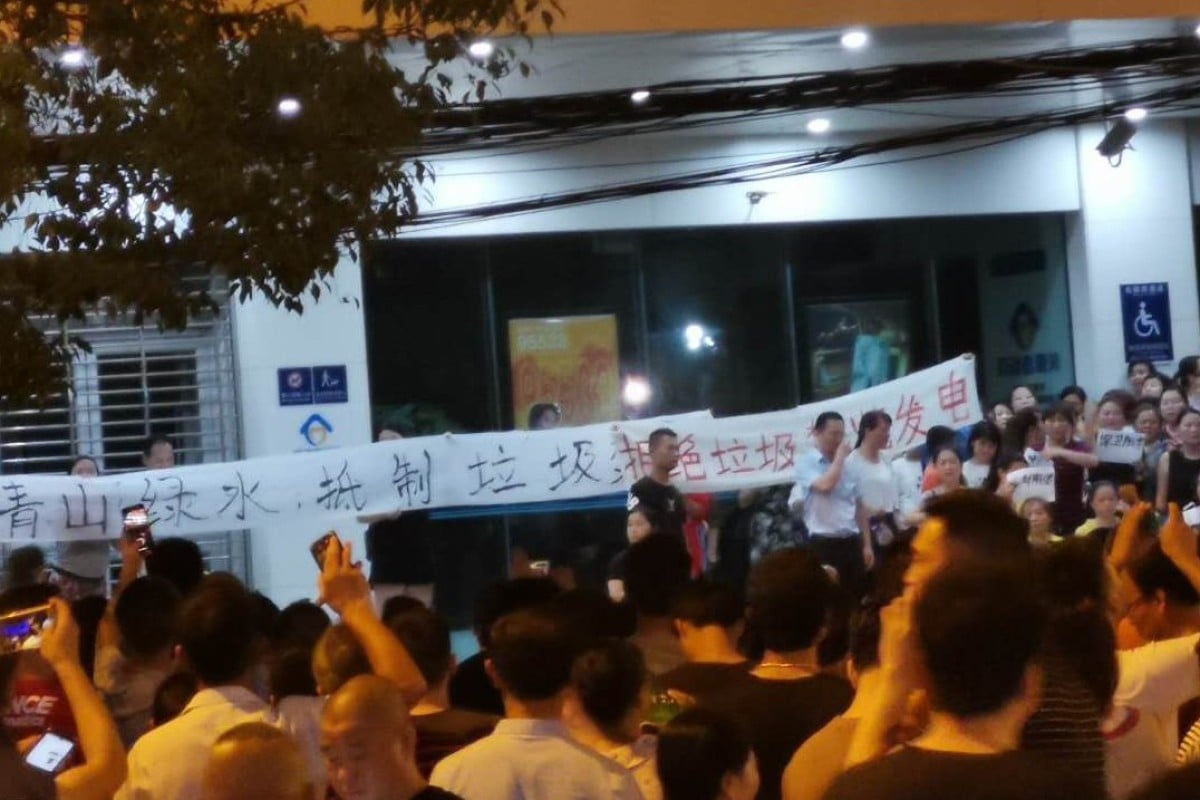
People in Yangluo protest against the proposed incineration plant on Thursday night. Photo: Handout
Thousands of people took to the streets in central China on Thursday night in a seventh day of protests against the construction of a waste incineration plant.
Protesters carried banners and chanted as they marched against a waste-to-energy plant that could be built next to residential areas in Yangluo, near Wuhan, the capital of Hubei province.
Residents were angered by plans to build the plant on a garbage landfill site that had been expected to be turned into a public park.
They shouted slogans such as “Return us the green mountain and clear waters” and “Garbage burning plant get lost from Yangluo”.
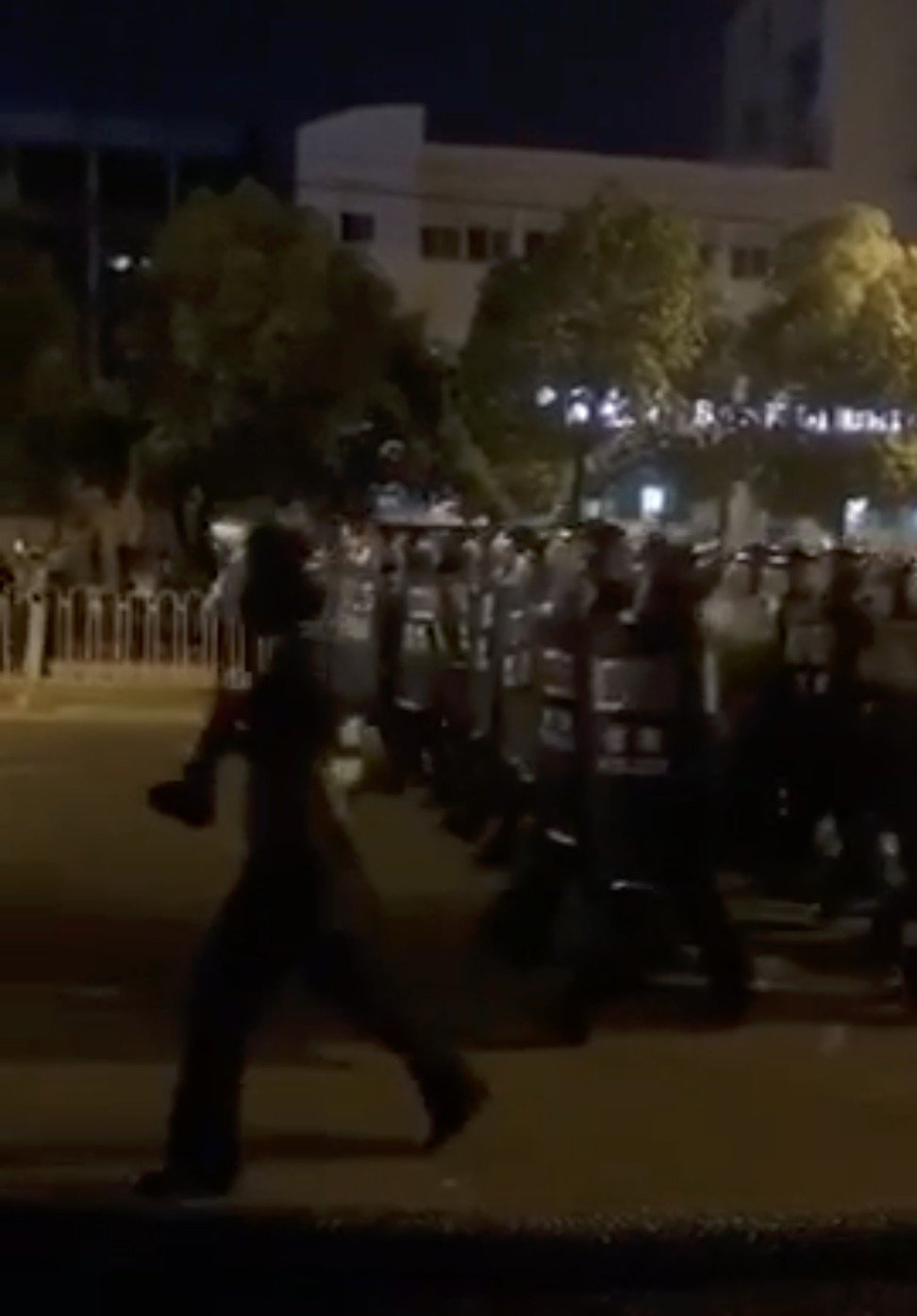
Riot police move in as protests continue in Yangluo on Thursday. Photo: Handout
A letter to the public by the Xinzhou district government on Wednesday had urged people “not to listen to or spread rumours”, and said that a location had yet to be finalised for the plant.
“What is rumoured online to be the garbage burning project that has already started is in fact demolition work for a railway construction project,” the letter said.
Converting waste to energy by burning it has been adopted in China as an alternative to burying rubbish in landfill sites – which causes pollution and requires a lot of land – but it has been widely resisted because of fears that it is a health hazard. Large protests against incinerators have been held in recent years in Zhejiang, Jiangsu, Hubei, Beijing and Guangdong.
“We understand the need to dispose of garbage in an environmentally friendly way, but does it have to be that close to our homes? Two universities and more than 10 residential areas are within a 3km (1.86 miles) radius,” said the man, referring to the Wuhan University of Bioengineering and Wuhan Engineering Institute.
Yangluo, designated as an economic and technology development area, is 30km northeast of downtown Wuhan and has a population of 300,000. The incineration plant would handle 2,000 tonnes of waste per day, the Wuhan urban management committee said last month.
Residents asked about the progress of the project in early June and were told that the authorities were still choosing a site.
Protests broke out last Friday after rumours spread that the project had already started – forcing the district government to say on Saturday that it would “not start without approval from the public”.
Nonetheless, thousands of protesters – about 10,000, according to one source – marched on Saturday and Sunday, leading to some arrests, although those detained at the weekend had since been released, protesters said.
After minor protests on Monday and Tuesday, residents gathered in greater numbers in Yangluo on Wednesday and Thursday nights, met by a heavy police presence.
Videos seen by the South China Morning Post show hundreds of riot police marching through the streets, equipped with helmets, shields and batons
The crowd dispersed at about 10pm as police began to round up some protesters. They were taken aboard a coach and two men were handled roughly, the videos showed.
Chinese town residents clash with riot police over incinerator
An official from the Xinzhou district government’s publicity department stressed to the Post that the project would not begin without public approval and its location had not yet been chosen.
Source: SCMP
Posted in Beijing, economic and technology development area, garbage landfill site, Guangdong, Hubei, hubei province, Jiangsu, public park, south china morning post, Thousands protest, Uncategorized, waste incineration plant, Wuhan, Wuhan Engineering Institute, Wuhan University of Bioengineering, Xinzhou, Yangluo, Zhejiang |
Leave a Comment »
20/04/2019
- Vijay Keshav Gokhale is expected to meet Chinese deputy foreign minister Kong Xuanyou and Foreign Minister Wang Yi during two-day visit
- Beijing’s refusal to sanction a Pakistani militant leader and its belt and road push in the disputed Kashmir region have strained ties
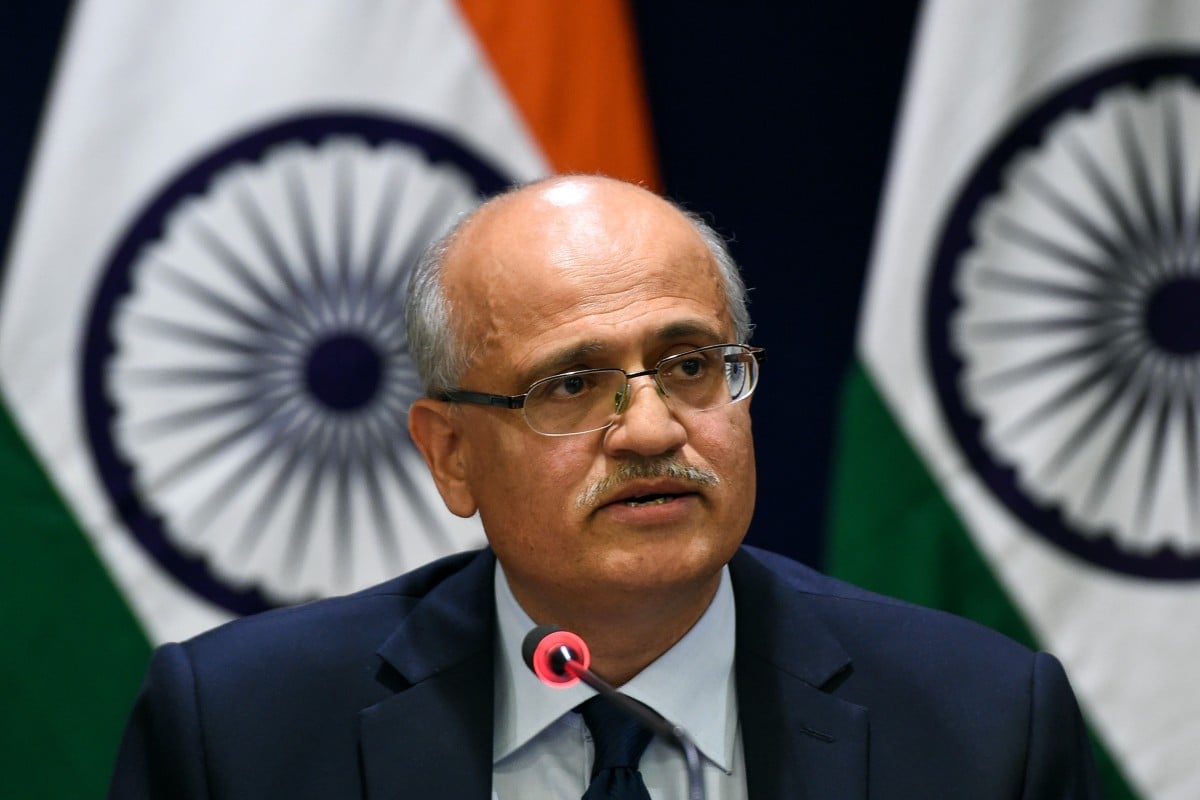
Indian Foreign Secretary Vijay Keshav Gokhale will visit China as part of “regular exchanges” between the two countries. Photo: AFP
Indian Foreign Secretary Vijay Keshav Gokhale will travel to Beijing on Sunday amid tensions between India and China over Beijing’s refusal to sanction a Pakistani militant leader and its infrastructure push in the disputed Kashmir region.
Gokhale’s two-day visit is part of “regular exchanges” between the two nations, the Indian embassy in Beijing said on Saturday.
During his stay, Gokhale is expected to meet Chinese deputy foreign minister Kong Xuanyou and Foreign Minister Wang Yi.
He will return to India on Monday, three days before the second Belt and Road Forum begins in the Chinese capital. Forty foreign leaders will attend the summit on Beijing’s global trade and infrastructure scheme, the “Belt and Road Initiative”, but India is not taking part.
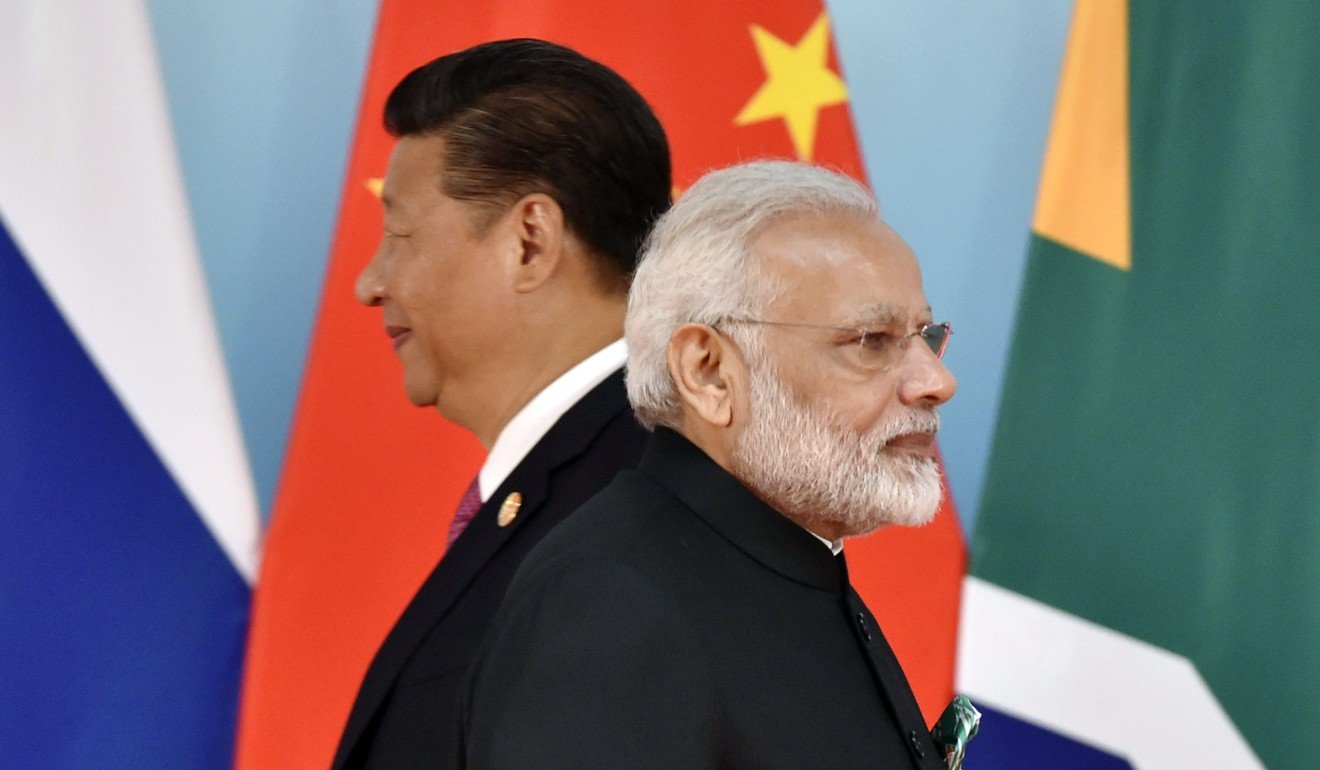
Wang on Friday called on India, and other countries sceptical of the initiative, to join up, dismissing claims that it is a geopolitical tool. He also said China was ready to hold a leaders’ summit with India like the informal meeting held between Chinese President Xi Jinping and Indian Prime Minister Narendra Modi in Wuhan, Hubei province last year.
A summit between Xi Jinping (left) and Narendra Modi in Wuhan last year was seen as a breakthrough in China-India relations after the Doklam border dispute. Photo: AFP
Gokhale visited Beijing in February last year, and the Wuhan summit happened two months later. That meeting was seen as a breakthrough in the
after a 73-day military stand-off over the Doklam plateau.
But the progress was overshadowed in February after a terror strike on Indian security forces in the Jammu and Kashmir province, which killed 40 Indian soldiers. The Pakistan-based Jaish-e-Mohammed group claimed responsibility for the attack. India has long wanted to designate its leader, Masood Azhar, as a terrorist under international law, but China has opposed the move.
During a visit to Pakistan in March, Kong said Beijing and Islamabad were all-weather strategic partners and would support each other on issues to do with their core interests.
What ‘Wuhan spirit’? Kashmir suicide attack reopens Modi’s China wound
Wang Dehua, head of the Institute for South and Central Asia Studies at the Shanghai Municipal Centre for International Studies, said China and India were looking to prevent their bilateral relations from deteriorating further.
“Both nations will elaborate on their stance on this matter, and China will probably deliver a message that the China-India relationship should not be affected by the dispute over Masood Azhar,” he said. “The positive sentiment out of Wuhan has been affected, and the two sides are seeking ways to continue the spirit of that informal summit.”
Du Youkang, director of Fudan University’s Pakistan Study Centre in Shanghai, said preparations for another informal summit of the nations’ leaders would only begin after India’s general election was over. Polling is being held in seven phases ending on May 19.
Gokhale’s trip would mainly be a chance to see how the two nations can push forward bilateral ties amid their disputes, Du said.
In addition to Azhar, India is also dismayed that some of China’s belt and road projects pass through the Pakistan-administered section of the disputed Kashmir region.
But Wang told reporters on Friday that the initiative did not target any third country, and that relations between China and India had improved after the Wuhan summit.
Source: SCMP
Posted in Belt and Road Initiative (BRI), belt and road push, China alert, Chinese deputy foreign minister, Chinese President Xi Jinping, Doklam plateau, Du Youkang, foreign minister, Fudan University’s Pakistan Study Centre, head of the Institute for South and Central Asia Studies, hubei province, India alert, Indian Foreign Secretary, Indian Prime Minister Narendra Modi, Islamabad, Kashmir, Kong Xuanyou, Masood Azhar, Pakistani militant leader, Shanghai, Shanghai Municipal Centre for International Studies, Uncategorized, Vijay Keshav Gokhale, Wang Dehua, Wang Yi, Wuhan |
Leave a Comment »
01/04/2019
Aerial photo taken on June 23, 2018 shows a wetland of the Yellow River Delta national nature reserve in Dongying, east China’s Shandong Province. The city of Wuhan in central China’s Hubei Province will apply for the 2021 Wetland City Accreditation of the Ramsar Convention, the municipal forestry bureau announced. The announcement was made as the city joined the global “Earth Hour” campaign Saturday night by turning off lights on major landmarks. Wuhan, which sits at the confluence of the Yangtze River and its longest tributary Han River, boasts about 1,624 square km of wetlands, accounting for 18.9 percent of the city’s total area. The bureau said Wuhan’s wetlands are home to more than 400 wild animal species and over 400 plant species. A total of 18 cities from seven countries were honored as international wetland cities in 2018. Six Chinese cities were among the list, namely Haikou, Harbin, Changde, Changshu, Dongying and Yinchuan. (Xinhua/Guo Xulei)
WUHAN, March 31 (Xinhua) — The city of Wuhan in central China’s Hubei Province will apply for the 2021 Wetland City Accreditation of the Ramsar Convention, the municipal forestry bureau announced.
The announcement was made as the city joined the global “Earth Hour” campaign Saturday night by turning off lights on major landmarks.
Wuhan, which sits at the confluence of the Yangtze River and its longest tributary Han River, boasts about 1,624 square km of wetlands, accounting for 18.9 percent of the city’s total area.
The bureau said Wuhan’s wetlands are home to more than 400 wild animal species and over 400 plant species.
“Wuhan is a competitive applicant not only because of its abundant wetland resources, but also due to its pioneering wetland protection mechanism,” said Lei Gang, an expert with World Wildlife Fund (WWF) China’s freshwater program.
“Wuhan was the first Chinese city to implement an ecological compensation mechanism for wetlands and to carry out the strictest lake management regulations,” Lei added.
The Ramsar Convention, or the Convention on Wetlands, is an inter-governmental environmental treaty adopted in 1971. It provides the framework for national actions and international cooperation regarding the conservation and wise use of wetlands and their resources.
The Ramsar Convention introduced the Wetland City Accreditation scheme in 2015, aiming to recognize cities that make exceptional efforts to safeguard their urban wetlands.
A total of 18 cities from seven countries were honored as international wetland cities in 2018. Six Chinese cities were among the list, namely Haikou, Harbin, Changde, Changshu, Dongying and Yinchuan.
Posted in China alert, Uncategorized, wetland city, Wuhan |
Leave a Comment »
14/03/2019
The bonhomie witnessed between India and China over the last one year after the informal summit between Prime Minister Narendra Modi and Chinese President Xi Jinping in Wuhan April last year has clearly evaporated following the Chinese action
Even as China asserted on Thursday that the ‘Wuhan Spirit’ was still on, there is a sense of betrayal in New Delhi over Beijing’s decision to stand by its ‘all-weather friend’ Pakistan by blocking the designation of JeM chief Masood Azhar as a global terrorist by the UN Security Council.
The bonhomie witnessed between India and China over the last one year after the informal summit between Prime Minister Narendra Modi and Chinese President Xi Jinping in Wuhan April last year has clearly evaporated following the Chinese action.
Amid the growing clamour in India for boycotting China after it used its veto power to block listing of Masood Azhar as a global terrorist, New Delhi has expressed disappointment over Beijing’s move while reaffirming its determination to pursue all avenues to bring the JeM chief to justice for terror attacks in different parts of India.
A number of reasons, including the significant role Pakistan plays in China’s ties with the Islamic world and Beijing’s anxiety over spill-over effect of a ban on Azhar in China’s own restive Muslim-dominated Xinjiang region, could have played a role in Beijing deciding to yet again stonewall any action by the UNSC against the JeM chief, observers say.
Despite its burgeoning trade relationship with India, China has never hidden the fact that it needed Pakistan more than any other country for achieving its geo-strategic goals in the region. Pakistan’s importance for China has increased manifold in recent years in view of the heavy economic and manpower investments it has made in the China-Pakistan Economic Corridor (CPEC) as part of President Xi’s signature Belt and Road Initiative (BRI).
Sources said it was quite clear to New Delhi over the past few days that China was adopting double standards in the global fight against terrorism only to shield Pakistan. China, they said, could no longer take shelter under ‘lame excuses’ like India had not provided any ‘updated material’ on Azhar’s terrorist activities in India which could compel Beijing to reconsider its position on the JeM chief.
Sources pointed out that India had submitted to China and other key nations ‘clinching and irrefutable’ evidence linking JeM to terror attacks in India, including the Pulwama attack. All other members of the UNSC, including those in the non-permanent category, solidly backed India’s effort to get the JeM chief banned but China put a spanner in their works yet again, they regretted.
The US, meanwhile, said responsible UNSC members might be forced to other actions at the Security Council if Beijing continued to block Masood’s designation.
China’s veto against banning Masood Azhar has once again highlighted the deep-rooted suspicion and mistrust between India and China on strategic issues, particularly the fight against terrorism. Despite pledging to work with India in combating terror, China has done precious little to assuage India’s concerns over terrorism emanating from Pakistan.
China has, in fact, praised Pakistan on many occasions for its role in the global war against terrorism. Beijing’s contention has been that Pakistan itself has been one of the main victims of terrorism and it must be supported in combating the menace.
There is also a feeling in Chinese circles that the situation in Jammu and Kashmir is the prime reason for terrorism in India. The argument being advanced by them is that while Kashmir is a disputed territory, Xinjiang is a province of China and, therefore, a comparison can not be drawn between the two regions.
Source: The Statesman
Posted in Beijing, Belt and Road Initiative (BRI), betrayed, bilateral ties, bonhomie, boycotting China, China alert, China-Pakistan Economic Corridor (CPEC), Chinese President Xi Jinping, global terrorist, India alert, Islamic world, Jammu and Kashmir, JeM chief, Masood Azhar, New Delhi, Pakistan, Prime Minister Narendra Modi, trade relationship, UN Security Council, Uncategorized, UNSC, Wuhan, Wuhan Spirit, Xinjiang |
Leave a Comment »
10/03/2019
WUHAN, March 9 (Xinhua) — The city of Wuhan, capital of central China’s Hubei Province, will invest 40 billion yuan (about 6 billion U.S. dollars) to provide key support to the development of high-tech infrastructure by 2022, local authorities said.
The province and its capital will forge ahead with high-tech industries by raising a 10-billion-yuan fund per year for major projects, platforms, industrial parks, equipment and talent teams, from 2019 to 2022.
So far, a research facility of precise gravity measurement, a national major science and technology infrastructure, is under construction in the Huazhong University of Science and Technology in Wuhan.
In the past few years, the city has completed a pulsed high magnetic field facility and opened China’s first national bio-safety level four lab, which requires the highest level of biological safety.
Wuhan will work with universities, institutes and enterprises to achieve great breakthroughs in various fields including integrated electromagnetic energy, optoelectronics, microelectronics, geomatics, and new materials, as well as build national laboratories.
Data released at the city’s science and technology conference for 2019 on Friday showed that the value added of the hi-tech industries in Wuhan exceeded 300 billion yuan last year, accounting for 20.56 percent of the city’s gross domestic product.
With 3,536 high-tech enterprises in total, the city is making efforts to build itself into a tech hub of the country.
Source: Xinhua
Posted in breakthroughs, China alert, enterprises, equipment, geomatics, hi-tech industries, high-tech infrastructure, Huazhong University of Science and Technology, hubei province, industrial parks, institutes, integrated electromagnetic energy, major projects, major science and technology infrastructure, microelectronics, national bio-safety level four lab, national laboratories, new materials, optoelectronics, platforms, precise gravity measurement, pulsed high magnetic field facility, research facility, science and technology conference, talent teams, tech hub, Uncategorized, universities, Wuhan, yuan |
Leave a Comment »
09/03/2019
- Researchers say they spend so much time on grant applications that they get no time to do science
- Funding applications are said to be too onerous and inflexible
Chinese scientists say funding applications are too onerous and restrictive. Photo: Xinhua
Chinese scientists are appealing for a bigger say over research funding as they buckle under a rigid and bureaucratic application system.
The appeal from delegates to the country’s peak advisory body, the Chinese People’s Political Consultative Conference, comes as the central government prepares to launch a pilot project that will give research teams greater flexibility in the way funds are used.
Despite slowing economic growth, the central government also plans to increase the budget for science and technology by 13.4 per cent this year to 354.31 billion yuan (US$52.7 billion) as Beijing tries to challenge the United States in the race for high technology.
But researchers have been hampered by a funding structure that demands they clearly state the use of their research and submit a detailed plan with a deadline for delivery of results.
Application rules have become stricter in the last few years, partly a result of a crackdown on corruption, which has led to a dozen university presidents and top scientists being arrested for embezzling research and infrastructure funding.
Chinese science minister warns scientists not to overstep ethical bounds after He Jiankui’s gene-edited babies scandal
CPPCC delegate Yuan Zhiming, an agricultural scientist from the Chinese Academy of Sciences in Wuhan, said he spent so much time filling out funding applications that he did not have time to do any research.
“It’s not easy to complete the budget with detailed outcomes, because I don’t already know my research results,” Yuan said in an open panel discussion on the sidelines of the CPPCC.
Wang Liming, a CPPCC delegate from China National Nuclear Corporation, agreed, saying funding applications were too onerous and inflexible. “Money earmarked for buying soy sauce cannot be used to buy vinegar,” he joked.
People’s Daily, the Communist Party’s mouthpiece, reported in December 2016 that it took a scientist a month to finish an annual report for a regular research project and much longer for a major one.
The fears about more bureaucracy in research intensified last year when the National Natural Science Foundation – which manages science funding and promotes research – was downgraded and put under the Ministry of Science and Technology.
The authorities said the change was aimed at strengthening the government’s “research-driven development strategy” and “optimising the distribution of funding on science and technology”, while scientists said it meant funding approval would be more stringent.
China’s science and tech minister calls on private enterprises to develop ‘core technologies’
But senior Chinese officials said they understood the need to speed up research for China to transform itself into an innovation powerhouse.
Science and Technology Minister Wang Zhigang said on Friday that China would overhaul the way funding was managed to give researchers more incentives.
“The ministry [of science and technology] has done a series of things to ease the burden on researchers, so that they will not be bothered by forms, reimbursements, titles and prizes and have more time to do real research,” Wang said.
“The upcoming reforms will be centred on how to ignite researchers’ enthusiasm, initiative and creativity.”
Source: SCMP
Posted in agricultural scientist, Beijing, buying soy sauce cannot be used to buy vinegar, China alert, China National Nuclear Corporation, Chinese Academy of Sciences, Chinese People's Political Consultative Conference, Chinese scientists, Communist Party’s mouthpiece, CPPCC delegate, He Jiankui, Ministry of Science and Technology, National Natural Science Foundatio, People’s Daily, Red tape, research funding, rigid and bureaucratic application system, science and tech minister, Science and Technology Minister, Uncategorized, United States, Wang Liming, Wang Zhigang, Wuhan, Yuan Zhiming |
Leave a Comment »
24/02/2019
Aerial photo taken on Feb. 12, 2019 shows emergency worker Dong Jinbing (L) inspecting the high voltage wire with his workmate Wang Wensheng on the power transmission tower in the mountain area of Wuhan, capital of central China’s Hubei Province.
A team of electricians was dispatched to repair a high voltage wire that was broken due to thick layer of ice accumulation. After one day’s work on the over 40-meter-high power transmission tower in bad weather condition, the team succeeded in fixing the failed power system that lowered the trains’ speed causing delay during the post-holiday travel peak. This year’s Spring Festival travel rush started on Jan. 21 and will last till March 1, with railway trips expected to hit 413 million in total, up 8.3 percent. (Xinhua/Xiao Yijiu)
Posted in China alert, Dong Jinbing, Electricians, high voltage wire, holiday travel, hubei province, railway trips, Spring Festival, travel rush, Uncategorized, Wang Wensheng, Wuhan |
Leave a Comment »
22/02/2019
- Firms in Jiangsu and Guangdong provinces top the list of new additions to blacklist in 2018
- Bogus advertising, illegal activities in property industry, substandard health care products and P2P lending fraud are typical cases
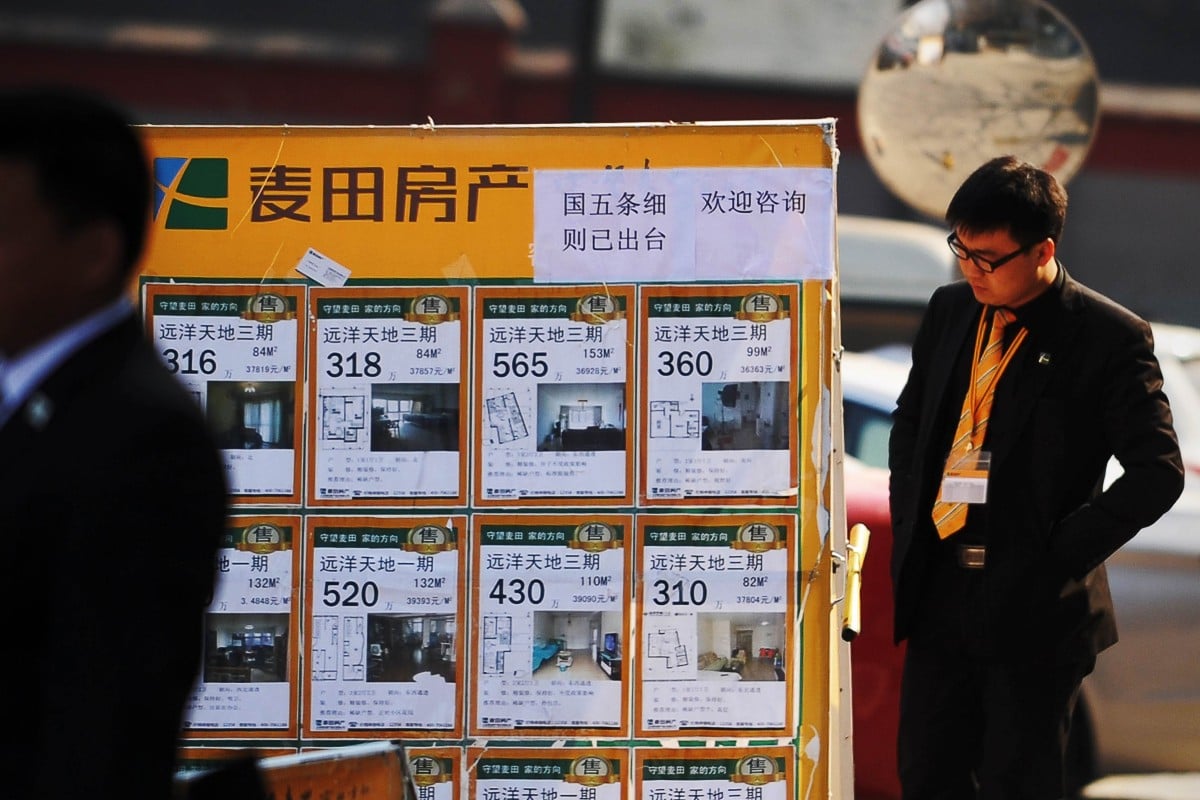
A real property agent checks a property advertising board in Beijing. According to a report by the Chinese government, property brokerages are among the country’s least scrupulous group of firms. Photo: Agence France-Presse
China’s wealthiest regions also have the largest number of untrustworthy businesses, according to the government’s social credit system, which rates citizens and companies based on their behaviour.
Jiangsu, the country’s second largest provincial economy – 9.26 trillion yuan (US$1.37 trillion) – accounted for 16.7 per cent of the discredited businesses that were added to the national blacklist last year, more than any other region.
According to a report compiled by the National Public Credit Information Centre that is backed by China’s state planner, the National Development and Reform Commission, Guangdong is next in line.
Guangdong is China’s most prosperous province, Guangdong, but is also home to 12.77 per cent of the total 3.59 million blacklisted firms. The southern province had a gross domestic product of 9.73 trillion yuan last year.
In third spot was Zhejiang, the prosperous province just south of Shanghai, while the capital city of Beijing was ranked fifth. These places together contributed slightly more than 30 per cent of China’s gross domestic product (GDP) last year.
By naming and shaming the millions of Chinese businesses and individuals on the annual blacklist, Beijing hopes to boost “trustworthiness” in Chinese society. Under the system, each of its 1.4 billion citizens is expected to receive a personal trustworthiness score.
“In more developed coastal provinces, businesses have long operated in the grey area between emerging China and established Hong Kong,” said Brock Silvers, managing director of Kaiyuan Capital, a Shanghai-based financial advisory firm.
Silvers said the situation evoked the Chinese saying: “Heaven is high and the Emperor is far away”, which alludes to local officials’ tendency to disregard central government’s directives.
While it was previously not such a faux pas to engage in “untrustworthy” behaviour in attaining economic development, things are now different.
China’s social credit system shows its teeth, banning millions from taking flights, trains
“The ability to cut corners in search of profit isn’t as prized in China’s modern economy, and many of those old traits can now lead companies to be added to Beijing’s blacklist,” Silvers said.
Among the firms named in the hall of shame is Chuangyue Energy Group, from northwest Xinjiang, which topped the list of new cases involving at least 500 million yuan in fraudulent activity.
Chuangyue and its legal representative Qin Yong were reprimanded by the Shenzhen Stock Exchange in 2016 for failing to disclose transactions on time. The transaction involved changes to the shareholding structure of a listed firm in which Chuangyue held interest in, state media reported.
Also on the list was property developer Zhonghong Holding, which was delisted from the Shenzhen exchange late-last year after its shares fell below the par value of 1 yuan for 20 consecutive days.
Zhonghong had posted massive losses, failed to repay loans and halted development projects during 2018.
A typical area of fraud cited in the report was bogus advertising, with the biggest number of discredited companies located Shanghai, China’s most commercial city.
Property brokerage was a hotbed industry for fraudsters. The report named and shamed two agents in Wuhan, An Yi Real Estate Brokerage and Hong Run De Real Estate Brokerage, which Chinese netizens described as “black brokers”.
In one case, Hong Run De subdivided one flat to lease without the owner’s knowledge and consent. To terminate the contract, the owner had to pay “compensation” of 30,000 yuan before they could reclaim the flat.
Other dodgy sectors were health care product makers and peer-to-peer (P2P) lending platforms.
Quanjian Group, a maker of herbal medicines, was accused of making false marketing claims about the benefits of a product that a four-year-old cancer patient drank.
Health care companies are among the worst performing in China, according to a report on the country’s social credit index. Photo: Agence France-Presse
Share:
Changsheng Bio-Technology, the major Chinese manufacturer of rabies vaccines, was fined US$1.3 billion in October after it was found to have fabricated records.
A total of 1,282 P2P operators, more than half located in Zhejiang, Guangdong and Shanghai, were placed on the blacklist because they could not repay investors, or were involved in illegal fundraising.
While more individuals and companies were added to the blacklist, others were also removed – 2.17 million. Those removed had paid taxes owed or fines imposed.
Source: SCMP
Posted in An Yi Real Estate Brokerage, Beijing, black broker, Brock Silvers, cancer patient, Changsheng Bio-Technology, China alert, Chinese manufacturer, Chuangyue Energy Group, dodgy firms, faux pas, Guangdong, Heaven is high and the Emperor is far away, herbal medicines, Hong Run De Real Estate Brokerage, Jiangsu, Kaiyuan Capital, National Public Credit Information Centre, netizens, Qin Yong, Quanjian Group, rabies vaccines, richest provinces, Shanghai, Shenzhen, social credit system, Stock exchange, Uncategorized, Wuhan, Xinjiang, Zhejiang, Zhonghong Holding |
Leave a Comment »






 CHINDIA ALERT: You'll be living in their world, very soon