CHINDIA ALERT: You'll be living in their world, very soon

continuously updated blog about China & India

  • Home
    • HOME: Why Chindia?
    • Chindia sources
  • Historical Perspectives
    • 4,000 years of records
    • Before the Raj
    • China’s first-half 20C Timeline
    • India’s first-half 20C Timeline
    • 70 years from Liberation
    • 70 years from Independence
  • Social & Cultural Factors
    • India’s British influence
    • China is homogeneous
    • India is diverse
    • Very different mindsets
    • Chinese mindset
    • Indian mindset
    • Chinese body, mind and spirit
    • Indian body, mind and spirit
    • Uncanny similarities
    • Major events or changes in China – Social & Cultural 2013:
    • Major events or changes in India – Social & Cultural 2013
  • Economic Factors
    • Major Chinese Economic events or changes: 2013 – 2019
    • Major Indian economic events or changes: 2013 – 2017
    • Chinese overseas acquisitions / investments
    • China needs to rebalance her economy
    • China’s infrastructure
    • ‘Greening’ of China
    • China’s manufacturing
    • India changes gear in 1991
    • India’s services
    • Consumerism blossoms
    • Information Technology
  • Political Factors
    • Major Chinese Political events or changes: 2013 – 2017
    • Major Indian Political events or changes: 2013 – 2017
    • Intrinsic uncertainty and instability – China
    • Intrinsic uncertainty and instability – India
    • Geopolitics: Chinese
    • 2014 is a year of bumper harvest for China’s diplomacy, FM says
    • Geopolitics: Indian
  • Prognosis?
    • Will China be a superpower by 2038?
    • How close will India be in 2038?
    • China’s relationship with the Rest of the World
    • Chinese challenges?
    • Indian challenges?
    • How well will China and India innovate – to 2017?
  • In Closing
    • Eight ways China is changing your world
    • Ten forces forging China’s future
    • Reimagining India: Unlocking the Potential of Asia’s Next Superpower
  • ABOUT / Contact us
  • Chindia Alert: You’ll be Living in their World Very Soon

    aims to alert you to the threats and opportunities that China and India present. China and India require serious attention; case of ‘hidden dragon and crouching tiger’.

    Without this attention, governments, businesses and, indeed, individuals may find themselves at a great disadvantage sooner rather than later.

    The POSTs (front webpages) are mainly 'cuttings' from reliable sources, updated continuously.

    The PAGEs (see Tabs, above) attempt to make the information more meaningful by putting some structure to the information we have researched and assembled since 2006.

  • Follow CHINDIA ALERT: You'll be living in their world, very soon on WordPress.com
  • If you wish to read the material on the PAGES in an eBook format; here it is

    You will be living in their world, very soon

  • If you wish to read the material on China on the PAGES in a paperback format; here it is

    Beware the Waking Dragon

  • Categories

  • Beijing China China alert Chindia Alert Chinese President Xi Jinping coronavirus corruption COVID-19 Diplomacy Economics GeoPolitics Good news History Hong Kong India alert Internal politics Japan Manufacturing Military Neighbour conflict Pakistan Politics Pollution Shanghai Social & cultural Technology Uncategorized United States Washington Wuhan
  • Since July 21, 2012 free counters
  • Blogs I Follow

    • CCChang
    • Law of Unintended Consequences
    • ChiaHou's Book Reviews
    • What's wrong with the world; and its economy

Archive for ‘Xinjiang’

« Older Entries  |   Newer Entries »
09/05/2019

China’s Xinjiang citizens monitored with police app, says rights group

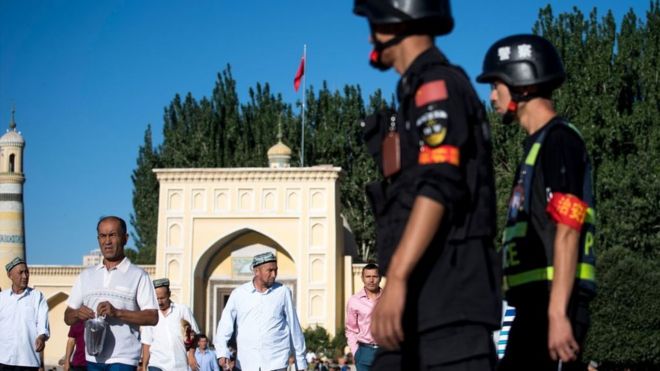
Police patrolling as Muslims leave the Id Kah Mosque in the old town of Kashgar in China's XinjiangImage copyright GETTY IMAGES
Image caption Police in Xinjiang now have one more way to record data about its citizens

Chinese police are using a mobile app to keep data on millions of ethnic Uighurs in Xinjiang province, according to Human Rights Watch (HRW).

In a report released on Thursday, HRW said it had reverse engineered the app to see how mass surveillance worked.

The app is used to closely monitor behaviours, it said, including lack of socialising, using too much electricity or having acquaintances abroad.

Rights groups say Uighur Muslims are being severely persecuted in China.

The UN has said there are credible reports up to a million Uighurs are being held in detention in Xinjiang, in what China says are “re-education centres”.

‘Most intrusive surveillance system’

According to the rights group’s report, the app is used by officials to record and file away information about people.

In particular, it targets “36 person types” that authorities should pay attention to.

These include people who seldom use their front door, use an abnormal amount of electricity and those that have gone on Hajj – an Islamic pilgrimage – without state authorisation.

The report does not make explicit mention of any ethnic groups specifically targeted, but the “36 person types” include “unofficial” imams – Islamic leaders – and those who follow Wahhabism, an Islamic doctrine.
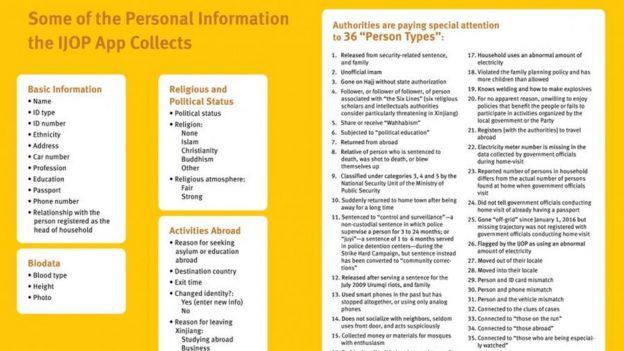
Graphic by HRWImage copyrightHRW
Image captionThe 36 person types listed in the HRW report

The information taken from the app will be fed into the central system of the Integrated Joint Operations Platform (IJOP) – the main system for mass surveillance in Xinjiang, says HRW.

HRW senior China researcher Maya Wang said IJOP was “one of the world’s most intrusive mass surveillance systems”.

“It gathers information from checkpoints on the street, gas stations, schools… pulls information from these facilities and monitors them for ‘unusual’ behaviour that triggers alerts [to the]authorities.”

The app was obtained and analysed by HRW in partnership with Cure53, a Berlin-based security firm.

Media caption In your face: China’s all-seeing surveillance system

As well as its Xinjiang operations, China has 170 million CCTV cameras in place across the country and by the end of 2020, an estimated 400 million new ones will be installed.

All this is part of China’s aim to build what it calls “the world’s biggest camera surveillance network”.

China’s also setting up a “social credit” system that is meant to keep score of the conduct and public interactions of all its citizens.

The aim is that by 2020, everyone in China will be enrolled in a vast national database that compiles fiscal and government information, including minor traffic violations, and distils it into a single number – ranking each citizen.

China’s detention camps

Xinjiang is a semi-autonomous region and in theory at least, has a degree of self-governance away from Beijing.

The Uighurs, a mostly Muslim ethnic minority, make up around 45% of its population.

HRW’s report comes as China faces increasing scrutiny over its treatment of them and other minorities in Xinjiang.

Up to one million Uighurs are being held in detention camps across Xinjiang, a UN human rights committee heard last year.
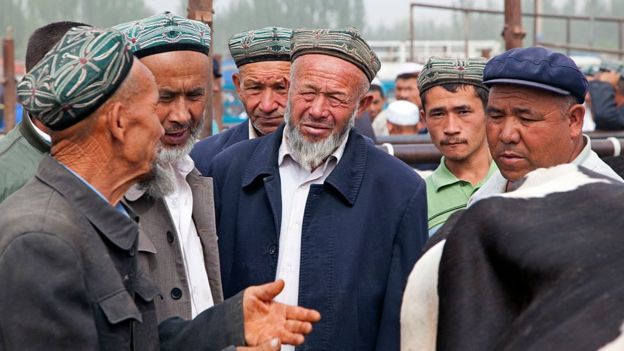
Uyghur farmers wearing doppas, trading cows at the cattle market in KashgarImage copyright GETTY IMAGES
Image caption Uighurs make up around 45% of Xinjiang’s population

One member said she was concerned by reports that Beijing had “turned the Uighur autonomous region into something that resembles a massive internment camp”.

A BBC investigation last year revealed that what appear to be “large prison-type structures” have been built across Xinjiang in the past few years.

  • China’s hidden camps
  • China Uighurs: All you need to know on Muslim ‘crackdown’
  • Why is there tension between China and the Uighurs?

China says these buildings are “vocational training centres” used to educate and integrate Muslim Uighurs and steer them away from separatism and extremism.

A Chinese Foreign Ministry spokeswoman, Hua Chunying, said, “everyone can see that people of all ethnicities in Xinjiang live and work in peace and contentment and enjoy peaceful and progressing lives”.

Source: The BBC

Posted in Chinese Foreign Ministry spokeswoman, Citizens, Hua Chunying, Human Rights Watch (HRW), Integrated Joint Operations Platform (IJOP), monitored, police app, rights group, Uighur Muslims, Uighurs, Uncategorized, Xinjiang | Leave a Comment »

05/05/2019

China putting minority Muslims in ‘concentration camps,’ U.S. says

WASHINGTON (Reuters) – The United States accused China on Friday of putting well more than a million minority Muslims in “concentration camps,” in some of the strongest U.S. condemnation to date of what it calls Beijing’s mass detention of mostly Muslim Uighur minority and other Muslim groups.

The comments by Randall Schriver, who leads Asia policy at the U.S. Defense Department, are likely to increase tension with Beijing, which is sensitive to international criticism and describes the sites as vocational education training centres aimed at stemming the threat of Islamic extremism.

Former detainees have described to Reuters being tortured during interrogation at the camps, living in crowded cells and being subjected to a brutal daily regimen of party indoctrination that drove some people to suicide.

Some of the sprawling facilities are ringed with razor wire and watch towers.

“The (Chinese) Communist Party is using the security forces for mass imprisonment of Chinese Muslims in concentration camps,” Schriver told a Pentagon briefing during a broader discussion about China’s military, estimating that the number of detained Muslims could be “closer to 3 million citizens.”

Schriver, an assistant secretary of defence, defended his use of a term normally associated with Nazi Germany as appropriate, under the circumstances.
When asked by a reporter why he used the term, Schriver said that it was justified “given what we understand to be the magnitude of the detention, at least a million but likely closer to 3 million citizens out of a population of about 10 million.””So a very significant portion of the population, (given) what’s happening there, what the goals are of the Chinese government and their own public comments make that a very, I think, appropriate description,” he said.
The Chinese embassy in Washington did not immediately respond to a request for comment.
U.S. Secretary of State Mike Pompeo on Thursday used the term re-education camps to describe the sites and said Chinese activity was “reminiscent of the 1930s.”
The U.S. government has weighed sanctions against senior Chinese officials in Xinjiang, a vast region bordering central Asia that is home to millions of Uighurs and other Muslim ethnic minorities. China has warned that it would retaliate “in proportion” against any U.S. sanctions.
The governor of Xinjiang in March directly dismissed comparisons to concentration camps, saying they were “the same as boarding schools.”
U.S. officials have said China has made criminal many aspects of religious practice and culture in Xinjiang, including punishment for teaching Muslim texts to children and bans on parents giving their children Uighur names.
Academics and journalists have documented grid-style police checkpoints across Xinjiang and mass DNA collection, and human rights advocates have decried martial law-type conditions there.
Source: Reuters

Posted in Academics, Asia policy at the U.S. Defense Department, assistant secretary of defence, Beijing, China alert, Chinese embassy, Communist Party, concentration camps, human rights advocates, Islamic extremism, journalists, martial law-type conditions, mass DNA collection, Mike Pompeo, minority Muslims, Nazi Germany, U.S. says, U.S. Secretary of State, Uighur, Uncategorized, vocational education training centres, Washington, Xinjiang | Leave a Comment »

08/04/2019

Shell enters China’s shale oil scene with joint study with Sinopec

SINGAPORE (Reuters) – Royal Dutch Shell has entered China’s shale oil sector, signing an agreement with state-owned Sinopec to study an East China block, part of the nation’s early efforts to unlock the potentially massive unconventional resource.

China is already in the initial stages of developing its vast shale gas resources, with production last year making up just 6 percent of total gas output after more than a decade of work. China’s shale oil is at an even more basic phase due to challenging geology and hefty development costs, experts said.

Shale oil makes up less than 1 percent of China’s crude output after several years of development, according to Angus Rodger, research director of Asia-Pacific upstream at Wood Mackenzie.

“China’s shale oil has very low permeability, which means very low per well output that makes the economics hard to work,” said an oil and gas official with China’s Ministry of Natural Resources (MNR). The official declined to be named because he’s not authorized to speak with the press.

Sinopec said on Monday it had agreed with Shell to study the Dongying trough of Shengli in China’s eastern province of Shandong, without giving further details.

Shell confirmed the joint study agreement, but did not offer further comment.

That makes Shell one of the few international oil and gas explorers venturing into China’s shale oil sector, and follows the Anglo-Dutch company’s exit from shale gas drilling in Sichuan province in the southwest after spending at least $1 billion (766.22 million pounds) and getting unsatisfactory results.

Unlike shale gas resources, which are highly concentrated in Sichuan, most of China’s shale oil is trapped in eastern regions such as the Songliao and Bohai Rim basins. North China’s Ordos and Junggar basins are also believed to hold large shale oil resources, the experts said.

The Dongying trough is part of the Bohai Rim basin, where top Chinese oil and gas group China National Petroleum Corp (CNPC) said in February that it is developing another small shale oil field with an annual output of 50,000 tonnes this year.

In 2013, U.S. energy firm Hess Corp signed a production-sharing contract with PetroChina, CNPC’s listed arm, to develop the Malang block of Santanghu basin in the northwest region of Xinjiang, China’s first shale oil deal.

Hess quit the block around late 2014 due to poorer-than-expected drilling prospects and as global oil prices plunged, said the MNR official.
“The understanding of geology, resource and the best recovery techniques (for shale oil) has only just begun,” said Woodmac’s Rodger.
Sinopec is hoping Shell’s expertise in shale oil exploration could help the Chinese state major turn around its fortunes at Shengli oilfield as the reserves at the giant conventional oilfield are depleting rapidly, said Rodger.
Source: Reuters

Posted in Anglo-Dutch company, Angus Rodger, Asia-Pacific upstream, China alert, China National Petroleum Corp. (CNPC), China’s Ministry of Natural Resources (MNR), Chinese oil and gas group, Dongying trough, East China block, Hess Corp, joint study, Malang block, oil and gas official, Ordos and Junggar basins, PetroChina, research director, Royal Dutch Shell, Santanghu basin, shale oil, shandong province, Shell, Shengli, Sinopec, Songliao and Bohai Rim basins, Uncategorized, Wood Mackenzie, Xinjiang | Leave a Comment »

16/03/2019

China-Europe freight trains running from Xinjiang’s Urumqi reach 2000

CHINA-XINJIANG-RUSSIA-FREIGHT TRAIN (CN)

A worker onloads cargo to the 2,000th China-Europe freight train heading to Krasnodar of Russia at the freight logistics center in Urumqi, capital of northwest China’s Xinjiang Uygur Autonomous Region, on March 15, 2019. Since its operation in 2016, trains running from the freight train logistics center in the regional capital reached 2,000. (Xinhua/Fu Xiaobo)

Posted in Ürümqi, China alert, Europe, freight trains, Uncategorized, Xinjiang | Leave a Comment »

14/03/2019

New Delhi feels betrayed by China on Masood Azhar; bilateral ties could suffer

The bonhomie witnessed between India and China over the last one year after the informal summit between Prime Minister Narendra Modi and Chinese President Xi Jinping in Wuhan April last year has clearly evaporated following the Chinese action

Even as China asserted on Thursday that the ‘Wuhan Spirit’ was still on, there is a sense of betrayal in New Delhi over Beijing’s decision to stand by its ‘all-weather friend’ Pakistan by blocking the designation of JeM chief Masood Azhar as a global terrorist by the UN Security Council.
The bonhomie witnessed between India and China over the last one year after the informal summit between Prime Minister Narendra Modi and Chinese President Xi Jinping in Wuhan April last year has clearly evaporated following the Chinese action.
Amid the growing clamour in India for boycotting China after it used its veto power to block listing of Masood Azhar as a global terrorist, New Delhi has expressed disappointment over Beijing’s move while reaffirming its determination to pursue all avenues to bring the JeM chief to justice for terror attacks in different parts of India.
A number of reasons, including the significant role Pakistan plays in China’s ties with the Islamic world and Beijing’s anxiety over spill-over effect of a ban on Azhar in China’s own restive Muslim-dominated Xinjiang region, could have played a role in Beijing deciding to yet again stonewall any action by the UNSC against the JeM chief, observers say.
Despite its burgeoning trade relationship with India, China has never hidden the fact that it needed Pakistan more than any other country for achieving its geo-strategic goals in the region. Pakistan’s importance for China has increased manifold in recent years in view of the heavy economic and manpower investments it has made in the China-Pakistan Economic Corridor (CPEC) as part of President Xi’s signature Belt and Road Initiative (BRI).
Sources said it was quite clear to New Delhi over the past few days that China was adopting double standards in the global fight against terrorism only to shield Pakistan. China, they said, could no longer take shelter under ‘lame excuses’ like India had not provided any ‘updated material’ on Azhar’s terrorist activities in India which could compel Beijing to reconsider its position on the JeM chief.
Sources pointed out that India had submitted to China and other key nations ‘clinching and irrefutable’ evidence linking JeM to terror attacks in India, including the Pulwama attack. All other members of the UNSC, including those in the non-permanent category, solidly backed India’s effort to get the JeM chief banned but China put a spanner in their works yet again, they regretted.
The US, meanwhile, said responsible UNSC members might be forced to other actions at the Security Council if Beijing continued to block Masood’s designation.
China’s veto against banning Masood Azhar has once again highlighted the deep-rooted suspicion and mistrust between India and China on strategic issues, particularly the fight against terrorism. Despite pledging to work with India in combating terror, China has done precious little to assuage India’s concerns over terrorism emanating from Pakistan.
China has, in fact, praised Pakistan on many occasions for its role in the global war against terrorism. Beijing’s contention has been that Pakistan itself has been one of the main victims of terrorism and it must be supported in combating the menace.
There is also a feeling in Chinese circles that the situation in Jammu and Kashmir is the prime reason for terrorism in India. The argument being advanced by them is that while Kashmir is a disputed territory, Xinjiang is a province of China and, therefore, a comparison can not be drawn between the two regions.
Read More
Source: The Statesman

Posted in Beijing, Belt and Road Initiative (BRI), betrayed, bilateral ties, bonhomie, boycotting China, China alert, China-Pakistan Economic Corridor (CPEC), Chinese President Xi Jinping, global terrorist, India alert, Islamic world, Jammu and Kashmir, JeM chief, Masood Azhar, New Delhi, Pakistan, Prime Minister Narendra Modi, trade relationship, UN Security Council, Uncategorized, UNSC, Wuhan, Wuhan Spirit, Xinjiang | Leave a Comment »

03/03/2019

China Focus: Industrial upgrade moves fast in Xinjiang

URUMQI, March 2 (Xinhua) — Farmers at a small village in western Xinjiang hardly had any days off this winter. Production at a walnut processing factory is going full throttle to meet demand.

Yusup Tursun and his wife are walnut farmers in Kupchi Village in Yecheng County on the edge of the Taklimakan Desert. The couple has been hired by a new walnut processing facility in the village, with the husband a quality inspector and his wife working part-time cracking nuts.

As a main base for walnut production, Yecheng has over 38,000 hectares of high-quality thin-shell walnut groves.

“It used to be quite difficult to sell the walnuts. The factories, with so many products, have made it easier for the sales,” Yusup said.

Seven companies make products from the nuts — walnut milk, walnut candies and edible oil. The shells are made into coloring agent and pollutant-absorbing carbon.

Diversity in the walnut products pushed the industry output to a new high of 2 billion yuan (about 299 million U.S. dollars). Three in every five people work in the walnut industry in Yecheng, where 550,000 people live.

Across Xinjiang, processing facilities are established to add value to agricultural products. Transport and logistical services are improved to boost the sales of Xinjiang’s signature agricultural products such as Hami melons, Korla pears and Turpan grapes.

UP THE VALUE CHAIN

Xinjiang is also moving up the value chain in two of its traditional industries — cotton and coal.

As one of the main cotton production bases in China, Xinjiang holds sway in the textile industry. By making full use of its cotton resources and geographical advantages as a portal for opening up, the region no longer sees itself as just a production base for raw materials. Starting from 2014, China’s leading garment and apparel makers including Ruyi Group, HoDo Group, and Huafu Fashion Co. Ltd invested in the region and built factories.

These factories have produced added benefits and created jobs for the local people. Xinjiang produces 1.5 million tons of yarn and over 40 million ready-made garments every year. More than 400,000 people work in the industry.

In the eastern part of the coal-rich Junggar Basin, workers have found that the snow is cleaner than before. The Zhundong Economic Technological Development Park, about 200 km west of Urumqi, is home to China’s largest coal field.

A stringent environmental requirement is applied to the park, said Ren Jianpin, director of the management committee of the park. Coal enterprises are required to control coal dust, install equipment to recycle water and coal slags are processed into construction materials, he said.

The park is focused on boosting high-end industries in aluminum and silicon materials, which generate more value and have less impact on the environment, he said.

GOING HI-TECH

Last year, a large-scale bio-based plant went into operation in Usu City to turn corn into nylon. The Cathay Industrial Biotech, a Shanghai-based biotech company, is the investor.

Nylon is usually made from petroleum, and the use of crops such as corn and wheat to make recyclable and environment-friendly nylon has promising business prospects, said Wang Hongbo, vice general manager of the company’s Usu branch.

The Usu branch will have an annual output of 100,000 tons of bio-based polyamide, and it is expected to boost the development of downstream industries in the future, he said.

The oil-rich city of Karamay has also received a hi-tech boost as cloud computing firms eye the dry and cold weather in the area. Karamay is home to many key state-level projects and IT-industry leaders, including a global cloud service data center for Huawei, data centers for the China National Petroleum Corp. (CNPC) and China Mobile.

Xinjiang is making new breakthroughs in precision machining, new materials, manufacturing and textiles.

Data from the regional statistics bureau show that the value added of the hi-tech manufacturing in Xinjiang rose by 32.1 percent year-on-year in 2018.

FURTHER OPENING UP

As a core area on the Silk Road Economic Belt, Xinjiang has maintained solid growth momentum in foreign trade. Foreign trade volume between Xinjiang and 36 countries and regions along the Belt and Road (B&R) totaled about 291.5 billion yuan (43.5 billion U.S. dollars) in 2018, up 13.5 percent year on year.

Economic observers say that there is still much room for Xinjiang to scale up its processing trade to raise the level of imports and exports.

Xinjiang will further develop an export-oriented economy in 2019 and participate in economic exchanges with neighboring countries, according to the regional government’s work report released in January.

Source: Xinhua

Posted in agricultural products, aluminum, Ürümqi, Belt and Road (B&R), bio-based plant, bio-based polyamide, Cathay Industrial Biotech, China alert, China Mobile, China National Petroleum Corp. (CNPC), coal, coloring agent, corn, cotton, edible oil, environment-friendly, Hami melons, HoDo Group, Huafu Fashion Co. Ltd, Huawei, Karamay, Korla pear, Korla pears, Kupchi Village, logistical services, nylon, pollutant-absorbing carbon, quality inspector, recyclable, Ren Jianpin, Ruyi Group, Shanghai-based biotech company,, silicon, Silk Road Economic Belt, Taklimakan Desert, Transport, Turpan grapes, Uncategorized, Usu City, walnut, walnut candies, walnut milk, Wang Hongbo, Xinjiang, Yecheng County, Yusup Tursun, Zhundong Economic Technological Development Park | Leave a Comment »

01/03/2019

China’s envoy says Turkish Uighur criticism could hit economic tie

ANKARA (Reuters) – Turkey risks jeopardising economic ties with China if it keeps criticising Beijing’s treatment of Uighur Muslims, China’s envoy to Ankara warned, just as Chinese firms are looking to invest in Turkish energy and infrastructure mega-projects.

Last month Turkey broke a long silence over the fate of China’s Uighurs, saying more than one million people faced arbitrary arrest, torture and political brainwashing in Chinese internment camps in the country’s northwestern Xinjiang region.

Turkey’s Foreign Minister Mevlut Cavusoglu repeated Ankara’s concern at a United Nations meeting this week, calling on China to respect human rights and freedom of religion.

China has denied accusations of mistreatment and deems criticism at the United Nations to be interference in its sovereignty. Beijing says the camps are re-education and training facilities that have stopped attacks previously blamed on Islamist militants and separatists.

“There may be disagreements or misunderstandings between friends but we should solve them through dialogue. Criticising your friend publicly everywhere is not a constructive approach,” said Deng Li, Beijing’s top diplomat to Ankara.
“If you choose a non-constructive path, it will negatively affect mutual trust and understanding and will be reflected in commercial and economic relations,” Deng, speaking through a translator, told Reuters in interview.
For now, Deng said that many Chinese companies were looking for investment opportunities in Turkey including the third nuclear power plant Ankara wants to build.

Several Chinese firms including tech giant Alibaba, are actively looking at opportunities in Turkey after the lira’s sell-off has made local assets cheaper.

In addition to Alibaba, which last year purchased Turkish online retailer Trendyol, other companies holding talks included China Life Insurance and conglomerate China Merchants Group, Deng said.

GAPING DEFICIT

Deng said Chinese banks wanted to invest in Turkey, following the lead of Industrial and Commercial Bank of China (ICBC) which bought Tekstilbank in 2015.

Chinese investment in Turkey would help narrow Ankara’s gaping current account deficit, which stood at $27.6 billion last year. Turkey’s trade deficit with China alone stood at $17.8 billion last year, according to Trade Ministry data.

In January, Turkey’s Finance Minister Berat Albayrak said it was “impossible” for Turkey to maintain such a trade deficit with China and other Asian countries, saying the government was considering taking measures.

Deng said he did not expect Turkey to take protectionist steps. “Both countries are strictly against such policies, and both economies need an open world economy,” he said.

He also called on Turkey to adopt Chinese payment platforms such as WeChat and AliPay. “People don’t want to pay in cash and the population here is very young so they wouldn’t have trouble adapting to new technologies,” Deng said.

Good diplomatic and political ties, however, would remain crucial for developing economic ties and attracting more Chinese investment, he said, adding that he had raised the issue with Cavusoglu on Tuesday, a day after the foreign minister’s intervention at the United Nations.

“The most important issue between countries are mutual respect,” he said. “Would you stay friends if your friend criticized you publicly every day?

Source: Reuters

Posted in Alibaba, Alipay, Ankara, Beijing, Berat Albayrak, Cavusoglu, China alert, China Life Insurance, China Merchants Group, Deng Li, diplomat, energy and infrastructure, Industrial and Commercial Bank of China (ICBC), Mevlut Cavusoglu, Tekstilbank, Trendyol, Turkey, Turkey’s Finance Minister, Turkey’s Foreign Minister, Turkish Uighur, Uighurs, Uncategorized, United Nations, WeChat, Xinjiang | Leave a Comment »

28/02/2019

All 56 ethnic groups part of big family of Chinese nation: Chinese ambassador

SWITZERLAND-GENEVA-UNHRC SESSION

Yu Jianhua, head of the Chinese Mission to the UN Office in Geneva, attends the 40th session of the UN Human Rights Council (UNHRC) in Geneva, Switzerland, Feb. 27, 2019. The 56 ethnic groups in China, living together like brothers and sisters, are all parts of the big family of the Chinese nation, Yu Jianhua told the UNHRC session. “The people of all ethnic groups are tightly held together like pomegranate seeds, and together they are making arduous efforts for the great rejuvenation of the Chinese nation where they can all live a happy life,” Yu said, when elaborating on China’s human rights propositions and expounding achievements of the human rights undertakings in Xinjiang Uygur Autonomous Region in northwest China. (Xinhua/Xu Jinquan)

GENEVA, Feb. 27 (Xinhua) — The 56 ethnic groups in China, living together like brothers and sisters, are all part of the big family of the Chinese nation, a Chinese envoy said Wednesday at the ongoing UN Human Rights Council (UNHRC) session in Geneva.

“The people of all ethnic groups are tightly held together like pomegranate seeds, and together they are making arduous efforts for the great rejuvenation of the Chinese nation where they can all live a happy life,” said Yu Jianhua, head of the Chinese Mission to the UN Office at Geneva, when elaborating on China’s human rights propositions and expounding achievements of the human rights undertakings in Xinjiang Uygur Autonomous Region in northwestern China, during the UNHRC’s 40th session.

Yu said that as unilateralism and protectionism are on the rise in today’s world, coupled with the still outstanding problem of unbalanced, uncoordinated and unsustainable development, it’s particularly important for countries to firmly practise multilateralism and to jointly build a community with a shared future for mankind.

To that end, Yu put forward China’s propositions on advancing undertakings for human rights internationally. Firstly, mutual respect should be taken as a premise, by which all countries should respect their peoples’ choice of development path for human rights.

Secondly, all countries should adhere to the principle of fairness and justice, abide by the purposes and principles of the UN Charter, respect the sovereignty and territorial integrity of each country, and oppose interference into other countries’ internal affairs under the pretext of human rights.

Thirdly, all countries should aim for win-win results through cooperation; and lastly, all countries should champion a people-centered vision and promote human rights through development.

On the topic concerning China’s Xinjiang Uygur Autonomous Region, the Chinese ambassador said that the stance adopted by some countries is biased and entirely based on misjudgment, which runs counter to facts.

He said that the Chinese government has adopted a series of anti-terrorism and de-extremization measures in Xinjiang, including the establishment of vocational training facilities, which aim to help the few people who have been influenced by extremism to get rid of their terrorist and extremist thoughts and reintegrate them into the society as soon as possible.

These measures, carried out in full accordance with the law, have greatly improved the security situation in Xinjiang and effectively safeguarded the human rights of the people of all ethnic groups and thus received sincere support from the people, Yu said.

Source: Xinhua

Posted in China alert, Chinese ambassador, Chinese Mission to the UN Office, ethnic groups, Geneva, Human rights, UN Charter, UN Human Rights Council (UNHRC), Uncategorized, Uygur Autonomous Region, Xinjiang, Yu Jianhua | Leave a Comment »

26/02/2019

China has 2.9 million teachers in rural areas

BEIJING, Feb. 26 (Xinhua) — China had over 2.9 million teachers in rural areas by the end of 2018, the Ministry of Education said Tuesday.

Close to 2.5 million rural teachers work at primary and secondary schools, while 420,000 teachers work at kindergartens, according to the ministry.

The ministry is striving to build a high-quality team of rural teachers and dispatched a great number of college graduates to the rural areas, especially the poverty-stricken regions, said Liu Jiantong, an official with the ministry’s department of teachers.

The central budget financed 4.5 billion yuan (670 million U.S. dollars) last year as an allowance for 1.27 million teachers from over 80,000 rural schools in China’s central and western regions, said Liu.

In 2018, 1,800 retired teachers in good health registered to teach at rural schools. In addition, 19 provincial-level regions dispatched 4,000 teachers to support education in Tibet and Xinjiang, said the ministry.

Source: Xinhua

Posted in China alert, department of teachers, Liu Jiantong, Ministry of Education, rural areas, teachers, Tibet, Uncategorized, Xinjiang | Leave a Comment »

22/02/2019

China’s social credit system report shows that richest provinces are home to the most dodgy firms

  • Firms in Jiangsu and Guangdong provinces top the list of new additions to blacklist in 2018
  • Bogus advertising, illegal activities in property industry, substandard health care products and P2P lending fraud are typical cases

Social credit system: China’s richest regions are also home to the most blacklisted firms

22 Feb 2019

A real property agent checks a property advertising board in Beijing. According to a report by the Chinese government, property brokerages are among the country’s least scrupulous group of firms. Photo: Agence France-Presse

A real property agent checks a property advertising board in Beijing. According to a report by the Chinese government, property brokerages are among the country’s least scrupulous group of firms. Photo: Agence France-Presse

China’s wealthiest regions also have the largest number of untrustworthy businesses, according to the government’s social credit system, which rates citizens and companies based on their behaviour.

Jiangsu, the country’s second largest provincial economy – 9.26 trillion yuan (US$1.37 trillion) – accounted for 16.7 per cent of the discredited businesses that were added to the national blacklist last year, more than any other region.

According to a report compiled by the National Public Credit Information Centre that is backed by China’s state planner, the National Development and Reform Commission, Guangdong is next in line.

Guangdong is China’s most prosperous province, Guangdong, but is also home to 12.77 per cent of the total 3.59 million blacklisted firms. The southern province had a gross domestic product of 9.73 trillion yuan last year.

In third spot was Zhejiang, the prosperous province just south of Shanghai, while the capital city of Beijing was ranked fifth. These places together contributed slightly more than 30 per cent of China’s gross domestic product (GDP) last year.

By naming and shaming the millions of Chinese businesses and individuals on the annual blacklist, Beijing hopes to boost “trustworthiness” in Chinese society. Under the system, each of its 1.4 billion citizens is expected to receive a personal trustworthiness score.

By registering for these newsletters you agree to our T&C and Privacy Policy

“In more developed coastal provinces, businesses have long operated in the grey area between emerging China and established Hong Kong,” said Brock Silvers, managing director of Kaiyuan Capital, a Shanghai-based financial advisory firm.

Silvers said the situation evoked the Chinese saying: “Heaven is high and the Emperor is far away”, which alludes to local officials’ tendency to disregard central government’s directives.

While it was previously not such a faux pas to engage in “untrustworthy” behaviour in attaining economic development, things are now different.

China’s social credit system shows its teeth, banning millions from taking flights, trains

“The ability to cut corners in search of profit isn’t as prized in China’s modern economy, and many of those old traits can now lead companies to be added to Beijing’s blacklist,” Silvers said.

Among the firms named in the hall of shame is Chuangyue Energy Group, from northwest Xinjiang, which topped the list of new cases involving at least 500 million yuan in fraudulent activity.

Chuangyue and its legal representative Qin Yong were reprimanded by the Shenzhen Stock Exchange in 2016 for failing to disclose transactions on time. The transaction involved changes to the shareholding structure of a listed firm in which Chuangyue held interest in, state media reported.

Also on the list was property developer Zhonghong Holding, which was delisted from the Shenzhen exchange late-last year after its shares fell below the par value of 1 yuan for 20 consecutive days.

Zhonghong had posted massive losses, failed to repay loans and halted development projects during 2018.

A typical area of fraud cited in the report was bogus advertising, with the biggest number of discredited companies located Shanghai, China’s most commercial city.

Property brokerage was a hotbed industry for fraudsters. The report named and shamed two agents in Wuhan, An Yi Real Estate Brokerage and Hong Run De Real Estate Brokerage, which Chinese netizens described as “black brokers”.

In one case, Hong Run De subdivided one flat to lease without the owner’s knowledge and consent. To terminate the contract, the owner had to pay “compensation” of 30,000 yuan before they could reclaim the flat.

Other dodgy sectors were health care product makers and peer-to-peer (P2P) lending platforms.

Quanjian Group, a maker of herbal medicines, was accused of making false marketing claims about the benefits of a product that a four-year-old cancer patient drank.

Health care companies are among the worst performing in China, according to a report on the country’s social credit index. Photo: Agence France-Presse
Share:

Changsheng Bio-Technology, the major Chinese manufacturer of rabies vaccines, was fined US$1.3 billion in October after it was found to have fabricated records.

A total of 1,282 P2P operators, more than half located in Zhejiang, Guangdong and Shanghai, were placed on the blacklist because they could not repay investors, or were involved in illegal fundraising.

While more individuals and companies were added to the blacklist, others were also removed – 2.17 million. Those removed had paid taxes owed or fines imposed.

Source: SCMP

Posted in An Yi Real Estate Brokerage, Beijing, black broker, Brock Silvers, cancer patient, Changsheng Bio-Technology, China alert, Chinese manufacturer, Chuangyue Energy Group, dodgy firms, faux pas, Guangdong, Heaven is high and the Emperor is far away, herbal medicines, Hong Run De Real Estate Brokerage, Jiangsu, Kaiyuan Capital, National Public Credit Information Centre, netizens, Qin Yong, Quanjian Group, rabies vaccines, richest provinces, Shanghai, Shenzhen, social credit system, Stock exchange, Uncategorized, Wuhan, Xinjiang, Zhejiang, Zhonghong Holding | Leave a Comment »

« Older Entries  |   Newer Entries »

Tags

air pollution Asia Barack Obama Beijing Bharatiya Janata Party Business China Chinese language climate Communist Party communist party of china Delhi Economic growth economy Economy of the People's Republic of China environment European Union Government Gross domestic product Hong Kong Hu Jintao India Japan Li Keqiang manmohan singh Mao Zedong Modi mumbai Narendra Modi New Delhi Pakistan politics President of the People's Republic of China prime minister of india Russia Shanghai Sina Weibo South China Sea South Korea State Council of the People's Republic of China technology transportation United States Xi JinPing Xinjiang

Creative Commons

Chindia Alert: forewarned is forearmed by Chindia Alert Unlimited is licensed under a Creative Commons Attribution-NonCommercial-ShareAlike 3.0 Unported License.

Archives

  • October 2023
  • June 2022
  • May 2022
  • April 2022
  • March 2022
  • June 2021
  • September 2020
  • August 2020
  • July 2020
  • June 2020
  • May 2020
  • April 2020
  • March 2020
  • February 2020
  • January 2020
  • December 2019
  • November 2019
  • October 2019
  • September 2019
  • August 2019
  • July 2019
  • June 2019
  • May 2019
  • April 2019
  • March 2019
  • February 2019
  • January 2019
  • December 2018
  • February 2018
  • January 2018
  • December 2017
  • November 2017
  • October 2017
  • September 2017
  • August 2017
  • July 2017
  • June 2017
  • May 2017
  • April 2017
  • March 2017
  • February 2017
  • January 2017
  • December 2016
  • November 2016
  • October 2016
  • September 2016
  • August 2016
  • July 2016
  • June 2016
  • May 2016
  • April 2016
  • March 2016
  • February 2016
  • January 2016
  • December 2015
  • November 2015
  • October 2015
  • September 2015
  • August 2015
  • July 2015
  • June 2015
  • May 2015
  • April 2015
  • March 2015
  • February 2015
  • January 2015
  • December 2014
  • November 2014
  • October 2014
  • September 2014
  • August 2014
  • July 2014
  • June 2014
  • May 2014
  • April 2014
  • March 2014
  • February 2014
  • January 2014
  • December 2013
  • November 2013
  • October 2013
  • September 2013
  • August 2013
  • July 2013
  • June 2013
  • May 2013
  • April 2013
  • March 2013
  • February 2013
  • January 2013
  • December 2012
  • November 2012
  • October 2012
  • September 2012
  • August 2012
  • July 2012
  • June 2012
  • May 2012
  • April 2012
  • March 2012
  • February 2012
  • January 2012

Meta

  • Create account
  • Log in
  • Entries feed
  • Comments feed
  • WordPress.com

Blog Stats

  • 241,886 hits
Blog at WordPress.com.
CCChang

Law of Unintended Consequences

continuously updated blog about China & India

ChiaHou's Book Reviews

continuously updated blog about China & India

What's wrong with the world; and its economy

continuously updated blog about China & India

Privacy & Cookies: This site uses cookies. By continuing to use this website, you agree to their use.
To find out more, including how to control cookies, see here: Cookie Policy
  • Subscribe Subscribed
    • CHINDIA ALERT: You'll be living in their world, very soon
    • Join 846 other subscribers
    • Already have a WordPress.com account? Log in now.
    • CHINDIA ALERT: You'll be living in their world, very soon
    • Subscribe Subscribed
    • Sign up
    • Log in
    • Report this content
    • View site in Reader
    • Manage subscriptions
    • Collapse this bar