Archive for ‘zhejiang province’

06/05/2019

China fires up drills near Taiwan Strait in test of combat strength

  • Military exercises this week meant to foster image that Beijing can win a war over the island, analyst says

The PLA is staging live-fire drills at the northern end of the Taiwan Strait this week. Photo: AP
Beijing is conducting live-fire military drills at the northern end of the Taiwan Strait as it signals its resolve to thwart “pro-independence forces” in Taiwan.
Authorities in the small city of Yuhuan, Zhejiang province, notified the public on Sunday that a “no-sail zone” and “no-fishing zone” would be in effect in the area until Friday night.
It said the drills were part of the People’s Liberation Army’s “annual regular exercise plans” and would involve “actual use of weapons”.
“According to the annual [PLA’s] regular training plan … live-fire exercises involving the use of real weapons will be organised … in the designated areas from 6am on May 5 to 6pm on May 10,” the authorities said.
Collin Koh, a military analyst from the S. Rajaratnam School of International Studies at Singapore’s Nanyang Technological University, said the stress on the live-fire manoeuvres suggested the six-day exercise would simulate real combat conditions.
The drills come hard on the heels of an annual report by the Pentagon warning that China was preparing options to unify Taiwan by force, and there was a need to deter, delay or deny any third-party intervention on Taiwan’s behalf.
Under the Taiwan Relations Act, the United States is bound by law to help defend the self-ruled island. Washington is Taipei’s main source of arms, selling the island more than US$15 billion in weaponry since 2010, according to the Pentagon.
Beijing ‘loses all hope for Taiwan’s Tsai Ing-wen’ as she rallies Washington

Taiwan is one of a growing number of flashpoints in the China-US relationship – along with a trade war, Beijing’s growing influence in emerging economies, and its stronger military posture in the South China Sea. On Monday, two guided-missile destroyers, USS Preble and USS Chung-Hoon passed within 12 nautical miles of Gaven and Johnson reefs in the Spratly Islands, drawing immediate criticism from Beijing.

In addition, Taiwan will hold its annual Han Kuang live-fire drills from May 27 to 31 and held a computer-aided one just last month.

A Taiwan affairs analyst from the Chinese Academy of Social Sciences said the drills off Zhejiang were meant to show Beijing’s determination to defend its position on Taiwan.

“Beijing is trying to build up an image that China can win a war over Taiwan and Beijing’s key goal is to contain pro-independence forces, which are the biggest threat now to the peaceful unification process,” the analyst said.

Koh agreed, saying the drill sent a signal to external and domestic parties after the recent high-profile transits of US warships through the Taiwan Strait.

“The messaging to domestic audience is necessary because Beijing can’t be seen as weak following those reported transits by foreign warships – especially the Americans who are seen as supporting Taipei,” Koh said.

“And regarding external audience, the messaging is quite obviously to demonstrate that Beijing is ready to respond more resolutely to future such transits, following the tough verbal responses from Beijing, including its statement that it considers the strait under its jurisdiction and comprise its internal waters.”

Beijing ‘tones down’ response after US warships sail through Taiwan Strait

Relations between Beijing and Taipei have plunged since Tsai Ing-wen from the independence-leaning Democratic Progressive Party won the presidential election in 2016 and repeatedly refused to accept the “1992 consensus”, which Beijing says is the foundation for cross-strait dialogue.

In response, Beijing ramped up pressure against the island, including conducting more military exercises and establishing diplomatic ties with Taipei’s allies.

Source: SCMP
02/05/2019

China’s roads jammed as millions take Labour Day holiday

  • Major highways gridlocked for hours at start of four-day break
  • Chaos at railway stations as ticket-holding passengers turned away
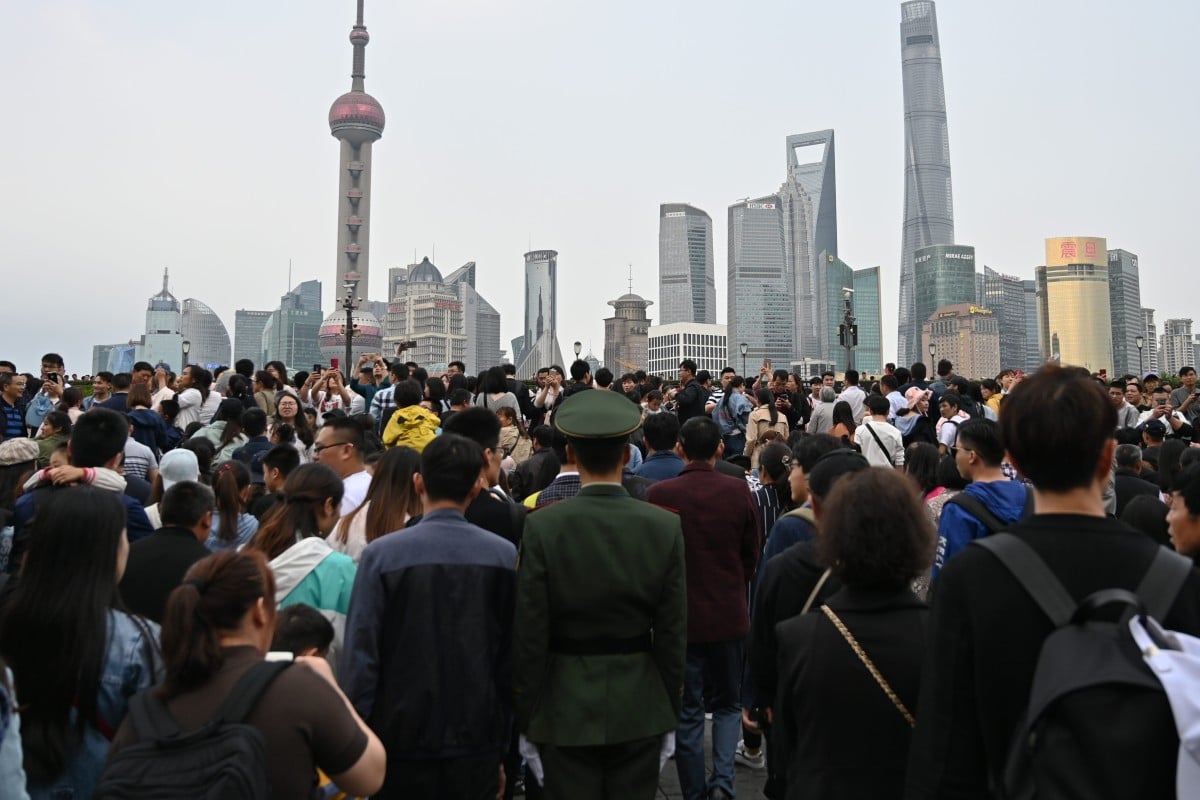
Holiday crowds pack the promenade on the Bund along the Huangpu River in Shanghai on the first day of China’s May break. Photo: AFP
China’s Labour Day holiday started on Wednesday with gridlocked roads and chaos at railway stations as millions of people took advantage of this year’s unusually long break.
Motorists reported being stuck in traffic jams which did not move for hours, while ticket-holding passengers were turned away from some trains due to severe overcrowding on the first day of the holiday.
Travel agency Ctrip estimated that around 160 million domestic tourists would be travelling over the four-day break, according to data from travel booking platforms.
Forty major highways recorded a 75 per cent spike in traffic on Wednesday, according to Xinhua, as toll fares for cars were suspended for the holiday.
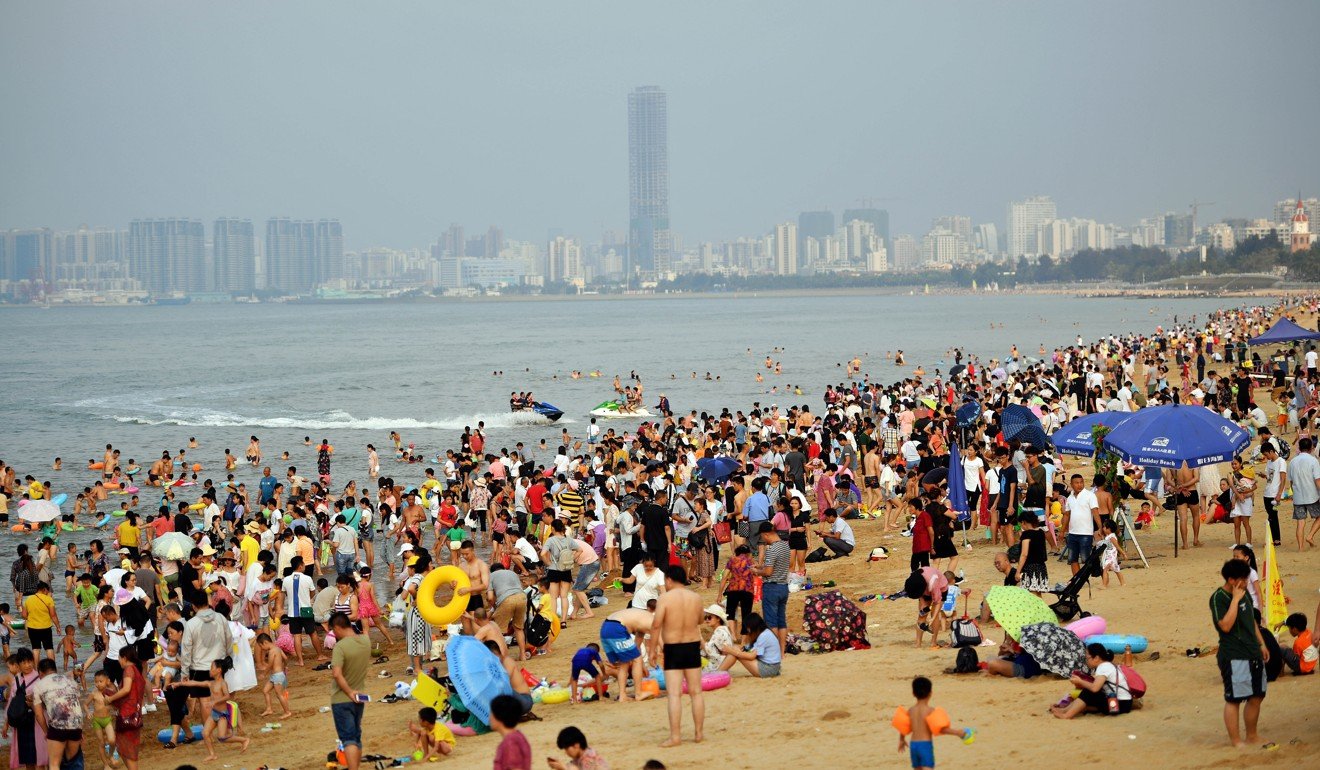
Tourists enjoy the first day of China’s four-day May holiday on a beach in Haikou, Hainan province, southern China. Photo: Xinhua

Monitoring stations on major routes – including the Beijing-Tibet Expressway, the Shanghai-Shaanxi Expressway, Shanghai’s Humin Elevated Road and the Beijing section of the Beijing-Hong Kong-Macau Expressway – recorded a 200 per cent increase in traffic from Tuesday onwards, Xinhua said.

The Ministry of Public Security’s traffic management bureau has warned holiday motorists to drive safely, especially on winding mountainside routes.

Online news portal The Paper reported on Thursday that traffic jams on some major routes were so severe that the drive from Shanghai to Hangzhou, capital of neighbouring Zhejiang province, took some travellers seven hours instead of the usual two.

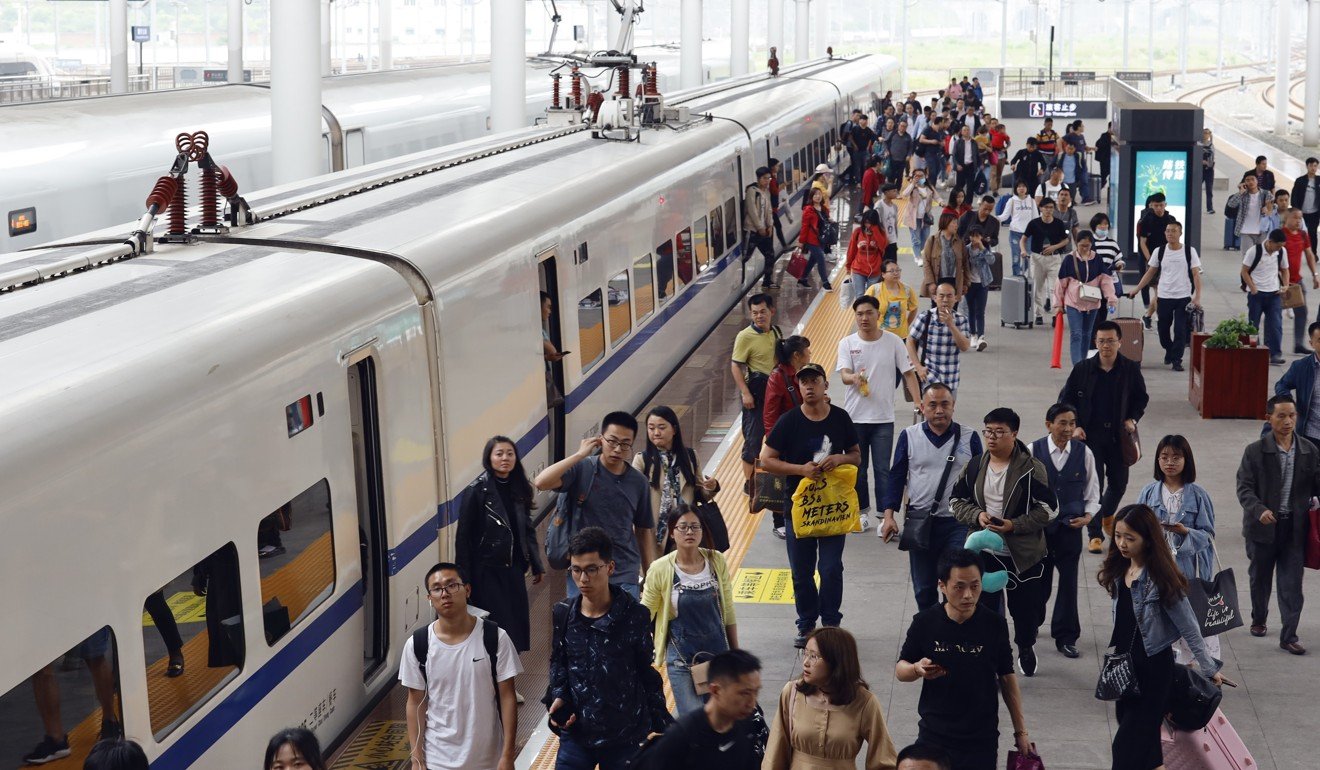
Passengers board the train at Chongqing North Railway Station in southwest China on Tuesday, hoping to beat the May holiday travel rush. Photo: Xinhua
Meanwhile, more than 54,000 tourists visited the popular Badaling section of the Great Wall on Wednesday, according to Beijing Youth Daily. The attraction’s management team had increased the number of volunteers, parking spaces and shuttle buses to prepare for the influx, the report said.
More than 53,000 tourists had visited the Shanghai International Tourism Resort and Shanghai Disneyland by 4pm on Wednesday, according to data from the Shanghai municipal government’s real-time visitor tracker. The Shanghai Zoo attracted more than 24,000 people, and more than 9,200 visited the Shanghai Science and Technology Museum.
Despite the crowds, no records were broken at the Shanghai attractions, which reached about 70 per cent of their maximum visitor numbers recorded, The Paper reported.
At railway stations, ticket-holding passengers were stopped from boarding trains between Nanjing and the city of Zibo in Shandong province, eastern China, due to severe overcrowding, Beijing Youth Daily reported on Wednesday.
Station staff promised full refunds to customers with pre-booked tickets who were refused entry.
Source: SCMP
29/04/2019

Racers tear through Chinese city streets in rented Porsche sports cars

  • Dangerous midnight speed drive fuelled by drinking and karaoke session
  • High-performance cars seen switching lanes, driving on the wrong side of the road and running a red light
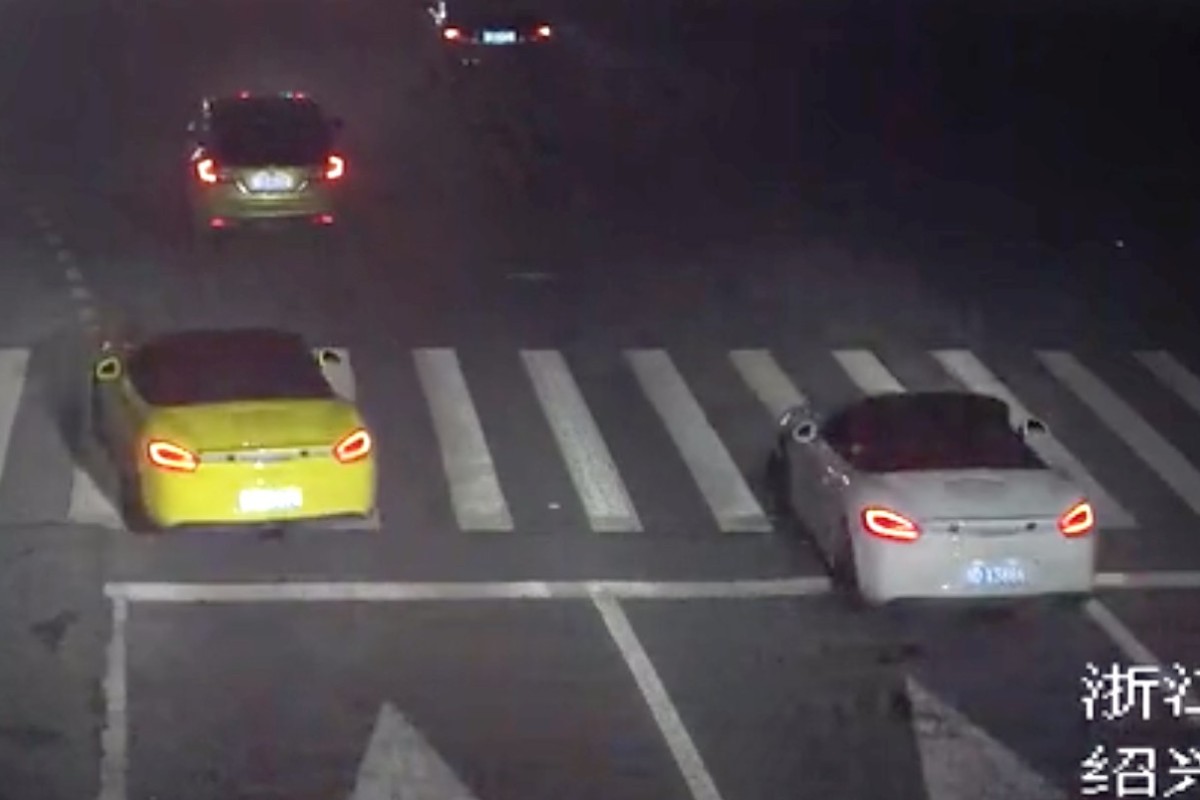
Two men have been detained in eastern China for racing their rented Porsche sports cars on city streets. Photo: Handout
An alcohol-fuelled midnight street race between two high-powered sports cars in an eastern Chinese city has landed two men in detention.
At one point, according to police in Zhuji, Zhejiang province, the rented Porsche cars hit 170km/h (105mph) as they tore through the city, randomly switching lanes, running a red light and even driving on the wrong side of the road.
A police investigation found the culprits had been drinking alcohol at a karaoke singing session before deciding to test their driving skills.
One of them, a 21-year-old university student surnamed Ying, had rented the yellow Porsche for a month for 20,000 yuan (US$3,000). The other man, a 24-year-old surnamed Jiang, had rented the white Porsche for a day at 800 yuan because he wanted to race his friend.
Chinese are buying more used cars online — without kicking a tyre
Ying was arrested two days after the illegal race and confessed, the police statement said.

Local police started receiving calls from residents at around midnight on April 22, complaining at the loud racing going on through the streets.

In a statement on the WeChat social messaging app, police said footage from more than 10 security cameras showed a yellow Porsche and a white one chasing each other in a dangerous manner down a main road past a hospital and numerous residential compounds.

Speeding has been a criminal offence in China since 2011. According to Chinese law, “whoever races a motor vehicle on a road with execrable circumstances or drives a motor vehicle on a road while intoxicated shall be sentenced to criminal detention and a fine.”

Source: SCMP

29/04/2019

China’s quest for clean energy heats up with groundbreaking ‘artificial sun’ project

    • Fusion reactor built by Chinese scientists in eastern Anhui province has notched up a series of research firsts
    • There are plans to build a separate facility that could start generating commercially viable fusion power by 2050, official says
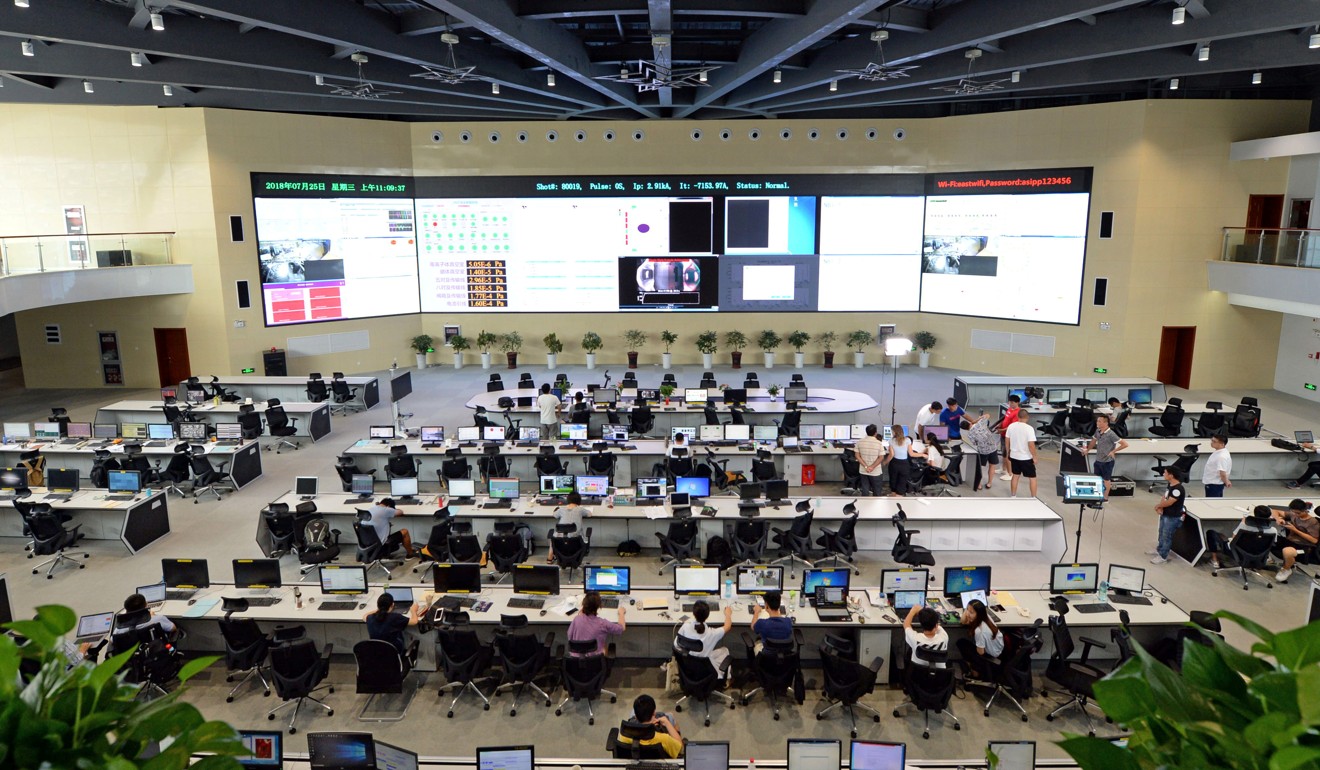
    The Experimental Advanced Superconducting Tokamak (EAST) device – or “artificial sun” – in Hefei, Anhui province. Photo: AFP/Chinese Academy of Sciences
    The Experimental Advanced Superconducting Tokamak (EAST) device – or “artificial sun” – in Hefei, Anhui province. Photo: AFP/Chinese Academy of Sciences
    A groundbreaking fusion reactor built by Chinese scientists is underscoring Beijing’s determination to be at the core of clean energy technology, as it eyes a fully functioning plant by 2050.
    Sometimes called an “artificial sun” for the sheer heat and power it produces, the doughnut-shaped Experimental Advanced Superconducting Tokamak (EAST) that juts out on a spit of land into a lake in eastern Anhui province, has notched up a succession of research firsts.
    In 2017 it became the world’s first such facility to sustain certain conditions necessary for nuclear fusion for 
    longer than 100 seconds

    , and last November hit a

    personal-best temperature

    of 100 million degrees Celsius (212 million Fahrenheit) – six times as hot as the sun’s core.

    Such mind-boggling temperatures are crucial to achieving fusion reactions, which promise an inexhaustible energy source.

    EAST’s main reactor stands within a concrete structure, with pipes and cables spread outward like spokes connecting to a jumble of censors and other equipment encircling the core. A red Chinese flag stands on top of the reactor.

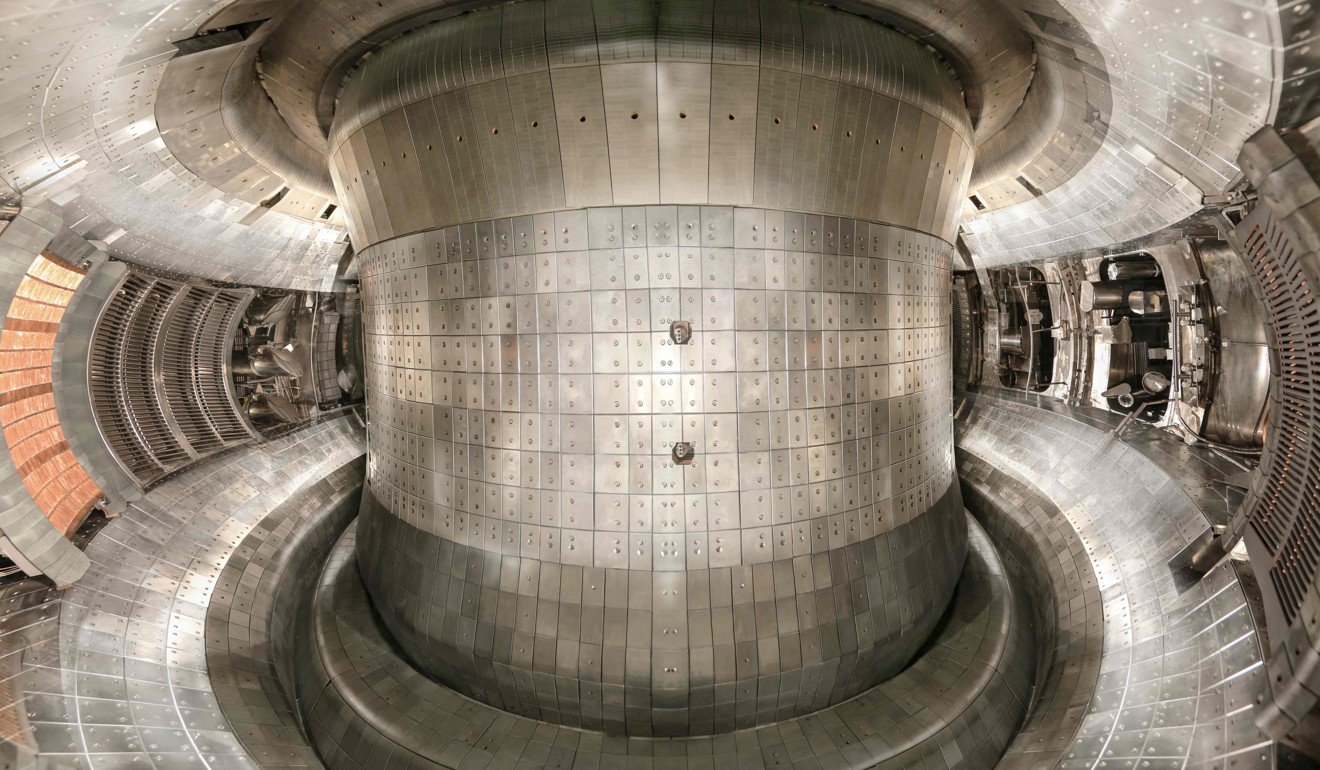
    A vacuum vessel inside the fusion reactor, which has achieved a temperature of 100 million degrees Celsius – six times as hot as the sun’s core. Photo: AFP/Chinese Academy of Sciences
    A vacuum vessel inside the fusion reactor, which has achieved a temperature of 100 million degrees Celsius – six times as hot as the sun’s core. Photo: AFP/Chinese Academy of Sciences

    “We are hoping to expand international cooperation through this device [EAST] and make Chinese contributions to mankind’s future use of nuclear fusion,” said Song Yuntao, a top official involved in the project, on a recent tour of the facility.

    China is also aiming to build a separate fusion reactor that could begin generating commercially viable fusion power by mid-century, he added.

    Some 6 billion yuan (US$891.5 million) has been promised for the ambitious project.

    EAST is part of the International Thermonuclear Experimental Reactor (ITER) project, which seeks to prove the feasibility of fusion power.

    Funded and run by the European Union, India, Japan, China, Russia, South Korea and the United States, the multibillion-dollar project’s centrepiece will be a giant cylindrical fusion device, called a tokamak.

    Now under construction in Provence in southern France, it will incorporate parts developed at the EAST and other sites, and draw on their research findings.

    China is “hoping to expand international cooperation” through EAST. Photo: Reuters
    China is “hoping to expand international cooperation” through EAST. Photo: Reuters

    Fusion is considered the Holy Grail of energy and is what powers our sun.

    It merges atomic nuclei to create massive amounts of energy – the opposite of the fission process used in atomic weapons and nuclear power plants, which splits them into fragments.

    Unlike fission, fusion emits no greenhouse gases and carries less risk of accidents or the theft of atomic material.

    But achieving fusion is both extremely difficult and prohibitively expensive – the total cost of ITER is estimated at 20 billion (US$22.3 billion).

    Wu Songtao, a top Chinese engineer with ITER, conceded that China’s technical capabilities on fusion still lag behind more developed countries, and that US and

    Japanese tokamaks have achieved more valuable overall results.

    But the Anhui test reactor underlines China’s fast-improving scientific advancement and its commitment to achieve yet more.

    China’s capabilities “have developed rapidly in the past 20 years, especially after catching the ITER express train”, Wu said.

    In an interview with state-run Xinhua news agency in 2017, ITER’s director general Bernard Bigot lauded China’s government as “highly motivated” on fusion.

    “Fusion is not something that one country can accomplish alone,” Song said.

    “As with ITER, people all over the world need to work together on this.”

Source: SCMP

15/04/2019

China’s online authors grow 3.82 mln in 3 years

HANGZHOU, April 14 (Xinhua) — China had 8.62 million online authors as of 2018, a significant increase from 4.8 million in 2015, according to a national conference on digital reading.

Among the digital reading materials, original online works took up 79.8 percent last year, up from 69 percent three years ago, while Liu Shu, vice president of Amazon China, said that e-book readers still love classic works.

An industry report released by the China Audio-Video and Digital Publishing Association at the conference showed that the value of China’s digital reading market reached 25.4 billion yuan last year, a 19.6 percent yearly growth.

About 432 million Chinese read digital publications on electronic devices during the year, averaging 12.4 digital publications per person and 71.3 minutes per read, the report said.

Over 66 percent of the respondents of the report were willing to pay for digital publications, up from 60.3 percent in 2016.

Since 2015, the conference has been held annually in east China’s city of Hangzhou, Zhejiang Province before World Book Day, which falls on April 23.

Source: Xinhua

10/04/2019

‘Lucky’ phone number sells for US$50,000 in China but it’s not a record

  • Online auction attracts fierce competition, sending value rocketing in first minutes of bidding
  • ‘Auspicious’ numbers are popular in China because they sound like words which signify good fortune
An “auspicious” mobile phone number has sold for more than US$50,000 at an online auction in China. Photo: Shutterstock
An “auspicious” mobile phone number has fetched more than 350,000 yuan (US$52,000) at an online auction in northern China.
The number, which ended in five fives, sold for more than 30 times the starting price of 11,250 yuan, after fierce bidding saw its value rocket to more than 300,000 yuan in just 12 minutes.
A total of 140 people registered to participate in the 24-hour auction and 107 bids were recorded. The winning bid came from a user called Li Zisheng on Tuesday evening, according to Alibaba’s Sifa court auction platform which hosted the sale.

The South China Morning Post is owned by Alibaba.

Why you shouldn’t clip your nails at night and other superstitions
It is not uncommon for people in China to pay a premium for phone numbers or car licence plates featuring numbers which are considered lucky.
Six, eight and nine are particular favourites, as they sound like the words for strength, wealth and longevity, respectively. The number five is said to represent happiness or wealth.

One of the most expensive mobile numbers on record in China contained a combination of eights and fives and sold at auction for US$680,000 in 2004, according to the Oriental Morning Post.

In 2006, a car licence plate in Zhejiang province, eastern China, containing five eights sold for 1.67 million yuan to a Wenzhou businessman with a BMW, according to online sales platform Tencent Auto.

Not everyone is willing to pay any price for a lucky number plate or phone number, with some internet users on China’s Twitter-like Weibo service questioning why people would pay so much money for such things.

“Are mobile and car plate numbers really this important?” a user from Hunan province, central China, wrote. “This type of number will have a higher chance of getting spam calls.”

Source: SCMP

07/04/2019

East China city to open direct flights to Tokyo, Seoul

HANGZHOU, April 6 (Xinhua) — The city of Ningbo in east China’s Zhejiang Province will launch direct flights to Tokyo and Seoul this year, the city’s Lishe International Airport said.

Sources with the airport said it would also increase flights to domestic cities like Beijing and Qingdao in 2019.

Ningbo has one of the busiest ports in the world.

The airport is expanding its terminal facilities amid a surging passenger volume. The airport handled 11.7 million passengers in 2018, a yearly increase of 24.8 percent.

Source: Xinhua

05/04/2019

China Focus: Funeral reform fosters new trends in China

BEIJING, April 5 (Xinhua) — “The air and environment in the cemetery have been notably improved, with less people burning joss paper,” said Wang Fang, a tomb sweeper from Yinchuan, Ningxia Hui Autonomous Region.

This year’s Tomb Sweeping Day, which falls on Friday, witnesses more changes, as China has made various efforts to reform funeral traditions in recent years, and ecological burial and environmentally friendly tomb sweeping practices are increasingly popular.

GREENER BURIAL

In a tea garden in Hangzhou in east China’s Zhejiang Province, there stands a hidden cemetery where burial plots are built under tea trees in a bid to enlarge its green area as well as conserve land.

“It would be good to return to nature here after I pass away,” said a local resident surnamed Wu.

China has seen progress in ecological burials in recent years, especially in developed cities. The first model ecological cemetery of Beijing has been built in Babaoshan Revolutionary Cemetery, with a green coverage rate of nearly 90 percent.

Currently, ecological burials in first-tier cities, including Beijing, Shanghai and Guangzhou, takes up more than 20 percent of the total. It is expected that by 2020, the share of ecological burial across the country reach over 50 percent.

In addition, tomb sweeping practices have become greener. Most tomb sweepers would rather present flowers at tombstones than burn joss paper to pay tribute to their deceased families and friends.

On Tomb Sweeping Day, some cemeteries hold cultural activities, such as calligraphy and painting exhibitions as well as poetry recitals as an alternative to tomb sweeping.

LAND CONSERVATIVE

Besides the “tea garden burial,” other ecological burial methods in China include tree, flower, wall and sea burials.

Replacing traditional tombstones with trees and flower beds, putting urns on shelves in walls or just dropping ashes into the sea requires less or even no land.

“At first people said it was for those in financial difficulties to save money, but as time changes, the popularity of ecological burials have increased,” said Zhao Quansheng, manager of a Yinchuan-based cemetery.

“A customer told us that his father voluntarily asked for an ecological burial to conserve land,” Zhao said.

Non-profit cemeteries are also thriving in places of separate burial traditions. In Yishui County, east China’s Shandong Province, 110 non-profit cemeteries have been built, leading to conservation of large areas of land that otherwise would be utilized for burial sites.

Xue Feng, Party secretary of Yishui, said it used to take about 20 to 27 hectares of land to accommodate all the private tombs in the county, but now it only needs 10 percent of that.

LESS MONEY

China has beefed up funeral infrastructure and public services, with the number of funeral parlours and cemeteries reaching 1,760 and 1,420, respectively.

Since 2009, the Ministry of Civil Affairs has pushed forward fee reduction in basic public funeral services as well as other preferential policies, benefiting low-income groups. For example, commercial cemeteries in Chongqing, Gansu and Ningxia were required to set aside part of their burial sites as non-profits for those with financial difficulties.

“Now the whole funeral is free, including the urn and burial site, which is a great help for households with low incomes like us,” said Yuan Li, a rural resident from Yishui, where funeral services have been free of charge since 2017.

Xue said the fee-reduction policy could save the public nearly 200 million yuan (about 30 million U.S. dollars) annually.

The Ministry of Civil Affairs issued a pilot plan for funeral reform in 2017, and released guidelines with another 14 authorities on further reform in 2018.

“The funeral reforms help encourage fine and up-to-date practices and trends, and make contributions to land and ecological conservation,” said Ma Guanghai, sociology professor of Shandong University. “It is an important aspect of social progress.”

Source: Xinhua

13/03/2019

Chinese woman pays $44,710 back to crowdfunders who helped her father and ‘gives 300 people a warm hug’

  • When truck driver dad needed money to compensate pedestrian after accident, Hai Lin raised it online in one night and she paid it back two years before her deadline
In 2015, Hai Lin posted an appeal for 300 donations of 1,000 yuan on WeChat with a promise to pay lenders back within five years. Photo: Xinhua
A woman from southeastern China has returned 300,000 yuan (US$44,710) to 300 people – many of them strangers – who donated money to a crowdfunding appeal she started four years ago.
In 2015, Hai Lin posted an appeal for 300 donations of 1,000 yuan on WeChat, with a promise to pay lenders back within five years. She kept her promise – and paid back all her loans two years early.
The internet was abuzz with the story of Hai’s crowdfunder, which was reported by Pearvideo.com on Tuesday. Many people said it warmed their hearts and restored their confidence in society.

Shortly before that, Hai’s mother was admitted to hospital with bleeding on the brain.

“The man [hit by her father] was in critical condition,” Hai, then 27 and from Hangzhou, Zhejiang province, was quoted in the Pearvideo.com as saying. “We had to hide the accident from my mother so that her rehabilitation won’t be affected.”

‘Social media queen’ closes WeChat account after fake story outrage

Hai said the accident was a big blow and, for the first time in her life, she felt frightened.

“My father told me that if we couldn’t afford the compensation, he would run away to escape the debt,” said Hai. “I said I would try my best to keep that from happening.”

In her post on WeChat, she wrote that she was looking for 300 people to lend her 1,000 yuan each. She planned to pay back those debts in five years by returning money to five lenders each month.

“It’s because I couldn’t find someone who could lend me 300,000 yuan at a one time,” said Hai. “Some friends said they could have loaned me 100,000 yuan, but I refused their kindness because that was too big an amount.”

Resourceful Hai Lin asked 300 people online for 1,000 yuan each to help her father out and was true to her word in repaying the money. Photo: Weibo

To her surprise, 300 WeChat contacts, many of whom were not acquaintances, came up with the funds in one night.

In July 2015, Hai began to pay back the money she had borrowed. By July of last year, two years ahead of schedule and thanks to pay rises and year-end bonuses, the debt was cleared.

Some creditors had deleted Hai’s WeChat details, so she had to track them down.

“Girl, thank you for restoring trust which I thought I’d lost and for warm feelings that will stay with me,” one of her creditors wrote on WeChat.

Another said that when he received Hai’s money transfer he thought someone was joking. After recalling Hai’s appeal, he said he was touched by her gesture.

“You gave us 300 people a warm hug,” he said on WeChat.

Travel nightmares and how strangers crowdfund for injured tourists

The report on pearvideo.com has scored more than 40,000 “likes” on Sina Weibo, China’s

Twitter-like, while users added 10,000 combined reposts and comments.

“In her [Hai’s] mind there was a debt while other people would treat it as donation,” an internet user wrote. “I think many people wouldn’t expect her to return the money.”

“It shows this woman is a nice person in her everyday life and deserves credits. I would lend money to people like her,” another wrote.

One cautious Weibo user said: “I’ve never loaned money to people whom I never met face-to-face and only chatted with online.”

“Is it a big thing that you borrow money and pay it back?” asked another user. “You borrow 1,000 yuan from a person and return it years later. Is it something to feel proud of?”

Source: SCMP

02/03/2019

China’s private business hub to increase trade with Africa

HANGZHOU, March 1 (Xinhua) — East China’s Zhejiang Province plans to increase its trade volume with Africa to 40 billion U.S. dollars by the end of 2022 to account for at least 20 percent of the total Sino-Africa trade.

Zhejiang’s department of commerce issued an action plan revealing the details on Friday as China’s first provincial-level plan on economic cooperation with African countries.

The 40-billion-dollar target will mark a significant rise from the 30.1-billion-dollar trade between Africa and Zhejiang, home to many of China’s most successful private businesses, in 2018.

The plan also promises to increase investments in Africa’s industries of textiles, garments, chemicals, equipment manufacturing and pharmaceuticals to meet the continent’s development needs.

The province, however, will bar investments that are polluting and highly energy-consuming from going to Africa, said the plan, which also calls for more agricultural investments and cooperation.

The document also said the province would expand goods imports from Africa, especially in the non-resources category.

According to China Customs, China’s foreign trade with Africa reached 204.19 billion dollars in 2018, up 19.7 percent year-on-year and 7.1 percentage points higher than the growth of China’s overall foreign trade during the same period.

Specifically, the country’s exports to Africa rose 10.8 percent to 104.91 billion dollars in 2018, while its imports from Africa surged 30.8 percent to reach 99.28 billion dollars.

Source: Xinhua

Law of Unintended Consequences

continuously updated blog about China & India

ChiaHou's Book Reviews

continuously updated blog about China & India

What's wrong with the world; and its economy

continuously updated blog about China & India