06/06/2019
- Prime Minister Scott Morrison says the visit was reciprocal, while to experts it showed China’s ability to carry out naval operations globally
- The flotilla has also been described as a ‘public relations disaster’, since it followed other controversies involving Australian and Chinese vessels
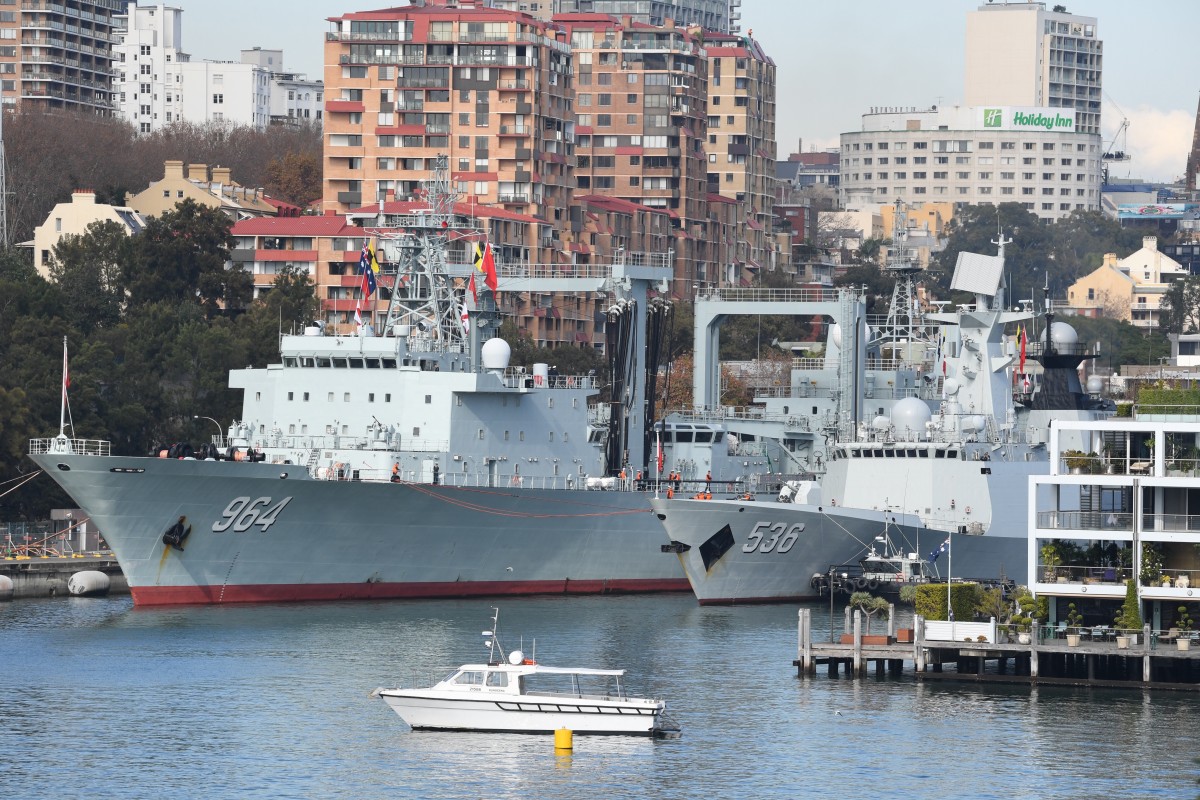
Two warships from the People’s Liberation Army Navy at Garden Island Naval Base in Sydney, Australia. Photo: EPA
The docking of
in Sydney for a publicly unannounced stopover on Monday set off a flurry of speculation about Beijing’s intentions amid rising anxiety about Chinese influence in the southern Pacific.
The visit by a Chinese frigate, auxiliary replenishment ship and amphibious vessel – with some 700 sailors in total – caught social media users and academics by surprise, with some questioning the visit’s timing and why the government had not given them advance notice.
It’s turning into a public relations disaster for ChinaJohn Fitzgerald, Swinburne University
“The People’s Liberation Army (PLA) Navy visit might have been intended as an act of diplomacy but it’s turning into a public relations disaster for China,” said John Fitzgerald, a China scholar at Swinburne University in Melbourne, noting that it followed
The stopover, as the ships returned from the Middle East, came days after reports emerged that an
navy vessel in the South China Sea was tailed by the Chinese navy and Australian navy pilots had been targeted by lasers from Chinese fishing vessels.
Rory Medcalf, the head of Australian National University’s National Security College, said on Twitter that Beijing appeared to be making “a serious show of presence in the South Pacific”.
Medcalf said previous visits by Chinese navy ships typically involved a single vessel and that Sydney was not a convenient stopover for vessels returning from the Gulf of Aden, the body of water bordered by Yemen and Somalia.
Peter Jennings, executive director of the Australian Strategic Policy Institute think tank, told local media the government was remiss for not telling the public about the visit in advance.
Speaking to reporters from the Solomon Islands, Australian Prime Minister Scott Morrison said the government had “known about [the Chinese navy visit] for some time”.
“This was an arrangement, a reciprocal visit because Australian naval vessels have visited China,” said Morrison as he wrapped up a trip aimed at boosting Canberra’s standing among Pacific island nations and countering Chinese influence in the region.
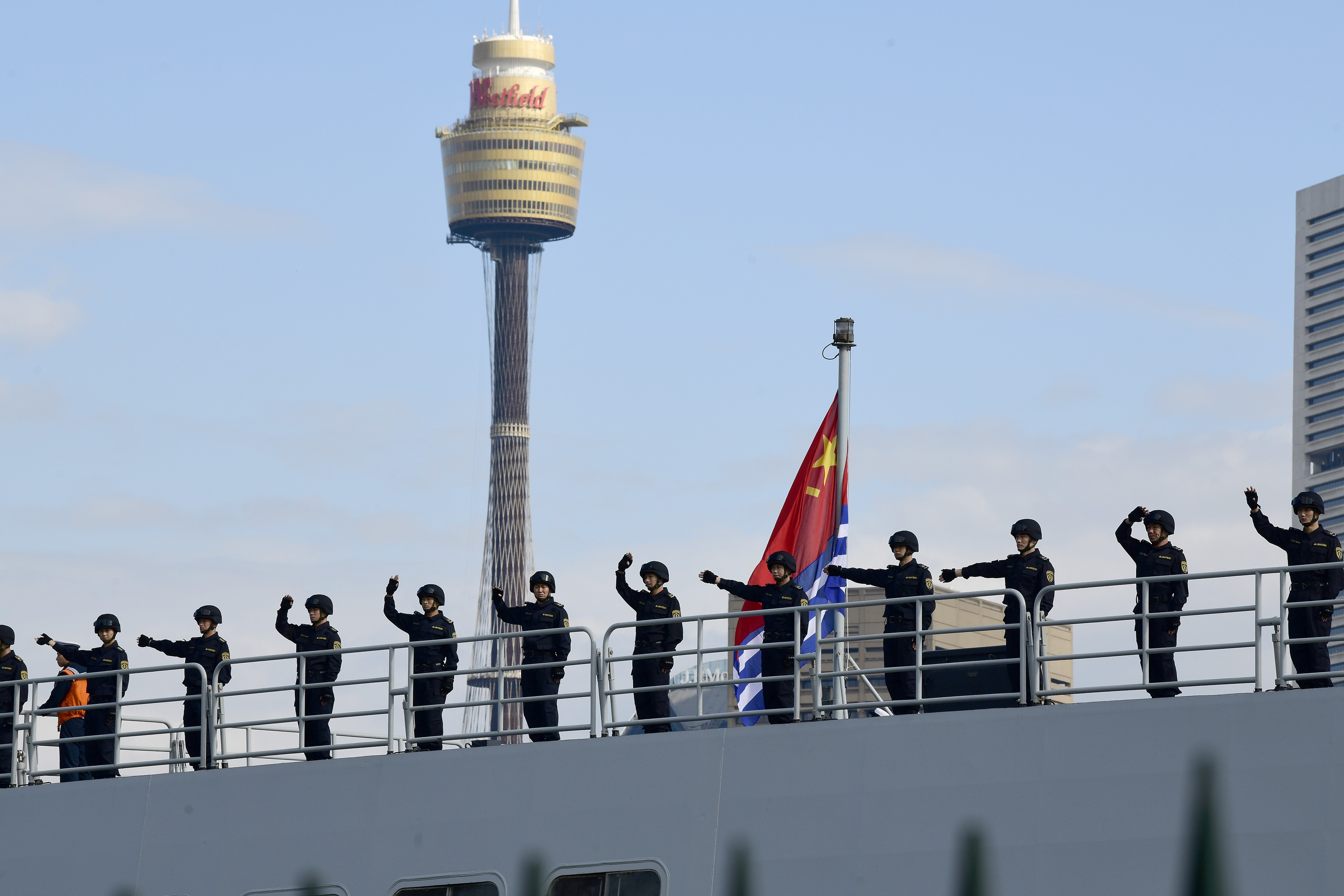
Chinese sailors wave from a PLA Navy ship after it arrives at Garden Island Naval Base in Sydney. Photo: EPA
Collin Koh, a research fellow at the S. Rajaratnam School of International Studies in Singapore, said it was not unusual for naval visits to not be announced in advance, depending on factors such as operational security requirements and expectations in the given country.
“Some visits are pre-announced and made public in the open domain, but some not,” Koh said.
Scholar points to Beijing’s ‘maritime militia’ in the South China Sea after lasers force Australian navy helicopter to land
“It’s not necessarily the case that foreign naval visits need to be publicised, though that, of course, depends on the sociopolitical circumstances of the host country which mandate a specific system of transparency and accountability.”
Morrison, who had earlier announced a A$250 million (US$173.36 million) grants programme for the Solomon Islands, said the Chinese ships were returning after a counter drug-trafficking operation in the Middle East.
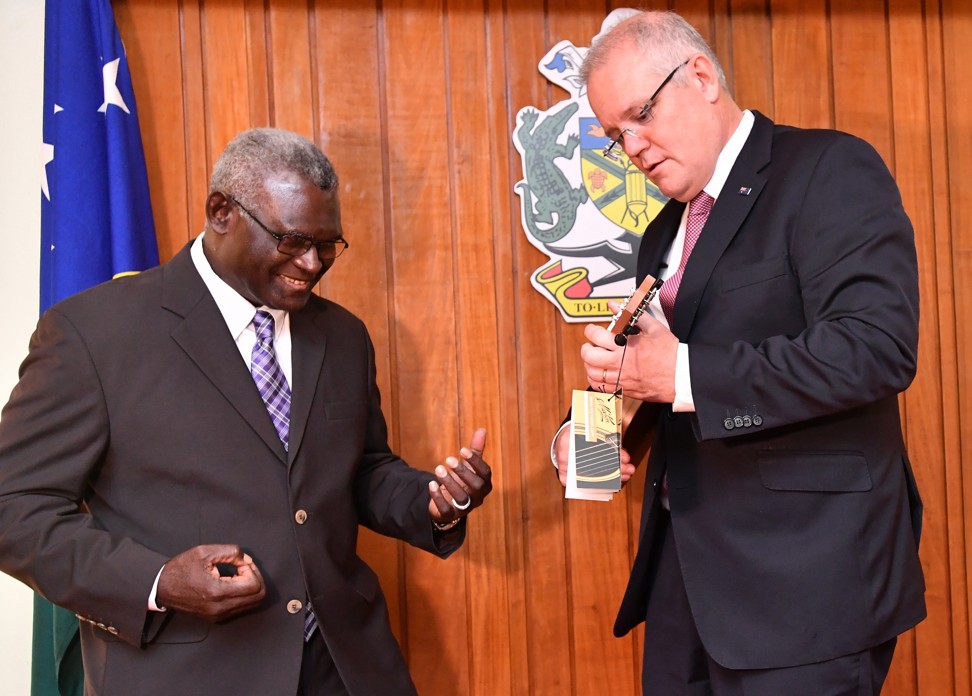
Solomon Islands Prime Minister Manasseh Sogavare (left) and Australian Prime Minister Scott Morrison. Morrison is visiting the Solomon Islands on his first post-election overseas trip. Photo: EPA
[The visit] is a further demonstration of the relationship that we have and this had been in train for some time,” he said. “It may have been a surprise to others but it certainly wasn’t a surprise to the government.”
The Australian Defence Force (ADF) said China had asked for the visit in April, and that the government was committed to fostering a “long-term constructive relationship with China”.
“Australia regularly hosts foreign navy vessels in its ports,” said an ADF spokesperson. “Notification to the public is not standard practice and is usually considered on a case-by-case basis.”
Since coming to power in 2012, China’s President Xi Jinping has invested heavily in the PLA Navy in a bid to project Chinese influence across the Pacific and beyond.
Singapore, China deepen defence ties, plan larger military exercises including joint navy drill
Beijing is locked in maritime disputes in the East and South China Seas with a number of countries including the Philippines, Japan, Vietnam and Brunei.
John Blaxland, a professor at the Strategic and Defence Studies Centre at the Australian National University, said it was interesting to consider what the PLA Navy flotilla would be doing after its Sydney port call.
“The Australian Government’s Pacific reset follows a period of some disengagement by Australia and has been, in part at least, triggered by China’s renewed interest in the Pacific – notably the remaining micro states that continue to support Taiwan,” Blaxland said.
The Kunlun Shan amphibious transport dock of the PLA Navy at Garden Island Naval Base in Sydney. Photo: EPA
Singapore-based research fellow Koh said the most significant takeaway from the visit was that it showed China’s emerging capability to carry out naval operations globally.
“The PLA Navy has since December 2008 been making long voyages across the globe – to the Baltic, Mediterranean, Caribbean and Latin America – and it’s been able to gain experience and exposure to such sustained long-duration missions,” he said.
What is the US Navy doing on Japan’s Iwo Jima, nearly 75 years after World War II?
“Hence, this visit to Australia – sailing from the Indian Ocean across to the far eastern end of Australia – represents no mean feat, and the coming of age of a blue-water-capable PLA Navy.”
Asked by reporters whether the stopover was appropriate given that it came on the eve of the 30th anniversary of Beijing’s bloody crackdown in Tiananmen Square in 1989, Morrison said: “No, I think any reading into timing could be subject to a bit of overanalysis.”
Neil James, executive director of the independent watchdog Australia Defence Association, said the timing of the visit appeared to be an “accidental coincidence” and could be awkward for Beijing as it drew further attention to the Tiananmen anniversary.
US warships made 92 trips through the Taiwan Strait since 2007
“The timing is far more of a problem for the PLA Navy than Australia,” James said.
“The Tiananmen anniversary might have been known in China but they either ignored it, or it was a left-hand versus right-hand coordination glitch inside the People’s Republic of China government.”
Source: SCMP
Posted in Australian public, Beijing, Chinese warships, Sydney, Uncategorized |
Leave a Comment »
06/06/2019
- Agreements to boost cooperation in spheres such as energy and technology highlight closer partnership in face of tensions with US
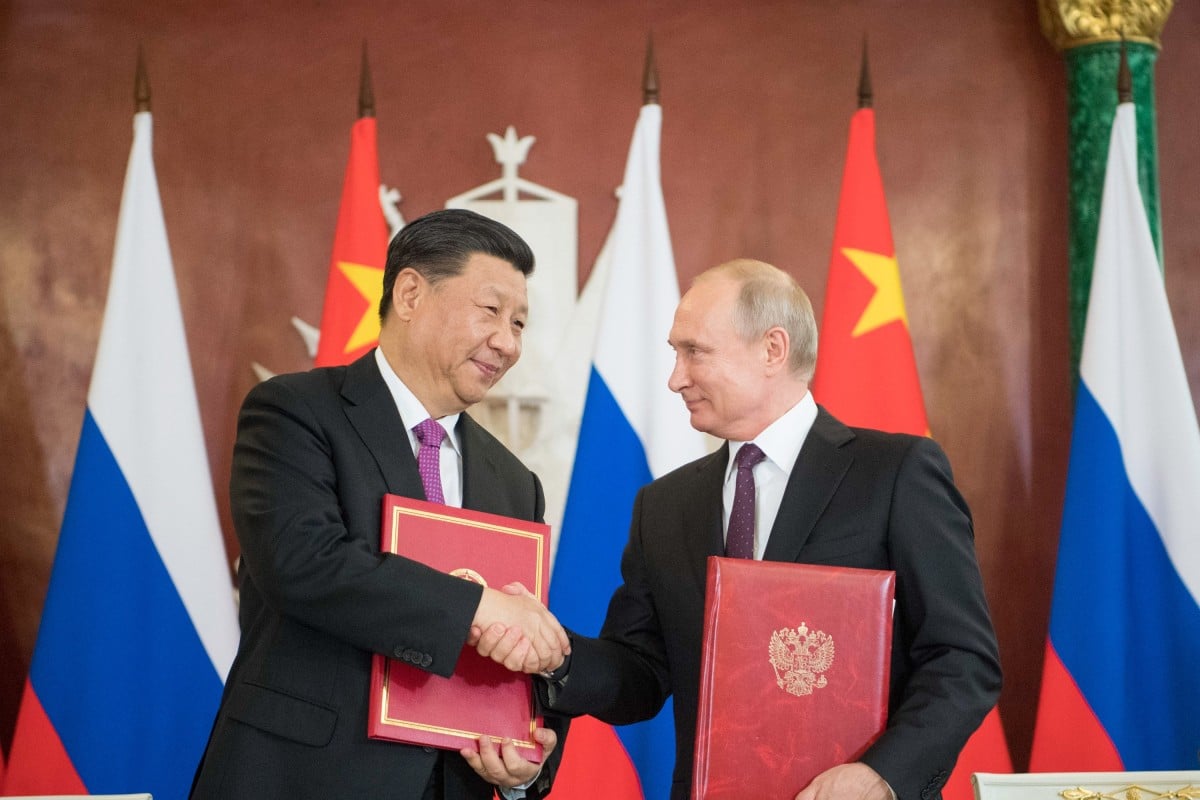
Xi Jinping and Vladimir Putin agreed to deepen their unprecedented partnership. Photo: Xinhua
China and Russia have signed more than US$20 billion of deals to boost economic ties in areas such as technology and energy following Xi Jinping’s summit with his “best friend” Vladimir Putin.
Wednesday’s meeting between the two presidents, who have spoken of their desire to boost practical cooperation in the face of increasing rivalry with the United States, marked the start of Xi’s three-day visit to Russia to commemorate the 70th anniversary of the establishment of diplomatic relations between Moscow and Beijing.
On Thursday the Chinese commerce ministry said that the two sides aimed to increase the volume of trade between the two countries to US$200 billion a year following last year’s 24.5 per cent rise to a record level of US$108 billion.
Gao Feng, a spokesman for the ministry, said the deals covered areas such as nuclear power, natural gas, automobiles, hi-tech development, e-commerce and 5G communications.
The deals were the first concrete results of the warm words exchanged between the leaders, who agreed to deepen their “unprecedented” strategic partnership for “mutual advantage”.
“We discussed the current state of, and prospects for, bilateral cooperation in a businesslike and constructive manner, and reviewed, in substance, important international issues while paying close attention to Russia-China cooperation in areas that are truly important for both countries,” Putin said in a joint press statement with Xi on Wednesday.
Xi – who had previously told Russian media that he “treasured” the relationship with Putin, whom he described as “my best friend” – said the two countries would work to “build mutual support and assistance in issues that concern our key interests in the spirit of innovation, cooperation for the sake of mutual advantage, and promote our relations in the new era for the benefit of our two nations and the peoples of the world”.
Russia is already China’s biggest oil exporter, and has agreed to further joint ventures. Photo: Reuters
Putin also highlighted the energy cooperation between the two countries, adding that Russia was China’s leading oil exporter and the eastern route of a gas pipeline between Russia and China will enter service in December.
China and Russia seek closer economic ties to counter US pressure
Novatek and Sinopec, Russian and China’s leading natural gas companies, signed a preliminary deal with Russian state-owned bank Gazprombank on Wednesday to set up a joint venture to market gas in China.
The Russian natural gas company is also forming a partnership with China Natural Petroleum Corporation and China National Offshore Oil Corporation to develop an Arctic natural gas facility, with both Chinese companies holding a 10 per cent stake in the project, according to S&P Global Platts, an energy information provider.
A general contract was also signed to build extra units of the Xudabao Nuclear Power Plant, located on the coast of the northeastern Chinese province of Liaoning.
Chinese tech giant Huawei has agreed a deal with Russian telecoms firm MTS. Photo: Xinhua
The Chinese commerce ministry also said that Moscow had agreed to increase its soybean exports after imports from America declined sharply due to the ongoing trade war.
Andrey Denisov, Russia’s ambassador to China, was quoted by Chinese media as saying that the country should “double” its soybean exports to China, which currently make up a tiny proportion of the overall quantities bought by China.
The two sides are also discussing a US$153.3 million investment to create a joint agricultural holding company in Primorsky in Russia’s far east.
Russia’s Putin calls time on UK spy scandal: ‘it’s your agent, not ours’
Meanwhile, Chinese telecoms giant Huawei, which has been targeted by US sanctions after it was accused of spying and undermining national security, signed a deal with Russian telecoms company MTS to develop a 5G network.
China Investment Corporation and RDIF, a Russian sovereign wealth fund, were also reported to have agreed to set up a US$1 billion joint technology research fund, according the US-based analysts Sovereign Wealth Fund Institute.
Shi Yinhong, an international relations professor at Renmin University of China, said the two sides were boosting their strategic and diplomatic collaboration at a time of “extraordinary” tensions between Washington and Beijing.
“Though concrete cooperation in hi-tech areas [between Beijing and Moscow] is necessarily limited, in the purely military field it is assured,” Shi, an adviser to China’s State Council, said.
China’s Huawei signs deal to develop 5G in Russia
Last September, 300,000 soldiers from the two countries took part in
a joint military exercise in eastern Siberia, the largest such drill in Russia in nearly four decades.
While Xi is highlighting his rapport with his “best friend” Putin, the professor added, “the romance has gone out of the personal relationship between Xi and [Donald] Trump”.
Source: SCMP
Posted in bears fruit, China alert, growing friendship, President Xi Jinping, Russia, sign deals, Uncategorized, Vladimir Putin |
Leave a Comment »
06/06/2019
Participants perform land boating in Huixingu resort in Miaoshan Village of Miaoxi Township, Huzhou City, east China’s Zhejiang Province, June 6, 2019. Various activities have been held to celebrate the upcoming Dragon Boat Festival, or Duanwu, which falls on June 7 this year. (Xinhua/Huang Zongzhi)
Source: Xinhua
Posted in celebrate, dragon boat festival, Duanwu, Huixingu, Huzhou City, Miaoshan Village, Miaoxi Township, Uncategorized, zhejiang province |
Leave a Comment »
05/06/2019
BEIJING, June 5 (Xinhua) — A national WeChat mini-program was launched Wednesday to enable users to enjoy over 200 e-government services via the cross-region and cross-department digital platform.
The mini-program, a small application embedded within China’s popular social media platform WeChat, connects users with services offered by six government agencies including the National Development and Reform Commission and the Ministry of Commerce, according to a statement from WeChat’s developer Tencent.
Individual users can search information about their education and traffic violation record, among others, while enterprises can apply for certain licenses and certificates online via the mini-program.
The mini-program is also connected with local government online service platforms in several provinces including Guangdong and Zhejiang, while more local e-government services will be connected in the future, the statement said.
E-government services via apps and mini-programs are increasingly popular in China amid national and local efforts to cut administrative red tape to benefit residents and businesses alike.
A total of 30 provincial-level regions have established integrated e-government platforms that incorporate the services of provincial, city and county governments, according to a report released in May.
In 2018, the number of real-name users on provincial e-government platforms reached 145 million, an increase of 38 million over the previous year, the report showed.
Source: Xinhua
Posted in e-government platforms, e-government services, Guangdong, launched, mini-program, Ministry of Commerce (MOC)., National, National Development and Reform Commission (NDRC), promote, TENCENT, Uncategorized, WeChat, Zhejiang |
Leave a Comment »
05/06/2019
A Long March-11 solid propellant carrier rocket is launched from a mobile launch platform in the Yellow Sea off east China’s Shangdong Province, June 5, 2019. China successfully launched a rocket from a mobile launch platform in the Yellow Sea off Shandong Province on Wednesday, sending two technology experiment satellites and five commercial satellites into space. A Long March-11 solid propellant carrier rocket blasted off at 12:06 p.m. from the mobile platform. It is China’s first space launch from a sea-based platform and the 306th mission of the Long March carrier rocket series. (Xinhua/Zhu Zheng)
QINGDAO, June 5 (Xinhua) — China successfully launched a rocket from a mobile launch platform in the Yellow Sea off Shandong Province on Wednesday, sending two technology experiment satellites and five commercial satellites into space.
A Long March-11 solid propellant carrier rocket blasted off at 12:06 p.m. from the mobile platform. It is China’s first space launch from a sea-based platform and the 306th mission of the Long March carrier rocket series.
The rocket is also named “CZ-11 WEY” under an agreement between the China Academy of Launch Vehicle Technology, China Space Foundation and a Chinese automobile producer.
Launching a carrier rocket from an ocean-based platform has many advantages over a land launch.
The closer to the equator a rocket launch can get, the greater the speed boost it will receive. It reduces the amount of energy required to get into space and means that less fuel is required.
The launch site is flexible and falling rocket remains pose less danger. Using civilian ships to launch rockets at sea would lower launch costs and give it a commercial edge.
The seaborne launch technology will meet the growing launch demand of low inclination satellites and help China provide launch services for countries participating in the Belt and Road Initiative, according to experts.
The two satellites, developed by China Academy of Space Technology, are expected to step up all-weather monitoring of ocean wind fields and improve typhoon monitoring and accuracy of the weather forecast in China.
Among the five commercial satellites, the two satellites, developed by China Electronics Technology Group Corporation, are China’s first small satellite system based on Ka-band.
The Long March-11, developed by China Academy of Launch Vehicle Technology, is the only rocket using solid propellants among China’s new generation carrier rockets. It is mainly used to carry small satellites and can take multiple satellites into orbit at the same time.
Source: Xinhua
Posted in China Academy of Launch Vehicle Technology, China alert, China Electronics Technology Group Corporation, China Space Foundation, Chinese automobile producer, completes, CZ-11 WEY, first, land launch, launch, Long March-11, ocean-based platform, offshore rocket, orbit, satellites, seaborne launch technology, shandong province, solid propellant carrier rocket, Uncategorized, Yellow Sea |
Leave a Comment »
05/06/2019
Chinese President Xi Jinping inspects the guard of honor during a welcoming ceremony upon his arrival at the airport in Moscow, Russia, June 5, 2019. Xi arrived here on Wednesday for a state visit to Russia. (Xinhua/Li Xueren)
MOSCOW, June 5 (Xinhua) — Chinese President Xi Jinping arrived here on Wednesday for a state visit to Russia as the two countries are expected to bring their comprehensive strategic partnership of coordination to a new era.
Upon arrival, Xi said he would exchange views with Russian President Vladimir Putin on how to deepen bilateral ties and promote practical cooperation, and over major international and regional issues of common concerns.
The two heads of state would plan for the future development of bilateral relationship so as to push forward the China-Russia comprehensive strategic partnership of coordination to a new era of greater development at a higher level, Xi said.
Xi’s visit to Russia, the eighth since 2013 when he was elected Chinese president, comes as the two countries are embracing the historic moment of the 70th anniversary of the establishment of diplomatic ties.
Thanks to the joint efforts from both sides, China-Russia comprehensive strategic partnership of coordination is now at its best in history, serving as a model of living in harmony and win-win cooperation between major countries and neighboring countries, Xi said.
China and Russia enjoy strong political trust, maintain sound mechanisms of high-level exchanges and cooperation in various fields, and keep close coordination in global affairs, playing a positive and constructive role in safeguarding peace and stability of the region and the world as well as international fairness and justice, Xi said.
After standing the test of changing circumstances over the past 70 years, the bilateral relations are increasingly mature, stable and resilient, Xi said, noting the ties is at a new historical starting point with a new historic opportunity.
During the visit, Xi and Putin are expected to sign or witness the signing of important cooperation documents, and attend a gathering celebrating the 70 anniversary of bilateral diplomatic ties.
Xi will also attend the 23rd St. Petersburg International Economic Forum. He will address a plenary session to expound China’s ideas on sustainable development and call for concerted efforts to safeguard multilateralism and improve global governance for the common development and prosperity of the world.
Xi and Putin, maintaining close friendship, have met nearly 30 times on bilateral and multilateral occasions since 2013. In a meeting with Putin in April, Xi said the bilateral relationship has become a major-country relationship featuring the highest degree of mutual trust, the highest level of coordination and the highest strategic value.
Source: Xinhua
Posted in arrives, China-Russia comprehensive strategic partnership of coordination, Chinese President Xi Jinping, Moscow, Russia, Russian President, State visit, Uncategorized, Vladimir Putin |
Leave a Comment »
05/06/2019
- The virus that causes the African swine fever is now endemic in Tibet and Xinjiang, the United Nations’ Food & Agriculture Organisation said
- Diseases that are endemic, or generally present, are harder to stamp out
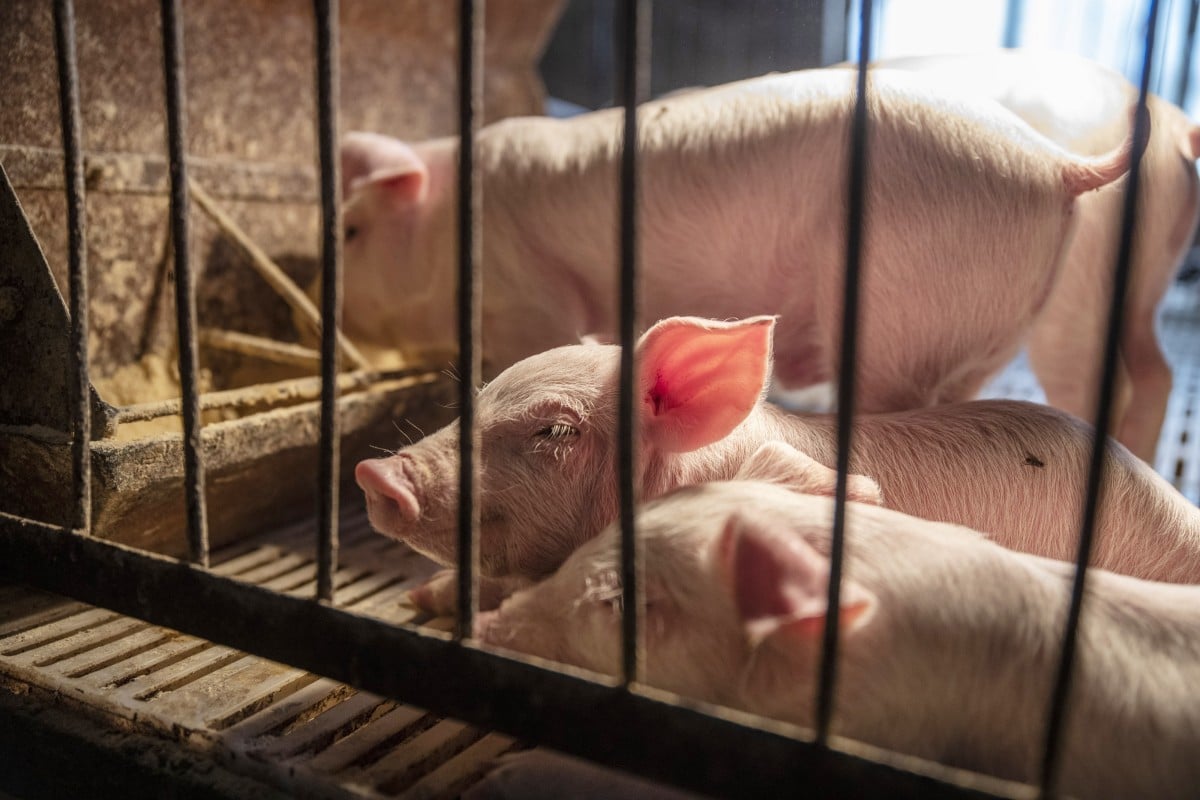
Piglets are kept in pens at a pig farm in Langfang in Hebei province on Monday, April 1, 2019. Photo: Bloomberg
China’s attempts to control African swine fever have been insufficient to stem further spread of the disease, with the deadly pig contagion now endemic in two regions, a United Nations group said.
The virus that causes the disease is entrenched among pig populations in the autonomous regions of Tibet and Xinjiang, the Food & Agriculture Organisation (FAO) in Rome said in a report Thursday.
Diseases that are endemic, or generally present, are more difficult to stamp out by quarantining and culling diseased and vulnerable livestock.
About 20 per cent of China’s pig inventories may have been culled in the first few months of 2019 amid fears of African swine fever spreading more rapidly, according to the FAO, which is monitoring the disease in cooperation with local authorities and China’s Ministry of Agriculture and Rural Affairs.
China’s pig production will drop by 134 million heads, or 20 per cent, in 2019, the US Department of Agriculture said last month.
“While official sources confirm a rapid spread of the disease, both the speed and severity of the spread could prove more pronounced than currently assumed,” the FAO said in its report. A government investigation in seven provinces found “irrational culling of sows on breeding farms in February, reducing the sector’s core production capacity.”
Thailand launches crackdown to keep out African swine fever
Since the first cases were reported last August, 130 outbreaks have been detected in 32 provinces, autonomous regions, municipalities and special administrative regions across the nation, which raises half the world’s pigs.
- In Jilin province, swine inventory fell 28 per cent from the previous year, with some reports pointing to a larger drop In Shandong province, sow numbers fell 41 per cent from July 2018 to February 2019
- In Guangdong province, hog inventories slumped 20 per cent from a year earlier and pig-feed sales fell 10 per cent to 50 per cent
- Production of fresh and frozen meat by meatpackers plunged 17 per cent in January and February, compared with the same months in 2018
- Source: SCMP
Posted in African swine fever virus, endemic, eradication, Food & Agriculture Organisation, guangdong province, Jilin, Ministry of Agriculture and Rural Affairs, Thailand, Tibet, UN, Uncategorized, US Department of Agriculture, Xinjiang |
Leave a Comment »
05/06/2019
- Communist Party says those taking part pledged to ‘cultivate the Chinese cultural character of our nation’s religions’
- Confucius has been rehabilitated by party in recent years as a means of rallying patriotism and countering foreign influences
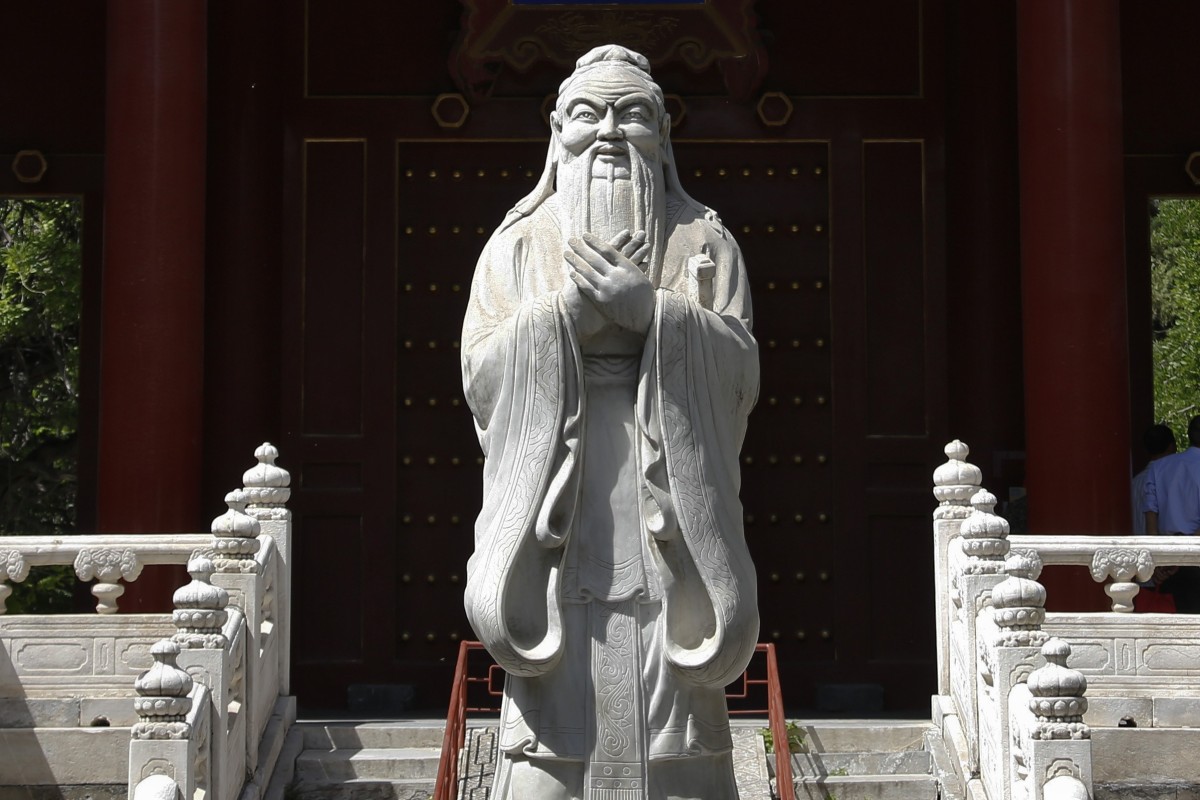
The Communist Party for decades attacked the sage as a symbol of feudalism, but now Confucianism has been elevated. Photo: AP
China has begun five-day Confucian culture immersion courses for religious leaders in the sage’s hometown as part of a campaign to extend government control over faith communities through a
.
The ruling Communist Party’s United Work Front Department said in a news release on Monday that the activity was designed to ensure the primacy of traditional Chinese values above all.
“To hold activities here … is a collective tribute to excellent traditional Chinese culture and a conscious identification and integration with Chinese culture,” said the release, posted on the department’s website.
Participants pledged to “cultivate the Chinese cultural character of our nation’s religions so that our nation’s religions are rooted in the fertile soil of excellent traditional Chinese culture, and to ceaselessly and deeply advance the Sinicisation of our nation’s religions”, it said.
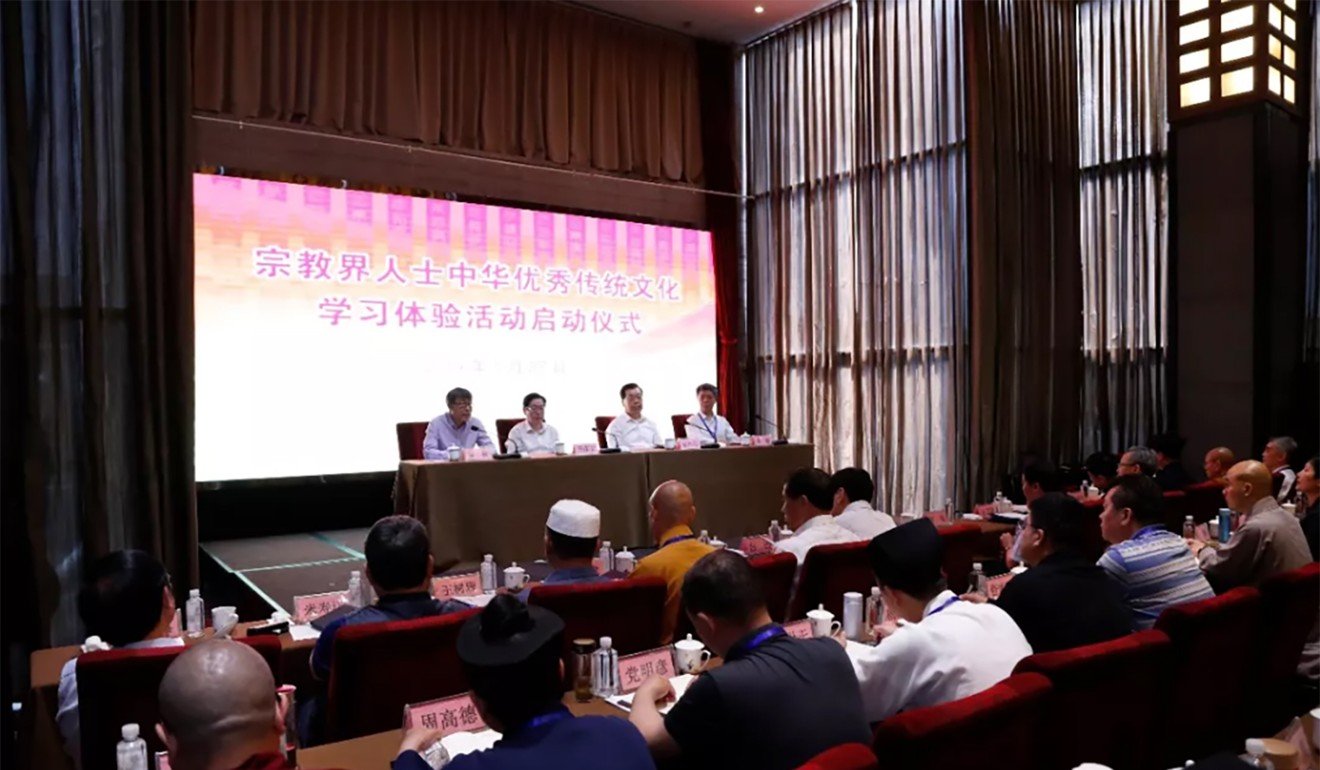
The five-day immersion courses are being held in the sage’s hometown of Qufu. Photo: United Front Work Department
President Xi Jinping has launched the harshest crackdown in decades on religious practices, especially those viewed as foreign such as Christianity and Islam, while at the same time elevating home-grown Confucianism.
While for decades the officially atheistic Communist Party attacked Confucius as a symbol of feudalism, he has been thoroughly rehabilitated in recent years as a means of rallying patriotism and countering foreign influences.
Confucianism’s emphasis on strict social organisation, advancement through study and exam taking, adherence to hierarchy and maintenance of social harmony appeals especially to the heavily bureaucratic party, which brooks no challenge to its authority.
Xi has repeatedly called for religious leaders and believers to be guided by “socialist core values”. Party bureaucrats overseeing religion have demanded that key religious tenets and texts such as the Bible and Koran be interpreted “in conformity with the demands of modern Chinese development and excellent traditional Chinese culture”.
That has been accompanied by a campaign of removing crosses and bulldozing many churches, destroying mosques and locking an
in camps where they are forced to renounce Islam and their cultural traditions.
Despite international condemnation, China claims it upholds freedom of religion and is seeking only to ensure regulations are followed while discouraging religious extremism and violence.
Those participating at the launch of the five-day course included the president of the Chinese Taoist Association, vice-president of the Chinese Islamic Association, chairman of the Chinese Catholic Patriotic Association and president of the Chinese Christian Association.
Confucius was believed to have been born in the 6th century BC in the eastern town of Qufu. He is credited with authoring or editing key texts of statesmanship and social order, particularly the Analects that contain his key aphorisms and teachings.
The sage’s legacy is also invoked in the name of the
, quasi-academic bodies set up in colleges and other centres of education around the world.
Several US universities have rejected offers to open Confucius Institutes on their campuses or declined to renew contracts over concerns about Chinese government political influence.
Source: SCMP
Posted in Analects, Bible, bulldozing many churches, China alert, Chinese Catholic Patriotic Association, Chinese Christian Association, Chinese Islamic Association, Chinese Taoist Association, Christianity, Communist Party, Confucian culture courses, Confucianism, Confucius, Confucius Institute, destroying mosques, islam, Koran, President Xi Jinping, Qufu, religious leaders, removing crosses, runs, Sinicisation, symbol of feudalism, the sage, traditional Chinese values, Uncategorized, United Work Front Department |
Leave a Comment »
05/06/2019
- The ‘success’ of China’s undemocratic model hides the continued exploitation of the poor, the destruction of faith communities and other victims who can’t speak out
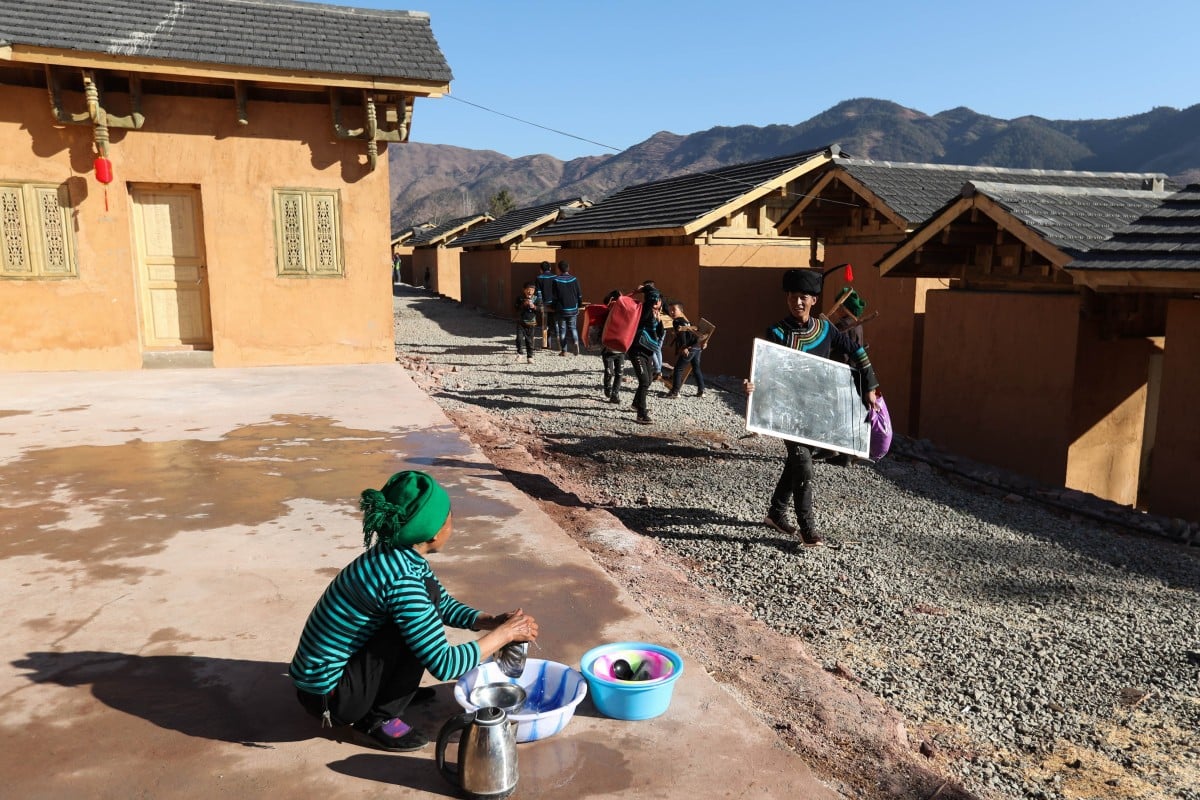
Villagers of the Yi ethnic group move into new houses for relocated residents from poor areas, in Zhaojue county in southwest China’s Sichuan province. Under President Xi Jinping, China has set the goal of eliminating poverty by 2020, but the state of the rural poor in remote counties may make the task difficult. Photo: Xinhua
I write to respond to Randy Lee’s letter, dated May 6, on the dilemma of democracy and prosperity in mainland China and Taiwan (“
”). Linear thinking of this kind has misled a lot of people on the issue.
Mr Lee compared the economies of China and Taiwan, saying the island’s economy is in a downturn and attributed this to its democratic governance. However, every nation faces regular ups and downs in its economy and there is no reason to place the blame on the so-called chaos of democracy.
The strong economy of China at present comes at a price, and the price is most likely paid by the individual citizens deprived of freedom of speech, businesses cultivating a “copying” culture to make a profit, as well as the
Xinjiang Uygurs: the human cost of China’s belt and road plan
Mr Lee acknowledges the widening
in the People’s Republic of China, so let’s not forget whole impoverished counties in the mainland. It is reported that the richest 100 individuals in China have more wealth than the poorest two-fifths of the country’s population combined. What does that mean? That such an economy and authoritarian government do not guarantee a more equally prosperous nation, but keep widening the gap between the poor and the rich, and even exploiting the poorest parts of the country. The image of a prosperous nation, as described by Mr Lee, is only an illusion – hiding its failure in protecting the poor from being exploited and ignored.
Source: SCMP
Posted in China’s rise, Chinese, Glowing tributes, ignore, no money or rights, People’s Republic of China, President Xi Jinping, sichuan province, Taiwan, Uncategorized, Xinjiang Uygurs, Yi ethnic group, Zhaojue county |
Leave a Comment »
05/06/2019
- Few signs of Eid celebrations after crackdown that has seen a reported million Uygurs and other minorities interned in camps
- Muslims in far western Chinese region say they are now ‘too scared’ to practise their faith in public
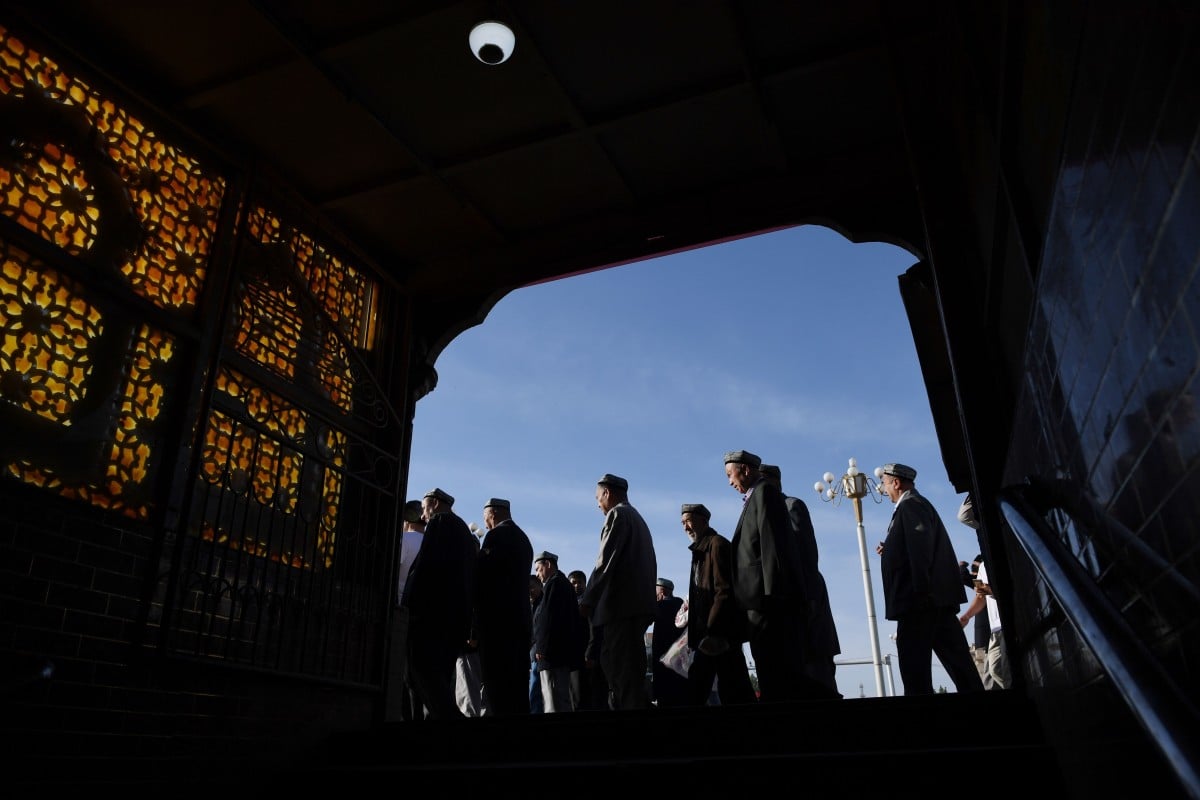
Worshippers leave a mosque in Kasghar after prayers on Wednesday. Photo: AFP
The corner where Heyitkah mosque in China’s far western region of Xinjiang once hummed with life is now a car park where all traces of the tall, domed building have been erased.
While Muslims around the world celebrated the end of Ramadan with prayers and festivities this week, the recent destruction of dozens of mosques in Xinjiang highlights the increasing pressure Uygurs and other ethnic minorities face in the heavily policed region.
Behind the car park in the city of Hotan, the slogan “Educate the people for the party” is emblazoned in red on the wall of a primary school where students must scan their faces upon entering the razor-wired gates.
The mosque “was beautiful,” recalled a vendor at a nearby bazaar. “There were a lot of people there.”
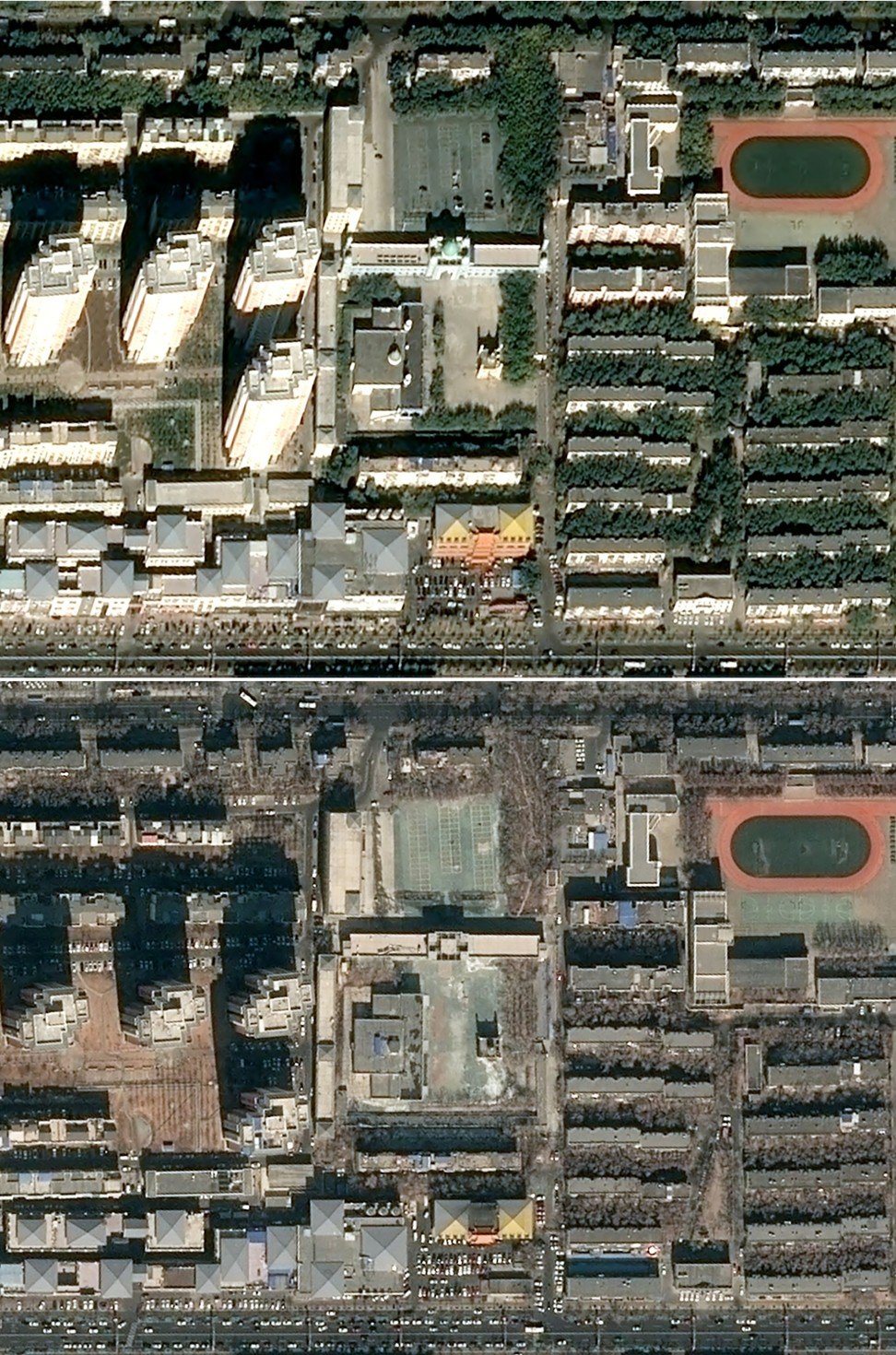
Satellite images reviewed by AFP and visual analysis non-profit Earthrise Alliance show that 36 mosques and religious sites have been torn down or had their domes and corner spires removed since 2017.
Satellite images from 2014 (top) and March this year show the disappearance of the dome of the Karamay West Mosque in Xinjiang. Photo: AFP/ Distribution Airbus Defence and Space/ CNES 2019/ Produced By Earthrise
In the mosques that are open, worshippers go through metal detectors while surveillance cameras monitor them inside.
“The situation here is very strict, it takes a toll on my heart,” said one Uygur, who requested anonymity for fear of reprisals. “I don’t go any more,” he added, referring to mosques. “I’m scared.”
In the ancient Silk Road city of Kashgar, no longer does the sunrise call for prayer echo throughout the city – a ritual the manager of the city’s central mosque once proudly shared with touristsOn Wednesday, locals celebrating Eid al-Fitr quietly filed into the entrance of state-approved Idkah Mosque – one of the largest in China – as police and officials fenced off the wide square surrounding the building and plain clothes men monitored every person’s actions.
It was another low-key Ramadan for Muslims in Xinjiang, where restaurants were busy serving food to customers throughout the day, a time when practising Muslims fast.
In Hotan on Friday – a holy day for believers – the only mosque in the city was empty after sundown, an important prayer session when Muslim families typically break their daily Ramadan fast.
Earlier in the day, at least 100 people attended a midday session but the vast majority were elderly men.
Human Rights Watch decodes surveillance app used to classify people in China’s Xinjiang region
The ruling Communist Party “sees religion as this existential threat”, said James Leibold, an expert on ethnic relations and policy in China at La Trobe University.
Over the long term, the Chinese government wants to achieve “the secularisation of Chinese society,” he told AFP.
The Xinjiang government told AFP that it “protects religious freedoms” and citizens can celebrate Ramadan “within the scope permitted by law”, without elaborating.
The authorities have thrown a hi-tech security net across the region, installing cameras, mobile police stations and checkpoints in seemingly every street in response to a spate of deadly attacks blamed on Islamic extremists and separatists in recent years.
An estimated one million Uygurs and other Turkic-speaking ethnic groups are held in a vast network of internment camps.
After initially denying their existence, Chinese authorities last year acknowledged that they run “vocational education centres” aimed at steering people clear of religious extremism by teaching them Mandarin and China’s laws.
In those centres, it was a different Ramadan.
The Xinjiang government told AFP that people in the centres are not allowed to hold religious activities because Chinese law forbids it within education facilities, but they are free to do so “when they return home on weekends”.
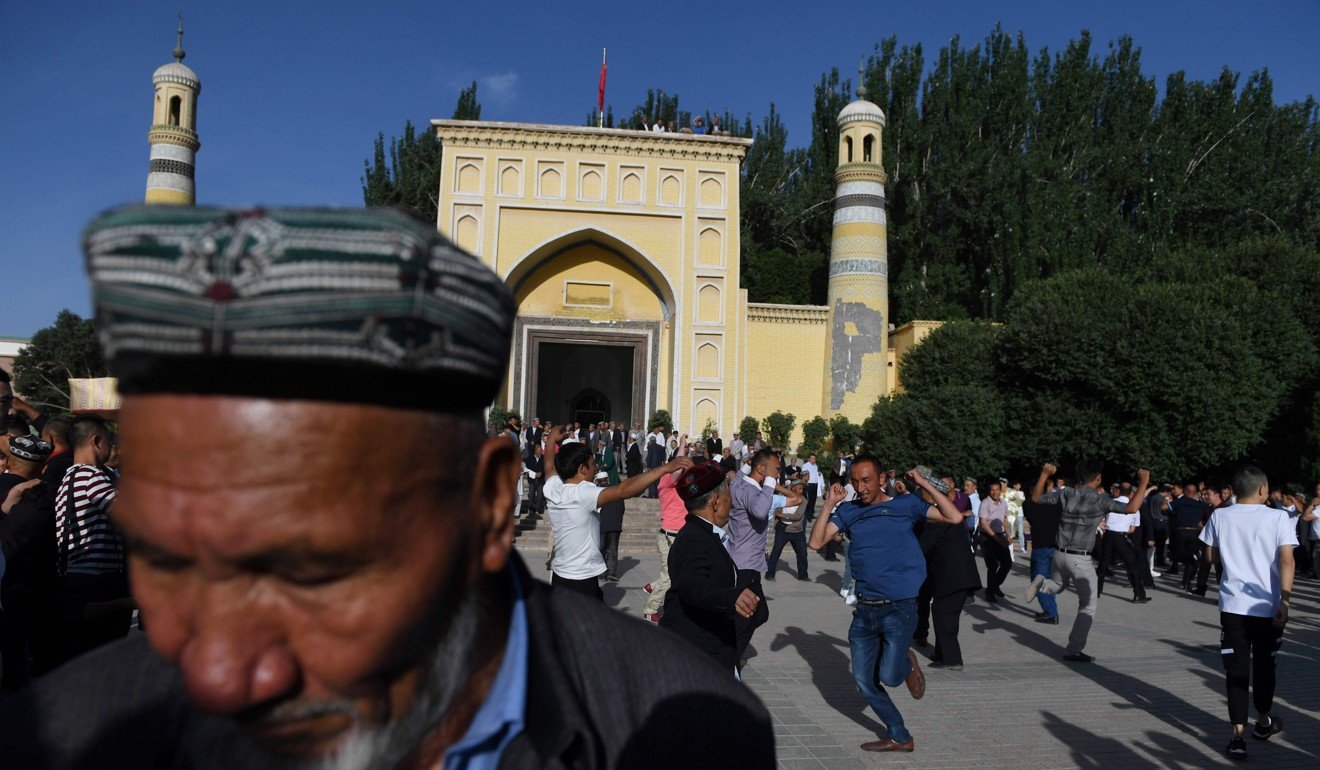
Uygur men dance after Eid al-Fitr prayers in Kashgar. Photo: Greg Baker/ AFP
In recent years, Chinese authorities have ramped up controls on public displays of religion and Islamic traditions in Xinjiang.
AFP reporters did not see any veiled women and few men sporting long beards during a week-long visit to the region. Former internment camp inmates have said they were incarcerated for these outward signs of their religion.
Places of worship too have become targets of Beijing’s draconian security measures.
Human Rights Watch decodes surveillance app used to classify people in China’s Xinjiang region
In the satellite images analysed by AFP and Earthrise Alliance, 30 religious sites were completely demolished while six had their domes and corner spires removed.
AFP reporters visited about half a dozen sites, and found that some mosques had been repurposed into public spaces.
Police officers blocked journalists from entering Artux, just north of Kashgar, where the town’s grand mosque and dozens of other community mosques were destroyed.
The area is some 22 kilometres (14 miles) away from an enormous complex believed to be a re-education centre. Visible from a nearby village, the facility has razor-wired walls, watchtowers and imposing block buildings.In Kashgar, two cameras perched on the columns of a former mosque point at its entrance. There is no minaret or dome – instead, a shop selling dresses lies to its right alongside houses.
A demolished mosque in Hotan has been converted into a garden, paved with concrete walkways and sparsely planted trees.
On the outskirts of town, situated between a cemetery and sand dunes, two white flags and a pile of burned refuse and debris was all that was left of an old shrine named Imam Asim.
China’s top Xinjiang official Chen Quanguo should face sanctions over alleged abuses, US lawmakers say
Uygurs consider these mosques and shrines “their ancestral heritage,” said Omer Kanat, director of the Uygur Human Rights Project.
“The Chinese government just wants to erase everything … that is different from Han, everything which belongs to Uygur culture or Islamic culture in the region,” he said.
Juma Maimaiti, the official imam of Idkah Mosque, told AFP in an interview arranged by the propaganda department that the demolition of mosques “has never happened here”.
“But our government has proceeded to protect some key mosques,” he added, and said that the city of Kashgar has over 150 mosques.
A propaganda slogan and surveillance camera at a mosque in Yangisar, south of Kashgar. Photo: AFP
Though Beijing’s restrictions on religious piety, such as fasting, are not new, observers say conditions have deteriorated to the point where celebrations for the holy month in Xinjiang are reduced or largely invisible.
Islamic greetings and openly fasting in public are no longer permitted, said Darren Byler, a lecturer at the University of Washington who focuses on Uygur culture.
While there are Uygurs who continue to practise their faith, they are “internalising it at this moment – they’re not expressing it openly,” he said.
EU calls out Beijing on human rights but activists want harder line against China’s Xinjiang and Tibet policy
At state-backed mosques, religious activity is controlled as Beijing pursues a five-year plan to “Sinicise” Islam as the “only way for a healthy development of Islam” in the country, said Yang Faming, president.
Source: SCMP
Posted in Artux, Beijing, chinese government, Chinese Society, dome, draconian security measures, Earthrise Alliance, Eid al-Fitr prayers, Eid celebrations, Heyitkah mosque, Hotan, Human Rights Watch (HRW), Idkah Mosque, Kasghar, minaret, Mosque, Muslims, Ramadan, secularisation, Silk Road, Turkic-speaking ethnic groups, Uncategorized, Uygur Human Rights Project, Uygurs, vanishing mosques, Xinjiang |
Leave a Comment »