Posts tagged ‘China’

28/06/2013

Death toll from Xinjiang attacks rises to 35

SCMP: “Beijing yesterday raised the death toll from a series of attacks in Turpan , Xinjiang , on Wednesday from 27 to 35.

e22b4f2d9201a0f19cff5f0782b8ea82.jpg

Twenty-four were killed by rioters, including two policemen, Xinhua said, adding that 16 of them were Uygurs. Police killed 11 rioters, while 21 police officers and civilians were injured.

Xinhua said an unspecified number of “mobsters” stormed the government office, the police station, the People’s Armed Police base and a construction site in Lukqun township, Shanshan county, at around 5.50am on Wednesday. The authorities did not mention that a PAP base was also among the targets of attacks until yesterday.

It said four suspected rioters who were injured had been detained.

It was the first Chinese-language report on the incident released by Xinhua, which carried an English report roughly seven hours after the attacks.

Neither report mentioned the number of attackers, their ethnicity or what caused the attacks. But yesterday’s report branded the incident a “violent terrorist attack”.

A visitor to Turpan yesterday said he saw a roadblock with armed police officers and about 20 police vehicles.

A resident said a helicopter arrived on the scene along with many police and soldiers.

The Global Times, a tabloid affiliated with the People’s Daily, yesterday quoted an unnamed regional official as saying that “earlier this year local police handled a case in which a store was attacked, which might have triggered that violence”.

The attack came less than two weeks ahead of the fourth anniversary of ethnic clashes between Han Chinese and Uygurs in Urumqi , the regional capital, which left nearly 200 dead. Two months ago, 15 policemen or officials and six assailants were killed in another conflict in Bachu county, Kashgar , which involved attackers armed with knives and axes and the burning of a house.

A Lukqun resident told the South China Morning Post by phone that local officials had told people to stay at home and be vigilant soon after the violence on Wednesday, adding that dozens of militia soldiers from his village were patrolling the streets.

It was the deadliest unrest in the region since the media-savvy Zhang Chunxian became regional party secretary in April 2010, less than a year after the bloody clashes in Urumqi.”

via Death toll from Xinjiang attacks rises to 35 | South China Morning Post.

See also:

28/06/2013

Confrontation over the South China Sea ‘doomed’, China tells claimants

Reuters: “Countries with territorial claims in the South China Sea that look for help from third parties will find their efforts “futile”, China’s Foreign Minister Wang Yi warned on Thursday, adding that the path of confrontation would be “doomed”.

PRC foreign minister Wang Yi

Beijing’s assertion of sovereignty over a vast stretch of the South China Sea has set it directly against Vietnam and the Philippines, while Brunei, Taiwan and Malaysia also lay claim to other parts of the sea, making it Asia’s biggest potential military troublespot.

At stake are potentially massive offshore oil reserves. The seas also lie on shipping lanes and fishing grounds.

Wang didn’t name any third countries, but the United States is a close ally of Taiwan and the Philippines, and has good or improving relations with the other nations laying claim to all or part of the South China Sea.

“If certain claimant countries choose confrontation, that path will be doomed,” Wang said after a speech at the annual Tsinghua World Peace Forum.

“If such countries try to reinforce their poorly grounded claims through the help of external forces, that will be futile and will eventually prove to be a strategic miscalculation not worth the effort.”

The Philippine military said this week it had revived plans to build new air and naval bases at Subic Bay, a former U.S. naval base that American forces could use to counter China’s creeping presence in the South China Sea.

Wang’s comments came days before the minister is due to attend a meeting of foreign ministers of the Association of Southeast Asian Nations grouping in Brunei from Saturday to Tuesday.

The 10-member ASEAN hopes to reach a legally binding Code of Conduct to manage maritime conduct in disputed areas. For now a watered-down “Declaration of Conduct” is in place.

The path to a Code of Conduct will be slow and deliberate, Wang said, adding that the Declaration of Conduct was a commitment made by China and the 10 ASEAN countries and China would continue to abide by it.

“The right way is to fully implement the Declaration, and in this process, move forward with the Code in a gradual way,” Wang said.”

via Confrontation over the South China Sea ‘doomed’, China tells claimants | Reuters.

See also:

28/06/2013

Exposure via internet now China’s top weapon in war on graft

SCMP: “The internet has become the primary tool for exposing corruption on the mainland, “removing a corrupt official with the click of a mouse”, according to a leading think tank’s analysis.

internet_pek06_35887719.jpg

In its Blue Book of New Media, researchers from the Chinese Academy of Social Sciences (CASS) said that 156 corruption cases between 2010 and last year were first brought to light online – compared with 78 cases to resulting from reports in traditional media.

Forty-four cases involving disciplinary violations were first exposed in some form online, while 29 cases followed print and broadcast stories. Sixteen cases citing abuses of power were exposed online; 10 were revealed in traditional media.

Among the latest officials to fall from grace thanks to online revelations was Liu Tienan , a former deputy chief of the National Development and Reform Commission.

Liu was sacked in mid-May, more than five months after an editor of the influential Caijing magazine used his microblog account to expose allegations against him.

The report said revelations online, and the rise in interest in public affairs the internet had engendered, were the main reasons more people were participating in anti-corruption efforts.

However, the report cautioned that such efforts still had a long way to go. Only five officials of above departmental rank were brought down via online exposures last year – just a fraction of the 950 officials of that level who were probed for crimes.

The mainland had 564 million internet users at the end of last year, including 309 million microbloggers, according to the China Internet Network Information Centre. The Blue Book said the online community would likely exceed 600 million this year.

The new-media boom has posed an unprecedented challenge to Communist Party rulers, experts warned, due to the easy spread of information, including rumours. The report blamed the online rumour mill on governments’ declining credibility and growing concern on the part of the public.”

via Exposure via internet now China’s top weapon in war on graft | South China Morning Post.

See also: https://chindia-alert.org/2012/04/26/understanding-social-media-in-china/

26/06/2013

College Grads: The PLA Wants You!

BusinessWeek: “Over the past decade, China has invested significantly in higher education—and roughly quadrupled the number of students graduating college annually, to about 7 million. Unfortunately, demand for diploma-holders in China hasn’t kept pace, and the bleak job prospects of the class of 2013 are a frequent source of lament on Weibo, China’s Twitter. Even the state-run Global Times newspaper, usually known for patriotic boosterism, recently printed a depressing chart suggesting that the number of available new positions for graduates has actually been declining.

Delegates from Chinese People's Liberation Army pose for photos outside the Great Hall of the People

One institution is expanding its efforts to recruit college graduates: the People’s Liberation Army. The Beijing News has reported on a change in hiring policy that took effect on June 24. In addition to increased financial compensation, army recruits who have graduated from universities in Beijing will be eligible for permanent Beijing residence cards, called hukous, after they complete their tours of duty and find other jobs in the city. The sought-after hukou is required to purchase an apartment or send children to school in Beijing—in short, to set down permanent roots in the city. In recent years the government has been allocating fewer new hukous for private employers to grant employees in China’s over-crowded capital.

The PLA is aiming to upgrade the caliber of recruits. “Many of the skills and specialties that the PLA needs can only be obtained by attracting civilian college graduates,” says Andrew Scobell, an expert on China’s military at RAND. While joining the army has long been an appealing option for rural students with limited schooling or career choices, it’s been a hard sell among educated urbanites. “The PLA continues to have a tough time attracting well-educated recruits with skills the military needs,” says Scobell. “These new [hiring] policies underscore this ongoing challenge” and also “take advantage of the opportunities presented by the tougher job market for college graduates.”

Beijing is home to China’s leading universities, including Peking University and Tsinghua University—often dubbed the Harvard and MIT of China, respectively. Whether or not the PLA’s recruitment policy will be extended to students in other cities remains to be seen.

via College Grads: The PLA Wants You! – Businessweek.

See also: https://chindia-alert.org/2013/02/10/as-graduates-rise-in-china-office-jobs-fail-to-keep-up/

26/06/2013

Chinese Leader Xi Jinping’s Rare Scolding of Top Communist Party Leaders

WSJ: “After telling the lower ranks of the Communist Party to shape up and make a clean break from past practice, Chinese leader Xi Jinping has taken aim at a new target:  the Party leadership itself.

And he’s done so with authority and openness from the highest pulpit of politics in China–the Politburo, the very place where the senior leaders sit and make policy.

In a speech at the conclusion of a three-day special meeting that was covered across Party media and took up nearly half of the evening newscast on Tuesday evening, Xi proclaimed that senior members of the Party needed “to play an exemplary role,” and that they had to be “broad-minded enough to reject any selfishness…to adhere to self-respect, self-examination and self-admonition” in their work (in Chinese).

It’s extremely rare for Politburo proceedings to be spoken of in such detail and openness.  And it’s unprecedented in modern times for the Party boss to start taking swings at his colleagues at the top by so directly reminding them of their responsibilities—a move that suggests he might be planning something even stronger soon.

Having just admonished lower-level cadres in a salvo last week, some observers might think that Xi is simply putting on a show here. After all, it’s difficult to demand improvement in the work-styles of the rank and file without at least paying lip-service to the idea that those at the top could stand to do a little better themselves.

But the tone of Xi’s comments and the play they’ve received in the state media suggest this is far more than just rhetorical window dressing.  It wasn’t enough for high officials to “strictly abide by party discipline and act in strict accordance with policies and procedures,” Xi said. Those at the top must also “strictly manage their relatives and their staff and refrain from abuse of power.”

“The sole pursuit” of senior members of the Party, Xi insisted, should be tied to “the Party’s cause and interests” – in other words, “to seek benefits for the Chinese people as a whole.”

Whether it’s misuse of official license plates or the high-end looting of state assets (in Chinese), Xi knows that corruption is not always confined to lower-level cadres.

Xi was careful to concede that there have been some positive developments in the ways by which the Politburo and other Party bodies operate, such as “improvements in research and reporting.”  Meetings have been shortened and presentations streamlined, “enhancing the majority of party members’ and cadres’ sense of purpose, as well as the view of the masses” towards the Party leadership, he noted.

But it’s clearly morality at the top — not the way that decisions are made — that concerns Xi and his allies the most.   As Xi’s speech noted, “as long as Politburo comrades always and everywhere set an example, they can continue to call the shots, for that will have a strong demonstration effect, and the Party will be very powerful.”

via Chinese Leader Xi Jinping’s Rare Scolding of Top Communist Party Leaders – China Real Time Report – WSJ.

26/06/2013

Violence in China’s Xinjiang ‘kills 27’

BBC: “Riots have killed 27 people in China’s restive far western region of Xinjiang, Chinese state media report.

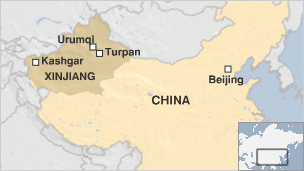
Map

The violence broke out in Turpan prefecture early on Wednesday.

Police opened fire after a mob armed with knives attacked police stations and a local government building, Xinhua news agency quoted officials as saying.

There are sporadic outbreaks of violence in Xinjiang, where there are ethnic tensions between Muslim Uighur and Han Chinese communities.

Confirming reports from the region is difficult because information is tightly controlled.

China’s state media have been quick to issue an official version of events regarding the latest round of violence in Xinjiang, but it will be tough to verify those reports.

Xinjiang lies on China’s remote north-west border and it is difficult for foreign media to travel there. Many people on both sides of the conflict are reluctant to speak to visiting journalists for fear of reprisals if they dispute the government’s stance.

Unfortunately Xinjiang usually hits international headlines when violence flares between the region’s minority ethnic Uighur Muslims and the majority Han Chinese. Many Uighurs contend that their language and religion are being smothered by an influx of Han Chinese migrants.

Xinjiang is a large geographic area rich in oil and gas deposits. Soon it will also become a major supplier of coal to China’s energy-hungry cities. The region’s fertile land also grows produce that is shipped to the rest of the country. The Han Chinese who move to Xinjiang hope to benefit from the region’s untapped resources.

The violence occurred in Turpan‘s remote township of Lukqun, about 200km (120 miles) south-east of the region’s capital, Urumqi.

The Xinhua news agency report, citing local officials, said rioters stabbed people and set police cars alight.

Seventeen people, including nine security personnel and eight civilians, were killed before police shot dead 10 of the rioters, it said.

At least three others were injured and were being treated in hospital, it added.

The Xinhua report did not provide any information on the ethnicity of those involved in the riot or on what sparked it.

But Dilxat Raxit, a spokesperson for the World Uighur Congress, an umbrella organisation of Uighur groups, told the Associated Press news agency the violence had been caused by the Chinese government’s “sustained repression and provocation” of the Uighur community.

In 2009 almost 200 people – mostly Han Chinese – were killed after deadly rioting erupted in Urumqi between the Han Chinese and Uighur communities.

In April an incident in the city of Kashgar left 21 people dead.

Uighurs and Xinjiang

Uighurs are ethnically Turkic Muslims. They make up about 45% of the region’s population; 40% are Han Chinese

China re-established control in 1949 after crushing short-lived state of East Turkestan. Since then, large-scale immigration of Han Chinese. Uighurs fear erosion of traditional culture.

The government said the violence began when “terrorists” were discovered in a building by officials searching for weapons.

But local people told the BBC that the violence involved a local family who had a longstanding dispute with officials who had been pressurising the men to shave off their beards and the women to take off their veils.

Uighurs make up about 45% of Xinjiang’s population, but say an influx of Han Chinese residents has marginalised their traditional culture.”

via BBC News – Violence in China’s Xinjiang ‘kills 27’.

See also: https://chindia-alert.org/political-factors/chinese-tensions/

22/06/2013

Russia, China sign ‘unprecedented’ $270 bn oil deal

Fox News: “Russian oil giant Rosneft and Chinese state firm CNPC signed Friday a $270 billion deal to supply China with oil over 25 years as Russian President Vladimir Putin pushes to diversify the country’s energy customer base away from Europe.

photo_1371814073854-2-HD.jpg

The agreement between Russia, the world’s largest energy producer and China, the world’s largest energy consumer — one of the biggest deals in the history of world oil industry — was signed by Rosneft chief executive Igor Sechin and CNPC head Zhou Jiping in the presence of Putin.

“An estimated value of the contract in current market parameters is absolutely unprecedented — 270 billion dollars,” Putin said in a speech to investors at the annual Saint Petersburg International Economic Forum after overseeing the signing of the deal together with visiting Chinese Vice Premier Zhang Gaoli.

Under the deal, the heavily-indebted Rosneft is slated to receive an upfront payment of around $70 billion, Putin said.

Under another deal, CNPC will acquire 20 percent in an Arctic liquified natural gas project in which France’s Total has 20 percent and Russian independent gas firm Novatek holds the rest.

Putin has made a priority of stabilising Russia’s sometimes prickly relations with its giant eastern neighbour at a time when its ties with the West are becoming ever more problematic.

Russia wants to diversify its base of energy customers away from crisis-hit Europe and is aware it has not fully exploited the colossal potential of Asian markets, China in particular.

“Consumption will be growing in China. And in Japan consumption will be growing, too,” Putin said. By contrast, he added: “Europe is going through some certain difficulties.””

via Russia, China sign ‘unprecedented’ $270 bn oil deal | Fox News.

21/06/2013

4.7-trillion-yuan plan to double mainland road network by 2030

SCMP: “Central government earmarks 4.7 trillion yuan for upgrading and extending roads, giving the country 400,000km of highway by 2030

shenzhen_international_toll_roads_4634887.jpg Newspapers suggest 4.7-trillion-yuan plan to double mainland road network by 2030

The mainland will spend 4.7 trillion yuan (HK$5.9 trillion) in the next 17 years to more than double its network of major roads, top transport officials said yesterday.

Dai Dongchang , chief planner with the Ministry of Transport‘s general planning department, told a press conference that a recently approved blueprint for road expansion included 50,000 kilometres of toll highways and 160,000 kilometres of toll-free “national trunk ways”, which are narrower and have slower top speeds.

The mainland has 173,000 kilometres of the two kinds of road at present and the plan approved by the State Council last month says that should rise to 400,000 kilometres by 2030.

By then, toll-free trunk ways should connect all counties, Dai said, while highways should connect all cities with populations of more than 200,000, as well as important transport junctions and border ports.

Huang Min , head of the National Development and Reform Commission‘s basic industry department, said 18 cities of more than 200,000 lacked highway links at present, while more than 900 counties were not connected to national trunk ways.

The new highways would include two north-south routes in the nation’s west, Huang said, with many of the 900 counties expecting new trunk ways also located in the west.

The mainland now had about 110 million private vehicles, 60 times the number in 1981, when the plan for the existing road system was drafted, he said.

Dai said the volume of goods carried on mainland roads was 3.7 times the volume carried on United States’ roads and was expected to at least double by 2030, along with the number of passenger vehicles.

He said China had previously paid more attention to the construction of highways and small roads in the countryside, leading to sluggish development and poor maintenance of trunk ways.

The blueprint forecasts a total of 5.8 million kilometres of roads on the mainland by 2030 – 84 per cent countryside roads, 9 per cent provincial roads and 7 per cent highways and trunk ways.”

via 4.7-trillion-yuan plan to double mainland road network by 2030 | South China Morning Post.

See also: https://chindia-alert.org/economic-factors/chinas-infrastructure/

21/06/2013

China’s Manufacturers Seek Ways to Cut Costs

Wage inflation and shortage of skilled labour is making outsourcing less easy to justify.

BusinessWeek: “In the southern Chinese city of Zhuhai, two hours by ferry and car from Hong Kong, there’s something new on the rooftop of the large factory complex owned by outsourcing specialist Flextronics International (FLEX): solar panels.

A worker on a communications equipment assembly line in Shenzhen, China

Flextronics first opened shop in Zhuhai in 1999, when the area was a backwater compared with Shenzhen and other industrial hot spots closer to Hong Kong. Today the company’s 50,000 Zhuhai workers produce Microsoft (MSFT) Xbox game consoles, Hewlett-Packard (HPQ) printers, Nike+ (NKE) FuelBands and other electronics. With wages rising quickly throughout Guangdong province along the coast, Flextronics managers must save money wherever they can. “Instead of paying the electric company, I’m able to generate my own electricity,” says Melinda Chong, general manager in charge of infrastructure operations.

A little savings here, a little there—that’s the new focus for multinationals that manufacture in the Pearl River Delta and other coastal export hubs. The country’s one-child policy is taking its toll. The number of working-age Chinese in 2012 fell by 3.45 million, to 937.27 million, according to the National Bureau of Statistics. While that’s just a small drop, it’s the first decline since record-keeping began and marks “the start of a trend expected to accelerate in the next two decades,” the Hong Kong-based China Labour Bulletin wrote in a June 11 report. “China no longer has an inexhaustible supply of young workers.”

China’s government is also mandating big raises: In 2012, 25 provinces increased the minimum wage by an average of 20.2 percent. The current five-year plan ending in 2015 calls for base wages to increase by an average 13 percent a year, part of a policy to address growing income inequality. Coping with mandated wage increases is “very tough,” says Carmen Lau, Asia vice president of human resources for Flextronics. Even when companies offer higher wages, they still find it difficult to hire workers since fewer young people are interested in toiling on factory floors. “We have a smaller and smaller pool” of potential recruits, Lau says.

Some of the biggest electronics manufacturers have relocated to other parts of China where workers are more plentiful and there’s space to grow. “They can’t get land in the Shenzhen area, so they have to be somewhere else,” says Cynthia Meng, an analyst in Hong Kong with Jefferies (JEF). Foxconn Technology (2354), the Taiwan-based maker of iPads and iPhones for Apple (AAPL), has expanded away from the coastal regions. There are 250,000 to 300,000 workers at a Foxconn plant in Zhengzhou in the central province of Henan, according to the company and Bloomberg Industries. Hiring in the interior has helped the manufacturer boost its workforce in China by 50 percent in two years, to 1.2 million.

Wages are going up in the interior, too. “The cost differential is merging very, very fast,” says Jitendra Waral, a Bloomberg Industries analyst in Hong Kong. “If you move inland, it’s not really saving you costs any which way.””

via China’s Manufacturers Seek Ways to Cut Costs – Businessweek.

See also:

21/06/2013

Tibet policy: Bold new proposals

Finally some one with a new idea for Tibet. Hopefully some progress will be made.

The Economist: “FEW outside China think the Communist Party’s strategy for Tibet is working. A combination of economic development and political repression was meant to reconcile Tibetans to Chinese rule and wean them off their loyalty to the Dalai Lama, the exiled spiritual leader. Instead disaffection is still rife, especially among the young. And all across Tibetan areas of China, Tibetans still display the Dalai Lama’s portrait, sometimes openly. Since March 2011 more than 100 Tibetans—especially in Tibetan areas of provinces bordering what China calls the Tibet Autonomous Region (TAR)—have set themselves on fire. Most have done so in part to call for the Dalai Lama’s homecoming. An overwhelming security presence and the Dalai Lama’s commitment to non-violence mean that the unrest is easily contained. Hence little has suggested that China’s leaders are concerned about the bleak implications for the future: that their rule in Tibet can be maintained only by the indefinite deployment of massive coercive force.

So for a Chinese scholar, Jin Wei, who is director of ethnic and religious studies at the Central Party School in Beijing, to call for a “creative” new approach is startling. For her to do so publicly, in an interview this month with a Hong Kong magazine, Asia Weekly, suggests that she has high-level backing. A report from a Beijing think-tank in 2009 challenged the official line that rioting in Tibet the year before was instigated from abroad. But Robert Barnett, a professor of Tibetan studies at Columbia University in New York, describes Ms Jin’s intervention as a sign that, after two decades, “debate has re-emerged within China about the government’s hard-line policies in Tibet”. Ms Jin even accused former party chiefs in Tibet of being “biased against the practice of religious affairs”. This, she said, “foreshadowed the accumulation of grievances today.”

Bold new proposals

One former party secretary in Tibet (from 1988-92) was Hu Jintao, who went on to head the party nationally for ten years until last November, when he gave way to Xi Jinping. Those who have forecast that Mr Xi might prove a bolder reformer than the cautious Mr Hu have so far seen little to back them up. Here, on Tibet, is at least a hint of a crack in the hardline consensus. Some have detected another in the appointment of Yu Zhengsheng to head the party’s main policy group on Tibet and Xinjiang, a Muslim-majority region in the north-west. Mr Yu is the head of an advisory body designed to promote national unity. Previous heads of the group have been security specialists.

This is new

Ms Jin’s analysis, though couched in the terminology of party orthodoxy, is similar to that of many foreign observers. She argues that, by demonising the Dalai Lama, and viewing any expression of Tibetan culture as potentially subversive, the party has turned even those Tibetans sympathetic to its aims against it. The struggle has evolved from “a contradiction between the central government and the Dalai Lama separatist clique into an ethnic conflict between Han Chinese and Tibetans”.

She is not advocating a new soft approach to “political” issues, such as the Dalai Lama’s call for greater autonomy for Tibet and Tibetans’ hankering after a “greater Tibet”—ie, within its historic borders, beyond the TAR. But in fact, most protests in Tibet are not about “politics”, defined like this. Many have been sparked by anger at Chinese repression—of Tibetan culture, language and tradition, or of individual protesters. It is a vicious circle, made worse by anger at the large-scale immigration into Tibet of Han Chinese.

Ms Jin has ideas on how to break the impasse. Talks with the Dalai Lama’s representatives, stalled since the most recent of nine fruitless rounds in 2010, should resume, she says. They should concentrate on “easy” issues first, setting contentious debate about Tibet’s status to one side for now. China should consider inviting the Dalai Lama to visit one of its semi-autonomous cities, Hong Kong or Macau, and eventually allowing him back to Tibet. It should also try to defuse the crisis his death will bring by agreeing with him on a chosen reincarnation from inside China’s borders. Otherwise, China risks having to deal with two incarnations: one it endorses and one in exile who is more likely to be revered by most Tibetans.”

via Tibet policy: Bold new proposals | The Economist.

Law of Unintended Consequences

continuously updated blog about China & India

ChiaHou's Book Reviews

continuously updated blog about China & India

What's wrong with the world; and its economy

continuously updated blog about China & India