Chindia Alert: You’ll be Living in their World Very Soon
aims to alert you to the threats and opportunities that China and India present. China and India require serious attention; case of ‘hidden dragon and crouching tiger’.
Without this attention, governments, businesses and, indeed, individuals may find themselves at a great disadvantage sooner rather than later.
The POSTs (front webpages) are mainly 'cuttings' from reliable sources, updated continuously.
The PAGEs (see Tabs, above) attempt to make the information more meaningful by putting some structure to the information we have researched and assembled since 2006.
HANGZHOU, May 19 (Xinhua) — Beekeepers in China’s high-tech powerhouse of Zhejiang Province have developed a smart way of using intelligent beehives to revolutionize bee farming.
Over 300 apiculture insiders and experts convened in Chun’an County on Saturday to witness the pilot.
More than 2,600 artificial beehives have been arranged in mountains in the western outskirts of Hangzhou, the provincial capital.
Chen Pinghua, chair of Qiandao Lake Mozhidao Biotechnology Co. Ltd., which operates the bee farm, said the smart hives were installed with sensors at the bottom, which can monitor and regulate the temperature and humidity and send the data on the number of times the bees enter and leave as well as the weight of the hive for technicians to determine whether the honey has matured.
Each hive is also pasted with a unique QR code that traces the source of the honey to ensure food safety, Chen said.
He said staff could open an app on their mobile phones to monitor the real-time data of each hive, which greatly improves efficiency.
Saturday coincided with World Honey Bee Day designated by the United Nations in 2017 to spread awareness on the significance of bees, which pollinate one-third of the world’s grain-producing plants.
“Beekeeping has a long history in China, but it has remained as a very low-end business without standards for hives and on how bees are raised and how honey is harvested,” said Yang Yibo, deputy secretary-general of the Eco-Apiculture Committee of the China Association for the Promotion of Quality.
He said the smart hive system had significance in digitizing the information of honey sources, bee colonies and beekeepers, and forming visualized big data to help analyze the quality in each procedure.
The annual output of honey in China exceeds 400,000 tonnes, and the country’s output of propolis, bee pollen and beeswax rank first in the world. More than 300,000 people are employed in the business.
Wang Fuchun, a veteran bee farmer in Chun’an, said with the high-tech bee farming, a hive could produce more than 30 kg of honey a year, almost quadrupling the amount produced in the traditional way.
The company plans to put 10,000 more smart hives in the mountain region this year.
Workers process components at a construction industrial research and production base in Lianjiang County, southeast China’s Fujian Province, May 17, 2019. Chinese economy is transitioning from high-speed growth to high-quality development. (Xinhua/Song Weiwei)
BEIJING, May 19 (Xinhua) — China will launch mass activities to celebrate the 70th anniversary of the founding of the People’s Republic of China (PRC).
The activities will take multiple forms across the country with patriotism at the core, according to a circular jointly issued by the General Office of the Communist Party of China Central Committee and the General Office of the State Council.
The activities will include touring urban and rural areas to fathom changes in the country, story-telling by citizens about endeavors to realize their dreams, thematic book reading, cherishing the memory of revolutionary martyrs, and national defense education activities, according to the circular.
The slogans of the 70th anniversary celebration were also unveiled in the circular.
China produces 90 per cent of the world’s rare earth minerals, used in hi-tech production such as electric vehicles
Rare earth minerals one of the few goods not hit by incoming US tariffs on US$300 billion of Chinese goods as trade war escalates
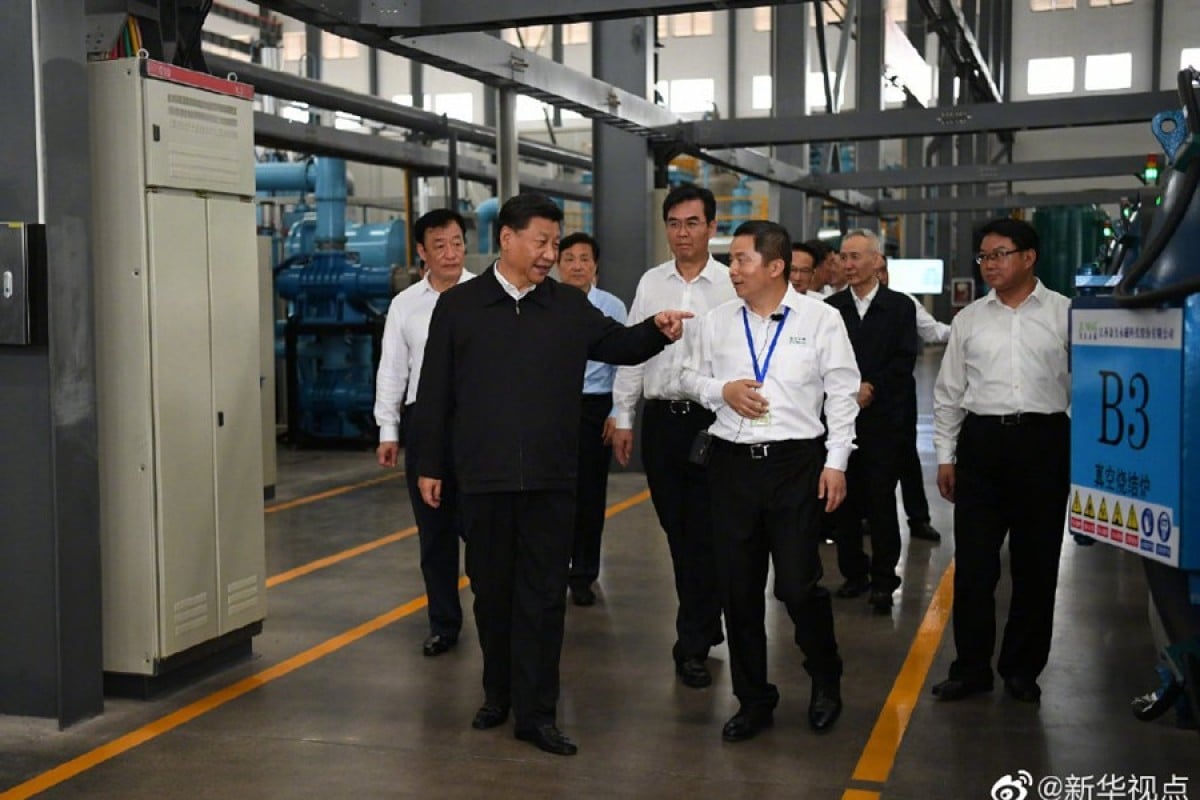
President Xi Jinping paid a visit to the country’s rare earth mining base in Jiangxi province on Monday, according to the official Xinhua news agency, in his first domestic tour after the trade talks between Beijing and Washington ended without a deal. Photo: Xinhua
Chinese President Xi Jinping visited one of the country’s major rare earth mining and processing facilities on Monday, in his first domestic tour since the
Xi’s visit, reported by the official Xinhua news agency, comes amid growing discussion in China that Beijing could consider banning the export of such minerals as a weapon
Rare earth minerals were among the few items excluded from the latest US government plans to implement tariffs on almost all of China’s remaining exports to the United States, highlighting their strategic importance. These tariffs, which are set to be levied on Chinese goods worth an estimated US$300 billion,
as early as July, according to the Office of the US Trade Representative.
The state media report, which includes one sentence of text and two pictures, made no mention of the trade war, but speculation is mounting that rare earth minerals could form a key part of China’s retaliation.
China is the world’s largest producer and exporter of rare earth minerals, which contain at least one of the 17 rare earth elements, many of which are vital to a number of low-carbon technologies, such as high-performance magnets and electronics. Photo: Xinhua
China is the world’s largest producer and exporter of rare earth minerals, which contain at least one of the 17 rare earth elements, many of which are vital to a number of low-carbon technologies, such as high-performance magnets and electronics.
It accounts for 90 per cent of global production, however the government has been carefully managing mining levels and it was reported last year that amid production quotas, the country became a net importer of rare earth minerals last year.
Jin Canrong, a professor of international relations at Renmin University in Beijing, wrote an article last week suggesting that China could ban rare earth exports to the US as a way to punish the US for
. China does not import enough goods from the US to retaliate in pure tariff terms.
The Chinese government has weaponised the trade of rare earth exports before, slashing the export quota by 40 per cent in 2010. The US, Japan and the European Union filed a compliant against the Chinese quota at the World Trade Organisation in 2012, with the WTO ruling against China. Beijing dropped its export restrictions in 2015.
According to the report, Xi visited JL Mag Rare Earth Co, a major rare earth processing company based in Ganzhou, Jiangxi province and “studied” the local rare earth industry. Ganzhou is the heartland of China’s rare earth mining and processing industry.
Xi was accompanied by vice-premier Liu He, who has been China’s top trade negotiator in the long-running talks with the US and who is Xi’s most trusted economic adviser. Also on the trip was a delegation of company officials and local cadres.
JL Mag is a leading supplier of high-performance rare earth magnets, which are widely used in intelligent manufacturing operations, energy-saving applications, and in the production of robots and new energy vehicles, according to the company’s website.
Images of Xi’s trip show a sign saying that the company is trying to build up “a rare metal industry base of tungsten with strong international competitiveness”.
Banning rate earth exports to the US is one of several ideas percolating in Chinese public discussions of possible trade war
Other analysts have suggested that China could sell its $3 trillion stockpile of US dollar-denominated securities, or allowing the yuan exchange rate to depreciate significantly, which would make Chinese exports cheaper for overseas buyers, helping to mitigate the effect of tariffs.
Google has barred the world’s second biggest smartphone maker, Huawei, from some updates to the Android operating system, dealing a blow to the Chinese company.
New designs of Huawei smartphones are set to lose access to some Google apps.
The move comes after the Trump administration added Huawei to a list of companies that American firms cannot trade with unless they have a licence.
Google said it was “complying with the order and reviewing the implications”.
Huawei said it would continue to provide security updates and after sales services to all existing Huawei and Honor smartphone and tablet products covering those have been sold or still in stock globally.
“We will continue to build a safe and sustainable software ecosystem, in order to provide the best experience for all users globally,” it added.
What does this mean for Huawei users?
Existing Huawei smartphone users will be able to update apps and push through security fixes, as well as update Google Play services.
But when Google launches the next version of Android later this year, it may not be available on Huawei devices.
Future Huawei devices may no longer have apps such as YouTube and Maps.
Huawei can still use the version of the Android operating system available through an open source licence.
Ben Wood, from the CCS Insight consultancy, said the move by Google would have “big implications for Huawei’s consumer business”.
What can Huawei do about this?
Last Wednesday, the Trump administration added Huawei to its “entity list“, which bans the company from acquiring technology from US firms without government approval.
In his first comments since the firm was placed on the list, Huawei chief executive Ren Zhengfei told Japanese media on Saturday: “We have already been preparing for this.”
He said the firm, which buys about $67bn (£52.6bn) worth of components each year according to the Nikkei business newspaper, would push ahead with developing its own parts.
Huawei faces a growing backlash from Western countries, led by the US, over possible risks posed by using its products in next-generation 5G mobile networks.
Several countries have raised concerns that Huawei equipment could be used by China for surveillance, allegations the company has vehemently denied.
Huawei has said its work does not pose any threats and that it is independent from the Chinese government.
However, some countries have blocked telecoms companies from using Huawei products in 5G mobile networks.
So far the UK has held back from any formal ban.
“Huawei has been working hard on developing its own App Gallery and other software assets in a similar manner to its work on chipset solutions. There is little doubt these efforts are part of its desire to control its own destiny,” said Mr Wood.
Media caption We explain the controversy around Huawei’s 5G tech – using castles
Short-term damage for Huawei?
By Leo Kelion, BBC Technology desk editor
In the short term, this could be very damaging for Huawei in the West.
Smartphone shoppers would not want an Android phone that lacked access to Google’s Play Store, its virtual assistant or security updates, assuming these are among the services that would be pulled.
In the longer term, though, this might give smartphone vendors in general a reason to seriously consider the need for a viable alternative to Google’s operating system, particularly at a time that the search giant is trying to push its own Pixel brand at their expense.
As far as Huawei is concerned, it appears to have prepared for the eventuality of being cut off from American know-how.
Its smartphones are already powered by its own proprietary processors, and earlier this year its consumer devices chief told German newspaper Die Welt that “we have prepared our own operating systems – that’s our plan B”.
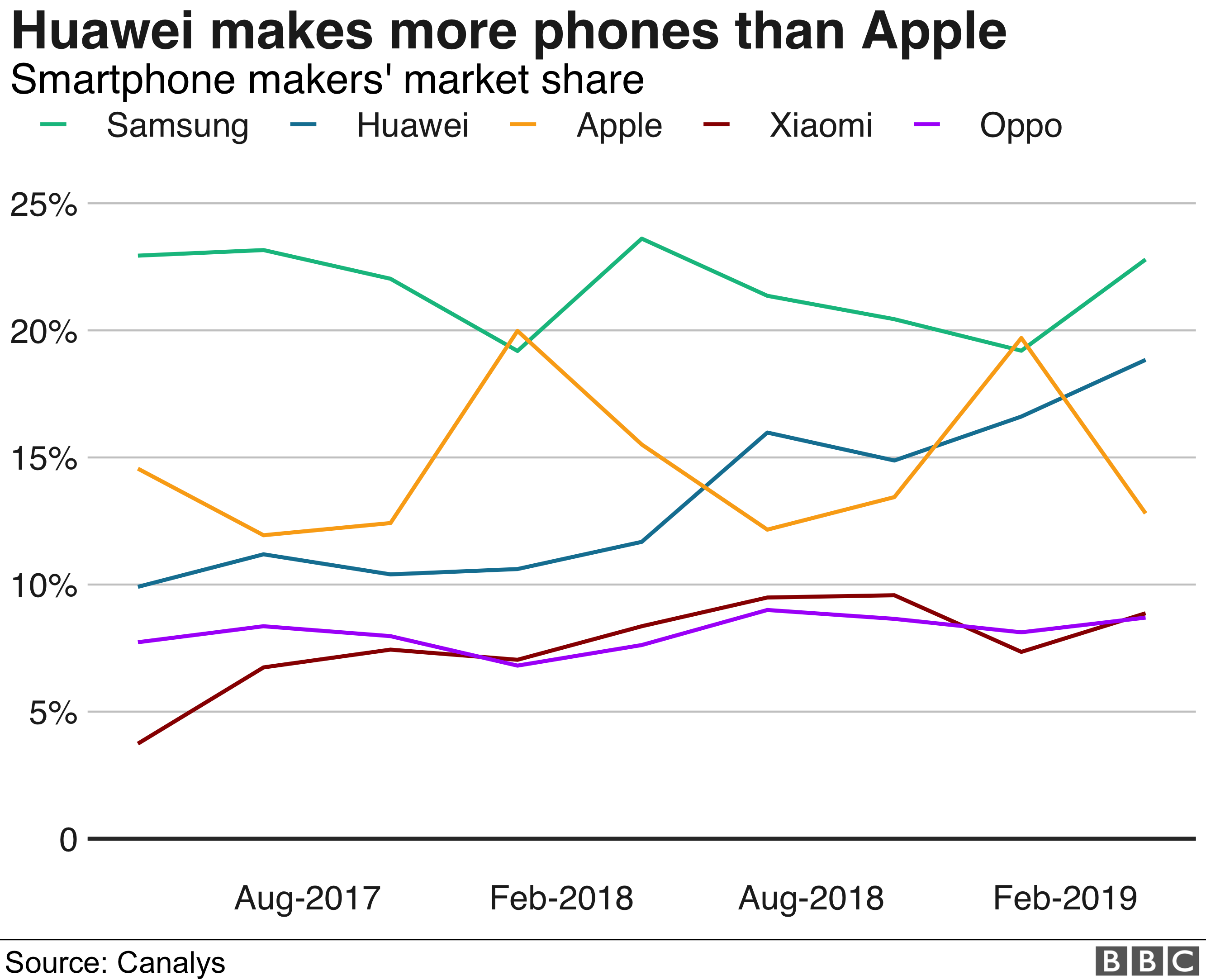
Even so, this move could knock its ambition to overtake Samsung and become the bestselling smartphone brand in 2020 seriously off course.
What about the US-China trade war?
The latest move against Huawei marks an escalation in tensions between the firm and the US.
It comes as trade tensions between the US and China also appear to be rising.
The world’s two largest economies have been locked in a bruising trade battle for the past year that has seen tariffs imposed on billions of dollars worth of one another’s goods.
Earlier this month, Washington more than doubled tariffs on $200bn of Chinese goods, prompting Beijing to retaliate with its own tariff hikes on US products.
The move surprised some – and rattled global markets – as the situation had seemed to be nearing a conclusion.
The US-China trade war has weighed on the global economy over the past year and created uncertainty for businesses and consumers.
WASHINGTON (Reuters) – U.S. Ambassador to China Terry Branstad was due to begin visiting Tibet on Sunday for official meetings and visits to religious and cultural sites, according to a news report on Sunday.
Branstad was scheduled to visit the Tibet Autonomous Region and Qinghai Province, a historic region of Tibet known to Tibetans as Amdo, from Sunday to Saturday, Radio Free Asia said in a report.
RELATED COVERAGE
U.S. Ambassador to China visiting Tibet this week
The State Department did not immediately comment on the story.
Radio Free Asia said it would be the first visit to Tibet by a U.S. official since the U.S. Congress approved a law in December that requires the United States to deny visas to Chinese officials in charge of implementing policies that restrict access to Tibet for foreigners. The U.S. government is required to begin denying visas by the end of this year.
In December, China denounced the United States for passing the law, saying it was “resolutely opposed” to the U.S. legislation on what China considers an internal affair, and it risked causing “serious harm” to their relations.
Since then, tensions have been running high between the two countries over trade. China struck a more aggressive tone in its trade war with the United States on Friday, suggesting a resumption of talks between the world’s two largest economies would be meaningless unless Washington changed course.
On Saturday, China’s senior diplomat Wang Yi told U.S. Secretary of State Mike Pompeo that recent U.S. words and actions had harmed the interests of China and its enterprises, and that Washington should show restraint.
While the Trump administration has taken a tough stance towards China on trade and highlighted security rivalry with Beijing, the administration has so far not acted on congressional calls for it to impose sanctions on China’s former Communist Party chief in Tibet, Chen Quanguo, for the treatment of minority Muslims in Xinjiang province, where he is currently party chief.
A State Department report in March said Chen had replicated in Xinjiang, policies similar to those credited with reducing opposition to Chinese rule in Tibet.
Beijing sent troops into remote, mountainous Tibet in 1950 in what it officially terms a peaceful liberation and has ruled there with an iron fist ever since.
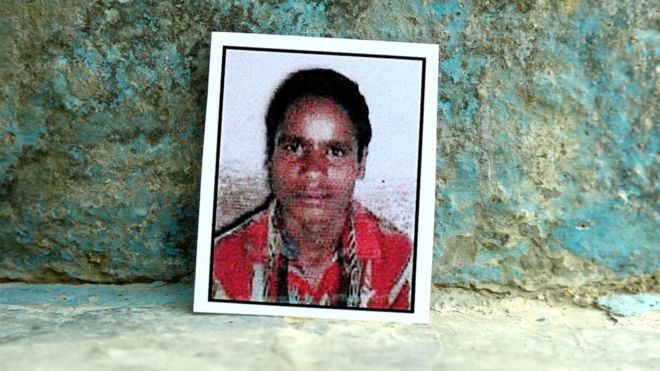
Image caption Jitendra was a carpenter and the only breadwinner in his family
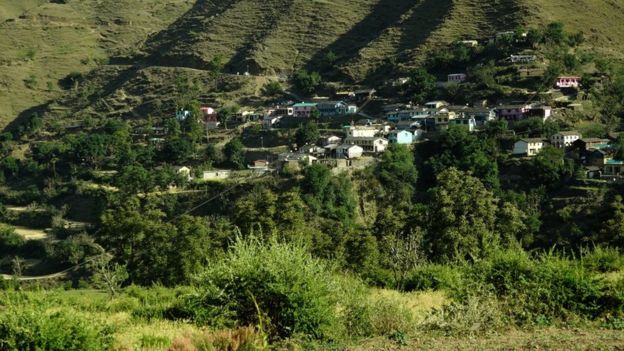
A helpless anger pervades the Dalit community in the remote Indian village of Kot.
Last month, a group of upper-caste men allegedly beat up a 21-year-old Dalit resident, named Jitendra, so badly that he died nine days later.
His alleged crime: he sat on a chair and ate in their presence at a wedding.
Not even one of the hundreds of guests who attended the wedding celebration – also of a young Dalit man – will go on record to describe what happened to Jitendra on 26 April.
Afraid of a backlash, they will only admit to being at a large ground where the wedding feast was being held.
Only the police have publicly said what happened.
The wedding food had been cooked by upper-caste residents because many people in remote regions don’t touch any food prepared by Dalits, who are the bottom of the rigid Hindu caste hierarchy.
“The scuffle happened when food was being served. The controversy erupted over who was sitting on the chair,” police officer Ashok Kumar said.
The incident has been registered under the Scheduled Castes and Scheduled Tribes (Prevention of Atrocities Act) – a law meant to protect historically oppressed communities.
It is still common to see reports of Dalits being threatened, beaten and killed for seemingly mundane reasons.
The culture that pervades their community is visible everywhere – including in Kot, which is in the hilly northern state of Uttarakhand.
Local residents from the Dalit community allege that Jitendra was beaten and humiliated at the wedding.
They say he left the event in tears, but was ambushed again a short distance away and attacked again – this time more brutally.
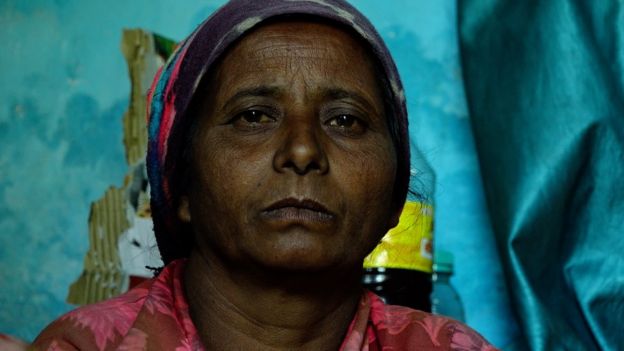
Jitendra’s mother, Geeta Devi, found him injured outside their dilapidated house early the next morning.
“He had been perhaps lying there the entire night,” she said, pointing to where she found him. “He had bruises and injury marks all over his body. He tried to speak but couldn’t.”
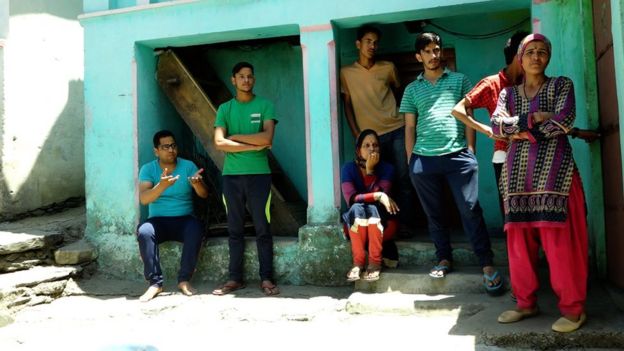
Image caption Dalits are outnumbered by upper-caste families in the village
She does not know who left her son outside their home. He died nine days later in hospital.
Jitendra’s death is a double tragedy for his mother – nearly five years ago her husband also died.
This meant that Jitendra, who was a carpenter, became the family’s only breadwinner and had to drop out of school to start working.
Family and friends describe him as a private man who spoke very little.
Loved ones have been demanding justice for his death, but have found little support among the community.
“There is fear. The family lives in a remote area. They have no land and are financially fragile,” Dalit activist Jabar Singh Verma said. “In surrounding villages too, the Dalits are outnumbered by families from higher castes.”
Of the 50 families in Jitendra’s village, only some 12 or 13 are Dalits.
Dalits comprise almost 19% of Uttarakhand’s population and the state has a history of atrocities committed against them.
Police have arrested seven men in connection with Jitendra’s death, but all of them deny any involvement.
Image caption Upper-caste villagers deny discriminating against the Dalit community
“It’s a conspiracy against our family,” said a woman whose father, uncles and brothers are among the accused. “Why would my father use caste slurs at a Dalit’s marriage?”
“He must have been embarrassed that he got beaten and popped dozens of pills that led to his death,” another local upper-caste person said.
But the Dalits in the village, who are livid over Jitendra’s death, hotly deny these claims.
They say Jitendra suffered from epilepsy, but insist there is no chance that he overdosed on his medication.
Apart from these expressions of anger, local Dalit families have largely remained silent.
“It is because they are economically dependent on families from the higher castes,” activist Daulat Kunwar said.
“Most Dalits are landless. They work the fields of their wealthy upper caste neighbours. They know the consequences of speaking out loud.”
Jitendra’s family has already experienced some of these consequences – Geeta Devi says they are under pressure to stop pushing for the truth.
“Some men came over to our house and tried to scare us,” she said. “There is no one to support us but I will never give up our quest for justice.”
NEW DELHI (Reuters) – India’s ruling Bharatiya Janata Party (BJP) is preparing to meet coalition partners to discuss a new government, two BJP sources said on Monday, after exit polls predicted a better-than-expected result for it in a general election.
The talks would most likely be held on Tuesday afternoon, the two sources in the BJP said. They declined to be identified as they are not authorised to speak about the meeting.
Nalin Kohli, a spokesman for the BJP, declined to comment.
India’s seven-phase general election, billed as the world’s biggest democratic exercise, began on April 11 and ended on Sunday. Votes will be counted on Thursday and results are likely the same day.
Prime Minister Narendra Modi’s BJP-led National Democratic Alliance is projected to win anything between 339-365 seats in the 545-member lower house of parliament with the Congress-led opposition alliance getting only 77 to 108, an exit poll from India Today Axis showed on Sunday.
A party needs 272 seats to command a majority.
Indian stock markets and the rupee were sharply higher on expectation the business-friendly Modi would stay on at the helm.
The benchmark NSE share index was up 2.8%, its best single day since March 2016.
“I expect another 2-3% rally in the market in the next three to four days based on the cue,” said Samrat Dasgupta, a fund manager at Esquire Capital Investment Advisors.
Congress spokesman Sanjay Jha cast doubt on the exit polls, saying on Twitter he believed they were wrong.
“If the exit poll figures are true then my dog is a nuclear scientist,” Jha said, adding he expected the next prime minister would come from outside the BJP alliance.
Modi and his BJP faced criticism in the run-up to the election over unemployment, in particular for failing to provide opportunities to young people coming onto the job market, and for weak farm prices.
But Modi rallied his Hindu nationalist base and made national security a central theme of the campaign after a surge in tension with Pakistan in February following a suicide bomb attack in Indian-controlled Kashmir by Pakistan based militants.
Modi ordered air strikes on a suspected militant camp in Pakistan, which led to a surge in tension between the nuclear-armed neighbours.
But many Indians applauded Modi’s tough stand and he was able to attack the opposition for being soft on security.
Ram Madhav, a senior leader in the BJP, told Reuters partner ANI the results would be even better for the party than the exit polls were suggesting, particularly in West Bengal state.
West Bengal has the third largest number of members of parliament and has been hotly contested between the BJP and the Trinamool Congress, one of the most powerful parties in the coalition trying to unseat Modi.
“Bengal will surprise all the pollsters, we are hoping to do extremely well there,” Madhav said. “Everyone has seen the tremendous support for PM Modi and the BJP in Bengal.”
BEIJING, May 19 (Xinhua) — China has allocated 47 billion yuan (6.8 billion U.S. dollars) for building 1,390 county-level hospitals since 2016, in a bid to ensure that every county and urban district has at least one county-level hospital, Health News reported.
This is part of the country’s efforts to narrow the gap in health services between urban and rural areas.
Traditional Chinese service centers have been set up in more than 30,000 health centers in towns, townships and communities, according to the newspaper.
The standard for the per capita basic public health service subsidy has raised from 25 yuan in 2011 to 55 yuan in 2018, and the number of free services provided by the national basic public health service program has been increasing over the period.
The health inequality index rated by urban and rural residents dropped by 32.5 percent from 2006 to 2016, according to the newspaper.
“The achievement is attributed to the national reforms in the medical and health care system aiming to ensure every citizen has the access to basic health services,” Miao Yanqing, a researcher with the health development research center under the National Health Commission, was quoted as saying.
Ma Zhaoxu (C, front), China’s permanent representative to the United Nations (UN), hosts a briefing on the U.S.-China trade relations at the UN headquarters in New York, May 17, 2019. Cooperation is the only right choice for China and the United States, said Ma Zhaoxu on Friday. (Xinhua/Ma Jianguo)
UNITED NATIONS, May 18 (Xinhua) — Cooperation is the only right choice for China and the United States, said China’s Permanent Representative to the United Nations (UN) Ma Zhaoxu on Friday.
The economic and trade relations between China and the United States are the “ballast” and “propeller” of this important bilateral relationship, said the Chinese envoy when hosting a briefing on the U.S.-China trade relations at the UN headquarters in New York, adding that it is not only about U.S.-China bilateral relations but also world peace and prosperity.
Representatives from more than 100 UN member states and international agencies attended the meeting.
Referring to the consultations between the two countries since the United States unilaterally provoked the frictions in March 2018, Ma said that China will resolutely defend its core interests and will never give in on major issues of principle.
China strongly opposes the U.S. practice of imposing additional tariffs, said the Chinese envoy, while expressing the hope that the United States and China could work together, meet each other in the halfway, address each other’s concern based on mutual respect and equality, and strive for a mutually beneficial agreement.
“The agreement between the two sides must be equal-footed and mutually beneficial,” he said, noting that China’s three core concerns — remove all the additional tariffs, work out a realistic amount of purchases, and improve the balance of the wording of the text — must be addressed.
The Chinese economy has maintained steady growth and has shown positive momentum, Ma told the audience. “The trade protectionist measures of the United States will have an impact on the Chinese economy, but it can be overcome.”
“The Chinese economy is a sea, not a small pond,” he added. “We will continue to promote reform and opening up according to our own pace, and promote high-quality development of the economy according to our own timetable and road map, to realize the long-term stability and growth of the Chinese economy.”
According to Ma, paying mutual respect to each other’s core concerns, and making mutual concessions on the basis of mutual respect, equality and mutual benefit are the premises of expanding cooperation, and only in such a way, the trade issues between the two sides could be resolved.






 CHINDIA ALERT: You'll be living in their world, very soon