Chindia Alert: You’ll be Living in their World Very Soon
aims to alert you to the threats and opportunities that China and India present. China and India require serious attention; case of ‘hidden dragon and crouching tiger’.
Without this attention, governments, businesses and, indeed, individuals may find themselves at a great disadvantage sooner rather than later.
The POSTs (front webpages) are mainly 'cuttings' from reliable sources, updated continuously.
The PAGEs (see Tabs, above) attempt to make the information more meaningful by putting some structure to the information we have researched and assembled since 2006.
SHANGHAI (Reuters) – The death toll from a major typhoon in eastern China rose to 30 on Sunday, with 18 people missing, state broadcaster CCTV reported, as the country braced for more travel disruptions as the storm moved further north up the coast.
Typhoon Lekima made landfall early on Saturday in the eastern province of Zhejiang with winds gusting to 187 km (116 miles) per hour, causing travel chaos with thousands of flights canceled and rail operations suspended.
The typhoon damaged more than 173,000 hectares of crops and 34,000 homes in Zhejiang, provincial authorities said in estimating the economic losses at 14.57 billion yuan ($2 billion), the state news agency Xinhua said.
Lekima, China’s ninth typhoon of this year, is expected to make a second landing along the coastline in Shandong province, prompting more flight cancellations and the closure of some expressways, Xinhua and state broadcaster CCTV said.
In Zhejiang, many of the deaths occurred about 130 km north of the coastal city of Wenzhou, where a natural dam collapsed in an area deluged with 160 mm (6.3 inches) of rain within three hours, causing a landslide, Xinhua reported.
State media reports showed rescuers wading in waist-high waters to evacuate people from their homes, while the Ministry of Emergency Management said that more than one million people in the financial hub of Shanghai, as well as Zhejiang and Jiangsu provinces, have been evacuated due to the typhoon.
An estimated 3,200 flights were canceled, state broadcaster CCTV reported, although some suspensions on high-speed railway lines were lifted on Sunday.
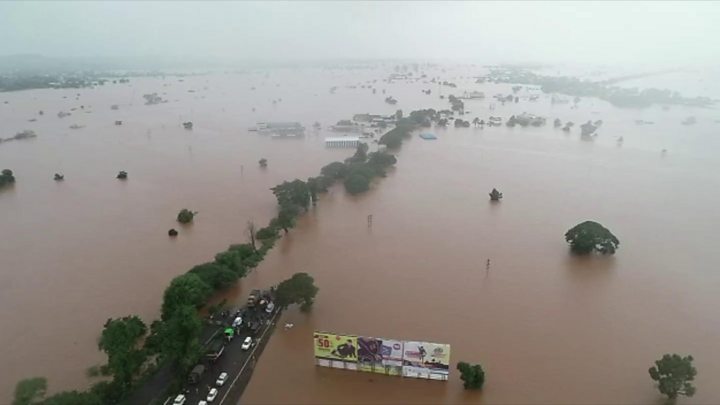
Image copyright AFPImage caption India is affected by seasonal monsoon rains between June and September
At least 95 people have been killed by monsoon flooding in southern and western India, while hundreds of thousands have been evacuated from their homes, according to reports.
More than 40 of those killed were in the south-western state of Kerala.
The flooding and landslides caused by the heavy seasonal rainfall have left some areas cut off.
Officials have called on those affected to try to seek shelter on higher ground.
India is affected by monsoon rains between June and September. While crucial to replenishing water supplies, the heavy rainfall also results in death and destruction each year.
Disaster management officials said more than 100,000 people in Kerala had been evacuated into emergency relief camps, while more than 40 had been killed.
“There are around 80 places where flood and rains have triggered mudslides, which we cannot reach,” state police spokesman Pramod Kumar told AFP news agency.
With the rains predicted to continue there in the coming days, the military is attempting to airlift food to stranded villages.
Media caption Aerial shots of flood-hit Indian states
The south-western state of Karnataka and western state of Maharashtra – which is home to India’s financial capital Mumbai – are also experiencing heavy rains, with dozens of fatalities reported and hundreds of thousands of people evacuated.
India’s National Disaster Management Authority issued warnings on Saturday for “heavy” to “extremely heavy” rainfall in several parts of the country, as well as strong winds.
BEIJING, Aug. 10 (Xinhua) — Chinese President Xi Jinping has led new advances in the development of major country diplomacy with Chinese characteristics.
Xi had a packed diplomatic schedule in the first half of 2019. In April-May, he chaired or attended three events China hosted in a row in just more than half a month. In June, he made four overseas visits and attended four important international meetings in a month.
Amid immense changes in the international situation, the head-of-state diplomacy has led the way forward.
FORGING GLOBAL PARTNERSHIP NETWORK
Xi made his first overseas visit this year in March to three European countries: Italy, Monaco and France, injecting strong impetus into the China-EU comprehensive strategic partnership.
Major-country relations continued to grow. In June, Xi paid a state visit to Russia where he and Russian President Vladimir Putin elevated the China-Russia ties to a comprehensive strategic partnership of coordination for a new era. It was Xi’s eighth visit to Russia and his 31st meeting with Putin since he took office as the Chinese president in 2013.
Friendly exchanges with neighboring countries were deepened. In June, he paid a state visit to the Democratic People’s Republic of Korea (DPRK), opening a new chapter for China-DPRK friendship. Also in June, Xi visited Kyrgyzstan and Tajikistan and met with Japanese Prime Minister Shinzo Abe in the Japanese city of Osaka. All in all, Xi met or held talks with more than 30 leaders of neighboring countries in the first half of the year.
Common progress with the vast majority of developing countries was advanced. Xi congratulated the inauguration of the China-Africa Institute, the opening of the Coordinators’ Meeting on the Implementation of the Follow-up Actions of the Beijing Summit of the Forum on the China-Africa Cooperation, and the first China-Africa Economic and Trade Expo.
Xi also chaired a China-Africa leaders’ meeting on the sidelines of the G20 summit in Osaka, at which leaders reached a broad consensus on a range of issues.
LEADING GLOBAL OPENNESS, COOPERATION
Xi has said a few anti-globalization movements that have emerged in the world cannot stop the tide of globalization.
Thinking in big-picture terms, a Chinese poem says, helps one dispel the clouds to see the sun.
At the G20 summit in Osaka, Xi announced China’s further opening-up measures which have since strengthened the confidence of the global economy.
On the sidelines of the G20 summit, Xi met with U.S. President Donald Trump. They agreed to advance a China-U.S. relationship featuring coordination, cooperation and stability.
China is playing a more positive role in the multilateral trading system, taking globalization toward the direction of more inclusiveness and benefit for all, said World Trade Organization Director General Roberto Azevedo.
Meanwhile, the China-proposed principle of extensive consultation, joint contribution and shared benefits is gaining worldwide recognition.
In April, the Second Belt and Road Forum for International Cooperation was attended by about 6,000 participants from 150 countries and 92 international organizations.
A study published by the World Bank found that fully implementing deeper policy reforms of the Belt and Road Initiative would lift 32 million people out of moderate poverty, increase global trade by up to 6.2 percent and increase global income by as much as 2.9 percent.
WORKING TOGETHER FOR BETTER FUTURE
The Chinese president has called on countries around the world to make concerted efforts and jointly shape the future of humanity.
In various occasions ranging from the global governance forum co-hosted by China and France to the Conference on Dialogue of Asian Civilizations, Xi put forward China’s approaches on global governance and encouraged all parties to build consensus on upholding multilateralism.
China has been committed to firmly upholding the international system with the United Nations at its core and international law as its foundation, and standing on the side of justice as China plays an active role in endeavors such as advancing the political settlement of the Korean Peninsula issue and supporting maintaining the Iran nuclear deal.
China has become a strong pillar of international cooperation and multilateralism, according to UN Secretary-General Antonio Guterres.
At the three events China hosted in the first half of the year, Xi expounded on the concept of building a community with a shared future for humanity from different perspectives: help developing countries break growth bottlenecks, tackle environmental challenges and look to culture and civilization to play their role.
All won broad recognition.
Under Xi’s leadership, the major country diplomacy with Chinese characteristics is sailing towards a brighter future.
Three-year-old security treaty between US and two key allies under threat as tensions between Seoul and Tokyo continue to escalate
End of General Security of Military Information Agreement risks undermining Washington’s influence in the region
South Korean protesters hold signs saying “No Abe” during a rally demanding the abolition of the General Security of Military Information Agreement. Photo: AP
The possible termination of a military information-sharing pact between South Korea and Japan would be a symbolic victory for China, a security analyst has warned.
Recent tension between the two countries recently threatened to spill over into the sphere of intelligence after Seoul signalled that it may pull out of the General Security of Military Information Agreement (GSOMIA) pact.
The agreement signed in 2016 enables three-way intelligence gathering between the US and its two allies and provides a crucial framework for coping with North Korea’s nuclear and missile threats.
But the escalating trade dispute between Seoul and Tokyo, prompted by a dispute about Japan’s colonial legacy, has left the future of the deal in jeopardy as the annual deadline for its renewal looms.
Japan approves first hi-tech exports to South Korea since start of ‘trade war’ – but with a warning
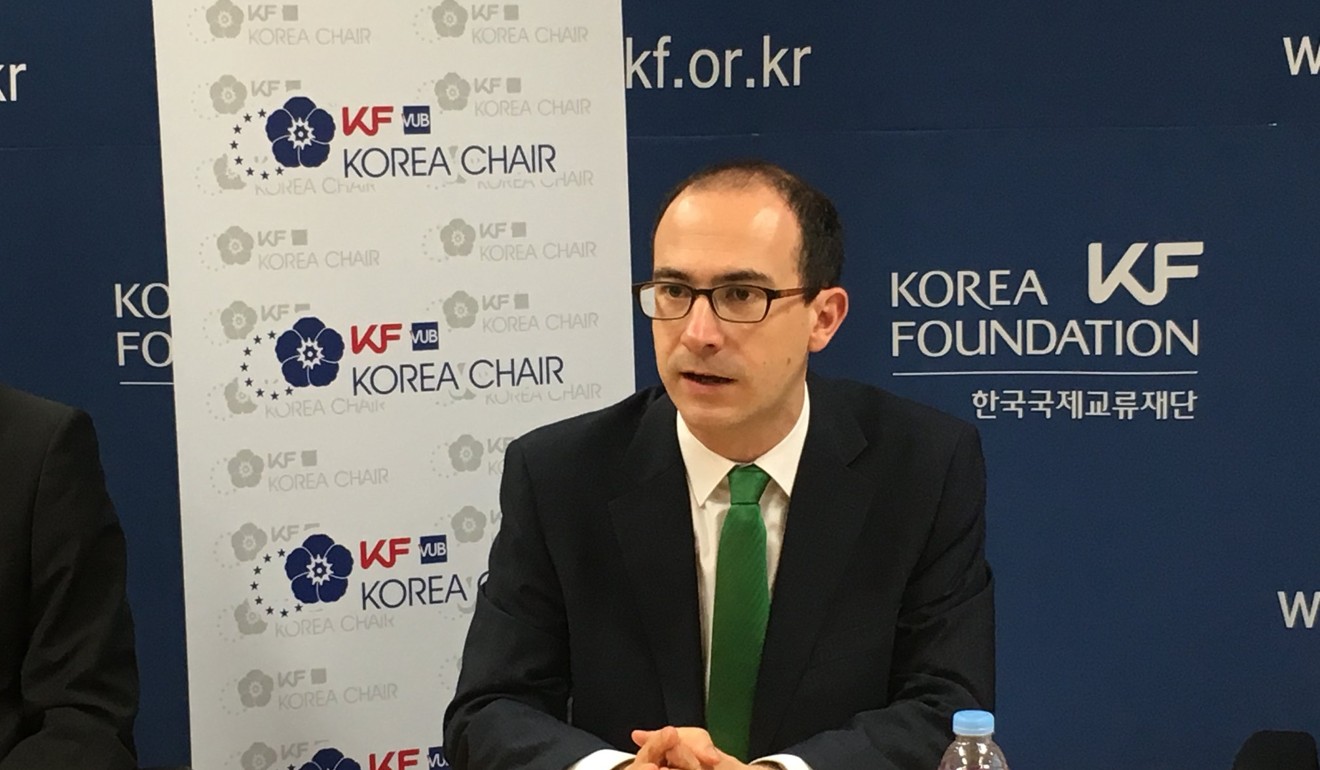
Ramon Pacheco Pardo, the first Korea chair at the Institute for European Studies at Vrije Universiteit Brussel in Belgium, said scrapping the pact would help strengthen China’s influence in the Asia-Pacific region at the expense of the US.
“It is undeniable that termination of GSOMIA would dent the US-South Korea-Japan alliance. The alliance system in northeast Asia will be weaker, strengthening China in relative terms in the process. “This could embolden China and Russia to strengthen their military cooperation in northeast Asia, said Pardo, a member of the non-governmental EU Council for Security Cooperation in the Asia-Pacific.
“Ending GSOMIA would signal that South Korea and Japan are not ready to follow Washington’s lead in the way the latter would like, given the political capital that successive US administrations spent in convincing both countries to share intelligence.”
Ramon Pacheco Pardo said the collapse of the pact would have a largely symbolic impact on China. Photo: Facebook
But Pardo also stressed that the intelligence alliance was not directly targeting China.
“While it is true that GSOMIA serves to connect the weakest link of the US-South Korea-Japan security triangle, ultimately South Korea’s security posture and the capabilities of each country independently mean that it is difficult to argue that the agreement is a concerted effort to contain China.”
“After all, Beijing does not share any significant information on North Korea’s nuclear and missile programmes with South Korea, Japan or the US.
“This is not going to change any time soon. So the good news for China would be symbolic rather than substantial.”
US missiles, jittery neighbours and South Korea’s big security dilemma
Beijing warned on Tuesday that it would take “countermeasures” if the US deployed ground-based missiles in either Japan or South Korea, and Pardo argued that scrapping the intelligence-sharing pact would expose the weaknesses in their co-ordinated approach towards China.
The security deal is automatically renewed every year unless one party decides to pull out. To do so, it must notify the others 90 days before its expiry – a deadline that falls on August 23.
The trade row was sparked by a recent South Korean court ruling that Japanese should compensate individual victims of wartime forced labour. Tokyo believes it settled all necessary compensation under a treaty signed in 1965, but Seoul believes that individual victims’ right to file a claim has not expired.
Relations between South Korea and Japan have deteriorated following a court ruling over forced labour in the wartime era. Photo: Shutterstock
Last week Japan said it would remove South Korea from its “white list” of countries with preferential trade status. Seoul has threatened to respond in kind, but also warned that it may reconsider whether to renew the intelligence-sharing pact.
Both the US and Japan have said they want the arrangement to continue, but Pardo said the effect of the termination would remain largely symbolic.
South Korea has already been investing in its own satellite and anti-submarine programmes to monitor the North’s activities, while Japan has also been developing its own intelligence programmes.
“This shows that neither South Korea nor Japan wants to rely on each other or third parties, namely the US, when it comes to monitoring North Korea’s military activities,” Pardo said.
But he argued that this behaviour already indicated that the alliance was weakening and suggested that terminating the treaty would increase China’s room for manoeuvre.
South Korea buys helicopters worth US$800 million after Trump seeks contribution for US presence
Since the 1990s successive US administrations have pushed for intelligence-sharing arrangements with Japan and South Korea to help build a framework to check Chinese and Russian military expansion in the Pacific.
“Beijing and Moscow are clearly moving in the direction of closer cooperation anyway. GSOMIA or not, military cooperation will continue … as long as Xi Jinping and Vladimir Putin lead each country and most probably even beyond then,” Pardo said.
China and Russia flexed their muscles in the region last month as the trade dispute between the two key allies intensified.
Russian and Chinese long-range military aircraft conducted their first-ever joint air patrol over the Sea of Japan – also known as the East Sea – and the East China Sea.
“The East Asian security landscape would be reshaped insofar that China, North Korea and Russia would see that their main opponent in the region – the US – is unable to convince its two key allies, South Korea and Japan, to cooperate on a key issue,” Pardo said.
“The current dispute between South Korea and Japan will need a negotiated solution … In any case, Japan will have to learn to live with the fact that former colonisers will, from time to time, receive criticism by many of their former colonies, criticism that sometimes will escalate.
“It happens to former European colonial powers, for example, and it is only logical because the interpretation of the past is always in flux.”
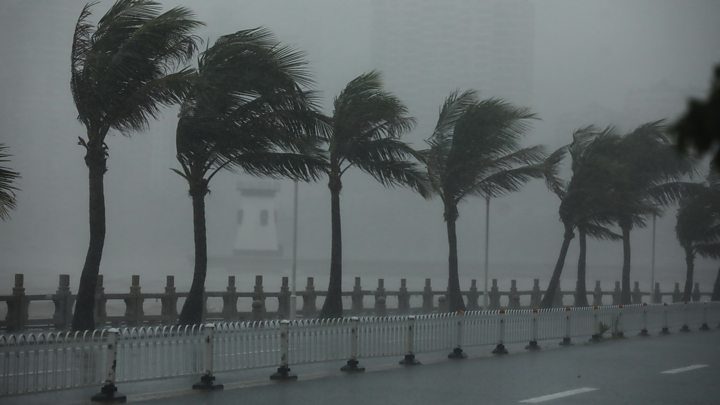
At least 13 people have been killed and more than a million forced from their homes as Typhoon Lekima hit China.
Sixteen people were also missing after a landslide was triggered by the storm, state media reported.
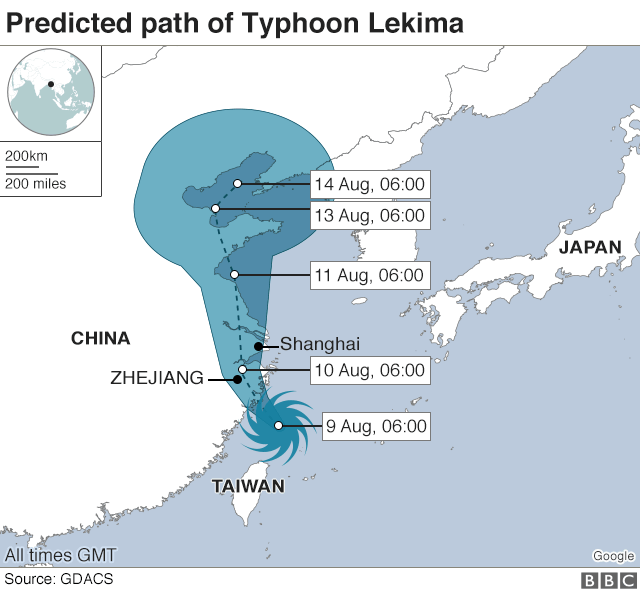
Lekima made landfall in the early hours of Saturday in Wenling, between Taiwan and China’s financial capital Shanghai.
The storm was initially designated a “super typhoon”, but weakened slightly before landfall – when it still had winds of 187km/h (116mph).
The fatal landslide happened when a dam broke in Wenzhou, near where the storm made landfall, state media said.
Lekima is now slowly winding its way north through the Zhejiang province, and is expected to hit Shanghai, which has a population of more than 20 million.
Emergency crews have battled to save stranded motorists from floods. Fallen trees and power cuts are widespread.
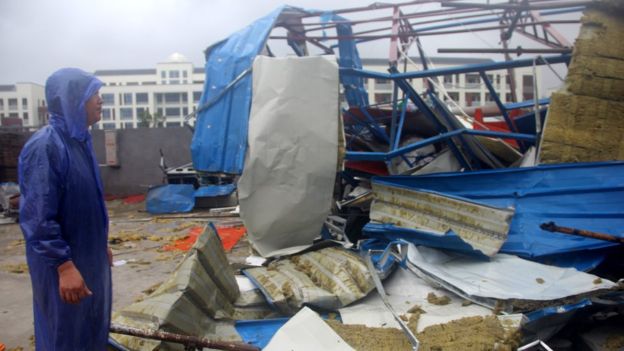
Image copyright EPAImage caption A worker looks for his belongings at a construction site shelter collapsed by the storm
Authorities have cancelled more than a thousand flights and cancelled train services as the city prepares for the storm.
It is expected to weaken further by the time it reaches Shanghai, but will still bring a high risk of dangerous flooding.
The city evacuated some 250,000 residents, with another 800,000 in the Zhejiang province also being taken from their homes.
An estimated 2.7 million homes in the region lost power as power lines toppled in the high winds, Chinese state media said.
It is the ninth typhoon of the year, Xinhua news said – but the strongest storm seen in years. It was initially given China’s highest level of weather warning but was later downgraded to an “orange” level.
Media caption Typhoon Lekima inches towards China
Chinese weather forecasters said the storm was moving north at just 15km/h (9mph).
It earlier passed Taiwan, skirting its northern tip and causing a handful of injuries and some property damage.
Coming just a day after a magnitude six earthquake, experts warned that the combination of earth movement and heavy rain increased the risk of landslides.
Lekima is one of two typhoons in the western Pacific at the moment.
Further east, Typhoon Krosa is spreading heavy rain across the Northern Mariana Islands and Guam. It is moving north-west and could strike Japan some time next week, forecasters said.
BEIJING (Reuters) – Eighteen people were killed and 14 were missing in eastern China on Saturday in a landslide triggered by a major typhoon, which caused widespread transport disruptions and the evacuation of more than one million people, state broadcaster CCTV reported.
Typhoon Lekima made landfall early on Saturday in the eastern province of Zhejiang with maximum winds of 187 km (116 miles) per hour, although it had weakened from its earlier designation as a “super” typhoon, the official Xinhua news agency reported.
Thousands of flights were cancelled in eastern China, according to the country’s aviation regulator, with most flights into and out of Shanghai’s two major airports cancelled on Saturday afternoon, their websites showed.
China’s weather bureau on Saturday issued an orange alert, its second highest, after posting a red alert on Friday, when the storm forced flight cancellations in Taiwan and shut markets and businesses on the island.
The deadly landslide occurred about 130 km north of the coastal city of Wenzhou, when a natural dam collapsed in an area deluged with 160 millimetres (6.3 inches) of rain within three hours, CCTV reported.
The storm was moving northward at 15 kph and was gradually weakening, Xinhua reported, citing the weather bureau.
High winds and heavy rains battered the financial hub of Shanghai on Saturday afternoon, and Shanghai Disneyland was shut for the day.
Nearly 200 hundred trains through the city of Jinan in Shandong province had been suspended until Monday, Xinhua reported.
More than 250,000 residents in Shanghai and 800,000 in Zhejiang province had been evacuated due to the typhoon, and 2.72 million households in Zhejiang had power blackouts as strong wind and rain downed electricity transmission lines, state media reported.
Some 200 houses in six cities in Zhejiang had collapsed, and 66,300 hectares (163,830 acres) of farmland had been destroyed, CCTV said.
The storm was predicted to reach Jiangsu province by the early hours of Sunday and veer over the Yellow Sea before continuing north and making landfall again in Shandong province, CCTV said.
Coastal businesses in Zhejiang were shut and the Ministry of Emergency Management warned of potential risk of fire, explosions and toxic gas leaks at chemical parks and oil refineries.
A villager shops at a mart in Wangzhuanggou Village of Wuxiang County, north China’s Shanxi Province, Feb. 17, 2019.
China has seen rapid income and consumption growth in rural areas over the past 70 years, according to a report from the National Bureau of Statistics (NBS). In 2018, rural per capita disposable income had increased 40 times from 1949 to stand at 14,617 yuan (about 2,088 U.S. dollars) in real terms after deducting price factors, up 5.5 percent on average annually, the NBS said. The country’s urban-rural income gap narrowed remarkably, with the ratio of per capita disposable income for urban residents to that of rural residents hitting 2.69 in 2018, 0.64 lower than 1956. The rural consumption level continued to rise in the last 70 years, as indicated by its expanding size and improving quality. Per capita rural consumption grew by an average annual rate of 5.2 percent to reach 12,124 yuan in real terms in 2018 after deducting price factors, up 32.7 times from 1949, while the Engel coefficient for rural residents dropped 38.5 percentage points from 1954 to reach 30.1 percent. Per capita living space in rural areas reached 47.3 square meters, posing a sharp contrast to 8.1 square meters in 1978, according to the report.
Household consumption in rural areas also increased, with the average ownership of cars, computers and cell phones per 100 households reaching 22.3, 26.9 and 257, respectively in 2018. (Xinhua/Zhan Yan)
WASHINGTON, Aug. 8 (Xinhua) — Chinese scientists discovered the oldest fossil forest in Asia, lending more clues to how those ancient plants evolved to become coal finally.
The study published on Thursday in the journal Current Biology reported the largest example of a patch of forest that grew in the Devonian period, which was 419 million to 359 million years ago.
It was made up of 250,000 square meters of fossilized lycopsid trees near Xinhang Town in east China’s Anhui Province.
The lycopsids in the fossilized forest resembled palm trees, and grew in a coastal environment prone to flooding. They were normally less than 3.2 meters tall, but the tallest one was estimated at 7.7 meters, according to the study.
Giant lycopsids would later thrive in a period that followed the Devonian, and became much of the coal that is mined today. The Xinhang forest in Anhui showed the early root systems, which made their height possible in the Carboniferous period (359 million to 299 million years ago), according to the study.
The forest also contributes to our understanding of atmospheric carbon dioxide decline and coastal consolidation at that time.
“The large density as well as the small size of the trees could make Xinhang forest very similar to a sugarcane field, although the plants in Xinhang forest are distributed in patches,” said the paper’s lead author Wang Deming, a professor in the School of Earth and Space Sciences at Peking University.
“It might also be that the Xinhang lycopsid forest was much like the mangroves along the coast, since they occur in a similar environment and play comparable ecologic roles,” said Wang.
Chinese and US researchers take inspiration from the hardy insect to design a robot that moves fast and is hard to squash
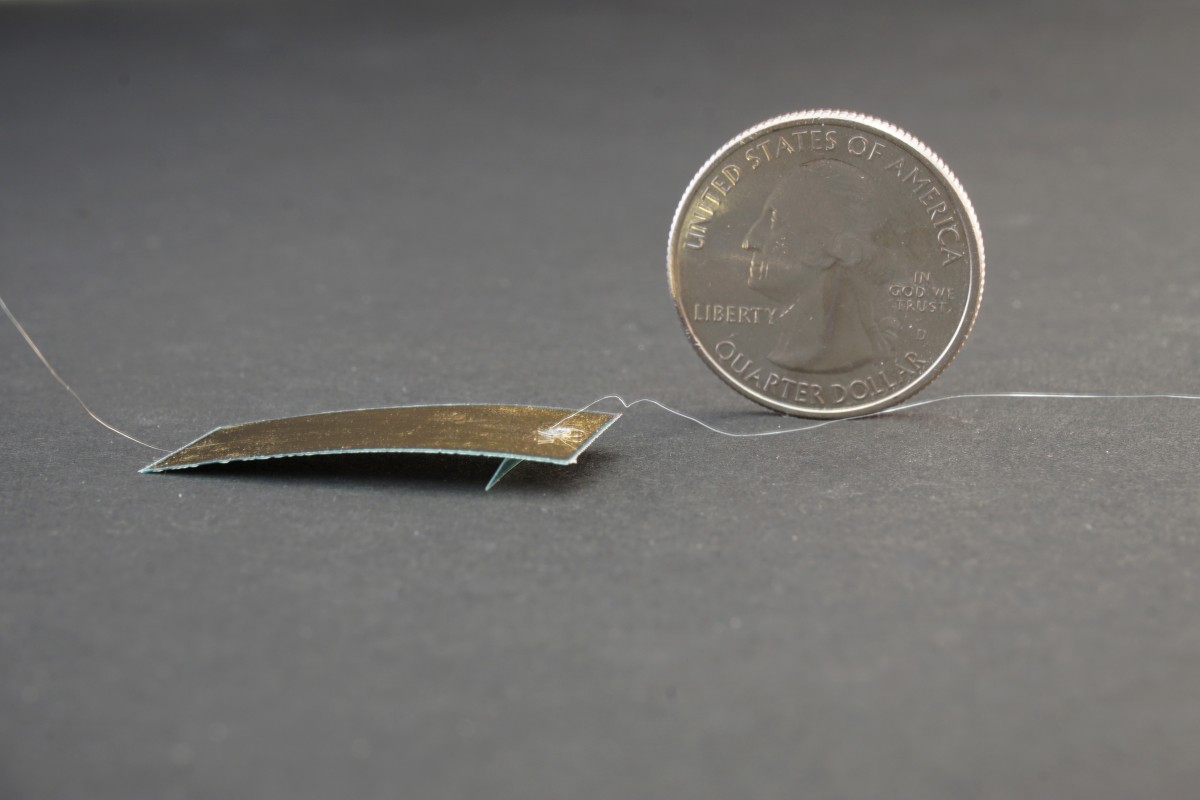
A prototype soft robot, which is about the size of a postage stamp, was developed by a group of researchers from China and the US. Its design was inspired by the capabilities of the hardy cockroach. Photo: Handout
Cockroaches are near-indestructible little creatures. These hardy insects have existed since at least 320 million years ago, outliving dinosaurs. A cockroach can also carry loads of up to 900 times its body weight, shrink to a quarter of its height to fit into small crevices and live for a week without its head.
Inspired by the qualities of this humble bug, a group of researchers from China and the United States have created a prototype of a fast-moving and near-indestructible miniature robot, which could potentially replace sniffer dogs in detecting people trapped in a rubble after a major earthquake or similar disastrous event.
Researchers from China’s Tsinghua University and the University of California, Berkeley, published their study on so-called soft robots in the academic journal Science Robotics last week.
“Although the cockroach is an annoying pest, it has certain interesting features, including the ability to move fast in a narrow space and being hard to squash,” said Zhang Min, an assistant professor at Tsinghua University’s Graduate School in Shenzhen and one of the study’s authors, in an email interview. “These features inspired us to develop a fast-moving and robust soft robot.”
Their work on soft robots was conducted under the Tsinghua-Berkeley Shenzhen Institute partnership, an initiative to collaborate with global researchers on fields such as environmental science and new energy technology.
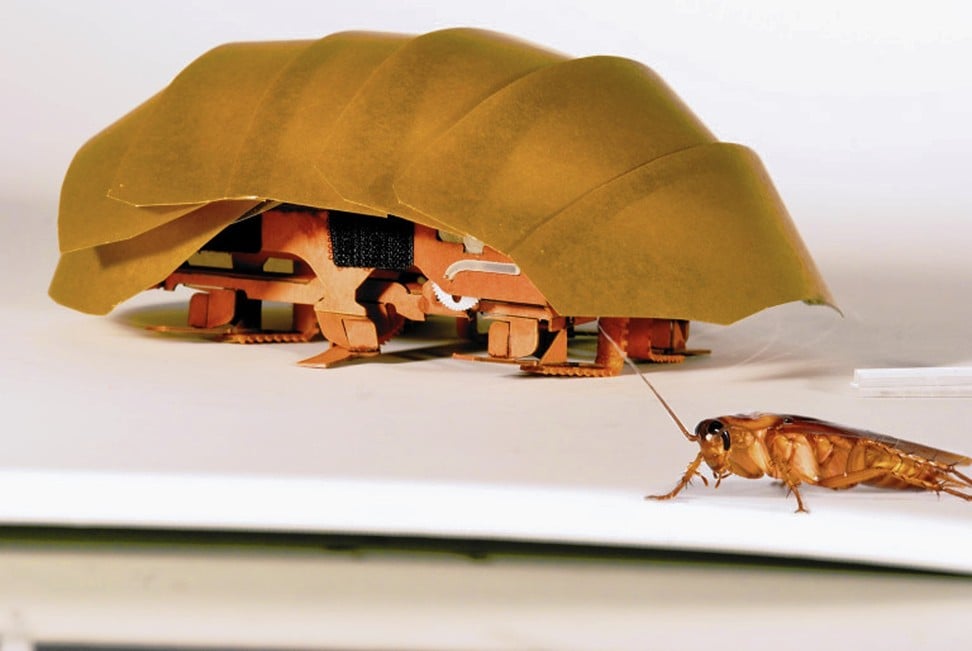
Scientists have long taken inspiration from insects, including cockroaches, for engineering robots. Researchers from UC Berkeley previously developed a palm-sized, roach-like robot – about 20 times the size of the bug – for rescue use in 2017.
By comparison, the new prototype achieved breakthroughs in terms of size and more importantly, the speed and robustness.
The latest robot, which is about the size of a postage stamp and weighs less than one-tenth of a gram, is composed of a flexible piezoelectric thin film and a polymer skeleton with two legs.
This screenshot from a video provides a closer look at the prototype soft robot developed by a group of researchers from China and the US. Its features were inspired by the sturdy qualities of the humble cockroach. Photo: YouTube
Despite its petite frame, this prototype showed the fastest speed among insect-scale robots in a similar weight range, as well as “ultra-robustness”, according to Lin Liwei, a professor of mechanical engineering at UC Berkeley who directed the research, in a separate email interview.
It can move as fast as a cockroach with speeds of up to 20 body lengths per second. It also continued to move after it was stepped on by an adult human weighting 60 kilograms, which is about 1 million times heavier than the robot, according to the study.
In 2017, researchers of the PolyPEDAL Lab at the University of California, Berkeley, designed a compressible robot, CRAM, that was about 20 times the size of a real cockroach. Photo: Handout
Those features sets up the robot for potential application in disaster relief, a field in which its size, agility and resilience would be invaluable to help detect survivors trapped beneath the rubble in catastrophes, such as major earthquakes.
Earthquakes have caused much devastation in China, a seismically active country with the world’s biggest population. For example, about 87,000 people died and more than 370,000 were injured when a magnitude-8 earthquake struck Wenchuan, a county in southwestern China’s Sichuan province, in 2008.
“The key innovation is the soft materials and structures used in the robot,” Lin said. “If the robot is too soft, it won’t be able to move fast. If the robot is too stiff, it can’t withstand the force of human weight.” The study detailed how the right combination of soft materials and structure enabled the robot to operate efficiently.
While the robot is currently attached to thin cables for power, the researchers are working to integrate a battery and control circuit to get rid of the existing wire in its design, helping expand its use in other applications.
“We want to make the robot carry small sensors, like a gas sensor, to provide it with more functions,” said Zhong Junwen, a researcher at UC Berkeley and one of the authors of the study, in a separate email interview. “With such a sensor, the robot can detect harmful gas leakage.”
Tower falls on car outside the Chengdu worksite, killing motorist
A motorist was killed when a construction crane collapsed in Chengdu on Wednesday. Photo: Weibo
Authorities in southwest China are investigating a crane collapse at a construction site that killed one person and injured another.
The crane collapsed in Chengdu, Sichuan province, at around 7pm on Wednesday, falling onto a car parked near the site and killing the driver, the city’s urban renewal authority said in an online statement. A pedestrian also suffered minor injuries, it said.
Police were investigating the cause of the incident.
A crane accident at a construction site in Southwest China killed one person and injured another on Wednesday. Photo: Weibo
Photos and footage posted online showed emergency workers and others trying to move the crane off of a white car.
Shanghai-based news outlet ThePaper.cn quoted a witness as saying that the crane fell through the construction site wall and a number of trees.
By 10pm, the car had been towed away and the road reopened for use, according to reports.
In January, four people were killed and one was injured when a crane collapsed in Changsha, Hunan province, state news agency Xinhua reported.










 CHINDIA ALERT: You'll be living in their world, very soon