Chindia Alert: You’ll be Living in their World Very Soon
aims to alert you to the threats and opportunities that China and India present. China and India require serious attention; case of ‘hidden dragon and crouching tiger’.
Without this attention, governments, businesses and, indeed, individuals may find themselves at a great disadvantage sooner rather than later.
The POSTs (front webpages) are mainly 'cuttings' from reliable sources, updated continuously.
The PAGEs (see Tabs, above) attempt to make the information more meaningful by putting some structure to the information we have researched and assembled since 2006.
GUANGZHOU, April 30 (Xinhua) — The United Nations World Food Program (WFP) has launched a global humanitarian hub in the southern Chinese city of Guangzhou to help the global fight against COVID-19.
Established earlier this month, the hub will support the global COVID-19 emergency response for the international community, including the UN, national governments and other humanitarian partners, according to the WFP.
It will provide strategic sourcing and stock consolidation services, facilitate the movement of life-saving humanitarian cargo, and operate aviation services to transport humanitarian workers.
The first consignment of humanitarian cargo consisting of COVID-19 medical supplies has arrived at the Guangzhou hub, from where it will be shipped to other UN hubs worldwide as well as directly to virus-affected countries and regions,
“With its leading manufacturing industry, supply chain expertise and technological innovations, China is uniquely advantaged to host this global humanitarian hub which will play a catalytic role in responding to COVID-19,” said WFP’s Country Director in China Qu Sixi.
As one of WFP’s global network of humanitarian hubs, the one in Guangzhou is supported by Alibaba Group’s Cainiao Smart Logistics Network.
“We will fully leverage our global logistics resources to support WFP in facilitating the safe and fast delivery of humanitarian goods,” said James Zhao, general manager of Cainiao Global Supply Chain.
This marks the latest mobile network upgrade on Mount Everest, where Chinese carriers had previously installed 2G, 3G and 4G equipment
China Mobile plans to deploy Huawei 5G gear at an altitude of 6,500 metres, providing network coverage to the mountain’s summit
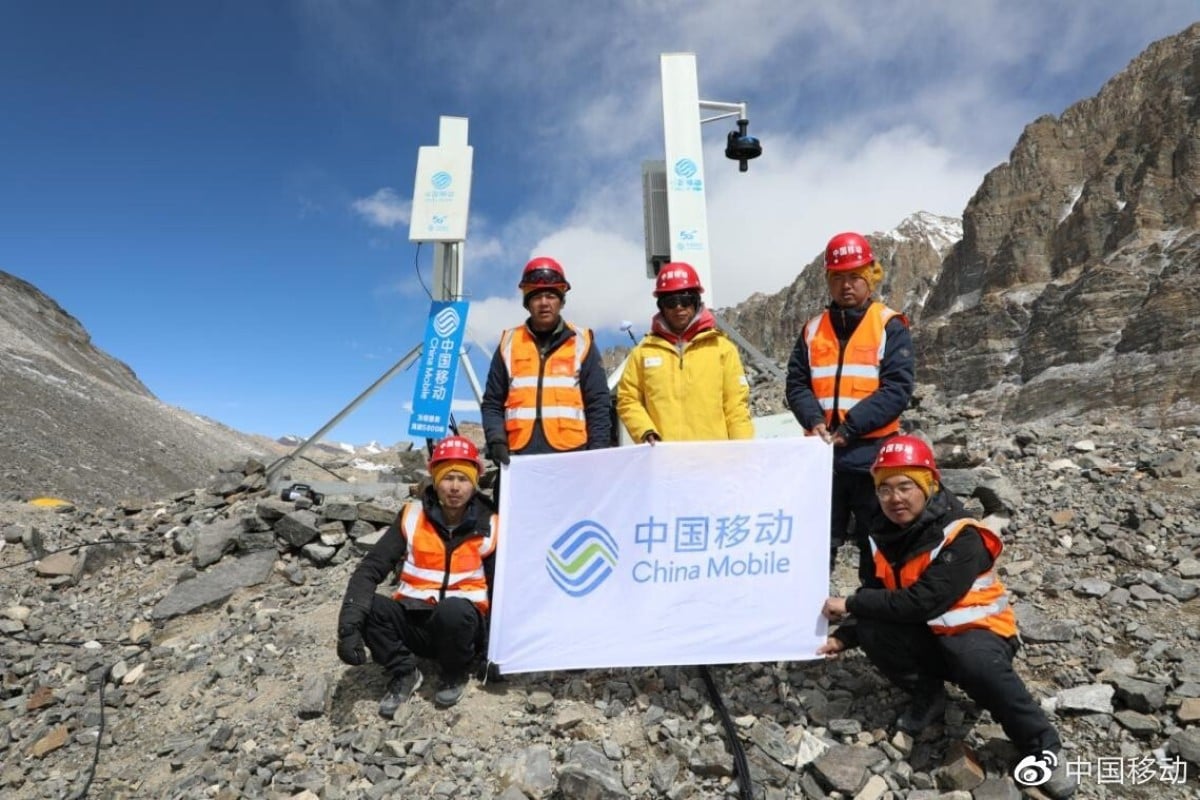
A team from China Mobile shows off the initial 5G base stations, supplied by Huawei Technologies, that the telecoms carrier deployed on Mount Everest this April. Photo: Weibo
Huawei Technologies has teamed up with wireless network operators China Mobile, China Unicom and China Telecom to roll out advanced 5G infrastructure on
The deployment of 5G base stations on the famous Himalayan mountain, with an elevation of 8,848 metres, has extended the reach of the next-generation mobile technology, which has been held up as “the connective tissue” for the Internet of Things, autonomous cars, smart cities and other new applications – providing the backbone for the industrial internet. The new 5G infrastructure roll-outs were announced by Huawei in a post on Chinese microblogging site Weibo on Monday and confirmed by its spokeswoman on Tuesday.
China Mobile, the world’s largest wireless network operator, said its 5G project on Mount Everest marked “not only another extreme challenge in a human life exclusion zone, but also laid a solid foundation for the later development of 5G smart tourism and 5G communications for scientific research”, according to the company’s post on Weibo on Monday.
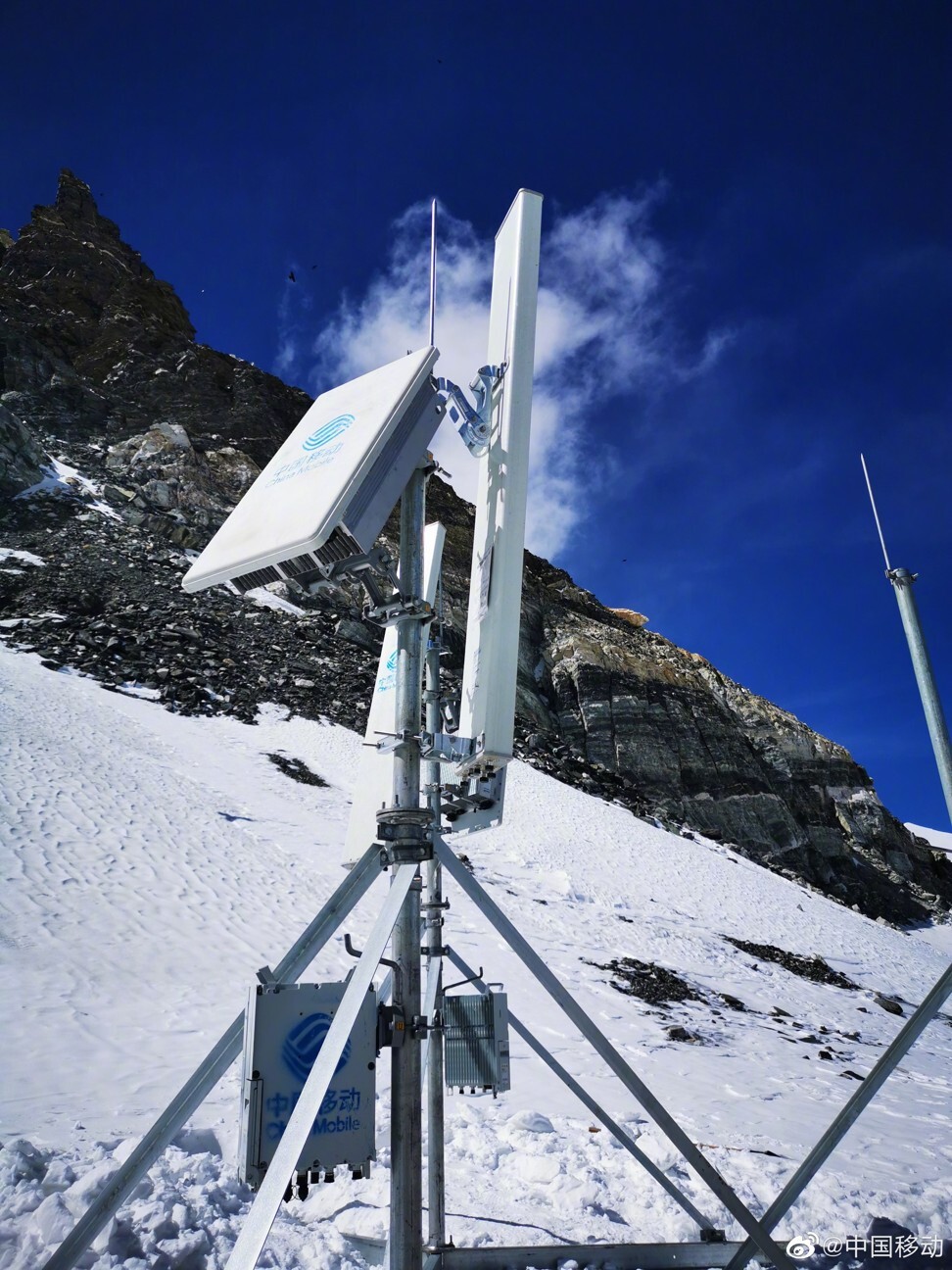
The Hong Kong and New York-listed carrier set up three 5G base stations – radio access gear that connects mobile devices to the broader telecommunications network – on April 19 in two camps at altitudes of 5,300 metres and 5,800 metres, which provide online download speed of about 1 gigabit per second.
China Mobile plans to install two more 5G base stations, supplied by telecommunications gear maker Huawei Technologies, on Mount Everest before April 25. Photo: Weibo
Installation of two more base stations are expected to be completed by China Mobile before April 25 in another camp at an altitude of 6,500 metres, providing 5G network coverage to the summit of Mount Everest. The international border between China and Nepal is 1,414 kilometres in length and runs across that summit.
More than 150 China Mobile employees are taking part on the construction and maintenance of the new 5G base stations as well as upgrading existing infrastructure on the surrounding areas, according to the company. It said 25 kms of new optical cables have also been laid out to support this project.
China Telecom confirmed its Mount Everest project on Tuesday in a statement, which said its 5G base stations were installed on April 13 at an altitude of 5,145 metres. It partnered with state-run China Central Television to broadcast a 24-hour live-streamed programme on April 14 from Mount Everest, which had an audience of more than six million people.
China Mobile did not immediately respond to a request for comment. China Unicom did not immediately reply to a separate request for comment.
Mobile network operators in China launched initial commercial 5G services last year. The country has already deployed more than 160,000 5G base stations, covering more than 50 cities, according to a report published last month by the GSMA, the trade body which represents mobile operators worldwide.
While initial commercial 5G mobile services were launched in countries like South Korea, the US, and Australia, the scale of China’s market is likely to dwarf the combined size of those economies, negating any first-mover advantage.
The steady annual deployment of new 5G base stations is critical to meet future demand in the world’s second largest economy and biggest smartphone market. China is expected to have 600 million 5G mobile users by 2025, which would make up 40 per cent of total global 5G subscribers, according to the GSMA.
Project will examine whether earthquake and changing wind speeds have affected peak’s snowcap
Survey team hoping the BeiDou satellite navigation system and other Chinese technology can help them find the answer
A Chinese team is preparing to determine the exact height of Mount Everest. Photo: AFP
China is sending a surveying and mapping team to the summit of Mount Everest this month in a bid to end the long-running debate over the precise height of the world’s tallest mountain.
The mission was announced on Wednesday at one of the mountain’s base camps in Tibet, where a team of 53 surveyors has been making technical preparations since March 2. The team will use China’s BeiDou navigation satellite system and Chinese surveying instruments for the project.
Mount Everest – known as Sagarmatha in Nepal and Qomolangma in Tibet – lies in the Himalayas on the border between China and Nepal. The two countries have long disputed whether measurements of the mountain should include its snowcap or be limited to the rock base.
Nepal suspends Everest permits over coronavirus
In 2005, a Chinese expedition assessed the peak and measured the height from both the rock base and from the top of the snowfall. The result, a rock height of 8,844.43 metres (29,017.2 feet), was declared by China to be the most accurate and precise measurement to date.
Nepal has long held that Everest’s snowcap should be included, putting the iconic peak at 8,848 metres, a height which is widely accepted. However, geologists believe the snowcap may have shrunk by several centimetres after the magnitude 8.1 earthquake in 2015. Changing wind speeds are also believed to have affected it.
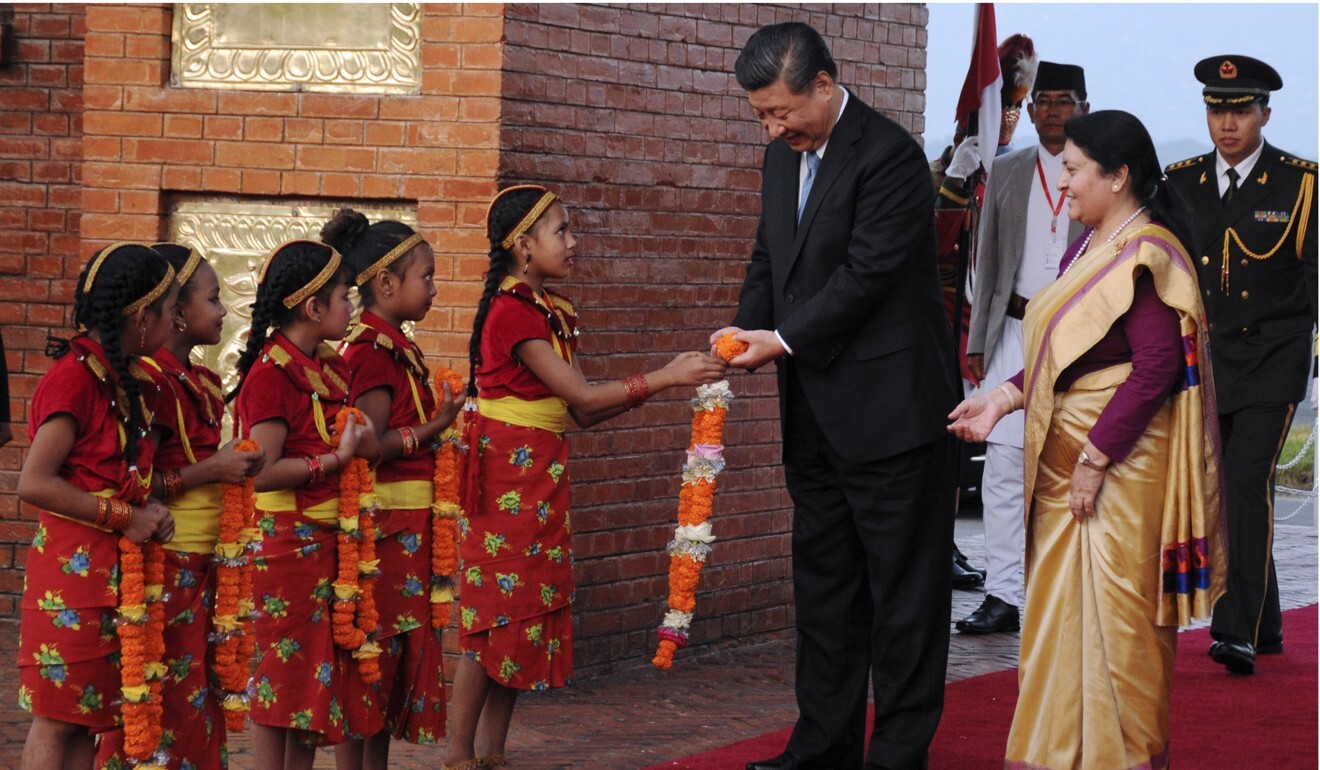
Chinese President Xi Jinping visited Nepal in October. Photo: EPA-EFE
Following a state visit to Nepal by Chinese President Xi Jinping in October, the two countries agreed to jointly launch a scientific research project to determine the exact height of Everest, recognising the peak as “an eternal symbol of the friendship between the two countries”.
China’s natural resources ministry said the project indicated a new step in the friendship and highlighted the historical significance of the mission, which coincides with the 60th anniversary of the first Chinese ascent of the mountain’s north side as well as the 45th anniversary of China’s first precise measurement of the peak.
The results of the survey will be used for geodynamics research and the precise depth of the summit’s snowcap, meteorological and wind speed data will offer first-hand materials for glacier monitoring and biological environment protection.
In a separate development, China Mobile said on Thursday that the entire peak now had 5G coverage.
In a joint project with Huawei, 5G antennas were installed at the mountain’s advance base camp, at a height of 6,500 metres. Antennas were installed earlier in April at the lower base camp, at 5,300 metres and at 5,800 metres.
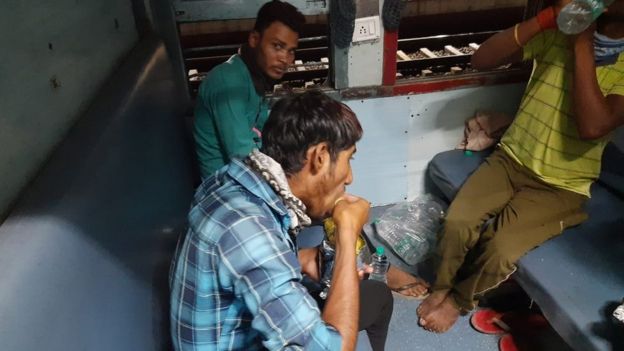
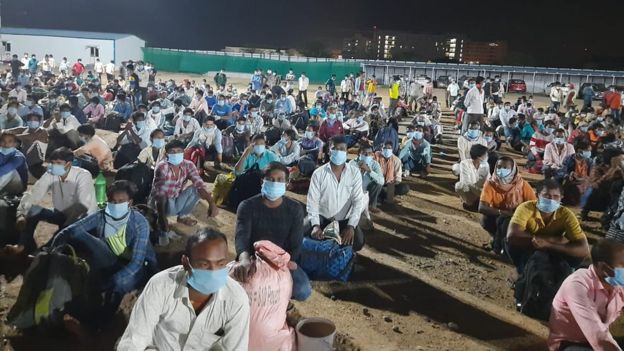
Image copyright ANIImage caption Millions of people across India have been stranded by the lockdown
The first train carrying migrant workers stranded by a nationwide lockdown in India has left the southern state of Telangana.
The 24-coach train, carrying 1,200 passengers, is travelling non-stop to eastern Jharkhand state.
Earlier this week, India said millions of people stranded by the lockdown can return to their home states.
The country has been in lockdown to curb the spread of coronavirus since 24 March.
However, the movement of people will be only possible through state government facilitation, which means people cannot attempt to cross state borders on their own.
This train is a “one-off special train” to transport the workers on the request of the Telangana state government, Rakesh Ch, the chief public relations officer of South-Central Railways, told the BBC.
The train left Lingampally, a suburb of the southern city of Hyderabad, early on Friday and is expected to reach Hatia in Jharkhand on Saturday.
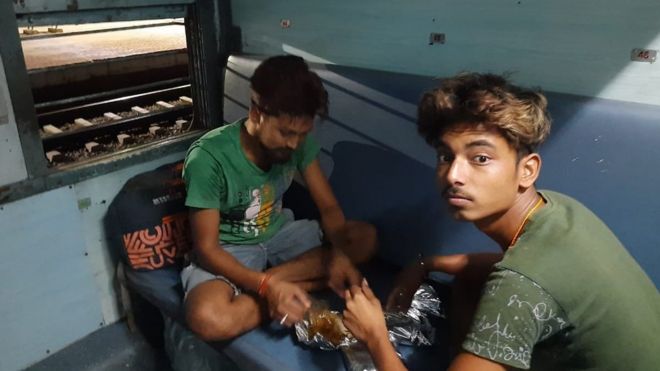
Mr Rakesh said that adequate social distancing precautions had been taken and food was being served to the passengers.
Image copyright ANIImage caption Railways officials said that adequate social distancing precautions had been taken and food was being served to the passengers.
He said each carriage was carrying 54 passengers instead of its 72-seat capacity.
“The middle berth is not being used in the sleeper coaches and only two people are sitting in the general coaches,” Mr Rakesh said.
Before the train pulled out of the station, all the passengers were screened for fever and other symptoms.
They had all been employed at a construction site at the Indian Institute of Technology, a top engineering school, in Hyderabad city.
The workers had earlier protested at the site against the non-payment of wages by their contractor.
Senior official M Hanumantha Rao said the contractor was asked to pay their salaries and arrangement made to send them back home.
The journey was organised at “very short notice”, senior police official S Chandra Shekar Reddy told BBC Telugu.
“We screened them at the labour camp itself and transported them to the railway station in buses,” he said.
India’s migrant workers are the backbone of the big city economy, constructing houses, cooking food, serving in eateries, delivering takeaways, cutting hair in salons, making automobiles, plumbing toilets and delivering newspapers, among other things.
Image copyright ANIImage caption Before the train pulled out of the station, all the passengers were screened for fever and other symptoms.
Most of the country’s estimated 100 million migrant workers live in squalid conditions.
When industries shut down overnight, many of them feared they would starve.
For days, they walked – sometimes hundreds of kilometres – to reach their villages because bus and train services were shut down overnight. Several died trying to make the journey.
Some state governments tried to facilitate buses, but these were quickly overrun. Thousands of others have been placed in quarantine centres and relief camps.
NEW DELHI (Reuters) – Hundreds of foreign companies are actively procuring components for India and Pakistan’s nuclear programmes, taking advantage of gaps in the global regulation of the industry, according to a report by a U.S.-based research group.
Using open-source data, the nonprofit Centre For Advanced Defense Studies (C4ADS) report provides one of the most comprehensive overviews of networks supplying the rivals, in a region regarded as one of the world’s most dangerous nuclear flashpoints.
“India and Pakistan are taking advantage of gaps in global non-proliferation regimes and export controls to get what they need,” said Jack Margolin, a C4ADS analyst and co-author of the report.
It is seldom possible to determine whether individual transactions are illegal by using publicly available data, Margolin said, and the report does not suggest that companies mentioned broke national or international laws or regulations.
But past reports by the think tank, whose financial backers include the Carnegie Corporation and the Wyss Foundation, have often led to action by law enforcement agencies.
Spokesmen from the offices of India’s Prime Minister Narendra Modi, and Pakistan’s Prime Minister Imran Khan did not respond to requests for comment. Pakistan’s military, which plays a major role in decision-making for the nuclear weapons programme, also declined to comment.
To identify companies involved, C4ADS analysed more than 125 million records of public trade and tender data and documents, and then checked them against already-identified entities listed by export control authorities in the United States and Japan.
Pakistan, which is subject to strict international export controls on its programme, has 113 suspected foreign suppliers listed by the United States and Japan. But the C4ADS report found an additional 46, many in shipment hubs like Hong Kong, Singapore and the United Arab Emirates.
“In Pakistan’s case, they have a lot more stringent controls, and they get around these by using transnational networks… and exploiting opaque jurisdictions,” Margolin said.
The father of Pakistan’s atomic bomb, AQ Khan, admitted in 2004 to selling nuclear technology to North Korea, Iran and Libya. He was pardoned a day later by Pakistani authorities, which have refused requests from international investigators to question him.
India has a waiver that allows it to buy nuclear technology from international markets. The Indian government allows inspections of some nuclear facilities by the International Atomic Energy Agency, but not all of them.
Neither India or Pakistan have signed the international Treaty on the Non-Proliferation of Nuclear Weapons, adhered to by most nuclear powers. Consequently, they are not obliged to submit to IAEA oversight over all of their facilities.
C4ADS identified 222 companies that did business with the nuclear facilities in India that had no IAEA oversight. Of these, 86 companies did business with more than one such nuclear facility in India.
“It’s evidence that more needs to be done, and that there needs to be a more sophisticated approach taken to India,” Margolin said. “Just because the product is not explicitly bound for a military facility, that doesn’t mean that the due diligence process ends there.”
India and Pakistan have gone to war three times – twice over the disputed Kashmir region – since they won independence from British colonial rule in 1947.
Having for years secretly developed nuclear weapons capability, the two declared themselves nuclear powers following tit-for-tat atomic tests in 1998.
A few years later, in 2002, the two foes almost went to war for a fourth time, following an attack by Pakistan-based militants on the parliament in New Delhi. And a year ago, a suicide attack by a Pakistan-based militant group in a part of Kashmir controlled by India sparked another flare up in tensions.
Both countries are estimated to have around 150 useable nuclear warheads apiece, according to the Federation of American Scientists, a nonprofit group tracking stockpiles of nuclear weapons.
GUBEI WATER TOWN, China (Reuters) – The mock Qing dynasty village nestled below the Great Wall would normally be teeming with tourists on Labour Day, but the thin crowds on Friday showed that while China’s coronavirus epidemic has subsided, people’s fears could take longer to fade.
During holidays, some 100,000 visitors a day would traipse round the quaint stone-paved streets of Gubei Water Town, 110 kilometres (68 miles) northeast of Beijing. Its marketing manager reckoned on getting just a tenth of that number this year.
“People have concerns about the virus and are unwilling to travel long distances,” said Guo Baorong. For a start, there will be no international tourists this time, he said, noting foreigners would normally make up around 15% of visitors.
About 70% of China’s tourist attractions had reopened as of Thursday, according to China’s Ministry of Culture and Tourism, but all sites have had to cap visitors to 30% of designed capacity.
More sites, including the Forbidden City in Beijing, were set to reopen Friday.
Staff at the entrance to Gubei Water Town checked visitors’ temperatures and health tracking codes. And inside, lines on the ground directed tourists to stand one meter apart and stores used ropes to keep crowds from forming. Like everywhere in China since the lockdowns were imposed to stem the epidemic, everyone wore masks.
Still, in places where tourists squeezed together as the streets narrowed, staff shouted at them to spread out.
Some tourists enjoyed the smaller crowds.
Xiao Chen, a 24-year-old student wearing traditional Chinese garb known as “Hanfu” came to Gubei to take pictures around ancient architecture.
“It’s good to come out of the city. There was barely anyone in Gubei Water Town yesterday, and even today, it’s not crowded,” she said.
The tranquility may not last. Room bookings jumped on Thursday after Beijing and nearby areas began easing coronavirus restrictions, with about 90% of accommodation now reserved.
“We were not expecting that many people to come in,” said Guo.
SYDNEY (Reuters) – The Australian government said on Friday it would meet a week ahead of schedule to decide whether to ease social distancing restrictions, as the numbers of new coronavirus infections dwindle and pressure mounts for business and schools to reopen.
Australia has reported about 6,700 cases of the new coronavirus and 93 deaths, well below the levels reported in the United States and Europe. Growth in new infections has slowed to less 0.5% a day, compared to 25% a month ago.
Prime Minister Scott Morrison said it was imperative to lift social distancing restrictions as early as possible as 1.5 million people were now on unemployment benefits and the government forecast the unemployment rate to top 10% within months.
“We need to restart our economy, we need to restart our society. We can’t keep Australia under the doona,” Morrison said, using an Australian word for quilt.
Morrison’s government has pledged spending of more than 10% of GDP to boost the economy but the central bank still warns the country is heading for its worst contraction since the 1930s.
With less than 20 new coronavirus cases discovered each day, Morrison said state and territory lawmakers would meet on May 8 – a week earlier than expected – to determine whether to lift restrictions.
“Australians deserve an early mark for the work that they have done,” Morrison told reporters in Canberra.
Australia attributes its success in slowing the spread of COVID-19 to social distancing restrictions imposed in April, including the forced closures of pubs, restaurants and limiting the size of indoor and outdoor gatherings.
Morrison said 3.5 million people had downloaded an app on their smartphones designed to help medics trace people potentially exposed to the virus, though the government is hoping for about 40% of the country’s 25.7 million population to sign up to ensure it is effective.
Cabinet will also decide next week how to restart sport across the country, the prime minister said.
The government says any resumption of sport should not compromise the public health, and recommends a staggered start beginning with small groups that play non-contact contact sport outdoors.
The recommendations suggests Australia’s National Rugby League (NRL) competition may not get permission to restart its competition as soon as many in the sports-mad country would like.




 CHINDIA ALERT: You'll be living in their world, very soon