Chindia Alert: You’ll be Living in their World Very Soon
aims to alert you to the threats and opportunities that China and India present. China and India require serious attention; case of ‘hidden dragon and crouching tiger’.
Without this attention, governments, businesses and, indeed, individuals may find themselves at a great disadvantage sooner rather than later.
The POSTs (front webpages) are mainly 'cuttings' from reliable sources, updated continuously.
The PAGEs (see Tabs, above) attempt to make the information more meaningful by putting some structure to the information we have researched and assembled since 2006.
— As the continued global spread of COVID-19 is weighing on the world economy, China’s foreign trade is under considerable downward pressure.
— Many export-oriented companies in China are turning to the domestic market for a lifeline while grappling with dropping overseas orders as major markets remain in the grip of the pandemic.
by Xinhua writers Zhang Yizhi, Li Huiying, Hu Guanghe, Xu Ruiqing
FUZHOU, May 9 (Xinhua) — Walking back and forth between shelves of neatly stacked shoes, some 20 live streamers dashed at the instructions of their followers on the phone, grabbing a shoe now and then from the shelves for a close-up in front of the camera.
At around eight o’clock every night, the supply chain platform 0594 in the city of Putian, east China’s Fujian Province, springs to life as live streamers flock to the exhibition area to sell shoes produced by the local manufacturers, many of which are troubled by the cancellations or delays of overseas orders amid the global coronavirus pandemic.
“To get rid of the excess inventory, many manufacturers in Putian are turning to live streaming to explore the domestic market,” said Chen Xing, general manager of 0594. “We are now cooperating with over 40 manufacturers and there will be more of them joining us in the future.”
The platform is also building an internet celebrity incubator and has so far organized seven rounds of influencer training courses enrolling more than 200 attendees.
Huang Huafang, 39, signed up for the two-day crash course in late March and soon after started her first live streaming session. She works from around 2 p.m. to 10 p.m., attracting over 500 followers and selling more than 20 pairs of shoes every day.
Though she is not a well-known live streamer, she is optimistic about the future. “There is a long way to go, but I believe live streaming is a trend. It is an essential skill for anyone who wants to market online,” said Huang.
A staff sells shoes through live streaming at an e-commerce warehouse in Putian, southeast China’s Fujian Province, May 7, 2020. (Xinhua/Lin Shanchuan)
According to Chen, the platform 0594 sold almost 130,000 pairs of shoes in April alone. As the domestic economic outlook continues to pick up, the sales target of May has been set at 200,000 pairs.
Like manufacturers in Putian, a city with a large number of export-oriented enterprises, many Chinese factories are turning to the domestic market for a lifeline, while grappling with dropping overseas orders as major markets remain in the grip of the pandemic.
ADAPT OR DIE
With decades of experience in manufacturing and developing products for overseas clients, some export-oriented companies in China are rolling out products catering to the domestic market.
After months of gloomy business, Wu Songlin, general manager of Putian-based Hsieh Shun Footwear Co., Ltd., heaved a sigh of relief as trucks loaded with therapeutic shoes tailored to the home market left his factory.
It was the first shipment for the domestic market since Wu and his partners started the company in 2010. In the past, his company only had two clients, one from Europe and the other from Japan. Business used to run smoothly and life was good.
But his factory was on the brink of a shutdown in March when the coronavirus pandemic started to ravage the global economy. No new orders came in and shipments of existing orders were requested to be delayed until June.
People work in a footwear workshop in Putian, southeast China’s Fujian Province, April 27, 2020. (Xinhua/Lin Shanchuan)
“Orders were canceled after completion of production, and our capital flow is stuck in our inventory. The pressure is mounting to keep the factory running,” Wu said. “By the end of June, workers would be left with no work to do as soon as we complete the existing orders.”
After losing almost all their orders from overseas clients, the desperate shoemaker turned to the domestic market. He called one of his old business partners and secured an order for massage footwear, which is selling like hot cakes in the domestic market as health tops the agenda in the time of the novel coronavirus.
The factory produced 10,000 pairs of massage shoes in April, and the number is expected to reach 30,000 in May, enough to keep the production lines running.
Thanks to the company’s quick adaptation, about 200 workers kept their jobs in the factory, while 20 percent were furloughed and the remaining workers were arranged to work in other companies as part of the city’s employee sharing program.
“If domestic orders keep coming in, our operation will hopefully get back to normal by September when the monthly output of massage shoes will reach 90,000,” Wu said. “By then the company will live and thrive without any orders from overseas customers.”
A woman works in a workshop of Hsieh Shun Footwear Co., Ltd. in Putian, southeast China’s Fujian Province, May 7, 2020. (Xinhua/Lin Shanchuan)
But switching to another market is not easy, explained Wu. In the past, export-oriented factories were only in charge of manufacturing, while brands would take care of sales, promotion as well as customer support.
“If you are selling to the domestic market, you need to have your own brand and marketing capacity,” he said. “Working with e-commerce platforms could be one way out, but it’s more important to understand domestic consumers and meet their needs.”
CUSTOMIZE THE FUTURE
For years, many export-focused manufactures have been trying to climb up the value chain and tap the uncharted waters of the domestic market. As the pandemic continues to spread, there is a strong push for them to embrace customized manufacturing.
In an experience store located in downtown Putian, customers line up waiting to have their feet measured on a smart device. After a few seconds, they get their readings on the phone, and a few swipes and clicks later, they place their orders with unique features, colors, and shapes.
Adjacent to the experience store, there is a flexible manufacturing workshop, which gives quick responses to orders and produces shoes following the customized demands of individual buyers.
SEMS, a longstanding sports footwear manufacturer that has established a partnership with several international brands, started to adopt flexible manufacturing years ago in an effort to adapt to the evolving domestic market.
A customer has her feet measured on a smart device in sports footwear manufacturer SEMS in Putian, southeast China’s Fujian Province, May 8, 2020. (Xinhua/Lin Shanchuan)
Customization gives consumers the benefit of products that fit their needs, and at the same time allows factories to utilize improved workflows and technology to maintain high output and omit the process of inventory and distribution, said Zhu Yizhen, the executive vice president of the company.
“Currently we only sell over 100 pairs of customized shoes a day, but we are at the dawn of a new era,” Zhu said. “We hope more companies awaken to the developing trend and join in the practice of mass customization.”
Customer to manufacturer, or C2M, which allows consumers to place orders directly to factories for customized products, has become a buzzword among export-oriented manufacturers hoping to reach domestic consumers amid the pandemic.
Li Junjie, who runs a ceramic flowerpot plant in Fujian’s Dehua County, one of the manufacturing centers of ceramics in China, did not sell a single pot to his overseas customers since the coronavirus outbreak in late January.
The factory used to export 30 percent of its flowerpots to the United States and Spain, but Li managed to make up for the lost deals by selling on domestic e-commerce platforms. Instead of bulk orders placed by foreign clients, domestic consumers tend to purchase customized products in small amounts.
Photo shows the automatic production line of a customized workshop in sports footwear manufacturer SEMS in Putian, southeast China’s Fujian Province, May 8, 2020. (Xinhua/Lin Shanchuan)
With the big data provided by e-commerce platforms, Li can tell which items will be a hit so as to increase their production and develop new products based on a thorough analysis of different consumer groups.
“Our online sales almost doubled over the past year, and we have sold over 100,000 customized pots this year, thanks to the C2M business model,” Li said.
Li’s company is one of many Chinese small and medium-sized enterprises (SMEs) that have benefited from the e-commerce giant Alibaba’s Spring Thunder Initiative, which is aimed at helping export-focused SMEs expand into new markets.
The initiative will also help some SMEs to transform and develop their business in the Chinese market through measures such as resource support, fee reductions, and fast-track processing.
The richest man in China opened his own Twitter account last month, in the middle of the Covid-19 outbreak. So far, every one of his posts has been devoted to his unrivalled campaign to deliver medical supplies to almost every country around the world.
“One world, one fight!” Jack Ma enthused in one of his first messages. “Together, we can do this!” he cheered in another.
The billionaire entrepreneur is the driving force behind a widespread operation to ship medical supplies to more than 150 countries so far, sending face masks and ventilators to many places that have been elbowed out of the global brawl over life-saving equipment.
But Ma’s critics and even some of his supporters aren’t sure what he’s getting himself into. Has this bold venture into global philanthropy unveiled him as the friendly face of China’s Communist Party? Or is he an independent player who is being used by the Party for propaganda purposes? He appears to be following China’s diplomatic rules, particularly when choosing which countries should benefit from his donations, but his growing clout might put him in the crosshairs of the jealous leaders at the top of China’s political pyramid.
Other tech billionaires have pledged more money to fight the effects of the virus – Twitter’s Jack Dorsey is giving $1bn (£0.8bn) to the cause. Candid, a US-based philanthropy watchdog that tracks private charitable donations, puts Alibaba 12th on a list of private Covid-19 donors. But that list doesn’t include shipments of vital supplies, which some countries might consider to be more important than money at this stage in the global outbreak.
The world’s top coronavirus financial donors
How Alibaba compares to the top five. No one else other than the effervescent Ma is capable of dispatching supplies directly to those who need them. Starting in March, the Jack Ma foundation and the related Alibaba foundation began airlifting supplies to Africa, Asia, Europe, Latin America and even to politically sensitive areas including Iran, Israel, Russia and the US.
Ma has also donated millions to coronavirus vaccine research and a handbook of medical expertise from doctors in his native Zhejiang province has been translated from Chinese into 16 languages. But it’s the medical shipments that have been making headlines, setting Ma apart.
“He has the ability and the money and the lifting power to get a Chinese supply plane out of Hangzhou to land in Addis Ababa, or wherever it needs to go,” explains Ma’s biographer, Duncan Clark. “This is logistics; this is what his company, his people and his province are all about.”
A friendly face
Jack Ma is famous for being the charismatic English teacher who went on to create China’s biggest technology company. Alibaba is now known as the “Amazon of the East”. Ma started the company inside his tiny apartment in the Chinese coastal city of Hangzhou, in the centre of China’s factory belt, back in 1999. Alibaba has since grown to become one of the dominant players in the world’s second largest economy, with key stakes in China’s online, banking and entertainment worlds. Ma himself is worth more than $40bn.
Officially, he stepped down as Alibaba’s chairman in 2018. He said he was going to focus on philanthropy. But Ma retained a permanent seat on Alibaba’s board. Coupled with his wealth and fame, he remains one of the most powerful men in China.
Media caption The BBC’s Secunder Kermani and Anne Soy compare how prepared Asian and African countries are
It appears that Ma’s donations are following Party guidelines: there is no evidence that any of the Jack Ma and Alibaba Foundation donations have gone to countries that have formal ties with Taiwan, China’s neighbour and diplomatic rival. Ma announced on Twitter that he was donating to 22 countries in Latin America. States that side with Taiwan but who have also called for medical supplies – from Honduras to Haiti – are among the few dozen countries that do not appear to be on the list of 150 countries. The foundations repeatedly refused to provide a detailed list of countries that have received donations, explaining that “at this moment in time, we are not sharing this level of detail”.
However, the donations that have been delivered have certainly generated a lot of goodwill. With the exception of problematic deliveries to Cuba and Eritrea, all of the foundations’ shipments dispatched from China appear to have been gratefully received. That success is giving Ma even more positive attention than usual. China’s state media has been mentioning Ma almost as often as the country’s autocratic leader, Xi Jinping.
AFP
So far…
Over 150 countries have received donations from Jack Ma, including about:
120.4mface masks
4,105,000testing kits
3,704ventilators
Source: Alizila
It’s an uncomfortable comparison. As Ma soaks up praise, Xi faces persistent questions about how he handled the early stages of the virus and where, exactly, the outbreak began.
The Chinese government has dispatched medical teams and donations of supplies to a large number of hard-hit countries, particularly in Europe and South-East Asia.
However, those efforts have sometimes fallen flat. China’s been accused of sending faulty supplies to several countries. In some cases, the tests it sent were being misused but in others, low-quality supplies went unused and the donations backfired.
In contrast, Jack Ma’s shipments have only boosted his reputation.
“It’s fair to say that Ma’s donation was universally celebrated across Africa,” says Eric Olander, managing editor of the China Africa Project website and podcast. Ma pledged to visit all countries in Africa and has been a frequent visitor since his retirement.
“What happens to the materials once they land in a country is up to the host government, so any complaints about how Nigeria’s materials were distributed are indeed a domestic Nigerian issue,” Olander adds. “But with respect to the donation itself, the Rwandan leader, Paul Kagame, called it a “shot in the arm” and pretty much everyone saw it for what it was which was: delivering badly-needed materials to a region of the world that nobody else is either willing or capable of helping at that scale.”
Walking the tightrope
But is Ma risking a backlash from Beijing? Xi Jinping isn’t known as someone who likes to share the spotlight and his government has certainly targeted famous faces before. In recent years, the country’s top actress, a celebrated news anchor and several other billionaire entrepreneurs have all “disappeared” for long periods. Some, including the news anchor, end up serving prison sentences. Others re-emerge from detention, chastened and pledging their allegiance to the Party.
“There’s a rumour that [Jack Ma] stepped down in 2018 from being the chairman of the Alibaba Group because he was seen as a homegrown entrepreneur whose popularity would eclipse that of the Communist Party,” explains Ashley Feng, research associate at the Centre for New American Security in Washington DC. Indeed, Ma surprised many when he suddenly announced his retirement in 2018. He has denied persistent rumours that Beijing forced him out of his position.
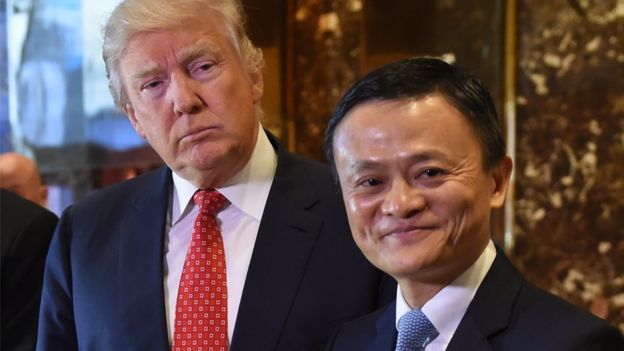
Image copyright GETTY IMAGESImage caption Ma discussed trade with then-President-elect Donald Trump in January 2017
Duncan Clark, Ma’s biographer, is also aware of reports that Ma was nudged away from Alibaba following a key incident in January 2017. The Chinese billionaire met with then-President-elect Donald Trump in Trump Tower, ostensibly to discuss Sino-US trade. The Chinese president didn’t meet with Trump until months later.
“There was a lot of speculation of time that Jack Ma had moved too fast,” Clark says. “So, I think there’s lessons learned from both sides on the need to try to coordinate.”
“Jack Ma represents a sort of entrepreneurial soft power,” Clark adds. “That also creates challenges though, because the government is quite jealous or nervous of non-Party actors taking that kind of role.”
Technically, Ma isn’t a Communist outsider: China’s wealthiest capitalist has actually been a member of the Communist Party since the 1980s, when he was a university student.
But Ma’s always had a tricky relationship with the Party, famously saying that Alibaba’s attitude towards the Party was to “be in love with it but not to marry it”.
Even if Ma and the foundations connected to him are making decisions without Beijing’s advance blessing, the Chinese government has certainly done what it can to capitalise on Ma’s generosity. Chinese ambassadors are frequently on hand at airport ceremonies to receive the medical supplies shipped over by Ma, from Sierra Leone to Cambodia.
China has also used Ma’s largesse in its critiques of the United States. “The State Department said Taiwan is a true friend as it donated 2 million masks,” the Chinese Foreign Ministry tweeted in early April. “Wonder if @StateDept has any comment on Jack Ma’s donation of 1 million masks and 500k testing kits as well as Chinese companies’ and provinces’ assistance?”
Perhaps Ma can rise above what’s happened to so many others who ran afoul of the Party. China might just need a popular global Chinese figure so much that Ma has done what no one else can: make himself indispensable.
“Here’s the one key takeaway from all that happened with Jack Ma and Africa: he said he would do something and it got done,” explains Eric Olander. “That is an incredibly powerful optic in a place where foreigners often come, make big promises and often fail to deliver. So, the huge Covid-19 donation that he did fit within that pattern. He said he would do it and mere weeks later, those masks were in the hands of healthcare workers.”
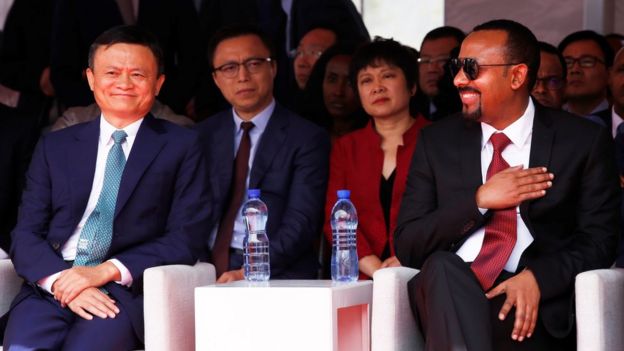
Image copyright GETTY IMAGESImage caption Ma at an Electronic World Trade Platform event with Ethiopian Prime Minister Abiy Ahmed last year
Duncan Clark argues that Ma already had a seat at China’s high table because of Alibaba’s economic heft. However, his first-name familiarity with world leaders makes him even more valuable to Beijing as China tries to repair its battered image.
“He has demonstrated the ability, with multiple IPOs under his belt, and multiple friendships overseas, to win friends and influence people. He’s the Dale Carnegie of China and that certainly, we’ve seen that that’s irritated some in the Chinese government but now it’s almost an all hands on deck situation,” Clark says.
There’s no doubt that China’s wider reputation is benefiting from the charitable work of Ma and other wealthy Chinese entrepreneurs. Andrew Grabois from Candid, the philanthropic watchdog that’s been measuring global donations in relation to Covid-19, says that the private donations coming from China are impossible to ignore.
“They’re taking a leadership role, the kind of thing that used to be done by the United States,” he says. “The most obvious past example is the response to Ebola, the Ebola outbreak in 2014. The US sent in doctors and everything to West Africa to help contain that virus before it left West Africa.”
Chinese donors are taking on that role with this virus.
“They are projecting soft power beyond their borders, going into areas, providing aid, monetary aid and expertise,” Grabois adds.
So, it’s not the right time for Beijing to stand in Jack Ma’s way.
“You know, this is a major crisis for the world right now,” Duncan Clark concludes. “But obviously, it’s also a crisis for China’s relationship with the rest of the world. So they need anybody who can help dampen down some of these those pressures.”
The enterprise collaboration industry in China is forecast to achieve a compound annual growth rate of 12.4 per cent over five years to reach US$7 billion by 2024
Tencent has been accused of using its market dominance with WeChat to stifle competition. Photo: Reuters
Tencent’s super app WeChat, with a user base of 1.2 billion people, has blocked links from a ByteDance remote work tool as Chinese tech giants fight for dominance in the burgeoning enterprise collaboration market.
The latest move adds another ByteDance app to WeChat’s blacklist, which already includes Douyin, the Chinese version of TikTok, and its sister platform Xigua Video, amid ongoing accusations that Tencent uses its market dominance to stifle competition.
Feishu, the Chinese version of ByteDance’s productivity tool Lark, said Saturday that users could not open any of its links on WeChat, nor could they share name cards to invite colleagues.
Feishu said WeChat did not provide advance notice of the ban, adding that the move has “significantly affected work efficiency and user experience” at a time when many companies in China have moved their office operations online to limit the spread of coronavirus infections.
Instead, Lark users need to copy the link and open it in a browser instead of opening it directly via WeChat.
Tencent launches new social apps as flagships WeChat and QQ show their age
13 Dec 2019
A WeChat representative declined to comment other than to cite the company’s regulations on external links. The rules, introduced in October 2019, said the platform will punish websites or apps that send links to “mislead or entice users to download or redirect to an external app”. Punishment includes blocking their domain name from opening in WeChat.
Xie Xin, a ByteDance vice president overseeing Feishu, said the app does not support sign-ups using a WeChat account nor does it enable the sharing of documents or messages on the Tencent app.
In addition to blocking the ByteDance app, WeChat also suspended two tech-focused media websites, 36Kr and ITHome, from publishing posts on the platform after they reported the Lark case over the weekend. The relevant articles have also been removed from WeChat.
The WeChat representative said it did not force media to delete their articles. Rather, the media in question have violated WeChat’s rules on multiple occasions.
The enterprise collaboration industry in China, which has received a huge boost from the health crisis, is forecast to achieve a compound annual growth rate of 12.4 per cent over five years to reach nearly 49 billion yuan (US$7 billion) by 2024, according to the Qianzhan Industry Research Institute.
Feishu is a small but fast-emerging player in the sector, jumping 40 places from late January to become the 15th most downloaded business iOS app on Monday. However, it still lags far behind Alibaba’s DingTalk and Tencent’s WeChat Work and Tencent Meeting, which ranked as the top three among business iOS apps in China as of Monday, according to App Annie.
Alibaba is the parent company of the South China Morning Post.Tencent has also blocked apps from other Chinese tech giants. Links from Taobao, Alibaba’s online marketplace, and Haokan, a short video app from Baidu, cannot be accessed on WeChat. In contrast, Tencent allows the sharing of links from JD.com and PDD pages, online marketplaces in which it owns a financial stake.
“Having more than 1 billion users, [WeChat] has a monopolistic position in the market,” said Wang Sixin, a professor at the Communication University of China who specialises in media policy and rules. “Under these circumstances, Tencent has to have legitimate reasons to block other apps, otherwise it’s taking advantage of its dominance to force out smaller rivals.”
In April 2019, a Chinese lawyer sued Tencent under the country’s anti-monopoly law, charging that the company’s actions infringed on his rights as a user. In December, the intellectual property court in Beijing heard the case, with Tencent representatives arguing that WeChat did not prevent users from sharing links and using the app on other platforms, Southern Metropolis Daily reported. The court has not yet reached a verdict.
Besides enterprise collaboration, Tencent and ByteDance are coming up against each other in other markets. Last week Tencent began testing a short video function for WeChat, a sector dominated by TikTok and Douyin, while ByteDance plans to







 CHINDIA ALERT: You'll be living in their world, very soon