Chindia Alert: You’ll be Living in their World Very Soon
aims to alert you to the threats and opportunities that China and India present. China and India require serious attention; case of ‘hidden dragon and crouching tiger’.
Without this attention, governments, businesses and, indeed, individuals may find themselves at a great disadvantage sooner rather than later.
The POSTs (front webpages) are mainly 'cuttings' from reliable sources, updated continuously.
The PAGEs (see Tabs, above) attempt to make the information more meaningful by putting some structure to the information we have researched and assembled since 2006.
People’s Liberation Army has officially recorded no infections but disease fears have delayed recruitment, training and operations
Analysts say Sars experience guided military’s prompt response, but combat effectiveness has been affected
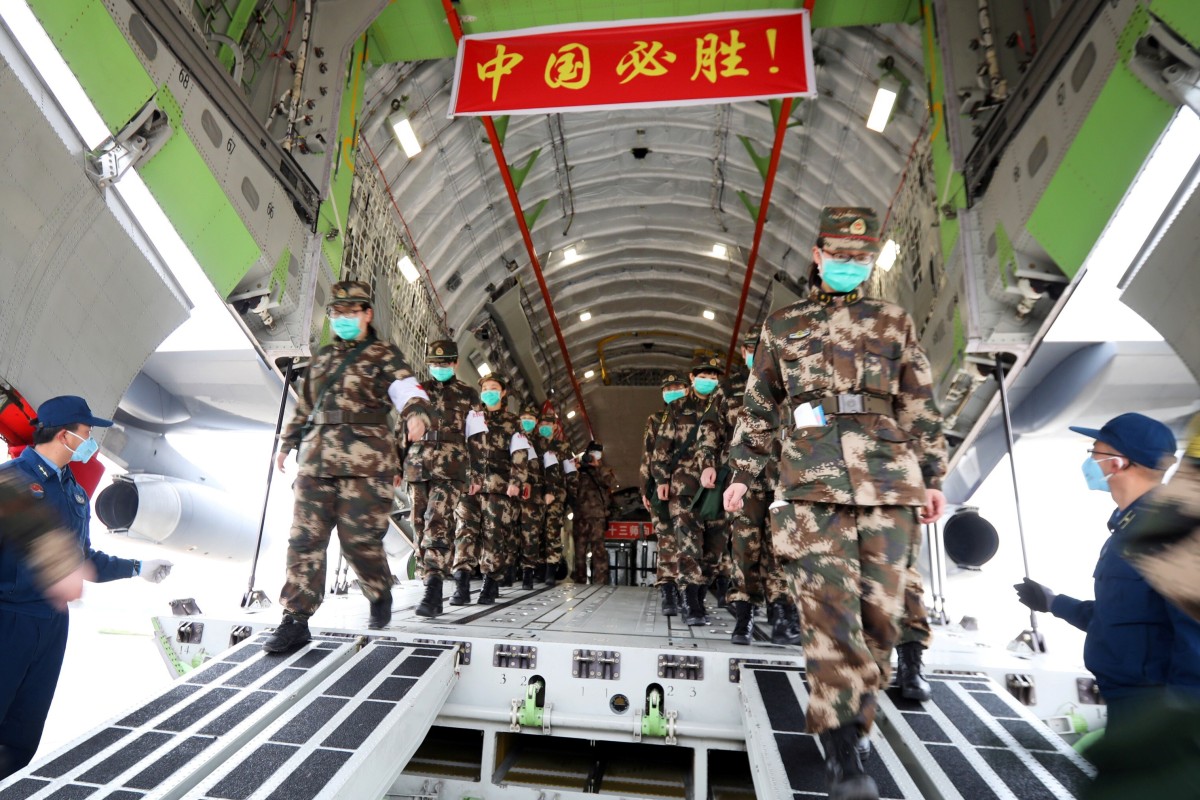
Chinese military medical personnel arriving in Wuhan in February to assist with the coronavirus outbreak response to the February. Photo: Reuters
China’s military may have been spared any coronavirus infections, but the global health crisis has slowed the progress of Chinese President Xi Jinping’s plan to transform the People’s Liberation Army into a modern fighting force capable of long-range power-projecting operations, experts say.
According to China’s defence ministry, the world’s largest armed force – with about 2.3 million personnel – has had zero confirmed cases of Covid-19. In contrast, the US and Russian militaries, ranked second- and third-largest in the world, have reported more than 4,000 and 1,000 respectively.
But the PLA has been affected in other ways by the disease, which was first reported in Wuhan in December before going on to infect 3.9 million people around the world to date.
Safety concerns delayed its annual spring recruitment programme – it has been rescheduled for August – while the PLA Navy was forced to change its training arrangements, switching to classroom study of military theory and tactics, according to Xinhua.
“The PLA is still a conscription army and, given its large turnover of soldiers every year and the late recruitment and training plan this year, the coronavirus pandemic has already affected combat effectiveness,” said Adam Ni, director of the China Policy Centre, an independent, non-profit research organisation based in Canberra, Australia.
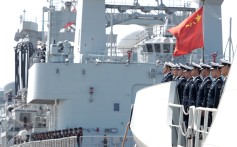
China’s military budget will still rise despite coronavirus, experts predict
3 May 2020
The navy’s operations, in particular, would have been affected, according to Charlie Lyons Jones, a researcher from the Australian Strategic Policy Institute’s defence and strategy programme.
“The Chinese navy, short of highly effective disease control measures, is unlikely to avoid similar outbreaks of the novel coronavirus on board its warships,” he said.
“Therefore, even if the PLA Navy currently has zero personnel infected by the novel coronavirus, its position as a navy that can operate effectively in a period of higher-than-normal tension remains precarious at best,” Jones said. He also questioned Beijing’s claims that the military was virus-free.
“The PLA played an important role in China’s response to the coronavirus outbreak in Wuhan … The idea that none of these personnel working on the front lines in Wuhan became infected by the novel coronavirus would be inconsistent with the experiences of countries from around the world,” he said.
More than 4,000 military medical workers were sent to Wuhan as part of China’s effort to contain the outbreak at ground zero – which included the rapid-built emergency field facility, the Huoshenshan hospital – and their efforts were highlighted in a documentary screened recently by state broadcaster CCTV.
China opens coronavirus hospital built in 10 days
At the time, rumours were rampant that the Chinese military had been affected by the coronavirus, fuelled by a report on February 17 by the official PLA Daily that some soldiers had been placed in quarantine and Yu Qiusong, captain of the Changzhou type 054A frigate, was isolating in a guest house. The news report did not mention why the personnel were in quarantine.
But analysts said that whether the official numbers were accurate, the PLA’s closed management, fast response and past experience with severe acute respiratory syndrome (Sars) gave China’s military an advantage in keeping the coronavirus at bay.
Zhou Chenming, a Beijing-based military observer, said a key reason for the less serious hit to the PLA compared to other forces was its speed in recognising the severity of the situation.
“What’s more, the PLA has its own logistic support system that can help minimise its contact with the outside world, thus reducing the possibility of contracting the virus,” he said.
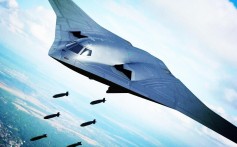
China’s long-range stealth bomber could make its debut this year
4 May 2020
According to Xinhua, the PLA’s Centre for Disease Control and Prevention drew up an emergency response plan and mobilisation arrangements on January 20, the same day Xi issued an instruction to the public that the virus must be “resolutely contained”.
Timothy Heath, a senior international defence research analyst with the Rand Corporation, a US think tank, said China’s military had benefited from its less international role, compared to US forces.
“The US is a globally distributed force while the Chinese military largely operates on the mainland. The US thus faces challenges in containing the disease that the Chinese military does not have to face … and the US military has a large range of missions and tasks it carries out to counter threats to its allies and partners, as well as to US security. This complicates efforts by the US military to carry out disease control measures,” he said.
TAIPEI (Reuters) – China accused the United States on Thursday of playing a dangerous game with its support for Taiwan, after a U.S. warship passed through the sensitive Taiwan Strait following heightened military tension between China and Taiwan.
China has been angered by the Trump administration’s stepped-up support for the island it considers its own, such as more arms sales, U.S. patrols near Taiwan and last month’s visit to Washington by Taiwan Vice President-elect William Lai.
Anthony Junco, a spokesman for the U.S. Seventh Fleet, said the guided-missile destroyer USS McCampbell conducted “a routine Taiwan Strait transit” on March 25, in line with international law.
“The ship’s transit through the Taiwan Strait demonstrates the U.S. commitment to a free and open Indo-Pacific,” he added. “The U.S. Navy will continue to fly, sail and operate anywhere international law allows.”
Taiwan’s defence ministry said the ship sailed north through the waterway and was monitored by Taiwan’s armed forces, on what it called an “ordinary mission”, adding there was no cause for alarm.
In Beijing, Chinese defence ministry spokesman Ren Guoqiang denounced “continued negative actions” by the United States on Taiwan, including sailings through and flights over the Taiwan Strait.
“U.S. moves have seriously interfered in China’s internal affairs, severely harmed peace and stability in the Taiwan Strait and poisoned Sino-U.S. military ties,” Ren told a monthly news conference.
The actions were “extremely dangerous”, he added.
Taiwan is China’s most sensitive territorial and diplomatic issue and Beijing has never ruled out the use of force to bring the island under its control. The narrow Taiwan Strait that separates the island from China is a frequent source of tension.
In recent weeks China’s air force has conducted several exercises close to Taiwan, prompting its mostly U.S.-equipped military to scramble fighters to intercept and warn away the Chinese aircraft.
Taiwan has called the drills provocative, and urged China to pay more attention to fighting a coronavirus pandemic, rather than menace it.
The United States, like most countries, has no official relations with Taiwan, but is the island’s most important international supporter and main source of arms.
In January another U.S. warship sailed through the Taiwan Strait less than a week after President Tsai Ing-wen won re-election by a landslide on a platform of standing up to China.
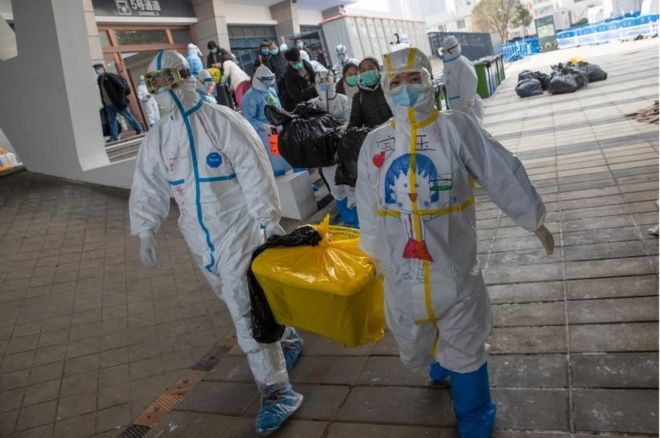
Image copyright EPAImage caption Wuhan has been sealed off since mid-January
The lockdown in Wuhan, the Chinese city where the global coronavirus outbreak began, will be partially lifted on 8 April, officials say.
Travel restrictions in the rest of Hubei province, where Wuhan is located, will be lifted from midnight on Tuesday – for residents who are healthy.
A single new case of the virus was reported in Wuhan on Tuesday following almost a week of no reported new cases.
Countries around the world have gone into lockdown or imposed severe curbs.
The UK is getting to grips with sweeping new measures to tackle the spread of coronavirus, including a ban on public gatherings of more than two people and the immediate closure of shops selling non-essential goods.
Image copyright AFPImage caption The WHO has urged the G20 group of nations to boost production of protective equipment
Meanwhile, health experts say Americans must limit their social interactions or the number of infections will overwhelm the health care system in the US.
Spanish soldiers helping to fight the coronavirus pandemic have found elderly patients in retirement homes abandoned and, in some cases, dead in their beds, the defence ministry has said.
An ice rink in Madrid is to be used as a temporary mortuary for Covid-19 victims.
The World Health Organization (WHO) has warned that the pandemic is accelerating, with more than 300,000 cases now confirmed. It is urging countries to adopt rigorous testing and contact-tracing strategies.
Wuhan has been shut off from the rest of the world since the middle of January. But officials now say anyone who has a “green” code on a widely used smartphone health app will be allowed to leave the city from 8 April.
Earlier, the authorities reported a new case of coronavirus in Wuhan, ending a five-day run of no reported new cases in the city.
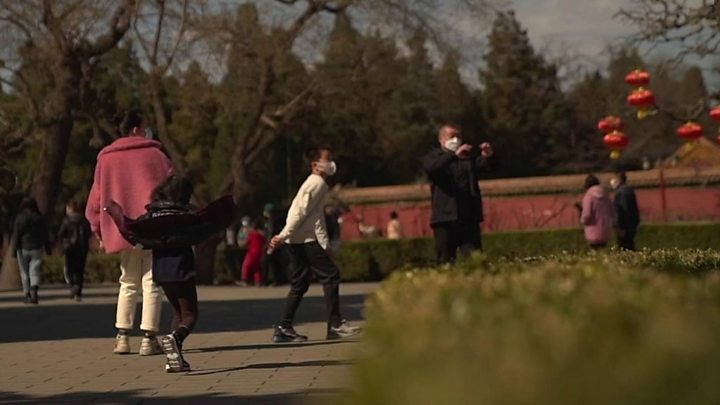
Media caption Coronavirus: People in Beijing begin to head outdoors
It comes after health officials there confirmed that they were not counting cases of people who were positive but had not been admitted to hospital or did not show any symptoms of the disease.
Official government figures say there have been 78 new cases reported on the Chinese mainland in the last 24 hours. All but four of them were caused by infected travellers arriving from abroad.
This so-called “second wave” of imported infections is also affecting countries like South Korea and Singapore, which had been successful in stopping the spread of disease in recent weeks.
South Korea has been seeing a drop in its daily tally of new cases. On Tuesday it reported its lowest number since 29 February.
China looks to repair its reputation
By Robin Brant, BBC News, Shanghai
China considers itself to be – very nearly – a “post corona” country.
In the last week we’ve heard Wuhan medics warning the UK and others that they need to do more to protect frontline health workers, citing the mistakes they made early on when some treated patients without wearing proper protective clothing.
But there’s also been reporting in state media of the reported death toll in Italy surpassing that in China. This has been combined with some commentary from prominent media figures that has appeared distasteful, almost triumphalist.
At the same time there is a panic about the threat of a second wave from imported cases – travellers arriving from abroad. This has fuelled the view – right or wrong – that some other countries aren’t taking the threat seriously because they aren’t doing what China did. (Almost all the cases in Beijing that have been made public are of Chinese nationals returning home).
Meanwhile, well away from senior leaders, there are some high-profile diplomatic figures using international-facing social media to spread theories that the US may have weaponised and dumped the virus in China. Or that Italy had cases that may have been Covid-19 earlier than China. China is sowing seeds of doubt and questioning assumed truths as it looks to repair its reputation.
Almost all of India with its 1.3bn people is under lockdown. Buses, trains and other forms of public transport are suspended. On Monday, the authorities said domestic flights would also stopped. The country has reported 485 cases and nine people have died. Prime Minister Narendra Modi will address the nation again this evening.
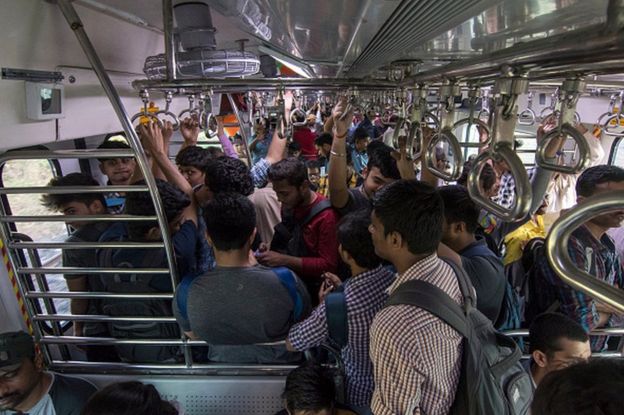
Image copyright GETTY IMAGESImage caption Mumbai’s suburban train network carries eight million passengers a day
Neighbouring Pakistan has almost twice as many confirmed cases – 878 as of Monday evening. Sweeping restrictions are in place although the government has stopped short of imposing a nationwide lockdown. However, several provinces have announced them independently. The army is being brought in to help enforce the restrictions.
Bangladesh, which has reported 33 cases and three deaths, is also deploying its armed forces to help maintain social distancing and boost Covid-19 preventive measures. The soldiers will also monitor thousands of quarantined expatriate returnees. Across South Asia, there are concerns that the actual number of cases could be much higher than is being reported.
Indonesia, which has 49 confirmed Covid-19 deaths – the highest in South-East Asia – has converted an athlete’s village built for the 2018 Asian Games into a makeshift hospital for coronavirus patients. A state of emergency was declared in Jakarta on Monday.
In Thailand, a month-long state of emergency which will include curfews and checkpoints will begin on Thursday. The government has been criticised for failing to take strong action so far. Four people have died and nearly 900 tested positive.
Talks between the Japanese PM and the International Olympic Committee are expected this evening.
The most populous country that was without a case until now – Myanmar – has announced two cases.
Europe’s battle against virus intensifies
UK Prime Minister Boris Johnson announced on Monday night that, with immediate effect, “people will only be allowed to leave their home…for very limited purposes”. They include shopping for basic necessities, taking one form of exercise per day, fulfilling any medical need, or travelling to work if working from home is impossible.
Media caption Reality Check tackles misleading health advice being shared online
The number of people who have died in the UK rose to 335 on Monday.
In Italy, the worst-hit country in the world, the authorities said 602 people with Covid-19 had died in the past 24 hours, bringing the total death toll there to 6,077.
But the daily increase in cases was the smallest since Thursday, raising hope that the stringent restrictions imposed by the government were starting to have an effect.
Spain, however, said on Tuesday that its death toll had risen by 514 to 2,696. Nearly 40,000 are infected, about 5,400 of them healthcare workers.
The remarks by Pitroda come on a day when the Pakistan High Commission in Delhi is hosting the reception for the Pakistan National Day, the invite to which has been declined by India.
SNS Web | New Delhi | March 22, 2019 12:11 pm
Lashing out heavily at the Congress after Sam Pitroda’s remarks on the IAF strike, Prime Minister Narendra Modi on Friday said the most trusted advisor and guide of Rahul Gandhi has kickstarted the Pakistan National Day celebrations on behalf of the Congress, ironically by demeaning Indian armed forces.
The PM said the Opposition has insulted the country’s armed forces time and again.
Sparking a massive controversy, Gandhi’s close confidant and Chairman of Indian Overseas Congress Sam Pitroda earlier in the day made shocking remarks on the IAF strike questioning the death toll in Balakot after the Indian Air Force dropped bombs on JeM camps in a pre-dawn attack on February 26.
Questioning the strike impact, Pitroda asked, “I would like to know more as I have read in New York Times and other newspapers, what did we really attack, we really killed 300 people?”
“If you say 300 people were killed, we all need to know that; all Indians need to know that. Then comes the global media which says nobody was killed. I look bad as an Indian citizen,” he added.
Referring to the 26/11 Mumbai terror attacks that killed 166 people, Sam Pitroda further said, “Eight people come and do something, you don’t jump on an entire nation. It is naive to assume that just because some people came here and attacked, every citizen of that nation is to be blamed. I don’t believe in that way”.
He also said that “attacks happen all the time, it also happened in Mumbai”, adding that the government could have then reacted and just sent fighter planes, but that is not the right approach”.
The Indian Overseas Congress chief further said that it was not the right approach by the Government to send Indian fighters to deal with issues like terror attacks.
Taking a dig at the Congress, PM Modi reacted saying the “loyal courtier of Congress’ royal dynasty admits what the nation already knew – that the Congress was unwilling to respond to forces of terror”.
“This is a New India – we will answer terrorists in a language they understand and with interest,” PM Modi.
The Prime Minister further appealed to the citizens of the country to question the Opposition leaders on their statements and let them know that the 130 crore Indians will not forgive or forget the Opposition for their antics.Union Minister Smriti Irani too hit back at the Congress saying “now the nation knows why Rahul Gandhi’s UPA chose not to respond with full might post the Mumbai terror attacks”, adding that “Congress sympathies with Pakistan stands exposed”.
The remarks by Pitroda come on a day when the Pakistan High Commission in Delhi is hosting the reception for the Pakistan National Day, the invite to which has been declined by the Government citing the presence of Hurriyat leaders.
Many Congress leaders have demanded proof of the retaliatory assault and casualties in the aftermath of the Pulwama terror attack that left over 44 CRPF men dead on February 14.
Following the Pulwama attack, India carried out “non-military pre-emptive” airstrikes targeting the JeM training camp in Balakot in Pakistan’s restive Khyber Pakhtunkhwa province, about 80-km from the Line of Control (LoC) early on February 26.
Hours after the pre-dawn offensive, Government sources had claimed that over 300 terrorists were killed.
The sparring between the government and the opposition intensified after BJP chief Amit Shah claimed that “more than 250” terrorists were killed in the operation, even when the government was yet to give out an official count of the terrorists killed.
NEW DELHI (Reuters) – India’s election commission issued a notice asking political parties not to use images of the country’s armed forces in their campaign posters and other advertising during its upcoming general election.
The notice followed pictures posted to social media recently showing the ruling Bharatiya Janata Party used images in their campaign posters of a captured Indian Air Force pilot recently returned by Pakistan after a clash with India over the disputed Kashmir territory.
The Election Commission said in a notice on its website on Saturday that political parties must refrain from using photographs of defence personnel in advertisements or their election campaign propaganda as the armed forces are “apolitical and neutral stakeholders in a modern democracy.”
The commission cited a 2013 order that said photographs of defence personnel should not be used “in any manner in advertisement/propaganda/campaigning or in any another other manner in connections with elections by political parties and candidates.”
It called for “strict compliance” with the order.
The pilot, Abhinandan Varthaman, was shot down on Feb. 27 by Pakistani aircraft during clashes between the two nuclear-armed powers that began after a terror attack last month in Kashmir that killed 40 Indian paramilitary police.
India blamed Pakistan for the attack and harbouring the militants that claimed responsibility for the attack. Pakistan denies the charges.
India later attacked a site inside Pakistan it claimed was a militant training camp. That triggered aerial clashes that led to Varthaman’s capture. Pakistan released him last week as a peace gesture.
Indian Prime Minister Narendra Modi hailed his release and claimed the clashes with Pakistan were an Indian victory. Nationalistic passions in India have risen since the terror attack.
Recent social media posts showed a campaign poster on a billboard in Indian capital of New Delhi with Varthaman’s face alongside Modi’s, along with the words: “If Modi is in power, it is possible! NaMo again 2019!” NaMo is an acronym for Modi.
Later on Sunday, the Election Commission is due to announce the polling schedule for the upcoming general election, which will be the world’s biggest democratic exercise.
BEIJING, March 5 (Xinhua) — China will lower its defense budget growth rate to 7.5 percent in 2019, from last year’s 8.1 percent, according to a draft budget report submitted to the annual session of the National People’s Congress (NPC) Tuesday.
The 2019 defense budget will be 1.19 trillion yuan (about 177.61 billion U.S. dollars), figures from the report show.
The rate marks the fourth straight year for the budgeted growth rate remaining single digit, following five consecutive years of double-digit increases.
China’s budgeted defense spending growth rate stood at 8.1 percent in 2018, 7 percent in 2017, and 7.6 percent in 2016.
“The Chinese government has always paid attention to controlling the scale of defense expenditure,” said He Lei, former deputy head of the Academy of Military Sciences.
Describing China’s defense budget increase as reasonable and appropriate, Zhang Yesui, spokesperson for the legislative session, said the rise aimed to “meet the country’s demand in safeguarding national security and military reform with Chinese characteristics.”
“China’s limited defense spending, which is for safeguarding its national sovereignty, security and territorial integrity, poses no threat to any other country,” Zhang said at a press conference Monday.
The expenditure has been mainly used for advancing defense and military reforms, supporting military training and diverse tasks, modernizing weapons and equipment, and improving welfare of service personnel, according to He, who is also a deputy to the NPC.
“The defense budget increase is appropriate against the backdrop of profound changes in the country’s overall strength, its security environment, and the global strategic situation,” He said.
China’s defense budget takes up a fairly small share of its GDP and national fiscal expenditure compared with other major countries, said He, noting that its military spending per capita and per soldier was also very low.
While the national defense spending in a number of major developed countries accounts for more than 2 percent of their GDP, the ratio was only about 1.3 percent for China in 2018.
The United States has increased its national defense expenditure for the fiscal year 2019 to 716 billion dollars, about four times the budget of China, the world’s second largest economy.
China’s military spending per capita is only about one-nineteenth of that of the United States.
“When it comes to whether a country poses a threat to other countries, the key is not that country’s national strength and armed forces, but the policies it adopts,” said Chen Zhou, research fellow with the Academy of Military Sciences.
“China has always been following the path of peaceful development and firmly adheres to a defense policy that is defensive in nature,” Chen said, noting that China’s development would not pose a threat to any other country.
He Lei highlighted China’s role in providing public security goods for the international community, saying the Chinese military had actively participated in UN peacekeeping missions, maintained security of marine passages, and engaged in international rescue and security cooperation.
“The growth in China’s defense spending is the growth of forces for world peace,” he noted.
BEIJING, Feb. 3 (Xinhua) — A senior military official on Sunday called on media as well as literary and art workers of the military to promote innovation and development in their work, so as to provide solid support for strengthening and revitalizing the armed forces.
Zhang Youxia, a member of the Political Bureau of the Communist Party of China (CPC) Central Committee and vice chairman of the Central Military Commission, made the remarks when he extended Spring Festival greetings at the news media center and the culture and arts center of the People’s Liberation Army (PLA).
The PLA’s news media center is an important publicity front of the Party, and the PLA and has to speak for the Party’s will, said Zhang, stressing adherence to correct political and public opinion direction.
The PLA’s culture and arts center should play an active role in nurturing the fighting spirit and build up a good image of art soldiers in the new era, Zhang said.
Chinese President Xi Jinping, also general secretary of the Communist Party of China (CPC) Central Committee and chairman of the Central Military Commission (CMC), delivers a speech at a CMC meeting held in Beijing, capital of China, Jan. 4, 2019. (Xinhua/Li Gang)
BEIJING, Jan. 4 (Xinhua) — President Xi Jinping Friday ordered the Chinese armed forces to enhance their combat readiness from a new starting point and open new ground for developing a strong military.
Xi, also general secretary of the Communist Party of China (CPC) Central Committee and chairman of the Central Military Commission (CMC), made the instruction at a CMC meeting held in Beijing.
Hailing the landmark, pioneering and historic military achievements since the 18th CPC National Congress, Xi said the armed forces had resolutely safeguarded national sovereignty, security and development interests and withstood complex situations and severe struggles.
“The world is facing a period of major changes never seen in a century, and China is still in an important period of strategic opportunity for development,” he said, warning that various risks and challenges were on the rise.
The entire armed forces should have a correct understanding of China’s security and development trends, enhance their awareness of danger, crisis and war, and make solid efforts on combat preparations in order to accomplish the tasks assigned by the Party and the people, Xi said.
Regarding combat capability as the only and fundamental criterion, Xi ordered all work, forces and resources to focus on military preparedness and ensure a marked progress in this regard.
Xi stressed the armed forces’ ability to respond quickly and effectively to contingencies, asking them to upgrade commanding capability of joint operations, foster new combat forces, and improve military training under combat conditions.
Party and government departments and agencies at the central and local levels are required to support the defense and military development.
Xu Qiliang, a CMC vice chairman, presided over the meeting, and Zhang Youxia, the other CMC vice chairman, announced the decision to give awards to 10 model units and 20 model individuals. They received awards from leaders, including Xi.
Xi also signed a mobilization order for the training of the armed forces, the CMC’s first order in 2019.
The Indian Space Research Organisation (Isro) will launch the country’s newest satellite GSAT-7A, which will give a boost to the defence forces’ communication capabilities, from Andhra Pradesh’s Sriharikota on Wednesday.
In the third mission in just over a month, the space agency will launch the 2,250 kg operational communication satellite from the second launch pad of Satish Dhawan Space Centre. (AP)
The Indian Space Research Organisation (Isro) on Wednesday launched the country’s newest satellite GSAT-7A, which will give a boost to the defence forces’ communication capabilities, from Andhra Pradesh’s Sriharikota on Wednesday.
In the third mission in just over a month, the space agency launched the 2,250 kg operational communication satellite from the second launch pad of Satish Dhawan Space Centre at 4.10pm on Wednesday.
The satellite was carried by the Geosynchronous Satellite Launch Vehicle-F11 (GSLV-F11), Isro’s 35th communication satellite and the 13th flight of the GSLV rocket to orbit.
The GSLV-Mk II rocket launched the satellite into the temporary orbit after a flight of nearly 20 minutes. The rocket will be taken into the geostationary or circular orbit using the onboard propulsion system and it will take few days after the separation from the launcher to reach its orbital slot.
“GSLV F11 is Isro’s fourth generation launch vehicle with three stages. The four liquid strap-ons and a solid rocket motor at the core form the first stage. The second stage is equipped with high thrust engine using liquid fuel. The Cryogenic Upper Stage forms the third and final stage of the vehicle,” the space agency said on its website.
According to reports, GSAT-7A has been built exclusively for the Indian Air Force (IAF) and the Indian Army and will add to the forces’ communication capabilities.
The satellite will allow IAF to interlink its ground radar stations, airbases and airborne early warning and control (AWACS) aircraft, and reduce the reliance on on-ground control stations for drones, they said. It will also boost the air force’s network-dependent warfare capabilities, enhancing its abilities to operate globally.
Wednesday’s mission will be the space agency’s last mission for this year. This year, Isro launched GSAT-11 on December 5 on a European vehicle from French Guinea’s Kourou, GSAT-29 on November 14 on its GSLV-MkIII vehicle and the ill-fated GSAT-6A on March 29 from Sriharikota.
The launch of Chandrayaan-2 and the PSLV-C44 remote-sensing satellite launch are among the seven missions lined up in 2019.







 CHINDIA ALERT: You'll be living in their world, very soon