Chindia Alert: You’ll be Living in their World Very Soon
aims to alert you to the threats and opportunities that China and India present. China and India require serious attention; case of ‘hidden dragon and crouching tiger’.
Without this attention, governments, businesses and, indeed, individuals may find themselves at a great disadvantage sooner rather than later.
The POSTs (front webpages) are mainly 'cuttings' from reliable sources, updated continuously.
The PAGEs (see Tabs, above) attempt to make the information more meaningful by putting some structure to the information we have researched and assembled since 2006.
The plight of these workers, many of whom have been walking for days without adequate food and water, has caused widespread anger in the country.
Train and bus services were shut during the lockdown and even though some have been restarted for migrants, many say they cannot afford the fare and are unsure if they will be accommodated on them due to social distancing norms.
Several have died in making the journey, including 16 migrants who were run over by a train while they were sleeping on the railway tracks.
Media caption Coronavirus: Heartbreaking scenes as India lockdown sparks mass migration
Ms Sitharaman also announced that workers would be able to use ration cards – usually only valid at village level – anywhere in the country regardless of where it was issued.
The ration cards usually entitle holders to subsidised food.
She added that the move towards portable cards would benefit nearly 670 million people and will be completed by March next year.
The government will also provide affordable housing for migrant labour by converting existing vacant government funded housing complexes, among other things.
The announcements on Thursday – the second tranche of a series of economic stimulus measures – were aimed at migrant workers, street hawkers, small traders and small farmers.
The full details of the economic package, which is equivalent to 10% of India’s gross domestic product, will be known in some days as the government is announcing a different tranche every day.
Ms Sitharaman’s announcements also included details of “special credit” to be provided to five million street hawkers who have been forced to cease working over the last month and a half.
To help farmers, the government also announced an emergency $4bn “working capital funding” which would benefit some 30 million small farmers to meet crop requirements in May and June
In March, India said it would provide around 1.7 trillion rupees in direct cash transfers and food security measures, mainly for the poor.
However, Mr Modi’s administration had been accused in some quarters of not having done enough.
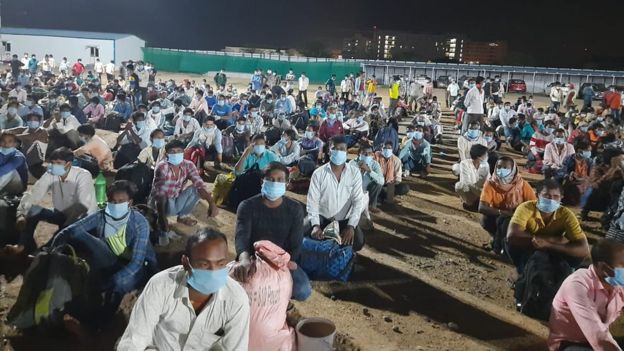
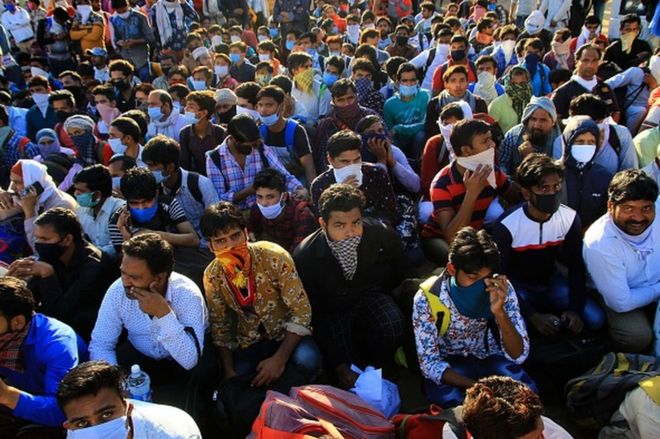
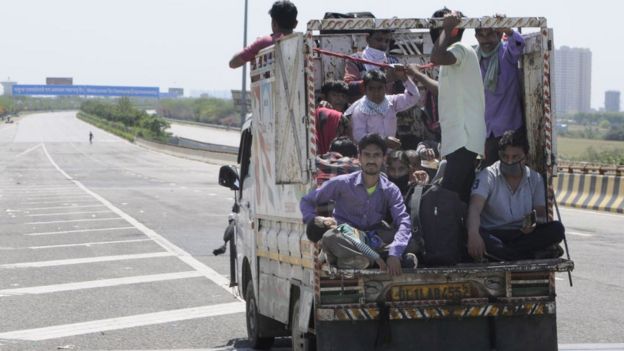
Image copyright ANIImage caption Millions of people across India have been stranded by the lockdown
The first train carrying migrant workers stranded by a nationwide lockdown in India has left the southern state of Telangana.
The 24-coach train, carrying 1,200 passengers, is travelling non-stop to eastern Jharkhand state.
Earlier this week, India said millions of people stranded by the lockdown can return to their home states.
The country has been in lockdown to curb the spread of coronavirus since 24 March.
However, the movement of people will be only possible through state government facilitation, which means people cannot attempt to cross state borders on their own.
This train is a “one-off special train” to transport the workers on the request of the Telangana state government, Rakesh Ch, the chief public relations officer of South-Central Railways, told the BBC.
The train left Lingampally, a suburb of the southern city of Hyderabad, early on Friday and is expected to reach Hatia in Jharkhand on Saturday.
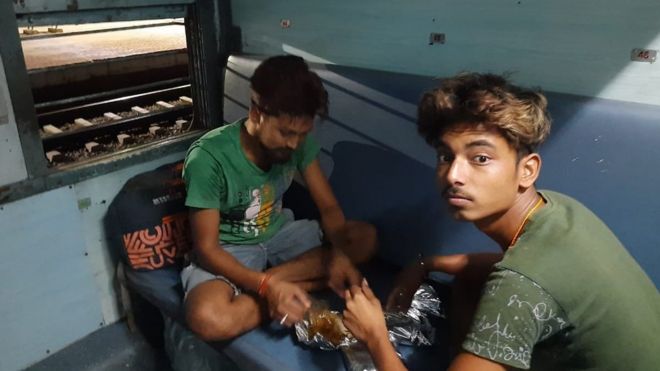
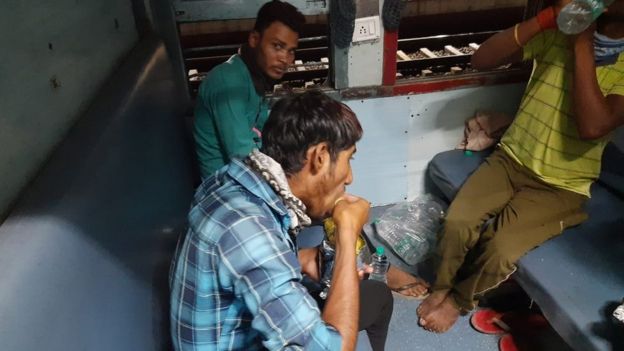
Mr Rakesh said that adequate social distancing precautions had been taken and food was being served to the passengers.
Image copyright ANIImage caption Railways officials said that adequate social distancing precautions had been taken and food was being served to the passengers.
He said each carriage was carrying 54 passengers instead of its 72-seat capacity.
“The middle berth is not being used in the sleeper coaches and only two people are sitting in the general coaches,” Mr Rakesh said.
Before the train pulled out of the station, all the passengers were screened for fever and other symptoms.
They had all been employed at a construction site at the Indian Institute of Technology, a top engineering school, in Hyderabad city.
The workers had earlier protested at the site against the non-payment of wages by their contractor.
Senior official M Hanumantha Rao said the contractor was asked to pay their salaries and arrangement made to send them back home.
The journey was organised at “very short notice”, senior police official S Chandra Shekar Reddy told BBC Telugu.
“We screened them at the labour camp itself and transported them to the railway station in buses,” he said.
India’s migrant workers are the backbone of the big city economy, constructing houses, cooking food, serving in eateries, delivering takeaways, cutting hair in salons, making automobiles, plumbing toilets and delivering newspapers, among other things.
Image copyright ANIImage caption Before the train pulled out of the station, all the passengers were screened for fever and other symptoms.
Most of the country’s estimated 100 million migrant workers live in squalid conditions.
When industries shut down overnight, many of them feared they would starve.
For days, they walked – sometimes hundreds of kilometres – to reach their villages because bus and train services were shut down overnight. Several died trying to make the journey.
Some state governments tried to facilitate buses, but these were quickly overrun. Thousands of others have been placed in quarantine centres and relief camps.
Image copyright GETTY IMAGESImage caption Millions are workers are defying a curfew and returning home
When I spoke to him on the phone, he had just returned home to his village in the northern state of Rajasthan from neighbouring Gujarat, where he worked as a mason.
In the rising heat, Goutam Lal Meena had walked on macadam in his sandals. He said he had survived on water and biscuits.
In Gujarat, Mr Meena earned up to 400 rupees ($5.34; £4.29) a day and sent most of his earnings home. Work and wages dried up after India declared a 21-day lockdown with four hours notice on the midnight of 24 March to prevent the spread of coronavirus. (India has reported more than 1,000 Covid-19 cases and 27 deaths so far.) The shutting down of all transport meant that he was forced to travel on foot.
“I walked through the day and I walked through the night. What option did I have? I had little money and almost no food,” Mr Meena told me, his voice raspy and strained.
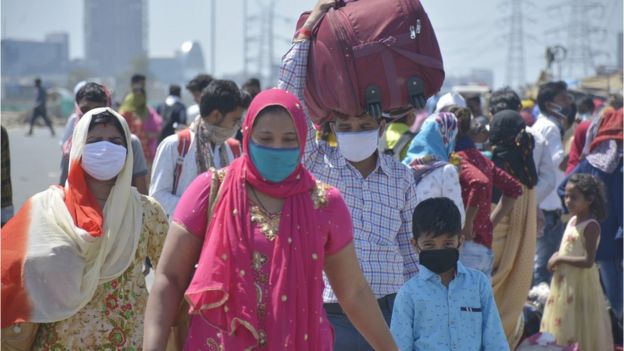
He was not alone. All over India, millions of migrant workers are fleeing its shuttered cities and trekking home to their villages.
These informal workers are the backbone of the big city economy, constructing houses, cooking food, serving in eateries, delivering takeaways, cutting hair in salons, making automobiles, plumbing toilets and delivering newspapers, among other things. Escaping poverty in their villages, most of the estimated 100 million of them live in squalid housing in congested urban ghettos and aspire for upward mobility.
Image copyright GETTY IMAGESImage caption Informal workers are the backbone of India’s big city economies
Last week’s lockdown turned them into refugees overnight. Their workplaces were shut, and most employees and contractors who paid them vanished.
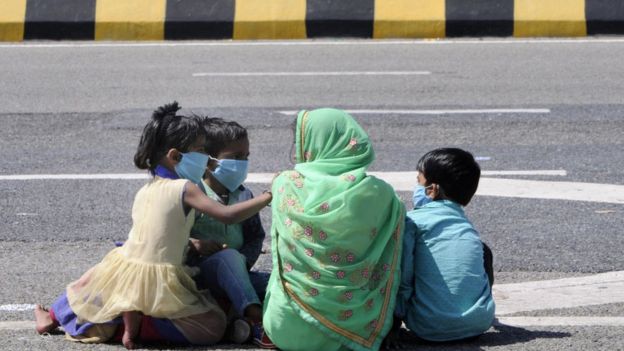
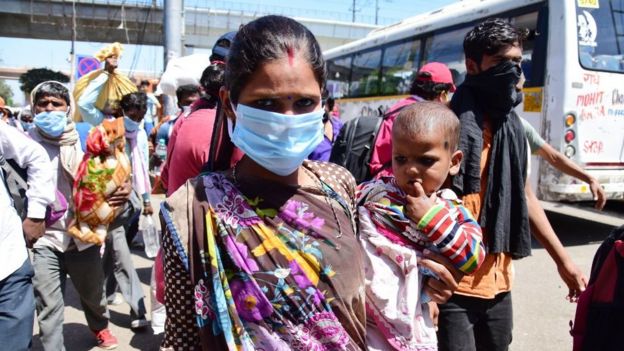
Sprawled together, men, women and children began their journeys at all hours of the day last week. They carried their paltry belongings – usually food, water and clothes – in cheap rexine and cloth bags. The young men carried tatty backpacks. When the children were too tired to walk, their parents carried them on their shoulders.
They walked under the sun and they walked under the stars. Most said they had run out of money and were afraid they would starve. “India is walking home,” headlined The Indian Express newspaper.
The staggering exodus was reminiscent of the flight of refugees during the bloody partition in 1947. Millions of bedraggled refugees had then trekked to east and west Pakistan, in a migration that displaced 15 million people.
Image copyright GETTY IMAGESImage caption Migrant labourers feel they have more social security in their villages
This time, hundreds of thousands of migrant workers are desperately trying to return home in their own country. Battling hunger and fatigue, they are bound by a collective will to somehow get back to where they belong. Home in the village ensures food and the comfort of the family, they say.
Clearly, a lockdown to stave off a pandemic is turning into a humanitarian crisis.
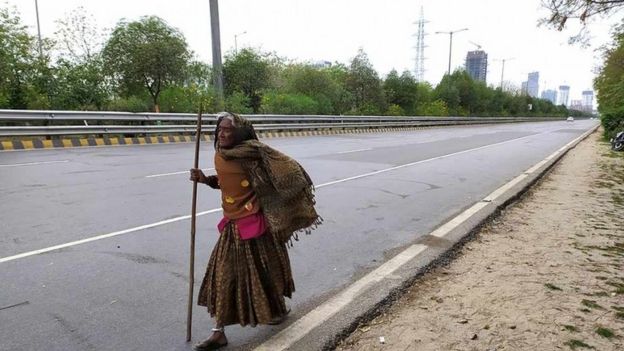
Among the teeming refugees of the lockdown was a 90-year-old woman, whose family sold cheap toys at traffic lights in a suburb outside Delhi.
Kajodi was walking with her family to their native Rajasthan, some 100km (62 miles) away. They were eating biscuits and smoking beedis, – traditional hand-rolled cigarettes – to kill hunger. Leaning on a stick, she had been walking for three hours when journalist Salik Ahmed met her. The humiliating flight from the city had not robbed her off her pride. “She said she would have bought a ticket to go home if transport was available,” Mr Ahmed told me.
Others on the road included a five-year-old boy who was on a 700km (434 miles) journey by foot with his father, a construction worker, from Delhi to their home in Madhya Pradesh state in central India. “When the sun sets we will stop and sleep,” the father told journalist Barkha Dutt. Another woman walked with her husband and two-and-a-half year old daughter, her bag stuffed with food, clothes and water. “We had a place to stay but no money to buy food,” she said.
Then there was Rajneesh, a 26-year-old automobile worker who walking 250km (155 miles) to his village in neighbouring Uttar Pradesh. It would take him four days, he reckoned. “We will die walking before coronavirus hits us,” the man told Ms Dutt.
He was not exaggerating. Last week, a 39-year-old man on a 300km (186 miles) trek from Delhi to Madhya Pradesh complained of chest pain and exhaustion and died; and a 62-year-old man, returning from a hospital by foot in Gujarat, collapsed outside his house and died. Four other migrants, turned away at the borders on their way to Rajasthan from Gujarat, were mowed down by a truck on a dark highway.
As the crisis worsened, state governments scrambled to arrange transport, shelter and food.
Image copyright SALIK AHMED/OUTLOOKImage caption Ninety-year-old Kajodi Devi is walking from Delhi to her village
But trying to transport them to their villages quickly turned into another nightmare. Hundreds of thousands of workers were pressed against each other at a major bus terminal in Delhi as buses rolled in to pick them up.
Delhi chief minister Arvind Kejriwal implored the workers not to leave the capital. He asked them to “stay wherever you are, because in large gatherings, you are also at risk of being infected with the coronavirus.” He said his government would pay their rent, and announced the opening of 568 food distribution centres in the capital. Prime Minister Narendra Modi apologised for the lockdown “which has caused difficulties in your lives, especially the poor people”, adding these “tough measures were needed to win this battle.”
Whatever the reason, Mr Modi and state governments appeared to have bungled in not anticipating this exodus.
Mr Modi has been extremely responsive to the plight of Indian migrant workers stranded abroad: hundreds of them have been brought back home in special flights. But the plight of workers at home struck a jarring note.
“Wanting to go home in a crisis is natural. If Indian students, tourists, pilgrims stranded overseas want to return, so do labourers in big cities. They want to go home to their villages. We can’t be sending planes to bring home one lot, but leave the other to walk back home,” tweeted Shekhar Gupta, founder and editor of The Print.
Image copyright GETTY IMAGESImage caption There is a precedent for this kind of exodus during crisis
The city, says Chinmay Tumbe, author of India Moving: A History of Migration, offers economic security to the poor migrant, but their social security lies in their villages, where they have assured food and accommodation. “With work coming to a halt and jobs gone, they are now looking for social security and trying to return home,” he told me.
Also there’s plenty of precedent for the flight of migrant workers during a crisis – the 2005 floods in Mumbai witnessed many workers fleeing the city. Half of the city’s population, mostly migrants, had also fled the city – then Bombay – in the wake of the 1918 Spanish flu.
When plague broke out in western India in 1994 there was an “almost biblical exodus of hundreds of thousands of people from the industrial city of Surat [in Gujarat]”, recounts historian Frank Snowden in his book Epidemics and Society.
Half of Bombay’s population deserted the city, during a previous plague epidemic in 1896. The draconian anti-plague measures imposed by the British rulers, writes Dr Snowden, turned out to be a “blunt sledgehammer rather than a surgical instrument of precision”. They had helped Bombay to survive the epidemic, but “the fleeing residents carried the disease with them, thereby spreading it.”
More than a century later, that same fear haunts India today. Hundreds of thousands of the migrants will eventually reach home, either by foot, or in packed buses. There they will move into their joint family homes, often with ageing parents. Some 56 districts in nine Indian states account for half of inter-state migration of male workers, according to a government report. These could turn out to be potential hotspots as thousands of migrants return home.
Image copyright GETTY IMAGESImage caption The fleeing migrants could spread the disease all over the country
Partha Mukhopadhyay, a senior fellow at Delhi’s Centre for Policy Research, suggests that 35,000 village councils in these 56 potentially sensitive districts should be involved to test returning workers for the virus, and isolate infected people in local facilities.
In the end, India is facing daunting and predictable challenges in enforcing the lockdown and also making sure the poor and homeless are not fatally hurt. Much of it, Dr Snowden told me, will depend on whether the economic and living consequences of the lockdown strategy are carefully managed, and the consent of the people is won. “If not, there is a potential for very serious hardship, social tension and resistance.” India has already announced a $22bn relief package for those affected by the lockdown.
The next few days will determine whether the states are able to transport the workers home or keep them in the cities and provide them with food and money. “People are forgetting the big stakes amid the drama of the consequences of the lockdown: the risk of millions of people dying,” says Nitin Pai of Takshashila Institution, a prominent think tank.
“There too, likely the worst affected will be the poor.”
BEIJING, March 28 (Xinhua) — Clean energy is becoming the mainstream of global energy supply and interconnection is the mainstream of energy allocation, according to the Global Energy Interconnection Development and Cooperation Organization (GEIDCO).
Over the years, China is active in clean energy development and power grid interconnection with neighboring countries, and has achieved significant breakthroughs in UHV grids, smart grids, and clean energy, GEIDCO spokesperson told a press conference via live stream on Friday.
GEIDCO remains committed to promoting the energy interconnection to meet global power demand with clean and green alternatives, making idea dissemination, planning and research, international cooperation and project promotion the focus of its work, said the spokesperson.
The 2020 Global Energy Interconnection & China-Asia Energy and Power Conference is expected to be held in Beijing in November to discuss and strengthen cooperation on sustainable development in the energy industry.
Founded in March 2016, GEIDCO so far had 860 members from 115 countries, covering fields including energy, electricity, information, finance, consultation, science and technology, and environmental protection.
The global energy interconnection is a platform that connects grids around the world to facilitate development, deployment and utilization of clean energy, with ultra-high voltage transmission as the backbone.
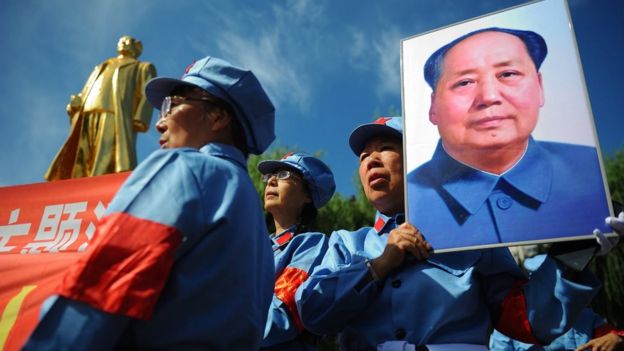
Image copyright GETTY IMAGESImage caption China’s version of its past is a story of prosperity, progress and sacrifice for the common good
China’s extraordinary rise was a defining story of the 20th Century, but as it prepares to mark its 70th anniversary, the BBC’s John Sudworth in Beijing asks who has really won under the Communist Party’s rule.
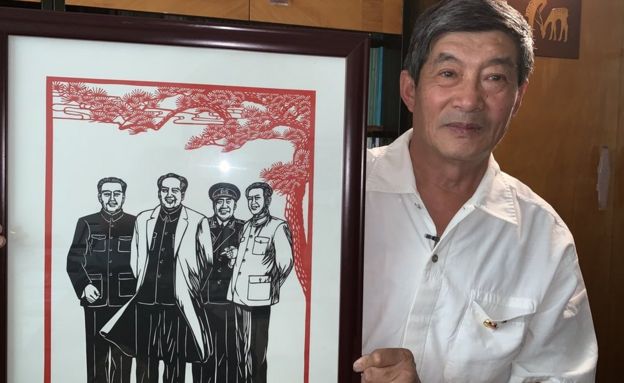
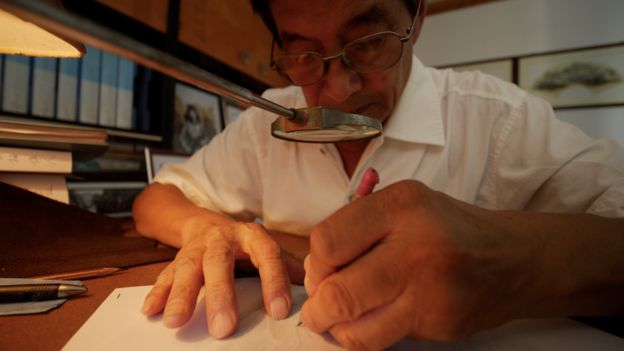
Sitting at his desk in the Chinese city of Tianjin, Zhao Jingjia’s knife is tracing the contours of a face.
Cut by delicate cut, the form emerges – the unmistakable image of Mao Zedong, founder of modern China.
The retired oil engineer discovered his skill with a blade only in later life and now spends his days using the ancient art of paper cutting to glorify leaders and events from China’s communist history.
“I’m the same age as the People’s Republic of China (PRC),” he says. “I have deep feelings for my motherland, my people and my party.”
Image caption For people like Zhao Jingjia, China’s success outweighs the “mistakes” of its leaders
Born a few days before 1 October 1949 – the day the PRC was declared by Mao – Mr Zhao’s life has followed the dramatic contours of China’s development, through poverty, repression and the rise to prosperity.
Now, in his modest but comfortable apartment, his art is helping him make sense of one of the most tumultuous periods of human history.
“Wasn’t Mao a monster,” I ask, “responsible for the deaths of tens of millions of his countrymen?”
“I lived through it,” he replies. “I can tell you that Chairman Mao did make some mistakes but they weren’t his alone.”
“I respect him from my heart. He achieved our nation’s liberation. Ordinary people cannot do such things.”
On Tuesday, China will present a similar, glorious rendering of its record to the world.
Beijing will tremble to the thunder of tanks, missile launchers and 15,000 marching soldiers, a projection of national power, wealth and status watched over by the current Communist Party leader, President Xi Jinping, in Tiananmen Square.
An incomplete narrative of progress
Like Mr Zhao’s paper-cut portraits, we’re not meant to focus on the many individual scars made in the course of China’s modern history.
It is the end result that matters.
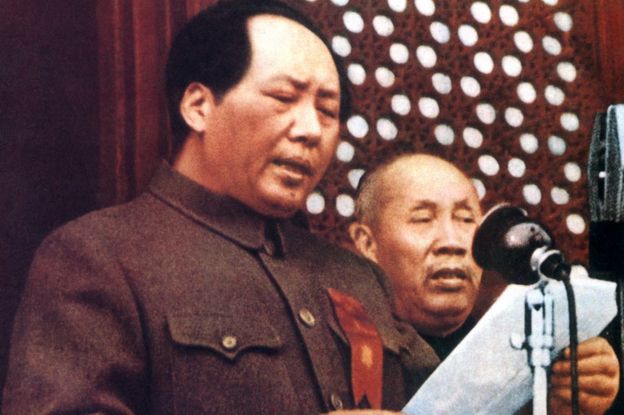
Image copyright XINHUA/AFPImage caption Mao Zedong pronounces the dawn of the People’s Republic of China on 1 October 1949
And, on face value, the transformation has been extraordinary.
On 1 October 1949, Chairman Mao stood in Tiananmen Square urging a war-ravaged, semi-feudal state into a new era with a founding speech and a somewhat plodding parade that could muster only 17 planes for the flyby.
This week’s parade, in contrast, will reportedly feature the world’s longest range intercontinental nuclear missile and a supersonic spy-drone – the trophies of a prosperous, rising authoritarian superpower with a 400 million strong middle class.
It is a narrative of political and economic success that – while in large part true – is incomplete.
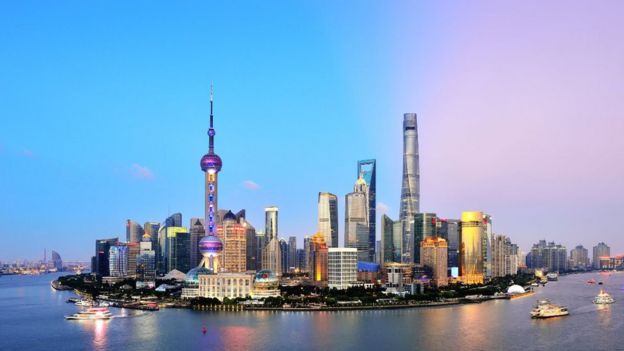
New visitors to China are often, rightly, awe-struck by the skyscraper-festooned, hi-tech megacities connected by brand new highways and the world’s largest high-speed rail network.
Image copyright GETTY IMAGESImage caption Those in China’s glittering cities may accept the trade-off of political freedom for economic growth
They see a rampant consumer society with the inhabitants enjoying the freedom and free time to shop for designer goods, to dine out and to surf the internet.
“How bad can it really be?” the onlookers ask, reflecting on the negative headlines they’ve read about China back home.
The answer, as in all societies, is that it depends very much on who you are.
Many of those in China’s major cities, for example, who have benefited from this explosion of material wealth and opportunity, are genuinely grateful and loyal.
In exchange for stability and growth, they may well accept – or at least tolerate – the lack of political freedom and the censorship that feature so often in the foreign media.
For them the parade could be viewed as a fitting tribute to a national success story that mirrors their own.
But in the carving out of a new China, the knife has cut long and deep.
The dead, the jailed and the marginalised
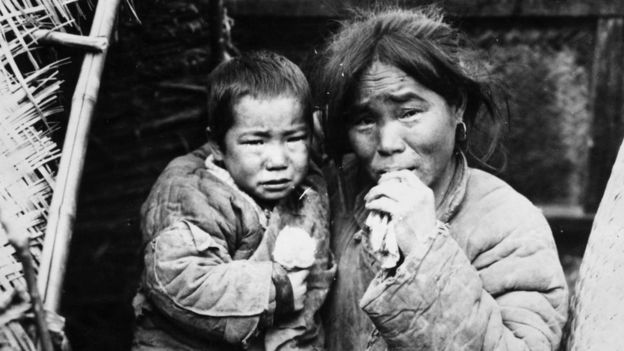
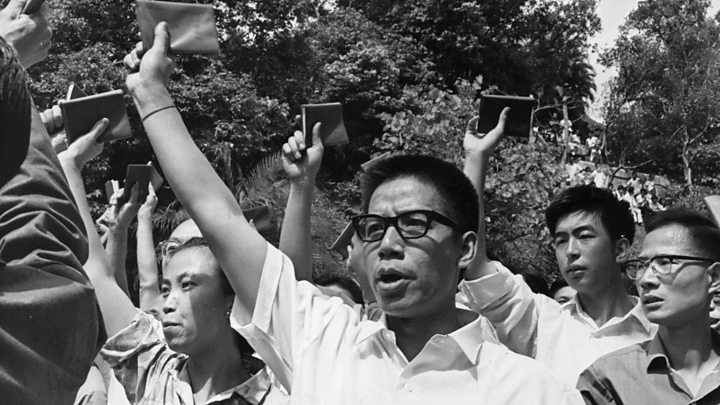
Mao’s man-made famine – a result of radical changes to agricultural systems – claimed tens of millions of lives and his Cultural Revolution killed hundreds of thousands more in a decade-long frenzy of violence and persecution, truths that are notably absent from Chinese textbooks.
Image copyright GETTY/TOPICALImage caption Tens of millions starved to death under Mao, as China radically restructured agriculture and society
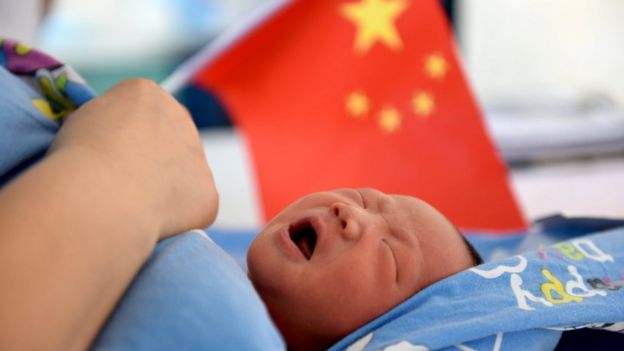
After his death, the demographically calamitous One Child Policy brutalised millions over a 40-year period.
Still today, with its new Two Child Policy, the Party insists on violating that most intimate of rights – an individual’s choice over her fertility.
The list is long, with each category adding many thousands, at least, to the toll of those damaged or destroyed by one-party rule.
Image copyright GETTY IMAGESImage caption Beijing still regulates how many children families can have
There are the victims of religious repression, of local government land-grabs and of corruption.
There are the tens of millions of migrant workers, the backbone of China’s industrial success, who have long been shut out of the benefits of citizenship.
A strict residential permit system continues to deny them and their families the right to education or healthcare where they work.
And in recent years, there are the estimated one and a half million Muslims in China’s western region of Xinjiang – Uighurs, Kazakhs and others – who have been placed in mass incarceration camps on the basis of their faith and ethnicity.
China continues to insist they are vocational schools, and that it is pioneering a new way of preventing domestic terrorism.
The stories of the dead, the jailed and the marginalised are always much more hidden than the stories of the assimilated and the successful.
Viewed from their perspective, the censorship of large parts of China’s recent history is not simply part of a grand bargain to be exchanged for stability and prosperity.
Getty
Timeline of modern China
1949 Mao declares the founding of the People’s Republic of China
1966-76 Cultural Revolution brings social and political upheaval
1977 Deng Xiaoping initiates major reforms of China’s economy
1989 Army crushes Tiananmen Square pro-democracy protests
2010 China becomes the world’s second-largest economy
2018 Xi Jinping is cleared to be president for life
It is something that makes the silence of their suffering all the more difficult to penetrate.
It is the job of foreign journalists, of course, to try.
‘Falsified, faked and glorified’
But while censorship can shut people up, it cannot stop them remembering.
Prof Guo Yuhua, a sociologist at Beijing’s Tsinghua University, is one of the few scholars left trying to record, via oral histories, some of the huge changes that have affected Chinese society over the past seven decades.
Her books are banned, her communications monitored and her social media accounts are regularly deleted.
“For several generations people have received a history that has been falsified, faked, glorified and whitewashed,” she tells me, despite having been warned not to talk to the foreign media ahead of the parade.
“I think it requires the entire nation to re-study and to reflect on history. Only if we do that can we ensure that these tragedies won’t be repeated.”
Image copyright GETTY IMAGESImage caption Can progress really be attributed to the leadership?
A parade, she believes, that puts the Communist Party at the front and centre of the story, misses the real lesson, that China’s progress only began after Mao, when the party loosened its grip a bit.
“People are born to strive for a better, happier and more respectful life, aren’t they?” she asks me.
“If they are provided with a tiny little space, they’ll try to make a fortune and solve their survival problems. This shouldn’t be attributed to the leadership.”
‘Our happiness comes from hard work’
As if to prove the point about how the unsettled, censored pasts of authoritarian states continue to impact the present, the parade is for invited guests only.
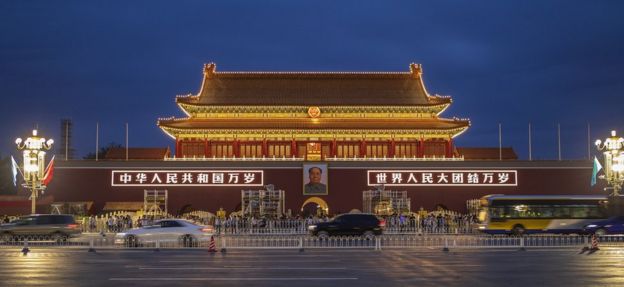
Image copyright GETTY IMAGESImage caption Mao’s portrait will, as it always is, be watching over the events in Tiananmen Square
Another anniversary, of which Tiananmen Square is the centrepiece, is also being measured in multiples of 10 – it is 30 years since the bloody suppression of the pro-democracy protests that shook the foundations of Communist Party rule.
The troops will be marching – as they always do on these occasions – down the same avenue on which the students were gunned down.
The risk of even a lone protester using the parade to mark a piece of history that has largely been wiped from the record is just too great.
With central Beijing sealed off, ordinary people in whose honour it is supposedly being held, can only watch it on TV.
Back in his Tianjin apartment, Zhao Jingjia shows me the intricate detail of a series of scenes, each cut from a single piece of paper, depicting the “Long March”, a time of hardship and setback for the Communist Party long before it eventually swept to power.
“Our happiness nowadays comes from hard work,” he tells me.
It is a view that echoes that of the Chinese government which, like him, has at least acknowledged that Mao made mistakes while insisting they shouldn’t be dwelt on.
“As for the 70 years of China, it’s extraordinary,” he says. “It can be seen by all. Yesterday we sent two navigation satellites into space – all citizens can enjoy the convenience that these things bring us.”
Media caption What was China’s Cultural Revolution?
Developers say their prototype craft could dive to 1,000 metres in five minutes
Liu Kaizhou, who also worked the Jiaolong submersible, says ‘We are in uncharted water’
Professor Liu Kaizhou, who developed the autopilot for China’s manned Jiaolong submersible, says his team has designed a vessel that can move through water like a plane moves through the air. Photo: Xinhua
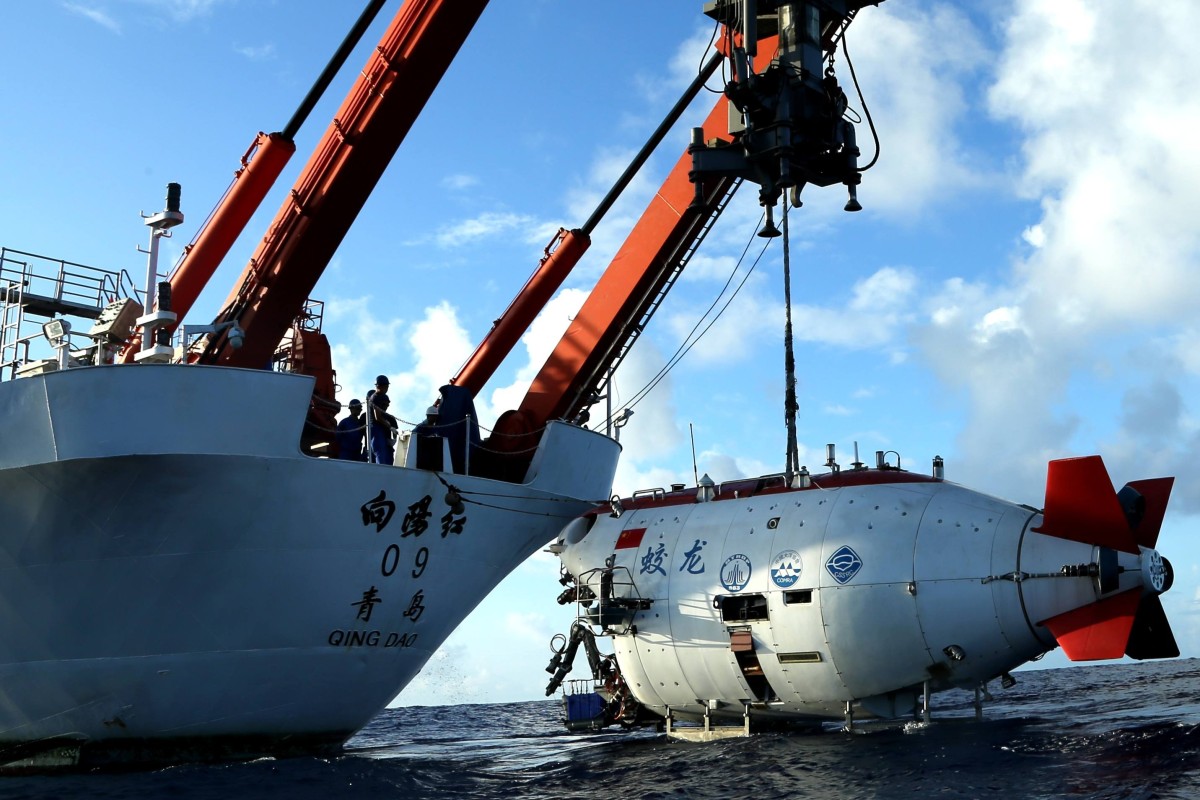
Chinese engineers say they are developing a radical design for a super-fast robot submersible which the project leader, who worked on the manned deep-sea vessel Jiaolong, or Sea Dragon, claims can “fly” in water like a plane travels through the air.
At 3 metres (9.8ft) long, the prototype consists of a cigar-shaped body, with a guidance system in the bow and a jet plane style rudder and a propeller in the stern.
Outriggers house batteries and two more propellers. These are attached to the body by wing-like planes that the developers said will give the vessel the kind of lift in water that takes an aeroplane into the air and back to the earth.
Developers said the prototype will be capable of 10 knots and could dive to a depth of 1,000 metres (3,281 feet) – or surface from that depth – at about three metres a second, taking about 5½ minutes.
Professor Liu Kaizhou, lead scientist of the project at the Shenyang Institute of Automation, part of the Chinese Academy of Sciences in Liaoning province, said the design had great potential.
If a traditional submarine was like an air balloon, he said, the prototype was like an aircraft. “It is technically flying, fast and freely, like a plane for the water.”
The prototype has 20 major components on board, including a computer, and communications and surveillance equipment. These were all developed and tested by the team, but getting them to work together posed some unexpected challenges, Liu said, meaning the transition to operations in a tough marine environment was some time away.
Underwater station could be a game changer, Chinese scientist says
“We aim to make the first open sea test in about a year,” he said.
The submersible can be powered by conventional batteries or a chemical engine that mixes lithium and sulphur hexafluoride to produce heated steam for electrical generators – an energy source often used by torpedoes.
Funded by the Ministry of Science and Technology from 2017, the project was driven by China’s growing ambition to become a superpower in the world’s oceans.
The team said their submersible had the potential to become the backbone of China’s search-and-rescue operations at sea, naval intelligence gathering, high-precision sea floor mapping, or to transport minerals from the seabed to the surface.
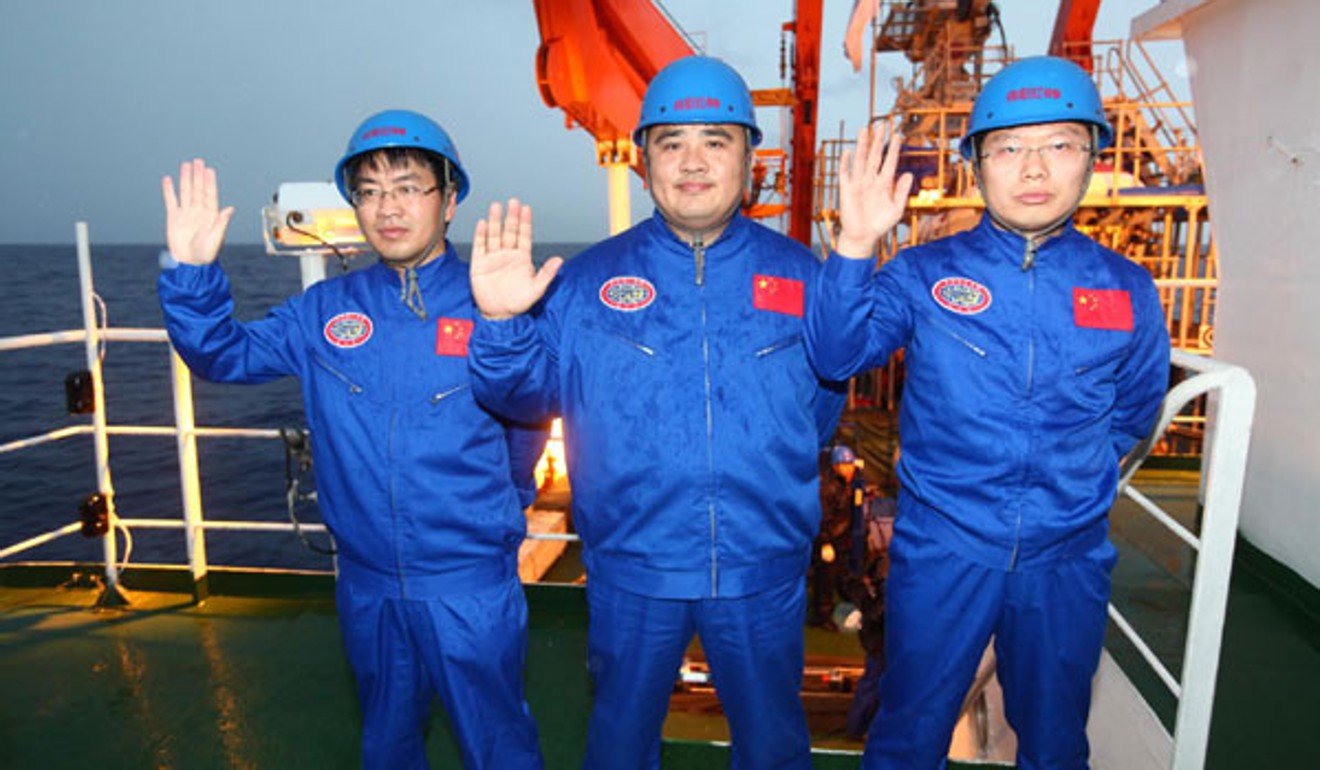
Professor Liu Kaizhou (left) with colleagues Ye Cong and Yang Bo, was instrumental in the success of China’s Jiaolong manned submersible. Photo: Xinhua
Professor Du Tezhuan, a researcher in fluid dynamics at the Institute of Mechanics of the Chinese Academy of Sciences in Beijing, said the design was a bold one but it posed the research team many hard questions.
The density of water was much higher than that of air, he said, which meant the vessel would encounter more drag and would need a strong power source.
“Without sufficient speed, the lift will be weak, and to reach high speeds, lots of energy will be needed. Flying in water is not as easy as flying in the air,” said Du, who was not involved in the project.
Why Beijing is speeding up underwater drone tests in the South China Sea
“But in theory it should work. It is worth a try.”
Liu – who led the design of the autopilot system that can take the Jiaolong to depths of more than 7,000 metres (23,000 ft) – said that after tests on the prototype were complete, other innovations were possible. These included covering the vessel with air bubbles to reduce friction.
“This technology is brand new,” he said. “We are in uncharted water and we are excited by the challenges.”


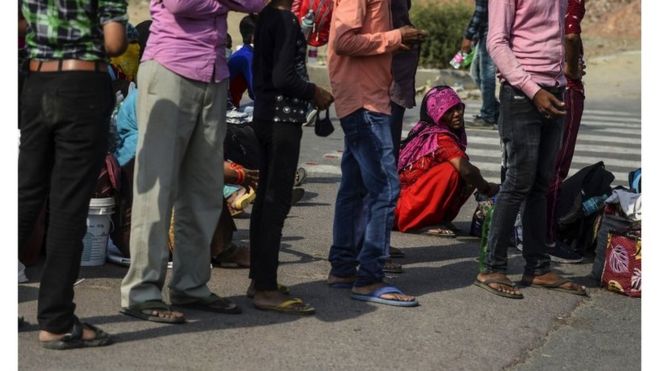 Image copyright EPA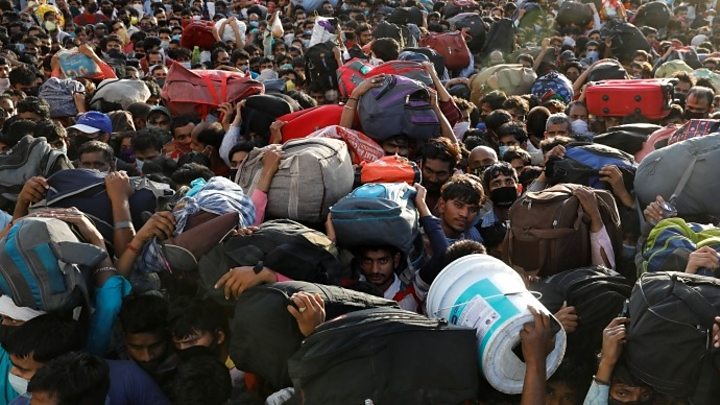



 CHINDIA ALERT: You'll be living in their world, very soon