Chindia Alert: You’ll be Living in their World Very Soon
aims to alert you to the threats and opportunities that China and India present. China and India require serious attention; case of ‘hidden dragon and crouching tiger’.
Without this attention, governments, businesses and, indeed, individuals may find themselves at a great disadvantage sooner rather than later.
The POSTs (front webpages) are mainly 'cuttings' from reliable sources, updated continuously.
The PAGEs (see Tabs, above) attempt to make the information more meaningful by putting some structure to the information we have researched and assembled since 2006.
SHENYANG, April 23 (Xinhua) — With trucks standing bumper to bumper and large cranes loading containers on the train, work returned to normal at a logistics base in northeast China’s Liaoning Province.
The base, where the China-Europe freight trains are set to depart in Shenyang, the provincial capital, has seen stable departures since early April as the novel coronavirus epidemic ebbs away.
With the global supply chain being affected by restrictions in air, land, and port travel due to the global pandemic, China-Europe railway has been playing a more important role, experts say.
“The train was operated by staff in different sections, which means it does not require cross-border personnel health inspections, giving it advantages during the pandemic,” said Shan Jing, an industry insider who wrote a book on China-Europe freight trains.
In March, a total of 809 China-Europe freight trains carrying 73,000 containers were sent across China. Both numbers hit a monthly record.
At the Shenyang logistics base, trains depart to travel through Russia, Belarus, Poland and finally reach Germany in around 18 days. As of April 13, a total of 130 trains carrying 11,200 standard containers had departed from the base.
“The province sends a stable number of five trains each week,” said He Ruofan, a business manager with the Shenyang branch of China Railway Container Transport Corp., Ltd, operator of the trains.
The stable operation has made the route a top choice for many Chinese enterprises, said Yao Xiang, a manager with logistics group Sinotrans’s northeast company.
“Many shipping routes have been canceled, and the rest are more and more expensive amid the epidemic,” said Yao, noting the price for air cargo surged 5 to 10 times the normal price as flights decreased from China to Europe.
With increasing departing trains, returning trains on the route have also been increasing, Yao said.
Among the 130 trains that have been sent from the Shenyang base so far this year, 33 returned, carrying construction materials, car parts, mechanical equipment, and daily products.
“These goods provide supplies to large companies like BMW and Michelin’s Shenyang factories,” Yao said.
Medical supplies have also been sent to hard-hit Europe to fight against the coronavirus pandemic.
As of April 18, a total of 448,000 pieces of medical supplies weighing 1,440 tonnes had been sent to European countries via the route, according to China State Railway Group Company, Ltd.
“China-Europe freight trains have shown great service capabilities during the epidemic,” said Shan, the industry insider. “It serves as a new choice for European enterprises, and I believe more people will come to realize the importance of the route.”
(Reuters) – Europe’s auto industry is facing a slowdown in demand for new cars, as well as disruption from the coronavirus epidemic and import tariffs between China and the United States. As a result, several companies have announced plans to cut costs and jobs.
Volkswagen said in March 2019 it would cut up to 7,000 positions and aim to deliver 5.9 billion euros ($6.7 billion) of annual savings at its core VW brand by 2023.
Volkswagen’s luxury car unit Audi (NSUG.DE) said in November it would cut one in ten jobs by 2025, up a total of 9,500, to fund its shift towards electric vehicle production.
PSA’s German unit Opel said in February it was ruling out forced redundancies until July 2025, but would reopen a voluntary leave programme for older employees.
Unions at Fiat Chrysler, which is planning a merger with PSA, said management promised to avoid redundancies and get all group employees off special furlough arrangements and back to work by 2022.
The merger aims to achieve annual savings of 3.7 billion euros.
In November, BMW management and its German labour representatives reached an agreement on changes to payout schemes and bonuses to reduce costs in Germany while avoiding “drastic measures”. BMW has said it will keep headcount stable, as hiring in software development will offset voluntary staff reductions in other areas.
In February, German business daily Handelsblatt reported Daimler (DAIGn.DE) was intensifying its cost-cutting measures and planning to cut up to 15,000 jobs. Daimler declined to comment.
Daimler Chief Executive Ola Kaellenius said in February the company would cut 1,100 leadership positions worldwide, or about 10% of its management over the next three years.
The company also said it would revamp the management of its portfolios to remove duplicate layers between Mercedes-Benz and Daimler AG.
VOLVO CARS
In July 2019, Volvo Cars announced plans to cut fixed costs by 2 billion Swedish crowns ($214 million), adding the savings drive – on which it did not provide details – would come into effect in the second half of 2019 and run into the first half of 2020.
JAGUAR LAND ROVER
In February, Britain’s biggest carmaker Jaguar Land Rover (TAMO.NS) said it would reduce or stop production on certain days at two of its British factories as it was pursuing cost-cutting measures in response to falling demand.
A month earlier, the company said it would cut around 10% of the workforce at its northern English Halewood factory, which has about 4,500 employees, as it was changing shift patterns to boost efficiency at the site.
After Renault’s first full-year loss in a decade, the French automaker said it would cut costs by 2 billion euros over the next three years and did not exclude job cuts during a performance review across its factories.
BOSCH
In January, German engineering company Bosch said it would make staff changes via shorter working hours, voluntary redundancy and severance packages, but declined to provide a global figure for headcount reductions.
German automotive supplier Continental said in November it would pare back its engine manufacturing activities, which could result in around 5,040 job losses by 2028.
BEIJING (Reuters) – Tens of thousands of ethnic Uighurs were moved to work in conditions suggestive of “forced labor” in factories across China supplying 83 global brands, and Australian think tank said in a report released on Sunday.
The Australian Strategic Policy Institute (ASPI) report, which cited government documents and local media reports, identified a network of at least 27 factories in nine Chinese provinces where more than 80,000 Uighurs from the western region of Xinjiang have been transferred.
“Under conditions that strongly suggest forced labor, Uighurs are working in factories that are in the supply chains of at least 83 well-known global brands in the technology, clothing and automotive sectors, including Apple, BMW, Gap, Huawei, Nike, Samsung, Sony and Volkswagen,” the think-tank said in the introduction to its report.
The ASPI report said the transfers of labor were part of a state-sponsored program.
It says the workers “lead a harsh, segregated life,” are forbidden to practice religion, and are required to participate in mandarin language classes.
It also says the Uighurs are tracked electronically and restricted from returning to Xinjiang.
China’s Foreign Ministry on Monday said reports the government had violated the Uighurs’ rights were untrue.
“This report is just following along with the U.S. anti-China forces that try to smear China’s anti-terrorism measures in Xinjiang,” spokesman Zhao Lijian at a regular press briefing on Monday.
The United Nations estimates over a million Muslim Uighurs have been detained in camps in Xinjiang over recent years as part of a wide-reaching campaign by Chinese officials to stamp out terrorism.
The mass detentions have provoked a backlash from rights groups and foreign governments, which say the arbitrary nature of the detentions violates human rights.
China has denied the camps violate the rights of Uighurs and say they are designed to stamp out terrorism and provide vocational skills.
“Those studying in vocational centers have all graduated and are employed with the help of our government,” said the Foreign Ministry’s Zhao, “They now live a happy life.”
The 83 global brands mentioned in ASPI’s report either work directly with the factories or source materials from the factories, it said, citing public supplier lists and the factories’ own information.
One of the factories, O-Film Technology Co Ltd, which has manufactured cameras for Apple Inc’s (AAPL.O) iPhones, received 700 Uighur laborers as part of the program in 2017, a local media article cited by the report said.
Apple referred Reuters to an earlier statement that said “Apple is dedicated to ensuring that everyone in our supply chain is treated with the dignity and respect they deserve. We have not seen this report but we work closely with all our suppliers to ensure our high standards are upheld.”
The other companies mentioned in the introduction to ASPI’s report – BMW (BMWG.DE), Gap Inc (GPS.N) , Huawei Technologies Co Ltd, Nike Inc (NKE.N), Samsung and Sony Corp (6758.T) did not respond to requests for comment on Monday.
O-Film Technology did not respond to a request for a comment either.
Volkswagen told Reuters in a statement that none of the listed companies is a direct supplier. It said the company holds “direct authority” in all parts of its business and “respects minorities, employee representation and social and labor standards.”
The report said a small number of the brands, including Abercrombie & Fitch Co [ANF.N], advised vendors to terminate their relationships with these companies in 2020, and others denied direct contractual relationships with the suppliers.
ASPI describes itself as an independent think-tank whose core aim is to provide insight for the Australian government on matters of defense, security and strategic policy.
(Reuters) – Asian companies dominate the market for electric vehicle (EV) batteries and they are expanding their production capacity in Europe, China and the United States in a fight to win lucrative contracts from global automakers.
Some carmakers worry, however, there won’t be enough batteries for all the EVs they plan to launch in the coming years and a bitter row between South Korea’s SK Innovation and LG Chem risks exacerbating the potential shortfall.
Below are details of the world’s leading EV battery makers with details of their customers and expansion plans:
CATL
China’s Contemporary Amperex Technology (CATL), the world’s biggest EV battery maker, counts BMW (BMWG.DE), Volkswagen (VOWG_p.DE), Daimler (DAIGn.DE) – which makes Mercedes cars – Volvo, Toyota Motor Corp (7203.T) and Honda Motor Co (7267.T) among its customers.
The company emerged as a major force partly thanks to Beijing’s policy of only subsidising vehicles equipped with Chinese batteries in the world’s biggest EV market. Beijing is phasing out EV subsidies next year.
CATL, which operates factories in China, is building its first overseas plant in Germany and is considering a U.S. factory.
Japan’s Panasonic, a supplier of U.S. EV pioneer Tesla (TSLA.O), said it has installed equipment to ramp up production at Tesla’s Nevada plant to 35 GWh from its current production of around 30 GWh as of late October. Panasonic has said it is investing about $1.6 billion in the factory.
Panasonic also produces EV batteries in Japan, China and plans to shift some of its plants to a new joint venture with Toyota. Panasonic’s clients also include Honda and Ford Motor Company (F.N).
China’s BYD, which is backed by U.S. investor Warren Buffett, is also one of the world’s biggest EV battery makers. It mainly uses them in-house for its own cars and buses. BYD said last year it is was considering cell production in Europe.
The South Korean firm was an early industry mover, winning a contract to supply General Motor’s (GM.N) Volt in 2008. It also supplies Ford, Renault (RENA.PA), Hyundai Motor (005380.KS), Tesla, Volkswagen and Volvo.
It is investing 3.3 trillion won ($2.8 billion) to build and expand production facilities near Tesla’s plant in Shanghai. It has a joint venture (JV) in China with Geely Automobile Holdings (0175.HK), which makes Volvos, and is in talks with other carmakers about JVs in major markets.
The firm is considering building a second U.S. factory in addition to its facility in Michigan and is expanding its plant in Poland.
SAMSUNG SDI CO LTD (006400.KS) Samsung SDI an affiliate of South Korean tech giant Samsung Electronics (005930.KS), has EV battery plants in South Korea, China and Hungary, which supply customers such as BMW (BMWG.DE), Volvo and Volkswagen. Samsung SDI is investing about 1.2 billion euros ($1.3 billion) to expand its factory in Hungary though the EU is investigating whether Budapest’s financial support complies with the bloc’s state aid rules.
Samsung started production last year on the Hungary plant, which will produce batteries for 50,000 EVs a year.
SK INNOVATION CO LTD (096770.KS) LG Chem’s cross-town rival SK Innovation supplies batteries to Volkswagen, Daimler and Kia Motors (000270.KS), as well as Jaguar Land Rover [TAMOJL.UL] and Ferrari (RACE.MI).
An oil refiner that came to the battery industry late, SKI is investing about $3.9 billion to build three plants in the United States, China and Hungary, with a goal of expanding its annual production capacity to 33 GWh by 2022.
SKI currently operates one battery factory in South Korea, with a capacity of 4.7 GWh annually.
It set up a joint venture with Beijing Automotive Industry Corporation (BAIC) of China in August 2018 and another Chinese partner. It is in talks with Volkswagen about another battery JV and is building a $1.7 billion factory in the U.S. state of Georgia, not far from Volkswagen’s Chattanooga plant.
NEW DELHI (Reuters) – German Chancellor Angela Merkel and Indian Prime Minister Narendra Modi signed wide-ranging agreements in New Delhi on Friday to deepen strategic cooperation and exchanged notes on ways to boost bilateral trade.
Merkel, accompanied by several cabinet colleagues and a business delegation, is in India on a three-day visit that began on Thursday.
“We’re encouraging our private sectors to give an impetus to our growing bilateral trade and Chancellor Merkel and I will meet some of the top business and industry leaders,” Modi told a joint news conference with the German leader.
“We’re encouraging our private sectors to give an impetus to our growing bilateral trade and Chancellor Merkel and I will meet some of the top business and industry leaders,” Modi said.
Bilateral trade between the two countries rose to $24.06 billion (18.5 billion pounds) in the 2018/19 fiscal year ending in March from $22 billion the previous year, while German companies have invested nearly $12 billion in India since 2000.
Germany is India’s largest trading partner in Europe and more than 1,700 German companies are operating in India.
The agreements struck on strategic cooperation, included agriculture, cyber security and artificial intelligence. Modi said the two countries would also bolster ties to combat “terrorism and extremism”.
Germany and India also agreed to join hands in the area of education.
“As many as 20,000 Indian nationals are studying in Germany and we would like to see more,” Merkel said.
Although Merkel and Modi didn’t mention anything about restarting talks on finalising a free trade agreement between India and the European Union, sources earlier said the two leaders could take up the trade deal.
Eric Schweitzer, president of the Association of German Chambers of Commerce and Industry (DIHK), earlier said India had enormous potential but there has been uncertainty among companies after an investment protection agreement between the two countries ended in 2016.
“Small and medium-sized German companies stand in a labyrinth of regulations and shy away from larger investment. Negotiations should restart and Merkel’s visit could help,” he said.
VDA, Germany’s car industry association that counts automakers like Volkswagen (VOWG_p.DE), Daimler, BMW and Audi as members, also wanted India to restart the FTA talks.
Daimler’s Mercedes-Benz, BMW and Audi dominate India’s luxury car market.
Father of three is killed as flames engulf car in crash at stop light in Henan
Woman from wealthy family is held as police investigate drink-driving
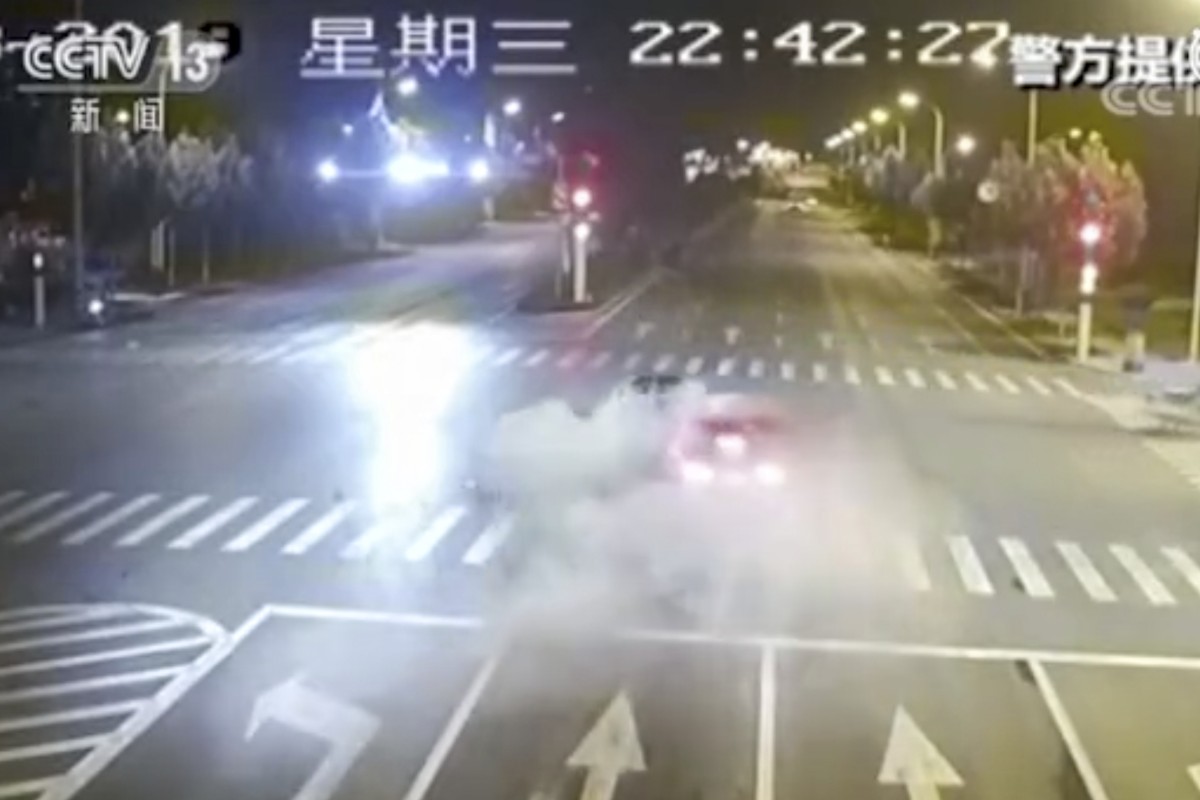
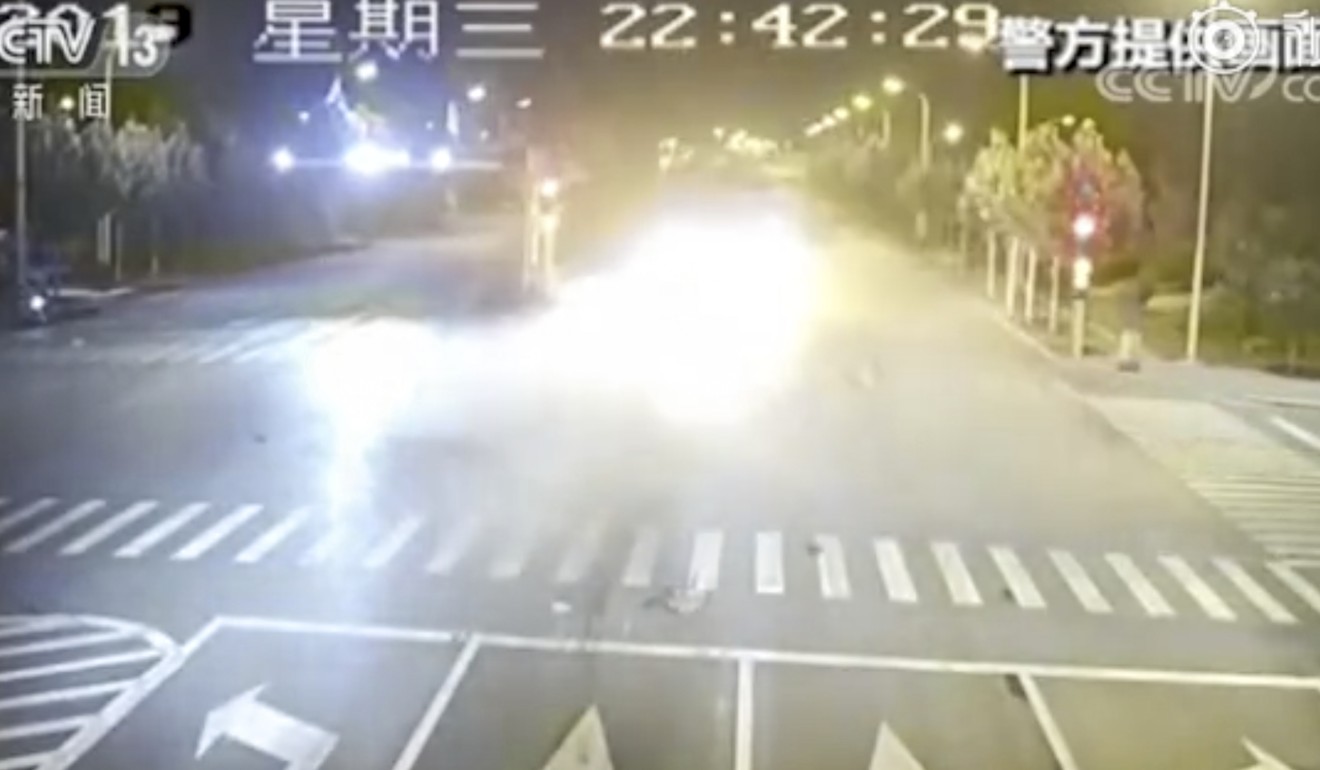
Footage from an intersection in Yongcheng, Henan shows the BMW being propelled across the road before bursting into flames. Photo: Weibo
A driver and her two passengers are in custody in central China after the Maserati SUV she was driving slammed into a BMW, killing two men.
Police said a 23-year-old woman surnamed Tan drove the Maserati through the streets of Yongcheng in Henan province on Wednesday night, scraping against cars on the way.
They said her vehicle struck the BMW at a red traffic light, causing it to burst into flames, killing two passengers and injuring the driver.
Tan and two others in the SUV, a woman and a man, were also injured. All three were detained by police but have not yet been charged. Police said Tan returned a blood-alcohol reading of 0.167 – well over the legal limit of 0.02.
State broadcaster CCTV reported that Tan and friends Zhang and Liu had met at a barbecue restaurant that night for dinner, according to police. After drinking, Tan took her friends for a drive. The Maserati scraped against multiple cars before the driver was slowed down by pedestrians signalling for her to stop, but she suddenly sped away from the scene. It crashed into the BMW soon afterwards, CCTV said.
The BMW bursts into flames after being shoved across the intersection. Photo: Weibo
Two men in the back of the BMW were killed in the fire that engulfed the vehicle, while the driver, also a man, suffered severe burns, according to the report. The occupants of the Maserati were treated in hospital for bone fractures and abdominal injuries, CCTV said.
Man arrested after car crashes into shop, injuring 12, in Tsim Sha Tsui, Hong Kong
The accident has prompted heated online discussion in China, with some calling for the death penalty for “such reckless behaviour and disregard for the law”.
Others have doxxed the detained driver – finding photos on a Weibo account that allegedly belonged to Tan showing she had an appetite for luxury goods and expensive cars.
In recent years, a “hate the rich” sentiment has emerged in Chinese society. As the wealth gap widens, many people have become vocal about injustices they feel are fuelled by the affluent and privileged.
Others voiced anger at the legal system, saying wealthy people could buy the law.
Coach driver in crash that left five dead and 32 injured had been working 12-hour shifts, Hong Kong police say
Chinese State Councilor Wang Yong (L) and Igor Komarov, Russia’s Presidential Plenipotentiary Envoy to the Volga Federal District, co-chair the third meeting of the Council of Cooperation between the upper and middle reaches of the Yangtze River and the Volga Federal District in Cheboksary, Russia, May 23, 2019. (Xinhua/Bai Xueqi)
CHEBOKSARY, Russia, May 23 (Xinhua) — China and Russia pledged to strengthen cooperation along the Yangtze and Volga rivers as local governments from these areas on Thursday signed an array of cooperation deals.
The third meeting of the Council of Cooperation between the upper and middle reaches of the Yangtze River and the Volga Federal District was co-chaired by Chinese State Councilor Wang Yong and Igor Komarov, Russia’s Presidential Plenipotentiary Envoy to the Volga Federal District, in the Russian city of Cheboksary.
Wang said that both sides should work to achieve more outcomes from local governments cooperation and make such partnership a new growth area for China-Russia relations.
Komarov said the unique “Volga-Yangtze” mechanism has been fruitful in trade and investment cooperation as well as people-to-people exchanges, and Russia is ready to work with China for more achievements.
Online auction attracts fierce competition, sending value rocketing in first minutes of bidding
‘Auspicious’ numbers are popular in China because they sound like words which signify good fortune
An “auspicious” mobile phone number has sold for more than US$50,000 at an online auction in China. Photo: Shutterstock
An “auspicious” mobile phone number has fetched more than 350,000 yuan (US$52,000) at an online auction in northern China.
The number, which ended in five fives, sold for more than 30 times the starting price of 11,250 yuan, after fierce bidding saw its value rocket to more than 300,000 yuan in just 12 minutes.
A total of 140 people registered to participate in the 24-hour auction and 107 bids were recorded. The winning bid came from a user called Li Zisheng on Tuesday evening, according to Alibaba’s Sifa court auction platform which hosted the sale.
The South China Morning Post is owned by Alibaba.
Why you shouldn’t clip your nails at night and other superstitions
It is not uncommon for people in China to pay a premium for phone numbers or car licence plates featuring numbers which are considered lucky.
Six, eight and nine are particular favourites, as they sound like the words for strength, wealth and longevity, respectively. The number five is said to represent happiness or wealth.
One of the most expensive mobile numbers on record in China contained a combination of eights and fives and sold at auction for US$680,000 in 2004, according to the Oriental Morning Post.
Not everyone is willing to pay any price for a lucky number plate or phone number, with some internet users on China’s Twitter-like Weibo service questioning why people would pay so much money for such things.
“Are mobile and car plate numbers really this important?” a user from Hunan province, central China, wrote. “This type of number will have a higher chance of getting spam calls.”
SHANGHAI (Reuters) – BMW AG (BMWG.DE) and Mercedes-Benz said on Saturday they will lower their prices in China, after the government announced it will reduce the country’s value-added tax (VAT) starting on April 1.
The German automobile companies each published posts on Chinese social media announcing immediate price cuts for several models. The discounts come as China endures a shrinking market for automobiles as the economy slows.
BMW said it would reduce prices for both domestically produced and imported models, including the locally-made BMW 3 series and BMW 5 series, along with the BMW X5 and BMW 7 import models. The BMW 320Li M model will sell for a suggested retail price of 339,800 yuan ($50,620), a drop of 10,000 yuan from its original price.
The reductions mark the company’s “active response to the national VAT adjustment notice,” BMW said in a post on WeChat, China’s popular messaging app.
Daimler AG-owned (DAIGn.DE) Mercedes-Benz announced similar price cuts on a range of its cars, also effective immediately, in advance of the upcoming VAT drop. The cuts shown on its social media page range from 10,000 yuan to 40,000 yuan on select models.
On March 5, Chinese Premier Li Keqiang announced that China will cut VAT across a range of industries, with the tax set to drop in the manufacturing sector from 16 percent to 13 percent and in the transport sector from 10 percent to 9 percent.
The carmakers’ cuts come as China’s automobile industry faces a major slowdown. In 2018, China’s car market shrank 5.8 percent, marking its first contraction in over two decades.
Policymakers have introduced a range of policies to stimulate demand for cars. In January, China’s National Development and Reform Commission (NDRC) said it would loosen restrictions on the second-hand car market and provide subsidies to boost purchases in rural areas.





 CHINDIA ALERT: You'll be living in their world, very soon