Chindia Alert: You’ll be Living in their World Very Soon
aims to alert you to the threats and opportunities that China and India present. China and India require serious attention; case of ‘hidden dragon and crouching tiger’.
Without this attention, governments, businesses and, indeed, individuals may find themselves at a great disadvantage sooner rather than later.
The POSTs (front webpages) are mainly 'cuttings' from reliable sources, updated continuously.
The PAGEs (see Tabs, above) attempt to make the information more meaningful by putting some structure to the information we have researched and assembled since 2006.
The rhetoric towards the self-ruled island has hardened in Premier Li Keqiang’s annual work report
Beijing regards Taiwan as one of its core national interests and says it ‘resolutely opposes’ any separatist activity
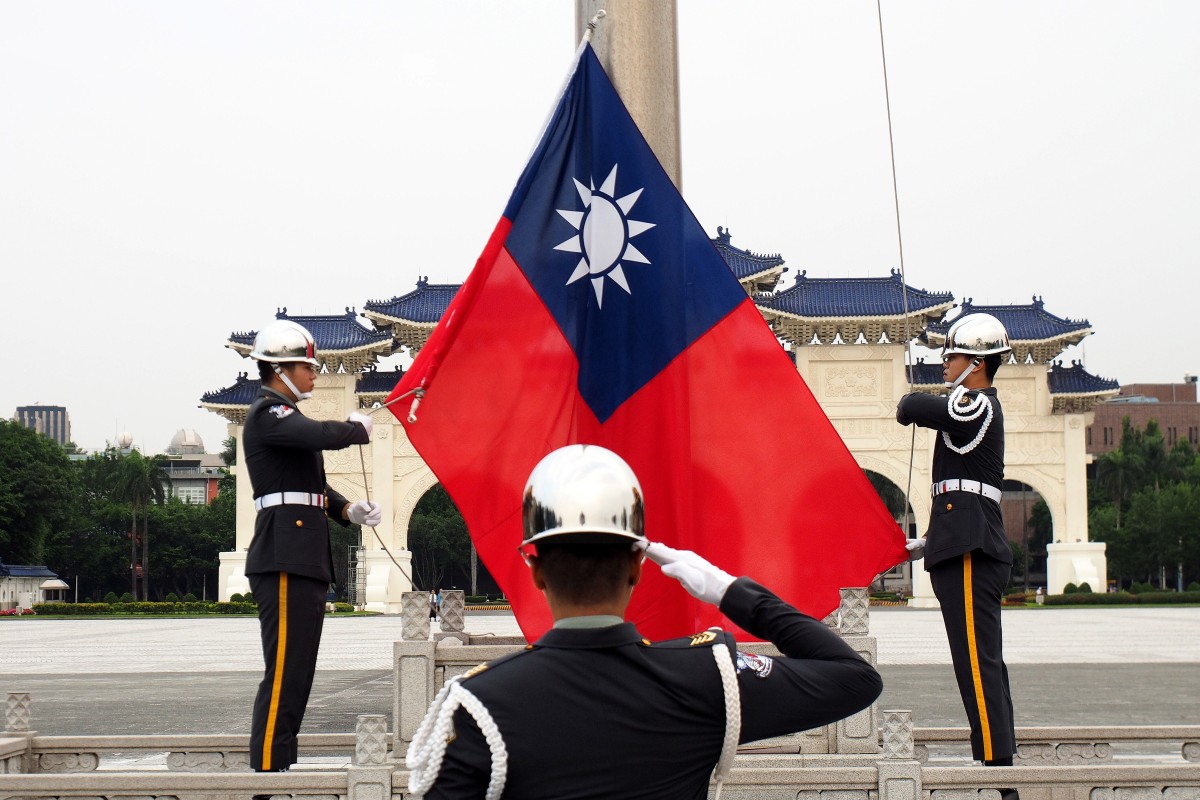
Beijing regards reunification with Taiwan as one of its core interests. Photo: EPA-EFE
Beijing has hardened its rhetoric towards Taiwan, removing references to “peaceful reunification”, in the government’s annual work report.
Observers said the change reflected the stronger stance Beijing would adopt in tackling the Taiwan issue, which it regards as one of its key national interests.
The past six work reports since President Xi Jinping took power in 2013 stressed peaceful reunification and the 1992 consensus – under which both sides tacitly agree there is only one China, but have different interpretations on what this means.
But the latest report from Premier Li Keqiang took a different tone, saying: “We will adhere to the major principles and policies on work related to Taiwan and resolutely oppose and deter any separatist activities seeking ‘Taiwan independence’.”
US to sell US$180 million worth of submarine-launched torpedoes to Taiwan
21 May 2020
“We will improve institutional arrangements, policies, and measures to encourage exchanges and cooperation between the two sides of the Taiwan Strait, further cross-strait integrated development, and protect the well-being of our compatriots in Taiwan,” the report said.
“We will encourage them to join us in opposing ‘Taiwan independence’ and promoting China’s reunification.
“With these efforts, we can surely create a beautiful future for the rejuvenation of the Chinese nation,” it said, dropping a clause that described the process as “peaceful”.
The 1992 consensus allows leeway for both parties to negotiate an agreement, but President Tsai Ing-wen has said the island would never accept it as the basis for cross-strait relations.
Taiwan’s Mainland Affairs Council said on Friday that the “one country, two systems” framework, touted by Beijing as a political basis for unification, had harmed cross-strait relations. It called for the two sides to work together to resolve their differences.
Tang Shao-cheng, an international relations specialist at Taiwan’s National Chengchi University, said the change in wording and tone of the Taiwan section of the work report could be seen as a warning to Tsai’s independence-leaning Democratic Progressive Party (DPP).
“Not mentioning ‘peace’ suggests Beijing is considering unification both by peaceful means and by force,” Tang said.
President Xi Jinping and Premier Li Keqiang at the National People’s Congress opening session on Friday. Photo: Kyodo
Derek Grossman, an analyst from US-based think tank Rand Corporation, said Beijing would continue to put pressure on the island using diplomatic, military, economic and psychological means.
“Beijing will continue to send military aircraft near the island … [it] could decide to end the Economic Cooperation Framework Agreement which has remained active in spite of Tsai’s election in 2016; Beijing could steal one or more diplomatic partners from Taipei. I would expect these types of actions to be on the table,” Grossman said.
How would mainland China attack Taiwan? A video outlines one scenario
22 May 2020
Sun Yun, director of the China programme at the Stimson Centre think tank in the US, said Beijing faced a dilemma on whether to continue economic integration with Taiwan because that had not had the political effect it wanted.
“The obstacles to unification are not economic, but political. Taiwan is unwilling to pursue unification with an authoritarian mainland. To solve that issue, presumably the mainland could pursue political reform. But in reality, the Chinese Communist Party is unwilling,” she said.
“If the economic and political approach doesn’t work, what’s left is the military approach. But with US intervention, the mainland will not prevail.”
Beijing recently warned Washington it would respond after US Secretary of State
, and demanded that the US stop selling arms to the island.
Joshua Eisenman, a professor from the University of Notre Dame in Indiana, said Beijing was running out of countermeasures, since its actions had only hardened attitudes on the island and enhanced the sense of Taiwanese identity.
“As I see it, all that remains is for the [Chinese Communist Party[ to sit down and talk to the DPP without preconditions and establish a modus vivendi for cross-strait relations,” he said.
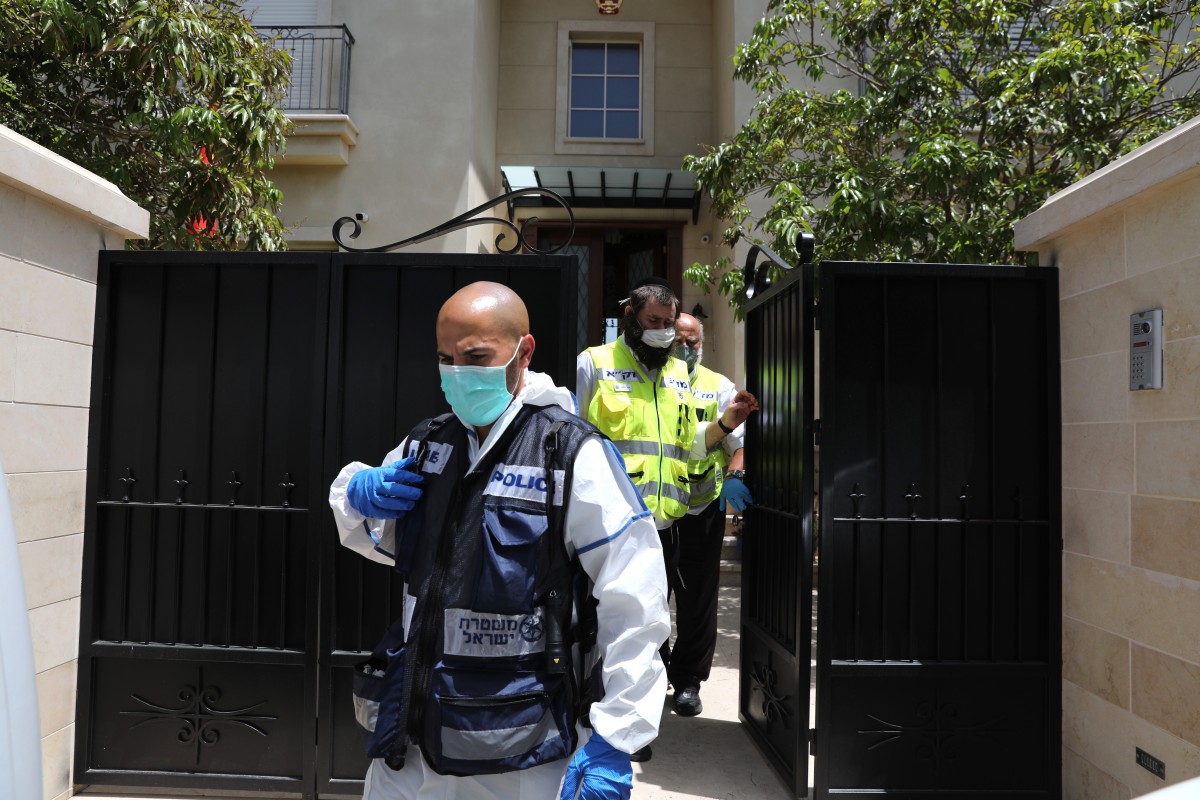
The team, accompanied by a member of Du’s family, was due to travel on Monday, and will handle arrangements for the remains, as well as conducting its own internal investigation, according to Israeli newspaper Haaretz.
Israel’s foreign ministry said its director general Yuval Rotem had spoken with deputy ambassador Dai Yuming to express his condolences. Local police are continuing to investigate at Du’s residence in a suburb of Herzliya, near Tel Aviv.
Details from the Chinese side have been scant. China’s foreign ministry provided a statement to AFP on Sunday which said the preliminary verdict was that Du, 57, had died unexpectedly for health reasons, and details awaited further confirmation. AFP also reported that Du’s wife and son were not with him in Tel Aviv.
“As far as I know, China’s ambassador to Israel Du Wei passed away in ambassador’s residence in Tel Aviv this morning for physical reasons. It happened abruptly,” said Hu Xijin, editor-in-chief of state media tabloid Global Times in a tweet late on Sunday night.
Du was last seen in public on Tuesday in a video conference with an official from Israel’s foreign affairs ministry, according to the embassy website.
James Dorsey, senior fellow at the S. Rajaratnam School of International Studies in Singapore, said Du’s untimely death should be seen as a personal, rather than a political, tragedy for the growing relationship between China and Israel, but he said it came at an important moment for the two countries because of rising US-China tensions.
Dorsey said Israel’s increasing hi-tech cooperation with China, as well as continuing US hostility to Iran – which has close ties with China – were potentially problematic for relations between the two countries.
“I’m not sure that the China-Israel relationship can be seen as independent of the Israel-US relationship. One could argue that the Chinese may be well advised to very quickly replace him soon,” Dorsey said. “Israel could find itself on the fault line of deepening US-China decoupling,” he added.
Israel’s ambassador to China in quarantine after ‘infected’ flight to Seoul
28 Feb 2020
Following a brief trip to Jerusalem on Wednesday – his first foreign visit since March – US Secretary of State Mike Pompeo renewed warnings about China-Israel ties in an interview with Israeli state-owned media outlet Kan News.
“We do not want the Chinese Communist Party to have access to Israeli infrastructure, Israeli communication systems, all of the things that put Israeli citizens at risk,” he said.
China’s embassy in Tel Aviv blasted Pompeo’s comments as “absurd” and “ill-intentioned”. However, the embassy statement was not written by Du, but by a spokesperson.
Du had only served in Israel since February. Just before his arrival, the Chinese embassy had to issue an apology after then-acting ambassador Dai denounced Israel’s tightened restrictions on Chinese visitors by comparing them to the Holocaust.
During his brief tenure, Du gave frequent interviews to local media, speaking mainly about China’s virus control measures, US-China tensions, and friendship between China and the Jewish people.
Du had worked as a career diplomat since entering China’s foreign service in 1989. Before his appointment in Tel Aviv, he served as China’s ambassador to Ukraine from 2016-2019.
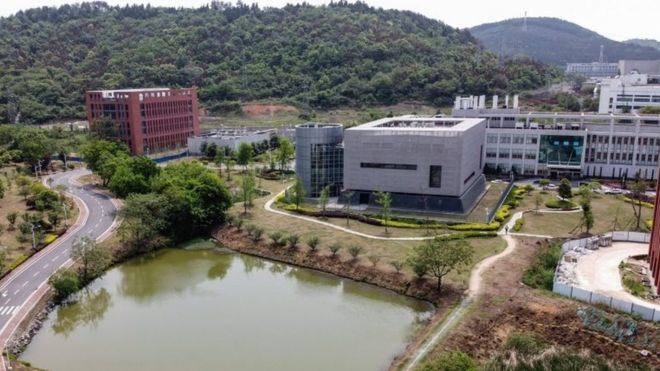
Image copyright AFP / GETTYImage caption The P4 laboratory (centre) in Wuhan is among a handful around the world cleared to handle viruses that pose a high risk of person-to-person transmission
Chinese state media has accused US Secretary of State Mike Pompeo of lying, after he said there was “enormous evidence” the coronavirus emanated from a laboratory in Wuhan.
Mr Pompeo made the claim on Sunday, without going into specifics.
In an editorial on Tuesday, the hawkish Global Times newspaper said Mr Pompeo was “degenerate”.
The World Health Organization says the US claims are “speculative”, and that it has seen no “specific evidence”.
What did Chinese media say?
Editorials in Chinese state media often given an insight into the direction of government thinking, but there has been no official response to Mr Pompeo’s comments as yet.
“Pompeo aims to kill two birds with one stone by spewing falsehoods,” it said.
“First, he hopes to help Trump win re-election this November…second, Pompeo hates socialist China and, in particular, cannot accept China’s rise.”
Media caption “The Chinese Communist Party has refused to co-operate with world health experts” – Mike Pompeo
The editorial admitted there were “initial problems” in China’s response to the outbreak, but claimed “the overall performance is bright enough to outweigh the flaws”.
It also said it was “conceivable that the virus first contacted humans in other places [than Wuhan]”.
The Global Times is not the only Chinese outlet to take aim at Mr Pompeo and the US.
The People’s Daily said Mr Pompeo had “no evidence”, while a piece on the CCTV site accused US politicians of “nefarious plotting”.
What did Mike Pompeo say?
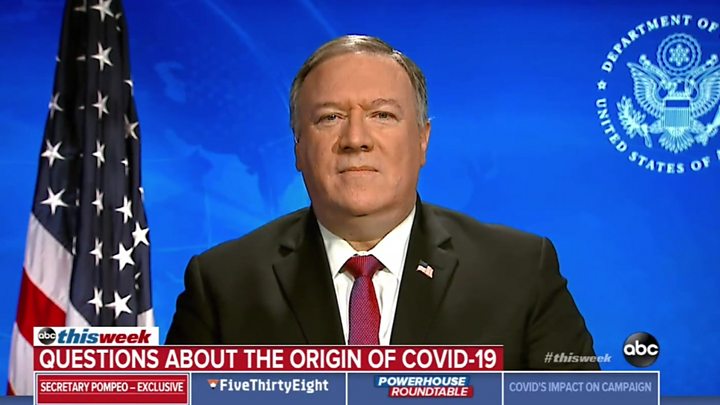
In an interview with ABC on Sunday, Mr Pompeo said there was “enormous evidence” that the virus had emerged from the Wuhan Institute of Virology.
“Remember, China has a history of infecting the world, and they have a history of running sub-standard laboratories,” he said.
Mr Pompeo – a former director of the Central Intelligence Agency (CIA) – said he did not think the virus was man-made or genetically modified.
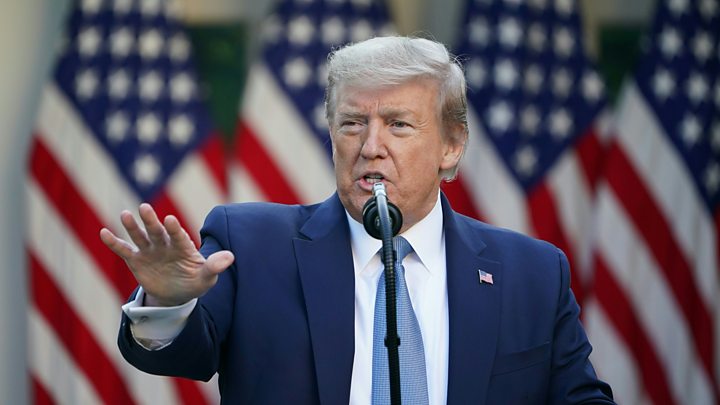
The Wuhan laboratory is known to study coronaviruses in bats. In April, President Trump was asked whether “lax safety protocols” allowed such a virus to escape via an intern and her boyfriend.
Mr Trump did not confirm the theory, but said: “More and more we’re hearing the story.”
Media caption Donald Trump was recently asked if the virus emanated in a laboratory, rather than a market
Last week, he was asked if he had seen evidence that gave him a “high degree of confidence” that the virus emerged in the Wuhan laboratory.
“Yes I have,” he replied – but said he could not go into specifics.
On Monday, World Health Organization emergencies director Michael Ryan said it had received “no data or specific evidence” from the US about the virus origins.
“So from our perspective, this remains speculative,” he said.
Last week, the US intelligence community said it “concurred” that the virus “was not man-made or genetically modified”.
But it said it would “continue to examine” whether the outbreak began via “contract with infected animals, or if it was the result of an an accident at a laboratory in Wuhan”.
Australian Prime Minister Scott Morrison said on Tuesday that the most likely source of the virus was a wildlife market. However he said he would not rule out the theory that it originated in a lab.
“What’s really important is that we have a proper review, an independent review which looks into the sources of these things in a transparent way so we can learn the lessons,” he told reporters.
Meanwhile, Western “intelligence sources” have told several news outlets there is “no evidence” to suggest the virus leaked from a laboratory.
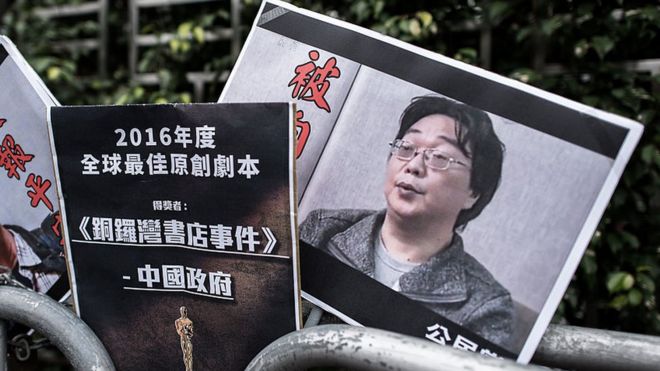
Image copyright GETTY IMAGESImage caption Mr Gui has been in and out of Chinese detention for years
A Chinese court has sentenced Hong Kong bookseller Gui Minhai to 10 years in jail for “illegally providing intelligence overseas”.
Mr Gui, who holds Swedish citizenship, has been in and out of Chinese detention since 2015, when he went missing during a holiday in Thailand.
He is known to have previously published books on the personal lives of Chinese Communist Party members.
Rights groups condemned the “harsh sentence” and called for his release.
He was one of five owners of a small bookstore in Hong Kong who went missing in 2015. It later emerged that they had been taken to China. Four were later freed, but Mr Gui remained in Chinese detention.
In delivering its verdict, the Ningbo Intermediate People’s Court said that his Chinese citizenship had been reinstated in 2018. China does not recognise dual citizenship.
Sweden’s foreign minister on Tuesday called for Mr Gui’s release, referring to him a “citizen”.
“We have not had access to the trial,” said Ann Linde in a tweet. “[We] demand that Gui be released and that we have access to our citizens to provide consular support.”
But according to a Reuters report, a Chinese foreign ministry spokesman said consular arrangements had been put on hold because of the latest coronavirus outbreak, and would be restored once the health problem was “resolved”.
Zhao Lijian added that Mr Gui’s “rights and interests… [had] been fully guaranteed”.
Human rights group Amnesty International on Tuesday also called for Mr Gui to be released immediately and said the charges were “completely unsubstantiated”.
A forced confession?
Mr Gui first made headlines in 2015 when he vanished from Thailand and resurfaced in China.
After his disappearance, there were allegations that he had been abducted by Chinese agents. Chinese officials, however, say Mr Gui and the four other men all went to China voluntarily.
The bookseller ultimately confessed to being involved in a fatal traffic accident more than a decade earlier – a confession supporters say was forced.
He served two years in prison but he was arrested months after his release while he was travelling to the Chinese capital of Beijing with two Swedish diplomats.
China later released a video interview featuring Mr Gui. In it, he accused Sweden of “sensationalising” his case. It is not uncommon for Chinese criminal suspects to appear in “confessional” videos.
Earlier in 2019, Sweden recalled its ambassador to China Anna Lindstedt, who was accused of brokering an unauthorised meeting between Angela Gui – the daughter of Mr Gui – and two Chinese businessmen.
Ms Gui – who has been vocal in campaigning for her father’s release – said one of the men had pressured her to accept a deal where her father would go to trial and might be sentenced to “a few years” in prison, and in return she would stop all publicity around her father’s detention.
It has been described as being one of the first major studies of its kind into public opinion on the subject in mainland China.
Some 80% of respondents said they were concerned that facial recognition system operators had lax security measures.
Separate research suggests that they have good reason to be concerned.
China was ranked the worst of 50 surveyed countries in a study looking at how extensively and invasively biometric ID and surveillance systems are being deployed. The work was carried out by the cybersecurity firm Comparitech.
It said China had no “specific law to protect citizens’ biometrics” and highlighted a “lack of safeguards for employees in the workplace”.
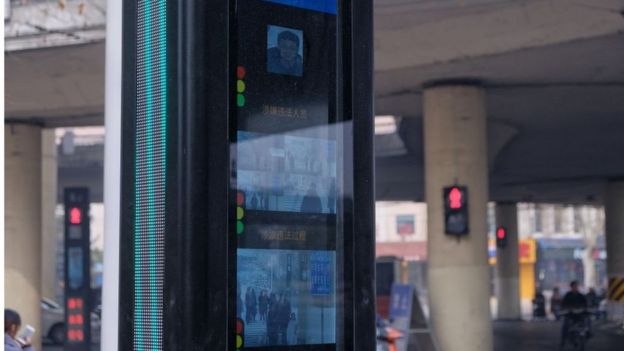
Image copyright GETTY IMAGESImage caption Some cities are deploying facial recognition systems at road crossings to identify and deter jaywalkers
Surveillance concerns
Nandu’s survey was carried out via the internet between October and November.
In its sample, 57% of respondents voiced concern about their movements being tracked.
In addition, 84% of people said they wanted to be able to review the data that facial recognition systems had collected on them and to be able to request that it should be deleted.
The majority said they wanted an option to be able to use ID cards, driving licenses and/or passports as an alternative. But the survey also suggested that between 60 to 70% of Chinese residents believed facial recognition made public places safer.
Hard to avoid
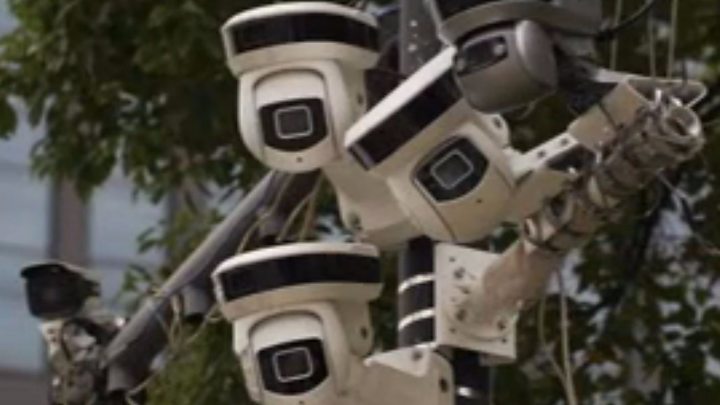
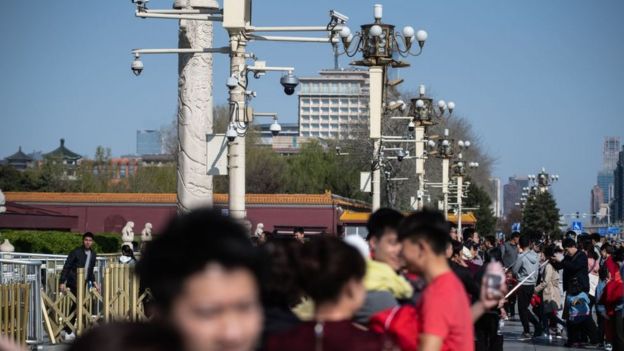
China has more facial recognition cameras than any other country and they are often hard to avoid.
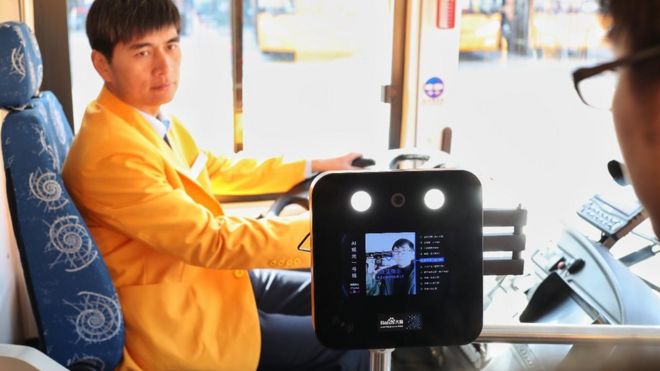
Earlier this week, local reports said that Zhengzhou, the capital of the northeastern Henan province, had become the first Chinese city to roll the tech out across all its subway train stations.
Commuters can use the technology to automatically authorise payments instead of scanning a QR code on their phones. For now, it is a voluntary option, said the China Daily.
Earlier this month, university professor Guo Bing announced he was suing Hangzhou Safari Park for enforcing facial recognition.
Prof Guo, a season ticket holder at the park, had used his fingerprint to enter for years, but was no longer able to do so.
The case was covered in the government-owned media, indicating that the Chinese Communist Party is willing for the private use of the technology to be discussed and debated by the public.
Media captionWATCH: BBC’s John Sudworth put a Chinese facial recognition system to the test in December 2007
But the state continues to make some uses of the tech mandatory.
At the start of the month, a new regulation came into force that requires mobile phone subscribers to have their faces scanned when they sign a new contract with a provider.
The authorities say the move is designed to prevent the resale of Sim cards to help combat fraud.
Latest measures grant island’s people and enterprises more equal treatment with their mainland counterparts
Package in March last year was dismissed by Taiwan’s Mainland Affairs Council as an attempt to buy political support
Taipei’s elections in January could influence the tone of cross-strait relations. Photo: EPA-EFE
Beijing announced a series of sweeteners for Taiwanese businesses and individuals on Monday – including participation in its 5G research and allowing Taiwanese to use mainland consular services – only two months before Taiwan’s critical presidential election.
The latest 26 measures drawn up by 20 government departments, including the State Council’s Taiwan Affairs Office and the National Development and Reform Commission, are designed to attract more Taiwanese to live and work in mainland China, despite worsening cross-strait relations.
But Taiwan’s Mainland Affairs Council criticised the move as an attempt by the Chinese Communist Party to “divide Taiwan internally, and was a further reflection of attempts to try to interfere in and influence Taiwan’s election”.
It follows a similar package of 31 measures unveiled by Beijing in March last year, which included tax incentives, preferential land-use policies for Taiwanese businesses on the mainland and benefits for Taiwanese individuals in studying or living on the mainland.
Taiwan charges pro-Beijing politicians with accepting mainland cash
The latest measures to grant Taiwan-funded enterprises more equal treatment with their mainland counterparts include offering access to research and development in 5G technology, investment in passenger and cargo air services, the establishment of microlending and financing companies and the right to apply for financial guarantees from local government funds.
Taiwanese individuals will also be officially entitled to mainland Chinese consular protection abroad, will be treated the same as their mainland counterparts when buying residential property on the mainland, and will be able to train in Beijing for the 2020 Olympic Games.
Beijing claims sovereignty over self-ruled Taiwan, and has not renounced the use of force to take the democratic island into its fold. Beijing’s ruling Communist Party has stressed its intention to promote “peaceful reunification”, pledging in its communique from the fourth plenary meeting of the party’s elite last week to “deepen cross-strait integration and development” while opposing Taiwanese independence.
The latest measures from Beijing came ahead of Taiwan’s presidential and legislative elections in January. Relations across the Taiwan Strait have been frozen under the administration of independence-leaning Taiwanese President, ostensibly over her refusal to accept the “1992 consensus”, or the understanding that there is only “one China” – something that Beijing considers a prerequisite for any talks with Taipei.
Taiwan’s Mainland Affairs Council said on Monday that the roll-out of the 26 measures one year later was intended to “cover up” the fact that the 31 measures had not been executed properly, and reflected administrative problems on the mainland amid slowing economic growth.
“Even more than that, it also reflects that during this period Taiwanese people have rejected ‘one country, two systems’ and do not agree with the results of the Communist Party’s united front divisions,” the council said.
“We urge the Communist Party officials to specifically implement protections for Taiwanese businesses and Taiwanese people in their investments and lives.”
Joseph Wu, Taipei’s foreign minister, also responded with a tweet written in simplified Chinese – which is used on the mainland – rather than the traditional Chinese used in Taiwan.
“China’s Taiwan Affairs Office came out with 26 measures and last year there were 31 – it looks like there are so many measures,” he wrote. “But we in Taiwan do not need one country, two systems, so there is really no need to be so polite. Giving your people more freedom is also good!”
Ongoing anti-government protests in Hong Kong – which is semi-autonomous from Beijing under the one country, two systems model – have highlighted for many Taiwanese voters the threat from Beijing to the island’s sovereignty.
The latest polling by the MAC found that 89 per cent of respondents opposed the one country, two systems framework that Beijing proposed for Taiwan, up from 75 per cent in a similar survey in January.
Edward I-hsin Chen, a political-science professor at Chinese Culture University in Taipei, said the impact of the 26 measures on the election would depend on how they were implemented, but that one country, two systems was clearly not palatable for Taiwanese voters, whether they supported Tsai’s Democratic Progressive Party (DPP) or the mainland-friendly Kuomintang (KMT).
“Taiwan, of course, will not accept one country, two systems, so these policies will need to be more long-term. Mainland officials did not handle the Hong Kong issue very well, so it will be very hard for one country, two systems in Taiwan – blue and green will both reject it,” he said, referring to the party colours for the KMT and DPP. “But it is good for Taiwanese people and businesses to be able to take part in the 5G sector, and there will be more cooperation in the future.”
Lin Chingfa, former chairman of the Beijing-based Association of Taiwan Investment Enterprises, said he believed the new measures were intended to appeal to Taiwanese youth.
“A very important direction for cross-strait cooperation nowadays is to bridge the opportunities available in mainland China for young people who feel deprived from the slow Taiwanese economy. Some of these policies should be especially appealing to them because it shows that the country hopes to make it more convenient for young Taiwan people willing to come,” Lin said.
He said this approach was especially obvious in the measures that were introduced to provide equal treatment for Taiwan people on the mainland – for example the opportunities for Taiwan people to apply for scholarships and the expansion of places for Taiwanese students at universities.
Analysts say mood is shifting in mainland China as demonstrators ‘cross a line’ with national symbols
Staff and students from Pui Kiu Middle School in North Point hold flag-raising ceremony on campus on Monday. Photo: Nora Tam
A Hong Kong protester’s decision to tear down a Chinese flag and throw it in Victoria Harbour on Saturday set off an outpouring of criticism, from Chinese internet users and celebrities to pro-Beijing businesses and schools in the city.
Then on Monday at about 7pm, a group of protesters went to the same flagstaff in Tsim Sha Tsui, tore down the flag again and threw it into the harbour, the second such incident in three days. In both cases, the protesters escaped.
In North Point, the Pui Kiu Middle School organised a flag-raising ceremony at the campus on Monday even though the school was officially on summer holidays.
Principal Ng Wun-kit said teachers and students were called back on short notice to take part.
“We saw [on the news] that some rioters in helmets threw the Chinese national flag in the harbour and we strongly condemn such behaviour. It was disrespectful,” Ng said.
“We wanted to show that we are one of the 1.4 billion Chinese people who want to protect the national flag. We hope that the students, teachers, and [Hong Kong] citizens who love the country and the Chinese Communist Party can respect the Chinese flag.”
Other Hong Kong businesses and organisations flying the Chinese flag on Monday included international hotel chain Courtyard by Marriott Hong Kong, Chinese engineering firm Shanghai Zhenhua Heavy Industries and Chinese pharmaceutical giant Beijing Tong Ren Tang.
Beijing’s Hong Kong affairs office condemns protesters who threw Chinese flag in the sea
A spokeswoman from the hotel chain said it had flown the flag for many years and Monday was no exception.
“We display the flag because we are a Chinese-funded company. We do not have plans to take it down any time soon,” she said.
On Sunday, a group of Beijing supporters sang the national anthem and raised the Chinese flag in Tsim Sha Tsui to replace the one taken down.
On microblogging site Weibo, mainland Chinese and Hong Kong celebrities were among those forwarding pictures of the flag or salutes to it, adding the hashtag “the Chinese national flag has 1.4 billion flag bearers”, a topic started by China Central Television (CCTV) on Sunday. As of Monday night, the trending topic had been read more than 2 billion times, with more than 8 million posts and support from Hong Kong actors Jackie Chan, Jordan Chan Siu-chun and Hawick Lau Hoi-Wai.
In a commentary published online on Sunday, CCTV said the topic had attracted a strong response because patriotism ran deep among the Chinese people.
“We protect the flag, the national emblem, our country, and we protect our country like we protect our own homes,” it said.
Hong Kong Chief Executive Carrie Lam blasts violence at Yuen Long and liaison office, amid further extradition bill unrest
Analysts said the mood on Chinese social media had changed as protesters in Hong Kong vandalised symbols of the central government, crossing a line for most mainland Chinese.
Wang Jiangyu, an associate law professor at the National University of Singapore, said that although many mainlanders had admired Hong Kong and sympathised with its civil movements in the past, the situation had changed.
“The Chinese flag being insulted is on the top of a list of things mainlanders dislike, and for state media, which represent the central government’s position, focusing on such issues can frame the protesters as enemies of the Chinese nation or the people,” Wang said.
“It can increase the hatred of mainlanders towards the Hong Kong protesters and gain support for the central government to take action in the future.”
Ma Ngok, a political scientist at Chinese University of Hong Kong, said mainland media were using the incident to achieve their own propaganda purposes.
“Mainland media made it seem like [the flag protest was] the theme for the whole movement … but it does not represent the main demands of the anti-extradition movement. They are turning single actions into broad propaganda, and biasing mainland sentiment about Hong Kong,” Ma said.
President Tsai Ing-wen says Taipei should ‘maintain a high degree of vigilance’
Exercise simulates response to attack from mainland on military bases
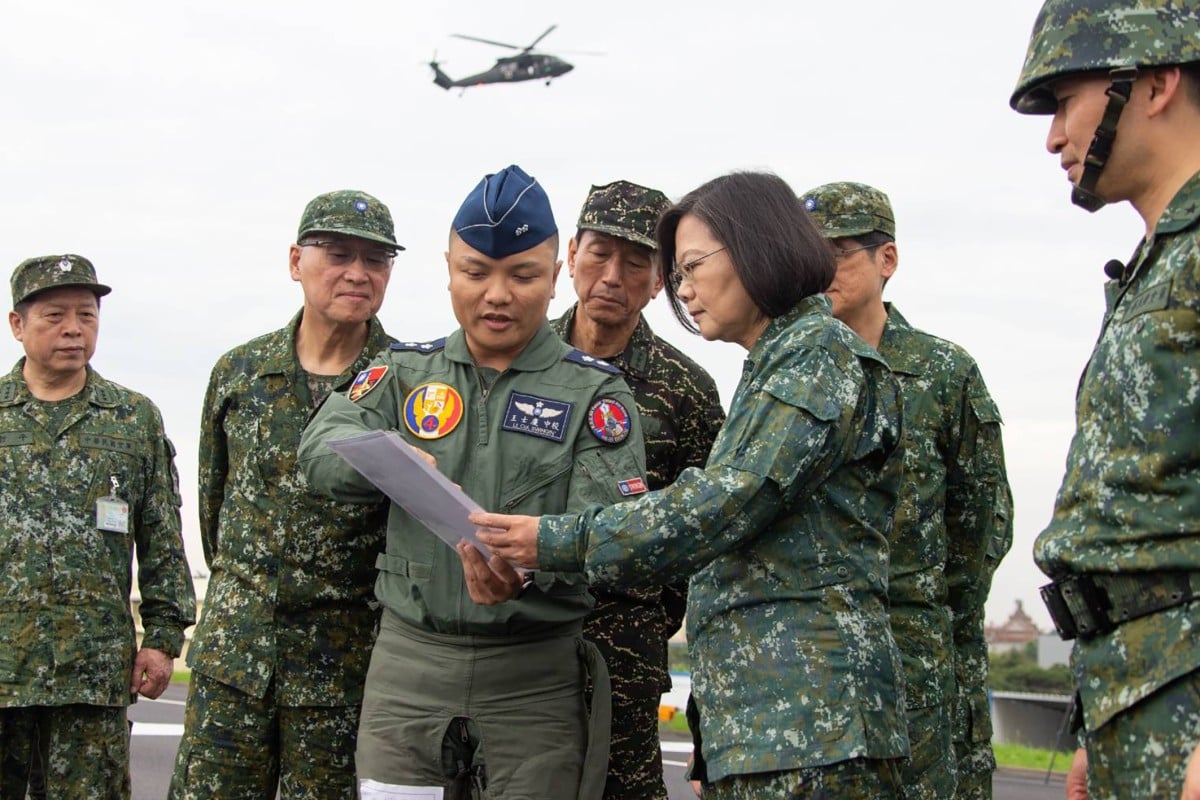
President Tsai Ing-wen and senior Taiwanese military staff during an exercise in southern county Changhua, not far from one of the island’s main airbases at Taichung. Photo: Facebook
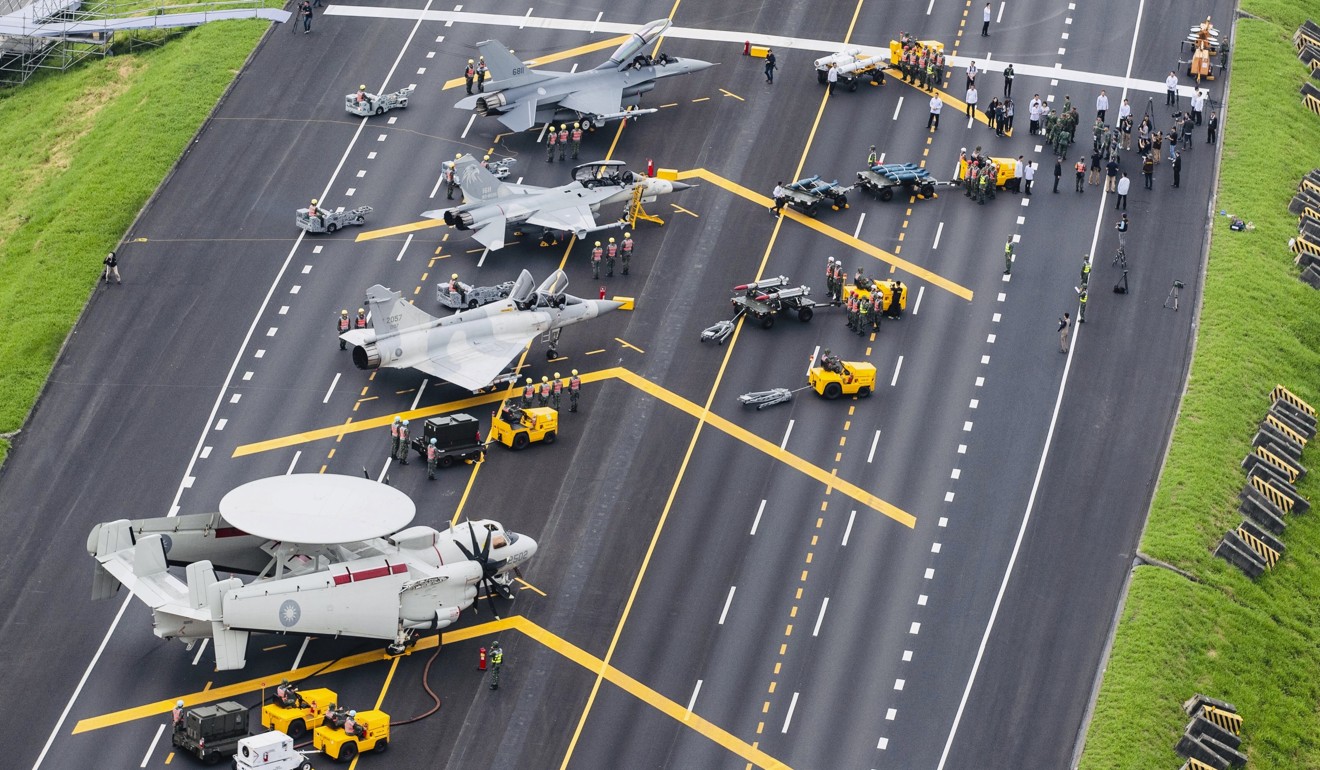
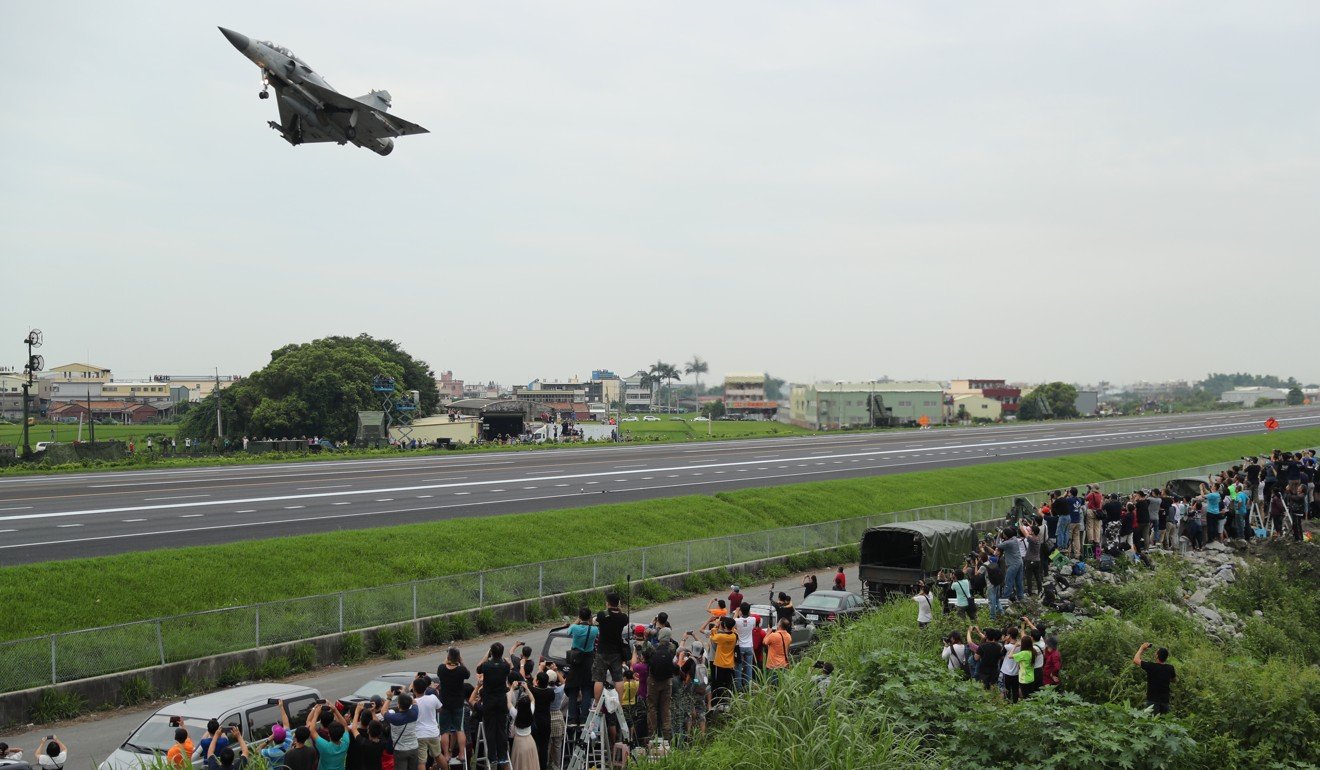
Taiwanese warplanes landed on a highway on Tuesday as part of annual exercises designed to test the island’s military capabilities and resolve to repel an attack from the mainland across the Taiwan Strait.
President Tsai Ing-wen watched the exercise in the southern county of Changhua, not far from one of Taiwan’s main airbases at Taichung.
“Our national security has faced multiple challenges,” Tsai said. “Whether it is the Chinese Communist Party’s [People’s Liberation Army] long-distance training or its fighter jets circling Taiwan, it has posed a certain degree of threat to regional peace and stability.
“We should maintain a high degree of vigilance,” she said.
Taiwanese warplanes are parked on a highway during an exercise to simulate a response to a mainland attack on its airfields in Changhua. Photo: AP
Aircraft involved in the exercise included US-made F-16 Fighting Falcons, French Mirage 2000s, Taiwan-made IDF fighter jets and US-built Northrop Grumman E-2 Hawkeye surveillance aircraft.
Ground crews practised refuelling and ammunition replenishment before the aircraft returned to the air. About 1,600 service personnel were mobilised in Tuesday’s exercise.
The event marked the exercise debut of the first F-16 upgraded to the V variant, featuring advanced radar and combat capabilities. Taiwan is spending about US$4.21 billion to upgrade 144 F-16As and Bs to the F-16V version.
Rare meeting between Taiwanese, US security officials angers Beijing
Taiwan buys military hardware mainly from the US and has asked to purchase new F-16V fighters and M1 Abrams tanks.
American arms sales to Taiwan have long been a thorn in the side of US relations with China, routinely drawing protests from Beijing that Washington had reneged on commitments.
Beijing has also been angered by warming relations between Taipei and Washington since Tsai came to power in 2016.
On Monday, Beijing reacted frostily to photos showing a rare meeting between uniformed Taiwanese officers and their US counterparts this month.
A Mirage 2000-5 fighter jet takes off from a highway during an emergency take-off and landing drill in Changhua, Taiwan. Photo: EPA
Last week, Beijing lodged a protest with Washington after two US warships sailed through the Taiwan Strait.
Taiwan expected to be outgunned in terms of troop numbers and firepower in any war with mainland China but it claimed to have had developed sophisticated asymmetric warfare tactics to make any invasion costly for Beijing.
“There are only a few military airbases which would become the prime targets in the event of an attack. The highway drill is necessary as highway strips would be our priority choice if the runways were damaged during a war,” air force Colonel Shu Kuo-mao.
Taiwan changes name of de facto embassy in United States to ‘reflect stronger ties’
Taiwan’s Central News Agency said highway take-off and landing drills last took place in 2014. A military source told CNA that Tuesday’s drill was not much different from those conducted by the military during the Han Kuang exercises, but it was still challenging.
Among the challenges were that the drill could not be rehearsed and it required clear communications between the military, police and the National Freeway Bureau, said the source.
WASHINGTON/NEW YORK (Reuters) – The Trump administration on Wednesday took aim at China’s Huawei Technologies Co Ltd, banning the firm from buying vital U.S. technology without special approval and effectively barring its equipment from U.S. telecom networks on national security grounds.
Taken together, the two moves threaten Huawei’s ability to continue to sell many products because of its reliance on American suppliers, and represents a significant escalation in the U.S. government’s worldwide campaign against the company.
The steps also come at a delicate time in relations between China and the United States as the world’s two largest economies ratchet up tariffs in a battle over what U.S. officials call China’s unfair trade practices.
Washington believes the handsets and network equipment for telecommunications companies made by Huawei could be used by the Chinese state to spy on Americans.
Huawei, which has repeatedly denied the allegations, said in a statement that “restricting Huawei from doing business in the U.S. will not make the U.S. more secure or stronger; instead, this will only serve to limit the U.S. to inferior yet more expensive alternatives, leaving the U.S. lagging behind in 5G deployment.”
“In addition, unreasonable restrictions will infringe upon Huawei’s rights and raise other serious legal issues.”
The ban on U.S. suppliers, which appears similar to one on Huawei rival ZTE Corp. last year, could hit the shares of Huawei’s biggest U.S. suppliers, including chipmakers Qualcomm Inc and Broadcom Inc (AVGO.O).
In the first action taken on Wednesday, President Donald Trump signed a long-awaited executive order declaring a national emergency and barring U.S. companies from using telecommunications equipment made by firms posing a national security risk.
The order invoked the International Emergency Economic Powers Act, which gives the president the authority to regulate commerce in response to a national emergency that threatens the United States. It directs the Commerce Department, working with other government agencies, to draw up an enforcement plan by October.
Members of Congress said Trump’s order was squarely aimed at Chinese companies like Huawei, which generated $93 billion in revenue last year and is seen as a national champion in China.
“China’s main export is espionage, and the distinction between the Chinese Communist Party and Chinese ‘private-sector’ businesses like Huawei is imaginary,” Republican Senator Ben Sasse said.
ENTITY LIST
Soon after the White House announced the order had been signed, the Commerce Department said it had added Huawei and 70 affiliates to its so-called Entity List – a move that bans the telecom giant from buying parts and components from U.S. companies without U.S. government approval.
U.S. officials told Reuters the decision would make it difficult, if not impossible, for Huawei, the largest telecommunications equipment producer in the world, to sell some products because of its reliance on U.S. suppliers. It will take effect in the coming days.
Commerce Secretary Wilbur Ross said in a statement Trump backed the decision that will “prevent American technology from being used by foreign owned entities in ways that potentially undermine U.S. national security or foreign policy interests.”
With Huawei on the Entity List, U.S. suppliers will need to apply for licenses to provide the Chinese company with anything subject to U.S. export control regulations. Obtaining such licenses will be difficult because they will have to show the transfer of items will not harm U.S. national security, said John Larkin, a former export control officer in Beijing for the Commerce Department.
The United States in January unsealed a 13-count indictment against Huawei accusing the company and its chief financial officer of conspiring to defraud global financial institutions by misrepresenting Huawei’s relationship with a suspected front company that operated in Iran.
The indictment was unsealed a month after CFO Meng Wanzhou was arrested in Canada on a U.S. warrant for her role in the alleged fraud. Meng, who maintains her innocence, is fighting extradition.
5G NETWORKS
Reuters reported on Tuesday that Trump was expected to sign his long-awaited executive order this week. The order does not specifically name any country or company, but U.S. officials have previously labeled Huawei a “threat”.
The United States has been actively pushing other countries not to use the Chinese company’s equipment in next-generation 5G networks that it calls “untrustworthy.” In August, Trump signed a bill that barred the U.S. government from using equipment from Huawei and another Chinese provider, ZTE Corp.
ZTE was added to the Commerce Department’s Entity List in March 2016 over allegations it organised an elaborate scheme to hide its re-export of U.S. items to sanctioned countries in violation of U.S. law.
The restrictions prevented suppliers from providing ZTE with U.S. equipment, potentially freezing the company’s supply chain, but the restrictions were suspended in a series of temporary reprieves, allowing the company to maintain ties to U.S. suppliers until it agreed to a plea deal a year later.
The status of Huawei and ZTE has taken on new urgency as U.S. wireless carriers rollout 5G networks.
While the big wireless companies have already cut ties with Huawei, small rural carriers continue to rely on both Huawei and ZTE switches and other equipment because they tend to be cheaper. Trump’s order applies to future purchases and does not address existing hardware, officials said Wednesday.








 CHINDIA ALERT: You'll be living in their world, very soon