Archive for ‘cybersecurity’

29/04/2020

Exclusive: Amazon turns to Chinese firm on U.S. blacklist to meet thermal camera needs

NEW YORK/SAN FRANCISCO (Reuters) – Amazon.com Inc (AMZN.O) has bought cameras to take temperatures of workers during the coronavirus pandemic from a firm the United States blacklisted over allegations it helped China detain and monitor the Uighurs and other Muslim minorities, three people familiar with the matter told Reuters.

China’s Zhejiang Dahua Technology Co Ltd (002236.SZ) shipped 1,500 cameras to Amazon this month in a deal valued close to $10 million, one of the people said. At least 500 systems from Dahua – the blacklisted firm – are for Amazon’s use in the United States, another person said.

The Amazon procurement, which has not been previously reported, is legal because the rules control U.S. government contract awards and exports to blacklisted firms, but they do not stop sales to the private sector.

However, the United States “considers that transactions of any nature with listed entities carry a ‘red flag’ and recommends that U.S. companies proceed with caution,” according to the Bureau of Industry and Security’s website. Dahua has disputed the designation.

The deal comes as the U.S. Food and Drug Administration warned of a shortage of temperature-reading devices and said it wouldn’t halt certain pandemic uses of thermal cameras that lack the agency’s regulatory approval. Top U.S.-based maker FLIR Systems Inc (FLIR.O) has faced an up to weeks-long order backlog, forcing it to prioritize products for hospitals and other critical facilities.

Amazon declined to confirm its purchase from Dahua, but said its hardware complied with national, state and local law, and its temperature checks were to “support the health and safety of our employees, who continue to provide a critical service in our communities.”

The company added it was implementing thermal imagers from “multiple” manufacturers, which it declined to name. These vendors include Infrared Cameras Inc, which Reuters previously reported, and FLIR, according to employees at Amazon-owned Whole Foods who saw the deployment. FLIR declined to comment on its customers.

Dahua, one of the biggest surveillance camera manufacturers globally, said it does not discuss customer engagements and it adheres to applicable laws. Dahua is committed “to mitigate the spread of the COVID-19” through technology that detects “abnormal elevated skin temperature — with high accuracy,” it said in a statement.

The U.S. Department of Commerce, which maintains the blacklist, declined comment. The FDA said it would use discretion when enforcing regulations during the public health crisis as long as thermal systems lacking compliance posed no “undue risk” and secondary evaluations confirmed fevers.

Dahua’s thermal cameras have been used in hospitals, airports, train stations, government offices and factories during the pandemic. International Business Machines Corp (IBM.N) placed an order for 100 units, and the automaker Chrysler placed an order for 10, one of the sources said. In addition to selling thermal technology, Dahua makes white-label security cameras resold under dozens of other brands such as Honeywell, according to research and reporting firm IPVM.

Honeywell said some but not all its cameras are manufactured by Dahua, and it holds products to its cybersecurity and compliance standards. IBM and Chrysler’s parent Fiat Chrysler Automobiles NV (FCHA.MI) did not comment.

The Trump Administration added Dahua and seven other tech firms last year to the blacklist for acting against U.S. foreign policy interests, saying they were “implicated” in “China’s campaign of repression, mass arbitrary detention, and high-technology surveillance against Uighurs, Kazakhs, and other members of Muslim minority groups.”

More than one million people have been sent to camps in the Xinjiang region as part of China’s campaign to root out terrorism, the United Nations has estimated.

Dahua has said the U.S. decision lacked “any factual basis.” Beijing has denied mistreatment of minorities in Xinjiang and urged the United States to remove the companies from the list.

A provision of U.S. law, which is scheduled to take effect in August, will also bar the federal government from starting or renewing contracts with a company using “any equipment, system, or service” from firms including Dahua “as a substantial or essential component of any system.”

Amazon’s cloud unit is a major contractor with the U.S. intelligence community, and it has been battling Microsoft Corp (MSFT.O) for an up to $10 billion deal with the Pentagon.

Top industry associations have asked Congress for a year-long delay because they say the law would reduce supplies to the government dramatically, and U.S. Secretary of State Mike Pompeo said last week that policies clarifying the implementation of the law were forthcoming.

FACE DETECTION & PRIVACY

The coronavirus has infected staff from dozens of Amazon warehouses, ignited small protests over allegedly unsafe conditions and prompted unions to demand site closures. Temperature checks help Amazon stay operational, and the cameras – a faster, socially distant alternative to forehead thermometers – can speed up lines to enter its buildings. Amazon said the type of temperature reader it uses varies by building.

To see if someone has a fever, Dahua’s camera compares a person’s radiation to a separate infrared calibration device. It uses face detection technology to track subjects walking by and make sure it is looking for heat in the right place.

An additional recording device keeps snapshots of faces the camera has spotted and their temperatures, according to a demonstration of the technology in San Francisco. Optional facial recognition software can fetch images of the same subject across time to determine, for instance, who a virus patient may have been near in a line for temperature checks.

Amazon said it is not using facial recognition on any of its thermal cameras. Civil liberties groups have warned the software could strip people of privacy and lead to arbitrary apprehensions if relied on by police. U.S. authorities have also worried that equipment makers like Dahua could hide a technical “back door” to Chinese government agents seeking intelligence.

In response to questions about the thermal systems, Amazon said in a statement, “None of this equipment has network connectivity, and no personal identifiable information will be visible, collected, or stored.”

Dahua made the decision to market its technology in the United States before the FDA issued the guidance on thermal cameras in the pandemic. Its supply is attracting many U.S. customers not deterred by the blacklist, according to Evan Steiner, who sells surveillance equipment from a range of manufacturers in California through his firm EnterActive Networks LLC.

“You’re seeing a lot of companies doing everything that they possibly can preemptively to prepare for their workforce coming back,” he said.

Source: Reuters

08/04/2020

Internet giant Tencent pledges to invest in Wuhan as city emerges from coronavirus lockdown

  • Wuhan, where the first cases of the novel coronavirus were detected, is ending a 76-day lockdown
  • A day before the lockdown was fully lifted, Tencent announces a slew of initiatives focused on helping to revive the digital industry in the city
Passengers leaving Wuhan city are pictured at the Hankou Railway Station in Wuhan city, central China's Hubei province, on Wednesday morning, April 08, 2020. Photo: SCMP/Simon Song
Passengers leaving Wuhan city are pictured at the Hankou Railway Station in Wuhan city, central China’s Hubei province, on Wednesday morning, April 08, 2020. Photo: SCMP/Simon Song
A day before China lifted a months-long lockdown of Wuhan city, the initial epicentre of the coronavirus pandemic, Chinese internet giant Tencent Holdings pledged to invest in digital government, online education and artificial intelligence (AI) in the city, among other fields.
“During the epidemic, Tencent has been supporting Hubei and Wuhan’s fight against the virus through funds and technology,” the company best known for its gaming business said in a statement posted on Tuesday on WeChat. “In the future, we will also fully support Wuhan’s post-pandemic reconstruction and continue to support the development of Wuhan’s digital industry.”
China’s major tech companies have played a big role in the fight against the coronavirus, and are now playing their part in the economic recovery of Wuhan and other areas that have suffered under extended travel restrictions and business closures.
Last week, China’s biggest e-commerce services providers Alibaba Group Holding
JD.com

and Pinduoduo each announced their own initiatives to help revive sales of farm goods from Hubei as the province emerges from its months-long lockdown.

Popular mobile payments app Alipay also created a dedicated section for Wuhan merchants to allow users to buy from merchants in the city, and offered loans to small local merchants in need of financial support, according to an Alipay statement. Alipay is operated by Ant Financial, an affiliate of Alibaba, which owns the South China Morning Post.
How tech has helped China in its public health battle with coronavirus
23 Mar 2020

Wuhan, an industrial powerhouse for the steel, semiconductors and automotive sectors, is emerging from an unprecedented lockdown which began on January 23 and prevented people from moving in and out of the city.

Since restrictions began easing gradually in late March, business activity has shown signs of recovery: Tencent’s mobile payment platform WeChat Pay recorded a 162 per cent increase in offline transactions in a 10-day period from March 25, compared to the same period the previous month, according to a separate statement by Tencent on Wednesday.

Searches for “work resumption certificates” – which businesses need to submit to local authorities to prove their staff can safely restart work – also increased 320 per cent on Baidu, China’s biggest search engine, in the past month, Baidu said in a report on Wednesday.

Tencent declined to provide specific details regarding the size of its latest investment in Wuhan or a timeline for its implementation, but said in the statement that it will involve closer cooperation with city authorities in the areas of digital government, education, smart mobility, AI and cybersecurity to help the city with its digital industries.

Among these initiatives, it will push ahead with a plan to build a headquarters focusing on digital industries in Wuhan, specifically digitalisation for the government and smart city initiatives.

It will also establish a base in Wuhan for its online education initiatives, set up an AI lab and cybersecurity academy and build a school focusing on smart mobility in collaboration with Chinese carmaker Dongfeng Motor Corporation, the company said in the statement.

Source: SCMP

27/09/2019

EU and Japan play ‘guardians of universal values’ in effort to challenge China’s Belt and Road Initiative

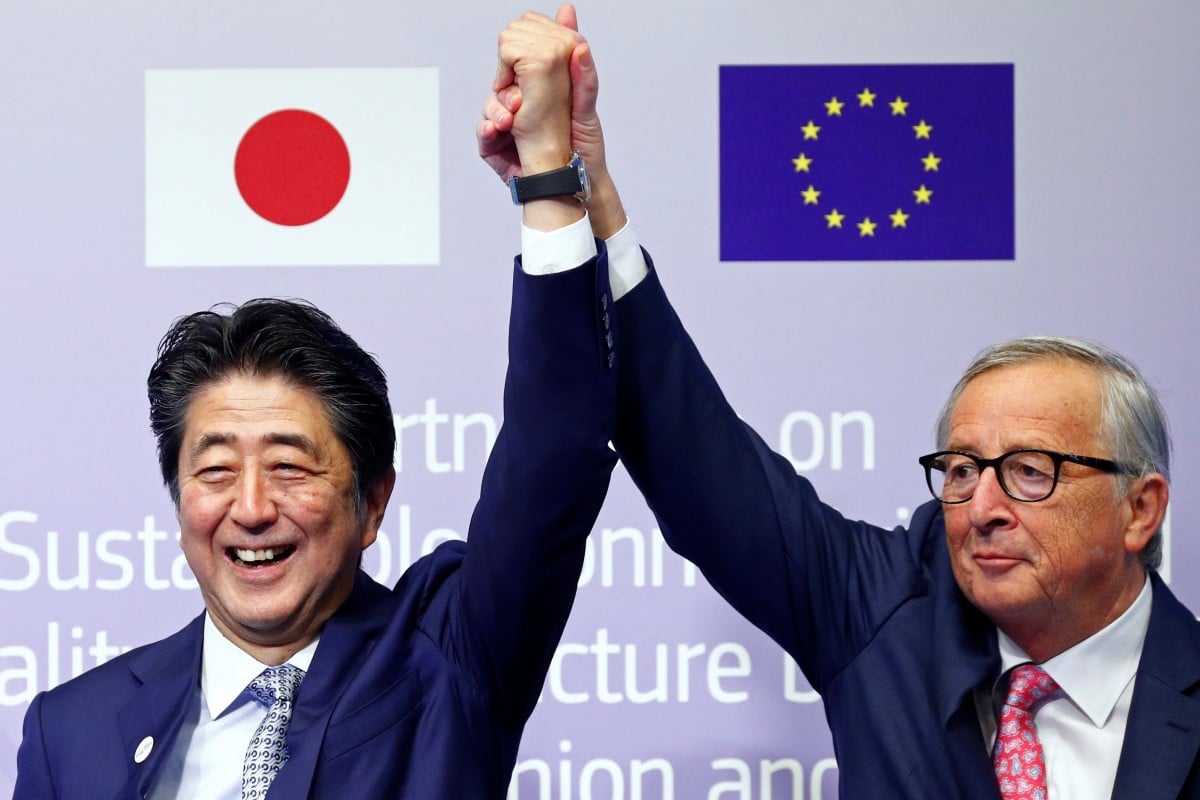
  • Japan’s Prime Minister Shinzo Abe and EC President Jean-Claude Juncker mark first anniversary of EU-Asia Connectivity scheme with swipes at China
  • Partners reach out to countries in Balkans and Africa and agree US$65.5 billion development plan
Japan’s Prime Minister Shinzo Abe (left) and European Commission President Jean-Claude Juncker mark the anniversary of the EU-Asia Connectivity scheme in Brussels, Belgium. Photo: Reuters
The European Union and Japan are stepping up their efforts to counter China’s

Belt and Road Initiative

, with their leaders vowing to be “guardians of universal values” such as democracy, sustainability and good governance.

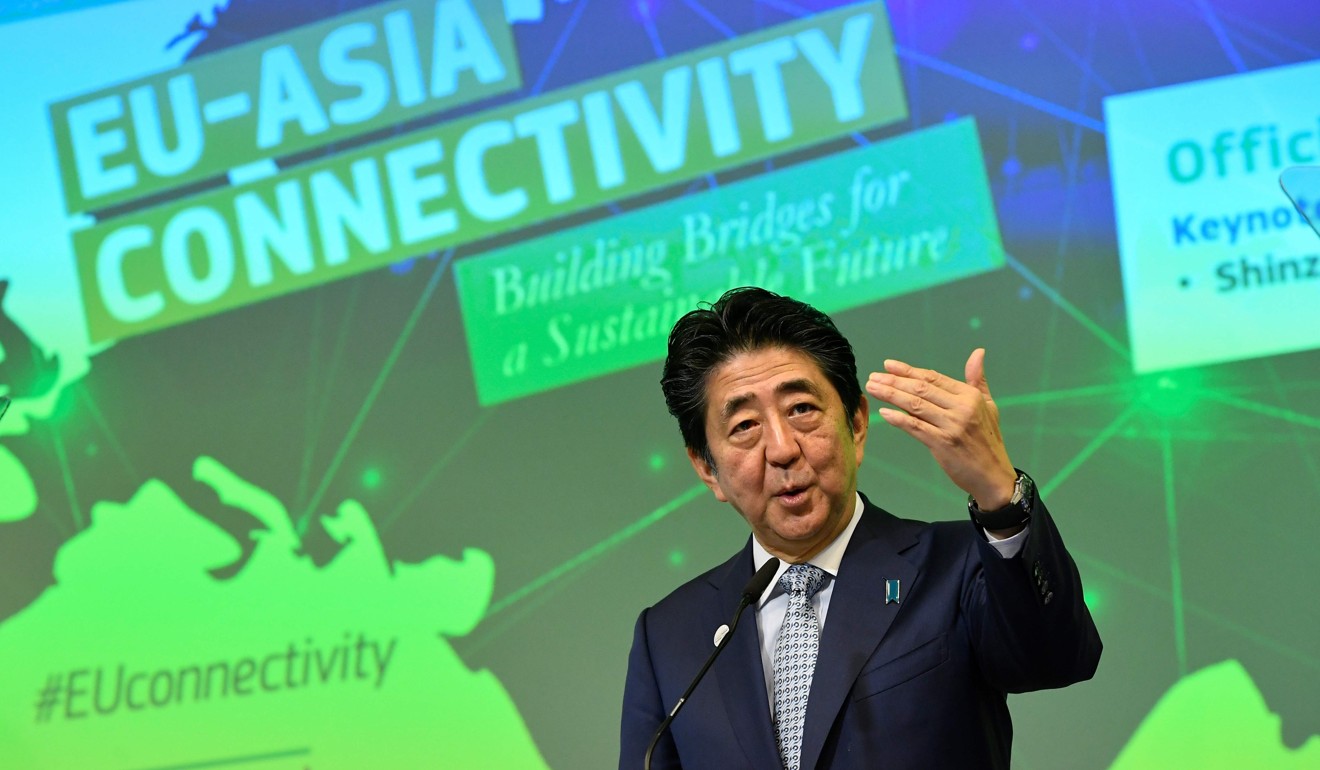
Speaking in Brussels on Friday, Japanese Prime Minister Shinzo Abe said the world’s third-biggest economy would work with the EU to strengthen their transport, energy and digital ties to Africa and the Balkans – key regions for China’s flagship trade and development project.
At a forum to mark the first anniversary of the EU-Asia Connectivity scheme, Abe and European Commission President Jean-Claude Juncker signed an agreement formalising Japan’s involvement in the Europe-Asia plan that will be backed by a 60 billion (US$65.54 billion) EU guarantee fund, development banks and private investors.

Abe said Japan would ensure that officials from 30 African countries would be trained in sovereign debt management over the next three years, a veiled attack on what Western diplomats claim is China’s debt trap for its belt and road partners.

“The EU and Japan are linked through and through,” Abe said. “The infrastructure we build from now on must be [high] quality infrastructure.

“Whether it be a single road or a single port, when the EU and Japan undertake something, we are able to build sustainable, comprehensive and rules-based connectivity, from the Indo-Pacific to the west Balkans and Africa.”

Japan wants to extend its business reach through its alliance with the EU as its economy slows and geopolitical competition from China takes its toll.

Japan indicates China is bigger threat than North Korea in latest defence review

China’s low-key delegation to the forum was led by Guo Xuejun, deputy director general of international affairs at the foreign ministry.

The US was represented by its deputy assistant secretary of state for cyber policy, Robert Strayer, who was in Europe to lobby against Chinese telecoms giant Huawei Technologies and its involvement in fifth-generation telecoms networks.

Abe and Juncker made cybersecurity the highlight of their addresses. Juncker, who will step down from the presidency by the end of October, repeated his attack on China’s trade policies without naming the country.

“Openness is reciprocal, based on high standards of transparency and good governance, especially for public procurement, and equal access to businesses while respecting intellectual property rights,” he said.

Prime Minister Shinzo Abe says Japan will train officials from 30 African countries in sovereign debt management in three years. Photo: AFP

European policymakers and businesses have for years complained about China’s refusal to allow foreign companies in without a Chinese joint venture partner, a practice that critics claimed involved forced transfer of intellectual property to the Chinese side.

“One of the keys to successful connectivity is to respect basic rules and common sense,” Juncker said, stressing that EU-Japanese cooperation focused on the “same commitment to democracy, rule of law, freedom and human dignity”.

European businesses urge EU to take ‘defensive’ measures against China’s state-owned enterprises

When the commission proposed improved transport, energy and digital infrastructure links with Asia last year, it denied it was seeking to stymie Chinese ambitions.

The EU plan, which would be backed by additional funds from the EU’s common budget from 2021, private sector loans and development banks, amounted to a response to China’s largesse in much of central Asia and south-eastern Europe, where Beijing has invested billions of dollars.

Source: SCMP

22/09/2019

China Focus: China accelerates efforts to promote public awareness of cybersecurity

TIANJIN, Sept. 21 (Xinhua) — Just scan a QR code on a vending machine, then you will be given a drink. The special vending machine placed at the ongoing cybersecurity expo held in Tianjin has attracted many people to try it out.

Once you scan the code, you will receive a message in a second, reminding you that “arbitrary code-sweeping will endanger personal property safety,” as your personal information might have been illegally collected.

This machine was installed by 360 Security Technology Inc.

The expo is a part of a cybersecurity publicity campaign held in north China’s Tianjin Municipality, aiming to promote public awareness of the issue

In fact, it is also a part of the 2019 China Cybersecurity Week, held from Sept. 16 to 22 nationwide.

The campaign was jointly launched by the Publicity Department of the Communist Party of China Central Committee, the Office of the Central Cyberspace Affairs Commission and the ministries of education, public security and industry and information technology.

Over 100 cybersecurity and Internet enterprises have attended various activities held during the week.

There will also be themed activities to promote cybersecurity issues related to students, the telecommunication sector and financial sector.

Personal information protection is a major theme of this year’s campaign.

In Tianjin, an interactive experience area has been set up at the expo, which allowed visitors to raise their cybersecurity awareness through taking part in different activities.

“I’ve learned a lot about cybersecurity through these activities. Do not click strange links or download mobile software from unofficial platforms,” said a 64-year-old visitor surnamed Zhang.

Statistics released showed that China has more than 200 app stores providing nearly 5 million apps. They bring convenience for many people, but some of them become “information funnels,” leaking people’s mobile phone numbers, call records, text messages, consumption records and other private information.

According to a report on netizen’s satisfaction on cybersecurity issued during the event, 51.25 percent of surveyed Chinese netizens believe the Internet is safe, up 12.91 percentage points from last year. About 37 percent of the respondents believe there are personal information leaks on the Internet, and 58 percent experienced personal information infringement.

More than 82 percent of the respondents also urge legislation on individual information protection.

Early in January, the Office of the Central Cyberspace Affairs Commission, the Ministry of Industry and Information Technology, the Ministry of Public Security and the State Administration for Market Regulation teamed up to launch a campaign to crackdown on illegal collection of personal information in mobile apps.

So far, more than 600 popular apps have been evaluated, with over 200 apps asked to make improvements in personal information protection.

Source: Xinhua

28/07/2019

Chinese FM says BRICS cooperation a strategic choice, urges bigger BRICS role in world affairs

BRAZIL-RIO DE JANEIRO-CHINA-WANG YI-BRICS-MEETING

Chinese State Councilor and Foreign Minister Wang Yi (2nd L) poses for a group photo with Brazilian Foreign Minister Ernesto Araujo (3rd L), Russian Foreign Minister Sergey Lavrov (1st L), South African Foreign Minister Naledi Pandor (2nd R) and India’s Minister of State for External Affairs Vijay Kumar Singh in Rio de Janeiro, Brazil, July 26, 2019. Wang Yi attended the Formal Meeting of the BRICS Ministers of Foreign Affairs in Rio de Janeiro. (Xinhua/Xin Yuewei)

RIO DE JANEIRO, July 27 (Xinhua) — The rise of emerging markets and developing countries, represented by the BRICS countries, has bolstered a more multi-polar world, Chinese State Councilor and Foreign Minister Wang Yi said here on Friday.

At the Formal Meeting of the BRICS Ministers of Foreign Affairs, Wang also said BRICS cooperation is not a band-aid solution for the five countries but a strategic choice that focuses on common and long-term development and harbors bright prospects.

The five countries are Brazil, Russia, India, China and South Africa.

Wang said no matter how the international landscape changes, the direction of the BRICS cooperation must not change. Faced with new challenges, the five countries should let their voices be heard, offer more solutions to pressing global issues and play a greater role in world affairs.

Wang pointed out that unilateralism undermines international rules and challenges the international rule of law, which exacerbates the instability and uncertainty of the world.

The BRICS countries must take the lead in maintaining multilateralism and safeguarding the global governance system with the UN as its core and under international law.

Furthermore, the bloc should safeguard the multilateral trading system represented by the WTO and protect the common interests and development space of emerging market and developing countries, he said.

The five countries together must continue to integrate the interests of other emerging market countries and developing countries through flexible and diverse platforms such as “BRICS Plus.”

At the meeting, the five foreign ministers all agreed to safeguard the purposes and principles of the UN Charter, defend multilateralism and free trade, oppose unilateralism and protectionism, strengthen global governance, and build a community with a shared future for humankind.

They agreed that regional hotspot issues should be resolved through dialogue and consultation and that BRICS cooperation should work to benefit the peoples of the five countries.

The foreign ministers also agreed to maintain vigilance on cybersecurity issues and expressed opposition to the use of cybersecurity to suppress the development of science and technology in other countries. They agreed to strive toward an open and non-discriminatory environment for the application of information technology.

The foreign ministers were tasked with preparing for the BRICS summit to be held in Brasilia in November.

Source: Xinhua

11/04/2019

China urges relevant countries to offer fair business environment for enterprises

BEIJING, April 10 (Xinhua) — China on Wednesday urged relevant countries to offer a fair, just and non-discriminatory business environment for enterprises of various countries, including Chinese ones.

Foreign Ministry spokesperson Lu Kang made the remarks at a routine press briefing when asked whether Australia applies double standards on the cybersecurity issue.

Recently, a number of Australian media reported that relevant Australian law mandated communication enterprises install “backdoors” for the Australian government. Google, Apple, Amazon and other technology companies have expressed serious concern about the act, saying it threatens cybersecurity in Australia and the world.

While the Australian side previously claimed that the country does not want any company in its communications networks that have an obligation to any other government. For this reason, Australia banned Huawei from the 5G telecommunications network.

Noting China has been closely following the relevant developments, Lu said the communication market and international cooperation will be seriously affected when it forces enterprises to install “backdoors” by legislation, which builds its own security and interests on the basis of violating other countries’ security and the privacy of their citizens.

“As you can see, the business communities have expressed serious concern about this,” Lu said.

A puzzling thing is that on the one hand, relevant countries use cybersecurity and sensationalize the so-called “security threat” of other countries or enterprises with trumped-up charges. On the other hand, they are doing things that endanger cybersecurity, Lu said.

“I am just as interested as you are in what the Australian government would say,” said the spokesperson.

Emphasizing that China has always attached great importance to and firmly maintained cybersecurity, Lu said that the Chinese side is willing to continue to actively participate in international cooperation in cybersecurity and work with all parties to build a peaceful, secure, open, cooperative and orderly cyberspace.

Source: Xinhua

17/01/2019

Beijing builds cybersecurity industrial park

BEIJING, Jan. 16 (Xinhua) — Beijing is building a national-level cybersecurity industrial park to boost the industry and tap into the potential of domestic tech companies.

Over 10 companies specialized in internet security have signed a contract to move into the park, which has two branches respectively in Haidian district and Tongzhou district, according to the Beijing Municipal Bureau of Economy and Information Technology.

Construction on the park started at the end of 2017. By 2020, the industrial output is expected to reach 100 billion yuan (about 14.5 billion U.S. dollars).

“We are actively advancing the project. Leading firms in cybersecurity from home and abroad will establish their headquarters in the park,” said Jiang Guangzhi, an official with the bureau.

As smart cities’ initiatives using information technology are rolling out in many cities in China, the demand for internet security infrastructure is high.

“The fact that many agencies and organizations are exploring digitization and information technology without sufficient security creates a lot of risks,” said Qi Xiangdong, a member of the Beijing municipal committee of the Chinese People’s Political Consultative Conference. The committee is currently holding its annual session.

“Beijing is the center for political activity, culture, international exchange and technological innovation, but it is also a big target for cyber attacks,” said Qi.

The 360 Enterprise Security Group said it found security loopholes in over half of the one million websites in Beijing. On a daily basis, over 9.55 million malware are detected and blocked from PC users.

The global average of security spending in IT is about 3.7 percent of the total IT spending, but the Chinese average is only 1.1 percent, Qi said.

Insufficient investment in cybersecurity may lead to serious consequences, said Tong Liqiang, also a member of the committee and former director of the Beijing cyber information office.

“A full-fledged internet security shield is still not yet in place, but it is needed to service the development of the IT industry, tackle the security challenges and meet the public demand,” said Tong.

Source: Xinhua

Law of Unintended Consequences

continuously updated blog about China & India

ChiaHou's Book Reviews

continuously updated blog about China & India

What's wrong with the world; and its economy

continuously updated blog about China & India