26/11/2019
Chinese President Xi Jinping, also general secretary of the Communist Party of China (CPC) Central Committee, meets with a delegation of the United Russia party led by Chairman of the United Russia’s Supreme Council Boris Gryzlov at the Great Hall of the People in Beijing, capital of China, Nov. 25, 2019. (Xinhua/Li Tao)
BEIJING, Nov. 25 (Xinhua) — Chinese President Xi Jinping Monday met with a delegation of the United Russia party at the Great Hall of the People in Beijing.
The delegation, led by Chairman of the United Russia’s Supreme Council Boris Gryzlov, is in Beijing for the seventh meeting of the dialogue mechanism between the ruling parties of China and Russia held Monday.
Xi, also general secretary of the Communist Party of China (CPC) Central Committee, expressed congratulations for the success of the 19th congress of the United Russia party.
This year marks the 70th anniversary of the forging of diplomatic ties between China and Russia, said Xi.
“President Putin and I jointly announced the development of the China-Russia comprehensive strategic partnership of coordination for a new era, agreeing to guide bilateral relations in the direction of mutual support, in-depth integration and innovative cooperation to achieve win-win results,” said Xi.
He said China and Russia have formed strong strategic support for each other, which is of great strategic significance to world peace and development.
Saying that as ruling parties, the CPC and the United Russia party shoulder responsibilities to further promote China-Russia ties, Xi called on delegates to the seventh meeting of the dialogue mechanism to fully exchange views so as to contribute wisdom and strength to bilateral ties as well as world peace and prosperity.
Congratulating China on the fourth plenary session of the 19th CPC Central Committee, Gryzlov said Russia-China ties have reached an unprecedented level as the two countries have sound cooperation in various fields and good coordination in international and regional hotspot issues.
The United Russia party stands ready to enhance cooperation with the CPC to further promote bilateral ties, said Gryzlov.
The dialogue mechanism between the CPC and the United Russia party was launched in June 2009. Its sixth meeting was held in Kazan in March 2017.
Source: Xinhua
Posted in 70th anniversary, Beijing, China alert, China-Russia comprehensive strategic partnership of coordination, Chinese President Xi Jinping, diplomatic ties, general secretary of the Communist Party of China (CPC) Central Committee, Great Hall of the People, Kazan, President Putin, Russia, Uncategorized, United Russia party, United Russia's Supreme Council |
Leave a Comment »
13/10/2019
- The leaders agreed to set up a mechanism to boost economic ties and tackle India’s trade deficit with China after their second informal summit
- As 2020 is the 70th anniversary of diplomatic ties between both countries, India and China will hold 70 events next year to promote relations
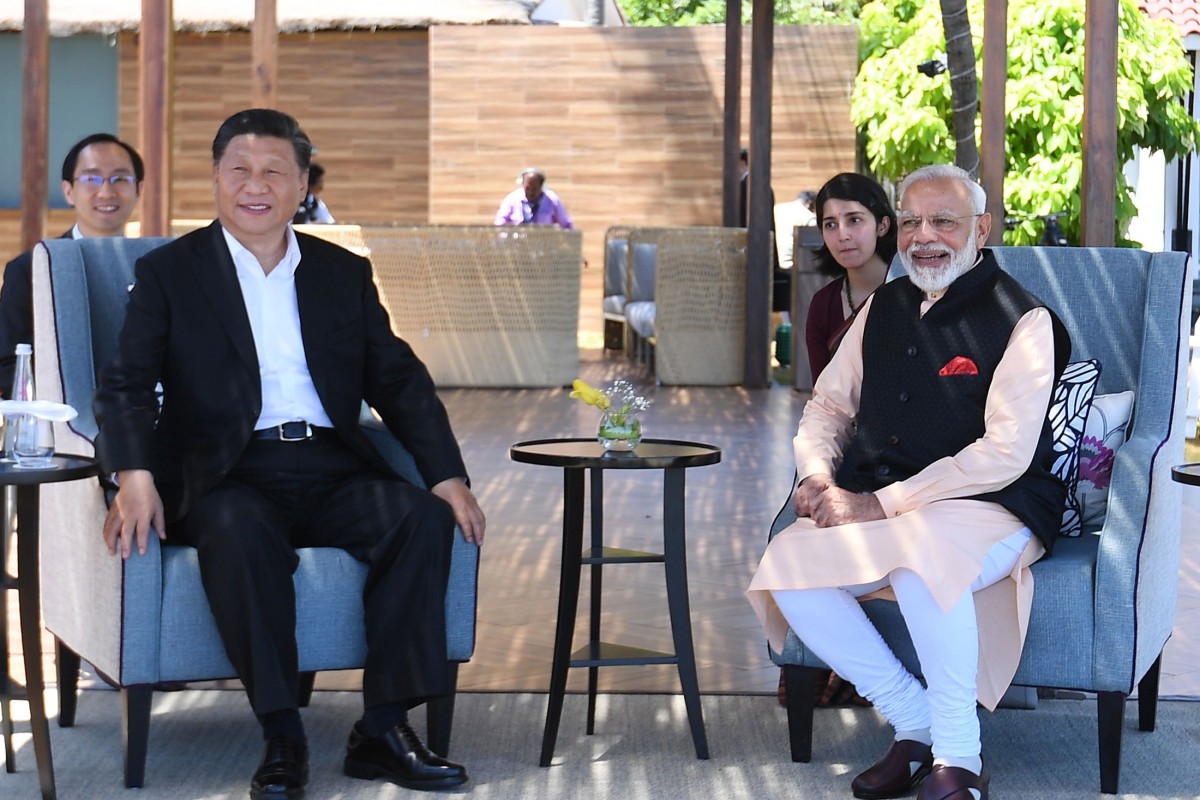
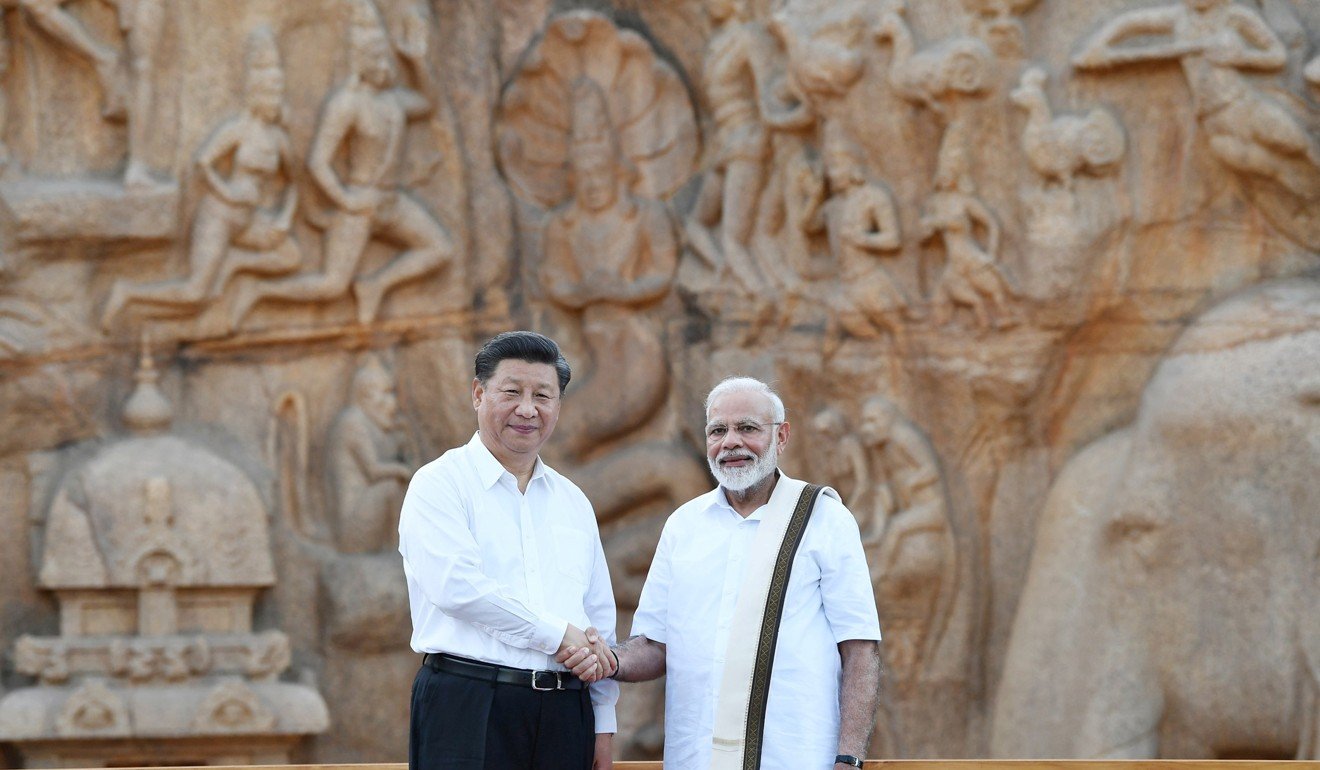
Indian Prime Minister Narendra Modi and Chinese President Xi Jinping during their meeting in Mamallapuram, Chennai. Photo: EPA
Chinese President
Xi Jinping and Indian Prime Minster
Narendra Modi concluded their second informal summit on Saturday by pledging to overcome trade differences and appreciate “each other’s autonomous foreign policies”, signalling an effort to focus on mutual interests rather than on long-standing contentious issues.
Modi remarked that both sides had agreed to be “sensitive” to each other’s concerns and not let differences escalate into disputes, while Xi called for communication to “alleviate suspicions” and for India and China to enhance strategic mutual trust, according to state news broadcaster CCTV.
Their desire to look beyond irritants in diplomatic ties, including a decades-long border row and China’s close military ties with India’s arch rival, Pakistan, comes as Beijing is embroiled in a tariff war with Washington that has rocked the global economy.
In a sign of China’s willingness to address India’s trade deficit with it, the leaders agreed to launch a “High Level Economic and Trade Dialogue”.
As Xi meets Modi, Chinese in Chennai hope to witness the ‘Wuhan spirit’
Chinese Vice-Premier Hu Chunhua and Indian Finance Minister Nirmala Sitharaman will meet regularly to discuss ways to boost two-way trade and investments, Indian foreign secretary Vijay Gokhale said in a media briefing.
India has a US$53 billion trade deficit with China, which makes up almost a third of its total trade deficit. It is also facing pressure to decide if it will commit to the China-led
(RCEP), which aims to create the world’s largest trading bloc involving 16 countries before the end of the year.
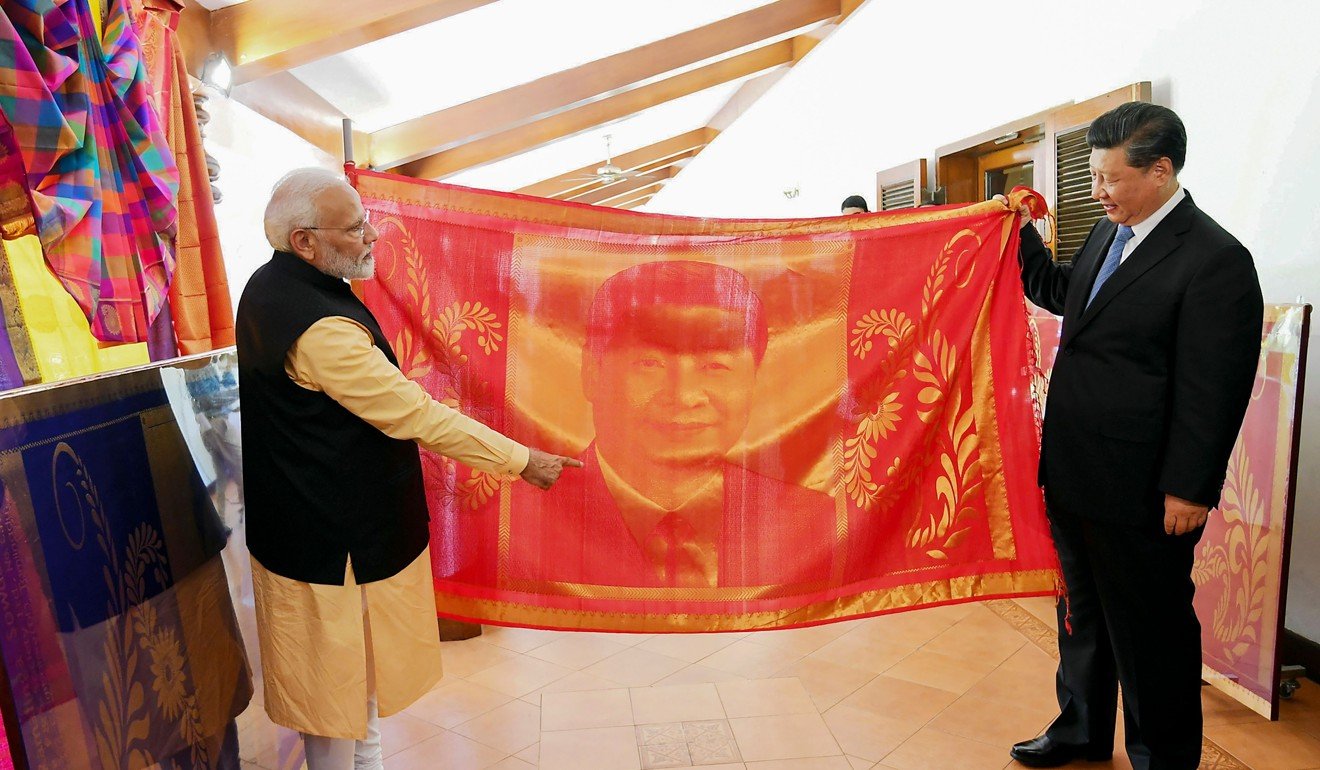
Narendra Modi exchanges gifts with Xi Jinping. Photo: AFP
Negotiations are ongoing with talks taking place in Bangkok this week, but India’s domestic producers have opposed the agreement over fears of a flood of Chinese imports. On Friday, the Indian government rejected clauses in the agreement related to e-commerce, according to reports.
Gokhale told the media briefing that both leaders, who met in the coastal town of Mamallapuram about 50km away from Chennai, briefly discussed the RCEP.
“PM Modi said India was looking forward to the RCEP but it is important that RCEP is balanced, that a balance is maintained in trade in goods, trade in services and investments,” he said, adding that Xi agreed to further discussions of India’s concerns on the issue.
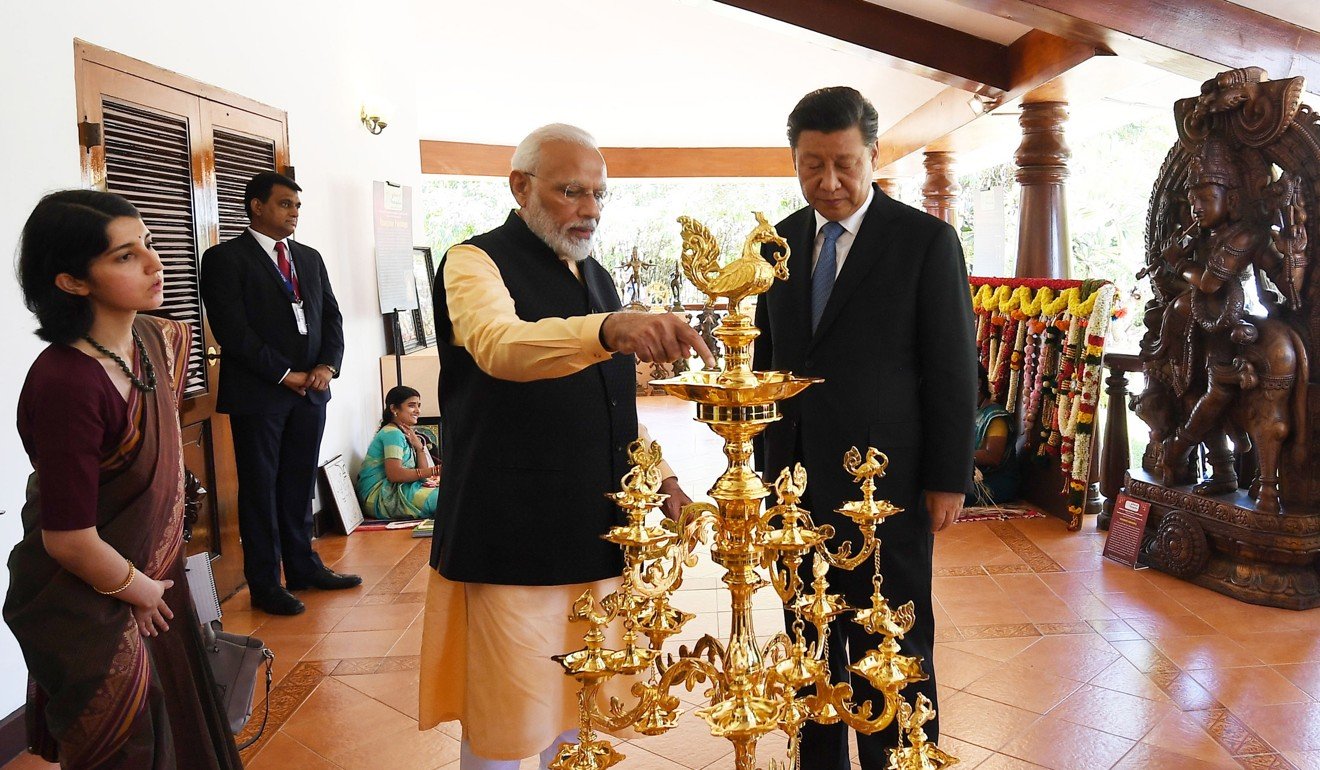
Narendra Modi with Xi Jinping in Mamallapuram. Photo: EPA
CCTV said Xi had six suggestions for how China and India could further improve ties, including assessing each other correctly and stepping up cooperation between their militaries. Besides economic and trade dialogue, China welcomed Indian pharmaceutical and IT companies to invest there, he said.
“We should look at disputes with a correct mind, and not let disputes affect cooperation.
“Both sides should properly and fairly get a solution for border disputes that are acceptable to each other … [and] cautiously handle each other’s core interests, and take proper measures to control issues that cannot be resolved immediately,” the president reportedly said.
Gokhale told reporters that both countries had agreed to pursue, through special representatives, an ongoing dialogue on their disputed border. China and India have held more than 20 rounds of talks to resolve their boundary dispute, over which they went to war in 1962. Different mechanisms have been set up to maintain peace along the 4,000-kilometre (2,485-mile) so-called Line of Actual Control.
Xi and Modi bank on chemistry as they talk trade and terrorism
Gokhale confirmed that the leaders – who met for a total of seven hours over Friday and Saturday, with the bulk of their time spent in one-on-one talks – did not discuss
, a region that is currently divided between India and Pakistan but which both nuclear-armed rivals claim in full.
Since India revoked the autonomy of the area it controls in August and imposed a lockdown,
has lobbied its allies – including its all-weather friend China – to support its opposition to the move. New Delhi had reacted sharply to Beijing’s move to take the matter to the United Nations, insisting that it was a purely bilateral issue. Two days before the summit, Xi had hosted Pakistan Prime Minister Imran Khan and had assured him of China’s support on all core issues, a statement that had irked India.
Gokhale said both leaders “emphasised the importance of having independent and autonomous foreign policies”.
“President Xi said that the two countries needed to have more extensive dialogue in order to understand each other’s perspectives on major global and regional issues,” he added.
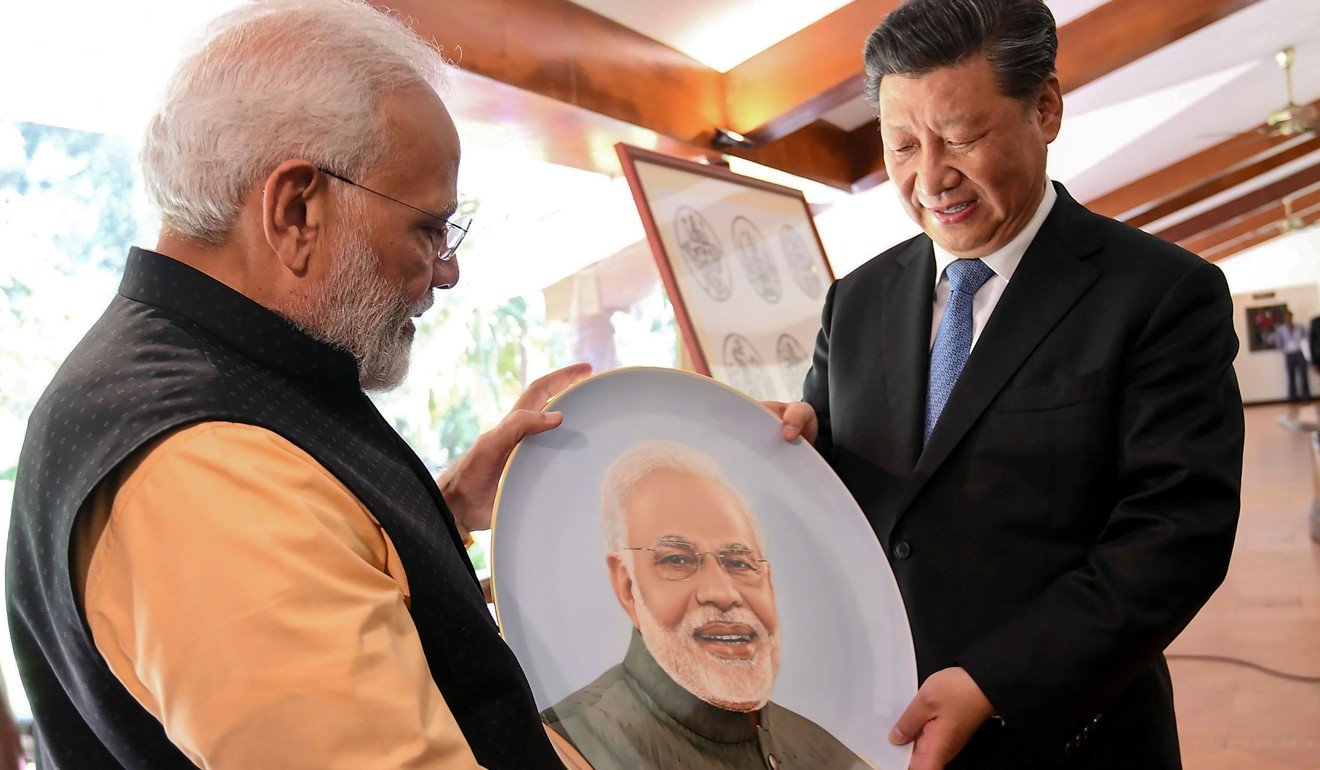
Narendra Modi exchanges gifts with Xi Jinping. Photo: AFP
The leaders also discussed terrorism, with a statement issued later by New Delhi saying both sides would make efforts to ensure the international community strengthened its framework “against training, financing and supporting terrorist groups throughout the world and on a non-discriminatory basis”.
The China-led multilateral Financial Action Task Force, which has been investigating Pakistan’s efforts to stamp out the financing of terrorism, is expected to decide soon if it would add Islamabad to its blacklist along with Iran and North Korea, a move that could invite stringent economic sanctions and drive away international financial institutions, both of which could affect Pakistan’s already-indebted economy adversely.
Gokhale added that as 2020 is the 70th anniversary of diplomatic ties between both countries, India and China will hold 70 events next year to promote people-to-people ties, with Modi accepting an invitation by Xi for the next informal summit to be held in China.
Both leaders had struck positive notes on the summit – with Xi describing their discussions as “candid” and between friends and Modi hailing the “Chennai Connect” meeting as marking a new era of cooperation between both countries.
War games, Kashmir and a US$57b question: the issues as Xi meets Modi
But analysts said they would be looking to see how the newly-announced high-level mechanism on trade panned out.
Narayani Basu, a New Delhi-based author, foreign policy analyst and China watcher felt the summit had achieved its purpose of bagging small wins for both sides.
“Discussing contentious issues would have defeated the purpose of the summit. The idea behind such a summit must be that despite the overarching posturing on different divergent issues, the two countries can achieve the easily-achievable wins. That is what the summit seems to have tried doing.”
But in terms of actual outcomes, she said she remained sceptical.
“I don’t think there has been much progress in the ties between the two countries since the last summit in Wuhan. Hence, this time, there is a lot more caution and scepticism towards such a summit,” she said, referring to the first summit last year in the Chinese city of Wuhan.
During Xi’s visit to southern India, which lasted 24 hours in all, Modi took him on a personal tour of temple monuments dating back to the seventh and eighth century in Mamallapuram when regional leaders had trade ties with Chinese provinces. He was also shown local artisan handicrafts and art forms, and gifted a handwoven silk portrait, a lamp and a painting.
Xi gave Modi a porcelain plate with the image of the prime minister’s face printed on it.
Xi Jinping with Narendra Modi in Mamallapuram. Photo: Reuters
On Friday, New Delhi announced that visa rules for Chinese nationals visiting India would be relaxed, with multiple-entry visas with a validity period of five years available from this month onwards. At present, most visas are single-entry and usually for between 30 and 60 days. Visa fees would also be reduced, the government said, with the multiple-entry visa costing US$80.
This was aimed at further enhancing “people-to-people exchanges between the two countries and [encouraging] more Chinese tourists to choose India as a destination for tourism purposes,” it said in a statement.
Xi left Chennai on Saturday afternoon and arrived in Nepal, which lies in between India and China. He will be the first Chinese president to visit Nepal in 22 years and is expected to sign a slew of deals with Nepal’s Prime Minister K.P. Sharma Oli, including the planned extension of the rail link from remote, mountainous Tibet to Nepal’s capital, Kathmandu.
The link will be part of Beijing’s ambitious infrastructure project to boost trade, the
(BRI), that Nepal joined two years ago.
More than 120 countries have signed on to the BRI, including Pakistan, where a series of projects worth US$46 billion are being constructed under the China-Pakistan Economic Corridor (CPEC). India has snubbed the BRI and questioned the transparency of funding agreements.
Source: SCMP
Posted in 70th anniversary, ambitious infrastructure project, autonomous foreign policies, “High Level Economic and Trade Dialogue”, Bangkok, Beijing, Belt and Road Initiative (BRI), BRI, CCTV, chemistry, Chennai, China-Pakistan Economic Corridor (CPEC), Chinese President Xi Jinping, Chinese Vice-Premier, Chinese Vice-Premier Hu Chunhua, diplomatic ties, economic and trade dialogue, Financial Action Task Force, global economy, Imran Khan, India alert, India’s trade deficit, Indian Finance Minister, Indian Foreign Secretary, Indian Prime Minister Narendra Modi, informal summit, iran, IT companies, Kashmir, Kathmandu, major global and regional issues, Mamallapuram, Nepal, Nepal’s Prime Minister, New Delhi, Nirmala Sitharaman, North Korea, Pakistan, Pakistan Prime Minister, pharmaceutical companies, Prime Minister Imran Khan, Prime Minister K.P. Sharma Oli, rail link from remote, mountainous Tibet, Regional Comprehensive Economic Partnership, Regional Comprehensive Economic Partnership (RCEP), seventh and eighth century, tariff war, temple monuments, terrorism, trade and terrorism, Uncategorized, United Nations, Vijay Gokhale, Washington, Wuhan Spirit |
Leave a Comment »
09/10/2019
BEIJING, Oct. 9 (Xinhua) — Chinese President Xi Jinping’s upcoming trip to India and Nepal is expected to inject new impetus into China’s relations with the two countries, an official said here Wednesday.
The Chinese Foreign Ministry announced earlier in the day that at the invitation of Indian Prime Minister Narendra Modi and Nepali President Bidhya Devi Bandari, President Xi will attend the second informal meeting with Modi and pay a state visit to Nepal from Oct. 11 to 13.
This will be Xi’s first overseas trip after the grand celebration of the 70th anniversary of the founding of the People’s Republic of China, Vice Foreign Minister Luo Zhaohui told a press briefing.
Xi’s trip will inject new impetus into China-India and China-Nepal relations, even China’s relations with South Asia, Luo said, adding that Xi’s trip will also open up new space for strengthening regional connectivity and economic and trade cooperation, set up new platforms for enhancing mutual trust and friendship among regional people, and make new contributions to world peace and prosperity.
China and India, both as developing countries and emerging economies, are the only two major countries in the world with a population of more than 1 billion, Luo said, stressing that China-India cooperation will not only benefit the development of the two countries, but also help promote world multipolarization and economic globalization, and safeguard the common interests of developing countries.
Since the first informal meeting between Xi and Modi in Wuhan last year, China-India relations have entered a new stage of steady growth, with cooperation and exchanges being carried out in various fields and differences being properly managed, Luo said.
In Chennai, Xi will have an in-depth communication with Modi on issues that have overall, long-term and strategic significance on bilateral relations, set the tune and guide the direction for future development of the ties, and speak to the world in unanimous voice, so as to inject positive energy into the world full of uncertainties.
Regarding Xi’s visit to Nepal, Luo said that Xi will be the first Chinese president to visit the South Asian country after an interval of 23 years.
Nepal, as a friendly neighbor, also serves as an important partner of China in terms of carrying out the Belt and Road cooperation, Luo said.
Since the establishment of diplomatic ties, the two countries have treated each other on an equal footing with mutual respect and support, said Luo, adding that China and Nepal have become a model of mutually beneficial cooperation between countries that are different in social system and size.
“This historic visit will definitely exert historic influence,” Luo said.
He said that Xi will attend the welcome ceremony and banquet hosted by President Bandari, meet with Bandari, hold talks with Prime Minister K.P. Sharma Oli and jointly witness the signing of cooperation documents with him.
Xi will also meet with co-chairman of the Nepal Communist Party Pushpa Kamal Dahal, also known as Prachanda, and leaders of the country’s Federal Parliament and other political party leaders, Luo added.
Leaders of the two countries will make new plans for the development of bilateral relations, ushering in a new era of fast development for China-Nepal relations, Luo said.
This will also consolidate political mutual trust and foundation of public opinions for friendship between the two countries, push forward high quality construction of the Belt and Road, speed up building an interconnectivity network across the Himalayas, and inject new impetus into pragmatic cooperation in various areas between the two countries, Luo said.
Source: Xinhua
Posted in 70th anniversary of the founding of the PRC, Belt and Road (B&R), Belt and Road Cooperation, Chennai, China-India relations, China-Nepal relations, Chinese foreign ministry, Chinese President Xi Jinping, diplomatic ties, economic globalization, Federal Parliament, grand celebration, Himalayas, India alert, Indian Prime Minister Narendra Modi, multipolarization, Nepal, Nepal Communist Party, Nepali President Bidhya Devi Bandari, overseas trip, Prime Minister K.P. Sharma Oli, South Asia, South Asian country, Uncategorized, Vice Foreign Minister Luo Zhaohui, Wuhan |
Leave a Comment »
06/10/2019
BEIJING, Oct. 4 (Xinhua) — Chinese President Xi Jinping and his Guinean counterpart Alpha Conde on Friday exchanged congratulatory messages on the 60th anniversary of the establishment of the two countries’ diplomatic ties.
Noting that Guinea was the first sub-Saharan African country to establish diplomatic relations with the People’s Republic of China, Xi said in his message that over the past 60 years, the two countries have always maintained sincerity, friendship and mutual support no matter how the international situation changed, setting an example of unity and cooperation for China-Africa relations.
Xi said he attaches great importance to the development of China-Guinea relations, and values the traditional friendship between the two countries.
He said he is willing to work together with Conde, taking the 60th anniversary of bilateral diplomatic relations as a new starting point, to grasp the historical opportunity of jointly building the Belt and Road and the flourishing development of China-Africa cooperation, cement friendship and mutual trust, and deepen practical cooperation.
The two sides should continue to promote the development of China-Guinea comprehensive strategic cooperative partnership, so as to benefit both countries and peoples, and further contribute to building an even stronger China-Africa community with a shared future, said the Chinese leader.
Conde, for his part, said that the establishment of Guinea-China diplomatic relations has great significance to the development of Africa-China ties. For a long time, the two countries have maintained special, friendly relations, representing an epitome of Africa-China friendly cooperation.
Guinea highly appreciates the Belt and Road Initiative, and is willing to work together with the Chinese side to cement their traditional friendship, carry out the outcomes of the Beijing Summit of the Forum on China-Africa Cooperation, and promote continuous and in-depth development of China-Guinea comprehensive strategic cooperative partnership, Conde added.
Source: Xinhua
Posted in 60th anniversary, Alpha Conde, Beijing Summit of the Forum on China-Africa Cooperation, Belt and Road Initiative, Belt and Road Initiative (BRI), China-Africa relations, China-Guinea comprehensive strategic cooperative partnership, Chinese president, Chinese President Xi Jinping, congratulations, diplomatic ties, exchange, Guinea, Guinean presidents, People's Republic of China, sub-Saharan African country, Uncategorized |
Leave a Comment »
05/10/2019
BEIJING, Oct. 4 (Xinhua) — Chinese President Xi Jinping and his Guinean counterpart Alpha Conde on Friday exchanged congratulatory messages on the 60th anniversary of the establishment of the two countries’ diplomatic ties.
Noting that Guinea was the first sub-Saharan African country to establish diplomatic relations with the People’s Republic of China, Xi said in his message that over the past 60 years, the two countries have always maintained sincerity, friendship and mutual support no matter how the international situation changed, setting an example of unity and cooperation for China-Africa relations.
Xi said he attaches great importance to the development of China-Guinea relations, and values the traditional friendship between the two countries.
He said he is willing to work together with Conde, taking the 60th anniversary of bilateral diplomatic relations as a new starting point, to grasp the historical opportunity of jointly building the Belt and Road and the flourishing development of China-Africa cooperation, cement friendship and mutual trust, and deepen practical cooperation.
The two sides should continue to promote the development of China-Guinea comprehensive strategic cooperative partnership, so as to benefit both countries and peoples, and further contribute to building an even stronger China-Africa community with a shared future, said the Chinese leader.
Conde, for his part, said that the establishment of Guinea-China diplomatic relations has great significance to the development of Africa-China ties. For a long time, the two countries have maintained special, friendly relations, representing an epitome of Africa-China friendly cooperation.
Guinea highly appreciates the Belt and Road Initiative, and is willing to work together with the Chinese side to cement their traditional friendship, carry out the outcomes of the Beijing Summit of the Forum on China-Africa Cooperation, and promote continuous and in-depth development of China-Guinea comprehensive strategic cooperative partnership, Conde added.
Source: Xinhua
Posted in 60th anniversary, Alpha Conde, Beijing Summit of the Forum on China-Africa Cooperation, Belt and Road (B&R), Belt and Road Initiative, Belt and Road Initiative (BRI), China-Africa community, China-Guinea comprehensive strategic cooperative partnership, Chinese president, congratulations, diplomatic ties, exchange, Guinean president, traditional friendship, Uncategorized |
Leave a Comment »
28/09/2019
NEW YORK (Reuters) – China and the Pacific island state of Kiribati restored diplomatic ties on Friday after the former diplomatic ally of Taiwan abandoned Taipei.
A poor but strategic country which is home to a mothballed Chinese space tracking station, Kiribati announced last week that it was cutting relations with self-ruled Taiwan in favour of China, which claims Taiwan as a wayward province with no right to state-to-state ties.
China and Kiribati had ties until 2003, when Tarawa established relations with Taipei, causing China to break off diplomatic relations.
Up until that time, China had operated a space tracking station in Kiribati, which played a role in tracking China’s first manned space flight.
The Chinese government’s top diplomat State Councillor Wang Yi and Kiribati’s President Taneti Maamau signed a communique on restoring diplomatic relations at the Chinese mission to the United Nations in New York.
“We highly prize this important and the correct decision,” Wang told a news conference. “Let’s hope for our friendship to last forever. We will work together to grow together towards a bright and prosperous future.”
Speaking alongside Wang, Maamau said there was much to learn from China.
“I do believe that there is much to learn and gain from the People’s Republic of China and the re-establishment of our diplomatic relations is just the beginning,” he said.
There was no mention of the space tracking station at the news conference, nor in the joint communique between the two countries released by China’s Foreign Ministry.
China’s space programme is overseen by the military.
China’s Defence Ministry this week declined comment on the Kiribati facility.
Last week was difficult for Taiwan, as the Solomon Islands also ditched it for Beijing. The Solomon Islands foreign minister signed a deal on diplomatic ties in China last Saturday.
Both the Solomon Islands and Kiribati are small developing nations but lie in strategic waters that have been dominated by the United States and its allies since World War Two. China’s moves to expand its influence in the Pacific have angered Washington.
A former Taiwanese ambassador to Kiribati, Abraham Chu, told Taiwan’s Central News Agency last weekend that China had never fully removed the tracking station in Kiribati and that it “could come back at any time”.
Taiwan now has formal relations with just 15 countries, mostly small and poor nations in Latin America and the Pacific, including Nauru, Tuvalu and Palau. China has signalled it is coming for the rest of Taiwan’s allies.
Source: Reuters
Posted in abandoned, allies, angered, Beijing, China alert, China’s Foreign Ministry, defence ministry, diplomatic ally, diplomatic ties, foreign minister, influence, Kiribati, Latin America, Military, Nauru, New York, Pacific, Pacific island state, Palau, People’s Republic of China, President Taneti Maamau, restores, site, Solomon Islands, space programme, space tracking station, State Councillor Wang Yi, state-to-state ties, Taipei, Taiwan, Tarawa, ties, Tuvalu, Uncategorized, United Nations, United States, Washington, World War Two |
Leave a Comment »
21/09/2019
Chinese State Councilor and Foreign Minister Wang Yi and Solomon Islands’ Minister of Foreign Affairs and External Trade Jeremiah Manele sign a joint communique on the establishment of diplomatic relations after their talks in Beijing, capital of China, Sept. 21, 2019. (Xinhua/Xie Huanchi)
BEIJING, Sept. 21 (Xinhua) — China and the Solomon Islands signed a joint communique in Beijing Saturday on the establishment of diplomatic relations.
The communique was signed by Chinese State Councilor and Foreign Minister Wang Yi and Solomon Islands’ Minister of Foreign Affairs and External Trade Jeremiah Manele after they held talks.
The communique stated that the two countries have decided to recognize each other and establish diplomatic relations at the ambassadorial level effective from the date of signature of this communique, in keeping with the interests and desire of the two peoples.
China and the Solomon Islands agree to develop friendly relations on the basis of the principles of mutual respect for sovereignty and territorial integrity, mutual non-aggression, non-interference in each other’s internal affairs, equality, mutual benefit and peaceful coexistence.
The government of Solomon Islands recognizes that there is but one China in the world, that the Government of the People’s Republic of China is the sole legal government representing the whole of China, and that Taiwan is an inalienable part of China’s territory, according to the communique.
“The Government of the Solomon Islands shall sever ‘diplomatic relations’ with Taiwan as of this day and undertakes that it shall no longer develop any official relations or official exchanges with Taiwan. The Government of the People’s Republic of China appreciates this position of the Government of the Solomon Islands,” the communique said.
Prior to the signing of the communique, the Solomon Islands announced in a statement that it recognized the one-China principle and severed the so-called “diplomatic ties” with Taiwan.
Source: Xinhua
Posted in Beijing, China alert, China's territory, Chinese State Councilor and Foreign Minister Wang Yi, diplomatic ties, establish, Government, inalienable part, Jeremiah Manele, Minister of Foreign Affairs and External Trade, one China in the world, one-China principle, People's Republic of China, People's Republic of China (PRC), severed, Solomon Islands, Taiwan, Uncategorized |
Leave a Comment »
19/09/2019
Chinese Premier Li Keqiang meets with Russian President Vladimir Putin at the Kremlin in Moscow, Russia, Sept. 18, 2019. (Xinhua/Liu Bin)
MOSCOW, Sept. 18 (Xinhua) — Chinese Premier Li Keqiang on Wednesday met with Russian President Vladimir Putin at the Kremlin to discuss bilateral relations.
Li arrived at Moscow after holding talks and co-chairing the 24th regular meeting between Chinese and Russian heads of government with his Russian counterpart, Dmitry Medvedev, in St. Petersburg.
The Chinese premier firstly extended Chinese President Xi Jinping’s sincere greetings to Putin.
Recalling his meeting with Medvedev, Li said this visit helped draw a comprehensive plan for exchanges and cooperation between China and Russia in various fields, and achieved a lot of new results.
The three-day visit came as the two countries are celebrating the 70th anniversary of their diplomatic ties. During Xi’s visit to Russia in June this year, China-Russia relationship was elevated to a comprehensive strategic partnership of coordination for a new era.
China and Russia are each other’s biggest neighbor, said Li, adding that a healthy and stable development of bilateral relations is not only beneficial to both sides, but also conducive to the region and the world.
China is willing to continue to consolidate friendship, deepen cooperation and strengthen exchanges with Russia, as well as jointly safeguard an international system with the United Nations at its core and a multilateral trading system based on the World Trade Organization’s rules, which is of great significance for promoting development, prosperity, peace and stability of the world, said the premier.
Noting that China and Russia have broad prospects for cooperation, Li said that China stands ready to better synergize the Belt and Road Initiative (BRI) with the Eurasian Economic Union, to promote the simultaneous increase in both the scale and the quality of the two-way trade.
“China is further expanding opening up and the huge market potential will bring more opportunities to enterprises from all over the world including Russia,” Li said, expressing hopes that the two countries can continue to open up to each other, broaden investment and market access and create more cooperation opportunities for enterprises from the two countries.
With joint efforts, China-Russia practical cooperation will achieve more fruitful results and deliver greater benefits to the two peoples in the new era, Li said.
Congratulating on the 70th anniversary of the founding of the People’s Republic of China, Putin said relations with China are a priority of Russian diplomacy.
Bilateral cooperation has recorded remarkable achievements since the two countries established diplomatic ties 70 years ago, he said, noting that their relations have been upgraded to a comprehensive strategic partnership of coordination for a new era.
Russia-China relations are an important stabilizing factor in international relations, Putin said.
Noting the meeting between Li and Medvedev has effectively promoted bilateral practical cooperation with its many new results, he pledged Russia’s willingness to better align its development strategy with the BRI, constantly expand the two countries’ trade and promote common development.
Also on Wednesday, Li laid a wreath at the Tomb of the Unknown Soldier in Moscow.
Source: Xinhua
Posted in 70th anniversary, Belt and Road Initiative (BRI), Chinese premier Li Keqiang, Chinese President Xi Jinping, diplomatic ties, Dmitry Medvedev, Eurasian Economic Union, founding of the People's Republic of China (PRC), Kremlin, Moscow, Russian counterpart, Russian diplomacy, Russian President, russian president vladimir putin, St. Petersburg, Tomb of the Unknown Soldier, Uncategorized, United Nations, World Trade Organization (WTO), wreath |
Leave a Comment »
18/09/2019
Chinese Premier Li Keqiang and his Russian counterpart Dmitry Medvedev jointly meet the press in St. Petersburg, Russia, Sept. 17, 2019. (Xinhua/Yin Bogu)
ST. PETERSBURG, Russia, Sept. 17 (Xinhua) — China and Russia should open up more to the world and to each other to achieve mutual benefit and common development, Chinese Premier Li Keqiang said here Tuesday.
Jointly meeting the press with Russian Prime Minister Dmitry Medvedev, Li said that as the two countries observe the 70th anniversary of their diplomatic ties this year, the sound and stable development of bilateral relations is in the interests of both sides and also conducive to human progress under current circumstances.
Describing bilateral pragmatic cooperation as comprehensive, broad and of high level, Li said while the two countries’ cooperation in traditional spheres like energy is making new breakthroughs, their cooperation in new areas like cross-border e-commerce and sci-tech innovation is also gaining steam.
He expressed hope that the two sides will actively explore deepening refining-petrochemical integration, and increase the added value of energy cooperation to help realize their goal of doubling bilateral trade on time.
Noting that both countries support multilateralism and free trade, Li said China is furthering opening up with its manufacturing sector fully open now. He invited Russian companies to seize the opportunity and invest in China.
Li also urged the two countries to tap their cooperation potential in sci-tech innovation as they have designated the years of 2020 and 2021 as “Year of Scientific and Technological Innovation” in each other’s country.
Medvedev said the two countries’ comprehensive strategic partnership of coordination has entered a new era, and the two sides are in close communication with pragmatic cooperation in various areas achieving new progress.
Earlier Tuesday, Li and Medvedev co-chaired the 24th regular meeting between Chinese and Russian heads of government.
Medvedev said that during the meeting, the two sides signed a slew of cooperation agreements in a wide range of areas. He pledged Russia’s willingness to work with China to expand their cooperation from traditional energy to high-tech to inject new vitality to their comprehensive strategic partnership of coordination for a new era.
Source: Xinhua
Posted in 70th anniversary, Chinese premier Li Keqiang, cross-border e-commerce, diplomatic ties, Dmitry Medvedev, High tech, Russian Prime Minister, sci-tech innovation, St. Petersburg, traditional energy, Uncategorized, vitality |
Leave a Comment »
10/09/2019
BEIJING, Sept. 9 (Xinhua) — Chinese Premier Li Keqiang’s upcoming visit to Russia will open up broader space for pragmatic cooperation between the two countries in the new era and boost bilateral ties, a Chinese Foreign Ministry official said Monday.
At the invitation of Russian Prime Minister Dmitry Medvedev, Li will pay an official visit to Russia from Sept. 16 to 18 and co-chair the 24th regular meeting between Chinese and Russian heads of government with Medvedev, Vice Foreign Minister Le Yucheng said at a press briefing.
The visit comes as the two countries are embracing the 70th anniversary of the establishment of diplomatic ties and ushering in a new era in their relations.
Noting that the China-Russia relationship has become more mature, stable and tenacious over the past 70 years, Le said it is now a major-country relationship featuring the highest degree of mutual trust, coordination and strategic value.
“China and Russia enjoy solid political mutual trust and firmly support each other on issues concerning core interests and major concerns, while their all-round mutually beneficial cooperation has continued to expand and their interests have been more closely interconnected,” Le said, adding that the bilateral trade volume exceeded 100 billion U.S. dollars for the first time last year.
According to Le, the two countries also have close and effective communication and coordination in international affairs.
The upcoming meeting between the two countries’ heads of government will focus on two major objectives, Le said. The first is to promote the implementation of the major consensus reached by the two countries’ heads of state, deepen the integration of interests and consolidate the material basis of bilateral relations.
The second is to contribute the two countries’ wisdom to and voice their support for safeguarding multilateralism, open economy, and the liberalization and facilitation of trade and investment, Le said.
During the visit, Li will hold talks with Medvedev in St. Petersburg and sign a joint communique of the 24th regular meeting between Chinese and Russian heads of government. Li will also meet with Putin in Moscow
Source: Xinhua
Posted in 70th anniversary, China-Russia relationship, Chinese premier Li Keqiang, diplomatic ties, Dmitry Medvedev, mature, Moscow, pragmatic cooperation, Putin, Russia, Russian Prime Minister, St Petersburg, stable, tenacious, Uncategorized, Vice Foreign Minister, Vice Foreign Minister Le Yucheng |
Leave a Comment »




 CHINDIA ALERT: You'll be living in their world, very soon