Chindia Alert: You’ll be Living in their World Very Soon
aims to alert you to the threats and opportunities that China and India present. China and India require serious attention; case of ‘hidden dragon and crouching tiger’.
Without this attention, governments, businesses and, indeed, individuals may find themselves at a great disadvantage sooner rather than later.
The POSTs (front webpages) are mainly 'cuttings' from reliable sources, updated continuously.
The PAGEs (see Tabs, above) attempt to make the information more meaningful by putting some structure to the information we have researched and assembled since 2006.
(Reuters) – The Utah-based Church of Jesus Christ of Latter-day Saints, also known as the Mormon church, plans to open its first temple in mainland China at a time when Beijing has been clamping down steadily on religious freedoms.
The temple in the eastern Chinese city of Shanghai will help fill a gap left by renovation work since last July at the church’s temple in Hong Kong, Russell M. Nelson, president of the church, announced on Sunday.
He also said seven other temples would open, including one in Dubai, its first in the Middle East.
“In Shanghai, a modest, multipurpose meeting place will provide a way for Chinese members to continue to participate in ordinances of the temple,” Nelson said.
“Because we respect the laws and regulations of the People’s Republic of China, the Church does not send proselytizing missionaries there; nor will we do so now,” he said.
A former cardiac surgeon, Nelson has spent time in China, studied Mandarin and was granted an honorary professorship by China’s Shandong University School of Medicine.
In January, the church sent two planeloads of protective medical equipment to the Children’s Medical Center in Shanghai to help manage the coronavirus outbreak.
No official figure is available for the number of Mormons in China.
China’s constitution guarantees religious freedom but under President Xi Jinping Beijing has tightened restrictions on religions seen as a challenge to the authority of the ruling Communist Party.
The government has cracked down on underground churches, both Protestant and Catholic, and has rolled out legislation to increase oversight of religious education and practices.
Chinese law requires that places of worship register and submit to government oversight, but some have declined to register and are known as “house” or “underground” churches.
The Chinese government formally recognizes five religions: Buddhism, Taoism, Islam, Catholicism and Protestantism.
“Expatriate and Chinese congregations will continue to meet separately. The Church’s legal status there remains unchanged,” Nelson said.
“In an initial phase of facility use, entry will be by appointment only. The Shanghai Temple will not be a temple for tourists from other countries,” he said.
In 2018, the Vatican and China signed an agreement on the appointment of Roman Catholic bishops, a breakthrough on an issue that for decades fuelled tensions between the Holy See and Beijing and thwarted efforts toward diplomatic relations.
In the Chinese city of Wuhan, where the virus emerged, the authorities earlier announced that some non-residents would be allowed to leave if they showed no symptoms of the virus.
However, local officials now say that order was made without authorisation and has been revoked.
The city has been in lockdown since January 23, with authorities cutting off transport links in and out of the city.
More than 2,500 people have died from the virus in mainland China, with some 77,150 cases confirmed cases reported.
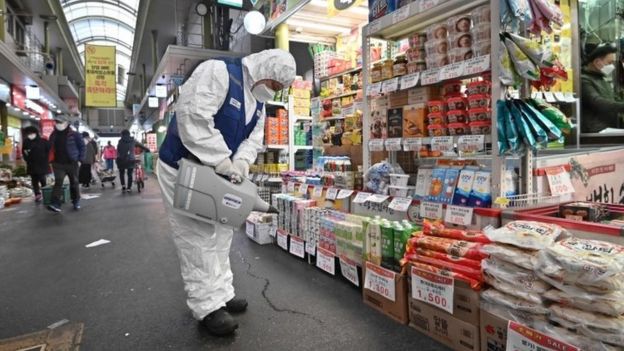
Image copyright AFPImage caption A worker sprays disinfectant to help prevent the spread of the novel coronavirus at a market in Seoul
What is the situation in North Korea?
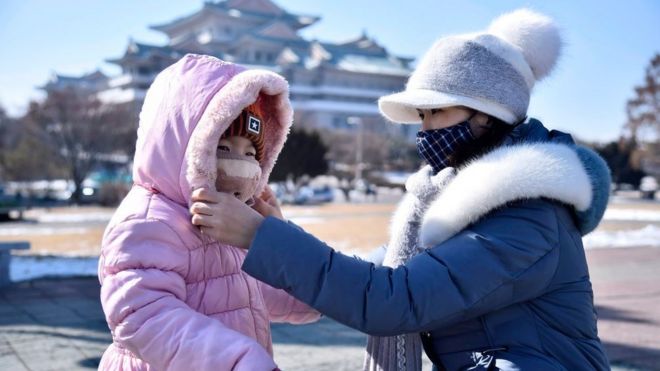
North Korea has not confirmed any cases but the country shares a long and often porous border with China. There are concerns that North Korea, which is subject to international sanctions, lacks the health infrastructure to test and treat those infected and that any outbreak could quickly spread unchecked.
At the moment, all foreigners coming into the country must be quarantined for 30 days.
There are relatively few foreigners in North Korea, and only around 200 Westerners, according to one expert.
North Korean authorities have also cancelled the annual Pyongyang marathon, which typically sees people from all over the world participating.
Around 3,000 people in North Pyongan province – a north-western region bordering China – are also now under monitoring for reportedly showing suspected symptoms, said state media.
What about South Korea?
Media caption People in Daegu have voiced concern over the spread of the virus
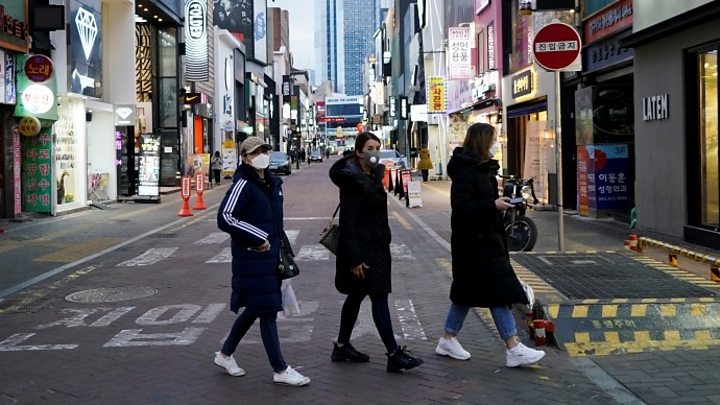
South Korea has the largest number of confirmed cases outside China, after a huge spike in the past week.
Before last Wednesday, the country had recorded just 31 cases. That number has now jumped to 763.
Eight new cases of the virus have been reported in the army, and one in the navy, air force and marine corps – bringing the number to 11.
But the biggest virus clusters have been linked to a hospital and a religious group near the south-eastern city of Daegu.
A handful of South Korea airlines, including Korean Air Lines – the country’s biggest airline – has suspended flights going to Daegu, which has a population of around 2.5m.
Korean Air says the suspension will last until March 27
What’s happening in Italy?
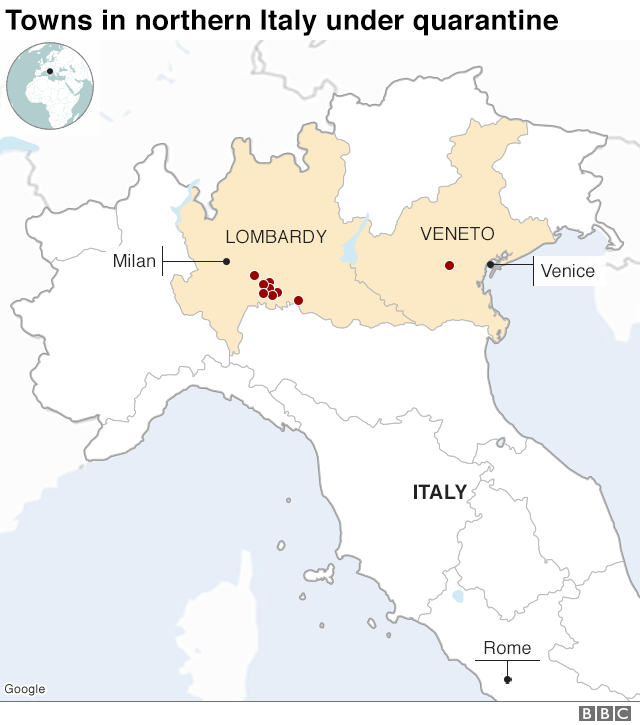
Italian officials have introduced sweeping measures to control what is now the worst outbreak of the coronavirus in Europe – at least three people have died and more than 150 cases confirmed.
In the regions of Lombardy and Veneto, a lock-down is in place in several small towns. For the next two weeks, 50,000 residents will not be able to leave without special permission.
Even outside the zone, many businesses and schools have suspended activities, and sporting events have been cancelled – including several top-flight football matches.
Officials have yet to find the first carrier of the virus in the country.
World edges closer to coronavirus pandemic
Analysis by Fergus Walsh, medical correspondent
The combined situation in South Korea, Iran and Italy points to the early stages of pandemic. This means a global outbreak, with the coronavirus spreading in the community in multiple parts of the world.
In each of these countries we are seeing spread of the virus with no connection to China. The lockdown efforts in Italy mirror those that have happened in China.
The situation in Iran is especially worrying, because the health authorities have reportedly said the virus has spread to multiple cities, and it appears the first case in Lebanon is linked to a traveller from Iran.
If we have a pandemic, it will still be important to limit the speed of spread of the virus.
If countries could hold it somewhat at bay until the end of winter, there is a hope that warmer temperatures will reduce the time the virus can survive in the air, as we see with seasonal flu. But this may not be certain.
What’s the latest from Iran?
Iran said on Sunday it had 43 confirmed cases of the virus, most of them in the holy city of Qom. Eight of those infected have died, the highest number of deaths outside China.
Iraq, Pakistan, Armenia and Turkey have closed their borders with Iran, and Afghanistan has suspended air and road travel to and from Iran.
What about China, where the outbreak started?
China’s President Xi Jinping has described the outbreak as the “largest public health emergency” in the country’s recent history.
Speaking on Sunday, he acknowledged “shortcomings” in China’s response and said lessons must be learned.
China reported 409 new infections on Monday, the bulk of which were from Wuhan.
But outside China, cases with no clear link to that country or other confirmed cases continue to rise, prompting concern from the World Health Organization (WHO).
The likes of Saudi Arabia also saw an upswing in travellers from the mainland after the release of its new visa programme
But fewer Chinese tourists went abroad this year, with a 15 per cent drop from 2018 attributed to more opting to visit local historical sites
Chinese tourists take photos in front of the Imperial Palace in Tokyo, Japan. Photo: Reuters
Fewer Chinese travellers went overseas during “golden week” this year – but for those who did, Japan, Thailand and Singapore were the top-ranked destinations as tourists from the mainland gave Hong Kong a miss, according to China’s largest travel company Ctrip.
Chinese government data showed only 6.07 million people travelled during the national holiday between October 1-6, a 15.1 per cent drop from the corresponding period last year. Analysts attributed this to Chinese tourists opting for a “staycation”, as 782 million people – a 7 per cent increase from last year – chose to celebrate the 70th anniversary of the People’s Republic of China by visiting local historical sites.
How a new wave of Indian travellers are transforming tourism in Southeast Asia
For those who did venture abroad, Japan, Thailand and Singapore ranked as the top three most-booked countries in Asia during the week, according to Chinese travel firm Ctrip, as tourists from the mainland skipped protest-hit Hong Kong for other destinations.
The city, now in its 19th week of anti-government protests, over the week saw a 50 per cent overall drop in tourism from last year, as well as a 47.8 per cent reduction in border crossings at the Luohu border checkpoint, according to government figures.
Japan remained the most popular destination for Chinese tourists. In the first half of 2019, the nation saw 4.5 million visitors from China, up 11.7 per cent from the same period in 2018. In order of popularity, the top-visited cities were Osaka, Tokyo, Kyoto, Sapporo and Nagoya, according to Japanese media.
Over the same week, Japan increased its sales tax from 8 to 10 per cent, but Chinese shoppers – who accounted for 37 per cent, or US$15.4 billion, of the spending by international visitors to the nation last year – were undeterred.
Japan saw the highest volume of overseas transactions over the week, according Alipay Mobile, the world’s largest mobile payment platform. The firm declined to share the exact amount Chinese tourists had spent in Japan, but reported average spending per international traveller during golden week had increased by 15 per cent to 2,500 yuan (US$350).
From Nissan sales to Tsushima tourism, trade spat with Korea hits Japan in the pocket
Alipay is operated by Ant Financial, an affiliate of Alibaba Group Holding, which owns the Post.
Japanese department stores such as Sogo and Seibu celebrated the Chinese national holiday by holding golden week events and sales at 15 different branches across the nation, with food and arts promotions targeting Chinese shoppers.
Chinese travellers to Japan want cultural experiences involving local customs such as temple tours, heritage sites and cultural events, according to Emily Guo, a researcher at Hong Kong-based marketing research firm Cherry Blossoms.
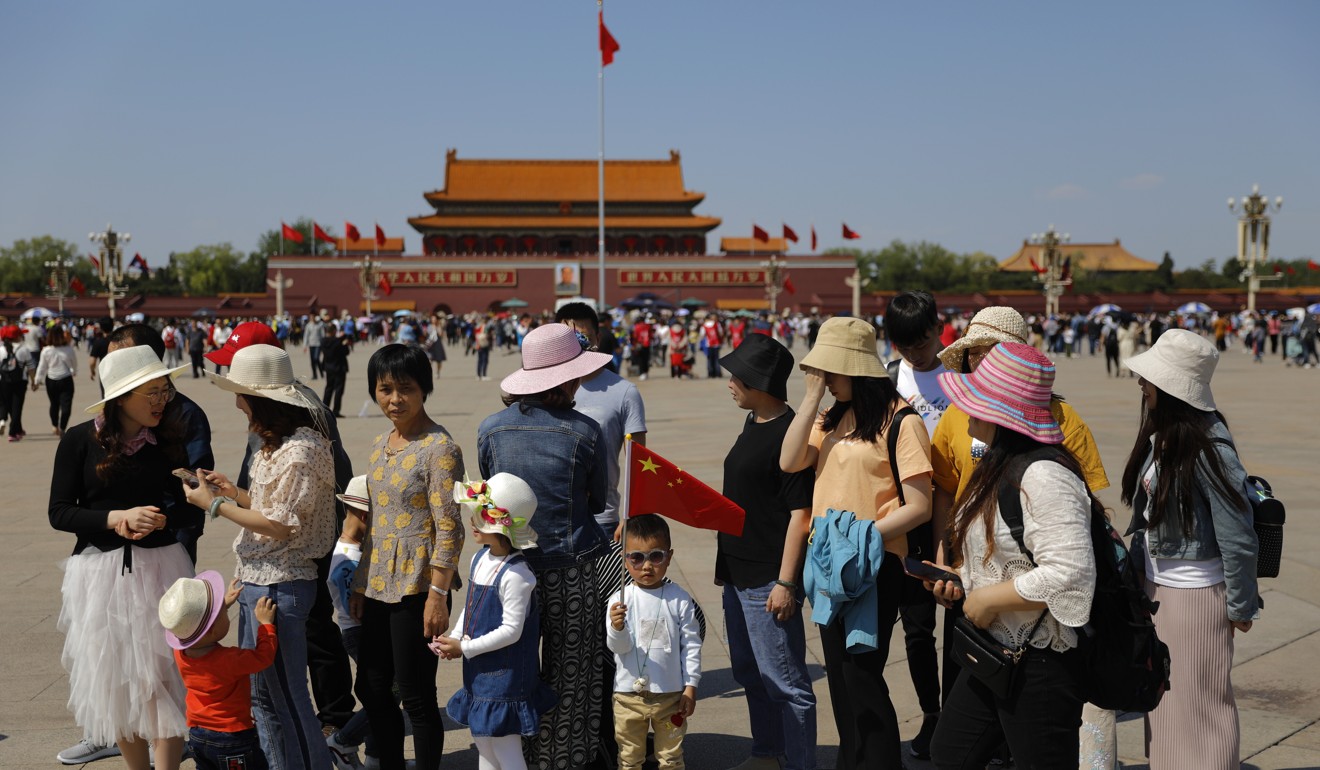
Chinese tourists visit Tiananmen Square in Beijing. Analysts say 782 million people opted for “staycations” at local historical sites over golden week this year. Photo: EPA
Experts say Thailand – the second-most booked country during golden week, according to Ctrip – saw many repeat travellers return to the country. The nation saw 1.03 million arrivals from China in August, up 19 per cent from 2018.
Guo said these travellers were more budget-conscious than those who travelled to Japan, and enjoyed the good value and picturesque scenery for sharing on social media.
“They have already travelled to Southeast Asia before, and are therefore looking for personalised and local experiences like interacting with Thai residents, jungle treks and food tours,” she said, adding that many are willing to spend extra on immersive experiences such as a hotel in the countryside, or on a room with a forest view.
Thailand’s tourism industry gets jitters after currency surges, visitor numbers from China fall
According to Alipay Mobile, the sale of “durian experience” packages for Chinese tourists looking to taste the spiky, pungent fruit at local farms increased by 60 per cent in Thailand and Malaysia from last year.
Shopping remained on the agenda, too. Thailand ranked second for the highest volume of overseas transactions during the week, according to data from Alipay Mobile. Most Chinese shoppers frequented duty-free shops, convenience stores and local malls, according to local press.
Singapore remained a destination of choice for tourists from the mainland. The city was among the most popular “traditional destinations” for them, according to China’s culture and tourism ministry, with others including Malaysia, Thailand, Japan, Australia, France, Italy, and Russia.
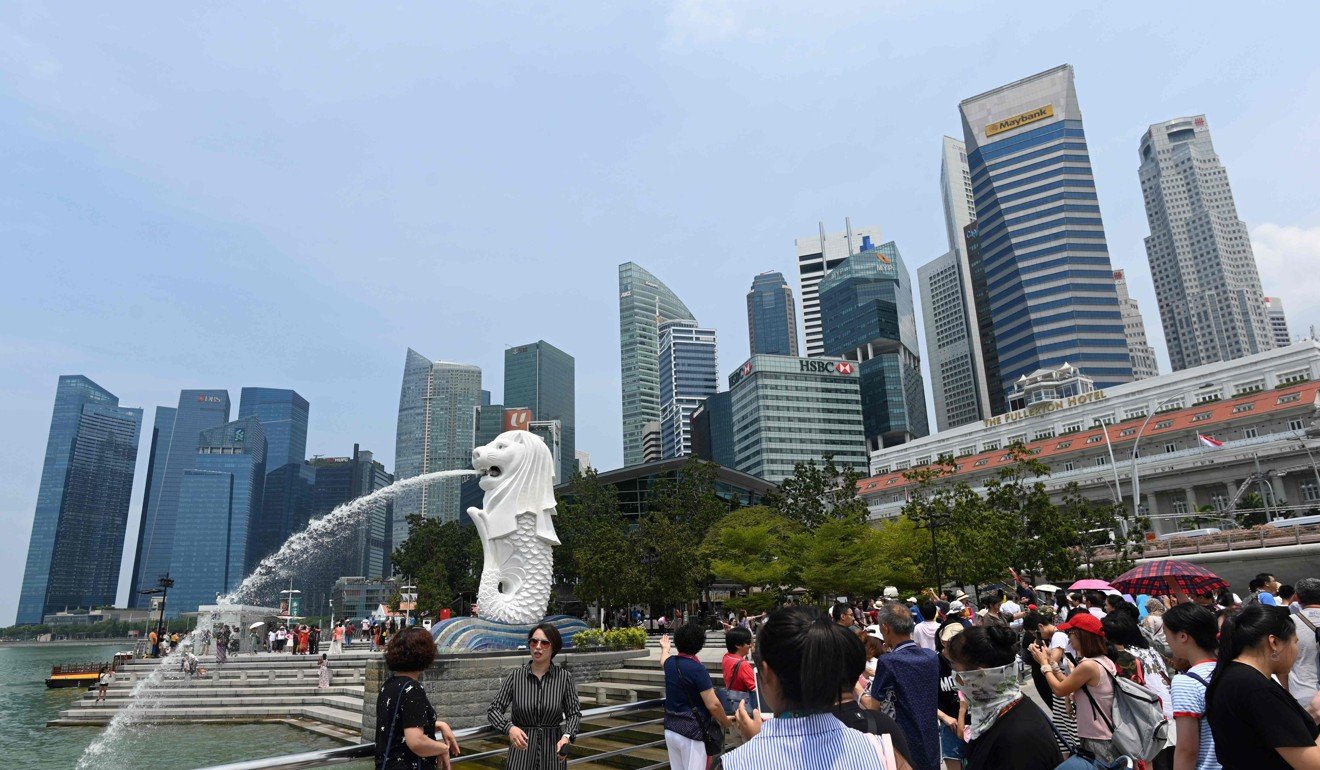
Chinese tourists visiting Singapore over golden week also seized the opportunity to check out property in the Lion City. Photo: AFP
July saw the Lion City break its record for the number of Chinese arrivals, at close to 390,000, an unprecedented 46 per cent jump from the previous month.
Analysts have attributed this to a diversion of tourists from Hong Kong, but property agents such as Clarence Foo, associate deputy group director at OrangeTee & Tie, said some of these Chinese tourists were using the golden week as a chance to eye Singaporean real estate.
“Compared to a normal week, there were probably 15 to 20 per cent more Chinese visitors who viewed property,” said Foo, who counts Singaporean and international buyers among his clients.” They are certainly more keen on Singapore [property] now as there isn’t another comparable investment destination in Asia.”
Meanwhile, the Middle East is emerging as a popular shopping destination for Chinese tourists. According to Ctrip, Dubai saw 501,000 travellers from the mainland in the first half of 2019, an 11 per cent increase from last year.
Saudi Arabia has also experienced a surge in Chinese tourists, with 7,931 heading to the country since it launched its new instant tourist visa programme on September 27. With the new visa, which can be obtained online or upon arrival, tourists can stay in the country for up to 90 days, and unwed foreign men and women can for the first time share hotel rooms.
“Saudi Arabia has the potential to become very popular with Chinese tourists,” said Guo from Cherry Blossoms, adding that travellers from the mainland are increasingly looking for exciting new adventures. “It’s a status symbol for them to visit a country others haven’t visited before.”
Aerial photo taken on Sept. 21, 2019 shows a steel girder being lifted by a crane at the construction site of the Pingtan Strait Road-rail Bridge in southeast China’s Fujian Province. China on Wednesday completed the main structure of the world’s longest cross-sea road-rail bridge in Fujian. The last steel girder, weighing 473 tonnes, was bolted on the Pingtan Strait Road-rail Bridge, another mega project in China, on Wednesday morning. With a staggering span of 16.34 km, the bridge connects Pingtan Island and four nearby islets to the mainland of Fujian Province. (Xinhua/Lin Shanchuan)
FUZHOU, Sept. 25 (Xinhua) — China on Wednesday completed the main structure of the world’s longest cross-sea road-rail bridge in its southeastern province of Fujian.
The last steel truss girder, weighing 473 tonnes, was bolted on the Pingtan Strait Road-rail Bridge, another mega project in China, on Wednesday morning.
Hundreds of bridge builders clad in orange overalls, as well as government officials, hailed the completion on the bridge deck, with several rounds of fireworks being set off to celebrate the moment.
With a staggering span of 16.34 km, the bridge connects Pingtan Island and four nearby islets to the mainland of Fujian Province.
The bridge, which is expected to open to traffic next year, can help shorten travel time from two hours to half an hour between Fuzhou, capital city of Fujian Province and Pingtan, a pilot zone set up to facilitate trade and cultural exchanges across the Taiwan Strait.
“Of all the bridges being built across the world, this is no doubt the most challenging,” said Wang Donghui, chief engineer of the project, adding that it is China’s first and the world’s longest cross-sea road-rail bridge.
The project has attracted worldwide attention from the start of construction in 2013 as it spans an area off the coast of southeast China long seen as a “no-go zone” for bridge-building.
The region has strong gales and high waves for most of the year and is known as one of the world’s three most perilous seas along with Bermuda and the Cape of Good Hope.
Workers had to battle the notoriously strong winds, choppy waters and rugged seabed in the region to drill 1,895 piles into the ocean.
MORE THAN MEGA PROJECT
The road-rail bridge has a six-lane highway on the top and a high-speed railway at the bottom, which is designed to support bullet trains traveling as fast as 200 km per hour. It is a part of the 88-km Fuzhou-Pingtan railway.
In the past, Pingtan was a backwater island of humble fisheries. It did not even have a bridge connecting it to the mainland until 2010 when the Strait Bridge began operating for cars only.
In 2010, China established the Pingtan Comprehensive Pilot Zone to facilitate cross-Strait exchange and cooperation, ramping up its efforts to improve the island’s infrastructure.
Today, skyscrapers are popping up all along the shoreline, with the glow of construction work filling the night sky. Meanwhile, thousands of Taiwan residents swarm into the booming island to live and start businesses.
The island has accommodated more than 1,000 shops and companies set up by Taiwan residents, according to government statistics.
Chen Chien-hsiang, a 29-year-old man who moved from Taiwan to Pingtan two years ago, believes that the new bridge will help attract more businesses to the island and further boost its economic development.
“The new bridge means more than a mere mega project,” Chen said. “It also promises a brighter future for people from Taiwan who chose to live and work here.”
INFRASTRUCTURE MANIAC
Huang Zhiwei, 22, found himself making history by lifting the last piece of the bridge girder from a ship about 80 meters below the bridge deck, an undertaking that he had never expected when he joined the project a year ago as an intern.
His parents, unhappy about their son’s career choice, felt relieved after several video chats during which their son showed them his working and living conditions at the construction site.
“With so many advanced technologies and safety measures, I am convinced that we will accomplish the mission, and I am very proud of my contribution,” said the young operator.
More than 1.24 million tonnes of steel have been used for the bridge, enough to build 190 Eiffel Towers, and 2.97 million cubic meters of cement, nine times the amount of cement used to build the Burj Khalifa towers in Dubai, the world’s tallest skyscraper.
“We could not possibly have realized the construction 15 years ago for lack of advanced construction technologies and equipment such as the drilling machine and ship cranes we have developed today,” said Xiao Shibo, an engineer of the China Railway Major Bridge Engineering Group Co., Ltd. The bridge has made history in many aspects, Xiao added.
China is dubbed as an “infrastructure maniac” for countless dazzling megaprojects, with the Chinese builders breaking their own world records.
China is home to the world’s highest bridge, longest cross-sea bridge and 90 out of the 100 highest bridges built this century.
From 2015 to 2020, China’s transportation investment is expected to exceed 15 trillion yuan (2.1 trillion U.S. dollars), with a substantial portion reserved for bridge construction.
October 1 event is intended to be a showcase for military’s progress under Xi Jinping, with J-20 stealth fighters set to take pride of place
Domestically developed weapons are main focus of event despite long-standing problems in building aircraft engines
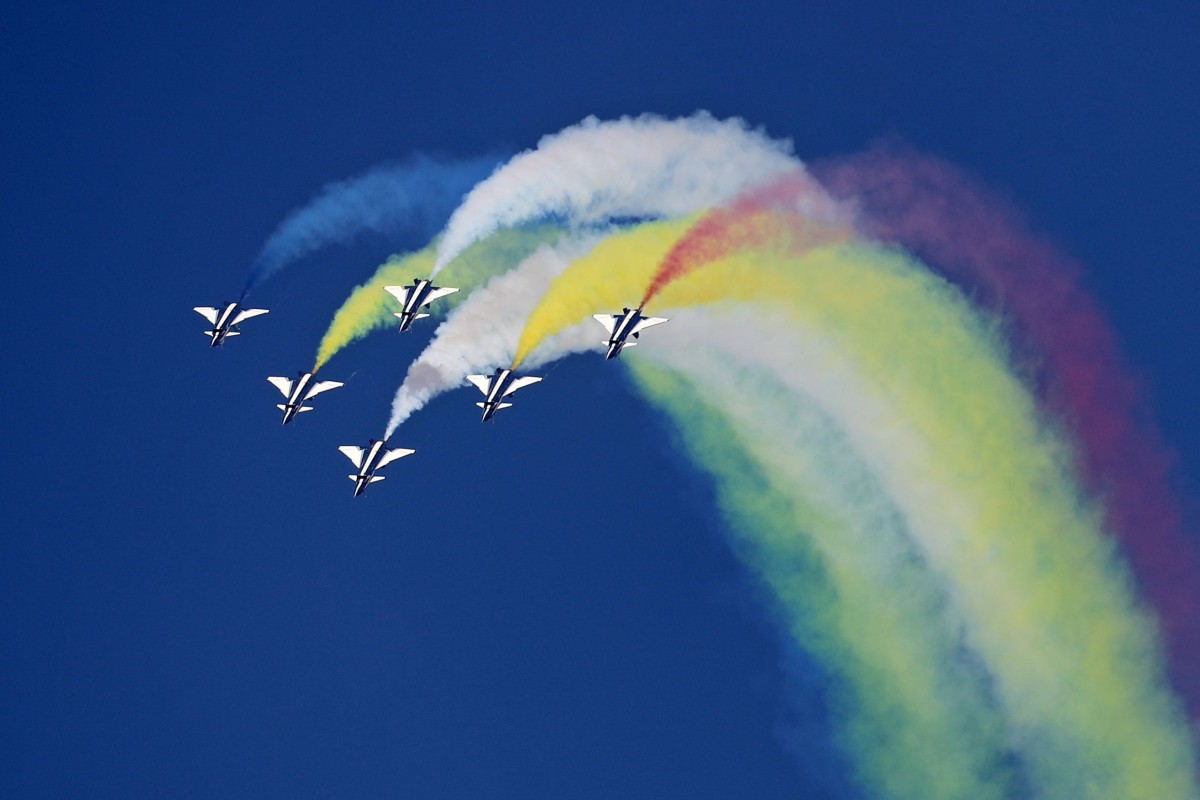
Chinese J-10 jets perform at the Dubai air show in 2017. Photo: AFP
China has stepped up intensive rehearsals for the upcoming National Day parade, which military insiders say is designed to showcase the achievements of Chinese President Xi Jinping’s modernisation drive.
The parade on October 1 will mark the 70th anniversary of the founding of the People’s Republic and will focus on weapons developed since Xi came to power in late 2012, despite long-standing problems in aircraft engine development.
Video clips circulating on mainland social media in recent days have shown at least seven types of aircraft – including the KJ-2000 airborne early warning and control aircraft and J-10 and J-11B fighter jets – taking part in rehearsals over the countryside around Beijing.
A military insider said the country’s first stealth fighter jet, the J-20, had been rehearsing over the western suburbs of the capital since April.
“There will be up to seven J-20 displayed in the military parade, which is the largest formation since its formal deployment to the Chinese air force in 2017,” the military insider said.
“The J-20 has entered mass production. So far at least 70 J-20s have been made, even though all of them are still equipped with Russian AL-31 engines.”
Earlier this month, the People’s Liberation Army Air Force released a video of a flight of seven J-20s, the largest formation seen so far, suggesting that the fifth-generation warplane has gone into mass production as an arms race with the United States mounts in the region.
The second-largest J-20 formation was shown in an air force video for PLA Day on August 1, when five of the jets were shown.
China has been forced to deploy the J-20 ahead of its schedule since the US has increased the deployment of its fifth-generation stealth fighter jets like the F-22 and F-35s in the Asia-Pacific region.
The US and its allies, including Japan and South Korea, will have more than 200 F-35s by 2025, which means China also needs a similar number of stealth fighters.
To meet demand, China has been working on the development of a purpose-built thrust engine for its stealth fighter since the early 2000s, but has yet to achieve international quality control standards due to problems that include single-crystal turbine blade technology.
China’s air force spreads its wings in 70th anniversary video
Hong Kong-based military commentator Song Zhongping said aircraft engine development had been a long-standing shortcoming but it would not affect the practical fighting capacity of the J-20, which currently uses Russian engines.
“The J-20 hasn’t used the domestic engines so far because it wants a better one, and it still has time,” Song said.
“Other [Chinese-developed] warplanes like the J-10, J-11 and multipurpose attack helicopters are all modified and advanced types, indicating comprehensive achievements amid China’s military modernisation over the past years.”
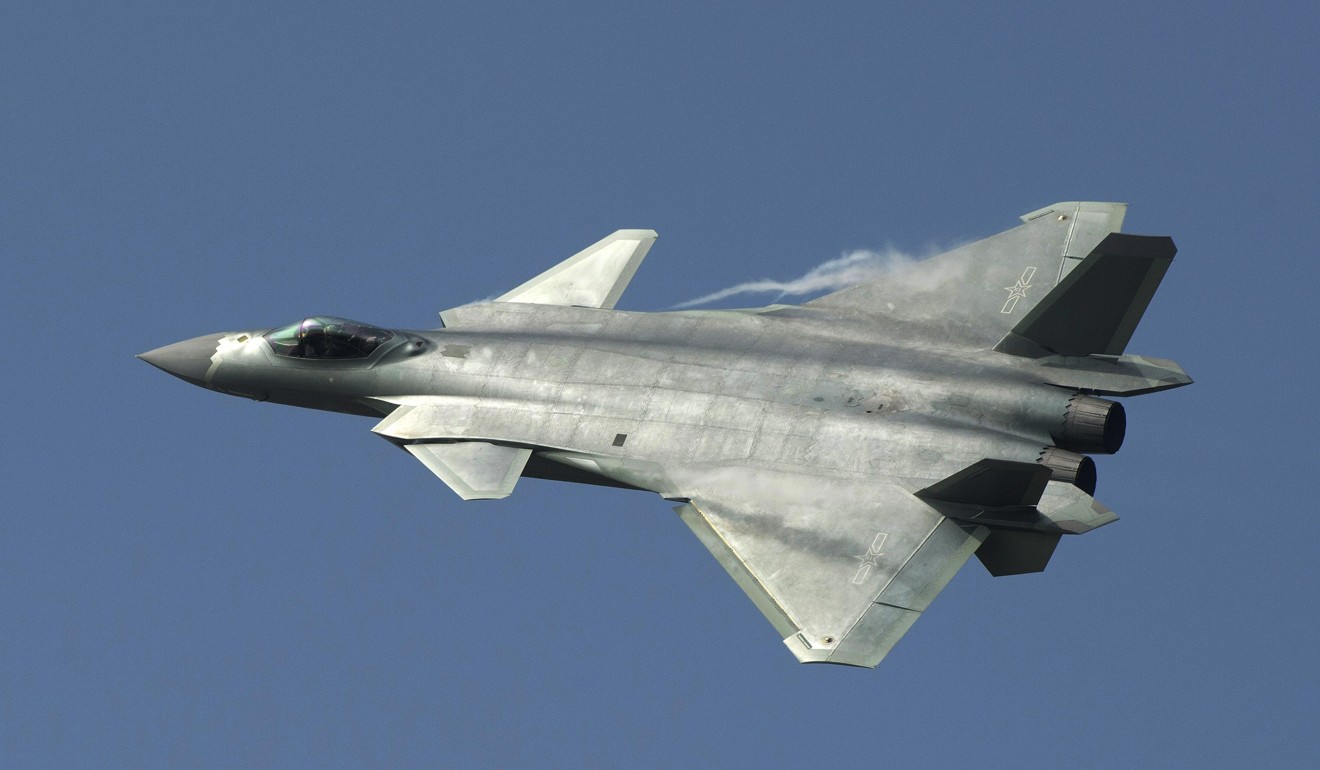
A Chinese J-20 stealth fighter has entered mass production. Photo: EPA-EFE
Besides the domestically developed aircraft, Beijing is going to display its strategic nuclear missiles, such as the DF-41 intercontinental ballistic missile and the JL-2 submarine-launched ballistic missile, as centrepieces of its National Day military parade, according to a Beijing-based military source.
Xi, who also chairs the powerful Central Military Commission, inspected the country’s biggest military parade at the Zhurihe Combined Tactics Training Base in Inner Mongolia in 2017 to celebrate the 90th anniversary of the PLA, but the source said the weapons displayed in Zhurihe had been developed under the leadership of Xi’s predecessor, Hu Jintao.
“Xi needs to highlight his personal achievements in his era, that’s why this year’s parade has political aims more than military significance,” the source said.
The source also highlighted the significance of the People’s Republic marking its 70th anniversary because the Soviet Union did not survive for that length of time.
“Xi is attempting to tell the outside world that Chinese communist regime has been consolidated under his leadership.”







 CHINDIA ALERT: You'll be living in their world, very soon