Archive for ‘bridges’

27/05/2020

New Indian roads, air strips sparked border standoff with China, India observers say

NEW DELHI/SRINAGAR (Reuters) – A Himalayan border standoff between old foes India and China was triggered by India’s construction of roads and air strips in the region as it competes with China’s spreading Belt and Road initiative, Indian observers said on Tuesday.

Soldiers from both sides have been camped out in the Galwan Valley in the high-altitude Ladakh region, accusing each other of trespassing over the disputed border, the trigger of a brief but bloody war in 1962.

About 80 to 100 tents have sprung up on the Chinese side and about 60 on the Indian side where soldiers are billeted, Indian officials briefed on the matter in New Delhi and in Ladakh’s capital, Leh, said.

Both were digging defences and Chinese trucks have been moving equipment into the area, the officials said, raising concerns of a long faceoff.

“China is committed to safeguarding the security of its national territorial sovereignty, as well as safeguarding peace and stability in the China-India border areas,” the Chinese Foreign Ministry spokesperson’s office said in a statement.

“At present, the overall situation in the border areas is stable and controllable. There are sound mechanisms and channels of communication for border-related affairs, and the two sides are capable of properly resolving relevant issues through dialogue and consultation.”

There was no immediate Indian foreign ministry comment. It said last week Chinese troops had hindered regular Indian patrols along the Line of Actual Control (LAC).

But interviews with former Indian military officials and diplomats suggest the trigger for the flare-up is India’s construction of roads and air strips.

“Today, with our infrastructure reach slowly extending into areas along the LAC, the Chinese threat perception is raised,” said former Indian foreign secretary Nirupama Rao.

“Xi Jinping’s China is the proponent of a hard line on all matters of territory, sovereignty. India is no less when it comes to these matters either,” she said.

After years of neglect Prime Minister Narendra Modi’s government has pushed for improving connectivity and by 2022, 66 key roads along the Chinese border will have been built.

One of these roads is near the Galwan valley that connects to Daulat Beg Oldi air base, which was inaugurated last October.

“The road is very important because it runs parallel to the LAC and is linked at various points with the major supply bases inland,” said Shyam Saran, another former Indian foreign secretary.

“It remains within our side of the LAC. It is construction along this new alignment which appears to have been challenged by the Chinese.”

China’s Belt and Road is a string of ports, railways, roads and bridges connecting China to Europe via central and southern Asia and involving Pakistan, China’s close ally and India’s long-time foe.

Source: Reuters
03/11/2019

Chinese State Councilor Wang Yi offers condolences, help to Philippine quake victims

MANILA, Nov. 3 (Xinhua) — Chinese State Councilor and Foreign Minister Wang Yi has offered condolences for the people killed in the series of strong earthquakes that devastated central and eastern Mindanao in the southern Philippines last month, saying China is ready to help the Philippine government in its efforts to rehabilitate the region.

In a message of sympathy sent to Philippine Foreign Secretary Teodoro Locsin on Saturday, Wang said he was shocked to learn that strong earthquakes had hit Mindanao, resulting in casualties and property damage.

“He (Wang) would like to extend sincere sympathy to the victims and the bereaved families,” the Chinese Embassy in the Philippines said in a statement.

“China is willing to offer assistance to the Philippines within our capacity, and believes that under the strong leadership of the Philippine government, the Philippine people will overcome the disaster and return to normal life at an early date,” it quoted Wang as saying.

On Friday, China announced a donation of 3 million yuan (about 434,896 U.S. dollars) to help the quake victims, mostly poor farmers.

The Philippine National Disaster Risk Reduction and Management Council (NDRRMC) said in an updated report on Sunday that the Oct. 29 6.6-magnitude and the Oct. 31 6.5-magnitude earthquakes that hit several central and eastern Mindanao provinces had killed 21 people and injured more than 400 others.

Rescuers were still looking for two missing villagers, the country’s disaster agency said.

The agency said the two tremors also affected more than 178,000 people in 200 villages in the region. Nearly 22,000 displaced people were staying in makeshift tents, it added.

The agency said the quakes also damaged nearly 29,000 infrastructures in the region, mostly houses, school buildings, hospitals, roads and bridges.

Source: Xinhua

31/10/2019

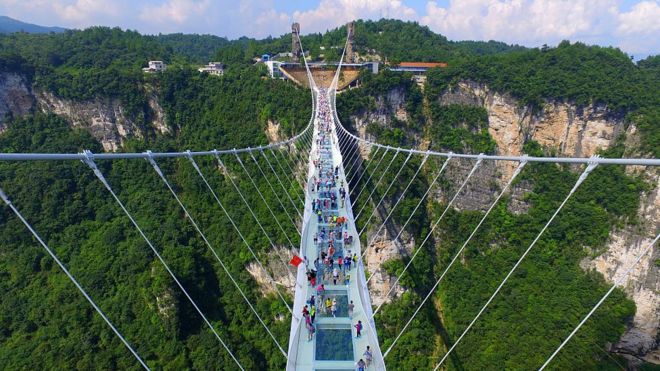
‘Scary’ glass bridges shut in Chinese province

Aerial view photo shows tourists visiting on the glass-bottom bridge at Zhangjiajie Grand Canyon on August 20, 2016Image copyright GETTY IMAGES
Image caption This bridge in Zhangjiajie was the longest and tallest glass bottomed bridge in the world when it opened

A Chinese province has shut all 32 of its glass attractions – including bridges, walkways and viewing decks – as safety checks are carried out.

The attractions, spread across 24 sites in Hebei province, have been shut since March 2018, said state media CCTV.

The move had not previously been widely reported.

China has seen a flurry of glass attractions spring up across the country – but there have been accidents and at least two deaths.

There are an estimated 2,300 glass bridges in China. According to state media outlet ECNS, there are also an “undetermined number of glass walkways or slides”.

The glass attractions are an attempt to attract thrill-seeking tourists and capitalise on China’s growing domestic tourism.

The Zhangjiajie bridge in Hunan province – which was the highest and longest glass-bottomed bridge in the world when it opened in 2016 – arguably kicked off the craze.

But earlier this year, one tourist died and six others were injured after they fell off a glass slide in Guangxi province.

Rain had made the glass extra slippery, causing the man to crash through the guardrail, and fly off the slide. He died from severe head injuries.

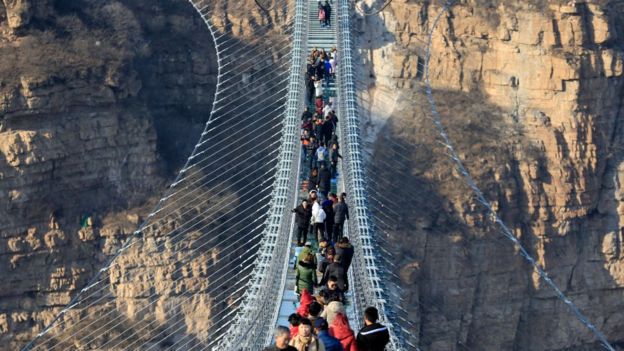
The Hongyagu glass bridge – which until May this year held the title of world’s longest glass bridge – was among those shut in Hebei province.

Tourists walk on the glass-bottomed suspension bridge at Hongyagu Scenic Area on December 26, 2017 in Pingshan, Hebei Province of China.Image copyright GETTY IMAGES
Image caption The Hongyagu bridge in Hebei province

The closures have not just affected Hebei province – across the country, a number have been shut.

Earlier this year, the government called for local tourism authorities to carry out “comprehensive safety assessments” of glass bridge projects.

On social media site Weibo, many applauded the closures, with one saying it was “about time safety was addressed”.

Others criticised the sheer number of glass bridges built over the past few years.

Media caption Thousands wobble over the world’s longest glass bridge in Hebei province, China

“I don’t really understand why there are so many glass bridges recently. It’s a waste of money,” said one commenter.

The death in Guangxi province was not the only glass attraction fatality. In 2017, a tourist died after an accident on a glass slide in Hubei.

And in 2016, someone was injured after being hit by falling rocks while walking on a glass walkway in the city of Zhangjiajie.

In 2015, a glass skywalk in Henan province cracked despite being open for only two weeks, sending tourists fleeing.


Source: The BBC

13/03/2019

China’s coastal province Shandong unveils bln-dollar infrastructure plan

JINAN, March 13 (Xinhua) — Transport authorities in east China’s Shandong Province announced that it plans to invest 162.2 billion yuan (about 24.2 billion U.S. dollars) on roads, railways, ports and airports this year.

The investment is aimed at building an integrated infrastructure network in the province, said Jiang Cheng, head of the provincial transport department.

Last year, fixed asset investment in Shandong’s transportation sector reached 160 billion yuan, among which 115.8 billion yuan was spent on roads, highways and waterways, up 28 percent year on year.

This year, 61 percent of the investment will be on roads, Jiang said.

Shandong has set a target for its expressway mileage to reach 7,400 km by 2020. By the end of this year, the total will hit 6,400 km, he said.

More roads, bridges, and stations will be built in rural areas, he added.

About 10 railway projects are under construction in the province this year, with a total planned investment of 32 billion yuan (4.7 billion dollars). Upon completion, the province will be better connected with big cities such as Beijing, Shanghai and Tianjin.

Shandong had a permanent population of 100.4 million at the end of 2018. It is one of the most populous provinces in China. An improved infrastructure network will better meet economic and social needs.

Source: Xinhua

14/10/2016

Stopping bridge collapses | The Economist

ON AUGUST 2nd a century-old bridge carrying the road from Mumbai to Goa over the Savitri river collapsed (see picture), killing at least 20 people.

The probable cause was that the river, swollen by monsoon rains, had scoured away the foundations of the bridge’s piers. Such erosion-induced collapses are not peculiar to India. In 2009 the Malahide viaduct, north of Dublin, failed similarly just after a train had crossed it. This was despite its having been inspected and pronounced safe a few days earlier. In America, meanwhile, foundation-scouring is reckoned to be the leading reason for bridge failure. Half of the 500 collapses that happened there between 1989 and 2000 were caused by it.

If detected early enough, foundation-scouring is easy to fix. Dumping rubble, known as riprap, into the water around a bridge’s piers stabilises the riverbed they are sunk into. But until now such detection has involved the deployment of teams of divers, which is expensive. Hence a search for technology which can substitute for the men and women in the wetsuits.

Stopping bridge collapses

Ken Loh of the University of California, San Diego, thinks he has an answer. He has created flexible rods that, when inserted into a riverbed, monitor erosion quite simply. The exposed portion of a rod undulates in the water. Piezoelectric polymers in the rod convert this motion into electricity, with the frequency of the undulation (and therefore of the electric current) indicating the length of the rod’s exposed part. As the bed erodes, this portion gets longer and the frequency drops. That tells the riprap tippers when to get busy.

Genda Chen of Missouri University of Science and Technology has a more unusual proposal: to throw magnetic “rocks” (artificial boulders with magnets embedded inside them) into the river. These rocks roll around in the riverbed until they settle in dips in the sediment, which are generally places where erosion is at its greatest. Sensors fitted to a bridge’s piers then estimate the amount of scouring, and where it is, from the strength and direction of the magnetic field they detect.Some researchers, like Luke Prendergast of Delft University of Technology in the Netherlands, think installing sensors below the waterline like this is too expensive—and is also unreliable. He worries that heavy storms will wash them away when they are needed most. He has focused instead on monitoring the part of the bridge above the water, using accelerometers of the sort found in most smartphones. All bridges vibrate, as traffic bumps over them or winds rattle their decks. If their foundations begin to erode, the pattern of these vibrations will change, much as the pitch of a tuning fork varies with its length. Accelerometers, Dr Prendergast suggests, could monitor such changes and forewarn of problems.

Accelerometers are not the only way to measure vibrations, though. David Mascareñas of Los Alamos National Laboratory videos them. He then uses a computer algorithm to analyse the resulting footage and determine a structure’s properties, even if the vibrations recorded have an amplitude of less than a millimetre.

Whether methods that study vibrations in these ways can detect problems early enough to prevent collapses remains to be seen. Branko Glisic of Princeton University, by contrast, thinks the best approach is to detect threatening cracks directly. He has created special sensor sheets, designed to be pasted onto the sides of a bridge. Wires within a sheet elongate if a crack opens underneath them. That changes their resistance. The arrangement of the wires means such changes in resistance give away precisely where the crack is.

If methods such as these can be made to work in practice, then it will, more often, be possible to send the rip rappers in at the appropriate moment to save a bridge that is otherwise sound. And, for those bridges that are not, timely warning will be provided that a crossing needs to be closed before someone is killed traversing it.

Source: Stopping bridge collapses | The Economist

Law of Unintended Consequences

continuously updated blog about China & India

ChiaHou's Book Reviews

continuously updated blog about China & India

What's wrong with the world; and its economy

continuously updated blog about China & India