Chindia Alert: You’ll be Living in their World Very Soon
aims to alert you to the threats and opportunities that China and India present. China and India require serious attention; case of ‘hidden dragon and crouching tiger’.
Without this attention, governments, businesses and, indeed, individuals may find themselves at a great disadvantage sooner rather than later.
The POSTs (front webpages) are mainly 'cuttings' from reliable sources, updated continuously.
The PAGEs (see Tabs, above) attempt to make the information more meaningful by putting some structure to the information we have researched and assembled since 2006.
BEIJING (Reuters) – Tang Yue, a 27-year-old teacher from the city of Guilin in southwest China, steam-presses a blue dress and takes dozens of photographs before picking one to clinch her 200th online sale.
For a growing number of Chinese like Tang, hit by job losses, furloughs and salary cuts, the consumer economy has begun to spin in reverse. They are no longer buying – they are selling.
Instead of emerging from the coronavirus epidemic and returning to the shopping habits that helped drive the world’s second-largest economy, many young people are offloading possessions and embracing a new-found ethic for hard times: less is more.
With Tang’s monthly salary of about 7,000 yuan ($988), the self-described shopaholic said she has bought everything from Chanel lipsticks to Apple’s (AAPL.O) latest iPad in the past three years.
But the adrenaline rush that comes with binge-shopping is gone, said Tang, whose wages have been slashed with the suspension of all the classes on tourism management she usually teaches.
“The coronavirus outbreak was a wake-up call,” she said. “When I saw the collapse of so many industries, I realised I had no financial buffer should something unfortunate happen to me.”
There is no guarantee that the nascent minimalist trend will continue once the coronavirus crisis is fully over, but if it does, it could seriously damage China’s consumer sector and hurt thousands of businesses from big retailers to street-corner restaurants, gyms and beauty salons.
To be sure, there are signs that pent-up demand will drive a rush of spending as authorities reopen malls, leisure venues and tourist spots. In South Korea, the first major economy outside of China to be hit by the virus, people thronged malls this weekend to go “revenge shopping” to make up for time lost in lockdown.,
There are some signs that a similar trend will take hold in China, where some upscale malls are starting to get busy, although luxury firm Kering SA (PRTP.PA) – which owns Gucci, Balenciaga and other fashion brands – has said it is hard to predict how or when sales in China might come back.
A recent McKinsey & Co survey showed that between 20% and 30% of respondents in China said they would continue to be cautious, either consuming slightly less or, in a few cases, a lot less.
“The lockdown provided consumers with a lot of time and reasons to reflect and consider what is important to them,” said Mark Tanner, managing director at Shanghai-based research and marketing consultancy China Skinny.
“With much more of their days spent in their homes, consumers also have more time and reasons to sort through things they don’t feel they need – so they’re not living around clutter that is common in many apartments.”
#DITCHYOURSTUFF
Tang made a spreadsheet to keep track of her nearly 200 cosmetic products and hundreds of pieces of clothing. She then marked a few essentials in red that she wanted to keep. In the past two months, she has sold items worth nearly 5,000 yuan on second-hand marketplaces online.
Bargain-hunting online has become a new habit for some Chinese as the stigma that once hung over second-hand goods has begun to fade.
Idle Fish, China’s biggest online site for used goods, hit a record daily transaction volume in March, its parent company Alibaba (BABA.N) told Reuters.
Government researchers predict that transactions for used goods in China may top 1 trillion yuan ($141 billion) this year.
Posts with the hashtag #ditchyourstuff have trended on Chinese social media in recent weeks, garnering more than 140 million views.
Jiang Zhuoyue, 31, who works as an accountant at a traditional Chinese medicine company in Beijing – one of the few industries that may benefit from the health crisis – has also decided to turn to a simpler life.
“I used to shop too much and could be easily lured by discounts,” said Jiang. “One time Sephora offered 20% off for all goods, I then bought a lot of cosmetics because I feel I’m losing money if I don’t.”
Jiang, the mother of a 9-month-old baby, said she recently sold nearly 50 pieces of used clothing as the lockdown gave her the opportunity to clear things out. “It also offered me a chance to rethink what’s essential to me, and the importance of doing financial planning,” she said.
Eleven Li, a 23-year-old flight attendant, said she used to spend her money on all manner of celebrity-endorsed facial masks, snacks, concert tickets and social media activity, but now has no way to fund her spending.
“I just found a new job late last year, then COVID-19 came along, and I haven’t been able to fly once since I joined, and I’ve gotten no salary at all,” said Li, who said she was trying to sell her Kindle.
Some are even selling their pets, as they consider leaving big cities like Beijing and Shanghai where the high cost of living is finally catching up with them.
NO RETURN TO OLD WAYS?
As the coronavirus comes under control in China, the government is gradually releasing cities from lockdown, easing transport restrictions and encouraging consumers to venture back into malls and restaurants by giving out billions-worth of cash vouchers, worth between 10 yuan and 100 yuan.
But many people say they are still worried about job security and potential wage cuts because of the struggling economy. Nationwide retail sales have plunged every month so far this year.
Xu Chi, a Shanghai-based senior strategic analyst with Zhongtai Securities, said some Chinese consumers may prove the ‘21 Day Habit Theory,’ a popular scientific proposition that it only takes that long to establish new habits.
“We believe people’s spending patterns follow the well-known theory, which means most people in China, having been cooped-up at home for more than a month and not having binge-shopped, may break the habit and not return to their old ways,” Xu said.
Jiang said she was determined not to return to her free-spending ways and planned to cook more at home.
“I’ll turn to cheaper goods for some luxury brands,” she said. “I’ll choose Huawei’s smartphone, because (Apple’s) iPhone has too much brand premium.”
Tang, who has recently used 100 yuan of shopping coupons to stock up on food, is going to hold the purse strings even tighter.
“I’ve set my monthly budget at 1,000 yuan,” she said. “Including one – and just one – bottle of bubble tea.”
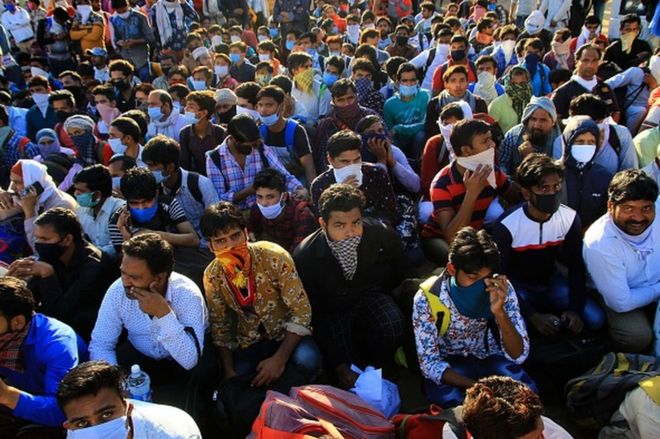
Image copyright ANIImage caption Millions of people across India have been stranded by the lockdown
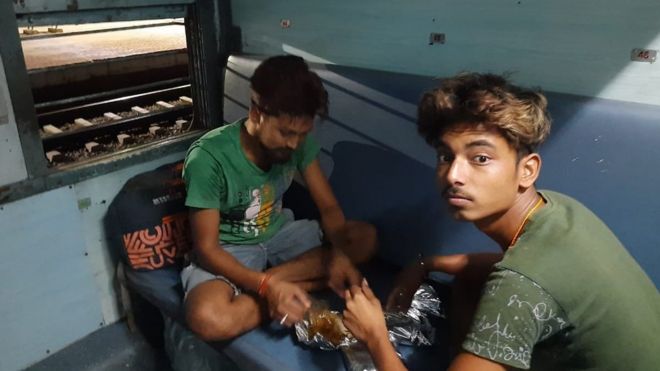
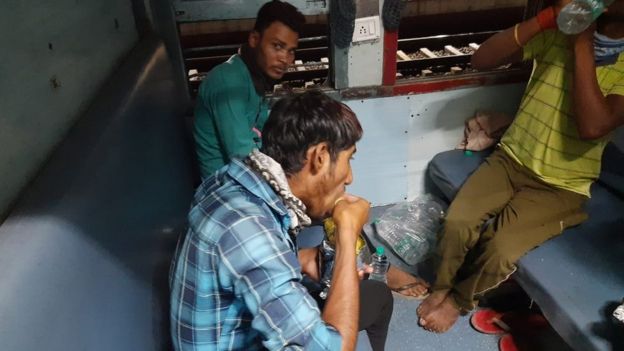
The first train carrying migrant workers stranded by a nationwide lockdown in India has left the southern state of Telangana.
The 24-coach train, carrying 1,200 passengers, is travelling non-stop to eastern Jharkhand state.
Earlier this week, India said millions of people stranded by the lockdown can return to their home states.
The country has been in lockdown to curb the spread of coronavirus since 24 March.
However, the movement of people will be only possible through state government facilitation, which means people cannot attempt to cross state borders on their own.
This train is a “one-off special train” to transport the workers on the request of the Telangana state government, Rakesh Ch, the chief public relations officer of South-Central Railways, told the BBC.
The train left Lingampally, a suburb of the southern city of Hyderabad, early on Friday and is expected to reach Hatia in Jharkhand on Saturday.
Mr Rakesh said that adequate social distancing precautions had been taken and food was being served to the passengers.
Image copyright ANIImage caption Railways officials said that adequate social distancing precautions had been taken and food was being served to the passengers.
He said each carriage was carrying 54 passengers instead of its 72-seat capacity.
“The middle berth is not being used in the sleeper coaches and only two people are sitting in the general coaches,” Mr Rakesh said.
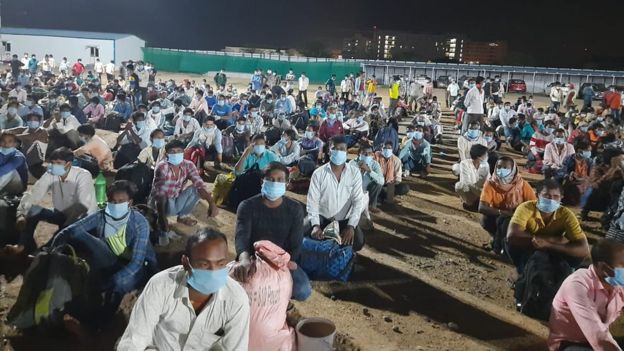
Before the train pulled out of the station, all the passengers were screened for fever and other symptoms.
They had all been employed at a construction site at the Indian Institute of Technology, a top engineering school, in Hyderabad city.
The workers had earlier protested at the site against the non-payment of wages by their contractor.
Senior official M Hanumantha Rao said the contractor was asked to pay their salaries and arrangement made to send them back home.
The journey was organised at “very short notice”, senior police official S Chandra Shekar Reddy told BBC Telugu.
“We screened them at the labour camp itself and transported them to the railway station in buses,” he said.
India’s migrant workers are the backbone of the big city economy, constructing houses, cooking food, serving in eateries, delivering takeaways, cutting hair in salons, making automobiles, plumbing toilets and delivering newspapers, among other things.
Image copyright ANIImage caption Before the train pulled out of the station, all the passengers were screened for fever and other symptoms.
Most of the country’s estimated 100 million migrant workers live in squalid conditions.
When industries shut down overnight, many of them feared they would starve.
For days, they walked – sometimes hundreds of kilometres – to reach their villages because bus and train services were shut down overnight. Several died trying to make the journey.
Some state governments tried to facilitate buses, but these were quickly overrun. Thousands of others have been placed in quarantine centres and relief camps.
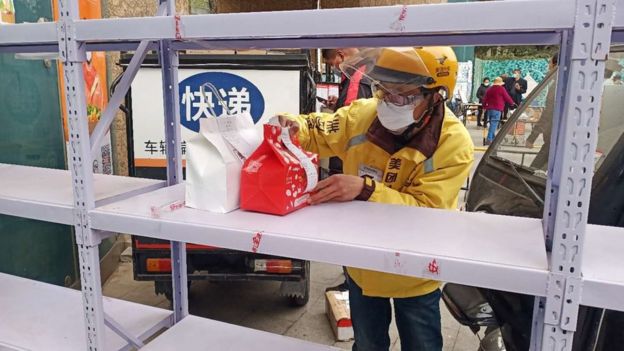
“Doctors and nurses are people who saved me from cancer and gave me strength in the darkest time. I need to return the favour,” says Li Yan, a food delivery rider based in Beijing.
Mr Li was diagnosed with lymph cancer in 2003, when he was just 17 years old. He recovered from the disease and has been full of gratitude ever since for the medical workers who nursed him back to health. With China in a national lockdown, food delivery firms found themselves in hot demand providing meals for residents stuck at home to prevent the spread of the coronavirus.
As a delivery rider for Meituan, one of China’s biggest food delivery firms, Mr Li saw an opportunity to repay the medical professionals he admires by providing them with food and drinks as they worked tirelessly on patients across the city. “Given my past experience, I felt I needed to do something for them in return during the virus outbreak,” he adds.
Beijing is a city of 21 million residents, and Mr Li covers its Tongzhou district, where there are a handful of hospitals with fever clinics, one of which is a designated hospital for Covid-19 treatment. “Many might have concerns delivering for the hospital, but I’ve chosen to deliver for them more often. I just think of the local residents and medical workers who need us. I can’t leave them being hungry. It’s not for money.”
Before the outbreak in China, he delivered more than 50 orders on an average day. But during the first ten days after the coronavirus outbreak in late January, the number of orders dropped to less than 20, as some restaurants were closed. The outbreak also coincided with the Chinese New Year period which is normally a low season.
“By mid-February when the situation was brought more under control, and people’s concerns and fears gradually began to ease, orders started to be restored. I can deliver over 40 orders a day now.”
Image copyright LI YAN
During this time, Meituan brought in a contactless delivery option which allowed food to be dropped off at designated points to avoid contact between customers and riders. “When I called customers to explain, some initially didn’t understand and wanted to cancel the order. But gradually people grew more understanding and began to welcome the contactless approach.”
Empty streets
China was in lockdown for more than two months, although restrictions are now beginning to be lifted. It will still take time before a sense of normalcy returns.
“I remember when the coronavirus first broke out, it was hazy for a few days in Beijing. Streets were empty and stores were closed. An ambulance or a delivery rider occasionally drove by. It felt like I was living in a different world.”
Mr Li says restaurants have started to re-open and people have begun coming back to work in the office since mid-February. Orders are still lower than normal but are improving.
“I miss the hustling Beijing which used to filled with traffic, the days when I could smell car exhaust when I stop at crossroads, the times when I had to walk all the way up to the 6th floor to deliver food, and even times when I was late for a delivery.”
Image copyright LI YAN
When the virus first broke out, face masks and alcohol disinfectant were the most ordered items along with supermarket groceries. “Grains, rice, cooking oil, vegetables, fruits, and solid, packaged food that lasts long. Orders often came in big sizes and transaction prices at around 200 yuan [£23; $28] to 300 yuan on one order.”
Being a food delivery rider, Mr Li feels he can not only give back to the medical community but to the city’s vulnerable too.
“I once received an order that came with a note saying the customer is a 82-year-old who lives alone and couldn’t get downstairs to pick up the food so the rider needs to enter the residential community and deliver food to the door. I had to spend some time communicating with security and finally was allowed in. The door was open when I arrived, and I put the bowl of wontons [a type of dumpling] on the table.”
Tips have increased from happy customers during the pandemic as a result. “Many more send me thank-you notes in the Meituan app and tell me to take care.”
Image copyright LI YAN
Keeping clean
Mr Li has a new routine now which involves lots of disinfecting and temperature checks. “I get my temperature checked dozens of times everyday now, before entering shopping malls, at restaurants, and returning home to the residential compound I live in. I also bring with me disinfectant sprays, a towel in my scooter and use disposable gloves when delivering to areas with reported confirmed cases.”
While he’s providing a vital service, is Mr Li worried about the risk of infection? “I did have worries when the virus spread and was at its worst time here but I feel like I’ve already been there, given what I went through in the fight against cancer.
“I’ve learnt to take things easy, look at the bright side of things and always seek strength in a dark time. As long as I take sufficient precautions, masks, gloves, disinfectants and everything, and follow advice from disease control experts, I think the possibility of getting the virus is pretty low.”
And with a seven-month pregnant wife at home, Mr Li is looking forward to happier times.
BEIJING (Reuters) – China’s factory gate prices fell the most in five months in March, with deflation deepening and set to worsen in coming months as the economic damage wrought by the coronavirus outbreak at home and worldwide shuts down many countries.
The world’s second-largest economy is trying to restart its engines after weeks of near paralysis to contain the pandemic that had severely restricted business activity, flow of goods and the daily life of people.
Friday’s data from the National Bureau of Statistics suggested a durable recovery was some way off, with China’s producer price index (PPI) falling 1.5% from a year earlier, the biggest decline since October last year. It compared with a median forecast of a 1.1% fall tipped by a Reuters poll of analysts and a 0.4% drop in February.
Headline consumer inflation also eased somewhat last month, partly led by government control measures, while core prices remained benign, leaving more room for monetary easing, some analysts said.
RELATED COVERAGE
China’s auto sales fall at a slower rate in March; industry expects second-half pick-up
China March new loans surge to $405 billion as coronavirus stimulus kicks in
The overall decline in the factory gate gauge was exacerbated by a slump in global oil and commodities prices, which filtered through to crude oil, steel and non-ferrous metal industries, the statistics bureau said in a statement accompanying the data.
“The issue of having more supply than demand, and persistently low oil prices, will intensify deflationary pressures,” said Yang Yewei, a Beijing-based analyst with Southwest Securities.
“Work resumptions on the production side are faster than the repair in demand. Downstream demand is recovering slowly and still remains weak,” he said.
The oil and gas extraction sector had the biggest year-on-year price fall of 21.7%, among the 40 major industrial sectors surveyed, deteriorating sharply from a 0.4% drop in the previous month.
The stringent travel and transport curbs have now been lifted across much of the country including Wuhan, the epicentre of the outbreak where the virus first emerged in late 2019. So far the virus has killed more than 3,300 and infected over 81,000 people in the country.
Analysts expect a deep first-quarter economic contraction in China and have grown increasingly pessimistic about the country’s prospects for 2020 due to the pandemic’s sweeping global impact.
Many economists and policymakers are forecasting a steep global recession this year as numerous countries are forced into lockdowns to contain the spread of the coronavirus, severely curtailing business activity in a major blow to jobs and incomes.
Worldwide, the virus has killed around 95,000 people and infected more than 1.5 million. Policymakers globally have responded to the crisis by launching an unprecedented package of stimulus measures, injecting trillions of dollars to backstop their economies that have been brought to a virtual standstill.
Beijing has also rolled out a series of fiscal and monetary support steps, and sources have told Reuters that policymakers are readying more stimulus in the coming months to stabilise growth and prevent mass unemployment.
China’s consumer prices rose 4.3% from a year earlier in March, compared with a 4.8% gain tipped by a Reuters poll and a 5.2% increase in February, as logistics and transport conditions improved and government price control measures kicked in.
But food prices still rose over 18% from a year earlier, led by a 116.4% jump in pork prices, the data showed. The virus outbreak has pushed up prices of some food items, such as pork and vegetables.
Core inflation – which excludes food and energy prices – remained benign last month at 1.2%,but it still edged up from 1% in February.
Image copyrigh tREUTERSImage caption India’s prime minister called on the country to “challenge the darkness” of coronavirus
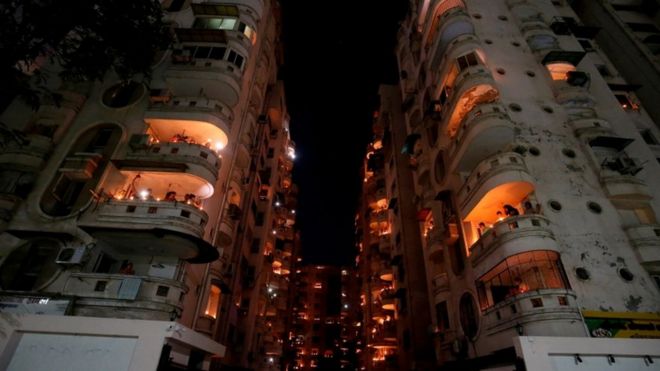
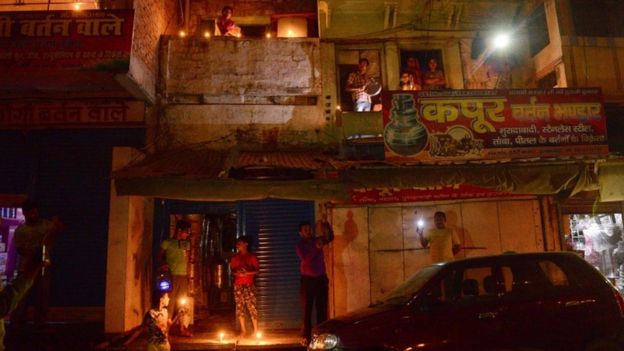
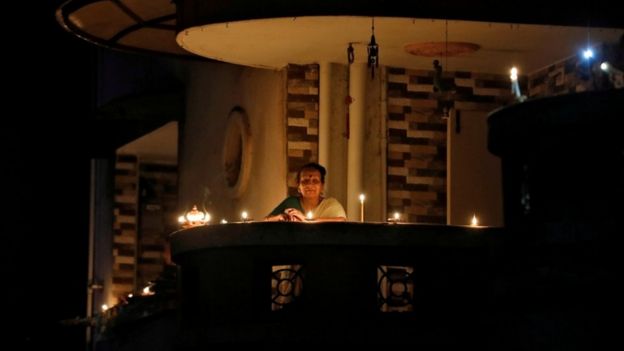
Indians have turned off their lights for a nationwide candle-lit vigil, heeding a call for unity as the country battles coronavirus.
Prime Minister Narendra Modi asked India’s 1.3 billion citizens to observe nine minutes without electricity at 21:00 local time (16:30 GMT) on Sunday.
He urged them to “challenge the darkness” of Covid-19 by lighting candles and lamps.
Millions responded, lighting up the night sky in a show of unity.
“Salute to the light of the lamp which brings auspiciousness, health and prosperity, which destroys negative feelings,” Mr Modi tweeted at the time of the vigil.
But critics have dismissed the event as a stunt, arguing it distracted from the health and economic crisis caused by the coronavirus pandemic.
Mr Modi imposed a nationwide lockdown on 25 March, announced with little warning, leaving millions stranded and without food.
Image copyright GETTY IMAGESImage caption Millions of Indians observed the nine-minute vigil called for by Mr Modi
The true figures, however, are thought to be far higher. India has one of the lowest testing rates in the world, although efforts are under way to ramp up capacity.
Image copyright REUTERSImage caption India has been under lockdown since 25 March
There are fears that a major outbreak in the country – one of the world’s most densely populated – could result in a humanitarian catastrophe.
People are banned from leaving their homes under the lockdown measures. All non-essential businesses have been closed and almost all public gatherings are banned.
Media caption As cases of coronavirus rise and the virus hits India’s congested slums, will the country cope?
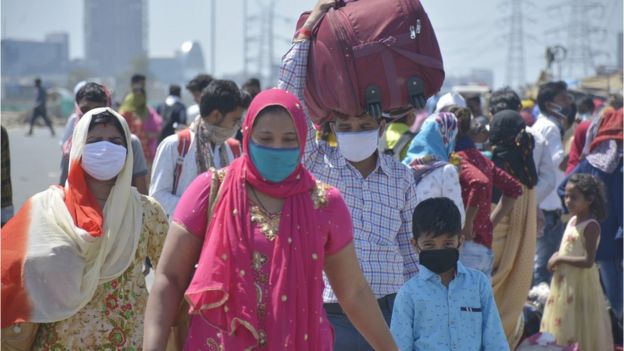
But the shutdown sparked an exodus from major cities such as Delhi, forcing thousands of migrant labourers to walk hundreds of kilometres to their native villages.
Last week, Mr Modi apologised for the impact of the strict stay-at-home measures, saying there was “no other way” to stop the spread of the virus.
Image copyright GETTY IMAGESImage caption Millions are workers are defying a curfew and returning home
When I spoke to him on the phone, he had just returned home to his village in the northern state of Rajasthan from neighbouring Gujarat, where he worked as a mason.
In the rising heat, Goutam Lal Meena had walked on macadam in his sandals. He said he had survived on water and biscuits.
In Gujarat, Mr Meena earned up to 400 rupees ($5.34; £4.29) a day and sent most of his earnings home. Work and wages dried up after India declared a 21-day lockdown with four hours notice on the midnight of 24 March to prevent the spread of coronavirus. (India has reported more than 1,000 Covid-19 cases and 27 deaths so far.) The shutting down of all transport meant that he was forced to travel on foot.
“I walked through the day and I walked through the night. What option did I have? I had little money and almost no food,” Mr Meena told me, his voice raspy and strained.
He was not alone. All over India, millions of migrant workers are fleeing its shuttered cities and trekking home to their villages.
These informal workers are the backbone of the big city economy, constructing houses, cooking food, serving in eateries, delivering takeaways, cutting hair in salons, making automobiles, plumbing toilets and delivering newspapers, among other things. Escaping poverty in their villages, most of the estimated 100 million of them live in squalid housing in congested urban ghettos and aspire for upward mobility.
Image copyright GETTY IMAGESImage caption Informal workers are the backbone of India’s big city economies
Last week’s lockdown turned them into refugees overnight. Their workplaces were shut, and most employees and contractors who paid them vanished.
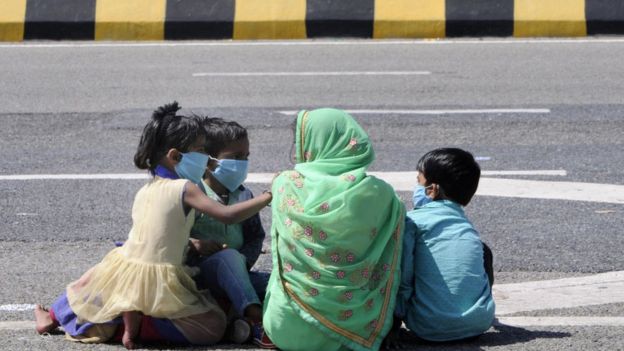
Sprawled together, men, women and children began their journeys at all hours of the day last week. They carried their paltry belongings – usually food, water and clothes – in cheap rexine and cloth bags. The young men carried tatty backpacks. When the children were too tired to walk, their parents carried them on their shoulders.
They walked under the sun and they walked under the stars. Most said they had run out of money and were afraid they would starve. “India is walking home,” headlined The Indian Express newspaper.
The staggering exodus was reminiscent of the flight of refugees during the bloody partition in 1947. Millions of bedraggled refugees had then trekked to east and west Pakistan, in a migration that displaced 15 million people.
Image copyright GETTY IMAGESImage caption Migrant labourers feel they have more social security in their villages
This time, hundreds of thousands of migrant workers are desperately trying to return home in their own country. Battling hunger and fatigue, they are bound by a collective will to somehow get back to where they belong. Home in the village ensures food and the comfort of the family, they say.
Clearly, a lockdown to stave off a pandemic is turning into a humanitarian crisis.
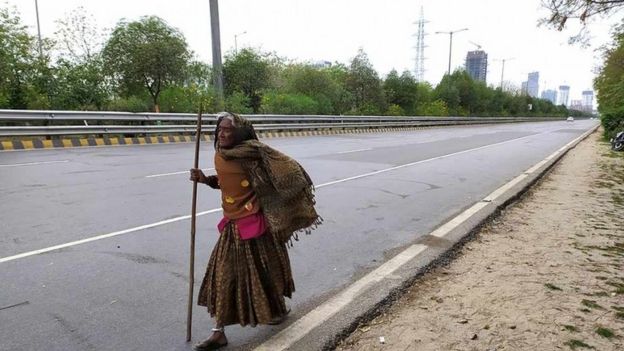
Among the teeming refugees of the lockdown was a 90-year-old woman, whose family sold cheap toys at traffic lights in a suburb outside Delhi.
Kajodi was walking with her family to their native Rajasthan, some 100km (62 miles) away. They were eating biscuits and smoking beedis, – traditional hand-rolled cigarettes – to kill hunger. Leaning on a stick, she had been walking for three hours when journalist Salik Ahmed met her. The humiliating flight from the city had not robbed her off her pride. “She said she would have bought a ticket to go home if transport was available,” Mr Ahmed told me.
Others on the road included a five-year-old boy who was on a 700km (434 miles) journey by foot with his father, a construction worker, from Delhi to their home in Madhya Pradesh state in central India. “When the sun sets we will stop and sleep,” the father told journalist Barkha Dutt. Another woman walked with her husband and two-and-a-half year old daughter, her bag stuffed with food, clothes and water. “We had a place to stay but no money to buy food,” she said.
Then there was Rajneesh, a 26-year-old automobile worker who walking 250km (155 miles) to his village in neighbouring Uttar Pradesh. It would take him four days, he reckoned. “We will die walking before coronavirus hits us,” the man told Ms Dutt.
He was not exaggerating. Last week, a 39-year-old man on a 300km (186 miles) trek from Delhi to Madhya Pradesh complained of chest pain and exhaustion and died; and a 62-year-old man, returning from a hospital by foot in Gujarat, collapsed outside his house and died. Four other migrants, turned away at the borders on their way to Rajasthan from Gujarat, were mowed down by a truck on a dark highway.
As the crisis worsened, state governments scrambled to arrange transport, shelter and food.
Image copyright SALIK AHMED/OUTLOOKImage caption Ninety-year-old Kajodi Devi is walking from Delhi to her village
But trying to transport them to their villages quickly turned into another nightmare. Hundreds of thousands of workers were pressed against each other at a major bus terminal in Delhi as buses rolled in to pick them up.
Delhi chief minister Arvind Kejriwal implored the workers not to leave the capital. He asked them to “stay wherever you are, because in large gatherings, you are also at risk of being infected with the coronavirus.” He said his government would pay their rent, and announced the opening of 568 food distribution centres in the capital. Prime Minister Narendra Modi apologised for the lockdown “which has caused difficulties in your lives, especially the poor people”, adding these “tough measures were needed to win this battle.”
Whatever the reason, Mr Modi and state governments appeared to have bungled in not anticipating this exodus.
Mr Modi has been extremely responsive to the plight of Indian migrant workers stranded abroad: hundreds of them have been brought back home in special flights. But the plight of workers at home struck a jarring note.
“Wanting to go home in a crisis is natural. If Indian students, tourists, pilgrims stranded overseas want to return, so do labourers in big cities. They want to go home to their villages. We can’t be sending planes to bring home one lot, but leave the other to walk back home,” tweeted Shekhar Gupta, founder and editor of The Print.
Image copyright GETTY IMAGESImage caption There is a precedent for this kind of exodus during crisis
The city, says Chinmay Tumbe, author of India Moving: A History of Migration, offers economic security to the poor migrant, but their social security lies in their villages, where they have assured food and accommodation. “With work coming to a halt and jobs gone, they are now looking for social security and trying to return home,” he told me.
Also there’s plenty of precedent for the flight of migrant workers during a crisis – the 2005 floods in Mumbai witnessed many workers fleeing the city. Half of the city’s population, mostly migrants, had also fled the city – then Bombay – in the wake of the 1918 Spanish flu.
When plague broke out in western India in 1994 there was an “almost biblical exodus of hundreds of thousands of people from the industrial city of Surat [in Gujarat]”, recounts historian Frank Snowden in his book Epidemics and Society.
Half of Bombay’s population deserted the city, during a previous plague epidemic in 1896. The draconian anti-plague measures imposed by the British rulers, writes Dr Snowden, turned out to be a “blunt sledgehammer rather than a surgical instrument of precision”. They had helped Bombay to survive the epidemic, but “the fleeing residents carried the disease with them, thereby spreading it.”
More than a century later, that same fear haunts India today. Hundreds of thousands of the migrants will eventually reach home, either by foot, or in packed buses. There they will move into their joint family homes, often with ageing parents. Some 56 districts in nine Indian states account for half of inter-state migration of male workers, according to a government report. These could turn out to be potential hotspots as thousands of migrants return home.
Image copyright GETTY IMAGESImage caption The fleeing migrants could spread the disease all over the country
Partha Mukhopadhyay, a senior fellow at Delhi’s Centre for Policy Research, suggests that 35,000 village councils in these 56 potentially sensitive districts should be involved to test returning workers for the virus, and isolate infected people in local facilities.
In the end, India is facing daunting and predictable challenges in enforcing the lockdown and also making sure the poor and homeless are not fatally hurt. Much of it, Dr Snowden told me, will depend on whether the economic and living consequences of the lockdown strategy are carefully managed, and the consent of the people is won. “If not, there is a potential for very serious hardship, social tension and resistance.” India has already announced a $22bn relief package for those affected by the lockdown.
The next few days will determine whether the states are able to transport the workers home or keep them in the cities and provide them with food and money. “People are forgetting the big stakes amid the drama of the consequences of the lockdown: the risk of millions of people dying,” says Nitin Pai of Takshashila Institution, a prominent think tank.
“There too, likely the worst affected will be the poor.”
Matriarchal and matrilineal communities centred around women have existed for centuries in China, India and Indonesia
But a recent influx of tourism, technology and mainstream patriarchal ideas is rapidly changing their way of life
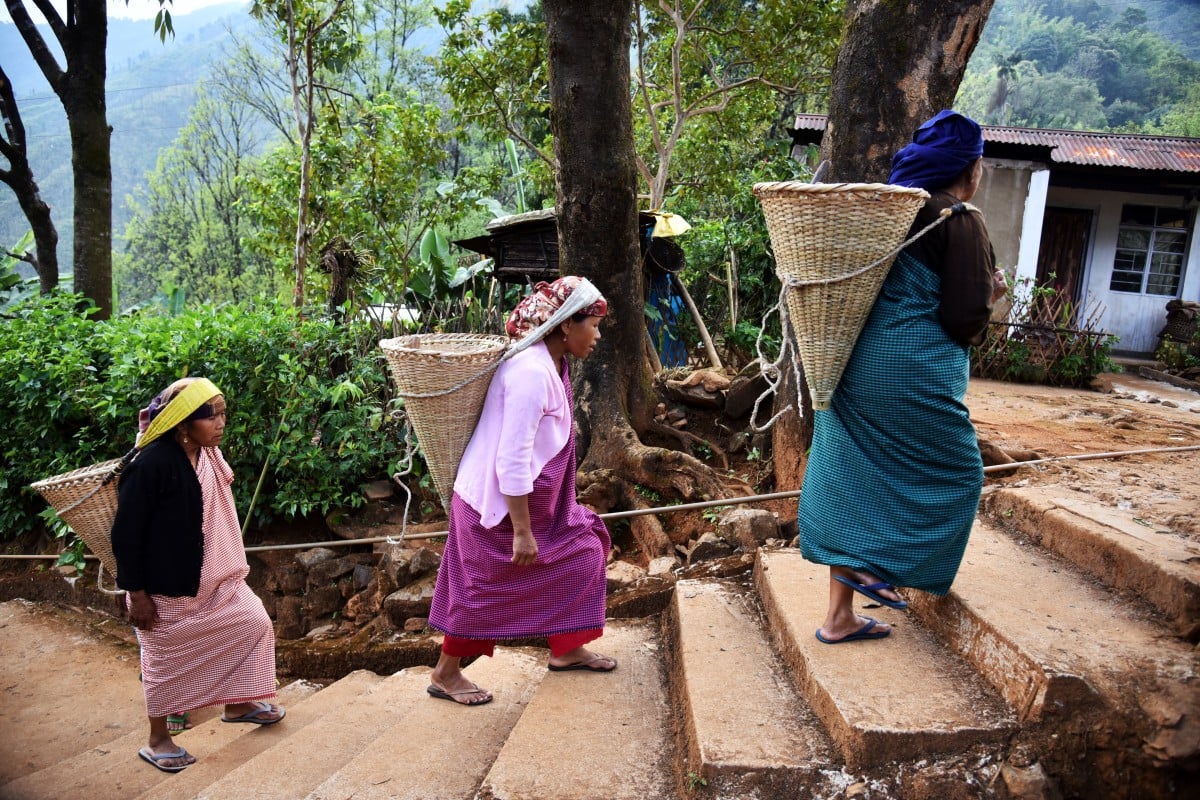
Khasi women leave their village of Nongtraw in India’s northeastern Meghalaya state to collect herbs from the fields. Photo: AFP
While women’s rights may have become a major topic of discussion around the world in recent years, there are female-centric communities that for centuries have distinguished themselves by carving out their own feminist traditions in places such as China, India
and Indonesia.
But many of these matriarchal and matrilineal societies are now struggling to survive, amid threats posed by the modern world such as mass tourism, technology and the infiltration of ideas from mainstream patriarchal society.
In China, for instance, there is a small Mosuo tribe known as the “kingdom of women”.
“Key to the Mosuo culture is their matrilineal family structure, with a basic building block of only members sharing the same female bloodline making up the family … Any male bloodline is not taken into account,” says Choo Waihong, a former Singaporean corporate lawyer who has researched the community for the past decade.
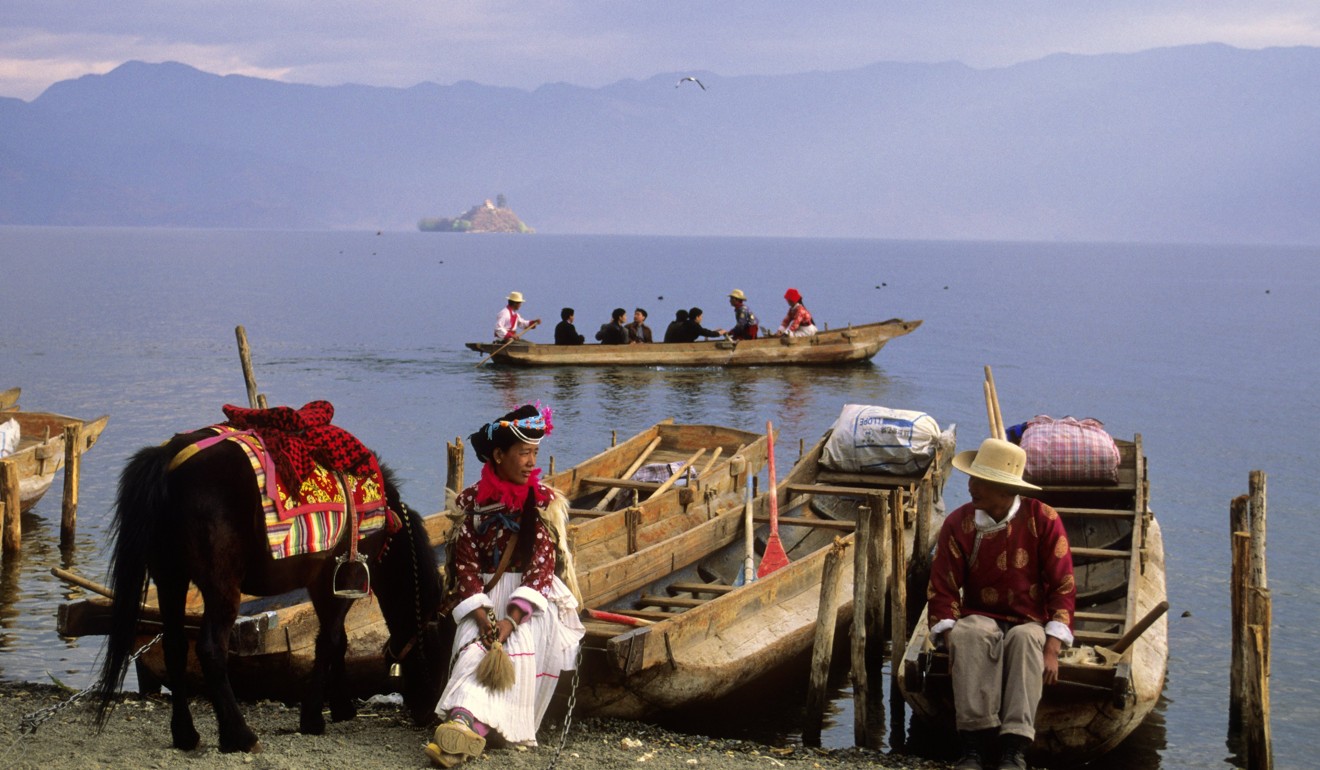
Lugu Lake in China’s Yunnan province is home to the Mosuo tribe. Photo: hemis.fr
At the top of the hierarchy is the grandmother, who is the head of the household. “Her daughters run the home and look after all the children of the female siblings … The sons and grandsons are expected in their supporting role to shoulder the manual tasks required to maintain the farmstead,” Choo says.
Researchers say that there are about 30,000 to 40,000 Mosuo people – most of whom live in the far eastern foothills of the Himalayas in Yunnan, southwest China. This unique community has come together in a series of villages dotted around a mountain and Lugu Lake, while growing numbers have moved out to work in larger towns and cities elsewhere in the country.
According to Choo, author of the book The Kingdom of Women: Life, Love and Death in China’s Hidden Mountains, the most distinctive facet of this community that sets it apart from mainstream society is the absence of formal marriage arrangements between men and women. Instead, they have “walking marriages”, where the man goes to the woman’s home, spends the night with her and then leaves the following morning.
The Kingdom of Women: China’s ‘lost tribe’ of matriarchs, the Mosuo
15 Mar 2017
The couple can choose to have a temporary or even a permanent arrangement as partners, but they are not bound by marriage ties. If they have children, the baby belongs to the woman’s household. “In fact, the man is not considered part of the matrilineal family and his ties to the baby do not determine the social place of the baby,” the researcher says.
Such a society, where women are not subjected to men and sexual freedom is an intrinsic part of their culture, is so radically different from mainstream patriarchal family structures that the Mosuo tribe has been examined and studied over time. More recently, its unique features have also become an eye-catching selling point for the local tourism industry.
TOURISM INDUSTRY
The Mosuo tribe used to live off the land by farming, herding and hunting. But many families now rely on tourism after the tribe’s culture and Lugu Lake became more popular and widely known.
“Tour buses on fancy freeways and planes arriving at a new airport bring more and more tourists daily to turn the whole area into a busy travel playground,” Choo says. “Every household around the lake is involved one way or another with the hotel, restaurant and tour guide industries.”
While the tourism industry has brought money and better food for most families as well more access to educational opportunities for their children, it is also posing a serious threat to their culture and traditional ways of life.
“The greatest challenge for the tribe is their rapid transition from living a rudimentary subsistence farming way of life right into a burgeoning modern middle-class existence within a short span of 20 or so years,” Choo says.
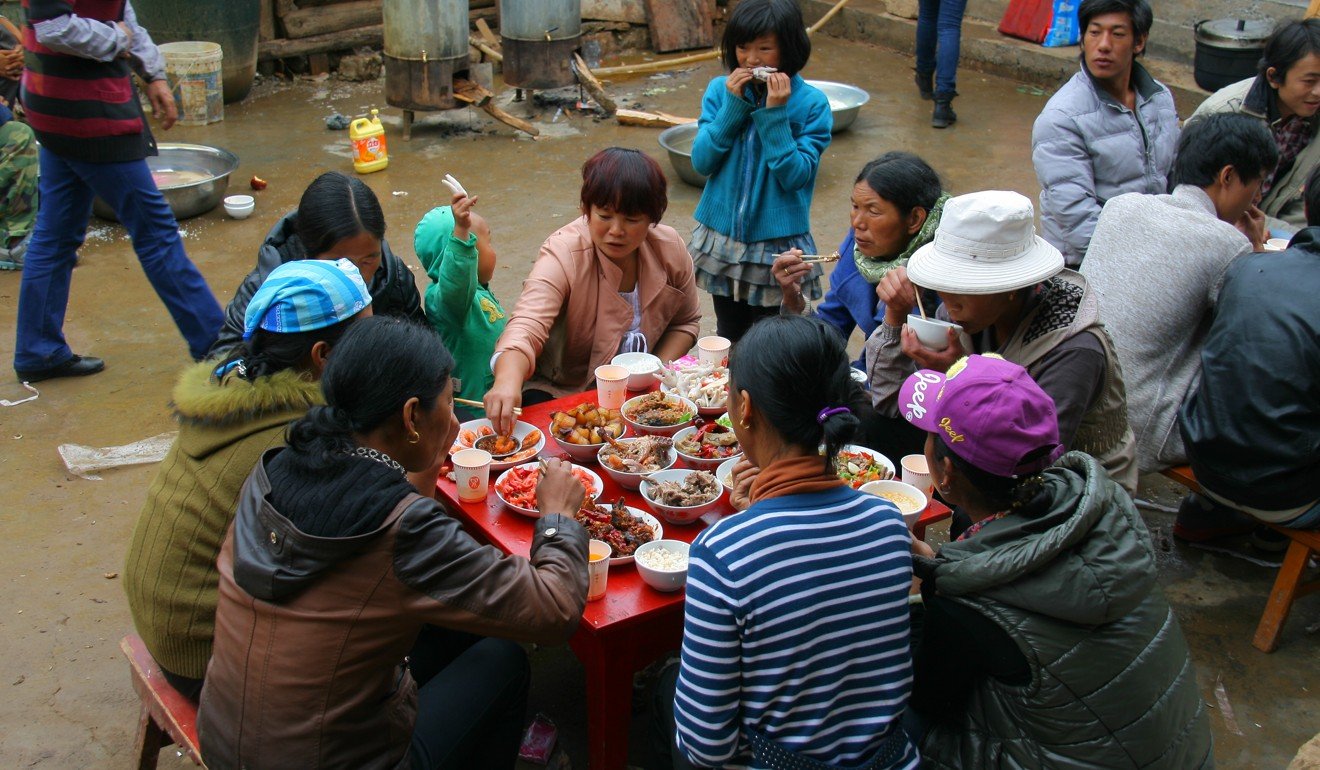
Mosuo people pictured at a wedding ceremony with an all-meat feast in 2013. Photo: Shutterstock
The Mosuo are now being bombarded not only by mainstream traditional Chinese values, but also by new economic values connected to money and the digital economy. “That is a lot to take in for people who had no writing to support their oral language … and only had primary schools for their children not so long ago,” she says.
Older Mosuo are now being pushed to learn Mandarin in order to keep up with the younger generations.
At the same time, the researcher says, “their long-held cultural beliefs and principles are evolving as the young generation gets exposed to the outside world and start to question the old ways of doing things.”
How life is changing for Thailand’s Karen tribe
17 Mar 2017
Walking marriages are not as common, with more youngsters getting married and forming nuclear families. “Large matrilineal families which were the norm are now breaking up into smaller nuclear families. All this dilutes the traditional matrilineal Mosuo family structure,” Choo says.
“The central place of the female in old Mosuo society is slowly being affected, as the male Mosuo are beginning to entertain some patriarchal outlook in the face of outside cultural influences.”
China may have radically reinvented itself in recent decades, but the changes to the Mosuo tribe have been nearly as dramatic. “The world of the Mosuo when I first ventured into their midst 12 years ago is a distant past as I look [today in 2020] at how they have changed,” Choo says.
PATRIARCHY IN DISGUISE
There are dozens of female-centric communities scattered around the world. The Garo and Khasi tribes, which are also traditionally matrilineal societies, can be found mostly in India.
In a Khasi family, the youngest daughter inherits the ancestral property, while in the Garo community, women also inherit property, but don’t necessarily have to be the youngest daughter of the family.
Caroline Marak, former head of the Garo Department at the North Eastern Hill University in India, says that the Garo are female-oriented, but not female-dominated. Women “have no part in the field of administration decision-making”, she wrote in an academic paper.
In recent years, the husbands of Garo women who are property owners have had a greater say over land deals, such as with government. “We are now trying to reclaim our rights from the males,” says Sume Sangma, secretary of the Garo Mothers Union NGO. “Women in the community are self-reliant and we are fighting for their real power.”
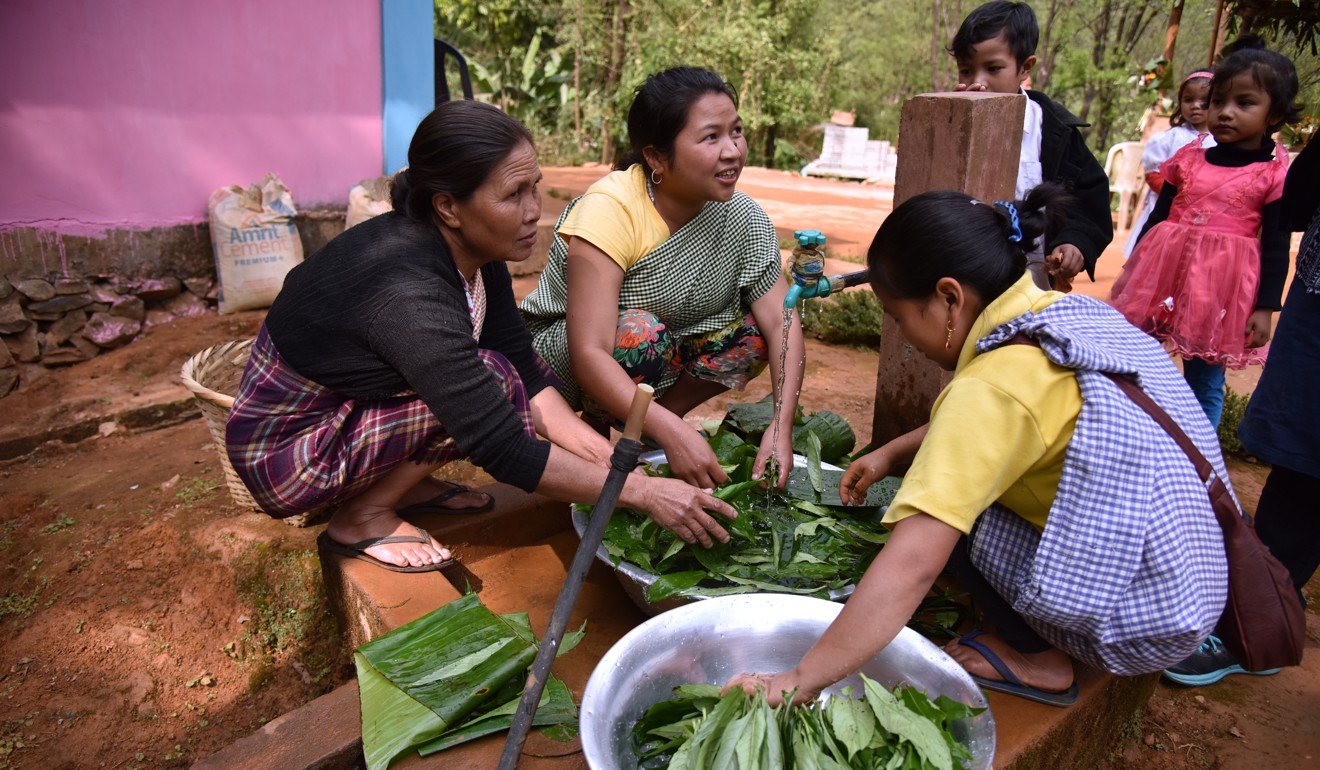
Khasi women wash leaves for cooking in the village of Nongtraw in India’s north-eastern Meghalaya state. Photo: AFP
Tiplut Nongbri, from the Centre for North East Studies and Policy Research at the Jamia Millia Islamia in New Delhi, also says women don’t have much authority in Garo and Khasi societies. “Patriarchy is in disguise in both the communities. The societies are matrilineal only as far as descent, residence and inheritance of property are concerned,” she says. “Women are not allowed to take part in politics.”
RG Lyngdoh, former home minister of Meghalaya – the hilly state in north-eastern India where both communities are based – says inward migration and the presence of Christian missionaries in the state have affected traditional lifestyles. “The old practices of equity between males and females have eroded,” Lyngdoh says.
“This has led to a perception of inadequacy among the males, [creating] discord within the family, which found expression in many negative ways, such as domestic violence and abandonment of wives, which never existed within the Khasi community.”
Gertrude Lamare, a member of the Khasi-Jaintia community now pursuing her PhD in anthropology at the London School of Economics and Political Science, argues that “with families becoming more nuclear, women do have a huge role in the decision-making process”.
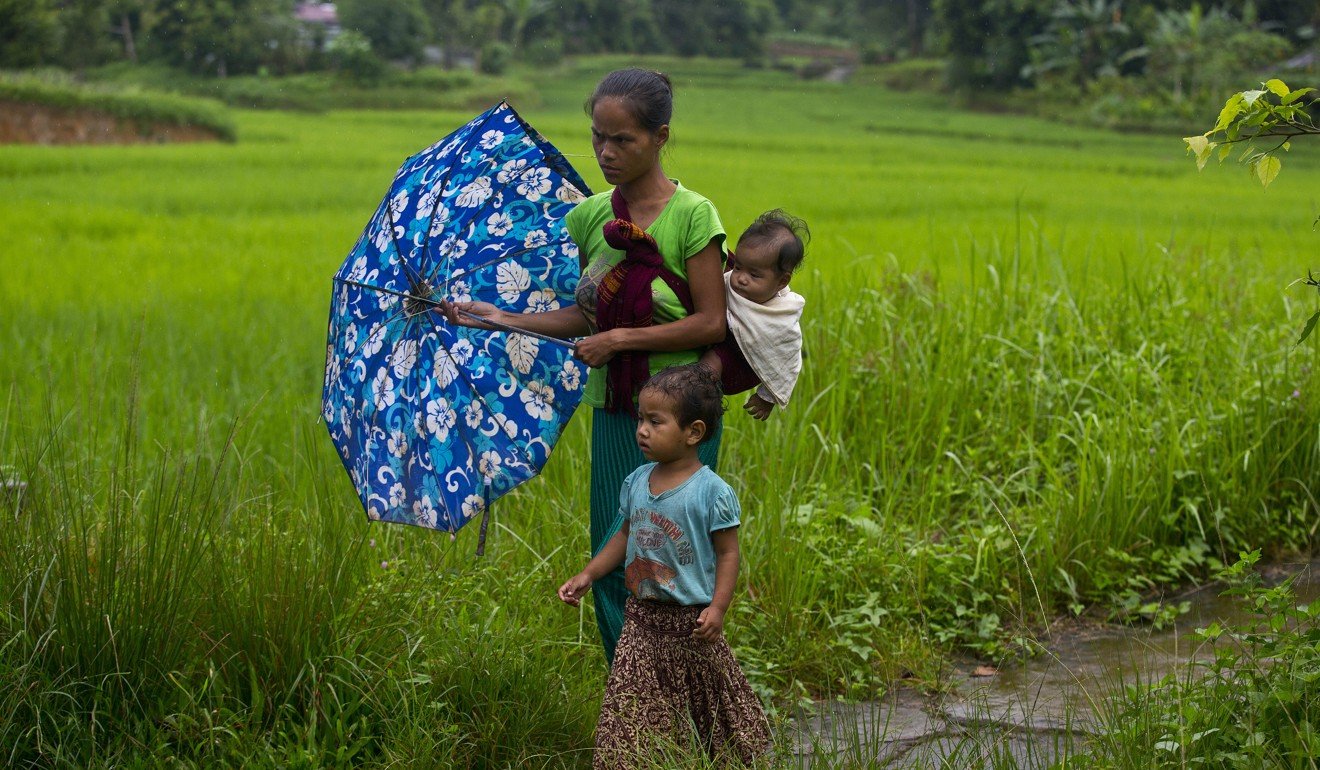
A Khasi woman walks in the rain with children past a paddy field along the Assam-Meghalaya state border in India. Photo: AP
Researchers have estimated that there are 1 million Garo in India and
, and 1.7 million Khasi in the Khasi and Jaintia Hills.
Some of them have become increasingly wary of outsiders preying on their natural resources, which are dwindling, thanks to deforestation and climate change.
Another challenge these communities are facing has to do with the growing trend of mixed marriages. “In recent years, children of a Khasi or Garo mother and non-tribal father [have] not [been] welcomed. The males in the family want their women to marry within the tribal community,” researcher Nongbri says, noting that younger generations are going through an identity crisis.
STILL PROUD
The world’s largest known matrilineal society today is believed to be in Indonesia: the Minangkabau, also known as Minang. Their community of about 8 million is scattered around the world, but most are in Indonesia’s West Sumatra province. While traditionally animist, they were later influenced by Hinduism and Buddhism, and most have since embraced Islam.
But much like the others, their community is also changing.
Nursyirwan Effendi, dean of the Faculty of Social and Political Science at Andalas University, says that many of those who remain in villages and rural areas still hold tight to the tribe’s values.
“Women are central in the distribution of assets, such as rice fields, gardens and [houses], from their ancestors,” he says.
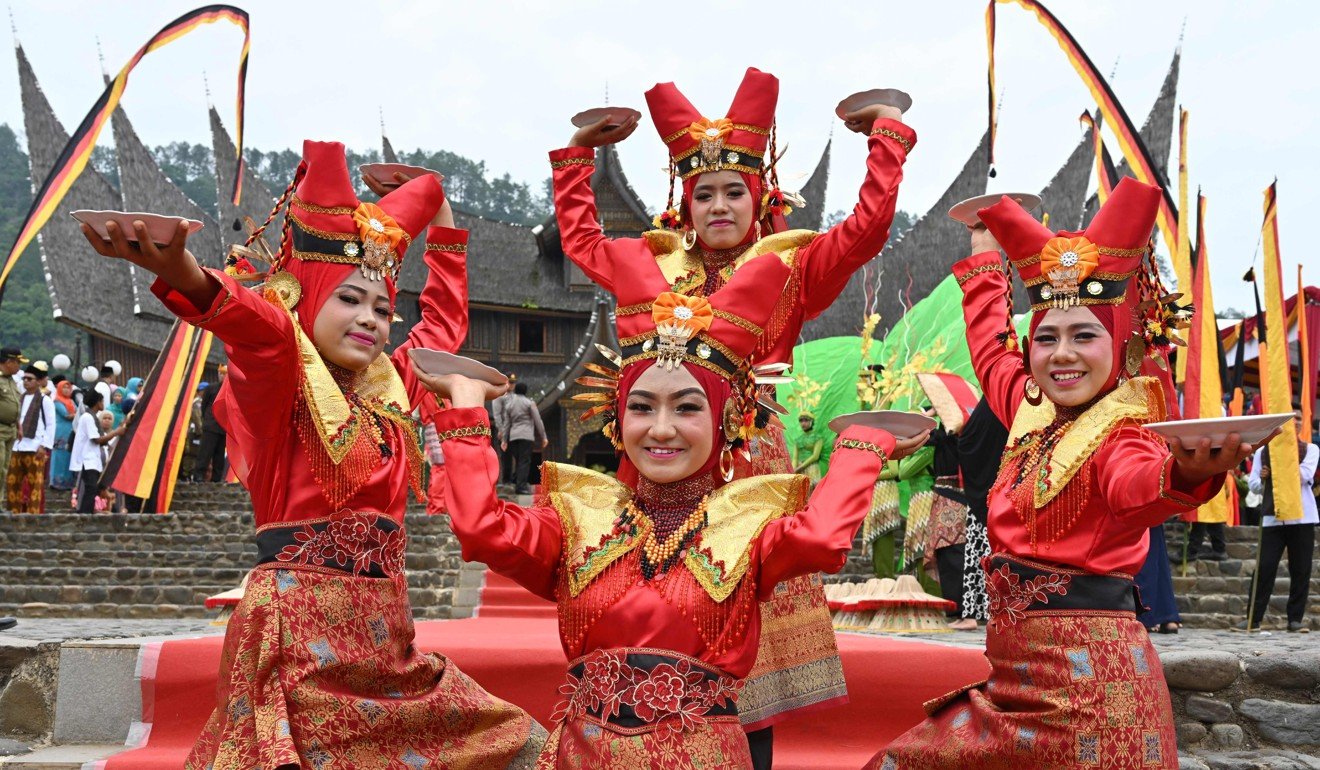
Dancers pose during the 2018 Minangkabau art and culture festival in Batusangkar, West Sumatra. Photo: AFP
Traditionally, Minangkabau women play an essential role in their children’s education and hold inheritance rights, while men are expected to take jobs elsewhere and occupy political and religious positions. When they do get married, the man moves to the woman’s house.
But Nursyirwan, who is of Minangkabau descent, notes that many have left for bigger cities, where they do not closely follow the community’s traditions.
An example of this is Afrianto Sikumbang, a 53-year-old businessman who was born to Minangkabau parents in West Sumatra province but now lives in the capital, Jakarta. Although he married a Minangkabau woman, he says they “don’t really apply” the tribe’s values in their daily life.
Sonya Anggraini, 35, who also works in the capital, has got used to city life, but remains proud of her ancestral roots and hopes that Minangkabau culture will persist for years to come.
“I am a member of my mother’s family, not of my father’s,” she says. ■
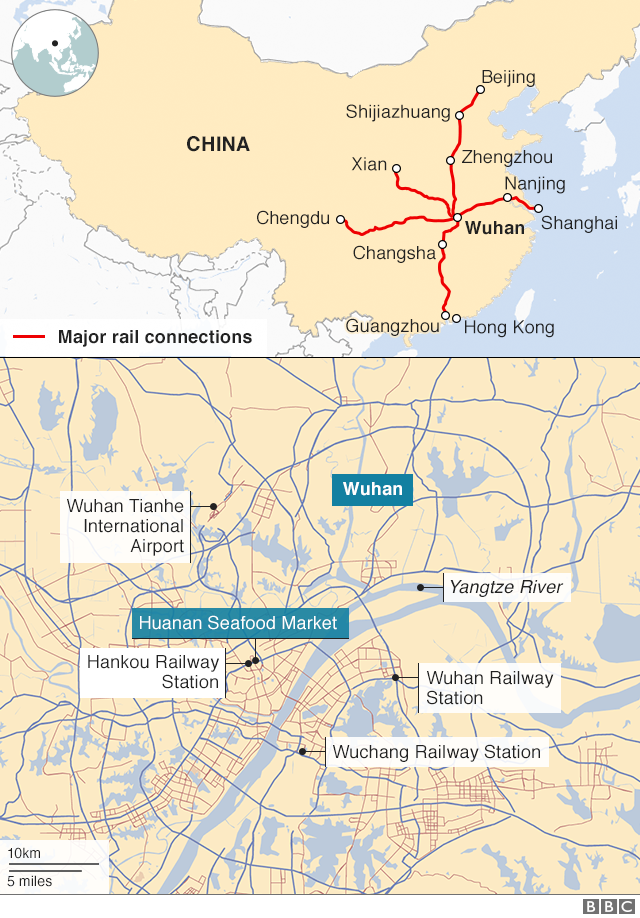
Wuhan, a Chinese city of eleven million people, has temporarily shut down its public transport as it tries to halt the outbreak of a new strain of virus.
Those living in the city have been advised not to leave, in a week when millions of Chinese are travelling for the upcoming Lunar New Year holiday.
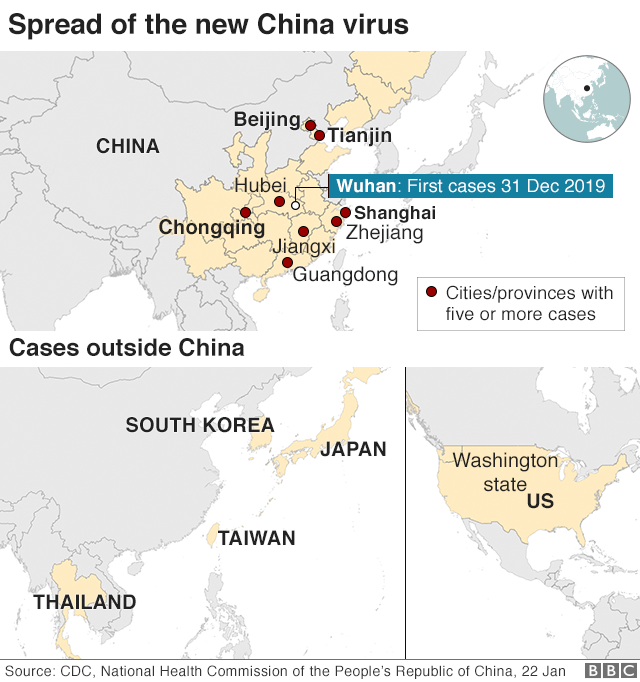
The respiratory illness has spread to other parts of China, with some cases in other countries including the US.
There are more than 500 confirmed cases and 17 people have died.
Known for now as 2019-nCoV, the virus is understood to be a new strain of coronavirus not previously identified in humans. The Sars (severe acute respiratory syndrome) virus that killed nearly 800 people globally in the early 2000s was also a coronavirus, as is the common cold.
All the fatalities so far have been in Hubei, the province around Wuhan.
Meanwhile, after a day of discussions in Geneva, the World Health Organization’s (WHO) emergency committee has announced it will not yet declare a “global emergency” over the new virus.
Director general Dr Tedros Ghebreyesus said more information was needed about the spread of the infection. The committee of health experts will meet again on Thursday.
A global emergency is the highest level of alarm the WHO can sound and has previously been used in response to swine flu, Zika virus and Ebola.
What measures have been announced?
From Thursday, all flights and passenger train services out of Wuhan have been stopped.
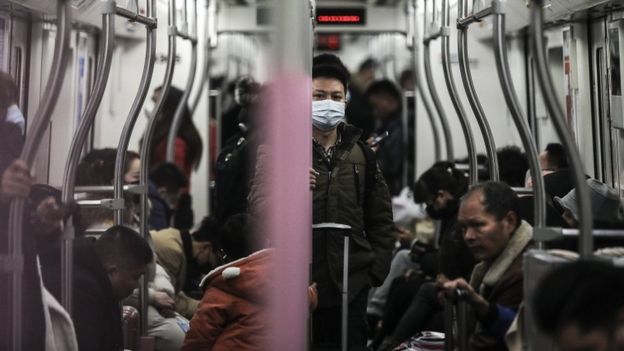
Bus, subway and ferry services all shut down from 10:00 local time (02:00 GMT).
A special command centre in Wuhan set up to contain the virus said the move was meant to “resolutely contain the momentum of the epidemic spreading”.
Those living in Wuhan had already been told to avoid crowds and minimise public gatherings.
State news agency Xinhua said tourist attractions and hotels in the city had been told to suspend large-scale activities while libraries, museums and theatres were cancelling exhibitions and performances.
A Lunar New Year prayer-giving ceremony at the city’s Guiyuan Temple, which attracted 700,000 people last year, has also been cancelled.
The hashtag “Wuhan is sealed off” was trending on Chinese social media website Weibo.
One user said worries about food and disinfectant made it feel like “the end of the world”, while another said they were on the “verge of tears” when Chinese officials announced the shut-down.
The WHO’s Dr Ghebreyesus described the latest measures as “very strong” and said they would “not only control the outbreak, they will minimise spread internationally”.
Chinese officials said the country was now at the “most critical stage” of prevention and control.
“Basically, do not go to Wuhan. And those in Wuhan please do not leave the city,” said National Health Commission vice-minister Li Bin in one of the first public briefings since the beginning of the outbreak.
Like shutting down London before Christmas
By James Gallagher, BBC health and science correspondent
Wuhan is starting to look like a city in quarantine.
Officials had already warned residents not to leave the city and visitors not to come.
Now the reported public transport ban – which includes flights – slams many of the routes in and out of the city shut.
Image copyright GETTY IMAGESImage caption Subways in Wuhan will be temporarily shut
It is a significant attempt to stop the spread of this new virus, which we now know can spread from person to person.
Limiting transport will cut the chance of the virus reaching other cities in China and other countries around the world.
This all comes just as millions of people are travelling across China for the week-long holiday that is Lunar New Year.
If you’re struggling for context – imagine shutting down London in the week before Christmas.
The big question left is the roads – and whether any of Wuhan’s 11 million inhabitants will be able to simply drive away.
The patient in Macau is said to be a businesswoman who arrived from Wuhan over the weekend.
The first US case was confirmed on Tuesday. President Donald Trump said the situation was “totally under control” and that he trusted the information being provided by Chinese authorities.
There have been three cases in Thailand, one in Korea, one in Japan and one in Taiwan.
Although only about 500 cases have been confirmed, calculations by scientists at the MRC Centre for Global Infectious Disease Analysis at Imperial College London suggest there are 4,000 people sick with the virus in Wuhan.
Our estimate at 4,000 cases is more than double the past estimate due to increase of number of cases outside China. This should not be interpreted as implying the outbreak has doubled in size.
The virus originated in a seafood market in Wuhan that “conducted illegal transactions of wild animals”, authorities said. The market has since been shut down.
Image caption The pack of cards cost £1.50 from Tesco
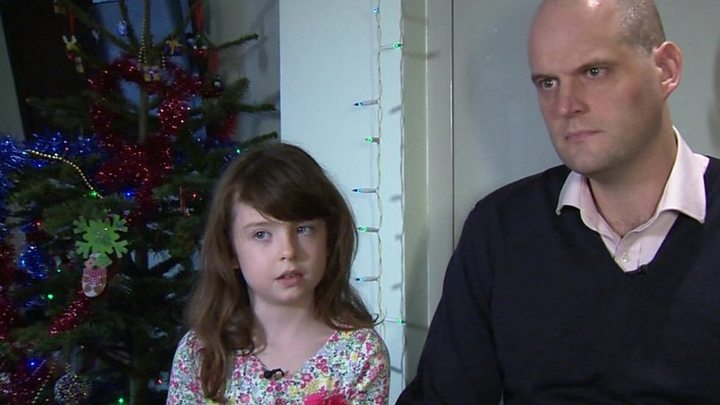
A factory in China has denied it used forced labour after a six-year-old girl found a message from workers inside a Tesco charity Christmas card.
The card supplier, Zhejiang Yunguang Printing, told China’s Global Times it had “never done such a thing”.
Tesco halted production at the factory on Sunday over the message, allegedly written by prisoners claiming they were “forced to work against our will”.
The Chinese foreign ministry said the allegation was “a farce”.
Speaking to the nationalist newspaper Global Times on Monday, a spokesman for the card supplier said: “We only became aware of this when some foreign media contacted us. We have never done such a thing.
The message – first reported by the Sunday Times – was found by Florence Widdicombe, who was writing cards to her school friends. She found that one of them – featuring a kitten with a Santa hat – had already been written in.
In block capitals, it said: “We are foreign prisoners in Shanghai Qingpu prison China. Forced to work against our will. Please help us and notify human rights organisation.”
The message in the card asked whoever found the message to contact Peter Humphrey, a British journalist who was himself imprisoned there four years ago.
Chinese foreign ministry spokesman Geng Shuang told reporters on Monday the allegation was “a farce” created by Mr Humphrey.
“Shanghai’s Qingpu prison has no such foreign prisoners undergoing forced labour,” Mr Shuang said.
Zhejiang Yunguang Printing’s factory manager, Shu Yunjia, told the BBC it had not outsourced any of its work to the Qingpu prison.
Media caption Florence Widdicombe was writing the cards last Sunday when she discovered the message
Florence, from Tooting in south London, said she was writing her “sixth or eighth card” when she saw “somebody had already written in it”.
“It made me feel shocked,” she said, adding that when it was explained to her what the message meant she felt “sad”.
Tesco added that it would de-list Zhejiang Yunguang if it was found to have used prison labour.
A Tesco spokeswoman said: “We were shocked by these allegations and immediately halted production at the factory where these cards are produced and launched an investigation.”
The supermarket said it has a “comprehensive auditing system” to ensure suppliers are not exploiting forced labour.
The factory in question was checked only last month and no evidence of it breaking the ban on prison labour was found, it said.
Sales of charity Christmas cards at the company’s supermarkets raise £300,000 a year for the British Heart Foundation, Cancer Research UK and Diabetes UK.
Tesco has not received any other complaints from customers about messages inside Christmas cards.
‘Very bleak life’
The message in the card urged the recipient to contact Peter Humphrey, who was formerly imprisoned at Qingpu on what he described as “bogus charges that were never heard in court”.
After the Widdicombe family sent him a message via Linkedin, Mr Humphrey said he then contacted ex-prisoners who confirmed inmates had been forced to work.
Media caption Peter Humphrey: “I think I know who it was but I will never disclose the name”
Mr Humphrey told the BBC that the cell block of foreign prisoners has about 250 people in it, who are living a “very bleak daily life” with 12 prisoners per cell.
He added that when he was in there, manufacturing labour work was voluntary – to earn money to buy soap or toothpaste – but that work has now become compulsory.
Mr Humphrey told the BBC: “I spent two years in captivity in Shanghai between 2013 and 2015 and my final nine months of captivity was in this very prison in this very cell block where this message has come from.
“So this was written by some of my cellmates from that period who are still there serving sentences.
“I’m pretty sure this was written as a collective message. Obviously one single hand produced this capital letters’ handwriting and I think I know who it was, but I will never disclose that name.”
It is not the first time that prisoners in China have reportedly smuggled out messages in products they have been forced to make for Western markets.
In 2012, Julie Keith from Portland, Oregon, discovered an account of torture and persecution by a prisoner who said he was forced to manufacture the Halloween decorations she had purchased.
And in 2014, Karen Wisinska from Co Fermanagh in Northern Ireland, found a note on a pair of Primark trousers reading: “Our job inside the prison is to produce fashion clothes for export. We work 15 hours per day and the food we eat wouldn’t even be given to dogs or pigs.”
Under the UN’s guidance for human rights and prisons, prisoners “should not be subordinated merely to making a profit either for the prison authorities or for a private contractor”.
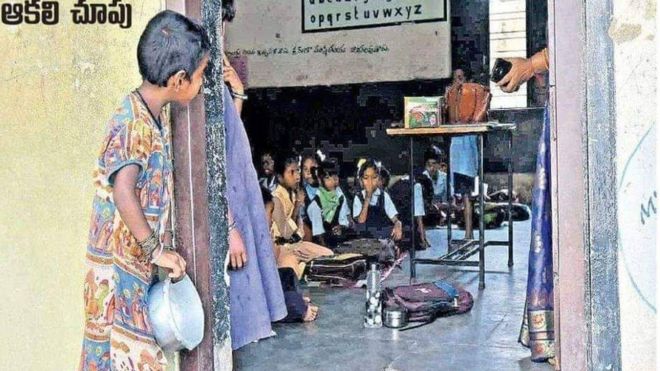
Image copyright EENADU NEWSPAPER/A SRINIVASImage caption The photo that sparked an outcry
A five-year-old in the southern city of Hyderabad was enrolled in school after a photo of her peeking into a classroom sparked an outcry. BBC Telugu’s Deepthi Bathini reports on why the photo doesn’t tell the full story.
Divya is something of a local celebrity in the slum where she lives. The shy five-year-old was the subject of a recent photo which went viral – it showed her clutching a bowl and peeking into a classroom at the local government school.
The touching image was published in a Telugu newspaper on 7 November with a caption that translates from the Telugu as “hungry gaze”.
It quickly grabbed people’s attention: a children’s rights activist shared it on Facebook, lamenting that yet another child was being denied the right to food and education.
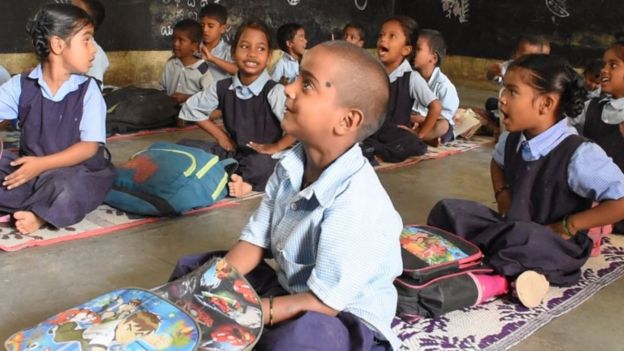
It had such an impact, the school enrolled Divya the following day.
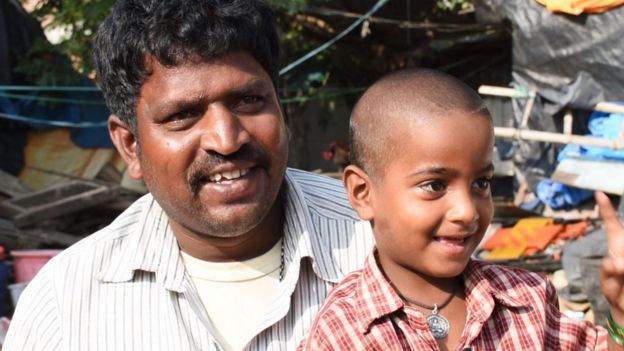
But her father, M Lakshman, says the photo and the outcry it provoked was in fact unfair to him and his wife, Yashoda, who works as a sweeper.
Image caption Five-year-old Divya enrolled in school after a photo of her in a newspaper went viral
“I felt sad when I saw the photo,” he told the BBC. “Divya has parents and we are working so hard to give her a good future – but she was portrayed as a hungry orphan.”
Mr Lakshman says he was waiting for Divya to turn six so he could enrol her in a government hostel where his other two daughters are studying. The couple also have a son, who has finished school and is now applying to college while helping Mr Lakshman, who works as a rag picker.
Breaking the cycle
Divya and her parents live in a one-room hut in a shanty town in the heart of Hyderabad. The slum is about 100 metres from the government school, where Divya was photographed. Most of the 300 families living here are daily wage labourers and their children attend the school nearby.
The home is sparse and plastic and glass are piled outside, ready to be sold for recycling. He says between him and his wife, they earn about 10,000 rupees ($139; £108) a month, which pays for their food and clothes. Education, however, is free for the children, since they are all enrolled in government-run schools.
Mr Lakshman knows what it is to struggle: he himself grew up without parents and always battled to earn a decent living. “I never wanted my children to have the life I had. So I made sure they all go to school.”
The photo, he adds, was especially hurtful because he has also been taking care of his brother’s five children.
Image caption Divya’s father said the outcry over the photo was “unfair” to his family
“My brother and sister-in-law passed away sometime ago. I didn’t want their five children to grow up as orphans. So, I enrolled all of them in a hostel and I take care of them.”
When asked why Divya had gone to the government school with a bowl in hand, Mr Lakshman explains that a lot of the younger children from the slum go there around lunch time to take advantage of the free midday meal – a government programme which provides cooked meals to children in more than a million schools – which they know about because their older brothers and sisters are already enrolled.
“Divya doesn’t go every day but she happened to go on that day and someone photographed her,” he explained.
This was confirmed by teachers at the school who told the BBC that some children brought lunch from home, so leftovers over from the free meal scheme would be given to the younger children who had not yet joined.
“Children are children. And there is no day-care centre, so a lot of these children hang around the school anyway,” says one teacher, who spoke on the condition of anonymity.
Image caption Divya says she’s excited to go to school
Mr Lakshman and his neighbours acknowledged the lack of an anganwadi, or government-sponsored day-care centre, in the neighbourhood was a major problem as parents had no place to leave their children so they could go to work.
The local school inspector, SU Shivram Prasad, says he hopes the attention generated by the Divya’s photo will hasten the process of setting up one up.
“It will help the parents and the children can eat a nutritious meal,” he adds.
Teachers at the school also hope that the media spotlight will improve facilities. They say there is an acute shortage of staff and teaching materials, and the school did not even have a compound wall, which meant they have to constantly watch the children during their breaks.
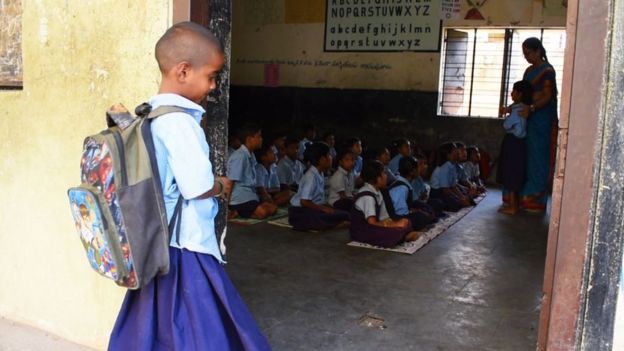
Divya, however, is excited to be going to school. She insists on taking her school bag with her everywhere, even to the playground. Other than saying her name, she does not answer any questions.
“She is a very calm child,” says Mr Lakshman, as his daughter holds his hand and kisses it.
And he admits that despite everything, the photo did do some good.
“Now other children who are Divya’s age are also enrolling in school. So that makes me happy.”













 CHINDIA ALERT: You'll be living in their world, very soon