Chindia Alert: You’ll be Living in their World Very Soon
aims to alert you to the threats and opportunities that China and India present. China and India require serious attention; case of ‘hidden dragon and crouching tiger’.
Without this attention, governments, businesses and, indeed, individuals may find themselves at a great disadvantage sooner rather than later.
The POSTs (front webpages) are mainly 'cuttings' from reliable sources, updated continuously.
The PAGEs (see Tabs, above) attempt to make the information more meaningful by putting some structure to the information we have researched and assembled since 2006.
NEW DELHI/SRINAGAR (Reuters) – A Himalayan border standoff between old foes India and China was triggered by India’s construction of roads and air strips in the region as it competes with China’s spreading Belt and Road initiative, Indian observers said on Tuesday.
Soldiers from both sides have been camped out in the Galwan Valley in the high-altitude Ladakh region, accusing each other of trespassing over the disputed border, the trigger of a brief but bloody war in 1962.
About 80 to 100 tents have sprung up on the Chinese side and about 60 on the Indian side where soldiers are billeted, Indian officials briefed on the matter in New Delhi and in Ladakh’s capital, Leh, said.
Both were digging defences and Chinese trucks have been moving equipment into the area, the officials said, raising concerns of a long faceoff.
“China is committed to safeguarding the security of its national territorial sovereignty, as well as safeguarding peace and stability in the China-India border areas,” the Chinese Foreign Ministry spokesperson’s office said in a statement.
“At present, the overall situation in the border areas is stable and controllable. There are sound mechanisms and channels of communication for border-related affairs, and the two sides are capable of properly resolving relevant issues through dialogue and consultation.”
There was no immediate Indian foreign ministry comment. It said last week Chinese troops had hindered regular Indian patrols along the Line of Actual Control (LAC).
But interviews with former Indian military officials and diplomats suggest the trigger for the flare-up is India’s construction of roads and air strips.
“Today, with our infrastructure reach slowly extending into areas along the LAC, the Chinese threat perception is raised,” said former Indian foreign secretary Nirupama Rao.
“Xi Jinping’s China is the proponent of a hard line on all matters of territory, sovereignty. India is no less when it comes to these matters either,” she said.
After years of neglect Prime Minister Narendra Modi’s government has pushed for improving connectivity and by 2022, 66 key roads along the Chinese border will have been built.
One of these roads is near the Galwan valley that connects to Daulat Beg Oldi air base, which was inaugurated last October.
“The road is very important because it runs parallel to the LAC and is linked at various points with the major supply bases inland,” said Shyam Saran, another former Indian foreign secretary.
“It remains within our side of the LAC. It is construction along this new alignment which appears to have been challenged by the Chinese.”
China’s Belt and Road is a string of ports, railways, roads and bridges connecting China to Europe via central and southern Asia and involving Pakistan, China’s close ally and India’s long-time foe.
Image copyright GETTY IMAGESImage caption India’s railways are hoping to ease the burden on hospitals
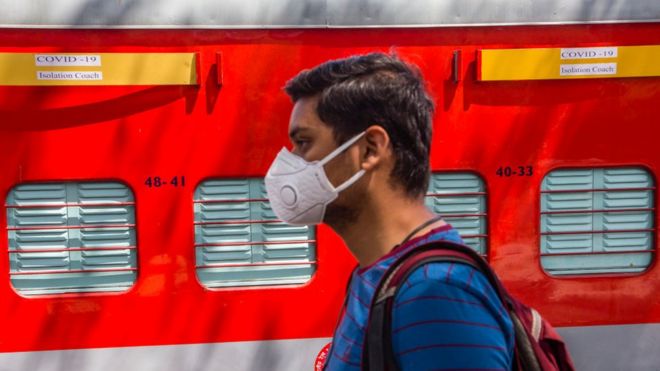
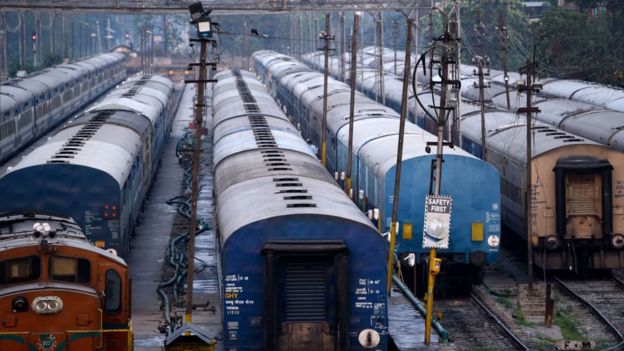
India is preparing for a potential surge in Covid-19 patients by tapping into an unusual resource: its trains, which power the world’s fourth biggest rail network.
The country suspended its passenger trains for the first time after it announced a three-week lockdown on 25 March to contain the coronavirus. As of Wednesday, it had reported 4,643 active cases and 149 deaths, and the numbers are rapidly increasing.
“We, at the railways, thought: how can we contribute?” its spokesman, Rajesh Bajpai, told the BBC. “So we came up with this idea and everyone liked it.”
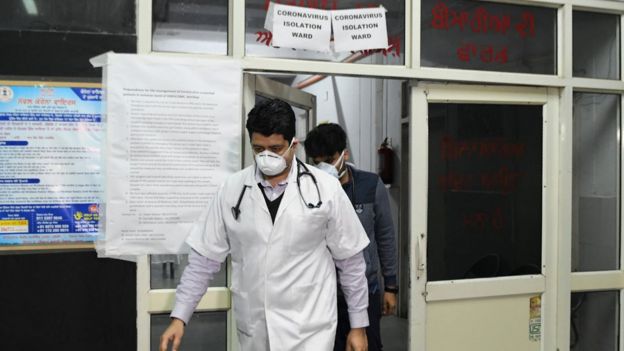
Work has already begun to convert 5,000 train coaches into quarantine or isolation wards, which amounts to 40,000 beds. And the railway ministry says it’s prepared to convert 15,000 more coaches.
The Indian railways – as the ministry is known – is a behemoth. Largely constructed during British rule, it’s still the mainstay of India’s public transport, and includes some of the world’s busiest urban rail systems. It transports 23 million passengers a day and its 12,000 trains crisscross 65,000km (40,389 miles) of tracks, connecting the remotest parts of India.
Mr Bajpai says the coaches can be spared as they are mostly trying to convert older ones, and passengers will be fewer than ever in the coming months even if restrictions are eased.
He adds that this is not unusual for the railways, which already runs several “special” trains, from luxury trains to exhibition trains to a hospital train, complete with operation theatres.
“The coach is a shell and inside, you can provide anything – a drawing room, a dining room, a kitchen, a hospital.”
A looming crisis?
And India may well need the extra beds.
States have already turned all sorts of spaces – sports centres, stadiums, wedding venues, hotels, resorts – into quarantine or isolation centres. But officials fear they will run out of space as the country ramps up testing.
Image copyright GETTY IMAGESImage caption India suspended all passenger trains last month
For every person who tests positive, there are scores more who need to be traced, quarantined and, if necessary, isolated. But isolation at home is not always an option in India’s joint family households – and especially not in its densely-populated slums.
“There are so many options available and this [the coaches] is one of the options,” Mr Bajpai says.
He doesn’t foresee them being used until beds in existing quarantine or isolation centres are filled. But, he adds, they will keep them ready with the necessary facilities.
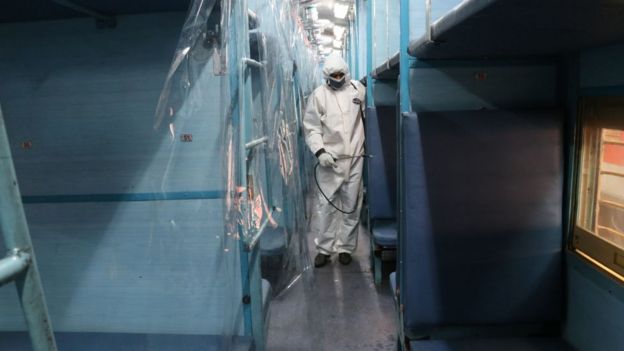
That includes converting one of the two toilets in each coach into a “bathing room”, providing oxygen cylinders in every coach, and modifying all the cabins so they can hold medical equipment. And then there are measures that are specific to Covid-19 – such as replacing taps that turn with those that have long handles, and fitting dustbins with foot pedals.
Image copyright GETTY IMAGESImage caption It takes up to three days to turn a coach into an isolation ward
The ministry has also ordered extra coat hooks and mosquito nets for every cabin, and has instructed officials to make sure that charging points are working, the upholstery “is in good condition” and “broken panels are replaced”.
The coaches are being readied in 130 different locations across the country, but it’s yet to be decided where they will be stationed.
Mr Bajpai says it’s up to states to decide which stations they want the coaches in. But that in itself is a process because the coaches need regular water and electric supply.
And there are other concerns too. Summer has begun and large parts of India record scorching temperatures, often more than 40C. And the coaches that are being converted are not air-conditioned.
“The patient will be very uncomfortable. Doctors and nurses will be wearing protective gear, and they will find it very difficult,” says Vivek Sahai, a former chairman of the railway board.
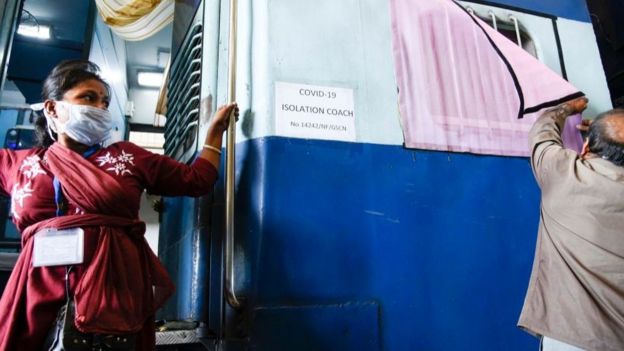
Image copyright GETTY IMAGESImage caption Staff member of Northeast Frontier Railway (NFR) prepare train coaches to convert them into isolation wards for COVID-19 patients.
He also says not everyone might be comfortable squatting to use Indian-style toilets; and he wonders if all the designated coaches have a proper system of waste management. (Indian coaches are designed to dispose of human waste onto the tracks although new technologies have begun to be adopted in recent years.)
“I am not saying it cannot be done but they have to take care of these things,” he says. “But if anybody can do it, it’s the railways.”
However, some experts say that this by itself is not going to help solve India’s problems.
“You don’t just need space,” says Dr Sumit Sengupta, a pulmonologist. “We need thousands of doctors and nurses if you really have to make a dent.”
India is severely short of both, and at least three hospitals have been sealed this week alone after members of the staff tested positive.
Media caption As cases of coronavirus rise and the virus hits India’s congested slums, will the country cope?
“Why isolate someone who has symptoms when there is no treatment? Because you don’t want them to spread the infection,” Dr Sengupta says.
But, he adds, the virus is spreading anyway because so many patients are asymptomatic. He says isolating symptomatic patients will not help unless India starts testing aggressively.
“This will work only as part of a larger strategy,” he adds. “Test, trace and isolate. Test should come first.”
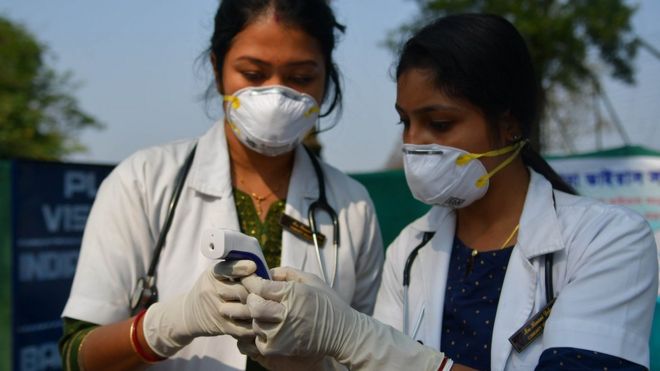
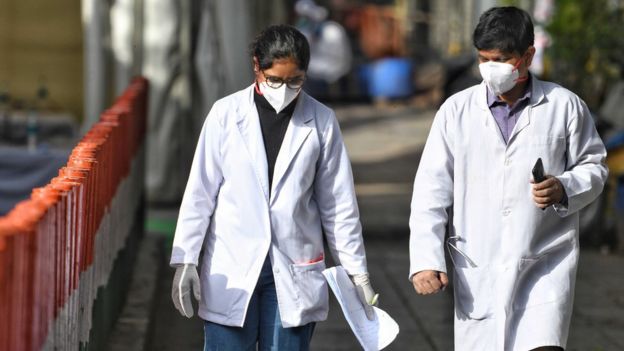
Image copyright MAJORITY WORLDImage caption Indian doctors have been working extra hours to halt the spread of the coronavirus
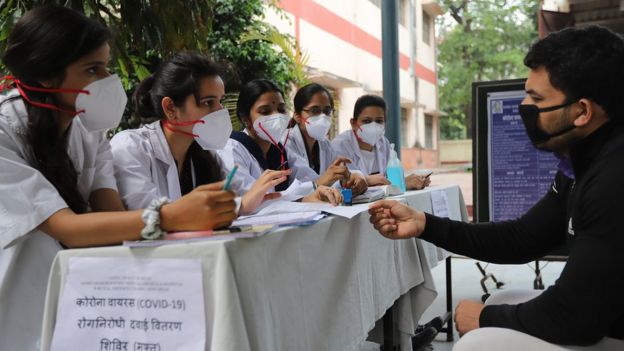
Several healthcare workers in India have been attacked as they battle to stop the spread of the coronavirus.
Reports say doctors have been spat at and chased away from homes, and that in one case patients directed abusive and vulgar language towards female nurses.
Some physicians and their families have also been ostracised by their neighbours because of their exposure to patients infected with Covid-19.
India has reported more than 2,300 cases and at least 50 people have died.
One video, which has gone viral, showed a mob throwing stones at two female doctors wearing personal protective equipment in the central city of Indore.
The doctors had gone to a densely-populated area to check on a woman suspected of having Covid-19 when they came under attack.
Despite being injured, one of the doctors seen in the video, Zakiya Sayed, said the incident “won’t deter me from doing my duty”.
“We were on our usual round to screen suspected cases,” she told the BBC. “We never thought that we would be attacked.”
“I had never seen scenes like that. It was frightening. We somehow fled from the mob. I am injured but not scared at all.”
Dr Sayed added: “We had no reason to suspect that people would be agitated against medical teams.”
“We are working to keep people safe. We had information about a person coming in contact with a Covid-19 patient. We were talking to the person when residents got agitated and attacked us.”
Image copyright HINDUSTAN TIMESImage caption Doctors have been abused and attacked in different parts of India
Seven people have been arrested in connection with the incident.
Dr Anand Rai, who is also a part of the Covid-19 taskforce in Indore, told the BBC: “Nothing can justify the attack against medical team. But it happened in a Muslim-dominated area where there is general distrust against the government.”
“So that anger spilled over and took the form of this attack. But whatever maybe the reason, nothing can justify violence, especially against doctors during a national health emergency,” he added.
Thousands who attended the gathering in Delhi, organised by Islamic preaching group Tablighi Jamaat, have been put in quarantine, and authorities are still tracing others. It is believed that the infections were caused by preachers who attended the event from Indonesia.
At the Ghaziabad hospital, some of the quarantined attendees allegedly used abusive and vulgar language against members of staff.
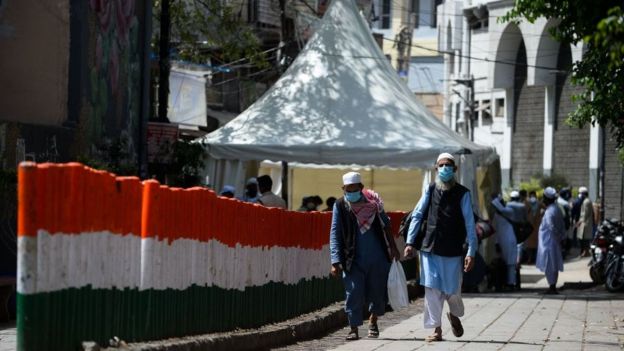
Image copyright GETTY IMAGESImage caption Almost 400 cases of Covid-19 have been traced to a Tablighi Jamaat event in Delhi
“Some were walking naked in the hospital ward and harassing women doctors and nurses,” a doctor who works at the hospital told the BBC. “They kept asking for cigarettes and tobacco.”
A senior police officer in the city told the BBC that cases had been registered against some people after doctors filed a complaint.
“Registering cases was the last resort. Police are still trying to make them understand the severity of the situation,” he said.
Image copyright SOPA IMAGESImage caption Doctors and nurses have asked people to follow their advice and not panic
Similar incidents have been reported in neighbouring Delhi.
Some attendees of the Tablighi Jamaat event who are being held in a quarantine facility run by the railways are said to have spat at doctors and misbehaved.
Deepak Kumar, spokesman for Northern Railways, said the situation there was now under control.
“The attendees have been counselled and they are now co-operating with the staff,” he said.
Delhi’s state government has reportedly written to the police, requesting more security for medical staff.
Reports of attacks on doctors and nurses have also come from the southern city of Hyderabad and the western city of Surat.
A doctor who was treating coronavirus patients is Hyderabad’s Gandhi Hospital was attacked on Wednesday.
Police have promised the doctor that “strict action will be taken against the culprits”.
Image copyright NARINDER NANUImage caption Prime Minister Narendra Modi has said that doctors are “front-line soldiers”
But it is not just a work where medical workers are facing discrimination. It has followed them home.
One doctor, who did not wish to be identified, said she felt “extremely disheartened when I learnt that even my neighbours think that me and my family shouldn’t be allowed to live in the building”.
“We want our families to be safe. But we are being discriminated for doing our job.”
“A number of doctors have tested positive across India and that shows how tough our job is at the moment. And that is why we need everybody’s support to win this war against coronavirus.”
She added: “We are following all safety protocols. We are not meeting even our families and that is stressful.”
“But seeing this open discrimination just breaks my heart. But we will go on because there is really no other option.”
BEIJING, Feb. 6 (Xinhua) — A slew of preventive measures have been taken to contain the novel coronavirus as a growing number of Chinese people hit the road and return to work after the Spring Festival holiday, the Ministry of Transport (MOT) said Thursday.
According to big data analysis, passenger flow is expected to pick up around this weekend, said Cai Tuanjie, an official with the MOT, at a press conference.
To contain virus infections during the trips, railways, airports and other public transportation operators have intensified disinfection, ventilation and sanitation of vehicles and stations, Cai said.
Passengers will go through body temperature screening at both entrances and exits of operating public transportation stations across the country. People found to have caught a fever above 37.3 degrees Celsius will be transferred to health departments.
Meanwhile, steps have been taken to make sure vehicles are not fully booked to allow a safe distance between passengers, Cai said, adding that temporary isolation areas had been set in the vehicles to avoid cross-infections in case of emergency during the journey.
NAYPYITAW (Reuters) – China and Myanmar inked dozens of deals on Saturday to speed up infrastructure projects in the Southeast Asian nation, as Beijing seeks to cement its hold over a neighbour increasingly isolated by the West.
But no major new projects were agreed during the two-day visit by President Xi Jinping, the first of any Chinese leader in 19 years. Analysts said Myanmar was generally cautious of investments by Beijing and was also being careful ahead of elections later this year.
Still, Xi and Myanmar leader Aung San Suu Kyi signed 33 agreements shoring up key projects that are part of the flagship Belt and Road Initiative, China’s vision of new trade routes described as a “21st century silk road”.
They agreed to hasten implementation of the China Myanmar Economic Corridor, a giant infrastructure scheme worth billions of dollars, with agreements on railways linking southwestern China to the Indian Ocean, a deep sea-port in conflict-riven Rakhine state, a special economic zone on the border, and a new city project in the commercial capital of Yangon.
They did not address a controversial $3.6 billion Beijing-backed mega dam, where work has been stalled since 2011, reflecting the contentiousness of Chinese investment in Myanmar, where many are uncomfortable with the sway Beijing has over its smaller neighbour.
“While a large number of different agreements have been signed, there is no Big Bang here,” said Richard Horsey, a Yangon-based analyst with the International Crisis Group.
“The overall impression is that Myanmar is being cautious about Chinese investment, especially ahead of elections planned later in the year, he said.
“China will be hoping that this is an incremental step towards realizing its mega-infrastructure goals, and that further progress can be locked in over the coming months,” he said.
‘DERAILED’ BY WEST
At a welcoming ceremony on Friday, Xi hailed a “new era” of relations between the countries.
“We are drawing a future roadmap that will bring to life bilateral relations based on brotherly and sisterly closeness in order to overcome hardships together and provide assistance to each other,” Xi said. He was scheduled to leave later on Saturday.
Suu Kyi called China “a great country playing an important role in the international affairs and the world economy” but urged for economic projects that avoid environmental degradation and benefit locals.
Xi also met leaders from political parties in ethnic areas riven with civil conflict where Chinese infrastructure projects are underway.
Sai Kyaw Nyunt, joint-secretary of the Shan Nationalities League for Democracy, one of the ethnic politicians invited to meet Xi, said it was only a handshake.
“Our country is very small and powerless,” he said, “So they treat us that way.”
The two countries have historically had a fraught relationship, but have moved closer since 2017, when Myanmar was internationally condemned for its treatment of minority Rohingya Muslims in Rakhine state.
More than 730,000 Rohingya were forced to flee western Myanmar after a military crackdown that the United Nations has said was executed with “genocidal intent”. China has defended the country on the global stage and is viewed as the biggest obstacle to a prosecution of its leaders at an international war crimes tribunal.
An article in Chinese state media ahead of the state visit said Myanmar had been “derailed” by its engagement with the West and only China was willing to “pull Myanmar from the sludge”.
“But after some turbulence, Myanmar realized there were double standards in the approach Western countries had taken on human rights issues and began to turn to China for diplomatic and economic help,” the article in the Global Times said.
Chinese President Xi Jinping meets with visiting Uzbek Prime Minister Abdulla Aripov at the Great Hall of the People in Beijing, capital of China, Aug. 28, 2019. (Xinhua/Yao Dawei)
BEIJING, Aug. 28 (Xinhua) — Chinese President Xi Jinping met with visiting Uzbek Prime Minister Abdulla Aripov here on Wednesday, calling on the two countries to jointly push forward the high-quality construction of the Belt and Road.
Xi asked Aripov to convey his sincere regards to Uzbek President Shavkat Mirziyoyev.
The key to the constant leap-forward development of China-Uzbekistan relations is that both sides always adhere to the spirit of good-neighborliness, mutual benefit and mutual assistance, according to Xi.
Xi stressed that he attaches great importance to the development of the China-Uzbekistan comprehensive strategic partnership, which is in line with the fundamental interests of the two countries and their peoples.
Hailing the achievements of the fifth meeting of the China-Uzbekistan intergovernmental committee of cooperation, Xi said that the cooperation goals set by the two sides will certainly be realized as long as the bilateral relationship stays on the right track.
Xi called on both countries to further promote the high-quality construction of the Belt and Road, enhance synergy between national development strategies, strengthen connectivity through cross-border roads and railways, expand cooperation in trade, investment, high and new technology, energy and other fields, as well as foster new highlight in people-to-people and cultural exchanges.
China is willing to increase imports of Uzbek quality agricultural products, Xi said, adding that Uzbekistan is welcome to attend the second China International Import Expo as guest of honor later this year.
In addition, Xi said that the two sides should work together to combat the “three evil forces” of terrorism, separatism and extremism, fight against drug trafficking and other transnational organized crimes.
The rejuvenation of the Chinese nation is to seek happiness for the Chinese people and will also benefit world peace and human progress, Xi said, stressing that China will absolutely not follow the old path of “a strong country must seek hegemony.”
China is ready to enhance coordination with Uzbekistan on international affairs, safeguard common interests of the two countries, uphold multilateralism and promote democracy in international relations, Xi said.
He also called on the two countries to work with other members of the Shanghai Cooperation Organization (SCO) to raise the awareness of a community with a shared future and lift cooperation in various fields, so as to promote further development of the SCO and benefit peoples of various countries in the region.
Aripov conveyed President Mirziyoyev’s sincere greetings and lofty respect to President Xi and his warm congratulations on the 70th anniversary of the founding of the People’s Republic of China.
President Mirziyoyev sincerely hopes China will achieve greater prosperity and early national rejuvenation under the leadership of President Xi, according to Aripov.
Calling China “the closest and most reliable neighbor and partner” of Uzbekistan, Aripov said that Uzbekistan will work with China to firmly implement the important consensus reached by the two heads of state.
Mirziyoyev has appointed a special agency to synergize development strategies with the Chinese side, actively promote cooperation with China on the construction of the Belt and Road, and expand people-to-people and cultural exchanges, according to Aripov.
Uzbekistan firmly supports China in safeguarding its sovereignty, security and unity, and will continue to actively work with China to combat the “three evil forces” of terrorism, separatism and extremism, said Aripov.
Aripov is paying an official visit to China from Tuesday to Thursday at the invitation of Chinese Premier Li Keqiang.
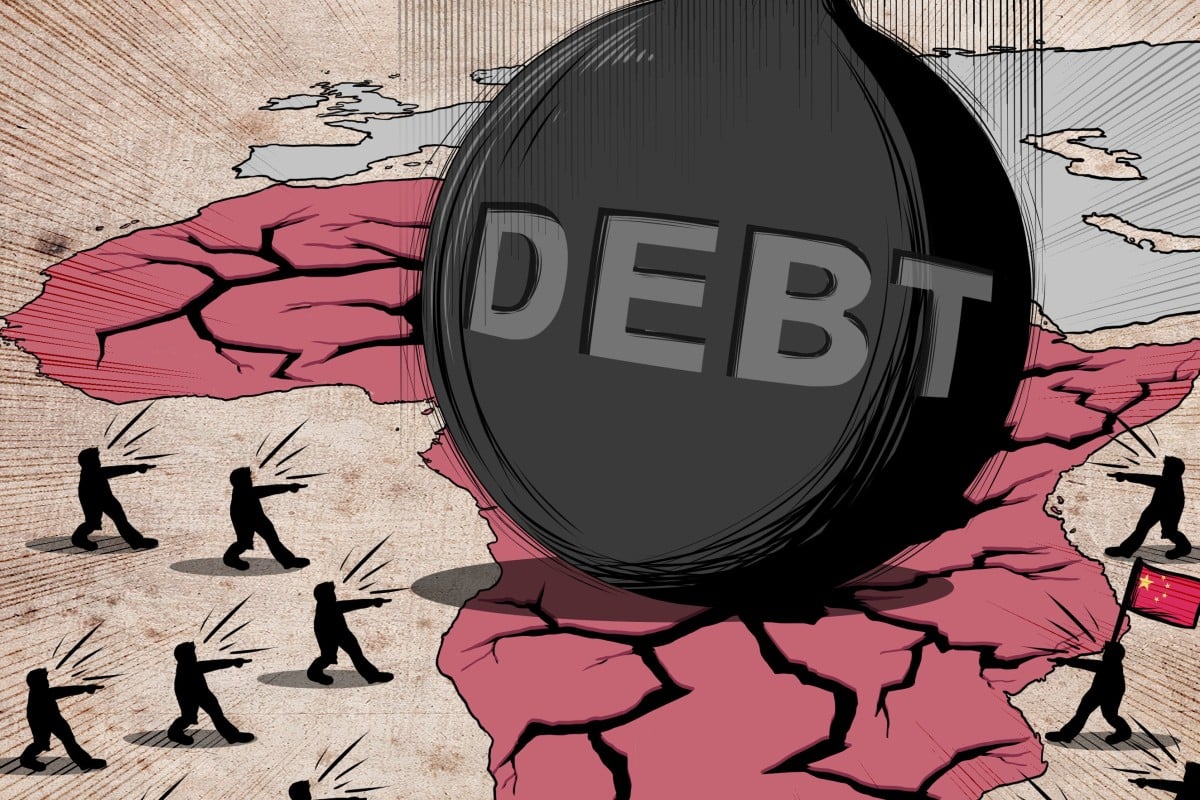
Beijing has lent billions of dollars to countries on the continent to build railways, highways and airports but critics say the borrowings are unsustainable
Chinese officials say the projects will pay off in the long run and host nations are well aware of their limits and needs
Illustration: Lau Kakuen
When Clement Mouamba went to Beijing last year, he had two main tasks.
The prime minister of the Republic of Congo needed to find out exactly how much his country owed to China, a number the struggling, oil-rich central African nation had until then not been able to provide the International Monetary Fund (IMF) to qualify for a bailout. He also needed to convince Beijing to restructure its debt to ensure sustainability.
The IMF had put talks for further loans on hold until Mouamba’s administration could say exactly how much it had to repay to the country’s external creditors, including China – the republic’s single largest bilateral lender – and oil multinationals such as Glencore and Trafigura.
The country, which heavily depends on oil revenue, turned to China and private oil majors for funding to run the government when in 2014 oil prices fell from a high of US$100 per barrel to as low as US$30.
The Republic of Congo has since restructured its borrowings from China, which holds about a third, or US$2.5 billion, of the Congolese debt, by extending the repayment period by an additional 15 years.
A number of other African countries struggling to service their loans from Beijing have also pursued concessions. Ethiopia has had part of its Chinese debt written off and terms relaxed for the US$3.3 billion loan it took to build its railway, while Zambia is seeking similar adjustments for its borrowings used to build airports and highways.
Critics say countries on the continent are being burdened with unrealistic levels of debt for inviable infrastructure backed and built by China without adequate transparency and scrutiny.
The biggest concern is that several African countries will be left with huge debts and grandiose infrastructure that they cannot maintain and run profitably. I liken it to borrowing money to buy a Tesla when you don’t have adequate access to electricity: Obert Hodzi of the University of Helsinki in Finland
But Chinese observers say the West must take some of the blame for the countries’ debt problems and that the support China offers will benefit the host countries in the long run.
In the early 1990s, when China began to embrace Africa again after years of isolation from the outside world, the aspiring manufacturer was at a serious disadvantage in the race for raw materials and markets for its industrial goods.
The former colonial powers of the West had already sewn up deals for many of the continent’s most lucrative and readily exploitable reserves, from fossil fuels to minerals.
China needed new strategies to convince African governments to allow it access raw materials for its industries and markets for its products to a largely unfamiliar partner.
China also wanted to challenge the dominance of the US in global trade and politics so it courted allies in Africa to help it push for political legitimacy in international institutions.
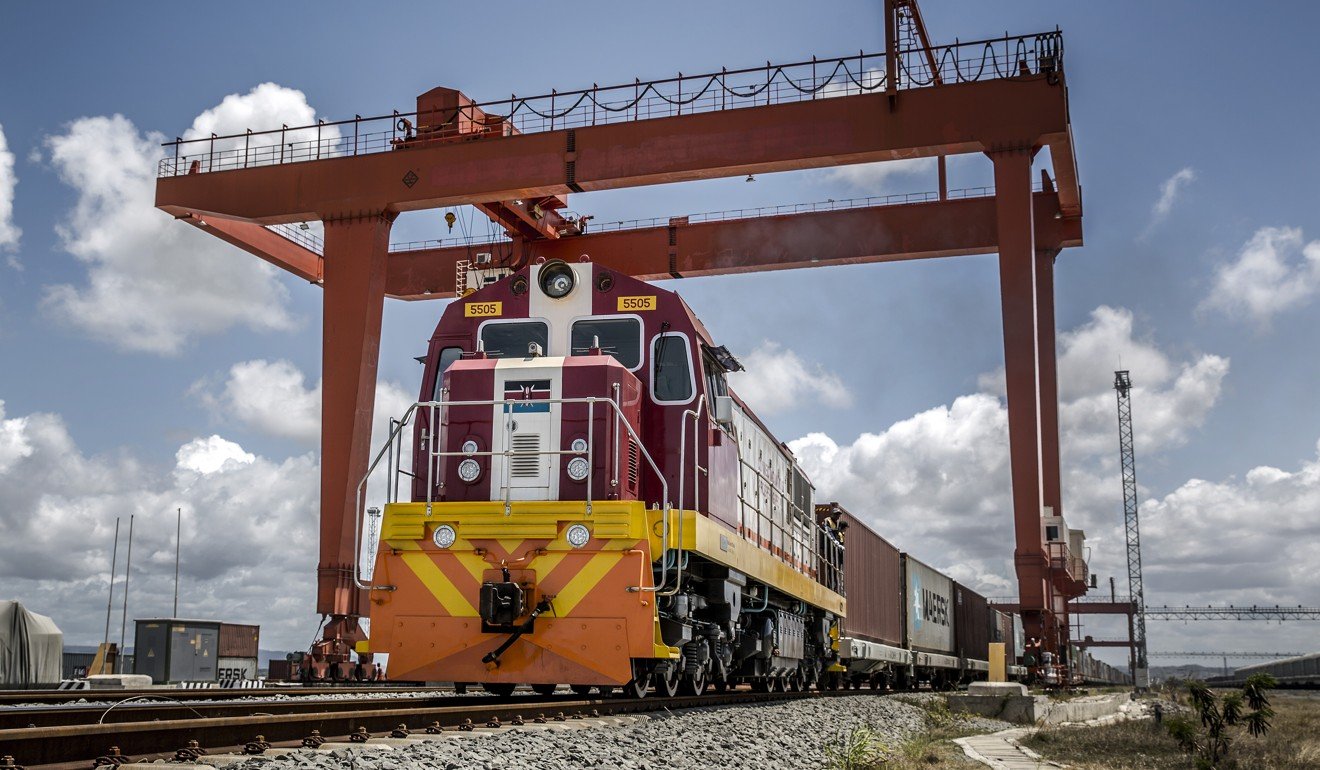
A Kenya Railways freight train leaves the port station on the Mombasa-Nairobi railway in Mombasa, Kenya, a huge project backed by China. Photo: Bloomberg
At the time, many African leaders were under fire to liberalise their economies. China’s approach was to promise not to meddle in individual country’s internal affairs and assure African countries that they could get billions in exchange for future delivery of minerals through resource-backed deals.
Beijing sold its policies that it had no conditions attached to its development finance. In the drive to drum up business, China promised affordable loans for African countries to build roads, bridges, highways, airports and power dams.
Is Kenya’s Chinese-built railway a massive white elephant?
But Beijing also pursued tied finance, ensuring that countries borrowing from China used Chinese contractors to implement the projects rather than open them up to outside bids.
In addition, many of the deals were built on weak financial, technical and environmental conditions, with Chinese state firms conducting the technical feasibility, environmental impact assessment and financial viability studies for free for projects that they also build.
For example, in Kenya, the China Road and Bridge Corporation conducted a free feasibility study that was used in the construction of the railway.
The same company was handed the contract to implement the project and is operating both the passenger and cargo train service for a fee.
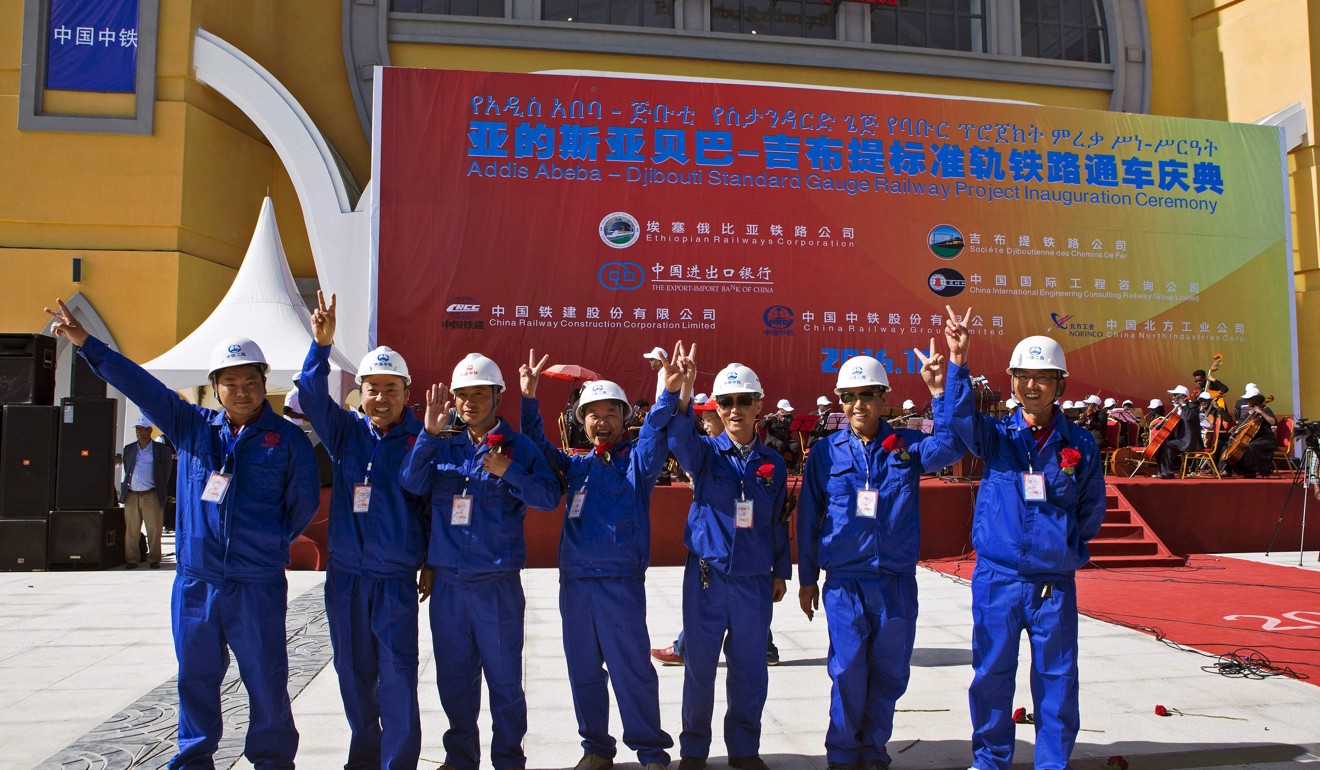
Chinese companies were responsible for the construction of a rail line between Addis Ababa and Djibouti. Photo: AFP
In contrast, the World Bank and its partner institution, the IMF, demand that such studies be done by an independent consultant and not by the company that implements the project.
According to data compiled by the China-Africa Research Initiative, at the Johns Hopkins University School of Advanced International Studies, Beijing has advanced loans worth US$143 billion to African countries since 2000, levels that some critics say are unsustainable for the borrowers.
China meets resistance over Kenya coal plant, in test of its African ambitions
For many of China’s new African partners, these arrangements – from easy lending terms, to non-competitive bidding and opaque contract details – have led to new problems – problems that corrupt or poorly managed governments now share substantial responsibility.
Some critics, both in the West and in host countries, suggest there is a “debt-trap strategy” at the heart of Beijing’s push for international business and influence, but there is no evidence that China deliberately pushes other countries into debt to seize their assets or gain sway.
However, the drive for overseas contracts and big business has led some countries into difficulties with new debts, and there are question marks over the viability of many of the projects the money is funding.
Obert Hodzi, an international relations expert at the University of Helsinki in Finland, said the Addis Ababa-Djibouti railway and the Mombasa-Nairobi railway were good examples of huge projects that were financed by easy borrowing terms from China but were not sustainable and that had in turn forced the African partners to seek further Chinese help.
“The biggest concern is that several African countries will be left with huge debts and grandiose infrastructure that they cannot maintain and run profitably,” Hodzi said. “I liken it to borrowing money to buy a Tesla when you don’t have adequate access to electricity.”
Ken Opalo, a Kenyan scholar at Georgetown University in Washington, said the key issue was the inability of African countries to design projects that were actually needed for the local economies.
A road is not just a means of transport but an economic belt or corridor that will catalyse the development of the whole region: Huang Xueqing, spokeswoman for the Chinese embassy in Nairobi
“Most African countries have been willing to accept projects designed, financed, and implemented by Chinese firms,” Opalo said.
“It would be better to decouple the feasibility studies and design phases of projects from the financing. That way African governments can ensure that they are truly getting value for money.”
But Chinese officials said Beijing had invested in infrastructure largely at the request of the host countries, adding that it could take time to yield returns on the projects.
Huang Xueqing, spokeswoman for the Chinese embassy in Nairobi, said the projects were valid assets with value that would grow in time.
“So, in the long run, it is beneficial to the host countries. Just like when young people buy a house with a mortgage, they may take some debts, but they have a place to live in and have their own assets,” Huang said.
“Underdeveloped infrastructure is the bottleneck that has been holding back Africa’s development. Up to today, many African countries, although in the same continent, are not connected with direct flights, railways or even roads. You have to fly to Paris or Zurich in order to get to some African countries.
“A road is not just a means of transport but an economic belt or corridor that will catalyse the development of the whole region.”
Huang said Beijing had advised the countries to act within their means and not to overstretch themselves when they considered projects that might not be in line with local conditions.
“When making investment decisions, the Chinese side, along with the recipient countries, carry out rigorous feasibility studies and evaluations. We do things according to our ability,” she said.
China’s leadership has also said it is paying close attention to the fiscal and financial difficulties faced by some African countries.
“As a good friend and good brother … the Chinese side is willing to lend a helping hand when needed by the African people to help them overcome temporary difficulties,” State Councillor and Foreign Minister Wang Yi said in January while on a trip to Ethiopia, adding that the debt situation in Africa is also a legacy issue.
China must allay any debt-trap fears in its dealings with Africa
“The African debt issue does not come up today, still less is it caused by the Chinese side. The African people know who are the initiators of African debt.”
The West should take a lot of the blame for worsening debt problems in some African countries, according to Li Anshan, from Peking University’s Centre for African Studies.
He cited the cases of Liberia and the Democratic Republic of Congo, two countries that have had close relations with the West for many years but remain ravaged by war and poverty despite immense natural resources.
“China-Africa relations have been going on for quite some time. Is there any African country which has got poorer because of its deal with China?” Li said.
Gyude Moore, a former Liberian minister of public works whose department oversaw construction and maintenance of various public infrastructure funded and built by China, said it would be difficult to imagine that China would knowingly ensnare its partners in debt.
“China attempts to differentiate itself from Western donors by limiting non loan-related conditionality. China also practices non-interference, so how a country manages its resources, treats its people or deploy its finances were considered ‘internal’,” he said.
“So, Chinese loans are negotiated faster and place less emphasis on public financial management.”
Moore, now a visiting fellow at the Centre for Global Development, said there were trade-offs in such situations.
China focuses on sustainable projects to dismiss fears of African debt trap
“If the loans are going to be fast – the due diligence will not be as rigorous. Chinese project selection mixes political with economic considerations. So, while a project may not make as much economic sense, it may pay political dividends,” he said.
He said non-transparent processes would invite abuse, be they Chinese, Western or African.
Other observers say the question of opacity is more directly related to China’s own economic system.
Howard French, author of China’s Second Continent: How a Million Migrants are Building a New Empire in Africa, said China has very limited transparency and public accountability in its own domestic processes.
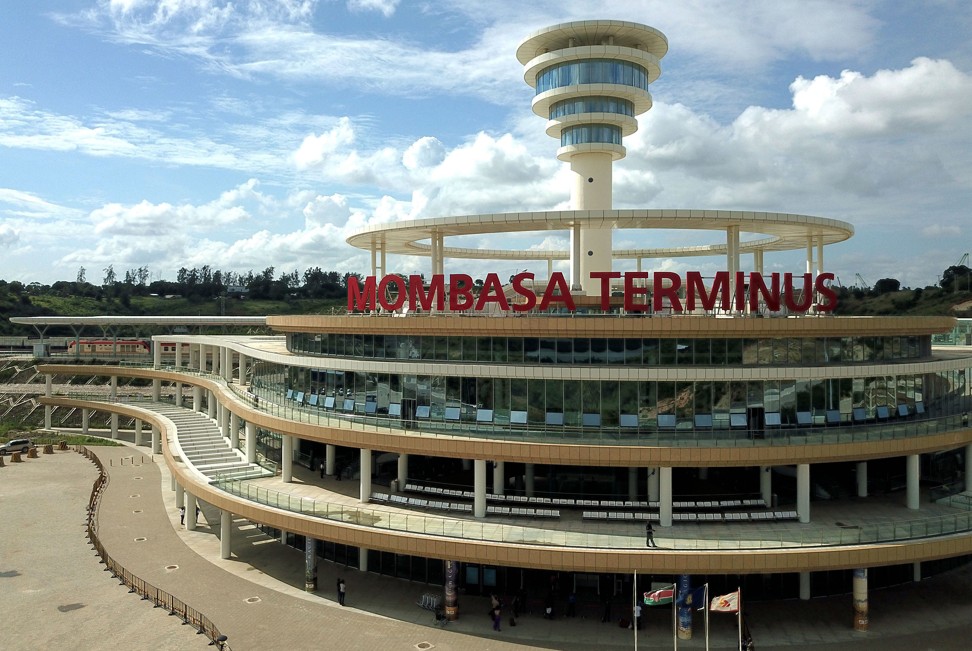
The Mombasa railway station is seen in Mombasa, Kenya, in 2018. Photo: Xinhua
“So it would be unusual to expect that China would introduce greater transparency and accountability in its dealings with African countries than it is used to at home – that is, unless African governments insist on it,” French said.
“And this is where African governance comes in. African states should insist on contract transparency but often don’t do so because that offers leaders plentiful opportunities for graft.”
David Shinn, professor of international relations at George Washington University in Washington, agreed that China’s lack of loan transparency was a huge problem and increased the risk of corruption on both the African and Chinese sides. But he also said that in some cases, African governments might have negotiated poorly.
“This is, however, the responsibility of the African government. I don’t think China is purposely trying to encourage African debts in order to gain leverage,” Shinn said.
“In fact, China is becoming more careful about its lending because it is concerned it has made too much credit available to some African countries.”
China ‘ready to talk’ about trade deal with East Africa bloc
Huang Hongxiang, director of China House, a Nairobi-based consultancy that helps Chinese in Africa integrate better, agreed, saying the Chinese government needs to communicate more about projects in Africa but African countries also have a bigger part to play in ensuring better deals.
“On commercial viability, accountability, transparency and governance, I believe the responsibility does not lie with China, the US or the West but in the hands of African countries,” he said.
Wherever the fault lies, one thing is clear when money is wasted on ill-designed projects that have little to no economic return, according to Opalo.
“The lack of planning and transparency creates default risks … [and] African taxpayers will be left holding the bag.”
This article is the third in a series examining the local impact of Chinese investment and infrastructure projects in Africa. Read part one here and part two
JINAN, March 13 (Xinhua) — Transport authorities in east China’s Shandong Province announced that it plans to invest 162.2 billion yuan (about 24.2 billion U.S. dollars) on roads, railways, ports and airports this year.
The investment is aimed at building an integrated infrastructure network in the province, said Jiang Cheng, head of the provincial transport department.
Last year, fixed asset investment in Shandong’s transportation sector reached 160 billion yuan, among which 115.8 billion yuan was spent on roads, highways and waterways, up 28 percent year on year.
This year, 61 percent of the investment will be on roads, Jiang said.
Shandong has set a target for its expressway mileage to reach 7,400 km by 2020. By the end of this year, the total will hit 6,400 km, he said.
More roads, bridges, and stations will be built in rural areas, he added.
About 10 railway projects are under construction in the province this year, with a total planned investment of 32 billion yuan (4.7 billion dollars). Upon completion, the province will be better connected with big cities such as Beijing, Shanghai and Tianjin.
Shandong had a permanent population of 100.4 million at the end of 2018. It is one of the most populous provinces in China. An improved infrastructure network will better meet economic and social needs.
BEIJING, March 6 (Xinhua) — Chinese companies operating in Africa have created huge opportunities for the continent’s development, a senior political advisor said Wednesday at a press conference on the sidelines of the annual sessions of the top legislative and political advisory bodies.
There are more than 10,000 Chinese companies in Africa and over 90 percent of them are private businesses, said Nan Cunhui, a member of the Standing Committee of the Chinese People’s Political Consultative Conference National Committee, citing a recent survey.
These companies have built roads, railways, airports, ports and other infrastructure projects in Africa, addressing the bottleneck in development, said Nan, also a vice chairman of the All-China Federation of Industry and Commerce. They have also invested in green energy development, including photovoltaic power stations, to boost local power supply.
The Chinese companies have also brought advanced technologies, development concepts and management to the continent, Nan said.
Citing the operation of an industrial park in Egypt as an example, Nan said over 95 percent of the employees are locals who develop professional skills and gain managerial know-how through their work.
“Chinese companies in Africa have contributed a lot to the local economic development through infrastructure construction, job creation and tax payment,” Nan said. “I believe China-Africa cooperation will go from strength to strength.”
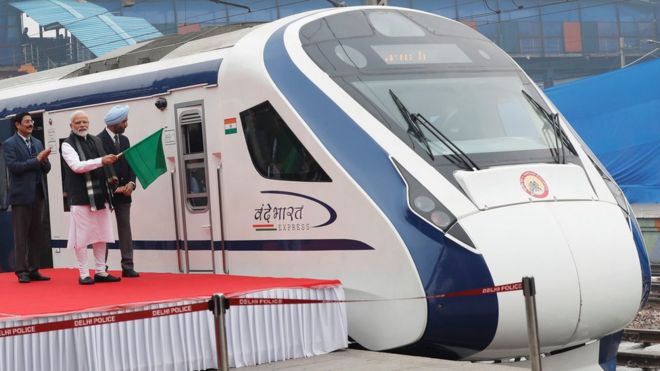
Image copyrightREUTERSImage captionPM Narendra Modi flagged off the Vande Bharat Express on Friday
India’s fastest train has broken down on its first trip, a day after it was inaugurated by Prime Minister Modi.
The Indian-built semi high-speed Vande Bharat Express was returning to the capital Delhi from the city of Varanasi after its first outing when brakes in a carriage reportedly jammed.
Indian media quoted a railways spokesperson as saying the train may have struck cattle on the line.
The train reached a speed of 180km/hr (110mph) during trials.
The new train service is expected to start its commercial run from Sunday. It is expected to reduce the travel time between Delhi and Varanasi by six hours.







 CHINDIA ALERT: You'll be living in their world, very soon