Chindia Alert: You’ll be Living in their World Very Soon
aims to alert you to the threats and opportunities that China and India present. China and India require serious attention; case of ‘hidden dragon and crouching tiger’.
Without this attention, governments, businesses and, indeed, individuals may find themselves at a great disadvantage sooner rather than later.
The POSTs (front webpages) are mainly 'cuttings' from reliable sources, updated continuously.
The PAGEs (see Tabs, above) attempt to make the information more meaningful by putting some structure to the information we have researched and assembled since 2006.
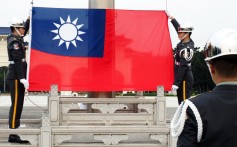
American destroyer’s mission comes a week before Taiwanese president officially starts second term in office
Increased military activity in the region could have unintended consequences but unlikely to lead to direct conflict, observer says
The guided-missile destroyer USS McCampbell made a transit through the Taiwan Strait on Thursday. Photo: US Navy
The United States sent a warship through the Taiwan Strait on Thursday as the Chinese military embarked on more than two months of live-fire naval drills off the mainland’s northern coast.
According to Taiwan’s defence ministry, the Arleigh Burke-class guided-missile destroyer transited the narrow body of water separating Taiwan from mainland China from north to south “in a routine mission”.
“It is continuing its southward voyage and the military is monitoring its movement through the intelligence it has gathered,” the ministry said.
In a statement on its Facebook page, the US Pacific Fleet said the McCampbell transited the Taiwan Strait as part of ongoing operations in the Indo-Pacific.
Analysts said the passage was a response to the People’s Liberation Army’s increasing military activity near Taiwan and in the wider region.
“This will become a new routine as a kind of US security commitment to maintain stability in the Indo-Pacific region,” said Soong Hseik-wen, professor of strategic studies and international relations at National Chung Cheng University in Taiwan.
Beijing urges France to cancel contract to sell arms to Taiwan
13 May 2020
The PLA has staged a series of war games, including fly-bys and warship transits through the strait, in recent months in response to what Beijing sees as growing pro-independence moves by the Tsai government and her party. China has also warned the US against supplying weapons to the island, which Beijing considers to be a wayward province that must return to the mainland fold, by force if necessary.
Mainland China has suspended official exchanges with Taiwan since Tsai was first elected president in 2016 and refused to accept the one-China policy, which Beijing says must be the foundation for any talks.
The PLA has embarked on 11 weeks of naval exercises off the coast of Tangshan in northern China, barring all other vessels from a 25km (15 mile) radius of the drill area, according to the China Maritime Safety Administration.
Taiwanese support closer ties with US over China, few identify as solely Chinese, Pew Research survey finds
13 May 2020
Both Beijing and Washington have ramped up military activities near Taiwan in recent months during the coronavirus pandemic, moves that some observers say run the risk of miscommunication.
Alexander Huang Chieh-cheng, professor of strategic studies and international relations at Tamkang University in Taipei, said no one could exclude the possibility of unintended incidents when both the US and the mainland were stepping up their presence in the region.
“Rational analysts would however argue that the two nuclear powers are not likely to engage in or escalate to direct military conflict,” he said.
Huang said he believed cross-strait relations would worsen during Tsai’s second term in office, which begins on May 20.
“The already damaged relationship between Taiwan and mainland China has worsened since the pandemic mainly due to travel bans and Taiwan’s increased international visibility,” he said.
On Tuesday, Japan’s Kyodo News reported that the PLA was planning a large-scale beach landing exercise near Hainan province in August, simulating a takeover of the Pratas Islands, which are controlled by Taiwan and also known as the Dongsha Islands.
In Taipei, Major General Lin Wen-huang said Taiwan was monitoring the PLA movements and “has contingency plans in place for the South China Sea to strengthen combat readiness and defence preparedness on both the Spratly and Pratas islands”.
Taiwan’s coastguard also announced on Wednesday that its Pratas Islands Garrison was scheduled to conduct an annual live-fire exercise in June to ensure the “effectiveness of various mortar and machine-gun positions”.
Taiwan shows off its military power after presidential election
Shanghai-based military commentator Ni Lexiong said that both the US Navy and PLA were increasing activities during the pandemic because neither side could afford to show weaknesses that the other might take advantage of.
The destroyer’s passage and the PLA’s drills were all part of such efforts, Li said.
But he agreed that both countries were unwilling, unable, and unlikely to have a real conflict.
“They are both bluffing. It’s a fake crisis,” he said. “A pandemic always ends or prevents a war if you look at history.
“I also don’t believe the PLA would want to take over the Dongsha or Taiping islands [in the South China Sea], because these islets alone are not worth a military campaign and all the consequences of that. The only target valuable enough for the PLA is Taiwan.”
Test in Xiong’an, the new city being built south of Beijing, will focus on everyday goods and services for the first time
American food outlets to be included in the digital currency tests, conducting small transactions with local firms
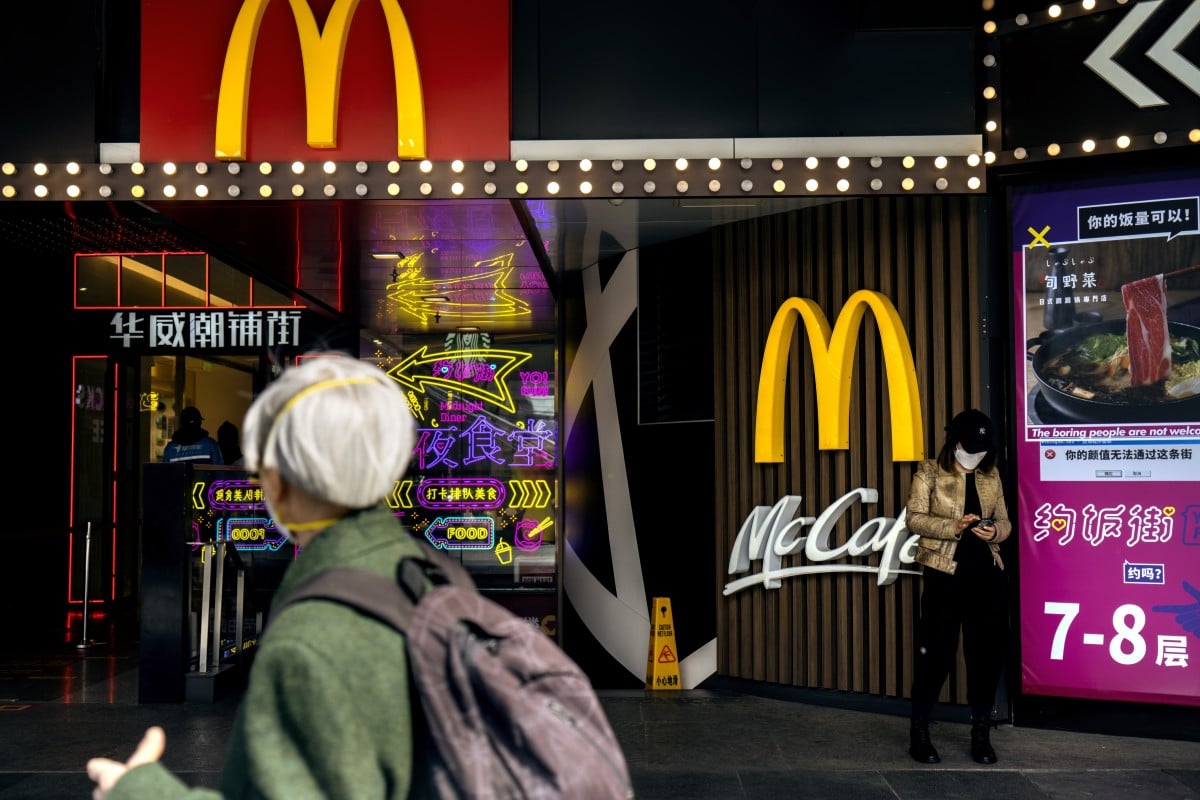
American chains Starbucks, McDonald’s and Subway were named on the People’s Bank of China’s list of firms that will test the digital currency in small transactions with 19 local businesses. Photo: Bloomberg
China’s central bank has accelerated the testing of its new sovereign digital currency and, for the first time, will include some foreign consumer brands in the programme.
American chains Starbucks, McDonald’s and Subway were named on the People’s Bank of China (PBOC)’s list of firms that will test the digital currency in small transactions with 19 local businesses.
The global names will be joined by local hotels, convenience stores, a stuffed bun shop, a bakery, a bookstore and a gym, according to details revealed at a promotional event in the Xiong’an New Area, a city being built south of Beijing, news portal Sina.com reported.
The inclusion of businesses providing everyday goods and services marks an expansion of the PBOC’s testing. It follows a previous disclosure that last week in Suzhou the digital currency was used to pay half public sector workers’ travel subsidies for May.
Is China a currency manipulator?
Wednesday’s promotional event was organised by the local branch of the National Development and Reform Commission, the powerful planning agency, and attended by representatives of the Big Four state-owned banks and two of the country’s internet giants – Alibaba and Tencent.
China has not released a timetable for launching the digital yuan, but last week’s reports on new testing have fanned speculation that it could be imminent.
The tests were reportedly accelerated after Facebook launched its Libra project in June last year, an attempt to create a global digital currency pegged to a basket of currencies and backed by global commercial giants.
The Libra Association, the consortium managing the project, announced changes last week in an attempt to win regulatory approval and pave the way for an official launch sometime later this year. The consortium said it would create multiple digital units tied to existing currencies such as the US dollar or the euro, rather than a single token based on a basket of currencies.
China’s official digital currency, known as Digital Currency Electronic Payment (DCEP), came into the public spotlight last week when a screenshot of a test version of an app developed by the Agricultural Bank of China circulated online.
The digital currency app has several basic functions, similarly to other Chinese online payment platforms such as Alipay and WeChat Pay – the country’s two most popular online payment tools – allowing users to make and receive payments, and transfer money.
“It’s certain that the DCEP is now in its final testing stage and should be officially launched,” BlockVC, an investment firm, said in a research note.
The PBOC’s digital currency research institute confirmed last Friday that testing was being conducted in four cities: Shenzhen, Suzhou, Xiong’an and Chengdu. In addition, venues for the 2022 Winter Olympics in Beijing and Zhangjiakou will join the testing programme in the future.
What is the Hong Kong Dollar Peg?
The institute, which was inaugurated in 2017, said that the test versions and applications of the currency had not been finalised.
The project testing is based on two principles: the central bank issues the virtual money to commercial banks who then pass it on to consumers, and that is aimed at replacing cash in all transactions.
China is the first major economy to publicly announce plans for a sovereign digital currency, aiming to better control the rapid rise of digital payments worldwide.
The PBOC has, however, cracked down on the trading of other digital currencies and banned banks from accepting cryptocurrencies, which it views as a risk to financial stability.
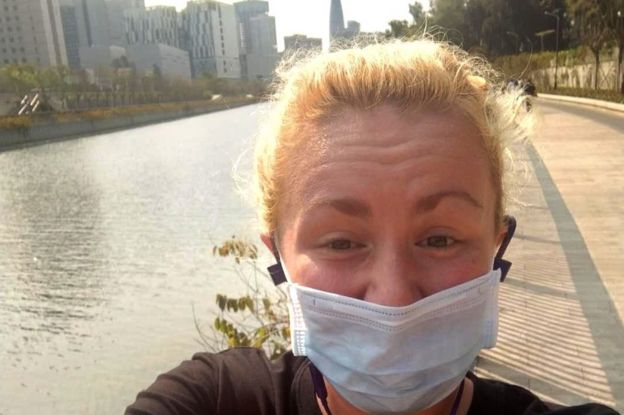
Image copyright JEN SMITHImage caption Jen Smith lives in Shenzhen, where it’s compulsory to wear a mask outside at all times
My Money is a series looking at how people spend their money – and the sometimes tough decisions they have to make. Here, Jen Smith, a children’s TV presenter from Shenzhen in southern China, takes us through a week in her life, as the country slowly emerges from the coronavirus pandemic.
Over to Jen…
Since being in lockdown I’ve been bingeing on Keeping Up With the Kardashians. It starts with one episode after dinner, blink, and suddenly it’s 3am. YouTube, Facebook, Google and Instagram are all banned here, so you’d think I’d be a binge-free socialite after a year and a half living in China. Well, those sites are banned unless you have a VPN – I pay $120 (£97) a year for mine, so Sunday was a late night, with a lie-in until 10.30 this morning.
I go for a run – mask and all, as it’s currently illegal to be outside without one. I make my coffee (bought in the UK), fruit smoothie (about 20 yuan, $2.82, £2.27) and cereal (80 yuan a packet) before cycling to work.
Today is a bit of a crazy day in the studio. I work as a children’s TV presenter. My company has profited from the lockdown as more children are watching the shows non-stop – meaning a rapid turnaround for us.
We shoot two shows from 2-6pm then “break” for a meeting. We discuss tomorrow’s shoot while I eat dinner – homemade aubergine curry. It is normal for the Chinese to eat breakfast, lunch and dinner at work. Normally the company gives all staff 25 yuan through a food-ordering app, and the whole company would eat together. However, because of the current social distancing, that social time is in the far distant past!
I make it home for 8pm, order some deep-fried cauliflower as a snack (45 yuan) and start the inevitable Kardashian binge.
Total spend: 65 yuan ($9.10, £7.37)
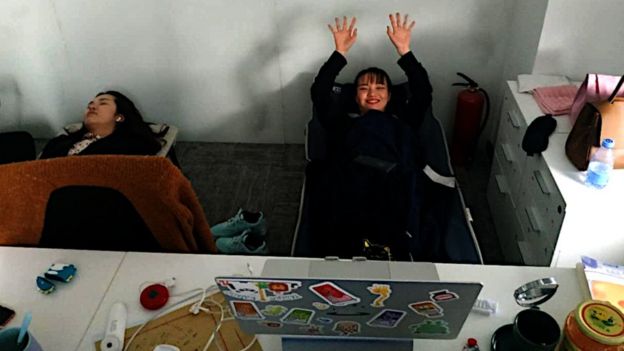
Image copyright JEN SMITHImage caption Workers often have a midday nap in the office
It’s a much earlier start (7.30am), but the same morning routine. On my cycle to work I notice that the traffic is almost back to normal – Shenzhen is inhabited by well over 12 million people, so as you can imagine rush hour is intense. This doesn’t change the fact that everywhere you go you have to scan a QR code – leaving my apartment, using the walkway by the river, and getting into the building I work in.
After a morning of shooting I eat homemade potato curry and settle down for a nap. Naptime is such a commonality in China that people store camp beds at the office. I order a coffee and banana chips (20 yuan) for a pick-me-up before the afternoon’s shooting.
It’s St Paddy’s Day so I head to the local pubs area, catch dinner at a French restaurant (222 yuan), then a few drinks (25 yuan – mainly bought by men at the bar for us) before a very tipsy cycle home.
Total spend: 242 yuan ($34, £25)
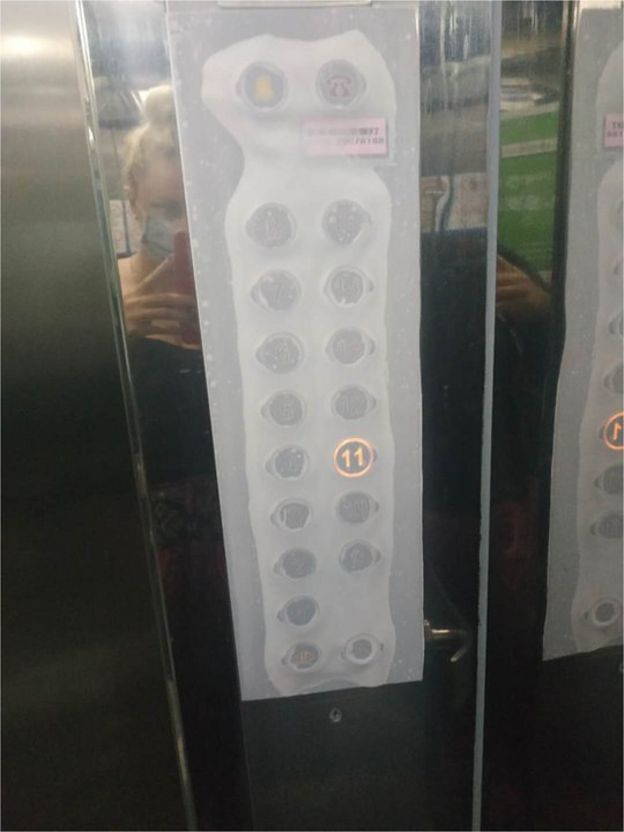
Image copyright JEN SMITHImage caption A disposable cover reduces the risk of transmitting the virus by touching lift buttons
The morning’s shoot (thankfully) was cancelled, so I nursed a hangover in bed until around 11am, at which point I had a phone meeting for a company that I do “plus-size” modelling for (for context I’m a UK size 12). I eat a bowl of cereal and order more cauliflower (45 yuan) while I watch a film.
At 2.30pm an intern picks me up, and we head to the government building to apply for a new work visa. Ironically, the image taken for my visa is Photoshopped to remove wrinkles, freckles and my frizzy hair. When I ask why this is being done for an identification document, the intern replies that the government wants it to be neat, and “the Chinese way” is to have altered photos.
I don’t argue, and have an interview before I hand in my passport. The whole process takes around two hours, so I order food to my house while on the way home (150 yuan for burger, salad and cake!) I take a taxi across town which ends up being 39.05 yuan.
The day starts at 8.30am with coffee and reading, before I get a manicure (280 yuan). My nail lady has been very worried about the state of my hands during the virus, so she spends a whopping two and a half hours treating them while I watch a film (0.99 yuan – bought by her). Because the manicure was so long I don’t have time to eat lunch before our fitness shoot, which runs from 2-5.30pm. I then have an appointment to sign into a building which I’ll shoot in tomorrow.
The building is near a supermarket called Ole (one of the only western supermarkets), and I pick up groceries for 183 yuan before heading home to cook, listen to podcasts and prep for the big day of shooting on Friday.
Total spend: 463 yuan ($64, £52.5)
Image copyright JEN SMITHImage caption Jen filming in front of a green screen – a more colourful digital background will be added later in post-production
Fridays are generally my busiest day. The way the Chinese seem to function, is a boss will say “I want this done now” and then employees rush to finish it. Generally, they will write scripts on Monday and Tuesday, discuss Wednesday, then we shoot later in the week. The poor editors, despite mandatory office hours during the week, then have to work tirelessly through the weekend to achieve a Sunday evening deadline.
I start with mashed avocado and a hard-boiled egg before work. The morning shoot runs from 9.30-11.40am, and I have an early lunch – homemade curry again, before my regular nap time. The afternoon shoot is three hours, so I have time to pop home and shower before a live stream at 6pm. I take a taxi to and from the live stream which ends up being 28 yuan.
Total spend: 28 yuan ($3.92, £3.18)
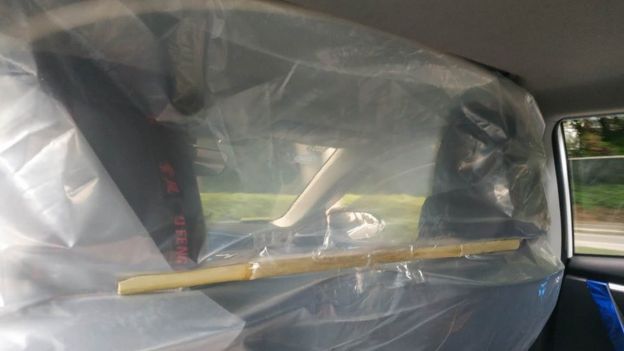
Image copyright JEN SMITHImage caption A taxi driver has improvised a screen to reduce the risk of picking up Covid-19 from a passenger
Finally the weekend! Although things are slowly getting better in China after the coronavirus outbreak, there’s still not too much to do. So I use this time to write, play my piano and generally chill inside. Around 3pm, I venture outside to the shops to pick up some snacks (159.60 yuan) before settling in to ring my family back in the UK with a homemade cocktail – a friend of mine in Canada is doing a daily live stream, “quarantinis” where he teaches you how to make cocktails!
What’s interesting is that a lot of people have started leaving their houses again, but it is still illegal to go outside without a mask on, and temperature checks are taken everywhere. I was even refused entry to a building due to being foreign. I imagine this is because recently the only new cases are being brought in by non-Chinese travelling back to China.
Total spend: 159.60 yuan ($22, £18)
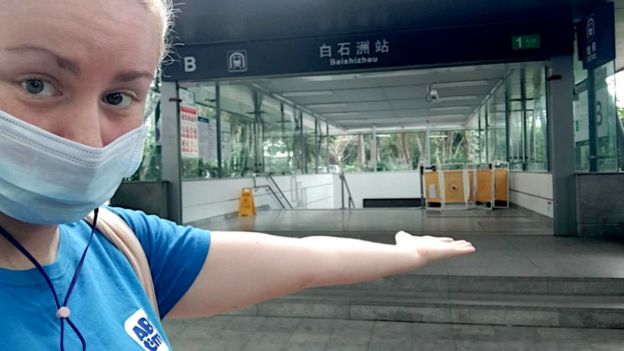
Image copyright JEN SMITHImage caption Shenzhen’s Metro system is still very quiet
It’s another slow day for me as many foreigners have not yet returned to China, so most of my friends are out of the country. I start the day by reviewing potential scripts.
This takes me to 1.30pm without realising I haven’t eaten. I decide to go for a quick run and I return to eat mashed avocado and a hard-boiled egg.
I home-bleach my hair with products bought in the UK, then head back to editing again. About half way through the afternoon I take a little break to practice Chinese. I use an app which is fantastic and free! Definitely worth everyone downloading this during social distancing so you can learn new skills!
For dinner I order online again, a three-dish meal for 160 yuan.
not long ago – unless they have a child addicted to the wildly popular app, on which users make and share short, amusing videos.
It has grown explosively since its 2016 launch, with 800 million monthly active users now – 300 million of them outside China in places such as India (120 million) and the
(37 million). And many have no idea it is owned by a Chinese company, ByteDance.
The first Chinese app to mount a real global challenge to Facebook and Instagram, it is seen as one of the shiniest new weapons in the US-China technology war. And a boost, perhaps, to Chinese soft power.
TikTok, the missing link between Hong Kong and Indian protesters?
9 Feb 2020
It experienced a growth spurt in 2019 that analysts predicted would slow a little this year. That, however, was before the coronavirus, which seems to be giving the app a bump, especially beyond its core teenage fan base.
As pandemic fears rise and millions are stuck indoors, major Hollywood celebrities such as Jennifer Lopez, 50, have taken to posting their own all-singing, all-dancing videos, which then go viral on other media platforms.
Even the World Health Organisation has jumped on the bandwagon, joining the app in late February to share public health advice.
The TikTok logo on a smartphone. Photo: Getty Images
But to some, the growth of TikTok is far from benign.
Privacy advocates and several US congressmen want to rein in the app over concerns it may censor and monitor content for the Chinese government, and be used for misinformation and election interference. This despite the fact that TikTok keeps its servers outside China and swears it will not hand over user data.
Are these fears justified – or fuelled by political and anticompetitive motives?
Thinkers such as Yuval Noah Harari warn that the coronavirus pandemic could be a watershed in the history of mass surveillance.
But Eric Harwit, a professor of Asian studies at the University of Hawaii, does not buy such arguments against TikTok, especially given that 60 per cent of its US users are aged 16 to 24.
“ByteDance has done a pretty good job of having a firewall between TikTok and the Chinese version of it, Douyin.
TikTok, iPhone: all you need to escape Mumbai’s slums – for 15 seconds
1 Nov 2019
“Also, many users in the US are teens and they’re not a particularly useful source of national security information.
“So I’d say the concerns are motivated more by a general fear of any kind of Chinese telecommunication application rather than actual attempts to siphon off valuable US intelligence information.
“And Facebook and other American companies have similar products,” Harwit points out. “US government officials will always want to protect American commercial interests.”
Sarah Cook, a China analyst for Freedom House – the US government-funded think tank – disagrees.
“We have concerns about how Facebook and Twitter deal with information affecting electoral politics, and that’s magnified if you’re talking about a Chinese company that now has a user base that rivals theirs.”
Chinese officials, she argues, have shown a willingness to censor and manipulate information well beyond their country’s borders – for instance, regarding the scale of the initial outbreak in Wuhan, an obfuscation that may have exacerbated its impact abroad.
“For those who think Chinese government censorship is only Chinese people’s problem, this pandemic shows how much that’s not the case.
“And even if it’s not happening right now with TikTok, the concern is that Chinese companies are beholden to their government, whether they want to be or not.
“I’m not saying block TikTok entirely,” she says. “It’s a question of looking at it in a democratic system and deciding on reasonable oversight and safeguards to protect users and information flows when that time comes.”
When it comes to expanding China’s cultural influence, though, neither Cook nor Harwit believes the app is especially effective.
Most people are oblivious to its Chinese origins, which the user experience does not reflect in any way. So there is no goodwill-generating soft power of the sort wielded by, say,
If anything, TikTok often promotes the increasingly homogenous, Western-leaning culture seen on many globally popular social media apps.
So says Morten Bay, a lecturer in digital and social media at the University of Southern California’s Annenberg School for Communication and Journalism.
“A semi-Western culture, with small variations of local culture, is becoming the norm on social media. And Chinese soft power is difficult to assert because there’s no value difference.”
And even if Chinese tech companies keep taking bigger bites of the Western market, he is sceptical of China’s “ability to leverage that for soft power in a geopolitical sense”.
“Because there is a very big apparatus pushing against China in that regard. As soon as TikTok started gaining traction in the US, people came out against it, trying to make everyone aware of the privacy and geopolitical issues.
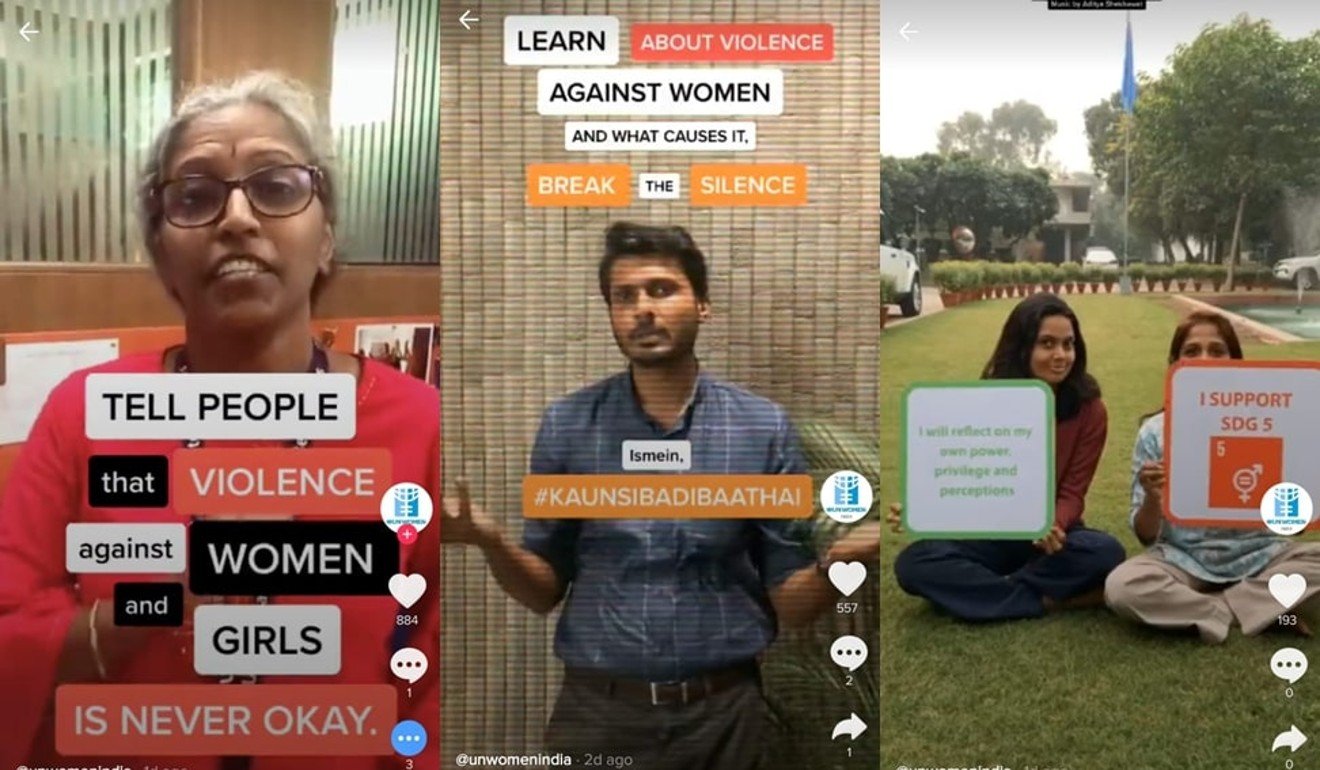
The #KaunsiBadiBaatHai campaign on TikTok aims to raise awareness about women’s safety issues in India. Image: TikTok
“So China faces a lot of resistance,” Bay concludes. “And I’m not sure a social media platform on its own can do much about that.”
Still, if you had to back a horse in this race, TikTok would be it, says Zhang Mengmeng.
When she and her colleagues from global industry analysis firm Counterpoint Research visited the company, they were impressed by its research and development capabilities.
“Because they’re a very young company, their pace for incubating new projects is a lot faster, especially compared to successful but older internet companies in China which have been around for 15 to 20 years.
Indian invasion of Chinese social media apps sparks fear and loathing in New Delhi
28 Apr 2019
“They have lots of little start-up projects within the company and their organisational structure is very flat – it doesn’t matter what your age is, if you have a good idea, you get promoted very quickly.”
TikTok’s rise is also emblematic of a broader role reversal in the US-China tech war, she believes.
“Before, the US was more advanced in terms of internet development and China seemed to just copy its new ideas. Now, this is reversing. There are so many people in China using the internet that start-ups there can test ideas very easily.
“So now it seems like a lot of US companies are trying to see what ideas are coming out of China.” ■
With India under lockdown and social distancing being advised to deal with the threat of the coronavirus, an online collective of “Caremongers” is reaching out to help the elderly and other vulnerable groups.
It started last week when Mahita Nagaraj, a digital marketing professional and single mum, received a call from a close friend in the UK requesting her to help arrange some medicines for her “very elderly parents”.
Within hours, she heard from another friend living in the US with a similar question: can you ensure that my parents have provisions for the month?
Ms Nagaraj, who lives in the southern city of Bengaluru (formerly Bangalore), says that set her thinking about other friends whose elderly parents didn’t have anyone to call upon.
So, she posted a message on Facebook asking people to get in touch if they needed help.
The response she got was “overwhelming”. People reached out to her from all over India and, surprisingly, most who got in touch said they wanted to help out too.
And thus was born Caremongers India – a Facebook group, asking people to “stop scaremongering and start caremongering” – on 17 March.
“There is so much scaremongering in the current scenario,” says Ms Nagaraj. “We are trying to address the feeling of helplessness in the people. We are telling people to stop spreading fear and panic, and instead spread love.”
Image copyright CAREMONGERS INDIAImage caption Mahita Nagaraj set up Caremongers India after her friends called her to seek help
Ms Nagaraj says she learnt about caremongering from a BBC article from Canada. The concept actually started in Toronto to help vulnerable people, but within days it spread to cover almost all of Canada with tens of thousands signing up.
Reports of altruism have come in from other parts of the world too. Britons are delivering soup to the elderly, in the US neighbours are helping those quarantined with buying groceries and one Long Island mother, infected with the virus, wrote about a neighbour who cooked a lasagne and left it outside her door.
Along with all the fear and panic caused by the coronavirus, the pandemic has also seen kindness go viral across the globe, with neighbours and complete strangers pitching in to help.
In India too, caremongering took off from the word go – in the first 24 hours, the Facebook group had 200 members. A week later, it has become a pan-India network with more than 6,500 volunteers.
Ms Nagaraj says she realised that on Facebook, most people were getting in touch to offer help, but only a few were asking for help. So, on Friday night, she launched a helpline number and since then, “it’s gone crazy”.
Caremongers India offers help to those who are most at risk of health complications due to the virus like the elderly, the disabled, those with pre-existing health conditions and anyone with an infant under a year.
In less than a week, Ms Nagaraj says, she has received thousands of calls and messages and although a large number of them have been to verify whether the number is genuine, she has also taken hundreds of requests for assistance.
Listed on the Caremongers India page are countless examples of assistance sought and provided; and testimonials and messages of gratitude.
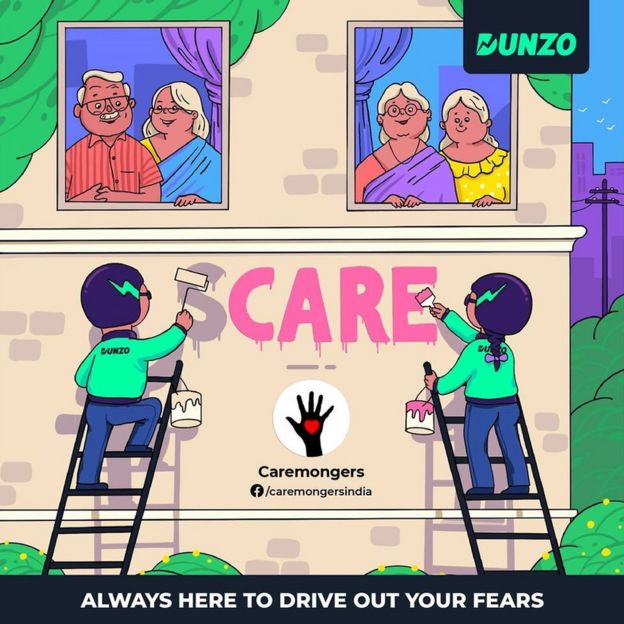
Image copyright IMAGE COURTESY: DUNZOBesides those calling in from within India, Ms Nagaraj has been fielding dozens of calls from people across the globe seeking help for their elderly parents and grandparents.
“When people give their requirement and address, we match the requester with the closest volunteer,” she explains.
So last Saturday, when Amit Joshi, a resident of an upscale apartment block in the Delhi suburb of Noida, called the helpline, he was connected to Caremonger Madhavi Juneja, who also lives in Noida.
“We woke up to the news that our apartment complex was under lockdown,” Mr Joshi told me.
A resident had tested positive for the coronavirus and Mr Joshi was informed that they would not be allowed to leave home for a week.
“Police had put up barricades outside on the road and our complex was swamped with disaster management teams and health officials. Everything around us was shuttered. There was complete panic,” he says.
Mr Joshi, who lives with his wife and elderly parents, says his biggest worry was how to get essentials like bread and milk.
And when he received a random WhatsApp forward from a colleague about Caremongers India, he decided to call them.
A few hours later, Ms Juneja, a psychotherapist and life coach, turned up at the gate of Mr Joshi’s housing society and handed over the supplies to him.
“I wore a mask and took my bottle of hand sanitiser and drove to his complex to carry out the delivery,” she said.
“Because the street was barricaded, I parked my car and then walked. If I had left it outside, someone else could have taken it. After I handed over the package to him, I sanitised my hands and got back into my car.”
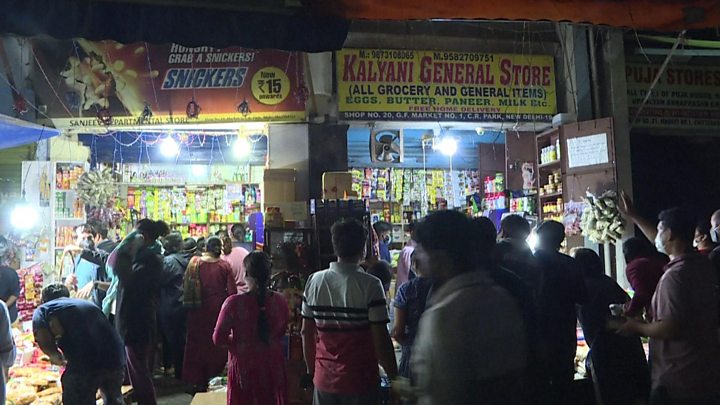
Media caption People panicked after Narendra Modi said nobody should leave their homes, and did not mention the status of essential supplies
Mr Joshi says, “In trying times like these, to have people selflessly reaching out to those in need has strengthened my belief in humanity.”
Ms Nagaraj says it’s “so heartening” to see that so many people want to help.
“Every request we receive is very special when we fulfil it. When a daughter calls to say her dad who lives alone requires provisions, we work hard to ensure he gets it.”
Ms Nagaraj says caremongering has taken over life and even her home.
“It’s not easy to answer 450 calls a day,” she says, “but when you help others, you go to bed thinking you haven’t wasted your day and that’s good enough for me.”
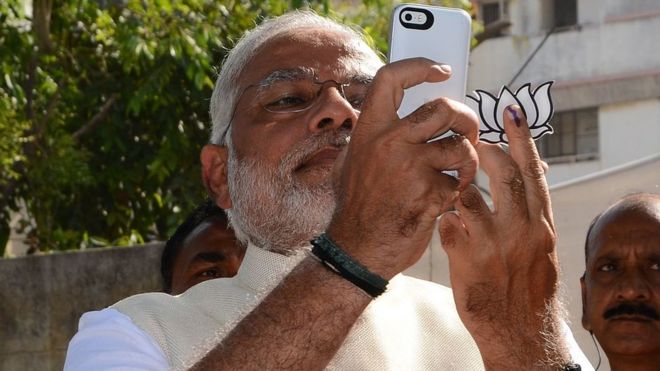
Image copyright STRDELImage caption Prime Minister Modi is the third most followed leader on Twitter after Donald Trump
The world’s second most popular leader – when it comes to social media, at least – sent shockwaves through the internet on Monday, after announcing he was considering leaving the platforms.
After all, Indian Prime Minister Narendra Modi is the only politician to even come close to challenging US President Donald Trump’s online dominance.
And so it was somewhat unsurprising that the hashtag #ModiQuitsSocialMedia began trending in India, with users quick to share a heady cocktail of conspiracy theories, memes and desperate pleas.
However, Mr Modi, who has 54 million followers on Twitter, 35.2 million followers on picture sharing platform Instagram and 44 million followers on Facebook, soon revealed the true reason behind his abandonment of social media.
On Tuesday, he said that he would “give away my social media accounts to women whose life & work inspire us”.
But the “big reveal” came only after his first tweet generated an absolute social media storm.
Some theories suggested he was quitting social media platforms as they were being controlled by his opponents. Others speculated that he would launch an indigenous social platform, to match Twitter and Facebook, something similar to social media platforms like WeChat and Weibo in China.
“Expect SM companies stock to crash,” wrote one confident user.
Apart from the theories, there were desperate pleas from his fans. One wrote: “Please Sir, You can’t leave social media now for the sake of your fans!” Another added: “Modi Ji if you leave social media , they will use it against you and nation interest.”
“For me he is not only PM of India but also emotion. You’re king of social media. Don’t go sir.”
Some users suggested that his account had been hacked.
Soon, #Iwillalsoleavetwitter started trending.
Arun Yadav, the head of Haryana state IT and social media for BJP, tweeted asking the PM to not quit the platform as it was one way Indians could communicate with him.
But there were also jokes.
“Spare a thought for Twitter, Facebook & their stocks. PM Modi is all set to demonetise social media,” wrote one user, referring to the overnight decision to ban high value currency notes in November.
One user suggested that the prime minister was quitting all other platforms in order to make his TikTok debut.
“Modi ji is a typical Indian boyfriend after breakup,” quipped one Twitter user.
“Modiji should be awarded Nobel Peace Prize for bringing peace in the digital world,” said another.
Image caption #NoModiNoTwitter was a India trend on Twitter after PM Modi’s tweet yesterday
There were political reactions too.
In a cheeky response, Rahul Gandhi, former president of the main opposition Congress party, tweeted: “Give up hatred, not social media accounts.”
Congress leader and MP Shashi Tharoor followed suit, writing: “The PM’s abrupt announcement has led many to worry whether it’s a prelude to banning these services throughout the country too.”
Mr Modi’s eventual tweet which clarified matters was seen by some as an anti-climax.
But for the millions who were pleading with him to reconsider, this is surely a big relief.
SHANGHAI/SEOUL (Reuters) – Asia reported hundreds of new coronavirus cases on Wednesday, including a U.S. soldier stationed in South Korea, as the United States warned of an inevitable pandemic and outbreaks in Italy and Iran spread to other countries.
World stocks tumbled for the fifth day on fears of prolonged disruption to global supply chains, while safe-haven gold rose back toward seven-year highs and U.S. bond yields held near record lows.
Stock markets globally have wiped out $3.3 trillion of value in the past four trading sessions, as measured by the MSCI all-country index.
The disease is believed to have originated in a market selling wildlife in the central Chinese city of Wuhan late last year and has infected about 80,000 people and killed more than 2,700, the vast majority in China.
RELATED COVERAGE
Trump returns to U.S. as country warily eyes spread of coronavirus
Facebook to ban misleading ads about coronavirus
The U.S. Centers for Disease Control and Prevention urged Americans to prepare, saying that while the immediate risk there was low the global situation suggested a pandemic was likely.
“It’s not a question of if. It’s a question of when and how many people will be infected,” the CDC’s principal deputy director, Anne Schuchat, said on Tuesday.
World Health Organization (WHO) chief Tedros Adhanom Ghebreyesus, however, advised against referring to a pandemic.
“We should not be too eager to declare a pandemic without a careful and clear-minded analysis of the facts,” Tedros said in remarks to Geneva-based diplomats.
“Using the word pandemic carelessly has no tangible benefit, but it does have significant risk in terms of amplifying unnecessary and unjustified fear and stigma, and paralyzing systems. It may also signal that we can no longer contain the virus, which is not true.”
‘DON’T WAIT’
The United States has reported 57 cases of the virus. U.S. President Donald Trump, back in Washington after a visit to India, said on Twitter that he would meet U.S. officials for a briefing on the coronavirus on Wednesday.
Dr Bruce Aylward, head of a joint WHO-Chinese mission on the outbreak, told reporters on his return to Geneva that countries’ preparations should not wait.
“Think the virus is going to show up tomorrow. If you don’t think that way, you’re not going to be ready,” he said. “This a rapidly escalating epidemic in different places that we have got to tackle super-fast to prevent a pandemic.”
Aylward said China’s “extraordinary mobilization” showed how an aggressive public health policy could curb its spread.
The WHO says the outbreak peaked in China around Feb. 2, after authorities isolated Hubei province and imposed other containment measures.
China’s National Health Commission reported another 406 new infections on Wednesday, down from 508 a day earlier and bringing the total number of confirmed cases in mainland China to 78,064. Its death toll rose by 52 to 2,715.
The WHO said only 10 new cases were reported in China on Tuesday outside Hubei.
South Korea, which with 1,261 cases has the most outside China, reported 284 new ones including a U.S. soldier, as authorities readied an ambitious plan to test more than 200,000 members of a church at the center of the outbreak.
Of the new cases, 134 were from Daegu city, where the virus is believed to have been passed among members of the Shincheonji Church of Jesus, the Korea Centers for Disease Control and Prevention said.
The U.S. military said a 23-year-old soldier based in Camp Carroll, about 20 km (12 miles) from Daegu, had been infected and was in self-quarantine at home.
OLYMPIC WORRIES
In Japan, Prime Minister Shinzo Abe called for sports and cultural events to be scrapped or curtailed for two weeks to stem the virus as concern mounted for the 2020 Tokyo Olympics.
Japan’s professional baseball teams would play matches without spectators until March 15 due to virus concerns, Kyodo news agency reported.
Japan has nearly 170 virus cases, besides the 691 linked to a cruise ship that was quarantined of its coast this month. Six people have died in Japan, including four from the ship.
There have been nearly 50 deaths outside China, including 11 in Italy and 19 in Iran, the most outside China, according to a Reuters tally.
Iran’s deputy health minister – seen mopping his brow at a televised news conference – was among its 139 coronavirus infections. Cases linked to Iran have been reported across the region.
Kuwait said six new coronavirus cases, all linked to travel to Iran, took its tally to 18, while Bahrain said its infections had risen to 26 after three new ones on a flight from Iran.
The United Arab Emirates, which has reported 13 coronavirus cases, is prepared for “worst case scenarios” as it spreads in the Middle East, a government official said.
In Europe, Italy has become a front line in the global outbreak with 322 cases. Italians or people who had recently visited the country, have tested positive in Algeria, Austria, Croatia, Romania, Spain and Switzerland.
Two hotels, one in Austria and one in Spain’s Canary Islands, were also locked down after cases emerged linked to Italy. Spain also reported its first three cases on the mainland.
It started with a cough by a passenger who had visited China, leading to the two-week quarantine of some 3,700 passengers and crew
At least 218 cases have been detected on board the Diamond Princess, which has been described as ill-equipped to prevent the spread of infections
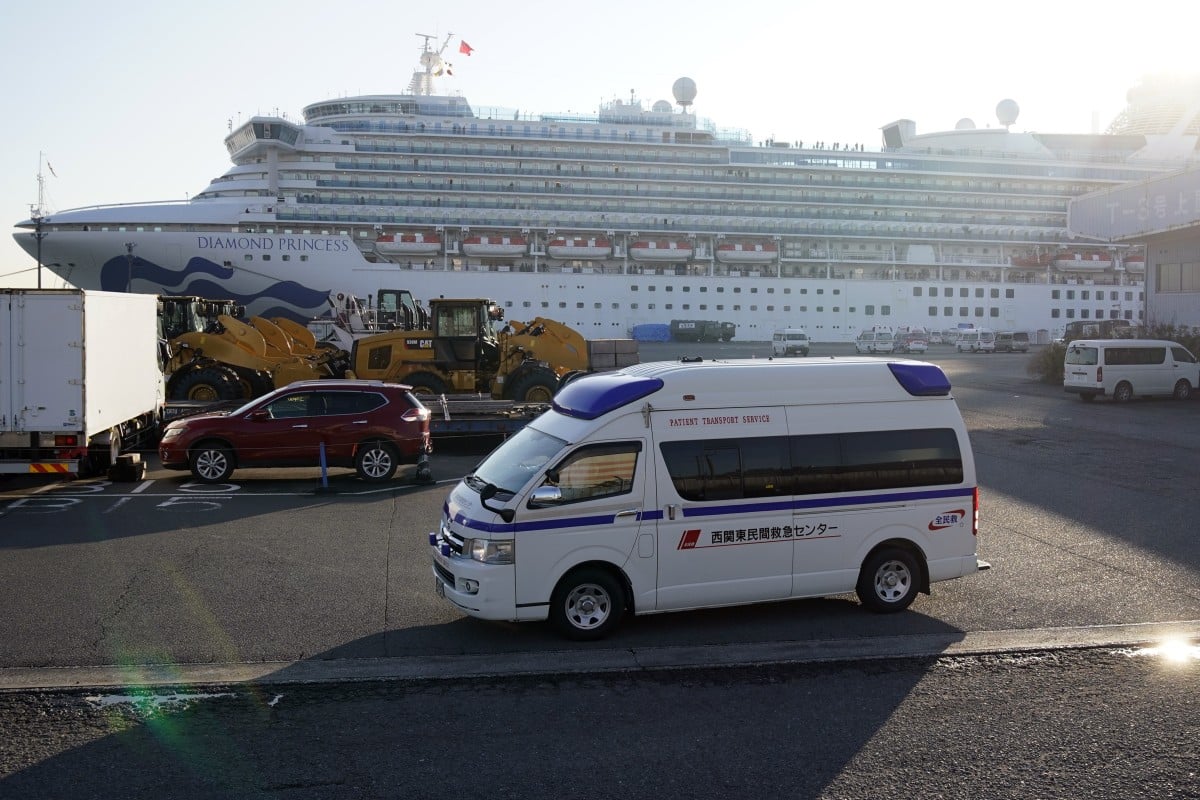
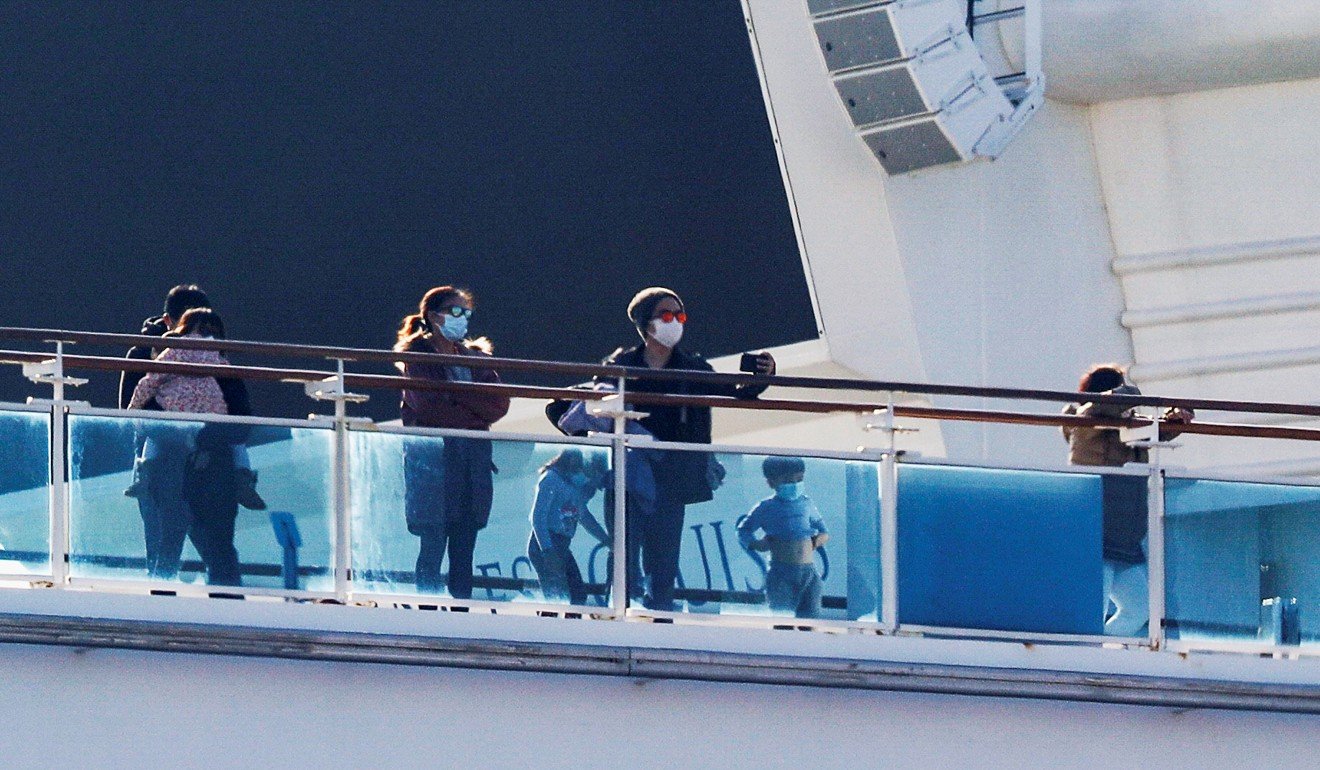
Passengers and crew on the Diamond Princess cruise liner are under quarantine until February 19, 2020. Photo: Reuters
For almost a fortnight and counting, the Diamond Princess has resembled a floating hospital more than a luxury cruise liner, as 3,711 passengers and crew have remained under quarantine in Japan due to an outbreak of the deadly coronavirus on board.
The UK-flagged vessel, which set out on a 29-day voyage from Singapore to Yokohama on January 6, has been in lock-down since arriving at the Japanese city on February 3, after an elderly passenger who disembarked in Hong Kong tested positive for the virus, which causes the respiratory disease officially known as Covid-19.
Along the way, the ship had stopped at 14 ports, including Ho Chi Minh City in
Kobe and Osaka in Japan, and Taipei in Taiwan, with repeat visits to a number of destinations, including Hong Kong.
How did the outbreak start?
While the exact source of the outbreak on the Diamond Princess is yet to be determined, it is suspected to be linked to a 80-year-old man from Hong Kong who had recently made a brief visit to mainland China.
The man boarded the ship on January 20 in Yokohama before disembarking five days later in Hong Kong, where he tested positive for the virus after seeking medical attention for symptoms including a cough.
Coronavirus: 44 more cases on Diamond Princess cruise ship
13 Feb 2020
How many people have tested positive for the coronavirus on board?
Japanese Health Minister Katsunobu Kato announced on Thursday that 44 new cases
of the virus had been detected on the Diamond Princess, including a quarantine officer who tested positive, bringing the total number of infections on board to at least 218.
The hike in infections came after officials announced 40 fresh cases on Wednesday. Authorities have so far tested 713 people on board, fewer than one-fifth of the total, but the outbreak already ranks as the largest single cluster of infections outside mainland
Japan has confirmed 247 cases overall since the virus was first detected in the Chinese city of Wuhan in late December.
Passengers are allowed short visits above deck for fresh air. Photo: Reuters
What has it been like for passengers on board?
Passengers who have not been diagnosed with the coronavirus have been asked to stay in their cabins, except for short visits above deck for fresh air, until the quarantine period ends on February 19.
Those who have tested positive have been evacuated to onshore medical facilities. Health officials announced on Thursday that they intended to move elderly people and those with pre-existing conditions off the ship in the coming days even if they tested negative.
Many of those on board have described the tedium of being confined to their cabins and anxiety about the virus spreading further, or expressed frustration at the lack of timely information about the outbreak coming from Japanese authorities.
“It’s getting tougher by the day, and certainly for passengers with the inside cabins, it’s not easy,” said British passenger David Abel in a Facebook live-stream on Thursday.
The sorry state of Hongkongers stuck aboard quarantined cruise ship in Japan
11 Feb 2020
Some passengers have praised the efforts of the crew to keep up people’s spirits, including putting together videos featuring magic tricks and dance and stretching routines.
Matthew Smith, a passenger from the United States, has racked up thousands of followers on Twitter with his regular upbeat appraisals of the ship’s food.
“Don’t believe the honeymooners who would rather be in an American hospital,” he wrote in one post last week. “You might have to drag me off the ship when the quarantine ends.”
The event on the Diamond Princess cruise would fit the description of a super spreading event. David Hui, infectious diseases expert
Why has Japan’s handling of the outbreak been so controversial?
Some medical experts have questioned the wisdom of placing the passengers and crew in quarantine in the close confines of a ship, rather than removing them to dedicated facilities on the shore.
“Ideally, the crew members and the passengers should be quarantined at holiday camps,” said David Shu-Cheong Hui, the director of the Stanley Ho Centre for Emerging Infections Diseases in Hong Kong. “The event on the Diamond Princess cruise would fit the description of a super spreading event.”
Panic buying, mistrust and economic woes as Japan reels from coronavirus
12 Feb 2020
Kumar Visvanathan, an infectious diseases expert at the University of Melbourne, said a cruise liner such as the Diamond Princess would be ill-equipped to prevent the spread of infections.
“It seems that though isolation in individual cabins is somewhat effective, the increasing numbers of symptomatic infections seems to suggest active infections even with the best precautions are occurring,” Visvanathan said.
“It is clear that cruise ships and their individual cabins are not made for isolation purposes and depend heavily on individual participation in the isolation procedures, including respiratory hygiene, cough etiquette and hand hygiene,” he said.
Japanese city encourages travellers in coronavirus quarantine after return from China
Visvanathan said, however, that gauging the correct response was difficult as authorities had to consider the welfare of both the general public and those on the ship.
“I think the way to look at it is there are two disparate concerns that need to be balanced,” he said. “The first is the protection of the outside community which I think the Japanese government is taking as most important, and in this case isolation on board is the most efficient way to prevent infection of the Japanese population.”
Criticism has also been levelled at authorities for not testing all of those on board from the start. After initially insisting that they did not have the resources to test everyone on board, health officials said on Thursday that they were now aiming to test 1,000 people a day.
The World Health Organisation, however, has defended Japan’s handling of the situation, saying the country was ensuring those who were ill received proper treatment, the most important consideration during such an outbreak.
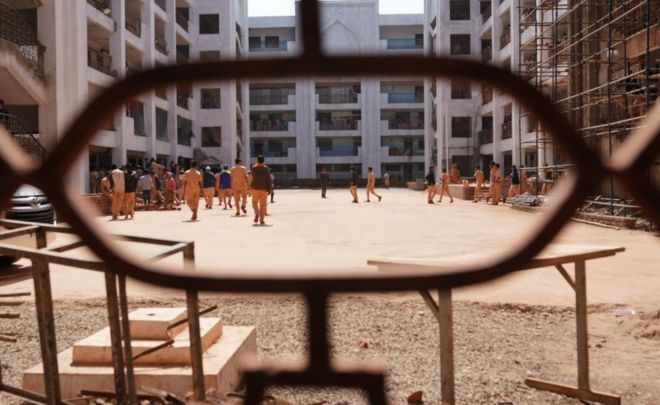
Image caption A play staged at Shaheen School has led to the arrest of a parent and a teacher
An Indian school play involving nine to 12-year-olds became the subject of national attention after it landed a young mother and a teacher in jail. BBC Telugu’s Deepthi Bathini reports.
“I’m not sure how I ended up here,” says 26-year-old Nazbunnisa, a single mother who did not give her last name and who works as a domestic help.
She was arrested on 30 January, along with Farida Begum, a teacher at her daughter’s school. The charge against them: sedition, which the women, both Muslim, deny.
They spoke to the BBC in a prison official’s office at Bidar district jail in the southern state of Karnataka. Both were on the verge of tears – they said they are trying to be “strong”, but their lives have suddenly turned “upside down”.
Their bail hearing is scheduled for Tuesday. Their lawyer says the charge of sedition is being misused.
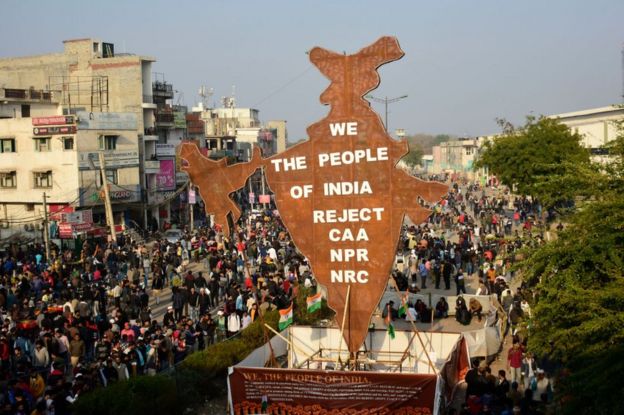
Image copyright GETTY IMAGESImage caption The citizenship law has sparked huge protests
The two women are accused of spreading “false information” and of “spreading fear among [the] Muslim community” and of using children to insult India’s Prime Minister, Narendra Modi.
Their ordeal began with a play put on by the students and staff at Shaheen School in Bidar, where Ms Nazbunnisa’s daughter studies and Farida Begum, 52, teaches.
The play was about a controversial new citizenship law, which has polarised India since it was passed in December by the governing Hindu nationalist Bharatiya Janata Party (BJP).
The Citizenship Amendment Act (CAA), offers amnesty to non-Muslim immigrants from Pakistan, Bangladesh and Afghanistan. It sparked fear among India’s 200 million-plus Muslims as it came in the wake of the government’s plans to introduce a National Register of Citizens (or NRC) based on those who can prove their ancestors were Indian citizens.
Authorities are yet to clarify what documents would be needed to prove citizenship, but taken together, the measures have spurred massive protests – critics say the government is marginalising Muslims while offering a path to citizenship for people of other religious communities who fail to make it on to the NRC.
The governing BJP denies these charges, and insists India’s Muslims have nothing to worry about.
So, given the contentious subject, after one of the parents streamed the school play live on Facebook, the recording quickly went viral. Local resident Neelesh Rakshal was among those who watched it.
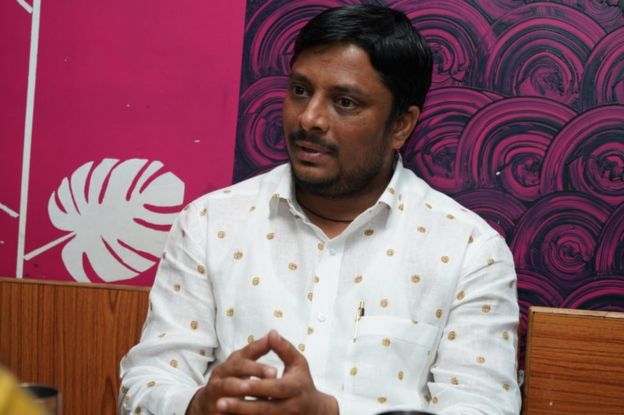
Mr Rakshal, who describes himself as a social activist, says he became furious over a scene where a man approaches an elderly woman and tells her that Narendra Modi wants Muslims to produce documents proving their Indian citizenship and that of their ancestors, and if they fail to do so, they will be asked to leave the country.
Image caption Mr Rakshal says the play “spreads hatred”
The woman responds that she has been in India for generations and would have to dig up the graves of her ancestors to look for documents. She then says a “boy who was selling tea”, a reference to Mr Modi who has said he used to sell tea as a teenager, is now demanding that she show him her documents.
“I will ask him for his documents and if he doesn’t show them to me, I will hit him with slippers,” she adds.
Mr Rakshal says he immediately registered a police complaint against the school for “using children in a school play to abuse the prime minister and also for spreading hatred”.
The complaint named the school management and the parent who streamed the play. While several members of the school management and the president of the school have also been charged with sedition, police told the court they are still looking for them.
“We do not know for what reason sedition charges have been invoked against the school. It is beyond the imagination of any reasonable person. We will fight it in court,” the school’s CEO, Thouseef Madikeri, says.
Image copyright GETTY IMAGESImage caption School officials allege that they are being targeted because most of the students are Muslim
Police also questioned students – videos and screen grabs of CCTV footage showing them speaking to students were shared widely on social media, prompting criticism.
Mr Madikeri alleges that on one occasion, police in uniform questioned students, with no child welfare officials present – an accusation denied by police superintendent DL Nagesh.
“The students were questioned five times. It’s mental harassment to students and this may have an impact on them in [the] long run,” Mr Madikeri says.
The Karnataka State Commission for Protection of Child Rights has asked police to explain why they questioned students so many times. Police say it was because not all the students were available at the same time.
Mr Madikeri told the BBC it was the questioning of students that led to the arrest of Farida Begum and Ms Nazbunnisa.
One parent whose child was questioned says she is now scared of going to school.
“My daughter told me police repeatedly asked her to identify the teachers and others who might have taught them the [play’s] dialogues,” he said.
“I do not understand what was wrong in the play. Children have been seeing what has been happening around the country. They picked up the dialogues from social media.”
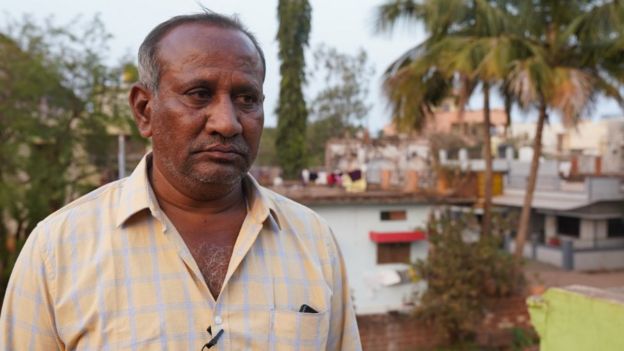
Image caption Farida Begum’s husband is worried about what will happen
Ms Nazbunnisa is also perplexed as to why she was arrested.
“My daughter was rehearsing for the play at home,” she says. “But I did not know what it was about, or what this controversy about CAA or NRC is about. I did not even go to see her play.”
Ms Nazbunnisa has met her daughter only once since she was jailed: “It was just for a few minutes, and even then only through a window. I held back my tears. I did not want to scare her further.”
The girl is staying with a friends of the family – they told the BBC she is having nightmares and often wakes up crying for her mother.
“She has been pleading that her mother not be punished for her mistake. She is sorry for what has happened,” one of them says.
Farida Begum, who suffers from high blood pressure, says she is “scared of what the future holds”. Her husband, Mirza Baig, says he fears that his wife being in jail will affect his daughter’s marriage prospects.
A push to connect Pacific nations highlights a submarine struggle for dominance over the world’s technology infrastructure
The ambitions of Chinese tech giants like Huawei, which have laid thousands of kilometres of cable, are of increasing concern to Washington
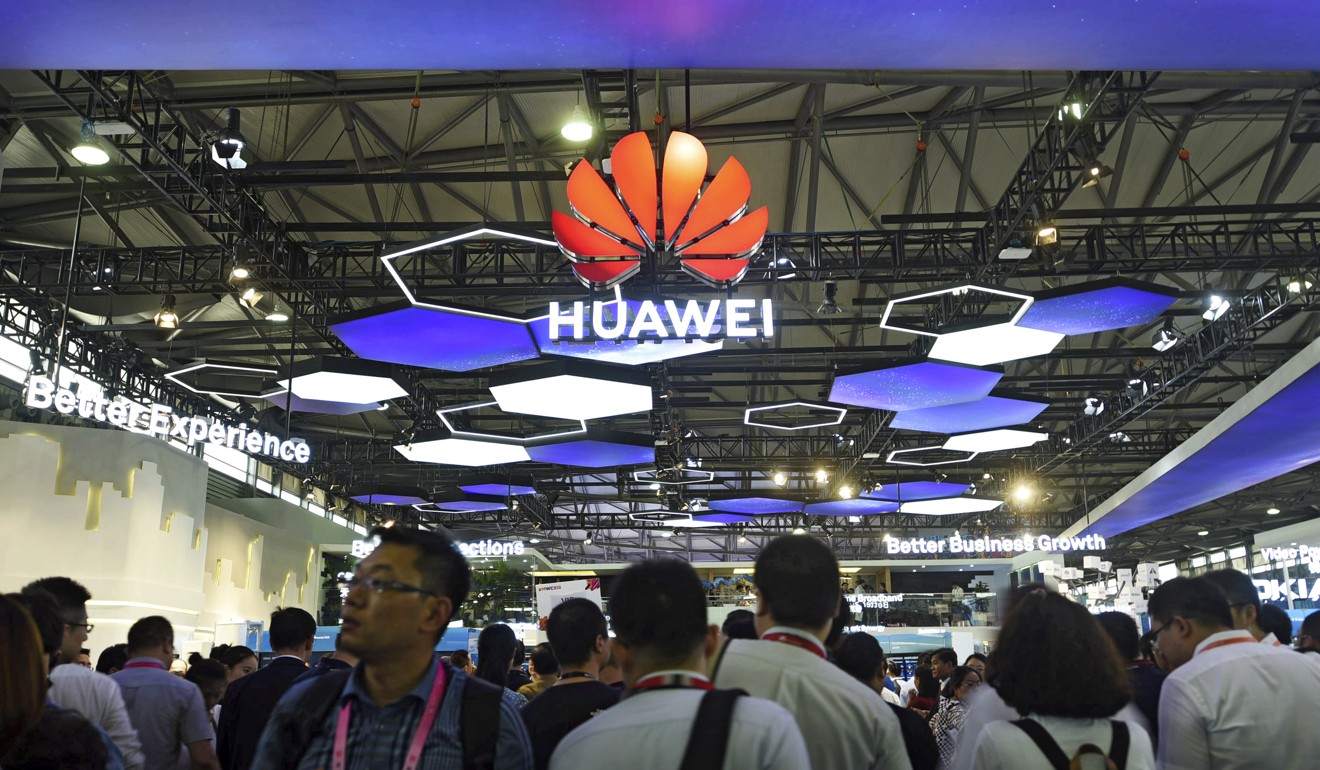
The ambitions of Chinese tech giants like Huawei, which have laid thousands of kilometres of cable, are of increasing concern to Washington. Photo: Reuters
While the US has been upping the pressure on its allies not to include equipment made by Chinese telecom giants like Huawei and ZTE in their 5G systems, Chinese companies have gained a foothold in some of the world’s most essential communications infrastructure – undersea internet cables.
Smart telecom cables: climate change hope or submarine spying tech?
14 Dec 2019
Almost all global data communications flow through cables under the ocean – just one per cent travels by satellite – and Chinese companies have quietly been eroding US, European and Japanese dominance over the backbone of the internet, the undersea cable market. Now, they have trained their sights on connecting one of the most virtually remote parts of the globe, the Pacific Island countries.
Of the 378 cables currently operating worldwide, 23 are under the Pacific. But many of these cables run right by Pacific Island nations on their paths between hubs in Los Angeles, Tokyo and Singapore.
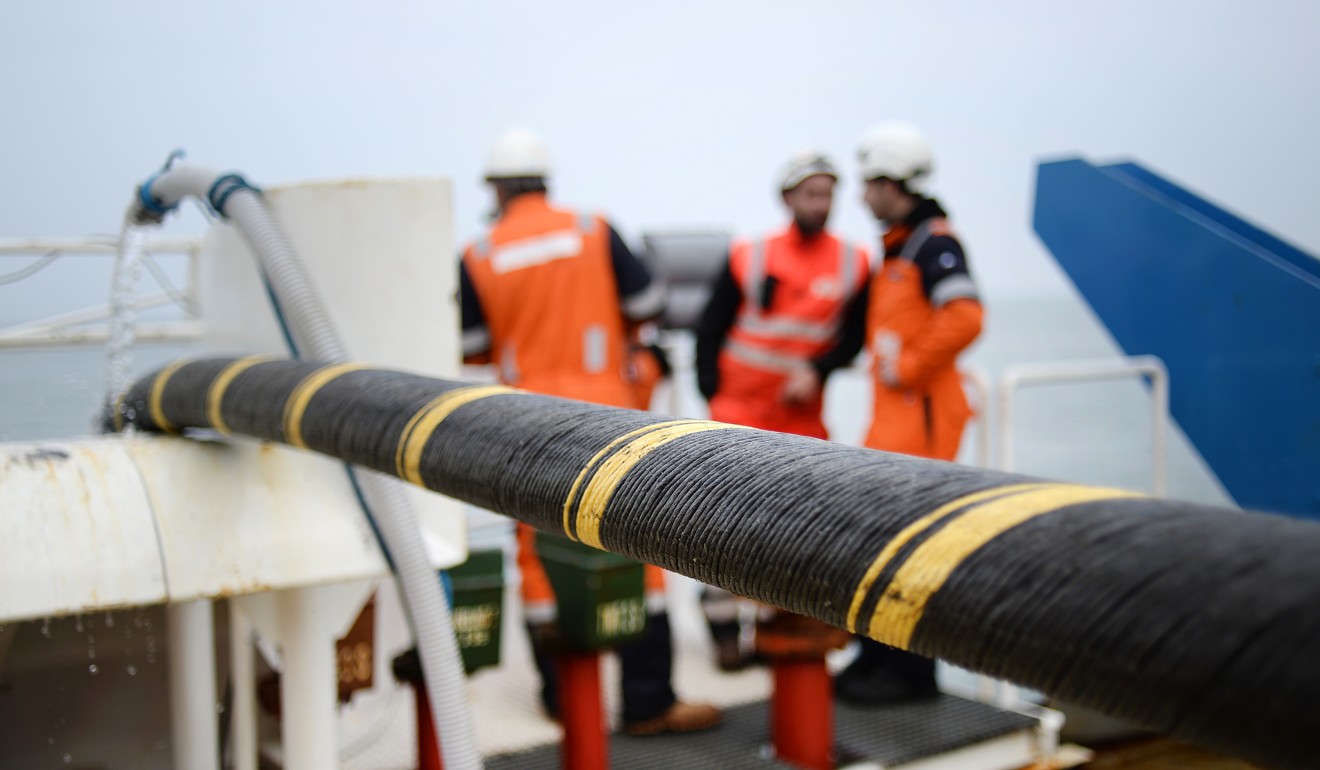
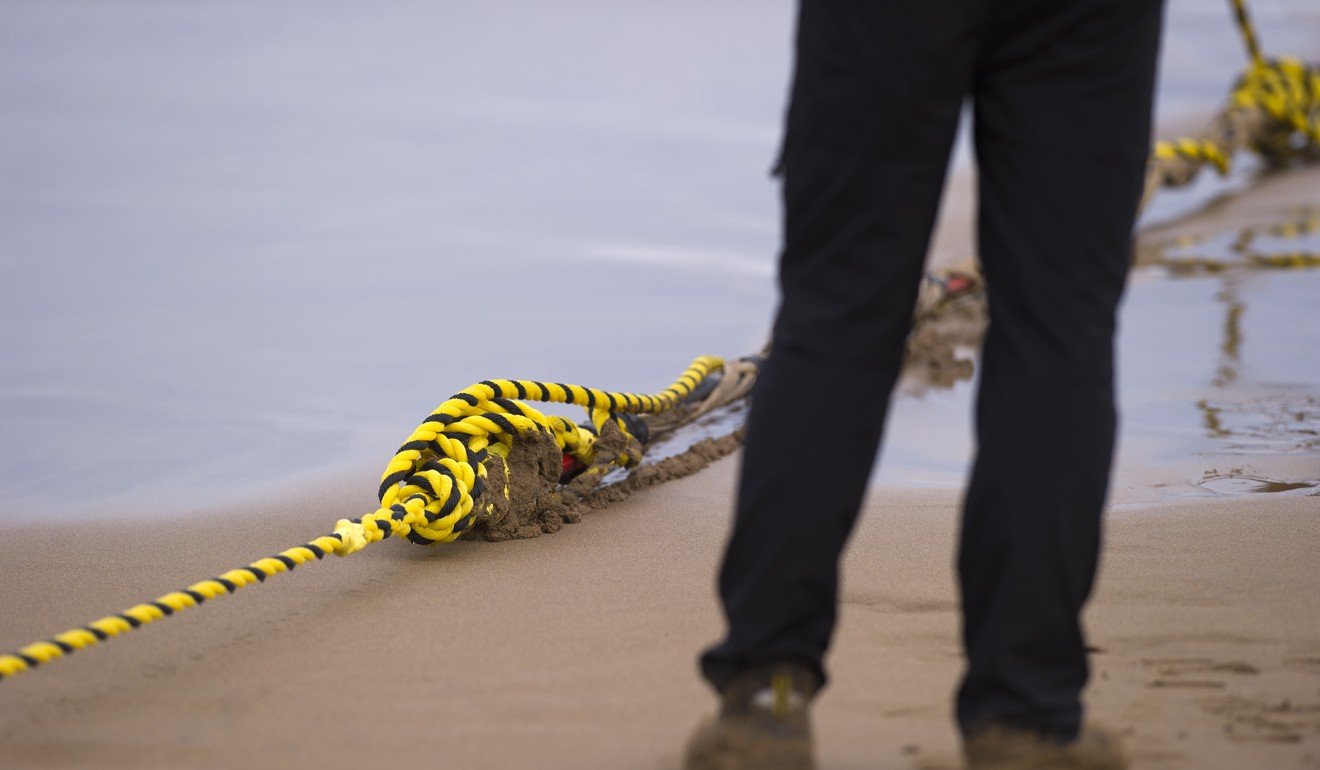
An electric submarine cable and optical fibre. File photo
Despite the volume of data flowing under the Pacific Ocean, just half a million of the 11 million people living in Pacific Island countries and Papua New Guinea – less than five per cent – have access to a wired internet connection and only 1.5 million to a mobile connection, according to the United Nations Economic and Social Commission for the Asia Pacific (UNESCAP), compared with 53 per cent of people in Thailand and 60 per cent in the Philippines.
More than US$4 billion worth of cables are to come into service by 2021, continuing a trend in which US$2 billion worth of cables have come online every year since 2016, and six of these cables will connect Pacific Island countries.
The push to connect Pacific Island nations to the latest generation of internet infrastructure has received extra scrutiny from the US and its allies like Australia
over the involvement of Chinese tech companies.
Choose Beijing over Taipei, Solomon Islands task force recommends
13 Sep 2019
SECURITY CONCERNS
While the US has moved to block Huawei from supplying equipment to its allies’ 5G networks, experts say Chinese tech companies could contest the US, EU and
long-standing dominance over global data traffic through investments in subsea cables.
Chinese tech giants like Huawei have entire divisions devoted to undersea connectivity that have laid thousands of kilometres of cable, and Chinese state telecommunication companies such as China Unicom have access to many of the existing trans-Pacific cables.
But a panel led by the US Department of Justice has held up a nearly complete trans-Pacific cable project over concerns about its Chinese investor, Beijing-based Dr Peng Telecom & Media Group.
The project, the Pacific Light Cable Network, could be the first cable rejected by the panel on the grounds of national security – despite being backed by American tech giants Google and Facebook – setting a precedent for a tougher US stance on Chinese involvement in subsea cables.
Chinese tech giants like Huawei have entire divisions devoted to undersea connectivity that have laid thousands of kilometres of cable. Photo: AP
Craige Sloots, director of sales at Southern Cross Cable Network, which operates the largest existing sets of trans-Pacific cables, said for any new cable, regulators were likely to scrutinise the ownership of the companies involved and the maker of the project’s equipment.
These two factors, said Sloots, “pragmatically limit some of the providers you can use if you want to connect through the US”.
Experts say that Hong Kong, where the stalled Pacific Light Cable would land, was previously considered a more secure shore landing point than mainland China. But people close to the project say the recent unrest in the city has made this distinction less relevant, according to The Wall Street Journal.
If these nations want to be part of the international economy, they need reliable communications: Bruce Howe, University of Hawaii
Similar concerns caused a proposed Huawei-backed cable linking Vanuatu with Papua New Guinea to be called off last year after Australia stepped in to fund its own cable instead.
Just months after the government-owned Solomon Islands Submarine Cable Company agreed to the project with Huawei in mid-2017, Canberra put up US$67 million to connect Sydney with the Solomon Islands and Papua New Guinea with cables laid under the Coral Sea by Nokia’s Alcatel Submarine Networks.
Simon Fletcher, CEO of Vanuatu company Interchange, which had been planning another cable in the neighbourhood connecting Vanuatu with the Solomon Islands, said the Coral Sea project undercut the viability for small private businesses to operate in the fledgling market, where services had historically been provided by international organisations like development banks. His company’s cable has been on pause since the announcement of the Coral Sea project, though Fletcher said it would go forward next year.
US-China battle for dominance extends across Pacific, above and below the sea
22 Jul 2019
VIRTUALLY REMOTE
For years, as Japan, Hong Kong and Singapore became global hubs of high-speed internet data traffic, the cables criss-crossing the ocean floor passed by just off the shores of Pacific Island countries en route between hubs on either side of the ocean.
Tiziana Bonapace, director of UNESCAP’s information technology and disaster risk-reduction division, said the Pacific Islands remain one of the most disconnected areas in the world, where “a vast proportion of the population has no access to the internet”.
Over the past five years, international organisations like UNESCAP, the Asia Development Bank and the World Bank have been pushing for better connectivity in the region. The World Bank’s Pacific Regional Connectivity Programme has invested more than US$90 million into broadband infrastructure for Fiji, the Federated States of Micronesia, Kiribati, the Marshall Islands, Palau, Samoa and Tuvalu.
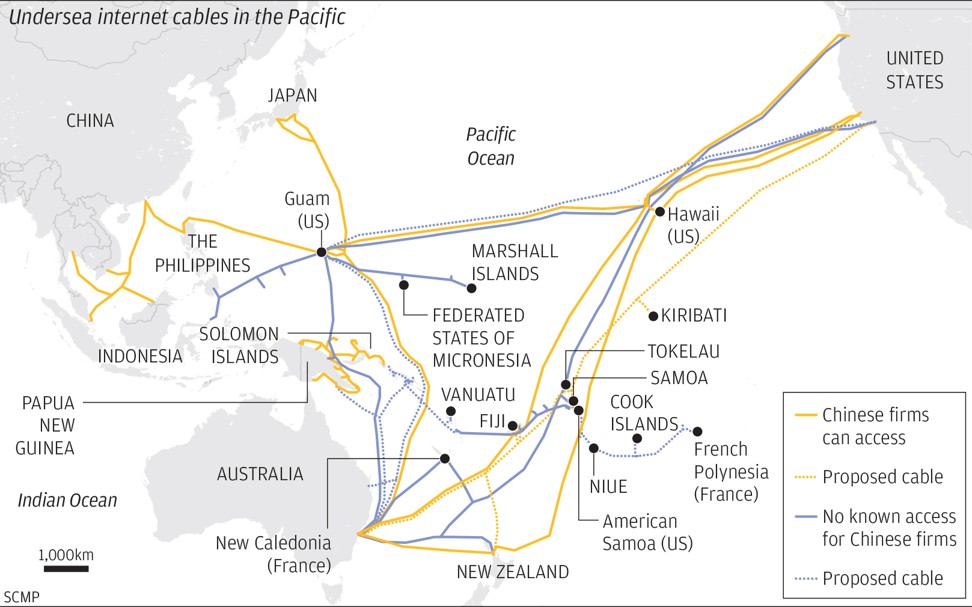
Internet cables in the Pacific Ocean.
But the business case had never been good, said Bonapace.
“A cable has to travel thousands of kilometres just to connect a population smaller than one of Asia’s megacities,” she said. “As everything we do is somehow connected to the internet, the prospects for the Pacific to become virtually more remote are even higher.”
Even nations which are connected have tenuous infrastructure. In January, Tonga experienced a total internet blackout for two weeks after damage to its single cable. Most parts of the world were linked by multiple cables to prevent this type of outage, said Bruce Howe, professor of ocean and resources engineering at University of Hawaii.
“If these nations want to be part of the international economy, they need reliable communications,” Howe said.
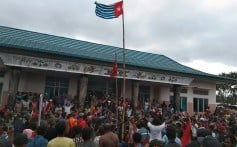
Is Chinese support for Pacific nations shaping their stance on West Papua?
26 Aug 2019
DRAWING NEW LINES
In Papua New Guinea, where mobile internet currently reaches less than a third of the population, a partnership between local telecoms company GoPNG and the Export-Import Bank of China funded the new Huawei-built Kumul Domestic cable system, which came online this year.
The Southern Cross Next system, owned by Spark, Verizon, Singtel Optus and Telstra – the same group of shareholders which operates the massive 30,500km (19,000 mile) set of twin cables connecting the US with Australia and New Zealand known as Southern Cross – is planned to come online in 2022, and will connect directly to Fiji, Samoa, Kiribati and Tokelau.
Chinese telecoms company China Unicom counts the existing Southern Cross cables among its network capabilities – meaning it is likely to have access to the cable through a leasing agreement with one of the other companies that uses the cable, according to Canberra think tank the Australian Strategic Policy Institute (ASPI).
An undersea fibre optic cable. Photo: AFP
China Unicom and China Telecom also list the Asia America Gateway Cable System as one of their network capabilities, according to ASPI. The 20,000km (12,400-mile) cable came online in 2009 and connects the US, Guam, Hong Kong, Brunei, the Philippines, Singapore, Malaysia, Vietnam and Thailand.
It is owned by a consortium of carriers including AT&T, Telekom Malaysia, Telstra and Spark.
A cable backed by Google and the Australian Academic and Research Network connecting Japan and Australia through Guam is to come online early next year.
China: the real reason Australia’s pumping cash into the Pacific?
28 Jul 2018
WHAT’S NEXT
Natasha Beschorner, senior digital development specialist at the World Bank, said that while there were challenges ahead in terms of broadband access and affordability, increased connectivity was starting to bring new opportunities to the Pacific.
“Digital technologies can contribute to economic diversification, income generation and service delivery in the Pacific,” Beschorner said. “E-commerce and financial technologies are emerging and governments are considering how to roll out selected services online.”
Experts say the industry has recently seen a switch from cables being mostly funded by telecommunication carriers to being funded by content providers, like Google and Facebook. Members of the private cable industry say content companies can afford to invest in cable infrastructure to ensure the supply chain for their customers, but that the competition puts the squeeze on the research-and-development budgets of other types of companies.
Sloots at Southern Cross predicted that the nations which connected directly to the massive next-generation cable – Samoa, Kiribati and Tokelau – would be able to function as connecting points for intra-Pacific cables.
“There’s a blossoming effect in capability once certain islands are connected,” Sloots said.
There is also the push to locate an exchange point within the Pacific so that internet data no longer has to travel to a hub in Tokyo or Los Angeles and back to Pacific nations when processing – a move that could ultimately lower the cost of broadband internet service for consumers in the Pacific.
Perhaps the most effective outcome could be for Pacific nations to cut the cord and receive their internet by satellite.
The Asian Development Bank has agreed to give a US$50 million loan to Singapore’s Kacific Broadband Satellites International to provide up to two billion people across the Asia-Pacific region with affordable satellite-based internet.
The project is to be launched into orbit by SpaceX next week and aims to begin providing service by early next year.



























 CHINDIA ALERT: You'll be living in their world, very soon