Chindia Alert: You’ll be Living in their World Very Soon
aims to alert you to the threats and opportunities that China and India present. China and India require serious attention; case of ‘hidden dragon and crouching tiger’.
Without this attention, governments, businesses and, indeed, individuals may find themselves at a great disadvantage sooner rather than later.
The POSTs (front webpages) are mainly 'cuttings' from reliable sources, updated continuously.
The PAGEs (see Tabs, above) attempt to make the information more meaningful by putting some structure to the information we have researched and assembled since 2006.
BEIJING, May 28 (Xinhua) — Chinese lawmakers Thursday voted to adopt the country’s long-expected Civil Code at the third session of the 13th National People’s Congress, the top legislature.
The Civil Code will take effect on Jan. 1, 2021.
In addition to general provisions and supplementary provisions, the Civil Code, the world’s latest modern-day civil law, has six parts on real rights, contracts, personality rights, marriage and family, succession, and tort liabilities.
The personal rights, property rights and other lawful rights and interests of the parties to civil legal relations shall be protected by law and shall not be infringed upon by any organization or individual, reads the Civil Code in its opening chapter.
Lawmakers say the codification is not about formulating a new civil law but rather systematically incorporating existing civil laws and regulations, modifying and improving them to adapt to new situations while maintaining their consistency.
A major innovation of China’s Civil Code, jurists say, is embodied in the personality rights part. While some countries have related law provisions, few have a specific law book in civil code dedicated to protecting personality rights.
The personality rights part covers stipulations on a civil subject’s rights to his or her life, body, health, name, portrait, reputation and privacy, among others.
The personality rights part shows that China has reached a new height in protecting the dignity of people, said Chen Jingying, a national lawmaker and vice president of East China University of Political Science and Law.
The Civil Code is a milestone in developing the socialist legal system with Chinese characteristics, and will greatly boost the modernization of China’s system and capacity for governance, said Wang Yi, dean of the law school at Renmin University of China.
Xie Haifeng’s story is one of luck and resilience and he has made it his mission to help others through adversity
Professional dancer owes part of his success to the city of Hong Kong and one of its doctors who helped survivors through recovery
Xie Haifeng was 15 when he lost his leg in one of modern China’s most devastating disasters. Photo: Handout
When the rumbling began, Xie Haifeng thought someone was shaking his bed. Perhaps one of the other 800 children in the school dormitory was being naughty. Or maybe it was a small quake. Then came the unmistakable sound of screams.
Xie, then a 15-year-old pupil at Muyi Town Middle School in the southwestern Chinese province of Sichuan, started running. He fell as the dorm building collapsed around him. When he tried to stand up, he realised something was missing. His left leg was gone.
What Xie thought was a small quake turned out to be one of the most devastating disasters in modern Chinese history.
The Sichuan earthquake of May 2008 left at least 87,000 people dead and shook the country to its core. It was less than three month before Beijing would host its first Olympic Games, an opportunity to show the world its strength and ambition.
Instead, 7,444 schools had crumbled like tofu in an area known to be seismically active. Their rubble was a stark demonstration of the weak foundation of China’s progress and its tragic consequences. At Xie’s school, the shoddily built walls and ceilings crushed 600 children. Only 300 survived.
It still frightens me to recall the earthquake.Xie Haifeng, dancer
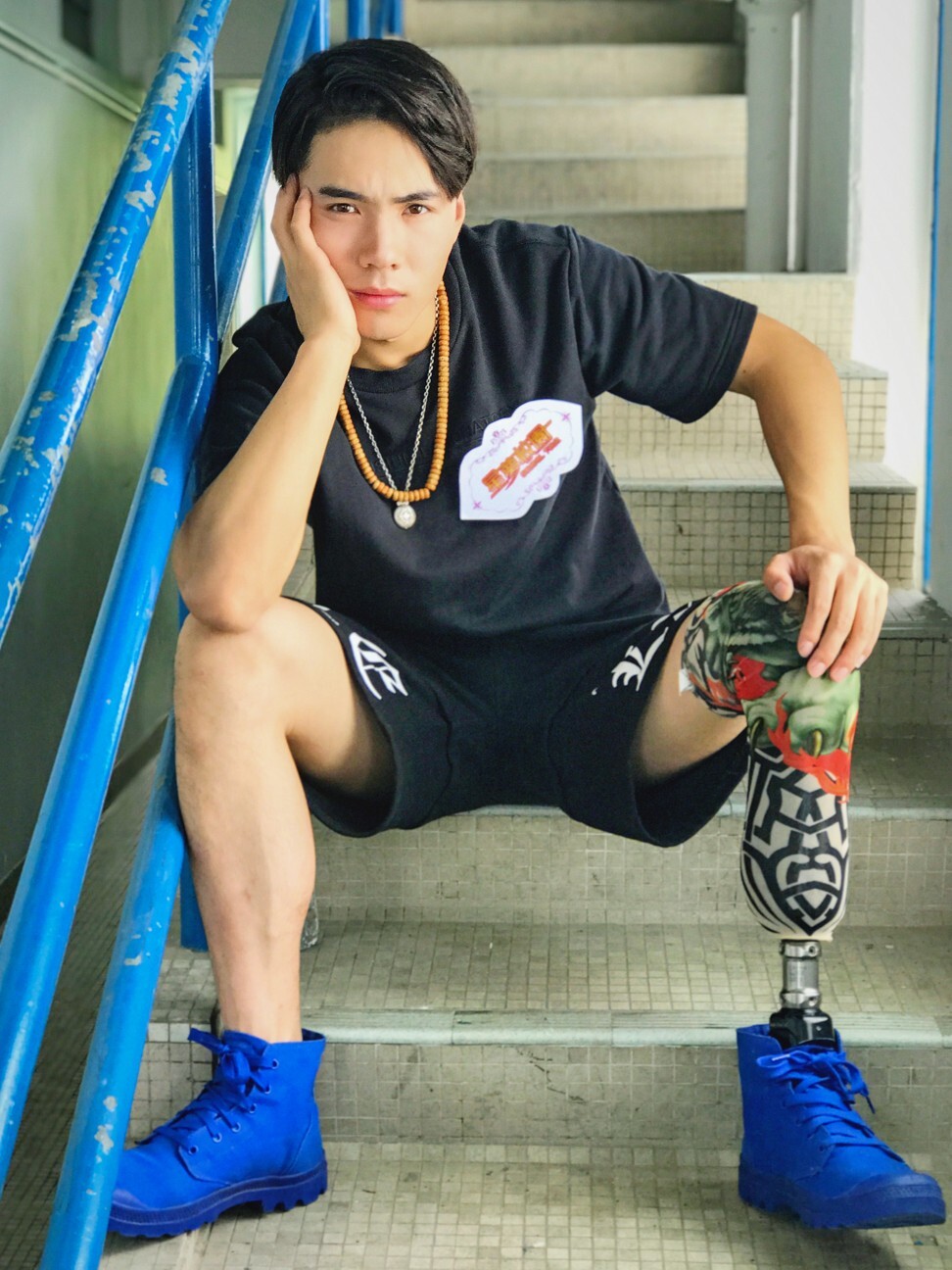
Xie considers himself lucky. “If I had run just one second more slowly, I would have been dead. If I had run one second faster, I would have been completely fine. But anyway, I am lucky to be alive,” he said. A dozen years later, his story is also one of resilience. Defying all the odds, Xie is now a professional dancer for a troupe in Sichuan and has made it his mission to help others through adversity.
The journey from his hospital bed to the stage was long and difficult and even though many years have passed, “it still frightens me to recall the earthquake”. But, he said: “I have forgiven fate and accepted the reality that I have only one leg.”
Xie’s trauma was a particularly difficult blow to his family. His older sister was already handicapped, after injuring her arm in an accident. When his mother, a migrant worker in the northwestern province of Gansu, arrived at the hospital a few days after the earthquake, she had no idea of the extent of Xie’s condition.
“When I woke up in the evening, I saw my mother weeping beside my bed. I told myself I should be strong,” Xie said, adding that his mother initially thought he had suffered only bruises. He was sent for treatment to a hospital in the prosperous southern city of Shenzhen, along with other survivors who had been left with disabilities by the earthquake.
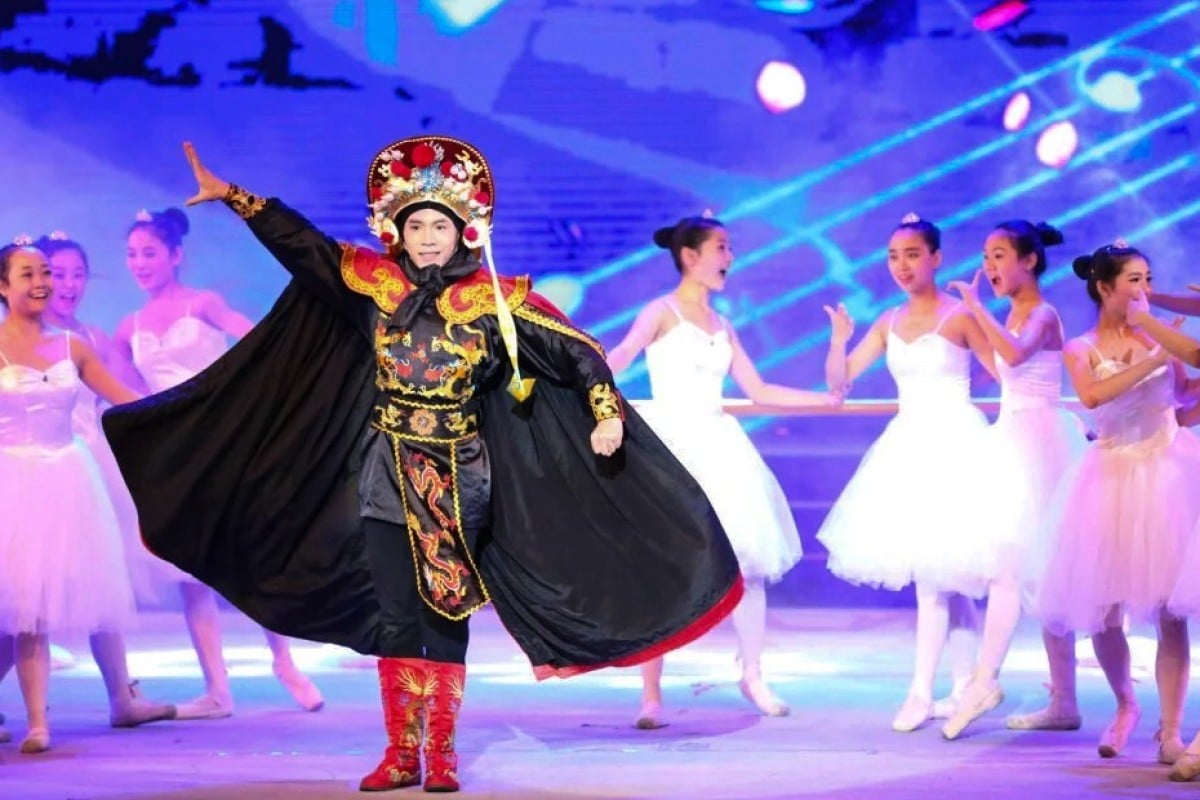
Defying all the odds, Xie Haifeng is now a professional dancer. Photo: Handout
It was there that Xie was inspired to make the most of his life. A team of athletes visited the hospital and he was shocked to see one of them, a volleyball player, walking on a prosthetic leg.
Xie began to wear a prosthesis and after rehabilitation training returned to his hometown in 2009 where he was admitted to Qingchuan High School. At first, he was self-conscious and felt inferior to his peers. He did not dare to wear shorts in summer and said he seldom talked to the other students.
The following year he was introduced to members of the Chengdu Disabled People’s Art Troupe, where he found a new and welcoming home. Xie quit school and joined the troupe, despite his parents’ opposition. They were convinced study was the only way for rural students like their son to get out of poverty.
Xie learned Sichuan opera and was soon performing its art of bian lian, or
– a skill that requires rapid mask changes in a dazzling sleight of hand – on stage until the troupe was disbanded in 2011, leaving him unemployed for six months.
China marks 10-year anniversary of Sichuan earthquake
But the misfortune led to an improbable opportunity when he was hired by the Sichuan Provincial Disabled People’s Art Troupe and trained to dance. At 19, and with no experience, Xie found the training far more difficult than those who had started at the more usual age of five or six.
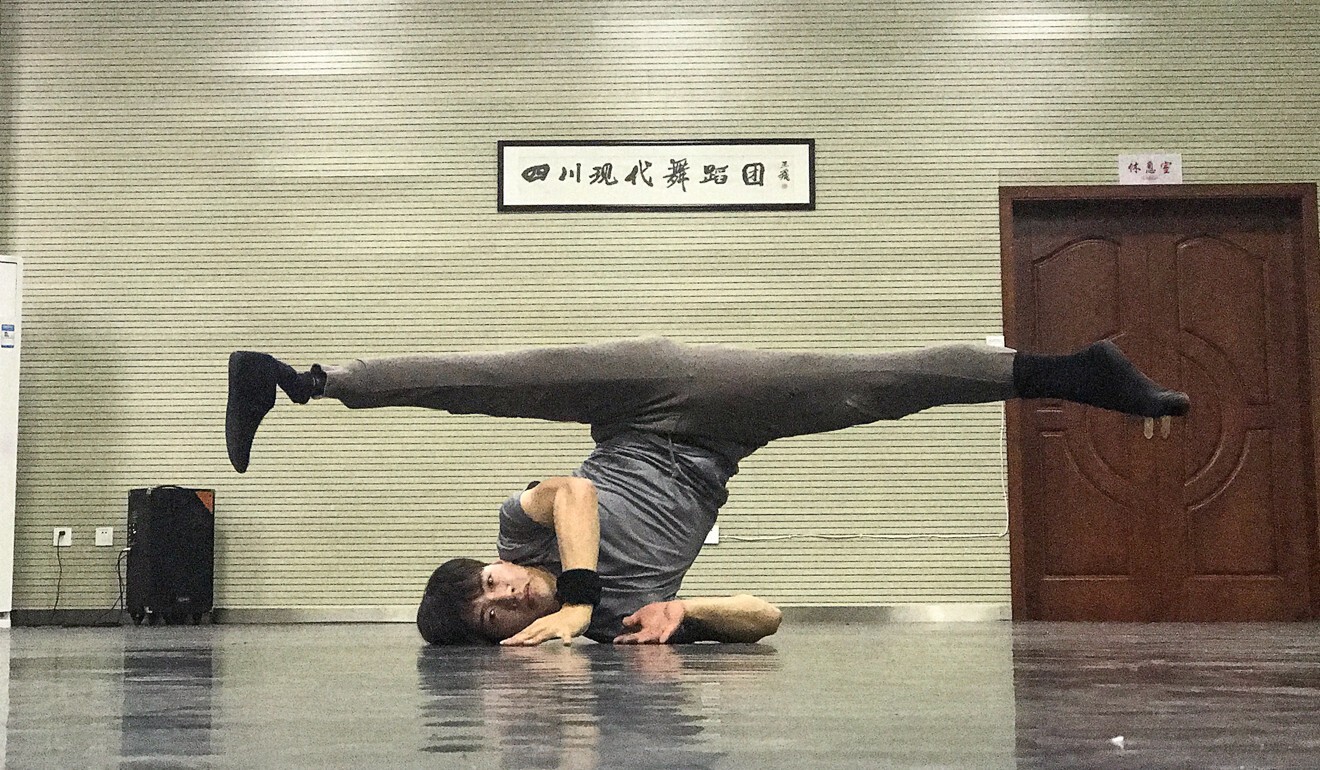
His body was too stiff, he said, and in the first months he spent 10 hours each day just stretching and building flexibility. It was just the beginning of a long and often arduous process.
“That agony is too much to be described,” Xie said about the pain of dancing on a prosthetic leg. “During the first six months’ training, I broke three artificial legs.”
More than once, he wondered whether he had chosen the right path. But, ultimately, his gruelling effort paid off and Xie has performed in Singapore, Hong Kong and Macau. In 2013, he won a gold medal at a national dancing competition for people with disabilities.
“My dances won me applause and recognition from the audience. I feel relieved and I think my heart belongs to the stage,” he said.
Xie broke three artificial legs during his first six months of dance training. Photo: Handout
Xie said he owed part of his success to Hong Kong which in 2008 donated HK$20 billion (US$2.5 billion) in aid to Sichuan and sent doctors to treat the injured. Among the volunteers was Poon Tak-lun, a Hong Kong orthopaedist who flew to Sichuan every two weeks from 2008 to 2013 to treat patients.
At a gala show in 2013 to express gratitude from the people of Sichuan to Hong Kong, Xie met Poon and the two became good friends, thanks to their common interest in the arts.
“Dr Poon promised to pay for all the costs of installing and repairing my artificial leg in the future. He told me to focus on dancing without worrying about the leg’s costs,” Xie said.
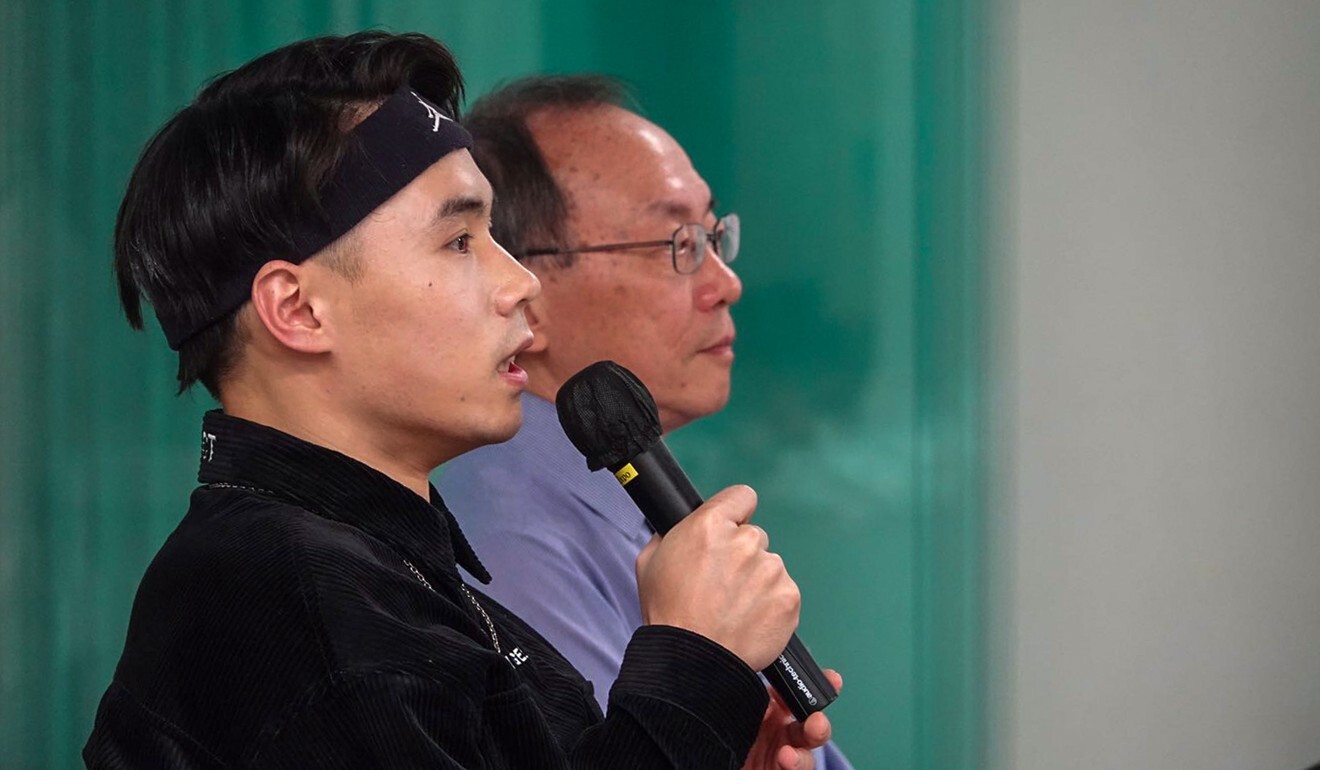
Xie Haifeng (pictured left with friend Poon Tak-lun) gives a speech to students in Hong Kong. Photo: Handout
Grateful for the help he received from Poon and Hong Kong, Xie has sought to return the favour by doing what he does best.
“I have no other skills except dancing and performing. So I thought of sharing my experience to encourage young students in Hong Kong,” he said.
Xie travels to Hong Kong about twice a year to perform and visit schools. In 2019, he visited the city four times, performing dances and Sichuan opera, and giving speeches at more than 10 primary and secondary schools.
“I encourage them to study hard. I said there are many people in this world who have more difficulties than them but still insist on pursuing their dreams, so they should not give up their dreams,” Xie said.
When he is not dancing and giving inspirational speeches, Xie said he lived a life like everyone else – climbing mountains, swimming and proudly walking on the leg he gained after almost losing everything in Sichuan’s deadly earthquake.
People work at a construction site of a utility tunnel in Wuhan, central China’s Hubei Province, April 30, 2020. (Xinhua/Xiao Yijiu)
BEIJING, May 1 (Xinhua) — China is getting the world’s largest workforce back to work as the nationwide battle against COVID-19 has secured major strategic achievements.
The unprecedented fight has nurtured new trends in the workplace. For example, more attention is being paid to public health and e-commerce to boost consumption and emerging sectors brought by new applications based on the country’s rapid new infrastructure development of 5G networks and data centers.
In this aerial photo taken on April 29, 2020, representatives of frontline health workers fighting COVID-19 attend a bell-ringing ceremony at the Yellow Crane Tower, or Huanghelou, a landmark in Wuhan, central China’s Hubei Province. (Xinhua/Xiao Yijiu)
ANGELS OF PUBLIC HEALTH
Ye Man, head nurse of gastrointestinal department of Hubei General Hospital East District, one of the five remaining COVID-19 designated hospitals in Wuhan, is taking her first weeklong vacation since January.
The 34-year-old mother of two started to take a week off on Monday, one day after her hospital cleared all remaining confirmed COVID-19 patients. The nine ICU wards in her hospital had been kept occupied over the past several months.
Friday marked International Workers’ Day, and the start of China’s five-day public holiday. Ye said she planned to visit urban parks with her family during the holiday.
At her busiest point, she and her colleagues took care of a ward filled with 40 COVID-19 patients.
“It was a really tough time,” she recalled. She had to wear a protective gown and a mask for nine hours a day and be separated from her family to avoid possible cross-infections.
Wuhan, capital of central China’s Hubei Province and once hard hit by COVID-19, cleared all confirmed cases in hospitals on April 26. Over 42,000 medical workers mobilized nationwide to aid Hubei have contributed to achieving a decisive outcome in the fight to defend Hubei and Wuhan.
In an inspection tour to Wuhan on March 10, President Xi Jinping, also general secretary of the Communist Party of China Central Committee and chairman of the Central Military Commission, lauded medical workers as “the most beautiful angels” and “messengers of light and hope.”
To reward brave and dedicated medics, major tourist sites in Hubei are offering free entry to medical staff over the following two years.
Chinese President Xi Jinping, also general secretary of the Communist Party of China Central Committee and chairman of the Central Military Commission, learns about development of the black fungus industry in Jinmi Village of Xiaoling Township in Zhashui County, Shangluo City, northwest China’s Shaanxi Province, April 20, 2020. (Xinhua/Xie Huanchi)
LIVESTREAMING ANCHORS
“We have a new batch of supplies today. Those who did not get the goods should hurry to buy now,” said Li Xuying, a livestreaming anchorwoman selling agaric mushrooms in Zhashui, a small county deep in the Qinling Mountains in northwest China’s Shaanxi Province.
Li has been prepared for a boom of online shopping in the holiday, because online buyers rushed to her livestreaming website to place orders, after Xi inspected the county and chatted with her in the village of Jinmi during a recent tour to Shaanxi.
“I used to sell goods worth about 50,000 yuan (7,070 U.S. dollars) on average after a six-hour livestreaming session. Now the sales are 10 times that,” she said.
Li was one of the 10 sales staff sent by the local agricultural e-commerce firm to Chinese e-commerce platform Taobao’s headquarters for livestreaming training. She said livestreaming is effective in bridging buyers and farmers, through which viewers can watch planting and harvesting online.
With the number of netizens in China reaching 904 million in March, e-commerce has been one of the popular means of promoting the sale of farm produce and helping farmers shake off poverty. Despite the impact of COVID-19, the country is determined to eradicate absolute poverty by the end of this year.
Workers work at the construction site of a 5G base station at Chongqing Hi-tech Zone in Chongqing, southwest China, April 15, 2020. (Xinhua/Wang Quanchao)
HI-TECH WORKERS IN “NEW INFRASTRUCTURE” BUILDING
As an elasticity calculation engineer of Alibaba Cloud, Zhao Kun and his colleagues always stay on alert for high data flow, for example, brought by the anticipated online shopping spike during the holiday.
“The profession, which may sound obscure, is actually closely connected to everyone’s life, as cloud computing is the infrastructure supporting high-tech applications of artificial intelligence and blockchain,” said Zhao.
The Chinese leadership has underscored expediting “new infrastructure” development to boost industrial and consumption upgrading and catalyze new growth drivers.
Seizing the opportunities of industrial digitization and digital industrialization, China needs to expedite the construction of “new infrastructure” projects such as 5G networks and data centers, and deploy strategic emerging sectors and industries of the future including the digital economy, life health services and new materials, President Xi has said.
During the epidemic, Zhao and his colleagues expanded more than 100,000 cloud servers to ensure the stable operation of “cloud classrooms” and “cloud offices” for millions of people working and studying from home.
In the “new infrastructure” building, people like Zhao contribute to constructing the virtual infrastructure of an ecosystem, which enables e-commerce, e-payment, online teaching and the digital transformation of manufacturing and supply chain management.
In early April, China released a plan on promoting the transformation of enterprises toward digitalization and intelligence by further expanding the application of cloud and data technologies, to nurture new business models of the digital economy.
City at centre of outbreak finally able to declare itself clear of disease after months in lockdown and thousands of deaths
Risk of infection remains, however, with some patients testing positive for coronavirus that causes disease without showing symptoms
Ferries and other public transport services resumed in Wuhan last week. Photo: Xinhua
The city of Wuhan, the initial epicentre of the coronavirus pandemic, no longer has any Covid-19 patients in hospital after the last 12 were discharged on Sunday.
Their release ended a four-month nightmare for the city, where the disease was first detected in December. The number of patients being treated for Covid-19, the disease caused by a new coronavirus, peaked on February 18 at 38,020 – nearly 10,000 of whom were in severe or critical condition.
“With the joint efforts of Wuhan and the national medical aid given to Hubei province, all cases of Covid-19 in Wuhan were cleared as of April 26,” Mi Feng, a spokesman for the National Health Commission said on Sunday afternoon.
The announcement came only one day after the city discharged the last patient who had been in a severe condition. That patient also was the last severe case in Hubei province.
The last patient discharged from Wuhan Chest Hospital, a 77-year-old man surnamed Ding, twice tested negative for Sars-CoV-2, the virus that causes Covid-19, and was released at noon on Sunday.
“I missed my family so much!” Ding told Changjing Daily.
Another unidentified patient exclaimed as he left the hospital: “The air outside is so fresh! The weather is so good today!”
Wuhan faced a long journey to bring its patient count down to zero.
The city of 11 million, the capital of Hubei province and a transport hub for central China, was put under a strict lockdown on January 23 that barred anyone from entering or exiting the city without official approval for 76 days until it was officially lifted on April 8.
Coronavirus: Wuhan, Los Angeles officials discuss getting back to work after lockdown
22 Apr 2020
Residents were ordered to stay in their apartments as the city stopped public transport and banned private cars from city streets. As the epidemic worsened, more than 42,000 medical staff from across the country were sent to the city and to Hubei province to help ease the burden on the local health care system.
Wuhan was the hardest hit city in China, accounting for 50,333 of the 82,827 locally transmitted Covid-19 cases recorded in China. More than 4,600 died in the country from the disease.
On March 13, the city reported for the first time that there were no new suspected cases of the infection, and five days later there were no confirmed cases.
The number of discharged patients bottomed out at 39.1 per cent at the end of February, gradually climbing to 92.2 per cent by last Thursday.
“Having the patients in the hospital cleared on April 26 marks a major achievement for the city’s Covid-19 treatment,” the Wuhan Health Commission said in a statement.
However, having no severe cases in hospital does not mean all the discharged patients will require no further treatment as they may still need further care.
“Clearing all the severe cases marks a decisive victory for the battle to safeguard Wuhan,” health minister Ma Xiaowei told state broadcaster China Central Television on Saturday.
“Some patients who have other conditions are being treated in specialised hospitals. It has been properly arranged.”
Coronavirus: Chinese writer hit by nationalist backlash over diary about Wuhan lockdown
18 Apr 2020
Ten patients aged between 42 and 85 who have been declared coronavirus-free are still in intensive care at the city’s Tongji Hospital where they are being treated for kidney problems and other complications arising from Covid-19. Some still need ventilators to help them breathe.
These 10 patients are under 24-hour care, with 190 nurses on four-hour rotations. There are other patients in a similar condition in two other hospitals in Wuhan, according to the Hubei Broadcasting and Television Network.
However, the discharge of the last batch of Covid-19 patients does not mean that the risk of infection is gone.
The city reported 20 new cases of people testing positive for Sars-CoV-2, the official name for the coronavirus that causes the disease, but who do not yet show symptoms.
There are 535 such carriers under medical observation. Past data shows some of these asymptomatic carriers will develop symptoms, and so will be counted as Covid-19 patients under China’s diagnosis and treatment plan.
China’s coronavirus infection curve has flattened out with about 694 imported cases of Covid-19 on top of about 800 locally transmitted ones now under treatment.
The national health commission spokesman warned that people still need to be on high alert as the virus is continuing to spread around the globe, with no sign yet of a slowdown.
“[We] must not drop our guard and loosen up. [We] must discover cases in time and deal with them quickly,” Mi said, citing the continued pressure from cases imported by people returning from overseas.
“The next step will be to implement the requirements of the central government and continue to guard against imported cases and a rebound of domestic transmitted cases.”
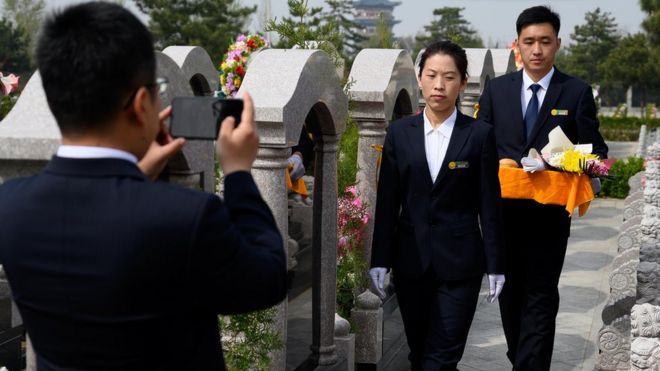
Image copyright GETTY IMAGESImage caption Staff film a tomb sweeping ceremony for a customer
People in China are paying their respects to dead ancestors digitally as the country continues to face the coronavirus outbreak.
The Qingming festival, also known as Tomb Sweeping Day, is usually a time when people visit the graves of friends and family, sprucing up the area and making offerings to their spirits.
But amid fears of another outbreak, the government has advised people to stay away and maintain social distancing.
That’s led to some cemeteries allowing people to come as long as they’ve booked a slot, while others are banning visits completely.
But other companies and burial places have turned to modern technology as they look for ways for families to continue the centuries-old tradition.
Li Quanxi, an official at Beijing’s civil affairs bureau, said: “We want to encourage people to transform social traditions amid the coronavirus outbreak.”
What is Qingming festival?
Qingming festival is one of the most important events in the calendar to commemorate ancestors who are no longer with you.
People clean the graves and burn items such as joss sticks and paper offerings – sometimes quite large ones – to honour the dead and transmit money and other goods to loved ones in the afterlife.
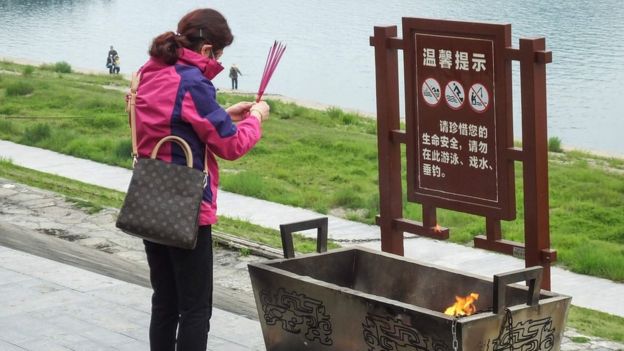
Image copyright AFPImage caption A woman burns incense ahead of the tomb sweeping festival
The tomb sweeping period falls between 28 March and 12 April.
Making offerings online
It is not completely unknown for pay their respects online, however, with the spread of Covid-19, there are now people who have no other option.
“Cloud tomb sweeping” allows people to “virtually” clean graves and make offerings to spirits.
One website providing this service is Heavenly Cemetery. On the surface, the website looks like any usual shopping site, although it also allows people to have their own memorial halls for their loved one so family and friends can join.
Relatives can light a candle, burn money and offer objects such as Chinese rice wine and beer. There is even an option for online tomb cleaning.
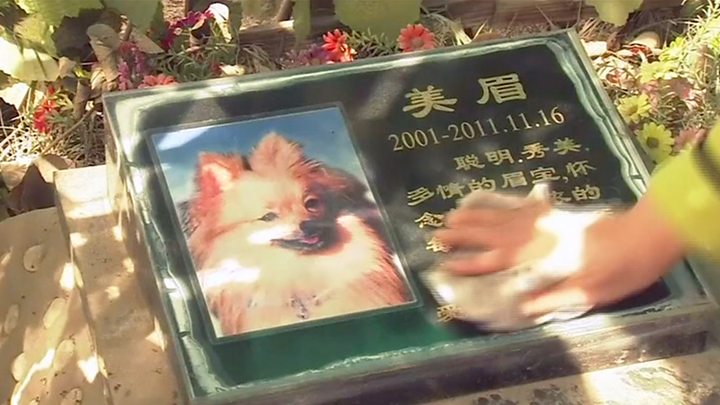
Media caption Watch: People pay respect to their deceased pets ahead of Tomb Sweeping Day
Funeral company Fu Shou Yuan International launched its own online tomb sweeping service on 12 March. It operates in more than 30 Chinese cities. In its first week, its website had about 87,000 visitors.
George Chen, whose grandparents are buried in Shanghai, visits their tombs every year but will be marking this year’s Tomb Sweeping Day online for the time being.
He told Shanghai Daily: “Old traditions are deeply rooted, but it is quite understandable because it is a special period. I will pay virtual respect and visit the scene once the epidemic ends.”
Getting someone to do it for you via livestream
While taking part in “cloud tomb sweeping” does mean you get to send offerings, it does not include the physical cleaning of a loved one’s tomb.
So some burial spots are now offering relatives a chance to watch a member of staff clean the tomb via a live stream. Others will send you photographs of the cleaned grave.
One cemetery in Shanghai is offering packages where a “valet sweep” starts from as little as 35 yuan (£4).
Image copyright GETTY IMAGESImage caption Staff hold a ceremony on behalf of a customer
Babaoshan funeral parlour, in Beijing, also offers live stream services.
Zhou Weihua, deputy director of the parlour, told Chinese news agency Xinhua that live streaming could become a future trend.
“Helping clients sweep tombs and holding online commemorative activities not only meets the demand in this special period but also offers more options for people to remember their deceased family members in the future.”
What about Wuhan?
China reported 3,199 deaths from coronavirus with 2,559 of those in Wuhan, where the first cases were recorded late last year.
The city is still in a lockdown which is expected to end on 8 April, and the government has announced that cemeteries will remain closed until 30 April.
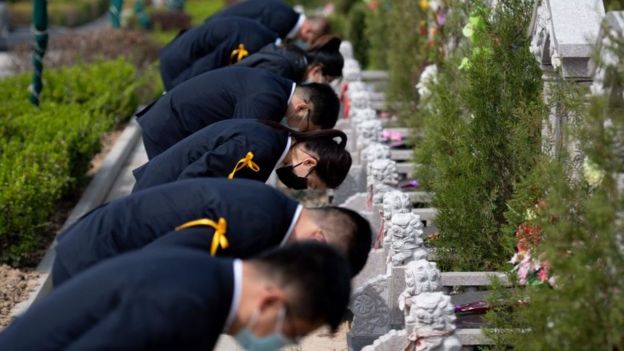
Wuhan’s civil affairs department said it would make “unified arrangements to organise staff at cemeteries to hold a collective ceremony to pay tribute to the deceased”.
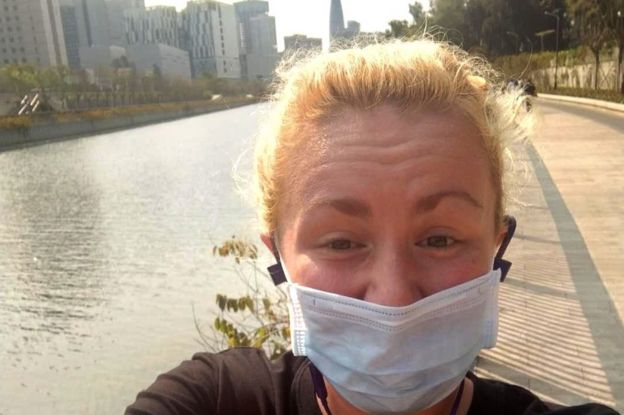
Image copyright JEN SMITHImage caption Jen Smith lives in Shenzhen, where it’s compulsory to wear a mask outside at all times
My Money is a series looking at how people spend their money – and the sometimes tough decisions they have to make. Here, Jen Smith, a children’s TV presenter from Shenzhen in southern China, takes us through a week in her life, as the country slowly emerges from the coronavirus pandemic.
Over to Jen…
Since being in lockdown I’ve been bingeing on Keeping Up With the Kardashians. It starts with one episode after dinner, blink, and suddenly it’s 3am. YouTube, Facebook, Google and Instagram are all banned here, so you’d think I’d be a binge-free socialite after a year and a half living in China. Well, those sites are banned unless you have a VPN – I pay $120 (£97) a year for mine, so Sunday was a late night, with a lie-in until 10.30 this morning.
I go for a run – mask and all, as it’s currently illegal to be outside without one. I make my coffee (bought in the UK), fruit smoothie (about 20 yuan, $2.82, £2.27) and cereal (80 yuan a packet) before cycling to work.
Today is a bit of a crazy day in the studio. I work as a children’s TV presenter. My company has profited from the lockdown as more children are watching the shows non-stop – meaning a rapid turnaround for us.
We shoot two shows from 2-6pm then “break” for a meeting. We discuss tomorrow’s shoot while I eat dinner – homemade aubergine curry. It is normal for the Chinese to eat breakfast, lunch and dinner at work. Normally the company gives all staff 25 yuan through a food-ordering app, and the whole company would eat together. However, because of the current social distancing, that social time is in the far distant past!
I make it home for 8pm, order some deep-fried cauliflower as a snack (45 yuan) and start the inevitable Kardashian binge.
Total spend: 65 yuan ($9.10, £7.37)
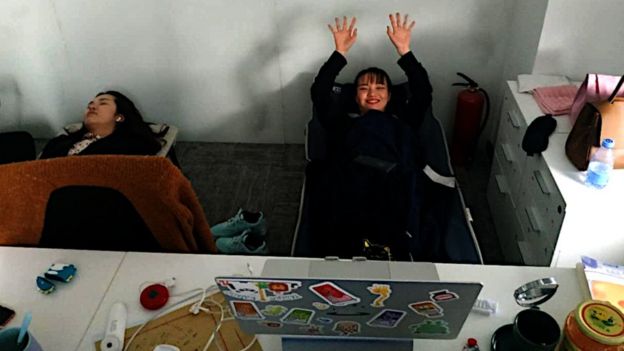
Image copyright JEN SMITHImage caption Workers often have a midday nap in the office
It’s a much earlier start (7.30am), but the same morning routine. On my cycle to work I notice that the traffic is almost back to normal – Shenzhen is inhabited by well over 12 million people, so as you can imagine rush hour is intense. This doesn’t change the fact that everywhere you go you have to scan a QR code – leaving my apartment, using the walkway by the river, and getting into the building I work in.
After a morning of shooting I eat homemade potato curry and settle down for a nap. Naptime is such a commonality in China that people store camp beds at the office. I order a coffee and banana chips (20 yuan) for a pick-me-up before the afternoon’s shooting.
It’s St Paddy’s Day so I head to the local pubs area, catch dinner at a French restaurant (222 yuan), then a few drinks (25 yuan – mainly bought by men at the bar for us) before a very tipsy cycle home.
Total spend: 242 yuan ($34, £25)
Image copyright JEN SMITHImage caption A disposable cover reduces the risk of transmitting the virus by touching lift buttons
The morning’s shoot (thankfully) was cancelled, so I nursed a hangover in bed until around 11am, at which point I had a phone meeting for a company that I do “plus-size” modelling for (for context I’m a UK size 12). I eat a bowl of cereal and order more cauliflower (45 yuan) while I watch a film.
At 2.30pm an intern picks me up, and we head to the government building to apply for a new work visa. Ironically, the image taken for my visa is Photoshopped to remove wrinkles, freckles and my frizzy hair. When I ask why this is being done for an identification document, the intern replies that the government wants it to be neat, and “the Chinese way” is to have altered photos.
I don’t argue, and have an interview before I hand in my passport. The whole process takes around two hours, so I order food to my house while on the way home (150 yuan for burger, salad and cake!) I take a taxi across town which ends up being 39.05 yuan.
The day starts at 8.30am with coffee and reading, before I get a manicure (280 yuan). My nail lady has been very worried about the state of my hands during the virus, so she spends a whopping two and a half hours treating them while I watch a film (0.99 yuan – bought by her). Because the manicure was so long I don’t have time to eat lunch before our fitness shoot, which runs from 2-5.30pm. I then have an appointment to sign into a building which I’ll shoot in tomorrow.
The building is near a supermarket called Ole (one of the only western supermarkets), and I pick up groceries for 183 yuan before heading home to cook, listen to podcasts and prep for the big day of shooting on Friday.
Total spend: 463 yuan ($64, £52.5)
Image copyright JEN SMITHImage caption Jen filming in front of a green screen – a more colourful digital background will be added later in post-production
Fridays are generally my busiest day. The way the Chinese seem to function, is a boss will say “I want this done now” and then employees rush to finish it. Generally, they will write scripts on Monday and Tuesday, discuss Wednesday, then we shoot later in the week. The poor editors, despite mandatory office hours during the week, then have to work tirelessly through the weekend to achieve a Sunday evening deadline.
I start with mashed avocado and a hard-boiled egg before work. The morning shoot runs from 9.30-11.40am, and I have an early lunch – homemade curry again, before my regular nap time. The afternoon shoot is three hours, so I have time to pop home and shower before a live stream at 6pm. I take a taxi to and from the live stream which ends up being 28 yuan.
Total spend: 28 yuan ($3.92, £3.18)
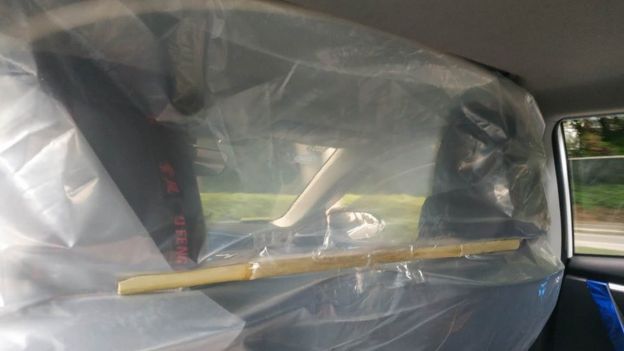
Image copyright JEN SMITHImage caption A taxi driver has improvised a screen to reduce the risk of picking up Covid-19 from a passenger
Finally the weekend! Although things are slowly getting better in China after the coronavirus outbreak, there’s still not too much to do. So I use this time to write, play my piano and generally chill inside. Around 3pm, I venture outside to the shops to pick up some snacks (159.60 yuan) before settling in to ring my family back in the UK with a homemade cocktail – a friend of mine in Canada is doing a daily live stream, “quarantinis” where he teaches you how to make cocktails!
What’s interesting is that a lot of people have started leaving their houses again, but it is still illegal to go outside without a mask on, and temperature checks are taken everywhere. I was even refused entry to a building due to being foreign. I imagine this is because recently the only new cases are being brought in by non-Chinese travelling back to China.
Total spend: 159.60 yuan ($22, £18)
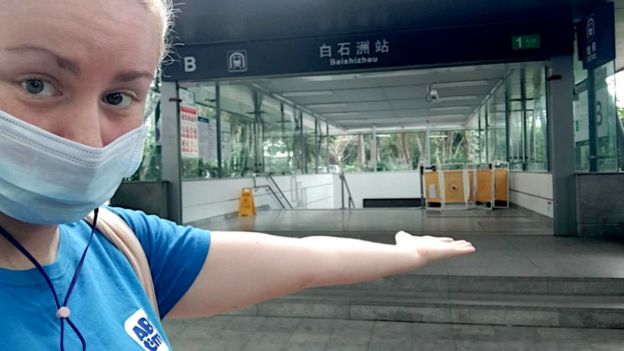
Image copyright JEN SMITHImage caption Shenzhen’s Metro system is still very quiet
It’s another slow day for me as many foreigners have not yet returned to China, so most of my friends are out of the country. I start the day by reviewing potential scripts.
This takes me to 1.30pm without realising I haven’t eaten. I decide to go for a quick run and I return to eat mashed avocado and a hard-boiled egg.
I home-bleach my hair with products bought in the UK, then head back to editing again. About half way through the afternoon I take a little break to practice Chinese. I use an app which is fantastic and free! Definitely worth everyone downloading this during social distancing so you can learn new skills!
For dinner I order online again, a three-dish meal for 160 yuan.
Wang Fuman became an internet sensation after he was pictured with his head encrusted in ice after freezing trek to school
Life has improved since then, but his dad says they are still struggling to make ends meet
Nine-year-old Wang Fuman’s family has now moved from their mud hut to a two-storey home. Photo: AFP
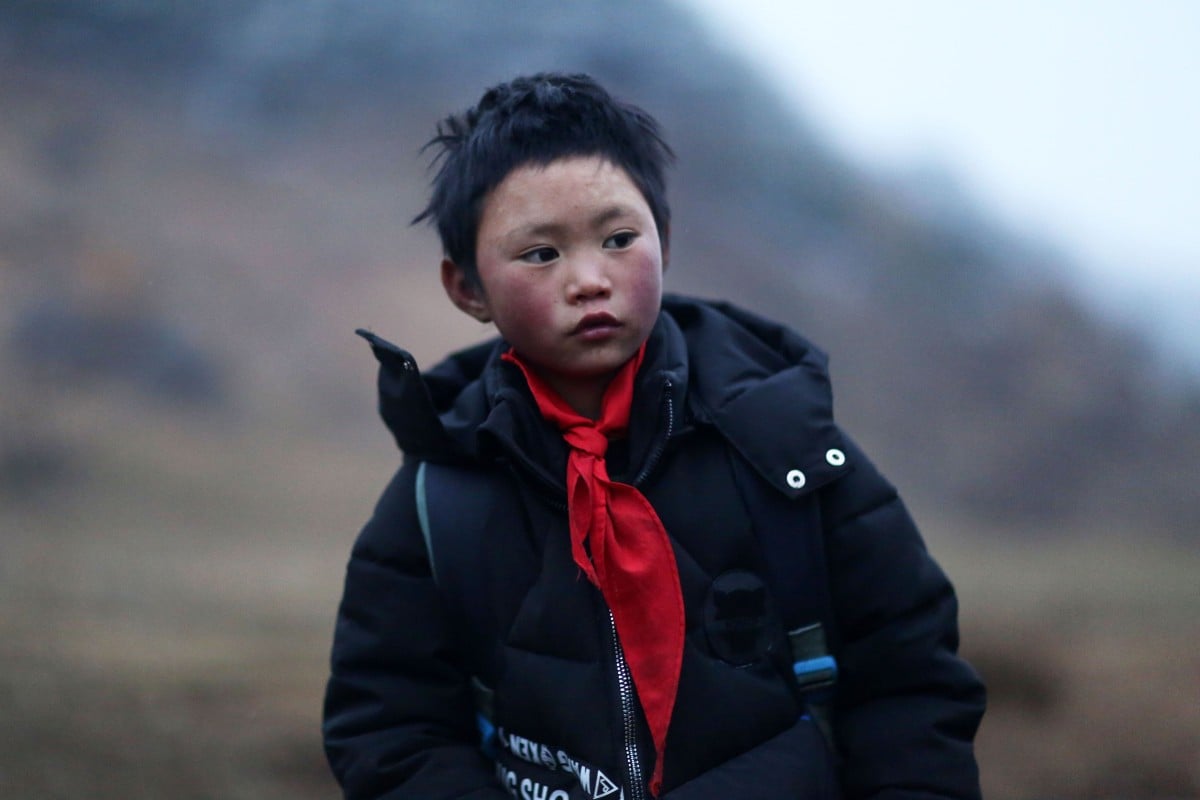
The father of the “Ice Boy” – who became an internet sensation after he was pictured with his head covered in icicles following a freezing trek to school in southwest China – has spoken out about being rejected for a poverty alleviation scheme.
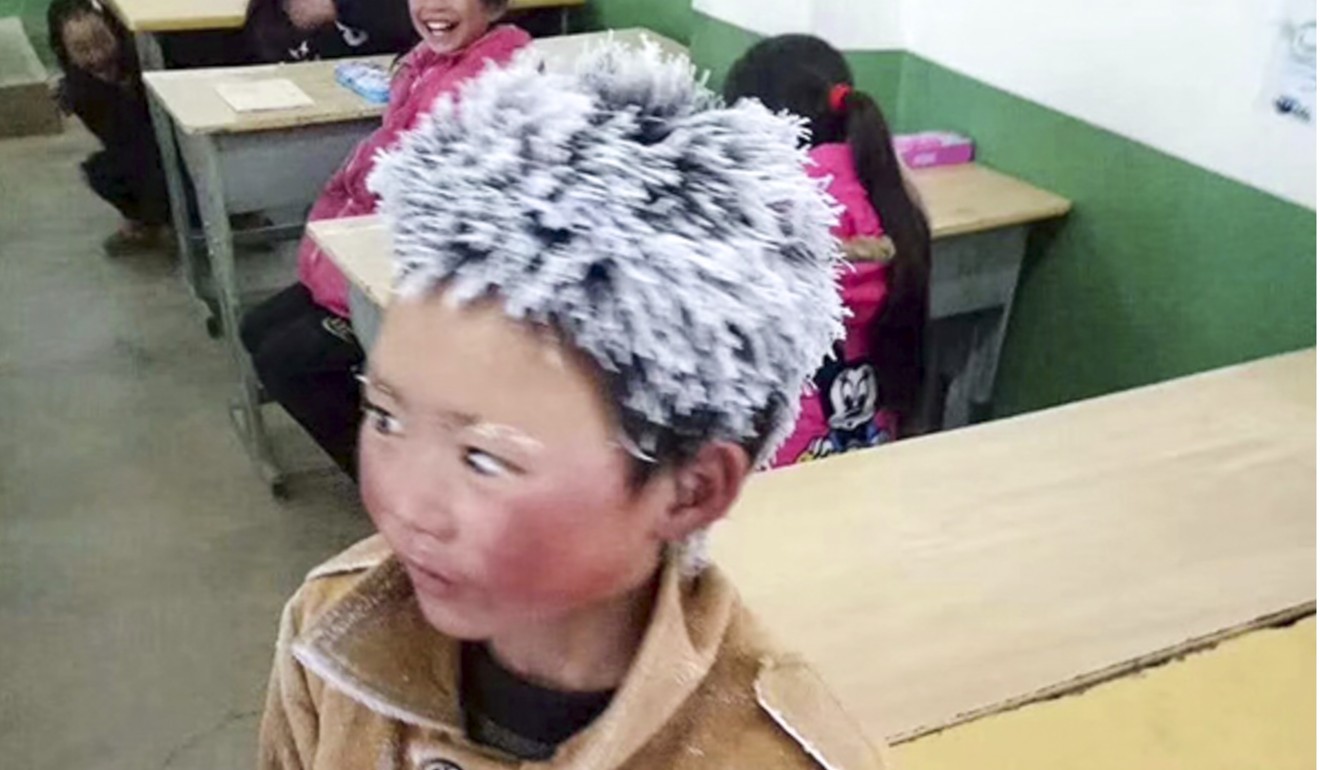
Wang Gangkui’s son, Wang Fuman, was eight when a photo of him taken by a teacher went viral on social media in January last year. It showed the little boy with his hair and eyebrows covered in ice and his cheeks ruddy from the cold after he had walked for over an hour from his home in thin clothing and no hat along treacherous mountain paths.
The plight of the impoverished primary school pupil from Ludian county, a poor area in Zhaotong, Yunnan province, touched hearts across China, with many people expressing sympathy online for the hardships the boy, and other children like him, endured to get to school. Donations of money, warm clothes and heating flooded in.
The photo of Wang Fuman arriving at school with his hair and eyebrows covered in ice went viral last year. Photo: news.163.com
But according to his 30-year-old father, the family is still struggling to make ends meet. He said his application for the assistance scheme had been turned down for the past five years without a satisfactory explanation.
“It’s unfair and unjust that my application wasn’t approved,” Wang Gangkui said on Thursday. “There are allegations in media reports that I have various assets, and they’re just not true. And neither am I trying to take advantage of my son’s fame,” he said.
Families approved for the means-tested scheme, a nationwide programme that is administered at the local level, are given benefits ranging from subsidies to vocational training and job opportunities.
Geng Tao, the party secretary of Zhuanshanbao village, told China News Service on Monday that the Wang family did not meet the eligibility criteria for the programme, citing their two-storey house with a total area of 160 sq metres.
Wang was responding to criticism from internet users after he posted his complaint on social media app Jinri Toutiao on Sunday, a post he later deleted. Some accused him of taking advantage of his son’s fame to get access to government aid, claiming the family was being “greedy” as they were already doing better than others in the region because of the donations they received last year.
State media also weighed in, with Beijing News saying in an editorial on Tuesday that “the authorities should not be influenced by public sentiment towards the Ice Boy and should look at the family’s real situation when assessing if they are in need or not”.
Wang acknowledged that the media attention and subsequent donations from the public had eased the family’s situation, but said they only received a small share.
“There were a lot of donations, but most of them went to the school and were shared among all the pupils and their families here,” he said. “Our family only received a small amount of money.”
After Fuman’s photo went viral, the Ludian county education authorities said there were many “Ice Boys” in the area, and all donations received had been distributed to local families in need, according to China News Service.
A local charity organisation received more than 300,000 yuan (US$42,500) in donations from the public, and said the money was shared among pupils at the Zhuanshanbao primary school, with Fuman receiving just 500 yuan.
Life has improved for Fuman and his family since the photo was taken. He was a
– a term used to describe youngsters from poor families whose parents work in cities away from home, leaving them in the care of relatives. His parents have now returned to their hometown and his father works nearby at a construction site in Zhaotong, earning 3,000 yuan a month – a relatively high salary for the area. But he is the breadwinner for the family of five – his wife, Lu Dafeng, and their two children, Fuman and their 11-year-old daughter Wang Fumei, as well as his mother.
They moved out of their mud hut into the two-storey home, and with the donated funds, Fuman’s primary school was renovated and now has a dormitory equipped with heating. Fuman stays at the school during the week and returns to his home – a 20-minute walk away – on the weekend.
Wang Gangkui said his wife and mother could not apply for jobs designated as “public welfare” positions – such as a street cleaner post offering 500 yuan a month – because they were not recognised as a family in need under the scheme.
He also dismissed media reports that he had two cars, saying he had a second-hand van worth no more than 3,000 yuan. He said reports that his family also had cattle were not true.
Instead, he said he was paying off a loan of tens of thousands of yuan that he took out to build the family’s new house.
There were an estimated 16.6 million people living in poverty in rural China at the end of 2018, about 14 million fewer than a year earlier, according to official data. The ruling Communist Party set the ambitious target of eliminating extreme poverty in China by the end of 2020, and claims that more than 700 million people have already been lifted out of poverty over the past four decades.
HYDERABAD, India (Reuters) – Indian police shot dead four men on Friday who were suspected of raping and killing a 27-year-old veterinarian near Hyderabad city, an action applauded by her family and many citizens outraged over sexual violence against women.
However, some rights groups and politicians criticised the killings, saying they were concerned the judicial process had been sidestepped.
The men had been in police custody and were shot dead near the scene of last week’s crime after they snatched weapons from two of the 10 policemen accompanying them, said police commissioner V.C. Sajjanar.
Thousands of Indians have protested in several cities over the past week following the veterinarian’s death, the latest in a series of horrific cases of sexual assault in the country.
RELATED COVERAGE
Factbox: Reactions, comments on killing of four men accused of rape in India
Why many Indians cheered police for killing gang rape accused
See more stories
The woman had left home for an appointment on her motor-scooter and later called her sister to say she had a flat tyre. She said a lorry driver had offered to help and that she was waiting near a toll plaza.
Police said she was abducted, raped and asphyxiated and her body was then set alight on the outskirts of Hyderabad. Four men were arrested.
Sajjanar, the police officer, said the men – two truck drivers and two truck cleaners, aged between 20 and 26 years – had been taken to the spot to help recover the victim’s mobile phone and other personal belongings on Friday morning.
“As the party approached this area today (during the) early hours, all the four accused got together. They started attacking the police party with stones, sticks and other materials,” he told reporters near the site of the shootings.
The men, who were not handcuffed, then snatched weapons away from the police and started firing at them, but were killed after the police retaliated. He did not say how the accused were able to overpower their escorts.
“Law has done its duty, that’s all I can say,” Sajjanar said.
The National Human Rights Commission, a government-funded watchdog, said it had ordered an investigation. “Death of four persons in alleged encounter with the police personnel when they were in their custody, is a matter of concern for the Commission,” it said in a statement.
Indian police have frequently been accused of extra-judicial killings, called “encounters”, especially in gangland wars in Mumbai and insurrections in the state of Punjab and in disputed Kashmir. Police officers involved in such killings were called “encounter specialists” and were the subject of several movies.
People shout slogans as they celebrate after police shot dead four men suspected of raping and killing a 27-year-old veterinarian in Telangana, in a residential area in Ahmedabad, India, December 6, 2019. REUTERS/Amit Dave
‘LONG LIVE POLICE’
The victim’s family welcomed the news the alleged perpetrators had been killed.
“I express my gratitude towards the police & govt for this. My daughter’s soul must be at peace now,” Reuters partner ANI quoted her father as saying.
A Reuters reporter saw the four men’s bodies lying in an open field, all of them face up and barefoot, with their clothes stained with blood, surrounded by policemen.
A large crowd gathered at the site and threw flower petals at police vans in support of the action. Some shouted “Long live police”, while others hoisted police officials onto their shoulders and burst firecrackers.
There was no immediate word from Prime Minister Narendra Modi’s government on the incident, but Maneka Gandhi, a lawmaker from his ruling Bharatiya Janata Party, said the police appeared to have over-reached.
“You can’t take the law in your own hands. The courts would’ve ordered them (the accused) to be hanged anyway. If you’re going to shoot them with guns before due process is followed, then what’s the point of having courts, police and law?” she said.
Tough laws were enacted after the 2012 gang rape and murder of a woman in a bus in New Delhi that led to an outpouring of anger across the country, but crimes against women have continued unabated.
Fast track courts have been set up but cases have moved slowly, for lack of witnesses and the inability of many families to go through the long legal process. Some victims and their families have ended up being attacked for pursuing cases against powerful men, often local politicians.
Many Indians applauded the killings.
“Great work #hyderabadpolice ..we salute u,” badminton star Saina Nehwal wrote on Twitter.
In Uttar Pradesh state, where a rape victim was set ablaze on Thursday while she was on her way to court, opposition politician Mayawati said the police there should take “inspiration” from what happened in Hyderabad.
“Culprits should be punished, and if they are not punished then whatever happened in Hyderabad should happen,” the victim’s brother said in hospital.
She was on life support, hospital authorities said, news that could further inflame passions in a country where public anger over crimes against women has grown in recent weeks.
Indian police registered more than 32,500 cases of rape in 2017, according to the most recent government data. But courts completed only about 18,300 cases related to rape that year, leaving more than 127,800 cases pending at the end of 2017.
But some people said the lack of progress in the courts did not mean the police had a free hand to dispense justice.
“We now have to trust that a police force that managed to let unarmed suspects escape their custody, and needed to shoot them dead because they could not catch them alive, is somehow competent enough to have identified and arrested the real culprits?,” Meenakshi Ganguly, South Asia Director at Human Rights Watch, told Reuters from London.
Superstitious medical student, 23, said it was customary in her hometown to throw money for good luck
Cousin’s child had fallen ill on flight from Jiangxi to Sichuan, she said
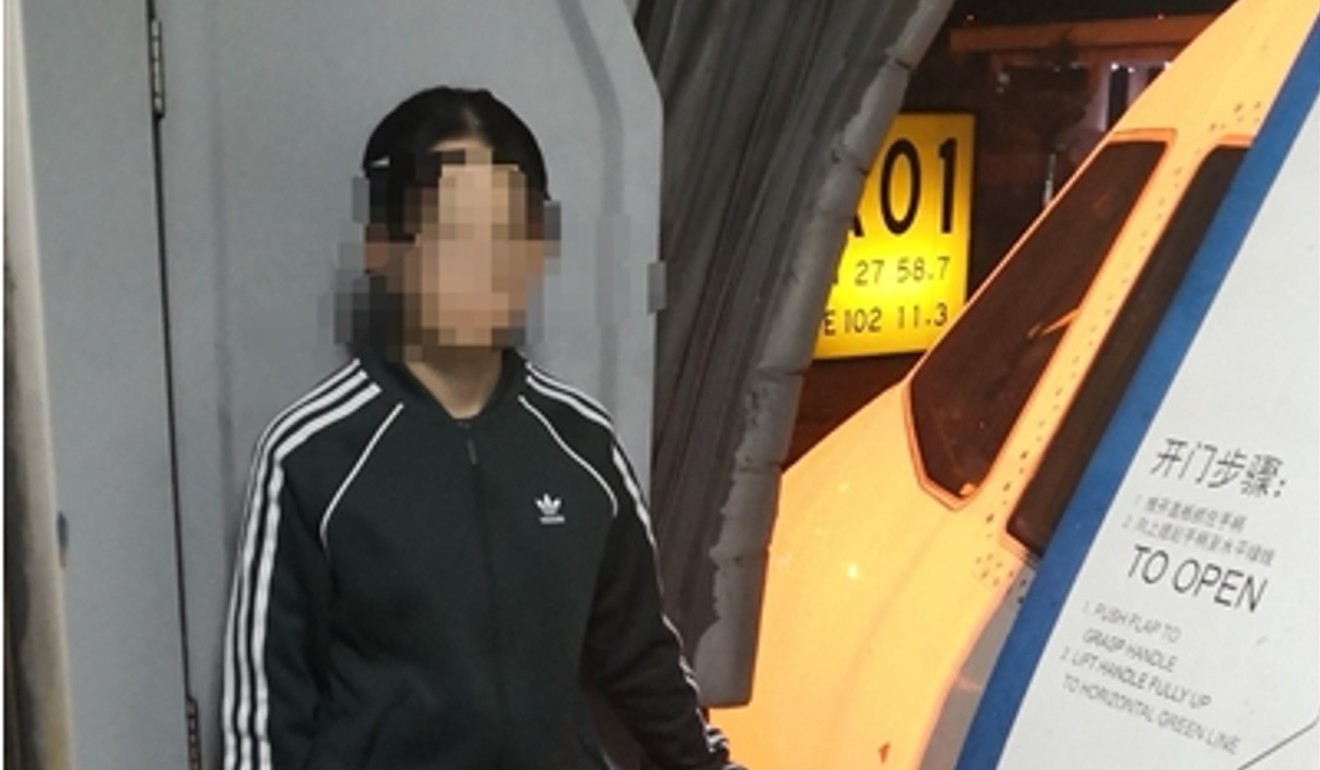
A woman was fined for tossing coins onto the apron at an airport in Sichuan province. Photo: Weibo
A woman who threw coins onto the parking apron at an airport in southwest China in the superstitious belief it might cure her cousin’s baby’s diarrhoea was instead fined 200 yuan (US$28), local media reported.
The incident happened on September 5, as the woman, surnamed Wang, and a group of her relatives arrived in Xichang, Sichuan province, after flying from Nanchang, Jiangxi province, to attend a family wedding, the Chengdu Business News reported on Friday.
Wang, 23, dropped the coins through the gap between the aircraft and the jet bridge as she and her family were disembarking.
Police said the medical student was shocked when she realised the trouble she had caused. Photo: Weibo
Although no one spotted what she had done at the time, airport workers later found three coins on the ground while conducting a security check and reported the matter to the police.
Officers reviewed footage from the airport’s surveillance cameras and identified Wang as the guilty party and went to see her at her hotel the following morning, the report said.
Wang said that during the flight her cousin’s baby had suffered from diarrhoea and that it was customary in her hometown to toss coins in the hope it would bring the child good luck.
“She said she didn’t realise her action could have had a very serious outcome,” a police officer was quoted as saying, adding that Wang appeared shocked when she realised the trouble she had caused.
However, as her actions had not resulted in any delays to flights or created any other problems, she was charged only with a minor offence.
Many Chinese think tossing coins before a flight will bring them good luck. Photo: EPA
Wang, who recently completed a bachelor’s degree in medicine and was preparing to sit a graduate school entrance examination, was worried the incident might have an impact on her future education and job prospects, the officer said.
More than 5,000 people commented on the story on news portal 163.com, with one asking: “You are so superstitious, how can you treat patients?”
In recent years there have been numerous reports of Chinese travellers causing delays and being punished for tossing coins onto airport runways and even into aircraft engines.
In April, a woman was detained for throwing six coins as she was about to board a plane in southern China in the hope it would guarantee her a safe trip.
Cai Rui and Wu Chen are the proud parents of twins but they had to go abroad for the IVF treatment they needed to bring the children into the world
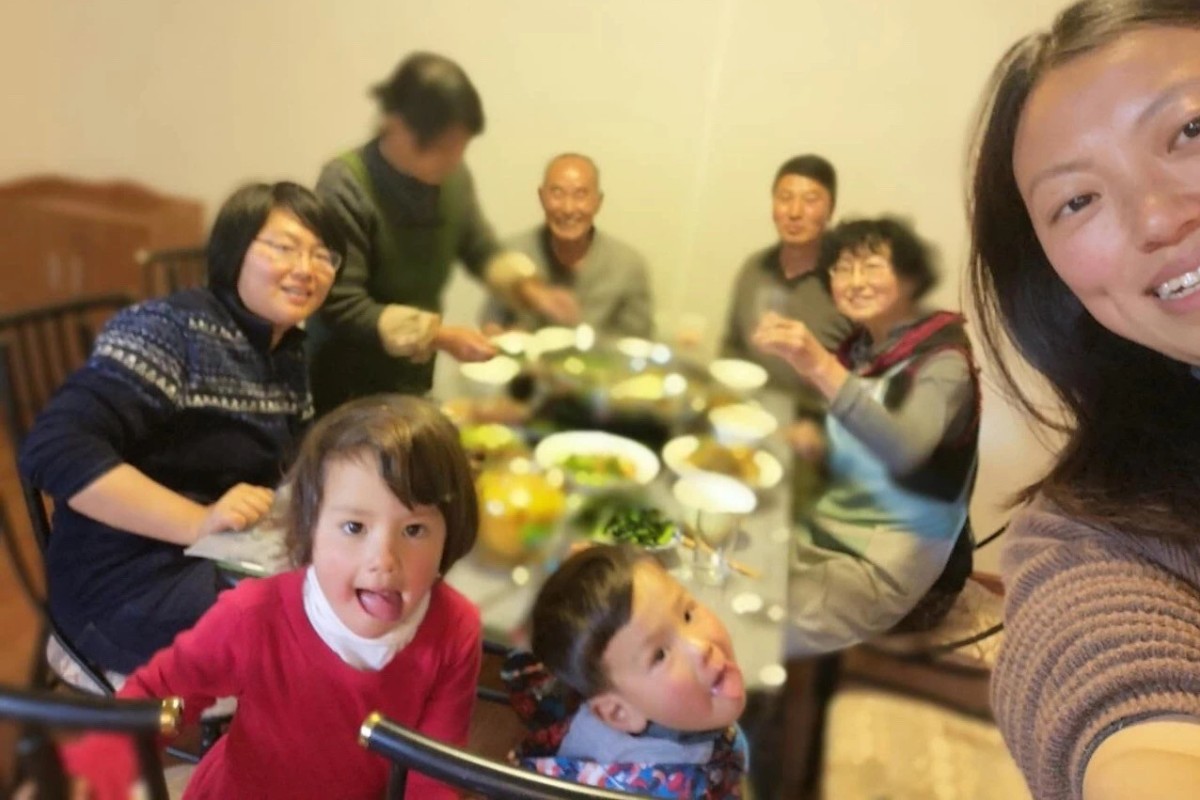
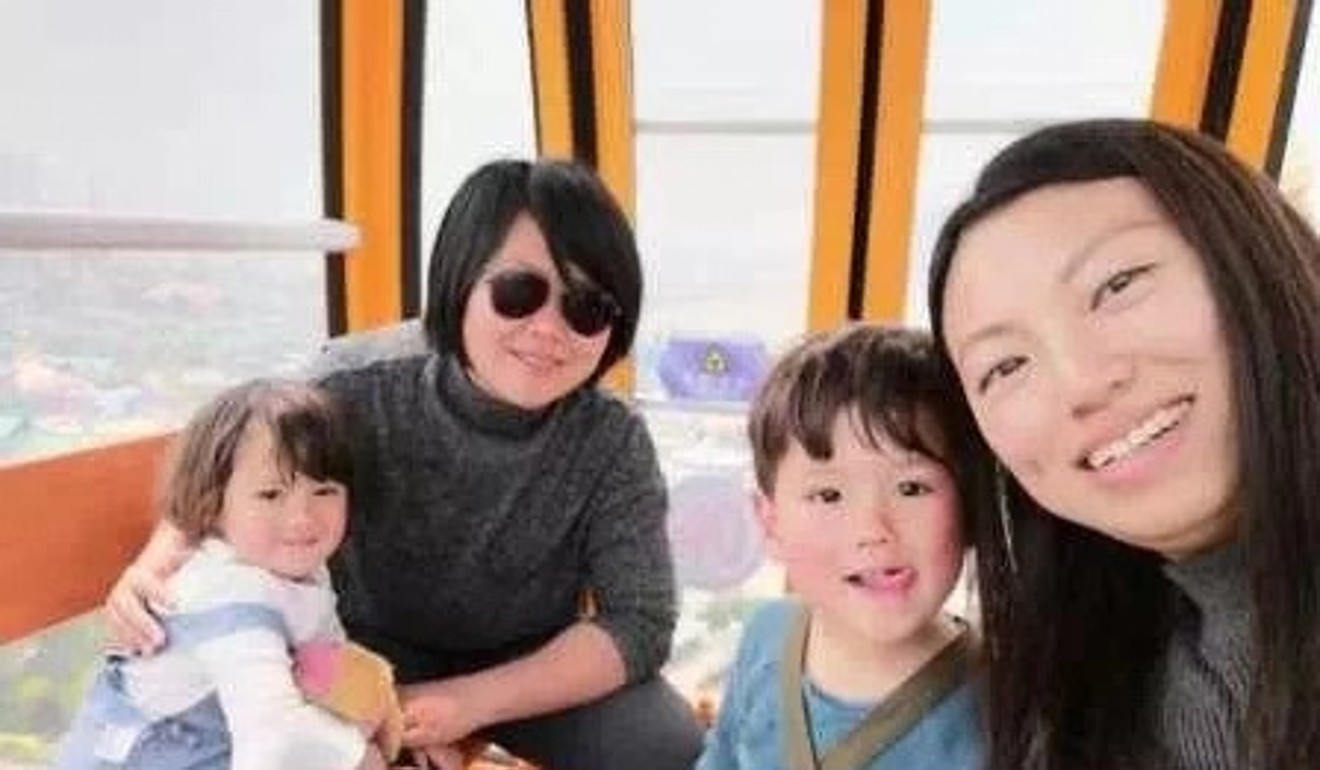
Wu Chen (far left) and Cai Rui (right) are raising their young family together in China. Photo: Cai Rui
When three-year-old twins Harry and Helen are asked about their dad, they have a set answer.
The children tell the curious that they do have a father but he lives in the United States.
Harry and Helen live on the outskirts of Kunming in the southwestern Chinese province of Yunnan with their two mothers, Cai Rui and Wu Chen.
Cai gave birth to the twins after being implanted at a US IVF clinic with ova from Wu and sperm from an American donor.
The couple were forced to seek treatment abroad because Chinese clinics will only perform IVF procedures on couples who can produce a marriage certificate – something limited to heterosexuals.
For Cai and Wu, it was a leap into the unknown – there was little information in China and few others had gone public about their experience.
But their biological clocks were ticking and the couple were used to taking difficult paths.
Gay Chinese find a place to be themselves on ‘Rainbow Cruise’ to Vietnam
Cai and Wu met while studying in Britain and registered their marriage there in 2014. Both women were in their thirties and soon began thinking about having children.
They looked forward to being mothers and felt the experience would strengthen their relationship even more, Cai said.
“I think it’s natural for a woman to aspire to be a mother once she turns 30,” she said. “We were both aware that the older a woman is, the harder it is for her to get pregnant. So it’s an immediate thing for us.”
Their parents were also worried about the couple’s welfare as they grew older.
“Our parents have accepted our relationship, thinking it’s our own choice. However, they worried that when we are old, there will be no children to look after us,” Cai said.
Wu Chen (left) and Cai Rui (right) brought their twin children Helen and Harry into the world with help from IVF treatment in the United States. Photo: Cai Rui
The couple embarked on two rounds of IVF in London, with Cai impregnated with Wu’s fertilised ova, but both rounds failed.
They then returned to China and searched for other options but at the time there were few posts by Chinese lesbians sharing their experience of having babies abroad, Cai said.
So they contacted three clinics in the US and finally decided to go through one in Portland, Oregon, in large part because of the city’s gay-friendly reputation.
Cai said that when it came time to choose a sperm donor, they were less concerned about his outward appearance and more focused on his physical and mental health, his academic record and his experience growing up.
“We wanted to make sure our baby’s father was a healthy and interesting guy,” she said.
The couple chose the sperm of a white man and implanted two fertilised eggs into Cai’s body to raise the chances of success. Twelve weeks later, the couple flew back to Beijing where Harry and Helen were born on April 1, 2016.
Thanks to a more relaxed population policy since 2016, Cai was able to register the children as a single mother while the children were given her partner’s surname.
“So my lover is their biological mother and I am their birth mother,” Cai said.
Small victory for China’s online lesbian community as censored forum is restored, but another remains blocked
The family lived in Beijing for about a year before moving to Yunnan for work commitments. Cai said there had not been any big problems raising the children there apart from some annoying questions from neighbours about why the children are biracial and why the father is not in the home.
“These questions are like flies around us. But they’re not a big deal and won’t affect our life,” she said.
She said she told various villagers in their community about the children’s conception and they responded by saying, “What an advanced lifestyle you have!”
Twins Harry and Helen celebrate Lunar New Year. Photo: Cai Rui
The couple have also tried to explain the situation to the twins.
“We instilled diverse family values in them from a very young age, through everything including cartoon books they read and stories we made up by ourselves,” Cai said.
“So we told [them] that you have a father. But the reason for forming a family is love. We don’t have love with your father, so he doesn’t live with us.”
About four years ago the couple opened a public account on social media app WeChat called Rainbow Babies, to share their experience with other lesbians on the mainland. Cai said the account had more than 17,000 followers, many responding by relating their own stories about IVF.
One woman wrote on the platform that she and her partner had been together for 10 years and after having a daughter they were pregnant with a boy.
“I am not confident of us lesbians raising a boy. Do you have any tips to share with us?” the woman wrote.
Why China’s gays and lesbians are still stuck in the closet
Another woman wrote that since she and her partner decided to have a baby, they had confronted obstacles at every step in the process, but the biggest benefit was that “after so many hardships, our love has been consolidated and we have cherished each other more than before”.
Cai said the most popular destinations for mainland lesbians seeking IVF treatment were the US, Thailand and Cambodia, with at least 1,000 either pregnant or having given birth.
“Some people are hesitant to have babies because of social pressure. [But] as times goes by and women get older, the possibility of them getting pregnant becomes lower,” Cai said.
Cai said she and Wu were often praised for their courage but they were in the habit of choosing a tougher road.
“On many occasions, this habit is the most reliable way to push us to keep our innocent heart and to do things to be ourselves,” she said.




















 CHINDIA ALERT: You'll be living in their world, very soon