Chindia Alert: You’ll be Living in their World Very Soon
aims to alert you to the threats and opportunities that China and India present. China and India require serious attention; case of ‘hidden dragon and crouching tiger’.
Without this attention, governments, businesses and, indeed, individuals may find themselves at a great disadvantage sooner rather than later.
The POSTs (front webpages) are mainly 'cuttings' from reliable sources, updated continuously.
The PAGEs (see Tabs, above) attempt to make the information more meaningful by putting some structure to the information we have researched and assembled since 2006.
The richest man in China opened his own Twitter account last month, in the middle of the Covid-19 outbreak. So far, every one of his posts has been devoted to his unrivalled campaign to deliver medical supplies to almost every country around the world.
“One world, one fight!” Jack Ma enthused in one of his first messages. “Together, we can do this!” he cheered in another.
The billionaire entrepreneur is the driving force behind a widespread operation to ship medical supplies to more than 150 countries so far, sending face masks and ventilators to many places that have been elbowed out of the global brawl over life-saving equipment.
But Ma’s critics and even some of his supporters aren’t sure what he’s getting himself into. Has this bold venture into global philanthropy unveiled him as the friendly face of China’s Communist Party? Or is he an independent player who is being used by the Party for propaganda purposes? He appears to be following China’s diplomatic rules, particularly when choosing which countries should benefit from his donations, but his growing clout might put him in the crosshairs of the jealous leaders at the top of China’s political pyramid.
Other tech billionaires have pledged more money to fight the effects of the virus – Twitter’s Jack Dorsey is giving $1bn (£0.8bn) to the cause. Candid, a US-based philanthropy watchdog that tracks private charitable donations, puts Alibaba 12th on a list of private Covid-19 donors. But that list doesn’t include shipments of vital supplies, which some countries might consider to be more important than money at this stage in the global outbreak.
The world’s top coronavirus financial donors
How Alibaba compares to the top five. No one else other than the effervescent Ma is capable of dispatching supplies directly to those who need them. Starting in March, the Jack Ma foundation and the related Alibaba foundation began airlifting supplies to Africa, Asia, Europe, Latin America and even to politically sensitive areas including Iran, Israel, Russia and the US.
Ma has also donated millions to coronavirus vaccine research and a handbook of medical expertise from doctors in his native Zhejiang province has been translated from Chinese into 16 languages. But it’s the medical shipments that have been making headlines, setting Ma apart.
“He has the ability and the money and the lifting power to get a Chinese supply plane out of Hangzhou to land in Addis Ababa, or wherever it needs to go,” explains Ma’s biographer, Duncan Clark. “This is logistics; this is what his company, his people and his province are all about.”
A friendly face
Jack Ma is famous for being the charismatic English teacher who went on to create China’s biggest technology company. Alibaba is now known as the “Amazon of the East”. Ma started the company inside his tiny apartment in the Chinese coastal city of Hangzhou, in the centre of China’s factory belt, back in 1999. Alibaba has since grown to become one of the dominant players in the world’s second largest economy, with key stakes in China’s online, banking and entertainment worlds. Ma himself is worth more than $40bn.
Officially, he stepped down as Alibaba’s chairman in 2018. He said he was going to focus on philanthropy. But Ma retained a permanent seat on Alibaba’s board. Coupled with his wealth and fame, he remains one of the most powerful men in China.
Media caption The BBC’s Secunder Kermani and Anne Soy compare how prepared Asian and African countries are
It appears that Ma’s donations are following Party guidelines: there is no evidence that any of the Jack Ma and Alibaba Foundation donations have gone to countries that have formal ties with Taiwan, China’s neighbour and diplomatic rival. Ma announced on Twitter that he was donating to 22 countries in Latin America. States that side with Taiwan but who have also called for medical supplies – from Honduras to Haiti – are among the few dozen countries that do not appear to be on the list of 150 countries. The foundations repeatedly refused to provide a detailed list of countries that have received donations, explaining that “at this moment in time, we are not sharing this level of detail”.
However, the donations that have been delivered have certainly generated a lot of goodwill. With the exception of problematic deliveries to Cuba and Eritrea, all of the foundations’ shipments dispatched from China appear to have been gratefully received. That success is giving Ma even more positive attention than usual. China’s state media has been mentioning Ma almost as often as the country’s autocratic leader, Xi Jinping.
AFP
So far…
Over 150 countries have received donations from Jack Ma, including about:
120.4mface masks
4,105,000testing kits
3,704ventilators
Source: Alizila
It’s an uncomfortable comparison. As Ma soaks up praise, Xi faces persistent questions about how he handled the early stages of the virus and where, exactly, the outbreak began.
The Chinese government has dispatched medical teams and donations of supplies to a large number of hard-hit countries, particularly in Europe and South-East Asia.
However, those efforts have sometimes fallen flat. China’s been accused of sending faulty supplies to several countries. In some cases, the tests it sent were being misused but in others, low-quality supplies went unused and the donations backfired.
In contrast, Jack Ma’s shipments have only boosted his reputation.
“It’s fair to say that Ma’s donation was universally celebrated across Africa,” says Eric Olander, managing editor of the China Africa Project website and podcast. Ma pledged to visit all countries in Africa and has been a frequent visitor since his retirement.
“What happens to the materials once they land in a country is up to the host government, so any complaints about how Nigeria’s materials were distributed are indeed a domestic Nigerian issue,” Olander adds. “But with respect to the donation itself, the Rwandan leader, Paul Kagame, called it a “shot in the arm” and pretty much everyone saw it for what it was which was: delivering badly-needed materials to a region of the world that nobody else is either willing or capable of helping at that scale.”
Walking the tightrope
But is Ma risking a backlash from Beijing? Xi Jinping isn’t known as someone who likes to share the spotlight and his government has certainly targeted famous faces before. In recent years, the country’s top actress, a celebrated news anchor and several other billionaire entrepreneurs have all “disappeared” for long periods. Some, including the news anchor, end up serving prison sentences. Others re-emerge from detention, chastened and pledging their allegiance to the Party.
“There’s a rumour that [Jack Ma] stepped down in 2018 from being the chairman of the Alibaba Group because he was seen as a homegrown entrepreneur whose popularity would eclipse that of the Communist Party,” explains Ashley Feng, research associate at the Centre for New American Security in Washington DC. Indeed, Ma surprised many when he suddenly announced his retirement in 2018. He has denied persistent rumours that Beijing forced him out of his position.
Image copyright GETTY IMAGESImage caption Ma discussed trade with then-President-elect Donald Trump in January 2017
Duncan Clark, Ma’s biographer, is also aware of reports that Ma was nudged away from Alibaba following a key incident in January 2017. The Chinese billionaire met with then-President-elect Donald Trump in Trump Tower, ostensibly to discuss Sino-US trade. The Chinese president didn’t meet with Trump until months later.
“There was a lot of speculation of time that Jack Ma had moved too fast,” Clark says. “So, I think there’s lessons learned from both sides on the need to try to coordinate.”
“Jack Ma represents a sort of entrepreneurial soft power,” Clark adds. “That also creates challenges though, because the government is quite jealous or nervous of non-Party actors taking that kind of role.”
Technically, Ma isn’t a Communist outsider: China’s wealthiest capitalist has actually been a member of the Communist Party since the 1980s, when he was a university student.
But Ma’s always had a tricky relationship with the Party, famously saying that Alibaba’s attitude towards the Party was to “be in love with it but not to marry it”.
Even if Ma and the foundations connected to him are making decisions without Beijing’s advance blessing, the Chinese government has certainly done what it can to capitalise on Ma’s generosity. Chinese ambassadors are frequently on hand at airport ceremonies to receive the medical supplies shipped over by Ma, from Sierra Leone to Cambodia.
China has also used Ma’s largesse in its critiques of the United States. “The State Department said Taiwan is a true friend as it donated 2 million masks,” the Chinese Foreign Ministry tweeted in early April. “Wonder if @StateDept has any comment on Jack Ma’s donation of 1 million masks and 500k testing kits as well as Chinese companies’ and provinces’ assistance?”
Perhaps Ma can rise above what’s happened to so many others who ran afoul of the Party. China might just need a popular global Chinese figure so much that Ma has done what no one else can: make himself indispensable.
“Here’s the one key takeaway from all that happened with Jack Ma and Africa: he said he would do something and it got done,” explains Eric Olander. “That is an incredibly powerful optic in a place where foreigners often come, make big promises and often fail to deliver. So, the huge Covid-19 donation that he did fit within that pattern. He said he would do it and mere weeks later, those masks were in the hands of healthcare workers.”
Image copyright GETTY IMAGESImage caption Ma at an Electronic World Trade Platform event with Ethiopian Prime Minister Abiy Ahmed last year
Duncan Clark argues that Ma already had a seat at China’s high table because of Alibaba’s economic heft. However, his first-name familiarity with world leaders makes him even more valuable to Beijing as China tries to repair its battered image.
“He has demonstrated the ability, with multiple IPOs under his belt, and multiple friendships overseas, to win friends and influence people. He’s the Dale Carnegie of China and that certainly, we’ve seen that that’s irritated some in the Chinese government but now it’s almost an all hands on deck situation,” Clark says.
There’s no doubt that China’s wider reputation is benefiting from the charitable work of Ma and other wealthy Chinese entrepreneurs. Andrew Grabois from Candid, the philanthropic watchdog that’s been measuring global donations in relation to Covid-19, says that the private donations coming from China are impossible to ignore.
“They’re taking a leadership role, the kind of thing that used to be done by the United States,” he says. “The most obvious past example is the response to Ebola, the Ebola outbreak in 2014. The US sent in doctors and everything to West Africa to help contain that virus before it left West Africa.”
Chinese donors are taking on that role with this virus.
“They are projecting soft power beyond their borders, going into areas, providing aid, monetary aid and expertise,” Grabois adds.
So, it’s not the right time for Beijing to stand in Jack Ma’s way.
“You know, this is a major crisis for the world right now,” Duncan Clark concludes. “But obviously, it’s also a crisis for China’s relationship with the rest of the world. So they need anybody who can help dampen down some of these those pressures.”
WUCHENG, China (Reuters) – After wading through mudflats, Fan Xinde, a 36-year-old fisherman, sifts old copper coins from the debris scooped from the bed of a dwindling river that feeds China’s biggest freshwater lake, the Poyang.
As residents fled invading Japanese troops 80 years ago, the coins were packed into boxes and sent down the river on rafts, with many sinking without trace. They are now being unearthed as the water in the Poyang recedes to its lowest level in decades, providing a small income for fishermen like Fan facing an uncertain future.
On Jan. 1 2020, China will ban fishing in environmentally sensitive regions along the Yangtze, China’s longest river, and by the start of 2021, fishing throughout the Poyang itself will be prohibited for at least 10 years.
Fan, who has worked half his life on the lake, said he and as many as 100,000 other fishermen were being unfairly blamed for mounting local environmental problems and must now find other ways to make a living.
“Our sources of income have been cut off. We don’t have anything else,” he said. “To be honest, we shouldn’t be collecting the coins at all because they are owned by the state, but it is only a tiny amount.”
The government says excessive fishing has brought stocks down to perilously low levels and put endangered species under threat, including China’s last surviving river mammal, the Yangtze finless porpoise.
But the Poyang, described by President Xi Jinping as a vital “kidney” filtering the water supplies of 40% of China’s population, has also been hurt by intensive sand mining, untreated wastewater and the impact of the giant Three Gorges Dam some 560km (350 miles) upstream.
Water in the Poyang, which spills off from the middle reaches of the Yangtze River in Jiangxi province, routinely declines in winter. But the lake is now at its lowest in 60 years. With little rain since July, hundreds of shriveled anchovies and tiny shellfish have been baked into the exposed shoreline flats.
DAMS AND QUARRIES
Residents blame the Three Gorges Project for the problems facing the lake, with its vast 660km-long (410 mile-long) reservoir storing huge volumes of water behind a giant dam for power generation.
“The Three Gorges is blocking off all the water,” said Zhang Yingsheng, a 59-year old fisherman picking clams from the edge of the lake. “Every winter is like this now, but this year is especially low because of the drought.”
With the 181-metre (600-foot) dam reducing the Yangtze’s flow in winter, water from the Poyang drains quickly and easily back into the river.
But the primary cause of problems is the two decades of intensive sand mining in the Poyang, said David Shankman, professor at the University of Alabama, who studies the lake.
“Sand mining has made the drainage channel (in the northern part of the lake) deeper and wider” accelerating the draining, he said.
Zhang said quarrying by giant dredgers had hit fishing hard, with deeper lake beds making it harder for fishermen to deploy their nets. The sand industry had also damaged the lake’s ecosystem, he said.
According to policy plans seen by Reuters, the local government is already working to reduce mining activity in the Poyang after banning it in the Yangtze River two decades ago.
Annual sand production will be limited to 39.9 million tonnes from 2019-2024, down 26.9% compared to the 2014-2018 period. Dredgers will be permitted to mine 65 square km (25 square miles) of the lake area, a quarter of the previous level.
The new policy was a sign officials had recognized sand mining had become a serious environmental liability, Shankman said, but simply stopping the activity wouldn’t automatically solve the problems.
“It depends not only on the extent of the mining, and not on the total area of the mining, but where they are mining,” he said.
IRREVERSIBLE
China is in the middle of a campaign aimed at ending big and “destructive” development along the Yangtze. President Xi said restoring the Poyang was a crucial element of the plan to revitalize regions along the river’s banks.
But experts say many of the devastating changes to the lake are irreversible.
Even before the Three Gorges Dam and the sand mining boom, the lake had already shrunk considerably as a result of an earlier campaign to reclaim farmland and curb floods through the use of dykes and diversions.
“Everything in the lake has been dramatically altered by landscape change, dams and sand mining,” said Shankman. “The amount of water in the lake, in the Yangtze River, the sediment going in and going out – everything is affected by human activity.”
FUZHOU, Oct. 3 (Xinhua) — Zheng Yangmei, 35, has mixed feelings about working as a receptionist in her childhood home, a 400-year-old country lodge that has been adapted into a luxury hotel in southeast China’s Fujian Province.
The new profession gives her a different angle to perceive the beauty of the ancestral house built sustaining Tang Dynasty (618-907) architecture style, as experts marveled.
The restoration is beyond her family clan’s imagination, which keeps the historic details of the dilapidated residence as much as possible, while replacing the interior with modern decor suitable for comfortable living.
The place of a stinky hog pen in the yard, which Zheng remembers, is turned into a tea pavilion decorated with a neutral color palette. But the lodge is still roughly what she remembers, wood carvings, stone mills and the grey-tile roofs.
Tucked away in the idyllic village of Banding, an hour’s drive north of Fuzhou, the provincial capital, the old house offers a breathtaking view in the backdrop of lush mountains and a vast expanse of paddy fields.
Named “Sanluocuo,” or three juxtaposed houses, the wood and stone complex covers an area of 3,000 square meters and consists of over 200 dark shabby rooms, where Zheng spent part of her childhood life bunking with her parents and two siblings in a 25-square-meter room.
Since the mid 16th century, it has been held by the extended Zheng family clan. Zheng remembers that there were over 200 members living in the houses when she was there.
“There was no toilet, no tap water in each house,” said Zheng, whose family moved out of the aged buildings when she was 8, as they could no longer fix the house. Instead, they built new two-story brick houses 1,000 meters away.
The old buildings were completely abandoned by all the villagers in the early 2000s, Zheng recalled.
She left the village for college study at the age of 19 and then worked as a vet in several pig farms in more prosperous towns, until 2013 when she got married and returned to the village to raise her kids.
“Villagers seldom went back to the buildings, considering the place pretty spooky, with filthy water, messy electric wires hung in the air like spider webs and cracks on walls,” said Zheng, a mother of two daughters.
Elders of the family clan called on the clan members to raise funds to fix leaky roof tiles, control termites, and straighten leaning walls to prevent the ancestral houses from completely collapsing, but nobody would imagine it can be fixed in a way that the hotel developer later did.
With the local government-initiated plan for preserving ancient folk houses, a property company came in investing 150 million yuan (20.98 million U.S. dollars) to rehab the obsolete buildings.
After two years of reconstruction, “Sanluocuo” was turned into a trendy boutique hotel with centuries-old wooden beams, garden-like atriums, earthen walls and contemporary luxury.
The transformative creation of “Sanluocuo” is among the artworks selected for the China Pavilion overseas show at the ongoing Biennale de Curitiba 2019 in Brazil, as a model for “building a future countryside.”
“We actually leased the complex from the villagers for the renovation. The old rooms were very small. So we converted the original 200 cramped rooms into 40 guest rooms to make them comfortable for living, but we pay the rents based on 200 rooms to the villagers,” said Zhang Yiwen, operations manager of the project.
Targeted at high-flown customers, the hotel rooms in “Sanluocuo” are priced on average at over 600 yuan per night even in the off season.
Visitors can touch the original wood pillars with deep cracks, and decayed rammed-earth walls with weeds, while enjoying hot bath and clean toilets with heated seats inside each room.
The hall that used to house the Zheng family shrine and warehouses have been converted to galleries, restaurants, bars and stores attached to the hotel, which help the village unleash its cultural potential, and once again become a place that villagers like hanging around in leisure time.
The project has triggered an online sensation, after visitors post their travel photos inside the hotel, showing off their cultural and stylish taste on social media.
Zhang said weeks ahead of the National Day holiday, all of the 40 rooms were booked out.
Zheng and 30 other villagers are employed in the hotel, which has also sparked an entrepreneurial enthusiasm in the village. Zhang said the hotel is willing to help villagers open small inns, eateries and stores selling souvenirs and local delicacies, to further improve the village’s tourist potential.
Zhang said the real estate developer of “Sanluocuo,” Land Shine, has leased two more clusters of such old residence from a neighboring village, as folks bear wishes that their obsolete ancestry complex could shine as well as “Sanluocuo.”
New material is almost identical in structure to human enamel, which does not regenerate itself
Crystal-like mineral can grow on teeth and last permanently, researchers say
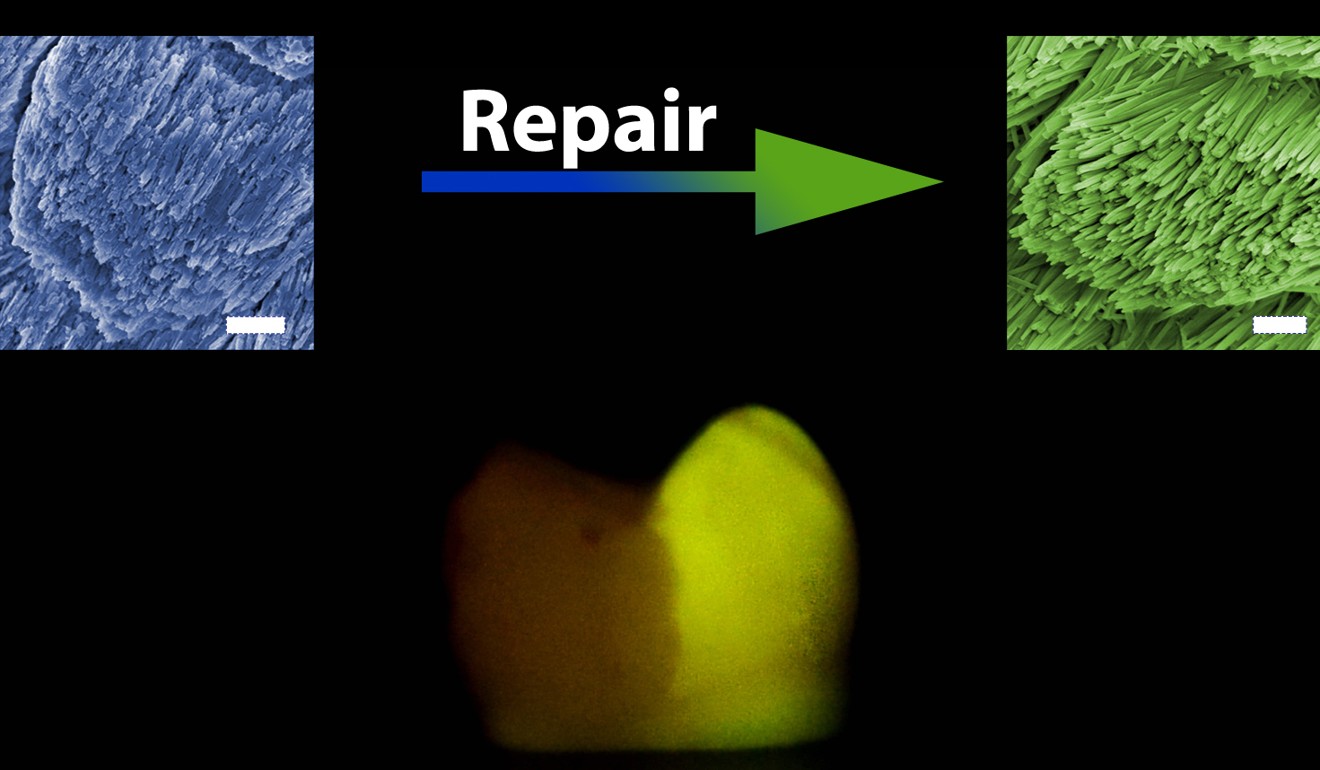
Drops of the liquid solution are applied to a human tooth. Photo: Zhejiang University
Scientists at a Chinese university say they have discovered the world’s first material that can repair damaged tooth enamel once and last for life.
A few drops of the liquid solution can fix all invisible cracks and wear on an ageing molar, according to researchers at Zhejiang University in Hangzhou, eastern China, whose work was published on Friday in the journal Science Advances.
The material, calcium phosphate ion clusters, can grow a thin layer of protective shield on teeth, the research showed. The transparent, crystal-like mineral has a structure resembling fish scales and a high mechanical strength – almost identical to the enamel on a human tooth.
Its repair of the tooth “would be permanent”, wrote the researchers, led by Professor Tang Ruikang at the university’s chemistry department.
A tooth’s non-repaired left side (darker) and repaired right side (lighter) are compared using a fluorescent chemical. Photo: Zhejiang University
The technology could be developed as an effective remedy in clinical practice for enamel erosion, the main cause of tooth decay, Tang’s team said. Tooth decay affects almost half of the world’s population, costing dental patients in the United States and European Union a combined US$200 billion annually, according to the World Dental Federation.
Enamel, the outer covering of teeth, is the hardest tissue in the human body, protecting teeth during biting and chewing food.
Unlike other tissues such as muscle, bone and skin, enamel is generated by cells that die immediately after completing their job. The human body cannot produce more of them, so when enamel breaks or chips, it will not regenerate itself.
For decades, researchers around the world have conducted studies to seek a solution, but the artificial materials tested previously could not recreate precisely the fine structure of natural enamel, leaving gaps or holes that could cause it to break off real enamel.
Wouldn’t it be nice if our teeth fixed themselves, just like pandas’ do?
Tang’s team claim their new material can grow seamlessly on human teeth. They mixed two different types of repairing material together to form tiny clusters of mineral particles only 1.5 nanometres in diameter – smaller than a strand of human DNA.
Unlike in previous experiments, these clusters could remain stable for a long time without clumping together, making precise reconstruction of an enamel-like structure possible.
Chen Haifeng, associate professor at Peking University’s biomedical engineering department, said that the research was a positive step but that the new material might need improvements before clinical use.
For instance, the artificial layer requires two days to grow, which could be difficult for dentists to schedule with patients.
Many children use so much toothpaste it’s unhealthy, experts warn
The liquid solution contains triethylamine, a toxic substance with a very strong smell, which may pose a health risk, according to Chen. “But it doesn’t mean we can’t do anything,” he said.
The researchers said the chemical would quickly vaporise and none would be left in the teeth after the protective shield had formed.
Some products preventing enamel erosion and decay, such as toothpaste with enamel-strengthening ingredients, are already available in shops.
“Prevention is the best approach,” Chen said. “We should never wait until the damage is done. Our teeth are a miracle of nature. Artificial replacement will never do the job as well.”


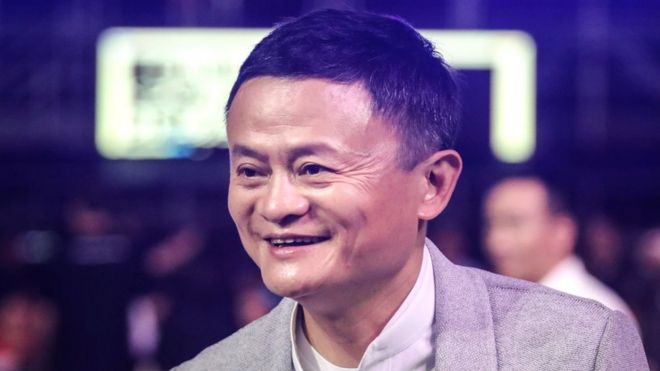 Image copyright GETTY IMAGES
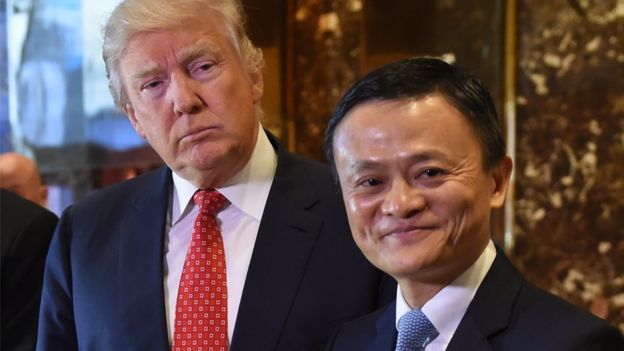 Image copyright GETTY IMAGES

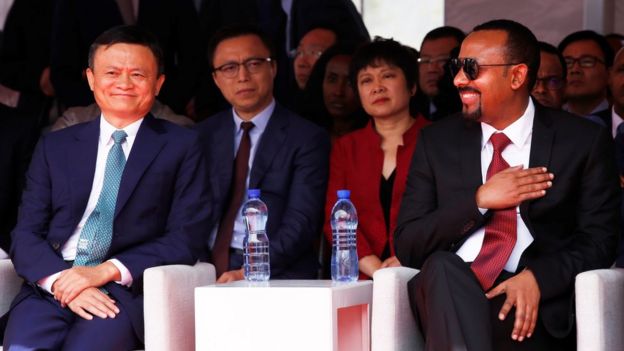 Image copyright GETTY IMAGES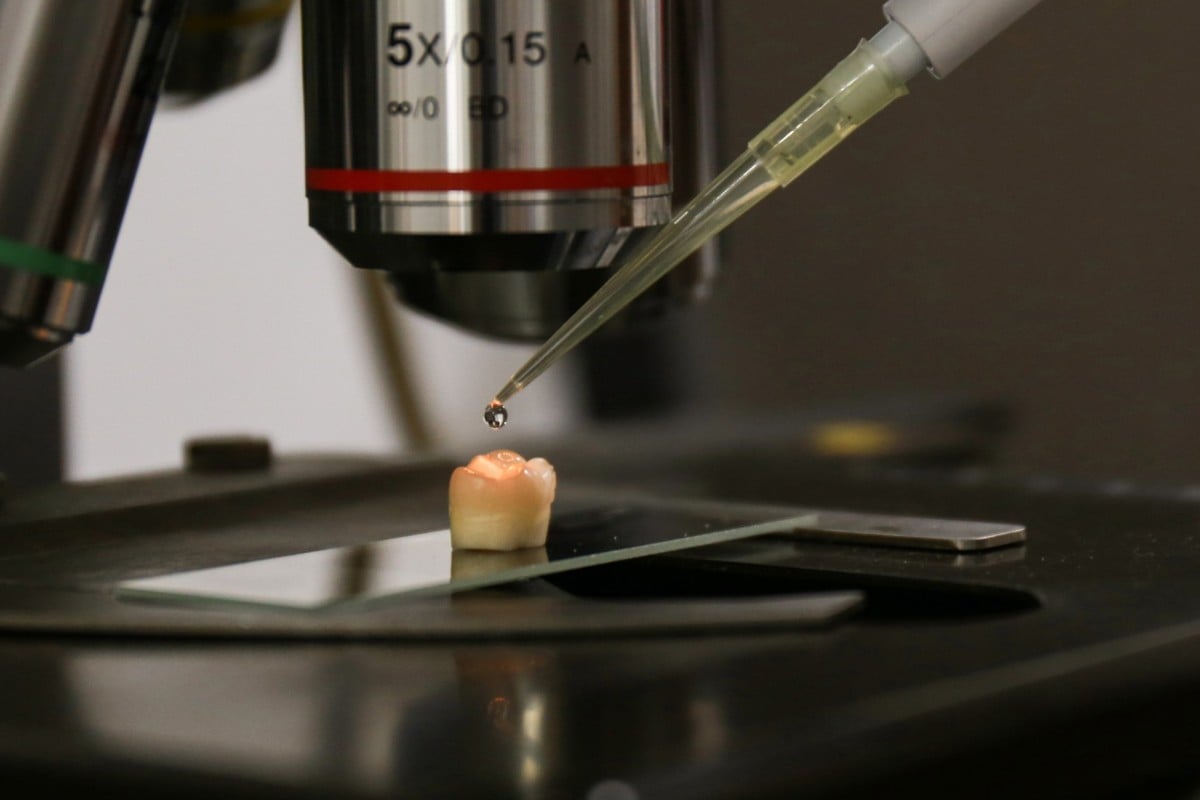

 CHINDIA ALERT: You'll be living in their world, very soon