Archive for ‘Guizhou Province’

06/05/2020

Poverty-alleviation workshops resume production in Huishui County, Guizhou

CHINA-GUIZHOU-HUISHUI-POVERTY ALLEVIATION WORKSHOP-WORK RESUMPTION (CN)A worker makes clothes at a poverty-alleviation workshop in a resettlement area for the poor in Huishui County, southwest China’s Guizhou Province, May 6, 2020. With strict epidemic prevention measures in place, the county’s all 11 poverty-alleviation workshops have resumed work and production recently, providing over 1,100 jobs to locals. (Xinhua/Ou Dongqu)

Soiurce: Xinhua

04/05/2020

Young workers stick to posts at construction site of Renhuai-Zunyi expressway during Labor Day holiday

CHINA-GUIZHOU-ZUNYI-EXPRESSWAY-CONSTRUCTION-YOUTH DAY (CN)

Combo photo taken on May 3, 2020 shows Cao Xiongbin checking the temperature of his colleague (left) and posing for a photo at the construction site of the Renhuai-Zunyi expressway in Zunyi, southwest China’s Guizhou Province. Cao, 25, from Jingdezhen of Jiangxi Province, has been working as a staff member on the COVID-19 control and prevention since early time this year. Many young workers have stuck to their positions during Labor Day holiday. (Xinhua/Liu Xu)

Source: Xinhua

06/03/2020

China’s Hubei reports no new coronavirus cases outside city of Wuhan

BEIJING (Reuters) – China’s central province of Hubei, excluding the provincial capital Wuhan, has reported zero new cases of coronavirus over 24 hours for the first time in the outbreak, as authorities seek to stem imported infections in other areas.

Wuhan, the centre of the epidemic, reported 126 new confirmed cases on Thursday but there were no new infections elsewhere in the province, the National Health Commission said on Friday.

Elsewhere in China, schools in provinces reporting no new cases for a number of days started to set reopening dates.

Qinghai, a northwesterly that had reported no new infections for 29 days as of March 5, said it would stagger the start date of different schools between March 11 and March 20, according to a notice posted on an official website.

The southwesterly province of Guizhou has said its schools will start reopening from March 16.

Outside of Hubei, there were 17 new confirmed cases, bringing the total new infections in mainland China to 143 on Thursday, up from 139 cases a day earlier.

Of the 17 new cases, 16 were imported from outside of China – 11 in Gansu province, four in Beijing and one in Shanghai.

A total of 311 passengers arriving at Gansu’s provincial capital Lanzhou from Iran were quarantined, state television reported late on Thursday.

Beijing’s four new cases had come from Italy. On Friday, one of the city’s government officials described its epidemic control campaign as being at its most challenging period, adding that roughly 827,000 people who had returned to the capital from outside – most of them from extended Lunar New Year holidays – were currently undergoing home observation.

Last month, Gansu became the first province to lower its emergency response measures from level I to level III, reflecting the lack of new infections.

Tibet became the latest region to lower its emergency response level on Friday, announcing on an official website that some areas had eased to level II and others to level III.

OPTIMISM FOR WUHAN

Health authorities in Shanghai said that the city had recorded three new cases in the first 12 hours of Friday. All were Chinese nationals who had studied in Iran, state media reported. [B9N28E04N]

All three had been transferred by Shanghai customs to quarantine on March 3, a spokeswoman for the city’s health commission told a news briefing.

Despite the fresh cases in Wuhan, senior Chinese government officials expressed optimism about its situation as the city shut its second makeshift hospital on Friday afternoon, state radio reported.

“As the situation in Wuhan and Hubei improves, relevant authorities, with approvals, will make timely adjustments according to China’s Infectious Diseases Law and public health emergency regulations,” Ding Xiangyang, vice secretary general at the State Council, told a news briefing.

“When I went out in the morning, the cherry blossoms were blooming in front of my door, telling us that winter has passed and spring has come. I think the day everyone has been looking forward to is not far away,” he said.

As new cases dwindle in China, attention has turned to potential infections arriving from overseas.

Authorities in Beijing, Shanghai and Guangdong have all vowed to quarantine travellers from countries hit the hardest by the coronavirus, which Beijing identified as South Korea, Japan, Iran and Italy.

The overall accumulated number of confirmed cases in mainland China stood at 80,552 as of Thursday.

The death toll from the outbreak in mainland China was 3,042 as of the end of Thursday, up by 30 from the previous day.

Hubei reported 29 new deaths, while in Wuhan, 23 people died.

Source: Reuters

04/03/2020

Xinhua Headlines: Guitars, roads and red tours: former revolutionary base casts off poverty

Zunyi, a former revolutionary base of the Communist Party of China in southwest China’s Guizhou Province, has cast off poverty.

Thanks to burgeoning industries, improving infrastructure and distinctive cultural tours, more than eight million people in Zunyi are living better lives.

By Xinhua writers Zhong Qun, Wang Li, Li Jingya and Liu Zhiqiang

GUIYANG, March 3 (Xinhua) — Riding on the fast development of industries, improving infrastructure and distinctive cultural tours, a former revolutionary site of the Communist Party of China (CPC) has formally cast off poverty in China’s southwestern mountains.

On Tuesday, the government of Guizhou Province announced that Zheng’an County in the province has shaken off poverty. The county is under the jurisdiction of the city of Zunyi, where the CPC conducted its early revolutionary activities. The announcement means that more than 8 million people in the entire city of Zunyi have officially bid farewell to poverty.

A view of Huamao Village of Fengxiang Township in Zunyi City, southwest China’s Guizhou Province, Feb. 28, 2020. (Xinhua/Tao Liang)

Over the years, Zunyi has taken a variety of measures in answer to China’s campaign to eradicate absolute poverty in 2020.

Major industries such as guitar-making and tea plantations powered Zunyi’s economic growth, while roads, water projects and the revolution-themed tourism also put the city, once mired in grinding poverty, on a fast track toward modernization.

GUITARS STRIKE A CHORD IN REVOLUTIONARY HEARTLAND

When Zheng Chuanjiu decided to build a guitar-making factory in Zunyi’s Zheng’an County in 2013, he was a little nervous.

“There were no raw materials, and transportation was bad,” said Zheng, 42. “But the county had advantages in land and labor and there was government support.”

Zheng, a native of the county, had found success in the guitar industry in Guangzhou, capital of south China’s Guangdong Province. He and his brother established the Guangzhou Shenqu Musical Instruments, a Guangzhou-based guitar-making company, after years of hard work in the southern metropolis.

“The county government of my hometown wanted to develop the guitar-making industry after they found many local migrant workers were working in the industry in Guangzhou,” Zheng said. “They established an industrial park and we were the first to join.”

An employee works at the workshop of Guangzhou Shenqu Musical Instruments, a Guangzhou-based guitar-making company, in Zheng’an County of Zunyi City, southwest China’s Guizhou Province, March 28, 2017. (Xinhua/Tao Liang)

The government put forward a variety of preferential policies in rents, financing and taxes, to support guitar-making companies like Zheng’s and allow the sector to prosper.

Today, Zheng’s company in the county has grown into one with an annual production value of more than 30 million U.S. dollars. One of the country’s top five guitar makers, it employs more than 500 local farmers and more than 100 poverty-stricken residents.

Zheng’s company is part of a bigger picture. The company’s success has led many to jump on the bandwagon. After years of growth, the county is now home to 64 companies specializing in guitar-related fields, churning out about 7 million guitars a year to more than 30 countries and regions across the world and employing more than 15,000 locals.

The guitar industry forms part of the government’s efforts to develop local industries. Thanks to geological advantages, the county also saw the emergence of tea gardens and traditional Chinese medicine plantations. All these sectors drove local economic growth.

A group of children trying tea-picking at Hetaoba Village in Meitan County of Zunyi City, southwest China’s Guizhou Province, April 1, 2018. (Xinhua/Yang Wenbin)

BETTER INFRASTRUCTURE, BETTER LIVES

Given the mountainous landscape in Guizhou, authorities in Zunyi knew the importance of improving infrastructure projects if they wanted to bring the local economy to the next level. So they started building new roads to facilitate transportation.

Last year, Guizhou built 8,116 km of roadways. The Guizhou provincial government spent 29.34 billion yuan (4.2 billion U.S. dollars) building the roadways, including 7,386 km in rural areas, according to the provincial highway bureau. The province also upgraded many old roadways.

The construction site of Tuanjie Grand Bridge of Renhuai-Zunyi Highway, which has resumed construction amid strict prevention measures against the novel coronavirus, in southwest China’s Guizhou Province, Feb. 27, 2020. (Xinhua/Tao Liang)

In the county of Zheng’an, for example, several major highways not only enhanced logistics to bring specialties out of town but also allowed outside investment to flow to the county tucked in the lush green mountains.

“Thanks to improved transportation conditions, our guitars can easily reach many areas in the country and around the world,” said Zheng Chuanjiu.

In Huanglian Village, rural family inns have mushroomed, as more visitors come as more roads were built. Many tourists come to enjoy the countryside scenes during the holidays.

In addition, water projects also began, bringing safe drinking water to local households.

“We used to depend on the weather for water,” said Zunyi resident Zeng Fanyun. “Now we have clean water from the taps.”

For areas deemed inhabitable, authorities moved people out.

Statistics show that Guizhou relocated 1.88 million people from inhospitable areas in 2019.

RED TOURS, GOLDEN OPPORTUNITIES

As many cities in China scramble to modernize and adopt the latest technology to power growth, Zunyi seems to have found a new way to develop itself by looking to the past.

In January 1935, an enlarged meeting of the Political Bureau of the CPC Central Committee took place in Zunyi during the Long March.

The meeting focused on rectifying the left-leaning errors in military and organizational affairs and established the correct leadership of the new Central Committee, as represented by Mao Zedong.

The Zunyi Meeting is regarded as a crucial turning point of the Long March, leading to the ultimate success of the Chinese revolution.

Since then, Zunyi has become a sacred place for generations of CPC members, and the footprints of the Red Army are forever imprinted on the city’s culture and spirit.

Today, local authorities are promoting “red tours” in the locality, aiming to bolster the tourism sector as part of economic growth.

Tourists are seen at the Memorial of Zunyi Meeting in Zunyi, southwest China’s Guizhou Province, Oct. 16, 2018. (Xinhua/Tao Liang)

Yang Zhirong started a family homestay in the county of Tongzi in Zunyi. The homestay is called “The Red Army Road Inn,” because it is close to the command center of a famous battle during the 1930s.

“During the summer holidays, there are barely enough rooms to accommodate all the tourists,” Yang said. “Because the Red Army used to walk near here, the visitors feel they could sense history by staying here.”

Last year, Zunyi received more than 46 million visitors for red tours, generating a revenue of about 35.5 billion yuan, up 24.1 percent year on year, according to official figures.

The red tours also prompted sales of local cultural products, such as handmade soap, wallets and fragrances, all featuring Red Army themes. Forums, hiking and even marathons feature red themes as well in Zunyi.

“Zunyi serves as a good example of the CPC’s ability and responsibility to help people live prosperous lives,” said Zheng Dongsheng, a professor with the Party School of the Guizhou Provincial Committee of the CPC. “Zunyi’s success to cast off poverty highlights the Long March spirit in the modern era.”

Source: Xinhua

25/01/2020

Snow scenery in Guizhou

#CHINA-GUIZHOU-BIJIE-SNOW SCENERY (CN)Aerial photo taken on Jan. 25, 2020 shows the snow scenery of Hezhang County in Bijie, southwest China’s Guizhou Province. (Photo by Han Xianpu/Xinhua)


Source: Xinhua

18/12/2019

Chinese mines: At least 14 dead in latest disaster

An explosion at a coal mine in south-west China has killed at least 14 people – the latest in a string of deadly mining accidents.

The local authorities said two people were still trapped underground at the mine in Guizhou province.

At least 37 people have died in five separate mining accidents in China since October.

The accidents are often due to poorly-enforced safety regulations.

The explosion at the Guanglong mine in Guizhou province happened in the early hours of Tuesday. Seven workers were lifted to safety.

On Saturday, flooding in a coal mine in south-west China’s Sichuan province killed five and trapped 13 miners underground.

Some 347 miners were working in the Shanmushu mine when the flood happened.

Rescuers carry a victim at the site of a coal mine explosion in Pingyao, early on November 19, 2019Image copyright AFP
Image caption A mine explosion in Pingyao, in China’s northern Shanxi province killed 15 people in November

On 25 November, one person died in an accident at a different mine in Guizhou province.

Before that, a blast in northern China’s Shanxi province killed 15 workers on 18 November.

At the time, officials said the accident was caused by “broken laws and regulations”.

In October, two people were killed in a blast in a mine in Shandong province in eastern China.

The poor safety record and high accident rate in China’s mining sector led to the government in November ordering a “crackdown” on safety issues, said the AFP news agency.

But – despite the string of deadly accidents – mine safety is generally improving.

Last year, 333 people died in Chinese mines – a decrease of 13% on the year before. Meanwhile, the “death per million tons of coal mined” fell to below 0.1 for the first time.

China mined three billion tonnes of coal over the first 10 months this year, according to official data cited by Reuters – up 4.5% from the same period in 2018.

Source: The BBC

01/11/2019

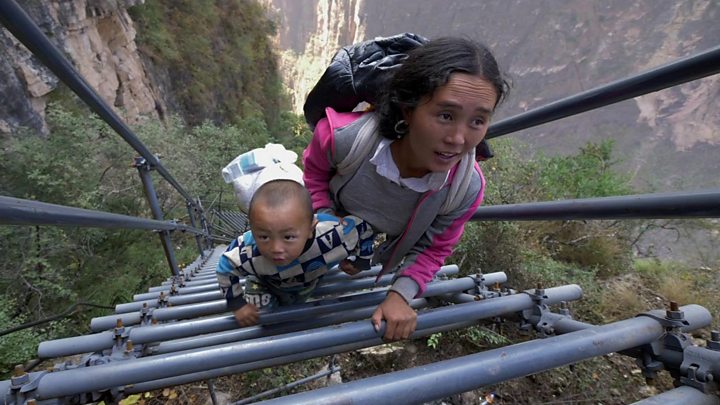
Help pours in for Chinese student who lived on 30 cents a day

Wu Huayan on her hospital bedImage copyright FENG VIDEO
Image caption Wu Huayan ate only rice and chillies in order to save money to help her ill brother

Well-wishers have donated almost a million yuan to a Chinese student who was hospitalised after living on 2 yuan ($0.30, £0.20) a day for five years.

The case of Wu Huayan shocked Chinese people after it hit the headlines earlier this week.

The 24-year old woman became seriously malnourished while struggling to study and support her sick brother.

Ms Wu’s story also sparked anger at authorities for failing to recognise her plight and help her much earlier.

After the story was reported, donations began pouring in for the college student in the city of Guiyang – reportedly totalling some 800,000 yuan ($114,000, £88,000).

What is Wu Huayan’s story?

Earlier, this month, the young woman went into hospital after having difficulty breathing, according to Chinese media.

She was only 135cm (4ft 5ins) tall, weighing barely more than 20kg (43 pounds; three stones).

The doctors found she was suffering from heart and kidney problems due to five years spent eating minimal amounts of food. She said she needed to save money to support her sick brother.

Wu Huayan lost her mother when she was four and her father died when she was in school.

She and her brother were then supported by their grandmother, and later by an uncle and aunt who could only support them with 300 yuan ($42, £32) each month.

Most of that money went on the medical bills of her younger brother, who had mental health problems.

This meant Ms Wu spent only 2 yuan a day on herself, surviving largely off chillies and rice.

The siblings are from Guizhou, one of the poorest provinces in China.

Media caption China’s uphill struggle fighting extreme poverty

What has the reaction been?

The case sparked an outpouring of concern – and anger at authorities.

Many people on social media said they wanted to help with donations, and many voiced concern about her college not helping her.

One user called her situation “worse than that of refugees in Afghanistan”, while another pointed to the extravagant cost of China’s 70th anniversary celebrations, saying the money could have been better spent.

Others expressed their admiration at her efforts to help her brother, while also persevering with her studies in college.

Aside from the donations on crowd funding platforms, her teachers and classmates donated 40,000 yuan ($5,700; £4,400), while local villagers collected 30,000 yuan to help her.

Officials released a statement saying Ms Wu had been receiving the minimum government subsidy – thought to be between 300 and 700 yuan a month – and was now getting an emergency relief fund of 20,000 yuan.

“We will keep following the case of this strong-minded and kind girl,” the Tongren City Civil Affairs Bureau said.

“We will actively co-operate with other relevant departments to solve the problem according to the minimum living standard and temporary assistance responsibility that the civil affairs department bears.”

How bad is poverty in China?

The case of Wu Huayan has echoes of a story from 2018 when a Chinese boy arrived at school with his hair full of frozen ice.

Dubbed “Little Wang”, his story also went viral, leading to international donations from people impressed by his resilience, and shocked at his poverty.

Wang, a left-behind migrant childImage copyright PEOPLE’S DAILY

While China’s economy has skyrocketed over the past decades, poverty has not disappeared, and inequality has grown.

One major reason cited is the huge divide between rural and urban areas.

According to the bureau, the per capita disposable income of a household in the capital Beijing was 57,229 yuan ($8,090; £6,300) in 2017.

As a point of comparison, in rural region of Guizhou where Ms Wu lives, that figure is around 16,703 yuan.

China has moved from being “moderately unequal in 1990 to being one of the world’s most unequal countries,” according to a 2018 report by the International Monetary Fund.

According to the National Bureau of Statistics in 2017, 30.46 million rural people were still living below the national poverty line of $1.90 a day.

China has previously pledged to “eliminate” poverty by 2020.

Source: The BBC

11/10/2019

Spotlight: Film, yoga, smartphone industries enhance China-India links

INDIA-CHINA-FILM-YOGA-SMARTPHONE

 People practice yoga at a park in New Delhi, India, June 21, 2019. TO GO WITH: Spotlight: Film, yoga, smartphone industries enhance China-India links (Xinhua/Zhang Naijie)

by Xinhua writers Chen Jian, Zhao Xu, Zhang Xingjun

CHENNAI, India, Oct. 11 (Xinhua) — “I would like to see a lot of collaboration between creative people from China and India, making stories that people from both countries would love to see,” said Bollywood star Aamir Khan before a film-promotion trip to China in early 2018.

As one of the most recognized Indian actors in China, Khan’s biographical sports film “Dangal” raked in nearly 1.3 billion yuan (190 million U.S. dollars) in the Chinese box office in 2017, making it the highest-grossing Indian film of all time in China.

Inspired by the real journey of an Indian wrestler, Khan acted the part of a strict father who turned his daughters into world-class athletes.

From “Dangal” and “Secret Superstar” to “Hichki” and “Thugs of Hindostan,” Bollywood hits have been immensely popular among Chinese moviegoers in recent years. Older generations were impressed by Indian films like “Awara” (1951) and “Caravan” (1971), which featured spectacular song-and-dance scenes.

Khan, who has visited China several times, said he felt Chinese and Indian people have many things in common. For example, both peoples attach great importance to family, he told Xinhua.

“Many people get to know a certain country through watching their movies. Through my work, quite a few foreign viewers start to know the sorrows and happiness of ordinary Indian people,” Khan said, adding that artists can help people with different cultural backgrounds understand each other.

Bollywood actress Rani Mukerji, whose Hindi comedy-drama film “Hichki” was screened in China last year, said Chinese audience watching her film with Chinese subtitles reacted similarly to Indian fans.

“You realize that you don’t have to know the language to connect with the film. I think that’s what makes movies so, so special … If the emotions are universal, it can connect anywhere,” she told Xinhua in an interview earlier this year.

In “Hichki,” Mukerji played the leading role of an aspiring teacher with Tourette Syndrome, who must prove herself by educating a group of underprivileged students.

Taking note of Bollywood’s developed industrial system and China’s huge film market, the Indian actress is also looking forward to India-China film co-productions.

“I am actually very keen to do India-China co-productions where I can be part of a Chinese film or Chinese actors can be part of Indian films,” she said.

YOGA IN CHINA

Before Yu Songsong, a young man from southwest China’s Guizhou Province, started to practice yoga, he knew little about India, where the practice originated.

Having spent the last six years learning yoga, he is attracted by the yoga culture and eager to travel to India.

Yu used to suffer from an emotional disorder. “It was yoga that turned me around. I was no longer lost. I’ve found a direction for my life,” he said.

Yu started to practice yoga when he was a freshman and became a vegetarian. “The physical and mental practices relieved me of psychological distress,” he said.

Through yoga, Yu is engaging in a comparative study in the philosophies of China and India, two ancient civilizations in the world.

“In the class, we discuss and compare the traditional Chinese theory that ‘man is an integral part of nature’ and the Indian idea that ‘the Buddha and I are one.’ Through this, we explore the similarities that underline the culture and civilizations of the two countries,” he said.

The China-India Yoga College, established at Kunming’s Yunnan Minzu University in June 2015, is China’s first yoga college. Fifty branches are planned to be opened in China’s major cities in the next three to five years, and are attracting batches of Indian yoga teachers to China, with 38-year-old Subbulakshmi Velusamy being one of them.

Velusamy arrived in Kunming in late 2015 and quickly adapted to the climate and life there. She said the local diet is light, which is very palatable to yoga practitioners and vegetarians.

Velusamy said teaching yoga in Yunnan was a wonderful experience as the Chinese people around her were very helpful and kind.

“They often chat with me after class and invite me to parties,” she told Xinhua in an earlier interview.

Velusamy said she was eager to learn about the ancient Chinese civilization. At the same time she introduced yoga to more Chinese as a unique and valuable Indian cultural asset.

Indian Prime Minister Narendra Modi has played a significant role in spreading yoga at home and abroad. He was instrumental in urging the United Nations to mark June 21 as International Yoga Day.

“Beyond exercise and health, yoga is about life, self-awareness and a connection with your soul. So I expect my students to understand their consciousness in today’s technologically-driven world,” said Rama Rathore, a yoga trainer in New Delhi.

CHINESE SMARTPHONE BRANDS

Smartphones are becoming easily available to everyone thanks to their affordable prices. With the exploding growth of Internet data usage and its access across the country, millions of Indians are now connected with the world thanks to their smartphones.

“It is the people’s window to the world and the growth opportunity in this sector is huge,” said Saifi Ali, a head researcher associated with a leading telecom operator located in Gurgaon on the outskirts of New Delhi.

“India has overtaken the United States in the smartphone market,” he said.

Meanwhile, Chinese smartphone brands, such as Xiaomi, Oppo and Vivo, have been successful in India’s fast growing market, according to global market research firm Canalys.

Xiaomi has been the leading smartphone brand in India for eight consecutive quarters, with a 28.3-percent market share for the second quarter of this year.

Xiaomi has become the first brand in India to sell more than 100 million smartphones within a span of five years, since the company began operations in the country in 2014.

Jobs and technical training provided by the Chinese companies have helped many Indian workers to enhance their technical skills and earn good money.

Neeraj Sharma, 25, is an Indian employee at MCM, a Noida-based Chinese company of smart terminal equipment. Sharma said he has learned a lot from the company and his technical skills have also improved.

“From here I started learning practical knowledge. Everything I know about the technology we are using here for SMT (Surface Mount Technology) and also in assembly is from this company. I started from the very lowest designation and right now I am working as a floor-in-charge there,” he told Xinhua in a recent interview.

Thanks to his stable income from MCM, Sharma, who is from the northern Uttar Pradesh state, has fulfilled his dream of buying a house in Noida, outside New Delhi.

“I came here, so at that time I had planned to buy a house here for my family. Right now I have already bought a small house. Maybe further in the future I will have a flat,” he said.

Source: Xinhua

18/09/2019

Safety questions after woman dies stepping off moving bus in China

  • Authorities investigating why passenger suddenly leapt to her feet and went through open door
The woman in yellow died after alighting from the moving bus in Fenggang county, Guizhou province, on Sunday. Photo: Weibo

Police in southern China are investigating the death of a woman who suddenly leapt from her seat and through the door of a moving bus on the weekend.

The unidentified woman was confirmed dead at hospital in Fenggang county, Guizhou province, on Sunday after alighting from the bus through the rear door which should have been closed, according to county police.

An officer from the county’s traffic police bureau told the South China Morning Post that an investigation into the woman’s action and the bus driver’s responsibility was under way.

Surveillance footage posted online shows the woman in a yellow top sitting near the open back door before suddenly getting up and rushing through the door.

The door then closes and the bus stops moments later as passengers appear shocked.
Chinese police do U-turn on traffic crash after online crowd doubt official account

The footage was shared widely online on Weibo, China’s Twitter-like platform.

Some internet users said the woman might have been dozing and awoke suddenly thinking she had missed her stop.

Others noted that the door should not have been open.

Just late last month, a woman was injured getting off a moving bus in Chongqing as the driver accidentally opened the rear door, video news app Kankanews.com reported.

The woman, in her 60s, simply stepped off as she saw the door open and thought she had arrived at her destination.

The driver said his safety belt loosened and he accidentally triggered the door button while trying to buckle up. He was held fully responsible for the passenger’s injury.

Source: SCMP

15/09/2019

China to start Mandarin promotion events

BEIJING, Sept. 14 (Xinhua) — The 22nd Mandarin popularization week will be held from Sept. 16 to 22 across China, highlighting a myriad of Mandarin-speaking and writing activities, according to the Ministry of Education.

Focusing on promoting Mandarin and carrying forward China’s fine traditional culture, this year’s event will start in Shanghai and conclude in the city of Kaili in southwest China’s Guizhou Province, the ministry said.

Initiated in 1998, the annual event falls on the third week of September and has become an important platform for Mandarin popularization and the promotion of fine traditional culture in society.

As of 2015, about 73 percent of Chinese people can speak Mandarin, up from 53 percent in 2000, while more than 95 percent of the literate population can use standardized Chinese characters.

Source: Xinhua

Law of Unintended Consequences

continuously updated blog about China & India

ChiaHou's Book Reviews

continuously updated blog about China & India

What's wrong with the world; and its economy

continuously updated blog about China & India