 People drive kartings at a resort during the International Labor Day holiday in Anshan, northeast China’s Liaoning Province, May 2, 2020. (Xinhua/Yao Jianfeng)
Source: Xinhua
continuously updated blog about China & India

You will be living in their world, very soon

Beware the Waking Dragon
People drive kartings at a resort during the International Labor Day holiday in Anshan, northeast China’s Liaoning Province, May 2, 2020. (Xinhua/Yao Jianfeng)
Source: Xinhua
BEIJING, May 2 (Xinhua) — A total of 35 parks and scenic spots in Beijing with large passenger flows require online reservations during the May Day holiday, Beijing Gardening and Greening Bureau said Friday.
Besides making reservations on the online platforms of these attractions, visitors can also book the tickets on the official website of Beijing Gardening and Greening Bureau and its official account on WeChat and microblog Sina Weibo.
Parks and scenic spots will embrace a peak of passenger flows during the holiday from May 1 to 5, according to Ye Xiangyang, director of the park management office of the bureau.
Online reservations can help control passenger flow effectively, ensuring the stable order of these popular sites and the health of visitors, Ye said.
Parks in the capital will limit real-time tourist numbers to no more than 30 percent of their maximum tourist capacity during the holiday for the safety of visitors amid the COVID-19 epidemic.
Beijing has lowered its emergency response to the COVID-19 epidemic from the top level to the second level starting Thursday.
Source: Xinhua
SHANGHAI, May 2 (Xinhua) — Shanghai’s 130 main tourist attractions have received over 1 million visitors in the first two days of the five-day May Day holiday.
The scenic sites received 456,000 visitors on Friday and 633,000 more on Saturday, marking a growing travel and leisure demand, according to the Shanghai Municipal Administration of Culture and Tourism.
The city requires reservations for tours of all tourist attractions to prevent crowding while tourist sites should not exceed 30 percent of their daily or real-time visitor capacity.
Tourists are also required to wear face masks, show their health QR codes and have their body temperatures taken for their safety.
“I feel safe and confident with the new reservation measures,” said Li Zhi, who has booked tours to the Zhujiajiao ancient town and Shanghai Oriental Land.
Under the reservation system, tourist sites are also better prepared to prevent crowding and provide better tour experiences to customers, according to Huang Ying with Shanghai Oriental Land.
Source: Xinhua

People work at a construction site of a utility tunnel in Wuhan, central China’s Hubei Province, April 30, 2020. (Xinhua/Xiao Yijiu)
BEIJING, May 1 (Xinhua) — China is getting the world’s largest workforce back to work as the nationwide battle against COVID-19 has secured major strategic achievements.
The unprecedented fight has nurtured new trends in the workplace. For example, more attention is being paid to public health and e-commerce to boost consumption and emerging sectors brought by new applications based on the country’s rapid new infrastructure development of 5G networks and data centers.

In this aerial photo taken on April 29, 2020, representatives of frontline health workers fighting COVID-19 attend a bell-ringing ceremony at the Yellow Crane Tower, or Huanghelou, a landmark in Wuhan, central China’s Hubei Province. (Xinhua/Xiao Yijiu)
ANGELS OF PUBLIC HEALTH
Ye Man, head nurse of gastrointestinal department of Hubei General Hospital East District, one of the five remaining COVID-19 designated hospitals in Wuhan, is taking her first weeklong vacation since January.
The 34-year-old mother of two started to take a week off on Monday, one day after her hospital cleared all remaining confirmed COVID-19 patients. The nine ICU wards in her hospital had been kept occupied over the past several months.
Friday marked International Workers’ Day, and the start of China’s five-day public holiday. Ye said she planned to visit urban parks with her family during the holiday.
At her busiest point, she and her colleagues took care of a ward filled with 40 COVID-19 patients.
“It was a really tough time,” she recalled. She had to wear a protective gown and a mask for nine hours a day and be separated from her family to avoid possible cross-infections.
Wuhan, capital of central China’s Hubei Province and once hard hit by COVID-19, cleared all confirmed cases in hospitals on April 26. Over 42,000 medical workers mobilized nationwide to aid Hubei have contributed to achieving a decisive outcome in the fight to defend Hubei and Wuhan.
In an inspection tour to Wuhan on March 10, President Xi Jinping, also general secretary of the Communist Party of China Central Committee and chairman of the Central Military Commission, lauded medical workers as “the most beautiful angels” and “messengers of light and hope.”
To reward brave and dedicated medics, major tourist sites in Hubei are offering free entry to medical staff over the following two years.

Chinese President Xi Jinping, also general secretary of the Communist Party of China Central Committee and chairman of the Central Military Commission, learns about development of the black fungus industry in Jinmi Village of Xiaoling Township in Zhashui County, Shangluo City, northwest China’s Shaanxi Province, April 20, 2020. (Xinhua/Xie Huanchi)
LIVESTREAMING ANCHORS
“We have a new batch of supplies today. Those who did not get the goods should hurry to buy now,” said Li Xuying, a livestreaming anchorwoman selling agaric mushrooms in Zhashui, a small county deep in the Qinling Mountains in northwest China’s Shaanxi Province.
Li has been prepared for a boom of online shopping in the holiday, because online buyers rushed to her livestreaming website to place orders, after Xi inspected the county and chatted with her in the village of Jinmi during a recent tour to Shaanxi.
“I used to sell goods worth about 50,000 yuan (7,070 U.S. dollars) on average after a six-hour livestreaming session. Now the sales are 10 times that,” she said.
Li was one of the 10 sales staff sent by the local agricultural e-commerce firm to Chinese e-commerce platform Taobao’s headquarters for livestreaming training. She said livestreaming is effective in bridging buyers and farmers, through which viewers can watch planting and harvesting online.
With the number of netizens in China reaching 904 million in March, e-commerce has been one of the popular means of promoting the sale of farm produce and helping farmers shake off poverty. Despite the impact of COVID-19, the country is determined to eradicate absolute poverty by the end of this year.

Workers work at the construction site of a 5G base station at Chongqing Hi-tech Zone in Chongqing, southwest China, April 15, 2020. (Xinhua/Wang Quanchao)
HI-TECH WORKERS IN “NEW INFRASTRUCTURE” BUILDING
As an elasticity calculation engineer of Alibaba Cloud, Zhao Kun and his colleagues always stay on alert for high data flow, for example, brought by the anticipated online shopping spike during the holiday.
“The profession, which may sound obscure, is actually closely connected to everyone’s life, as cloud computing is the infrastructure supporting high-tech applications of artificial intelligence and blockchain,” said Zhao.
The Chinese leadership has underscored expediting “new infrastructure” development to boost industrial and consumption upgrading and catalyze new growth drivers.
Seizing the opportunities of industrial digitization and digital industrialization, China needs to expedite the construction of “new infrastructure” projects such as 5G networks and data centers, and deploy strategic emerging sectors and industries of the future including the digital economy, life health services and new materials, President Xi has said.
During the epidemic, Zhao and his colleagues expanded more than 100,000 cloud servers to ensure the stable operation of “cloud classrooms” and “cloud offices” for millions of people working and studying from home.
In the “new infrastructure” building, people like Zhao contribute to constructing the virtual infrastructure of an ecosystem, which enables e-commerce, e-payment, online teaching and the digital transformation of manufacturing and supply chain management.
In early April, China released a plan on promoting the transformation of enterprises toward digitalization and intelligence by further expanding the application of cloud and data technologies, to nurture new business models of the digital economy.
Source: Xinhua
-China will embrace an opportunity for tourism and consumption in the upcoming International Labor Day holiday under regular epidemic prevention and control.
-Among comprehensive prevention and control measures during the holiday, tours to all of Shanghai’s top tourist attractions should be reserved to avoid gatherings of people.
-Internet technologies have also empowered tourism with online booking, live-streaming sessions and “cloud tourism.”
By Xinhua writers Chen Aiping, Sun Wenji
SHANGHAI, April 30 (Xinhua) — The upcoming five-day International Labor Day holiday will be an opportunity for tourism and consumption since China entered the phase of regular epidemic prevention and control.
The number of domestic trips to be made in the holiday is estimated to be over twice the number of that made in the three-day Tomb-sweeping Day holiday in April, said major online travel agencies in China.
How will the country guarantee healthy and safe travels while boosting tourism and consumption in the holiday?

Tourists visit the Yellow Crane Tower in Wuhan, central China’s Hubei Province, April 29, 2020. Wuhan’s landmark Yellow Crane Tower partly reopened to the public on Wednesday. For the time being, there is still a visitor number limit and online booking is needed. (Xinhua/Xiao Yijiu)
BOOMING RESERVATIONS
Among comprehensive prevention and control measures during the holiday, tours to all of Shanghai’s top tourist attractions should be reserved to avoid gatherings of people.
“Safety comes first,” said Yu Xiufen, head of the Shanghai Municipal Administration of Culture and Tourism.
The city, with 84 major tourist attractions and over 5,200 hotels reopened, will be the largest tourist destination as well as the largest tourist source for the holiday, according to booking data from Trip.com Group.
However, reopened tourist sites should receive no more than 30 percent of their daily or real-time visitor capacity, according to a circular jointly released by China’s Ministry of Culture and Tourism and the National Health Commission on April 13.

People enjoy themselves at the Shanghai Happy Valley in east China’s Shanghai Municipality April 5, 2020. (Shanghai Happy Valley/Handout via Xinhua)
“Better travel planning is needed if you don’t want to gather inside the attractions or outside waiting for entry,” said Zheng Bing, a 33-year-old visitor who has booked trips to Zhujiajiao Old Town and Shanghai Happy Valley for her family.
“I can book through the attractions’ official online channels or call them with the required information for a limited number of family members, and check the real-time passenger flow on the WeChat accounts of the Shanghai Municipal Administration of Culture and Tourism,” she said, adding that nearly 200 attractions, museums, art galleries and public cultural centers have launched booking access through Visit Shanghai, an online platform with Shanghai’s cultural and tourism resources.
“In April, the number of tourists who made online bookings increased by 300 percent from March,” said Yu Xiaojiang with Trip.com Group, noting that over 4,000 tourist attractions in China have launched online booking access.
“Nearly 2,000 visitors have booked for May 1, marking the largest daily volume during the holiday. We will take more precise epidemic prevention measures,” said Zhao Shuai, marketing director of Shanghai Happy Valley.
PREPARED DESTINATIONS
China has urged the safe and orderly opening of tourist sites across the country, noting that efforts should be made to control passenger flows, prevent the gatherings of crowds, implement reservation systems and raise public awareness of epidemic prevention and control.
China’s resort island Hainan Province recently announced 20 specific epidemic-control measures in tourism, transportation, dining and shopping sectors while launching holiday promotions to boost consumption.

A customer tries out a pair of sunglasses at a duty-free experience shop in a resort in Sanya, south China’s Hainan Province, April 15, 2020. (Xinhua/Pu Xiaoxu)
“Tourists are required to wear masks, show their health codes and have their temperature checked. All the sales staff are required to wear masks and gloves,” said Zhang Ke, an employee with a duty-free shop in downtown Haikou, capital of Hainan.
One-meter bars were set at the shop’s sales counters and sanitizers were provided, while staff will keep customer flows at a safe distance and disinfect public areas regularly every day, Zhang said.
Over 85 percent of hotels across China have resumed operations, according to Tongcheng-eLong, another online travel agency giant. Over 110,000 hotel suppliers have joined the Safety Hotel Initiative of Tongcheng-eLong in adopting more safety measures, including disinfecting public areas and popularizing coronavirus control knowledge.
In popular destinations such as Shanghai, Yunnan and Hainan, restaurants are encouraged to serve separate dishes. In Shanghai, some 30 percent of restaurants now offer separate dishes for diners.
Tourists will also shoulder more responsibilities with better travel plans and behavior, said He Jianmin, an expert with Shanghai University of Finance and Economics.
INTERNET EMPOWERMENT
“Epidemic-control measures including online booking are also important for ensuring the tourism sector’s high-quality long-term development,” said Zhao Shuai, adding that China will eye booming smart tourist attractions empowered by Internet technologies.
5G infrared thermal imaging temperature measurement has been implemented in public areas including metro stations, commercial centers, airports and train stations in Shanghai and many other cities to monitor people’s body temperature.

A visitor receives body temperature check at the entrance of Shanghai Museum in east China’s Shanghai Municipality, March 13, 2020. (Xinhua/Ren Long)
The Old Town of Lijiang in southwest China’s Yunnan Province implemented a big data system to monitor passenger flows and prevent the gathering of crowds.
Although group tours across provinces were still suspended, online consumption for tourism boosted.
Shanghai has taken measures to promote the recovery of epidemic-hit culture and tourism, and exhibitions, cooking competitions and tours have been held online. Trip.com Group said its sales of travel products had reached 200 million yuan (28.33 million U.S. dollars) in seven recent livestreaming sessions as of Wednesday.

Tour guide Zeng Hongjuan (R) introduces an exhibit via livestreaming on a cellphone platform at the Beijing Auto Museum in Beijing, capital of China, April 30, 2020. Livestreaming shows for this auto museum will be staged from April 30 to May 3 for the upcoming International Labor Day holidays. (Xinhua/Ren Chao)
Scenic spots in Yunnan have cooperated with video platforms to livestream their natural beauty to attract more tourists.
“Go-Yunnan,” an online travel platform, has launched more than 1,400 live feeds allowing people to enjoy the beautiful scenery of Yunnan from home.
“Online tourism, or ‘cloud tourism,’ as a new mode of tourism, helps scenic spots attract more tourists and aids the recovery of Yunnan’s tourism industry,” said Yang Wenwen, head of the platform’s content operation. “I expect ‘cloud tourism’ to drive the future upgrading of China’s tourism industry.”
The number of netizens in China had reached 904 million as of March 2020 and 897 million of them access the Internet through mobile phones, according to the China Internet Network Information Center.
Source: Xinhua


The rebound in bookings spells some hope for online travel providers in China as the country gradually emerges from a pandemic which the Chinese government responded to by implementing strict quarantine measures, shutting down tourist attractions and suspending group tours.
, which starts on Friday and is the first extended public holiday after Lunar New Year in late January.
In November, the Chinese government lengthened the holiday from the original three days to five to stimulate consumption and encourage travelling amid a slowing economy weighed down by the US-China trade war.
Some cities, such as Huzhou in eastern China’s Zhejiang province and Kunming in southwestern province Yunnan, have issued travel vouchers to stimulate consumption for the tourist industry, according to the Ministry of Culture and Tourism.
Ctrip estimated that there would be more than 86 million domestic tourists during the long weekend – more than double the number of travellers seen during the Ching Ming Festival in April, which recorded 43 million tourists, according to the China Tourism Academy.
However, Jiang said the rebound this week does not mean the Chinese travel industry is out of the red. “The travel industry will recover partially during the public holiday, but this will not be more than 60 per cent [of levels before the pandemic],” he said. “The government needs to do more to signal that travelling is safe and encourage residents to do so.”
Source: SCMP
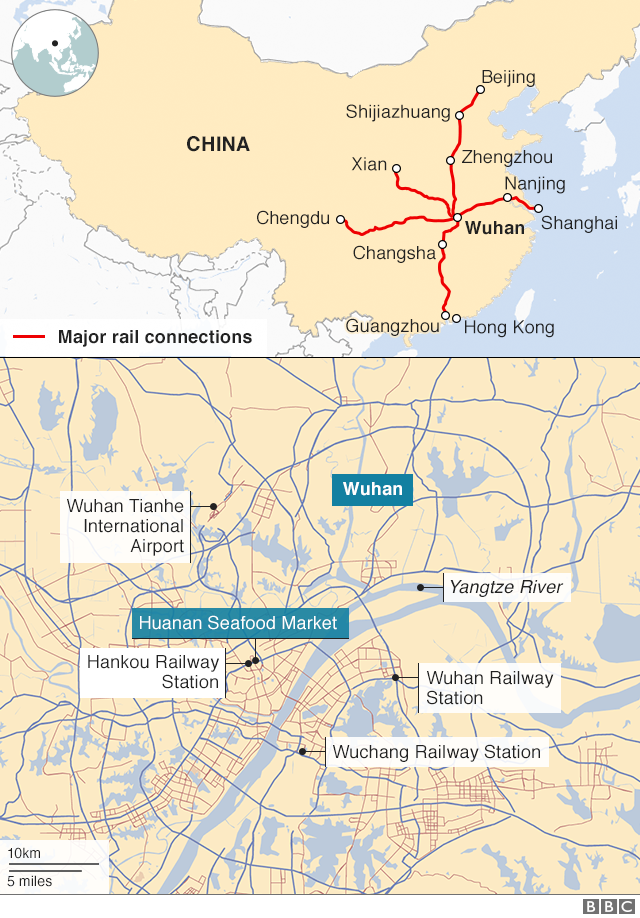
Wuhan, a Chinese city of eleven million people, has temporarily shut down its public transport as it tries to halt the outbreak of a new strain of virus.
Those living in the city have been advised not to leave, in a week when millions of Chinese are travelling for the upcoming Lunar New Year holiday.
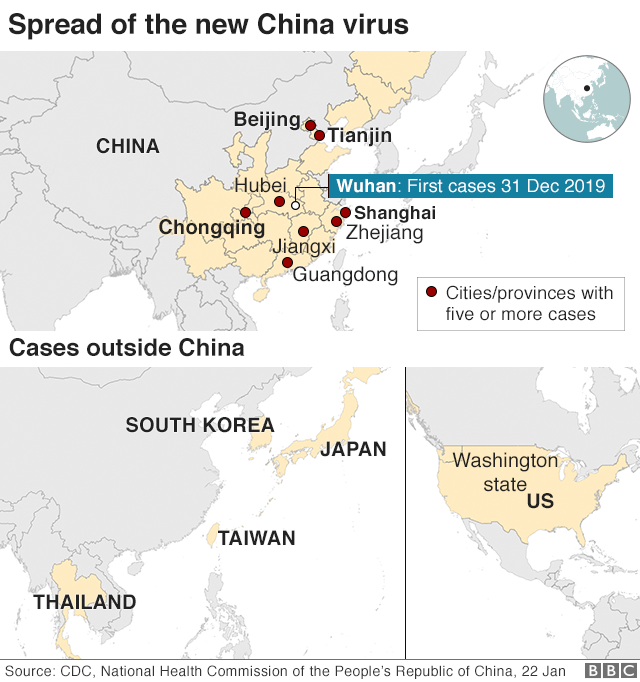
The respiratory illness has spread to other parts of China, with some cases in other countries including the US.
There are more than 500 confirmed cases and 17 people have died.
Known for now as 2019-nCoV, the virus is understood to be a new strain of coronavirus not previously identified in humans. The Sars (severe acute respiratory syndrome) virus that killed nearly 800 people globally in the early 2000s was also a coronavirus, as is the common cold.
All the fatalities so far have been in Hubei, the province around Wuhan.
Meanwhile, after a day of discussions in Geneva, the World Health Organization’s (WHO) emergency committee has announced it will not yet declare a “global emergency” over the new virus.
Director general Dr Tedros Ghebreyesus said more information was needed about the spread of the infection. The committee of health experts will meet again on Thursday.
A global emergency is the highest level of alarm the WHO can sound and has previously been used in response to swine flu, Zika virus and Ebola.
From Thursday, all flights and passenger train services out of Wuhan have been stopped.
Bus, subway and ferry services all shut down from 10:00 local time (02:00 GMT).
A special command centre in Wuhan set up to contain the virus said the move was meant to “resolutely contain the momentum of the epidemic spreading”.
 Those living in Wuhan had already been told to avoid crowds and minimise public gatherings.
State news agency Xinhua said tourist attractions and hotels in the city had been told to suspend large-scale activities while libraries, museums and theatres were cancelling exhibitions and performances.
A Lunar New Year prayer-giving ceremony at the city’s Guiyuan Temple, which attracted 700,000 people last year, has also been cancelled.
The hashtag “Wuhan is sealed off” was trending on Chinese social media website Weibo.
One user said worries about food and disinfectant made it feel like “the end of the world”, while another said they were on the “verge of tears” when Chinese officials announced the shut-down.
The WHO’s Dr Ghebreyesus described the latest measures as “very strong” and said they would “not only control the outbreak, they will minimise spread internationally”.
Chinese officials said the country was now at the “most critical stage” of prevention and control.
“Basically, do not go to Wuhan. And those in Wuhan please do not leave the city,” said National Health Commission vice-minister Li Bin in one of the first public briefings since the beginning of the outbreak.

By James Gallagher, BBC health and science correspondent
Wuhan is starting to look like a city in quarantine.
Officials had already warned residents not to leave the city and visitors not to come.
Now the reported public transport ban – which includes flights – slams many of the routes in and out of the city shut.
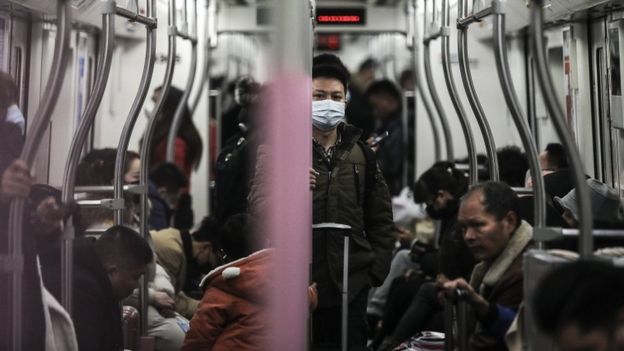 Image copyright GETTY IMAGES
It is a significant attempt to stop the spread of this new virus, which we now know can spread from person to person.
Limiting transport will cut the chance of the virus reaching other cities in China and other countries around the world.
This all comes just as millions of people are travelling across China for the week-long holiday that is Lunar New Year.
If you’re struggling for context – imagine shutting down London in the week before Christmas.
The big question left is the roads – and whether any of Wuhan’s 11 million inhabitants will be able to simply drive away.
Officials in Hong Kong reported the territory’s first two cases on Wednesday and one case was reported in the nearby city of Macau.
The patient in Macau is said to be a businesswoman who arrived from Wuhan over the weekend.
The first US case was confirmed on Tuesday. President Donald Trump said the situation was “totally under control” and that he trusted the information being provided by Chinese authorities.
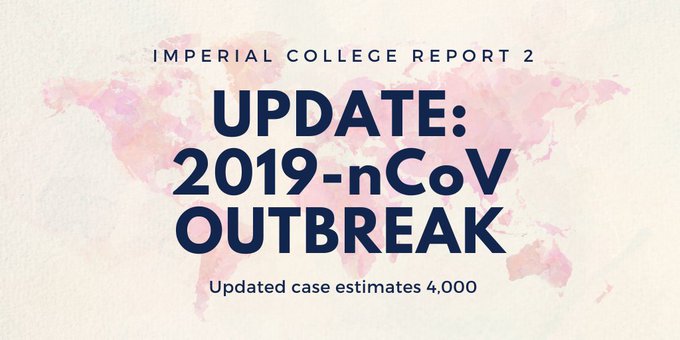
Although only about 500 cases have been confirmed, calculations by scientists at the MRC Centre for Global Infectious Disease Analysis at Imperial College London suggest there are 4,000 people sick with the virus in Wuhan.
 MRC Centre for Global Infectious Disease Analysis@MRC_Outbreak
UPDATE: Report estimates 4000 cases #coronavirus #2019nCoV
Our estimate at 4,000 cases is more than double the past estimate due to increase of number of cases outside China. This should not be interpreted as implying the outbreak has doubled in size.
https://www.imperial.ac.uk/mrc-global-infectious-disease-analysis/news–wuhan-coronavirus/ …
End of Twitter post by @MRC_Outbreak
The virus originated in a seafood market in Wuhan that “conducted illegal transactions of wild animals”, authorities said. The market has since been shut down.
There is also evidence of human to human transmission with the new virus spreading to family members and healthcare workers.
But understanding how easily and how often the virus spread between people is one of the major outstanding questions in this outbreak.
The virus infects the lungs and symptoms start with a fever and cough. It can progress to shortness of breath and breathing difficulties.
Source: The BBC
SHANGHAI, Dec. 11 (Xinhua) — Chinese tourists will travel to more overseas destinations during the Spring Festival holiday in 2020, said a report released by the country’s largest online travel agency Trip.com Group.
Chinese tourists have booked trips to 419 overseas cities in over 100 countries and regions during the seven-day holiday beginning Jan. 24, 2020, said Trip.com, adding that both figures are new highs for the group.
Boasting warm weather, Australia and New Zealand are among the most popular destinations for Chinese during the period. Trips to Italy, Britain, Spain, Russia, France and the United Arab Emirates are also bestsellers, according to the report.
Ninety percent of Trip.com Group’s users have chosen high-quality travel products and services. Private travel groups with tour guides and flexible schedules have also been favored by tourists.
The fact that Chinese are willing to spend more money and time on traveling shows their growing incomes and higher living standards, said Peng Liang, a researcher with the tourist data research center of Trip.com Group.
As more Chinese travel overseas for holidays, the world will also share the benefits of China’s development, said Peng.
Chinese made 6.3 million outbound trips during the Spring Festival holiday in 2019, up 12.48 percent year on year.
BEIJING, Sept. 12 (Xinhua) — China’s border check agencies are expected to see an average of 1.93 million inbound and outbound trips made by Chinese and foreign tourists per day during the three-day Mid-Autumn Festival holiday, the National Immigration Administration said Thursday.
The figure indicated a year-on-year increase of 1.6 percent, according to the administration.
It said the average daily trips at major airports in the cities of Beijing, Shanghai, Guangzhou and Chengdu are expected to reach 85,000, 109,000, 54,000 and 21,000 respectively.
The administration asked border check agencies nationwide to ensure sufficient personnel and disclose passenger flow information in a timely manner to properly handle the holiday travel surges.
It also advised passengers to avoid traveling during peak hours.
The Mid-Autumn Festival falls on Sept. 13 this year.
Source: Xinhua

continuously updated blog about China & India
continuously updated blog about China & India
continuously updated blog about China & India
 CHINDIA ALERT: You'll be living in their world, very soon