Chindia Alert: You’ll be Living in their World Very Soon
aims to alert you to the threats and opportunities that China and India present. China and India require serious attention; case of ‘hidden dragon and crouching tiger’.
Without this attention, governments, businesses and, indeed, individuals may find themselves at a great disadvantage sooner rather than later.
The POSTs (front webpages) are mainly 'cuttings' from reliable sources, updated continuously.
The PAGEs (see Tabs, above) attempt to make the information more meaningful by putting some structure to the information we have researched and assembled since 2006.
The leaders agreed to set up a mechanism to boost economic ties and tackle India’s trade deficit with China after their second informal summit
As 2020 is the 70th anniversary of diplomatic ties between both countries, India and China will hold 70 events next year to promote relations
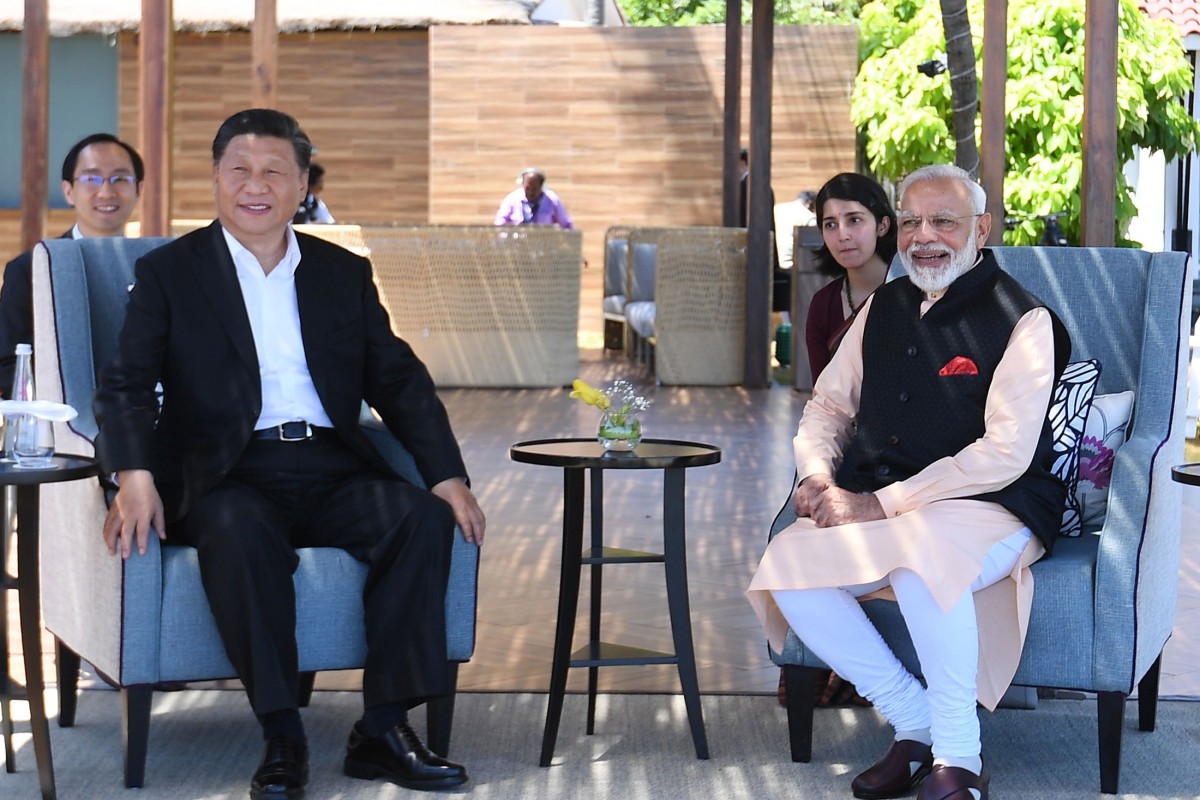
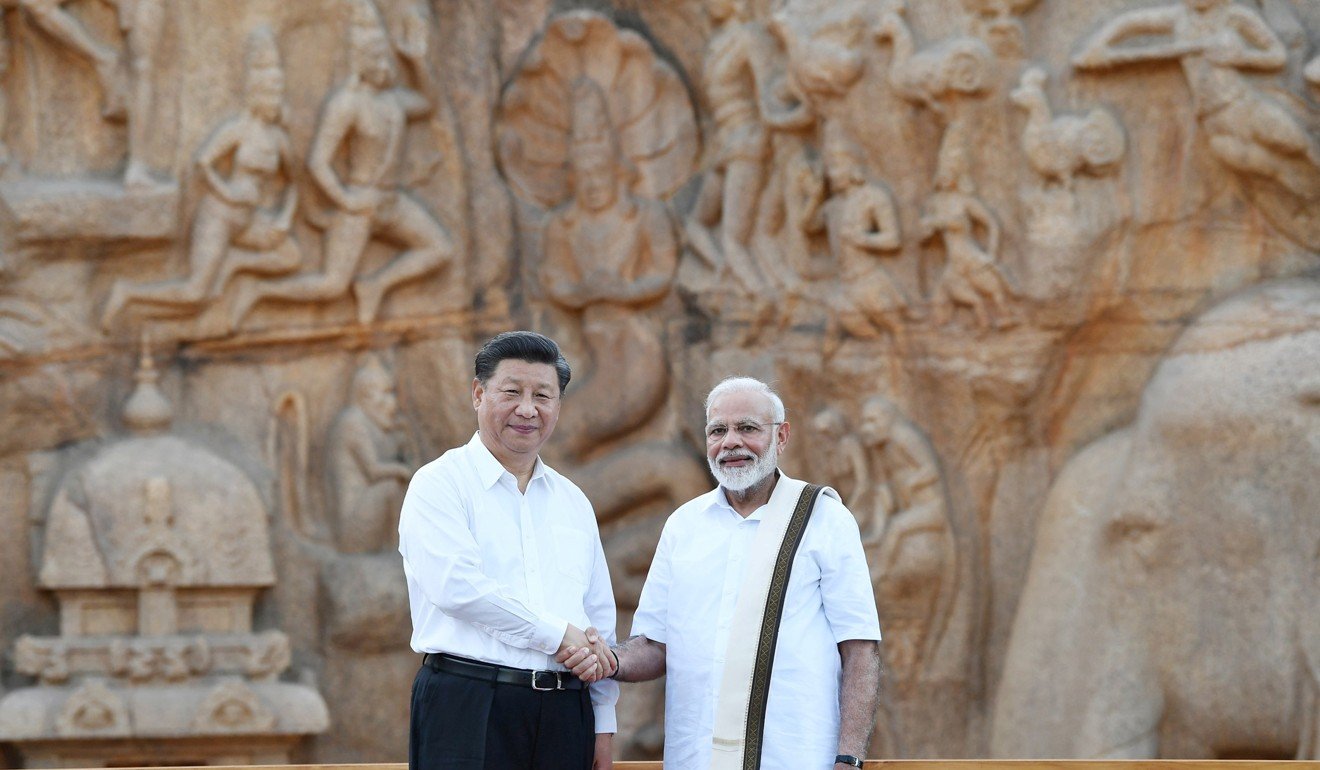
Indian Prime Minister Narendra Modi and Chinese President Xi Jinping during their meeting in Mamallapuram, Chennai. Photo: EPA
Chinese President Xi Jinping and Indian Prime Minster Narendra Modi concluded their second informal summit on Saturday by pledging to overcome trade differences and appreciate “each other’s autonomous foreign policies”, signalling an effort to focus on mutual interests rather than on long-standing contentious issues.
Modi remarked that both sides had agreed to be “sensitive” to each other’s concerns and not let differences escalate into disputes, while Xi called for communication to “alleviate suspicions” and for India and China to enhance strategic mutual trust, according to state news broadcaster CCTV.
Their desire to look beyond irritants in diplomatic ties, including a decades-long border row and China’s close military ties with India’s arch rival, Pakistan, comes as Beijing is embroiled in a tariff war with Washington that has rocked the global economy.
In a sign of China’s willingness to address India’s trade deficit with it, the leaders agreed to launch a “High Level Economic and Trade Dialogue”.
As Xi meets Modi, Chinese in Chennai hope to witness the ‘Wuhan spirit’
Chinese Vice-Premier Hu Chunhua and Indian Finance Minister Nirmala Sitharaman will meet regularly to discuss ways to boost two-way trade and investments, Indian foreign secretary Vijay Gokhale said in a media briefing.
India has a US$53 billion trade deficit with China, which makes up almost a third of its total trade deficit. It is also facing pressure to decide if it will commit to the China-led
(RCEP), which aims to create the world’s largest trading bloc involving 16 countries before the end of the year.
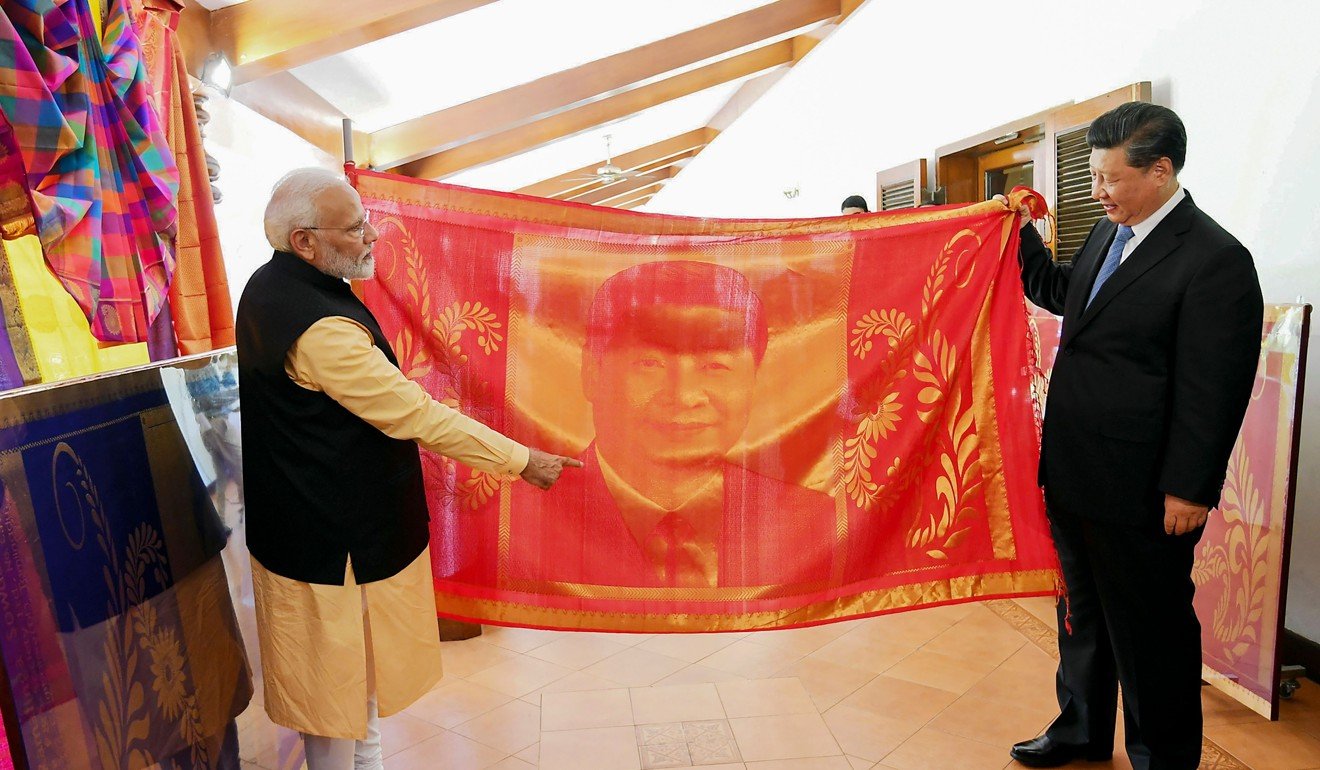
Narendra Modi exchanges gifts with Xi Jinping. Photo: AFP
Negotiations are ongoing with talks taking place in Bangkok this week, but India’s domestic producers have opposed the agreement over fears of a flood of Chinese imports. On Friday, the Indian government rejected clauses in the agreement related to e-commerce, according to reports.
Gokhale told the media briefing that both leaders, who met in the coastal town of Mamallapuram about 50km away from Chennai, briefly discussed the RCEP.
“PM Modi said India was looking forward to the RCEP but it is important that RCEP is balanced, that a balance is maintained in trade in goods, trade in services and investments,” he said, adding that Xi agreed to further discussions of India’s concerns on the issue.
Narendra Modi with Xi Jinping in Mamallapuram. Photo: EPA
CCTV said Xi had six suggestions for how China and India could further improve ties, including assessing each other correctly and stepping up cooperation between their militaries. Besides economic and trade dialogue, China welcomed Indian pharmaceutical and IT companies to invest there, he said.
“We should look at disputes with a correct mind, and not let disputes affect cooperation.
“Both sides should properly and fairly get a solution for border disputes that are acceptable to each other … [and] cautiously handle each other’s core interests, and take proper measures to control issues that cannot be resolved immediately,” the president reportedly said.
Gokhale told reporters that both countries had agreed to pursue, through special representatives, an ongoing dialogue on their disputed border. China and India have held more than 20 rounds of talks to resolve their boundary dispute, over which they went to war in 1962. Different mechanisms have been set up to maintain peace along the 4,000-kilometre (2,485-mile) so-called Line of Actual Control.
Xi and Modi bank on chemistry as they talk trade and terrorism
Gokhale confirmed that the leaders – who met for a total of seven hours over Friday and Saturday, with the bulk of their time spent in one-on-one talks – did not discuss
has lobbied its allies – including its all-weather friend China – to support its opposition to the move. New Delhi had reacted sharply to Beijing’s move to take the matter to the United Nations, insisting that it was a purely bilateral issue. Two days before the summit, Xi had hosted Pakistan Prime Minister Imran Khan and had assured him of China’s support on all core issues, a statement that had irked India.
Gokhale said both leaders “emphasised the importance of having independent and autonomous foreign policies”.
“President Xi said that the two countries needed to have more extensive dialogue in order to understand each other’s perspectives on major global and regional issues,” he added.
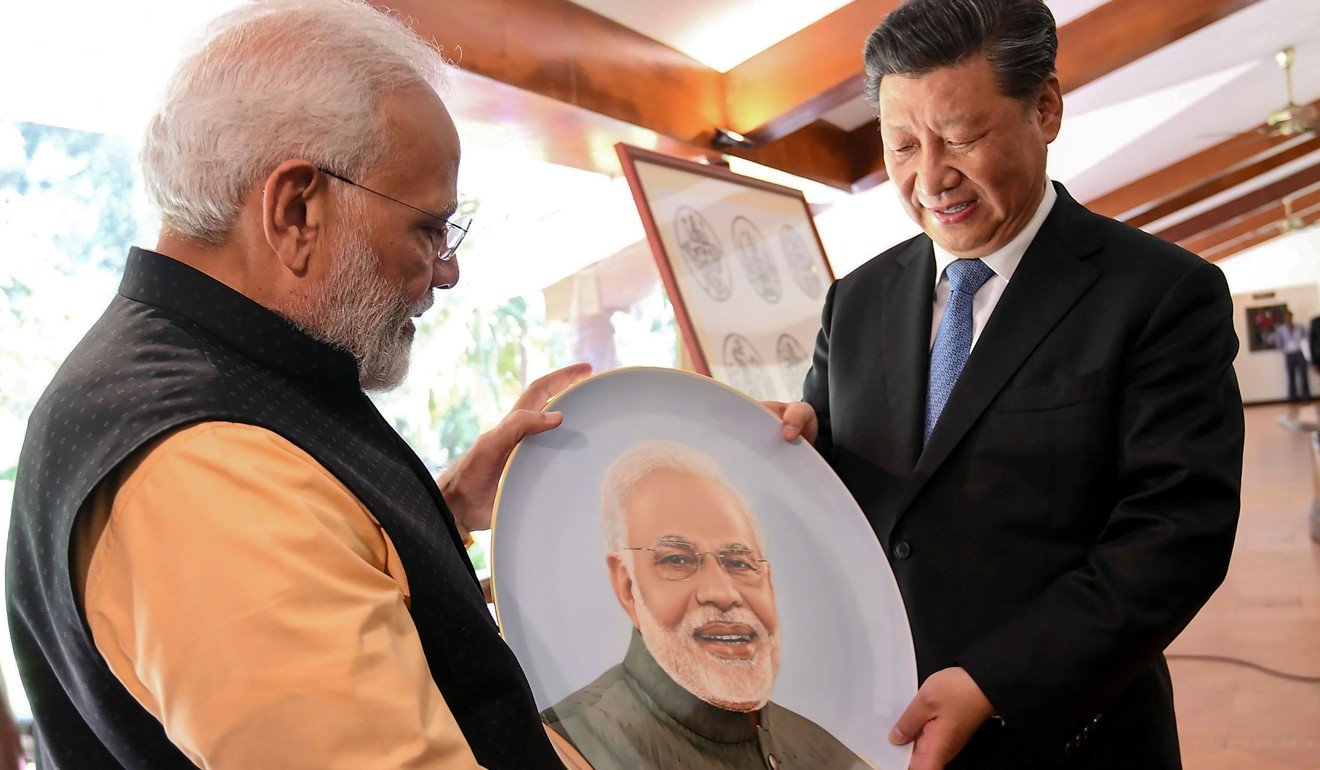
Narendra Modi exchanges gifts with Xi Jinping. Photo: AFP
The leaders also discussed terrorism, with a statement issued later by New Delhi saying both sides would make efforts to ensure the international community strengthened its framework “against training, financing and supporting terrorist groups throughout the world and on a non-discriminatory basis”.
The China-led multilateral Financial Action Task Force, which has been investigating Pakistan’s efforts to stamp out the financing of terrorism, is expected to decide soon if it would add Islamabad to its blacklist along with Iran and North Korea, a move that could invite stringent economic sanctions and drive away international financial institutions, both of which could affect Pakistan’s already-indebted economy adversely.
Gokhale added that as 2020 is the 70th anniversary of diplomatic ties between both countries, India and China will hold 70 events next year to promote people-to-people ties, with Modi accepting an invitation by Xi for the next informal summit to be held in China.
Both leaders had struck positive notes on the summit – with Xi describing their discussions as “candid” and between friends and Modi hailing the “Chennai Connect” meeting as marking a new era of cooperation between both countries.
War games, Kashmir and a US$57b question: the issues as Xi meets Modi
But analysts said they would be looking to see how the newly-announced high-level mechanism on trade panned out.
Narayani Basu, a New Delhi-based author, foreign policy analyst and China watcher felt the summit had achieved its purpose of bagging small wins for both sides.
“Discussing contentious issues would have defeated the purpose of the summit. The idea behind such a summit must be that despite the overarching posturing on different divergent issues, the two countries can achieve the easily-achievable wins. That is what the summit seems to have tried doing.”
But in terms of actual outcomes, she said she remained sceptical.
“I don’t think there has been much progress in the ties between the two countries since the last summit in Wuhan. Hence, this time, there is a lot more caution and scepticism towards such a summit,” she said, referring to the first summit last year in the Chinese city of Wuhan.
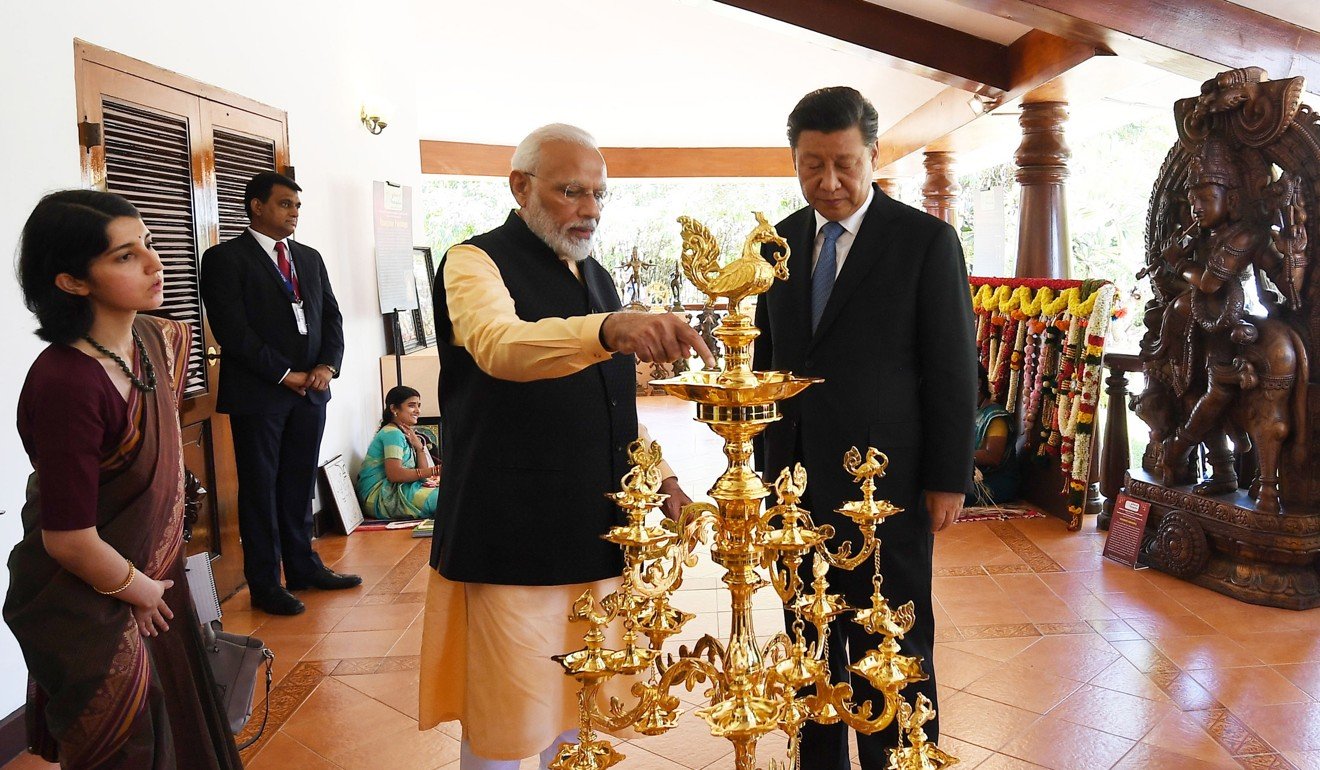
During Xi’s visit to southern India, which lasted 24 hours in all, Modi took him on a personal tour of temple monuments dating back to the seventh and eighth century in Mamallapuram when regional leaders had trade ties with Chinese provinces. He was also shown local artisan handicrafts and art forms, and gifted a handwoven silk portrait, a lamp and a painting.
Xi gave Modi a porcelain plate with the image of the prime minister’s face printed on it.
Xi Jinping with Narendra Modi in Mamallapuram. Photo: Reuters
On Friday, New Delhi announced that visa rules for Chinese nationals visiting India would be relaxed, with multiple-entry visas with a validity period of five years available from this month onwards. At present, most visas are single-entry and usually for between 30 and 60 days. Visa fees would also be reduced, the government said, with the multiple-entry visa costing US$80.
This was aimed at further enhancing “people-to-people exchanges between the two countries and [encouraging] more Chinese tourists to choose India as a destination for tourism purposes,” it said in a statement.
Xi left Chennai on Saturday afternoon and arrived in Nepal, which lies in between India and China. He will be the first Chinese president to visit Nepal in 22 years and is expected to sign a slew of deals with Nepal’s Prime Minister K.P. Sharma Oli, including the planned extension of the rail link from remote, mountainous Tibet to Nepal’s capital, Kathmandu.
The link will be part of Beijing’s ambitious infrastructure project to boost trade, the
More than 120 countries have signed on to the BRI, including Pakistan, where a series of projects worth US$46 billion are being constructed under the China-Pakistan Economic Corridor (CPEC). India has snubbed the BRI and questioned the transparency of funding agreements.
Chinese President Xi Jinping meets with Pakistani Prime Minister Imran Khan at the Diaoyutai State Guesthouse in Beijing, capital of China, Oct. 9, 2019. (Xinhua/Liu Weibing)
BEIJING, Oct. 9 (Xinhua) — Chinese President Xi Jinping on Wednesday met with Pakistani Prime Minister Imran Khan, vowing to work jointly to strengthen strategic coordination and pragmatic cooperation so as to forge a closer China-Pakistan community of shared future in the new era.
Noting the two countries as all-weather strategic cooperative partners, Xi said no matter how the international and regional situation changes, the friendship between China and Pakistan has always been unbreakable and rock-solid, and China-Pakistan cooperation has always maintained strong vitality with continuous expansion.
China has always viewed relations with Pakistan as a diplomatic priority and will continue to firmly support Pakistan on issues concerning its core interests and of major concern to it, Xi said.
This year marks the 70th anniversary of the founding of the People’s Republic of China.
“We have held a series of celebration activities, which is an opportunity for intensive patriotic education. Chinese people, nearly 1.4 billion in number, have forged a cohesive force with unprecedented patriotism, consolidating our confidence and determination to continue down the path of socialism with Chinese characteristics against all odds, run our own affairs, and stand firm in the community of nations,” Xi said.
In the past, Pakistan selflessly provided help to China in difficult times, and now that China has developed, it sincerely hopes to help Pakistan for better development, Xi said.
He called on the two sides to maintain close high-level exchanges, step up strategic communication and coordinate positions on major issues in a timely fashion.
On the China-Pakistan Economic Corridor (CPEC), Xi said the two sides should adopt a high standard, build and effectively run the existing energy projects, transport infrastructure, industrial parks and projects concerning people’s livelihoods, and make the CPEC a model for jointly building the Belt and Road Initiative.
China highly appreciates and firmly supports Pakistan’s efforts in fighting terrorism, Xi said, calling on the two sides to beef up communication and cooperation within the United Nations, the Shanghai Cooperation Organization and other multilateral mechanisms so as to jointly safeguard regional peace and stability.
Imran Khan offered his congratulations for the 70th anniversary of the founding of the People’s Republic of China.
Pakistan is delighted to see China’s remarkable development achievements and is grateful to China for always adhering to principles and upholding justice and for its firm support and selfless help to Pakistan, Khan said.
“Facts have shown that China is Pakistan’s all-weather strategic cooperative partner and the two countries’ friendship enjoys popular support,” he said, hoping to continue strengthening exchanges, coordination and cooperation with China, and advancing the construction of the CPEC so as to make it a paradigm of the Belt and Road Initiative.
He also pledged to continue to firmly advance counter-terrorism efforts so as to safeguard security and stability.
Khan briefed Xi on Pakistan’s views on the Kashmir situation, hoping to avoid deterioration of the situation, saying that Pakistan values and appreciates China’s objective and unbiased position.
Xi told Khan that China is paying close attention to the Kashmir situation and the facts are clear.
“China supports Pakistan to safeguard its own legitimate rights and hopes that the relevant parties can solve their disputes through peaceful dialogue,” Xi said.
Chinese State Councilor and Foreign Minister Wang Yi (R) meets with Pakistani Prime Minister Imran Khan on the sidelines of the United Nations General Assembly high-level week, at the UN headquarters in New York, on Sept. 23, 2019. (Xinhua/Han Fang)
UNITED NATIONS, Sept. 23 (Xinhua) — Chinese State Councilor and Foreign Minister Wang Yi on Monday said China and Pakistan hold all-weather strategic cooperative partnership and the friendship between the two countries is unbreakable.
Meeting with Pakistani Prime Minister Imran Khan on the sidelines of the UN General Assembly high-level week, Wang said the two countries have always enjoyed mutual trust, mutual understanding and mutual support.
He said China will continue to support Pakistan’s efforts to uphold its territorial sovereignty and national dignity. China-Pakistan cooperation has contributed significantly to Pakistan’s national development and improvement of its people’s livelihood.
Wang added that the two sides should work together to build the China-Pakistan Economic Corridor (CPEC) into a model for high-quality development projects under the Belt and Road Initiative.
Khan, for his part, said Pakistan will firmly push forward the transformation and upgrading of the CPEC and continue to make every effort to ensure the safety of Chinese projects, enterprises and personnel in Pakistan.
He said that Pakistan and China are close friends, and Pakistan thanks the Chinese government and people for standing firmly with the Pakistani people in the most difficult time.
He added that China’s support and assistance are of great significance to Pakistan’s national security and development.
Pakistan will spare no effort in maintaining bilateral friendship and will not allow any external forces to interfere in or sabotage the development of bilateral relations.
Khan introduced Pakistan’s views on the current situation in Kashmir. Wang reiterated China’s principled position on the issue.
The two sides also exchanged views on Afghanistan, Iran and other issues.
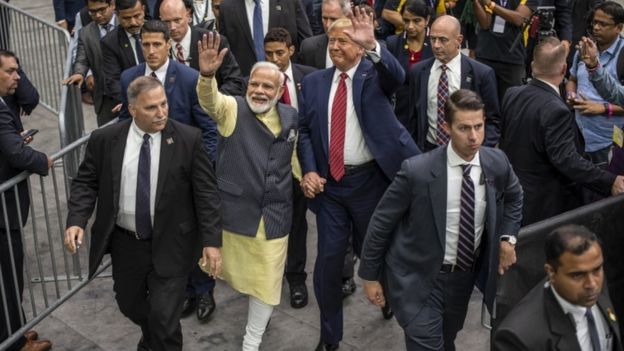
US President Donald Trump and Indian Prime Minister Narendra Modi exchanged warm words of friendship in Texas at a rare mass rally for a foreign leader.
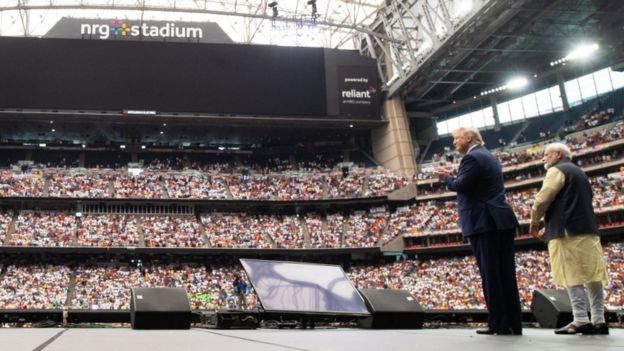
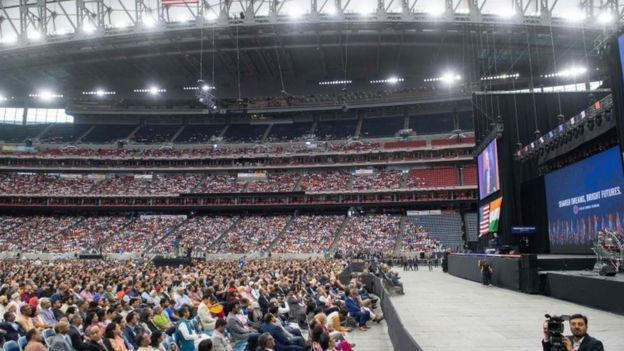
Around 50,000 people gathered for what Mr Trump called a “profoundly historic event” on Sunday in Houston.
The “Howdy, Modi!” event was billed as one of the largest ever receptions of a foreign leader in the US.
Mr Modi, however, may face a frostier reception at the UN General Assembly.
He is likely to face criticism over tensions in Indian-administered Kashmir, which he stripped of its special status last month, promising to restore the region to its “past glory”.
The region has been in lockdown for more than a month with thousands of activists, politicians and business leaders detained.
Trade talks and the UN General Assembly are on the Indian prime minister’s agenda during his week-long visit to the United States.
Pakistani Prime Minister Imran Khan, who has been the most vocal international leader to oppose India’s Kashmir move, is also in the US for the UN conference. Like Mr Modi, he will have a one-on-one meeting with Mr Trump on the sidelines of the summit.
A 90-minute show, featuring 400 performers, warmed up the crowd before Mr Modi and Mr Trump shared the stage.
“I’m so thrilled to be here in Texas with one of America’s greatest, most devoted and most loyal friends, Prime Minister Modi of India,” Mr Trump told the crowd.
Image copyright GETTY IMAGESImage caption Narendra Modi and Donald Trump leave the stage holding hands at Houston’s NRG Stadium
In his speech, Mr Modi said India has a “true friend” in the White House, describing Mr Trump as “warm, friendly, accessible, energetic and full of wit”.
“From CEO to commander-in-chief, from boardrooms to the Oval Office, from studios to the global stage… he has left a lasting impact everywhere,” Mr Modi said.
Personal-touch diplomacy played to perfection
Brajesh Upadhyay, BBC News, Houston
This was exactly the kind of crowd size and energy President Trump loves at his rallies.
Only here the chants were for Indian Prime Minister Narendra Modi and Mr Trump was the superstar invited to the party. But the crowd did not disappoint him either and greeted him with chants of “USA!”, most heard at Trump rallies.
The personal-touch diplomacy with Mr Modi’s trademark bear hugs was played to perfection.
This rally has been called a win-win for both the leaders. For President Trump, it was a chance to court Indian-Americans for the 2020 presidential election race where Texas could emerge as a battleground state. For Mr Modi, a PR triumph and picture with the president of the United States may help him shrug off the criticism over his recent strong-arm policies at home.
Houston’s NRG Stadium, where the event was hosted, was the first stop for Mr Modi, whose Hindu nationalist Bharatiya Janata Party (BJP) won a landslide victory in this year’s Indian elections.
Greeted by a standing ovation, Mr Trump used his speech to heap praise on Mr Modi, who he said was doing a “truly exceptional job for India” and its people.
Mr Trump also paid tribute to the Indian-American community, telling them “we are truly proud to have you as Americans”.
The US has a population of about 4 million Indians who are seen as an increasingly important vote bank in the country.
Apart from Mr Trump, organisers also invited Democrats to the event – House Majority Leader Steny Hoyer was among those who spoke.
The 2010 US census shows that Texas is home to the fourth-largest Indian-American population in the country after California, New York and New Jersey.
Analysis of voting patterns shows the community tends overwhelmingly to support the Democrat party.
Image copyright GETTY IMAGESImage caption The event, dubbed “Howdy, Modi!”, was attended by an estimated 50,000 people
No stranger to nationalist rhetoric himself, Mr Trump compared security at the US-Mexico border to the tensions between India and Pakistan in the tinderbox Kashmir region.
“Both India and US also understand that to keep our communities safe, we must protect our borders,” Trump said.
Image copyright GETTY IMAGESImage caption Donald Trump described Narendra Modi as one of America’s most “loyal friends”
In India, the rally was closely watched, with most mainstream media outlets running live news updates of what was transpiring on stage.
The event had been making headlines for days before as well.
On Twitter, many people shared instant analysis and opinions of what was taking place on the stage with the sentiment being overwhelmingly positive. Many praised Mr Modi for what they saw as his statesmanship and diplomatic acumen with a lot of praise coming in for the US president as well.
He is expected to join a trilateral dialogue with his counterparts from Pakistan and Afghanistan, and observers say he may try to mediate in Kashmir dispute
Trip also includes a stop in Nepal that could pave way for a visit by Xi Jinping
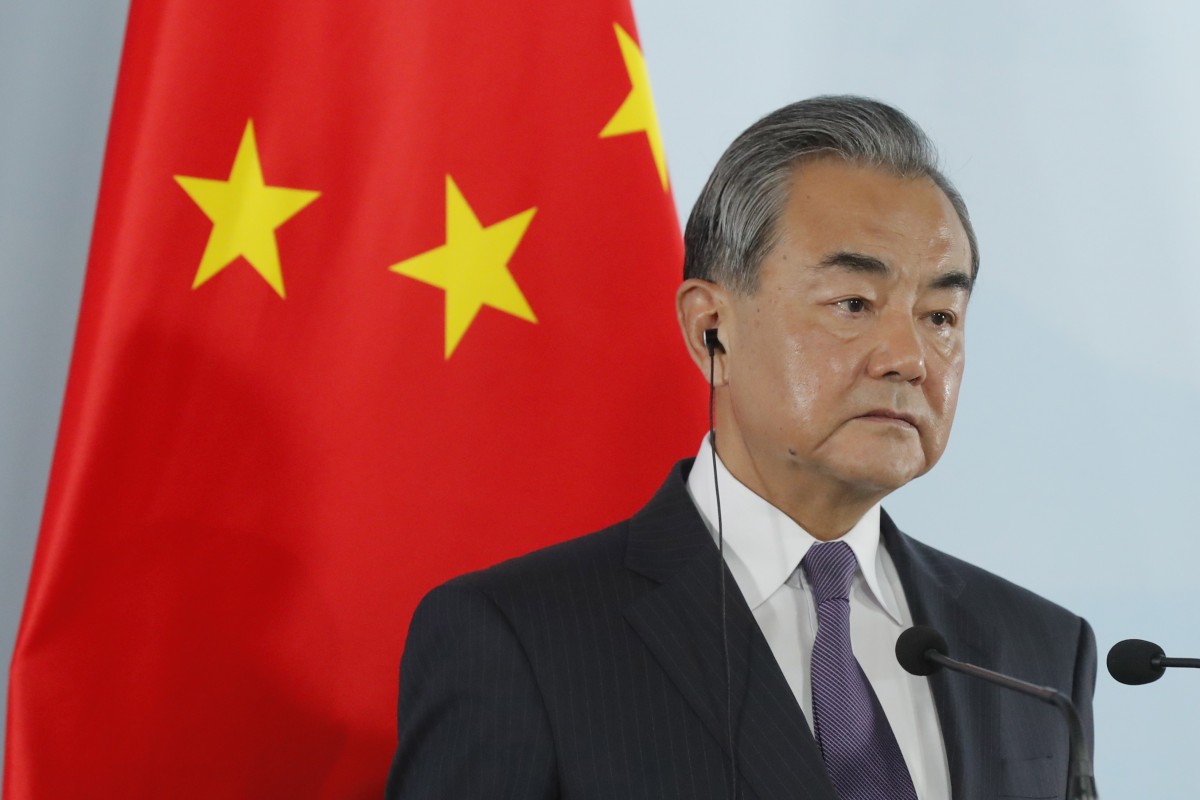
Chinese Foreign Minister Wang Yi may try to act as a negotiator in the Kashmir dispute. Photo: EPA-EFE
Chinese Foreign Minister Wang Yi began a four-day trip to Pakistan and Nepal on Saturday, amid escalating tensions between Islamabad and New Delhi over
Wang was expected to join a trilateral dialogue with the foreign ministers of Pakistan and Afghanistan in Islamabad, foreign ministry spokesman Geng Shuang said on Friday. He will also travel to Nepal.
Beijing has criticised India’s decision last month to strip the Jammu and Kashmir autonomous state of its special status and break it into two federally controlled territories, calling it “unacceptable”.
China also formally backed Pakistan’s request for the United Nations Security Council to hold “closed consultations” on the revocation of the state’s autonomy.
Meanwhile, observers say the Chinese foreign minister could attempt to act as a negotiator in the complex border dispute.
“Wang might try to play a role to mediate between the two sides to resolve the crisis,” said Wang Dehua, head of the Institute for South and Central Asia Studies at the Shanghai Municipal Centre for International Studies. “This has been China’s long-held position on the issue.”
Pang Zhongying, an international relations researcher at Ocean University of China in Qingdao, agreed.
“[Indian Prime Minister] Narendra Modi has visited China a couple of times and it is likely [Chinese President] Xi Jinping will visit India soon,” he said. “If Xi is to visit India later this year, China may try to contain its differing views with India on Kashmir.”
Modi has proposed an informal summit with Xi later this year that may be held in the religious hub of Varanasi, Modi’s parliamentary constituency. New Delhi said in May that Indian officials were working with the Chinese side to finalise the details, but Beijing has yet to confirm Xi’s visit.
India dismisses Beijing’s concerns over Kashmir because ‘it won’t have any impact on China’
Wang Yi was also due to visit India later this month for border talks, but the trip had to be postponed at the request of New Delhi because of scheduling problems, Hindustan Times reported, citing China’s foreign ministry.
The row over Kashmir has escalated in the past month. Pakistani Prime Minister Imran Khan said on Friday that Islamabad would make the fullest possible response to New Delhi’s actions in disputed Kashmir and that the global community would be responsible for any “catastrophic” aftermath.
Since Modi withdrew special rights for Indian-administered Kashmir on August 5, India has flooded the Kashmir valley with troops, restricted the movements of residents and cut off communication.
Both India and Pakistan claim the whole of Kashmir, which was partitioned between the two following the end of British rule in 1948, and they have subsequently fought wars over the territory.
China has its own territorial dispute with India over the part of Kashmir it controls. In early August, Chinese foreign ministry spokeswoman Hua Chunying
and said it was not binding. Beijing later appeared to soften its rhetoric, with Hua calling for a solution through dialogue and negotiation, without criticising either side.
The Chinese foreign minister will also visit Nepal, where he is expected to meet his counterpart, the president and prime minister. The trip could pave the way for an expected visit by Xi to Nepal.
President Xi Jinping will meet Russian counterpart Vladimir Putin next month and address economic summit in St Petersburg
Diplomatic flurry will also include regional security forums in Kyrgyzstan and Tajikistan
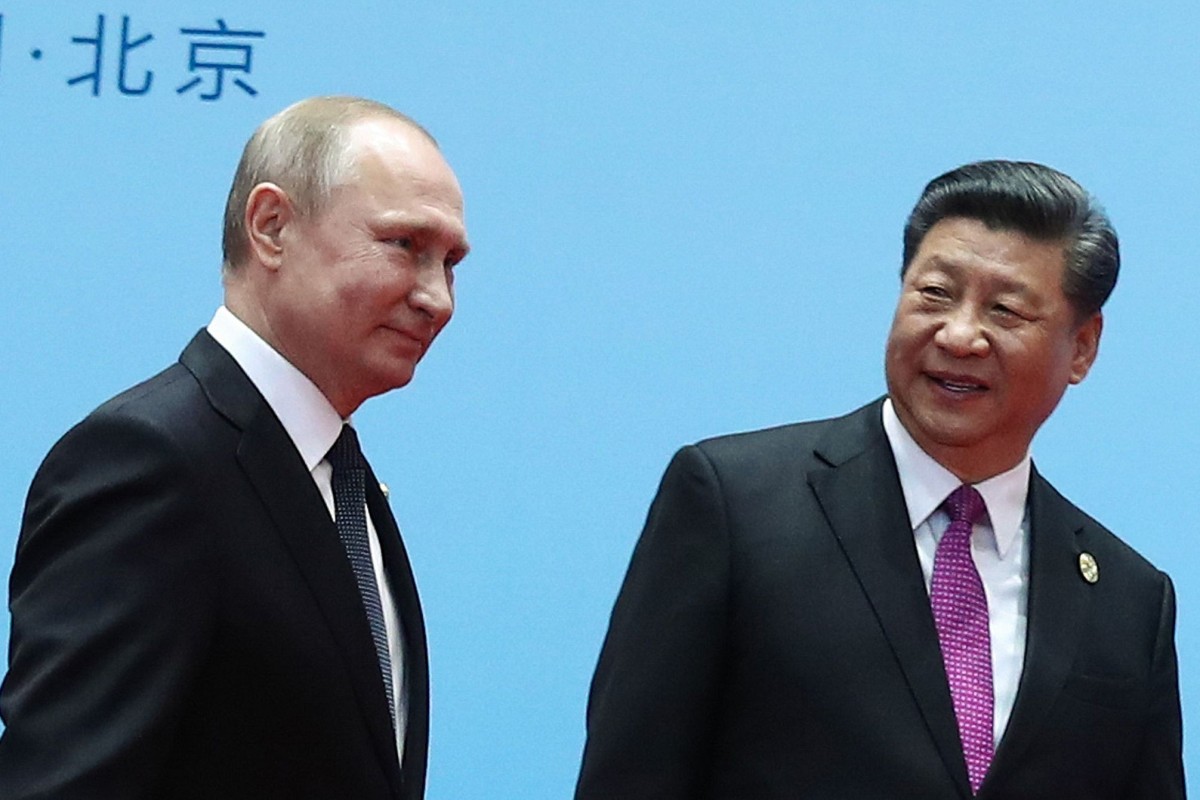
Xi Jinping has met Vladimir Putin more times than any other foreign leader since he took power in 2013. Photo: AFP
Beijing is stepping up efforts to seek support from regional and global players such as Russia and Central Asian nations as its geostrategic rivalry with Washington heats up.
President Xi Jinping is expected to meet his Russian counterpart Vladimir Putin next month, when he will also address the St Petersburg International Economic Summit,
The Chinese president will also visit the Kyrgyzstan capital Bishkek for the Shanghai Cooperation Organisation (SCO) summit in June, as well as another regional security forum in Dushanbe, Tajikistan.
Meanwhile, Vice-PresidentWang Qishan is visiting Pakistan before he heads to the Netherlands and Germany, according to the Chinese foreign ministry.
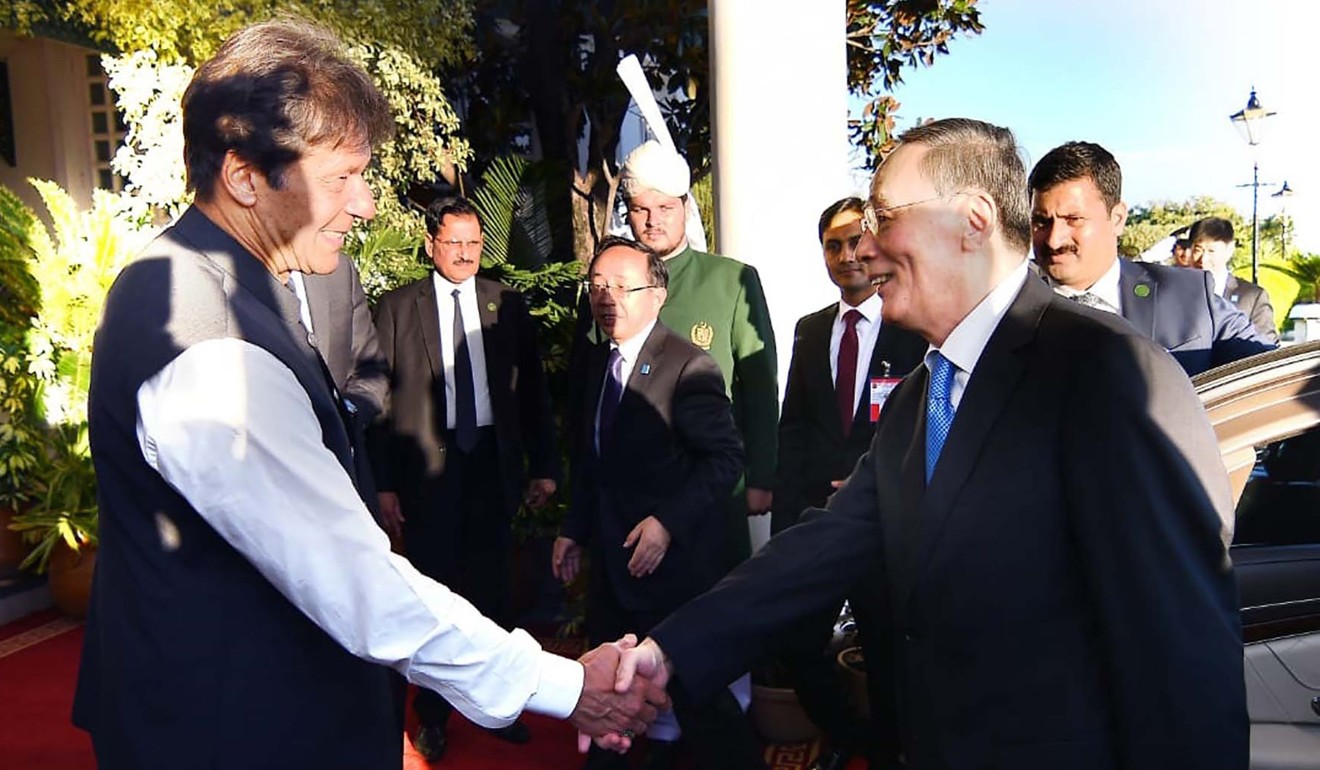
Pakistani Prime Minister Imran Khan meets Chinese Vice-President Wang Qishan in Islamabad on Sunday. Photo: AFP
The latest flurry of diplomatic activity comes as competition between China and the US intensifies on several fronts including trade and technology, the South China Sea and the Arctic, where Beijing’s partnership with Moscow –
It will be Xi’s second time at the St Petersburg forum, and observers expect the Chinese leader will reaffirm Beijing’s commitment to multilateralism and promote the nation as a champion of openness and cooperation.
China-Russia ties unrivalled, Beijing warns before Pompeo meets Putin
It will also be his second meeting with Putin in two months, after talks on the sidelines of the Belt and Road Forum in Beijing in late April, when the Russian president
for the controversial China-led infrastructure and investment initiative.
With China and Russia edging closer, the latest meeting is likely to see efforts to coordinate their strategies on a range of issues – including Venezuela, North Korea, nuclear weapons and arms control, according to observers. Xi has met Putin more times than any other foreign leader since he took power in 2013.
“This time it is very likely that the latest anti-China moves by the US, such as new tariffs and the Huawei ban, will feature prominently in their conversations,” said Artyom Lukin, an associate professor at Far Eastern Federal University in Vladivostok.
Lukin said Russia’s stagnating economy and sanctions imposed by the West limited its role as a substitute for the foreign markets and technologies China could lose access to because of the US crusade. But he said Putin would “provide political and moral support to Xi”.
“That is also significant as Russia has been withstanding intense US-led sanctions pressure for more than five years already,” Lukin said, referring to sanctions imposed after Russia’s annexation of Crimea in 2014.
Xi and Putin are also expected to talk about Venezuela, where US-backed opposition leader Juan Guaido is attempting to oust socialist President Nicolas Maduro, who has the support of China and Russia.
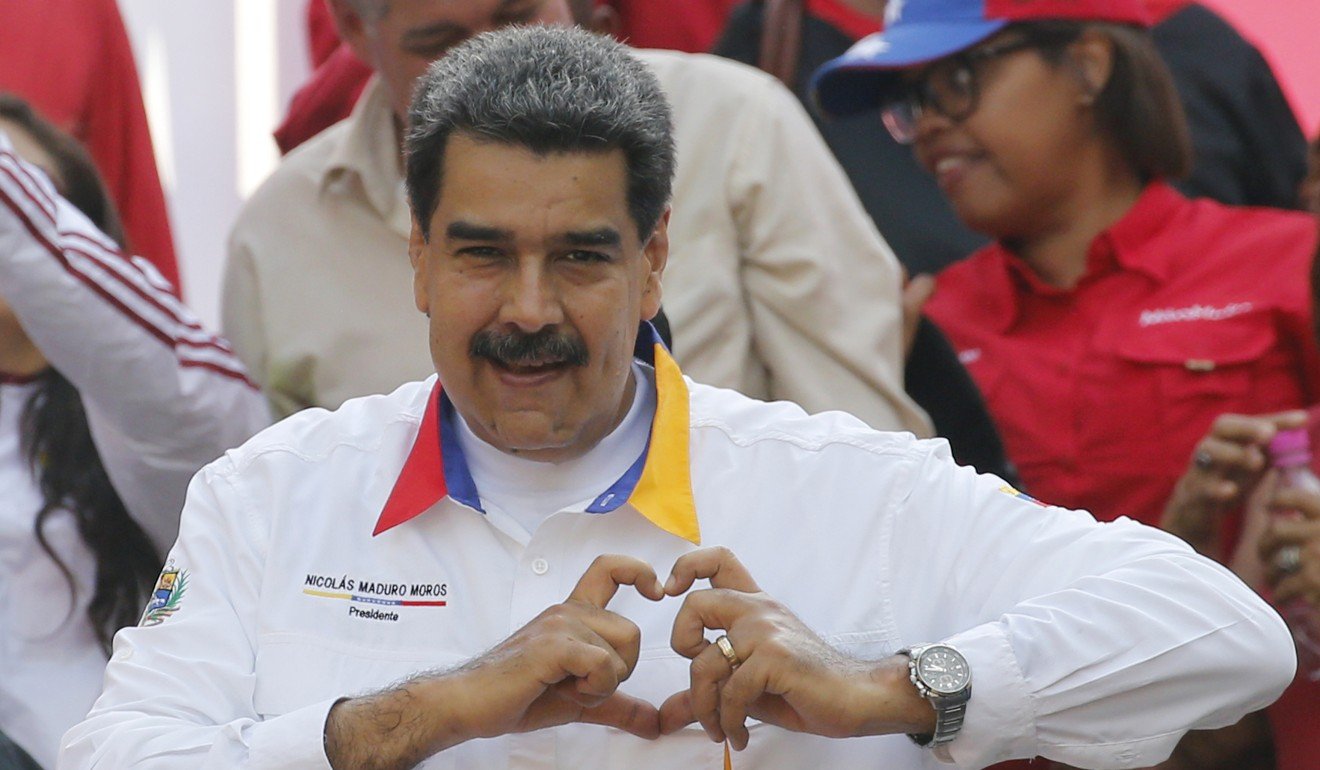
Venezuelan President Nicolas Maduro has the backing of China and Russia. Photo: AP
“Moscow and Beijing are not able to seriously hurt Washington by raising tariffs or denying access to high technology. However, there are plenty of areas where coordinated Sino-Russian policies can damage US interests in the short term or in the long run,” Lukin said. “For example, Moscow and Beijing could intensify their joint support for the Venezuelan government of Nicolas Maduro, frustrating Washington’s efforts to dislodge him.”
China and Russia would also be seeking to boost economic ties. Bilateral trade, dominated by Chinese imports of gas and oil, reached US$108 billion last year – falling far short of the target set in 2011 by Xi’s predecessor, Hu Jintao, of US$200 billion by 2020.
China and Russia to forge stronger Eurasian economic ties
Li Lifan, an associate research professor at the Shanghai Academy of Social Sciences, said bilateral trade was a sticking point. “This is one of the potential hindrances in China-Russia relations and Beijing is hoping to [address this] … in the face of a possible global economic slowdown,” Li said.
Given the escalating trade war with Washington, he said China would seek to diversify its investments and markets to other parts of the world, particularly Russia and Europe.
“China will step up its investment cooperation with Europe and Russia and focus more on multilateral investment,” Li said.
But Beijing was not expected to do anything to worsen tensions with Washington.
“China is currently taking a very cautious approach towards the US, trying to avoid heating up the confrontation and further aggravation of the situation,” said Danil Bochkov, a contributing author with the Russian International Affairs Council. “For China it is important to demonstrate that it has a reliable friend – Russia – but that should not be done in an openly provocative manner.”
Stephen Blank, a senior fellow at the American Foreign Policy Council in Washington, said Beijing and Moscow would also seek to contain US influence “as far as possible” from Central Asia, where China has increased its engagement through infrastructure building under the “Belt and Road Initiative”.
Leaders from the region will gather in Bishkek next month for the SCO summit, a security bloc set up in 2001 that now comprises China, Russia, Kazakhstan, Kyrgyzstan, Tajikistan, Uzbekistan, India and Pakistan. Those members account for about 23 per cent of the world’s land mass, 45 per cent of its population, and 25 per cent of global GDP.
Newly re-elected Indian Prime Minister Narendra Modi could meet the Chinese president for talks in Bishkek next month. Photo: EPA-EFE
There is growing speculation that Xi will meet newly re-elected Indian Prime Minister Narendra Modi on the sidelines of that summit.
Independent analyst and author Namrata Goswami said India would be seeking a commitment to a WTO-led and rules-based multilateral trading system during the SCO talks.
“This is interesting and significant given the current US tendencies under President Donald Trump focused on ‘America first’ and the US-China trade war,” Goswami said.
Counterterrorism will again be a top priority at the SCO summit, amid concerns among member states about the rising number of Islamic State fighters returning from Syria and Iraq. Chinese scholars estimated last year that around 30,000 jihadists who had fought in Syria had gone back to their home countries, including China.
Alexander Bortnikov, chief of the main Russian intelligence agency FSB, said earlier that 5,000 fighters from a group affiliated with Isis had gathered in areas bordering former Soviet states in Central Asia, saying most of them had fought alongside Isis in Syria.
War-torn Afghanistan, which shares a border with four SCO member states – China, Pakistan, Tajikistan and Uzbekistan – is also likely to be high on the agenda at the Bishkek summit.
“With the Trump administration drafting plans to withdraw troops from Afghanistan, the SCO will assess the security situation there and decide whether to provide training for Afghan troops,” Li said.
Eva Seiwert, a doctoral candidate at the Free University of Berlin, expected the security bloc would also discuss Iran after the US withdrew from the 2015 nuclear deal and ordered new sanctions against the country.
Iran, which has observer status with the SCO, was blocked from becoming a full member in 2008 because it was subject to UN sanctions at the time. But its membership application could again be up for discussion.
Iran presses China and Russia to save nuclear deal
“The Trump administration’s unilateral withdrawal from the Iran nuclear deal in 2018 made it easy for China and Russia to present themselves as the proponents of peaceful settlement of conflicts,” Seiwert said. “Discussing the possibility of admitting Iran as a full member state would help the SCO members demonstrate their support of multilateral and peaceful cooperation.
“This would be a strong signal to the US and enhance the SCO’s standing in the international community,” she said.
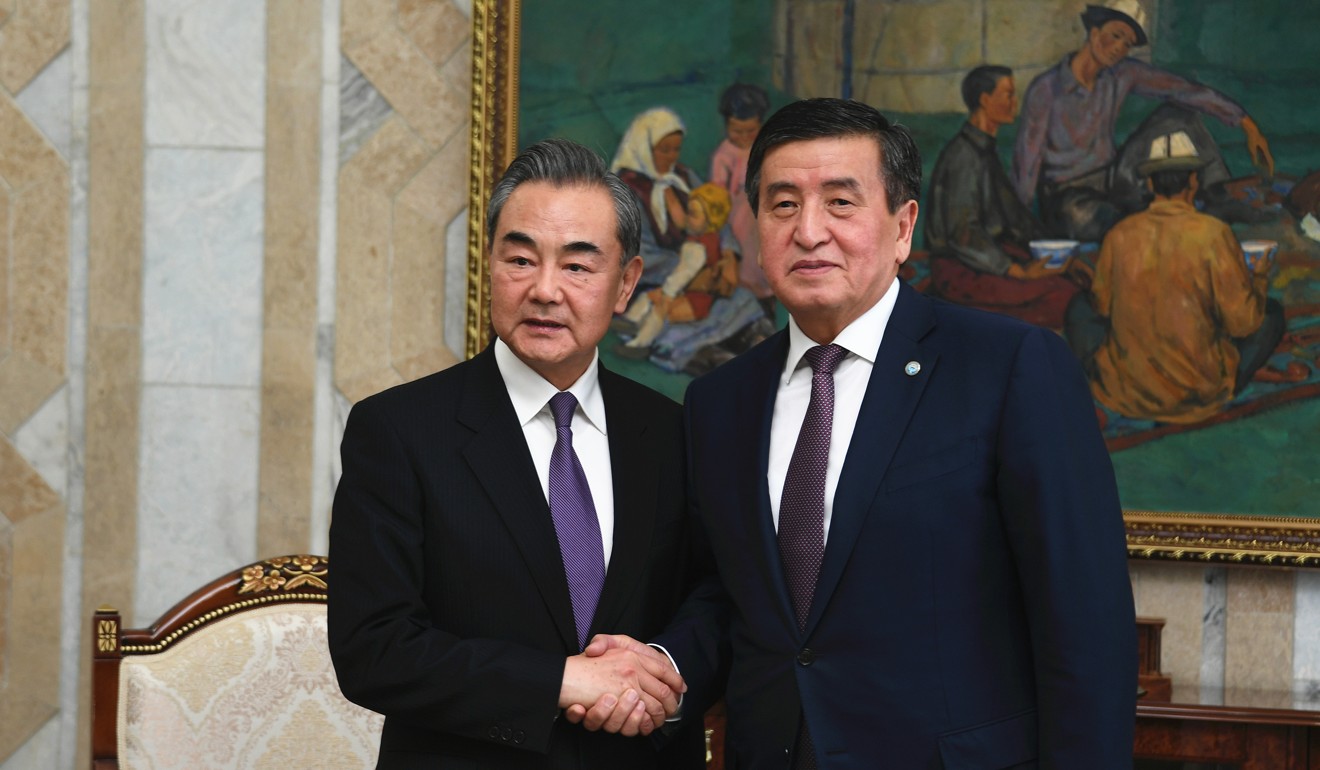
Kyrgyz President Sooronbay Jeenbekov (right) meets Chinese Foreign Minister Wang Yi in Bishkek on Tuesday last week. Photo: Xinhua
As well as security, Xi’s visit to Central Asia is also likely to focus on economic ties. Meeting Kyrgyz President Sooronbay Jeenbekov in Bishkek last week, Chinese Foreign Minister Wang Yi said Beijing would continue to “provide support and help national development and construction in Kyrgyzstan”.
Li said China may increase investment in the Central Asian region, especially in greenfield projects.
“China will continue to buy agriculture products from Central Asia, such as cherries from Uzbekistan, and build hydropower projects to meet local energy demand,” Li said. “Investment in solar and wind energy projects is also expected to increase too.”
Chinese Vice President Wang Qishan meets with Pakistani President Arif Alvi in Islamabad, Pakistan, May 26, 2019. Wang Qishan visited Pakistan from Sunday to Tuesday and held meetings with Pakistani President Arif Alvi and Prime Minister Imran Khan respectively on further strengthening bilateral relations. (Xinhua/Yan Yan)
ISLAMABAD, May 28 (Xinhua) — Chinese Vice President Wang Qishan visited Pakistan from Sunday to Tuesday and held meetings with Pakistani President Arif Alvi and Prime Minister Imran Khan respectively on further strengthening bilateral relations.
When meeting with the Pakistani president, Wang said China and Pakistan are “iron friends.” Throughout the past 68 years since the establishment of diplomatic ties, the two countries have always respected and supported each other on issues concerning each others’ core interests, forging the sincerest friendship.
In recent years, the development of China-Pakistan relations has kept a good momentum, with mutual political trust further enhanced, pragmatic cooperation continuously deepened and people-to-people exchanges growing more vigorous, Wang said.
He said the development of the China-Pakistan Economic Corridor (CPEC) has made concrete achievements and has become an important hallmark for China-Pakistan friendly cooperation in the new era, adding that his visit was meant for sending out a signal once more to peoples of the two countries and the world that China and Pakistan are all-weather strategic cooperative partners.
Wang said China is willing to strengthen the all-around cooperation with Pakistan in various sectors and at various levels, so as to make the friendship better benefit the two sides and forge a closer China-Pakistan community of shared future in the new era.
For his part, President Arif Alvi extended congratulations to the upcoming 70th anniversary of the founding of the People’s Republic of China. He said Pakistan-China cooperation has become more important in current times. Pakistan is firmly committed to the one-China policy, firmly supports China in safeguarding the country’s core and major interests, he said.
Pakistan wishes to deepen cooperation with China in such areas including agriculture, tourism and trade, with a bid to promote the all-weather strategic cooperative partnership further ahead, said the president, who also expressed appreciation for China’s support to Pakistan and wished China to play a bigger role in international and regional affairs.
After their meeting, the Pakistani president conferred on Wang the Nishan-e-Pakistan, the country’s highest award for foreign leaders.
While meeting with Pakistani Prime Minister Imran Khan, Wang said the prime minister has visited China twice since taking office and reached important consensus with Chinese leaders on further pushing forward the development of bilateral relations.
China is ready to join hands with Pakistan to deepen high-level exchanges, boost strategic communication and pragmatic cooperation as well as closely coordinate in international and regional affairs between the two sides, Wang said.
Wang called on the two sides to work for high-quality CPEC development in the next phase, and make concrete progress in industrial park building and agricultural cooperation.
China will speed up the implementation of social and people’s livelihood projects of early harvest, and discuss the third-party cooperation in the CPEC development, he added.
The Chinese vice president called for strengthened people-to-people and cultural exchanges and collaboration so as to expand the public foundation for the China-Pakistan friendship.
Wang hoped that Pakistan will take effective measures to provide security guarantees for the cooperation and exchanges between the two countries.
Imran Khan, for his part, said that Pakistan adheres to the friendly policy towards China, admires the achievements of China’s reform and opening-up and stands ready to consolidate the traditional friendship with China.
Pakistan also hopes to learn from China in terms of state governance, and enhance exchanges and cooperation in the sectors of agricultural technology, special economic zone development, talent training and anti-corruption.
Noting that fruitful results have been reaped in the CPEC development, the Pakistani prime minister said that the CPEC has played an important role in promoting Pakistan’s economic development and improving people’s livelihood.
He said Pakistan has established a special committee to take charge of inter-department and inter-sector coordination and ensure personnel safety of Chinese institutions in Pakistan.
Pakistan will continue to enhance coordination with China in international and regional affairs so as to enrich bilateral all-weather strategic cooperative partnership.
After the meeting, Wang Qishan and Imran Khan jointly witnessed the signing of bilateral cooperation agreements concerning agriculture, customs and disaster relief.
During his stay in Pakistan, the Chinese vice president also met with local leaders of the Punjab province, addressed the Friends of Silk Road Forum and visited Haier-Ruba Economic Zone.
ISLAMABAD (Reuters) – Pakistani Prime Minister Imran Khan on Sunday spoke to Narendra Modi and congratulated the Indian leader on the runaway election victory of his Hindu-nationalist Bharatiya Janata Party (BJP), both countries said on Sunday.
“Prime Minister Imran Khan spoke to Prime Minister Narendra Modi today and congratulated him on his party’s electoral victory in the Lok Sabha elections in India,” Pakistan’s foreign ministry said in a statement.
“The Prime Minister expressed his desire for both countries to work together for the betterment of their peoples.”
Tensions between India and Pakistan, both nuclear-armed countries, flared in February with cross-border air strikes and a brief battle between fighter jets above Kashmir.
India’s Ministry of External Affairs confirmed Khan had called Modi on Sunday, adding the two leaders had discussed fighting poverty together.
He (Modi) stressed that creating trust and an environment free of violence and terrorism were essential for fostering cooperation for peace, progress and prosperity in our region,” the ministry added in a statement.
KARACHI, Pakistan/MUMBAI (Reuters) – Pakistani Prime Minister Imran Khan blamed India’s ruling Bharatiya Janata Party (BJP) for “whipping up war hysteria” over claims that India shot down a Pakistani F-16 during a standoff in February, saying the truth is always the best policy.
U.S.-based Foreign Policy magazine, citing U.S. officials, said all of Pakistan’s F-16 combat jets had been accounted for, contradicting an Indian air force assessment that it had shot down one of the jets.
“The truth always prevails and is always the best policy,” Khan said in a Tweet. “BJP’s attempt to win elections through whipping up war hysteria and false claims of downing a Pak F 16 has backfired with US Defence officials also confirming that no F16 was missing from Pakistan’s fleet.”
Nuclear-armed neighbours India and Pakistan engaged in an aerial battle over the disputed region of Kashmir a day after Indian jets crossed over into Pakistan to attack a suspected camp of anti-India militants.
An Indian jet was brought down during the fight and its pilot captured when he ejected on the Pakistani side of the border. He was later released.
India said it too had shot down a Pakistani aircraft and the air force displayed pieces of a missile that it said had been fired by a Pakistani F-16 before it went down.
Foreign Policy said in a report published on Thursday two U.S. defence officials with direct knowledge of the matter said U.S. personnel had done a count of Pakistan’s F-16s and found none missing.
Details of the India-Pakistan air engagement have not been fully provided by either side. If the U.S. report turns out to be true, it would be a further blow to Prime Minister Narendra Modi, who had said that India had taught Pakistan a lesson, ahead of elections next week.
The BJP is campaigning on a platform of tough national security, especially with regard to arch foe Pakistan. New Delhi blames Pakistan for stoking a 30-year revolt in Muslim-majority Kashmir but Islamabad denies any involvement.
“Firstly, their (Pakistan’s) habit of lying is no secret to the world. Secondly, this is absolutely clear that the roots of terrorism lie in Pakistan and terrorism is cultivated in Pakistan,” he told Reuters.
The success of Indian air strikes on a camp of the Jaish-e-Mohammed militant group in northwestern Pakistan has also been thrown into doubt after satellite images showed little sign of damage.
High-resolution satellite images reviewed by Reuters last month showed that a religious school run by Jaish appeared to be still standing days after India said its warplanes had hit the Islamist group’s training camp on the site and killed a large number of militants.
Pakistan closed its airspace amid the standoff but most commercial air traffic has since resumed and major airports have opened.
Pakistan offered to open one air route on Friday, an Indian government official said, without specifying details and declining to be named as the matter was not public.
An Air India official said on condition of anonymity that Pakistan has opened one of its 11 air routes, from the southern side, adding that the carrier began operations via this route on Friday.
“Pakistan has opened one air route over India on April 4th, it is a north-west bound route,” Mujtaba Baig, spokesman for Pakistan’s Civil Aviation Authority, told Reuters on Saturday.
An email sent to the Indian Directorate General of Civil Aviation was not immediately answered. Air India did not immediately respond to an email seeking comment.
SRINAGAR, India (Reuters) – India should talk to Pakistan and separatists in Kashmir to defuse tension raised by a suicide attack on an Indian paramilitary convoy that was claimed by Pakistan-based militants, a former chief minister of the state said.
Mehbooba Mufti, who was the chief minister of Jammu and Kashmir from early 2014 to June last year when Prime Minister Narendra Modi’s Hindu nationalist party withdrew support for her regional party, said an ongoing crackdown on militants and those supporting secession could further alienate the people.
India has vowed to kill all the militants in the country’s only Muslim-majority state if they don’t give up arms, after a 20-year-old local man killed 40 paramilitary troopers in a suicide attack last month.
The attack nearly led to another war between the arch rivals India and Pakistan, which both claim the Himalayan region in full but rule in part.
“I strongly feel that there has to be a dialogue process internally as well as externally, with Pakistan,” Mufti said in an interview on Friday. “The situation is going to get worse if some kind of political process is not initiated on the ground now.”
Indian officials have repeatedly ruled out talks with Pakistan unless it acts on militant groups based there. India says its warplanes late last month bombed a militant camp in Pakistan, which responded with an aerial attack the next day.
Indian Foreign Secretary Vijay Gokhale said on the day of the strike that it had killed many Jaish-e-Mohammed “terrorists”. Pakistan said no one was killed.
Pakistan Prime Minister Imran Khan, who has sought to speak with Modi amid the hostility, said no militant group would be allowed to operate from his country to carry out attacks abroad, days after his government announced a sweeping crackdown against Islamist militant organisations.
“This confrontational attitude – no talks, no discussion -has an impact,” Mufti said. “Whatever relationship we have with Pakistan, it has a direct impact on Jammu and Kashmir and we are the worst sufferers of this animosity.”
Indian authorities have arrested many separatist leaders in Kashmir in the past few weeks, and the chief of Modi’s ruling Bharatiya Janata Party (BJP) said recently that the government had made it clear to them that “if they want to live in India, they will have to speak the language of India, not Pakistan’s”.
Mufti, whose father was also a chief minister of Jammu and Kashmir, said the tough stance by Indian authorities would only lead to “some calm on the surface” that won’t last. India killed 248 militants in Kashmir in 2018 – the highest in a decade.
“Once you start choking the space for dissent in a democracy, people feel pushed to the wall and then it leads to further dissent and alienation,” she said.
Mufti said India’s general election – starting April 11 and whose results will be declared on May 23 – could delay the process of any inter-party talks on Kashmir.







 CHINDIA ALERT: You'll be living in their world, very soon