Chindia Alert: You’ll be Living in their World Very Soon
aims to alert you to the threats and opportunities that China and India present. China and India require serious attention; case of ‘hidden dragon and crouching tiger’.
Without this attention, governments, businesses and, indeed, individuals may find themselves at a great disadvantage sooner rather than later.
The POSTs (front webpages) are mainly 'cuttings' from reliable sources, updated continuously.
The PAGEs (see Tabs, above) attempt to make the information more meaningful by putting some structure to the information we have researched and assembled since 2006.
NEW DELHI/SRINAGAR (Reuters) – A Himalayan border standoff between old foes India and China was triggered by India’s construction of roads and air strips in the region as it competes with China’s spreading Belt and Road initiative, Indian observers said on Tuesday.
Soldiers from both sides have been camped out in the Galwan Valley in the high-altitude Ladakh region, accusing each other of trespassing over the disputed border, the trigger of a brief but bloody war in 1962.
About 80 to 100 tents have sprung up on the Chinese side and about 60 on the Indian side where soldiers are billeted, Indian officials briefed on the matter in New Delhi and in Ladakh’s capital, Leh, said.
Both were digging defences and Chinese trucks have been moving equipment into the area, the officials said, raising concerns of a long faceoff.
“China is committed to safeguarding the security of its national territorial sovereignty, as well as safeguarding peace and stability in the China-India border areas,” the Chinese Foreign Ministry spokesperson’s office said in a statement.
“At present, the overall situation in the border areas is stable and controllable. There are sound mechanisms and channels of communication for border-related affairs, and the two sides are capable of properly resolving relevant issues through dialogue and consultation.”
There was no immediate Indian foreign ministry comment. It said last week Chinese troops had hindered regular Indian patrols along the Line of Actual Control (LAC).
But interviews with former Indian military officials and diplomats suggest the trigger for the flare-up is India’s construction of roads and air strips.
“Today, with our infrastructure reach slowly extending into areas along the LAC, the Chinese threat perception is raised,” said former Indian foreign secretary Nirupama Rao.
“Xi Jinping’s China is the proponent of a hard line on all matters of territory, sovereignty. India is no less when it comes to these matters either,” she said.
After years of neglect Prime Minister Narendra Modi’s government has pushed for improving connectivity and by 2022, 66 key roads along the Chinese border will have been built.
One of these roads is near the Galwan valley that connects to Daulat Beg Oldi air base, which was inaugurated last October.
“The road is very important because it runs parallel to the LAC and is linked at various points with the major supply bases inland,” said Shyam Saran, another former Indian foreign secretary.
“It remains within our side of the LAC. It is construction along this new alignment which appears to have been challenged by the Chinese.”
China’s Belt and Road is a string of ports, railways, roads and bridges connecting China to Europe via central and southern Asia and involving Pakistan, China’s close ally and India’s long-time foe.
has opened a new all-weather access point in a disputed part of its border with China to enable faster movement of troops and artillery, another potential irritant in
The new bridge, which can bear 40 tons of weight, was built in Arunachal Pradesh in India’s remote northeast, a region claimed by China that is near the scene of previous clashes. Border intrusions have risen 50 per cent in 2019 compared to the previous year, people with knowledge of the matter said.
“That part of the border has always had a tendency to friction point between India and China. Lack of reliable and all weather connectivity was vulnerability,” said Nitin Gokhale, a New Delhi-based strategic affairs expert. “The new bridge and improved road overcomes that and ensures uninterrupted supply to troops.”
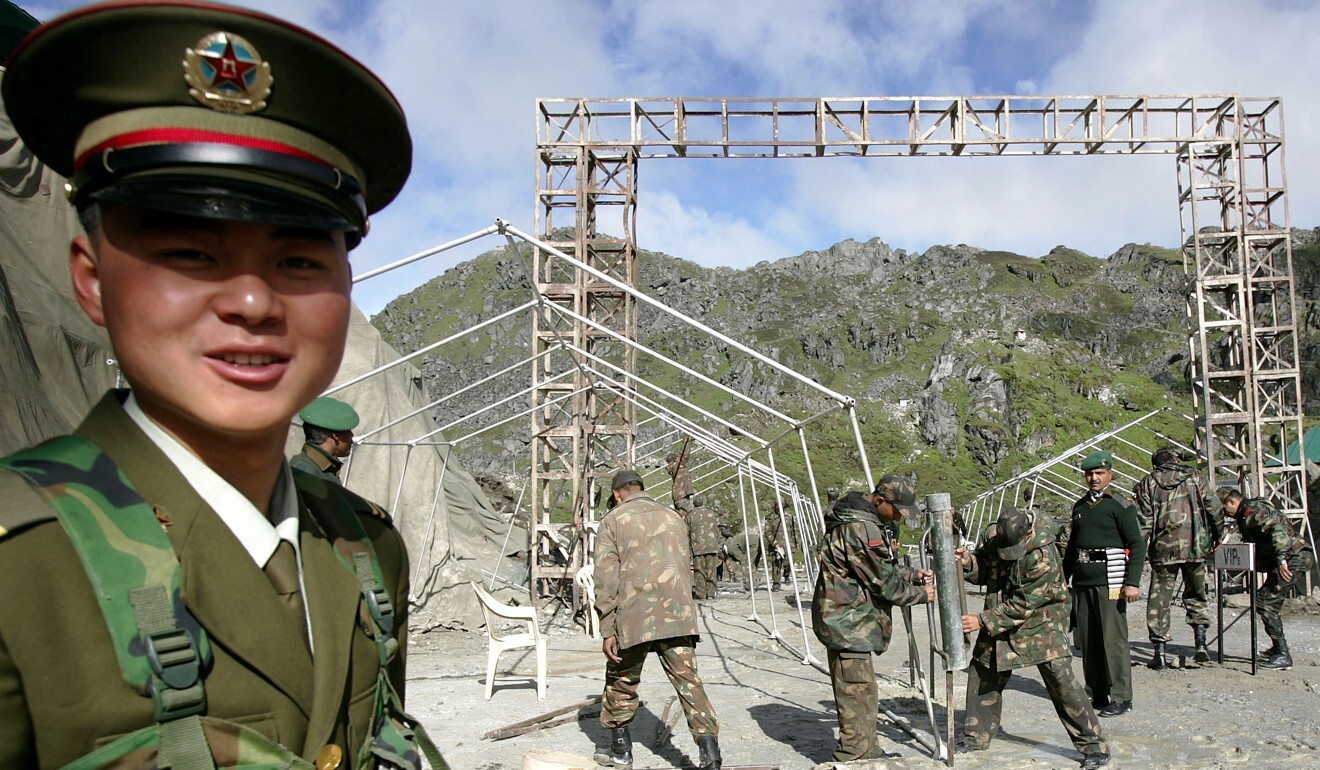
A Chinese soldier stands guard while Indian soldiers work near their shared border. Photo: AP
The new access along the border with China comes amid heightened tensions between the two nations after Beijing accused India of blocking its companies in the South Asian nation after New Delhi tightened laws for foreign investment. The bridge is located in a region that witnessed a months-long military stand-off in 2017 over the Doklam plateau, claimed by China and Bhutan, India’s ally. It was one of the most serious flare-ups since China won a border war with India in 1962.
China’s Ministry of Foreign Affairs did not respond to a message requesting comment.
India claims the Chinese army violated the 3,488km-long undemarcated border, parts of which are disputed, more than 600 times, the people said, asking not to be identified as the matter is not public.
“India and China have different perceptions of the border,” Indian Army spokesman Aman Anand said on Thursday. “Perceived transgressions are result of the perceived boundary.”
Under Prime Minister Narendra Modi, India is ramping up its infrastructure along the border, which it says isn’t aimed at any particular country, but rather the development of remote border areas. It has completed 74 strategic roads along the eastern border, with plans afoot to finish 20 more by next year, the people said. It will reduce time taken to move and material by half and help 431 villages that lie across the region during the Covid-19 outbreak.
by making it mandatory for companies from countries that share a land border to acquire local firms only after seeking an approval from the government. The move, which cuts the risk of opportunistic takeovers as the coronavirus outbreak drives down valuations of Indian companies, had so far applied only to FDI from Bangladesh and Pakistan. India shares its land border with seven countries, including China.
The new bridge opened by the India also strides one of the main access routes of the Chinese Army into India from Tibet.
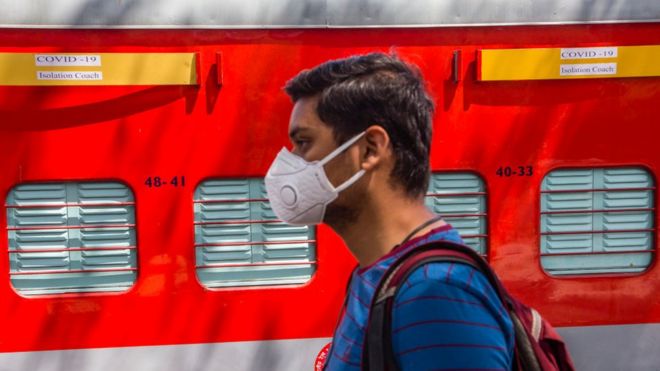
Image copyright GETTY IMAGESImage caption India’s railways are hoping to ease the burden on hospitals
India is preparing for a potential surge in Covid-19 patients by tapping into an unusual resource: its trains, which power the world’s fourth biggest rail network.
The country suspended its passenger trains for the first time after it announced a three-week lockdown on 25 March to contain the coronavirus. As of Wednesday, it had reported 4,643 active cases and 149 deaths, and the numbers are rapidly increasing.
“We, at the railways, thought: how can we contribute?” its spokesman, Rajesh Bajpai, told the BBC. “So we came up with this idea and everyone liked it.”
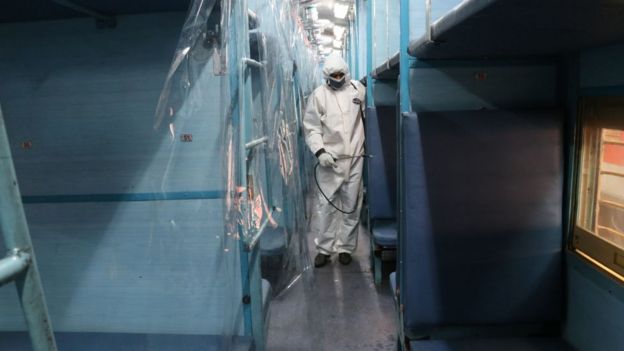
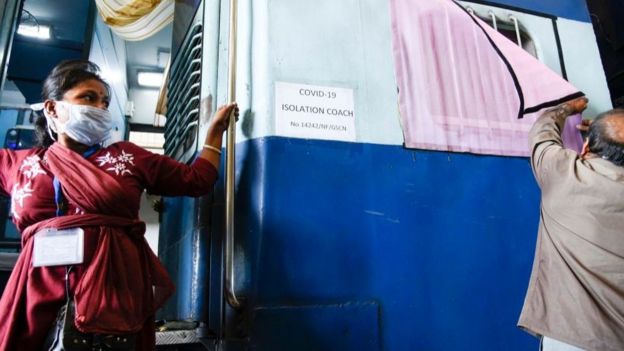
Work has already begun to convert 5,000 train coaches into quarantine or isolation wards, which amounts to 40,000 beds. And the railway ministry says it’s prepared to convert 15,000 more coaches.
The Indian railways – as the ministry is known – is a behemoth. Largely constructed during British rule, it’s still the mainstay of India’s public transport, and includes some of the world’s busiest urban rail systems. It transports 23 million passengers a day and its 12,000 trains crisscross 65,000km (40,389 miles) of tracks, connecting the remotest parts of India.
Mr Bajpai says the coaches can be spared as they are mostly trying to convert older ones, and passengers will be fewer than ever in the coming months even if restrictions are eased.
He adds that this is not unusual for the railways, which already runs several “special” trains, from luxury trains to exhibition trains to a hospital train, complete with operation theatres.
“The coach is a shell and inside, you can provide anything – a drawing room, a dining room, a kitchen, a hospital.”
A looming crisis?
And India may well need the extra beds.
States have already turned all sorts of spaces – sports centres, stadiums, wedding venues, hotels, resorts – into quarantine or isolation centres. But officials fear they will run out of space as the country ramps up testing.
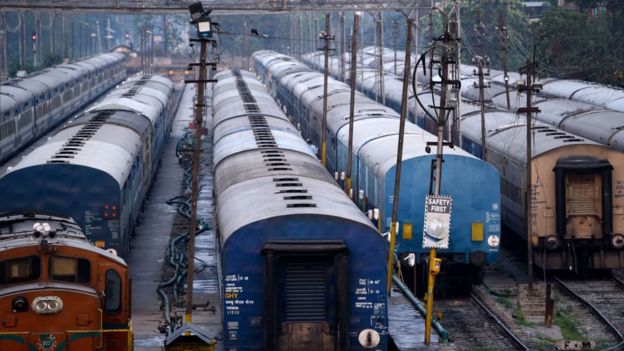
Image copyright GETTY IMAGESImage caption India suspended all passenger trains last month
For every person who tests positive, there are scores more who need to be traced, quarantined and, if necessary, isolated. But isolation at home is not always an option in India’s joint family households – and especially not in its densely-populated slums.
“There are so many options available and this [the coaches] is one of the options,” Mr Bajpai says.
He doesn’t foresee them being used until beds in existing quarantine or isolation centres are filled. But, he adds, they will keep them ready with the necessary facilities.
That includes converting one of the two toilets in each coach into a “bathing room”, providing oxygen cylinders in every coach, and modifying all the cabins so they can hold medical equipment. And then there are measures that are specific to Covid-19 – such as replacing taps that turn with those that have long handles, and fitting dustbins with foot pedals.
Image copyright GETTY IMAGESImage caption It takes up to three days to turn a coach into an isolation ward
The ministry has also ordered extra coat hooks and mosquito nets for every cabin, and has instructed officials to make sure that charging points are working, the upholstery “is in good condition” and “broken panels are replaced”.
The coaches are being readied in 130 different locations across the country, but it’s yet to be decided where they will be stationed.
Mr Bajpai says it’s up to states to decide which stations they want the coaches in. But that in itself is a process because the coaches need regular water and electric supply.
And there are other concerns too. Summer has begun and large parts of India record scorching temperatures, often more than 40C. And the coaches that are being converted are not air-conditioned.
“The patient will be very uncomfortable. Doctors and nurses will be wearing protective gear, and they will find it very difficult,” says Vivek Sahai, a former chairman of the railway board.
Image copyright GETTY IMAGESImage caption Staff member of Northeast Frontier Railway (NFR) prepare train coaches to convert them into isolation wards for COVID-19 patients.
He also says not everyone might be comfortable squatting to use Indian-style toilets; and he wonders if all the designated coaches have a proper system of waste management. (Indian coaches are designed to dispose of human waste onto the tracks although new technologies have begun to be adopted in recent years.)
“I am not saying it cannot be done but they have to take care of these things,” he says. “But if anybody can do it, it’s the railways.”
However, some experts say that this by itself is not going to help solve India’s problems.
“You don’t just need space,” says Dr Sumit Sengupta, a pulmonologist. “We need thousands of doctors and nurses if you really have to make a dent.”
India is severely short of both, and at least three hospitals have been sealed this week alone after members of the staff tested positive.
Media caption As cases of coronavirus rise and the virus hits India’s congested slums, will the country cope?
“Why isolate someone who has symptoms when there is no treatment? Because you don’t want them to spread the infection,” Dr Sengupta says.
But, he adds, the virus is spreading anyway because so many patients are asymptomatic. He says isolating symptomatic patients will not help unless India starts testing aggressively.
“This will work only as part of a larger strategy,” he adds. “Test, trace and isolate. Test should come first.”
Throughout the world, overworked health care professionals are being infected with Covid-19, yet the Lion City has kept numbers low
Preparation, planning, patient ratios and protective equipment have all played a part. Still, even the best gear cannot guard against discrimination
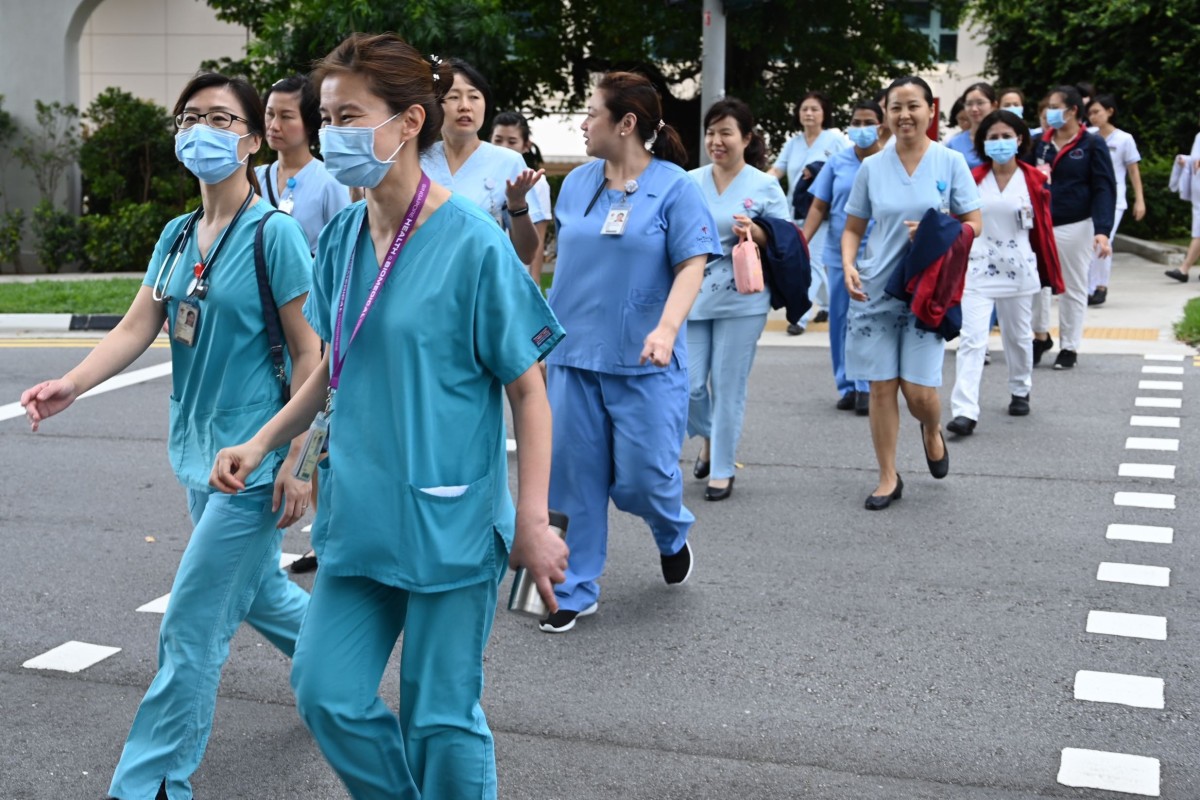
Medical staff walk to the National Centre for Infectious Diseases building at Tan Tock Seng Hospital in Singapore. Photo: AFP
Uncooperative patients, long hours and a lack of protective equipment are hampering health care workers across the world as they take the fight to the coronavirus, leading many to fall sick themselves.
In Malaysia, a pregnant woman who did not disclose that her father was infected tested positive after giving birth, leading to the shutdown of the entire hospital for cleaning. In the Philippines, nine doctors have died, two of whom had dealt with a patient who lied about her travel history.
In Spain, where more than 5,400 health care workers have been infected, accounting for about 14 per cent of the country’s patients, there are no longer enough workers to care for patients.
In Italy, which has more than 69,000 patients, the virus killed a doctor who had no choice but to work without gloves.
In the United States, which has surpassed China to become the world’s most infected nation with more than 83,000 people testing positive for Covid-19, hospitals are being overrun with patients.
Health care staff in the country say patients are packed into emergency wards and intensive care units (ICUs), further raising the risk of infections. They also report shortages of ventilators, face masks, gowns and shields.
The US Centres for Disease Control and Prevention on March 7 released interim guidelines saying health care workers exposed to the coronavirus could be asked to return to work as long as they wore face masks and were not showing symptoms, if their employers had no other manpower available.
Malaysian health workers at Kuala Lumpur International Airport. Photo: AFP
A REASON FOR OPTIMISM
However, amid all the gloom, Singapore’s experienceis being held up as a reason for optimism. The city state has reported more than 630 cases of infection, all of which are being treated in hospital, yet only a handful of its health care professionals have been infected. What’s more, even these cases, according to Vernon Lee, director of communicable diseases at the Ministry of Health, are thought to have been infected outside the health care setting.
Experts suggest this has been more than just luck, pointing to a case in which 41 health workers were exposed to the coronavirus in a Singapore hospital yet evaded infection.
The workers had all come within two metres of a middle-aged man with Covid-19 who was being intubated, a procedure which involves a tube being inserted into the patient’s trachea. The procedure is seen as being particularly hazardous for health workers as it is “aerosol generating” – patients are likely to cough.
The workers had not known at the time that the man had the virus and all were quarantined after he tested positive. However, on their release two weeks later, none of them had the virus.
Coronavirus: as Malaysia braces for third wave, doctors make their own face masks
27 Mar 2020
The case has come to widespread attention partly because the workers were wearing a mix of standard surgical masks and the N95 mask, which doctors see as the gold standard as it filters out 95 per cent of airborne particles.
The conclusion, published in The Annals of Internal Medicine this month, was this: “That none of the health care workers in this situation acquired infection suggests that surgical masks, hand hygiene, and other standard procedures protected them from being infected.”
Surgeon and writer Atul Gawande mentioned the case in an article for The New Yorker on how health care workers could continue seeing patients without becoming patients. He said there were things to learn from Asia and that some of the lessons came out of the “standard public health playbook”. In other words, there is much to be said for social distancing, basic hand hygiene and cleaning regimens.
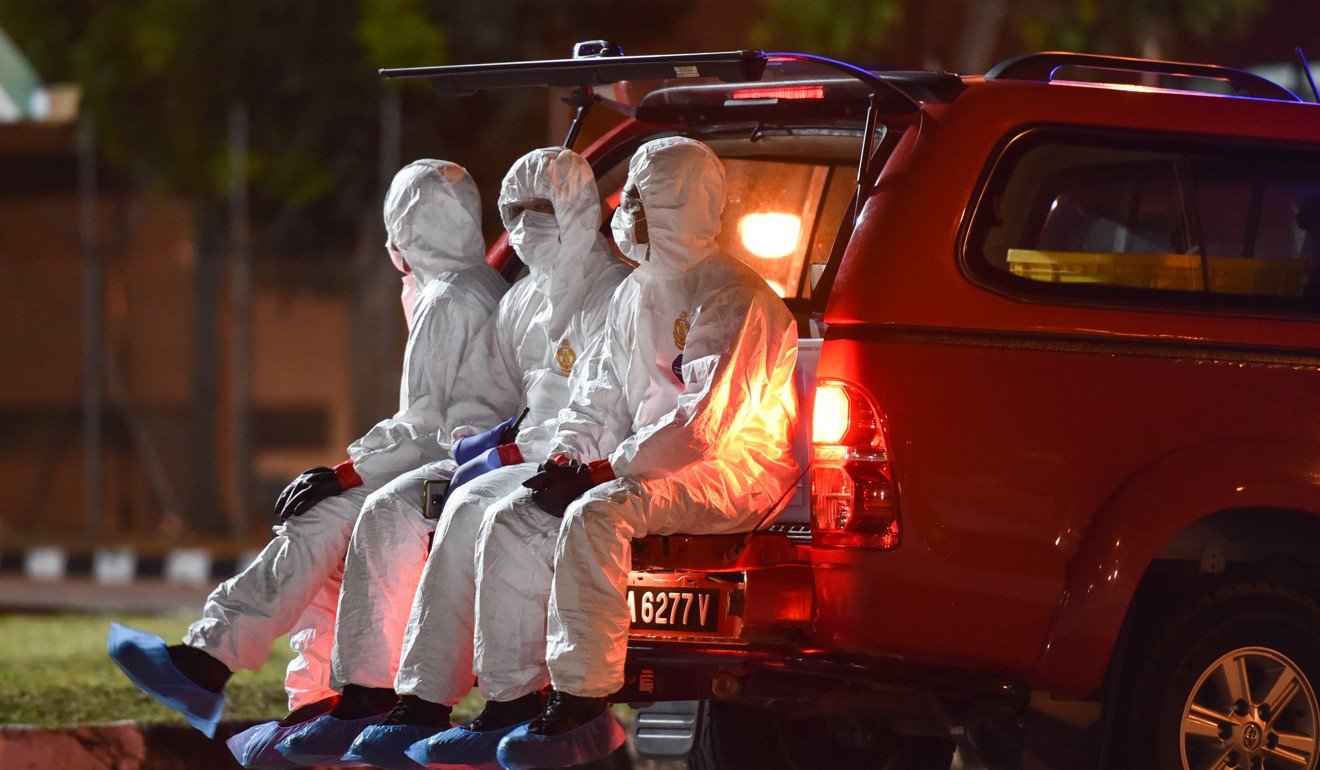
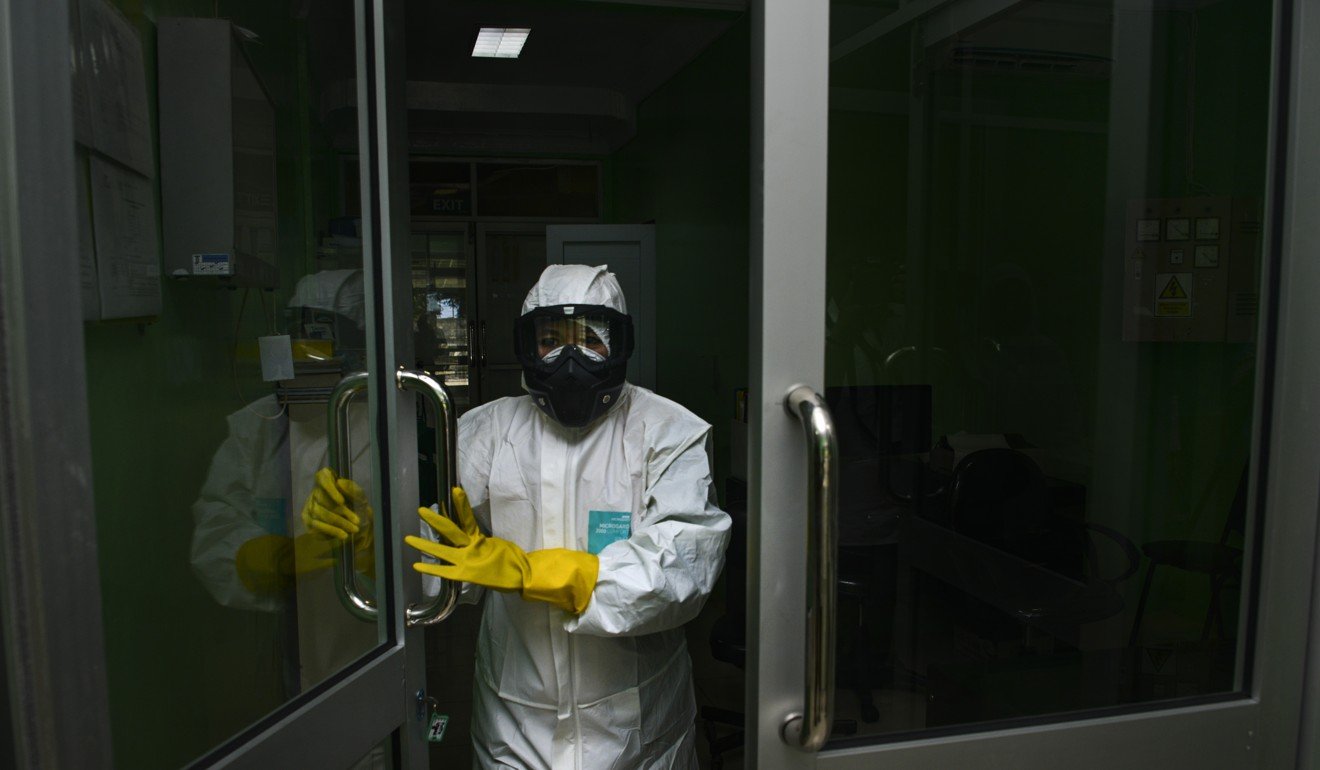
A health worker in protective gear walks into a quarantine room at a hospital in Banda Aceh, Indonesia. Photo: AFP
COMING TOGETHER
With critical supplies running short in many countries, experts say it is increasingly vital that countries share both knowledge and resources.
To this end, China has been donating personal protective equipment to places including the Philippines, Pakistan and Europe. China’s richest man Jack Ma is donating 1.8 million masks, 210,000 Covid-19 test kits and 36,000 pieces of protective clothing to 10 countries in Asia.
At the same time, doctors are encouraging the Western world to learn from Asia.
Infectious diseases expert Leong Hoe Nam said that being “bitten by Sars” (severe acute respiratory syndrome) in 2003 had prepared Asia for Covid-19, while Western countries were not similarly prepared and hence lacked sufficient protective equipment.
He pointed to how about 2,000 health care workers had fallen sick in China early in the outbreak because workers did not initially have protective gear. The trend reversed as equipment became available.
“Once the defences were up, there were very few health care workers who fell sick at work. Rather, they fell sick from contact with sick individuals outside the workplace,” he said.
Malaysia is a case in point. While it has reported 80 health care workers falling ill, most are thought to be community infections.
Coronavirus: Doctor explains the proper way to wash your hands and put on a face mask
In a webinar organised by Caixin Global on Thursday night, Peng Zhiyong, an intensive care specialist at Zhongnan Hospital of Wuhan University, shared how they managed a shortage of personal protective equipment early on in the outbreak by rationing workers to two sets of gear per shift.
Meanwhile, in the Philippines, doctors from Manila’s Chinese General Hospital held a video conference call with doctors in Zhejiang to learn from China’s experience of treating Covid-19 patients.
Crowdsourcing platforms have also been created to share advice. The Brigham and Women’s Hospital in Boston has released guidelines for treating critically ill patients and its website includes information from Chinese doctors.
Why Singapore’s coronavirus response worked – and what we can all learn
27 Mar 2020
The Jack Ma Foundation has also launched an online platform for doctors and nurses around the world to share knowledge on fighting the virus. “One world, one fight,” it said in a tweet.
Associate Professor Jeremy Lim from the global health programme at the Saw Swee Hock School of Public Health said it was crucial for countries to work together.
“Viruses don’t respect borders. Countries have to share information and help each other as we are only as strong as the weakest link. Any country can become a reservoir of disease and the world may then be forced to endure a ping-pong of outbreaks over and over again.”
And the advice of Lee, at Singapore’s Ministry of Health? “Practise good hygiene and wash hands regularly.”
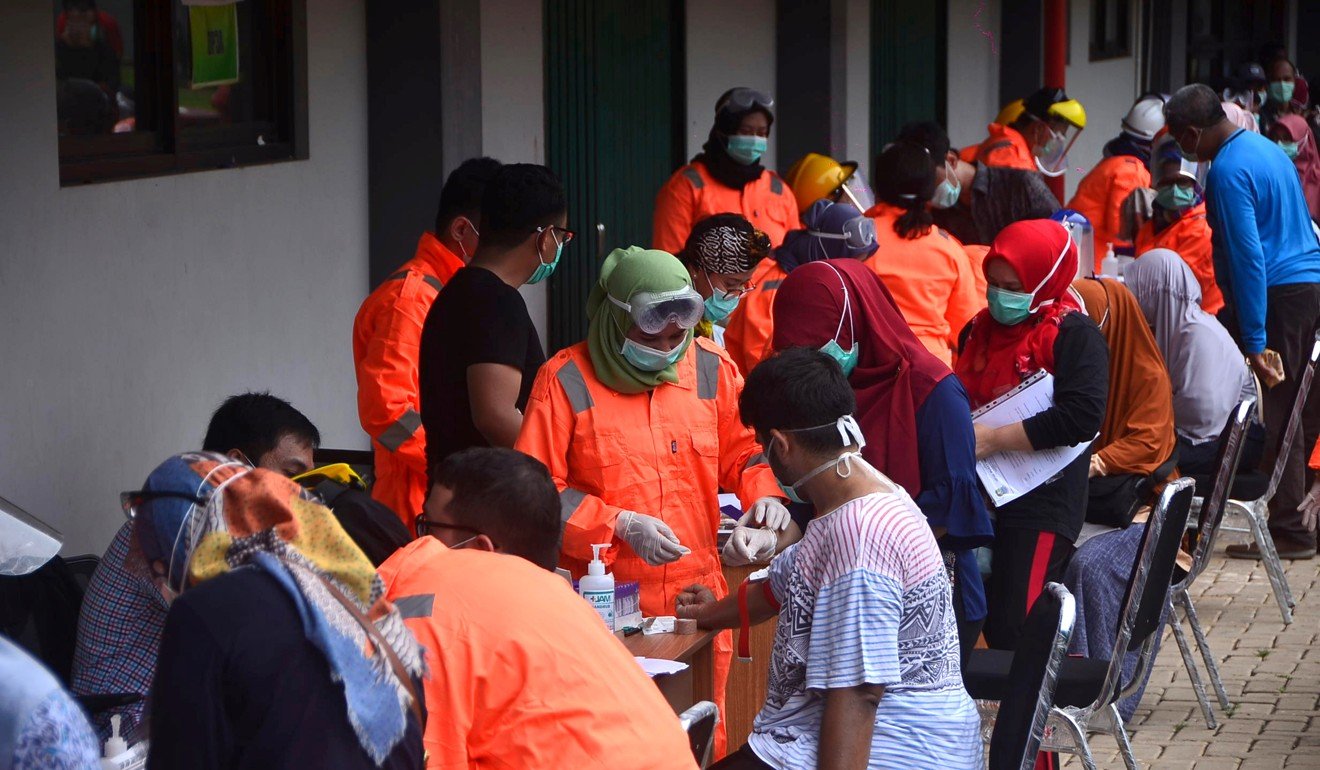
Indonesian medical staff administer mass testing for Covid-19 in Bekasi, West Java. Photo: AFP
SINGAPORE, A CASE STUDY
Amid this sharing of advice, it is often Singapore that is held up as an example to replicate. Despite the country grappling with a rising load of Covid-19 patients, most of whom have recently returned to the city state from abroad, its health care system has continued to run smoothly. Doctors say this is because it has been preparing for a pandemic ever since Sars caught it by surprise. During the Sars outbreak, health care workers accounted for 41 per cent of Singapore’s 238 infections.
Consequently its hospitals swung into contingency planning mode early on in the coronavirus outbreak, telling staff to defer leave and travel plans after its first cases emerged.
Meanwhile, its hospitals swiftly split their workforces into teams to ensure there were enough workers if the outbreak worsened, and to ensure workers got enough rest.
Singapore has 13,766 doctors, or 2.4 doctors for every 1,000 people. That compares to 2.59 in the US, 1.78 in China and 4.2 in Germany. Places like Myanmar and Thailand have fewer than one doctor for every 1,000 people.
Coronavirus: Covid-19 could live on in Indonesia long after world recovers
22 Mar 2020
“The objective is that you can run essential services with the greatest amount of security. Make sure functional units have redundancy built in, and are separate from each other. It depends on what you feel is sufficient to carry on services if one team is affected, factoring in rest periods and some system of rotation,” said Chia Shi-Lu, an orthopaedic surgeon.
The key is to ensure a good doctor-to-patient ratio and ensure there are enough specialists for the critical work, such as doctors and nurses who can provide intensive care, and know how to operate mechanical ventilators or machines to pump and oxygenate a patient’s blood outside the body.
At the emergency department where paediatrics emergency specialist Jade Kua treats Covid-19 cases in addition to regular emergencies, doctors are split into four teams of 21. Each team takes alternate 12-hour shifts and does not interact with other teams.
“We are in modular teams so the teams move together. So you and I would both do morning, off, night, off, morning off. Together. And then the other teams would do the same and we don’t intermingle,” said Kua.
US now has world’s most coronavirus cases, surpassing China
Chia, who works at the Singapore General Hospital, said doctors had been split up according to their functions.
“We try not to meet at all with the other teams as much as possible. We’ll just say hi from across the corridor. Meals are the same. All our cafeterias and everything have got social distancing spaced in already,” said Chia, who is also a member of parliament and chairs a shadow committee on health.
Chia said the health care system could also tap on doctors in the private sector.
Not every country has a plan like this. Last year’s Global Health Security Index by the Economist Intelligence Unit found that 70 per cent of 195 countries scored poorly when it came to having a national plan for dealing with epidemics or pandemics. Almost three in 10 had failed to identify which areas were insufficiently staffed. In India, with a population of 1.3 billion, only about 20,000 doctors are trained in key areas such as critical care, emergency medicine and pulmonology.
Singapore, Hong Kong, Taiwan: the real coronavirus world leaders
19 Mar 2020
In contrast, Singapore published its first Influenza Pandemic Preparedness and Response Plan in June 2005 and has since honed it to a tee. Hospitals regularly war-game scenarios such as pandemics or terrorist attacks and the simulations are sometimes observed by the Ministry of Health, which grades the performance and recommends areas for improvement.
The plan also covers the need to stockpile equipment to avoid the sort of shortages many countries are now facing, another lesson inspired by Sars when masks, gloves and gowns were in short supply.
In a pandemic preparation paper published in 2008, Singapore public health specialist Jeffery Cutter wrote that Singapore’s stockpile was sufficient to cover at least 5 to 6 months’ use by all front-line health care workers.
During the Covid-19 outbreak, it has also told citizens to not wear masks so it can conserve supply for medical staff.
Having enough protective gear has reassured Singapore’s health care workers such as Kua, a mother of six who blogged about her experience fighting Covid-19. Kua said: “I’m safe and my family is safe.”
India’s poor hit hard by 21-day nationwide lockdown amid the coronavirus pandemic
SOMETHING YOU CAN’T GUARD AGAINST
Despite the many positives to emerge from the Lion City, its health care workers are struggling with another problem: discrimination.
While in France, Italy and Britain, residents cheer health care workers from their windows, in Singapore health care workers are seen by some people as disease carriers.
“I try not to wear my uniform home because you never know what kind of incidents you may encounter,” said one Singapore nurse. “The public is scared and wearing our uniforms actually causes quite a bit of inconvenience. One of my staff tried to book a private-hire car to the hospital for an emergency and she was rejected by five drivers.”
There is a similar stigma in India, where the All India Institute of Medical Sciences has appealed to the government for help after health workers were forced out of their homes by panicked landlords and housing societies.
“Many doctors are stranded on the roads with all their luggage, nowhere to go, across the country,” the institute said in a letter.
Lim, from the Saw Swee Hock School of Public Health, said the worst human impulses and “every man for himself” attitudes could emerge in crises and “that is exactly why governments have to step in”.
Discrimination could affect both the performance and motivation of health care workers, Lim warned.
Meanwhile, when health care workers are infected, it creates a “triple whammy” threat.
“It means one fewer professional in an already-strained system, another patient to care for and, potentially, a team of colleagues who need to be quarantined,” said Lim.
“We must do everything possible to keep our health care workforce safe and free from Covid-19.” ■
manufacturers and distributors of surgical face masks are currently in overdrive to meet a surge in global demand for protective gear amid the coronavirus outbreak.
With an eye on enormous profits, these suppliers have turned their focus to exports,
– causing a chronic local shortage of masks due to the relatively lower margins in the domestic market.
Indian manufacturers produce 240 million disposable masks every year, primarily for domestic use, as per the estimates of the Association of Indian Medical Device Industry.
There are no large-scale manufacturers of surgical masks in the country; the landscape is dominated by more than a dozen medium-sized companies with a production capacity of between 20,000 and 100,000 masks a day.
China, Asean foreign ministers begin emergency meeting on coronavirus in Vientiane
20 Feb 2020
The production cost of a mask is estimated to be 1 rupee (less than 2 US cents), and masks were sold for 2-4 rupees at retail outlets a month ago. As of this week, the price of a surgical mask has skyrocketed to 15 rupees.
In some regions where there is a shortfall, retail stores are reportedly demanding as much as 50 rupees. Some experts, meanwhile, say exporting masks to coronavirus-threatened Asian countries where masks are in high demand could fetch firms up to US$15 per mask.
China has so far imported over 1.2 billion masks to meet soaring demand, according to the Ministry of Commerce.
Manoj Rajawat – director of Orthosut Biomedical and Engineering Company, which distributed about 500,000 masks every month before the surge in demand – estimates that nearly 90 per cent of masks manufactured in India in recent weeks have been exported to countries such as China, Malaysia and Singapore.
“The value of the exported masks could [easily be more than 50] times what it was before the virus outbreak in China,” Rajawat said.
More than 75,000 people have been infected with the coronavirus, the vast majority of them on mainland China, and more than 2,000 patients have died with more than 16,000 staging a full recovery. This includes India’s three cases of infection, which were discovered in Kerala and have since been cured.
To allay fears of a domestic shortage, the Indian government briefly banned exports of masks and protective gear earlier this month, when the country’s first case of coronavirus infection was confirmed. A week later, however, the ban was partially lifted for two- and three-ply masks as the demand for such protective equipment kept rising overseas.
Multiple Indian ministries are closely monitoring the situation, but are reluctant to comment on specific issues beyond releasing official notifications.
Coronavirus: Anxious Asian countries want China flight ban, says new poll
20 Feb 2020
“Indian manufacturers have exponentially increased their production of masks. With the government lifting the restrictions on exports, [these firms] are also catering to international demand, somewhat focusing more on exports as it seems more beneficial,” said Vivek Tiwari, chief executive of Medikabazaar, a business-to-business online platform for medical supplies and equipment.
However, experts and observers such as Prasad Danave, president of the Retail and Dispensing Chemist Association, say Indian manufacturers are not equipped to deal with the sudden demand for such large quantities.
“I talked to one of the manufacturers and his capacity to produce disposable masks is 20,000 pieces per day. Suddenly, two purchasers approached him asking for 2 million masks and 5 million masks respectively. It is impossible to cater to such a need immediately,” Danave said.
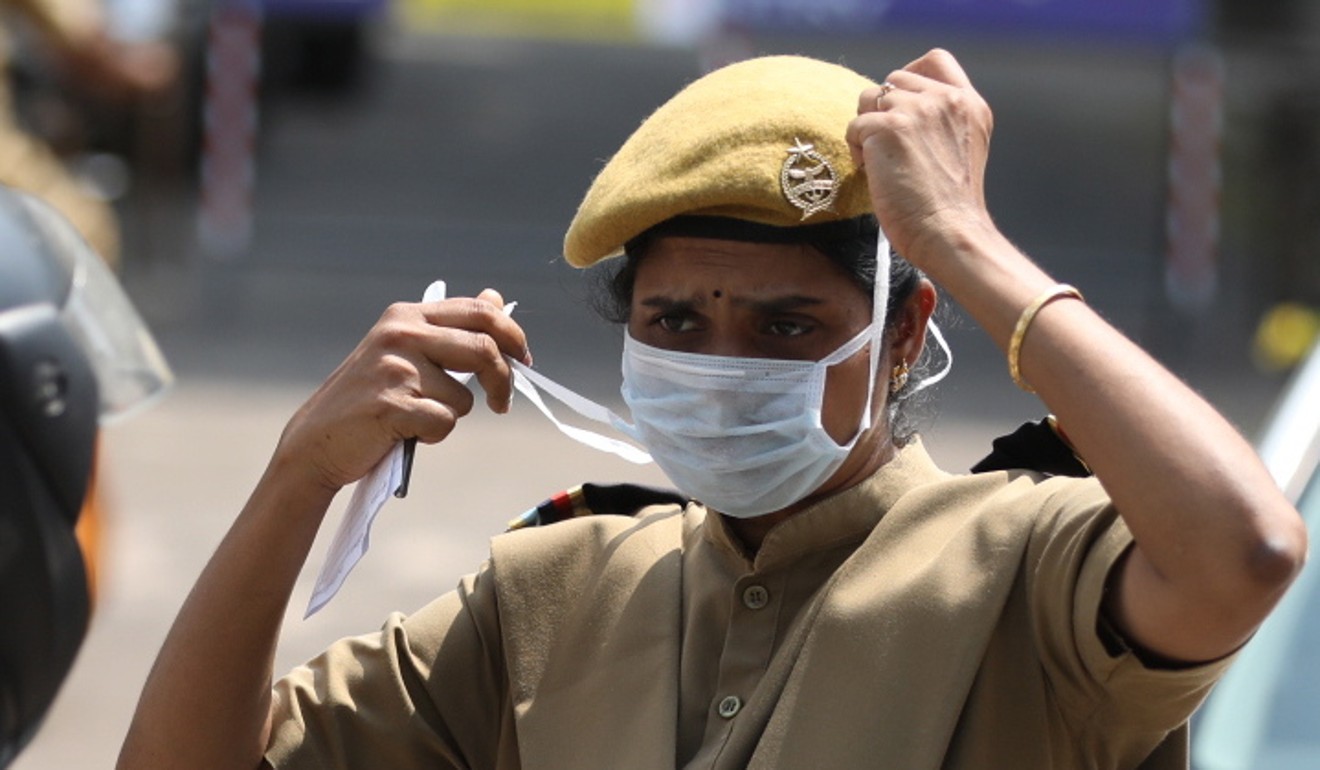
A police officer in Kochi, India wears a face mask amid fears of the coronavirus outbreak. Photo: EPA
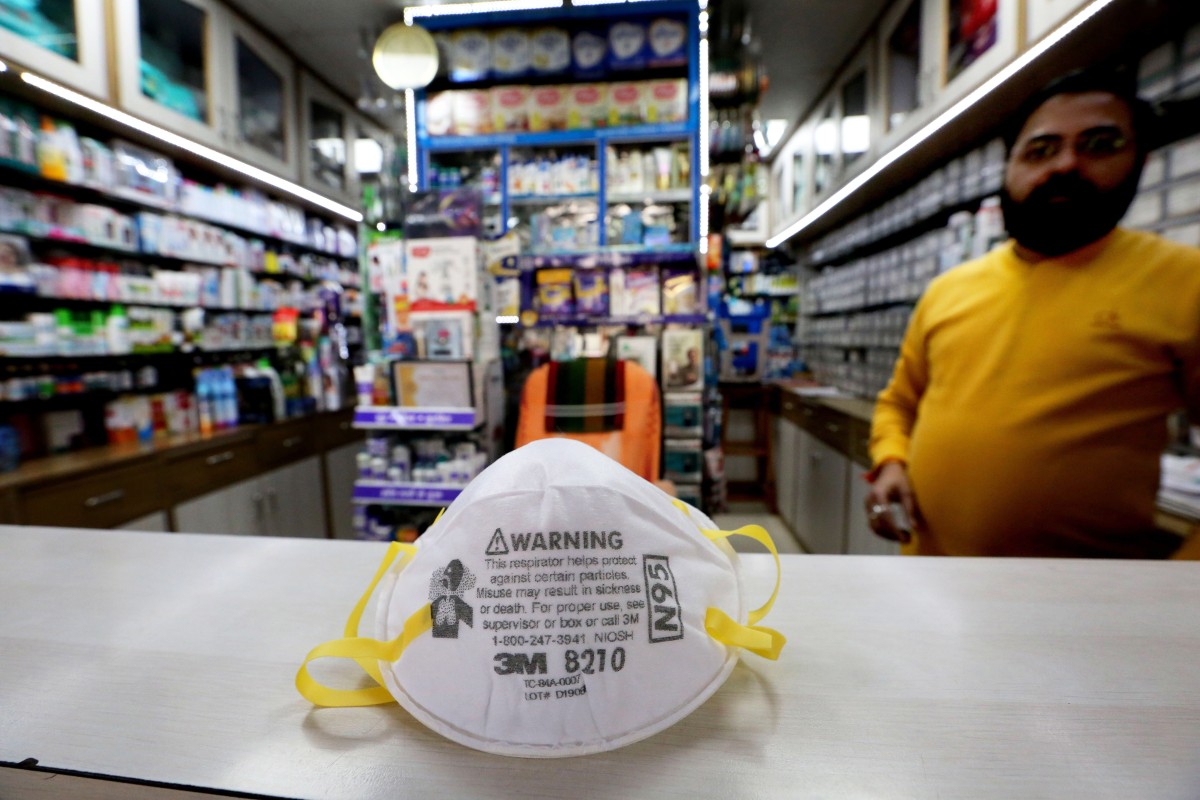
The N95 respirator, an industrial-purpose face mask, is in huge demand as people seek to protect themselves from the coronavirus. Alcohol-based hand sanitisers are also flying off shelves, while there are also concerns of panic buying and shopkeepers hyping up demand for their products to capitalise on the situation.
Abhay Pandey is the national president of the All Food and Drug Licence Holder Foundation, an industry organisation which represents about 7,000 pharmaceutical suppliers across India. He said vendors are distributing substandard face masks to domestic consumers due to a shortage of production time given the increased demand, as well as the lack of a credible mechanism to ensure standards.
Coronavirus: Japan scientist stands by ‘chaotic’ criticism of cruise ship quarantine
20 Feb 2020
“There’s a micro-filter which is usually fitted between two layers in the three-ply face masks used by doctors during surgical procedures. Now, the suppliers are preparing substandard face masks without this filter for the Indian market, and for exports they’re sending the good quality ones,” Pandey said.
Mask makers in China, the world’s largest producer of face masks, are currently operating at 76 per cent capacity, National Development and Reform Commission official Cong Liang said at a press conference in Beijing on Tuesday.
This means they are producing about 15.2 million masks daily but demand is estimated to be between 50 and 60 million units, according to Chinese media reports citing mainland mask manufacturers.
LUCKNOW (Reuters) – U.S. President Donald Trump vowed to “drain the swamp” of lobbyists and elites in Washington D.C. Now, one Indian city is racing to clean up a stagnant river as he prepares to visit.
Trump arrives in India on Feb. 24 on a maiden two-day trip that aims to repair bilateral relations hurt by a trade spat.
He plans to visit the western city of Ahmedabad and India’s capital New Delhi, as well as Agra, where he will view the famed monument to love, the Taj Mahal, at sunset.
In the city, authorities are on a clean-up drive, including the polluted waters of the Yamuna river, that backs on to the monument complex.
Jal Singh Meena, an officer with the Agra Ganga Nahar, the government body that manages the canal network that feeds into the Yamuna in Agra, said on Thursday an additional 17 million litres of water are being released from three locks in the week preceding Trump’s visit on Monday- more than double the usual amount.
The extra flow had been ordered “to keep it clean and remove the foul smell,” he told Reuters.
On Thursday, workers scrubbed walls and fountains at the monument, commissioned in 1632 by Mughal emperor Shah Jahan in memory of his late wife Mumtaz, TV channels showed.
India’s best-known attraction, the Taj Mahal is visited by nearly seven million tourists a year, according to official data, but has been blighted by overcrowding and pollution.
Along with polluted water, authorities are battling some of the world’s filthiest air that stains the white marble of the monument, and increasingly aggressive troops of monkeys that have been known to attack visitors.
District authorities have denied local media reports they have relocated some of the more troublesome primates for the visit, and that a bridge on a proposed route taken by Trump will be unable to bear the weight of his armour-plated limousine known as “The Beast”.
NEW DELHI (Reuters) – Violent clashes erupted in Delhi between police and hundreds of university students on Friday over the enactment of a new citizenship law that critics say undermines India’s secular foundations.
The unrest has already led Japanese Prime Minister Shinzo Abe to cancel a planned visit to India from Sunday.
The new law offers a way to Indian citizenship for six minority religious groups from neighbouring Bangladesh, Pakistan and Afghanistan including Hindus and Christians, but not Muslims.
RELATED COVERAGE
Explainer: What does India’s new citizenship law mean?
Clashes erupt in New Delhi between students, police over citizenship law
See more stories
Police fired tear gas and used baton charges to disperse scores of students demonstrating at Jamia Millia Islamia university in the heart of Delhi over the law.
Protesters attacked cars in the capital, and several people were injured and taken to hospital.
Zakir Riyaz, a PhD student in social work, said the new law made a mockery of India’s religious openness.
“It goes against the whole idea of a secular India,” he said, speaking by phone from the Holy Family Hospital in New Delhi where 15 of his fellow students were admitted after being injured in a police baton charge.
Police barricades were knocked down and streets were strewn with shoes and broken bricks. An official at the university dispensary said that more than 100 students had been brought in with injuries but all had been discharged.
Parvez Hashmi, a local politician who went to the protest site to speak to police, said about 50 students had been detained.
Students said it was meant to be a peaceful protest, with them trying to go from Jamia University to Parliament Street to show their opposition to the legislation. But police pushed them back, leading to clashes.
Critics of Prime Minister Narendra Modi’s government say it is promoting a Hindu-first agenda for India and that the citizenship law excluding Muslims showed a deep-seated bias against India’s 170 million Muslims.
Imran Chowdhury, a researcher, said “either give citizenship to refugees of all religions or none at all. The constitution is being tampered with in the name of religion.”
Modi’s ruling Bharatiya Janata Party denies any religious bias but says it is opposed to the appeasement of one community. It says the new law is meant to help minority groups facing persecution in the three nearby Muslim countries.
ABE CANCELS
The United Nations human rights office voiced concern that the new law is “fundamentally discriminatory in nature”, and called for it to be reviewed.
Two people were killed in India’s Assam state on Thursday when police opened fire on mobs torching buildings and attacking railway stations in protest at the new citizenship rules signed into law on Thursday.
Japan’s Prime Minister Shinzo Abe cancelled a trip to Assam for a summit with his Indian counterpart Narendra Modi that had been due to begin on Sunday.
Japan has stepped up infrastructure development work in Assam in recent years, which the two sides were expected to highlight during the summit. Abe had also planned to visit a memorial in the nearby state of Manipur where Japanese soldiers were killed in World War Two.
“With reference to the proposed visit of Japanese PM Abe Shinzo to India, both sides have decided to defer the visit to a mutually convenient date in the near future,” Indian foreign ministry spokesman Raveesh Kumar said in a tweet.
Japan’s Chief Cabinet Secretary Yoshihide Suga said both countries would decide on the appropriate timing for the visit although nothing has been decided yet.
A movement against immigrants from Bangladesh has raged in Assam for decades. Protesters there say granting Indian nationality to more people will further strain the state’s resources and lead to the marginalisation of indigenous communities.
MUMBAI (Reuters) – India’s richest state is set to be ruled by parties opposed to Prime Minister Narendra Modi’s nationalist Bharatiya Janata Party, jeopardising a Japanese-backed bullet-train project opposed by farmers.
The BJP’s inability to pull together voters in the westerly state of Maharashtra, of which Mumbai is capital, has meant that three parties, including a former BJP ally, will form the government. That is a major setback for Modi after his landslide victory in general elections this year.
It could also hinder the bullet train project, a $17 billion investment largely financed by a long-term, low-cost loan from Japan. The BJP was in power in both Maharashtra and Gujarat states when work began on project in 2017.
“We have always opposed the bullet train,” said Manisha Kayande, a spokesperson for the Shiv Sena, a former BJP ally whose leader is now set to head Maharashtra. “Our state is giving a major chunk of money for the project, when most of the track is in another state. This will definitely be re-framed,” .
The train will run from Mumbai to Ahmedabad, the main city in Gujarat state, a distance of 508 kilometres (315 miles). But it has run into obstacles acquiring land amid opposition from fruit farmers.
Any delay of the project is likely to undermine investor confidence, at a time when growth has slowed to its weakest pace in years.
Critics say India does not need the high-speed train and investment should go instead to improve the existing network.
“We are not against development or infrastructure projects, but at the same time farmers’ interests can’t be ignored. We will rethink about projects that farmers are opposing,” said a senior leader of Nationalist Congress Party, which is a part of the coalition government.
National High Speed Rail Corporation (NHSRCL), the government agency overseeing the project, had no immediate comment.
The authorities have acquired 548 hectares land out of the total requirement 1,380 hectares and the project was targeted to be operational by 2023 , the government told parliament in July.
Protests against land acquisitions are common in India, where tens of millions of farmers till small holdings. A planned $44 billion refinery to be run by a consortium including Saudi Aramco, the world’s biggest oil producer, is also struggling to secure land in Maharashtra.
Black market imports from China, confusing regulations and pollution concerns are undermining India’s fireworks industry
Industry sources say Diwali sales this year were down by 30 per cent
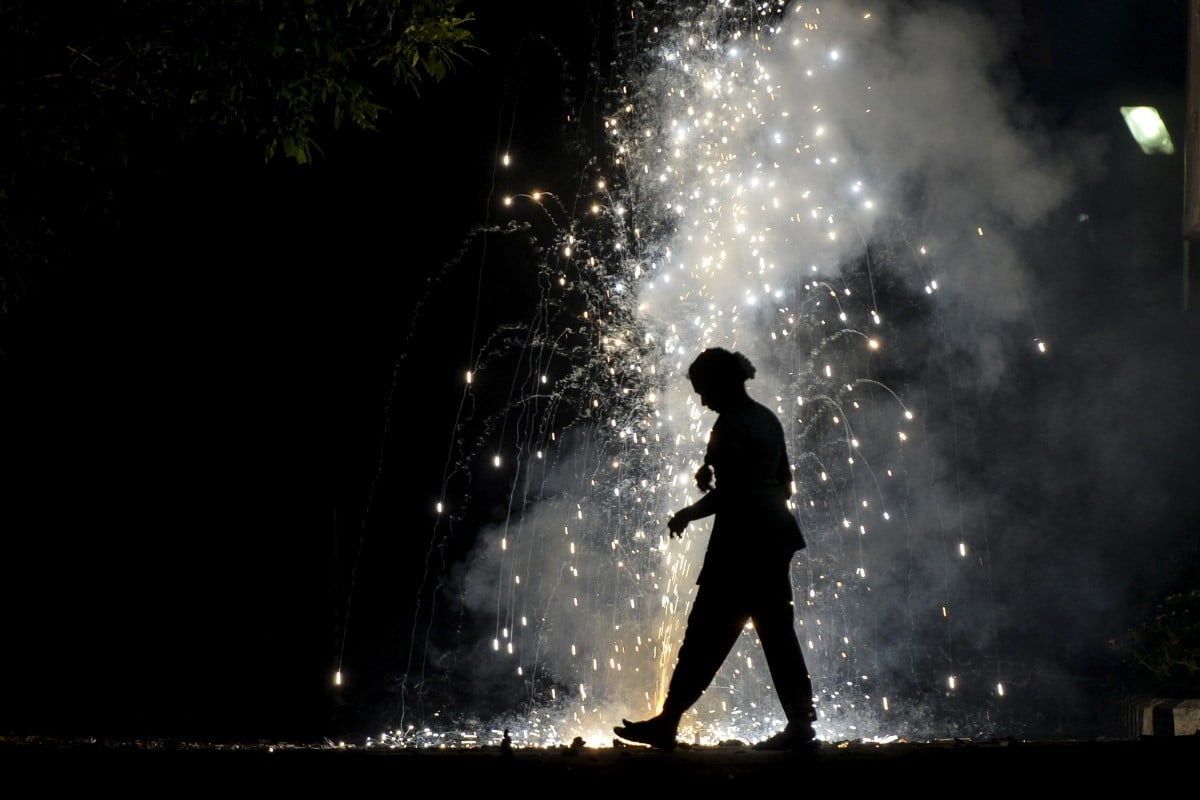
A woman is silhouetted by lit firecrackers during Diwali celebrations in Chennai. Photo: AFP
Arumugam Chinnaswamy set up his makeshift booth selling firecrackers in a Chennai neighbourhood a week ahead of Diwali, the Hindu festival of lights, with great expectations of doing a brisk trade.
Yet a week later, he has been forced to pack up more than half his stock in the hope he’ll have better luck next year.
“Four years ago, I sold firecrackers worth 800,000 rupees (US$11,288) on the eve of Diwali alone. This year, the sales have not even been a quarter of that,” said Chinnaswamy, 65, painting a grim picture that will be recognised by many in the Indian fireworks industry.
Chinnaswamy buys his firecrackers in Sivakasi, an industrial town in the southern Indian state of Tamil Nadu that produces more than 90 per cent of the country’s fireworks.
Sivakasi’s dry climate has helped to make it the firework capital of India and many production facilities in the town have been in the business for close to a century. For the most part, the industry has resisted mechanisation and still deals in handmade products. Its 1,100-plus manufacturing units provide jobs for 800,000 mostly uneducated workers and its diligent labour force have earned the town the nickname of ‘Little Japan’.
A worker lays firecrackers in an outdoor yard at a manufacturing unit involved in the production of firecrackers ahead of the Hindu festival of Diwali, in Sivakasi. Photo: AFP
But this reputation is under threat, struggling under the weight of an anti-pollution campaign, regulatory uncertainty and the arrival of cheap black-market Chinese imports. Irregular monsoons and a slowdown-induced cash crunch have not helped matters either.
Industry figures estimate the Diwali sales of India’s 80 billion-rupee firecracker industry took a 30 per cent drop this year.
A TOXIC PROBLEM
With pollution in Indian cities among the worst in the world, the government has come under pressure to do something about the nation’s toxic air – a problem that becomes more acute during Diwali due to the toxic fumes emitted when celebratory fireworks are set off. This Diwali, for instance, many areas in New Delhi recorded an Air Quality Index (AQI) of 999, the highest possible reading (the recommended limit is 60).
That makes the fireworks industry seem like an easy target when it comes to meeting government air quality targets.
Trouble began brewing in October last year when the Supreme Court banned the manufacture of traditional fireworks containing barium nitrate, a chief polluter. That decision put a rocket under the industry, as barium nitrate is cheap and is used in about 75 per cent of all firecrackers in India.
Factories in Sivakasi responded with a four-month shutdown protest that decimated annual production levels by up to a third.
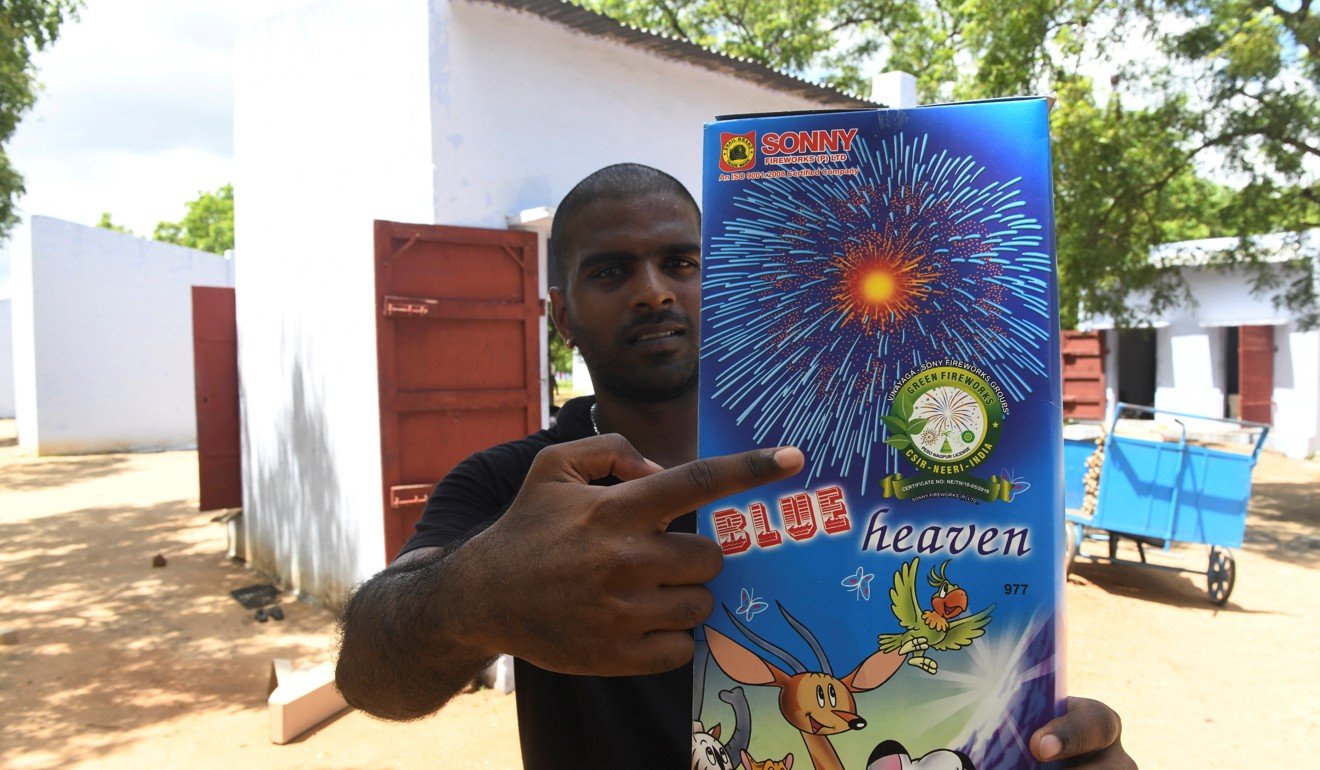
A seal denotes environment friendly ‘Green Fireworks’ at a manufacturing unit in Sivakasi. Photo: AFP
Apparently realising it had overstepped the mark – and that enforcing the Supreme Court regulations would be next to impossible – the government stepped in to rescue the industry, offering its assistance in the manufacture of environment-friendly crackers containing fewer pollutants, but it was too little, too late.
“The Supreme Court verdict was simply Delhi-centric with the vague idea of [cracking down on] urban pollution. It lacked any on-the-ground knowledge of the fireworks industry,” said Tamil Selvan, president of the Indian Fireworks Association, which represents more than 200 medium and large manufacturers.
Singapore travellers give Hong Kong a miss over Diwali long weekend
“Fireworks are low-hanging fruit for the anti-pollution drive as the industry is unorganised. Could the government or judiciary place a similar blanket ban on more pollution-causing industries like automobiles, plastics or tobacco?” asked Selvan.
CHINESE COMPETITION
The industry has also been hit by a flood of cheap Chinese firecrackers that are smuggled into the country on the black market.
In September, the country’s federal anti-smuggling agency, the Directorate of Revenue Intelligence, cautioned various government departments that huge quantities of Chinese-produced firecrackers had reached Indian soil in the lead up to Diwali.
But industry sources complain they have seen little action from the government to combat the problem.
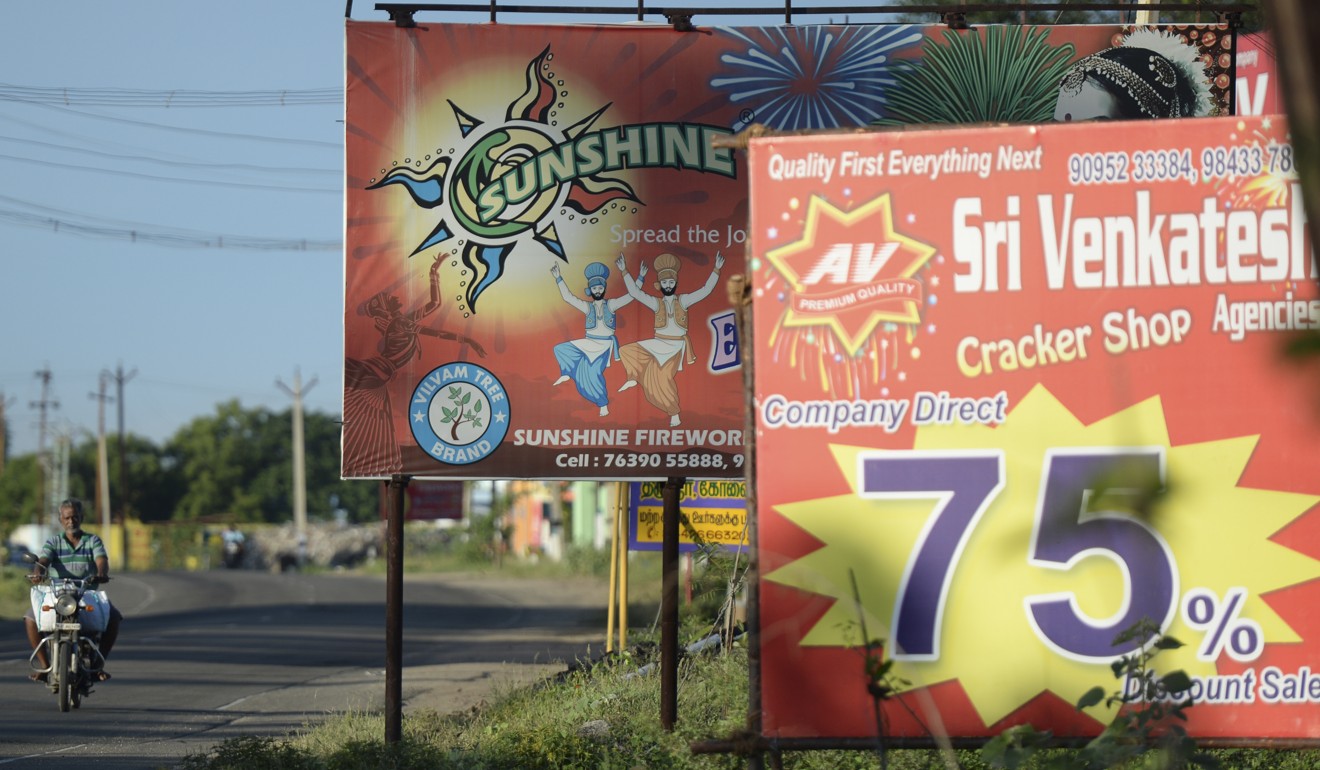
An advert for firecrackers ahead of the Hindu festival of Diwali, in Sivakasi. Photo: AFP
Legally, Indian manufacturers can neither import nor export firecrackers. The Indian firecracker industry is the second-largest in the world after China’s.
Raja Chandrashekar, chief of the Federation of Tamil Nadu Fireworks Traders, a lobbying body, said low-end Indian-manufactured firecrackers such as roll caps and dot caps – popular among children – had struggled to compete with Chinese-made pop pops and throw bombs.
“Despite our repeated complaints to government bodies, Chinese firecrackers find a way into India, particularly in the northern parts. This is severely affecting our business,” said Chandrashekar.
While more Chinese fireworks might be entering India, the effect has been to undermine the industry, resulting in fewer sales overall.
FIZZLING OUT?
The Sivakasi fireworks industry faces other problems, too. Not least among these is the use of child labour, which had been rampant until a government crackdown a few years ago, and the practice of some factories to operate without proper licences and with questionable safety standards.
But despite the darker aspects of the industry, its role goes beyond merely helping Diwali celebrations go with a bang every year.
India is crazy about gold. But can the love last as prices skyrocket?
“The livelihoods of over five million people who are indirectly involved in the business, in areas such as trade and transport, depend on the survival of the industry,” said Chandrashekar.
That survival looks increasingly in question. Dull sales of fireworks have been reported in major cities including New Delhi, Mumbai, Bangalore and Hyderabad, though exact numbers can be hard to come by due to the unregulated nature of the industry and unreliable numbers shared by manufacturers.
So great has the resultant outcry been that some cynics even wonder whether the industry is struggling as much as it claims or whether it is part of a ploy by manufacturers to gain more government concessions and avoid any further crackdown.
“These firecracker manufacturers lie through their teeth about the Diwali sales for self-serving motives such as tax avoidance. The overall business is healthy,” said Vijay Kumar, editor of the Sivakasi-based monthly magazine Pyro India News.
“Though there was a 30-40 per cent shortage in annual production, all the manufactured products have been sold this year. No large stockpile is left with any manufacturer.”
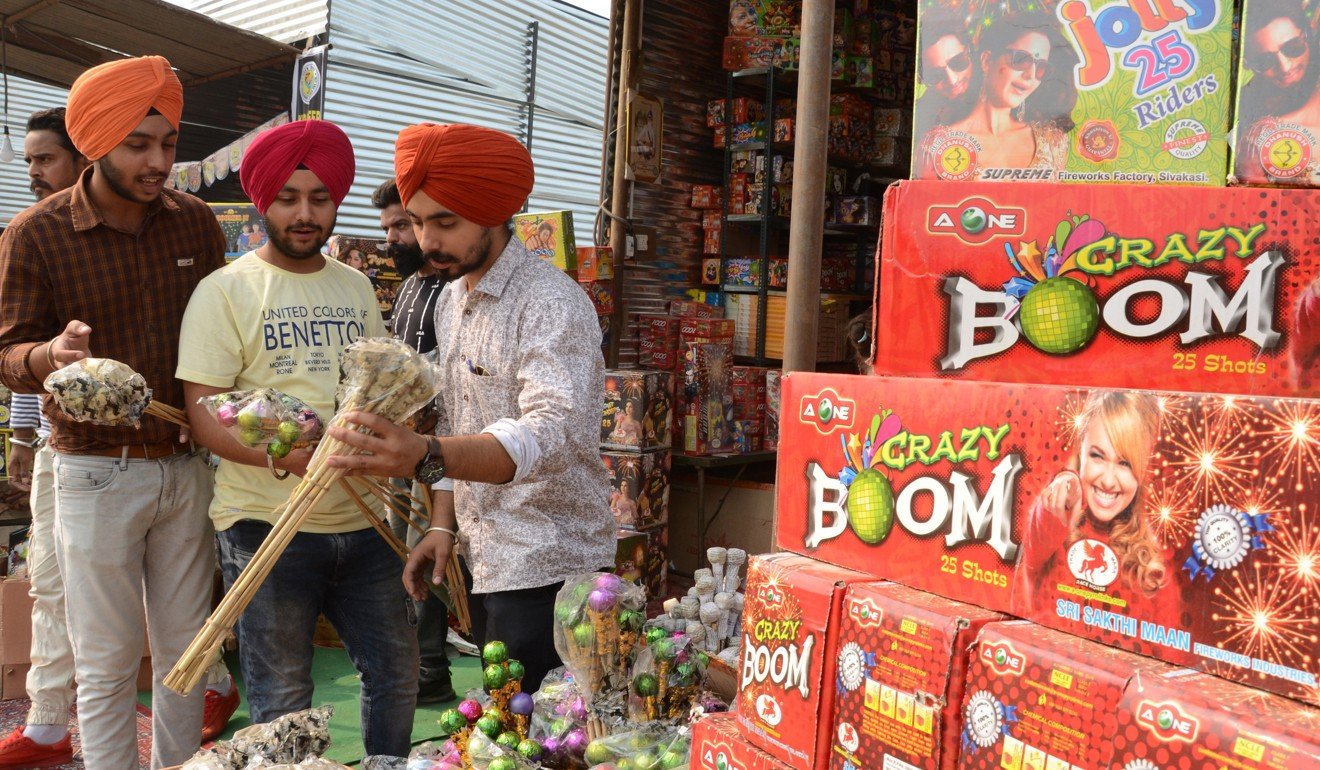
Customers buy firecrackers on the eve of the Hindu festival of Diwali in Amritsar. Photo: AFP
Still, regardless of the manufacturers’ motives, the result of the industry’s struggles has been that street sellers like Chinnaswamy have fewer fireworks to sell – and they are struggling even to sell those.
Chinnaswamy says people are confused about the government’s anti-pollution drive and about what firecrackers are now legal and this has discouraged them from buying. Despite the government’s effort to promote “green crackers” he says these are too hard to come by to be a ready solution, at least for this year.
“There was no clarity on what type of firecrackers, whether green crackers or otherwise, can be set off and at what time of the day. Many consumers even asked me whether or not the conventional firecrackers are totally banned while there was much misinformation floating about on social media,” said Chinnaswamy.
Shaking his head, all he can do is hope that next year his Diwali goes with more of a bang.
NEW DELHI/MUMBAI (Reuters) – India’s ruling Bharatiya Janata Party (BJP) is set to sweep two state polls next week, the first since Prime Minister Narendra Modi’s landslide win in a parliamentary election in May, a leading pollster said.
The BJP is set to comfortably win elections in the western state of Maharashtra and the northern state of Haryana, leaving the main opposition Congress party trailing, according to a survey by polling agency CVoter released on Friday.
CVoter estimates that a BJP-led alliance in Maharashtra will pick up 194 of the 288 seats on offer. In Haryana, the party is predicted to win 83 of the state’s 90 seats, leaving just three for Congress.
Voting in the elections will be held on Monday with the results expected to be announced on Thursday.
Several Congress party officials conceded they had all but given up hope of posing a serious challenge to Modi and the BJP.
In particular, the resignation of Congress chief Rahul Gandhi in July, after weeks of drama following the loss to the BJP in the general election, has sown internal confusion, triggering infighting and exits, two party officials in New Delhi said.
“It’s going to be a rout, and it will deflate morale even further,” one of the officials said, referring to the state elections. “It’s like a slow-moving disaster.”
They requested anonymity because they are not authorised to speak to the media.
Pranav Jha, the secretary in charge of Congress’s communication department, said the party was undergoing a period of “cleansing and churning” and remained committed to taking on the BJP.
“The people of India…can see through the diversionary drama of the ruling party, and realise that jobs, economy and issues of farmers can only be put on track by the Congress party,” Jha told Reuters.
Modi, analysts say, has moved decisively, including withdrawing special rights for Muslim-majority Jammu and Kashmir state, and consolidating the BJP’s hold over India’s Hindu-majority electorate.
INFIGHTING, INDIFFERENCE
In Maharashtra, one of India’s most industrialised states which includes Mumbai, two Congress officials said the top leadership’s relative indifference and infighting had hurt their already weak campaign.
Congress’s state wing had asked for Gandhi, his mother and current party chief Sonia Gandhi, and his charismatic sister Priyanka Gandhi Vadra to join the campaign, one of the two officials said.
But only Rahul Gandhi came and spoke at a handful of rallies.
“Senior leaders from BJP have covered every district. They have been visiting Maharashtra for the last two months to build momentum,” said one Congress official, who is contesting the upcoming poll.
“There wasn’t any concrete effort from Congress leaders in New Delhi to give energy to our cadre,” he said.
The list of recent resignations from the party include Ashok Tanwar, Congress’s former chief in Haryana who quit earlier this month and is now campaigning against his old party.
“The state of affairs in the Congress party is so dire that the decision makers can’t win an election themselves, while the soldiers on ground who stay in touch with the masses are neglected,” Tanwar wrote in his resignation letter.
The situation has even riled Congress allies. Two leaders from the Nationalist Congress Party, which is in alliance with the Congress in Maharashtra, said their partner was slack.
“It looks like Congress is not very serious about the state elections,” one of the leaders said. “Congress is not in the picture. Congress leaders are not attacking the ruling party the way we expected.”
In New Delhi, Congress officials said there was a sense of inertia at the party headquarters, without any understanding of who will become president after Sonia Gandhi, who is only holding charge temporarily.
“Without a clear leadership, nothing is going to change,” one of the officials said, “If it continues like this, the party will fade away.”








 CHINDIA ALERT: You'll be living in their world, very soon