Chindia Alert: You’ll be Living in their World Very Soon
aims to alert you to the threats and opportunities that China and India present. China and India require serious attention; case of ‘hidden dragon and crouching tiger’.
Without this attention, governments, businesses and, indeed, individuals may find themselves at a great disadvantage sooner rather than later.
The POSTs (front webpages) are mainly 'cuttings' from reliable sources, updated continuously.
The PAGEs (see Tabs, above) attempt to make the information more meaningful by putting some structure to the information we have researched and assembled since 2006.
The richest man in China opened his own Twitter account last month, in the middle of the Covid-19 outbreak. So far, every one of his posts has been devoted to his unrivalled campaign to deliver medical supplies to almost every country around the world.
“One world, one fight!” Jack Ma enthused in one of his first messages. “Together, we can do this!” he cheered in another.
The billionaire entrepreneur is the driving force behind a widespread operation to ship medical supplies to more than 150 countries so far, sending face masks and ventilators to many places that have been elbowed out of the global brawl over life-saving equipment.
But Ma’s critics and even some of his supporters aren’t sure what he’s getting himself into. Has this bold venture into global philanthropy unveiled him as the friendly face of China’s Communist Party? Or is he an independent player who is being used by the Party for propaganda purposes? He appears to be following China’s diplomatic rules, particularly when choosing which countries should benefit from his donations, but his growing clout might put him in the crosshairs of the jealous leaders at the top of China’s political pyramid.
Other tech billionaires have pledged more money to fight the effects of the virus – Twitter’s Jack Dorsey is giving $1bn (£0.8bn) to the cause. Candid, a US-based philanthropy watchdog that tracks private charitable donations, puts Alibaba 12th on a list of private Covid-19 donors. But that list doesn’t include shipments of vital supplies, which some countries might consider to be more important than money at this stage in the global outbreak.
The world’s top coronavirus financial donors
How Alibaba compares to the top five. No one else other than the effervescent Ma is capable of dispatching supplies directly to those who need them. Starting in March, the Jack Ma foundation and the related Alibaba foundation began airlifting supplies to Africa, Asia, Europe, Latin America and even to politically sensitive areas including Iran, Israel, Russia and the US.
Ma has also donated millions to coronavirus vaccine research and a handbook of medical expertise from doctors in his native Zhejiang province has been translated from Chinese into 16 languages. But it’s the medical shipments that have been making headlines, setting Ma apart.
“He has the ability and the money and the lifting power to get a Chinese supply plane out of Hangzhou to land in Addis Ababa, or wherever it needs to go,” explains Ma’s biographer, Duncan Clark. “This is logistics; this is what his company, his people and his province are all about.”
A friendly face
Jack Ma is famous for being the charismatic English teacher who went on to create China’s biggest technology company. Alibaba is now known as the “Amazon of the East”. Ma started the company inside his tiny apartment in the Chinese coastal city of Hangzhou, in the centre of China’s factory belt, back in 1999. Alibaba has since grown to become one of the dominant players in the world’s second largest economy, with key stakes in China’s online, banking and entertainment worlds. Ma himself is worth more than $40bn.
Officially, he stepped down as Alibaba’s chairman in 2018. He said he was going to focus on philanthropy. But Ma retained a permanent seat on Alibaba’s board. Coupled with his wealth and fame, he remains one of the most powerful men in China.
Media caption The BBC’s Secunder Kermani and Anne Soy compare how prepared Asian and African countries are
It appears that Ma’s donations are following Party guidelines: there is no evidence that any of the Jack Ma and Alibaba Foundation donations have gone to countries that have formal ties with Taiwan, China’s neighbour and diplomatic rival. Ma announced on Twitter that he was donating to 22 countries in Latin America. States that side with Taiwan but who have also called for medical supplies – from Honduras to Haiti – are among the few dozen countries that do not appear to be on the list of 150 countries. The foundations repeatedly refused to provide a detailed list of countries that have received donations, explaining that “at this moment in time, we are not sharing this level of detail”.
However, the donations that have been delivered have certainly generated a lot of goodwill. With the exception of problematic deliveries to Cuba and Eritrea, all of the foundations’ shipments dispatched from China appear to have been gratefully received. That success is giving Ma even more positive attention than usual. China’s state media has been mentioning Ma almost as often as the country’s autocratic leader, Xi Jinping.
AFP
So far…
Over 150 countries have received donations from Jack Ma, including about:
120.4mface masks
4,105,000testing kits
3,704ventilators
Source: Alizila
It’s an uncomfortable comparison. As Ma soaks up praise, Xi faces persistent questions about how he handled the early stages of the virus and where, exactly, the outbreak began.
The Chinese government has dispatched medical teams and donations of supplies to a large number of hard-hit countries, particularly in Europe and South-East Asia.
However, those efforts have sometimes fallen flat. China’s been accused of sending faulty supplies to several countries. In some cases, the tests it sent were being misused but in others, low-quality supplies went unused and the donations backfired.
In contrast, Jack Ma’s shipments have only boosted his reputation.
“It’s fair to say that Ma’s donation was universally celebrated across Africa,” says Eric Olander, managing editor of the China Africa Project website and podcast. Ma pledged to visit all countries in Africa and has been a frequent visitor since his retirement.
“What happens to the materials once they land in a country is up to the host government, so any complaints about how Nigeria’s materials were distributed are indeed a domestic Nigerian issue,” Olander adds. “But with respect to the donation itself, the Rwandan leader, Paul Kagame, called it a “shot in the arm” and pretty much everyone saw it for what it was which was: delivering badly-needed materials to a region of the world that nobody else is either willing or capable of helping at that scale.”
Walking the tightrope
But is Ma risking a backlash from Beijing? Xi Jinping isn’t known as someone who likes to share the spotlight and his government has certainly targeted famous faces before. In recent years, the country’s top actress, a celebrated news anchor and several other billionaire entrepreneurs have all “disappeared” for long periods. Some, including the news anchor, end up serving prison sentences. Others re-emerge from detention, chastened and pledging their allegiance to the Party.
“There’s a rumour that [Jack Ma] stepped down in 2018 from being the chairman of the Alibaba Group because he was seen as a homegrown entrepreneur whose popularity would eclipse that of the Communist Party,” explains Ashley Feng, research associate at the Centre for New American Security in Washington DC. Indeed, Ma surprised many when he suddenly announced his retirement in 2018. He has denied persistent rumours that Beijing forced him out of his position.
Image copyright GETTY IMAGESImage caption Ma discussed trade with then-President-elect Donald Trump in January 2017
Duncan Clark, Ma’s biographer, is also aware of reports that Ma was nudged away from Alibaba following a key incident in January 2017. The Chinese billionaire met with then-President-elect Donald Trump in Trump Tower, ostensibly to discuss Sino-US trade. The Chinese president didn’t meet with Trump until months later.
“There was a lot of speculation of time that Jack Ma had moved too fast,” Clark says. “So, I think there’s lessons learned from both sides on the need to try to coordinate.”
“Jack Ma represents a sort of entrepreneurial soft power,” Clark adds. “That also creates challenges though, because the government is quite jealous or nervous of non-Party actors taking that kind of role.”
Technically, Ma isn’t a Communist outsider: China’s wealthiest capitalist has actually been a member of the Communist Party since the 1980s, when he was a university student.
But Ma’s always had a tricky relationship with the Party, famously saying that Alibaba’s attitude towards the Party was to “be in love with it but not to marry it”.
Even if Ma and the foundations connected to him are making decisions without Beijing’s advance blessing, the Chinese government has certainly done what it can to capitalise on Ma’s generosity. Chinese ambassadors are frequently on hand at airport ceremonies to receive the medical supplies shipped over by Ma, from Sierra Leone to Cambodia.
China has also used Ma’s largesse in its critiques of the United States. “The State Department said Taiwan is a true friend as it donated 2 million masks,” the Chinese Foreign Ministry tweeted in early April. “Wonder if @StateDept has any comment on Jack Ma’s donation of 1 million masks and 500k testing kits as well as Chinese companies’ and provinces’ assistance?”
Perhaps Ma can rise above what’s happened to so many others who ran afoul of the Party. China might just need a popular global Chinese figure so much that Ma has done what no one else can: make himself indispensable.
“Here’s the one key takeaway from all that happened with Jack Ma and Africa: he said he would do something and it got done,” explains Eric Olander. “That is an incredibly powerful optic in a place where foreigners often come, make big promises and often fail to deliver. So, the huge Covid-19 donation that he did fit within that pattern. He said he would do it and mere weeks later, those masks were in the hands of healthcare workers.”
Image copyright GETTY IMAGESImage caption Ma at an Electronic World Trade Platform event with Ethiopian Prime Minister Abiy Ahmed last year
Duncan Clark argues that Ma already had a seat at China’s high table because of Alibaba’s economic heft. However, his first-name familiarity with world leaders makes him even more valuable to Beijing as China tries to repair its battered image.
“He has demonstrated the ability, with multiple IPOs under his belt, and multiple friendships overseas, to win friends and influence people. He’s the Dale Carnegie of China and that certainly, we’ve seen that that’s irritated some in the Chinese government but now it’s almost an all hands on deck situation,” Clark says.
There’s no doubt that China’s wider reputation is benefiting from the charitable work of Ma and other wealthy Chinese entrepreneurs. Andrew Grabois from Candid, the philanthropic watchdog that’s been measuring global donations in relation to Covid-19, says that the private donations coming from China are impossible to ignore.
“They’re taking a leadership role, the kind of thing that used to be done by the United States,” he says. “The most obvious past example is the response to Ebola, the Ebola outbreak in 2014. The US sent in doctors and everything to West Africa to help contain that virus before it left West Africa.”
Chinese donors are taking on that role with this virus.
“They are projecting soft power beyond their borders, going into areas, providing aid, monetary aid and expertise,” Grabois adds.
So, it’s not the right time for Beijing to stand in Jack Ma’s way.
“You know, this is a major crisis for the world right now,” Duncan Clark concludes. “But obviously, it’s also a crisis for China’s relationship with the rest of the world. So they need anybody who can help dampen down some of these those pressures.”
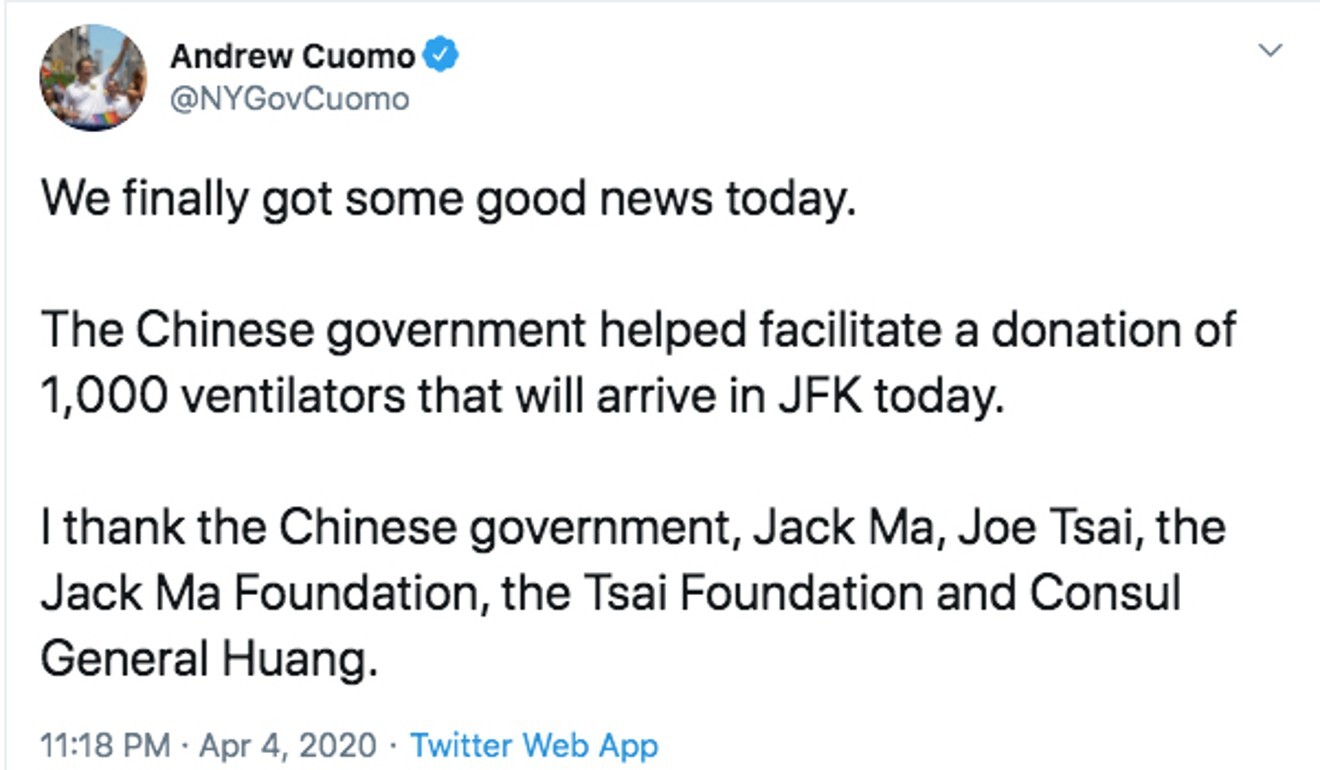
The philanthropic foundations of Jack Ma and Joe Tsai, two of China’s wealthiest technology entrepreneurs, have donated 23 million face masks, 2,000 ventilators and 170,000 pieces of protective gear to New York
The donation, the biggest by private citizens to the epicentre of the global coronavirus pandemic, was described by New York Governor Andrew Cuomo as ‘really good news’
A shipment of 1,000 ventilators donated by Jack Ma Foundation and Joe Tsai Foundation, has arrived in New York. Photo: Handout
Chinese philanthropists are stepping up their donation of protective gear, essential medical and diagnostic kits to the United States, Europe and Asian countries, despite rising acrimony between diplomats and government officials looking to pin blame amid the world’s worst pandemic in decades.
The private foundations of Jack Ma and Joe Tsai, co-founders of this newspaper’s owner Alibaba Group Holding and two of China’s wealthiest technology entrepreneurs, have donated a combined 23 million face masks, 2,000 medical ventilators and 170,000 pieces of protective gear to New York city.
The first 1,000 medical ventilators arrived today, with another 1,000 on the way, for a total donation valued at US$50 million, according to a person familiar with the matter.
Delivery of the essential materials, made possible by behind-the-scene manoeuvres by the donors and officials from both the Chinese and US sides due to import and export regulatory hurdles, highlights the role of civil diplomacy in dealing with the global public health crisis.
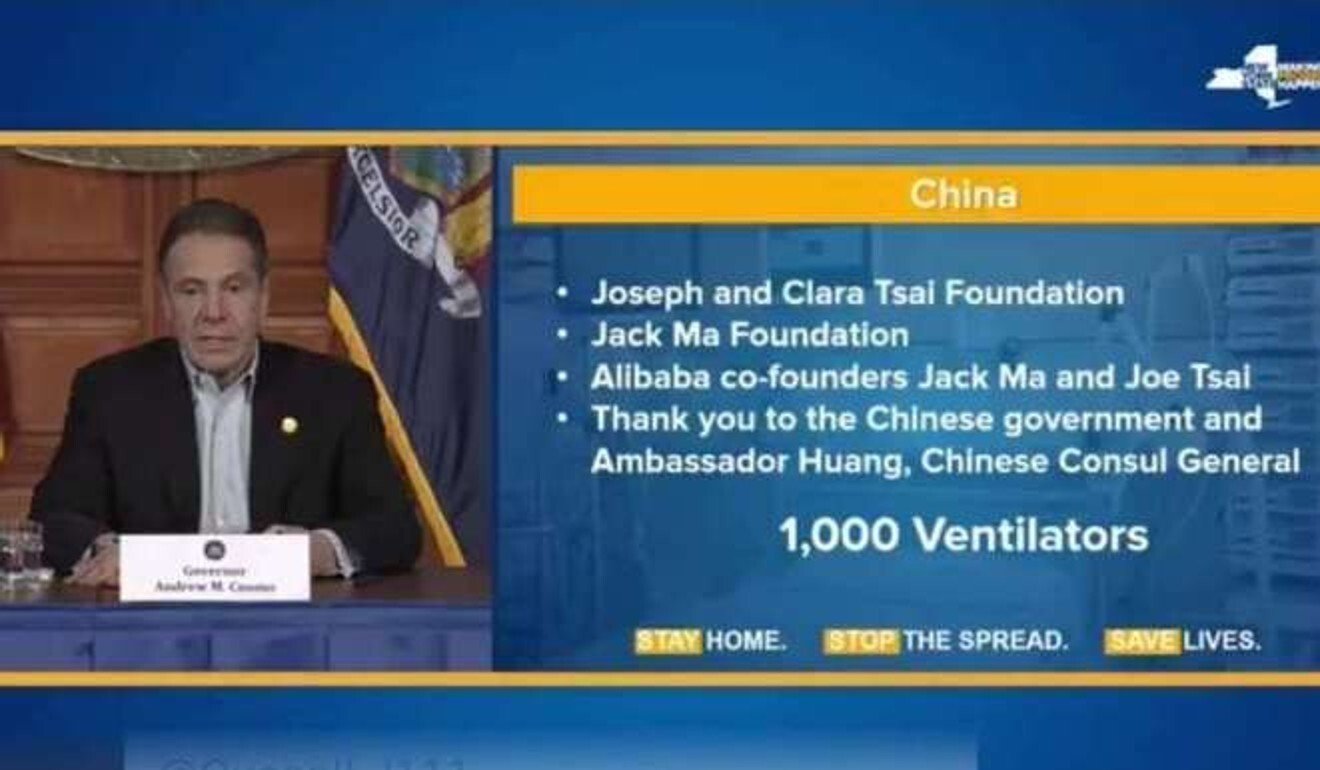
New York Governor Andrew Cuomo thanks the Chinese government for the 1,000 ventilators donated by Jack Ma Foundation and Joe Tsai Foundation, which arrived in New York on Saturday. Photo: Handout
The gesture comes as diplomats of both countries, and even government officials including the US president and his secretary of state, have engaged in a tit-for-tat war of words, as they attempt to pin the blame for the worlds worst pandemic in decades on each other.
Confirmed cases in the US have soared and surpassed China as the new global epicentre. In the US there are nearly 310,000 cases and nearly 8,500 people have died so far from the Covid-19 disease.
Jack Ma is a friend of mine and he’s made it very possible to get about 1,000 ventilators from China. But that was from him and my other friend [Tsai] that was really a gift – Andrew Cuomo, governor of New York
Andrew Cuomo, governor of New York, thanked the Chinese government for easing the transfer of the ventilators to the hard-hit state, the current epicentre of the coronavirus outbreak in the US.
He said the donations were “really good news”, as the state pushes up against the apex of the outbreak, which is likely to hit in about seven days.
“This is a big deal, and this is going to make a significant difference for us,” Governor Andrew Cuomo said on Saturday.
“Jack Ma is a friend of mine and he’s made it very possible to get about 1,000 ventilators from China. But that was from him and my other friend [Tsai] that was really a gift. And we appreciate it very much.”
One of the challenges in making the donation possible was the fact that the US had previously blocked China-made “KN95” standard masks, only allowing “3M N95” masks to be used. Although the two masks have different standards, they essentially have the same performance. On Friday, the US Food and Drugs Administration issued an emergency use authorisation for KN95 masks.
Alfred Wu, associate professor in Lee Kuan Yew School of Public Policy at National University of Singapore, said that what China is doing with its so-called masks diplomacy is very clear. “But given the emergency situation in New York, whatever channel – private or public sources – the equipment comes from, should not matter, especially those for medical workers,” he said.
Separately, the western state of Oregon has also said that it would send 140 ventilators to New York.
The state, like other areas of the US, is facing shortages of medical gear, including masks and ventilators.
“We are not yet at the apex. We are getting closer,” Cuomo said, adding that this was good as it gave the authorities more time to prepare.
A tweet from New York Governor Andrew Cuomo thanking the Chinese government for the 1,000 ventilators donated by Jack Ma Foundation and Joe Tsai Foundation. Photo: Twitter
Cuomo said 113,704 people in New York have tested positive for the coronavirus, with 15,000 having been hospitalised The state’s death toll saw a significant spike on Saturday to reach 3,565, up from 2,935 the previous day.
The White House has been criticised for not better coordinating the supply of medical goods to states, who are competing with each other on the open market.
NUS’ Wu said that tussle between the federal and state governments in the US on key decisions on acquiring medical supplies was not helping the fight against the pandemic. “Unlike in China, where the central government has the say over local governments, in the US, when it comes to public health provision, the power belongs to the state,” he said.
Meanwhile, Cuomo acknowledged that he asked the White House and others for help negotiating the ventilators.
Trump said he would like to hear a more resounding “thank you” from Cuomo for providing medical supplies and helping quickly to add hospital capacity.
KATHMANDU, March 29 (Xinhua) — The emergency epidemic prevention materials donated by the Chinese side arrived here on Sunday to help Nepal fight the COVID-19 pandemic.
The supplies that arrived at Tribhuvan International Airport in Nepali capital city Kathmandu in the wee hours of Sunday were formally handed over to the Nepali Health Minister Bhanu Bhakta Dhakal by the Chinese Ambassador to Nepal Hou Yanqi.
Dhakal welcomed the Chinese support and expressed gratitude to the northern neighbor for helping the Himalayan country overcome the epidemic.
“I would like to thank the Chinese people and the Chinese government for supporting Nepal in this difficult time to fight the COVID-19,” the minister said during the handover ceremony.
At a time when many countries are fighting against this battle, China keeping Nepal in the priority list and sending supplies immediately is really commendable, the minister expressed, adding that Nepal expects China’s support in the coming days as well.
The donations from China’s Sichuan Province and the Chinese Embassy include different kinds of masks, thermometers, Chloroquine phosphate tablets, protective clothing and portable ventilators weighing 1.1 tons.
Similarly, the donation from Alibaba Foundation, Jack Ma Foundation includes 100,200 N95 masks and 20,064 PCR test kits weighing 1.4 tons.
“We will try our best to send other necessary supplies as soon as possible. In case of any emergency, we can send a medical expert team or arrange a video conference meeting as well to help the health workers here,” the Chinese ambassador said.
She also welcomed the national lockdown enforced by the Nepal government, stating that it has received encouraging support from the general public.
Nepal is reportedly in dire need for medical supplies as the entire situation escalates in the country. Nepal, facing the shortage of test kits and personal protective equipment for health workers, has recorded five confirmed cases of the COVID-19 so far.
But there is a growing concern over a possible spike in the cases due to the relatively low number of tests. Nepal has enforced a week-long nationwide lockdown since March 24 to prevent the spread of infection.
The health ministry said that the received support materials will be distributed to federal and provincial levels hospitals immediately and will be useful for the prevention and management of the COVID-19 in Nepal.
Mahendra Shrestha, director general at the Department of Health Services under the Health Ministry, told Xinhua on Saturday, “The procured test kits from China will help us in the situation of spike in positive cases of the COVID-19.”
Throughout the world, overworked health care professionals are being infected with Covid-19, yet the Lion City has kept numbers low
Preparation, planning, patient ratios and protective equipment have all played a part. Still, even the best gear cannot guard against discrimination
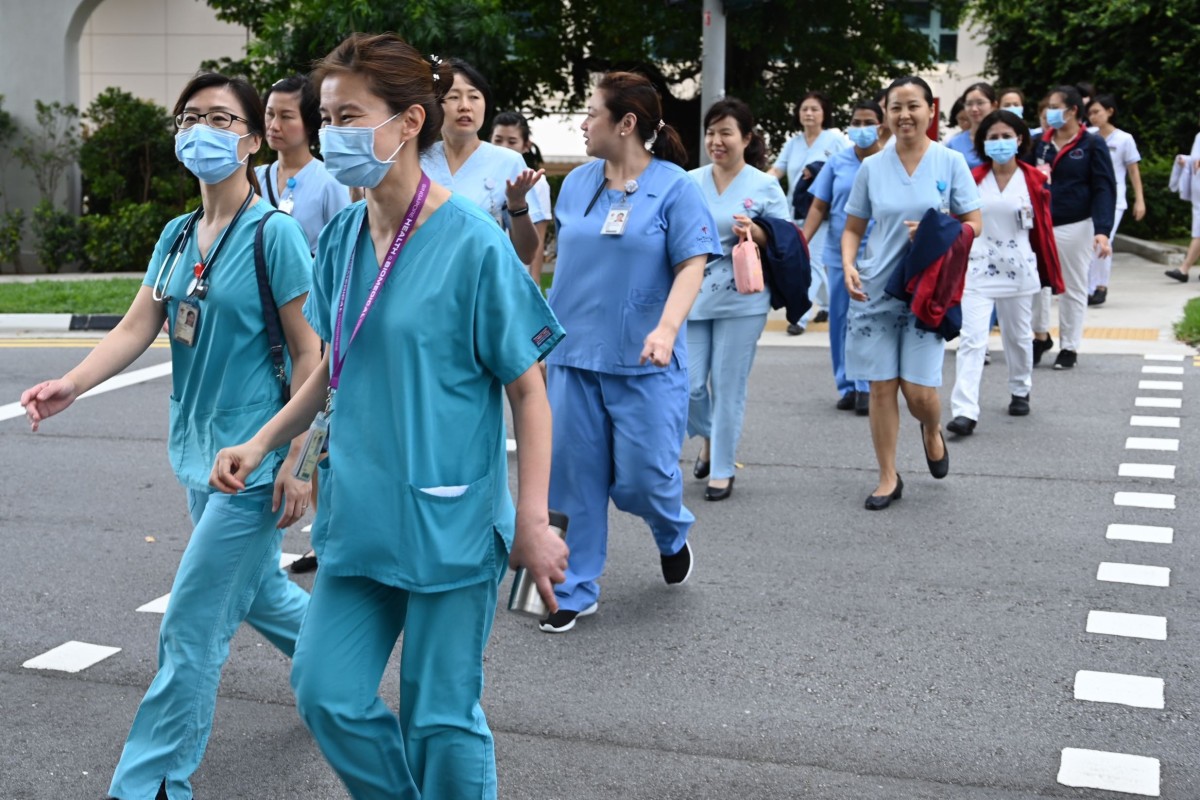
Medical staff walk to the National Centre for Infectious Diseases building at Tan Tock Seng Hospital in Singapore. Photo: AFP
Uncooperative patients, long hours and a lack of protective equipment are hampering health care workers across the world as they take the fight to the coronavirus, leading many to fall sick themselves.
In Malaysia, a pregnant woman who did not disclose that her father was infected tested positive after giving birth, leading to the shutdown of the entire hospital for cleaning. In the Philippines, nine doctors have died, two of whom had dealt with a patient who lied about her travel history.
In Spain, where more than 5,400 health care workers have been infected, accounting for about 14 per cent of the country’s patients, there are no longer enough workers to care for patients.
In Italy, which has more than 69,000 patients, the virus killed a doctor who had no choice but to work without gloves.
In the United States, which has surpassed China to become the world’s most infected nation with more than 83,000 people testing positive for Covid-19, hospitals are being overrun with patients.
Health care staff in the country say patients are packed into emergency wards and intensive care units (ICUs), further raising the risk of infections. They also report shortages of ventilators, face masks, gowns and shields.
The US Centres for Disease Control and Prevention on March 7 released interim guidelines saying health care workers exposed to the coronavirus could be asked to return to work as long as they wore face masks and were not showing symptoms, if their employers had no other manpower available.
Malaysian health workers at Kuala Lumpur International Airport. Photo: AFP
A REASON FOR OPTIMISM
However, amid all the gloom, Singapore’s experienceis being held up as a reason for optimism. The city state has reported more than 630 cases of infection, all of which are being treated in hospital, yet only a handful of its health care professionals have been infected. What’s more, even these cases, according to Vernon Lee, director of communicable diseases at the Ministry of Health, are thought to have been infected outside the health care setting.
Experts suggest this has been more than just luck, pointing to a case in which 41 health workers were exposed to the coronavirus in a Singapore hospital yet evaded infection.
The workers had all come within two metres of a middle-aged man with Covid-19 who was being intubated, a procedure which involves a tube being inserted into the patient’s trachea. The procedure is seen as being particularly hazardous for health workers as it is “aerosol generating” – patients are likely to cough.
The workers had not known at the time that the man had the virus and all were quarantined after he tested positive. However, on their release two weeks later, none of them had the virus.
Coronavirus: as Malaysia braces for third wave, doctors make their own face masks
27 Mar 2020
The case has come to widespread attention partly because the workers were wearing a mix of standard surgical masks and the N95 mask, which doctors see as the gold standard as it filters out 95 per cent of airborne particles.
The conclusion, published in The Annals of Internal Medicine this month, was this: “That none of the health care workers in this situation acquired infection suggests that surgical masks, hand hygiene, and other standard procedures protected them from being infected.”
Surgeon and writer Atul Gawande mentioned the case in an article for The New Yorker on how health care workers could continue seeing patients without becoming patients. He said there were things to learn from Asia and that some of the lessons came out of the “standard public health playbook”. In other words, there is much to be said for social distancing, basic hand hygiene and cleaning regimens.
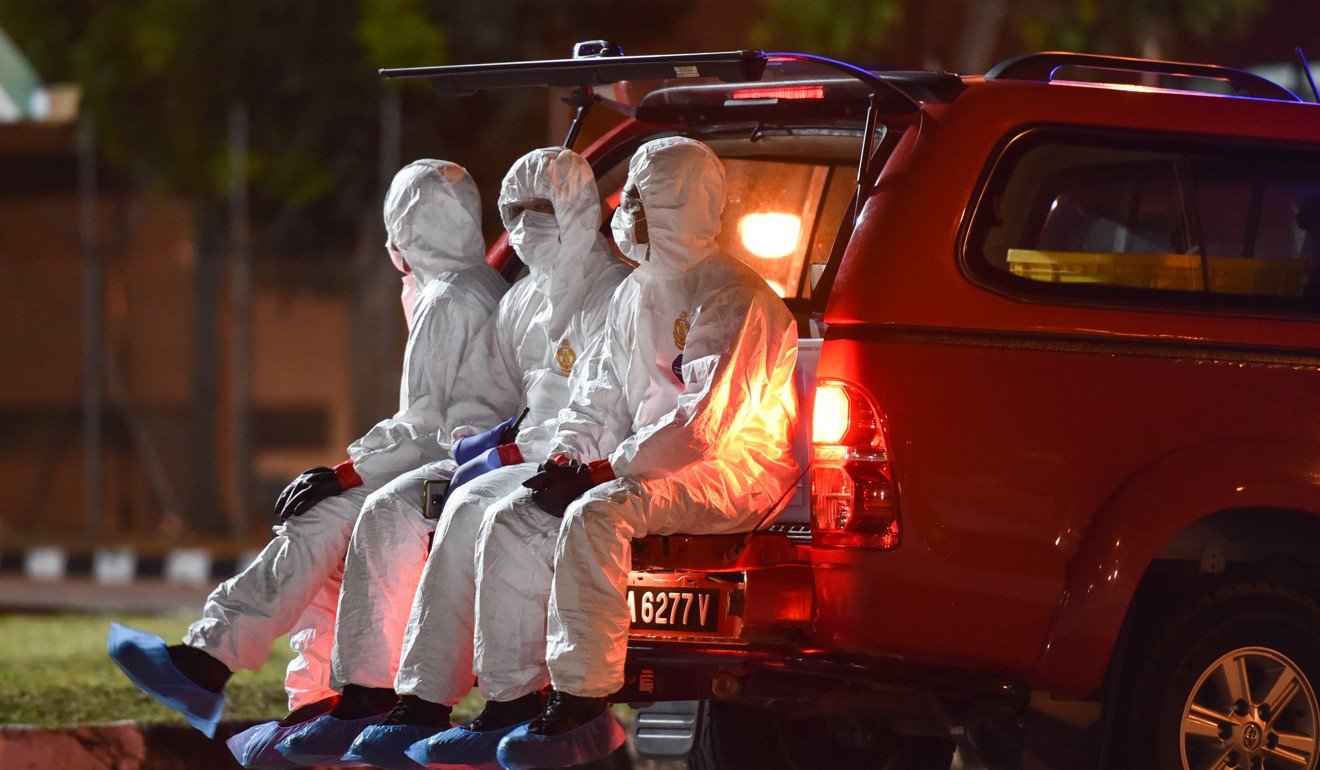
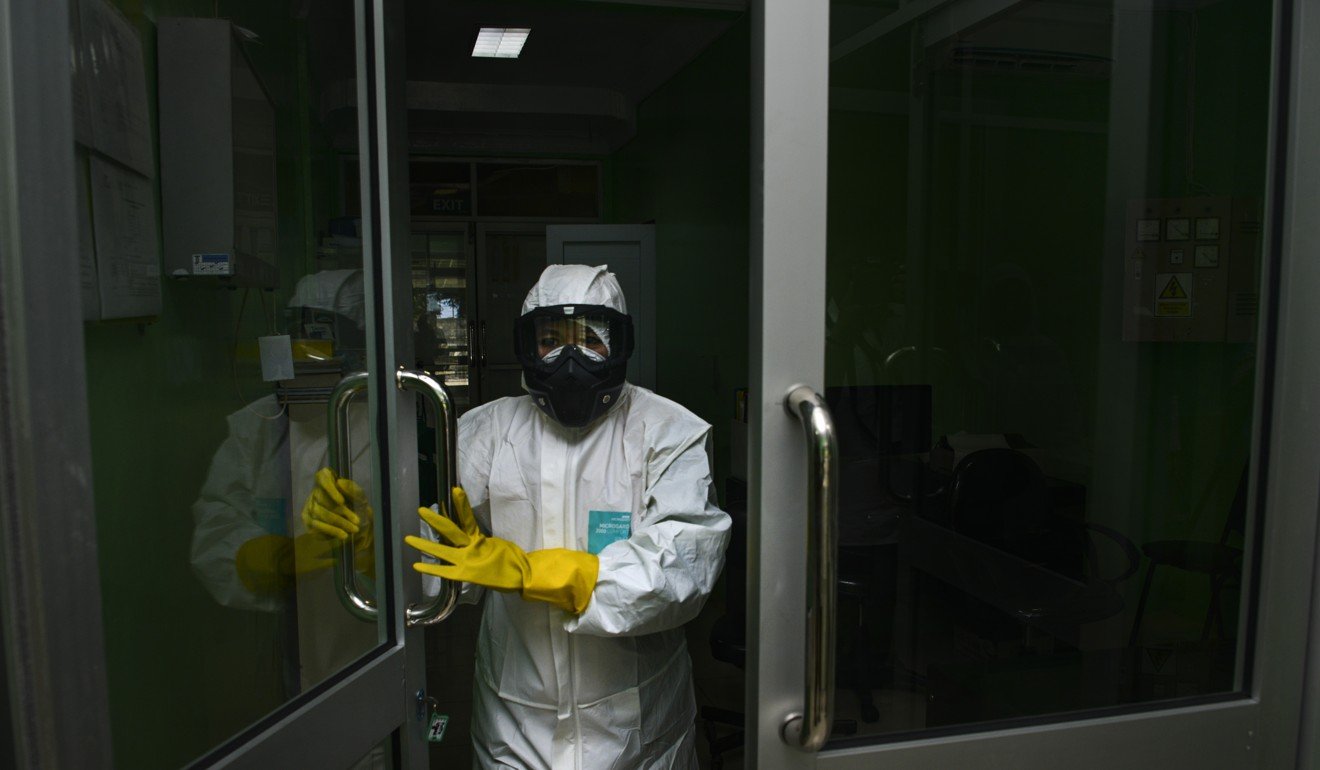
A health worker in protective gear walks into a quarantine room at a hospital in Banda Aceh, Indonesia. Photo: AFP
COMING TOGETHER
With critical supplies running short in many countries, experts say it is increasingly vital that countries share both knowledge and resources.
To this end, China has been donating personal protective equipment to places including the Philippines, Pakistan and Europe. China’s richest man Jack Ma is donating 1.8 million masks, 210,000 Covid-19 test kits and 36,000 pieces of protective clothing to 10 countries in Asia.
At the same time, doctors are encouraging the Western world to learn from Asia.
Infectious diseases expert Leong Hoe Nam said that being “bitten by Sars” (severe acute respiratory syndrome) in 2003 had prepared Asia for Covid-19, while Western countries were not similarly prepared and hence lacked sufficient protective equipment.
He pointed to how about 2,000 health care workers had fallen sick in China early in the outbreak because workers did not initially have protective gear. The trend reversed as equipment became available.
“Once the defences were up, there were very few health care workers who fell sick at work. Rather, they fell sick from contact with sick individuals outside the workplace,” he said.
Malaysia is a case in point. While it has reported 80 health care workers falling ill, most are thought to be community infections.
Coronavirus: Doctor explains the proper way to wash your hands and put on a face mask
In a webinar organised by Caixin Global on Thursday night, Peng Zhiyong, an intensive care specialist at Zhongnan Hospital of Wuhan University, shared how they managed a shortage of personal protective equipment early on in the outbreak by rationing workers to two sets of gear per shift.
Meanwhile, in the Philippines, doctors from Manila’s Chinese General Hospital held a video conference call with doctors in Zhejiang to learn from China’s experience of treating Covid-19 patients.
Crowdsourcing platforms have also been created to share advice. The Brigham and Women’s Hospital in Boston has released guidelines for treating critically ill patients and its website includes information from Chinese doctors.
Why Singapore’s coronavirus response worked – and what we can all learn
27 Mar 2020
The Jack Ma Foundation has also launched an online platform for doctors and nurses around the world to share knowledge on fighting the virus. “One world, one fight,” it said in a tweet.
Associate Professor Jeremy Lim from the global health programme at the Saw Swee Hock School of Public Health said it was crucial for countries to work together.
“Viruses don’t respect borders. Countries have to share information and help each other as we are only as strong as the weakest link. Any country can become a reservoir of disease and the world may then be forced to endure a ping-pong of outbreaks over and over again.”
And the advice of Lee, at Singapore’s Ministry of Health? “Practise good hygiene and wash hands regularly.”
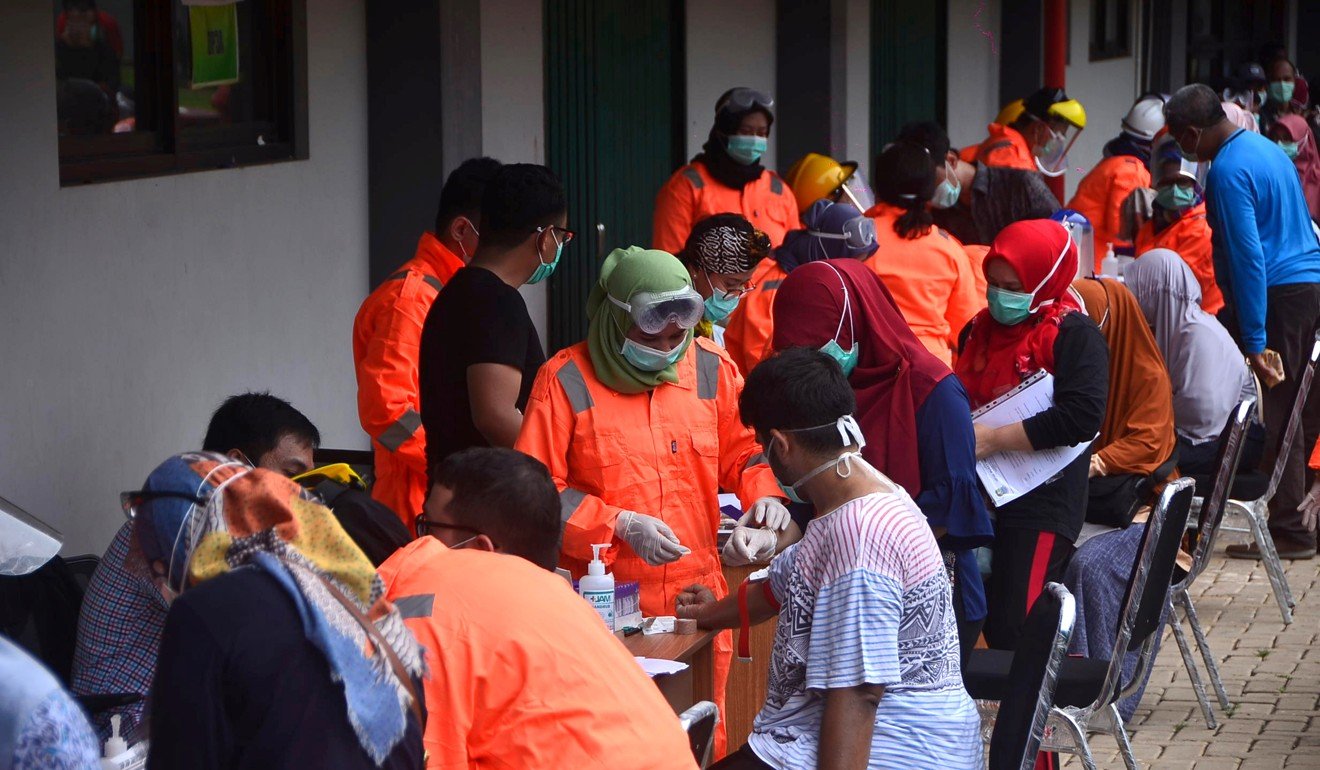
Indonesian medical staff administer mass testing for Covid-19 in Bekasi, West Java. Photo: AFP
SINGAPORE, A CASE STUDY
Amid this sharing of advice, it is often Singapore that is held up as an example to replicate. Despite the country grappling with a rising load of Covid-19 patients, most of whom have recently returned to the city state from abroad, its health care system has continued to run smoothly. Doctors say this is because it has been preparing for a pandemic ever since Sars caught it by surprise. During the Sars outbreak, health care workers accounted for 41 per cent of Singapore’s 238 infections.
Consequently its hospitals swung into contingency planning mode early on in the coronavirus outbreak, telling staff to defer leave and travel plans after its first cases emerged.
Meanwhile, its hospitals swiftly split their workforces into teams to ensure there were enough workers if the outbreak worsened, and to ensure workers got enough rest.
Singapore has 13,766 doctors, or 2.4 doctors for every 1,000 people. That compares to 2.59 in the US, 1.78 in China and 4.2 in Germany. Places like Myanmar and Thailand have fewer than one doctor for every 1,000 people.
Coronavirus: Covid-19 could live on in Indonesia long after world recovers
22 Mar 2020
“The objective is that you can run essential services with the greatest amount of security. Make sure functional units have redundancy built in, and are separate from each other. It depends on what you feel is sufficient to carry on services if one team is affected, factoring in rest periods and some system of rotation,” said Chia Shi-Lu, an orthopaedic surgeon.
The key is to ensure a good doctor-to-patient ratio and ensure there are enough specialists for the critical work, such as doctors and nurses who can provide intensive care, and know how to operate mechanical ventilators or machines to pump and oxygenate a patient’s blood outside the body.
At the emergency department where paediatrics emergency specialist Jade Kua treats Covid-19 cases in addition to regular emergencies, doctors are split into four teams of 21. Each team takes alternate 12-hour shifts and does not interact with other teams.
“We are in modular teams so the teams move together. So you and I would both do morning, off, night, off, morning off. Together. And then the other teams would do the same and we don’t intermingle,” said Kua.
US now has world’s most coronavirus cases, surpassing China
Chia, who works at the Singapore General Hospital, said doctors had been split up according to their functions.
“We try not to meet at all with the other teams as much as possible. We’ll just say hi from across the corridor. Meals are the same. All our cafeterias and everything have got social distancing spaced in already,” said Chia, who is also a member of parliament and chairs a shadow committee on health.
Chia said the health care system could also tap on doctors in the private sector.
Not every country has a plan like this. Last year’s Global Health Security Index by the Economist Intelligence Unit found that 70 per cent of 195 countries scored poorly when it came to having a national plan for dealing with epidemics or pandemics. Almost three in 10 had failed to identify which areas were insufficiently staffed. In India, with a population of 1.3 billion, only about 20,000 doctors are trained in key areas such as critical care, emergency medicine and pulmonology.
Singapore, Hong Kong, Taiwan: the real coronavirus world leaders
19 Mar 2020
In contrast, Singapore published its first Influenza Pandemic Preparedness and Response Plan in June 2005 and has since honed it to a tee. Hospitals regularly war-game scenarios such as pandemics or terrorist attacks and the simulations are sometimes observed by the Ministry of Health, which grades the performance and recommends areas for improvement.
The plan also covers the need to stockpile equipment to avoid the sort of shortages many countries are now facing, another lesson inspired by Sars when masks, gloves and gowns were in short supply.
In a pandemic preparation paper published in 2008, Singapore public health specialist Jeffery Cutter wrote that Singapore’s stockpile was sufficient to cover at least 5 to 6 months’ use by all front-line health care workers.
During the Covid-19 outbreak, it has also told citizens to not wear masks so it can conserve supply for medical staff.
Having enough protective gear has reassured Singapore’s health care workers such as Kua, a mother of six who blogged about her experience fighting Covid-19. Kua said: “I’m safe and my family is safe.”
India’s poor hit hard by 21-day nationwide lockdown amid the coronavirus pandemic
SOMETHING YOU CAN’T GUARD AGAINST
Despite the many positives to emerge from the Lion City, its health care workers are struggling with another problem: discrimination.
While in France, Italy and Britain, residents cheer health care workers from their windows, in Singapore health care workers are seen by some people as disease carriers.
“I try not to wear my uniform home because you never know what kind of incidents you may encounter,” said one Singapore nurse. “The public is scared and wearing our uniforms actually causes quite a bit of inconvenience. One of my staff tried to book a private-hire car to the hospital for an emergency and she was rejected by five drivers.”
There is a similar stigma in India, where the All India Institute of Medical Sciences has appealed to the government for help after health workers were forced out of their homes by panicked landlords and housing societies.
“Many doctors are stranded on the roads with all their luggage, nowhere to go, across the country,” the institute said in a letter.
Lim, from the Saw Swee Hock School of Public Health, said the worst human impulses and “every man for himself” attitudes could emerge in crises and “that is exactly why governments have to step in”.
Discrimination could affect both the performance and motivation of health care workers, Lim warned.
Meanwhile, when health care workers are infected, it creates a “triple whammy” threat.
“It means one fewer professional in an already-strained system, another patient to care for and, potentially, a team of colleagues who need to be quarantined,” said Lim.
“We must do everything possible to keep our health care workforce safe and free from Covid-19.” ■
Alibaba co-founder Jack Ma has sent the first shipment of surgical masks and coronavirus test kits to the US.
The Chinese billionaire tweeted two pictures of the pallets of goods being loaded on to a plane in Shanghai.
Earlier this month he said he would give 500,000 testing kits and one million masks to America.
Mr Ma is also sending consignments of medical supplies to Europe as he called for international cooperation efforts to combat the pandemic.
In his first tweet, Asia’s richest person posted photos of a China Eastern Airlines jet being loaded with boxes of coronavirus test kits and face masks as they were shipped to the US.
It comes after the Jack Ma Foundation and the Alibaba Foundation last week announced that they had prepared 500,000 testing kits and 1 million masks to be sent to America.
They also said that they had already donated supplies to other countries including Japan, South Korea, Italy, Iran and Spain, with two million protective masks pledged for distribution across Europe.
The first consignment of 500,000 masks and other medical supplies such as test kits, which was destined for Italy, arrived in Belgium on Friday.
He joins other high-profile technology executives in pledging support for coronavirus research and disease prevention.
Microsoft co-founder Bill Gates, who is the world’s second-richest person, has announced that the Bill and Melinda Gates Foundation would give $100m to help efforts to stop the spread of the virus.
On Friday Mr Gates announced that he was stepping down from Microsoft’s board to spend more time on philanthropic activities. He said he wanted to focus on global health and development, education and tackling climate change.
Chinese tech giants, including Tencent, ride-hailing company Didi Chuxing, and TikTok owner ByteDance, have all pledged money and resources to fight the coronavirus outbreak.


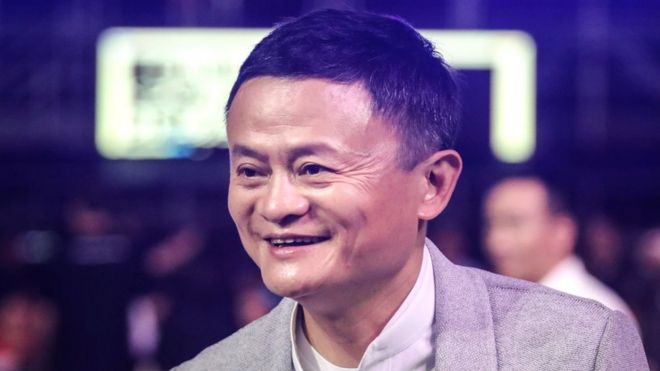 Image copyright GETTY IMAGES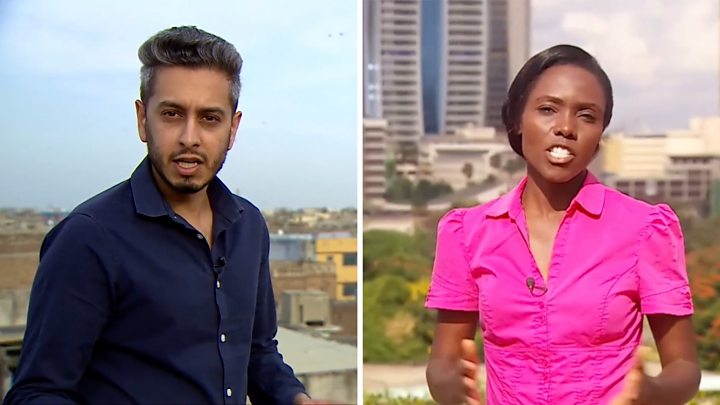
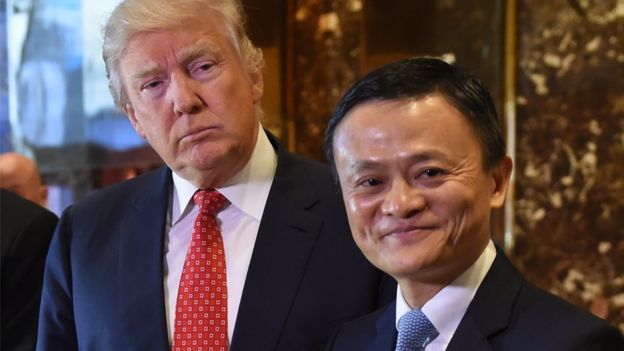 Image copyright GETTY IMAGES

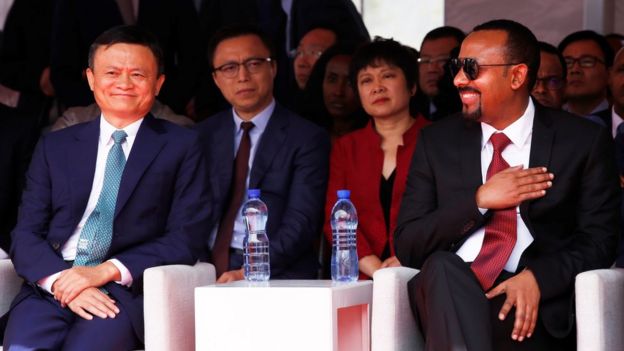 Image copyright GETTY IMAGES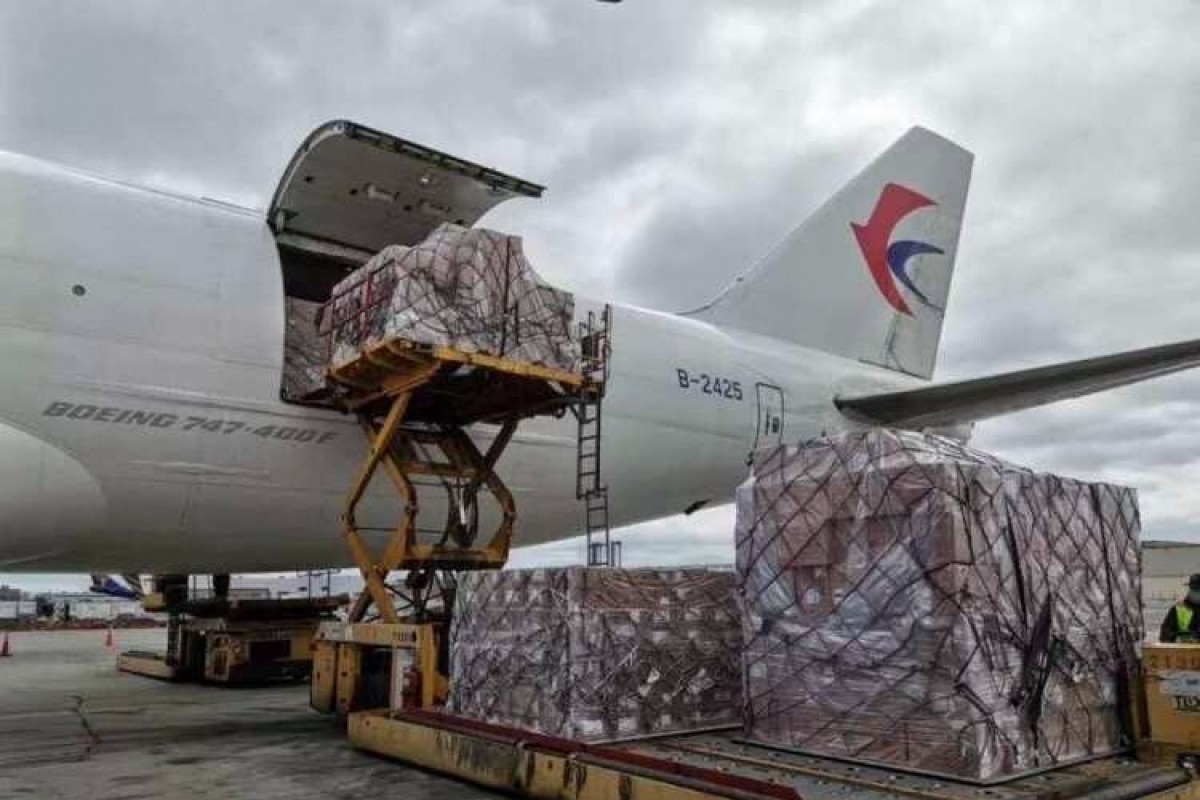



 CHINDIA ALERT: You'll be living in their world, very soon