Chindia Alert: You’ll be Living in their World Very Soon
aims to alert you to the threats and opportunities that China and India present. China and India require serious attention; case of ‘hidden dragon and crouching tiger’.
Without this attention, governments, businesses and, indeed, individuals may find themselves at a great disadvantage sooner rather than later.
The POSTs (front webpages) are mainly 'cuttings' from reliable sources, updated continuously.
The PAGEs (see Tabs, above) attempt to make the information more meaningful by putting some structure to the information we have researched and assembled since 2006.
Image copyright GETTY IMAGESImage caption An empty stretch of the road and Delhi Police barricades to screen commuters during lockdown, at Delhi Gate on April 16, 2020 in New Delhi, India.
India has eased some restrictions imposed as part of a nationwide lockdown to curb the spread of the coronavirus.
Most of the new measures are targeted at easing pressure on farming, which employs more than half the nation’s workforce.
Allowing farms to operate again has been seen as essential to avoid food shortages.
But some other measures announced last week, will not be implemented.
This includes the delivery of non-essential items such as mobile phones, computers, and refrigerators by e-commerce firms – the government reversed its decision on that on Sunday.
And none of the restrictions will be lifted in areas that are still considered “hotspots” for the virus – this includes all major Indian cities.
Domestic and international flights and inter-state travel will also remain suspended.
So what restrictions are being eased?
Most of the new measures target agricultural businesses – farming, fisheries and plantations. This will allow crops to be harvested and daily-wagers and others working in these sectors to continue earning.
To restore the supply chain in these industries, cargo trucks will also be allowed to operate across state borders to transport produce from villages to the cities.
Essential public works programmes – such as building roads and water lines in rural areas – will also reopen, but under strict instructions to follow social distancing norms. These are a huge source of employment for hundreds of thousands of daily-wage earners, and farmers looking to supplement their income.
Banks, ATMs, hospitals, clinics, pharmacies and government offices will remain open. And the self-employed – such as plumbers, electricians and carpenters – will also be allowed to work.
Some public and even private workplaces have been permitted to open in areas that are not considered hotspots.
But all businesses and services that reopen are expected to follow social distancing norms.
Who decides what to reopen?
State governments will decide where restrictions can be eased. And several state chief ministers, including Delhi’s Arvind Kejriwal, have said that none of the restrictions will be lifted in their regions.
Mr Kejriwal said the situation in the national capital was still serious and the decision would be reviewed after one week.
India’s most populous state, Uttar Pradesh, will also see all restrictions in place, as will the southern states of Andhra Pradesh, Telangana and Karnataka.
The southern state of Kerala, which has been widely acknowledged for its success in dealing with the virus, has announced a significant easing of the lockdown in areas that it has demarcated as “green” zones.
This includes allowing private vehicular movement and dine-in services at restaurants, with social distancing norms in place. However, it’s implementing what is known as an “odd-even” scheme – private cars with even and odd number plates will be allowed only on alternate days, to limit the number of people on the road.
At least 19 people have been killed in a freak accident in southern India, after a container slipped off a truck and rammed into a passenger bus.
Police are investigating the incident, but officials say the container came off its hinges after one of the wheels of the truck had a puncture.
“There were about 48 people in the bus, and several are in a critical condition,” an official told BBC Hindi.
The incident occurred around 3:30am local time (21:50 GMT), police said.
The bus was on a highway when the container slipped off the truck, which was in the opposite lane. It then rolled onto the other side, colliding with the bus.
The Volvo bus, owned by the Kerala state transport corporation, was travelling from Bangalore city in the neighbouring state of Karnataka to Ernakulam in Kerala.
The district collector, Dr Vijay Karthikeyan, told BBC Hindi that the cause of the accident was still being investigated.
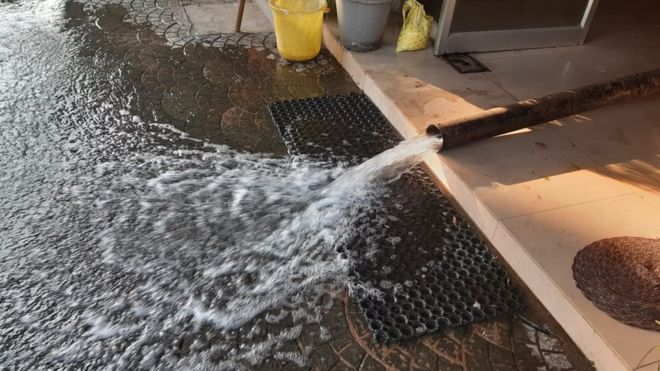
Image copyright JOSHY MALIYEKKALImage caption Drinking water reeking of alcohol started flowing out of the apartment taps
Residents of an apartment building in southern India were left in shock after a mix of beer, brandy and rum started gushing out of their taps.
The smelly, brown liquid began flowing from kitchen taps in the block of flats, in Kerala, on Monday morning.
Bemused residents then contacted the authorities for help, and discovered their water well had been contaminated by officials – albeit accidentally.
It emerged 6,000 litres of confiscated alcohol had been buried nearby.
The alcohol, which officials had placed in a pit after it was seized on court orders, had seeped through the soil and into a well – the same well which supplied the residents of the 18 flats in Thrissur district with drinking water.
“We were so shocked,” Joshy Malyiekkal, owner of the apartment complex, told BBC Hindi’s Imran Qureshi.
Luckily, the strong smell put people off consuming the water. However, the discovery meant there was not only no drinking water for the families, but they were also unable to wash.
“The children couldn’t go to school and even their parents couldn’t go to work,” Mr Malyiekkal said.
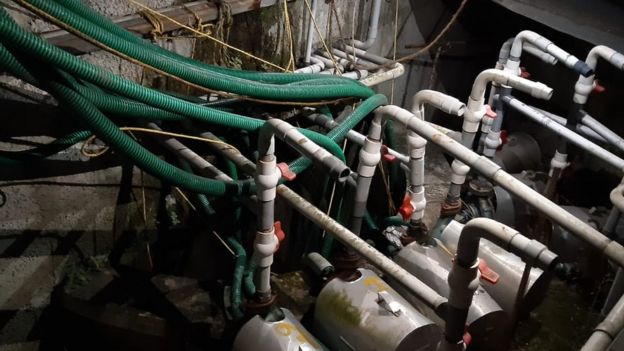
Image copyright JOSHY MALIYEKKALImage caption The contaminated water from the well being pumped out
After residents complained, officials acted to rectify the mistake.
But the process of pumping the well clean is likely to take a month, according to residents, leaving them reliant on deliveries from authorities.
“They’ve been supplying about 5,000 litres of water daily but it is not enough to cover all the families in our building,” Mr Malyiekkal said, pointing out the well was their main source of water.
Officials from the department did not respond to questions from the BBC.
The state of Kerala has the highest consumption of alcohol in the country.
The new coronavirus has been declared a global emergency by the World Health Organization, as the outbreak continues to spread outside China.
“The main reason for this declaration is not what is happening in China but what is happening in other countries,” said WHO chief Tedros Adhanom Ghebreyesus.
The concern is that it could spread to countries with weaker health systems.
Meanwhile, the US has told its citizens not to travel to China.
The state department issued a level four warning – having previously urged Americans to “reconsider” travel to China – and said any citizens in China “should consider departing using commercial means”.
China has said it will send charter plans to bring back Hubei province residents who are overseas “as soon as possible”.
A foreign ministry spokesman said this was because of the “practical difficulties” Chinese citizens have faced abroad. Hubei is where the virus emerged.
At least 213 people in the China have died from the virus, mostly in Hubei, with almost 10,000 cases nationally.
The WHO said there had been 98 cases in 18 other countries, but no deaths.
Most international cases are in people who had been to Wuhan in Hubei.
However in eight cases – in Germany, Japan, Vietnam and the United States – patients were infected by people who had travelled to China.
Getty Coronavirus outbreak outside China
18 The number of countries with cases
14 Cases in Thailand and Japan
13 Singapore
11 South Korea
8 Australia and Malaysia
5 France and USA
Source: WHO and local authorities
Speaking at a news conference in Geneva, Dr Tedros described the virus as an “unprecedented outbreak” that has been met with an “unprecedented response”.
He praised the “extraordinary measures” Chinese authorities had taken, and said there was no reason to limit trade or travel to China.
The US Commerce Secretary, Wilbur Ross, has said the outbreak could “accelerate the return of jobs to North America”.
Preparing other countries
What happens if this virus finds its way into a country that cannot cope?
Many low- and middle-income countries simply lack the tools to spot or contain it. The fear is it could spread uncontrollably and that it may go unnoticed for some time.
Remember this is a disease which emerged only last month – and yet there are already almost 10,000 confirmed cases in China.
The 2014 Ebola outbreak in West Africa – the largest in human history – showed how easily poorer countries can be overwhelmed by such outbreaks.
And if novel coronavirus gets a significant foothold in such places, then it would be incredibly difficult to contain.
We are not at that stage yet – 99% of cases are in China and the WHO is convinced the country can control the outbreak there.
But declaring a global emergency allows the WHO to support lower- and middle-income countries to strengthen their disease surveillance – and prepare them for cases.
How unusual is this declaration?
The WHO declares a Public Health Emergency of International Concern when there is “an extraordinary event which is determined… to constitute a public health risk to other states through the international spread of disease”.
It has previously declared five global public health emergencies:
Swine flu, 2009 – The H1N1 virus spread across the world in 2009, with death toll estimates ranging from 123,000 to 575,400
Polio, 2014 – Although closer than ever to eradication in 2012, polio numbers rose in 2013
Zika, 2016 – The WHO declared Zika a public health emergency in 2016 after the disease spread rapidly through the Americas
Ebola, 2014 and 2019 – The first emergency over the virus lasted from August 2014 to March 2016 as almost 30,000 people were infected and more than 11,000 died in West Africa. A second emergency was declared last year as an outbreak spread in DR Congo
Media caption Inside the US laboratory developing a coronavirus vaccine
How is China handling the outbreak?
A confirmed case in Tibet means the virus has reached every region in mainland China. According to the country’s National Health Commission, 9,692 cases have tested positive.
The central province of Hubei, where nearly all deaths have occurred, is in a state of lockdown. The province of 60 million people is home to Wuhan, the heart of the outbreak.
The city has effectively been sealed off and China has put numerous transport restrictions in place to curb the spread of the virus.
People who have been in Hubei are also being told to work from home until it is considered safe for them to return.
The virus is affecting China’s economy, the world’s second-largest, with a growing number of countries advising their citizens to avoid all non-essential travel to the country.
How is the world responding?
Voluntary evacuations of hundreds of foreign nationals from Wuhan are under way.
The UK, Australia, South Korea, Singapore and New Zealand are expected to quarantine all evacuees for two weeks to monitor them for symptoms and avoid contagion.
Australia plans to quarantine its evacuees on Christmas Island, 2,000km (1,200 miles) from the mainland in a detention centre that has been used to house asylum seekers.
In other recent developments:
Italy suspended flights to China after two Chinese tourists in Rome were diagnosed with the virus; earlier 6,000 people on board a cruise ship were temporarily barred from disembarking
In the US, Chicago health officials have reported the first US case of human-to-human transmission. Around 200 US citizens have been flown out of Wuhan and are being isolated at a Californian military base for at least 72 hours
Russia has decided to close its 4,300km (2,670-mile) far-eastern border with China
Two flights to Japan have already landed in Tokyo. Japan has now raised its infectious disease advisory level for China
Some 250 French nationals have been evacuated from Wuhan
India has confirmed its first case of the virus – a student in the southern state of Kerala who was studying in Wuhan
Israel has barred all flight connections with China
Papua New Guinea has banned all visitors from “Asian ports”
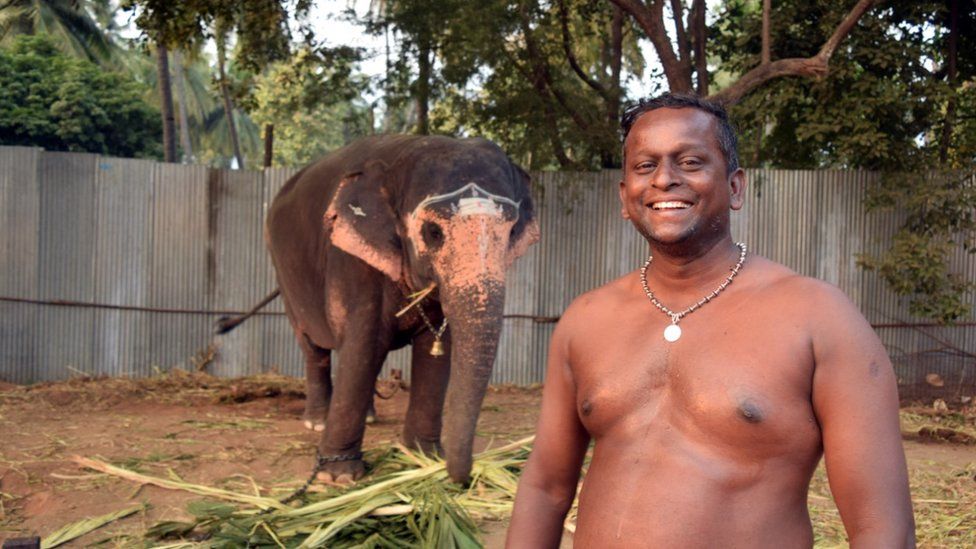
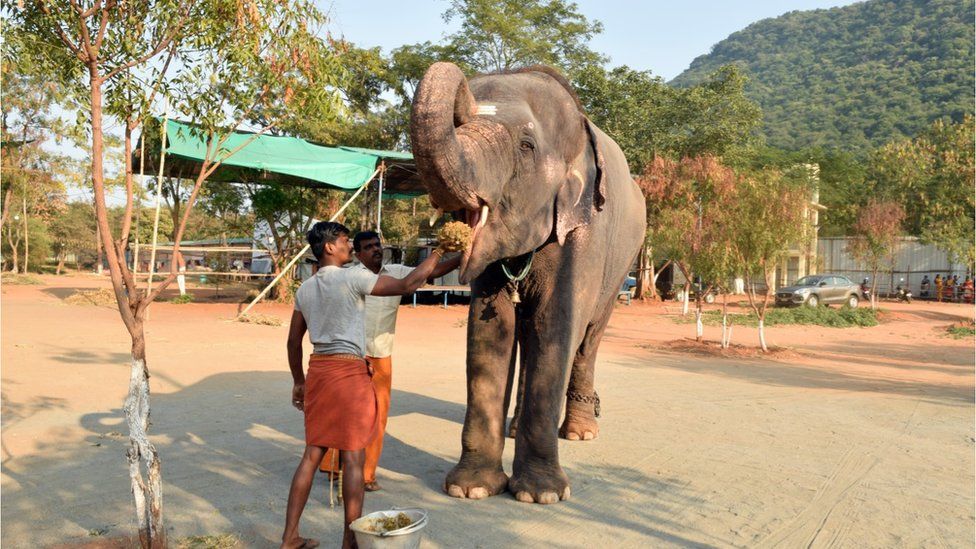
Image caption Arjun, the caretaker, pictured above with temple elephant, Akila
Once a year, some of India’s captive elephants are whisked off to a “rejuvenation camp”, where they are pampered and cared for by their caretakers. Omkar Khandekar visited one such retreat in the southern state of Tamil Nadu.
After seven years of being a local celebrity, Akila the elephant knows how to pose for a selfie. She looks at the camera, raises her trunk and holds still when the flash goes off.
It can get tiring, especially when there are hundreds of requests every day.
Despite this, Akila, performs her daily duties diligently at the Jambukeswarar temple. These include blessing devotees, fetching water for rituals in which idols of the deity are bathed, and leading temple processions around the city, decked up in ceremonial finery.
And, of course, the selfies.
But every December, she gets to take a break.
“When the truck rolls in, I don’t even have to ask her to hop in,” Akila’s caretaker B Arjun said. “Soon, she will be with her friends.”
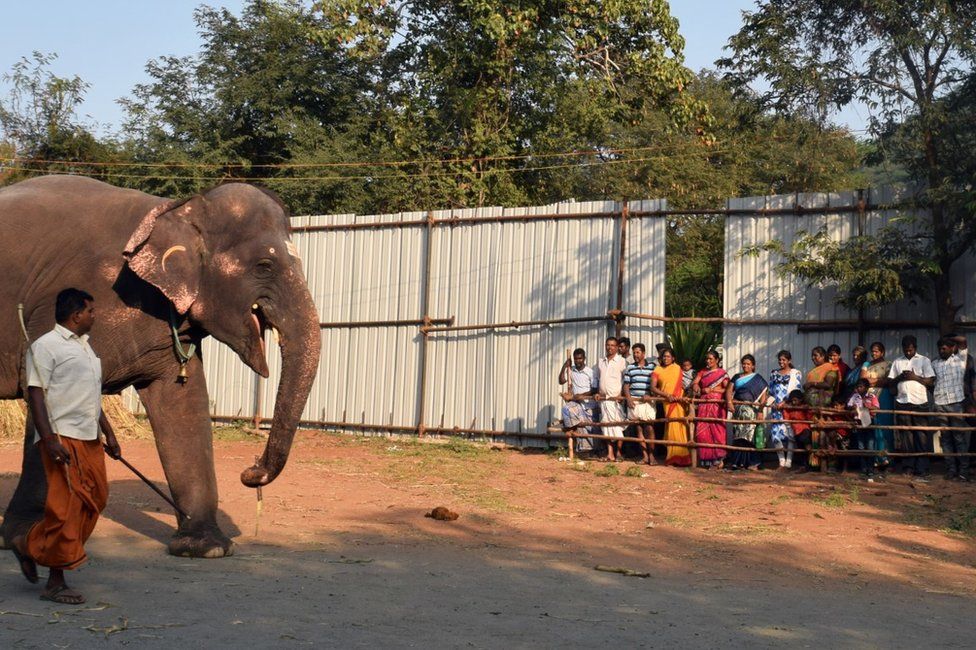
Image caption Elephants sold to temples in Tamil Nadu are brought to this camp every year
India is home to some 27,000 wild elephants. A further 2,500 elephants are held in captivity across the states of Assam, Kerala, Rajasthan and Tamil Nadu.
The country is widely believed to be the “birthplace of taming elephants for use by humans”. Elephants here have been held in captive by Indians for millennia. But 17 years ago, after protests by animal rights activists over instances of handlers abusing and starving captive elephants, the government stepped in to give the animals a bit of respite.
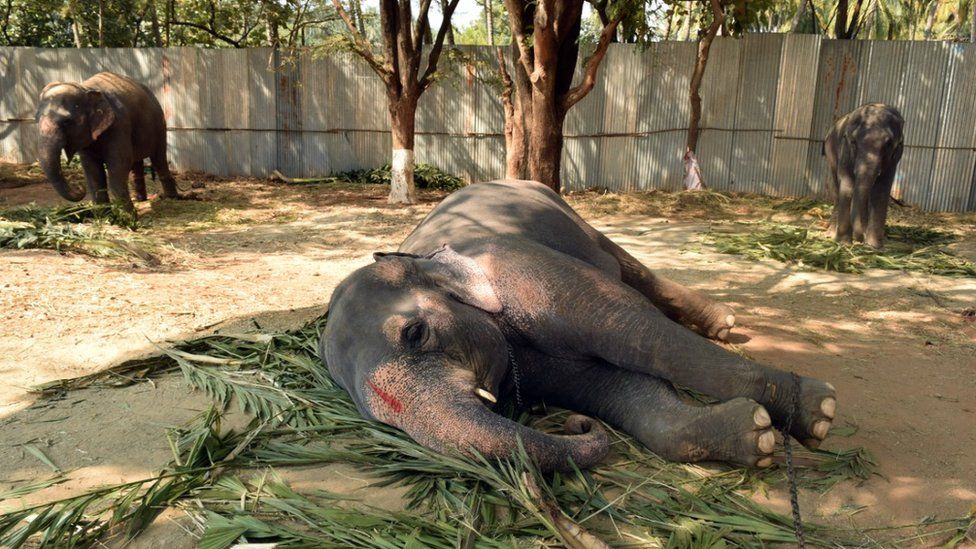
As a result, Akila and numerous other elephants held in temples around India are now brought to a “rejuvenation camp” each year, their caretakers in tow. For several weeks, the animals unwind in a sprawling six-acre clearing in a forest at the foothills of Nilgiris, part of the country’s Western Ghats.
Image caption India has more than 2,000 captive elephants
The camps were described as an animal welfare initiative and have become a popular annual event for the state’s temple elephants.
The one Akila and 27 other elephants are attending currently opened on 15 December last year, and will go on until 31 January, costing about $200,000 (£153,960) to run.
Supporters argue it is money well spent. A break from the city for these elephants is therapeutic, explains S Selvaraj, a forest officer in the area.
“Wild elephants live in herds of up to 35 members but there’s only one elephant in a temple,” he says. “For 48 days here, they get to be around their own kind and have a normal life.”
Image caption It costs about $200,000 to run the six-week annual camp
Akila, who is 16 years old, has been a regular at the camp since 2012, the year she was sold to the temple. Arjun, who has accompanied her every year, is a fourth-generation elephant caretaker.
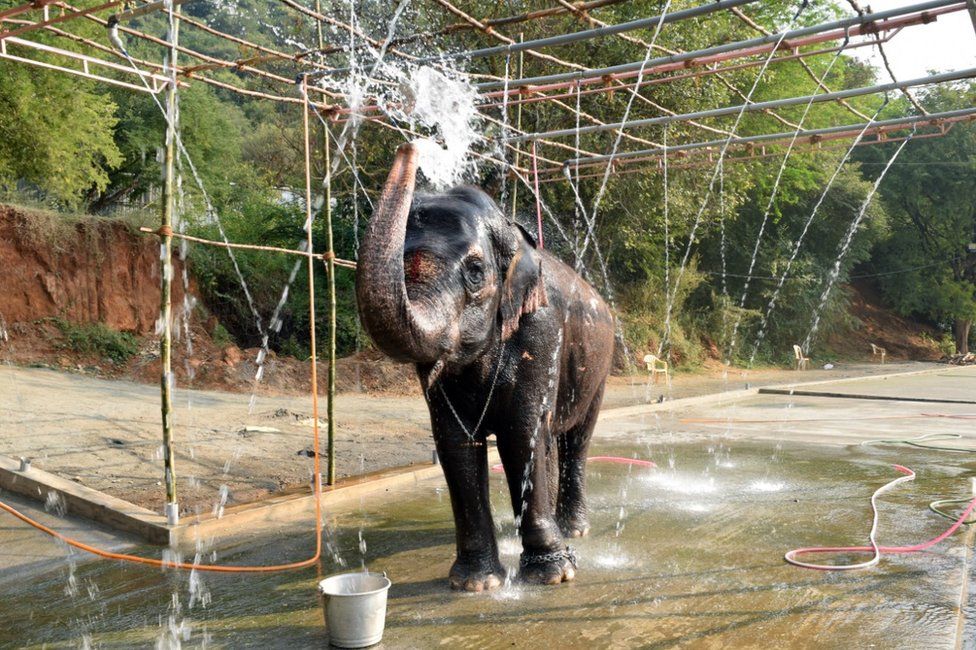
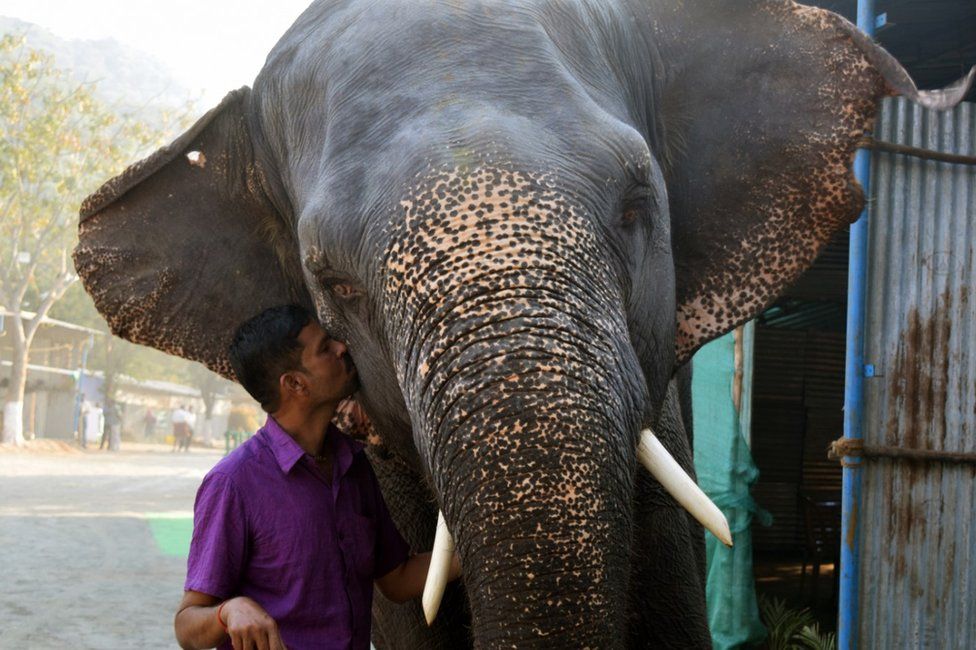
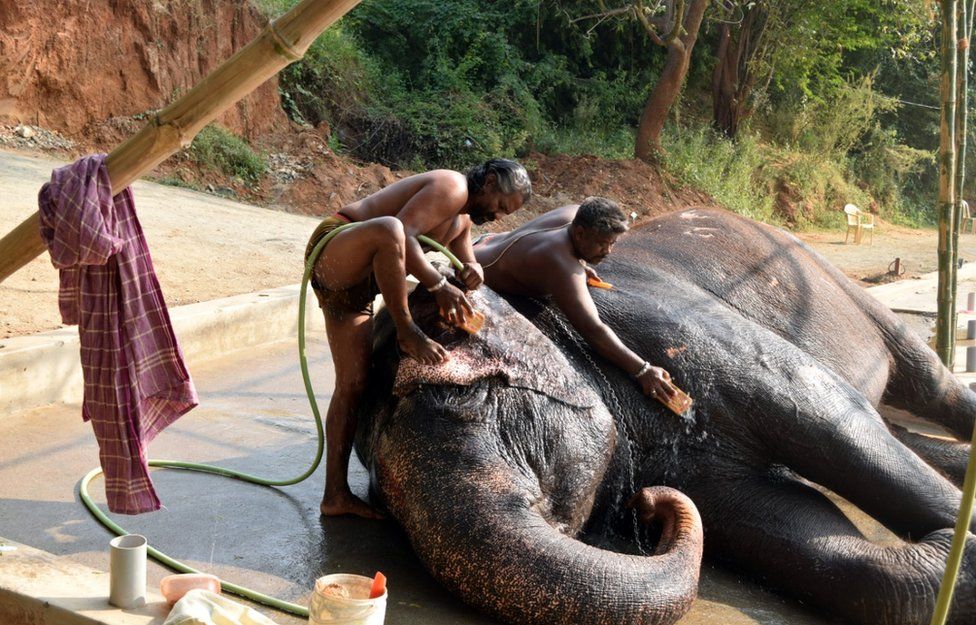
At the camp, he bathes Akila twice a day, feeds her a special mix of grains, fruits and vegetables mixed with vitamin supplements and takes her for a walk around the grounds. A team of vets are on hand to monitor the health of the camp’s large guests, while at the same time tutoring their handlers in subjects like elephant diet and exercise regimes.
Akila has even forged a friendship with Andal, an older elephant from another temple in the state, said Arjun.
But despite the shady trees and quiet, the getaway is a far cry from an elephant’s “normal life”.
Image caption The government initiated such camps after protests over instances of handlers abusing captive elephants
The walled campus has eight watchtowers and a 1.5km (0.93 miles) electric fence around its perimeter. While the elephants appear well cared for, they spend most of their time in chains and are kept under the close eye of their caretakers.
And one six-week rejuvenation camp a year does little to assuage the stress of temple elephants’ everyday lives, activists say.
“Elephants belong in jungles, not temples. A six-week ‘rejuvenation camp’ is like being let out on parole while being sentenced for life imprisonment,” argues Sunish Subramanian, of the Plant and Animals Welfare Society in the western city of Mumbai.
“Even at these camps, the animals are kept in chains and often in unhygienic conditions,” he adds. “If you must continue with the tradition, temple elephants should be kept in the camps for most of the year – in much better conditions – and taken to the temples only during festivals.”
Image caption The camps have been described as an animal welfare initiative
Even among the company of their own, the elephants – like Andal and Akila – aren’t allowed to get too close.
“I have to make sure the two keep their distance – otherwise, it’ll be difficult to separate them when we go back,” Arjun explains.
It is not just the animal rights activists who have concerns, however.
The camp has become a tourist spot in recent years, attracting a steady stream of visitors from neighbouring villages. Most watch, wide-eyed, from the barricades. But not everyone outside the camp is happy.
In 2018, a farmers’ union representing 23 villages nearby, petitioned a court to relocate the camp elsewhere. The petition claimed that the scent of the animals – all female, as is the norm among temple elephants – attracted male elephants from the wild.
This has caused them to go on the rampage, often destroying crops that farmers depend on for their livelihood. The union says 16 people have died in such incidents.
Image caption The camp has also become a popular tourist spot in recent years
But the court rejected the petition. Instead, it asked why there were human settlements in what was identified as an elephant corridor. It also criticised the state government’s tokenism of rejuvenation camps.
“Some day,” it said, “this court is going to ban the practice of keeping elephants in temples.”
But Arjun can’t bear the thought of parting with Akila.
“I love her like my mother,” he says. “She feeds my family, just like my mother used to. Without her, I don’t know what to do.”
But he also understands that his elephant can get lonely. “And that’s why I work twice as hard to make sure she doesn’t.”
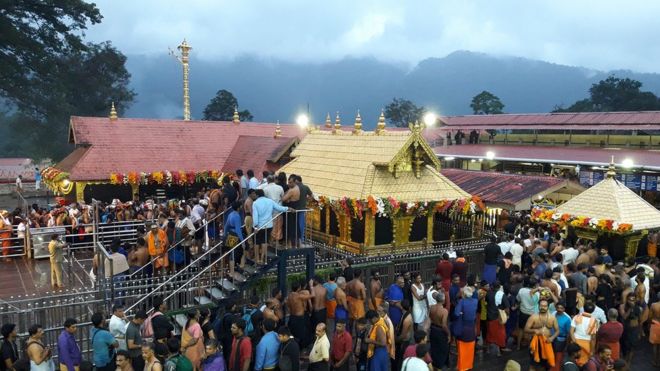
Image copyright KAVIYOOR SANTHOSHImage caption Sabarimala is one of the most prominent Hindu temples in the country
India’s Supreme Court has agreed to review its landmark judgement allowing women of menstruating age to enter a controversial Hindu shrine.
A five-judge bench last year ruled that keeping women out of the Sabarimala shrine in the southern state of Kerala was discriminatory.
The verdict led to massive protests in the state.
Women who tried to enter the shrine were either sent back or, in some cases, even assaulted.
The move is likely to anger women who fought hard to win the right to enter the temple.
Hinduism regards menstruating women as unclean and bars them from participating in religious rituals.
Many temples bar women during their periods and many devout women voluntarily stay away, but Sabarimala had a blanket ban on all women between the ages of 10 and 50.
What did the court say?
On Thursday the five-judge bench, responding to dozens of review petitions challenging the court’s landmark judgement last year, said that the matter would now be heard by a larger bench.
In doing so, however, it did not stay its earlier order. This means women can still legally enter the temple.
But it’s not going to be easy for them.
Image caption Some women tried to enter the temple last year
A temple official welcomed the ruling and appealed to women to stay away.
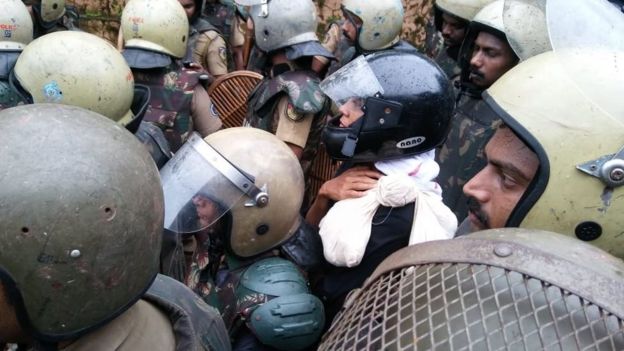
Women trying to enter the temple after the verdict last year were attacked by mobs blocking the way.
Many checked vehicles heading towards the temple to see if any women of a “menstruating age” – deemed to be those aged between 10 and 50 years – were trying to enter.
Following Thursday’s verdict, police in Kerala have appealed for calm, saying that action will be taken “against those who take the law into their own hands”. They added that social media accounts would be under surveillance and those stoking religious tensions online would be arrested.
‘One step forward, two steps back’
Geeta Pandey, BBC News, Delhi
Today’s verdict will come as a massive disappointment to women’s rights campaigners. It’s a case of one step forward, two steps back.
In 2018, while lifting the ban on women’s entry into the shrine, the Supreme Court had said that everyone had the right to practice religion and that the ban was a form of “untouchability”.
It was seen as a hugely progressive ruling and had given hope to women that they were equal before the law and could now claim equality before the gods too. What happened in court today has taken that sense away.
The Supreme Court has not put its earlier order on hold, but with the ambiguity over women’s entry continuing, it’s very likely they could be kept out in the name of keeping peace.
With the case now to be reopened by a larger seven-judge bench, the fight will have to be fought all over again.
Why is the temple so controversial?
Part of the violent opposition to the Supreme Court order to reverse the temple’s historical ban on women was because protesters felt the ruling goes against the wishes of the deity, Lord Ayappa, himself.
While most Hindu temples allow women to enter as long as they are not menstruating, the Sabarimala temple is unusual in that it was one of the few that did not allow women in a broad age group to enter at all.
Hindu devotees say that the ban on women entering Sabarimala is not about menstruation alone – it is also in keeping with the wish of the deity who is believed to have laid down clear rules about the pilgrimage to seek his blessings.
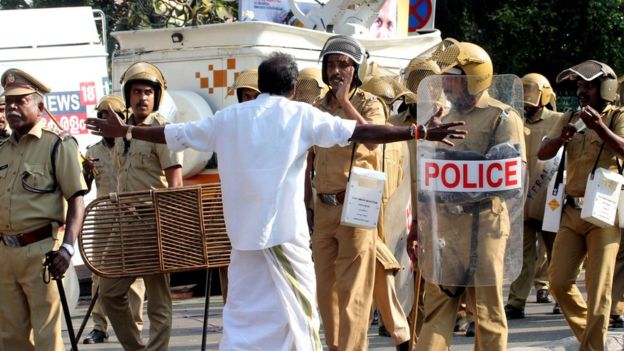
Image copyright GETTY IMAGESImage caption The entry of women into the Sabarimala temple sparked angry scenes
Every year, millions of male devotees trek up a steep hill, often barefoot, to visit the shrine. They also undertake a rigorous 41-day fast, abstaining from smoking, alcohol, meat, sex and contact with menstruating women before they begin the journey.
Women’s rights campaigners who appealed to the Supreme Court to lift the ban said that this custom violated equality guaranteed under India’s constitution. They added that it was prejudiced against women and their right to worship.
Supporters of the ban argued that the practice had been in effect for centuries, and there was no need to change it now.
So, were any women able to enter last year?
In January, two women defied protesters and entered the shrine.
Kanakadurga, 39, and Bindu Ammini, 40, made history when they entered the Sabarimala shrine – but they had to do so under heavy police protection and were also met with massive protests after.
Right-wing groups, supported by India’s ruling Hindu nationalist Bharatiya Janata Party (BJP), demanded a state-wide shutdown after, and businesses and transportation became paralysed.
Across the state hundreds were arrested, and at least one person was killed in clashes.
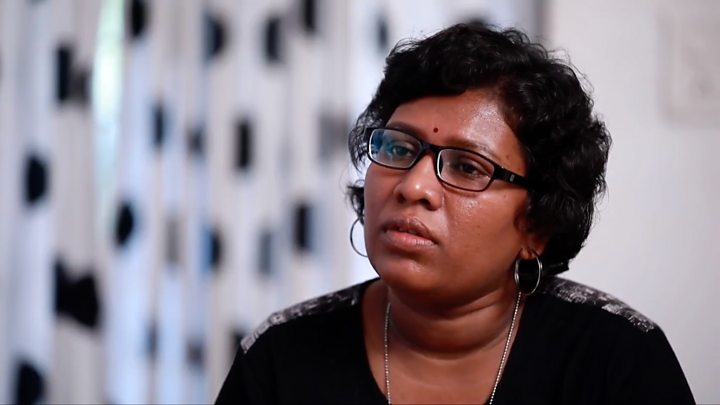
In an interview with the BBC, the women said they felt it necessary to uphold women’s rights and they weren’t afraid of mobs “enraged” by their actions.
Media caption One of the women who defied protesters to enter the Sabarimala temple says she has ‘no fear’
“I am not afraid. But every time women make any progress, society has always made a lot of noise,” Ms Kanakadurga told the BBC in January.
But their decision to enter the temple also came at heavy personal cost.
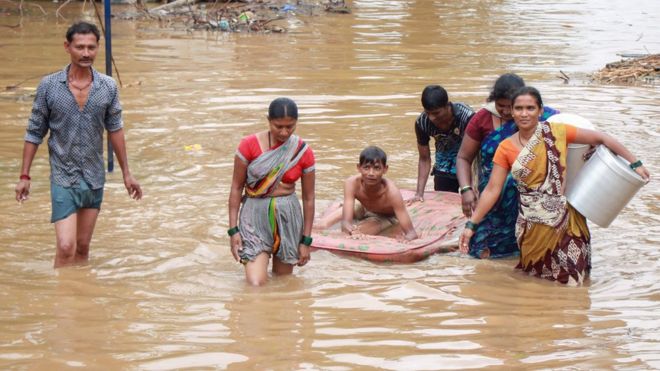
Image copyright AFPImage caption India is affected by seasonal monsoon rains between June and September
At least 95 people have been killed by monsoon flooding in southern and western India, while hundreds of thousands have been evacuated from their homes, according to reports.
More than 40 of those killed were in the south-western state of Kerala.
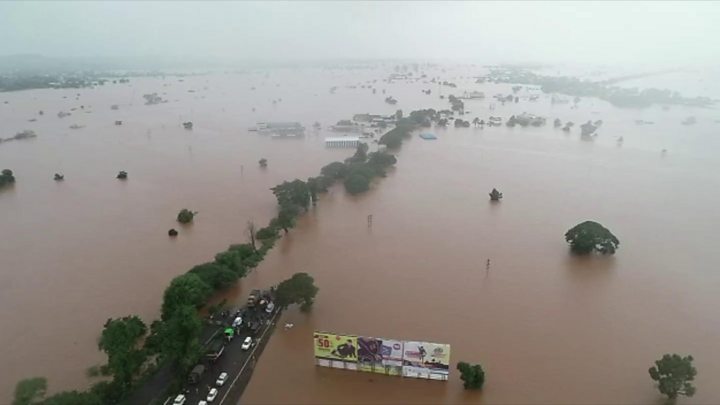
The flooding and landslides caused by the heavy seasonal rainfall have left some areas cut off.
Officials have called on those affected to try to seek shelter on higher ground.
India is affected by monsoon rains between June and September. While crucial to replenishing water supplies, the heavy rainfall also results in death and destruction each year.
Disaster management officials said more than 100,000 people in Kerala had been evacuated into emergency relief camps, while more than 40 had been killed.
“There are around 80 places where flood and rains have triggered mudslides, which we cannot reach,” state police spokesman Pramod Kumar told AFP news agency.
With the rains predicted to continue there in the coming days, the military is attempting to airlift food to stranded villages.
Media caption Aerial shots of flood-hit Indian states
The south-western state of Karnataka and western state of Maharashtra – which is home to India’s financial capital Mumbai – are also experiencing heavy rains, with dozens of fatalities reported and hundreds of thousands of people evacuated.
India’s National Disaster Management Authority issued warnings on Saturday for “heavy” to “extremely heavy” rainfall in several parts of the country, as well as strong winds.
MUMBAI (Reuters) – India’s monsoon rains were 24% below average in the week ended June 26, the weather office said on Thursday, as the seasonal rainfall was scanty over central and western parts of the country.
The rains are crucial for farm output and economic growth as about 55% of the south Asian nation’s arable land is rain-fed, and the farm sector makes up about 15% of a nearly $2.5-trillion economy that is Asia’s third-biggest.
The below-average rainfall has delayed sowing of summer-sown crop such rice, soybean and corn and threatens to curtail crop yields.
Monsoon has delivered 36% lower-than-normal rainfall since the start of the season on June 1, due to a delay in the onset of monsoon rains, according to data compiled by India Meteorological Department.
Monsoon rains arrived in the southern state of Kerala on June 8. However, Cyclone Vayu developed in the Arabian Sea drew moisture from the monsoon and weakened its progress.
A Google search for basic information on India’s caste system lists many sites that, with varying degrees of emphasis, outline three popular tropes on the phenomenon.
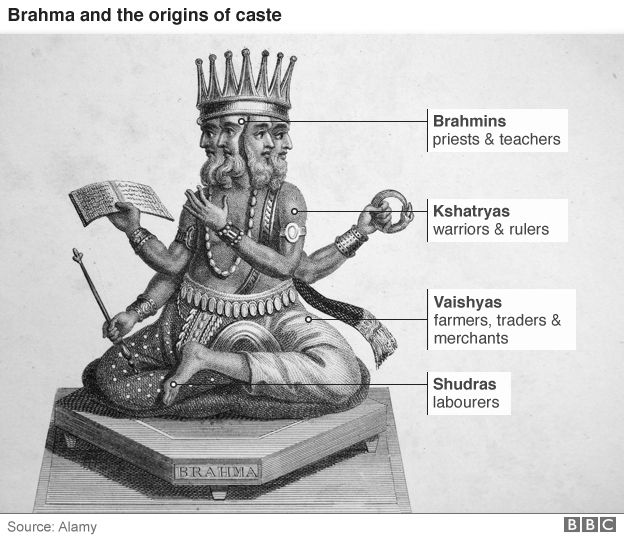
First, the caste system is a four-fold categorical hierarchy of the Hindu religion – with Brahmins (priests/teachers) on top, followed, in order, by Kshatriyas (rulers/warriors), Vaishyas (farmers/traders/merchants), and Shudras (labourers). In addition, there is a fifth group of “Outcastes” (people who do unclean work and are outside the four-fold system).
Second, this system is ordained by Hinduism’s sacred texts (notably the supposed source of Hindu law, the Manusmriti), it is thousands of years old, and it governed all key aspects of life, including marriage, occupation and location.
Third, caste-based discrimination is illegal now and there are policies instead for caste-based affirmative action (or positive discrimination).
These ideas, even seen in a BBC explainer, represent the conventional wisdom. The problem is that the conventional wisdom has not been updated with critical scholarly findings.
The first two statements may as well have been written 200 years ago, at the beginning of the 19th Century, which is when these “facts” about Indian society were being made up by the British colonial authorities.
In a new book, The Truth About Us: The Politics of Information from Manu to Modi, I show how the social categories of religion and caste as they are perceived in modern-day India were developed during the British colonial rule, at a time when information was scarce and the coloniser’s power over information was absolute.
Image caption Conventional wisdom says the caste system is a four-fold categorical hierarchy of the Hindu religion
This was done initially in the early 19th Century by elevating selected and convenient Brahman-Sanskrit texts like the Manusmriti to canonical status; the supposed origin of caste in the Rig Veda (most ancient religious text) was most likely added retroactively, after it was translated to English decades later.
These categories were institutionalised in the mid to late 19th Century through the census. These were acts of convenience and simplification.
The colonisers established the acceptable list of indigenous religions in India – Hinduism, Sikhism, Jainism – and their boundaries and laws through “reading” what they claimed were India’s definitive texts.
What is now widely accepted as Hinduism was, in fact, an ideology (or, more accurately, a theory or fantasy) that is better called “Brahmanism”, that existed largely in textual (but not real) form and enunciated the interests of a small, Sanskrit-educated social group.
There is little doubt that the religion categories in India could have been defined very differently by reinterpreting those same or other texts.
The so-called four-fold hierarchy was also derived from the same Brahman texts. This system of categorisation was also textual or theoretical; it existed only in scrolls and had no relationship with the reality on the ground.
This became embarrassingly obvious from the first censuses in the late 1860s. The plan then was to fit all of the “Hindu” population into these four categories. But the bewildering variety of responses on caste identity from the population became impossible to fit neatly into colonial or Brahman theory.
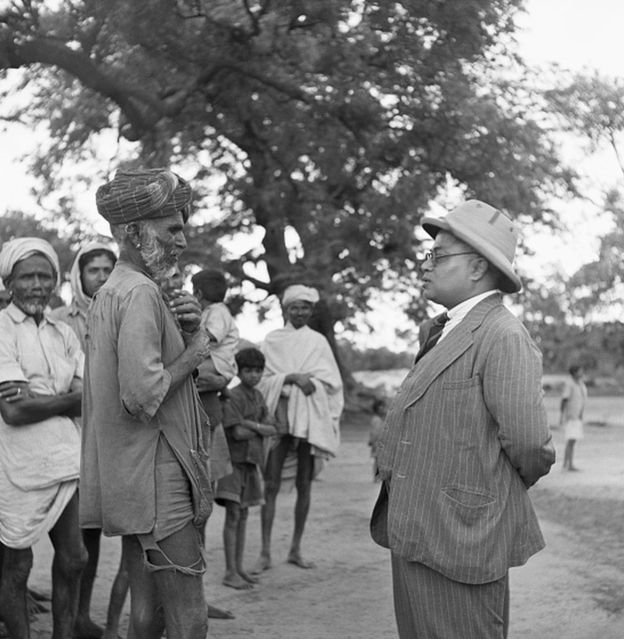
Image copyright GETTY IMAGESImage caption A leader of those formerly considered untouchable with a government official in British India
WR Cornish, who supervised census operations in the Madras Presidency in 1871, wrote that “… regarding the origin of caste we can place no reliance upon the statements made in the Hindu sacred writings. Whether there was ever a period in which the Hindus were composed of four classes is exceedingly doubtful”.
Similarly, CF Magrath, leader and author of a monograph on the 1871 Bihar census, wrote, “that the now meaningless division into the four castes alleged to have been made by Manu should be put aside”.
Anthropologist Susan Bayly writes that “until well into the colonial period, much of the subcontinent was still populated by people for whom the formal distinctions of caste were of only limited importance, even in parts of the so-called Hindu heartland… The institutions and beliefs which are now often described as the elements of traditional caste were only just taking shape as recently as the early 18th Century”.
In fact, it is doubtful that caste had much significance or virulence in society before the British made it India’s defining social feature.
Astonishing diversity
The pre-colonial written record in royal court documents and traveller accounts studied by professional historians and philologists like Nicholas Dirks, GS Ghurye, Richard Eaton, David Shulman and Cynthia Talbot show little or no mention of caste.
Social identities were constantly malleable. “Slaves” and “menials” and “merchants” became kings; farmers became soldiers, and soldiers became farmers; one’s social identity could be changed as easily as moving from one village to another; there is little evidence of systematic and widespread caste oppression or mass conversion to Islam as a result of it.
All the available evidence calls for a fundamental re-imagination of social identity in pre-colonial India.
The picture that one should see is of astonishing diversity. What the colonisers did through their reading of the “sacred” texts and the institution of the census was to try to frame all of that diversity through alien categorical systems of religion, race, caste and tribe. The census was used to simplify – categorise and define – what was barely understood by the colonisers using a convenient ideology and absurd (and shifting) methodology.
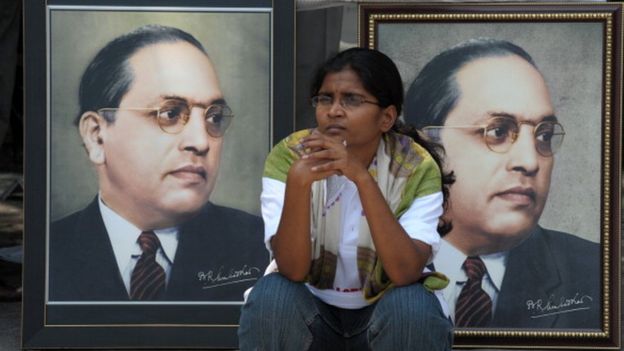
Image copyright AFPImage caption India’s constitution was written by BR Ambedkar, a member of the Dalit community which is at the bottom of the caste system
The colonisers invented or constructed Indian social identities using categories of convenience during a period that covered roughly the 19th Century.
This was done to serve the British Indian government’s own interests – primarily to create a single society with a common law that could be easily governed.
A very large, complex and regionally diverse system of faiths and social identities was simplified to a degree that probably has no parallel in world history, entirely new categories and hierarchies were created, incompatible or mismatched parts were stuffed together, new boundaries were created, and flexible boundaries hardened.
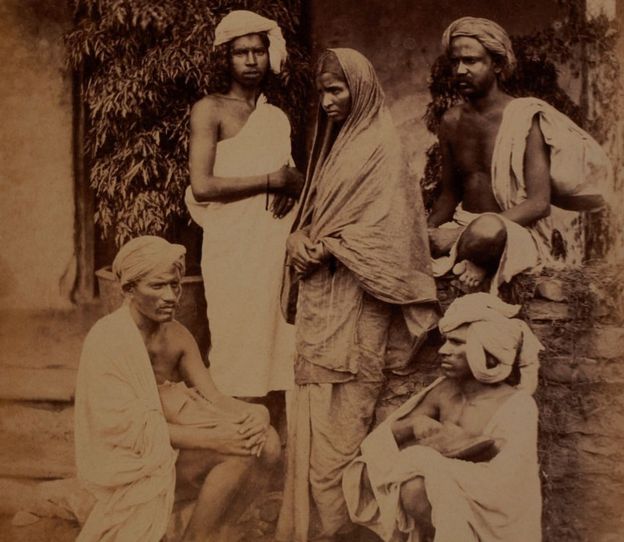
Image copyright GETTY IMAGESImage caption Dalits, or untouchables, were at the bottom of the caste system
The resulting categorical system became rigid during the next century and quarter, as the made-up categories came to be associated with real rights. Religion-based electorates in British India and caste-based reservations in independent India made amorphous categories concrete. There came to be real and material consequences of belonging to one category (like Jain or Scheduled Caste) instead of another. Categorisation, as it turned out in India, was destiny.
The vast scholarship of the last few decades allows us to make a strong case that the British colonisers wrote the first and defining draft of Indian history.
So deeply inscribed is this draft in the public imagination that it is now accepted as the truth. It is imperative that we begin to question these imagined truths.
NEW DELHI (Reuters) – The Bharatiya Janata Party (BJP) has one unwanted lead in this month’s general election race – according to data from an electoral watchdog it is fielding the most candidates among the major parties who are facing criminal charges. Its main rival, Congress, is just a step behind.
Election laws allow such candidates to run so long as they have not been convicted, on grounds both of fairness and because India’s criminal justice system moves so slowly that trials can take years, or even decades, to be resolved.
Still, the number of such candidates accused of offences ranging from murder to rioting has been rising with each election.
Analysts say political parties turn to them because they often have the deepest pockets in steadily costlier elections, and that some local strongmen are seen as having the best chance of winning.
Nearly one-in-five candidates running for parliament in the current election has an outstanding criminal case against them, inching up from 17% in the previous election and 15% in 2009, according to the Association for Democratic Reforms (ADR), a non-profit organisation that analysed candidates’ declarations.
The data shows that 40% candidates from Prime Minister Narendra Modi’s BJP face criminal charges, including crimes against women and murder, followed by the Congress party at 39%.
Among the smaller parties, the Communist Party of India (Marxist) has an even higher proportion, with 58 percent of its candidates embroiled in criminal cases.
Polls have suggested that the BJP and its allies lead the race to win the mammoth, staggered election that began last month and ends on Sunday. Votes will be counted on Thursday.
“Parties only think about winnability and they know that money power and muscle power of such candidates ensures that win,” said Anil Verma, head of the ADR.
With 240 cases against him, K Surendran of the BJP tops the list of candidates with the most outstanding criminal complaints that include rioting, criminal trespass and attempted murder.
He said most of the cases stem from his involvement in the BJP campaign to oppose the entry of women and girls of menstruating age into the Sabarimala temple in his home state of Kerala.
“I understand that an outsider might feel that I am a grave offender but, in reality, I am completely innocent of these charges,” he said. “It was all politically motivated.”
Dean Kuriakose from the Congress party has 204 criminal cases against him, the second highest, the data showed. Most of the cases were related to a political agitation against the ruling Communist Party in Kerala, which turned violent.
He was not available for comment. But a party spokesman said Kuriakose was innocent. “He was falsely charged by the police under influence from Kerala government,” the spokesman said.
Political analysts say that often people vote for candidates who face criminal charges because they are seen as best placed to deliver results. In some parts of India local strongmen mediate in disputes and dispense justice.
“Powerful people, even if criminals, offer a kind of parallel system of redressal,” said K.C. Suri, a professor of political science at the University of Hyderabad.
A separate ADR survey of more than 250,000 voters last year found 98% felt candidates with criminal backgrounds should not be in parliament, though 35% said they were willing to vote for such a candidate on caste grounds or if the candidate had done “good work” in the past.


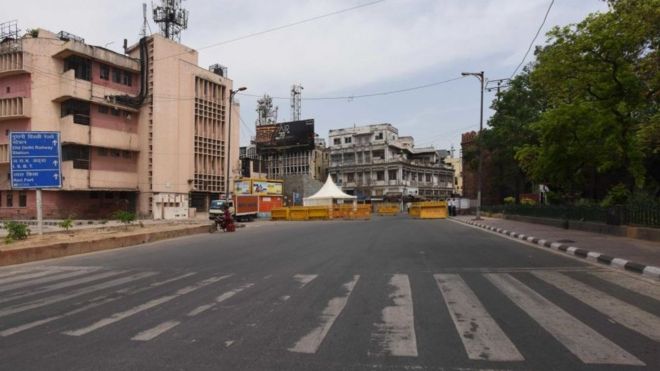 Image copyright GETTY IMAGES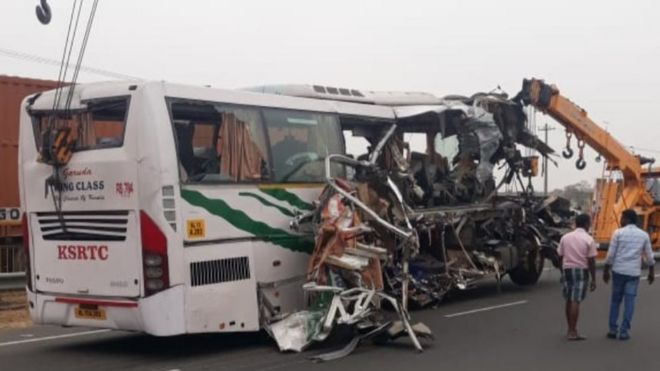





 CHINDIA ALERT: You'll be living in their world, very soon