Archive for ‘militant group’

13/09/2019

Thousands detained in Indian Kashmir crackdown, official data reveals

SRINAGAR/NEW DELHI (Reuters) – Authorities in Indian Kashmir have arrested nearly 4,000 people since the scrapping of its special status last month, government data shows, the most clear evidence yet of the scale of one of the disputed region’s biggest crackdowns.

Muslim-majority Kashmir, claimed by both India and Pakistan, has been in turmoil since India stripped its portion of the region of its autonomy and statehood on Aug. 5, leading to clashes between security forces and residents and inflaming tension with Pakistan.

India said the removal of the status that its part of Kashmir has held since independence from Britain in 1947 would help integrate it into the Indian economy, to the benefit of all.

In an attempt to stifle the protests that the reform sparked in Kashmir, India cut internet and mobile services and imposed curfew-like restrictions in many areas.

It has also arrested more than 3,800 people, according to a government report dated Sept. 6 and seen by Reuters, though about 2,600 have since been released.

A spokeswoman for India’s interior ministry did not respond to a request for comment. Neither did Jammu and Kashmir police.

It was not clear on what basis most of the people were being held but an Indian official said some were held under the Public Safety Act, a law in Jammu and Kashmir state that allows for detention for up to two years without charge.

The data for the first time shows the extent of the detentions, as well as indicating who was picked up and where.

More than 200 politicians, including two former chief ministers of the state were arrested, along with more than 100 leaders and activists from an umbrella organisation of pro-separatist political groups.

The bulk of those arrested – more than 3,000 – were listed as “stone pelters and other miscreants”. On Sunday, 85 detainees were shifted to a prison in Agra in northern India, a police source said.

Rights group Amnesty International said the crackdown was “distinct and unprecedented” in the recent history of the region and the detentions had contributed to “widespread fear and alienation”.

“The communication blackout, security clampdown and detention of the political leaders in the region has made it worse,” said Aakar Patel, head of Amnesty International India.

‘RIGHT TO LIFE’

India says the detentions are necessary to maintain order and prevent violence, and points to the relatively limited number of casualties compared with previous bouts of unrest.

The government says only one person is confirmed to have died compared with dozens in 2016, when the killing of a militant leader sparked widespread violence.

“The right to life is the most important human right,” India’s national security adviser Ajit Doval told reporters recently.

The report contains data from the 13 police districts that make up the Kashmir Valley, the most populous part of the Himalayan region where the main city of Srinagar is located.

The largest number of arrests have been in Srinagar, the data shows, at nearly 1,000. Earlier unrest often centred in rural areas.

Of the detained political leaders, more than 80 were from the People’s Democratic Party, formerly in coalition in Jammu and Kashmir state with the ruling Bharatiya Janata Party.

About 70 are from the National Conference, which has for years dominated politics in Indian Kashmir, and more than a dozen from India’s main opposition Congress party.

Police also arrested more than 150 people accused of association with militant groups fighting Indian rule.

An Indian official said it was likely that more than 1,200 people were still held, including all the high-profile politicians and separatists mentioned in the report, while dozens more are being arrested every day.

In the 24 hours before the report was compiled, more than two dozen people were arrested, mainly on suspicion of throwing stones at troops, the data showed.

The data did not include those under informal house arrest, nor people detained in a round-up of separatists that began in February after a bomb attack by a Pakistan-based militant group on Indian troops.

Days before India’s move to strip Kashmir of special status, one prominent separatist leader told Reuters that more than 250 people with links to the movement were already in detention.

Source: Reuters
25/06/2019

Police arrest newspaper publisher in midnight raid in Indian Kashmir

SRINAGAR (Reuters) – Police arrested the publisher of one of the most widely read newspapers in Indian-controlled Kashmir in a midnight raid over a decades-old case, the police and his brother said on Tuesday, highlighting the difficulties facing media in the region.

Tension has run high in the Himalayan region since more than 40 Indian police were killed in a February suicide car bomb attack by a militant group based in Pakistan.

Muslim-majority Kashmir is at the heart of more than seven decades of hostility between nuclear archrivals India and Pakistan. Each claims it in full but rules only a part.

Ghulam Jeelani Qadri, 62, a journalist and the publisher of the Urdu-language newspaper Daily Afaaq, was arrested at his home in the region’s main city of Srinagar, half an hour before midnight on Monday.

“It is harassment,” his brother, Mohammad Morifat Qadri, told Reuters. “Why is a 1993 arrest warrant executed today? And why against him only?”

Qadri was released on bail after a court appearance on Tuesday.

The case dates from 1990, when Qadri was one of nine journalists to publish a statement by a militant group fighting against Indian rule in Kashmir. An arrest warrant for Qadri was issued in 1993, but it was never served.

Qadri had visited the police station involved in the arrest multiple times since the warrant was issued, most recently in 2017 to apply for a passport, his brother added.

Asked why Qadri was arrested at night, Srinagar police chief Haseeb Mughal told Reuters, “Police were busy during the day.”

The Kashmir Union of Working Journalists condemned the arrest, saying it seemed to be aimed at muzzling the press.

“Qadri was attending the office on a daily basis and there was absolutely no need for carrying out a midnight raid at his residence,” it said in a statement.

Journalists in Kashmir find themselves caught in the crossfire between the Indian government and militant groups battling for independence.
Both sides are stepping up efforts to control the flow of information, with the situation at its worst in decades, dozens of journalists have told Reuters.
India is one of the world’s worst places to be a journalist, ranked 138th among 180 countries on the press freedom index of international monitor Reporters Without Borders, with conditions in Kashmir cited as a key reason.
Source: Reuters
09/03/2019

Man arrested over Kashmir grenade attack

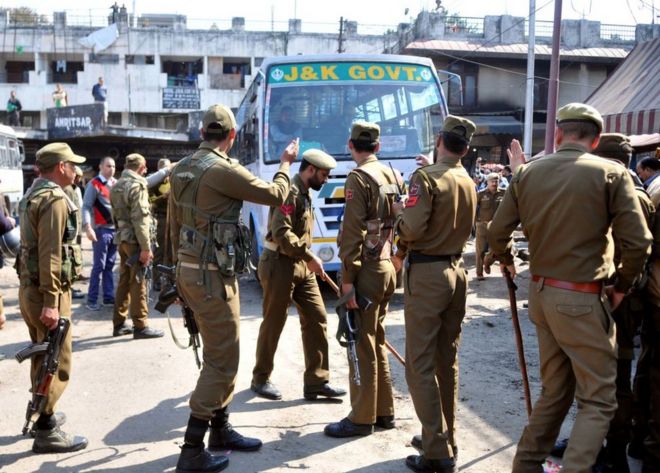
Police at the site of the blast in Jammu city on 7 March 2019.Image copyrightGETTY IMAGES
Image captionThe blast occurred at a busy bus station in Jammu city

Indian police have arrested an alleged member of the Hizbul Mujahideen militant group after a grenade attack killed at least two people and injured more than 30 others.

The attack took place on Thursday in a bus station in the Indian-administered state of Jammu and Kashmir.

Last month a suicide attack against security forces triggered cross-border air strikes between India and Pakistan.

Hizbul Mujahideen has said it was not behind Thursday’s attack.

But police told BBC Urdu that the accused, Yasir Javed Bhat, had confessed. He is a Kashmiri and reported to be in his 20s.

“He revealed that he was tasked with throwing the grenade by Farooq Ahmed Bhat, a district commander of Hizbul Mujahideen in Kulgam district,” inspector general Manish Kumar Sinha said.

Mr Sinha added that they were gathering more intelligence on Yasir.

Hizbul Mujahideen was formed in 1989 when an armed insurgency against Indian rule first broke out in the valley. It was the largest Kashmiri militant group through the 1990s and is considered to be pro-Pakistani.

India has blamed Pakistan for supporting militancy in the region – a charge Islamabad denies.

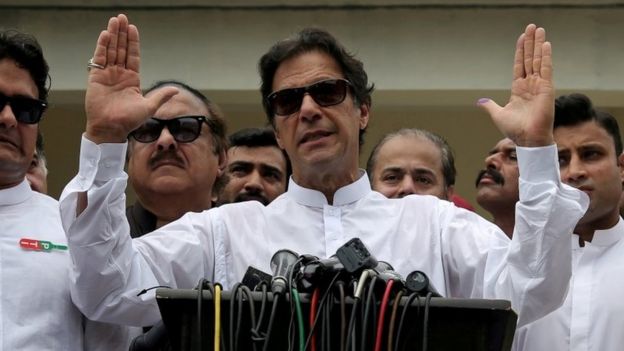
Cricket star-turned-politician Imran Khan, chairman of Pakistan Tehreek-e-Insaf (PTI), speaks after voting in the general election in Islamabad, July 25, 2018Image copyrightREUTERS
Image captionPakistan PM Imran Khan said Pakistan was not behind the suicide attack in February

This has long been a source of tension between the nuclear-armed neighbours as groups based in Pakistan have carried out deadly attacks on Indian soil. The suicide attack last month killed more than 40 central reserve policemen in Indian-administered Kashmir.

Tensions between the two sides escalated quickly. India carried out air strikes against what it said was a militant camp based in Pakistan and the latter retaliated with air raids of its own.

An Indian fighter jet was shot down in Pakistan-administered Kashmir and the pilot was captured. Two days later, Pakistan handed over the pilot to Indian officials establishing a fragile truce.

Source: The BBC

25/02/2019

India toughens Kashmir crackdown; five dead in battle with militants, more detained

SRINAGAR (Reuters) – Five people were killed in a gun battle between members of a Pakistani militant group and Indian security forces in disputed Kashmir on Sunday as India intensified a security

Indian authorities have killed at least eight JeM militants and detained around 50 militants, sympathizers and their relatives since the bomb attack, which also sparked the roundup of separatists which India says is needed to head off trouble ahead of a general election to be held by May.

Most of those rounded up over the last two days were linked to the Islamist party Jamaat-e-Islami (JeI).

“Since JeI has a wider network across Kashmir and they are mobilising anti-India protests, their arrest could help in curbing such protests ahead of elections,” the senior police officer said.


One well-known separatist leader, Abdul Gani Bhat, was placed under house arrest, according to his political party.

Separatists called a strike to protest against the detentions. Many shops, petrol stations, and businesses closed, with few people and vehicles on streets in sensitive areas, except for troop patrols.

In some areas of the main city of Srinagar, the government limited the movement of people and vehicles.

“The restrictions have been imposed as a precautionary measure to avoid any untoward incident,” the police said.

FUEL SUPPLIES LOW


The government of Jammu and Kashmir said fuel rationing had been introduced in the Kashmir Valley where there was only enough gasoline for one day, diesel for four days and no liquefied petroleum gas (LPG).

The government said it would seek to increase supplies to the region and that shortages are the result of road blockages after the suicide bomb attack.

Indian paramilitary troops in riot gear arrived in strength at first light, said Shakeel Ahmad, a resident of Nowhatta in the Srinagar district.

“At places, they have blocked the main roads with steel barricades and concertina wire,” he said.

State Governor Satya Pal Malik called on residents not to believe “rumours of any extreme nature”. The government said an increase in police numbers was to prevent candidates and voters from being intimidated into not standing or voting in the general election.

Separatist leader Mirwaiz Umar Farooq, who chairs the Hurriyat Conference of separatist groups, said arbitrary arrests and jailing of leaders, activists and young people for their political beliefs had happened across Kashmir for 30 years.

“Intimidating activists and leadership will not deter them from their path, nor will it stop people from demanding the resolution of the Kashmir dispute through self-determination,” he said.

Reuters’ telephone calls to the Indian home ministry to seek comment went unanswered.

TENSIONS RAISED

The suicide bomb attack has raised tensions between India and Pakistan which both claim Kashmir in full but rule it in part. India blames Pakistan for harbouring militant groups operating in Kashmir, which Pakistan denies.

After the attack, India dropped trade privileges for Pakistan and prepared to send as many as 10,000 more troops to the contested area, according to a home ministry letter seen by Reuters.

The Indian army said that early on Sunday evening Pakistan violated the two nations’ ceasefire at the Rajouri area of the border, through shelling from mortars and small arms fire. Defence spokesman Lieutenant Colonel Devender Anand said the Indian army was “retaliating strongly and effectively”.

Ceasefire violations are not unusual along the border.

A Pakistani security official said Pakistani forces had not initiated any action but had responded to Indian firing.

Kashmir is likely to be a key issue in India’s election, distracting from concerns about how Prime Minister Narendra Modi and his Bharatiya Janata Party have managed the economy.

Modi has promised a strong response to the attack, saying in a monthly radio broadcast on Sunday that it had caused anguish to all of India.

Modi added that the army had vowed to destroy the militants and those who helped them.

Islamabad has warned it would respond with “full force” if attacked. On Sunday, Foreign Minister Shah Mehmood Qureshi called on India to show restraint or it would put “the entire region’s peace and security at stake”.
India’s Supreme Court will hear a case this week seeking to drop a constitutional provision that bars non-residents from moving to the state of Jammu and Kashmir that encompasses the Muslim-majority region.


If passed, it could further escalate tensions.

Source: Reuters

15/02/2019

Pulwama attack: India will ‘completely isolate’ Pakistan

India has said it will ensure the “complete isolation” of Pakistan after a suicide bomber killed 46 soldiers in Indian-administered Kashmir.

Federal Minister Arun Jaitley said India would take “all possible diplomatic steps” to cut Pakistan off from the international community.

India accuses Pakistan of failing to act against the militant group which said it carried out the attack.

This is the deadliest attack to hit the disputed region in decades.

Both India and Pakistan claim all of Muslim-majority Kashmir but only control parts of it.

An insurgency has been ongoing in Indian-administered Kashmir since the late 1980s and there has been an uptick in violence in recent years.

How will India ‘punish’ Pakistan?

India says that Jaish-e-Mohammad, the group behind the attack, has long had sanctuary in Pakistan and accuses its neighbour of failing to crack down on it.

It has called for global sanctions against the group and has said it wants its leader, Masood Azhar, to be listed as a terrorist by the UN security council.

Although India has tried to do this several times in the past, its attempts were repeatedly blocked by China, an ally of Pakistan.

Mr Jaitley set out India’s determination to hold Pakistan to account when speaking to reporters after attending a security meeting early on Friday.

He also confirmed that India would revoke Most Favoured Nation status from Pakistan, a special trading privilege granted in 1996.

Pakistan said it was gravely concerned by the bombing but rejected allegations that it was in any way responsible.

But after Prime Minister Narendra Modi said in a speech that those behind the attack would pay a “heavy price”, many analysts expect more action from Delhi.

After a 2016 attack on an Indian army base that killed 19 soldiers, Delhi said it carried out a campaign of “surgical strikes” in Pakistan-administered Kashmir, across the de facto border. But a BBC investigation found little evidence militants had been hit.

However analysts say that even if the Indian government wants to go further this time, at the moment its options appear limited due to heavy snow across the region.

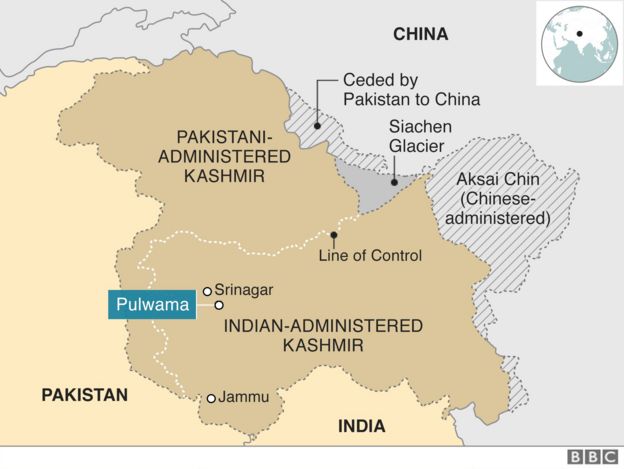
map

How did the attack unfold?

The bomber used a vehicle packed with explosives to ram into a convoy of 78 buses carrying Indian security forces on the heavily guarded Srinagar-Jammu highway about 20km (12 miles) from the capital, Srinagar.

“A car overtook the convoy and rammed into a bus,” a senior police official told BBC Urdu.

It stands as the deadliest militant attack on Indian forces in Kashmir since the insurgency began in 1989.

The bomber is reported to be Adil Dar, a high school dropout who left home in March 2018. He is believed to be between the ages of 19 and 21.

Soon after the attack Jaish-e-Mohammad released a video, which was then aired on the India Today TV channel. In it, a young man identified as Adil Dar spoke about what he described as atrocities against Kashmiri Muslims. He said he joined the banned group in 2018 and was eventually “assigned” the task of carrying out the attack in Pulwama.

He also said that by the time the video was released he would be in jannat (heaven).

Dar is one of many young Kashmiri men who have been radicalised in recent years. On Thursday, main opposition leader Rahul Gandhi said that the number of Kashmiri men joining militancy had risen from 88 in 2016 to 191 in 2018.

India has been accused of using brutal tactics to put down protests in Kashmir – with thousands of people sustaining eye injuries from pellet guns used by security forces.

What’s the reaction?

“We will give a befitting reply, our neighbour will not be allowed to de-stabilise us,” said Prime Minister Modi.

Mr Gandhi and two former Indian chief ministers of Jammu and Kashmir all condemned the attack and expressed their condolences.

The attack has also been widely condemned around the world, including by the US and the UN Secretary General.

The White House called on Pakistan to “end immediately the support and safe haven provided to all terrorist groups operating on its soil”.

Pakistan said it strongly rejected any attempts “to link the attack to Pakistan without investigations”.

What’s the background?

There have been at least 10 suicide attacks since 1989 but this is only the second suicide attack to use a car.

Prior to Thursday’s bombing, the deadliest attack on Indian security forces in Kashmir this century came in 2002, when militants killed at least 31 people at an army base in Kaluchak near Jammu, most of them civilians and relatives of soldiers.

At least 19 Indian soldiers were killed when militants stormed a base in Uri in 2016. Delhi blamed that attack on the Pakistani state, which denied any involvement.

The latest attack also follows a spike in violence in Kashmir that came about after Indian forces killed a popular militant, 22-year-old Burhan Wani, in 2016.

More than 500 people were killed in 2018 – including civilians, security forces and militants – the highest such toll in a decade.

India and Pakistan have fought three wars and a limited conflict since independence from Britain in 1947 – all but one were over Kashmir.

Who are Jaish-e-Mohammad?

Started by cleric Masood Azhar in 2000, the group has been blamed for attacks on Indian soil in the past, including one in 2001 on the parliament in Delhi which took India and Pakistan to the brink of war.

Most recently, the group was blamed for attacking an Indian air force base in 2016 near the border in Punjab state. Seven Indian security personnel and six militants were killed.

It has been designated a “terrorist” organisation by India, the UK, US and UN and has been banned in Pakistan since 2002.

However Masood Azhar remains at large and is reportedly based in the Bahawalpur area in Pakistan’s Punjab province.

India has demanded his extradition from Pakistan but Islamabad has refused, citing a lack of proof.

Source: The BBC

Law of Unintended Consequences

continuously updated blog about China & India

ChiaHou's Book Reviews

continuously updated blog about China & India

What's wrong with the world; and its economy

continuously updated blog about China & India