Archive for ‘mumbai’

11/06/2019

Aarey forest: The fight to save Mumbai’s last ‘green lung’

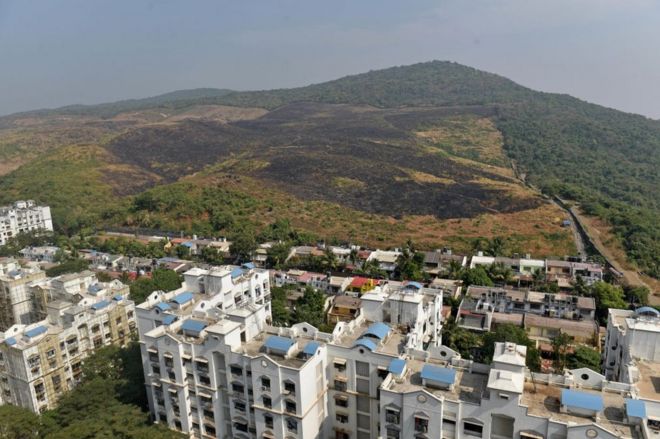
Aarey ForestImage copyright GETTY IMAGES
Image caption Aarey forest is in Mumbai city

The Aarey forest, a verdant strip that lies at the heart of India’s bustling Mumbai city, is often referred to as its last green lung. But now, locals say, it’s under threat from encroachment. BBC Marathi’s Janhavee Moole reports.

As a child, Stalin Dayanand used to picnic in the Aarey forest.

“It was the only place where you could go and play, climb trees or just sit and eat under the shade of a tree and be close to nature,” says Stalin, who prefers to go by his first name.

Now the 54-year-old is the director of an NGO that works to protect forests and wetlands. He is fighting for Aarey.

On 6 June, the government cleared 40 hectares (99 acres) of the 1,300 hectare forest to build a zoo, complete with a night safari.

Another slice of it is being claimed by Mumbai’s new metro rail which is currently under construction. Thousands of trees will have to be felled to construct a new multi-level parking unit for the metro.
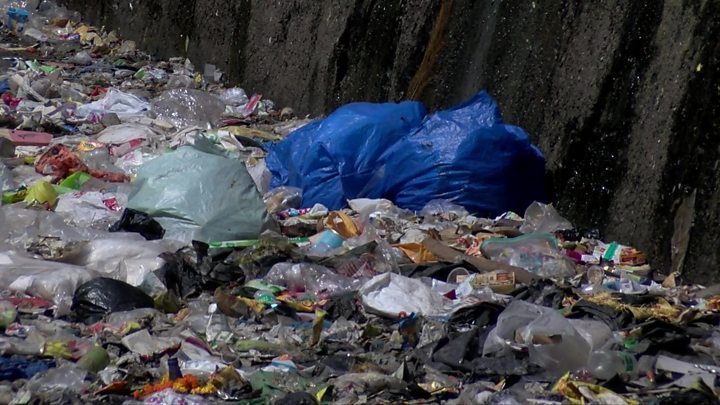
Media caption What happens if you ban plastic?

Stalin has petitioned India’s Supreme Court challenging the construction, but the case is still pending.

Locals and environmental activists like him are up in arms because they fear the government will eventually clear the way for private builders to encroach on the Sanjay Gandhi National Park, which lies to the north of Aarey. Spread over 104 sq km (40 sq miles), this protected area makes Mumbai one of the rare cities to have a jungle within its boundaries.

Their concern is partly fuelled by the fact that this is prime location in a city where land is scarce and real estate prices are among the most expensive in the world.

But officials dismiss these fears as unfounded and point out that the construction for the metro only requires 30 hectares of the 1,300 hectares that make up the Aarey forest.

“This is the most suitable land due to its size, shape and location,” says Ashwini Bhide, managing director of the Mumbai metro rail corporation.
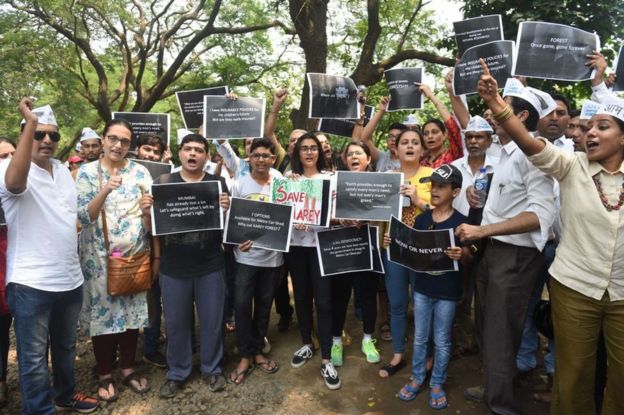
Residents of Aarey colony and Aam Aadmi Party members protest against cutting of trees to build a metro shed at Aarey Colony on 2 October 2018 in Mumbai, India.Image copyright GETTY IMAGES
Image caption Plans to fell trees in the forest have led to protests

She adds that the city badly needs a “mass rapid transport system”. India’s financial hub is congested and infamous for its crawling traffic jams and its local train system heavily overburdened.

Officials say that the metro will eventually carry around 1.7 million passengers every day and bring down the number of vehicles on the road by up to 650,000. The city’s current colonial-era railway system, which is effectively its lifeline, ferries some 7.5 million people between Mumbai’s suburbs and its heart on a daily basis.

But they have been up against the city’s residents, including activists and conservationists, ever since news emerged in 2014 that trees would be cut to make way for the metro.

Presentational grey line

Read more India stories

Presentational grey line

What makes the issue complicated is that the Aarey forest is the site of competing claims.

It’s locally known as the Aarey “milk colony” because most of the land was given to the department of dairy development in 1951. But they are allowed to grow cattle fodder only on a fraction of the land. The rest of it is densely forested and dotted with lakes, and the Mithi river flows through it.

Aarey is also home to tribal communities who live in settlements known as “padas”.

“We are not getting basic facilities here, and now metro authorities want to take away the jungle which belongs to us too,” says Asha Bhoye, who belongs to the Konkani tribe and lives in one of the 29 padas. Plans to relocate some of the tribal communities have also met with resistance and led to protests.

Stalin alleges that instead of declaring the Aarey forest a protected area, the state government has used the opportunity to parcel away pieces of it first to the dairy development department and now to other projects.
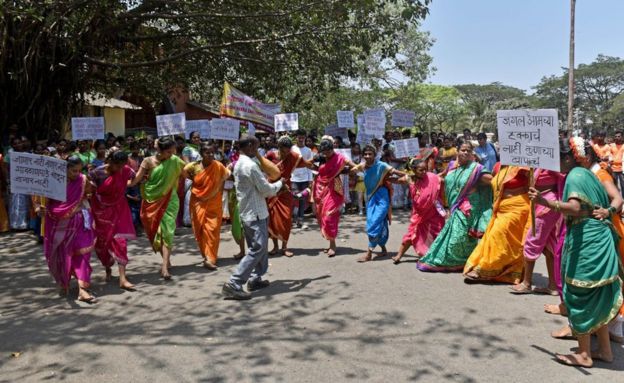
Aadivasi Halka Sanvardhan Samiti and Tribals of Aarey colony protesting to demand protection of Aare forest.Image copyright GETTY IMAGES
Image caption Tribals who live in Aarey demand that it be declared a protected area

“Aarey Forest is part of the same forest as Sanjay Gandhi National Park and we are fighting for the national park itself. In the name of public good, the land is being opened up for developers. It’s a systematic effort to destroy the forest.”

Activists fear that after the parking units are built, other projects will be permitted, further threatening the area’s ecology and wildlife, which includes leopards.

So locals have joined the fight enthusiastically, even leading hikes into the forest to raise awareness. “We bring people here, make them familiar with the forest – there are many species of spiders like trapdoor spiders, the site [of the parking unit] is a leopard site,” says Yash Marwa, a screenwriter who is among those campaigning for the forest.

“Mumbai needs to be liveable”, he adds. “We need to talk about good quality of air and life before talking about infrastructure and development.”

Stalin agrees, saying that “air quality and temperature seem to be last among people’s priorities.”

But he is determined to not give up.

“If I couldn’t do something for my city I’d consider I’ve failed myself.”

Source: The BBC
05/05/2019

India’s rural pain goes beyond farmers, and it may be a problem for Modi

ZADSHI VILLAGE, India (Reuters) – Three years ago, brick mason Pundlik Bhandekar was always busy as farmers in his tiny hamlet in Maharashtra commissioned new houses and nearby towns were undergoing rapid urbanisation. Now, as the rural economy sinks and the pace of construction slows, Bhandekar is struggling to get work.

“I used to get a new construction project before I could even finish one. People would come to my house to check when I would be free to work for them,” said Bhandekar, as he sat with friends under the shade of a tree on a hot afternoon.

From daily wage workers such as masons, to barbers and grocery shop owners – just about everyone in Zadshi village, some 720 km (450 miles) from India’s financial hub Mumbai, says a drop in farm incomes has dented their livelihoods.

Their woes are symptomatic of a wider problem across India, where more than half of the country’s 1.3 billion people are dependent on agriculture for their livelihoods, as the slowdown in the rural economy is felt in the dampening sales of consumer goods, especially the biggest such as car and motorbike sales.

The slowdown has also dented Prime Minister Narendra Modi’s popularity in the hinterland that propelled him to power in 2014, and political strategists say it may mean he struggles to form a majority after voting in a staggered general election that began on April 11 concludes on May 19.

Zadshi has been almost entirely dependent on annual cotton and soybean crops that, according to farmers, have given lacklustre returns in the past few years due to a dip in prices, droughts and pest attacks.

And as incomes have dropped, farmers have cut back on big-ticket spending such as building new houses, digging wells or laying water pipelines, squeezing employment opportunities for people such as Bhandkekar.

“No one is interested in hiring us. We are ready to work even at 250 rupees ($3.60) per day,” said Bhandekar, who charged 300 rupees a day when work was steady, but now gets work only once or twice in a fortnight.

LOWER WAGES, LESS SPENDING

Economic data reflects the plight of farmers and daily wage workers.

Retail food inflation in the fiscal year ended on March 31 fell to 0.74 percent, even as core inflation stood at 5.2 percent, according to Bank of America Merrill Lynch Research, eroding the spending power of farmers.

Inflation adjusted wage growth for workers involved in crop sowing was just 0.6 percent 2018/19 compared with 6.5 percent in 2013/14.

The value of farm produce at constant prices grew 15 percent in the past five years, compared with 23 percent in the previous five, while the manufacturing sector grew 40 percent, against 32.6 percent in the previous five years, government data shows.

“Lower rural wages will result in lesser spending, which in turn will reduce demand for goods and services that are part of the rural basket,” Rupa Rege Nitsure, group chief economist at L&T Finance Holdings in Mumbai, told Reuters.

The government needs to spend more in rural areas to generate employment and boost incomes, Nitsure said.

Modi’s Hindu nationalist government did introduce various support schemes in the past six months, such as a 6,000 rupees yearly handout to small farmers.

The main opposition Congress party has gone much further with its pledges though, saying it would introduce a basic minimum income, where the country’s poorest families would get 72,000 rupees annually, benefiting some 250 million people.

RISING UNEMPLOYMENT

In Zadshi, as the mercury touched a searing 40 degrees Celsius(104F), a group of villagers gathered under the trees lining a dusty road and began chatting about everything from crop prices to politics.

“What else we can do? Had work been available in urban areas, we could have moved there but even in the cities construction has slowed down,” said Amol Sontakke, an unskilled labourer who works in farms and on construction sites.

Job opportunities have slowed even in urban areas and India’s unemployment rate touched 7.2 percent in February, the highest since September 2016, according to data compiled by the Centre for Monitoring Indian Economy (CMIE). Official data is unavailable for recent periods.

The mood in Zadshi was glum. While four dozen villagers interviewed by Reuters were hopeful that if there was a good monsoon this year it could improve farm incomes, they’ve been cutting back on spending in the meantime.

“People are thinking twice before buying new clothes during festivals,” said Avinash Gaurkar, a farmer currently doubling up as a part-time driver. “Buying big-ticket items such as motorcycles or refrigerators is out of the question.”

Two years ago Gaurkar began building a house, but had to give up midway as his five-acre farm could not generate the money needed, he said, pointing towards a half-finished structure without doors.

In 2018, just four villagers bought new motorbikes compared with as many as 10 a year about four years ago, said cotton farmer Raju Kohale, whose son is sitting at home unemployed after graduating as an engineer.

“Poor monsoon or lower prices, something or the other has been hurting us in the past few years,” Kohale said.

MODI AGAIN?

In the 2014 general election, most in Zadshi voted for Modi, but the farmers’ distress has swayed many towards the opposition Congress party. That was clear from Reuters’ interviews with 48 villagers, who cast their ballots last month.

Farmers are at the bottom of the Modi administration’s priority list, said labourer Sagar Bahalavi.

“They are building big roads to connect metros and calling it development. How is that useful for us?” he said.

Some, though, want to give Modi a second chance.
“Modi’s intentions are good, it’s the bureaucratic system that is not supporting him,” said Gulab Chalakh, who owns a 20-acre farm and is among the richest in the village. “We should give him another chance.”
Source: Reuters
29/04/2019

Police break up clashes in West Bengal, Mumbai votes in fourth phase of massive poll

MUMBAI/NEW DELHI (Reuters) – Police broke up clashes between rival groups of voters in West Bengal on Monday as some of India’s richest families and Bollywood stars also cast their ballots in Mumbai during the fourth phase of a massive, staggered general election.

In West Bengal, a populous eastern state crucial for Prime Minister Narendra Modi’s re-election bid, supporters of his Hindu nationalist Bharatiya Janata Party (BJP) clashed with others from the regional Trinamool Congress, police said.

TV footage showed armed security forces chasing away people wielding sticks, although it was initially difficult to determine the scale of the clashes.

There were no immediate reports of any poll-related injuries in West Bengal, where at least one person was killed and three injured during the third phase of voting last week.

The BJP is in a direct, and sometimes bloody, fight in West Bengal with Trinamool, whose chief Mamata Banerjee is one of Modi’s biggest critics and a potential prime ministerial candidate.

More than 127 million people are eligible to vote in this round of the seven-phase election held across 71 seats in nine states. Modi’s coalition won more than 75 percent of the seats in the previous election in 2014.

Many of the constituencies are in Uttar Pradesh in the north and western India’s Maharashtra, where the financial capital Mumbai is located. Uttar Pradesh elects the most lawmakers, with Maharashtra next. Both states are ruled by the BJP and its allies.
However, political analysts say the BJP may struggle to repeat its strong showing this time due mainly to a jobs shortage and weak farm prices, issues upon which the main opposition Congress party has seized.

‘SOME PROGRESS’

First-time voter Ankita Bhavke, a college student in Mumbai, said she voted for economic development.

“I want the country to be at par with the best in the world,” she said. “There’s been some progress in the last five years.”

India’s financial markets were closed on Monday for the election.

Mumbai is home to the massive Hindi film industry, as well as Asia’s wealthiest man, Mukesh Ambani, and India’s richest banker, Uday Kotak.
Ambani, who heads Reliance Industries, and Kotak, managing director of Kotak Mahindra Bank, created a stir this month by publicly endorsing an opposition Congress party candidate from their upscale South Mumbai constituency.
Mumbai, which has six seats, is India’s wealthiest city but ageing and insufficient infrastructure is a major concern. Six people were killed last month when part of a pedestrian bridge collapsed, recalling memories of a 2017 rush-hour stampede that killed at least 22 people on a narrow pedestrian bridge.
The election, the world’s biggest democratic exercise with about 900 million voters, started on April 11 with Modi in the lead amid heightened tension with long-time enemy Pakistan.
The last phase of voting is on May 19, with results released four days later.
There are a total of 545 seats in the Lok Sabha.
Modi sent warplanes into Pakistan in late February in response to a suicide attack by an Islamist militant group based there that killed 40 Indian police in the disputed Kashmir region.
Modi has sought votes on his tough response towards militancy and in recent days has evoked the deadly Easter Sunday bombings in nearby Sri Lanka.
Maidul Islam, a professor of political science at Kolkata’s Centre for Studies in Social Sciences, said long queues outside polling stations would indicate whether Modi’s national security pitch was working.
“Whenever there is a BJP kind of a wave, you see a higher voter turnout,” he said.
Source: Reuters
15/04/2019

India gold smuggling slowed by election seizures of cash, bullion

MUMBAI (Reuters) – India’s gold smugglers have slowed their operations over worries their shipments will be caught up in seizures of cash, bullion, booze and drugs that are aimed at controlling vote-buying in the country’s national elections, industry officials told Reuters.

In India, political parties and their supporters often offer money or goods in exchange for votes. The Election Commission, which monitors the polls, tries to prevent this by setting up highway checkpoints to seize cash, gold, liquor and other high-value items that candidates avoid mentioning in their expenses due to a cap on the amount they can spend.

Last month in Mumbai, in one of the biggest seizures since the current election was announced on March 10, the Directorate of Revenue Intelligence seized 107 kg of gold, worth about 300 million rupees ($4.3 million).

The slowdown in smuggling has boosted gold imports at banks in the world’s second-biggest buyer of the precious metal, allowing them to charge a premium over global prices.

“After a big seizure in Mumbai, smuggling has gone down drastically. Grey market operators don’t want to take the risk during the election period,” Anantha Padmanabhan, chairman of All India Gem and Jewellery Domestic Council (GJC) told Reuters.

India’s Election Commission as of April 14 has seized $365 million in cash, liquor, gold, drugs and other goods over the last month, more than double the $172 million confiscated in the last election cycle in 2014.

(GRAPHIC – Drugs, gold, cash, alcohol: The gifts that buy votes (JPG), tmsnrt.rs/2D7Z2w5)

The random checking of vehicles and seizures have made it nearly impossible for smugglers and other “grey market” operators to move cash and gold from one place to another, said the head of the bullion division at a Mumbai-based private bank.

Gold smuggling surged in India after the government raised the import duty to 10 percent in August 2013. Grey market operators – businesses that smuggle gold from overseas and sell it in cash to avoid the duties – got a further boost in 2017 when India imposed a 3 percent sales tax on bullion.

The grey market operators can sell gold at discounts to prevailing market prices as they evade paying the 13 percent tax, said Harshad Ajmera, a gold wholesaler in Kolkata.

But this week, even in the cash market, gold was sold at the market price, said Ashok Jain, proprietor of Mumbai-based gold wholesaler Chenaji Narsinghji.

Dealers were charging a premium of up to $2.50 an ounce over official domestic prices, the highest in nearly five months.

Up to 95 tonnes of gold was smuggled into India in 2018, according to the World Gold Council, although India’s Association of Gold Refineries and Mints and other industry bodies put the figure at more than twice that.

Election Commission rules makes it mandatory for people to show valid documentation if they are carrying more than 50,000 rupees ($722) in cash, or else it could be seized. This rule has been hurting the jewellery industry, especially in rural areas where more than half of gold is bought in cash.

The limit of 50,000 rupees is “too low for the jewellery industry” as even a small 20-gram (0.7-ounce) gold chain costs more than that, said Padmanabhan of GJC.
“Demand has fallen due to the cash restrictions. We have requested that the Election Commission raise the limit.”
Source: Reuters
07/03/2019

The British woman who fought for India’s freedom

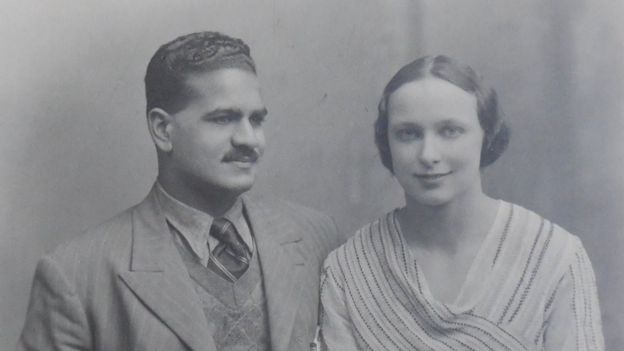
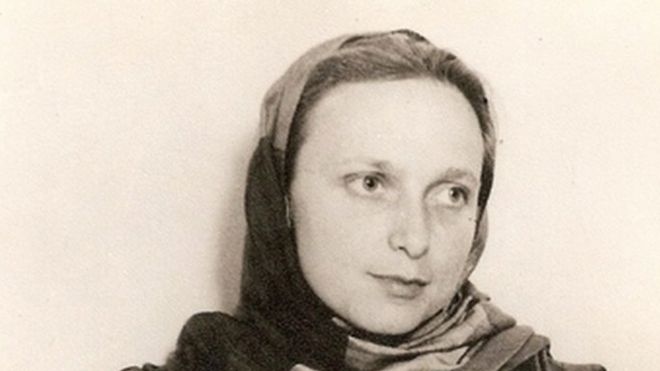
A portrait photo of Freda taken in Lahore in the early 1940
Image captionFreda Bedi’s is a remarkable story

Freda Bedi lived an unusual life. Born in a small town in England, she moved to India for love and ended up joining the independence movement. Her biographer, Andrew Whitehead, writes about her remarkable story.

“There are things deeper than labels and colour and prejudice, and love is one of them.”

These were the words of Freda Bedi, an English woman who overcame prejudice to marry an Indian Sikh and went on to challenge Indian notions about the role of a woman and a wife.

Freda and her boyfriend, Baba Pyare Lal Bedi (his friends called him BPL), met at Oxford where both were students.

This was the early 1930s and romances across the racial divide were rare – almost as rare as a girl from Freda’s background securing a spot at a top university. She was born, quite literally, above the shop in the city of Derby in England’s East Midlands, where her father ran a jewellery and watch repair business.

Freda could barely remember her father. He enlisted during the First World War and served in the Machine Gun Corps, where casualties were so high it was known as the “suicide club”. He died in northern France when his daughter was just seven years old. “This death shadowed my whole childhood,” she recalled – it shaped her political loyalties and prompted her lifelong spiritual quest.

Her years at Oxford were “the opening of the gates of the world”, as Freda once put it. She was part of “the Depression generation” – those who were students at a time of global crisis, mass unemployment and the rise of fascism.

She made firm friends at her college with young women who were rebellious by nature, and went with them to meetings of the Labour Club and the communist October Club.

The engagement photo of Freda and BPL taken at Oxford in 1933
Image captionFreda and BPL met as students at Oxford University

Driven by curiosity and by sympathy with those struggling against the Empire, she also went along to the weekly meetings of the Oxford Majlis, where radicals among the university’s small number of Indian students asserted their country’s case for nationhood. BPL Bedi, a handsome and cheerful Punjabi, was a regular there. A friendship developed into intellectual collaboration and, within months, Freda and BPL were a couple.

In the early 1930s, women’s colleges at Oxford were obsessed with sex or rather with preventing it. If a male student came to have tea in a female student’s room, a chaperone had to be present, the door left wide open and the bed had to be taken into the corridor. Freda’s college did its best to derail her relationship – she was disciplined for visiting BPL without a chaperone in what she was convinced was a case of racial discrimination.

But she was fortunate in her student friends. Barbara Castle, who later became a commanding British woman politician of her era, was thrilled when Freda confided that she intended to marry her boyfriend. “Well, thank goodness”, Barbara exclaimed. “Now at least you won’t become a suburban housewife!” Freda’s mother didn’t see things that way though. Her family were sternly disapproving, until BPL made a visit to Derby and managed to charm them.

Freda commented that the engagement caused “a minor sensation” in Oxford. That was an understatement. She believed she was the first Oxford woman undergraduate to marry an Indian fellow student. Some didn’t hide their disapproval. The registrar who conducted the marriage ceremony pointedly refused to shake hands with the couple.

From the moment she married, Freda regarded herself as Indian and often wore Indian-style clothes. A year later, husband and wife and their four-month old baby, Ranga, set off by boat from Trieste, Italy, on the two-week journey to the western Indian city of Bombay (now Mumbai). “The nightmare was to get milk for myself to drink because I was feeding the baby”, Freda recalled. “And I remember the millions of cockroaches that used to come out at night in the ship’s kitchens – I used to go in and attempt to get milk.”

Presentational grey line

Read more stories by Andrew Whitehead

Presentational grey line

The couple had already been marked out by the British authorities as revolutionaries and potential trouble makers because of their student activism. When they disembarked in Bombay, their bags and cases were inspected for seven hours to check for left-wing propaganda. “Even Ranga’s little napkin was taken off and searched,” recalled Freda, “because they thought I might be carrying messages in it”.

The key test of Freda’s marriage was still to come – the first meeting with her Indian mother-in-law, a widow and matriarch known in the family as Bhabooji. From Bombay, the Bedis travelled non-stop for a couple of days to reach the small Punjabi city of Kapurthala, arriving at the family home close to midnight. Freda was wearing a white cotton sari – “not the ideal travelling dress, and nursing Ranga had not improved it”.

BPL bowed to touch his mother’s feet in the traditional expression of respect. “I copied him, feeling a little awkward,” Freda said, “but all my shyness disappeared when she smiled at us both with tears in her eyes, and embraced us and the child as if she could not hold us close enough.”

Although Freda was determined to fit in with her Indian extended family, her lifestyle was anything but conventional. BPL’s political stand extended to rejecting any share in his family’s wealth. They made their home in Lahore, one of the largest cities in Punjab, in a cluster of thatched huts without power or running water, keeping hens and a buffalo. It can’t have been the sort of life Freda had expected – nor would she have been used to the idea of sharing the household with her mother-in-law.

“Nowhere had I seen a white woman trying to be a typical Indian daughter-in-law”, commented Som Anand, a frequent visitor to the Bedis’ huts. “It surprised me to see Mrs Bedi coming to Bhabooji’s hut in the morning to touch her feet. In household matters she respected the old mother’s inhibitions. Her mother-in-law was an equally large hearted person; despite all her conservatism she had accepted a Christian into the family without a murmur.”

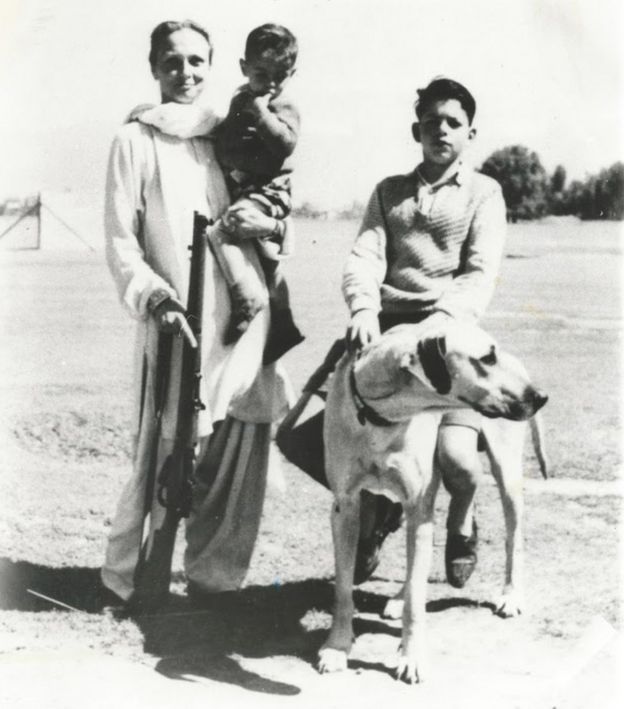
Freda with a rifle when she was living in Kashmir, probably 1948 - she is holding hr son, Kabir, while her older son, Ranga, is sitting on the family's pet dog.
Image captionFreda and BPL moved to Kashmir after 1947 and remained politically active

When World War Two broke out, both BPL and Freda were outraged that India was being dragged into supporting the British war effort. BPL was detained in a desert prison camp to stop him sabotaging military recruitment in Punjab. Freda decided to make her own stand against her motherland.

She volunteered as a satyagrahi, a seeker of truth, and was among those chosen by Indian independence leader Mahatma Gandhi to defy emergency wartime powers. She travelled to her husband’s home village of Dera Baba Nanak and announced that she would “break the law by asking the people not to support the military effort until India became democratic”. The authorities didn’t know how to respond to a white woman staging such a protest – they hurriedly sent an English police inspector to the village, deeming it inappropriate for an Indian policeman to arrest an Englishwoman.

Freda was brought before a visiting magistrate that same morning – she has left her own account of the trial:

It was finished in 15 minutes. The man on the other side of the table was quite young still, and looked as though he had been to Oxford. His face was red.

“I find this as unpleasant as you do,” he murmured.

“Don’t worry. I don’t find it unpleasant at all.”

“Do you want the privileges granted to an Englishwoman?”

“Treat me as an Indian woman and I shall be quite content.”

She was sentenced to six months in jail, which was fairly standard, and also to hard labour, which she regarded as vindictive.

That turned out to be no more onerous than supervising the prison gardens, where women imprisoned for criminal rather than political offences – many were locked up for killing their abusive husbands – did most of the work.

“It was my destiny to go to India,” Freda asserted. It was her destiny too to make history as an English woman who went willingly to jail in support of India’s demand for freedom.

The Bedis’ political prominence persisted after independence, when they moved to Kashmir – Freda joined a left-wing women’s militia and worked with the radical nationalists who gained power there. In the 1950s, her life changed utterly when, during a UN assignment in Burma, she encountered Buddhism for the first time and became an enthusiastic convert.

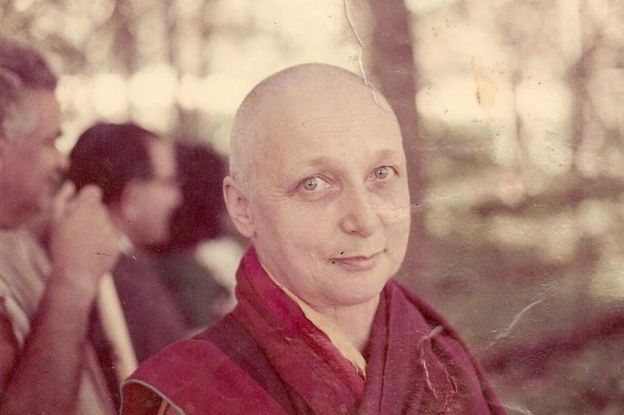
Freda as a nun, when she took the name Sister Palmo
Image captionFreda became a Buddhist nun in the 1950s

When thousands of Tibetans fled across the Himalayas in 1959 to escape Chinese oppression, Freda devoted herself to helping these “brave and wonderful” refugees. She became steeped in Tibetan spirituality. And once she felt that she had fulfilled her role as a mother (the film star Kabir Bedi is one of her three surviving children), she broke convention again by taking vows as a Tibetan Buddhist nun. In her sixties, she travelled relentlessly to spread the word about Buddhist teachings but never returned to live in the West.

“India is my womanhood and my wife-hood,” she once declared. “I too am ‘dust that England bore, shaped and made aware’. Yet I am living in an Indian way, with Indian clothes, with an Indian husband and child on Indian soil, and I cannot feel even the least barrier or difference in essentials between myself and the new country I have adopted.”

Throughout her life, Freda was determined not to be constrained by barriers of race, religion, nation or gender. She delighted in challenging convention and confounding expectations – that is what makes her story so beguiling.

Source: The BBC

07/03/2019

Pakistan seizes religious schools in intensified crackdown on militants

ISLAMABAD (Reuters) – Pakistan intensified its crackdown against Islamist militants on Thursday, with the government announcing it had taken control of 182 religious schools and detained more than 100 people as part of its push against banned groups.

The move represents Pakistan’s biggest move against banned organisations in years and appears to be targeting Islamic welfare organisations that the United States says are a front for militant activities.

Pakistan is facing pressure from global powers to act against groups carrying out attacks in India, including Jaish-e-Mohammed (JeM), which claimed responsibility for the Feb. 14 attack that killed at least 40 Indian paramilitary police.

The escalating tension in the wake of the bombing led to a major confrontation between the nuclear-armed rivals, with both countries carrying out aerial bombing missions and even engaging in a brief dogfight that prompted fears of a war.

Pakistani officials say the crackdown is part of a long-planned drive and not a response to Indian anger over what New Delhi calls Islamabad’s failure to rein in militant groups operating on Pakistani soil.

Previous large-scale crackdowns against anti-India militants have broadly been cosmetic, with the proscribed groups able to survive and continue operations.

The interior ministry said law enforcement agencies had placed 121 people in “preventive detention” as part of the crackdown that began this week.

“Provincial governments have taken in their control management and administration of 182 seminaries (madaris)”, the ministry said in a statement, referring to religious schools.

What to do with madrasas is a thorny issue in Pakistan, a deeply conservative Muslim nation where religious schools are often blamed for radicalisation of youngsters but are the only education available to millions of poor children.

The interior ministry said other institutions from different groups had been taken over, including 34 schools or colleges, 163 dispensaries, 184 ambulances, five hospitals and eight offices of banned organisations.
Many banned groups such as JeM run seminaries, which counter-terrorism officials say are used as recruiting grounds for militant outfits
Jamaat-ud-Dawa (JuD), which operates hospitals and a fleet of ambulances, is estimated to run about 300 madrasas across the country. Pakistan’s government banned the group this week.
JuD calls itself a humanitarian charity but the U.S. State Department has designated it a “foreign terrorist organisation” and calls it a front for Lashkar-e-Taiba (LET), a Pakistan-based group accused of orchestrating attacks in India, including the 2008 Mumbai attack that killed 166 people.
An image casts doubt on India airstrike claims
JuD called the crackdown unfair and said it would seek to counter the government action in courts.
“The whole nation is asking that what message the government wants to send by sealing welfare organisations and kicking students out,” said JuD spokesman Yahya Mujahid.
Pakistan has long used Islamist groups to pursue its aims in the region, but it has denied New Delhi’s accusations it actively supports militants fighting Indian forces in India’s part of Muslim-majority Kashmir.
The South Asian neighbours have fought three wars since independence from Britain in 1947, two of them over Kashmir which they both claim in whole but rule in part.
Source: Reuters
06/03/2019

‘War’ and India PM Modi’s muscular strongman image

Indian Prime Minister Narendra Modi gestures as he speaks during the National Democratic Alliance (NDA) "Sankalp" rally in Patna in the Indian eastern state of Bihar on March 3, 2019.Image copyrightAFP
Image captionMr Modi is accused of exploiting India-Pakistan hostilities for political gain

A gaffe is when a politician tells the truth, American political journalist Michael Kinsley said.

Last week, a prominent leader of India’s ruling Hindu nationalist Bharatiya Janata Party (BJP) appeared to have done exactly that. BS Yeddyurappa said the armed aerial hostilities between India and Pakistan would help his party win some two dozen seats in the upcoming general election.

The remark by Mr Yeddyurappa, former chief minister of Karnataka, was remarkable in its candour. Not surprisingly, it was immediately seized upon by opposition parties. They said it was a brazen admission of the fact that Prime Minister Narendra Modi’s party was mining the tensions between the nuclear-armed rivals ahead of general elections, which are barely a month away. Mr Modi’s party is looking at a second term in power.

Mr Yeddyurappa’s plain-spokenness appeared to have embarrassed even the BJP. Federal minister VK Singh issued a statement, saying the government’s decision to carry out air strikes in Pakistan last week was to “safeguard our nation and ensure safety of our citizens, not to win a few seats”. No political party can afford to concede that it was exploiting a near war for electoral gains.

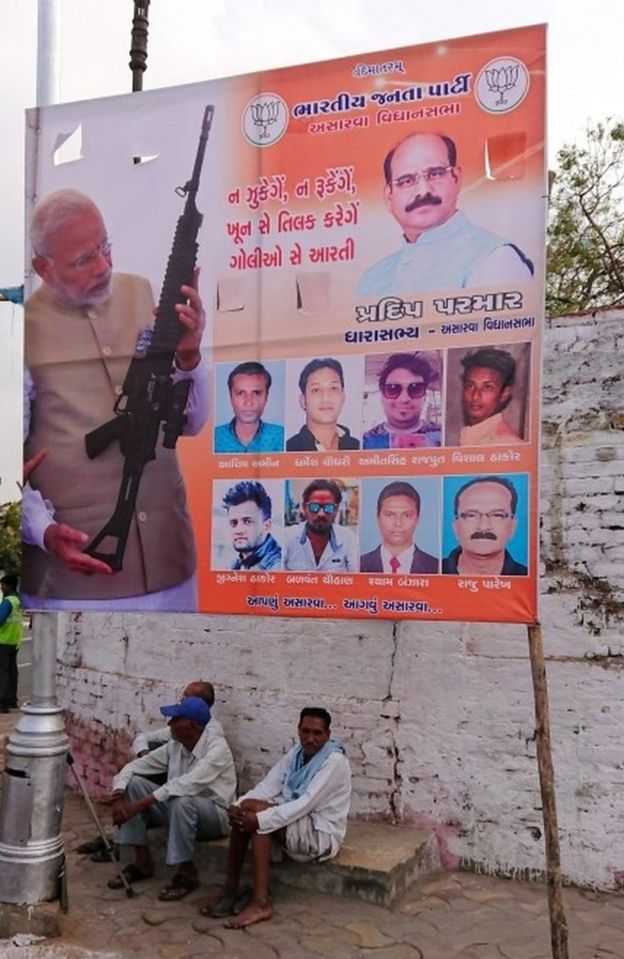
A billboard displaying an image of Indian Prime Minister Narendra Modi holding a rifle is seen on a roadside in Ahmedabad on March 3, 2019.Image copyrightAFP
Image captionThe BJP has put up election posters of Mr Modi posing with guns

Even as tensions between India and Pakistan ratcheted up last week, Mr Modi went on with business as usual. Hours after the Indian attack in Pakistan’s Balakot region, he told a packed election meeting that the country was in safe hands and would “no longer be helpless in the face of terror”. Next morning, Pakistan retaliated and captured an Indian pilot who ejected from a downed fighter jet. Two days later, Pakistan returned the pilot to India.

Mr Modi then told a gathering of scientists that India’s aerial strikes were merely a “pilot project” and hinted there was more to come. Elsewhere, his party chief Amit Shah said India had killed more than 250 militants in the Balakot attack even as senior defence officials said they didn’t know how many had died. Gaudy BJP posters showing Mr Modi holding guns and flanked by soldiers, fighter jets and orange explosions have been put up in parts of the country. “Really uncomfortable with pictures of soldiers on election posters and podiums. This should be banned. Surely the uniform is sullied by vote gathering in its name,” tweeted Barkha Dutt, an Indian television journalist and author.

Mr Modi has appealed to the opposition to refrain from politicising the hostilities. The opposition parties are peeved because they believe Mr Modi has not kept his word. Last week, they issued a statement saying “national security must transcend narrow political considerations”.

‘Petty political gain’

But can the recent conflict fetch more votes for Mr Modi? In other words, can national security become a campaign plank?

Many believe Mr Modi is likely to make national security the pivot of his campaign. Before last month’s suicide attack – claimed by Pakistan-based militants – killed more than 40 Indian paramilitaries in Kashmir, Mr Modi was looking a little vulnerable. His party had lost three state elections on the trot to the Congress party. Looming farm and jobs crises were threatening to hurt the BJP’s prospects.

Now, many believe, Mr Modi’s chances look brighter as he positions himself as a “muscular” protector of the country’s borders. “This is one of the worst attempts to use war to win [an] election, and to use national security as petty political gain. But I don’t know whether it will succeed or not,” says Yogendra Yadav, a politician and psephologist.

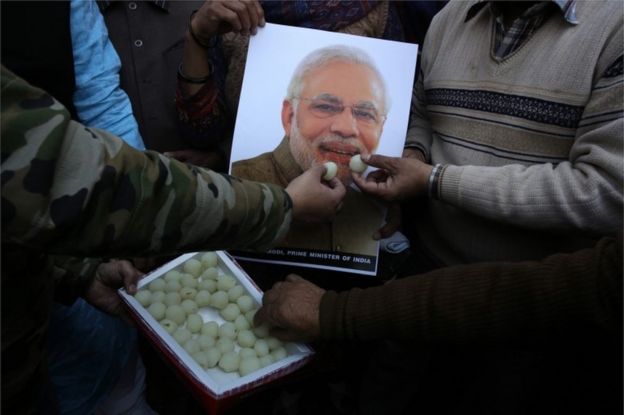
Indian people feed sweets to a poster of Indian Prime Minister Narendra Modi as they celebrate the Indian Air Force"s air strike across the Line of Control (LoC) near the international border with PakistanImage copyrightEPA
Image captionMany Indians have celebrated India’s strike in Pakistani territory

Evidence is mixed on whether national security helps ruling parties win elections in India. Ashutosh Varshney, a professor of political science at Brown University in the US, says previous national security disruptions in India were “distant from the national elections”.

The wars in 1962 (against China) and 1971 (against Pakistan) broke out after general elections. Elections were still two years away when India and Pakistan fought a war in 1965. The 2001 attack on the Indian parliament that brought the two countries to the brink of war happened two years after a general election. The Mumbai attacks in 2008 took place five months before the elections in 2009 – and the then ruling Congress party won without making national security a campaign plank.

Things may be different this time. Professor Varshney says the suicide attack in Kashmir on 14 February and last week’s hostilities are “more electorally significant than the earlier security episodes”.

For one, he says, it comes just weeks ahead of a general election in a highly polarised country. The vast expansion of the urban middle class means that national security has a larger constituency. And most importantly, according to Dr Varshney, “the nature of the regime in Delhi” is an important variable. “Hindu nationalists have always been tougher on national security than the Congress. And with rare exceptions, national security does not dominate the horizons of regional parties, governed as they are by caste and regional identities.”

Presentational grey line

Read more from Soutik Biswas

Presentational grey line

Bhanu Joshi, a political scientist also at Brown University, believes Mr Modi’s adoption of a muscular and robust foreign policy and his frequent international trips to meet foreign leaders may have touched a chord with a section of voters. “During my work in northern India, people would continuously invoke the improvement in India’s stature in the international arena. These perceptions get reinforced with an event like [the] Balakot strikes and form impressions which I think voters, particularly on a bipolar contest of India and Pakistan, care about,” says Mr Joshi.

Others like Milan Vaishnav, senior fellow and director of the South Asia Program at the Carnegie Endowment for International Peace, echo a similar sentiment. He told me that although foreign policy has never been a “mass” issue in India’s domestic politics, “given the proximity of the conflict to the elections, the salience of Pakistan, and the ability of the Modi government to claim credit for striking back hard, I expect it will become an important part of the campaign”.

But Dr Vaishnav believes it will not displace the economy and farm distress as an issue, especially in village communities. “Where it will help the BJP most is among swing voters, especially in urban constituencies. If there were fence-sitters unsure of how to vote in 2019, this emotive issue might compel them to stick with the incumbent.”

How the opposition counters Mr Modi’s agenda-setting on national security will be interesting to watch. Even if the hostilities end up giving a slight bump to BJP prospects in the crucial bellwether states in the north, it could help take the party over the winning line. But then even a week is a long time in politics.

Source: The BBC

27/02/2019

Live updates| PM Modi holds key meet on Pak situation with top officials

IAF strike on Jaish camp in Pakistan updates: IAF pilot who engaged Pakistan jets missing in action, said the government. India verifying Pak claims on his custody. Follow live updates here:

Pakistani aircraft violated Indian air space in the Nowshera sector of Jammu and Kashmir’s Rajouri district on Wednesday morning. The Indian Air Force scrambled jets and pushed them back. News agency ANI has reported that a Pakistan Air Force F-16 was shot down in Indian retaliatory fire in Nowshera’s Lam valley.

The Pakistani jets had entered into Indian air space over Rajouri district this morning, sources said.

The air space violation by Pakistani jets comes a day after Indian Air Force jets flew across the Line of Control to blow up Jaish-e-Mohammed’s biggest terror camp.

Watch| India lost one MiG 21, pilot who engaged Pak jets ‘missing in action’: Govt


Follow live updates here:

4:55 pm IST

Army’s Eastern Command chief visits Panagarh base in West Bengal amid escalating tensions

Amid heightened tensions between India and Pakistan, Army’s Eastern Command chief Lt General Manoj Naravane visited Panagarh base in West Bengal on Wednesday and reviewed operational preparedness, a defence official said.

Lt Gen Naravane, General Officer Commanding-in-Chief, Eastern Command, emphasised the need for remaining alert at all times to meet the emerging security challenges, the official said.

4:50 pm IST

“Whole country is proud of this brave son,” Arvind Kejriwal tweets for IAF pilot’s safe return

“I pray for the safety of Indian Air Force pilot Wing Commander Abhinandan,” tweeted Arvind Kejriwal. “Whole country is proud of this brave son and everyone is hoping for his safe return. We all stand united to keep our country safe and strong,” Arvind Kejriwal said in the tweet.

4:35 pm IST

Pakistan has long denied its role in terror acts in India

In his last televised statement, Imran Khan appeared to ignore the claims made by Jaish. Pakistan has long denied its role in terror acts in India, which has handed it over several dossiers containing evidence of involvement of terror groups working from its soil.

4:33 pm IST

Imran Khan’s fresh call for dialogue comes in the wake of Pulwama terror attack

Imran Khan’s fresh call for dialogue comes in the wake of India’s effort to corner Pakistan among international community in the wake of Pulwama terror attack, in which at least 40 soldiers were killed. Pakistan-based Jaish-e-Mohammed claimed responsibility for the attack.

4:26 pm IST

Imran Khan calls for talks to de-escalate rising tensions with India over Kashmir

Pakistani Prime Minister Imran Khan calls for talks to de-escalate rising tensions with India over Kashmir.

3:57 pm IST

Better sense should prevail: Imran Khan after Pak strike

“We offered that we are ready for any kind of investigation after Pulwama attack in India. We didn’t take action on Tuesday morning because we weren’t aware of the damage caused by air strike by India. We did not want to cause much collateral damage in India when there was not much damage on our side. The only motive of Pakistan’s strike today was to demonstrate that we have the capability to hit back.

All the wars have happened due to miscalculation. With all the weapons that Pakistan and India have, can we afford to miscalculate. If we take to war neither I nor Mr Narendra Modi would be in a position to control its course. This is why I suggest that better sense should prevail,” said Imran Khan.

3:25 pm IST

IAF pilot who engaged Pak jets missing in action: Govt

IAF pilot who engaged Pakistan jets missing in action, said the government. India verifying Pak claims on his custody.

Pakistan used air force to target military installations, attempt foiled successfully, the government added.

3:20 pm IST

Foreign ministry and Air Vice Marshal brief media

Foreign ministry and Air Vice Marshal briefed the media.

3:00 pm IST

Maharashtra on high alert amid border tensions

Maharashtra and its capital Mumbai have been put on high alert’ in the wake of the rising tensions on the country’s north-west border, official sources said in Mumbai on Wednesday.

Heightened security was seen in Mumbai, the commercial capital of the country. Police vigil has been enhanced in Pune, Nagpur, Aurangabad, Nashik and Kolhapur as well. The government is ensuring there is no disturbance to the ongoing HSC (Class XII) examinations in the state, reported news agency IANS.

2:45 pm IST

Pakistan closes its airspace for commercial flights

Pakistan has closed its airspace for commercial flights, the Civil Aviation Authority (CAA) announced on Wednesday amid escalating tensions with India.

The aviation authority made the announcement on Twitter after Major General Asif Ghafoor, Director General of the Pakistan Army’s media wing, Inter-Services Public Relations (ISPR), acknowledged the closure of Pakistan’s airspace due to the security situation, Dawn News reported.

2:35 pm IST

Air India avoiding route of Pakistan air space with immediate effect

Air India avoiding route of Pakistan air space with immediate effect. India use Pakistan airspace for flights to Gulf countries, Europe and USA, said an Air India official

1:25 pm IST

Pakistan says 2 IAF jets shot down, India rejects claim

There are no reports of any IAF jet suffering damage in action by India’s adversaries, defence sources said on Wednesday according to news agency PTI.

Earlier in the day, Pakistan claimed it shot down two Indian military aircraft over Pakistani air space and arrested at least one of the pilots, according to PTI.

1:20 pm IST

Army, BSF troops along IB, LoC on highest degree of alertness: Officials

The Army and BSF have been put on the highest degree of alertness along the border in Jammu after air space violations by the neighbouring country and the night-long heavy firing and shelling by Pakistani troops on forward and civilians areas across the LoC which stopped on Wednesday, reported news agency PTI.

Authorities have ordered temporary closure of educational institutions in a 5-km radius along the Line of Control (LoC) in Rajouri and Poonch districts on Wednesday amid mounting tensions between the two countries, following the Pulwama terror attack on February 14 and an Indian air strike on Jaish-e-Mohammed camp inside Pakistan on Tuesday.

1:14 pm IST

Defence minister Nirmala Sitharaman chairs DAC meeting

The Defence Acquisition Council (DAC) chaired by defence minister Nirmala Sitharaman met here today and accorded approval for acquisition of defence equipment for about Rs 2700 crores.

Approval was granted for procurement of three Cadet Training ships for the Indian Navy, which would be utilised to provide basic sea training for officer cadets including women officer undertrainees. The ships would be capable of undertaking Hospital Ship duties, providing Humanitarian Assistance and Disaster Relief, undertaking Search and Rescue (SAR) missions and Non-Combatant Evacuation Operations.

1:08 am IST

China reiterates call for India and Pakistan to exercise restraint

China’s Foreign Ministry on Wednesday said it reiterated its call for India and Pakistan to exercise restraint.

Ministry spokesman Lu Kang made the comment at a regular news briefing in Beijing.

1:00 pm IST

PM Modi rushes to review security situation: Report

Prime Minister Narendra Modi cut short his address at a function in Vigyan Bhawan on Wednesday and rushed to attend a meeting to review the security situation arising out of Pakistan’s attempt to violate Indian air space, reported news agency ANI.

Modi was replying to the questions from youngsters during the National Youth Festival 2019 when he was handed over a small piece of paper by an official of Prime Minister Office (PMO).

The Prime Minister immediately stopped and walked towards the panelist where Union minister Rajyavardhan Rathore was also present.

12:53 pm IST

Pakistan stops domestic, international flight operations from Lahore, Multan, Faisalabad, Sialkot and Islamabad

Pakistan immediately stops its domestic and international flight operations from Lahore, Multan, Faisalabad, Sialkot and Islamabad airports, reported news agency ANI.

12:30 pm IST

Sensex turns negative; cracks over 200 points

The benchmark BSE Sensex gave up all early gains and fell over 200 points in afternoon trade Wednesday on widespread selling after Pakistani fighter jets violated Indian air space in Jammu and Kashmir.

After dropping 238 points, the Sensex was trading 161.74 points, or 0.46 per cent, down at 35,811.97 after hitting a low of 35,735.33. The gauge rallied nearly 400 points in morning trade.

The 50-share Nifty also fell 62.55 points, or 0.58 per cent, to 10,772.75.

According to brokers, investor sentiment took a beating after Pakistan claimed that it shot down two Indian military aircraft over Pakistani air space and arrested one of the pilots.

The Pakistani fighter jets on Wednesday violated Indian air space in Jammu and Kashmir’s Poonch and Nowshera sectors.

12:08 pm IST

Rajnath reviews security situation

Home Minister Rajnath Singh Wednesday reviewed the security situation in the country, especially along the border with Pakistan, a day after Indian fighter jets bombed the biggest camp of terror group Jaish-e-Mohammad in that country, officials said.

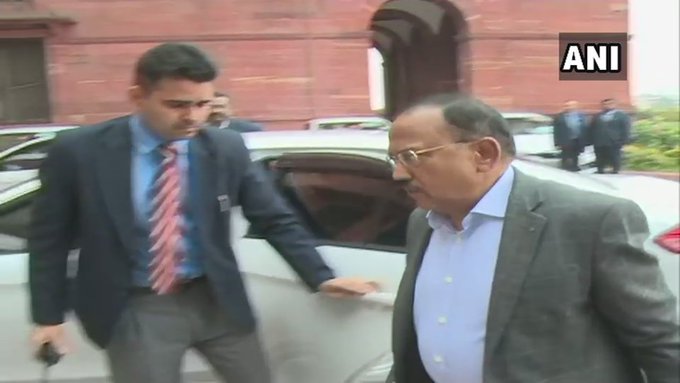
During the meeting, attended by National Security Advisor Ajit Doval among others, a detailed presentation was given about the security situation in the country and steps taken to ensure peace in all sensitive places.

Singh directed the officials to ensure the Border Security Force, which guards the India-Pakistan border continues to remain on highest level of alertness so that any misadventure from across the border could be foiled, a home ministry official said.

12:01 pm IST

‘Don’t want to escalate tensions, but we are prepared’, says Pakistan

“Today, Pakistan Air Force undertook strikes across Line of Control from within Pakistani airspace. This was not a retaliation to continued Indian belligerence. Pakistan has therefore, taken strikes at non military target, avoiding human loss and collateral damage. Sole purpose being to demonstrate our right, will and capability for self defence.

We have no intention of escalation, but are fully prepared to do so if forced into that paradigm. That is why we undertook the action with clear warning and in broad daylight. For the last few years, India has been trying to establish what they call “a new normal” a thinly veiled term for doing acts of aggression at whatever pretext they wish on a given day.

If India is striking at so called terrorist backers without a shred of evidence, we also retain reciprocal rights to retaliate against elements that enjoy Indian patronage while carrying out acts of terror in Pakistan. We do not wish to go to that route and wish that India gives peace a chance and to resolve issues like a mature democratic nation,” read a statement released by Pakistan on Wednesday.

11:50 am IST

National Security Advisor Ajit Doval arrives at Home Ministry

National Security Advisor Ajit Doval arrived at the Home Ministry in Delhi.

11:45 am IST

Hope India, Pak conduct dialogue to establish facts through investigation: Wang Yi

“As a mutual friend to both India and Pakistan, we hope that they can conduct dialogue to establish facts through investigation to keep things under control and maintain peace and stability in the region. In this process China is playing a constructive role not the opposite,” said China’s foreign minister Wang Yi.

11:42 am IST

Russia, China and India reaffirmed strong opposition to terrorism: Wang Yi

“Russia, China and India reaffirmed strong opposition to terrorism. At the same time we (China) believe Pakistan has always been opposed to terrorism. China appreciates statements from Indian and Pak friends saying they’ll exercise restraint and avoid escalation of situation,” said China’s foreign minister Wang Yi.

11:37 am IST

Pakistani jets violate Indian air space in Nowshera

Pakistani jets violated Indian air space in Jammu and Kashmir’s Nowshera sector but were successfully confronted.

An official said the jets were immediately pushed back by Indian jets on air patrol.

10:55 am IST

Discussed establishment of UN led global counter-terrorism mechanism: Swaraj

“We need a global strategy, global cooperation. I’m happy to tell you today we discussed the establishment of UN led global counter-terrorism mechanism and finalising CCIT (Comprehensive Convention on International Terrorism) proposed by India to implement it,” said external affairs minister Sushma Swaraj in Wuzhen, China.

“As far as Pulwama is concerned, I had raised this issue in the bilateral meeting with Mr Wang Yi and also at RIC (Russia-India-China) forum,” she added.

10:42 am IST

All countries need to show ‘zero tolerance’ towards terrorism: Sushma Swaraj

Terrorists attacks like Pulwama are a grim reminder for the need of all countries to show ‘zero tolerance’ towards terrorism, external affairs minister Sushma Swaraj said on Wednesday, a day after India conducted pre-emptive air strikes deep inside Pakistan hitting Jaish-e-Mohammad training camps.

The operation was carried out in light of Pakistan’s refusal to acknowledge and act against terror groups operating from its soil and credible information that JeM was planning attacks in India, she said.

10:10 am IST

India’s response to Pulwama attack top agenda of Opposition meet

Left parties will participate in the meeting of the opposition parties, scheduled to be held later today. They had earlier said that they will not participate in the meeting. Pulwama attack and India’s response to it are on the agenda of discussion, reported news agency ANI.

9:55 am IST

Defence minister to meet Army, IAF, Navy chiefs shortly

Defence minister Nirmala Sitharaman, Army Chief General Bipin Rawat, Chief of the Air Staff Air Chief Marshal Birender Singh Dhanoa and Navy Chief Admiral Sunil Lanba will attend DAC (Defence Acquisition Council) meeting shortly today.

9:35 am IST

Mumbai on high alert, govt asks schools to exercise caution

In the wake of air strikes carried out by the Indian Air Force (IAF) on terror camps in Pakistan’s Balakot, the Maharashtra government has called for office bearers of the School & Co. Bus Owner’s Association to ensure the safety of school children keeping the prevailing situation in mind, reported news agency ANI.

Chief Minister Devendra Fadnavis told the state legislature that security has been tightened across the city and appealed to people not to panic.

After intelligence informed Mumbai police to be on high alert, the vigilance and CCTV surveillance has been increased in places like the airport, railway stations, and other key locations.

9:22 am IST

2 Jaish terrorists killed

At least two Jaish terrorists were killed in an encounter that broke out with security forces in Shopian district of Jammu and Kashmir, officials said.

9:20 am IST

Villagers being shifted to safer places

After cross LoC shelling and ceasefire violations , the villagers in some areas of Jammu and Kashmir’s Uri are being shifted to safer places according to officials.

9:05 am IST

Balakot camp blown up by IAF was Jaish’s preferred training spot for 18 yrs

Balakot’s Jaba Top first emerged as a preferred training ground for militants in the time of President Zia-ul-Haq. It was an ideal place for a camp for non-state actors — remote, located near a small town, yet far enough from it, on a wooded hilltop, and on Pakistani territory in the Khyber-Pakhtunkhwa. India crossed into Pakistan’s territory in 1971 (and then again, its aircraft on Tuesday), and so the Pakistanis may have thought it was a good place to host a training camp for militants whom the rest of the world called terrorists.

8:58 am IST

Underscore priority of de-escalating current tensions by avoiding military action: Mike Pompeo to Pak foreign minister

“I spoke to Pakistani foreign minister Shah Mehmood Qureshi to underscore the priority of de-escalating current tensions by avoiding military action and the urgency of Pakistan taking meaningful action against terrorist groups operating on its soil,” said US Secy of State Mike Pompeo, according to news agency ANI.

8:50 am IST

Objective was to act against terrorist infrastructure: Sushma Swaraj in China

“It wasn’t a military op, no military installation targeted. Objective was to act against terrorist infrastructure of JeM to preempt another terror attack in India. India doesn’t wish to see further escalation of situation. It’ll continue to act with responsibility and restraint,” said external affairs minister Sushma Swaraj at the 16th Foreign Ministers meeting of Russia-India-China (RIC) in Wuzhen, China.

8:45 am IST

Target selected to avoid civilian casualties: Sushma Swaraj

“In the light of continuing refusal of Pak to acknowledge and act against terror groups on its territory and based on credible info that JeM was planning other attacks in parts of India, GoI decided to take preemptive action and target was selected in order to avoid civilian casualties,” said external affairs minister Sushma Swaraj at the 16th foreign ministers meeting of Russia-India-China (RIC) in Wuzhen, China, reported news agency ANI.

8:43 am IST

Pakistan outrightly denied any knowledge of Pulwama attack: Sushma Swaraj

“Such dastardly terrorist attacks are a grim reminder for the need of all the countries to show zero tolerance to terrorism and take decisive action against it.

Following the Pulwama terrorist attack instead of taking seriously the calls by international community to act against Jaish-e-Mohammed and other terror groups based in Pakistan, it denied any knowledge of the attack and outrightly dismissed claims by Jaish-e-Mohammed,” said external affairs minister Sushma Swaraj at the 16th foreign ministers meeting of Russia-India-China (RIC) in Wuzhen, China, reported news agency ANI.

8:40 am IST

Did the US know of India’s strike on Balakot? And how much?

Asked about India’s right to self-defence, President Donald Trump told reporters last week, “India is looking at something very strong. And, I mean, India just lost almost 50 people and… with an attack, so I can understand that also.”

And his national security adviser John Bolton had on his own told reporters at a briefing that he had conveyed to his Indian counterpart Ajit Doval in a phone call “that we support India’s right to self-defence”.

8:37 am IST

Only 7 people knew of timing of air strike

On February 18, Prime Minister Narendra Modi had approved the strike. According to intelligence officials, only seven people knew of this decision – Modi, Doval, the three service chiefs, and the heads of RAW and Intelligence Bureau.

Starting February 22, the Air Force started flying night sorties from various frontline bases to confuse the Pakistanis. On February 25, intelligence inputs suggested the presence of a large number of JeM terrorists, around 300-350, at the Balakot camp. The same evening it was decided to go ahead with the strike immediately. Modi knew by late evening that an attack could happen in the next few hours.

8:31 am IST

Exercise ‘maximum restraint’: UN chief to India, Pakistan

UN chief Antonio Guterres is following the situation between India and Pakistan “very closely” and has appealed to the governments of both nations to exercise “maximum restraint” to ensure the situation does not deteriorate further, a top UN official said Tuesday.

The UN Secretary General’s remarks came after Indian Air Force (IAF) carried out a pre-dawn air strike on a terror training camp inside Pakistan.

8:27 am IST

Pak must take ‘action’ against terror groups: US after IAF strikes

Pakistan must take ‘meaningful action’ against terror groups, says US after IAF strikes on Jaish camp, reported news agency PTI

8:25 am IST

Encounter underway between militants, security forces in J-K’s Shopian

An encounter broke out on Wednesday between militants and security forces in Shopian district of Jammu and Kashmir, officials said. Security forces launched a cordon and search operation in Meemendar area of Shopian following information about presence of militants there, the officials said.

They said the search operation turned into an encounter after militants opened firing towards the security forces, who retaliated.

Source: Hindustan Times

22/02/2019

“Don’t mess with Pakistan,” India is told amid Kashmir tension

RAWALPINDI, Pakistan (Reuters) – Pakistan will respond to any attack by India with “full force”, the army’s spokesman said on Friday, amid heightened tensions between the two nuclear-armed neighbours over Kashmir.

Major General Asif Ghafoor was speaking a week after a Pakistani-based militant group claimed responsibility for a suicide car bomb attack that killed 40 Indian paramilitary policemen the Himalayan region disputed between India and Pakistan.

India’s top military commander in the region has alleged Pakistan’s main Inter-Services Intelligence (ISI) spy agency was involved.

“We have no intention to initiate war, but we will respond with full force to full spectrum threat that would surprise you,” Ghafoor told reporters in the garrison city of Rawalpindi. “Don’t mess with Pakistan.”

The army’s response came two days after Prime Minister Imran Khan urged India to share any actionable evidence, offering full cooperation in investigating the blast.

He also offered talks with India on all issues, including terrorism, which India has always sought as a pre-requisite to any dialogue between the two arch-rivals.

India and Pakistan have fought two wars since independence in 1947 over Kashmir, which both the countries claim entirely.

Ghafoor also reiterated the talks offer.

“Kashmir is a regional issue,” he said. “Let us talk about it. Let us resolve it.”

India blames Pakistani Islamist militant groups for infiltrating into its part of Kashmir to fuel an insurgency and help separatist movements.

Washington and Delhi allege that the Pakistani army nurtures the militants to use them as a foreign policy tools to expand power in neighbouring India and Afghanistan. The army denies that.

One such group is Lashkar-e-Taiba (LeT), which India blamed for attacks in Mumbai in 2008 which killed 166 people, saying its founder, Hafiz Saeed, was the mastermind.

The United States has offered a $10 million reward for information leading to his conviction over the Mumbai attacks.

Pakistan has put him under house arrest several times and banned his Islamist groups, Jamaat-ud-Dawa (JuD) and Falah-e-Insaniat Foundation (FIF), which the United States and the United Nations say are terrorist fronts for the LeT.

Islamabad reinstated the ban on the groups yet again on Thursday, but Saeed remains free, allowed to roam the country and make public speeches and give sermons.

Source: Reuters

21/02/2019

India Catholic Cardinal Oswald Gracias ‘failed abuse victims’

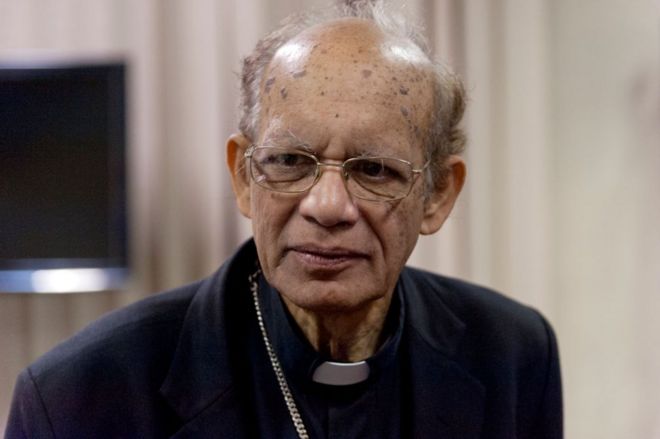
Cardinal Oswald Gracias, Archbishop of Bombay, during the launch of the bishops' declaration on climate justice on 26 October 2018 in Rome, Italy.Image copyrightGETTY IMAGES
Image captionCardinal Oswald Gracias told the BBC it pained him to hear accusations that he had neglected victims of alleged abuse

One of the Catholic Church’s most senior cardinals has admitted that he could have better handled sexual abuse allegations that were brought to him.

Oswald Gracias, the Archbishop of Mumbai is one of four men organising a major Vatican conference on child abuse this week.

We found two separate cases where the cardinal, who is tipped by some to possibly become the next Pope, is claimed to have failed to respond quickly or offer support to the victims.

Victims and those who supported them allege that Cardinal Gracias did not take allegations of abuse seriously when they were reported to him.

India’s Catholics say there is a culture of fear and silence in the Catholic Church about sexual abuse by priests. Those who have dared to speak out say it has been an ordeal.

‘My heart was hurt’

The first case dates back to 2015 in Mumbai.

A woman’s life changed when her son returned from Mass at the church and told her that the parish priest had raped him.

“I could not understand what should I do?” she said. She did not know this yet, but this event would put her on a collision course with the Catholic Church in India.

Media captionWhy is India’s Catholic church silent about sexual abuse?

The man she reached out to for help was and remains one of the most senior representatives of the Church.

It was nearly 72 hours after the alleged rape that the family briefly met Cardinal Gracias, then president of the Catholic Bishop’s Conference of India and Federation of Asian Bishops’ Conferences.

The issue of sexual abuse within the Church is being called the Vatican’s biggest crisis in modern times, and the integrity of the Catholic Church is said to ride on the outcome of this conference.

Pope Francis, flanked by Archbishop of Bombay Cardinal Oswald Gracias (L) and other bishops, arrives at Synod Hall in Vatican City on 24 October 2015Image copyrightGETTY IMAGES
Image captionPope Francis with Cardinal Oswald Gracias (fourth from left)

Over the past year, the Catholic Church has been reeling under multiple allegations of sexual abuse around the world.

But while abuse claims have made headlines in North and South America, Europe and Australia, very little is known about the problems in Asian countries. In countries such as India there is a social stigma about reporting abuse.

Among Christians, who are a minority of nearly 28 million people, a culture of fear and silence makes it impossible to gauge the true scale of the problem.

Cardinal Blase Cupich of Chicago – a colleague of Cardinal Gracias on the four-member organising committee – has promised that decisive action in Rome and in dioceses worldwide will follow after the meeting so as to safeguard children and bring justice to the victims.

Cardinal Gracias will open the second day of the summit with a conversation about accountability in the Church.

Media captionBrigitte, a survivor of child sex abuse by a chaplain, explains why she is ready to speak now

This vital role given to him during this crucial conference has made some in India unhappy.

They say his track record in protecting children and women from abusers is questionable. Those we have spoken to who have taken cases to him say they received little support from him.

The mother of the abused boy said: “I told the cardinal about what the priest had done to my child, that my child was in a lot of pain. So he prayed for us and told us he had to go to Rome…my heart was hurt in that moment.

“As a mother, I had gone to him with great expectations that he would think about my son, give me justice, but he said he had no time, he only cared about going to Rome.”

The family say they requested medical help but were offered none.

The cardinal told us it pained him to hear this, and that he was not aware that the boy needed medical help – and if he had been asked, he would have immediately offered it.

The Archbishop's house in Mumbai

The cardinal admits he left for Rome that night without alerting the authorities.

By failing to call the police, Cardinal Gracias may have violated India’s Protection of Children from Sexual Offences Act, 2012 (POCSO).

The provisions of this law state that if the head of any company or institution fails to report the commission of an offence in respect of a subordinate under his control, they shall be punished with imprisonment for a term which may extend to one year, and with a fine.

The cardinal told us he had telephoned his bishop the next day, who told him the family had subsequently informed the police themselves.

Asked if he regretted not calling the police personally at the time, he said: “You know I’m being honest, I’m not 100% sure… but I must reflect on that. I admit whether immediately, the police should have got involved, sure.”

He says he was under a duty to evaluate the credibility of accusations by speaking to the accused man.

Emerging from that meeting, the family decided to go to a doctor.

“He took one look at my boy and said that something has happened to him. This is a police case. Either you report it or I will… so we went to the police that night,” the mother said.

A police medical examination found that the child had been sexually assaulted.

Indian Catholics pray during Friday afternoon service at the Holy Name Cathedral in Mumbai on 15 March 2013.Image copyrightGETTY IMAGES
Image captionIndia is home to about 19 million Catholics

A current priest who spoke to us on the condition of anonymity said this was not the first time allegations about this priest had been brought to the cardinal’s attention.

“I met him some years before this [alleged] incident,” the priest told us.

“There were strong rumours about [the accused priest] in the diocese, and like these are about abuse that is taking place. And yet he seems to be moving from one place to another, one parish to another. The cardinal told me directly that he is not aware directly of all these things.”

The cardinal says he cannot recall the conversation. He says he did not recollect any “cloud of suspicion” over the man.

‘A lonely battle’

As part of our investigation, we wanted to see if there were other allegations of the cardinal being slow to act.

We found an instance dating back almost a decade, brought to his attention just a couple of years after becoming archbishop of Mumbai.

Virginia Saldanha.
Image captionCatholic activist Virginia Saldanha says three legal notices were sent to the cardinal, threatening court action unless took action about the claims of abuse

In March 2009, a woman approached him with accusations of sexual abuse by another priest who conducted retreats.

She says that he took no action against the priest so she reached out to a group of female Catholic activists, who say they forced the cardinal to act.

Under pressure, he finally set up an enquiry committee in December 2011. Six months after the enquiry, there was still no action and the accused priest continued working in his parish.

“We had to send the cardinal three legal notices to act, threaten to take the matter to the courts if he did not act,” said Virginia Saldanha, a devout Catholic who has worked on the women’s desk of multiple Church-affiliated positions for over two decades.

When the cardinal replied, he said: “The priest is not listening to me.”

Blurred image of family
Image captionThe family says they have been ostracised from the church and isolated within their communities since reporting the sexual assault

During the time, Saldanha said she had to leave the church because “I could not bear to see that man giving Mass in the church. I did not feel like going there.”

The priest was eventually removed from his parish, but the reasons for his departure were never made public.

The punishment, decided by the cardinal personally in October 2011, was a “guided retreat and therapeutic counselling”.

When we pressed him about the speed of process and punishment, the cardinal said it was a “complicated case”.

After a stay in the seminary, the accused priest was briefly given a parish again and still conducts retreats.

Meanwhile, the family of the allegedly raped minor feel abandoned by the institution that they had built their lives around.

“It has been a lonely battle,” the mother concedes. They say they have been ostracised from the church and isolated within their communities.

“After complaining to the police, when we would go into church, people would refuse to talk to us, to sit next to us during Mass. If I went to sit next to someone… they would get up and leave,” she said.

The hostility she encountered eventually “made us leave the church. But it got so difficult for us that we eventually had to change our home as well. We left it all behind”.

Church members say that it is this hostility that makes it harder for victims and their families to speak up.

Caught between an apparently unsupportive clergy and hostile social network, many find their voices faltering.

Source: The BBC

Law of Unintended Consequences

continuously updated blog about China & India

ChiaHou's Book Reviews

continuously updated blog about China & India

What's wrong with the world; and its economy

continuously updated blog about China & India