26/09/2019
- Cheng Qiang was just 12 when a magnitude 8 tremor destroyed his village, but he never forgot the heroism of the soldiers sent to help and swore one day to join their ranks
- Now a squad leader, on October 1 he will also be part of the National Day celebrations in Tiananmen Square
Cheng Qiang was just 12 when his home in Sichuan was hit by a massive earthquake and airborne troops were sent to help. Photo: People.cn
A young man who survived the devastating
Sichuan earthquake and vowed to one day join the ranks of the soldiers who spent months rescuing people from the rubble will on Tuesday lead his very own squad of airborne troops in
Tiananmen Square as part of the celebrations for the country’s 70th anniversary.
Now 23, Cheng Qiang was just 12 when on May 12, 2008 he and a group of friends played truant from school to go swimming in a local river, Xinhua reported on Thursday.
When the boys had finished their fun they returned to their village in the township of Luoshui to find their school and many other buildings had been razed to the ground. The death toll from the magnitude 8 quake would eventually rise to 87,000, with 370,000 people injured.
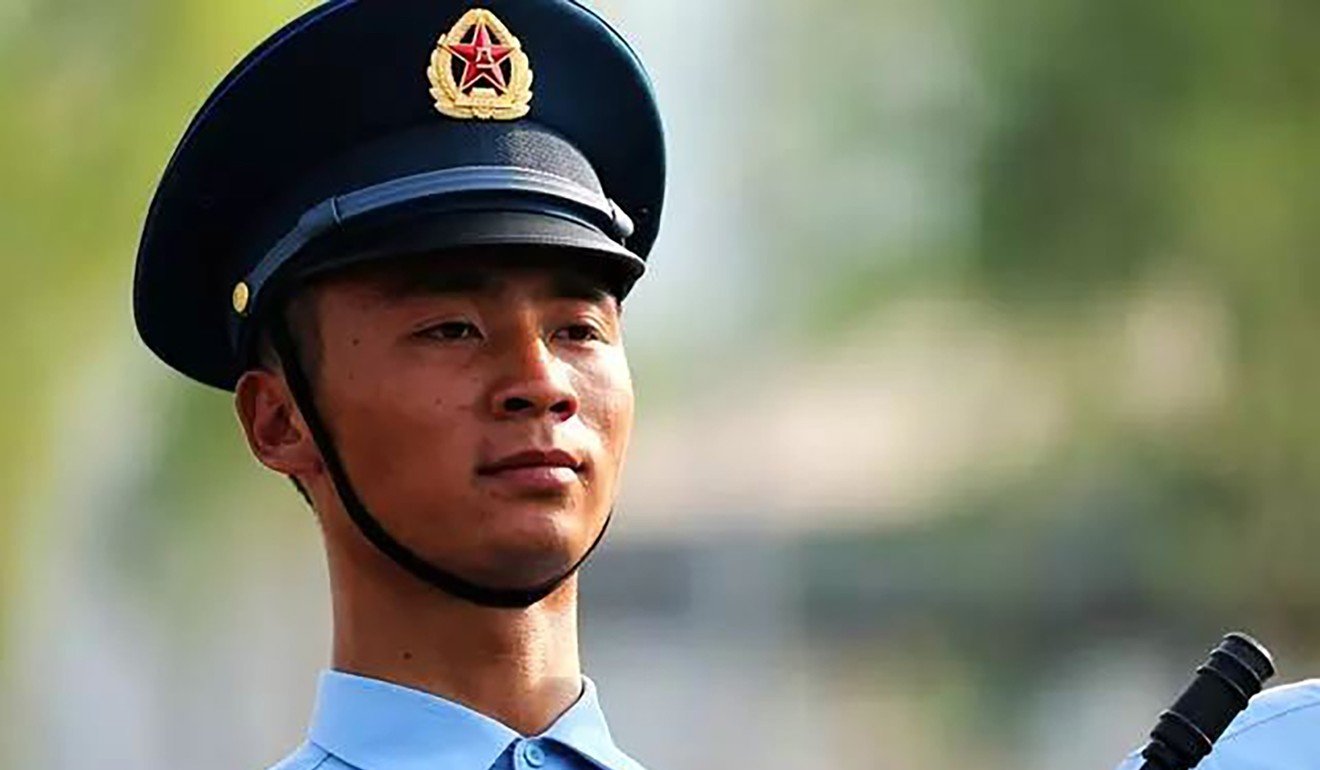
Cheng says he is ready to “continue the glory of the airborne troops” at Tuesday’s parade. Photo: Thepaper.cn
In the days and weeks that followed the devastation, tens of thousands of people from around China and the world descended on towns and villages across Sichuan to help with the rescue effort.
But the ones who impressed Cheng the most were the soldiers from the People’s Liberation Army (PLA) with the word “Airborne” printed on the helmets.
“Sometimes they had to remove the debris with their bare hands which were already covered in blood,” he said.
“But they just carried on and eventually pulled dozens of people out of the rubble. I knew then that I wanted to be one of them.”
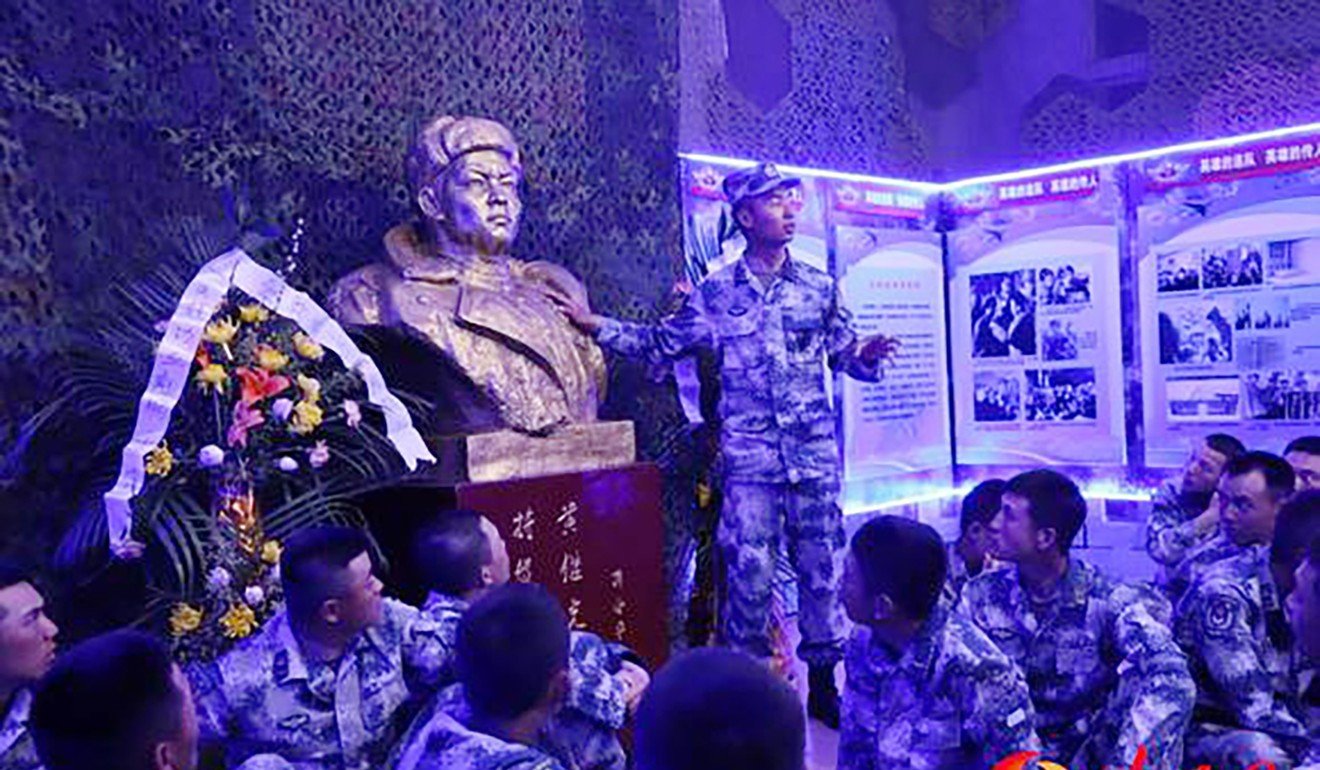
Cheng said that after the quake having the troops in his village made him feel safe. Photo: People.cn
Having the troops in his village made Cheng feel safe, he said, and he spent his days following them around and doing what he could to help.
Three months later, when the soldiers had completed their work and were preparing to pull out, Cheng said he was determined to show his new heroes just how grateful he was to them.
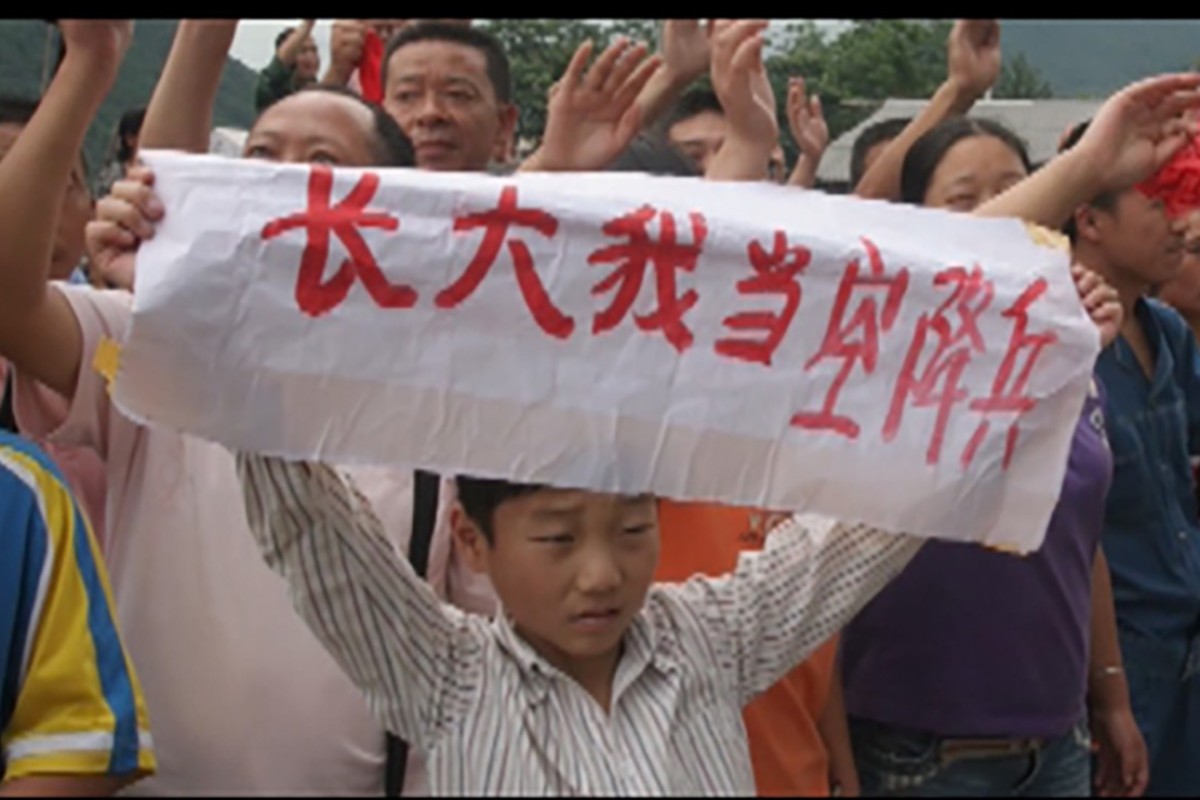
As the villagers gathered at the roadside to bid farewell to the men who had become their saviours, the young boy held up a handwritten sign. It said simply: “I want to be an airborne soldier when I grow up.”
The moment was captured on camera by a press photographer, and the image soon became a symbol of the gratitude felt by the people who had seen their lives and communities shattered but knew they had not been forsaken.
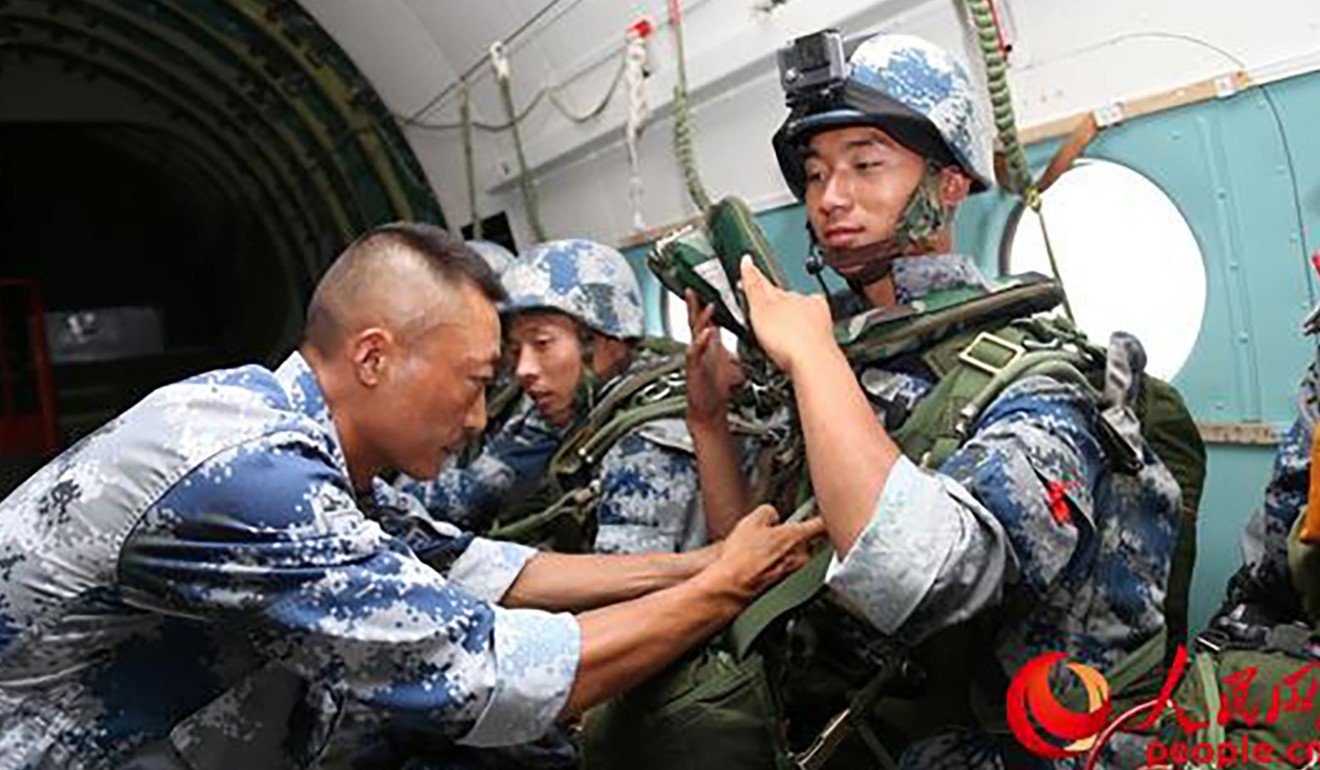
Cheng said he felt dizzy when he first jumped out of a plane. Photo: People.cn
Five years after the troops rolled out, Cheng was preparing to go to college when he heard the PLA was recruiting and that there were places available with the airborne division.
The teenager did not need a second invitation, and after securing a place on a training course and successfully completing it he joined the ranks of his heroes in 2013.
Not that everything was plain sailing, however.
“When I first jumped out of a plane I felt very dizzy and didn’t really know what was going on,” he said.
Thankfully Cheng managed to overcome his vertigo and went on to become a squad leader.
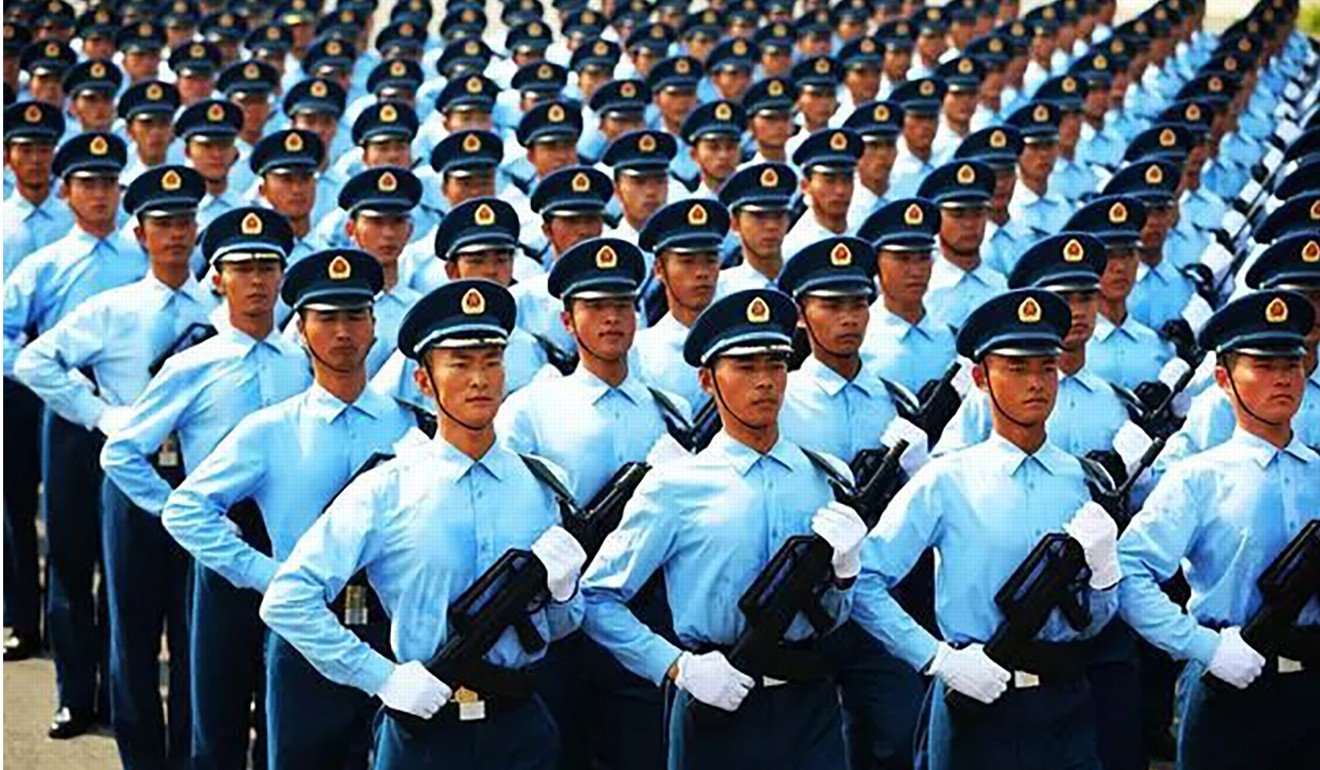
Tens of thousands of troops will take part in China’s National Day parade on October 1. Photo: Thepaper.cn
When the preparations were being made for next week’s anniversary celebrations in Beijing, Cheng said he and his squad were chosen to take part.
He said that during the rehearsals for the grand parade, he was repeatedly reprimanded by his trainer for not keeping his knees close enough together, for lifting his feet too high and for letting his gun slip off shoulder.
But he was determined to get it right, and after weeks of hard work and 11 years on from the tragedy that devastated his world, he said he was now ready to put his best foot forward.
“The nightmare of earthquake has long gone,” he said. “I am here to continue the glory of the airborne troops. I am ready for inspection.”
Source: SCMP
Posted in 70th anniversary parade, airborne, airborne troops, bare hands, captured, celebrations, Cheng Qiang, China alert, college, completing, covered in blood, debris, destroyed, dizzy, earthquake, farewell, first jumped, forgot, grand parade, gratitude, helmets, heroes, heroism, image, invitation, joined, local river, Luoshui, magnitude 8, National Day, October 1, on camera, People’s Liberation Army (PLA), place, plain sailing, plane, press photographer, ranks, ready to join, recruiting, rehearsals, reprimanded, roadside, rubble, saviours, school, securing, sichuan province, soldiers, squad leader, successfully, survivor, swimming, symbol, teenager, Tiananmen Square, trainer, training course, truant, Uncategorized, vertigo, Village |
Leave a Comment »
23/09/2019
Participants sing in a chorus performance in Kunming, capital of southwest China’s Yunnan Province, Sept. 22, 2019. A total of 3,500 participants took part in a chorus performance here on Sunday to celebrate the upcoming National Day. (Xinhua/Hu Chao)
Source: Xinhua
Posted in celebrate, chorus performance, Kunming, National Day, participants, People, sing, take part, Uncategorized, upcoming, Yunnan Province |
Leave a Comment »
22/09/2019
- October 1 event is intended to be a showcase for military’s progress under Xi Jinping, with J-20 stealth fighters set to take pride of place
- Domestically developed weapons are main focus of event despite long-standing problems in building aircraft engines
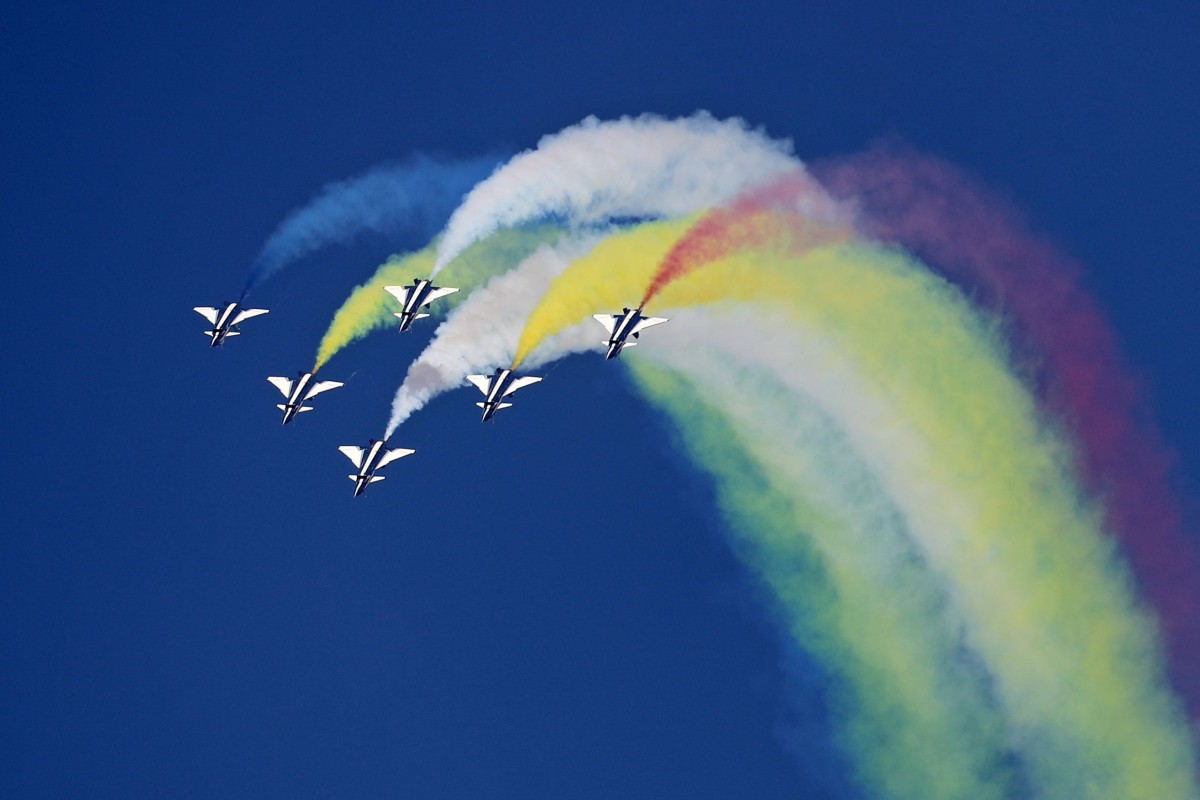
Chinese J-10 jets perform at the Dubai air show in 2017. Photo: AFP
China has stepped up intensive rehearsals for the upcoming National Day parade, which military insiders say is designed to showcase the achievements of Chinese President Xi Jinping’s modernisation drive.
The parade on October 1 will mark the 70th anniversary of the founding of the People’s Republic and will focus on weapons developed since Xi came to power in late 2012, despite long-standing problems in aircraft engine development.
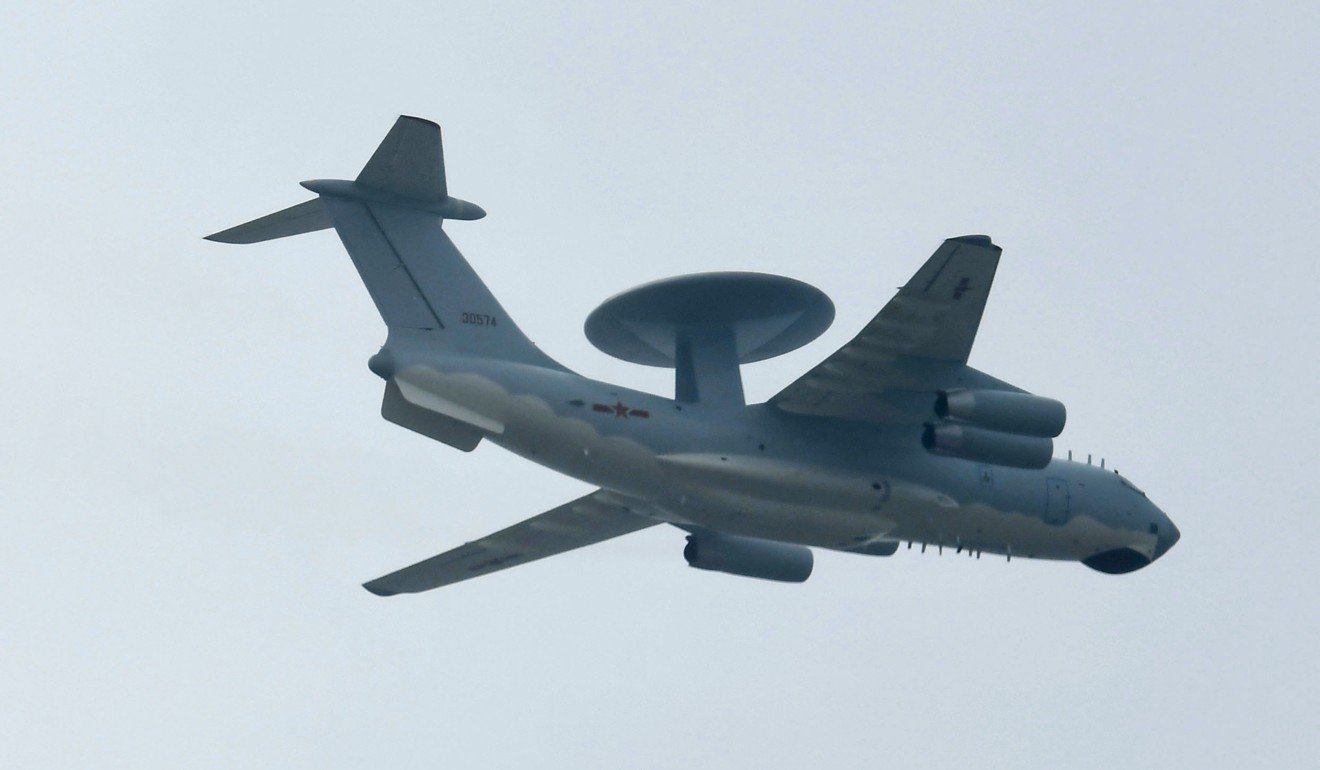
Video clips circulating on mainland social media in recent days have shown at least seven types of aircraft – including the KJ-2000 airborne early warning and control aircraft and J-10 and J-11B fighter jets – taking part in rehearsals over the countryside around Beijing.
A military insider said the country’s first stealth fighter jet, the J-20, had been rehearsing over the western suburbs of the capital since April.
“There will be up to seven J-20 displayed in the military parade, which is the largest formation since its formal deployment to the Chinese air force in 2017,” the military insider said.
“The J-20 has entered mass production. So far at least 70 J-20s have been made, even though all of them are still equipped with Russian AL-31 engines.”
Earlier this month, the People’s Liberation Army Air Force released a video of a flight of seven J-20s, the largest formation seen so far, suggesting that the fifth-generation warplane has gone into mass production as an arms race with the United States mounts in the region.
The second-largest J-20 formation was shown in an air force video for PLA Day on August 1, when five of the jets were shown.
China has been forced to deploy the J-20 ahead of its schedule since the US has increased the deployment of its fifth-generation stealth fighter jets like the F-22 and F-35s in the Asia-Pacific region.
The US and its allies, including Japan and South Korea, will have more than 200 F-35s by 2025, which means China also needs a similar number of stealth fighters.
To meet demand, China has been working on the development of a purpose-built thrust engine for its stealth fighter since the early 2000s, but has yet to achieve international quality control standards due to problems that include single-crystal turbine blade technology.
China’s air force spreads its wings in 70th anniversary video
Hong Kong-based military commentator Song Zhongping said aircraft engine development had been a long-standing shortcoming but it would not affect the practical fighting capacity of the J-20, which currently uses Russian engines.
“The J-20 hasn’t used the domestic engines so far because it wants a better one, and it still has time,” Song said.
“Other [Chinese-developed] warplanes like the J-10, J-11 and multipurpose attack helicopters are all modified and advanced types, indicating comprehensive achievements amid China’s military modernisation over the past years.”
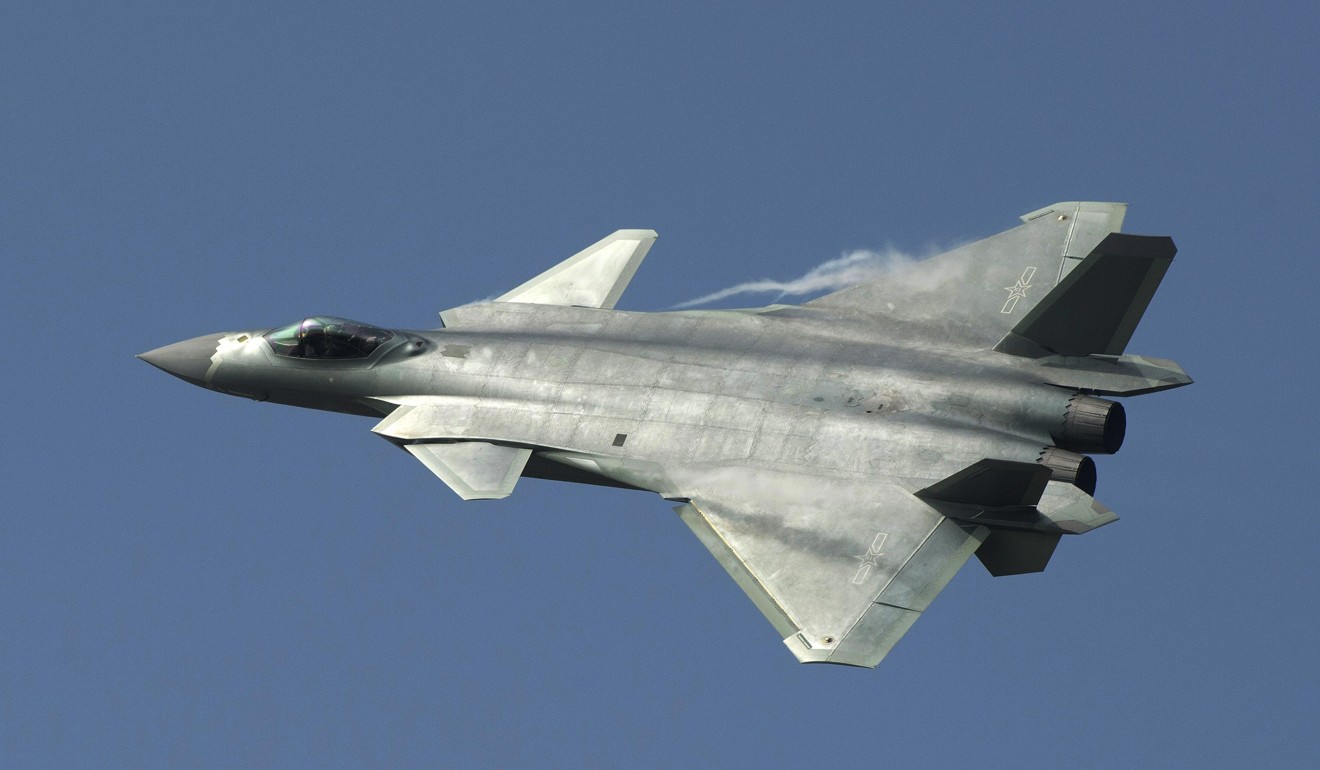
A Chinese J-20 stealth fighter has entered mass production. Photo: EPA-EFE
Besides the domestically developed aircraft, Beijing is going to display its strategic nuclear missiles, such as the DF-41 intercontinental ballistic missile and the JL-2 submarine-launched ballistic missile, as centrepieces of its National Day military parade, according to a Beijing-based military source.
Xi, who also chairs the powerful Central Military Commission, inspected the country’s biggest military parade at the Zhurihe Combined Tactics Training Base in Inner Mongolia in 2017 to celebrate the 90th anniversary of the PLA, but the source said the weapons displayed in Zhurihe had been developed under the leadership of Xi’s predecessor, Hu Jintao.
“Xi needs to highlight his personal achievements in his era, that’s why this year’s parade has political aims more than military significance,” the source said.
The source also highlighted the significance of the People’s Republic marking its 70th anniversary because the Soviet Union did not survive for that length of time.
“Xi is attempting to tell the outside world that Chinese communist regime has been consolidated under his leadership.”
Source: SCMP
Posted in 70th anniversary, 90th anniversary, Air show, aircraft engines, AL-31 engines, allies, Asia-Pacific region, Beijing, Central Military Commission, Central Military Commission (CMC), China’s air force, Chinese communist regime, Chinese fighter jet, countryside, domestically developed aircraft, Dubai, event, F-22, F-35, founding of the People’s Republic, Hong Kong, Hu Jintao, Inner Mongolia, J-11B fighter jets, J-20 stealth fighter, J-20 stealth fighters, Japan, KJ-2000 airborne early warning and control aircraft, Korea, military parade, multipurpose attack helicopters, National Day, National Day parade, October 1, People’s Liberation Army Air Force, PLA, preparations, pride of place, Russian, seen, single-crystal turbine blade technology, skies, Soviet Union, step up, strategic nuclear missiles, submarine-launched ballistic missile, Uncategorized, US, Xi JinPing, Zhurihe, Zhurihe Combined Tactics Training Base |
Leave a Comment »
22/09/2019
- Military experts say PLA modernisation brought about during Xi Jinping’s presidency will be the main focus of October 1 celebration in Beijing
- It’s necessary for China to ‘show some of its muscle’ amid the trade dispute with the US, observer says
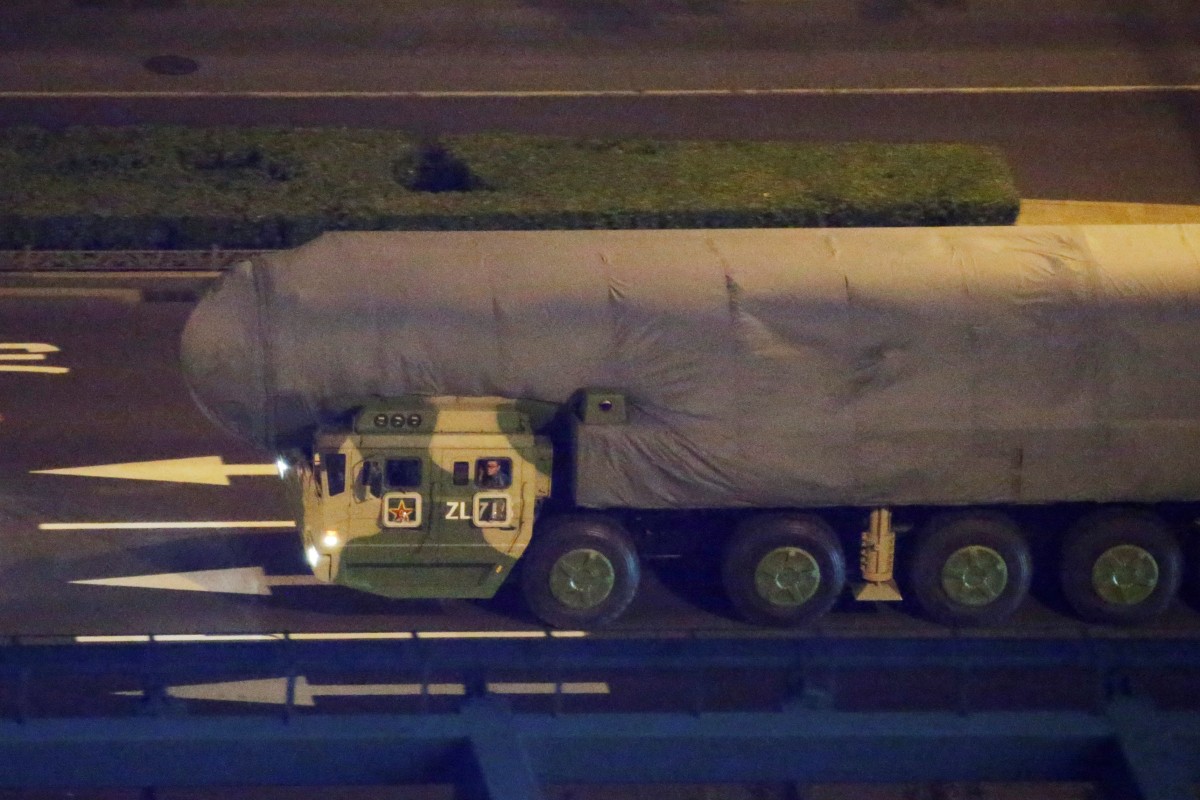
China’s land-based DF-41 intercontinental ballistic missile will be among the military hardware on show on October 1. Photo: Reuters
China plans to show off its most advanced active weapon systems at the upcoming National Day parade, which will be the biggest of the 14 such events it has held over the past seven decades.
The parade, to be held on October 1 to mark the 70th anniversary of the founding of the People’s Republic, will highlight the military modernisation – particularly in nuclear deterrence – that has taken place since President Xi Jinping came to power in late 2012, according to military experts.
The People’s Liberation Army (PLA) offered a glimpse of those weapons during rehearsals for the parade in downtown Beijing from September 14.
As part of the celebrations, Xi, who also chairs the Central Military Commission, will inspect 48 squads on the ground and more than a dozen airborne squadrons, according to a military insider involved in support services for the parade.
More than a dozen airborne squadrons will take part in the National Day parade. Photo: Kyodo
The squadrons will include the air force’s first stealth fighter, the J-20; the main active warplanes such as the J-10 and J-11B; and armed helicopters like the Z-20. However, the J-8 fighter jet would not appear this year, the source said, confirming that the first interceptor built in China has been formally retired.
“The ground march will be led by several hero forces from the five theatre commands, which is different from previous squads selected from the ground forces, air force and navy,” said the insider, who requested anonymity because of the sensitivity of the matter.
“The main goal of this year’s parade is to promote the military modernisation of the PLA under President Xi’s leadership over the past seven years, with the military overhaul being one of the key achievements.”
Thirty-three of the 48 squads would be “weapon squads”, while the 13 others would be made up of infantry troops from the five theatre commands, the source said.
National Day fireworks in Hong Kong cancelled over safety fears
As part of the PLA’s sweeping military reforms, the army’s previous seven military commands were reshaped into five theatre commands, while the four former general headquarters were dissolved and replaced by 15 small functional departments.
In September 2015, Xi announced the PLA would shed 300,000 troops, cutting its size to 2 million, a move aimed at turning the PLA into a more nimble and combat-ready fighting force on a par with international standards.
Xi also split the former Second Artillery Corps into the Rocket Force and the Strategic Support Force, with the latter backing up the military’s electronic warfare units in cyberspace and outer space.
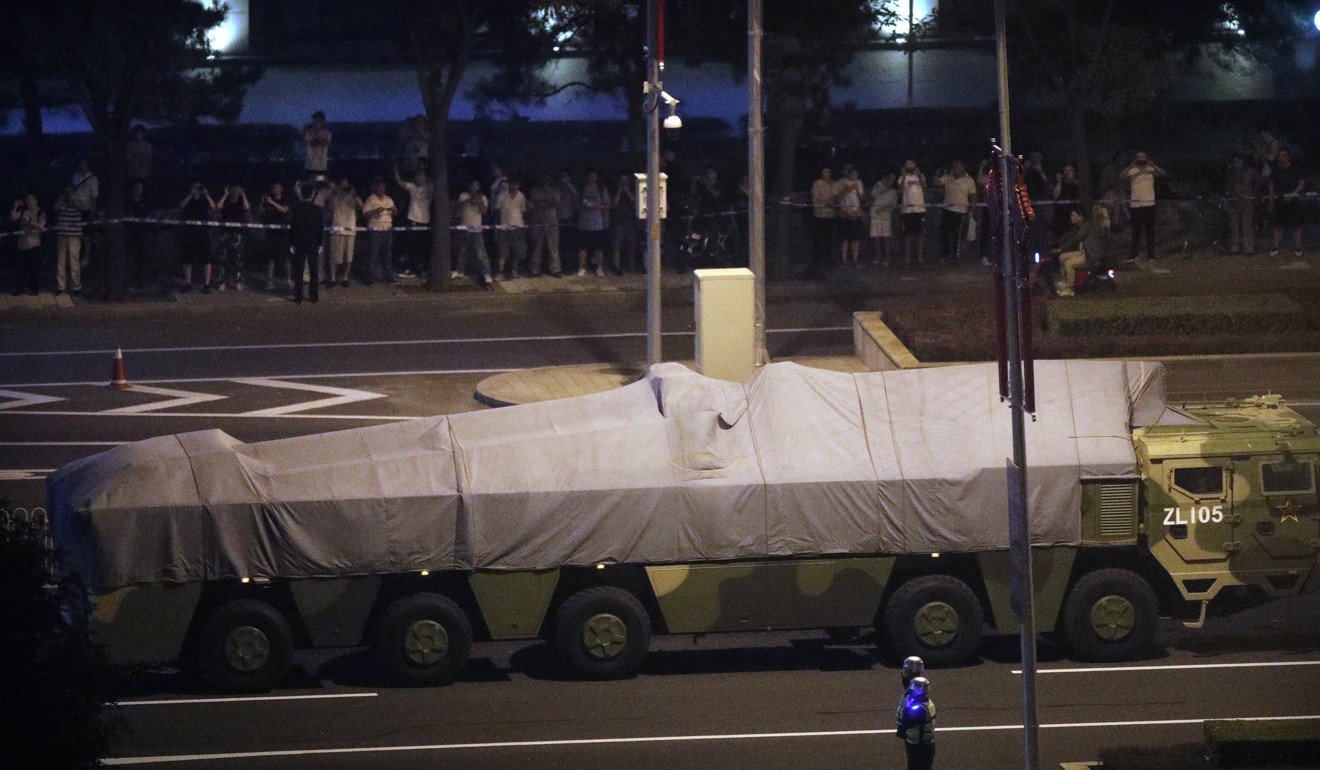
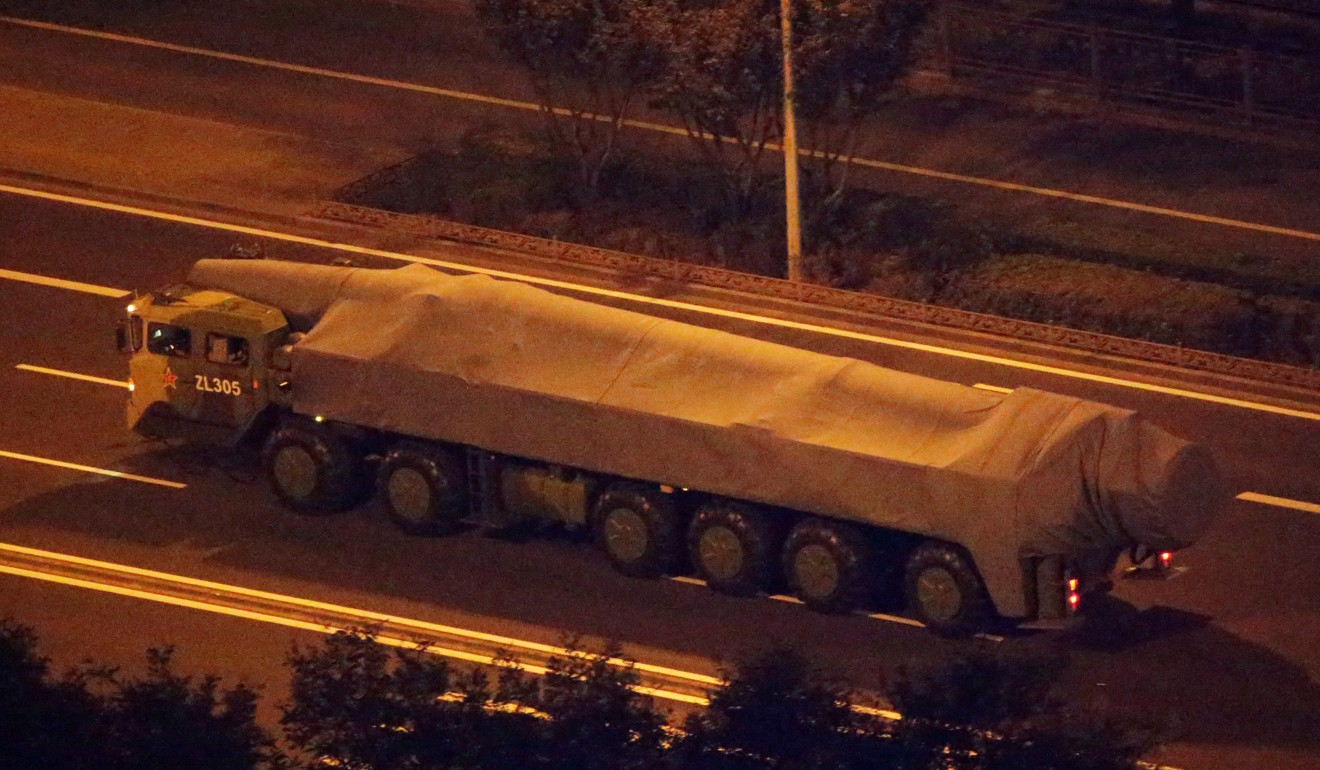
Among the 33 weapon squads, the highlights are expected to be the PLA’s strategic nuclear missiles such as the Rocket Force’s land-based DF-41 intercontinental ballistic missile (ICBM), the DF-21D anti-ship ballistic missile, the DF-17 hypersonic missile and the sea-launched JL-2, or Big Wave-2.
Adam Ni, a researcher at Macquarie University in Australia, said that showing off different types of missiles on land and sea indicated that the PLA was improving its nuclear deterrence capabilities by perfecting a three-pronged military force structure, or the so-called nuclear triad.
The DF-17 hypersonic ballistic missile will be one of the highlights of the parade. Photo: AP
The DF-41 is capable of carrying multiple warheads and many decoys, making it harder to detect than silo-based systems and better able to survive a first strike.
Ni said the DF-41 was China’s next-generation cutting-edge weapon.
“It’s actually an advanced ICBM and has a range to hit practically anywhere in the world, including the continental United States,” Ni said.
“The DF-41 is the ultimate symbol of the destructive potential of Chinese armed forces, just as nuclear weapons are similar symbols of the US and Russia.”
The JL-2 – which has a shorter range of 7,000km (4,350 miles) and can be launched by the PLA Navy’s Type 094 submarines – is unable to hit anywhere on the American continent when launched from submarines in the South China Sea and coastal areas of China.
China tests new warships in live-fire drills near Vietnam
However, China is developing the JL-3, which has a range of about 9,000km; the upgraded version of the JL-2, with a flight test conducted in June, though it is still less than the 12,000km range of the American Trident II.
“China is stepping up its military modernisation, which includes a number of aspects; the land-based aspect is introducing more mobile and survivable missile systems,” Ni said.
“The game change will happen when China is able to hit the whole US continent with its missile submarines in Chinese coastal waters.”
In military terms, survivable refers to the ability to remain mission capable after a single engagement.
The DF-17 is a land-to-land short-range strategic missile capable of delivering both nuclear and conventional payloads. The US intelligence community has estimated that it will reach initial operational capability by 2020. But if the missile is displayed in the parade, that means it is active already.
China conducted two tests of the DF-17 in November 2017, with the first launched from the Jiuquan Space Launch Centre in Inner Mongolia.
An insider said the main goal of this year’s parade is to promote the military modernisation of the PLA. Photo: Reuters
Hong Kong-based military commentator Song Zhongping said the nuclear weapons that would go on show in the parade would all be strategic missiles designed to improve China’s deterrent capabilities.
The show comes after the PLA delivered a national defence white paper in July stressing its goal to “maintain national strategic security by deterring other countries from using or threatening to use nuclear weapons against China”.
Unlike in the past, this year’s report stated that the US and China were now competing superpowers, and that the PLA’s growing forces were developing to the point that they could challenge the US.
Zhou Chenming, a Beijing-based military observer, said it was also necessary for the PLA to “show some of its muscle” amid the ongoing trade dispute between Beijing and Washington.
“To prevent misunderstanding, most of the weapons are just strategic equipment, not tactical arms, because Beijing still doesn’t want to irritate Washington,” he said.
About 280,000 people were involved in the rehearsals for the parade and related support services, according to Xinhua.
Source: SCMP
Posted in 70th anniversary, advances, airborne squadrons, Australia, Beijing, Big Wave-2, celebration, Central Military Commission, Central Military Commission (CMC), China’s National Day, continental United States, cyberspace, decoys, DF-17 hypersonic missile, DF-21D anti-ship ballistic missile, DF-41 intercontinental ballistic missile, DF-41 intercontinental ballistic missile (ICBM), electronic warfare units, first strike, founding of the People’s Republic, ICBM, Inner Mongolia, J-20 stealth fighter, Jiuquan Space Launch Centre, live-fire drills, Macquarie University, Military experts, military hardware, military modernisation, missile submarines, multiple warheads, National Day, nuclear deterrence, nuclear triad, nuclear weapons, October 1, outer space, parade, People’s Liberation Army (PLA), PLA modernisation, pla navy, President Xi Jinping, Rocket Force, Russia, sea-launched JL-2, showcase, silo-based systems, South China Sea, stealth fighter, Strategic Support Force, submarines, superpowers, survive, Trident II, Uncategorized, US, Vietnam, warships, Washington, Xinhua |
Leave a Comment »
30/08/2019
BEIJING, Aug. 29 (Xinhua) — Chinese President Xi Jinping will attend a grand gathering to celebrate the 70th anniversary of the founding of the People’s Republic of China (PRC) on Oct. 1.
Xi, also general secretary of the Communist Party of China (CPC) Central Committee and chairman of the Central Military Commission, will deliver an important speech at the event, said Wang Xiaohui, executive deputy head of the Publicity Department of the CPC Central Committee, at a press conference held Thursday.
A military parade and mass pageantry will be held following the gathering, Wang said.
At a grand evening gala in Tian’anmen Square on National Day, Party and state leaders will join the public to watch performances and a fireworks show.
Xi will also present the Medals of the Republic, Medals of Friendship and national titles of honor to outstanding individuals at an award ceremony to be held at the Great Hall of the People in Beijing.
On Sept. 30, the country’s Martyrs’ Day, people from various sectors, including Party and state leaders, will present flowers to deceased national heroes at the Monument to the People’s Heroes at Tian’anmen Square.
A National Day reception will be held at the Great Hall of the People and President Xi will give an important speech.
BROAD PARTICIPATION
“The 70th anniversary of the PRC is a festival shared by Chinese people of all ethnic groups, which is why the celebrations will highlight the participation of the people,” Wang said.
According to him, more than 100,000 ordinary citizens will take part in the mass pageantry on Oct. 1 and about 60,000 will attend the evening gala on the same day, while about 30,000 members of the public will be invited to observe the gathering and military parade.
Among the guests of the gathering and military parade, there will be people who made outstanding contributions to the republic’s founding and development together with their families as well as about 1,500 role models including outstanding Party members, model civil servants and workers.
MILITARY PARADE
The military parade is an important part of the National Day celebrations and is not aimed at any other countries or specific situations, Cai Zhijun, deputy head of the office of the leading group for the military parade, said at the press conference.
The scale of the parade will be greater than the ones commemorating the 50th and 60th founding anniversary of the PRC, as well as the V-Day military parade in 2015, he said.
The military parade is expected to showcase China’s achievements in building its national defense and armed forces in the past 70 years and reflect the outcomes of the reform of the people’s armed forces, according to Cai.
RICH CELEBRATION
“There will be rich and colorful celebrations spanning various sectors and regions,” Wang said.
An evening gala featuring music and dance will be held in the Great Hall of the People. From September, the Beijing Exhibition Center will host a large-scale exhibition on the achievements of the PRC in the past seven decades.
The CPC Central Committee, the State Council and the Central Military Commission will jointly issue medals in commemoration of the 70th anniversary of the PRC as part of the celebrations.
Commemorative coins and stamps will be issued and a documentary will be made.
The celebrations will also be carefully budgeted and avoid extravagance, Wang said.
Source: Xinhua
Posted in 70th National Day, award ceremony, Beijing, Beijing Exhibition Center, celebrate, Central Military Commission, Central Military Commission (CMC), Chairman of the Central Military Commission, China alert, Chinese President Xi Jinping, Commemorative coins, Commemorative stamps, cpc central committee, fireworks show, founding of the People's Republic of China (PRC), general secretary of the Communist Party of China (CPC) Central Committee, Great Hall of the People, Martyrs' Day, mass pageantry, Medals of Friendship, Medals of the Republic, military parade, Monument to the People's Heroes, National Day, national titles of honor, Oct. 1, Publicity Department of the CPC Central Committee, State Council, Tiananmen Square, Uncategorized, V-Day military parade |
Leave a Comment »
17/08/2019
- Chinese government advisers say Beijing has not reached direct intervention point but that could change if the violence continues
- Military action would trigger international backlash, observers say, as US expresses concern over reported paramilitary movements and ‘erosion of Hong Kong’s autonomy’
Footage of trucks from the paramilitary People’s Armed Police in Shenzhen has circulated online. Photo: Handout
The unrest in Hong Kong does not yet warrant direct intervention by Beijing despite hardening public sentiment and calls for tougher action in mainland China, according to Chinese government advisers.
Shi Yinhong, an international relations expert at Renmin University and an adviser to the State Council – China’s cabinet – said China would risk damaging its ties with the United States and other major foreign powers, upsetting its own development and losing Hong Kong’s special status if it took the matter directly into its hands.
“I don’t think we need to use troops. Hong Kong police will gradually escalate their action and they haven’t exhausted their means,” Shi said, expressing a view shared by other mainland government advisers and academics.
But he warned that if the violence and chaos continued, it “won’t be too far away from reaching that point”.
A US State Department spokeswoman said the United States was “deeply concerned” about reports of paramilitary movements along the Hong Kong border and reiterated a US call for all sides to refrain from violence.
She said it was important for the Hong Kong government to respect “freedoms of speech and peaceful assembly” and for Beijing to adhere to its commitments to allow a high degree of autonomy for Hong Kong.
She said the protests reflected “broad and legitimate concerns about the erosion of Hong Kong’s autonomy”.
brought the city’s air traffic to a halt and triggered
a huge backlash on the mainland
, where the public feel they have been wrongly targeted by the increasingly violent protesters. Many demanded the central government take action to end the chaos.
The tension deepened after US President Donald Trump, citing intelligence sources,
to the border with Hong Kong. Trump described the situation in the city as “tricky” and called on all sides to remain “calm and safe”.
Footage of trucks from the paramilitary People’s Armed Police rolling into Shenzhen began circulating online on Saturday.
Beijing ‘unlikely to intervene’ in Hong Kong as pressure mounts on police
But Shi and others said direct intervention would be too costly to China and would only be used when all other methods had been exhausted.
“As the trade war with the US goes on, Hong Kong’s importance to our financial system is getting bigger,” Shi said. “If Beijing intervenes with too much assertiveness, the US might revoke the preferential status of Hong Kong.”
He was referring to the US’ 1992 Hong Kong Policy Act which gives the city a special status. In June, American lawmakers introduced a bipartisan bill requiring the US government to examine Hong Kong’s autonomy annually to decide whether to extend the arrangement.
Losing that status could cripple the operations of many businesses based in Hong Kong, said Shen Dingli, a Shanghai-based international affairs expert.
A satellite image appears to show a close-up of Chinese military vehicles at Shenzhen Bay Sports Centre in Shenzhen. Photo: Maxar Technologies
Wang Yong, another specialist on international political economy with Peking University, agreed.
“There would be a lot of opposition from interest groups in the US. Hong Kong is the bridgehead for many multinational corporations and investors from Wall Street to get into the Chinese market,” said Wang, who also teaches at an academy affiliated with China’s Ministry of Foreign Affairs.
“Hong Kong and the Chinese government will need to handle this with extra care, so as not to give any ammunition to hawks in the United States.
“If Hong Kong is not handled properly, it could add tensions to the bilateral ties and ruin any prospect of a trade deal.”
China rejects requests for US warships to visit Hong Kong amid protests Pang Zhongying, an international relations specialist at Ocean University of China in Qingdao, said direct intervention could also damage China’s ties with other countries.
“The whole world is watching. Beijing has exercised restraint for two months and still hasn’t taken any clear action because this is not an easy choice,” said Pang, who is also a member of the Beijing-based Pangoal Institution, a think tank that advises several ministerial offices.
While some observers said Beijing was under political pressure to end the protests in Hong Kong before October 1 – the 70th anniversary of the founding of the People’s Republic, Shi said the central government would not lose patience so easily.
“National Day [on October 1] is an important time, but the Chinese government is not naive to believe there has to be peace under all heaven then,” he said.
“It’s only a bit more than a month from now, we can almost say for sure the trade war will still be on by then and a major turning point in Hong Kong is not likely to happen. But the celebration must go on.”
Source: SCMP
Posted in 70th anniversary, American, autonomy, backlash, Beijing, bipartisan bill, celebration, China alert, China's cabinet, China-US trade war, China’s State Council, concern, direct intervention, financial system, foreign powers, Hong Kong, international, lawmakers, Mainland China, military action, Ministry of Foreign Affairs, Ministry of Foreign Affairs (MFA), National Day, Ocean University of China, Pangoal Institution, paramilitary, peace under all heaven, People's Armed Police, People’s Republic, preferential status, Qingdao, quell, Renmin University, Risks, Risks still too big, send in troops, Shenzhen, Shenzhen Bay Sports Centre, trade war, trigger, Uncategorized, United States, unrest, US, US President Donald Trump, US warships, US’ 1992 Hong Kong Policy Act |
Leave a Comment »





 CHINDIA ALERT: You'll be living in their world, very soon